My Dad was born in Wilków, in the county of Secymin, outside Warsaw.
I’ve told what I know of his story in Episode 71 through 75, but despite having visited the German town where he lived as a displaced person after WWII, I really never expected to stand anywhere near his birthplace, knowing that there was nothing left of his family home other than a few disintegrating headstones in a nearby overgrown cemetery.
When I started talking about the potential of a family trip to Warsaw, my second cousin in Canada forwarded me a website for an open-air museum located very near our mutual families’ homes that promised to have not only some surviving buildings, but also some insight into how and why our “German” families ended up settling – way back at the end of the 18th century – in what is now Poland.
That reminded me that during the pandemic, when I was writing about my Dad, a Polish historian and blogger sent me this link to her exploration of the exact area in which he’d lived: Wolves On The Vistula. (It’s in Polish.To read it, use your browser’s translate feature.)
I put German in quotation marks earlier for a reason. We’ve always considered ourselves German because of both language and geography (perhaps more correctly geo-politics).
As for language, the Plattdeutsch (literally “flat German”) dialect that my dad’s family spoke is closer to Dutch, Frisian, and English than to High German.
And geographically/politically? The area of what is now (again) Poland that Dad came from was, at the time of his ancestors’ settlement there, the Kingdom of Prussia, a German state that existed from 1701 to 1918. It was around the 1770s that Prussia annexed the area around Warsaw, which had prior to that been the Polish-Lithuanian Commonwealth. That means that my great-great-grandfather was born in East Prussia (Ostpreussen) in 1812, but whether his father was born in that same area in 1763 or immigrated as a young man we have yet to verify.
The years from 1700-1899 when my family established themselves in the area were tumultuous ones. (There’s a fascinating timeline here: Vistula Settlement Timeline)
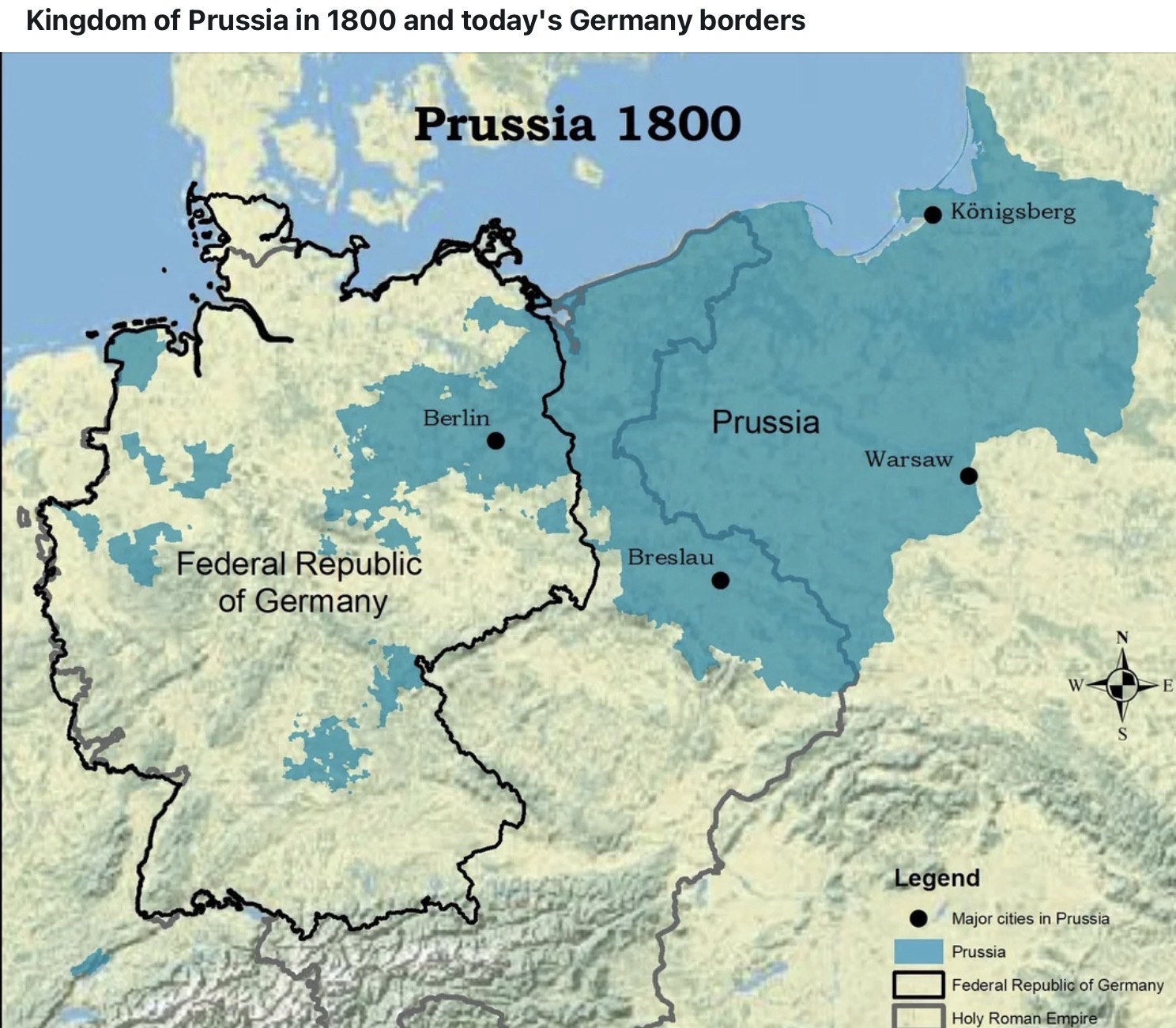
Germany, as a country, didn’t exist until the unification of independent states under Kaiser Wilhelm II in 1871. That’s a similar story to Italy, Spain, and many other European countries that we now recognize. Prussia as a state wasn’t officially dissolved until 1918.
But Prussia also had strong ties to Holland, with the sister of Kaiser Friedrich Wilhelm II being the wife of William V of Orange, the King of Holland.
Anyway…. it’s increasingly looking like my Prussian/German ancestors may actually have been “Olenders”, Dutch and Frisian settlers who migrated to the area along the Vistula in the 17th and 18th centuries because of their skill in draining and cultivating marshy land. That argument is given support by the fact that many Olenders were Mennonites or Anabaptists seeking religious freedom, and several of my dad’s half-sisters married Mennonite men. While my father was raised Lutheran, the two religious communities were closely intertwined in the area.
So, are we “German”? And what does claiming a nationality even mean? Is it “ethnicity”, language, changing borders? I’m lucky enough to be Canadian by birth; my “roots” may be more convoluted than I thought.
Today’s excursion may or may not untangle them a bit.
With Ted’s and CoPilot’s help, we found several Warsaw-based tour guides who spoke German and English, and eventually settled on a one who seemed to really understand what I wanted to do. Here was their proposal:
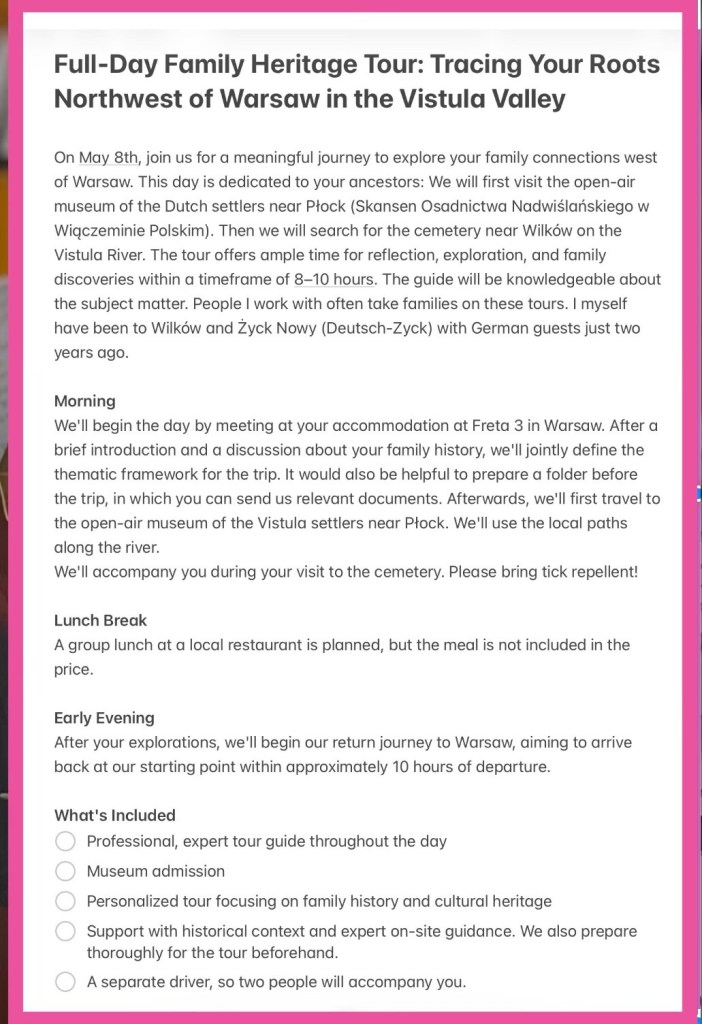
It’s not an inexpensive proposition at 1000 Euros ($1600CAD) for the day, but we’ll be splitting it between six people. My first cousins Helga and Doris, the daughters of my Dad’s sister Lidia, were keen to join us in Warsaw even before we confirmed this excursion. They invited two (half) first cousins once removed, Bärbel and Regina, granddaughters of my dad’s 26-year-older half-sister Hulda, to come along. They’re staying in a hotel near our rented apartment for a couple of days. I’ve never met them, but this seemed like an appropriate opportunity.
My distant cousin Susan back in BC (we think we’re 5th cousins based on DNA match but have yet to definitively confirm our common ancestor) is an avid genealogist, and will be interested to see whether anything our group experiences connects to her family tree or helps to connect ours.
So off we go…

