For both sides of my family, Bremerhaven is the bookend to Pier 21 in Halifax; one the port of embarkation, and the other the Canadian gateway to a new life. (The link to Pier 21 has many stories in its “Culture Trunk” that mimic my parents’ experiences.)
Both my parents, at separate times (they met in Canada), and my maternal grandmother, made their voyage across the Atlantic on the MV Beaverbrae.
The Beaverbrae was a Canadian Pacific Steamships vessel that carried 33,259 displaced persons and refugees from post-WWII Europe to Canada between 1948 and 1954.
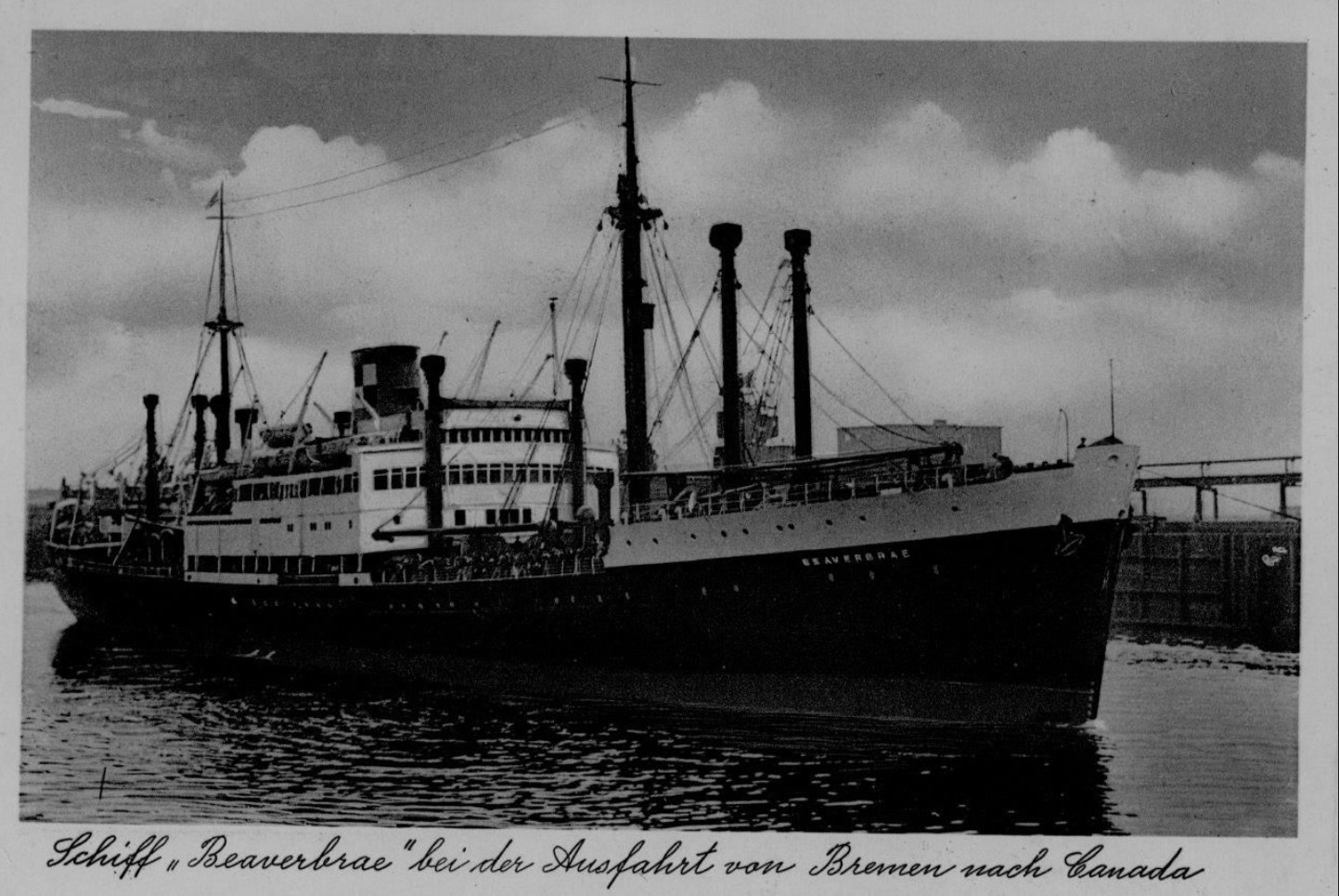
Built in 1939 as Huascaran for the Hamburg-America Line, her maiden voyage was from Hamburg to the west coast of South America (presumably through the Panama Canal). On her return, she was taken over by the German Navy for conversion to a submarine depot ship, and spent most of WWII in Norway where she was captured undamaged by the Allies in 1945. The ship was allocated to Canada as war reparation, and refit at Liverpool in 1947. Purchased by Canadian Pacific and renamed Beaverbrae, in collaboration with the Canadian Government and the Canadian Christian Council for the Resettlement of Refugees (CCCRR) she made her first sailing for them 8 Feb 1948 from Saint John New Brunswick with cargo to London. She then sailed to Bremerhaven to pick up passengers for Canada. Eventually she made 51 sailings from Bremerhaven, carrying 38,000 displaced persons westbound to Canada as refugees, and making the return trip carrying cargo eastbound. The Beaverbrae was the only ship to carry cargo eastbound and passengers westbound, and was also the only one under Canadian registration and with a Canadian crew.
The Atlantic crossing could be done in as little as seven days if the ocean cooperated; in stormy seas it could take 14-17 days.
When the St. Lawrence River was free of ice (the St. Lawrence Seaway not existing until 1959), the ship would dock in Quebec City or Montreal, otherwise it would be Halifax NS or Saint John NB. When advice was received in Montreal that the ship had left Bremerhaven, arrangements were made for two special trains with colonist and baggage cars to be assembled at the destination port entry. The first train would usually be routed to Montreal and Toronto, and the second to Winnipeg and points west.
The Beaverbrae’s last emigrant voyage to Canada departed Bremerhaven 28 Jul 1954, which may partially explain why my great grandmother who arrived in Canada that year was on a different ship.
After that last voyage the Beaverbrae was sold to Compagnia Genovese d’Armamento, Genoa (1 Nov 1954) and was rebuilt at Monfalcone to 10,022 GRT with accommodation for 1,124 tourist class passengers. Renamed Aurelia, she sailed from Trieste 13 May 1955, via Suez to Australia and made later voyages from Genoa. Re-engined in 1958-59 and rebuilt to 10,480 tons, she started Bremen-Suez-Australia service 12 Jun 1959. In 1962 she began a round of 34 voyages between English Channel ports and New York. In 1970 she was sold to Chandris Lines; renamed Romanza and refitted for cruising. Resold to Ambassador Leisure in 1991; renamed Romantica and cruised in the eastern Mediterranean. In 1997 she caught fire returning to Cyprus from Egypt and was abandoned without casualties. (Information details credit to https://bob.plord.net/Ships/MS-4/GreatBritain/Beaverbrae.html)
The ship’s burnt out hulk was towed to Limassol and scrapped the following year, along with decades of stories and memories.
But today was about the emigrants, not their specific transportation.
Since I’d been here at the emigration museum before and shared my impressions (Episode 694), what follows was written today by son #1.
I’ll note when my voice reappears.
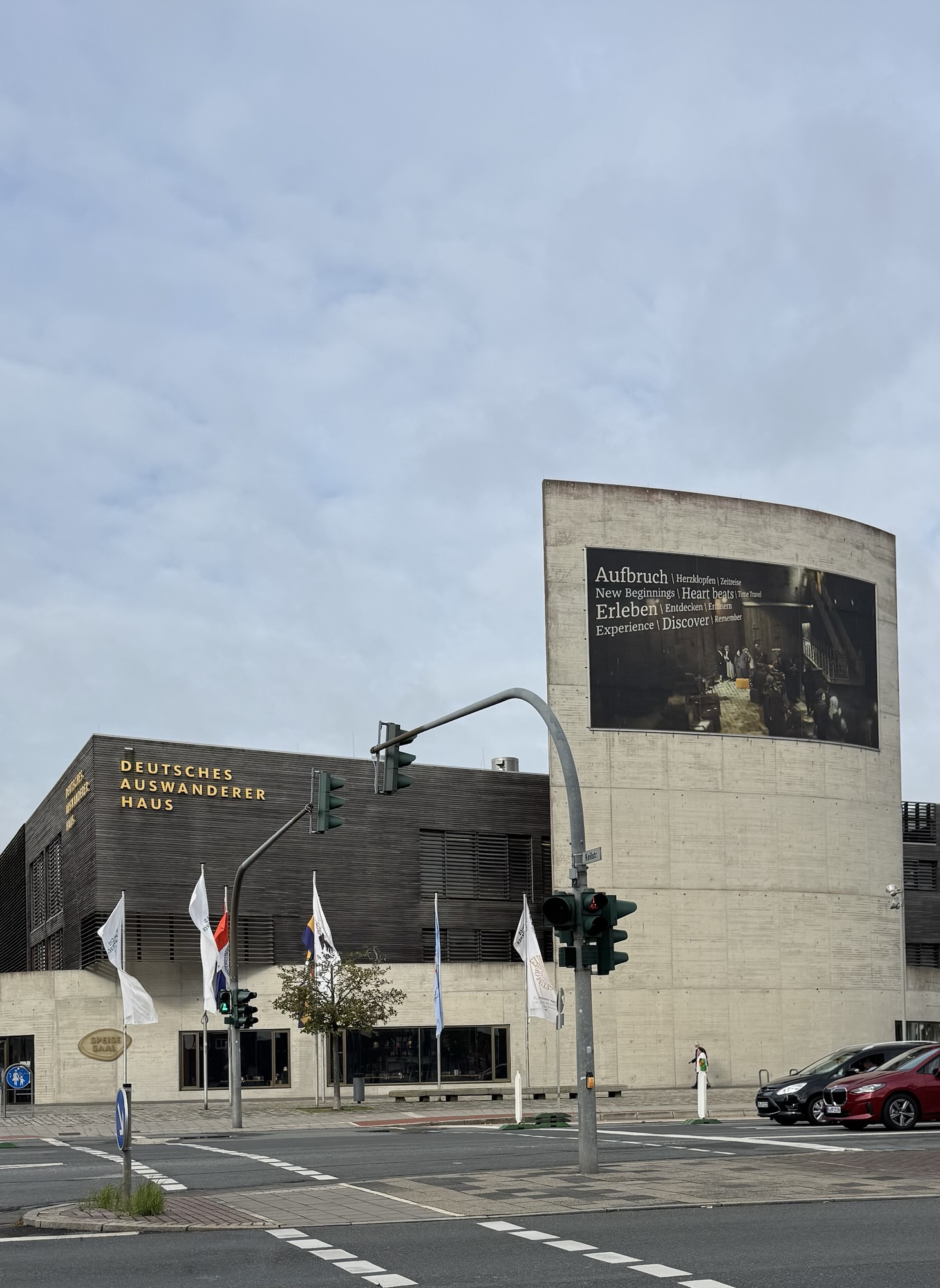
Today: Bremerhaven, for the [German Emigration Center](https://dah-bremerhaven.de/en/). Up early for breakfast both to catch a train and to avoid being penned in by the marathon being run through Bremen today, then out to Bremerhaven on the regional train service.
A quick word on German transit: I’ve really liked the service here for the most part. The ICE and RS/RE trains have been quiet, clean, and had plenty of room for passengers even with multiple bikes taking up space in the cars. That said, about half the trains we’ve taken have been delayed, sometimes by close to half an hour, and one was cancelled outright. Mom has said that the Deutsche Bahn app has made it really easy to manage finding alternates but for trains that are more like the GO train (usually reliable southern Ontario system) than the subway it’s been interesting to note. I think I still prefer the cleaner and smoother service over here but certainly both systems could learn things from the other.
For the visit to the museum itself I’ll let mom drop in a couple of pictures where they seem appropriate; permission to take photos was an extra fee on top of admission and I’m not currently in the habit of taking tons of pictures anyway so I left that to her. I did check in a day or so ago and ask if she was ok being the one who isn’t in the photos this trip, promise!
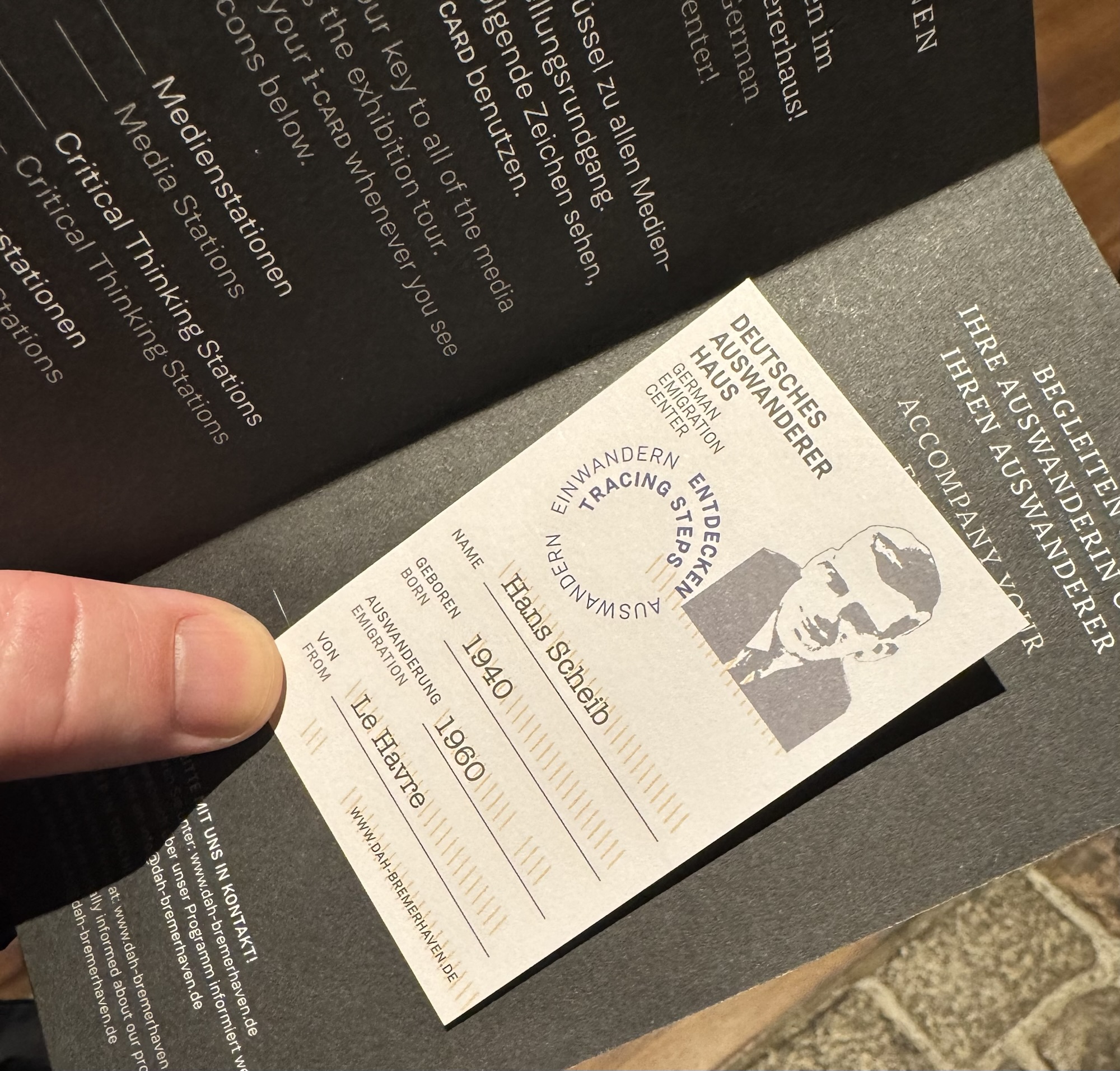
The Center is structured more or less as a journey from German shores to American, with examples of what that might have been like in various time periods. When you buy a ticket you’re also issued a card that you can tap against various points in the exhibits to trigger audio and video stations; these cards are available in German and English so even with my very limited German I was able to access most of the information available. The cards are also supposed to represent a migrant whose journey you’re tracking from Germany to the sea, but that part of the experience was pretty minimal from what I could tell. At any rate I picked up an English-language card for a gent who was born about 1940 and emigrated to Canada in 1960 as he seemed to be the closest parallel they had to grandma.
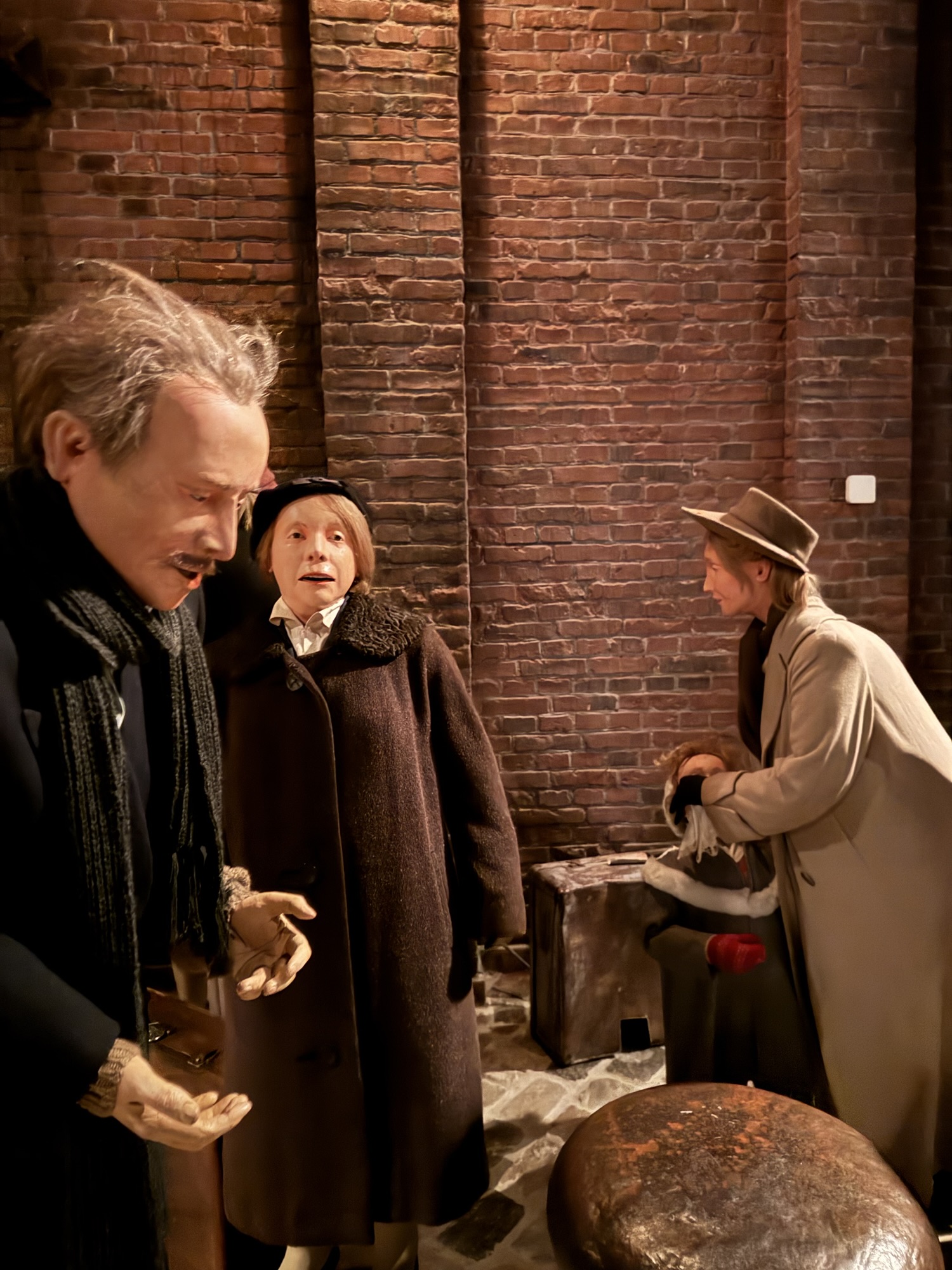
The first exhibit is a reconstruction of a third-class waiting room – dingy and badly lit, with warnings painted on the wall from the Polizei to mind your belongings and not be hustled by anyone who might be preying on those trying to make their way onto a ship. In that last way not so different from travel waiting areas today, but certainly not as nice as any terminal I’ve had to wait in. Mom pointed out that the warning was extra important for travellers who would likely be leaving with literally all of their worldly belongings!
From there up a narrow staircase to a crowded pier, lit to approximate early morning.
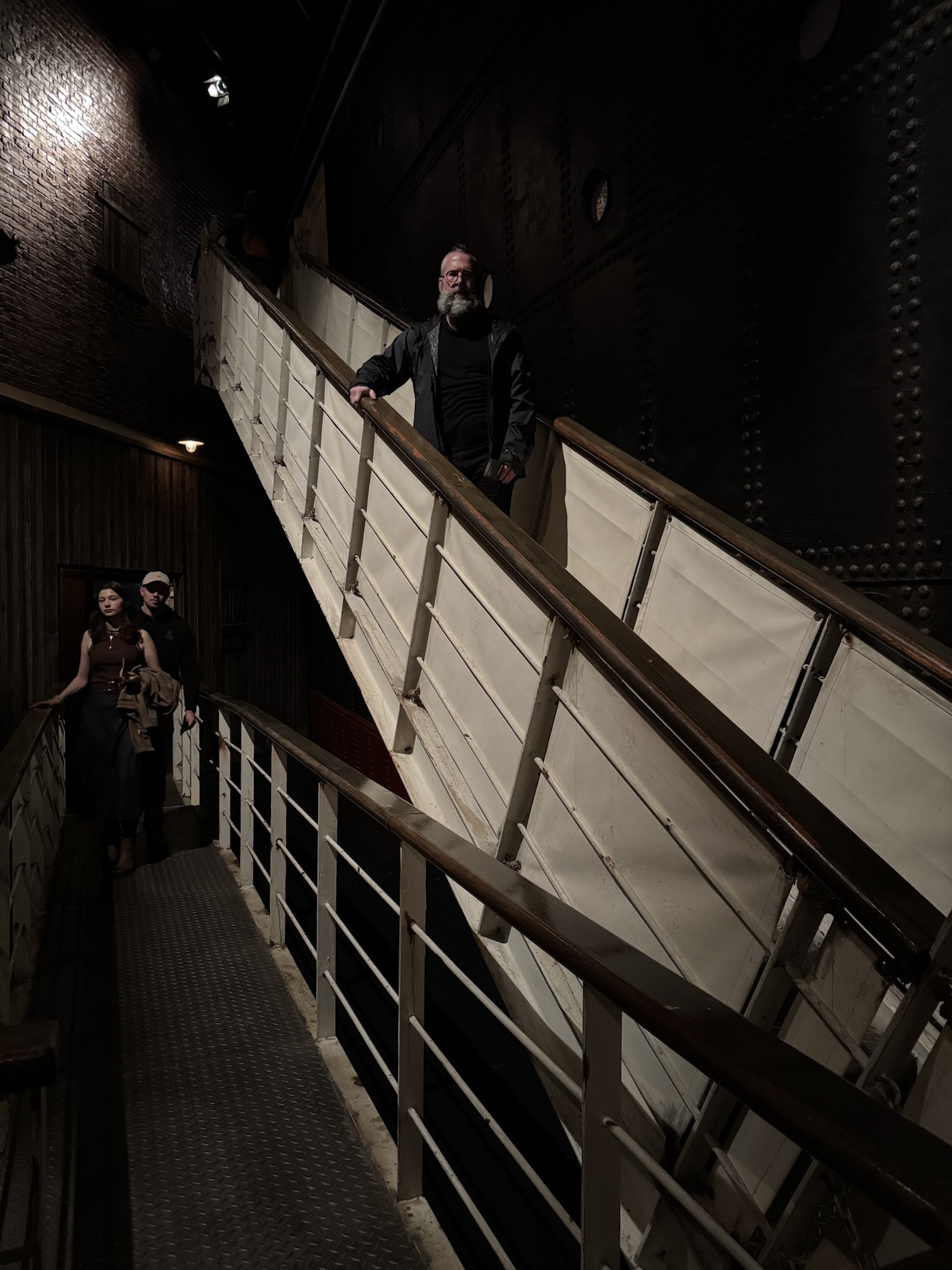
The massive ship beside us vanishing into the darkness and the crowd of mannequins waiting to board, coupled with audio in several different languages that might have been heard were really affecting. I only have a tiny bit of German (and no Yiddish or Russian at all) but hearing songs that might have been sung to ease the parting of family members and words tinged with worry and hope certainly made that moment feel real.
The next stop was the Hall of the Seven Million, where several individual migrants had some details of their stories shared and a number of statistics and facts about migration through the last couple of centuries were displayed. In this section was the first part of the story of the migrant I was following. At twenty years old he left Germany seeking peaceful work in construction rather than conscription into the military. Exiting via France he sailed to Quebec on a former troop transport. He had been inspired by his father to avoid there horrors of war – to avoid ever having to hold a gun against another person. The information in this room was presented with interpretive signs and audio that were presented alongside actual travel documents, letters, and items from the people represented on our cards (among others). We spent a little time looking for people who might have crossed in the 1940s/50s on the Beaverbrae or landing in Montreal, but didn’t have any luck.
Beyond that I was struck by how much the story of migration hasn’t changed over the last hundred and fifty years. The stories presented broadly fell into ones of opportunity and ones of persecution, with people leaving behind dwindling resources or deeply unfavourable social conditions in search of better. I was saddened to note that as population mobility increased it generally seemed that governments’ first responses were to institute border controls that reinforced dehumanizing ideas about the populations of foreign lands – it was not uncommon for people to travel a long way out of their way to avoid harsh border crossings between unfriendly neighbours. This kind of discrimination is clearly still in place today – rather than building systems that prevent discrimination based on country of origin, governments have gotten really good at tracking it more accurately.
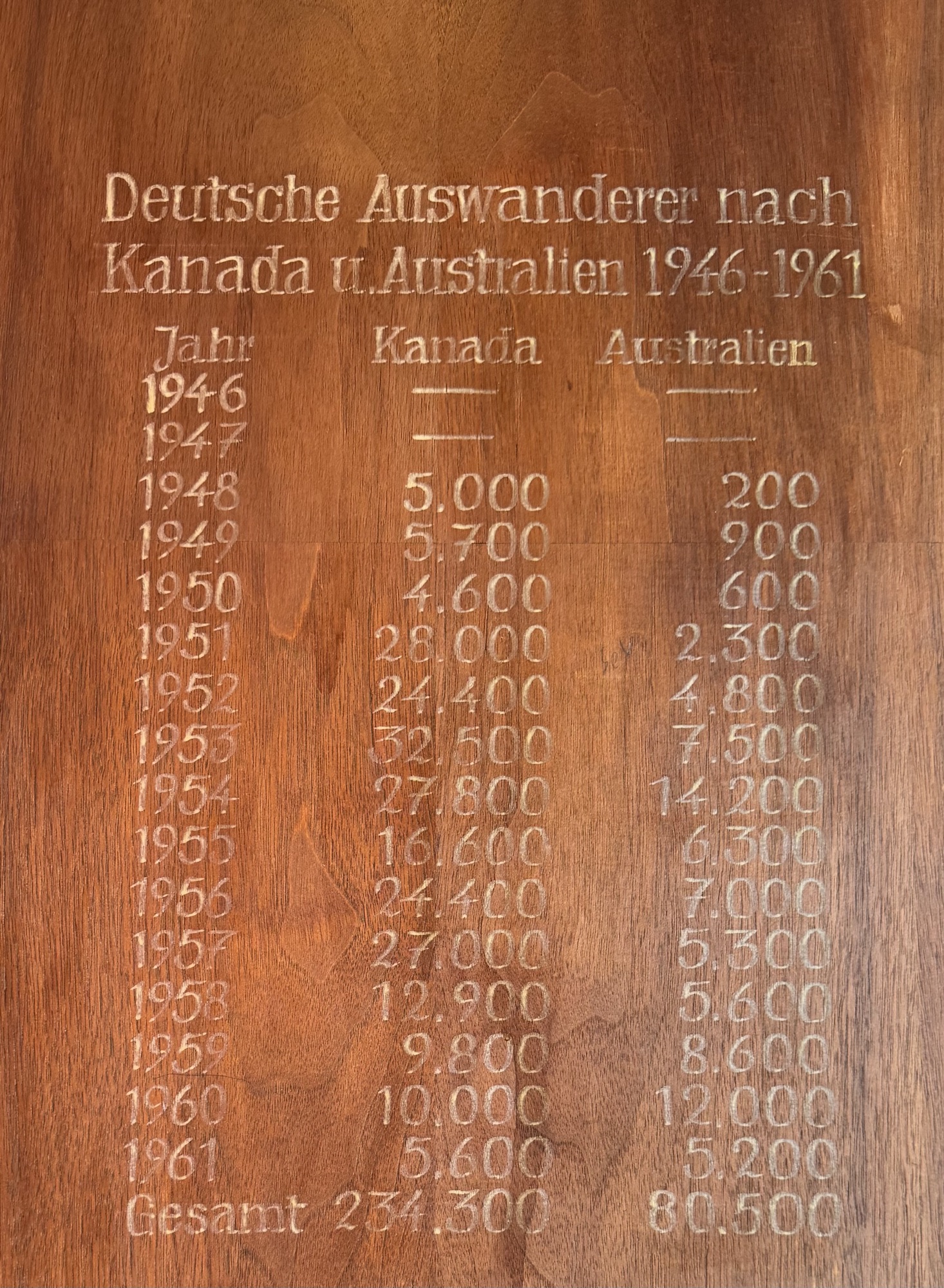
The efforts of the Nazi government to limit the migration of Jews and to “remigrate” Aryan emigrants back to the fatherland were starkly illustrated as well. The German population became less outwardly mobile in a very short period of time after the brown-shirts took over, and beyond finding new homes for displaced persons that didn’t really change until 1950. Punitive taxes for leaving and a system of persecution and propaganda were extremely effective.
This room was very information dense but left me feeling like not much changes over the years beyond the speed at which we accomplish our worst goals.
Up next was an exhibit that displayed third-class travel conditions as they would have been on sailing ships (with passengers in steerage) and then on steamships with passengers in first limited but then gradually improving conditions. The thing that stuck with me most about the sailing ships was the failure rate of the voyages. Prior to the advent of steamships, said one of the plaques, one in six voyages were expected by insurance companies to simply end in shipwreck. I imagine that made those voyages a significant risk and I can see a company’s rationale in not prioritizing the comfort of accommodations. Probably because of the miserable cramped stinking shared spaces, there were not many documentary attestations from that time.
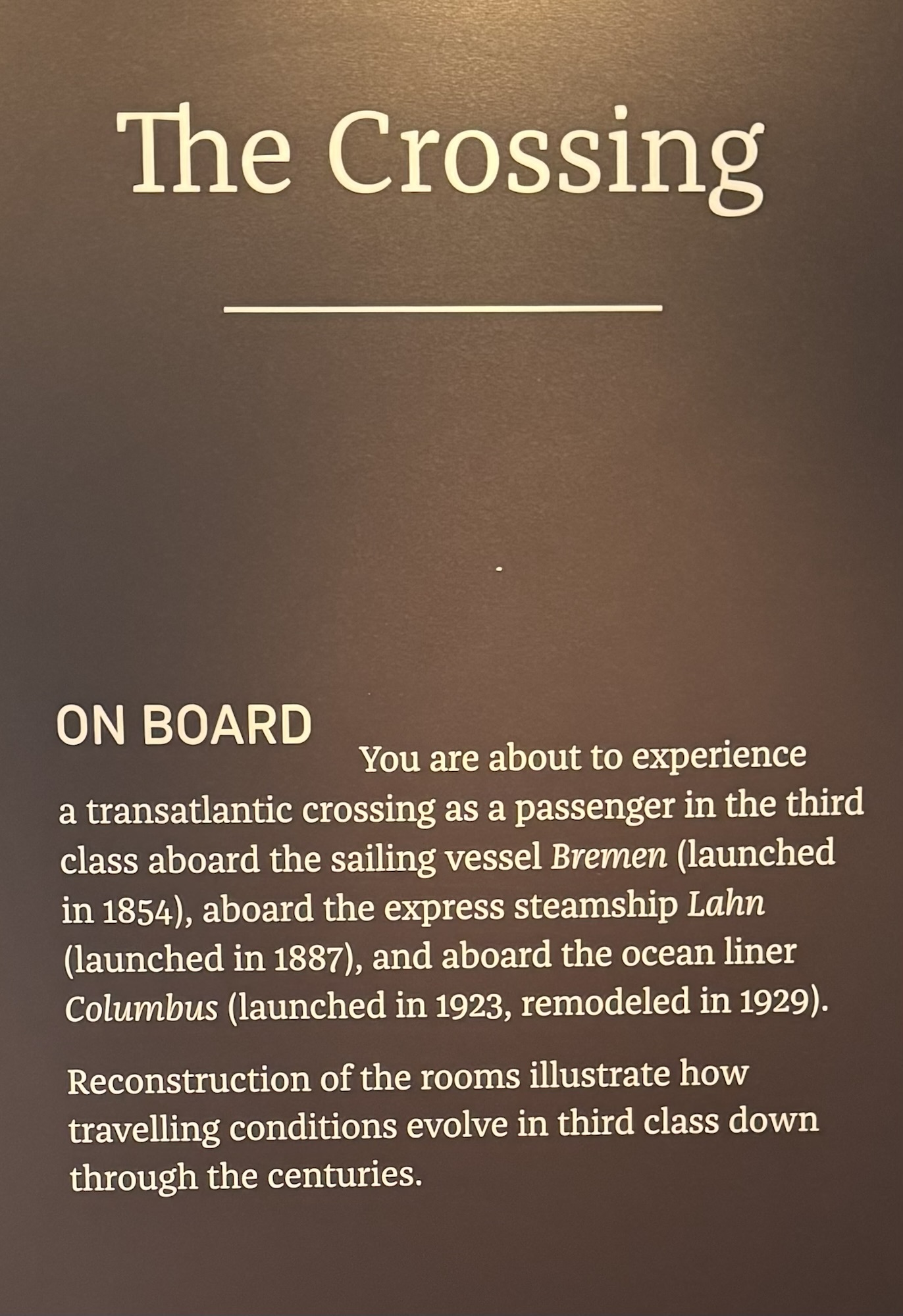
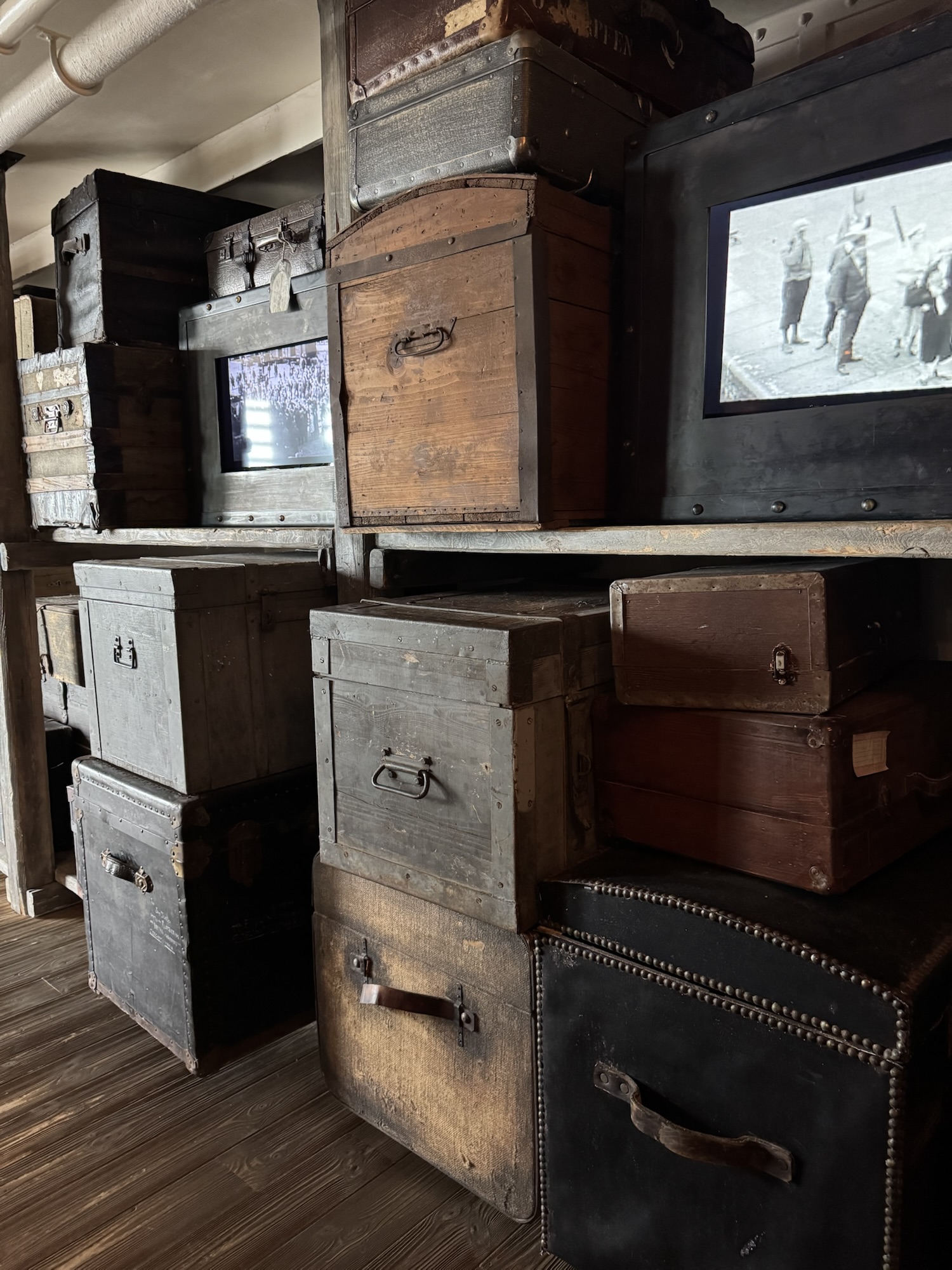
When steamships became the passenger transport method, accommodations quite rapidly increased in size and quality. I admit I’m a little fuzzy on exactly the level of accommodations that my grandmother would have had, coming over as a single woman in third class, but I can imagine her having minimal privacy and shared facilities for most of the journey. It’s likely that she had a berth in a cabin with at least three other people and (had she not been seasick for the entire journey, a trait my mother shared with her for at least her first few times on a ship) limited choices in variety of food, but still enough to eat. The Beaverbrae wasn’t designed as a passenger ship so honestly her sleeping arrangement may have been more communal and crowded. (Update because mom was looking into it while I was writing: 773 passengers with 74 in cabins and 699 in dormitory-style accommodations; she was probably in a pretty crowded communal space.) But by that point the voyage was measured in days rather than weeks and the conditions were approaching sanitary. Still not a way I would want to travel if I could avoid it – honestly there are a limited number of people I would spend a week with on a ship by choice and doing it out of necessity sounds truly awful. I wish she hadn’t had to endure it.
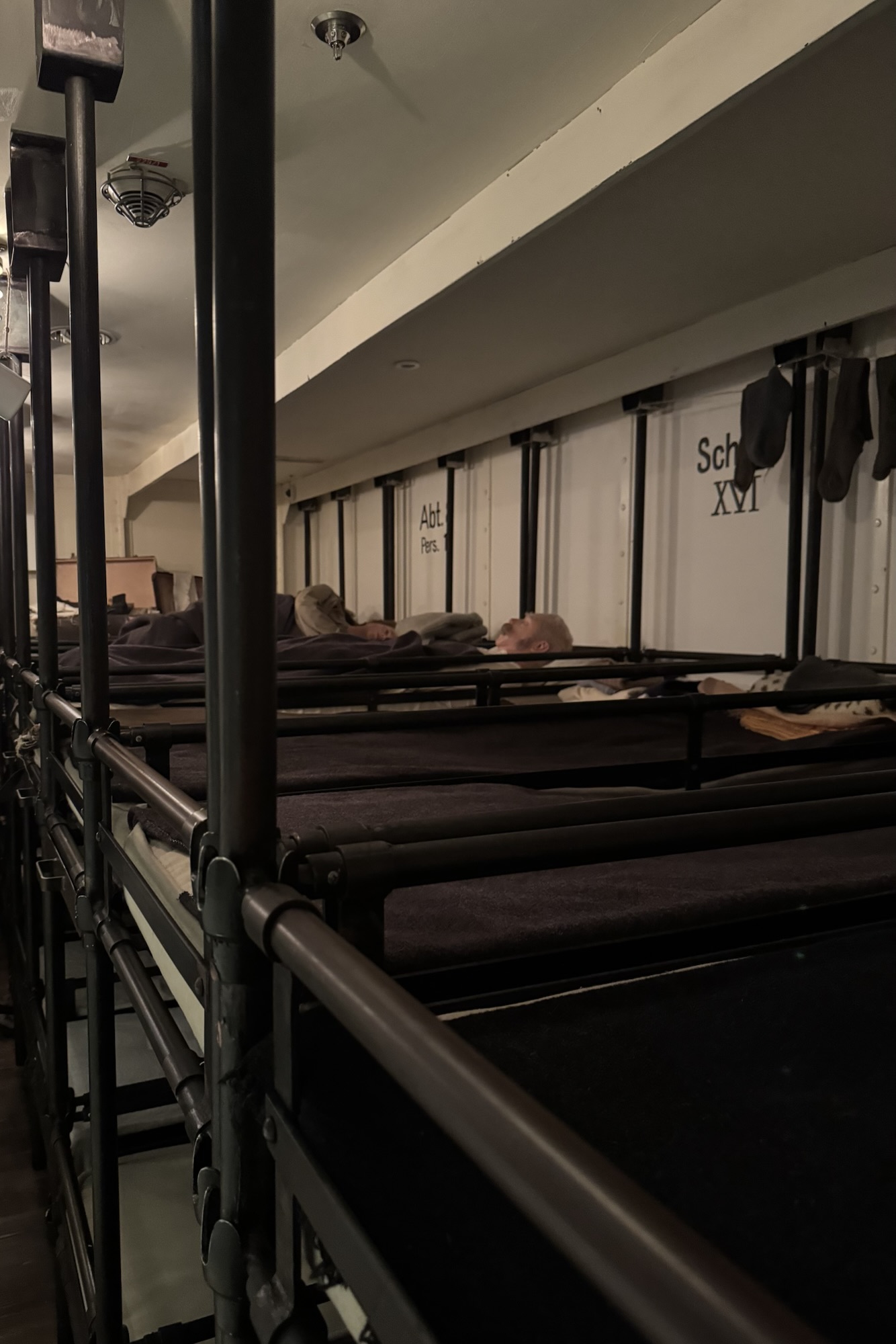
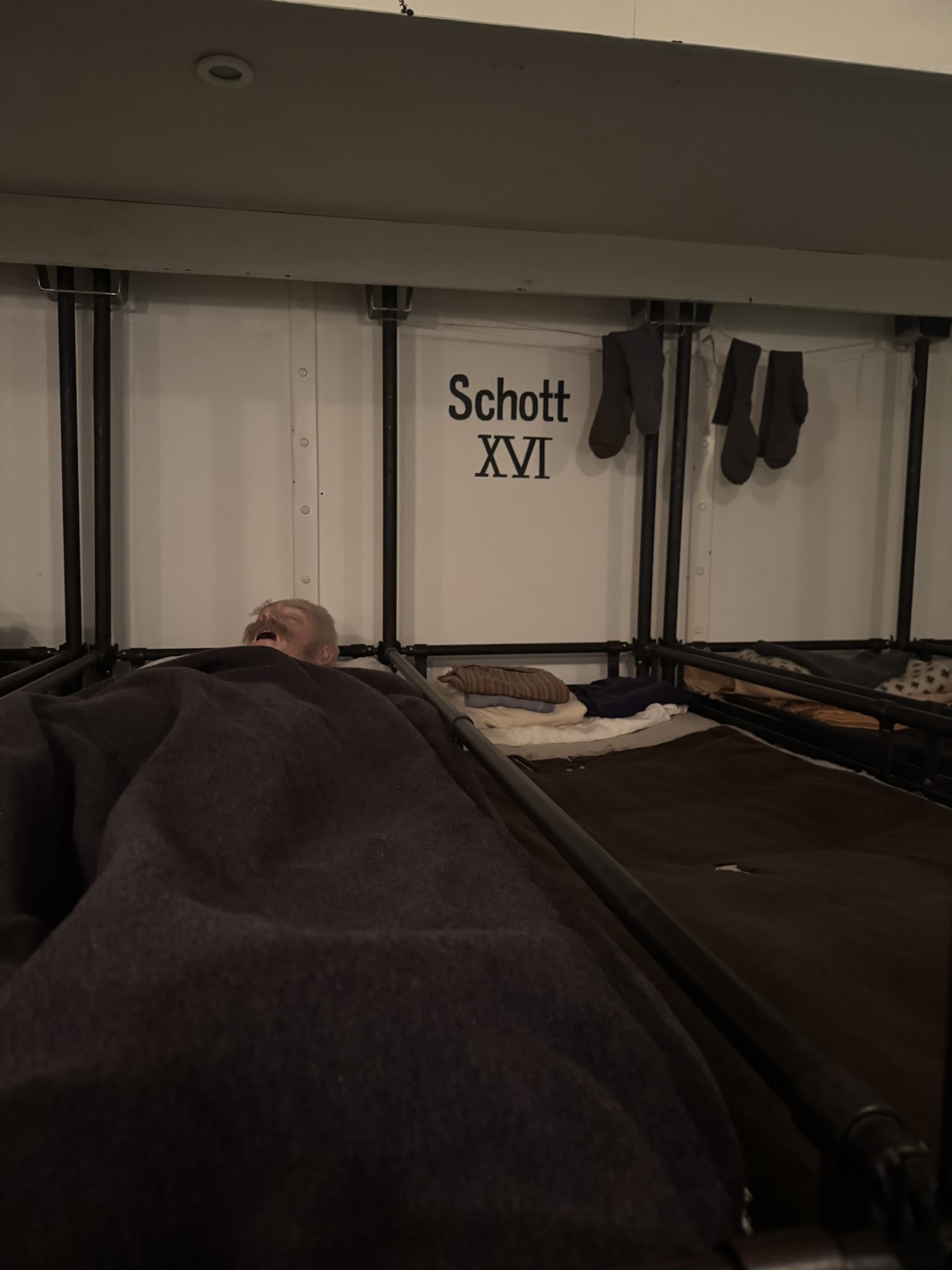
The directly relevant part of the museum kind of ended there for us. The arrival portions of the program were heavily focused on Ellis Island and city life in a rapidly growing America. My brief notes are:
– Canadian entry control, while not discussed, was probably just as focused on ensuring that sick or otherwise “undesirable” people didn’t enter the country. I wonder how that worked when resettling displaced persons? I know that there was an advantage to having relatives or sponsoring already over here, but I have no idea what the entry conditions otherwise were like.
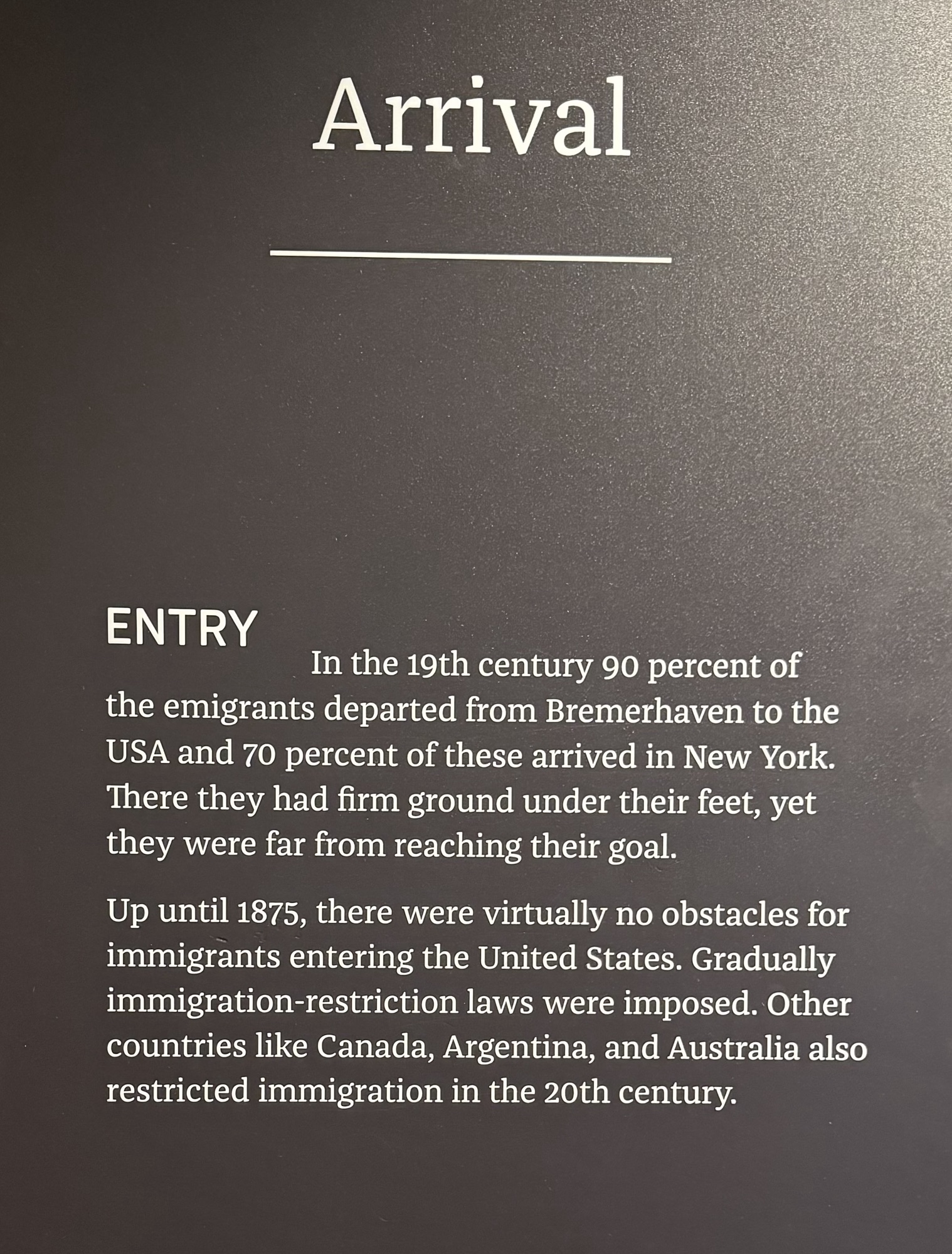
– the discrimination against “undesirables” would have started before they boarded ship in Germany, as shipping companies were expected to bear the cost of transporting people who were denied entry to the States back to their countries of origin. I wonder what the reception at home would have been like for those people?
– some of the people who left Germany in the 19th century were evangelical Christians of one sort or another and took it upon themselves to try to convert the indigenous peoples. I wonder if those migrants would have thought they were chasing opportunity or fleeing persecution, and if the latter I wonder whether they recognized the irony of their actions.
– the influence of Eastern European Jews and of German migrants on American society was extreme and undeniable. Both groups brought their societies, values, and mores over with them and they show up in many of the ways that make our social fabric strong, but also in many of the ways that we see tensions between labourers and capitalists.
– the diminishing of the national pride of immigrants after their old country is at the root of an international conflict isn’t a new thing, but it does seem new that we expect that distancing to be an ongoing and effusive performance now rather than just a toning down. White European-Americans are still expected to have some sense of pride in their nation of origin, but non-whites are largely expected to identify as American-only and to explicitly and repeatedly distance themselves from the culture of the country they descend from.
There was a closing section to the migration/arrival story that I found slightly touching. The man whose card I was following, much like my grandfather, met a woman who was also from Germany while studying English at night school. They married and had a family, put down roots, and have spent decades literally building a life here – he was a bricklayer and contractor up until a significant injury in 2020 that made him start considering retirement at the age of 81. I think he was about ten years younger than my grandfather. I wonder if they would have liked each other if they had met, their stories being similar.
At the end of the museum is a small research area, where visitors can access a couple of databases to try to find specific people who left Germany during the last two centuries. Mom was hoping to find some more information on grandma but was sadly disappointed. One of the databases only covers 1935 and earlier, and the other is a customized front-end to Ancestry, which she’s already pretty well acquainted with. I found that disappointing as well honestly – I’ve been hoping to learn a few more specifics about grandma’s journey while we’re over here and this was interesting on background but not so useful as to fill in any real blanks.
I’ve been suggesting to mom that she might try different archives but so far nothing is panning out. Montreal and Quebec ship arrival of this kind are sent to the national archives and she’s already checked there. Immigration and Naturalization Canada might have some additional information but accessing that would require a freedom of information/access to information request and some documents she doesn’t have copies of. While there were Jews transported on the Beaverbrae, the Jewish archives appear to have kept their records tightly focused on their own people.
Overall I think this was an interesting museum as a look at the way the human condition has developed as we’ve become more able to move around the world, but I didn’t find it specifically enlightening. I wasn’t expecting as emotionally pummelling a day as our visit to the NS-DOK last week, but I was hoping for something more personal to connect to.
Tomorrow is a travel day. We’re leaving Bremen in the morning for Nuremberg – mom says she knows grandma was there but we’re not sure what specifically she saw, so we’re going to spend time looking around and thinking about what she might have seen before we make our way to Vienna, which grandma apparently has a fair amount to say about. I confess I’m looking forward to more of the personal connections soon.
And with that, I’m back to share food pictures. We’d completely skipped lunch while we worked our way through the museum for almost 5 hours (apparently a typical visit is 3-4), so before leaving we stopped at the museum’s cafe for today’s Kaffee und Kuchen break.
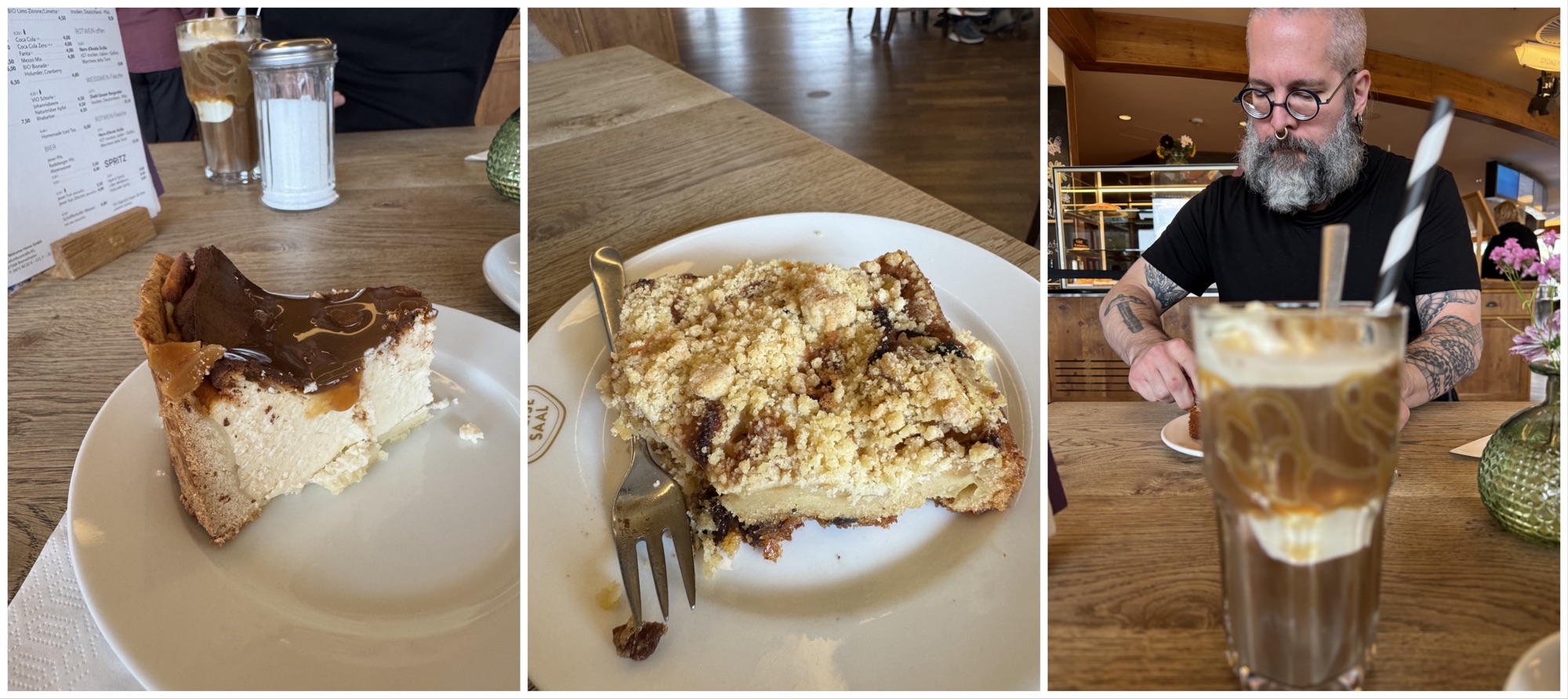
The train back to Bremen departed about 40 minutes later than scheduled. Our conductor announced that it was due to either elves or beavers (are there even beavers in Germany?) having built barriers on parts of the track. We were delayed a further 20 minutes while en route by track switches. The conductor’s announcements sounded absolutely world-weary at that point.
After time in the hotel for #1 to write about our day, we decided dinner would be at Becks sm Markt, just around the corner in the main square. It was time for #1 to add Currywurst to his culinary checklist, and both of us to enjoy Bremen’s iconic Haake Beck beer.
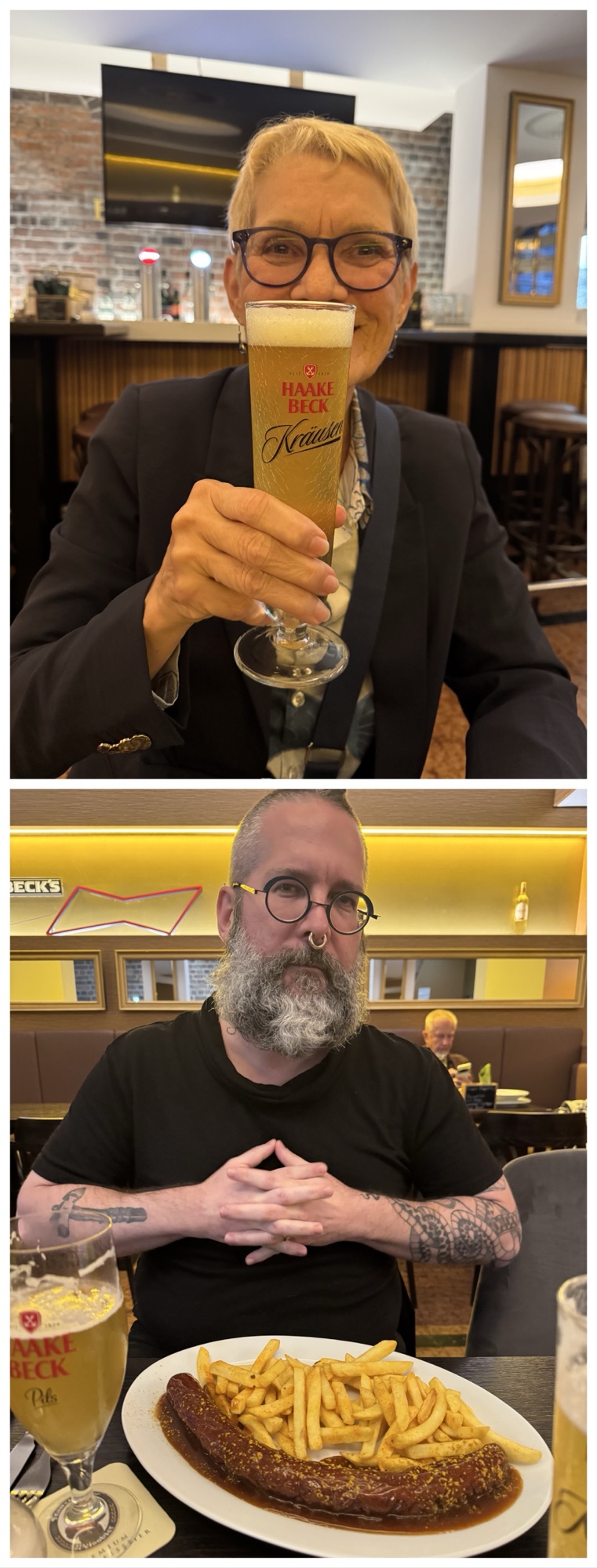
And that’s a wrap on Bremen!


How great to have a very competent guest writer! Nice to meet you #1. (I feel like I’m on Star Trek every time I read or write that!) These immigration/emigration stories of the past, but also of the present put our travel hardships in perspective, don’t they? I still hope to visit the museum of emigration in Dublin some day. My family name is Irish though I think that arrival in North America was back in the 19th c. Ellis Island was very moving — have you ever visited there? Is there a museum of Canadian immigration?
LikeLiked by 1 person
there is indeed a Canadian Museum of Immigration, at Pier 21 in Halifax – https://pier21.ca/ – but I’ve never been. Trying to plan an east coast trip next year though…
– #1
LikeLike
Dublin’s is amazing too!
LikeLike