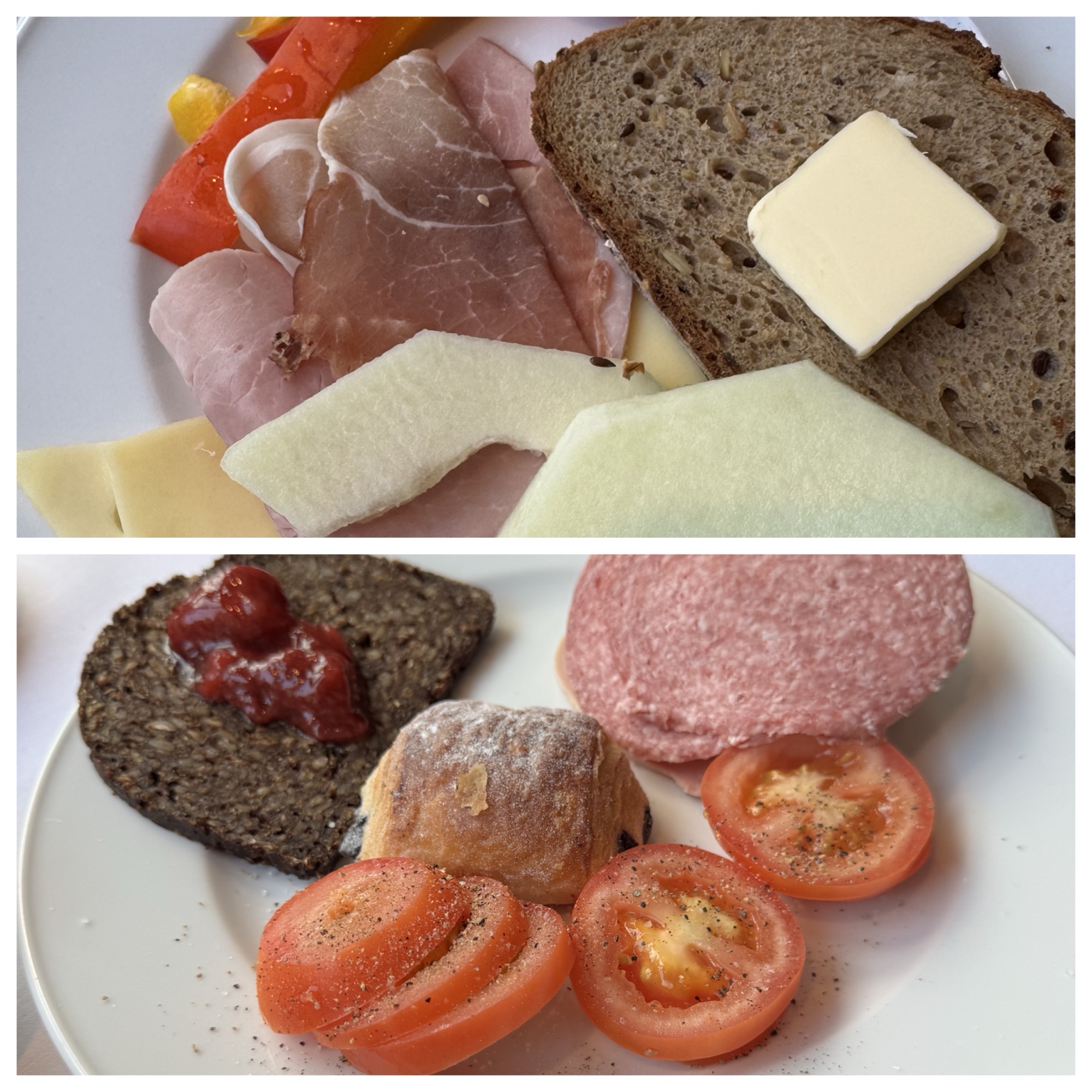
Today started with another yummy breakfast. We needed the energy to get us through our day.
Son #1 and I had agreed prior to this trip that we were not going to visit holocaust memorials, but we also wanted to acknowledge the era into which my mother was born.
Since mom grew up in Hungary, her experience was somewhat different from that of German nationals, but by the time she was a teenager the Nazi (National-Socialist) party was well ensconced. She turned 12 just before the onset of WWII, and by that time the Nazis had already done genealogical bloodline research on her family to ensure that they weren’t “Gypsies”. After all, they were German AND Hungarian speakers with dark hair and eyes living in Hungary.
In the end, #1 and I decided that we would visit Cologne’s N-S Documentation Centre. as a compromise, acknowledging the need for historical context.
It ended up being a very intense day.
Underneath their beauty, every German city has a less beautiful portion of their history; while it may not always be right on the surface, neither is it hidden.
Ted and I have often remarked during our visits here that the country does a particularly good job of not glossing over its biggest mistakes, with a particular emphasis on trying to prevent them from being repeated.
So off #1 and I went to discover Cologne’s mistakes.
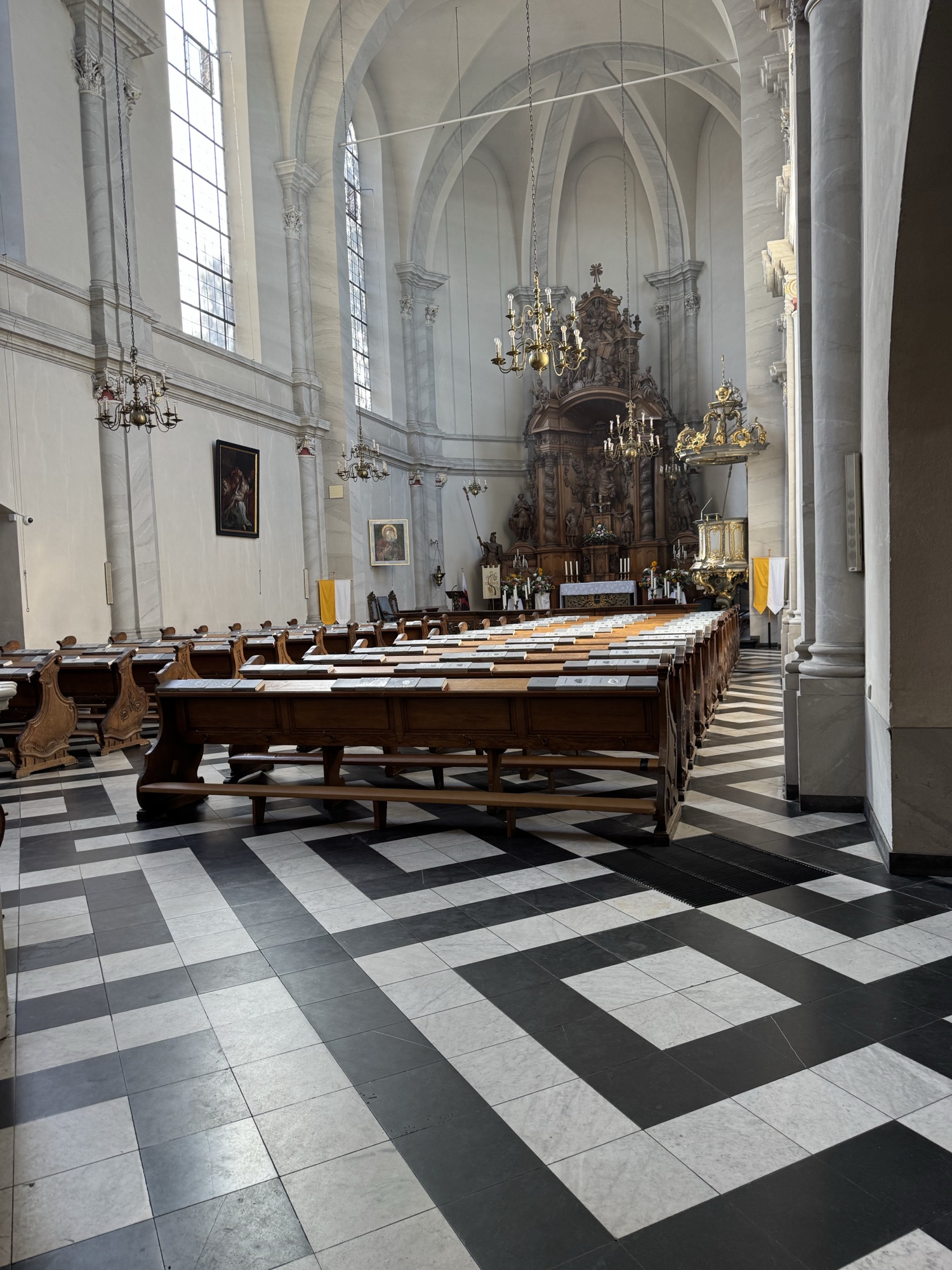
En route, we detoured into St Mary’s Carmelite Church on Kupfergasse. Of the original convent building, just the 1660 tower – the round one that looks out of sync with the rest of the 18th century building – remains.
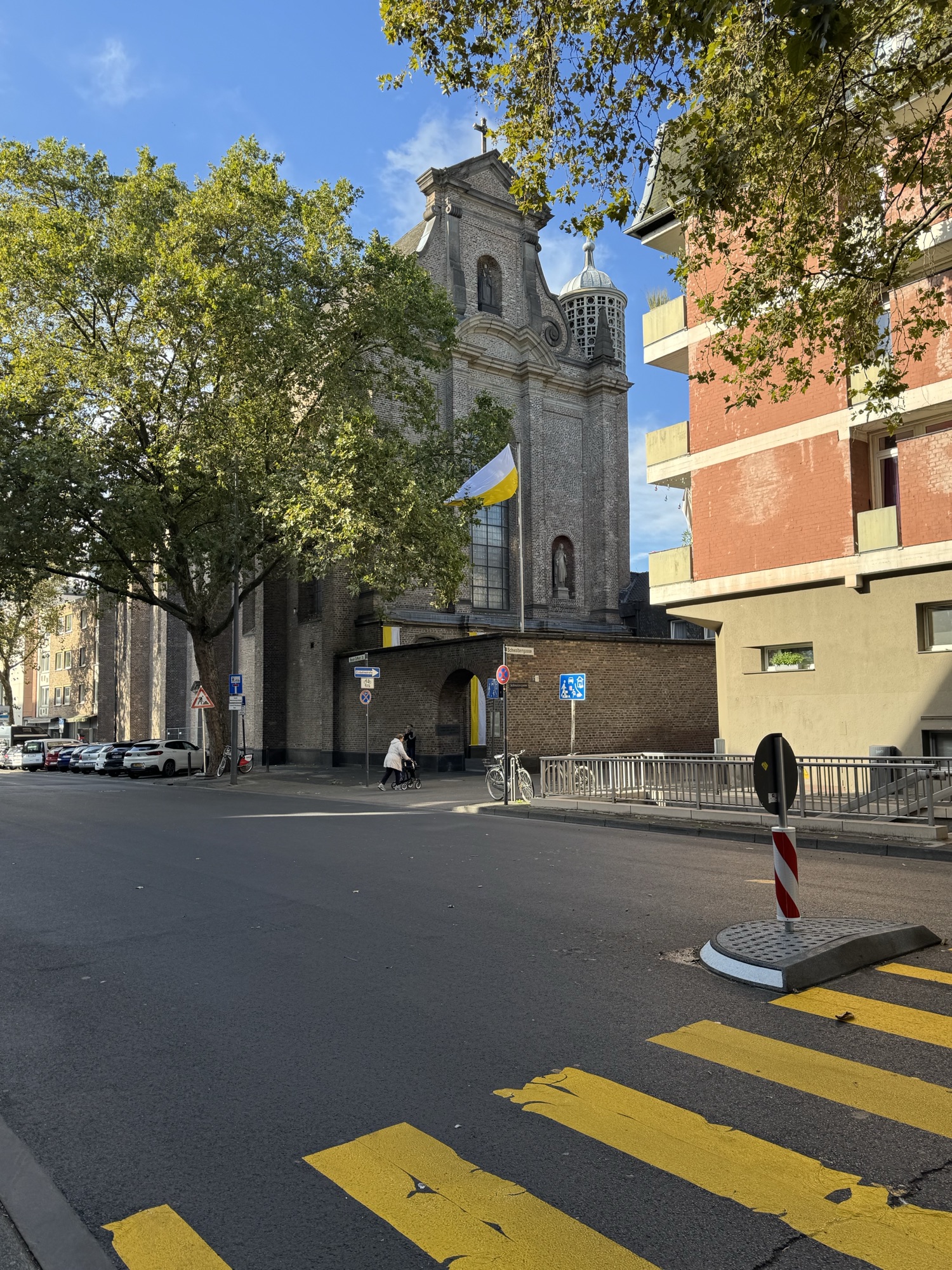
The sign on the church’s entry gate at the street reads “Don’t go by without praying an Ave”.
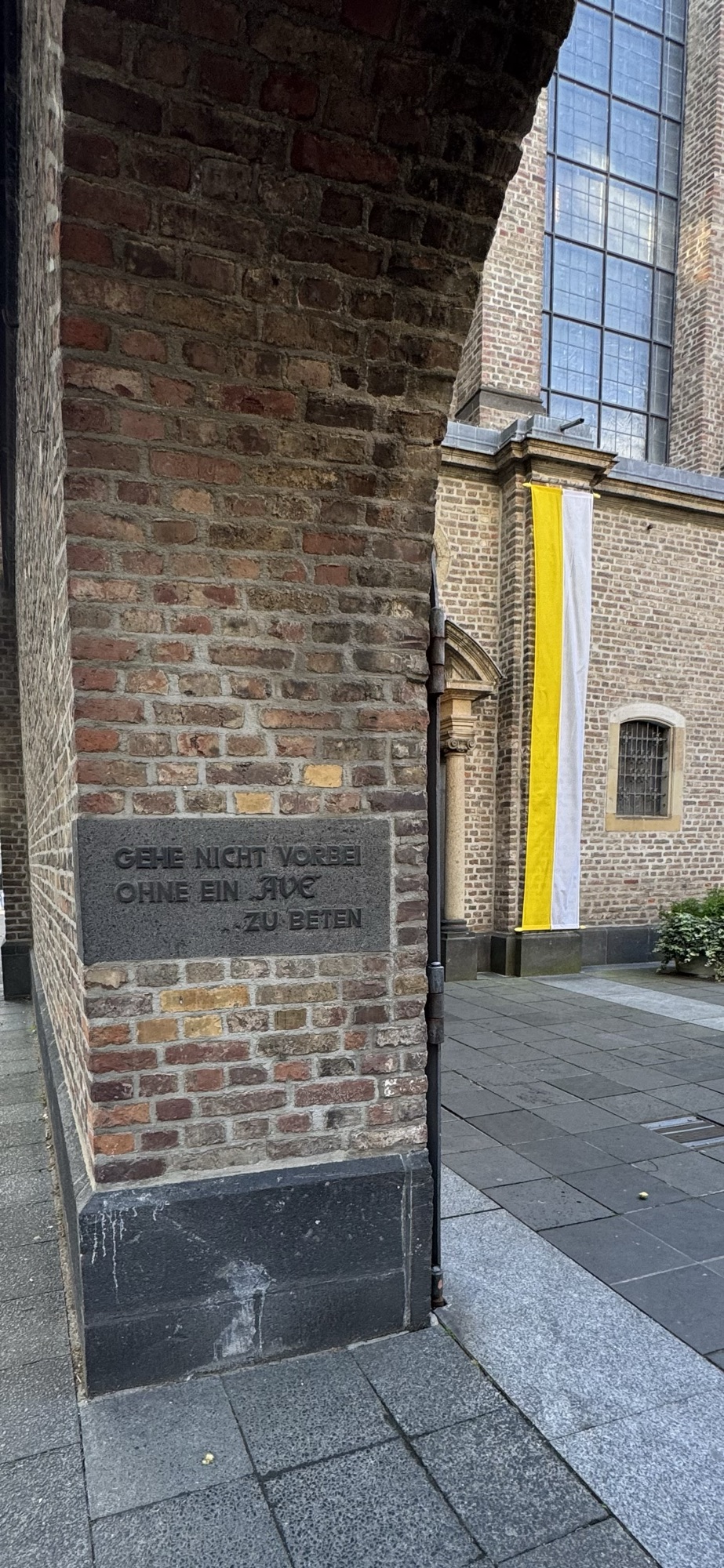
It was open, but we were only able to view the interior at an angle, through internal wrought iron gates, from one of the two vestibules.
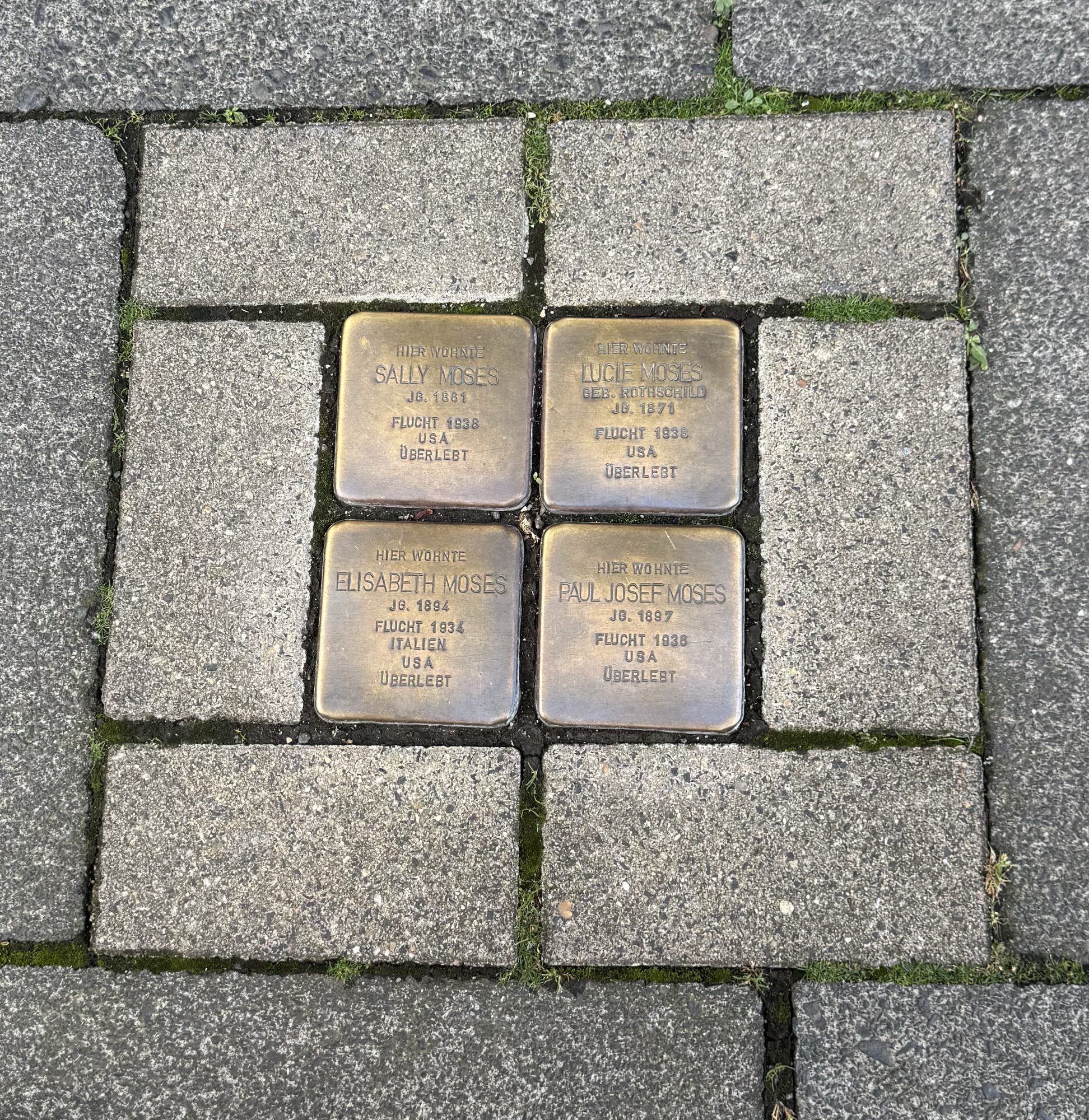
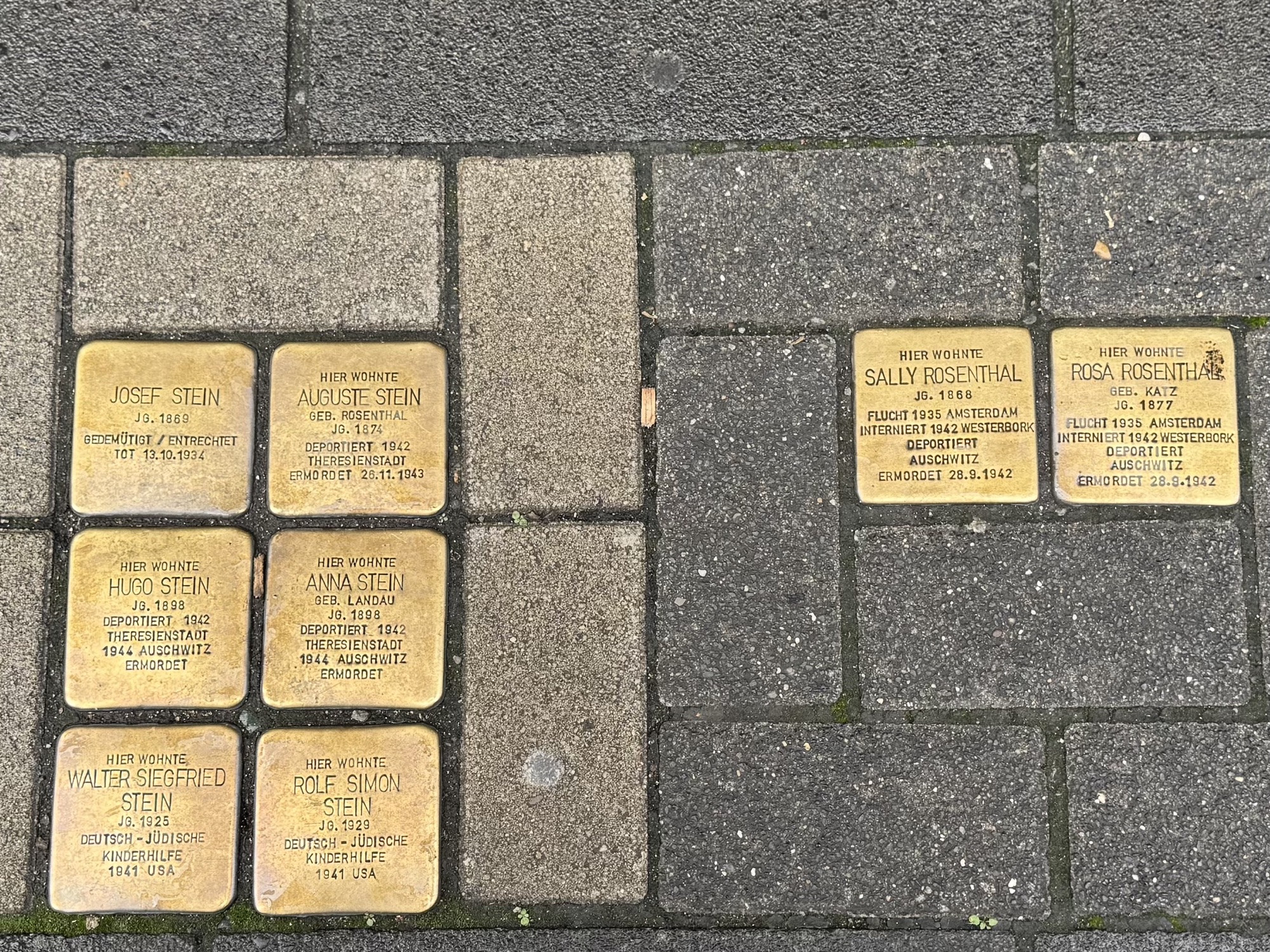
Out on the street we also stopped to say the names on a set of Stolpersteine commemorating a Jewish family lucky enough to have survived the war by fleeing to the USA.
We arrived just after the centre opened at 10:00, and picked up our audio guides, mine in German and #1’s in English.
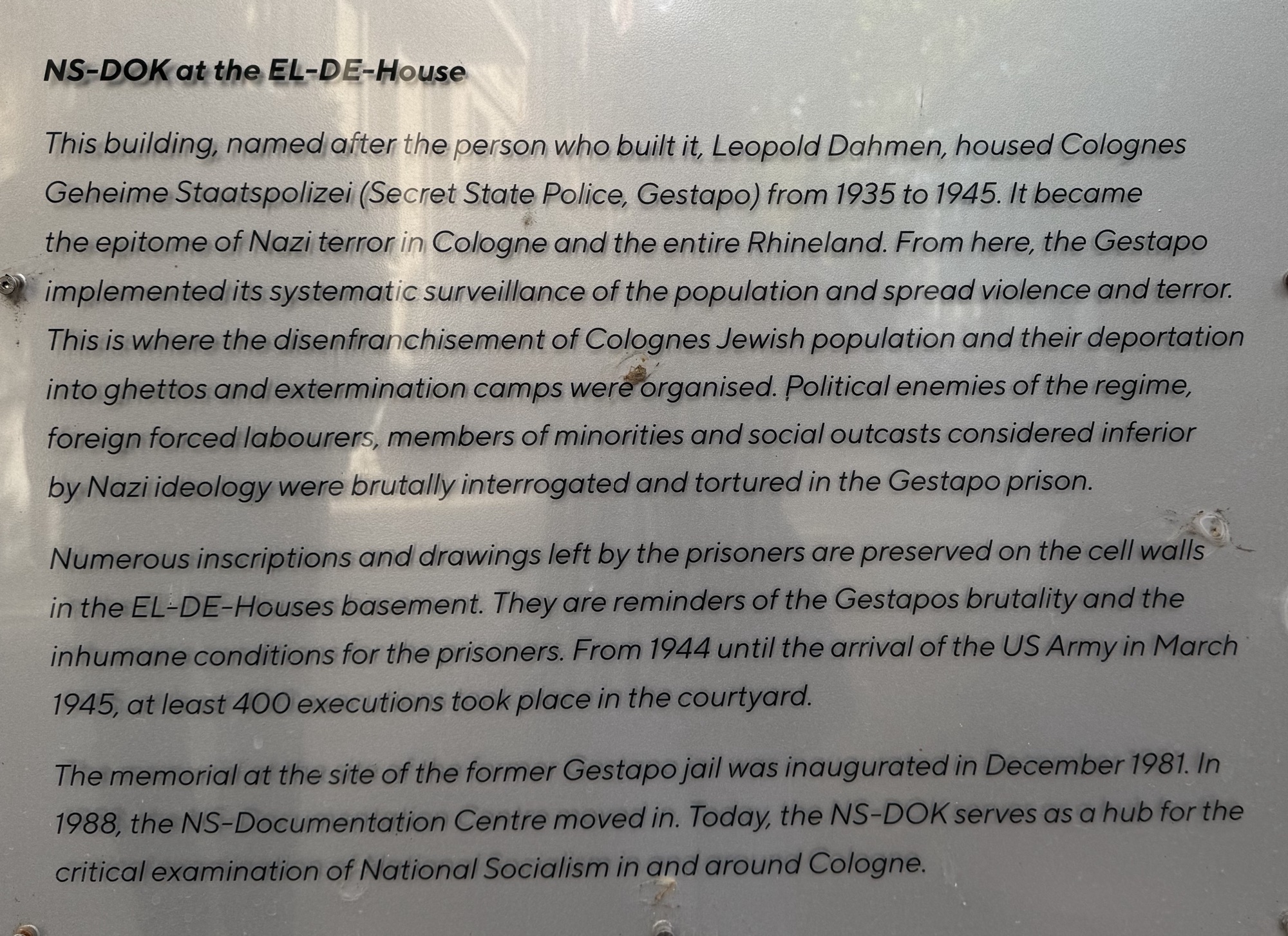
It took us almost 5 hours to work our way through the two floors of exhibits, using the provided audio guides at each station. It’s not the kind of place you can simply rush through.
The centre opened in 1988. Sooner might have been better, but in some ways the timing makes sense. Those still living and rebuilding in the aftermath of the war didn’t need it. The next generation would have heard the stories firsthand. By generation three there was a real risk of forgetting, ignoring, or avoiding the darkest elements of the city’s wartime history, or even just wanting to move forward feeling unencumbered – but remembering honestly is important to ensuring lessons are learned.
The combination of images, signage, archival film footage, and personal records make this museum/centre especially effective.
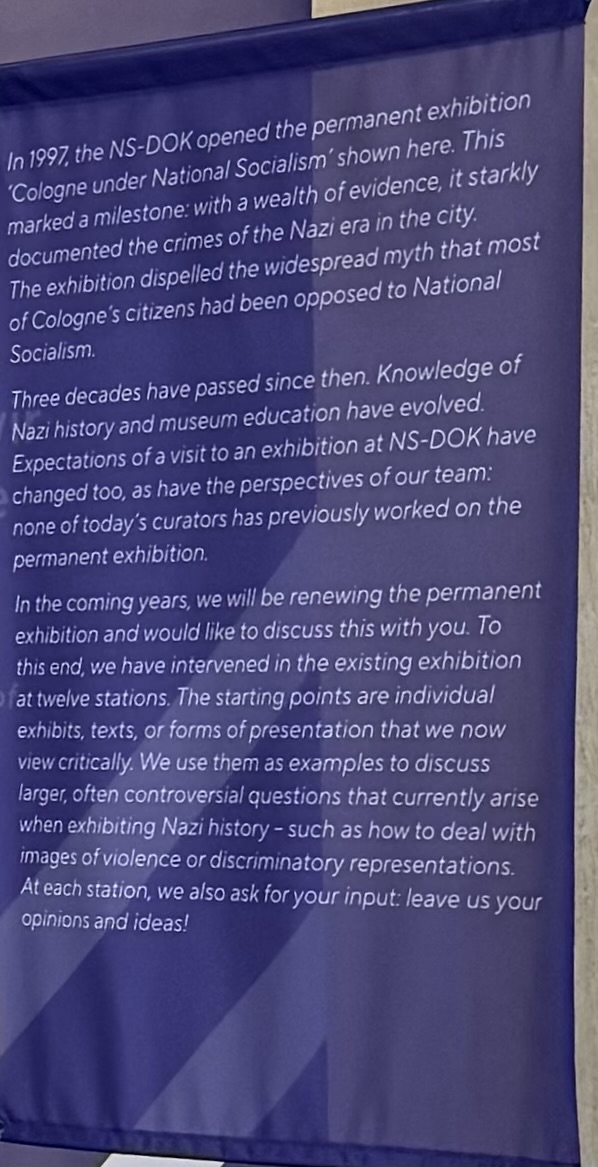
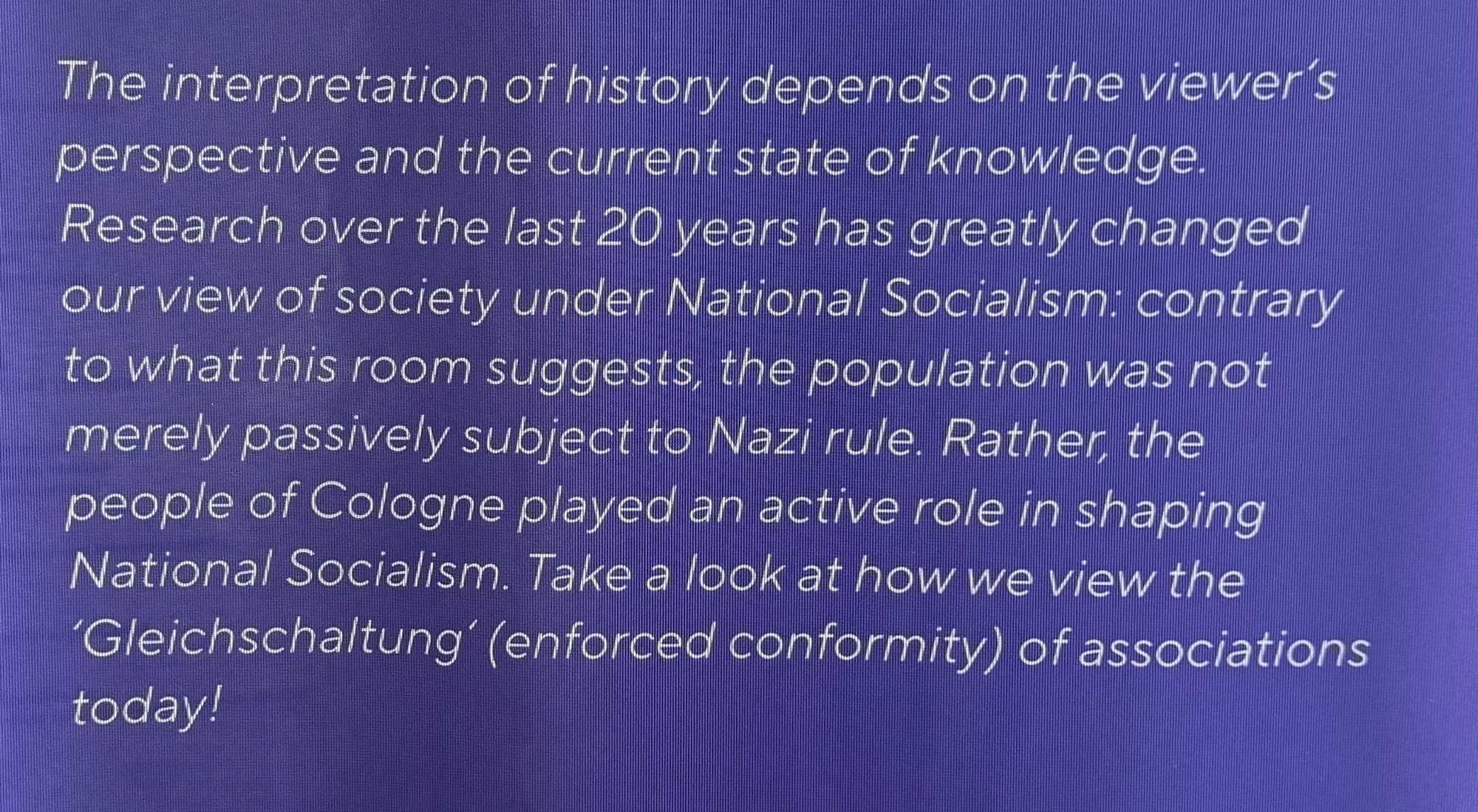
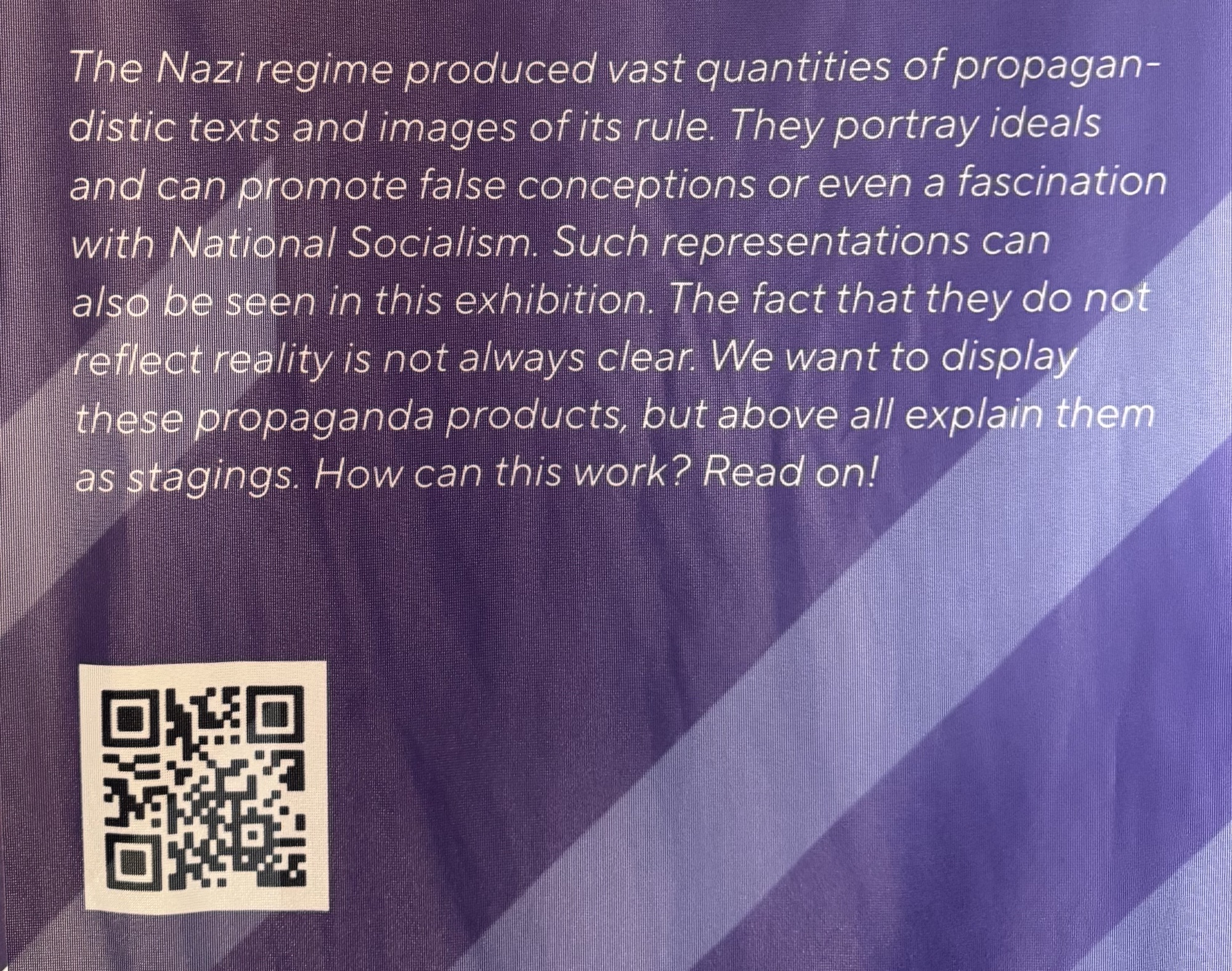
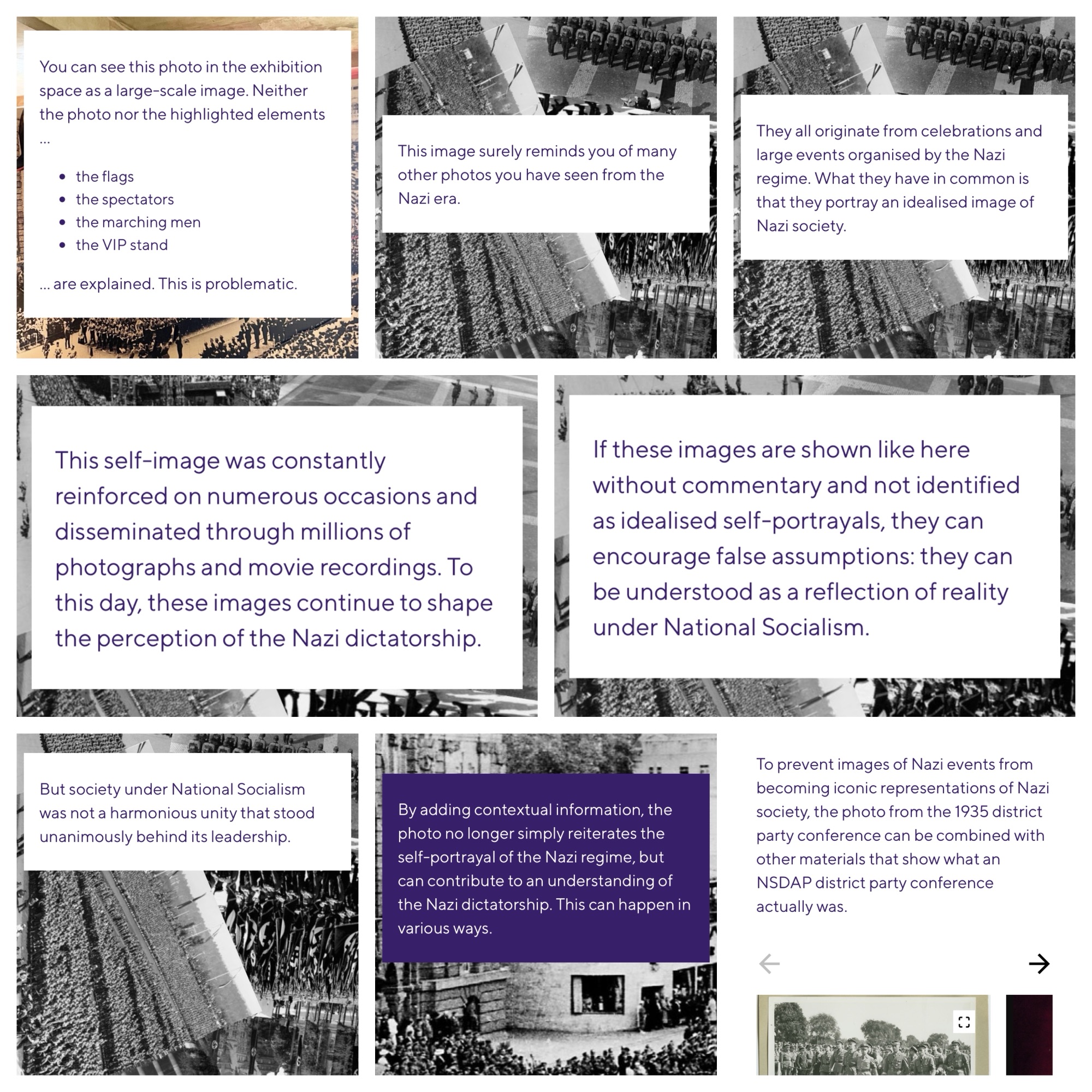
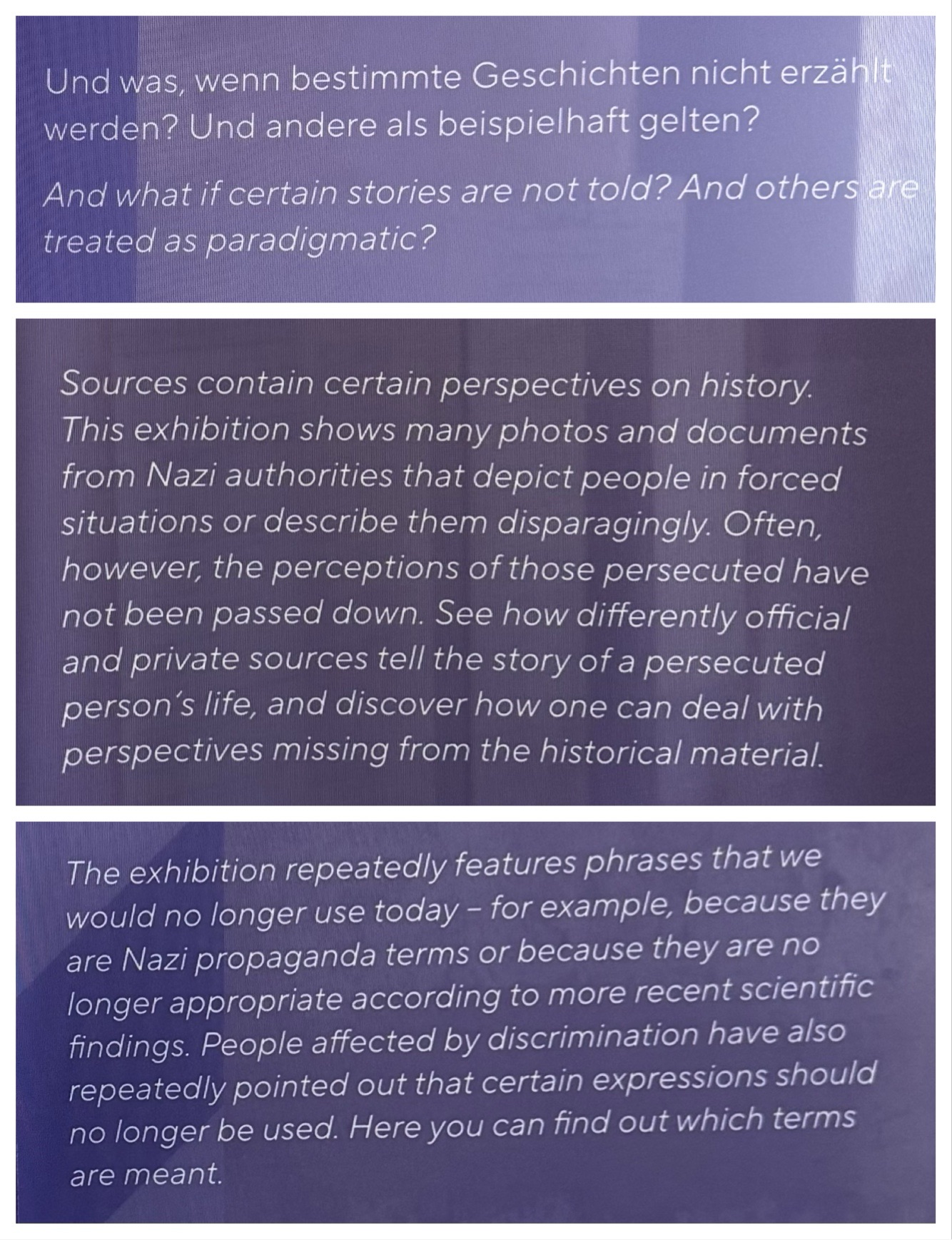
I didn’t take a lot of photos except of the banners that explained the centre’s decisions about what and how to present the information.
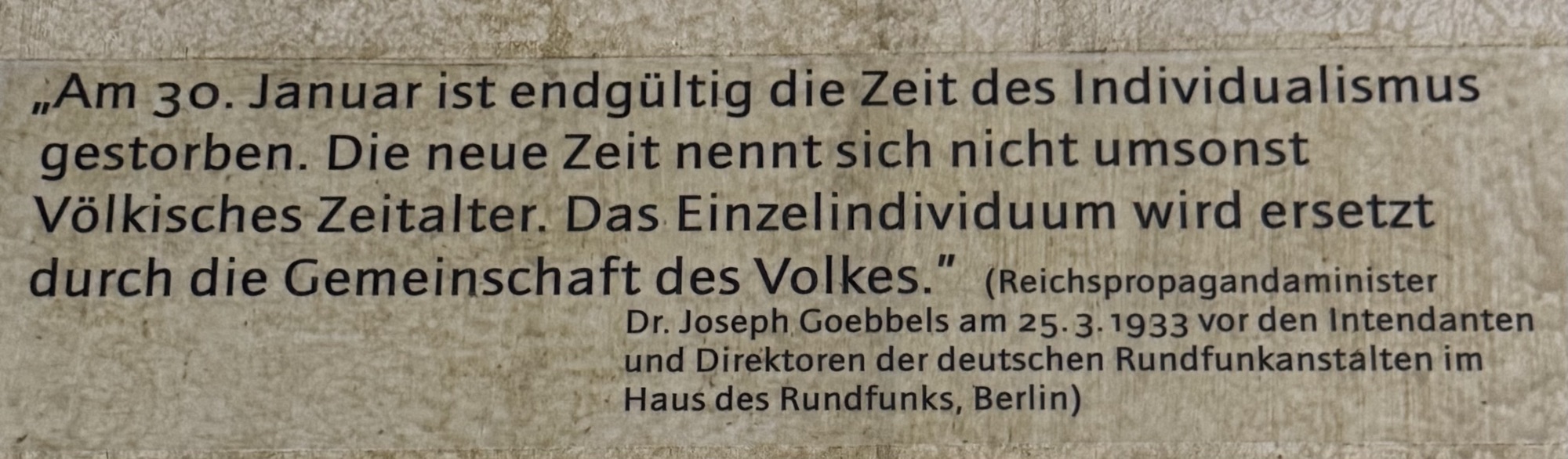
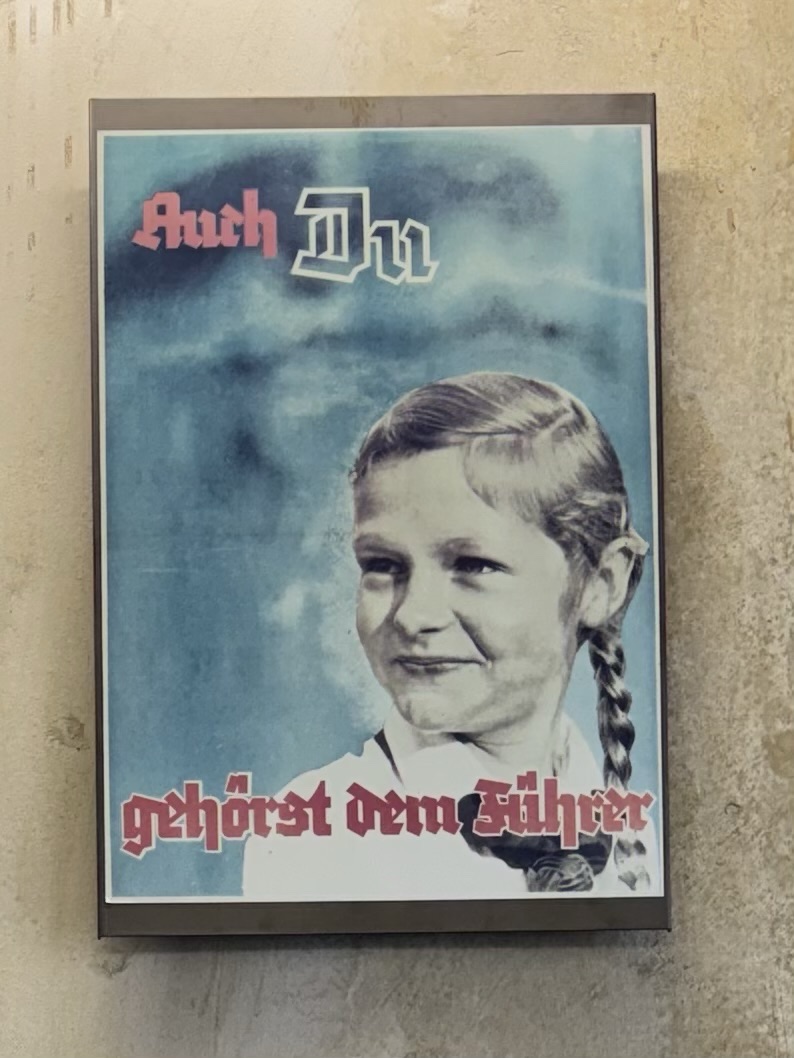
“Group” indoctrination began with young children, enrolled in gender-segregated Hitler youth groups and told that they “belonged” to him. They were taught that loyalty to the Führer was more important even than their biological families, or Jesus.
QR codes on various banners allowed even deeper understanding. I took pictures of several to explore later.
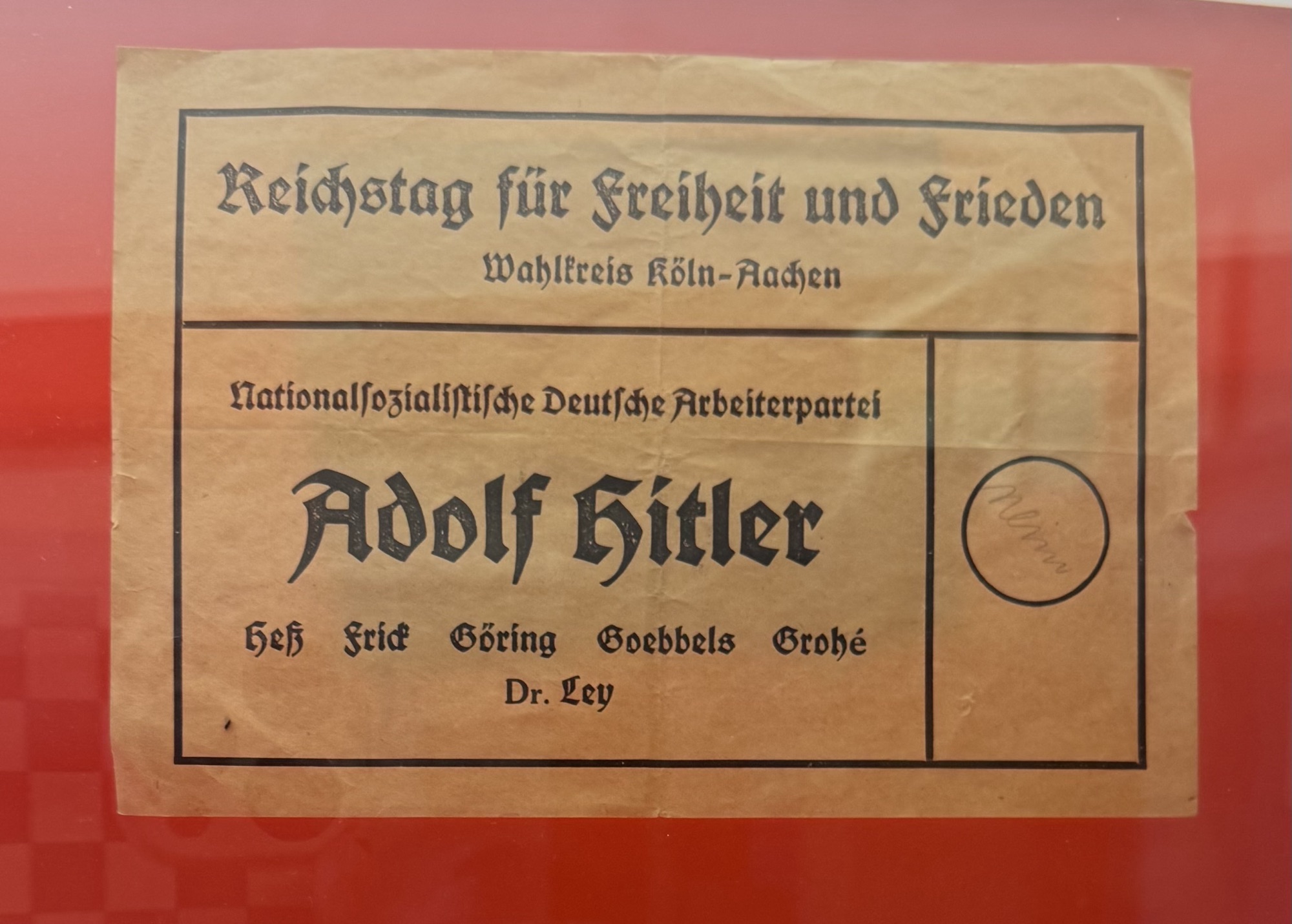
The election ballot below, with just one option, shows lip service to democracy that no longer existed.
In the rooms that told the story of church involvement, the introduction on the wall (translated) read: “The de-Christianization of public and private life was a prerequisite for the National Socialists to enforce their claim to power. The attacks of the Nazi regime were directed against churches and religious communities as political and social institutions, as well as against traditional religiosity and Christian values. Christian-influenced piety was to be replaced by a “belief in God” described as “völkisch-Germanic.” Loyalty to the churches was to be replaced by devotion to the Führer and the Reich.”
One display explained that a joint pastoral letter issued in 1931 by the Catholic bishops of the ecclesiastical province of Cologne warned against the ideological dangers posed by National Socialism. Nevertheless, National Socialism and the Catholic Church shared a fundamentally anti-modern, anti-liberal, and anti-Bolshevik stance. They were undercut by the concordat concluded between the Vatican and the German Reich in 1933.
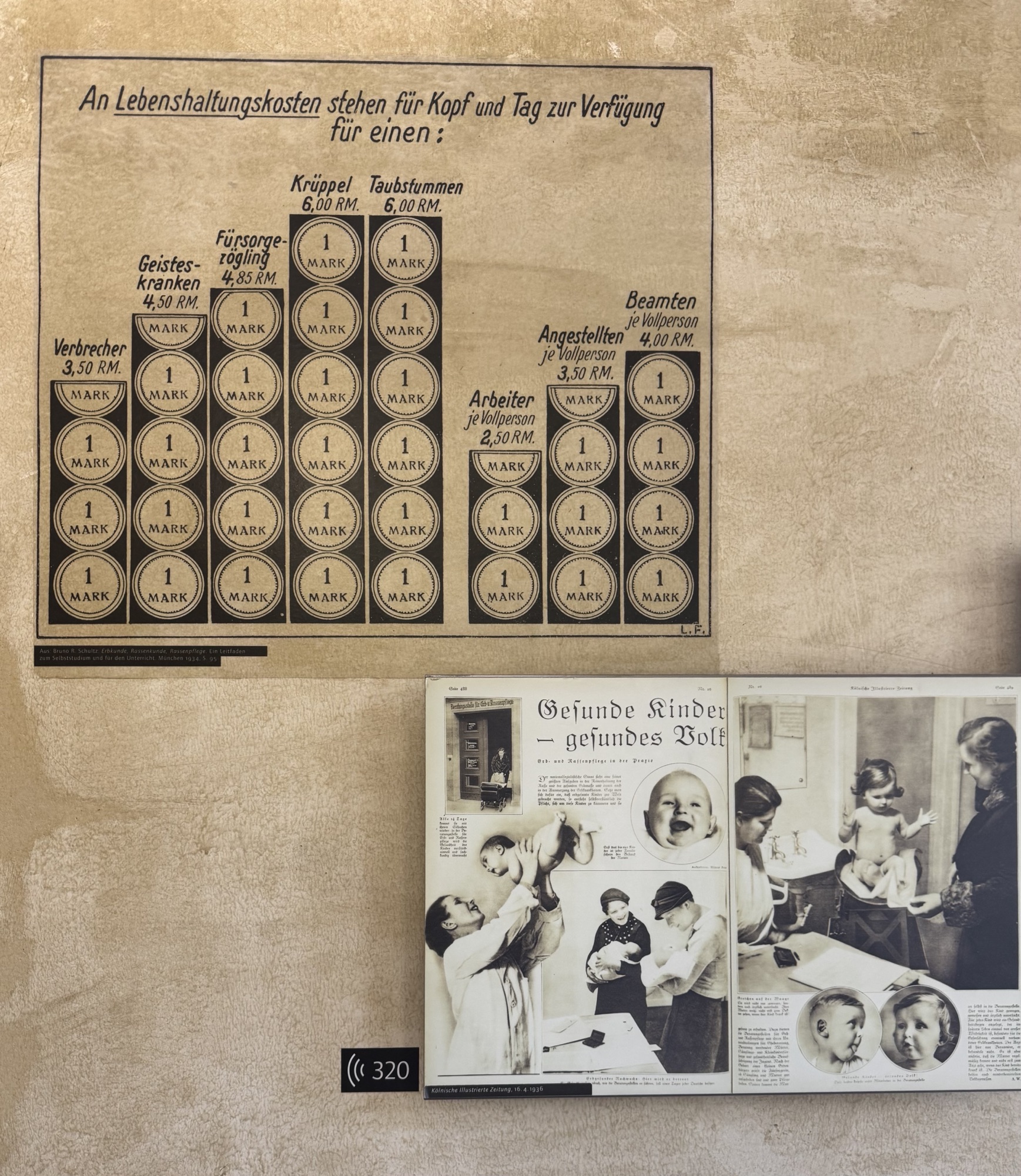
Another banner introduced one of the most disturbing rooms in a building full of disturbing rooms. The posters displayed of charts used in school textbooks to “teach” children how to identify “lesser order” humans, the posters intended for public display denigrating those with disabilities or “antisocial tendencies”, the charts comparing the cost to the state for supporting a healthy person vs a sick one, and the tables of reasons for forced sterilization or euthanasia all added up to a bizarre pseudoscientific excuse for culling the population. It was chilling and horrifying.
The photo below is the least offensive picture I could take. I felt physically ill reading the individual accounts, doctors’ analyses, and health ministry directives.
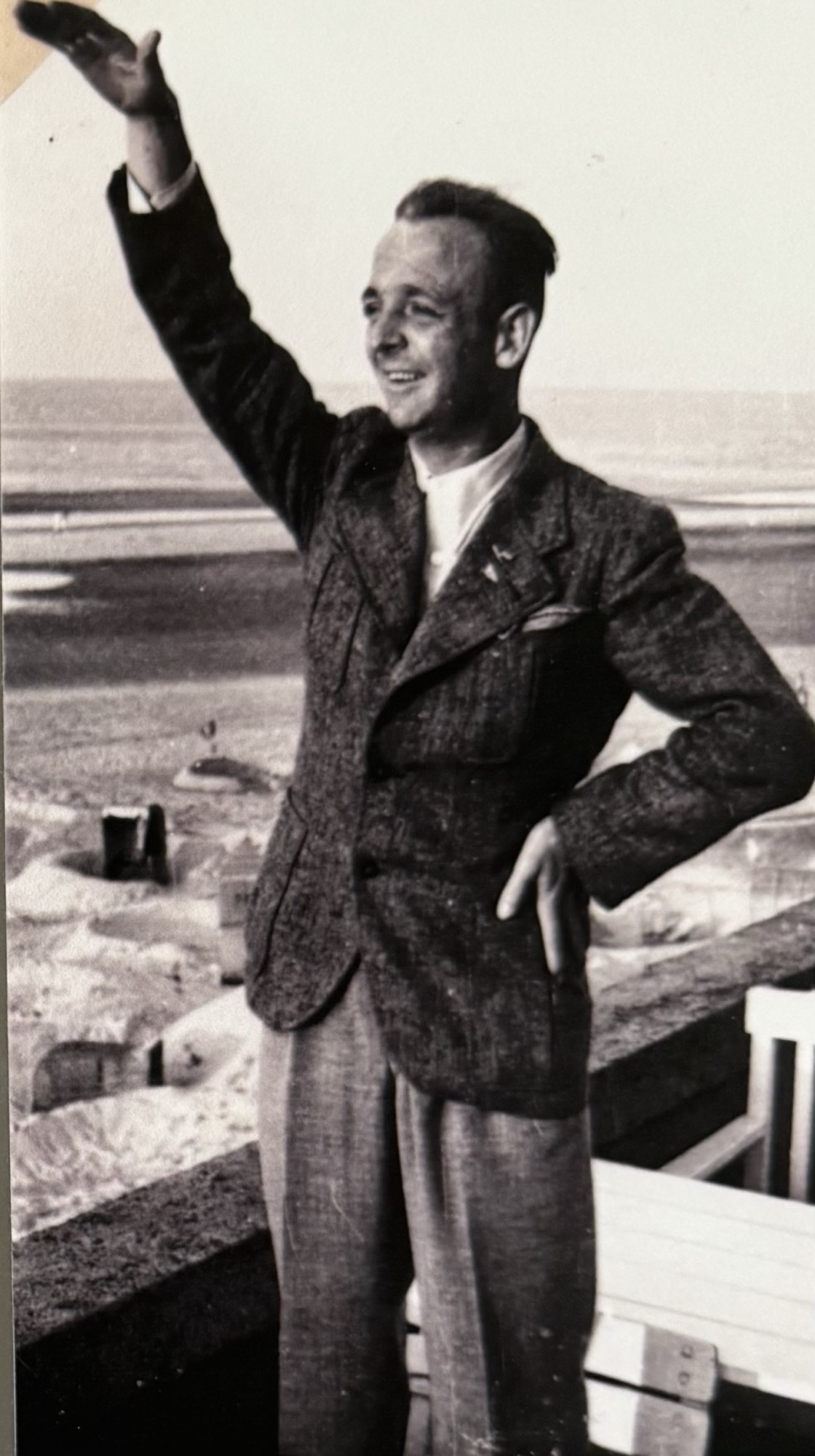
There were a very few stories with happy endings: those who were able to emigrate, those who survived deportation or forced labour, resisters who sheltered others and didn’t get caught. One photo and anecdote featured comedian Karl Kupper (dictators always hate comedians) who regularly mocked the Nazi salute by explaining it as checking the weather for rain, or measuring exactly how high the dirt behind his house or the excrement being piled by politicians was on a given day. He survived the war and lived until 1970.
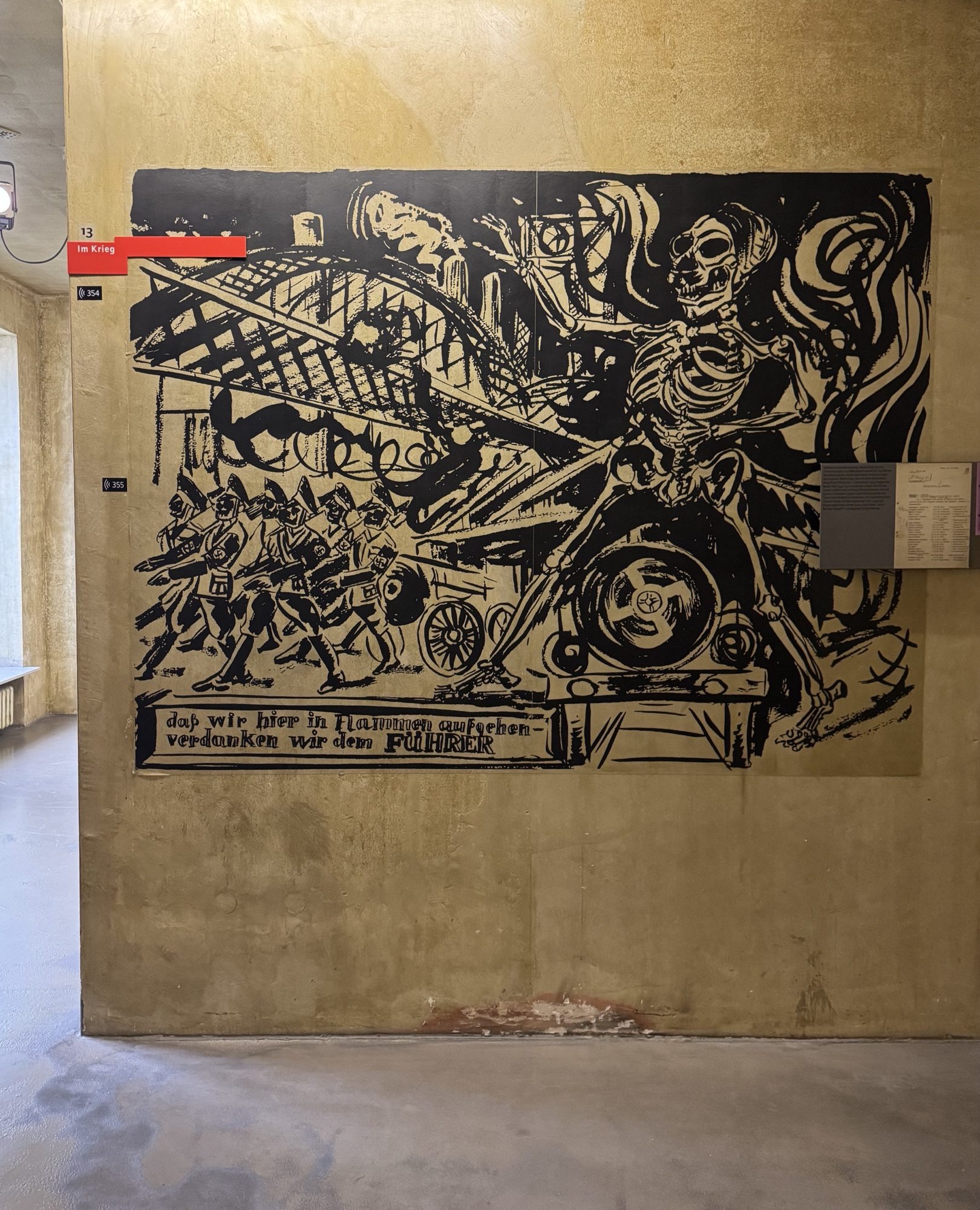
To this day, German cities host a famous parade on Rose Monday (the precursor to Karneval and then Lent) with floats disparaging politics and politicians, and commenting on world events. During WWII a Belgian Rose Monday parade featured a float that was afterwards depicted on this large poster.
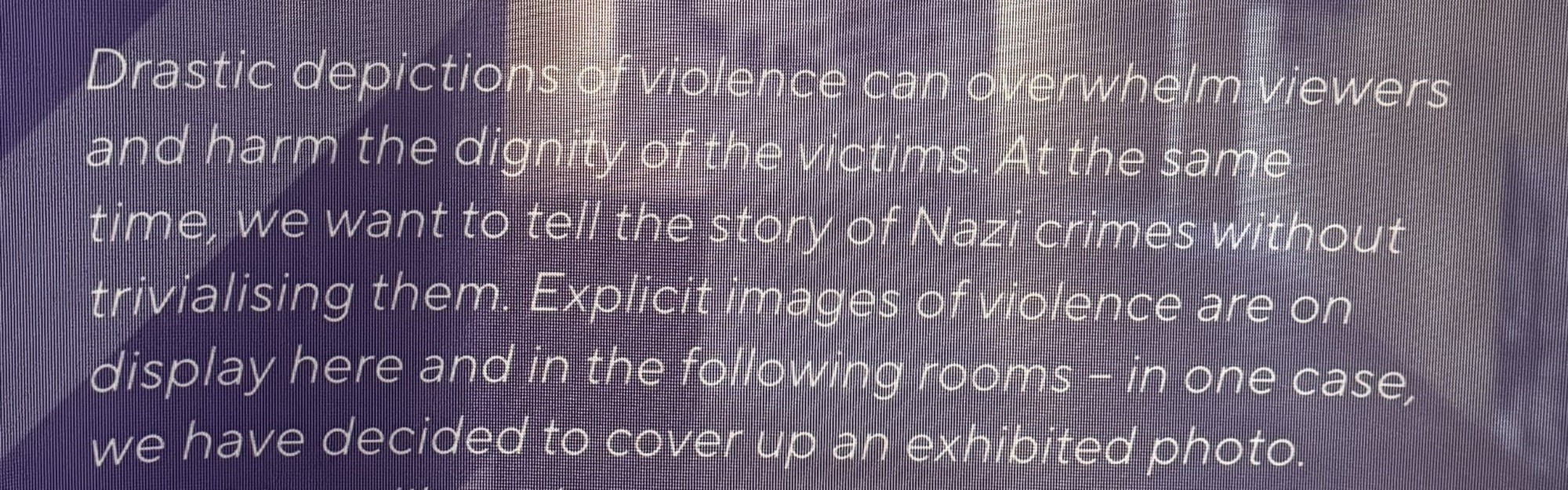
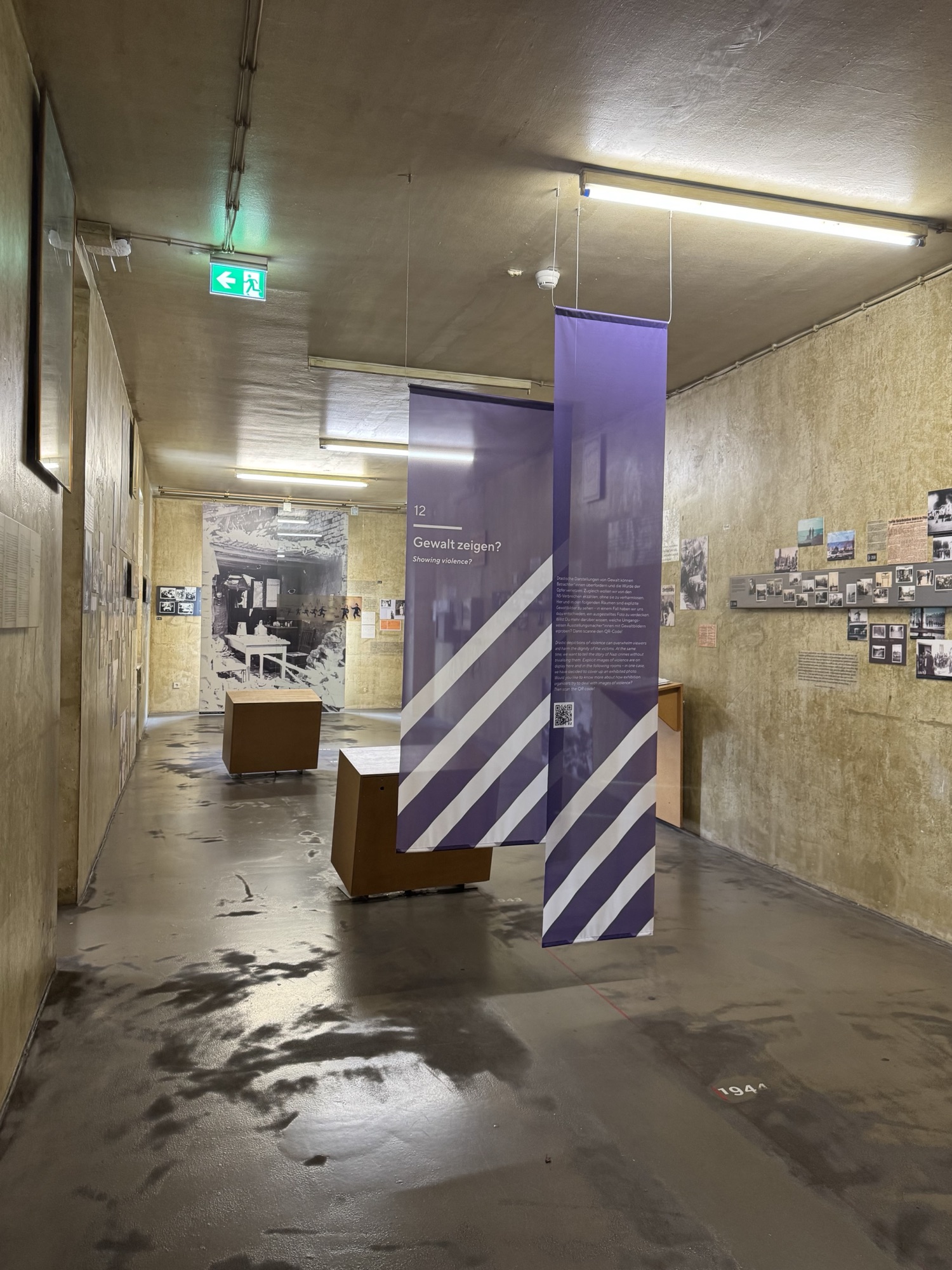
We were constantly being given context and cautions because the material was so disturbing.
The audio guide also allowed individual displays to be skipped. #1 listened to everything; I skipped only the room describing the Gestapo hierarchy, fearing that it was going to delve into the terrors they inflicted on those incarcerated in the cells below us. Neither of us chose to visit the cells.
The final room talked about the end of the war, specific to Cologne.
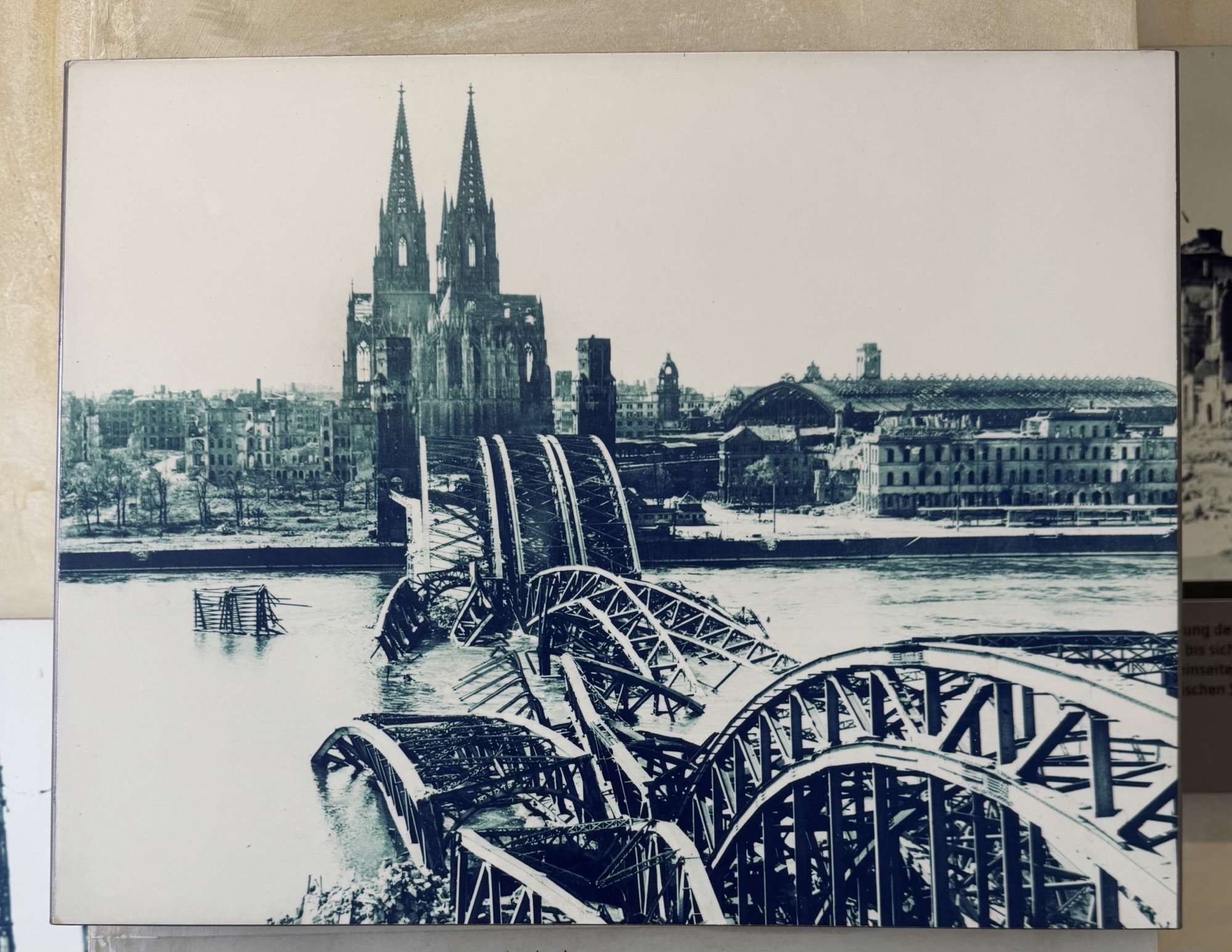
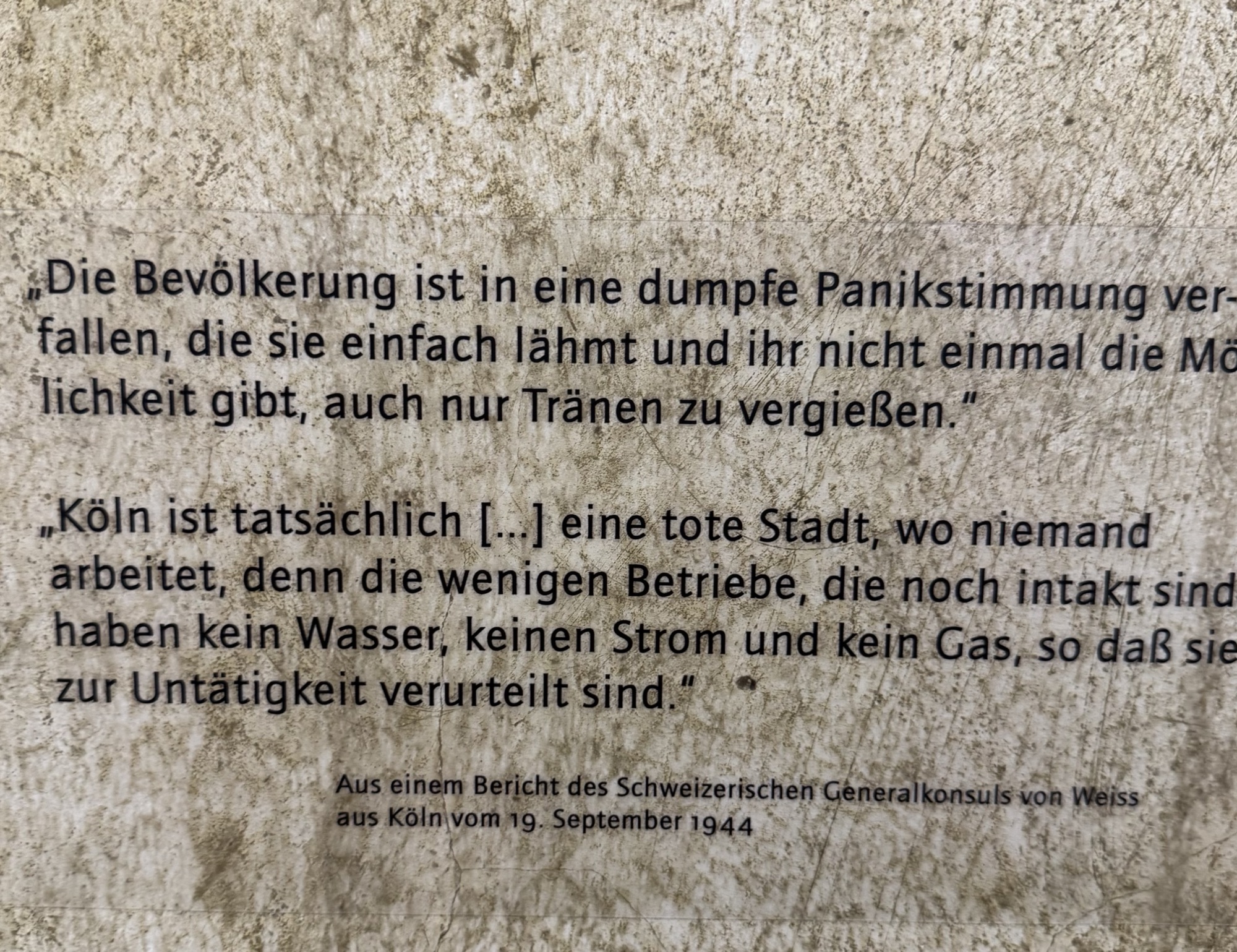
“Cologne is, in fact, a dead city where no one is working; the few businesses that remain intact have no water, electricity, or gas, condemning them to idleness.”
From a report by the Swiss Consul General, von Weiss, from Cologne, dated September 19, 1944.
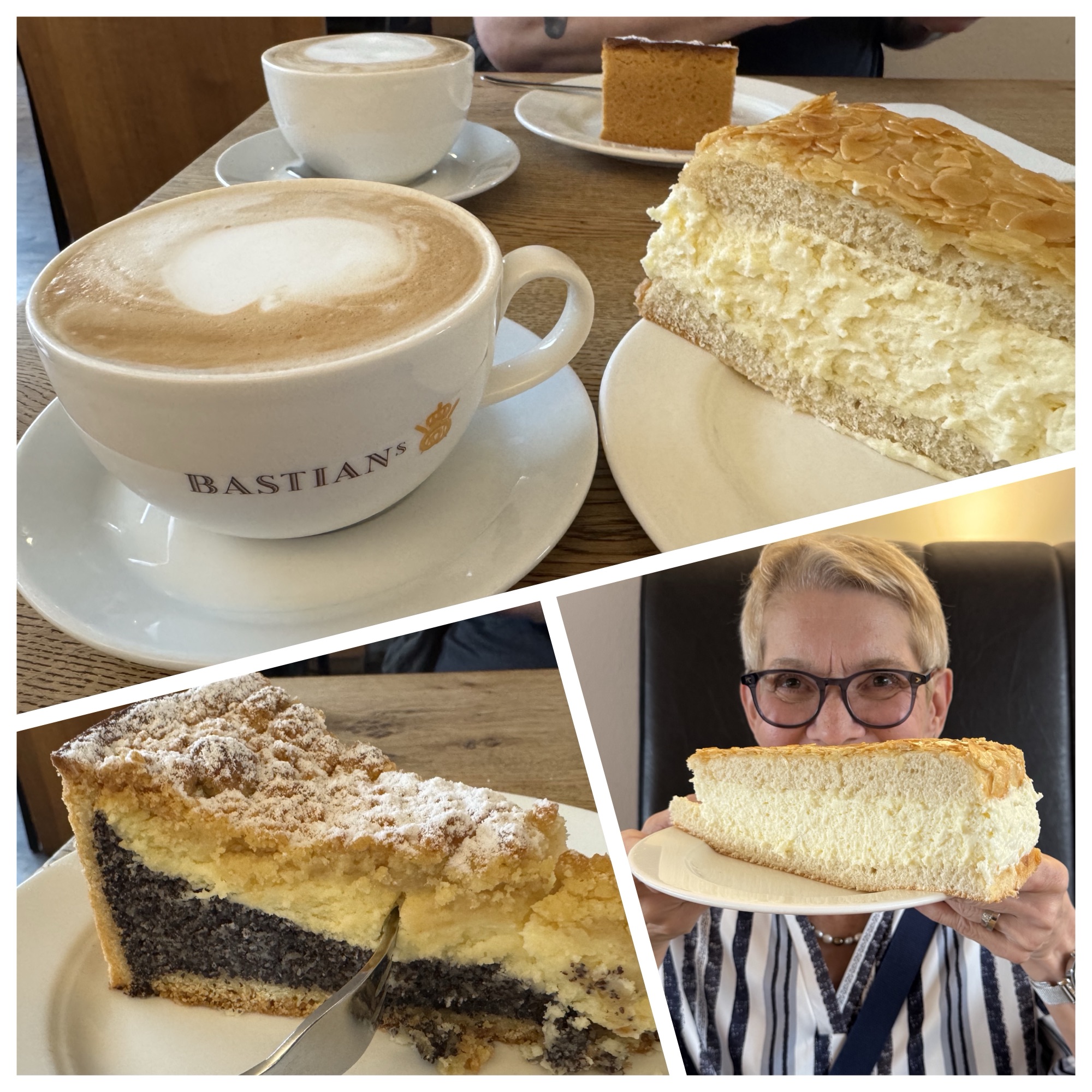
After a very intense visit, we both felt that we needed something sweet and in a bright friendly location while we internalized what we’d seen, so we headed to Bastian’s Cafe for cake and coffee. They are famous for their Bienenstich, which was served in huge slices. #1 chose another family favourite: poppyseed cheesecake.
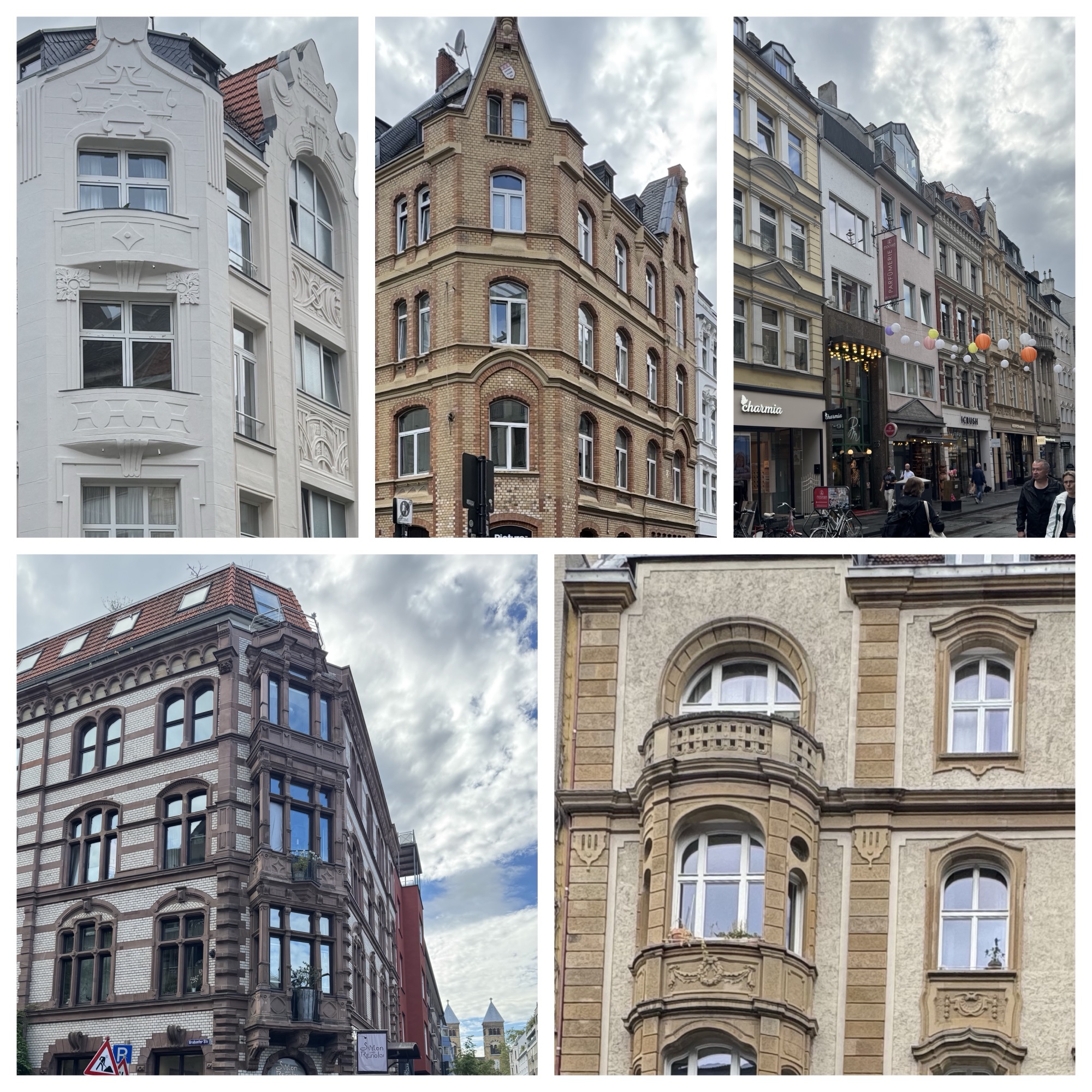
To walk off our afternoon “Kaffee und Kuchen” we strolled into the Belgian Quarter with its many Art Nouveau buildings.
We noticed many more Stolpersteine, and in each case stopped to read and say the names out loud.
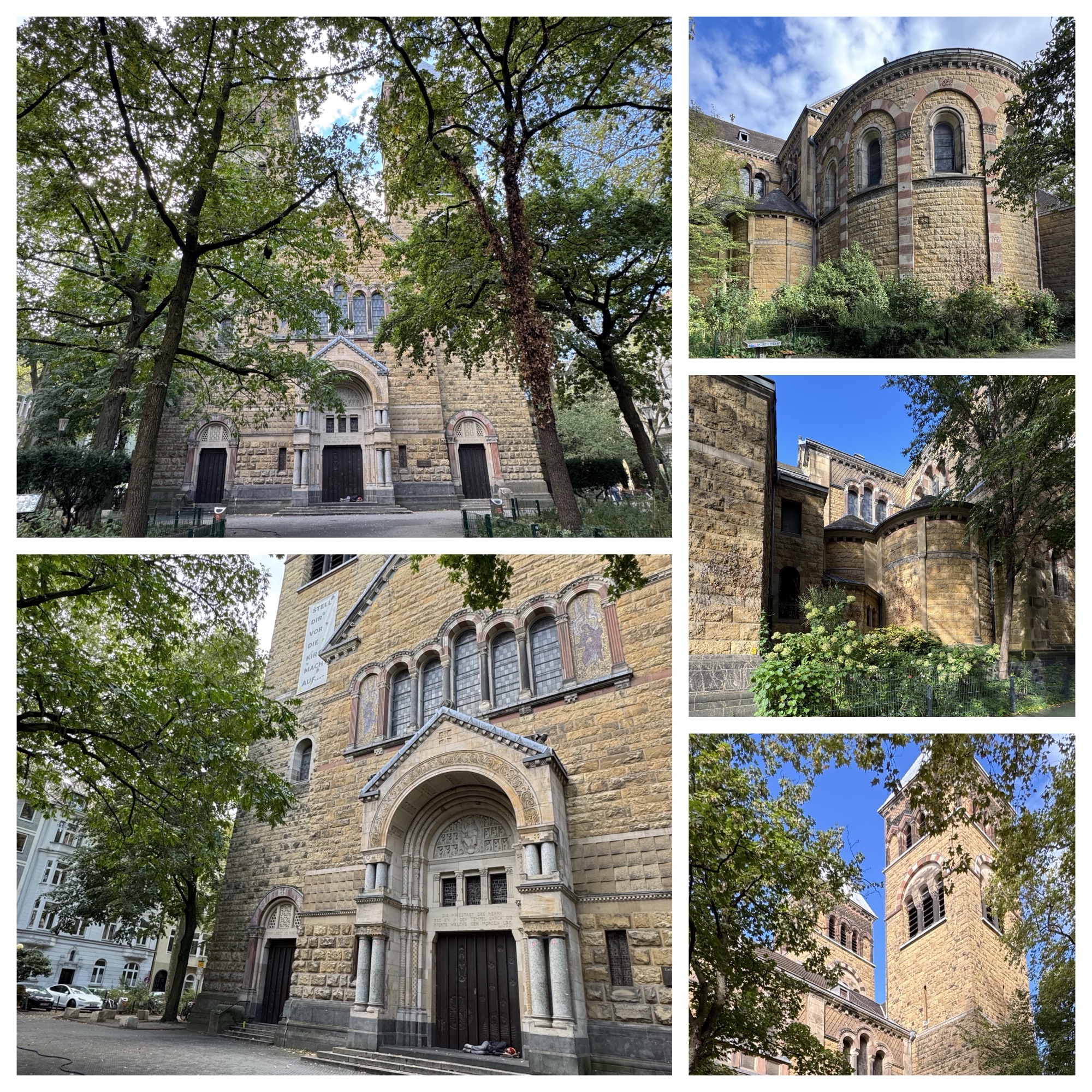
That portion of our walk culminated at Brüsselplatz and St. Gereon’s Basilica, one of Cologne’s most unusual Romanesque churches, with a decagonal dome. Surrounded as it is by tall trees and buildings, it was difficult to get a photo. I tried anyway, from several angles. I’m missing my resident photographer.
That church was not open, but in our walk back to the hotel we were able to enter the Basilica of St Mary in the Capital, which is also Romanesque.
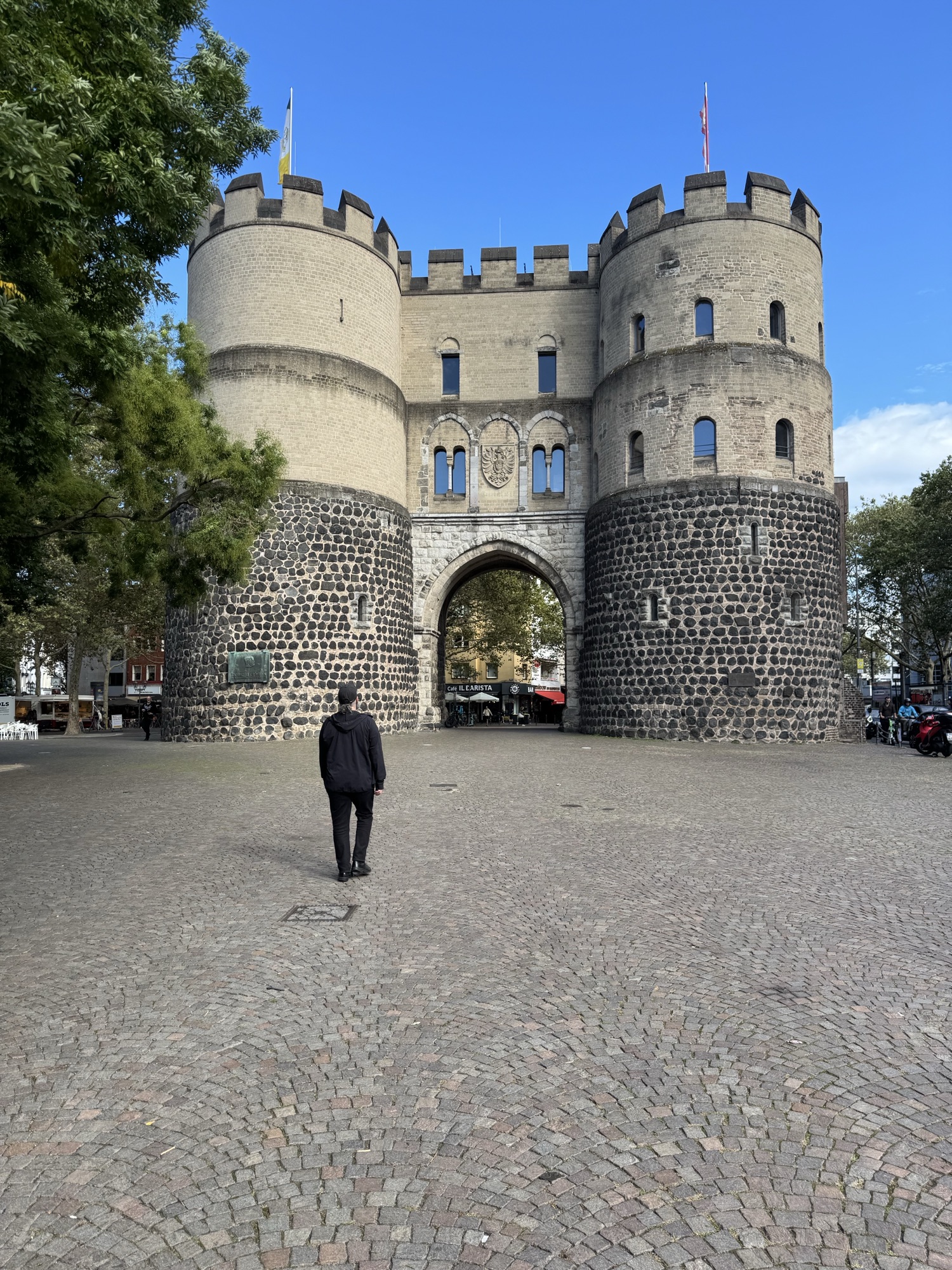
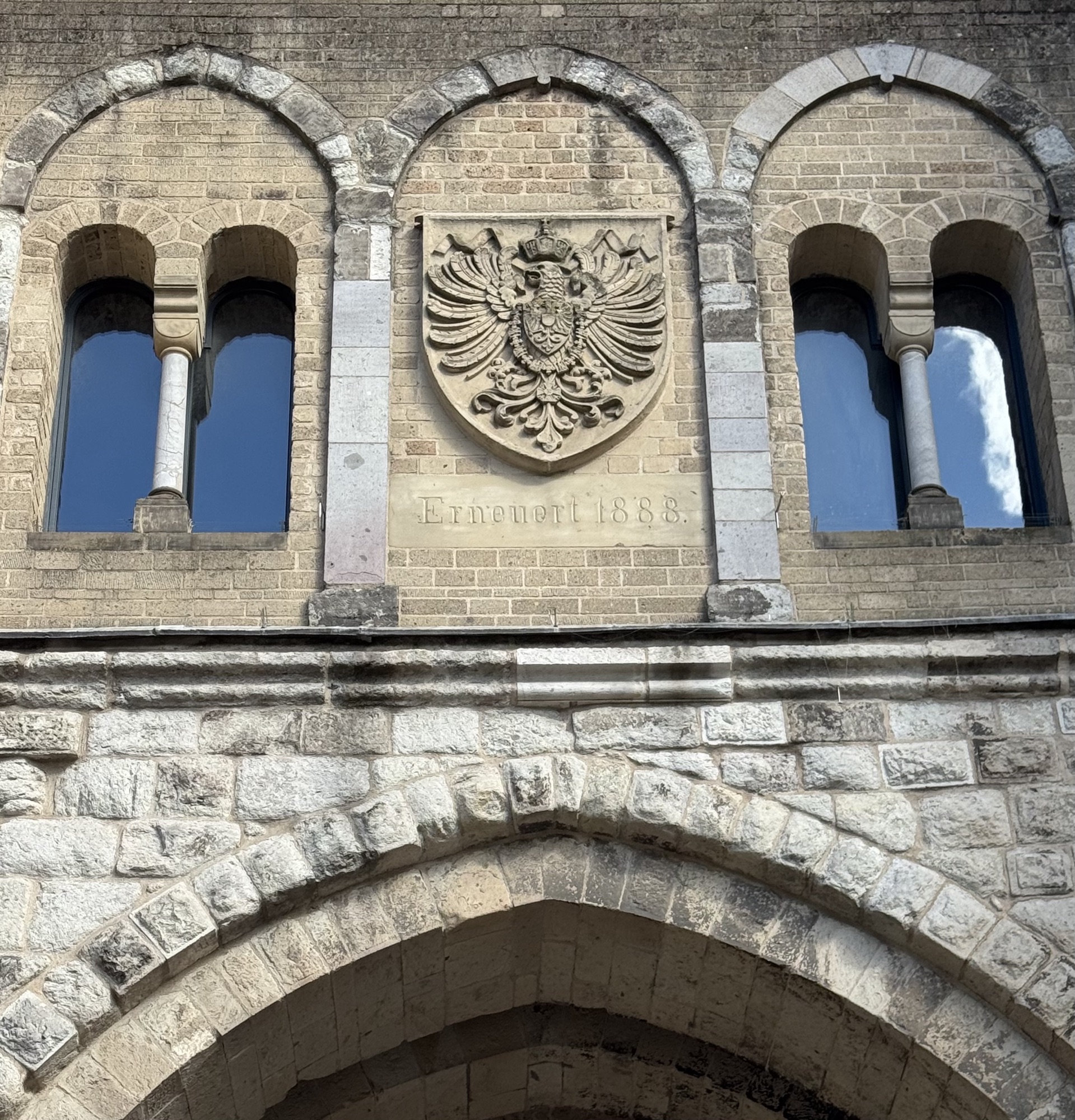
Before that, though, we passed through one of the only remaining city wall gates. The original dated to 1264CE. The current one is an 1888 reconstruction.
I omitted to photograph the exterior of the church, so its visitor brochure cover will have to do.
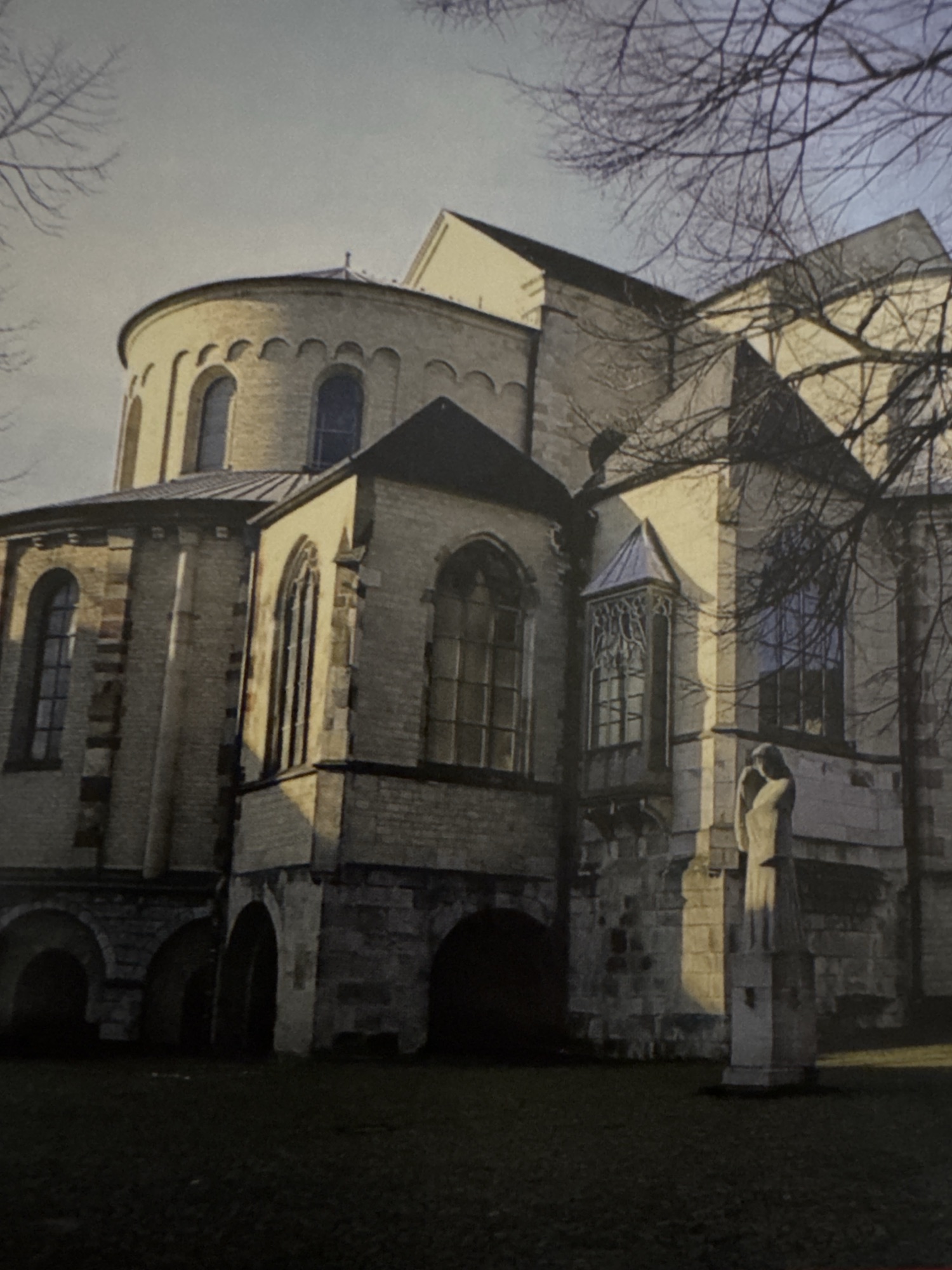
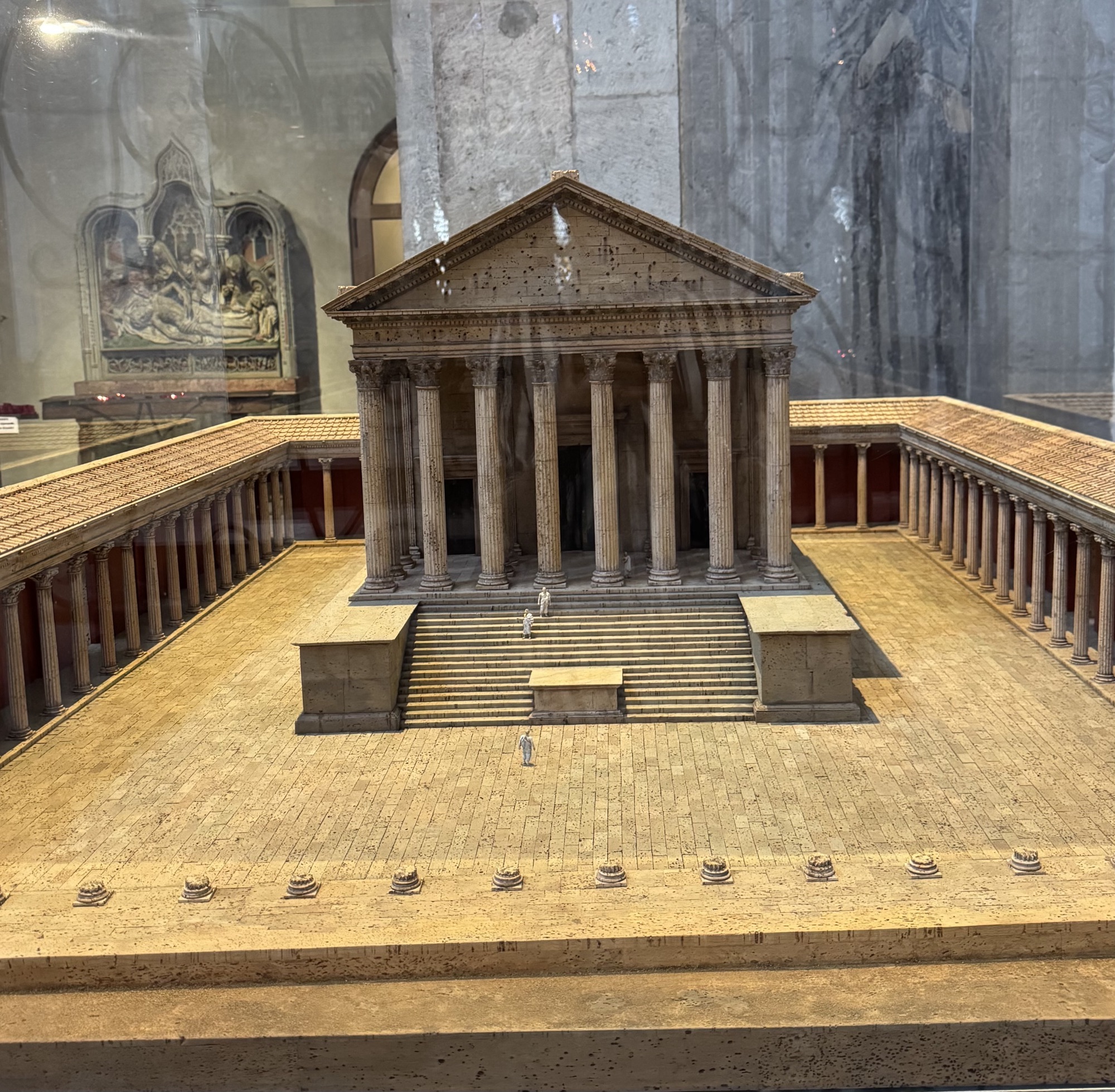
St Mary’s is Cologne’s oldest basilica, built circa 1040CE on the site of a first century Roman temple, a model of which is displayed in the church vestibule.
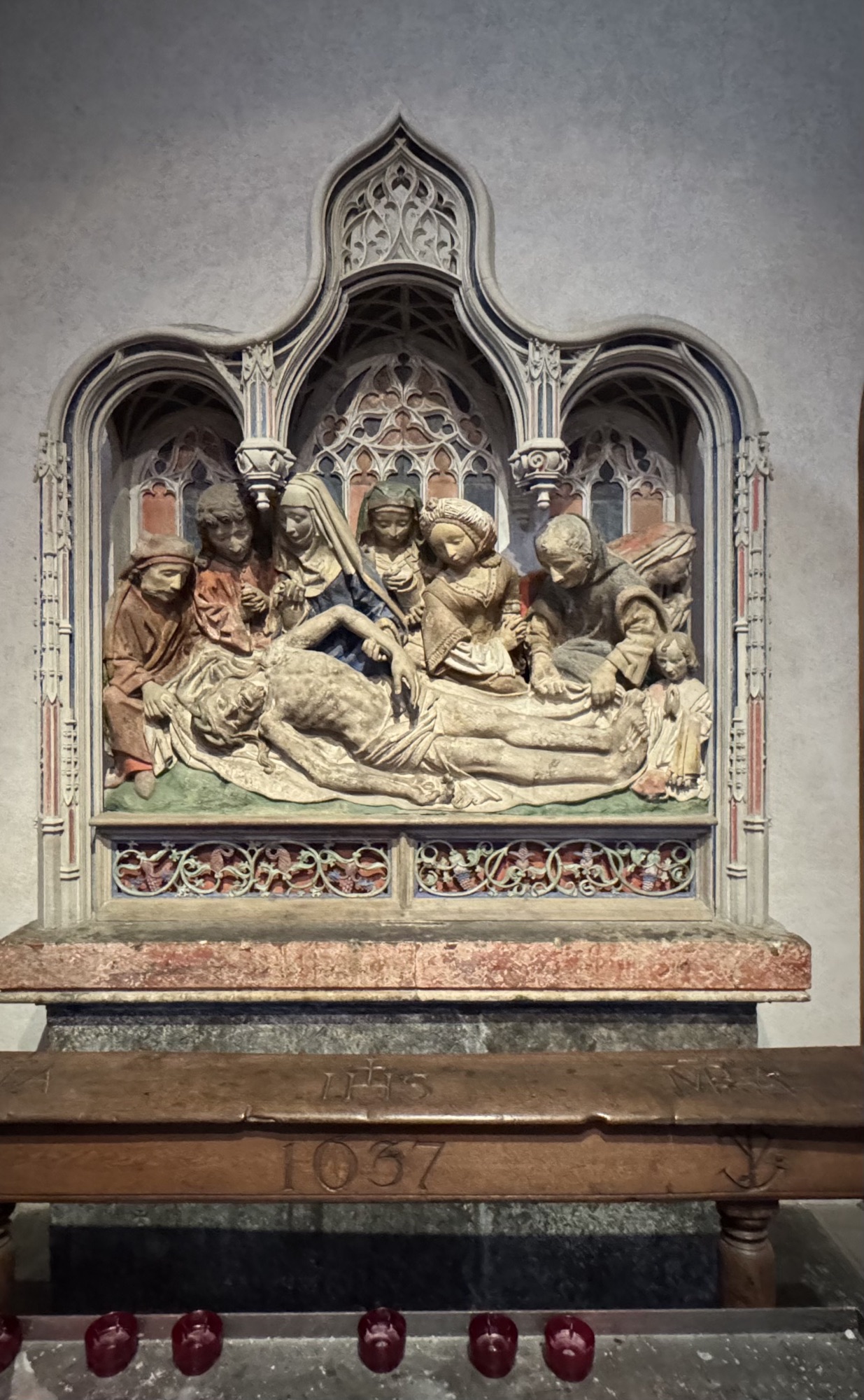
Notice the 1037 date under the frieze in the basilica’s entrance hall. The church’s first altar cross, no longer in existence, was personally blessed by Pope Leo IX in 1049CE.
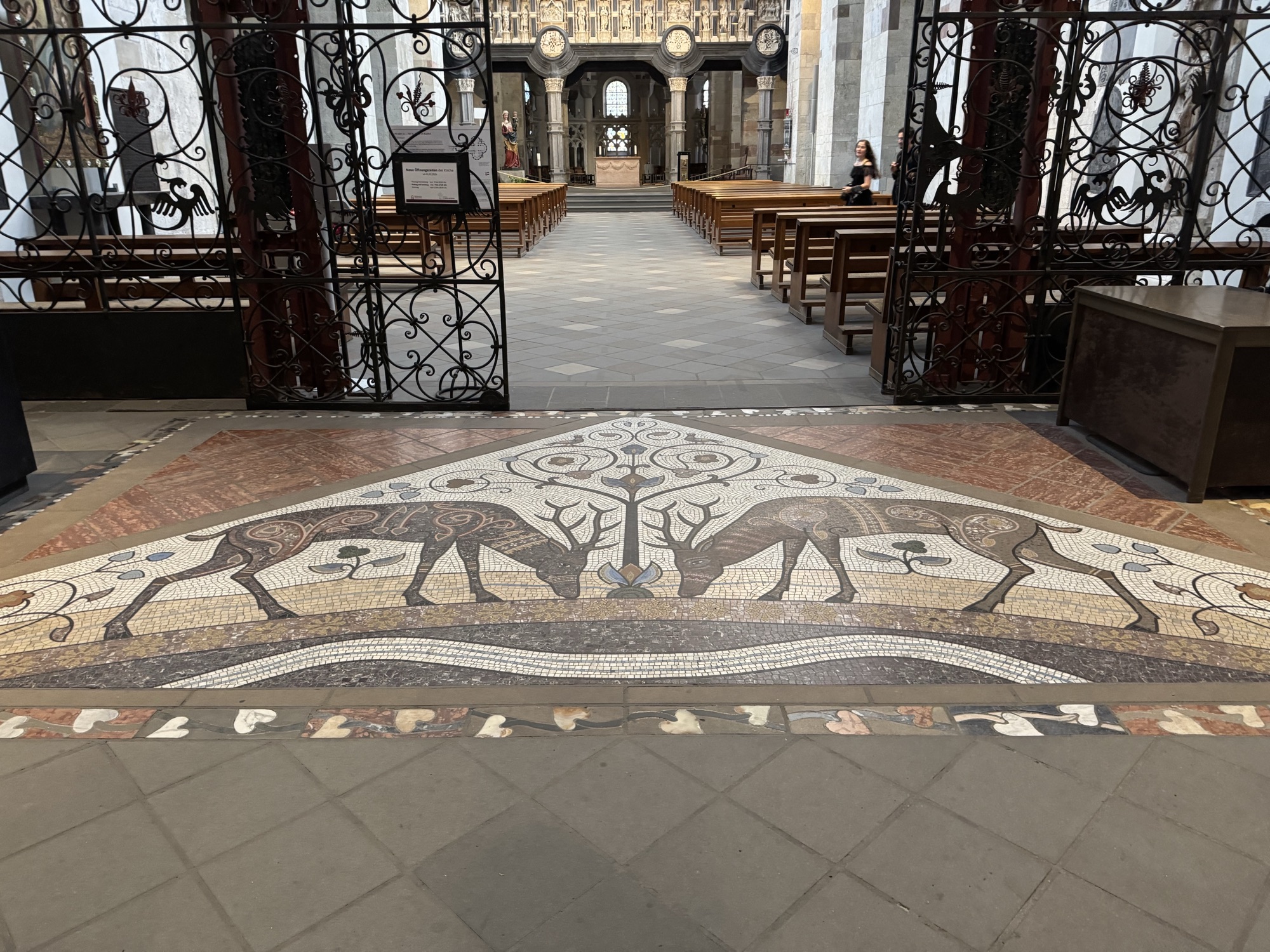
The vestibule mosaic floor is quite spectacular.
The openness and light made the space feel very peaceful.
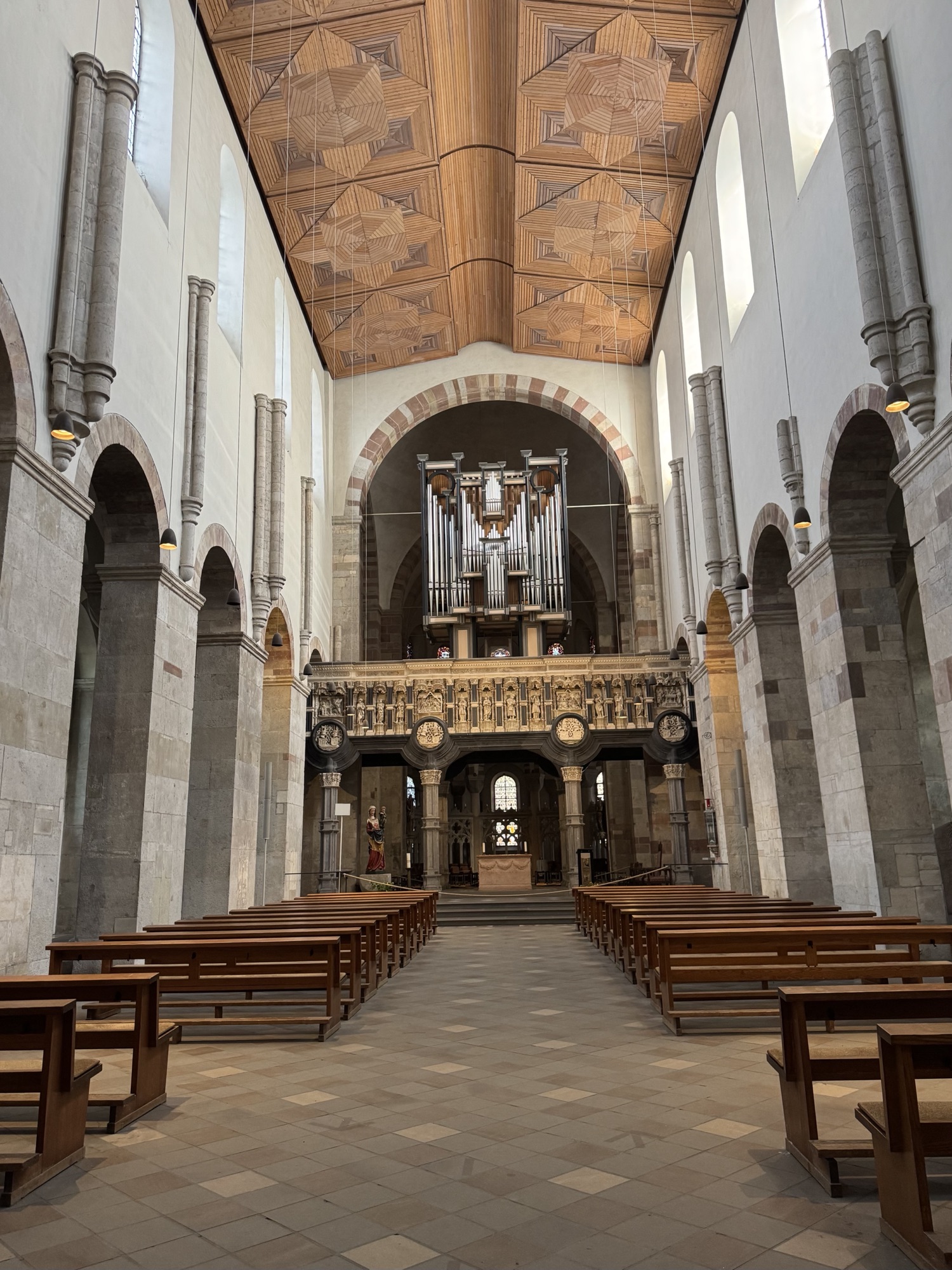
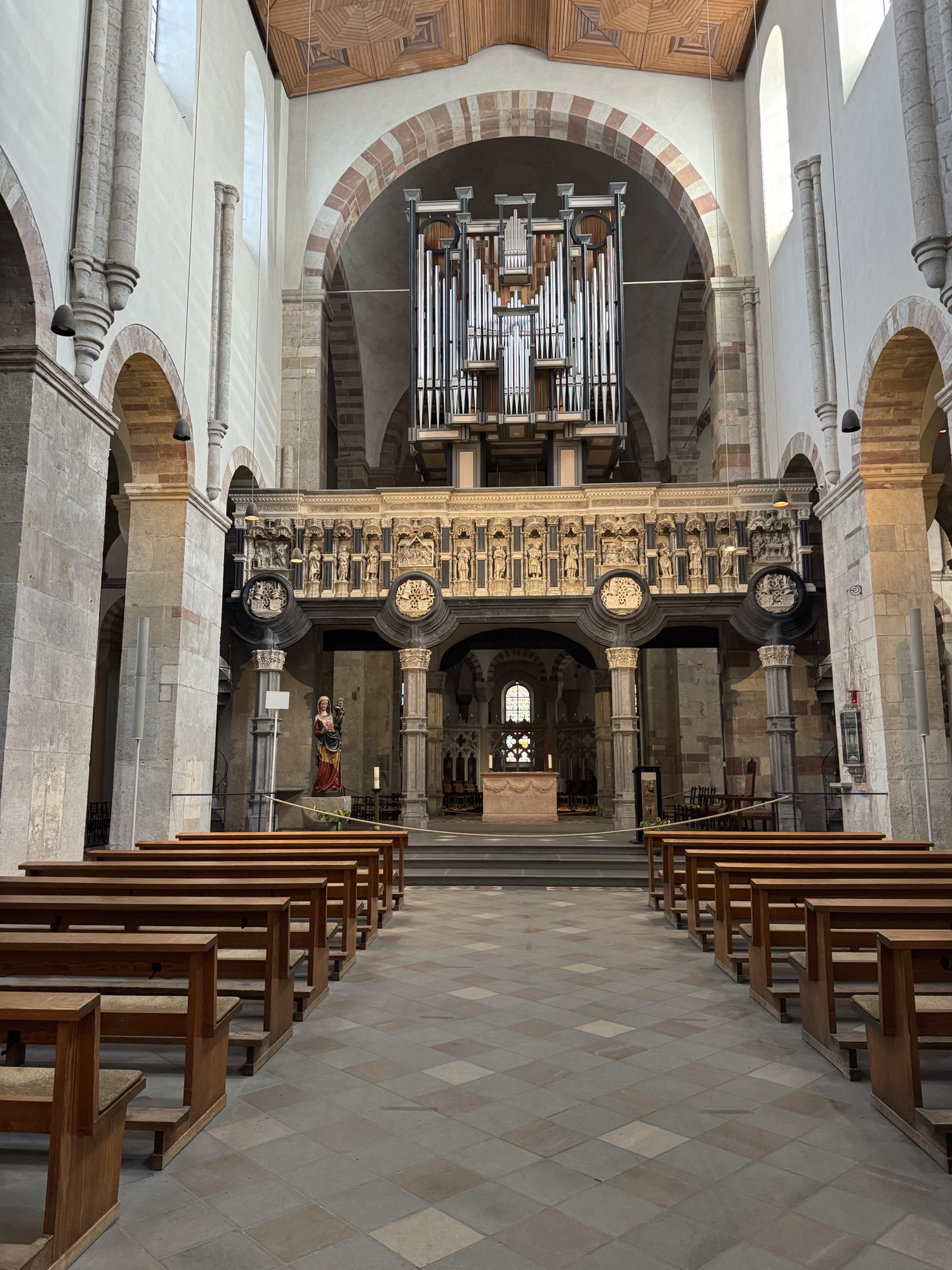
The church’s clean Romanesque lines, with the typical uncomplicated pillars and round arches, were truly lovely, and the bright stained glass windows drew our eyes.
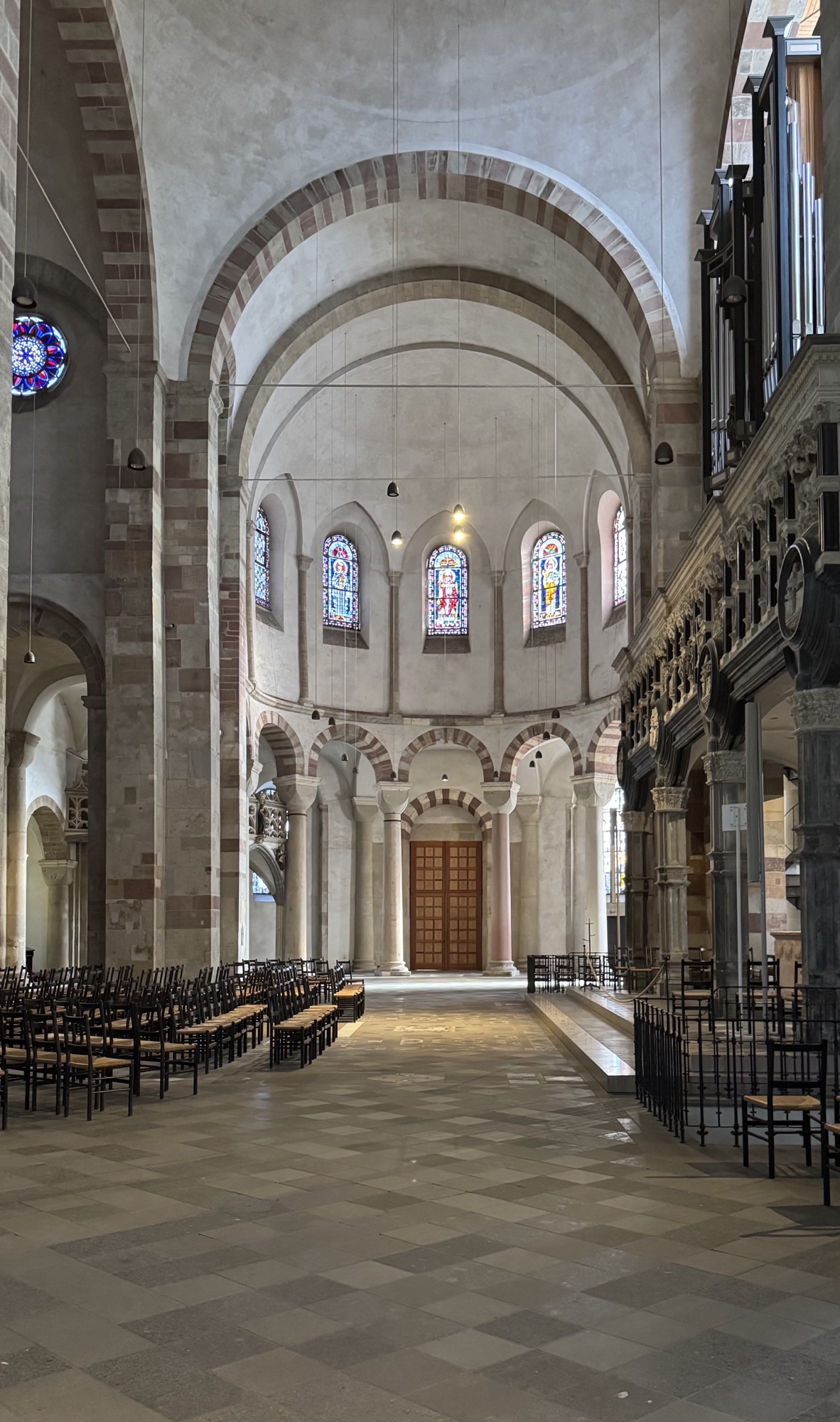
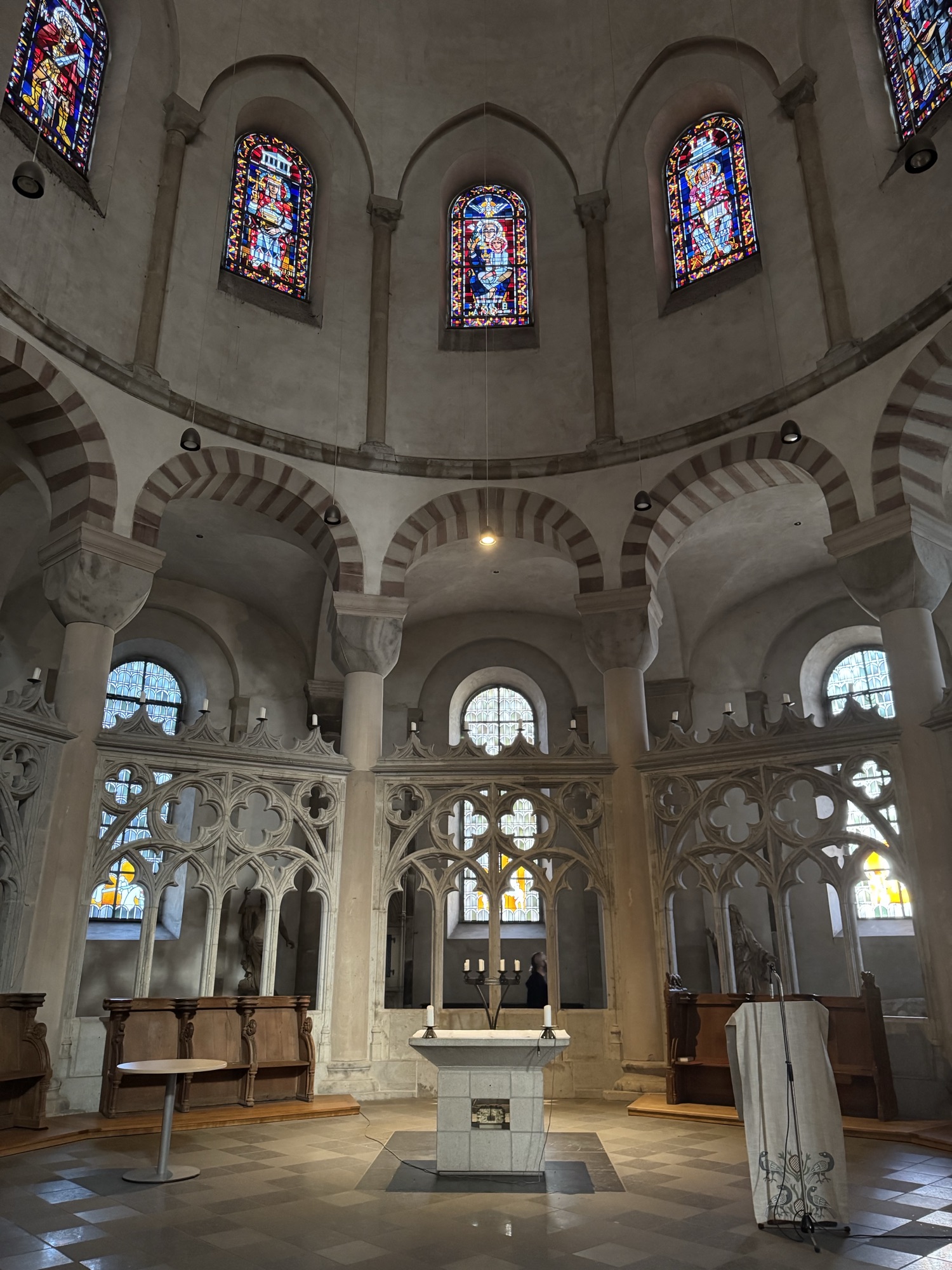
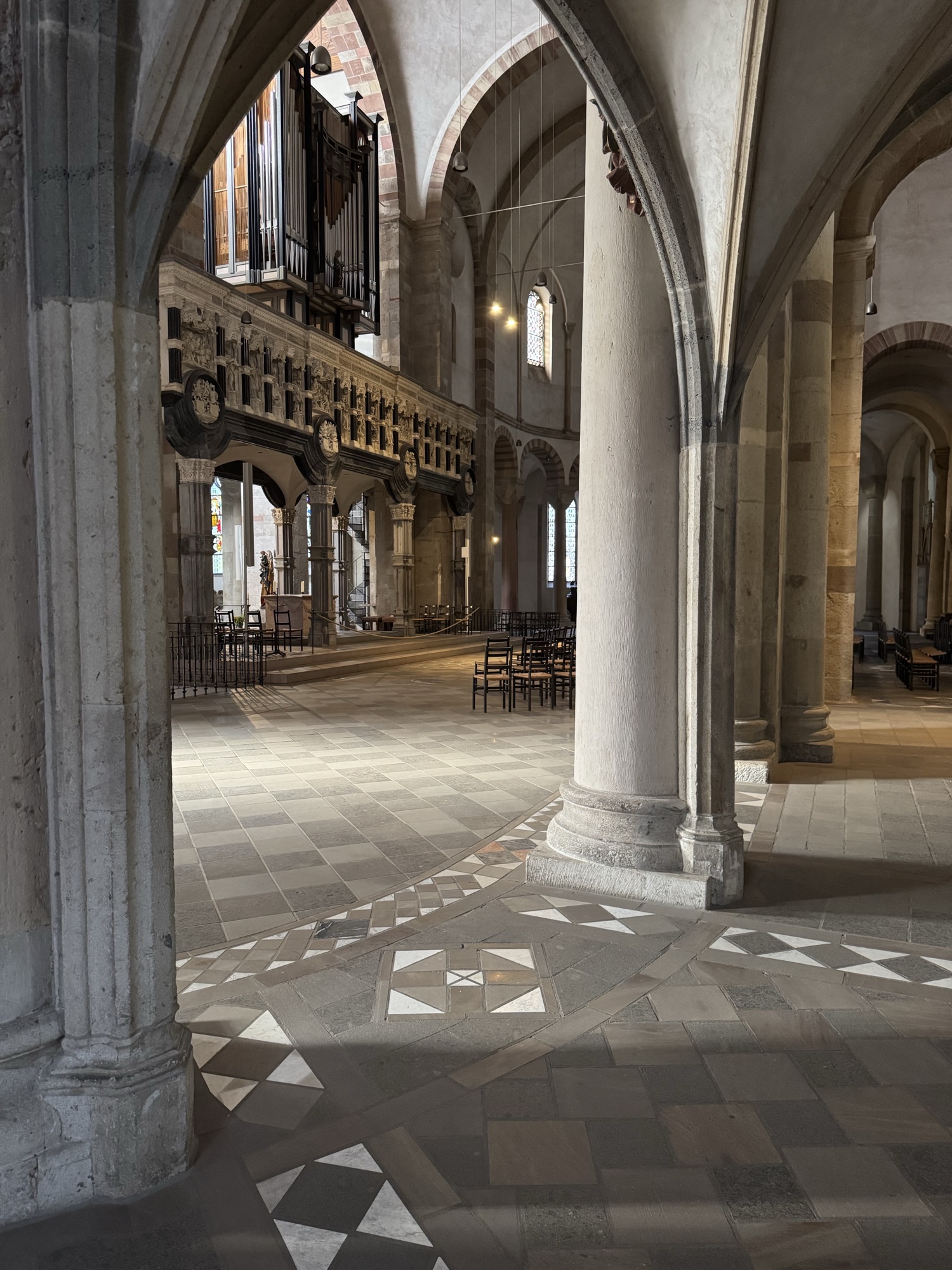
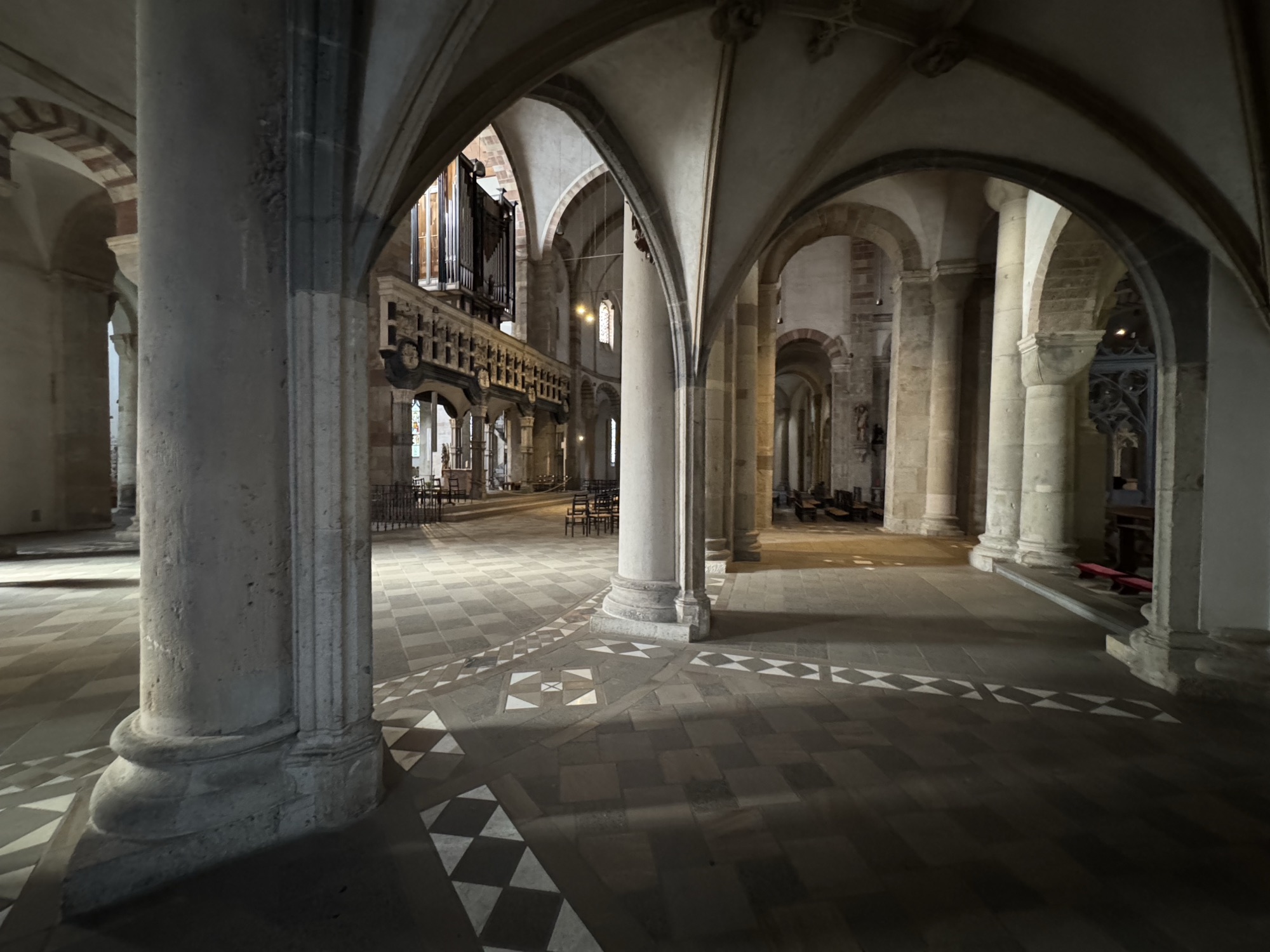
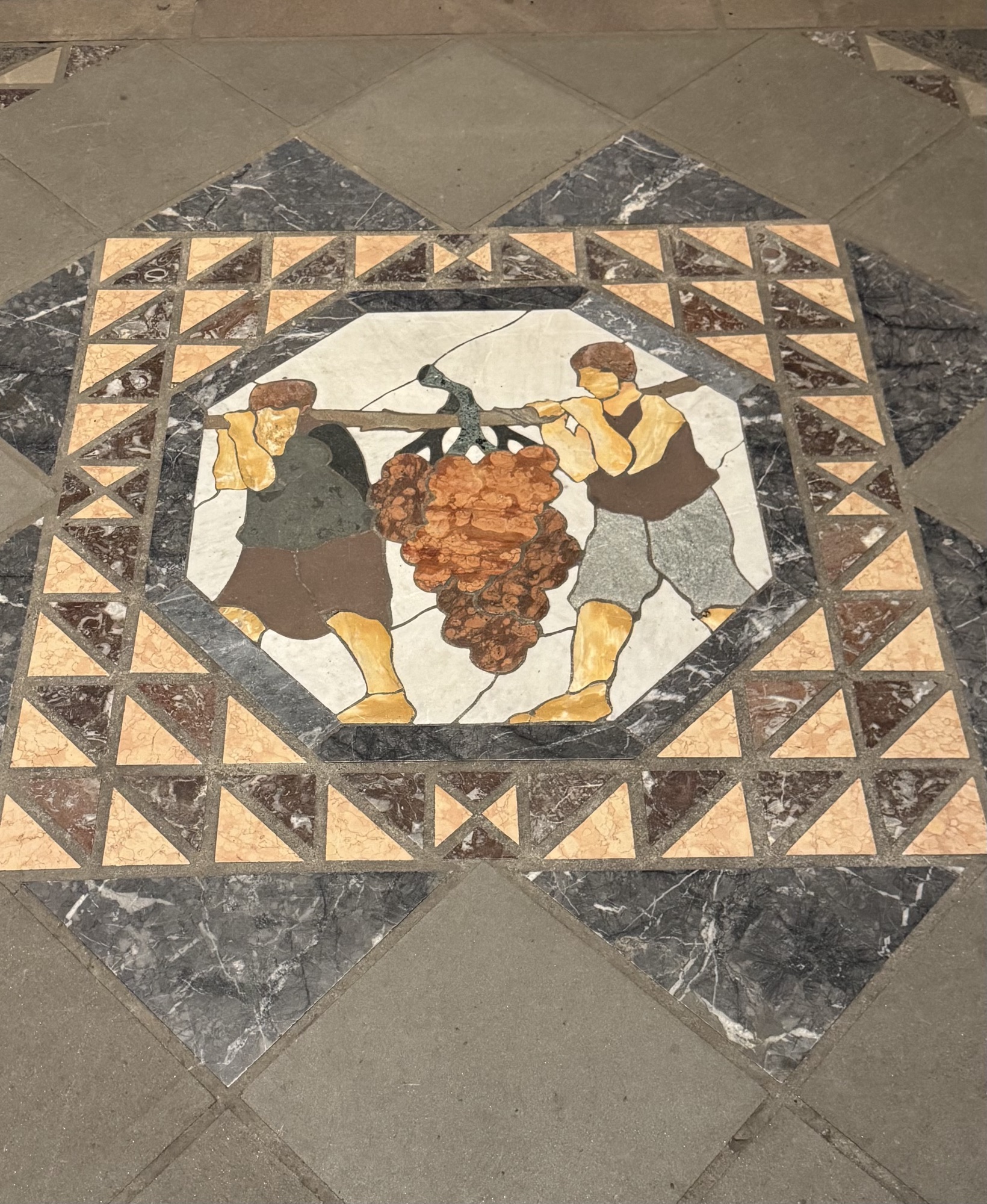
Two of the walls bore the remnants of original frescoes.
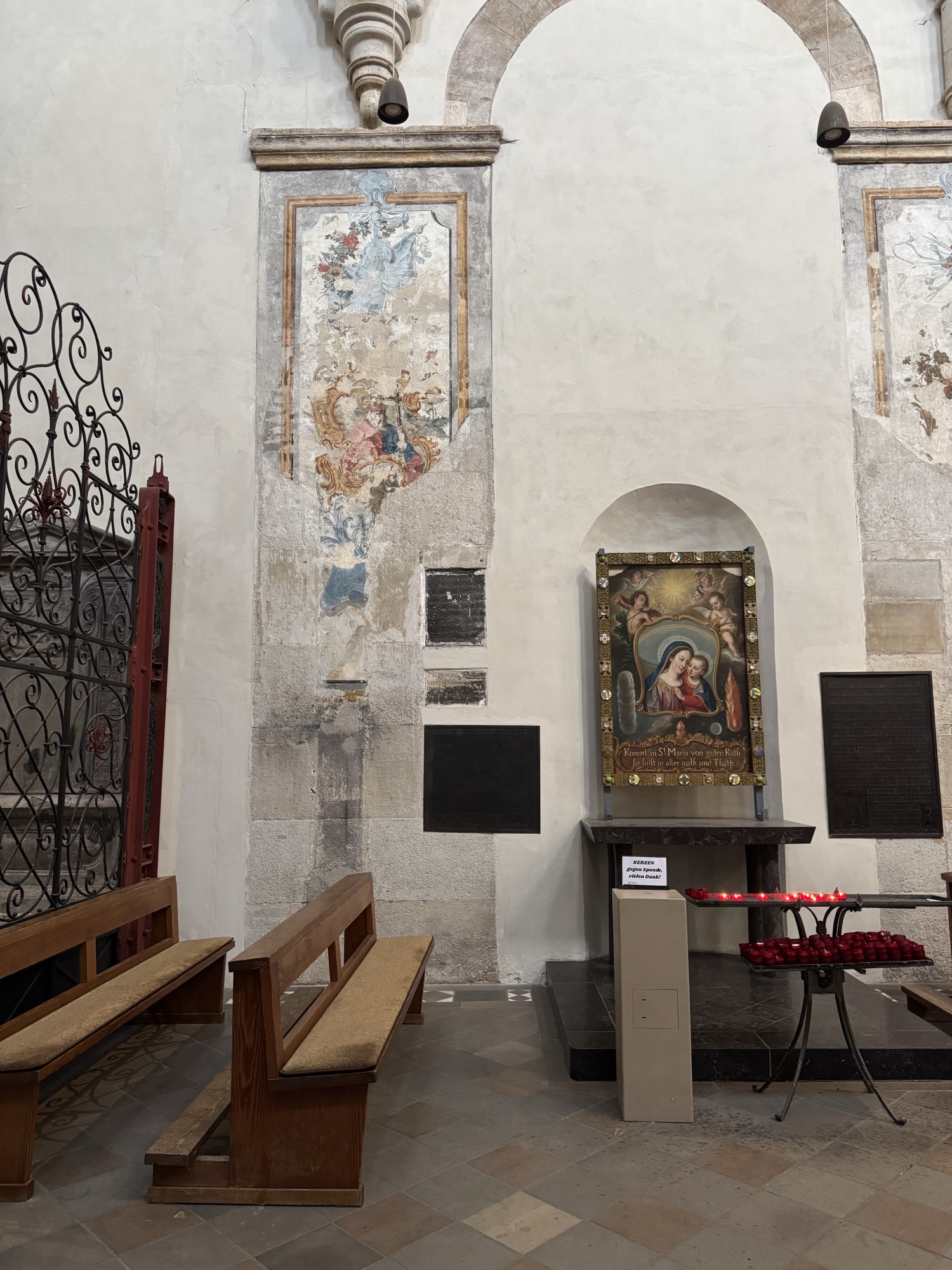
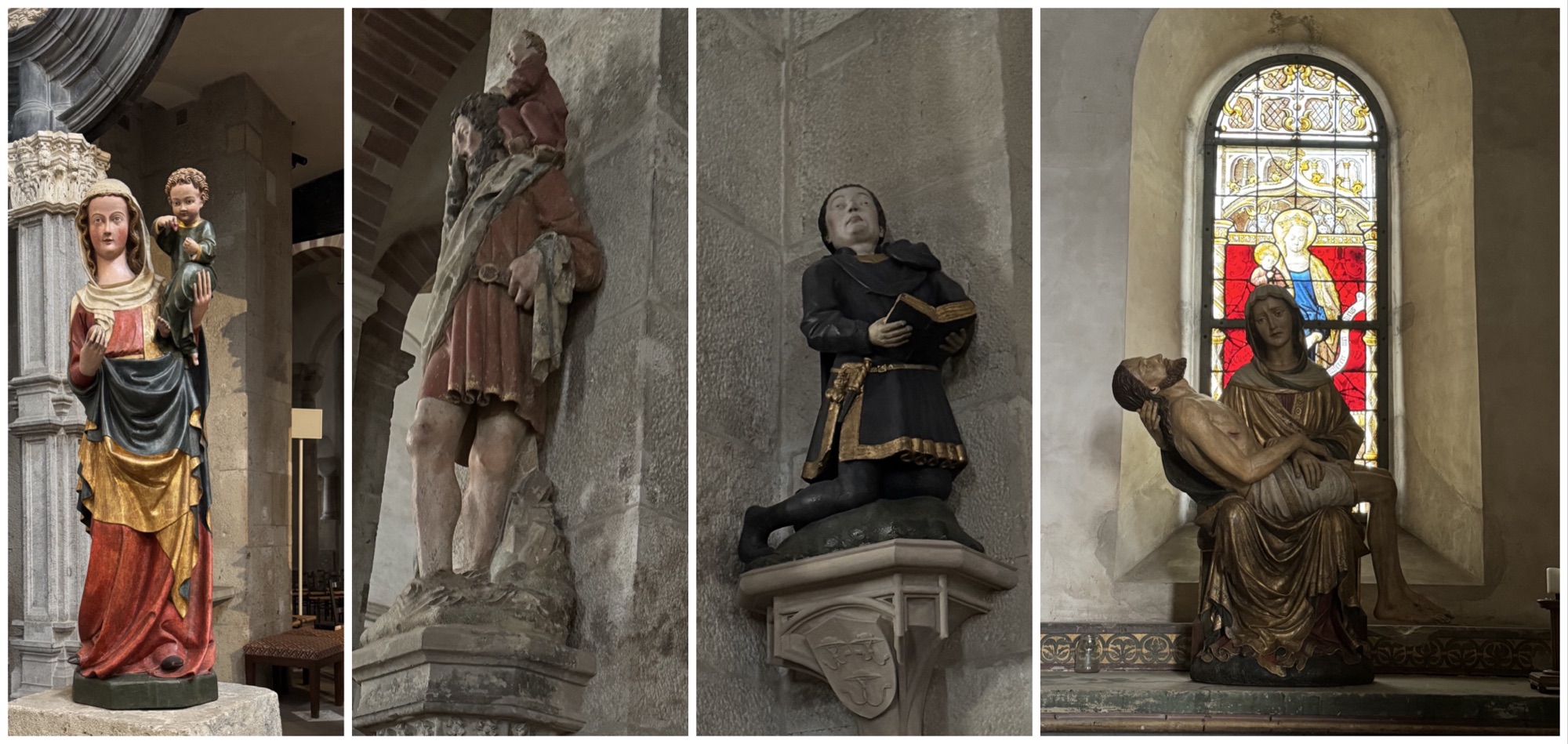
There was minimal iconography or statuary in the church, but what there was was interesting.
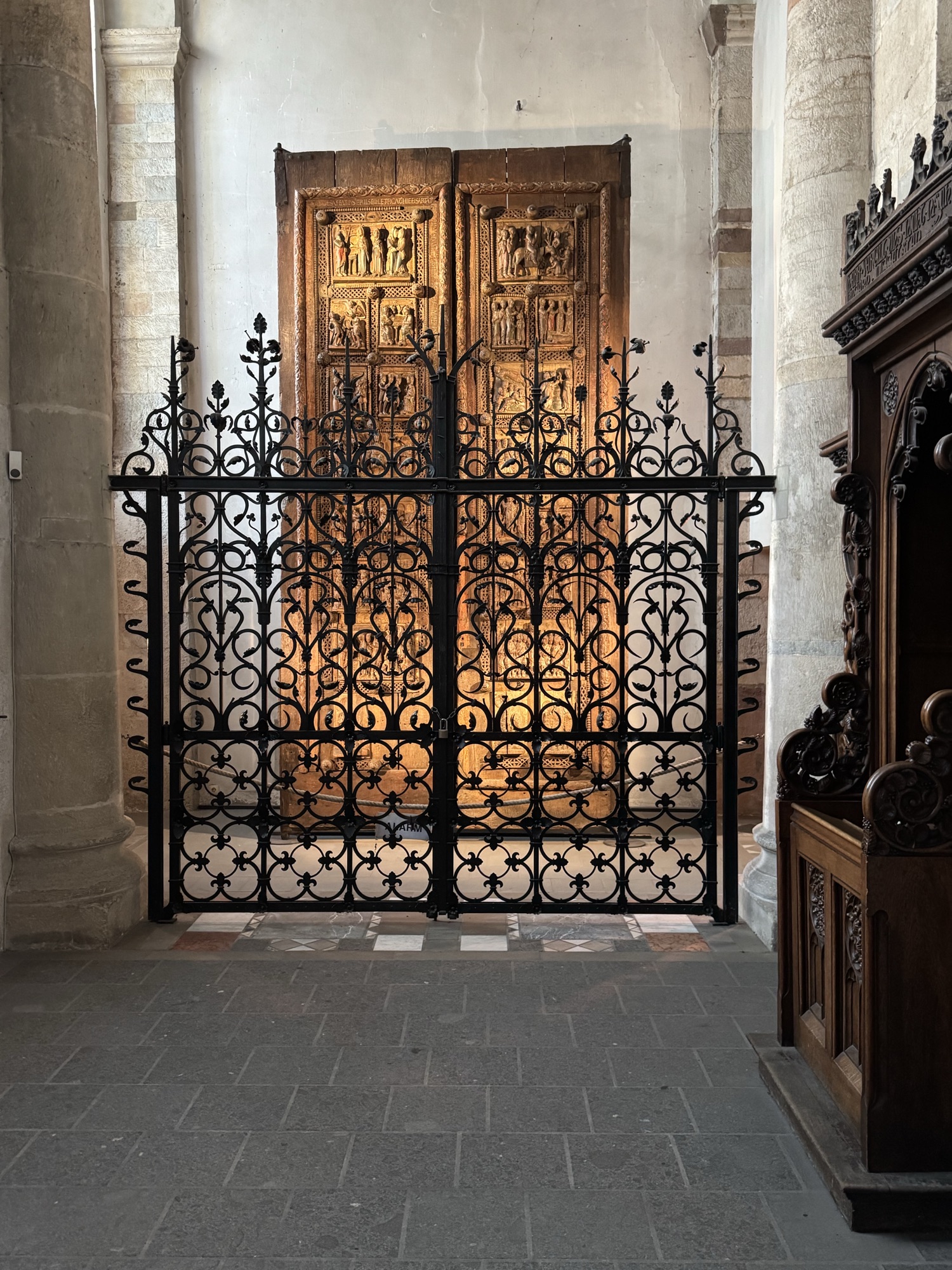
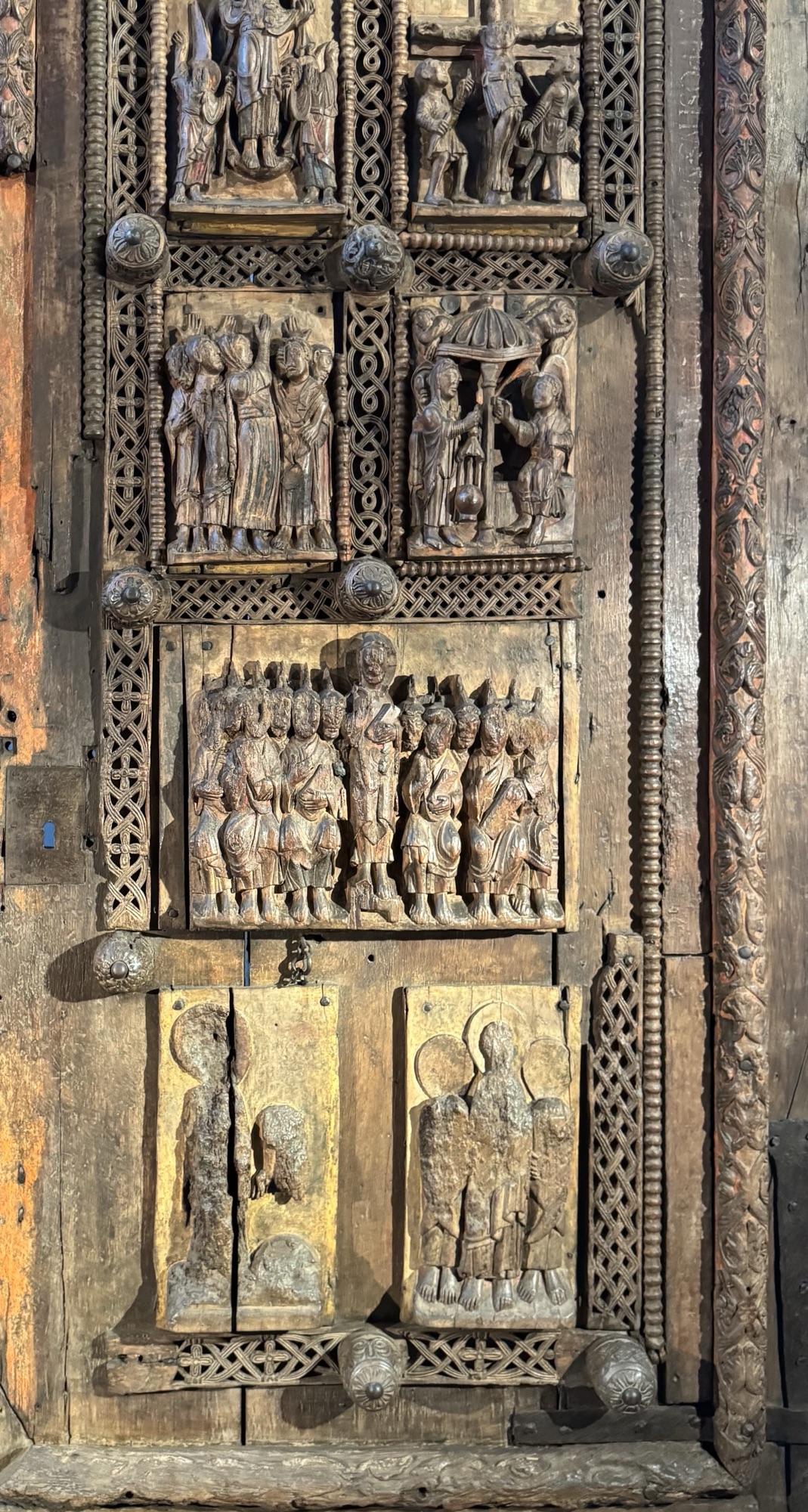
On display inside the church are a set of ornately carved mediaeval wooden doors, purportedly the oldest in the world. Other four surviving doors of the same time period are all bronze. The doors depict scenes from the life of Jesus.
If the church looks in ridiculously good condition for an 11th century building, that’s because most of it isn’t. Around 1802 during the Napoleonic occupation the basilica was “secularized”, which seems to be code for ransacked and damaged. Reconstruction took place in 1882, when a few baroque elements were added. There was extensive damage again during WWII, which was repaired enough between 1952 and 1957 for services to be held inside, but not fully remediated until 1985.
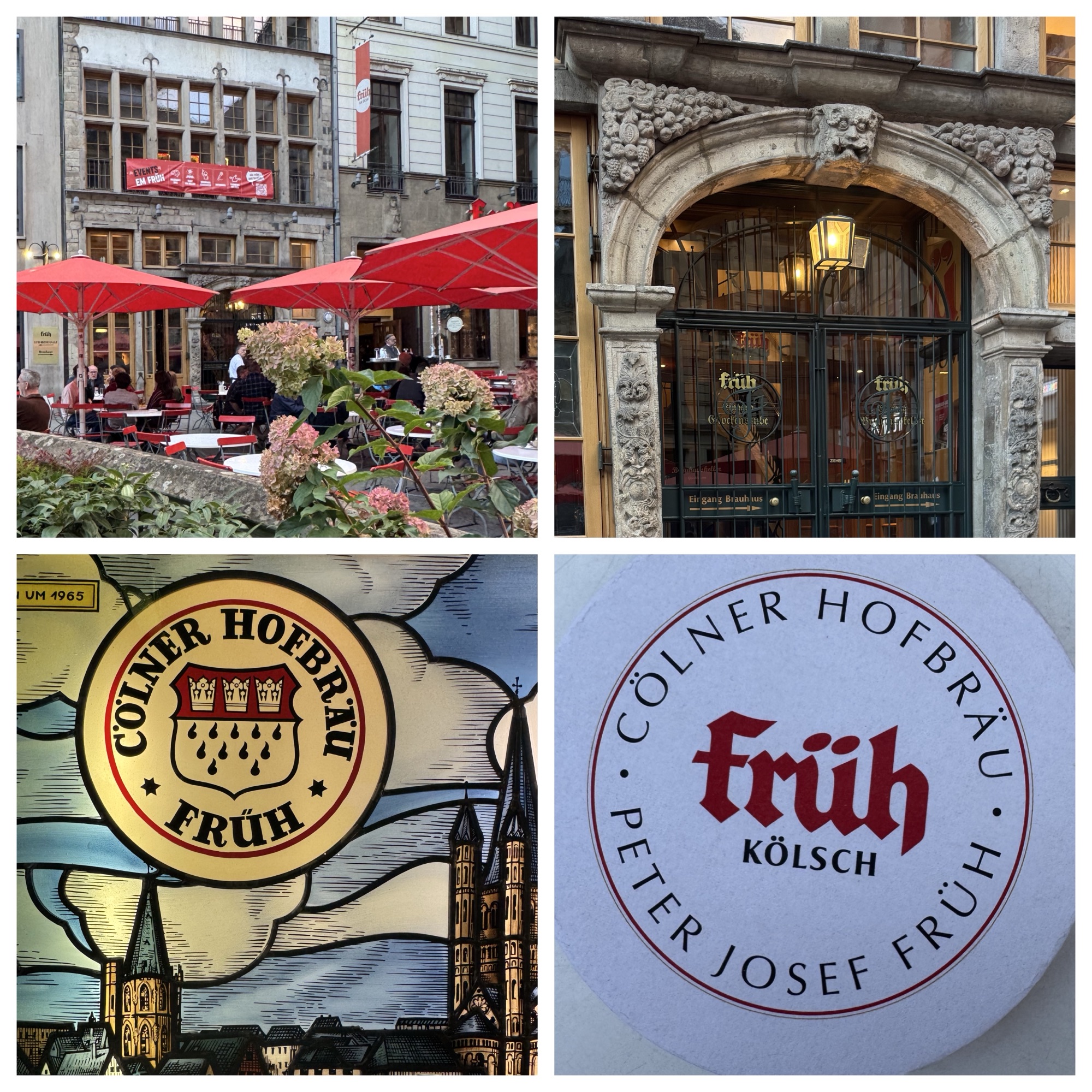
By this time #1 and I both felt as if our brains were overflowing, so all that remained was to fill our bodies. We enjoyed a simple dinner and our third brewery’s edition of Kölsch at the brew pub attached to our hotel.
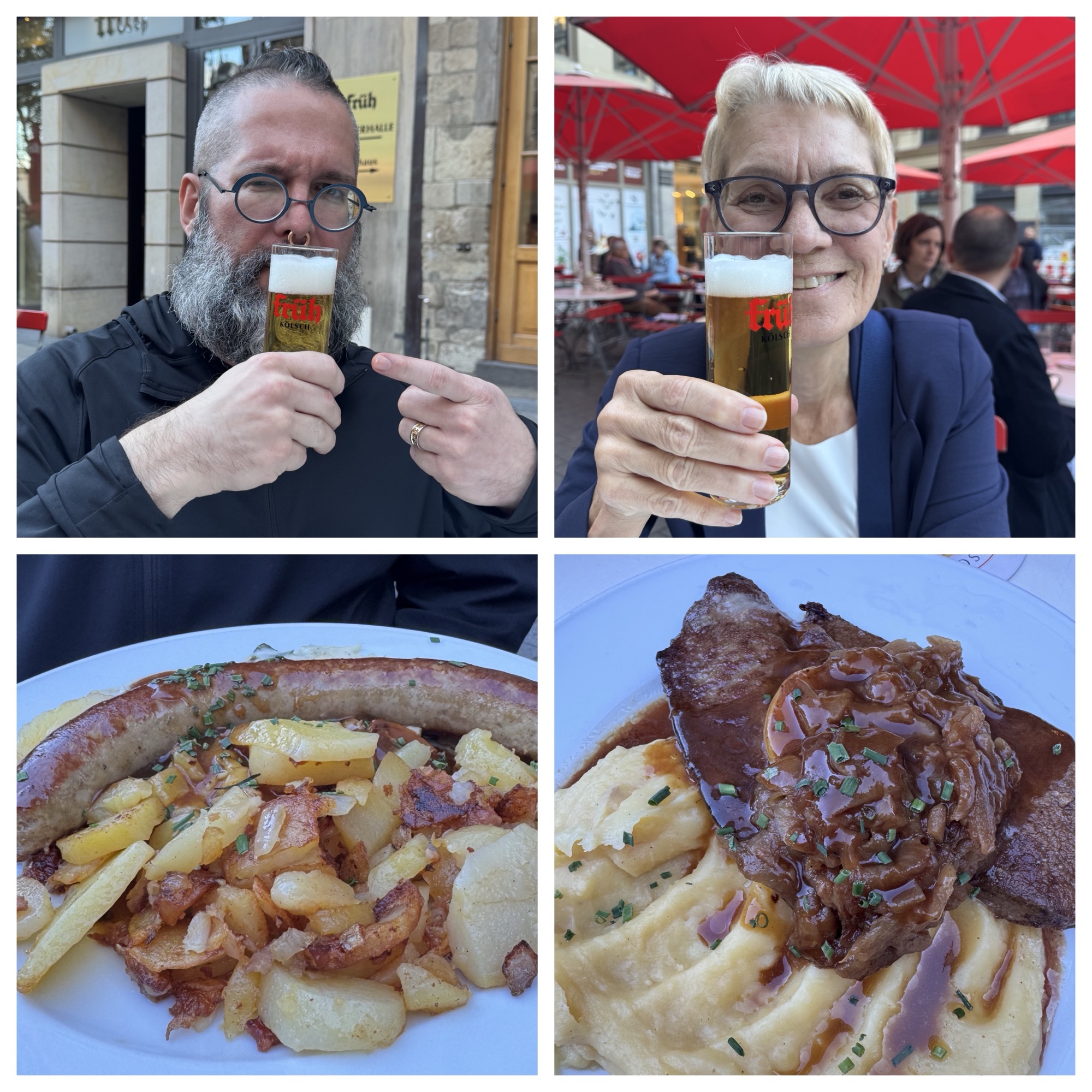
And that’s a wrap. Tomorrow is our last day here, with another new focus on the city.


Sobering. I so admire the way Germany has kept the memory of what happened and continues to work on keeping relevant as the decades and generations pass. It gives me hope that the success of the far right in that election recently won’t spread too far.
LikeLiked by 1 person
LaOn Sep 9, 2026,
LikeLike
Thank you for saying the names. They live on because someone, if only one person, remembers them.
LikeLiked by 2 people