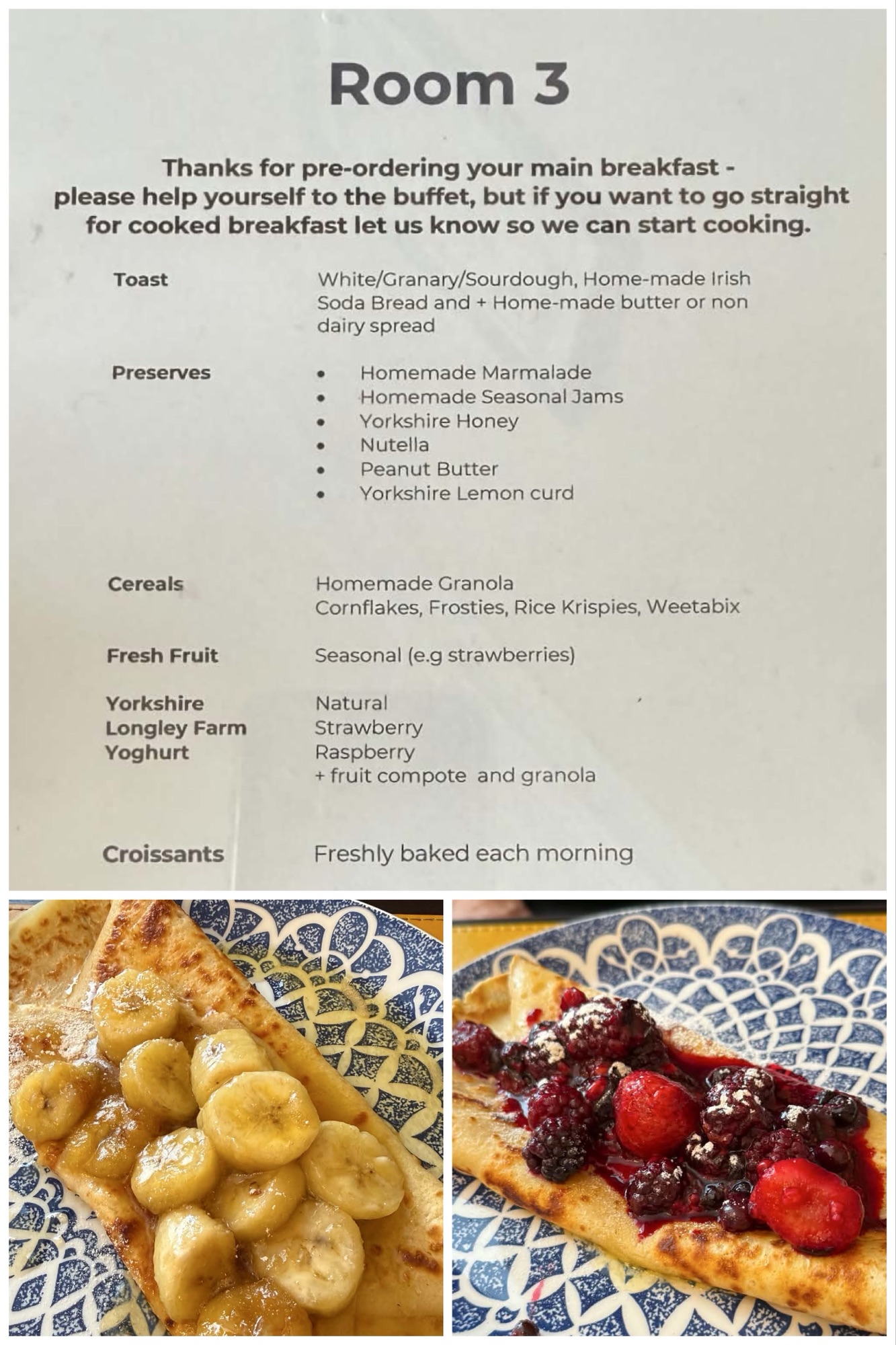
We began today with Paul’s breakfast special of crepes with either warm berries or caramelized bananas. Fiona has noticed that we always order the day’s special, but they’ve been consistently more attractive to us than the heavy “full English” that is always an option.
While we were in Warsaw, Ted found a YouTube documentary about the Treasurer’s House here in York, which inspired me to pre-order entry tickets.
Our visit today was yet another example of why we so enjoy guided tours, although in this case there was no other way to access the property’s interior.
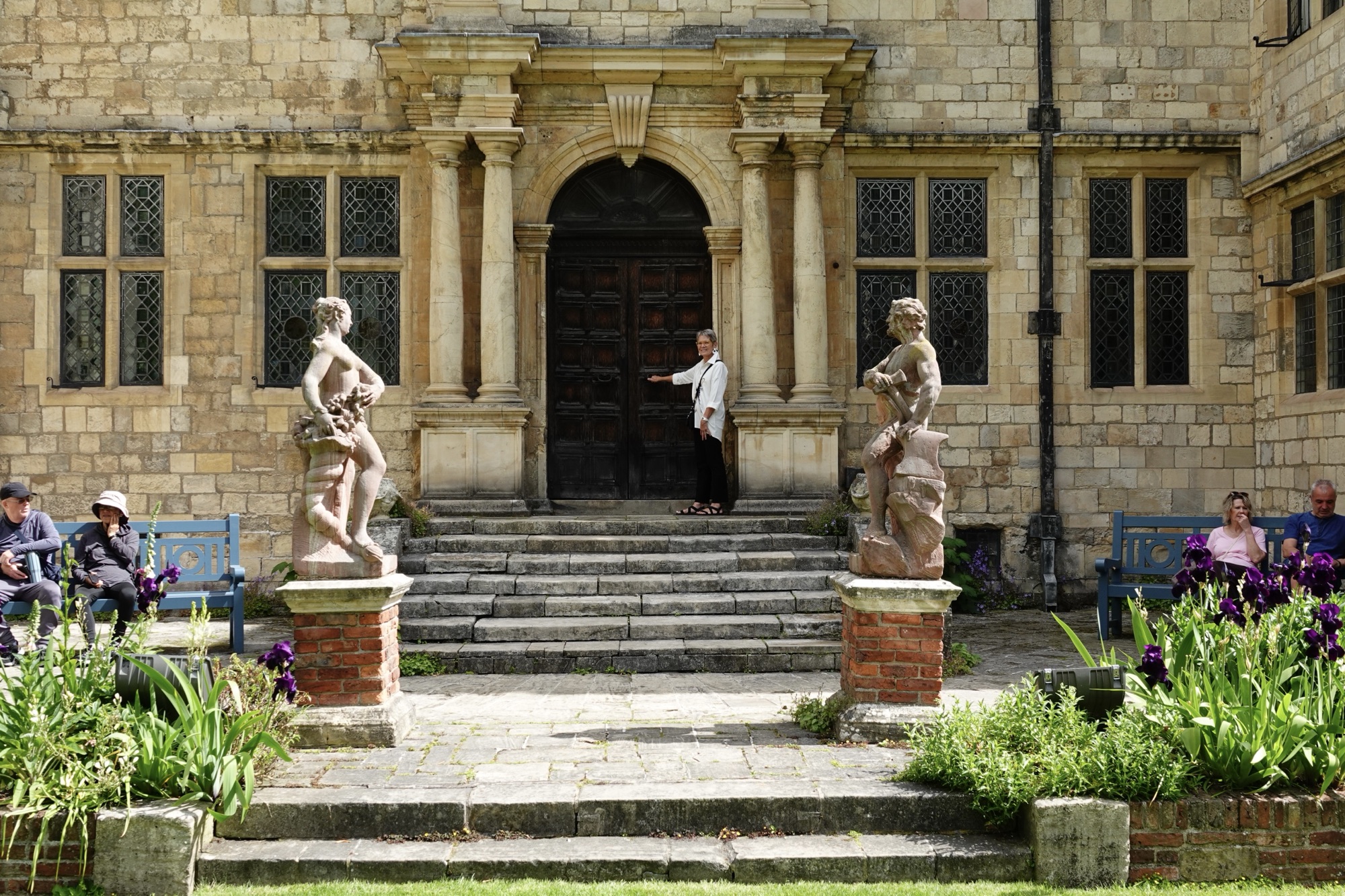
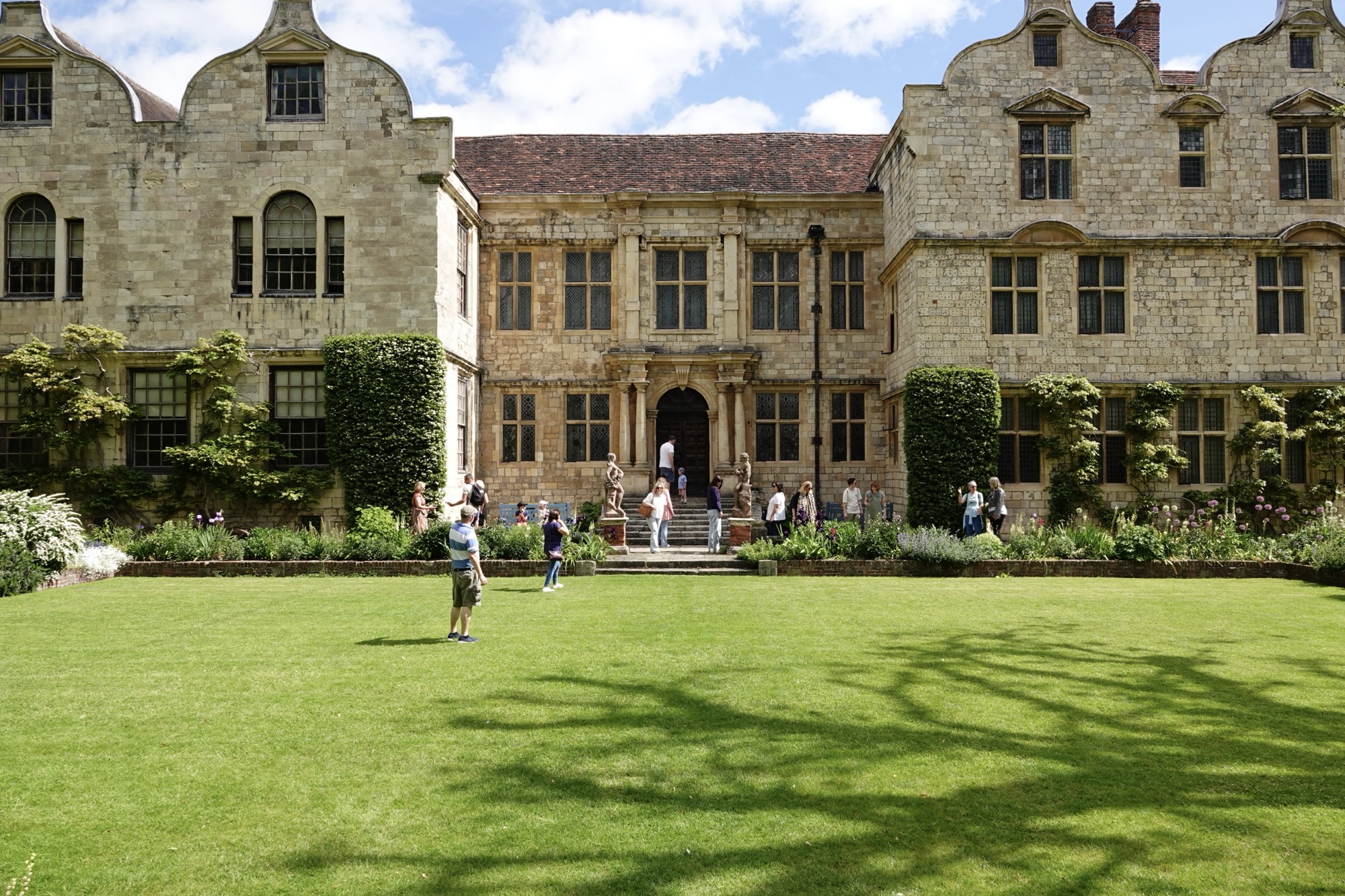
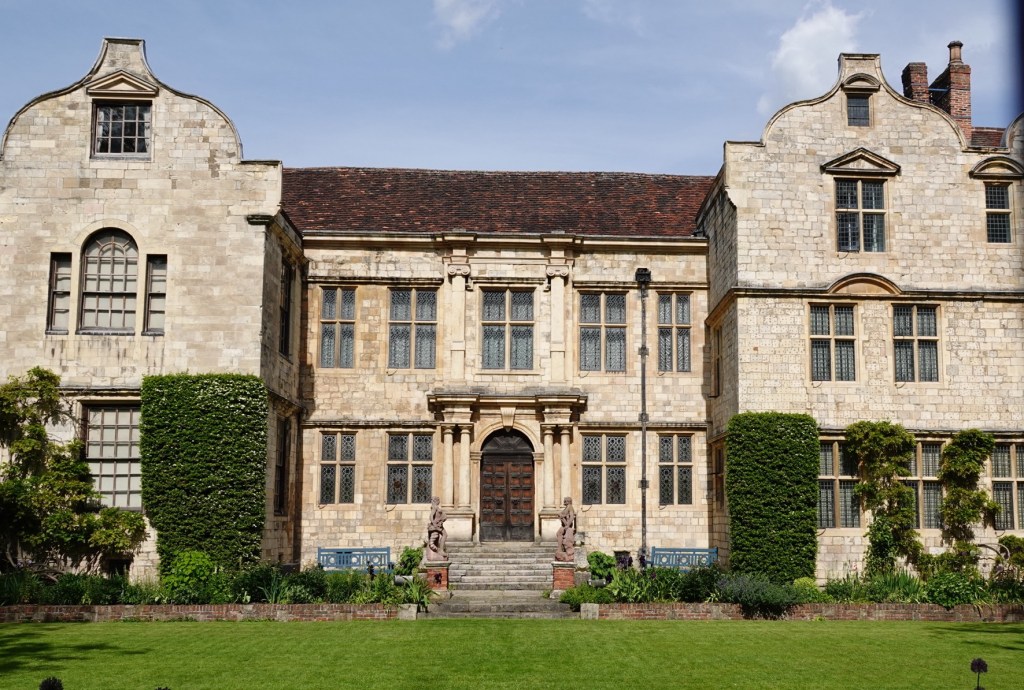
The house, originally the site of York Minster’s Treasurer, was built in the 14th-15th century to replace a former wooden one. It is located directly over the Roman Road, as is much of York itself.
This great mansion was where the Treasurer of the Minster lived. During the Middle Ages the Treasurer oversaw the money and treasures of the then Roman Catholic Minster and was second only to the Minster Dean.
The office of Treasurer was abolished in 1547, part of the Reformation of the Church under Henry VIII. By then, the mansion was already “much in decay” and was purchased by the Archbishop of York. Over the next centuries it was a private residence, and by 1725 was subdivided, eventually into 5 properties.
In 1897, three of the five properties were bought by Francis William(Frank) Green, the grandson of a wealthy industrialist, and by 1900 he had transformed it at great speed into an elaborately decorated town house, ready for the visit of royalty. He wanted to buy all five, but was thwarted by the Grey family who already owned the other two and were not willing to sell. Their holdings are now the very posh Grey’s Court Hotel.
Everything now in the house was chosen by Frank Green. When he eventually chose to move elsewhere, around 1930, he donated the house and its contents to The National Trust. That alone makes it somewhat unique, since most NT properties come to them because their owners cannot afford to pay the death duties owed on them.
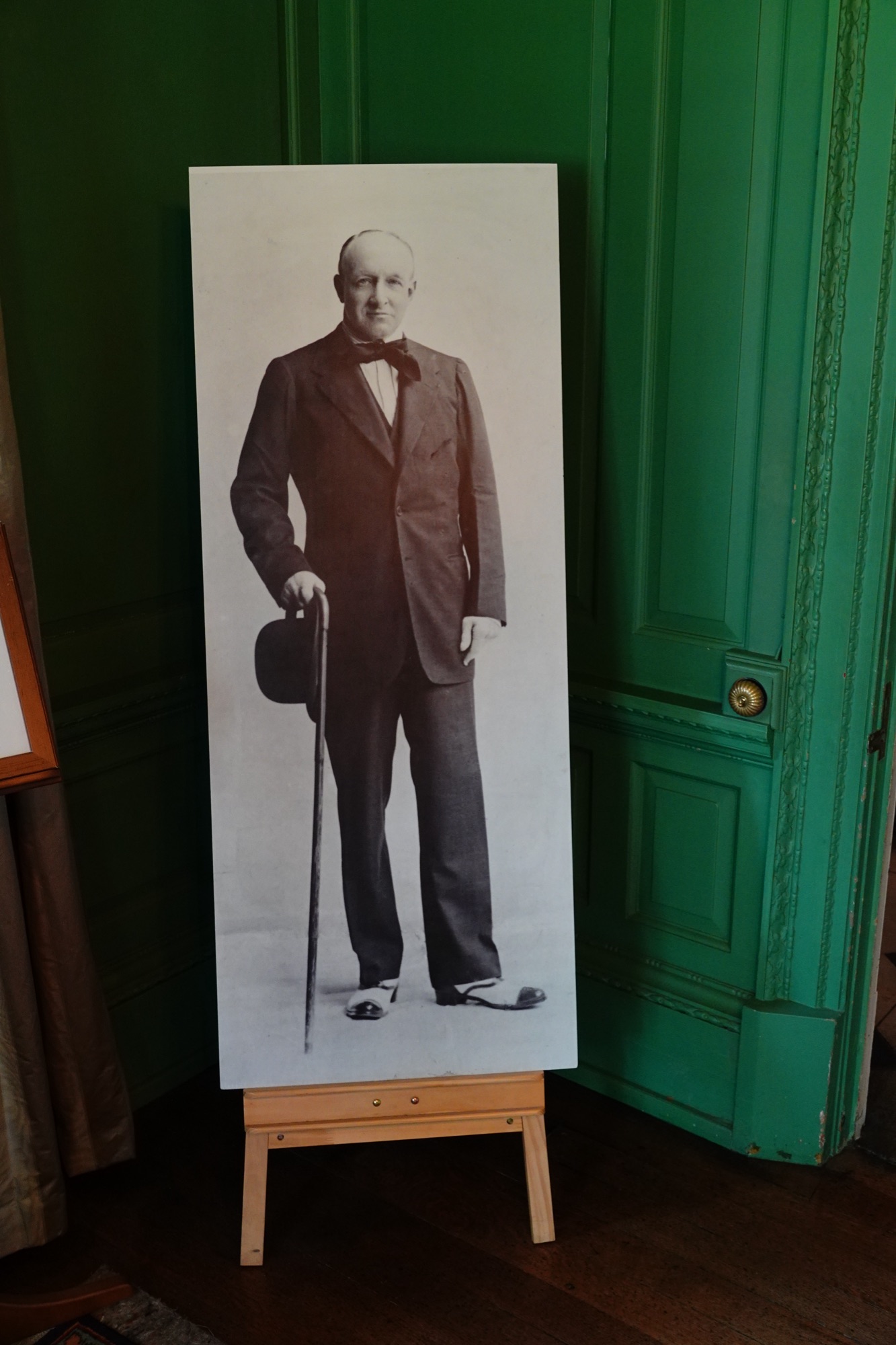
Our guides in the house were Yvonne and Duncan.
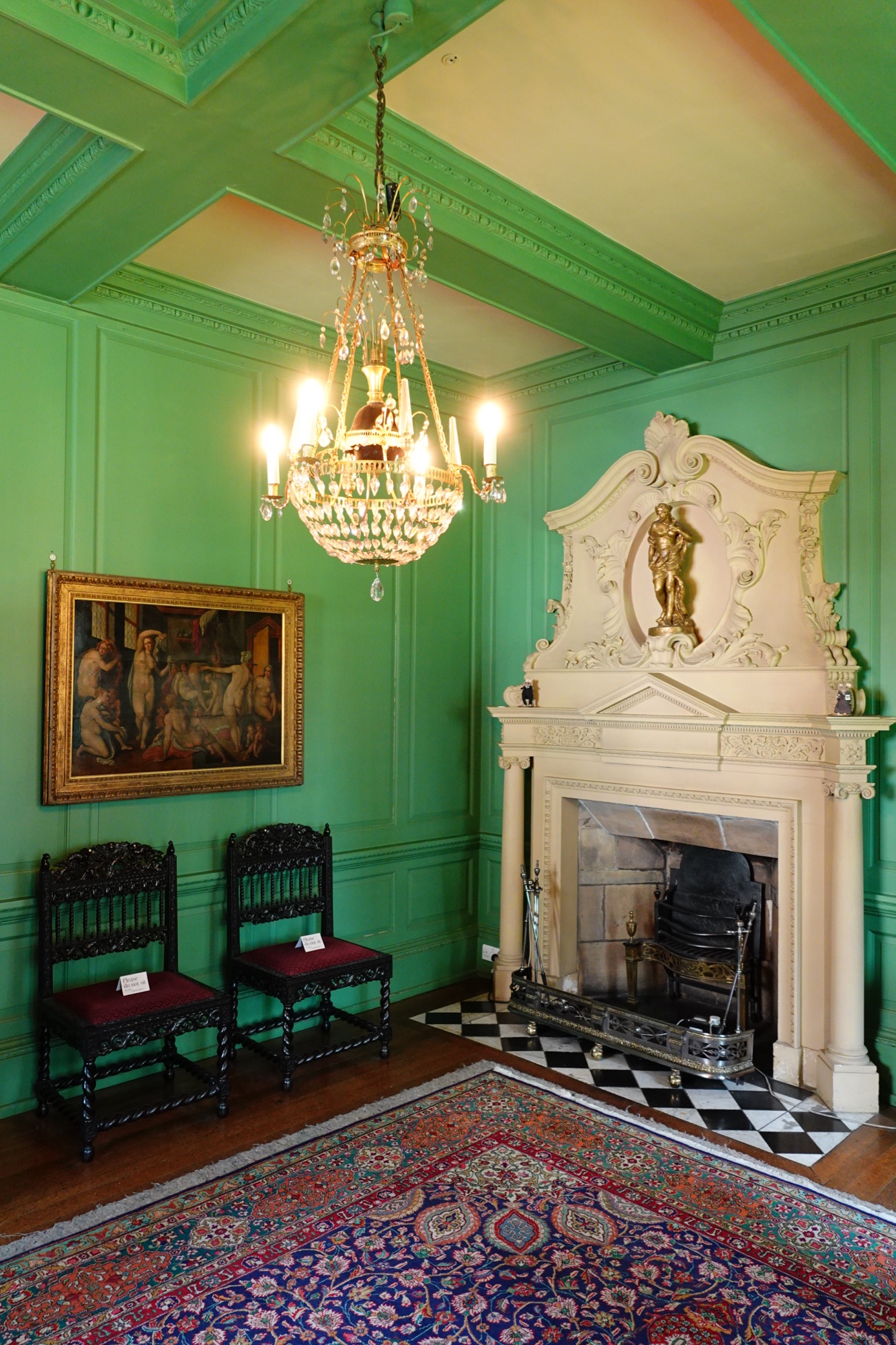
We began our tour in a room that may have served as a study, notable for its ornately carved ebony chairs and huge fireplace.
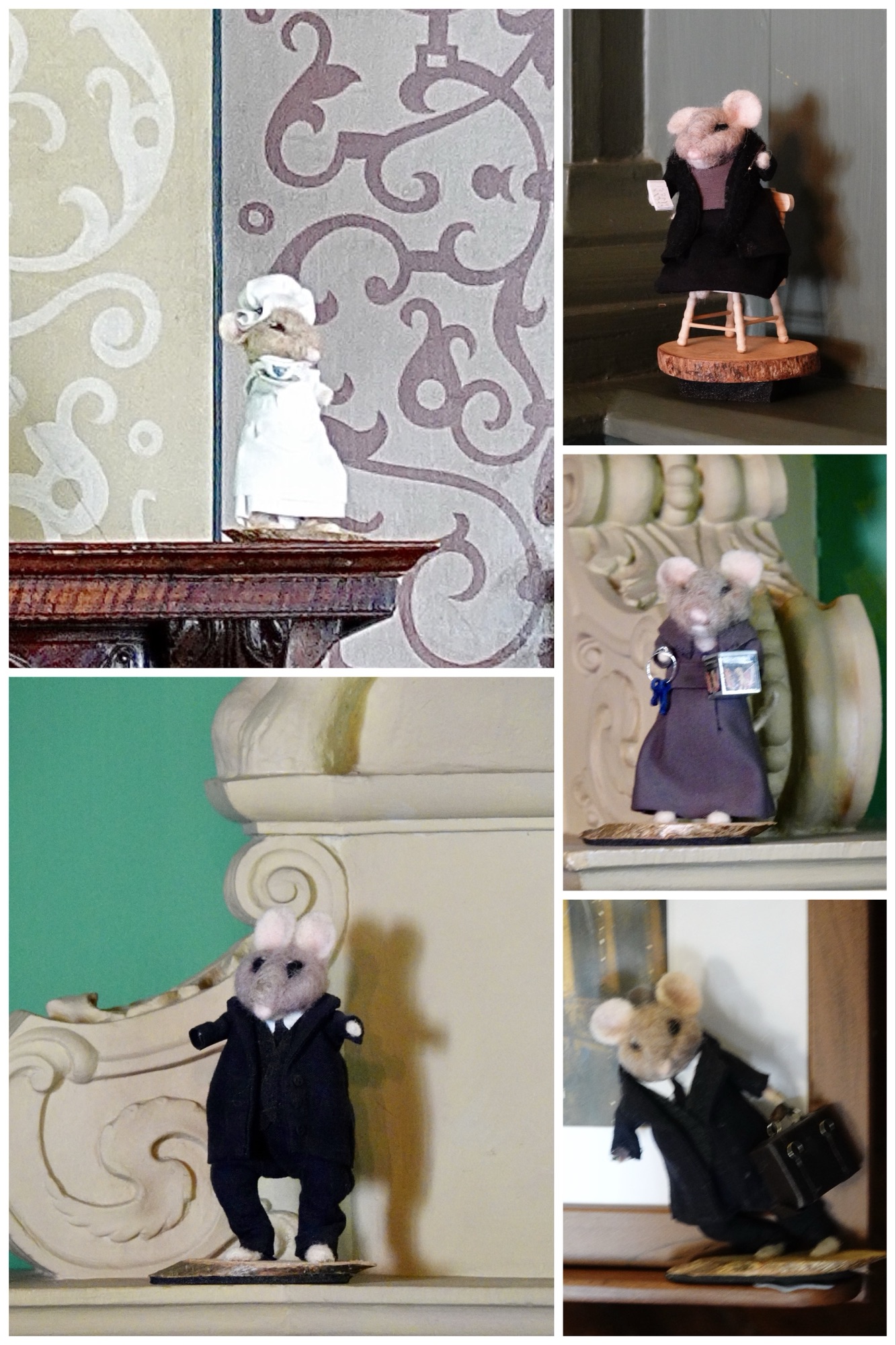
Here we saw the first of many clothed felted wool mice that appear in the house. They were made by a National Trust volunteer to form part of a children’s tour “mouse trail”. Each one represents a members of staff that worked here.
A hidden door in the study led to what was probably a private telephone room.
In Frank Green’s private dining room we learned that his family made its money through designing and then manufacturing“economizers” in a factory in Wakefield. These were essentially innovative hot water heaters that used the excess heat from fireplace flues. They became millionaires. Apparently when Frank’s father was introduced to the Queen at the Great Exhibition at the Crystal Palace, she asked what the device emitted, and he replied “champagne and furs”.
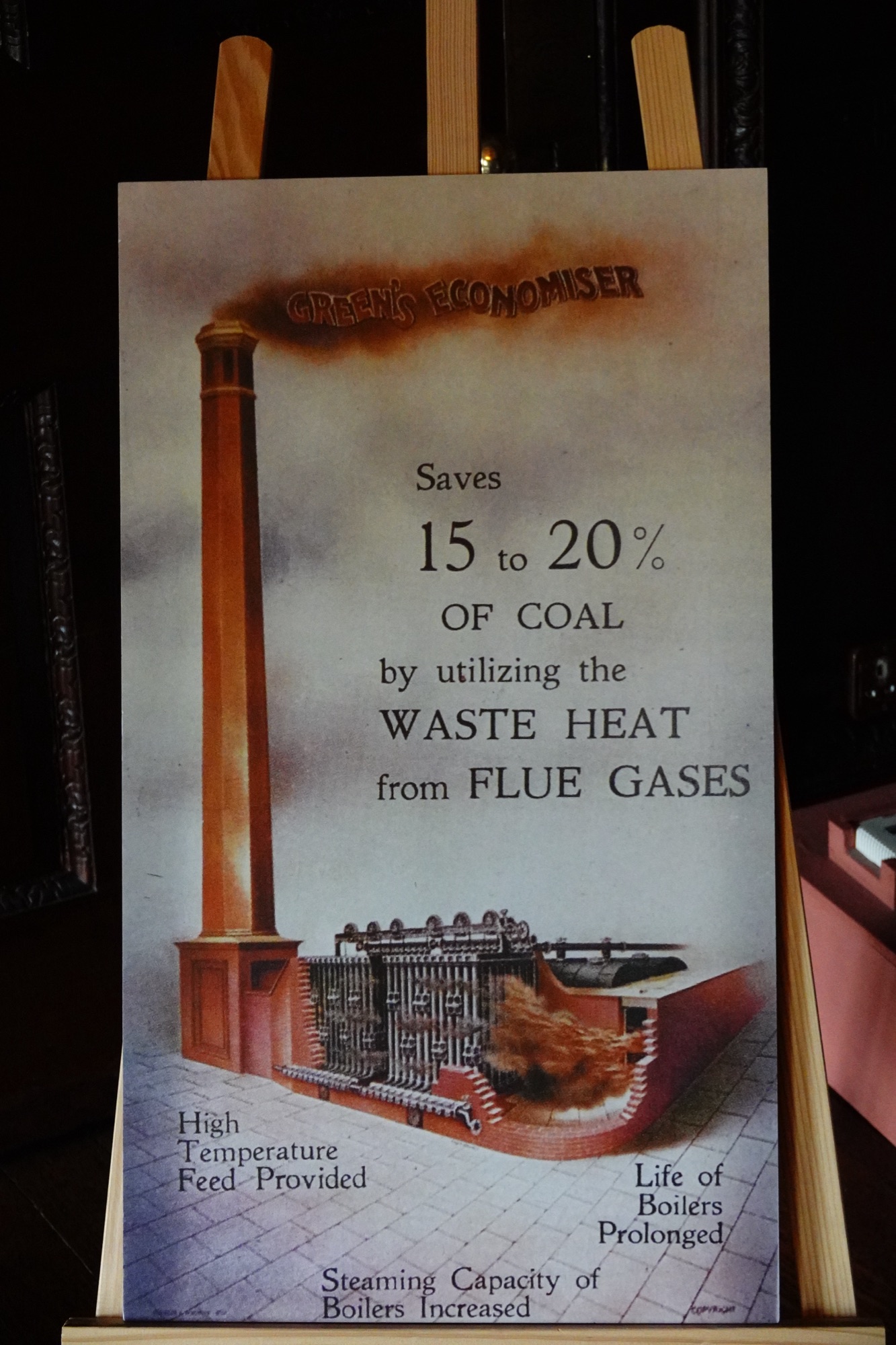
Duncan told me that while Frank’s grandfather and father were the ones making the family “nouveau riche”, it was his mother who worked to raise their social status. Frank and his elder brother were schooled separately: one at Eton and Oxford, the other at Harrow and Cambridge. That was not for academic reasons, but to ensure that they met all the right people.
Mrs. Green also influenced her husband to buy an estate near Sandringham, specifically to ensure proximity to the royal family, since it was the preferred residence of the Prince and Princess of Wales. It was well known that the Prince of Wales (“Bertie”), later Edward VII, was a bit of a socialite, and quite happy to associate with new money as long as it afforded him a suitable level of luxury in its entertainments.
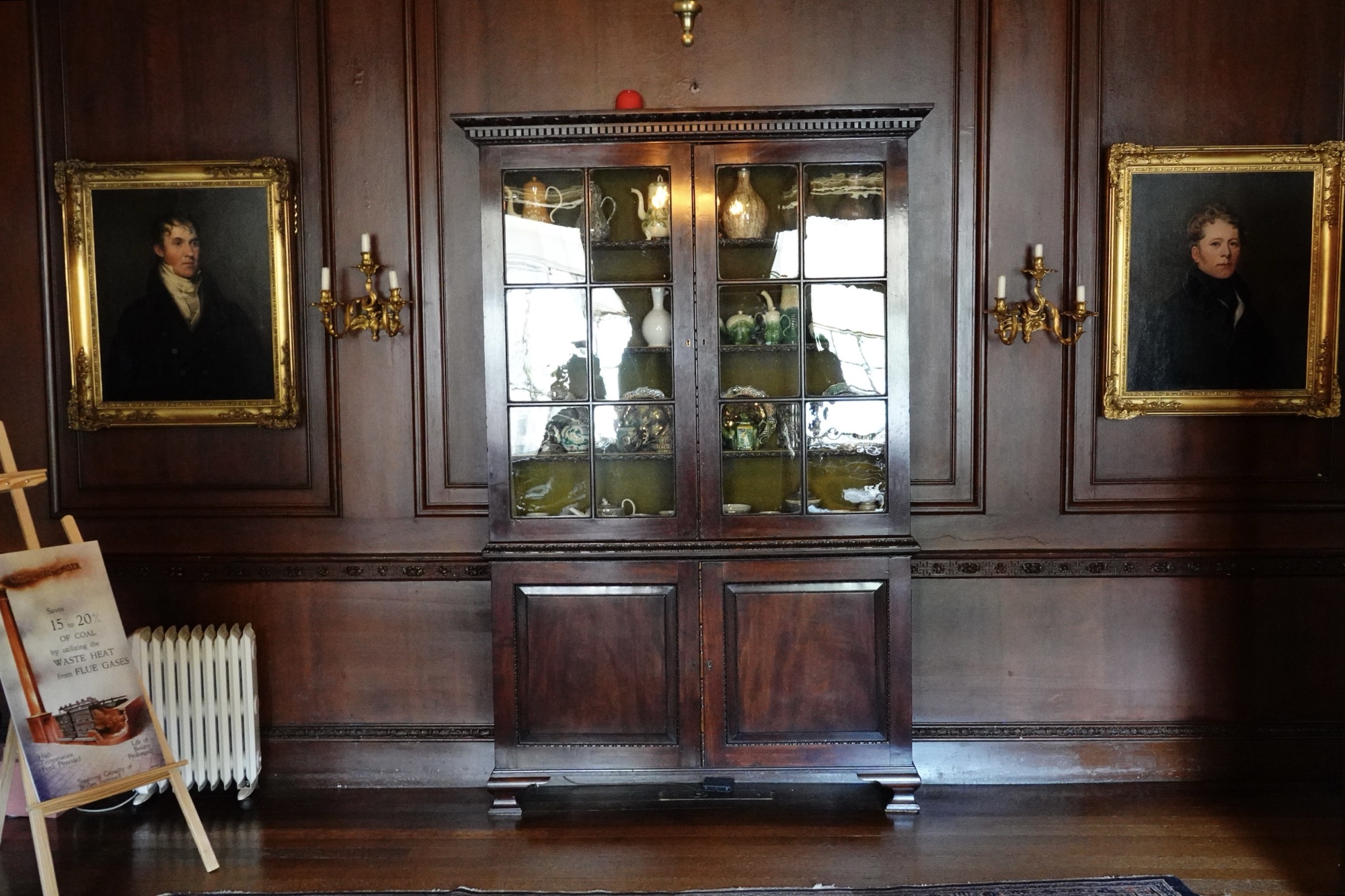
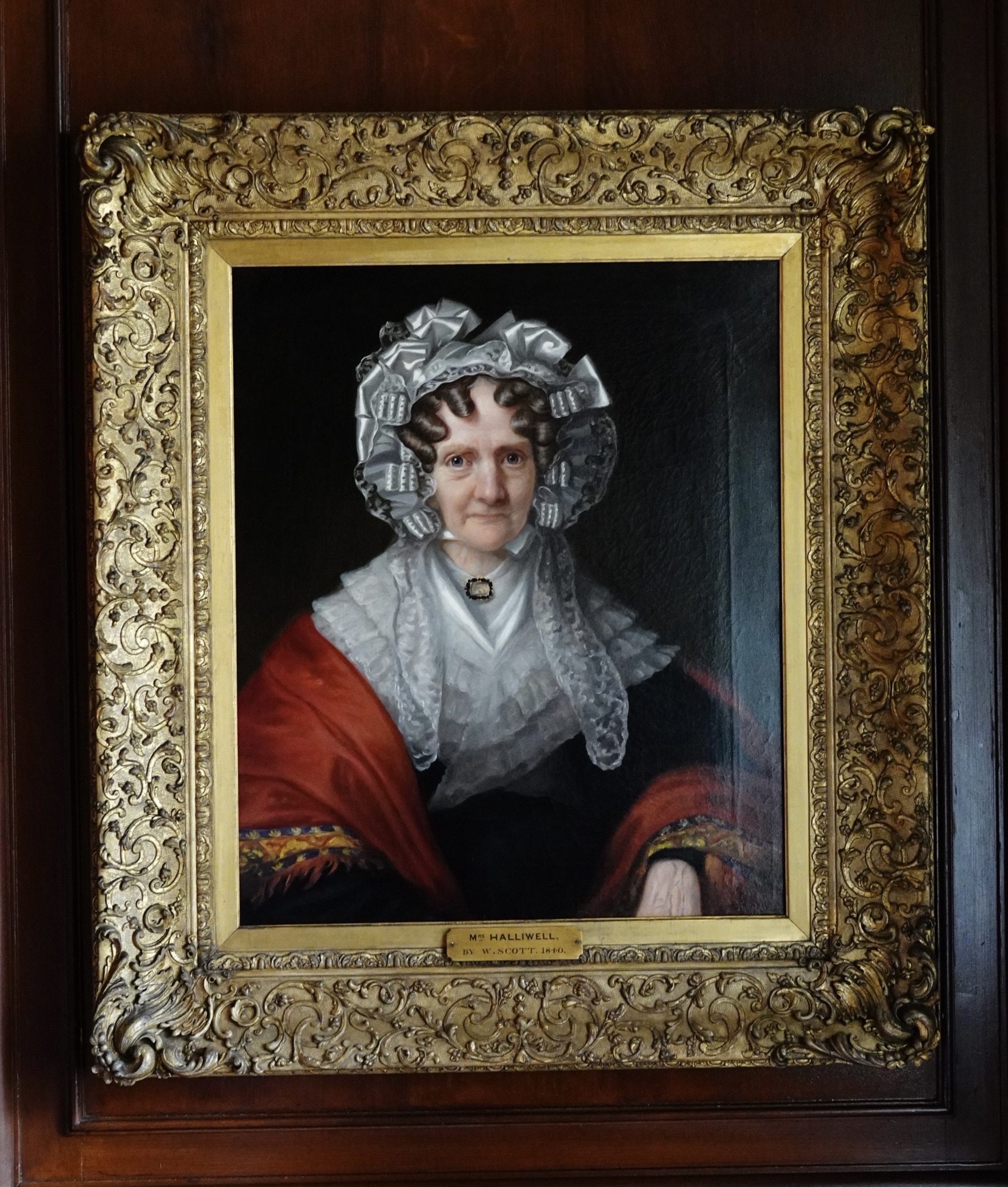
Relative Mrs Halliwell’s portrait on the wall shows her wearing a wiglet stitched to her bonnet and a mourning brooch.
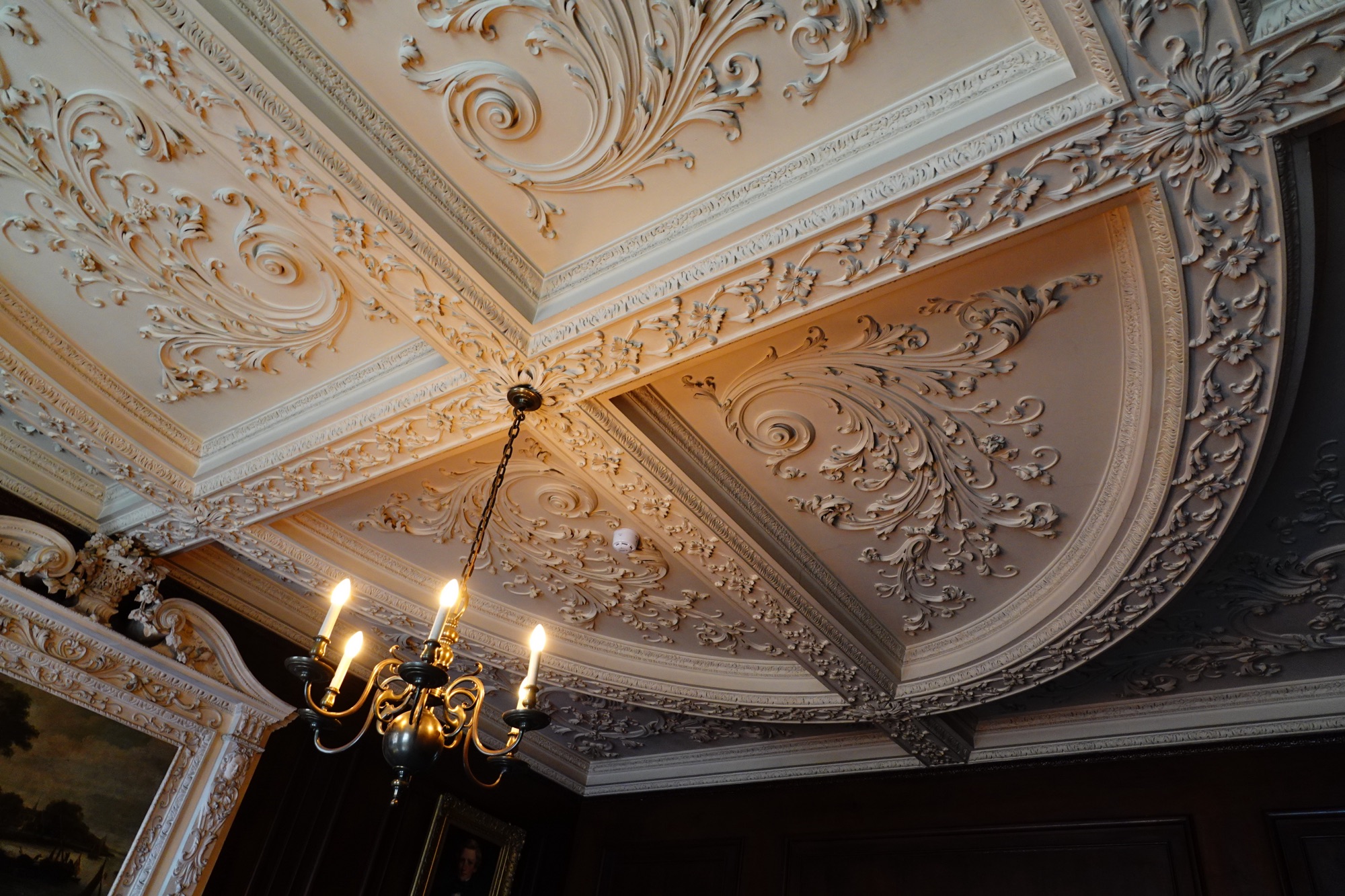
The room is full of faux items: the “wood” panelling is actually plaster, and the “plaster” fireplace is actually wood! On,y the plaster ceiling is what it appears to be.
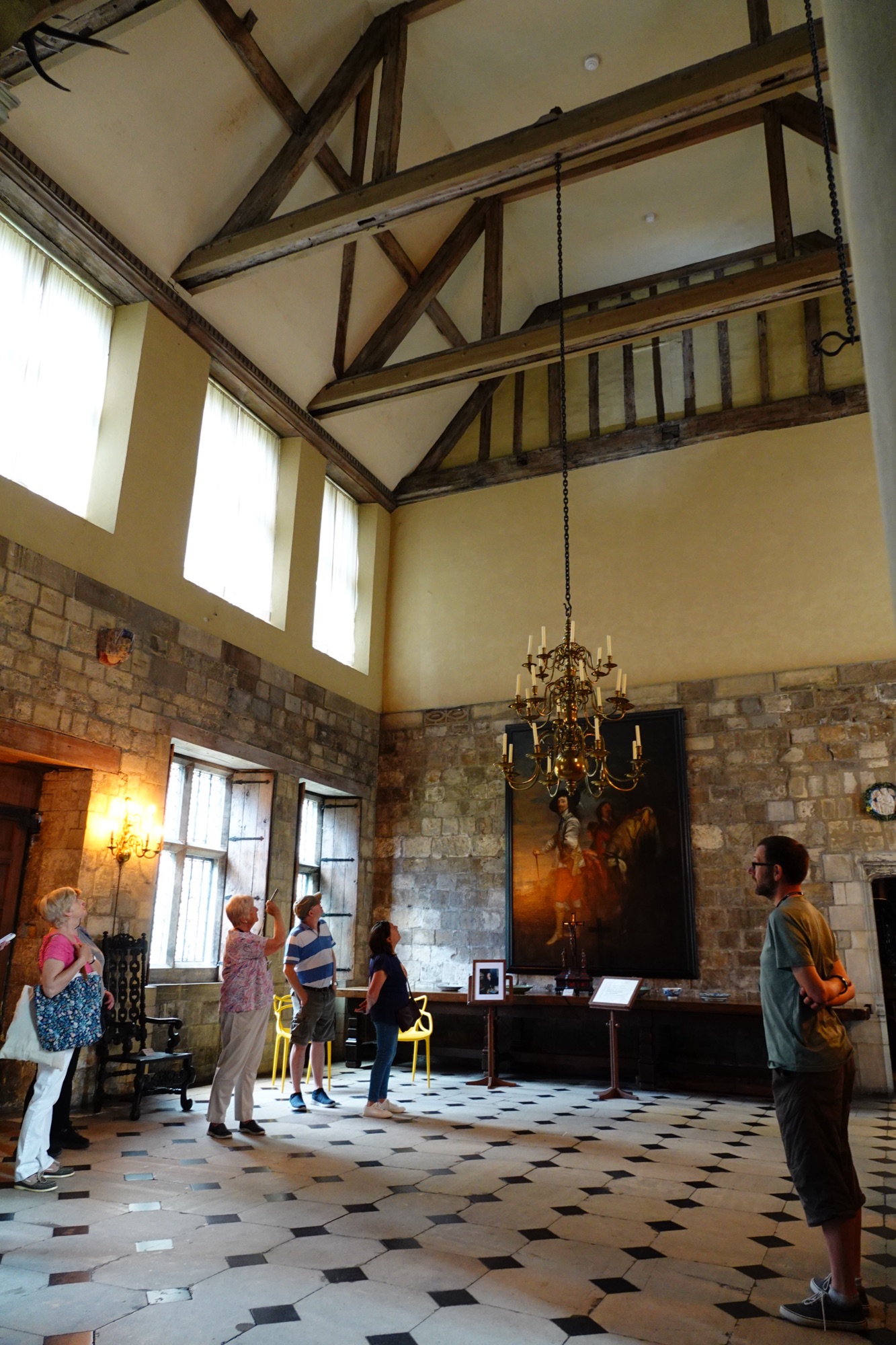
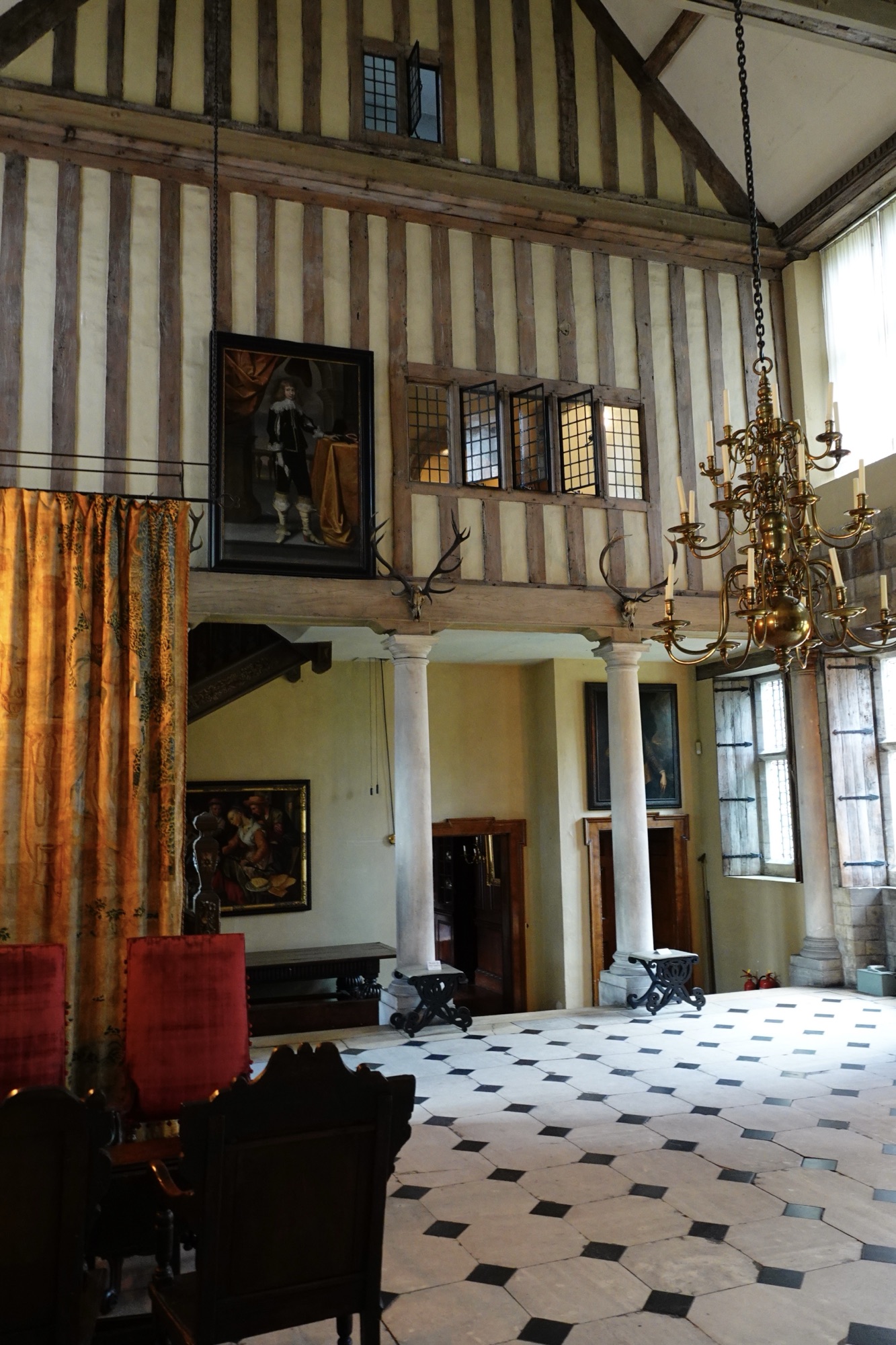
From the private dining room we entered the Great Hall, used for banquets and designed in mediaeval style. The high vaulted ceiling was created by removing bedrooms upstairs. That meant removing servants rooms. As a result, the staff had to cross from one side of the hall to the other using an exterior boardwalk.
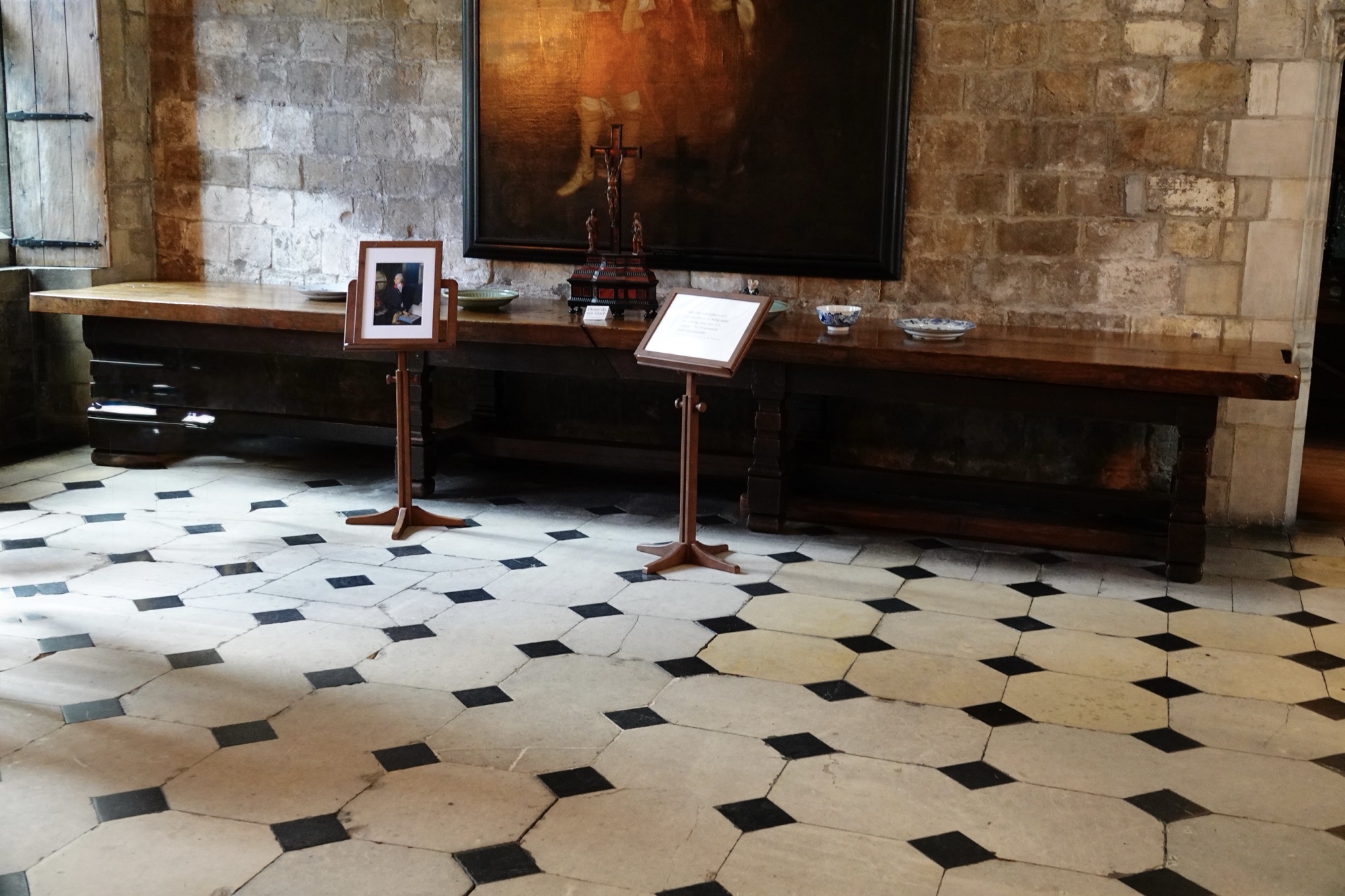
The huge banquet table is a single piece of oak. In addition to a visit by the Prince and Princess of Wales, for which parts of the house were specially enhanced, famous people like Lillie Langtry were entertained here. Given that she was widely known to be the Prince of Wales’ mistress, that must have made for some interesting stories.
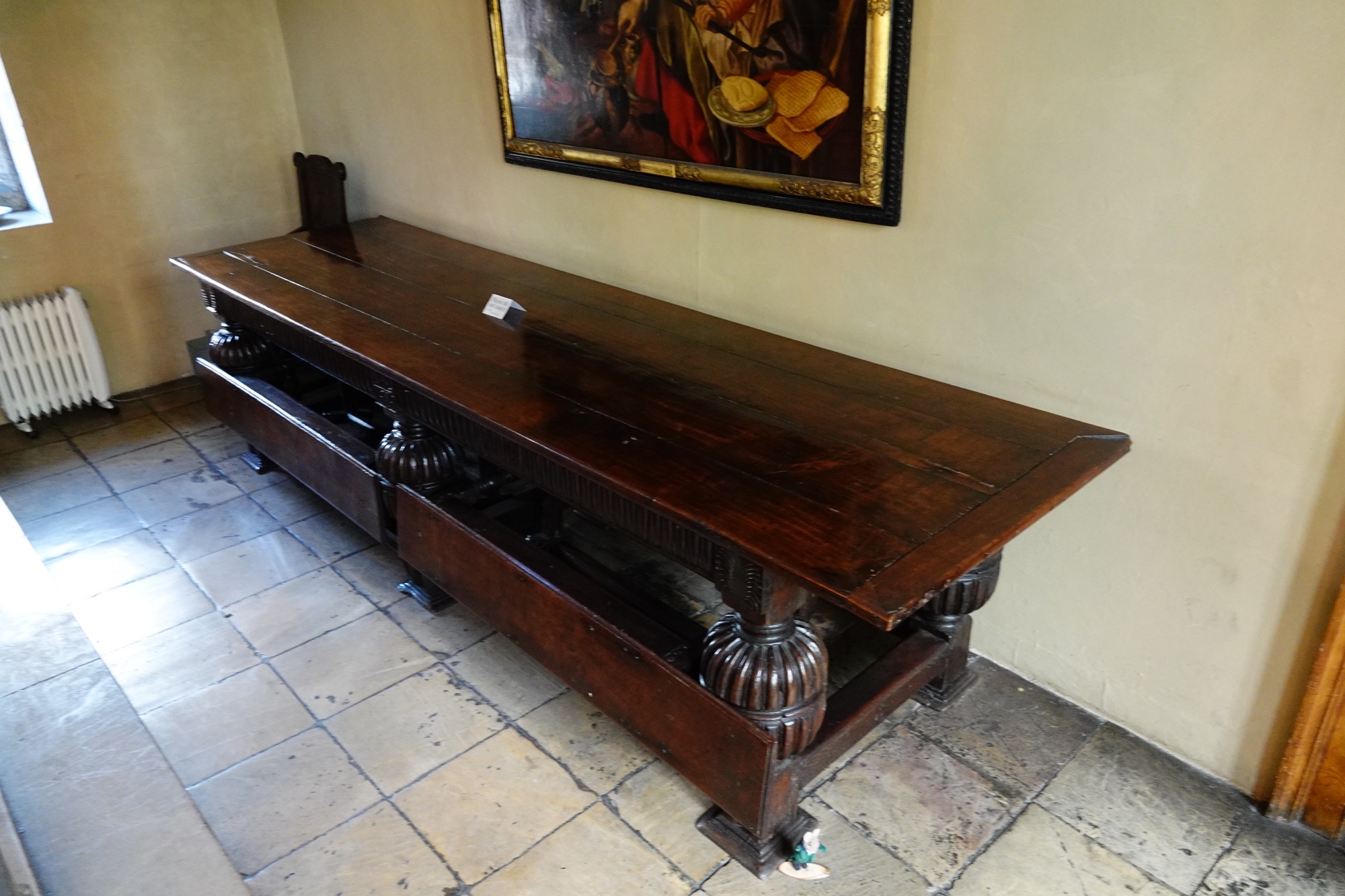
Another table with benches came from a farm, dated to mid 1800s, and has bulbous legs intended to prevent mice from climbing onto the table.
The Roman pillars were added because actual ones were found on the site. It was an affectation Frank Green simply enjoyed.
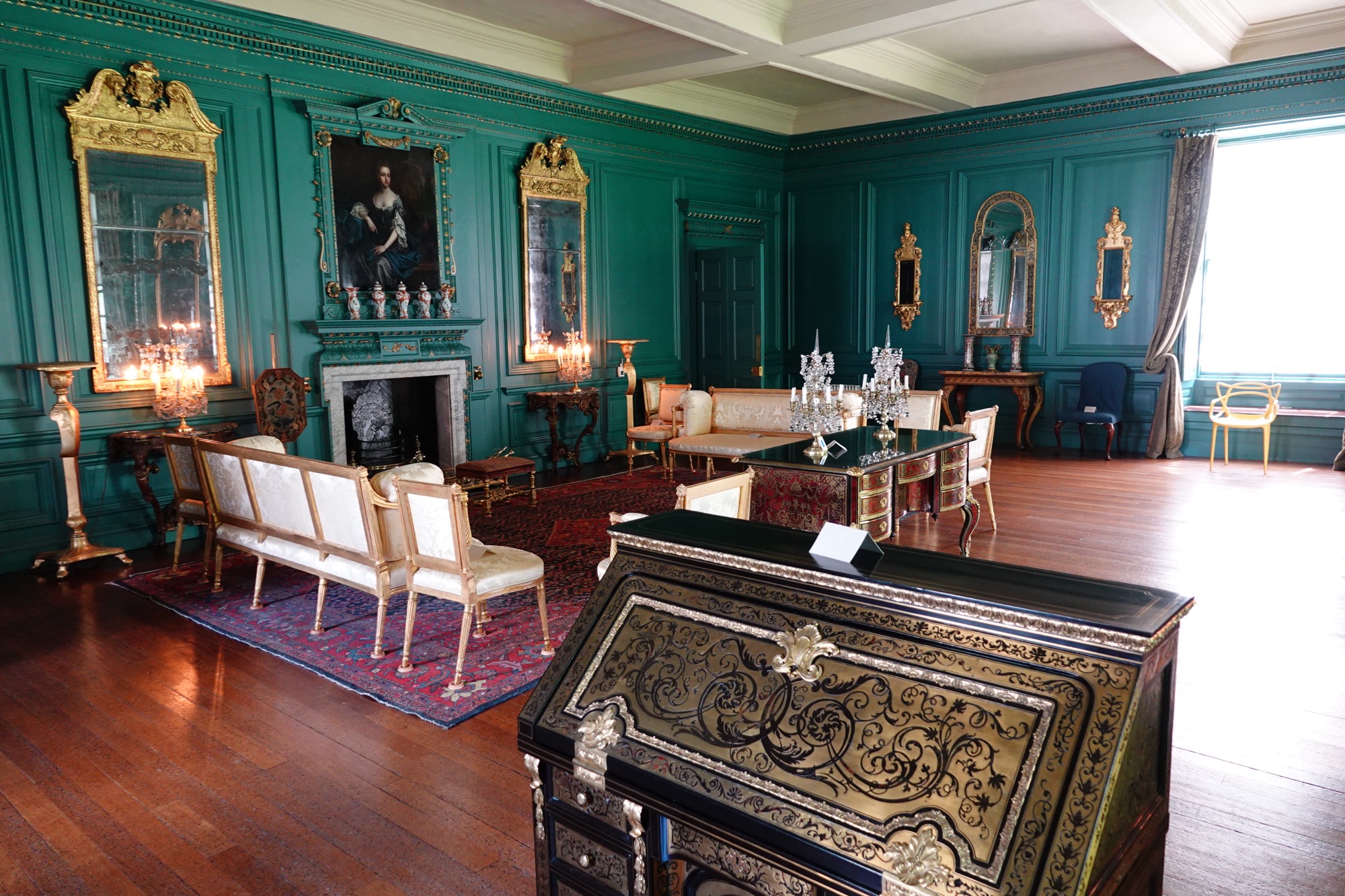
We walked through a hallway papered in green and ivory to the deep teal panelled “blue drawing room”, made by combining 2 smaller rooms and designed in the symmetrical Georgian style.
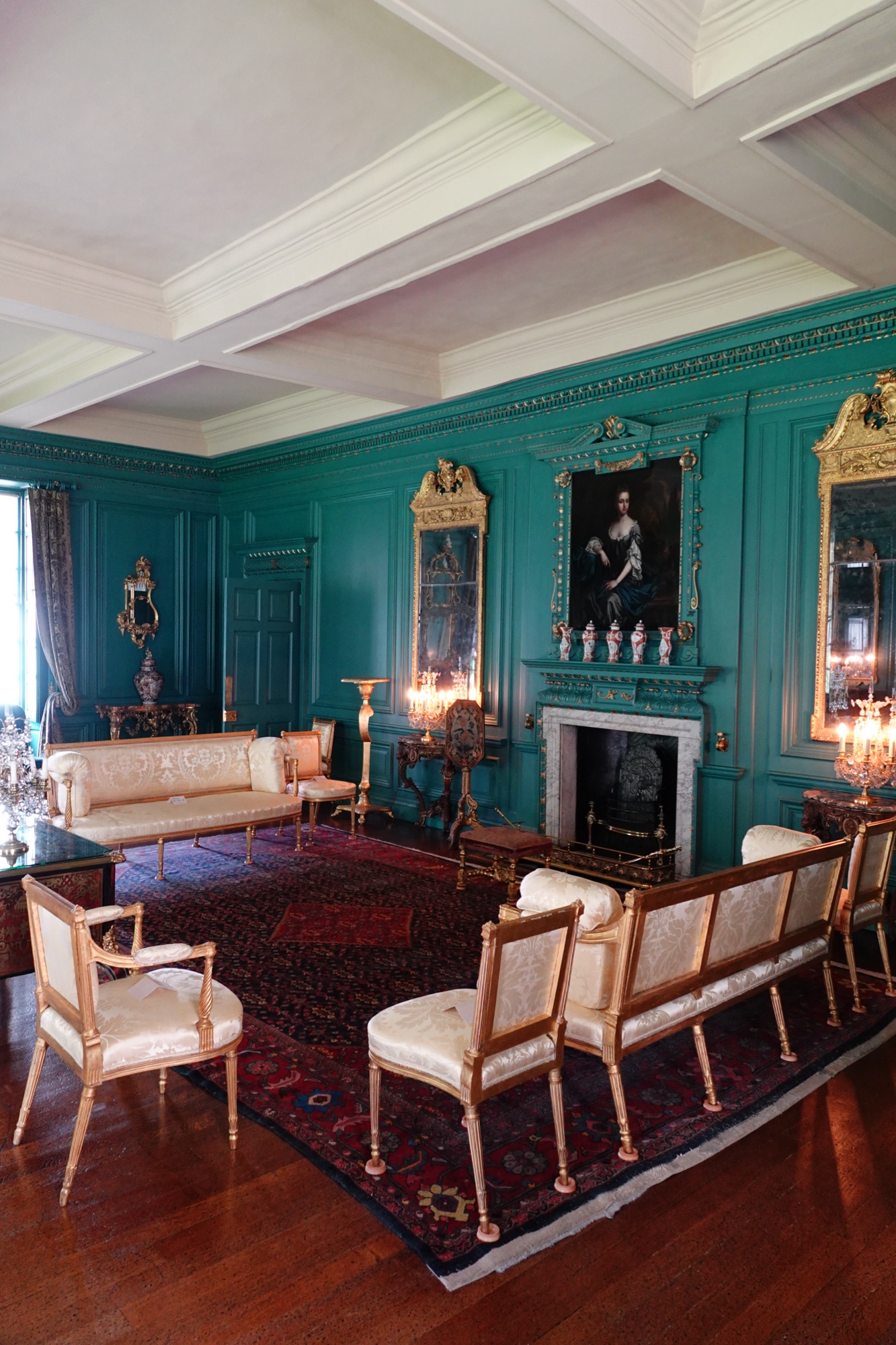
The furniture as we saw it is placed exactly as it was when Frank left.
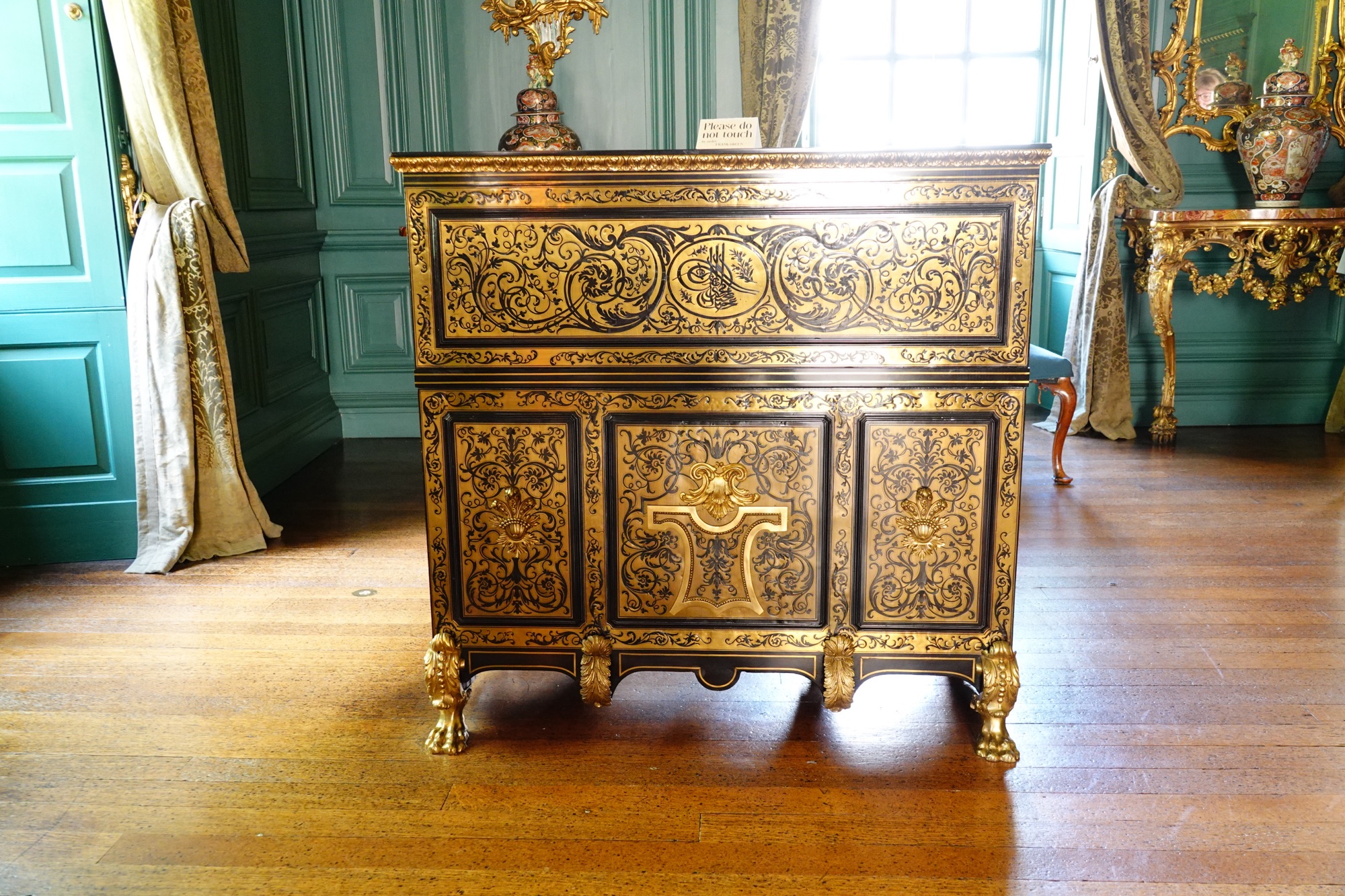
When Green donated the house and contents he specified that if anything were moved he would return to haunt the house. He actually hammered studs into the wood floors to mark each piece’s location. Having seen that, Ted definitely needs to stop calling me OCD.
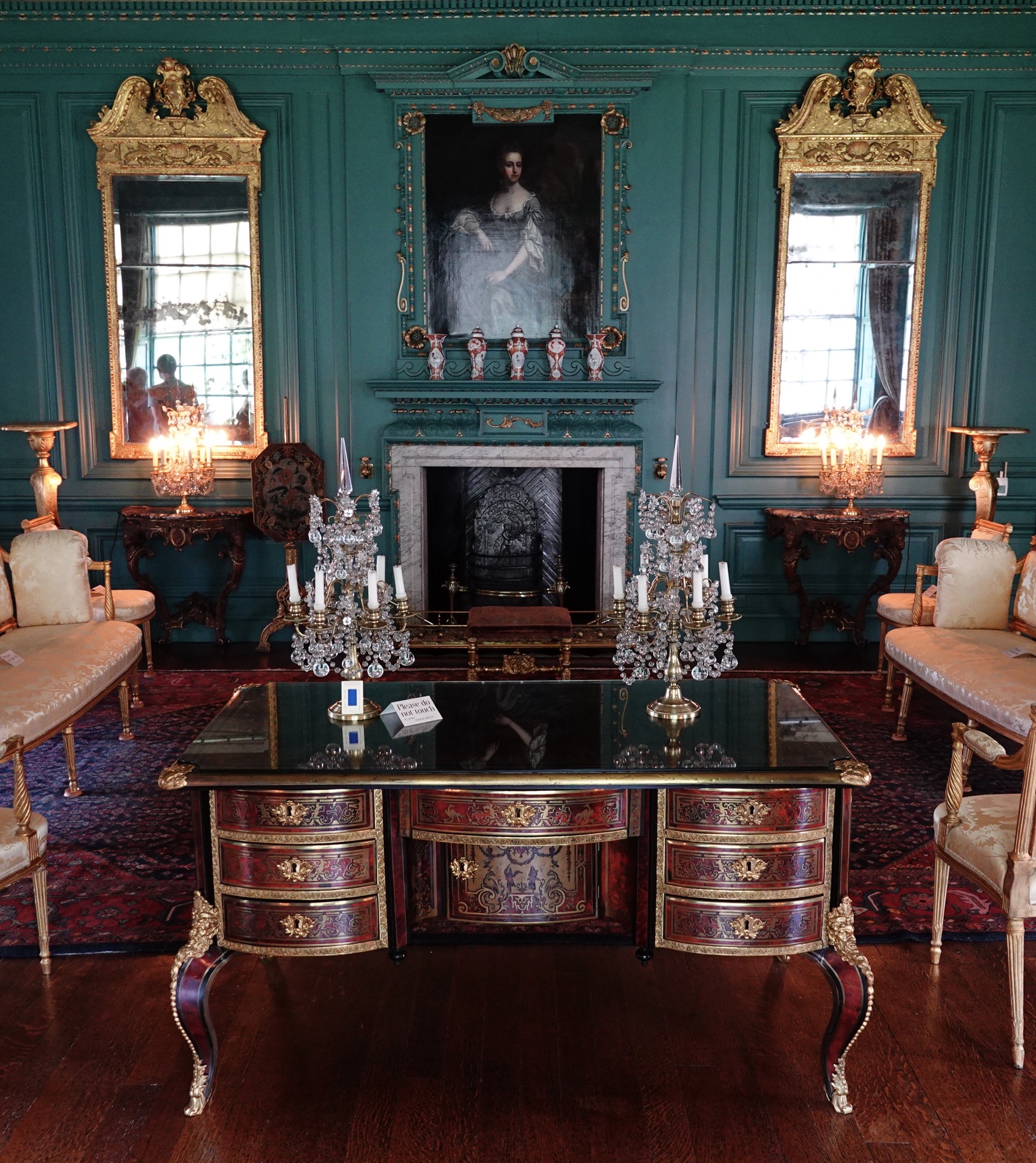
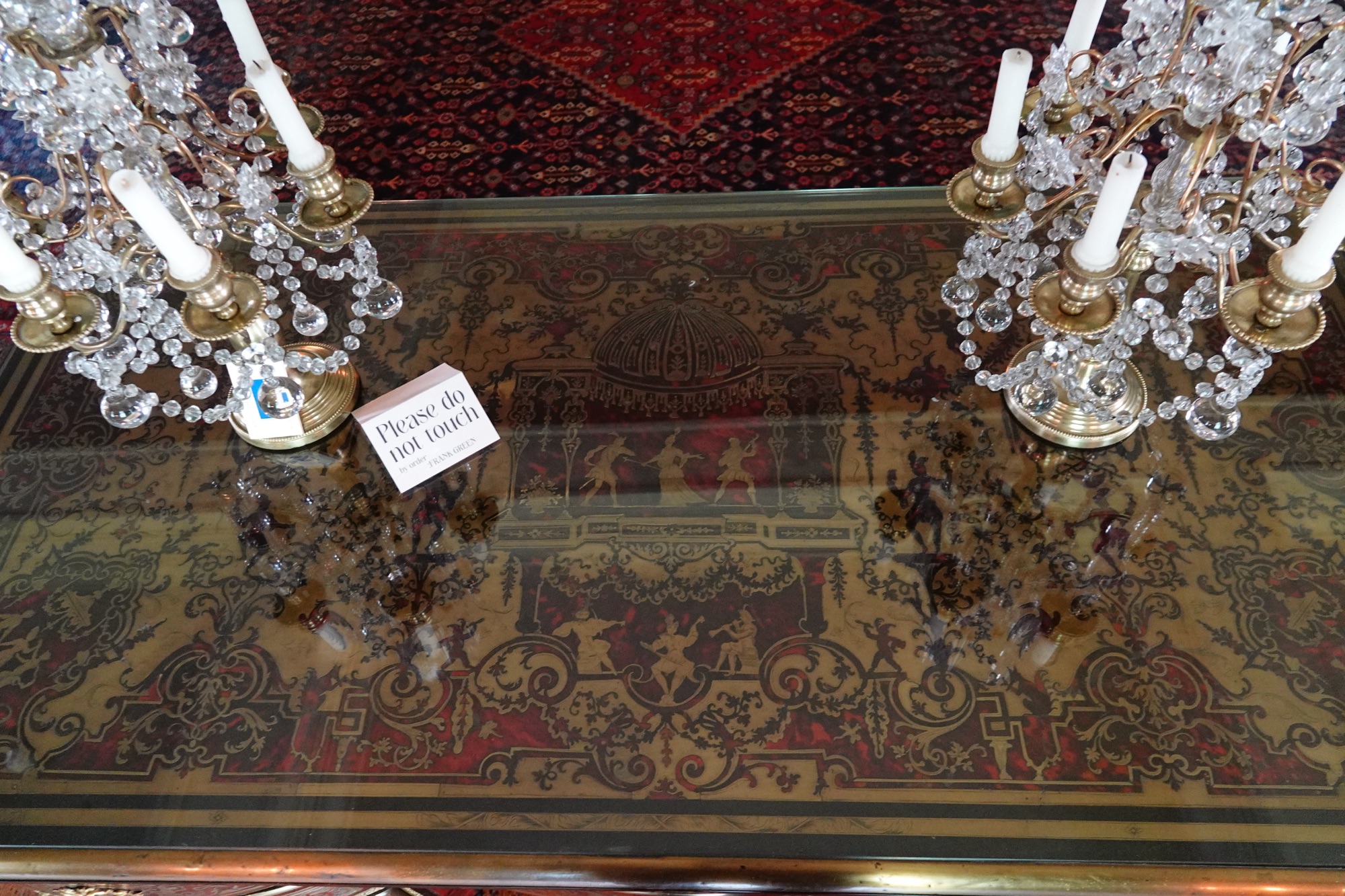
The his and hers desk below is topped with translucent tortoise shell.
The beautifully panelled “court room” facing the courtyard was a library. It features portraits all around and a centrepiece of a massive ship’s model made by Napoleonic War prisoners of war, who probably got extra rations or special privileges for creating it “to order” (although we don’t know who ordered it).
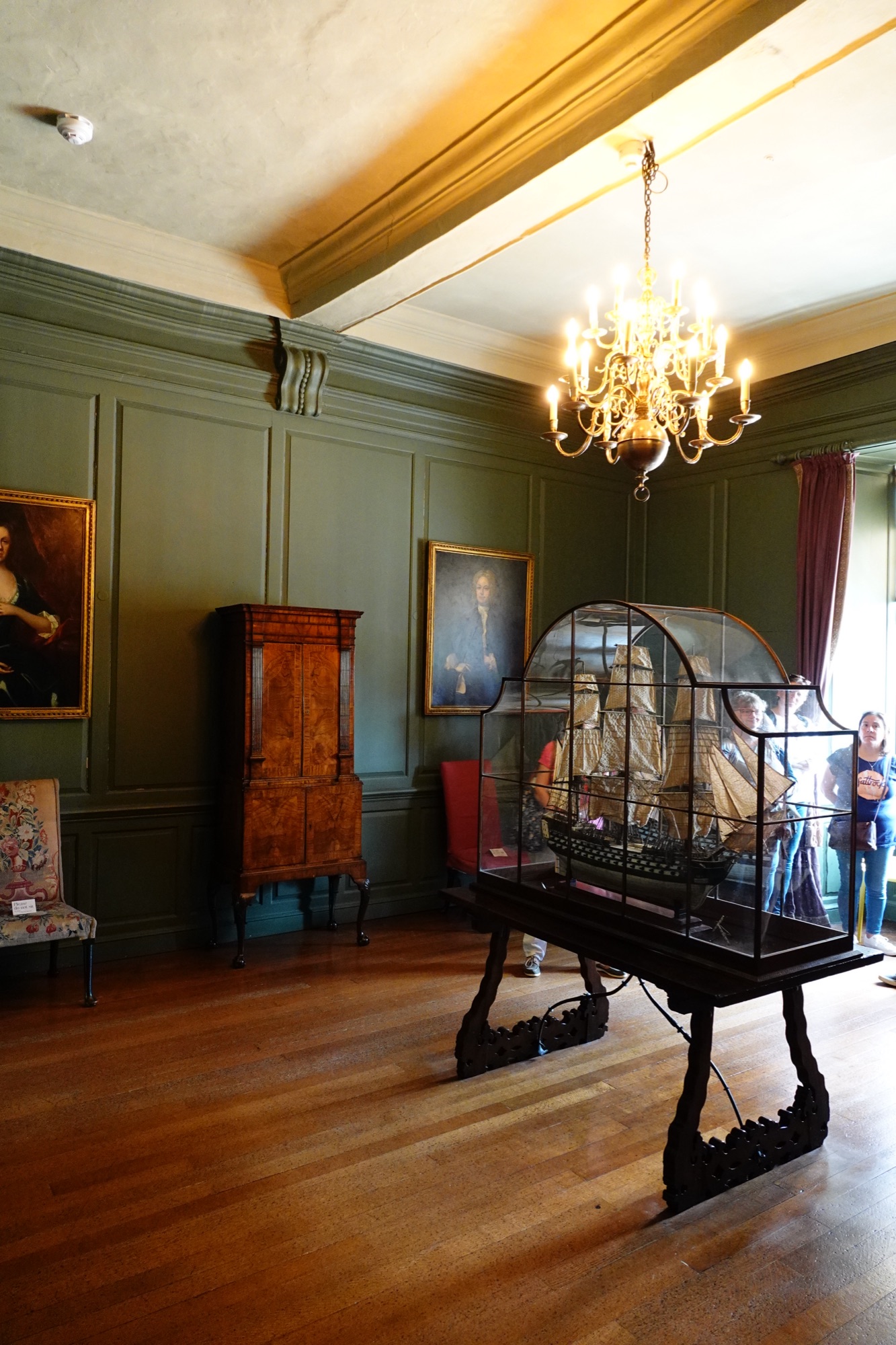
The hull is made of animal bone, and the rigging was originally made of human hair. The glass case that Green had made for it is the exact shape of the house’s gables. The table it is on is a Portuguese campaign table with removable legs.
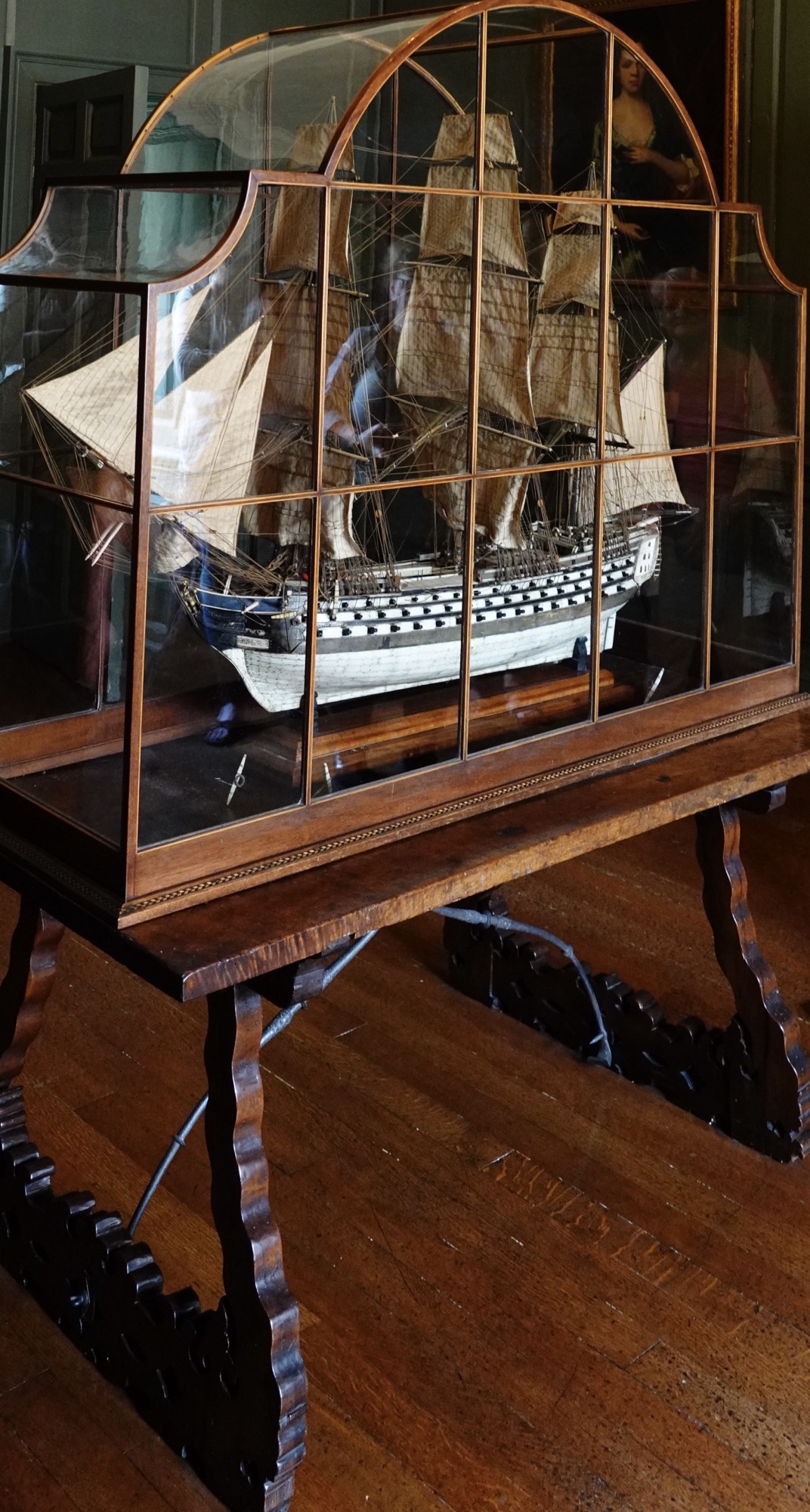
A mirror ball in the room’s window is known as a “witches ball”, believed to absorb evil spirits and scare off witches.
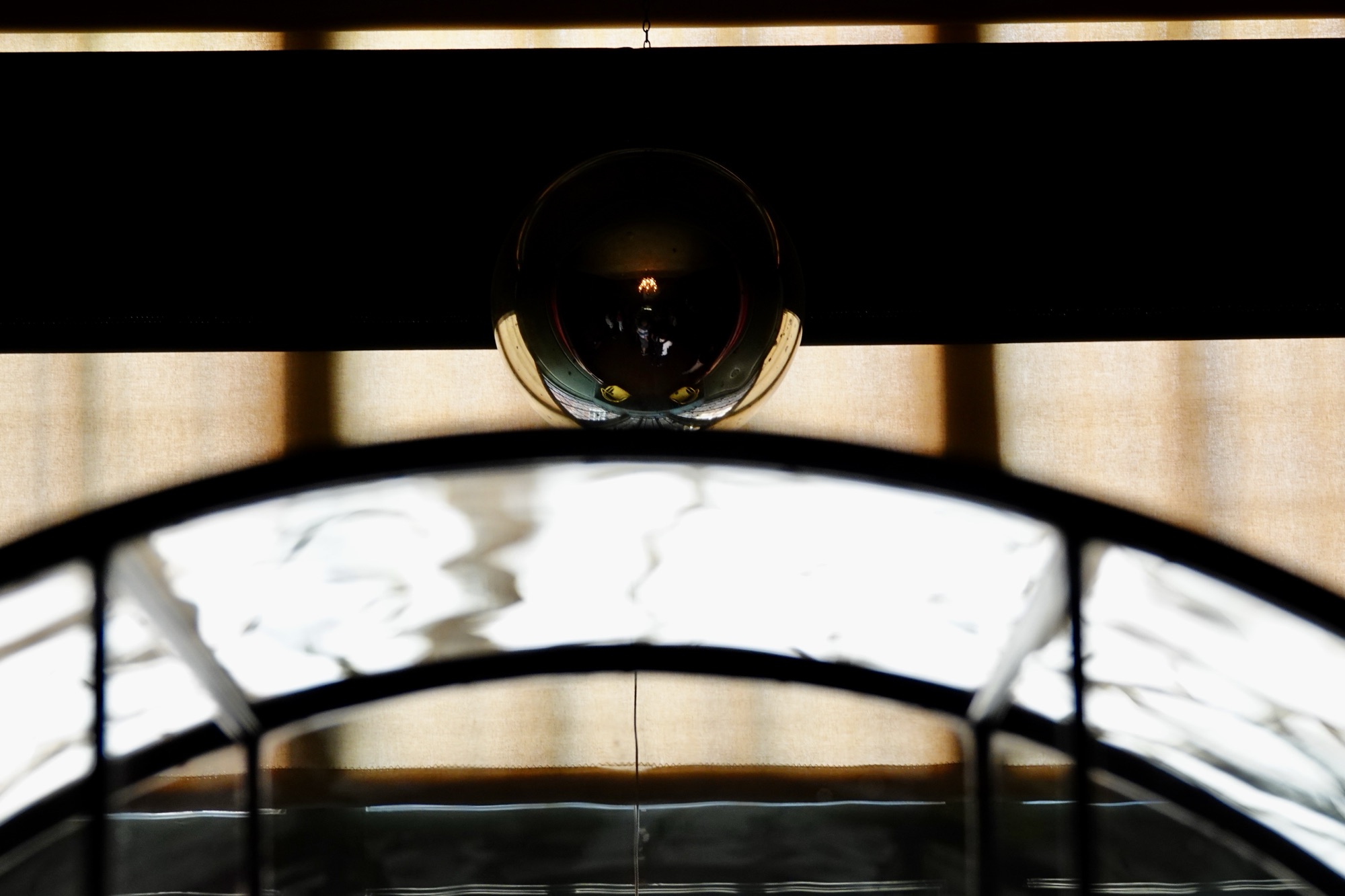
Next we stopped in the entrance hallway below the William and Mary staircase, so called because Green felt it fit the style of that era, (although it was already in the house when he bought it, presumably “unnamed”). This hall was papered in green and ivory, with the original door opposite the staircase, facing Grey’s Court Hotel, turned into a window, possibly to prevent hotel guests from wandering into his home by mistake.
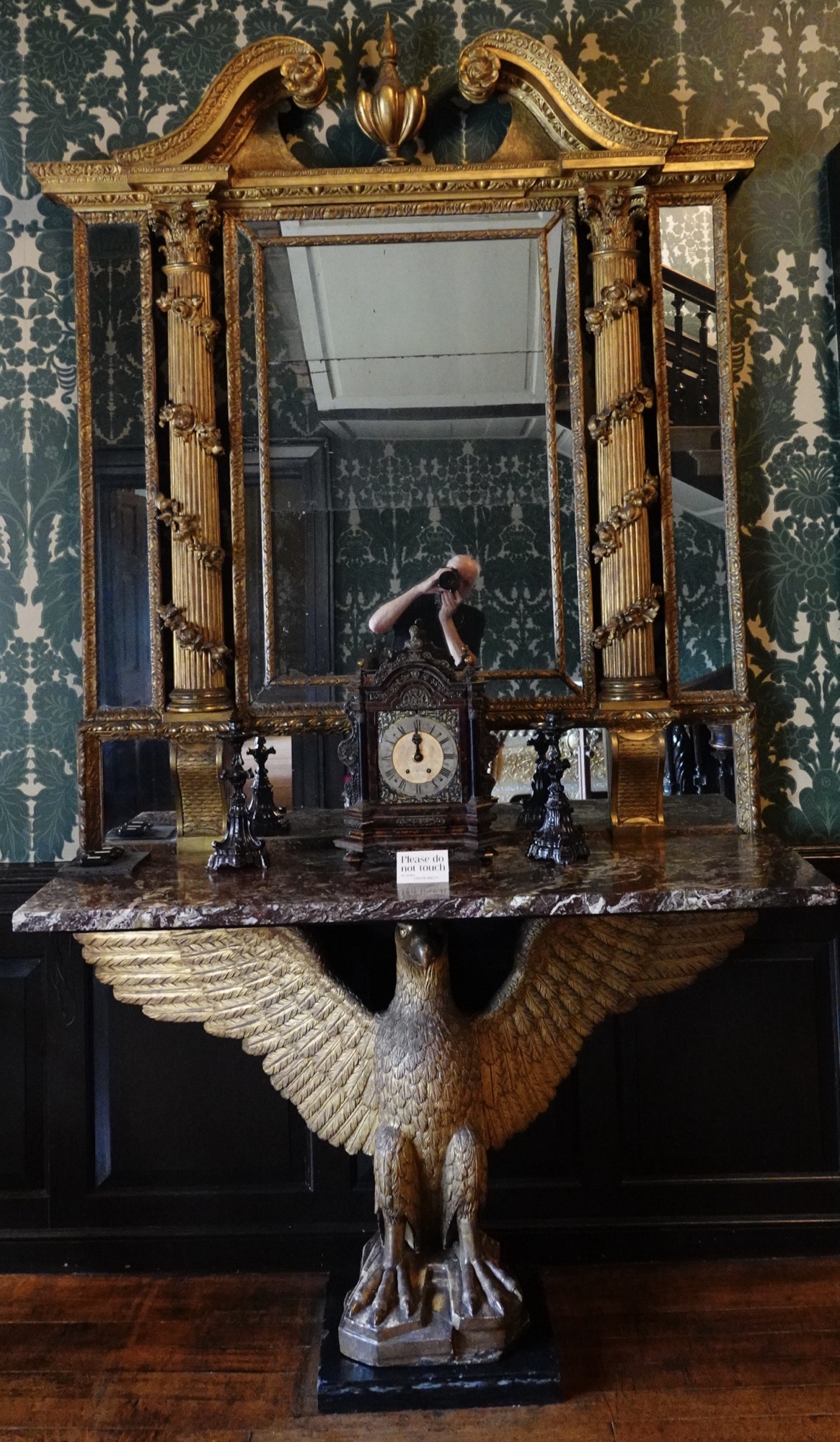
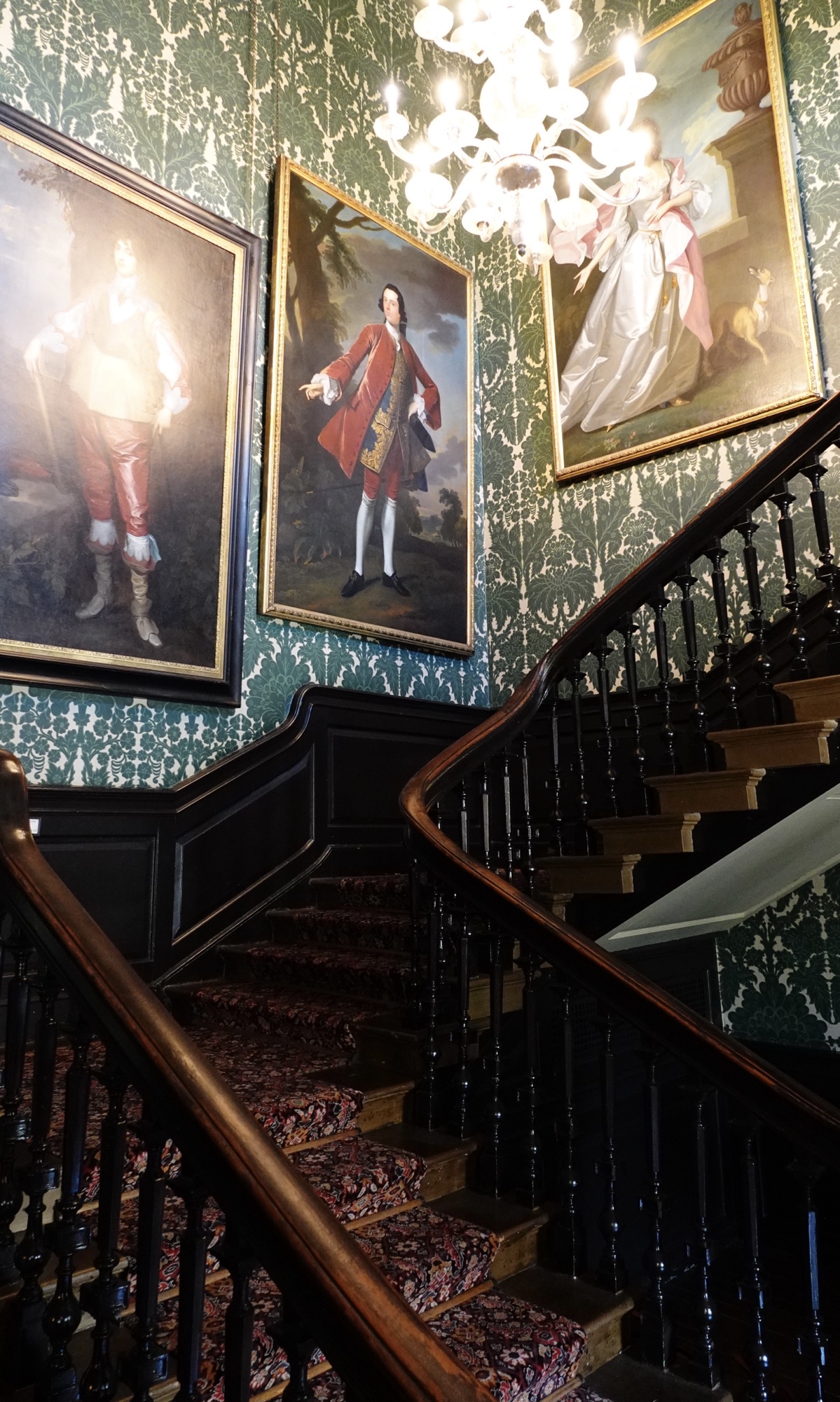
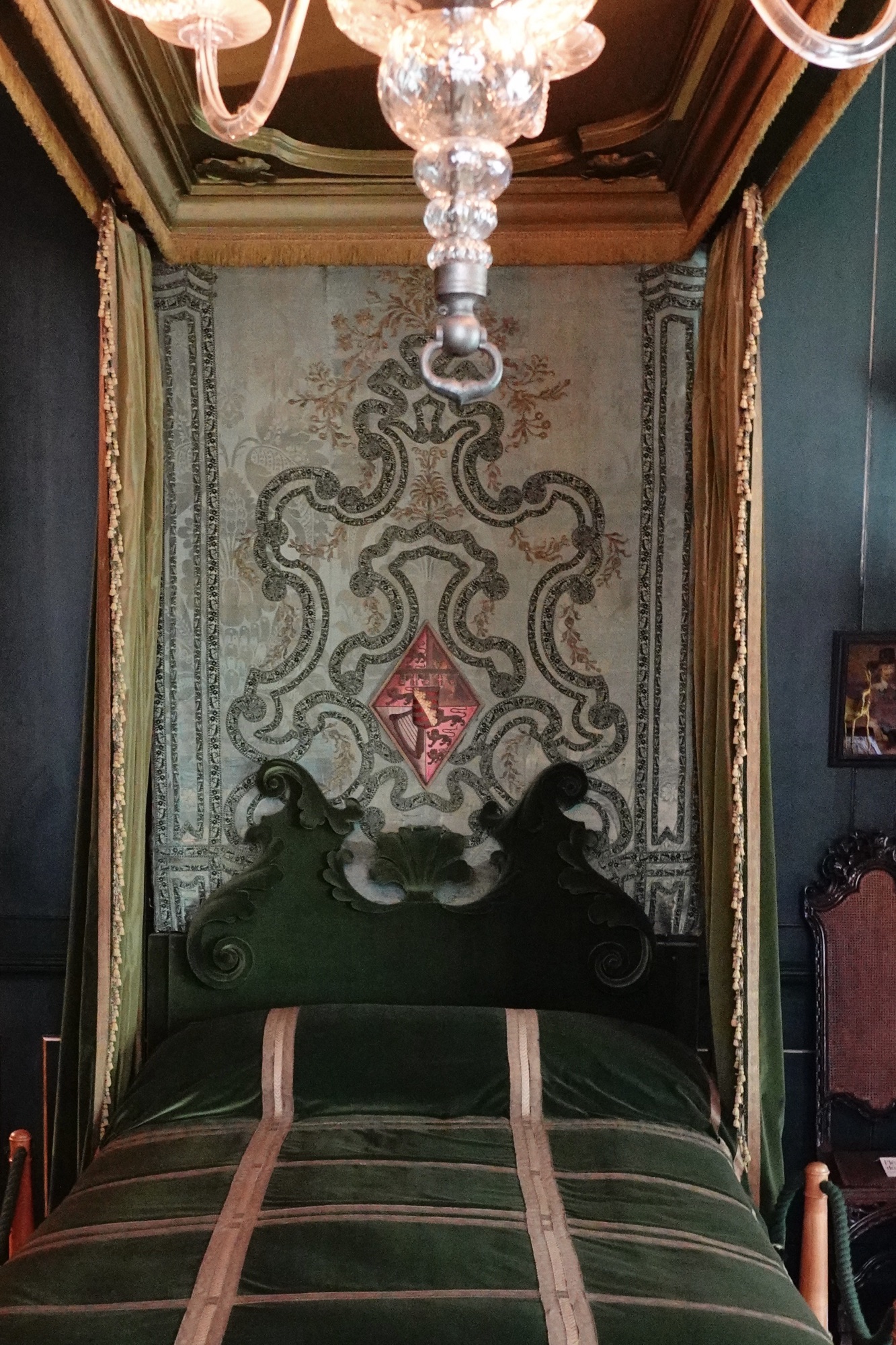
We walked up the shallow stairs to the “Queen’s Bedroom. Frank Green hosted the Prince of Wales and Princess Alexandra, but not in these exact beds. When Queen Victoria died, and his guests became King and Queen, Green asked permission to call the rooms they had slept in the King’s and Queen’s rooms, and add their coats of arms above the beds.
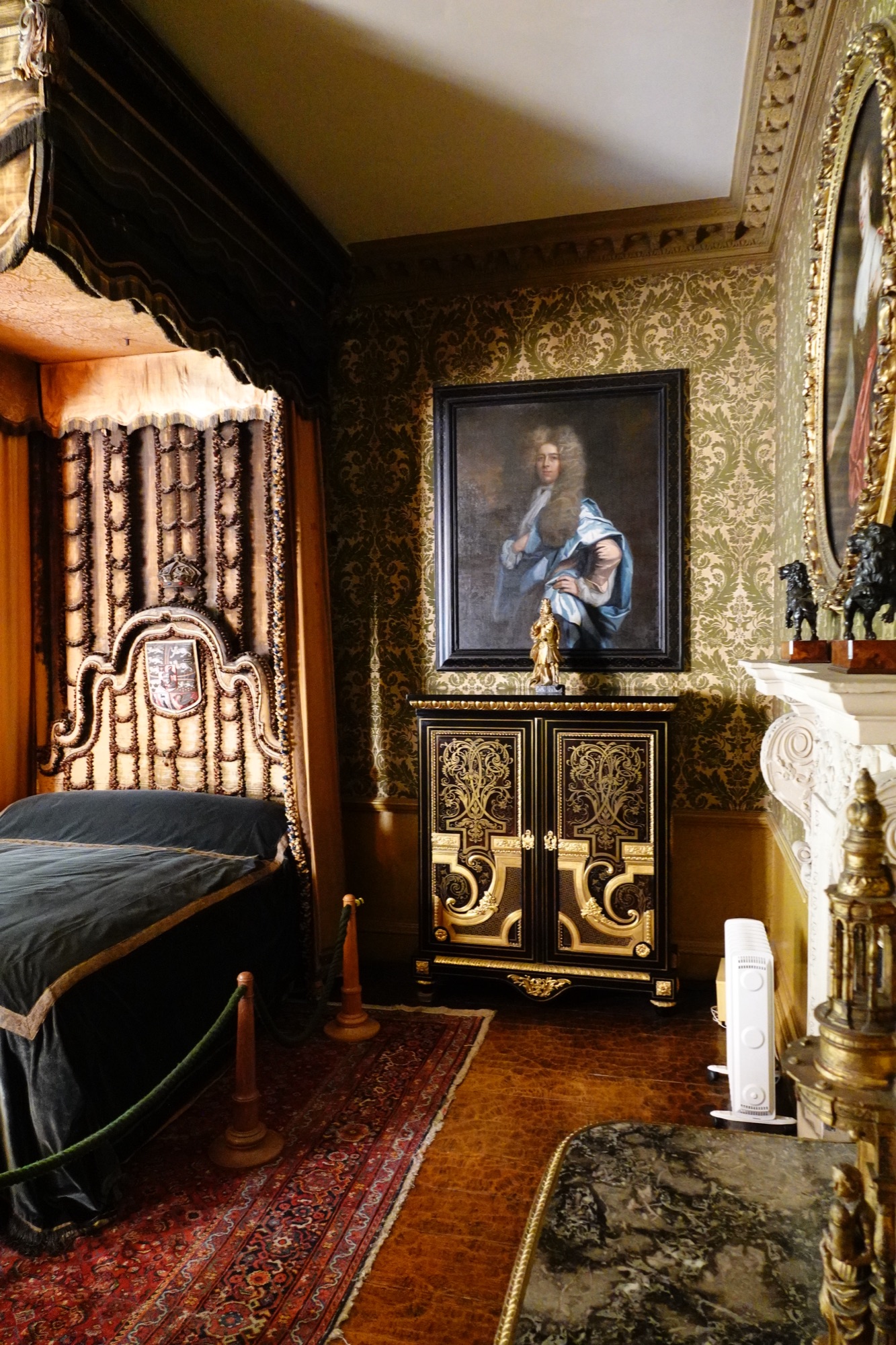
The matching boulle cabinets on either side of the bed are actually opposites: where one has black the other has gold.
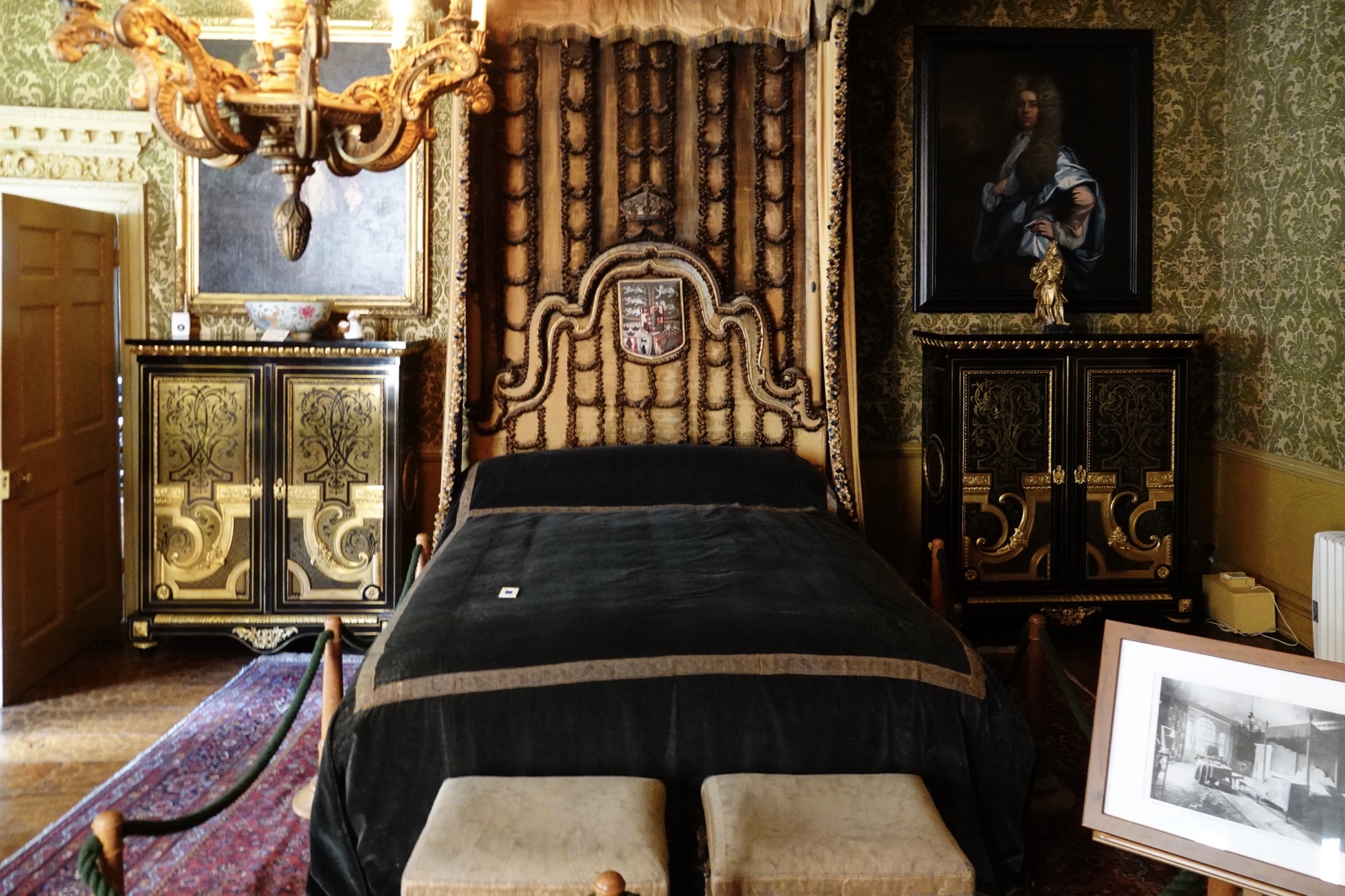
Frank Green had the original English oak floors covered with another layer of oak and that layer textured with an adze, which gives both an interesting sheen and a “giraffe neck” pattern that once described that way can never be seen as anything else. Thanks, Yvonne.
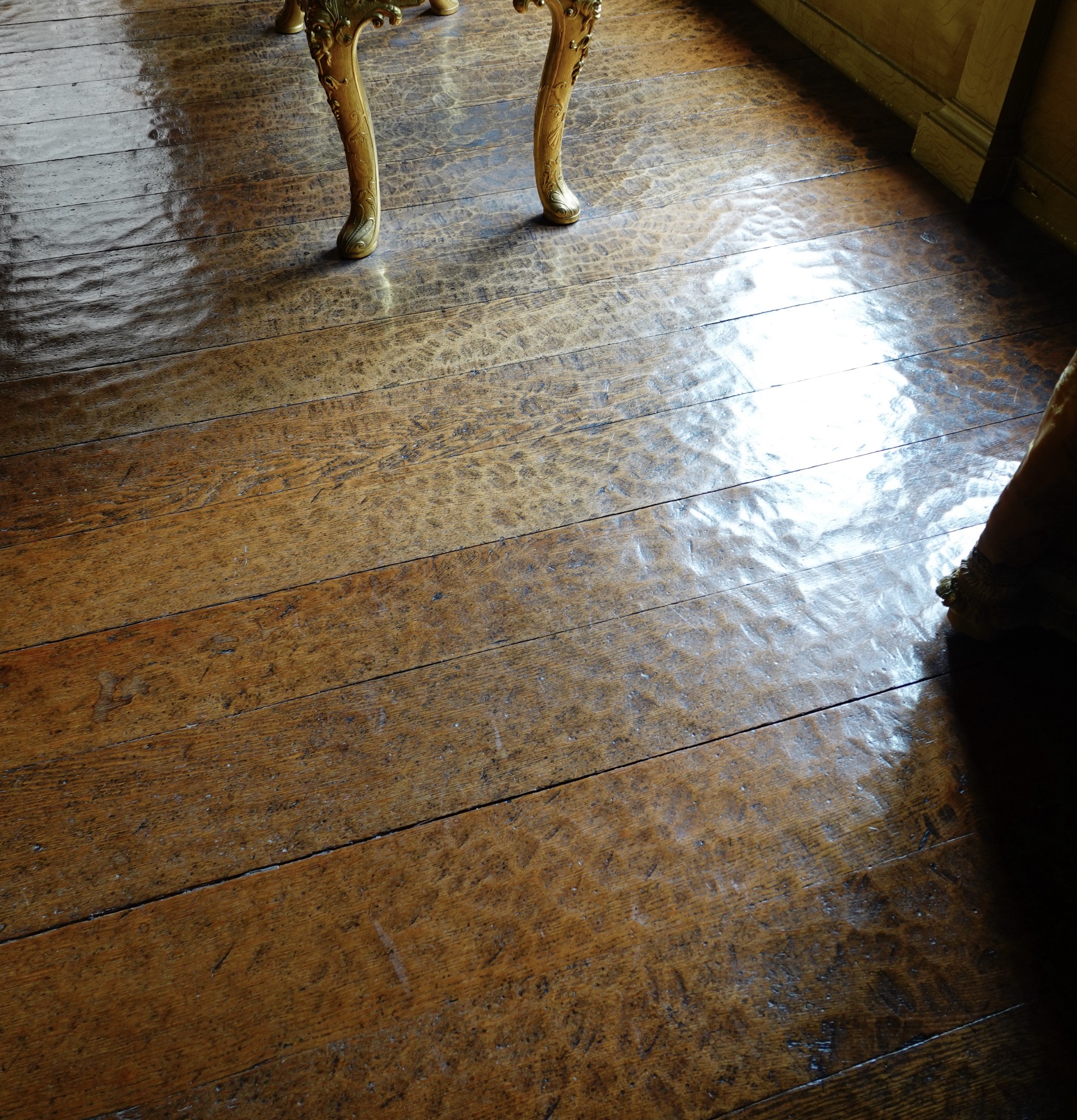
Beside the Queen’s Bedroom is the room where her daughter Princess Victoria slept during their visit.
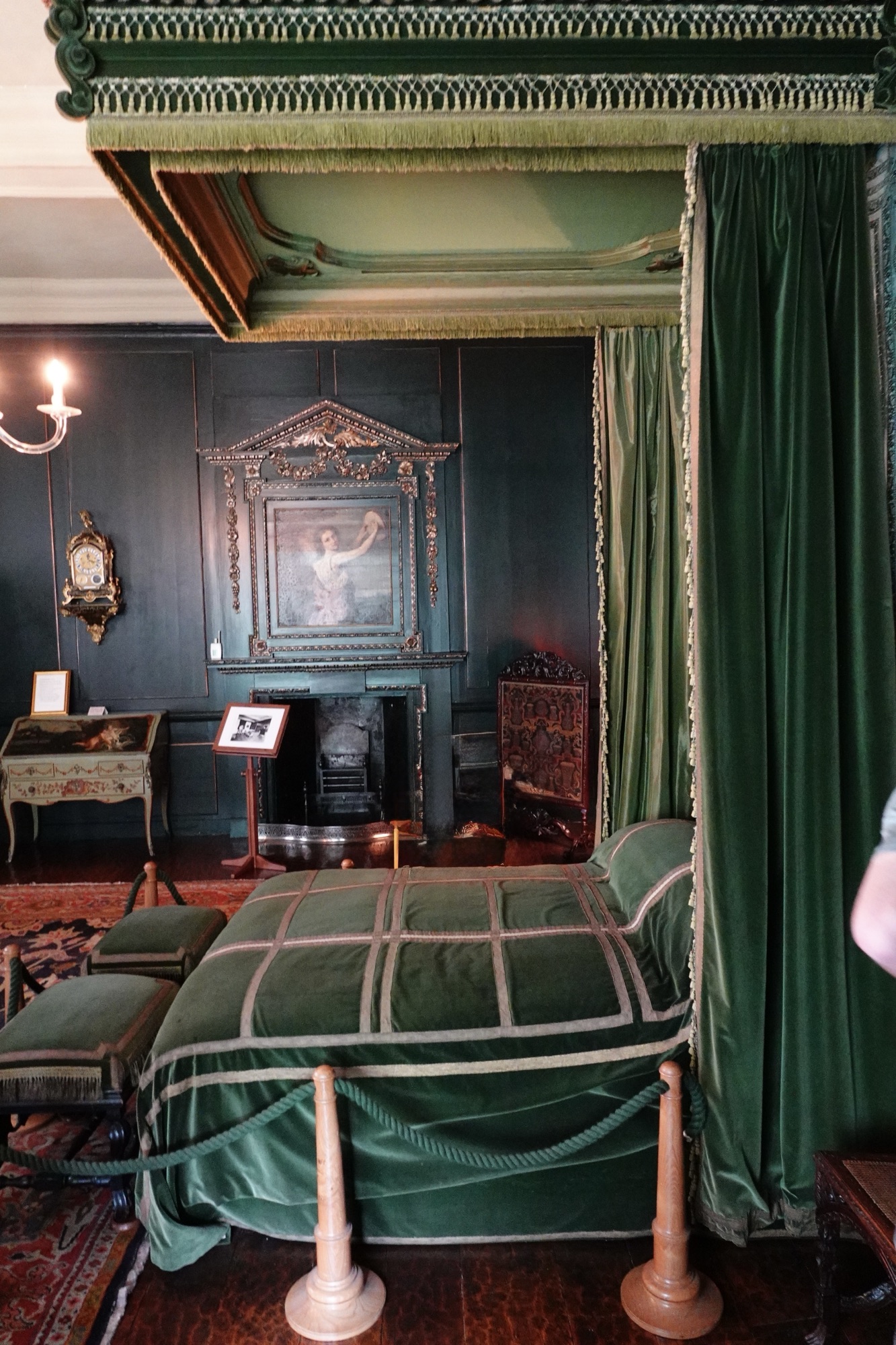
As Princess Alexandra became progressively deafer with age, Princess Victoria spent more and more time aiding her in social situations. Victoria never married, something which is reflected in the “lozenge” shape of her crest above the bed.
Yvonne pointed out the large walnut wardrobe, with presses inside instead of rails for hanging garments.
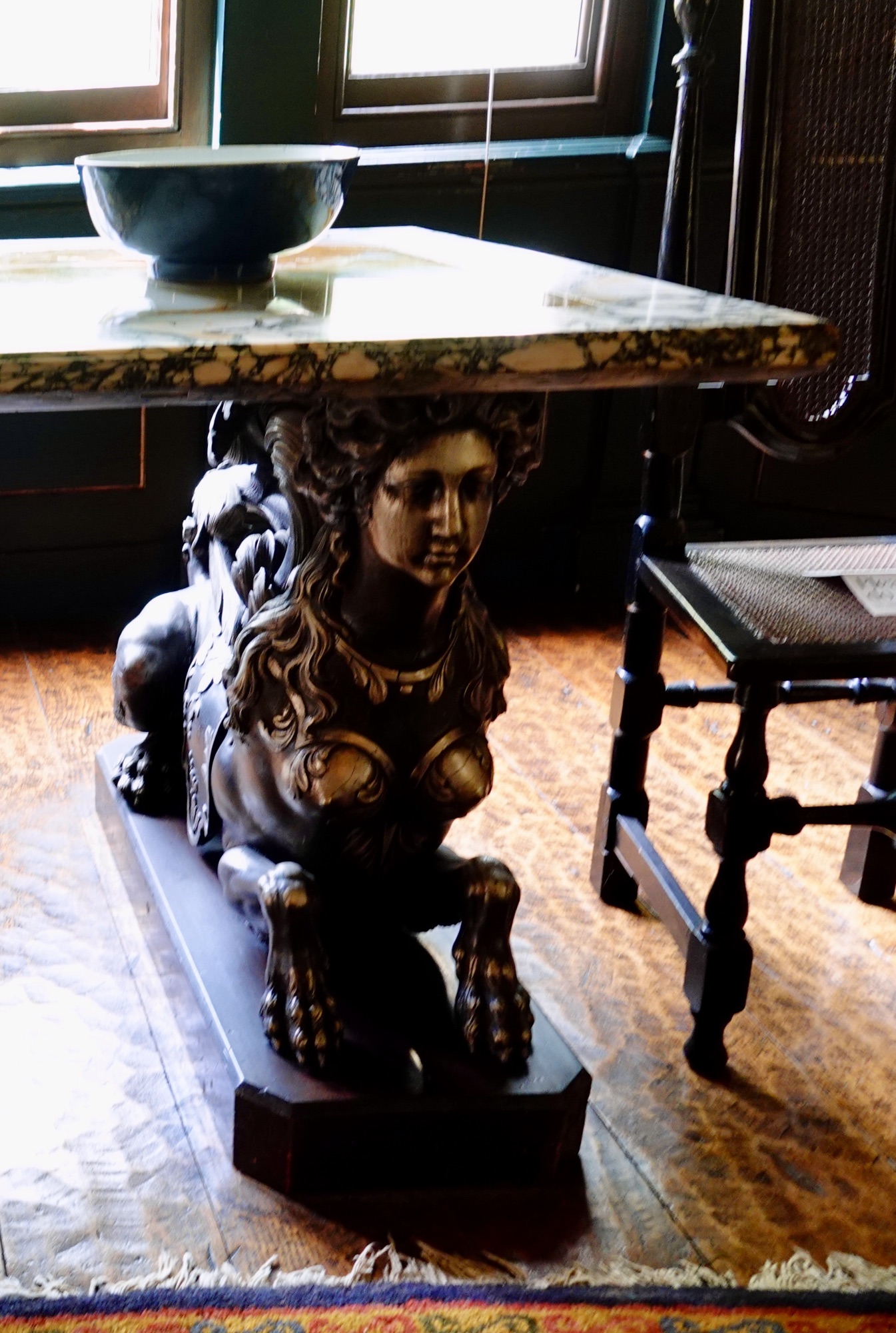
The marble table in this bedroom had legs that were almost sphinxlike, made of wood meant to look like metal.
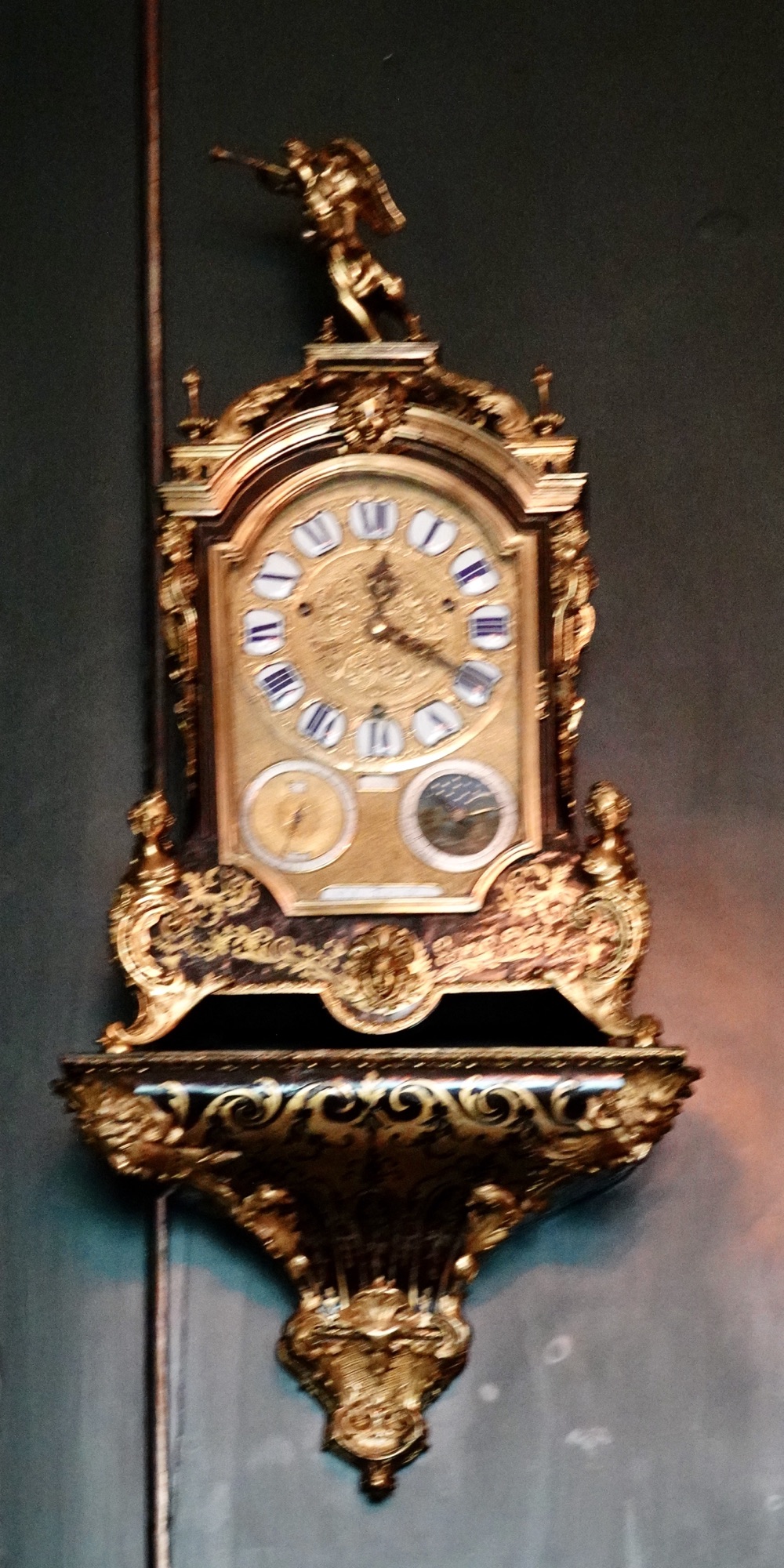
The French boulle clock on the room’s wall is one of the best in any National Trust property.
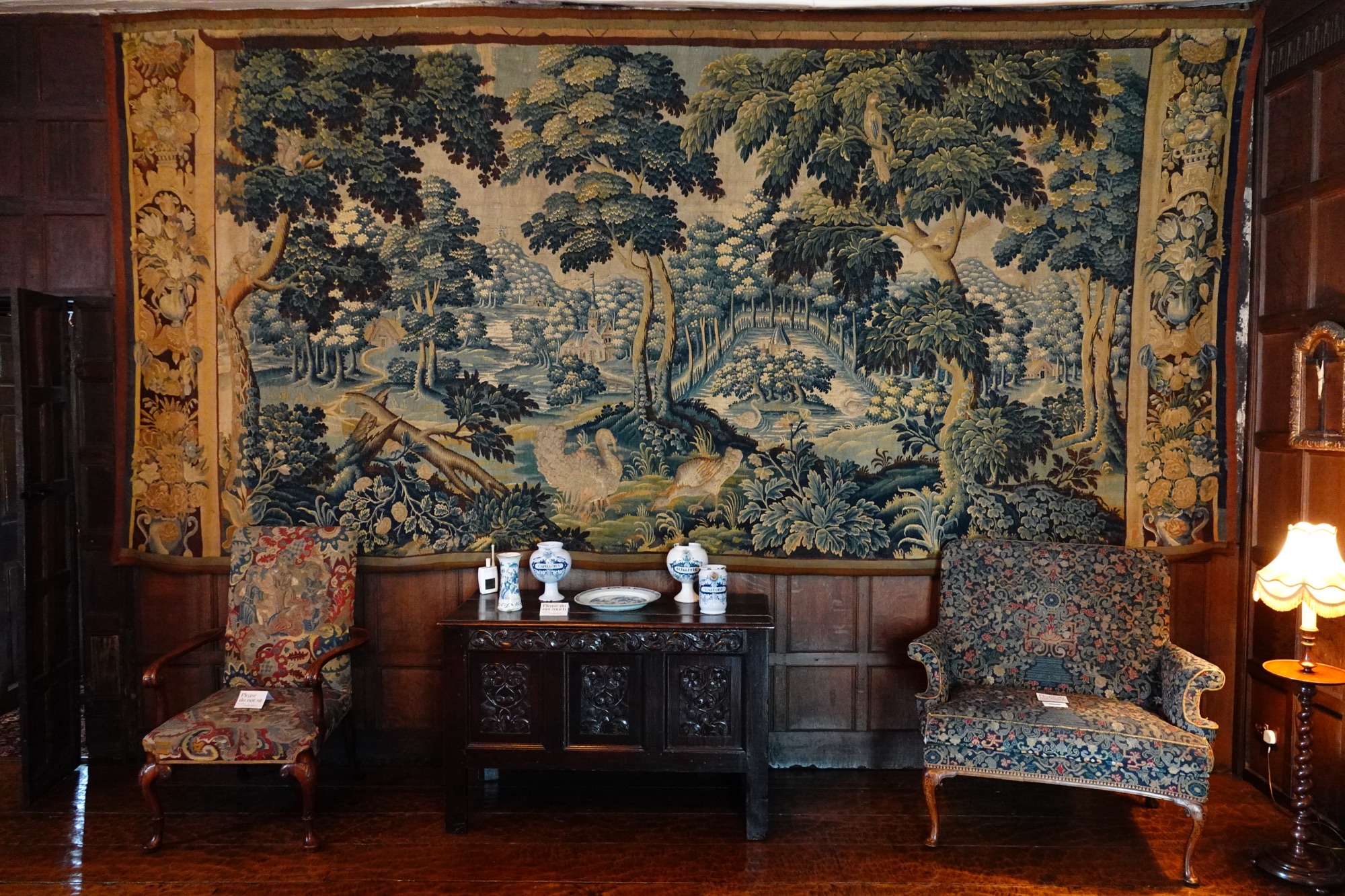
The tapestry room is so called for the two 16th century Flemish tapestries found hidden behind wallboard when Green bought the house.
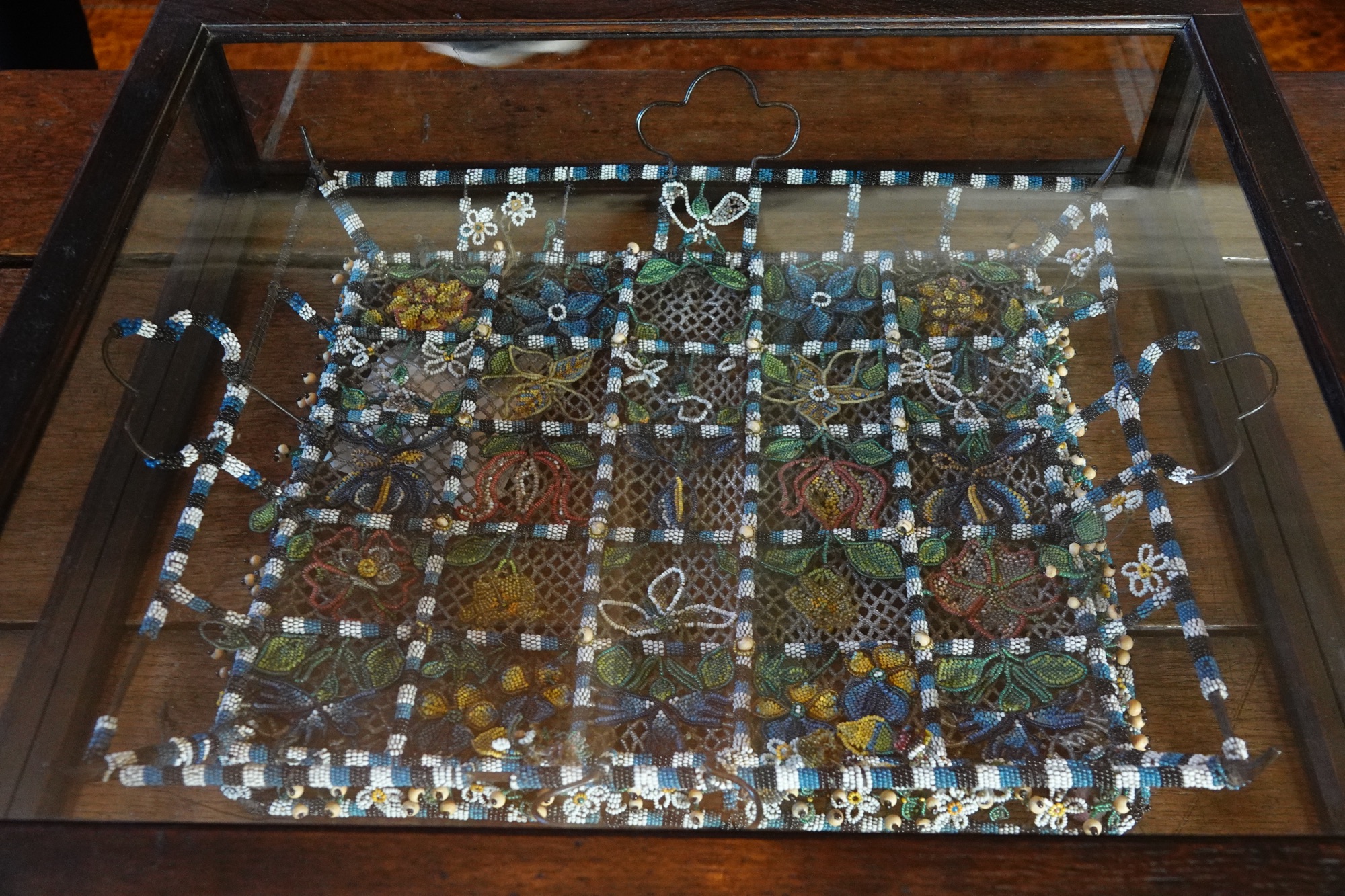
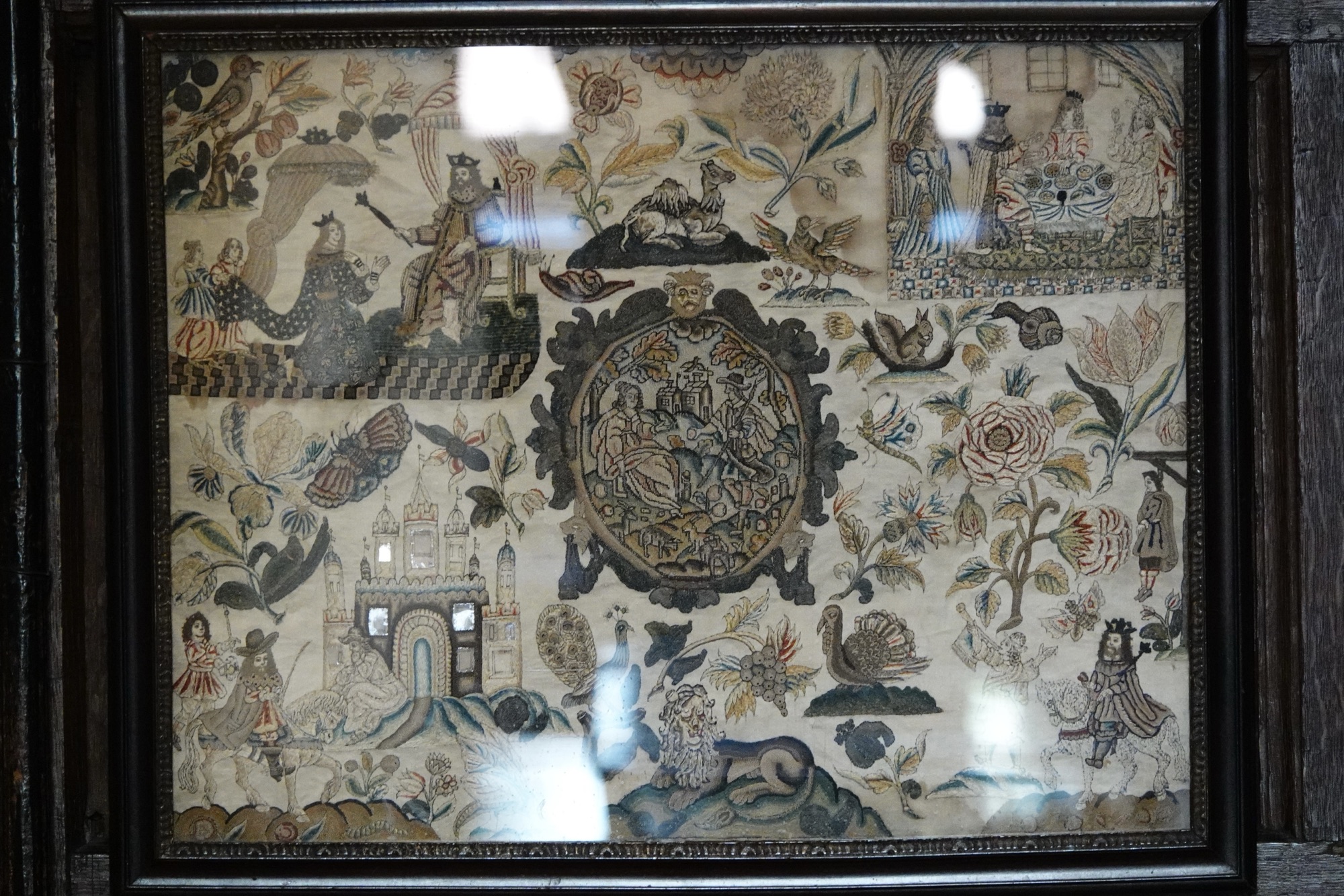
The room also holds an English beadwork basket and a very old stitched embroidery, evidence to Green’s eclectic taste in what he collected to furnish this house.
This room had a lift that Green specifically had installed for one of his maids who lost a leg to cancer. He apparently also paid for her treatment and for the best prosthetic leg available at the time, and adjusted her duties from housekeeping to acting as his secretary.
There are lovely ghost stories associated with the house, including a grey-clothed lady who once invited a child on a guided tour to sit on her lap in an antique chair that is off limits, and the appearance (separate story!) of a Roman legion.
Since the external boardwalk is no longer safe to traverse, we had to go back down through the great hall and up a set of stairs on the other side to reach the minstrels’ gallery and remaining bedrooms.
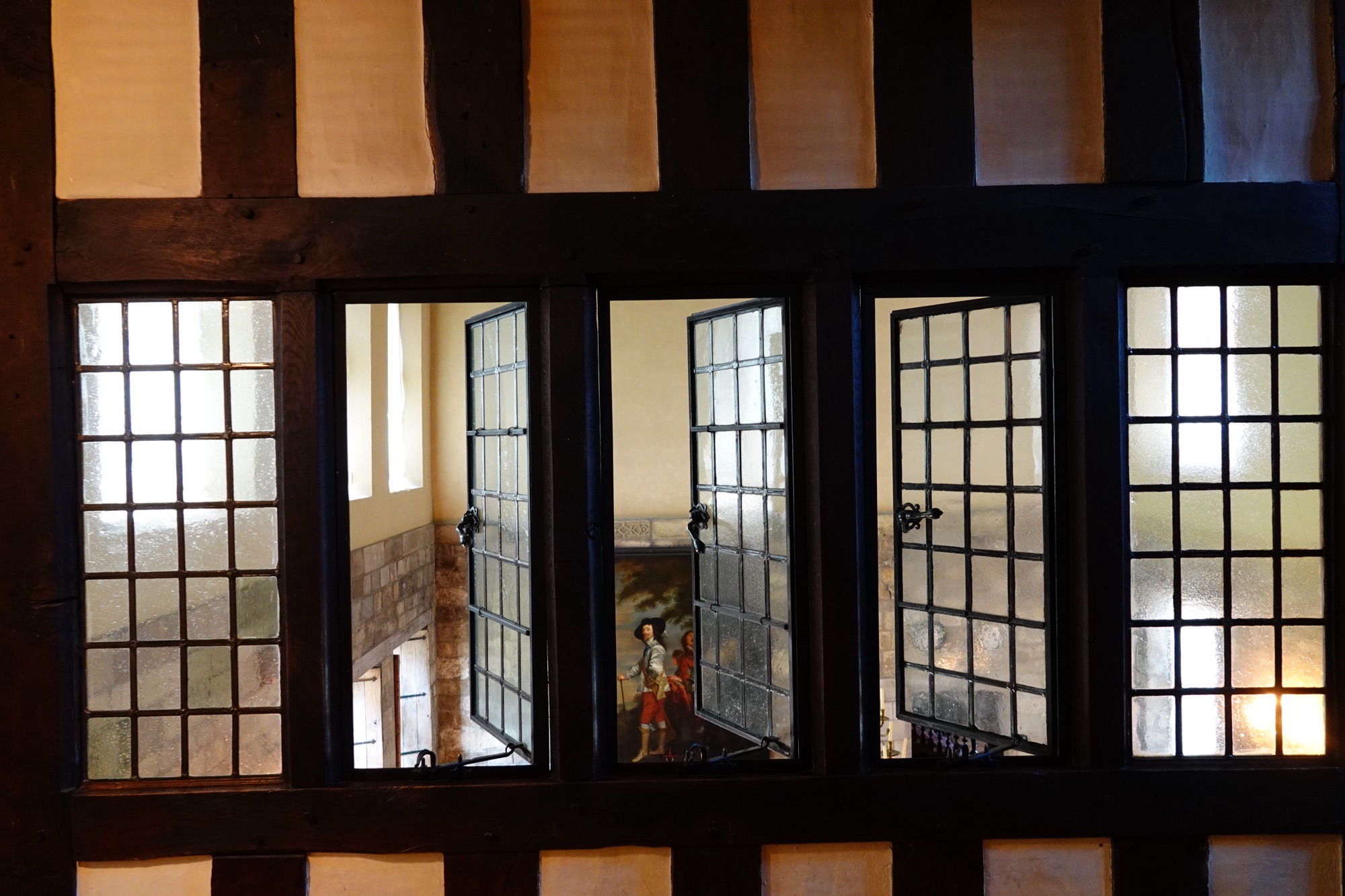
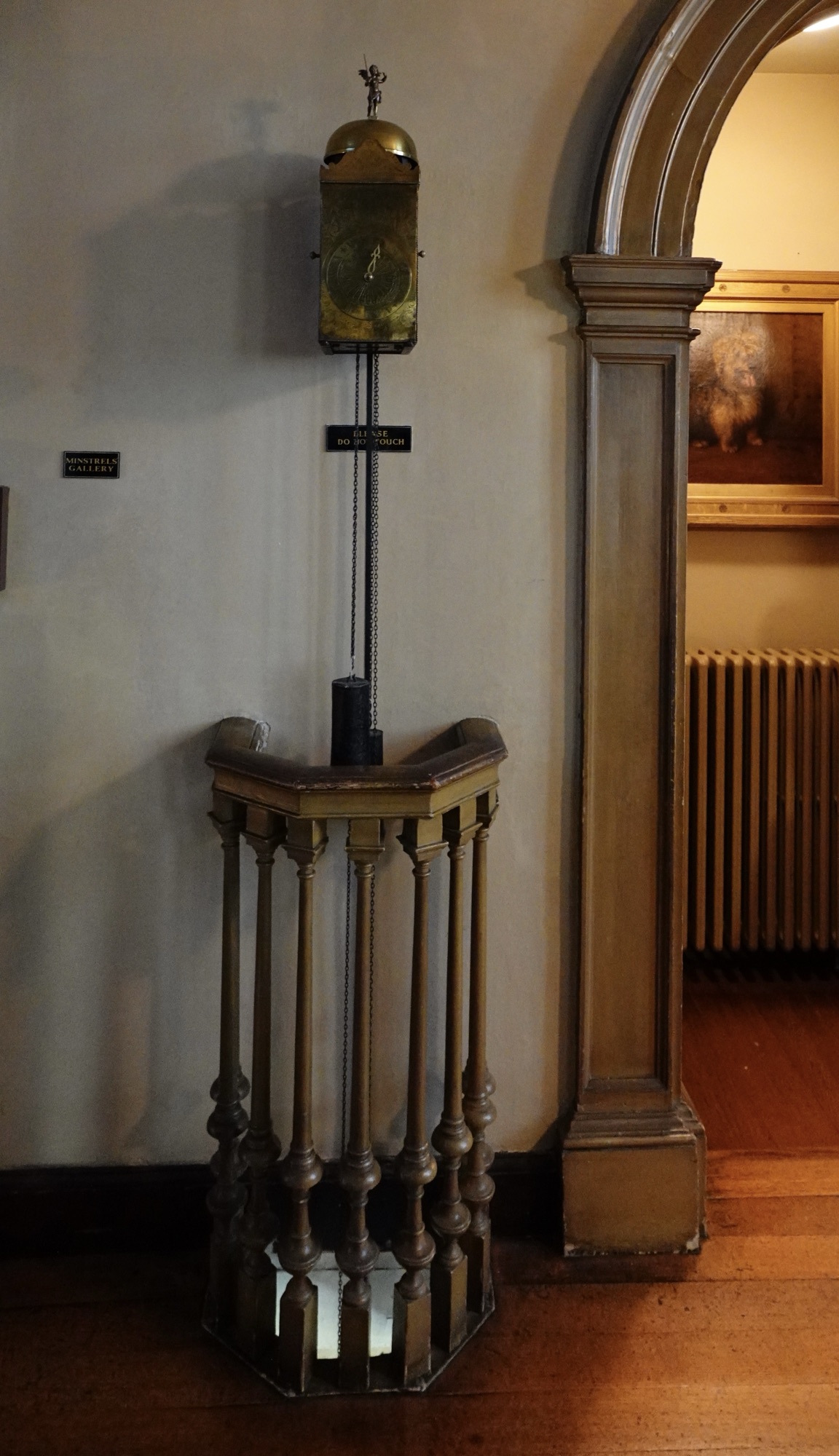
The most interesting thing in the gallery was a wall clock with a pendulum so long that a hole was cut into the floor through which it extends, and a balustrade built around the hole.
Frank Gray’s bedroom is also where the Prince of Wales slept, quite far from the Princess. (Well, Lillie Langtry was also a guest, so perhaps there was an intentional accommodation being made).
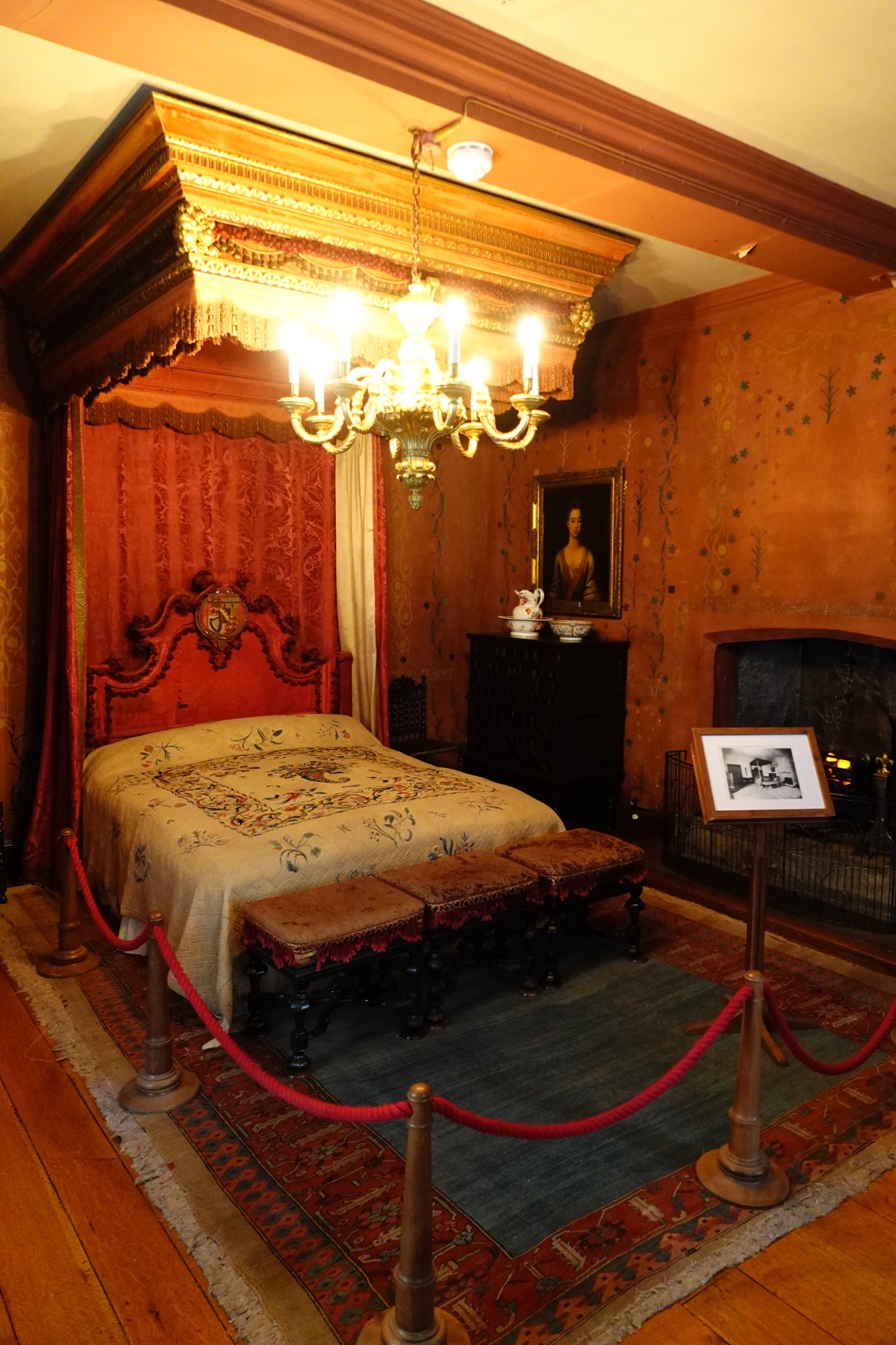
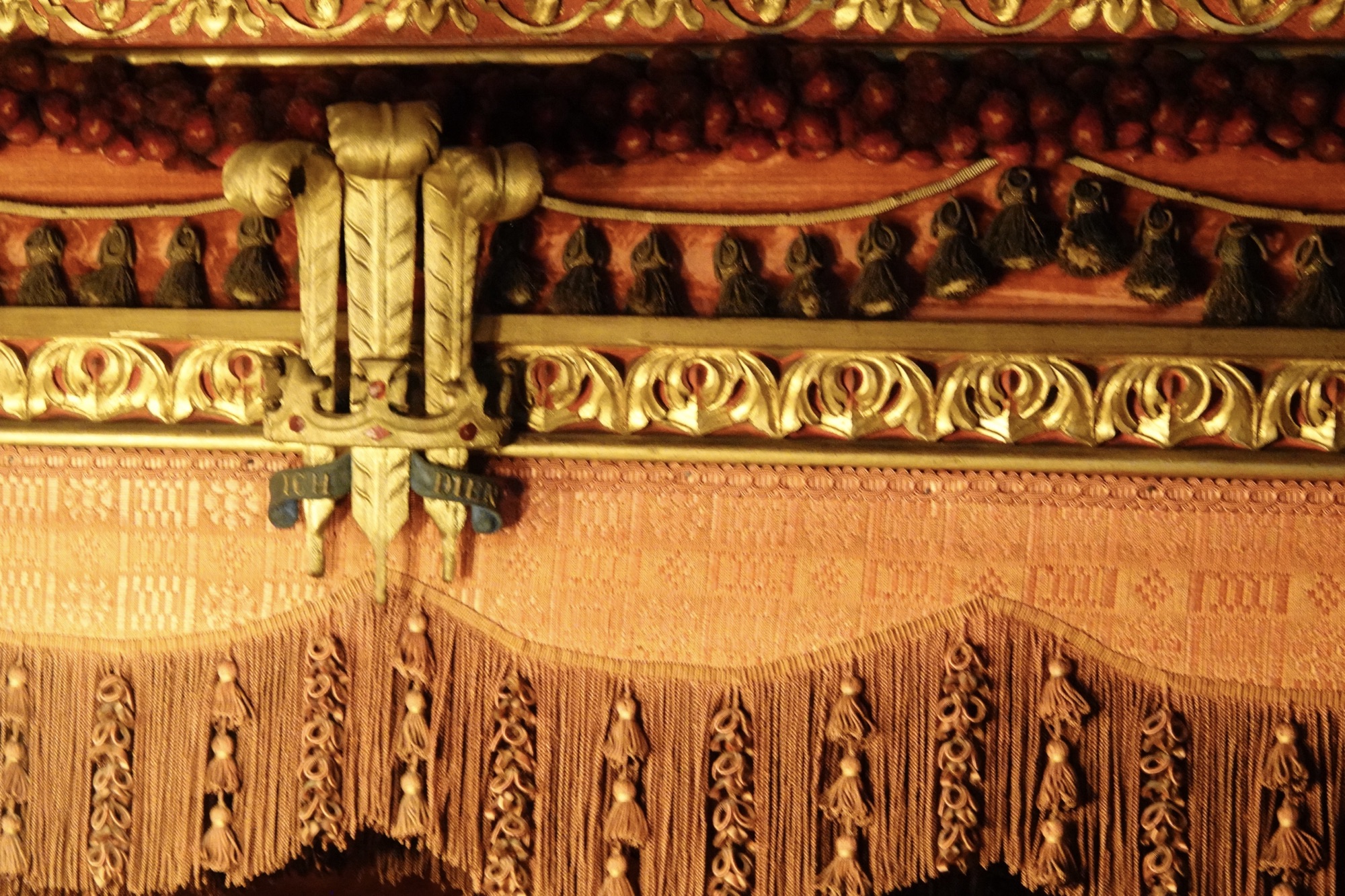
The walls are not paper, but stencilled. I wasn’t a fan of the dark colour of the room, and Duncan calling it the “Marmite room” did nothing to make me change my mind.
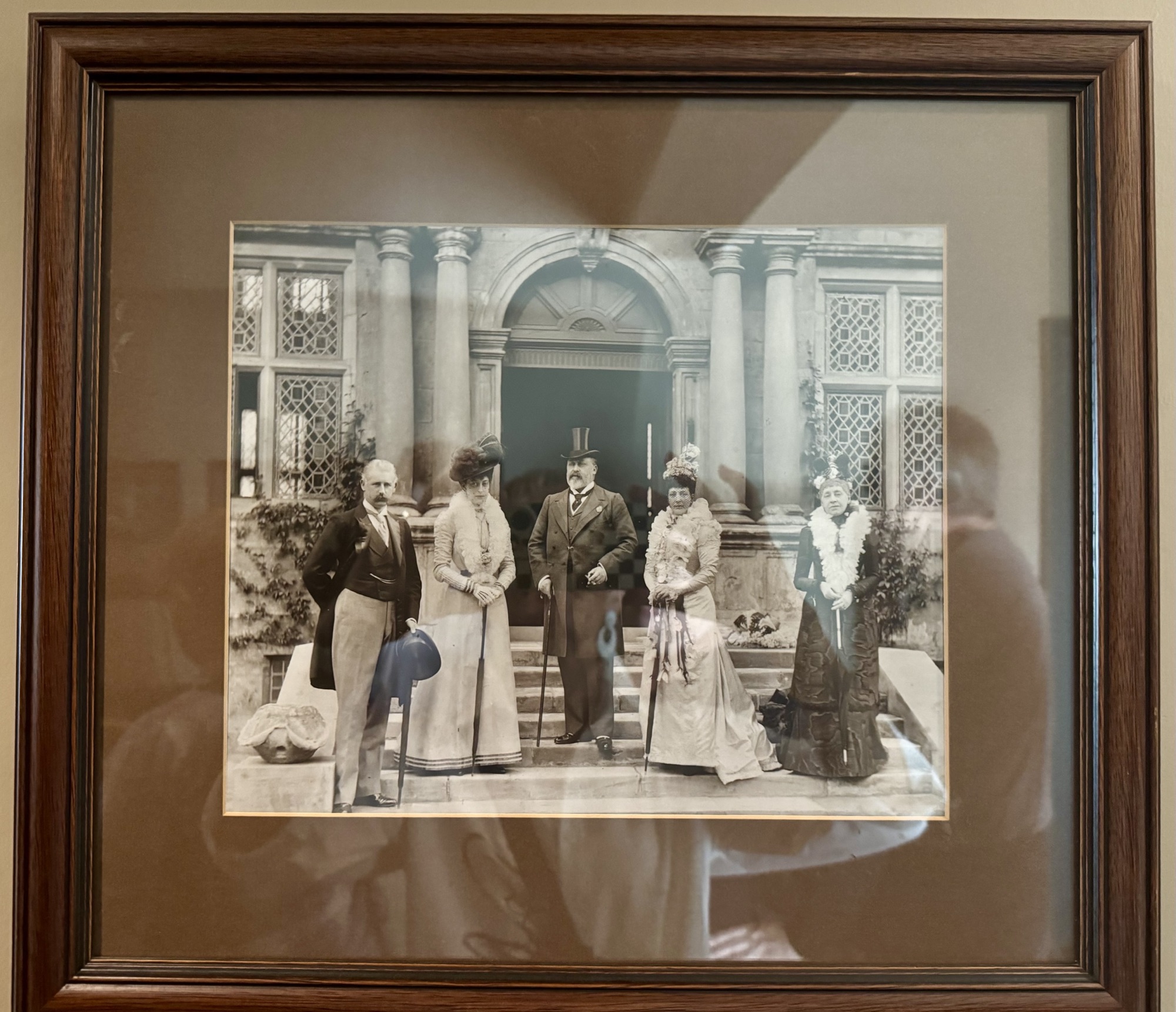
There was a photograph of the royal visit on display. In it, the Prince of Wales is standing one step higher than everyone else, including the Princess Alexandra, who was taller than her husband. Duncan quipped that the photo was a sign of things to come.
Our last stop was in a small pine green room with the Green family portraits.
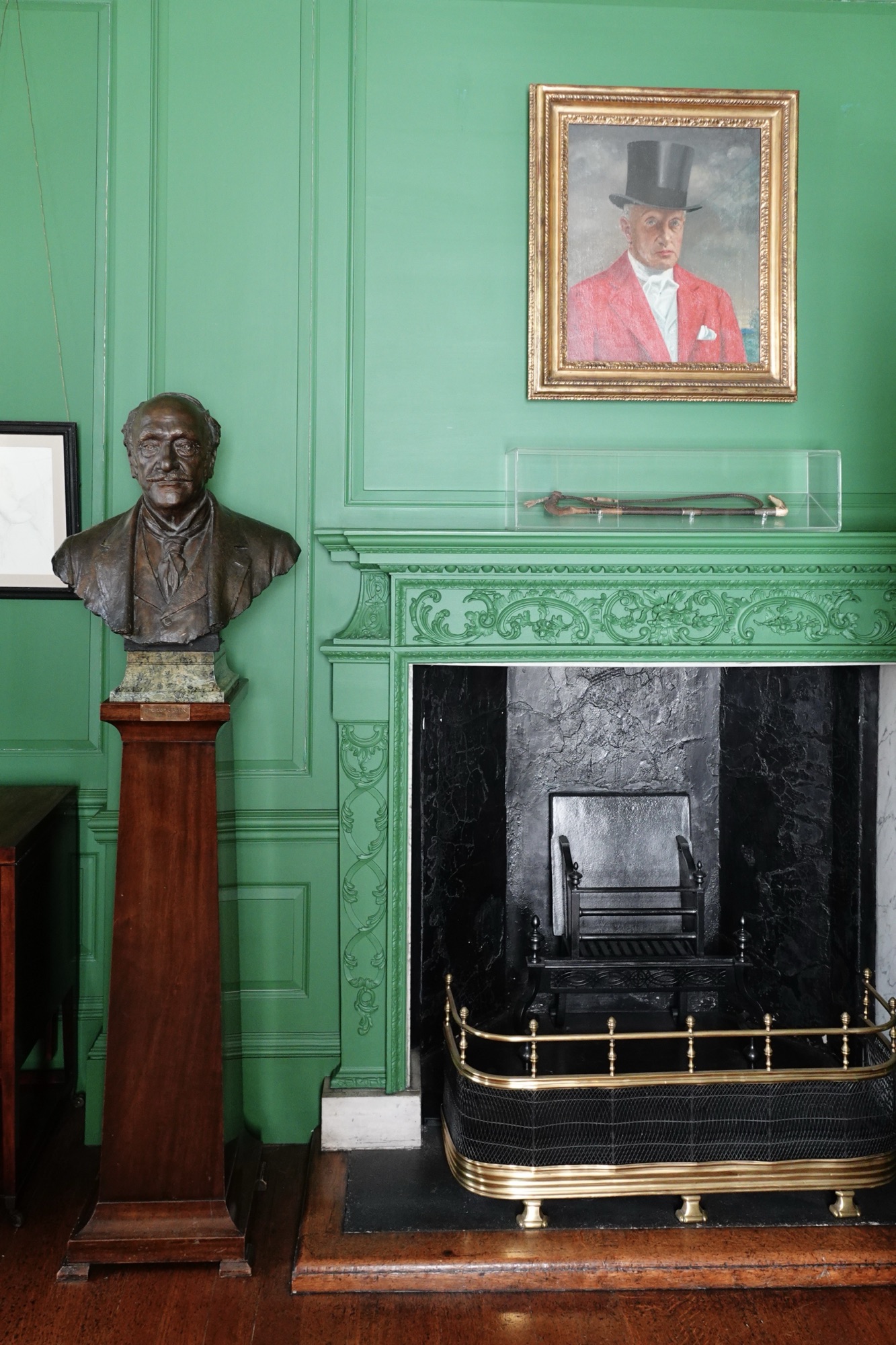
After the tour we headed below stairs for a sit and a cuppa, and a peek at the kitchen.
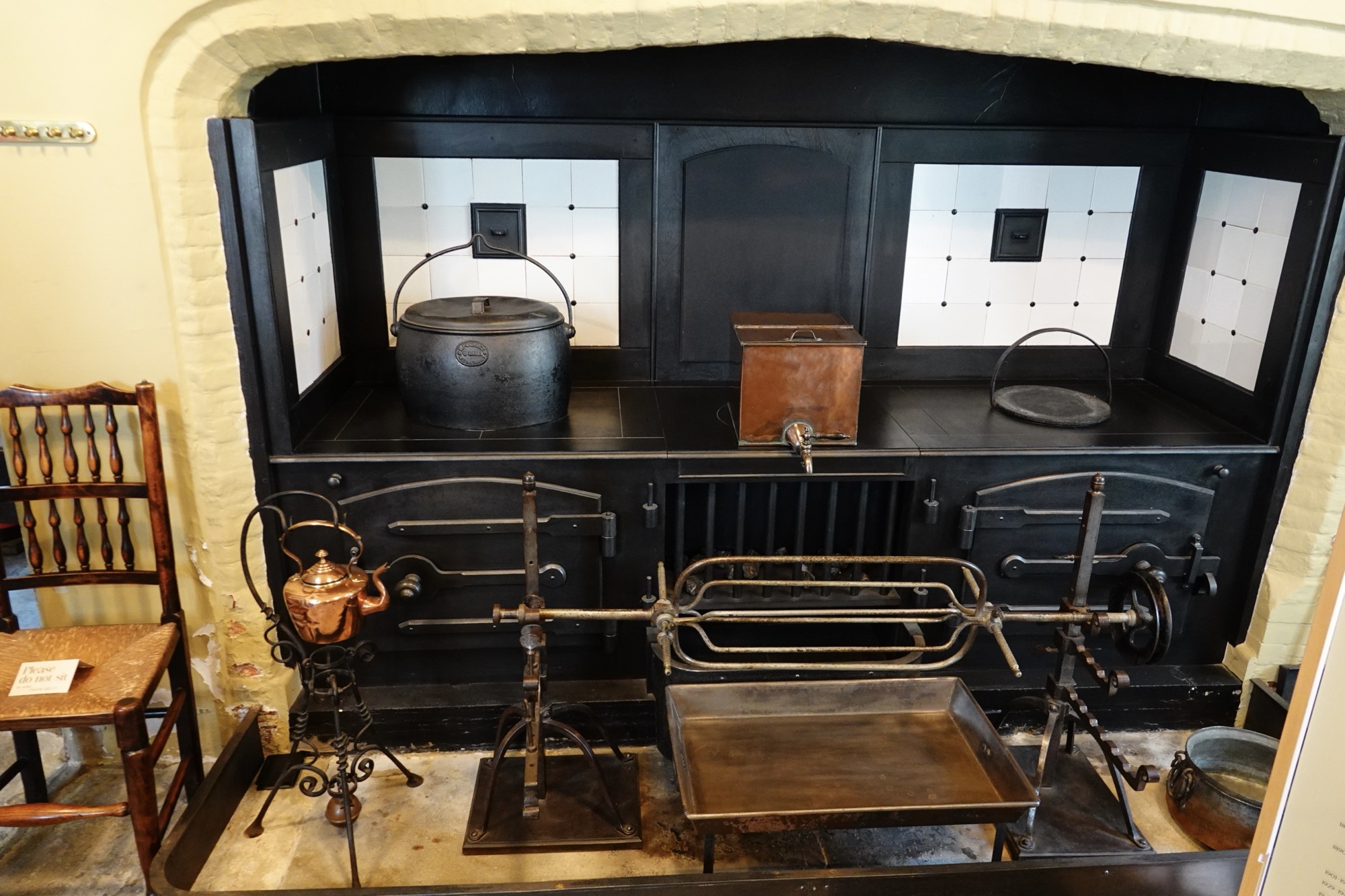
In the hallway leading to the café were photographs of some of Frank Green’s staff. In the group photo, with Frank in the centre, you can see his maid’s prosthetic leg (she is seated second from the right in the front row).
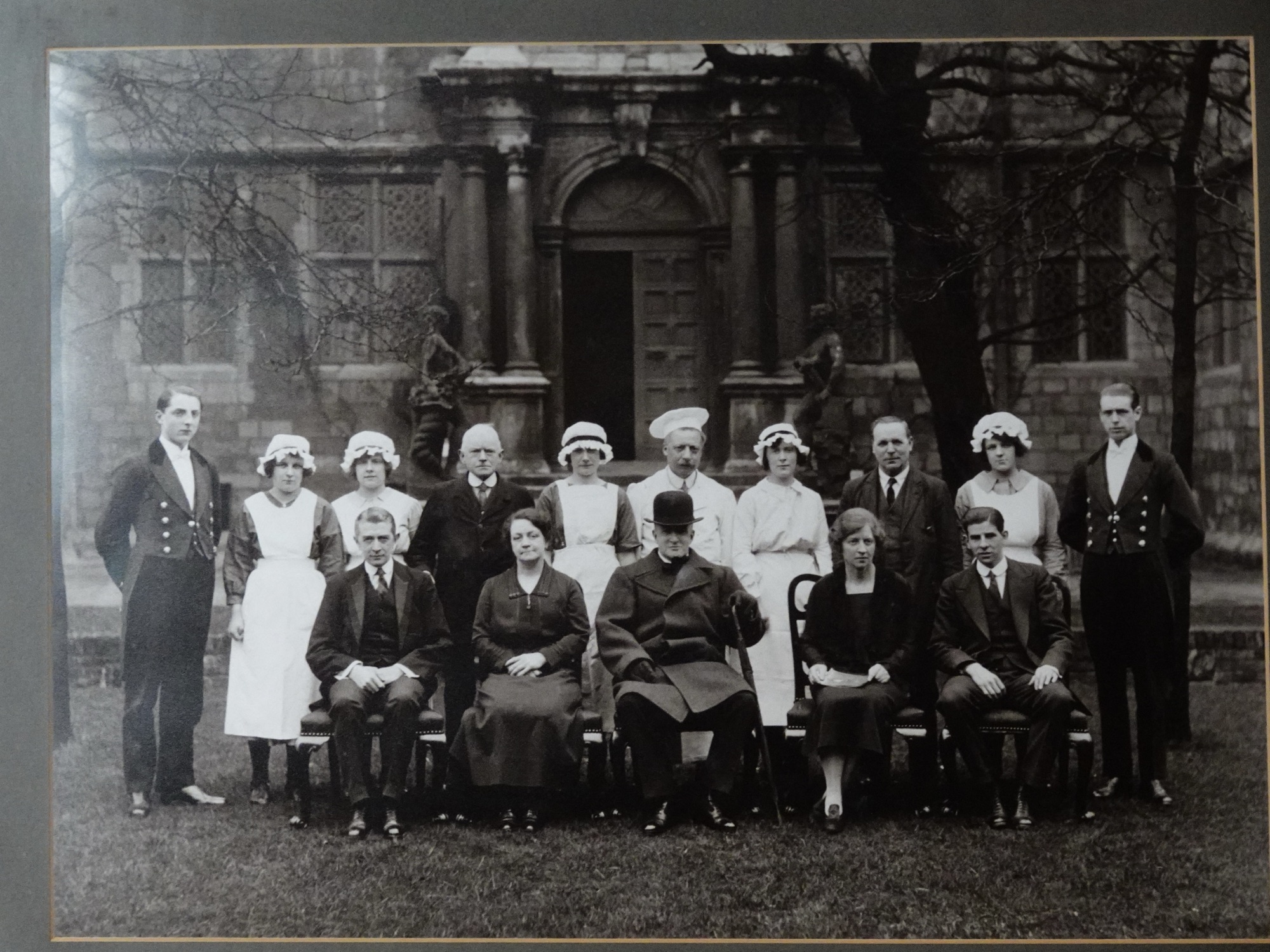
We learned that when Frank Green left the Treasurer’s House, he gifted his chauffeur with one of his 6(!) Rolls Royces, which his chauffeur turned into a posh taxi service, and yet he cannot have been an easy man for whom to work.
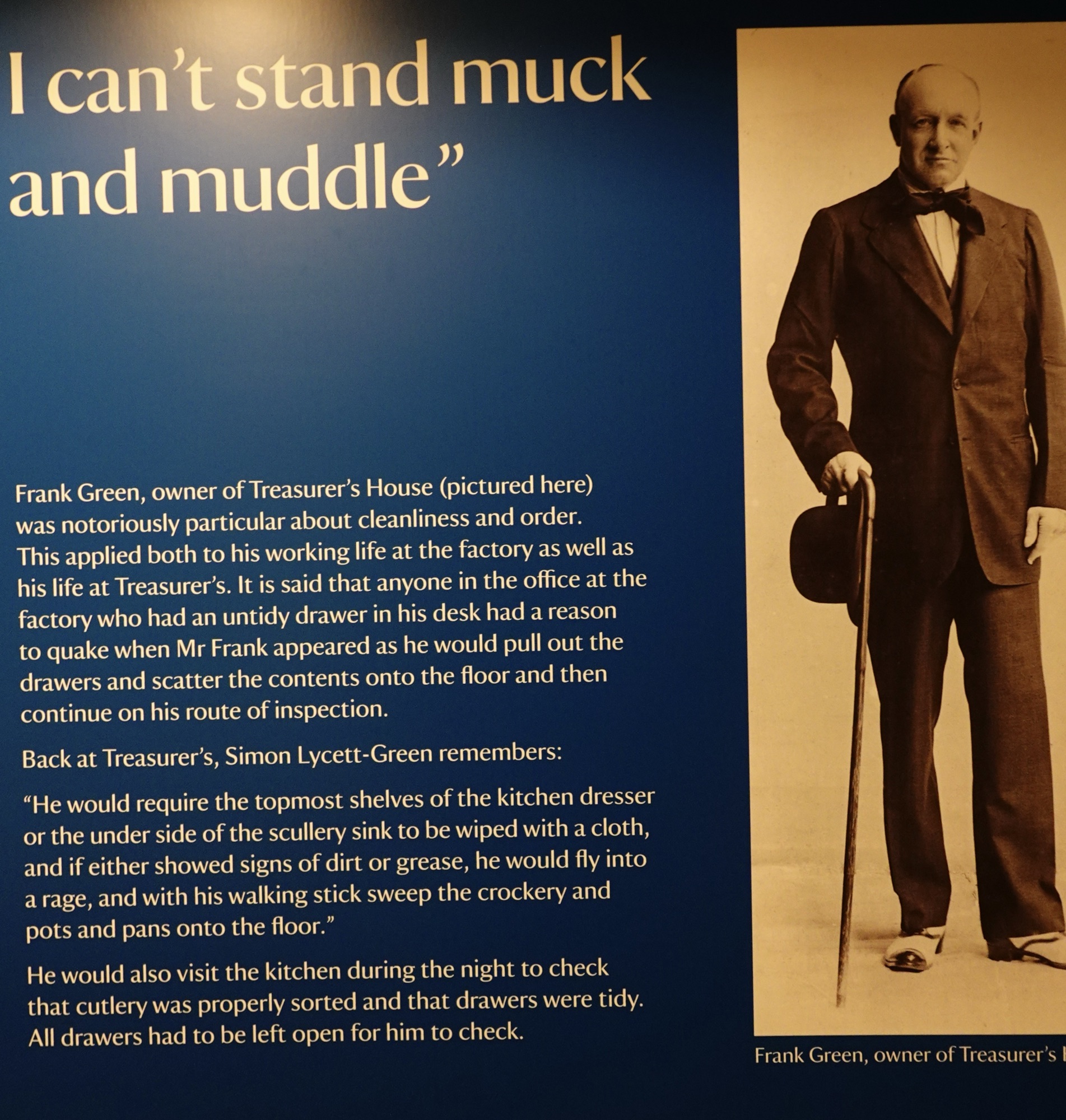
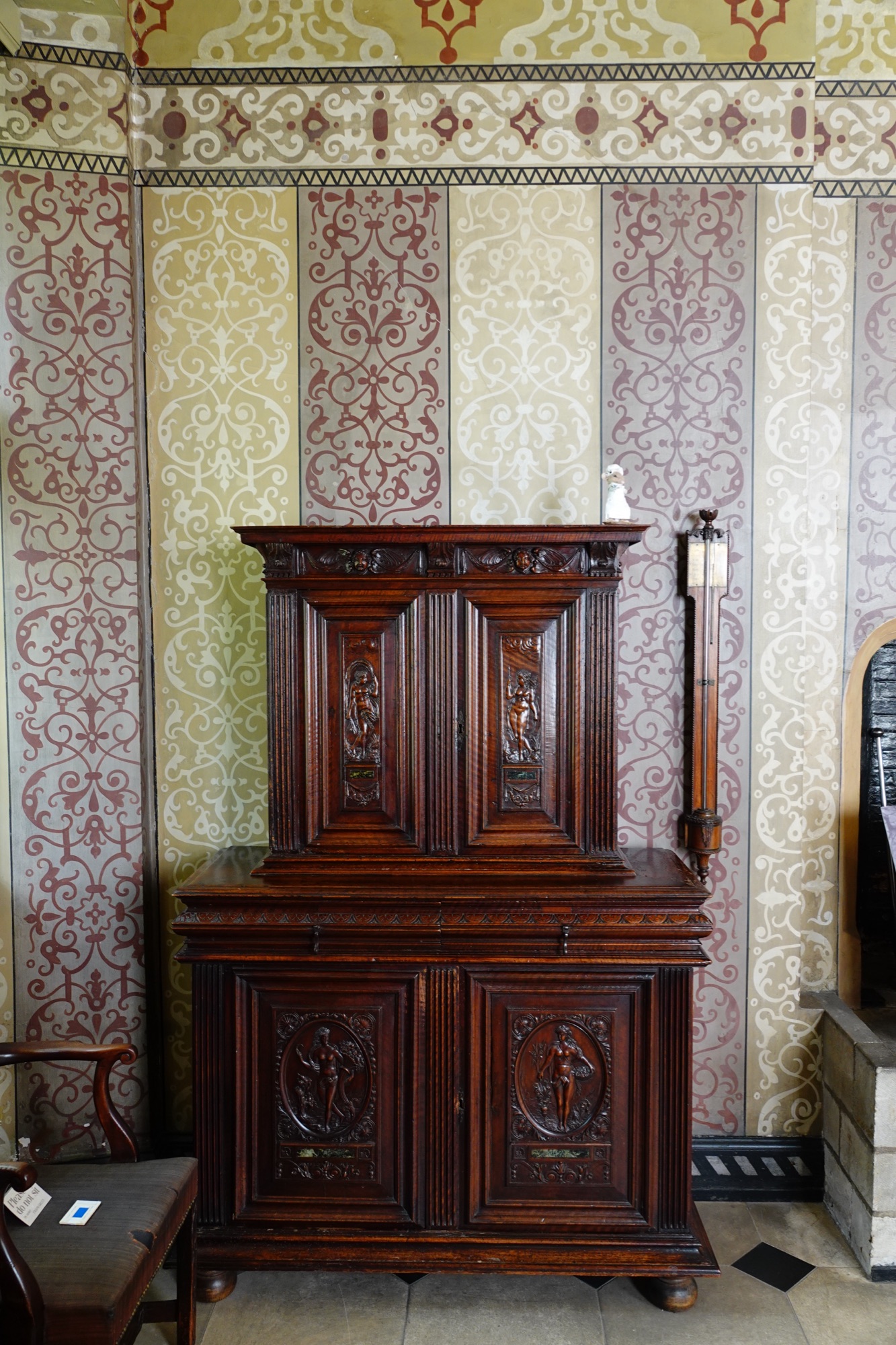
Before leaving, while saying our thanks, one of the National Trust staff pointed out the woodworm damage on the carved wooden cabinet in the front hall. She suggested imagining it travelling from distant parts, probably for months at sea, and being unpacked to have larvae crawling around or the mature beetles flying out!!
Time for some fresh air.
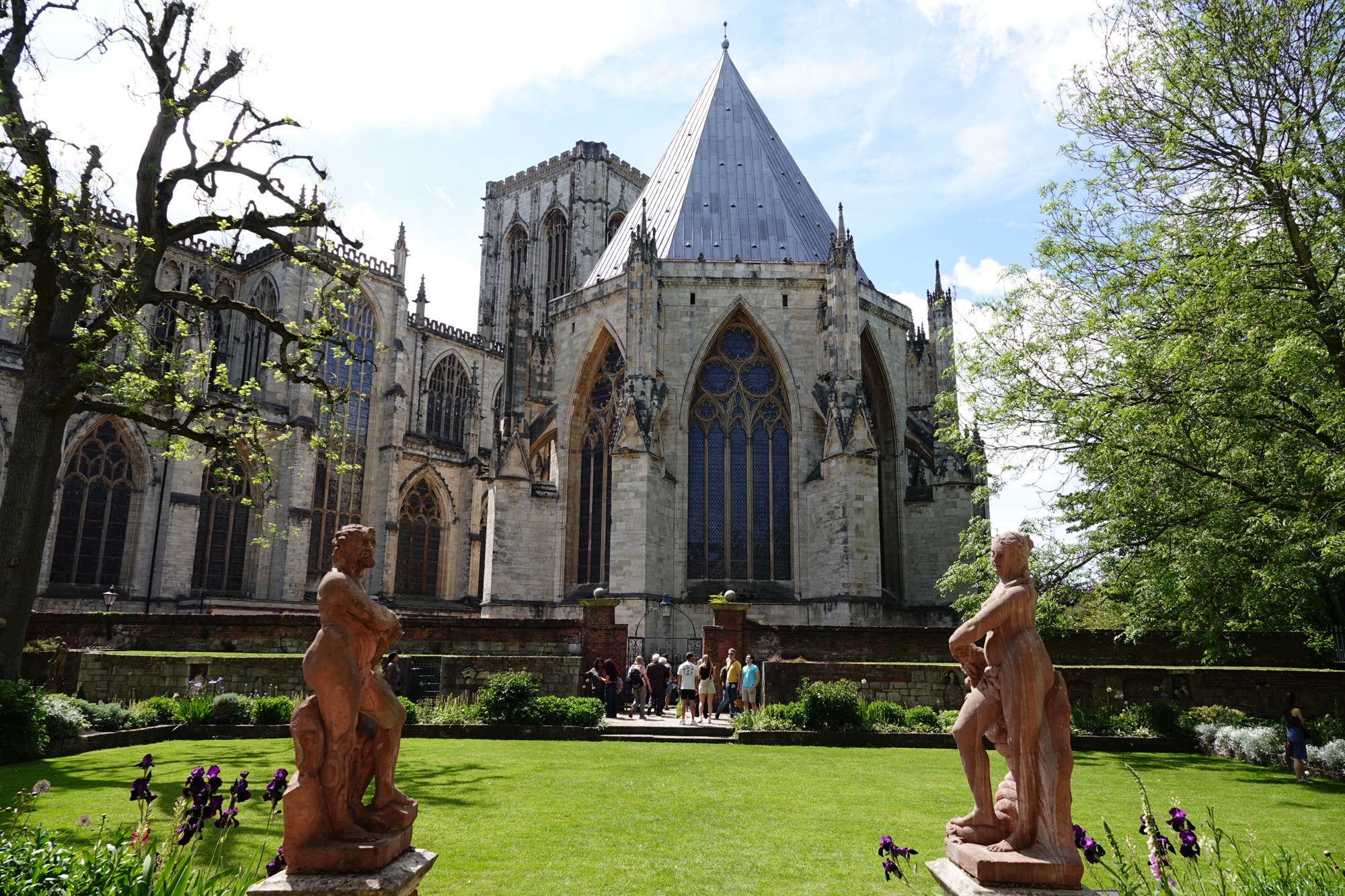
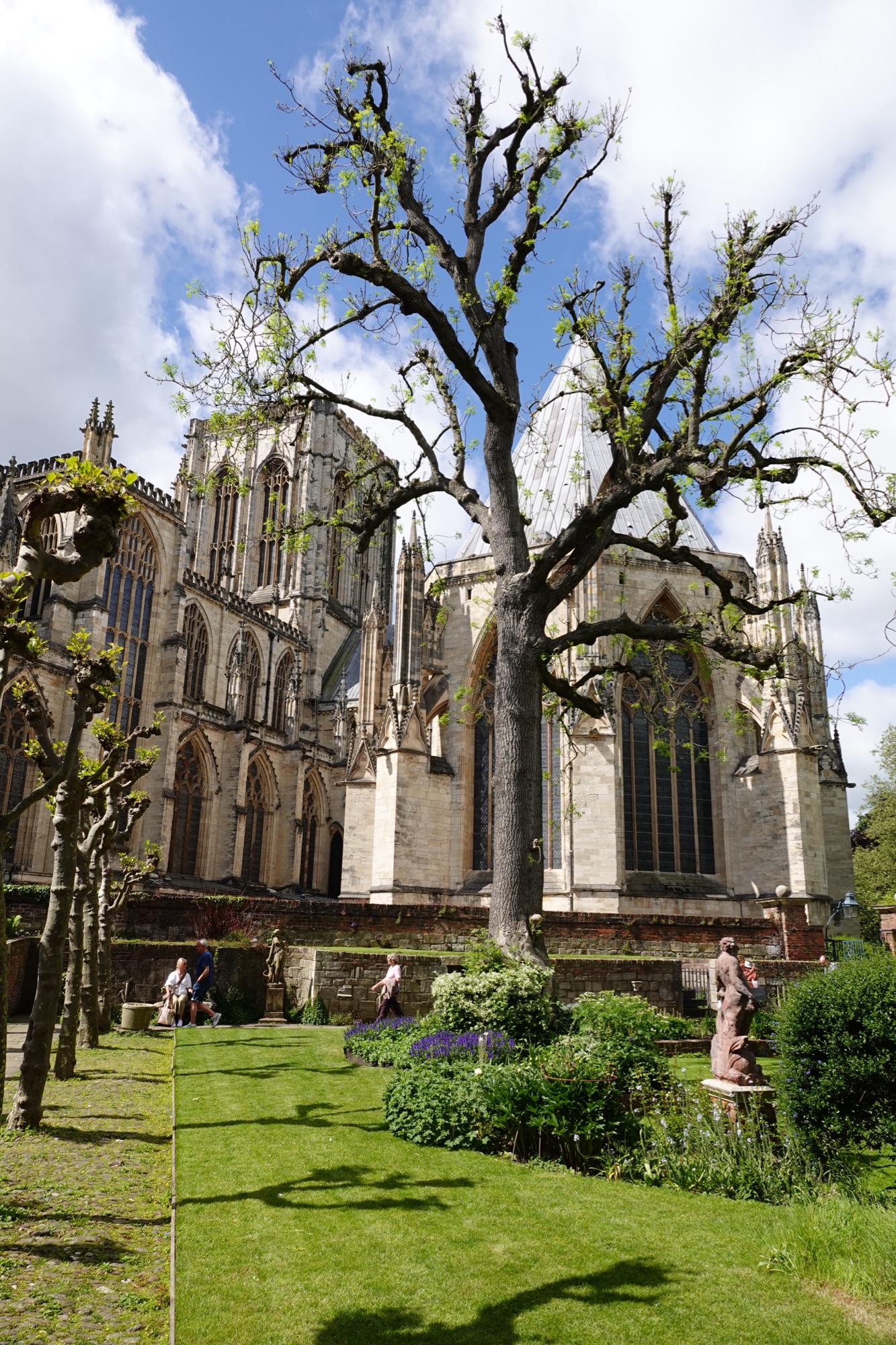
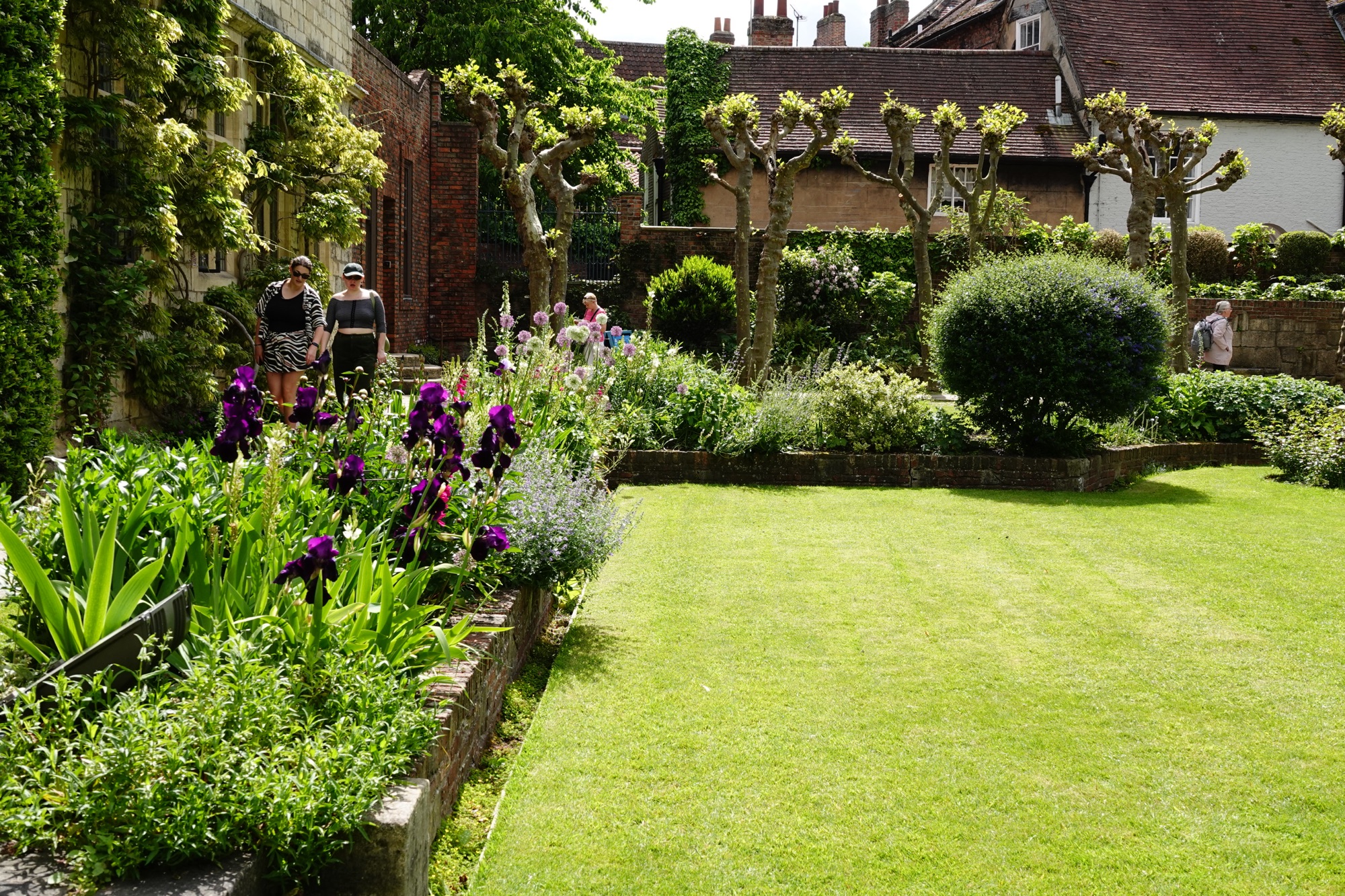
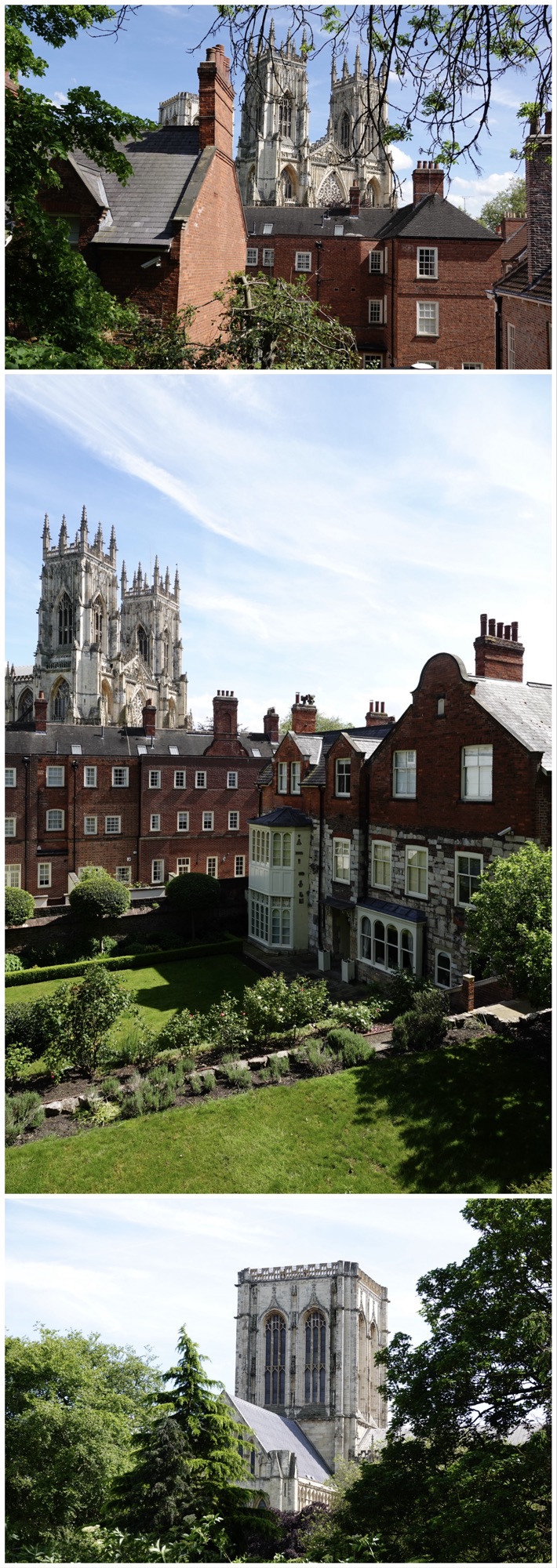
We walked around the Treasurer’s House Garden for a bit, taking in the view of the Minster that Frank must have enjoyed.
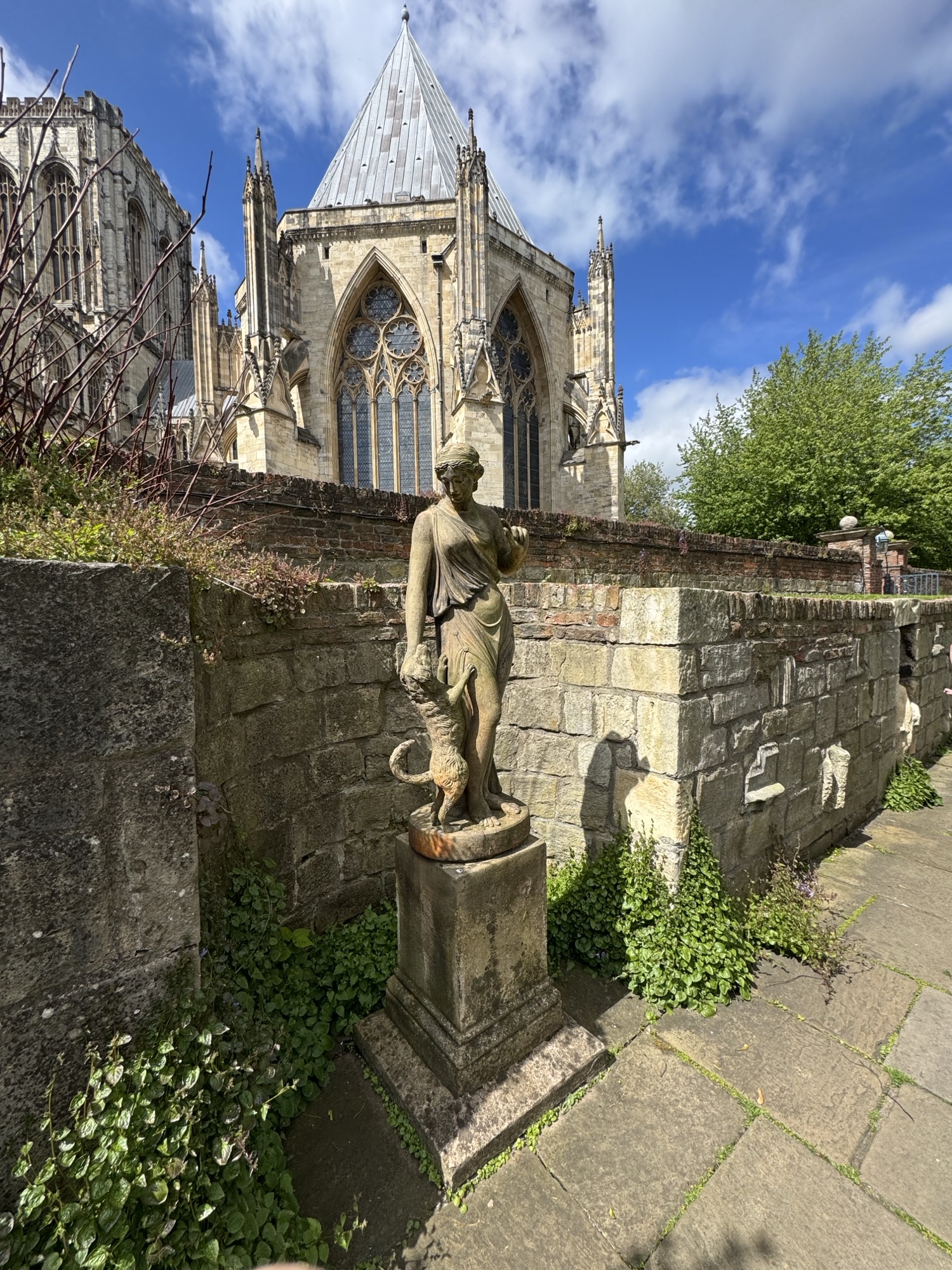
Then we headed toward Bootham Gate to walk another piece of the York City walls.
En route, we detoured into the York Museum Gardens where the Eboracum Roman Festival was taking place. (Eboracum is the Latin name of the Roman fort and city that eventually became York.)
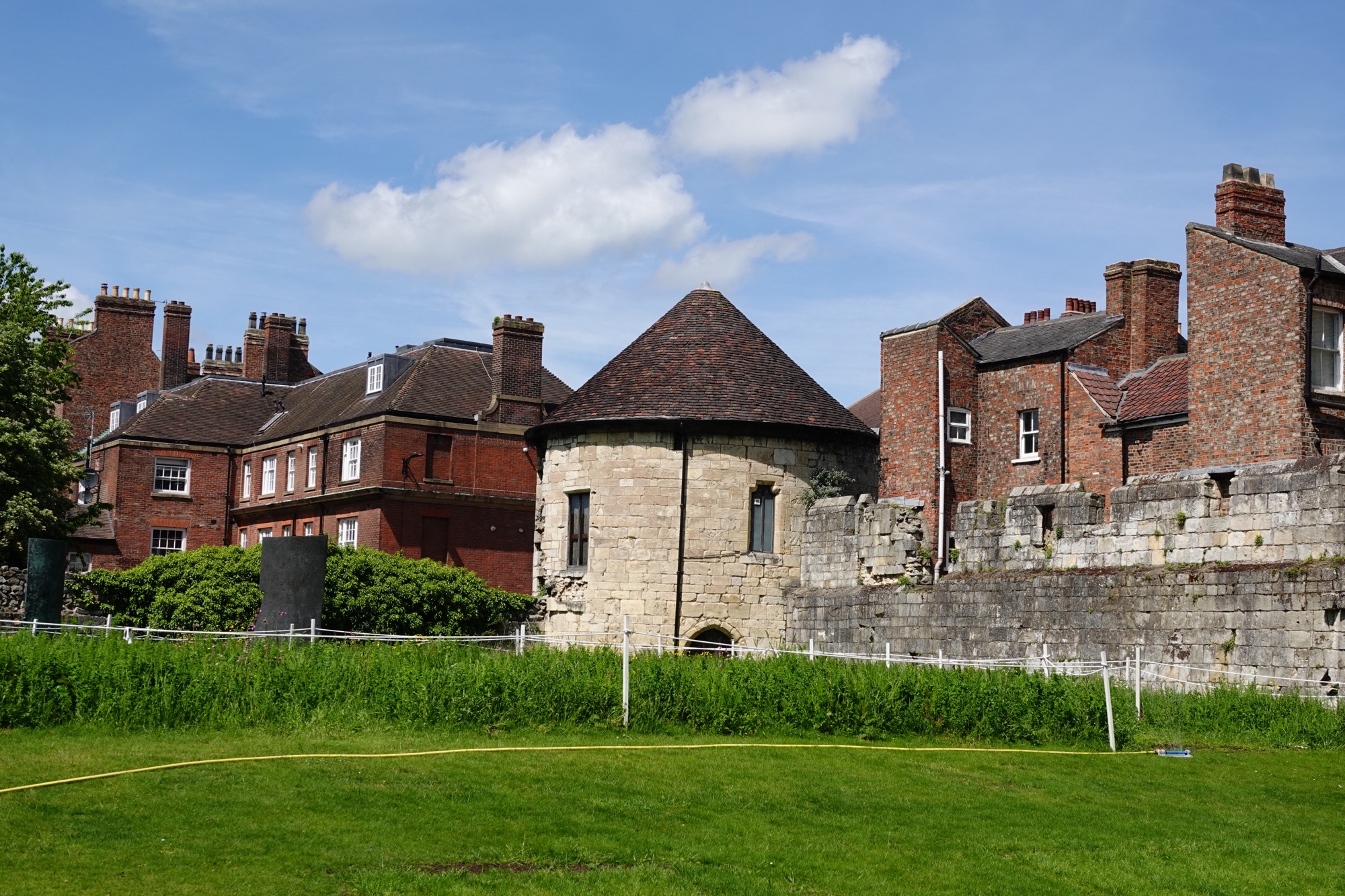
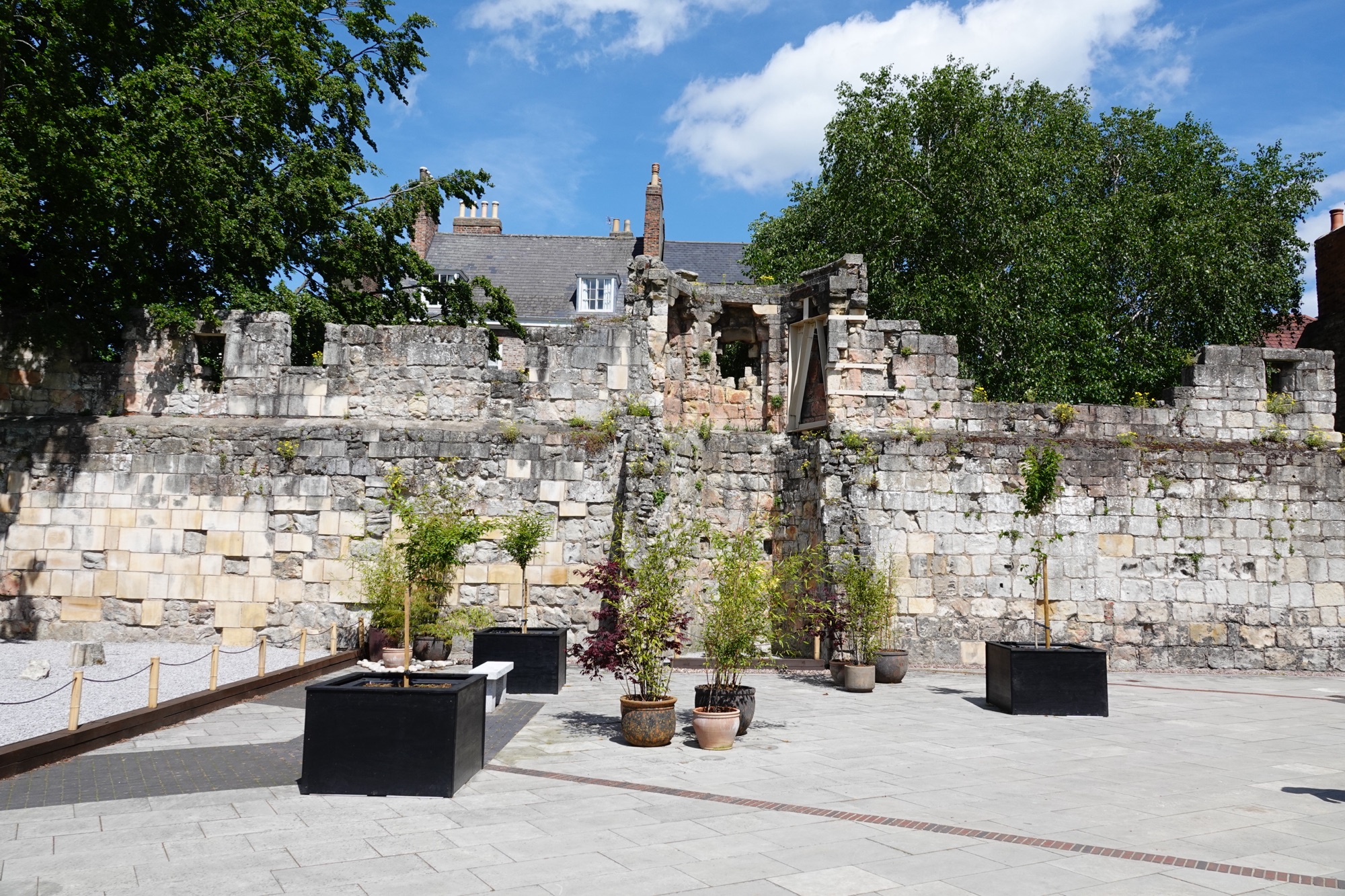
A group of children, and some parents, were engaged in a mock Roman vs Celt battle taking place amidst the ruins of the ancient Roman walls in the middle of the city.
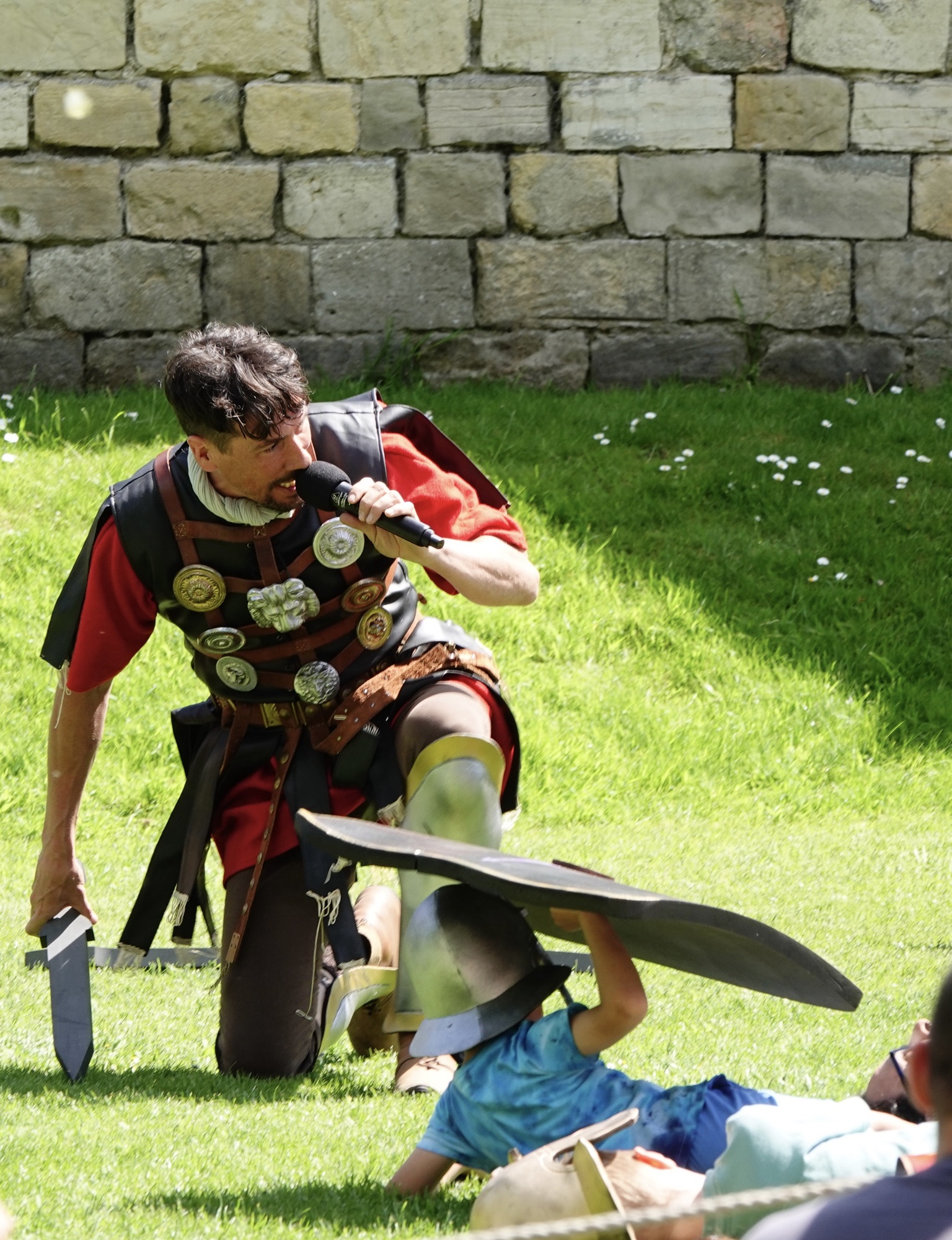
The Roman legion and Boudicca’s warriors seemed to be having a terrific time. The children representing Romans were encouraged to form an impenetrable shield wall; Boudicca’s Celts were simply encouraged to be madmen!
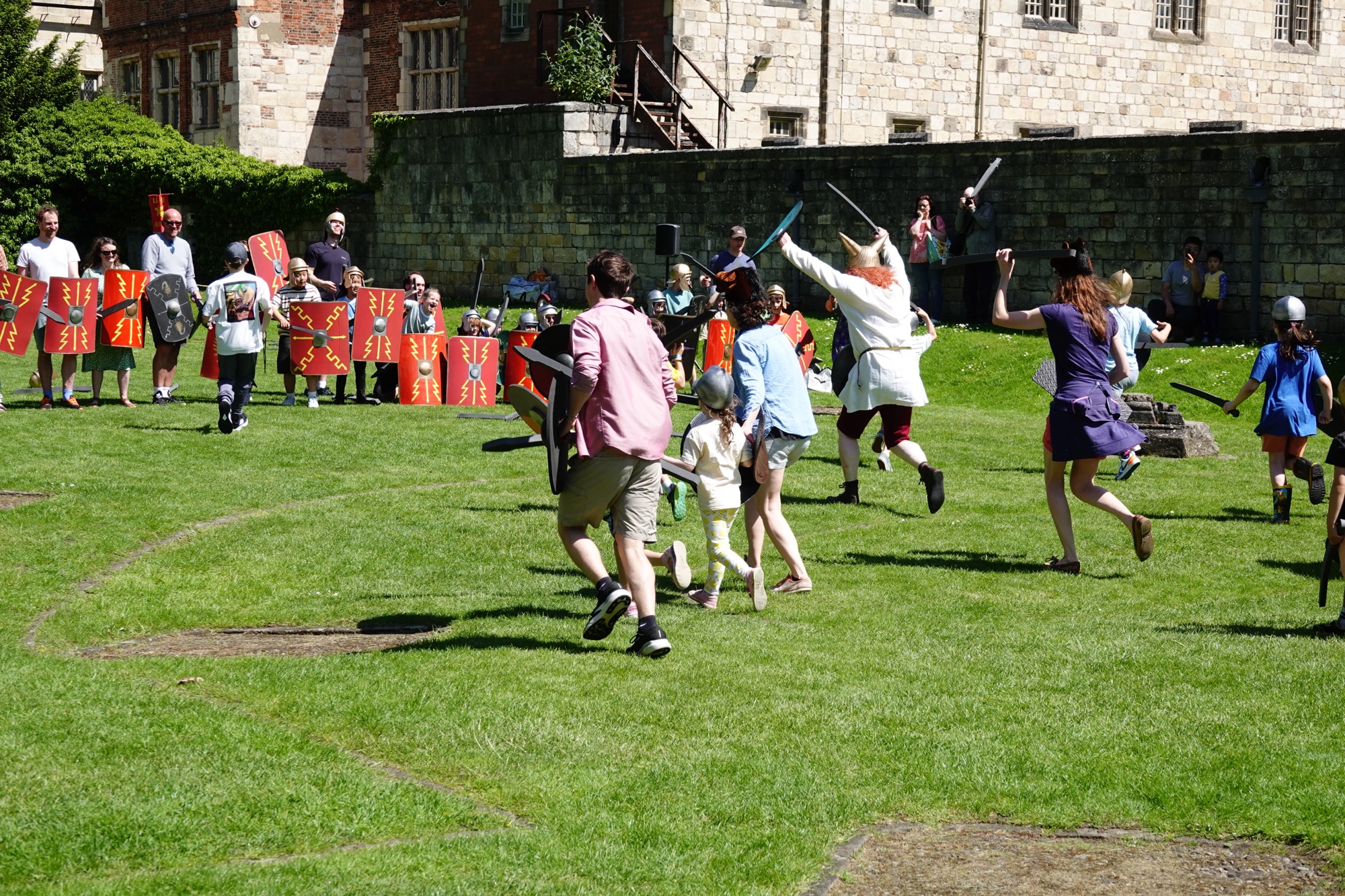
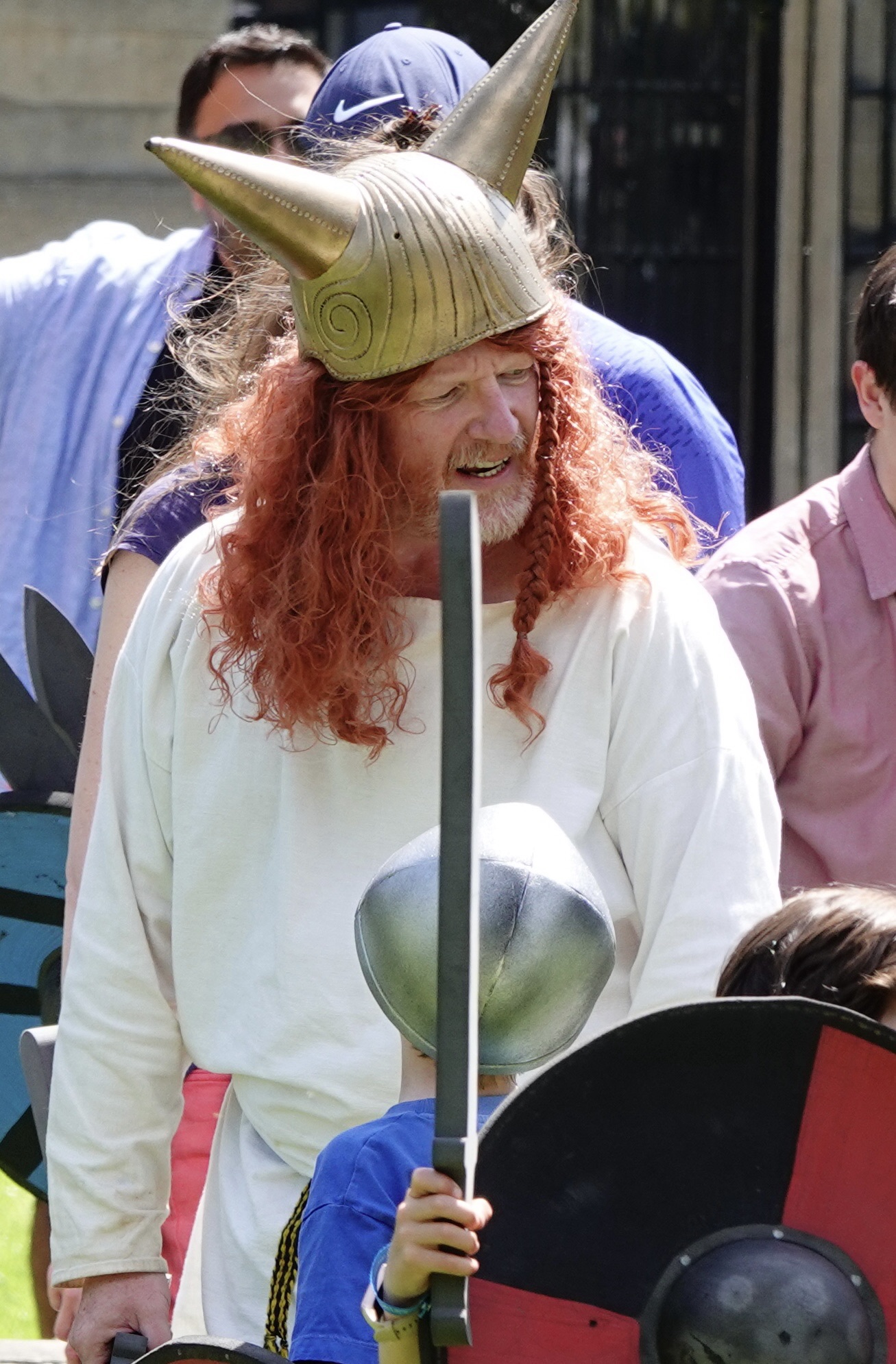
I commented to Ted that only in England would children reenacting a battle be told to “die in the best Monty Python fashion”, after a speech that began with “in the words of Blackadder”.
We strolled through the York Museum Gardens beyond the Roman Festival events too.
Around the corner from the gardens we noticed St. Olave’s, a church founded in 1041CE by Siward, Earl of Northumbria, dedicated to Olaf, the first Norwegian saint. In 1055CE the property was donated to Benedictine monks who in108mCE founded St. Mary’s Abbey but who kept St. Olave’s as a local church.
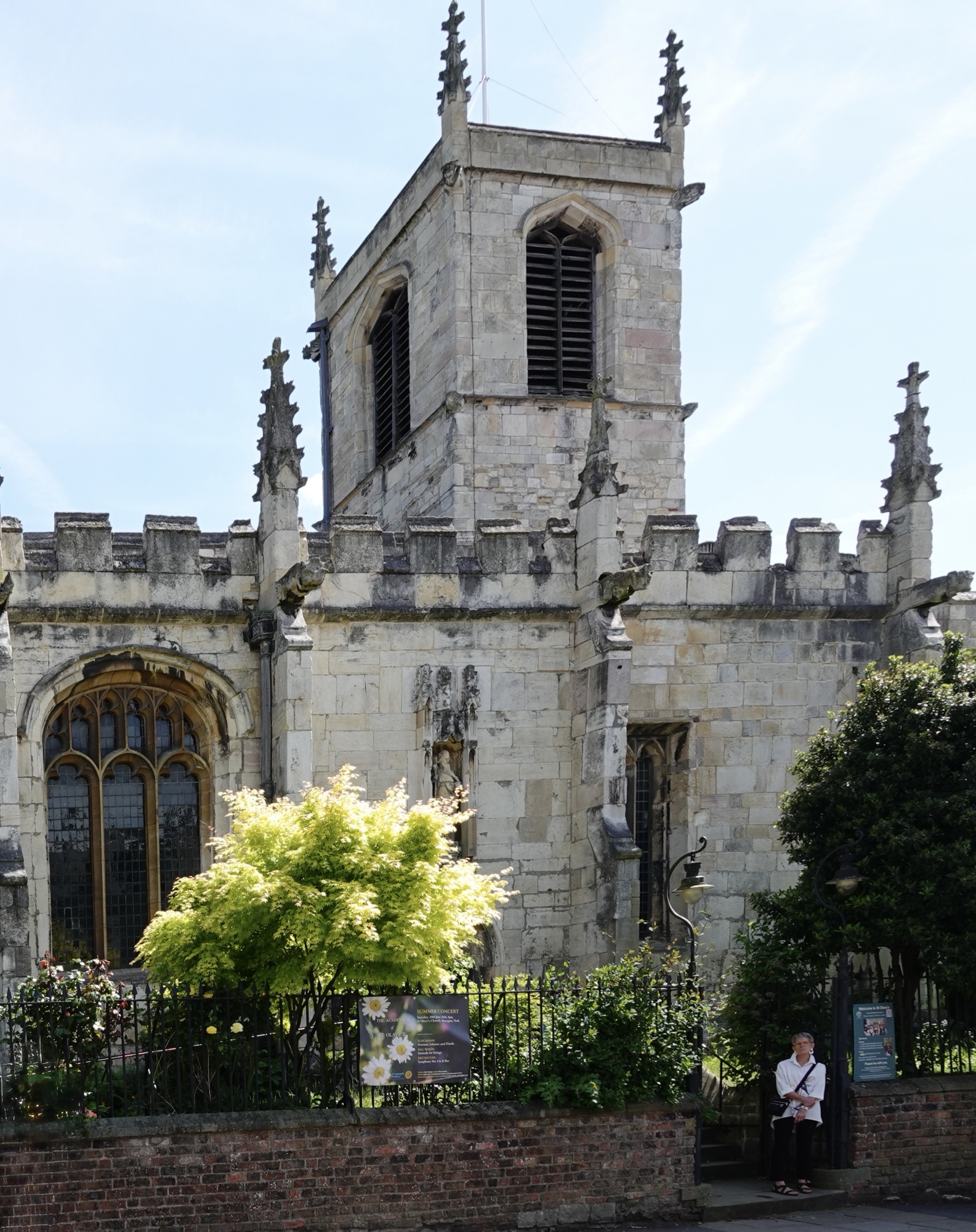
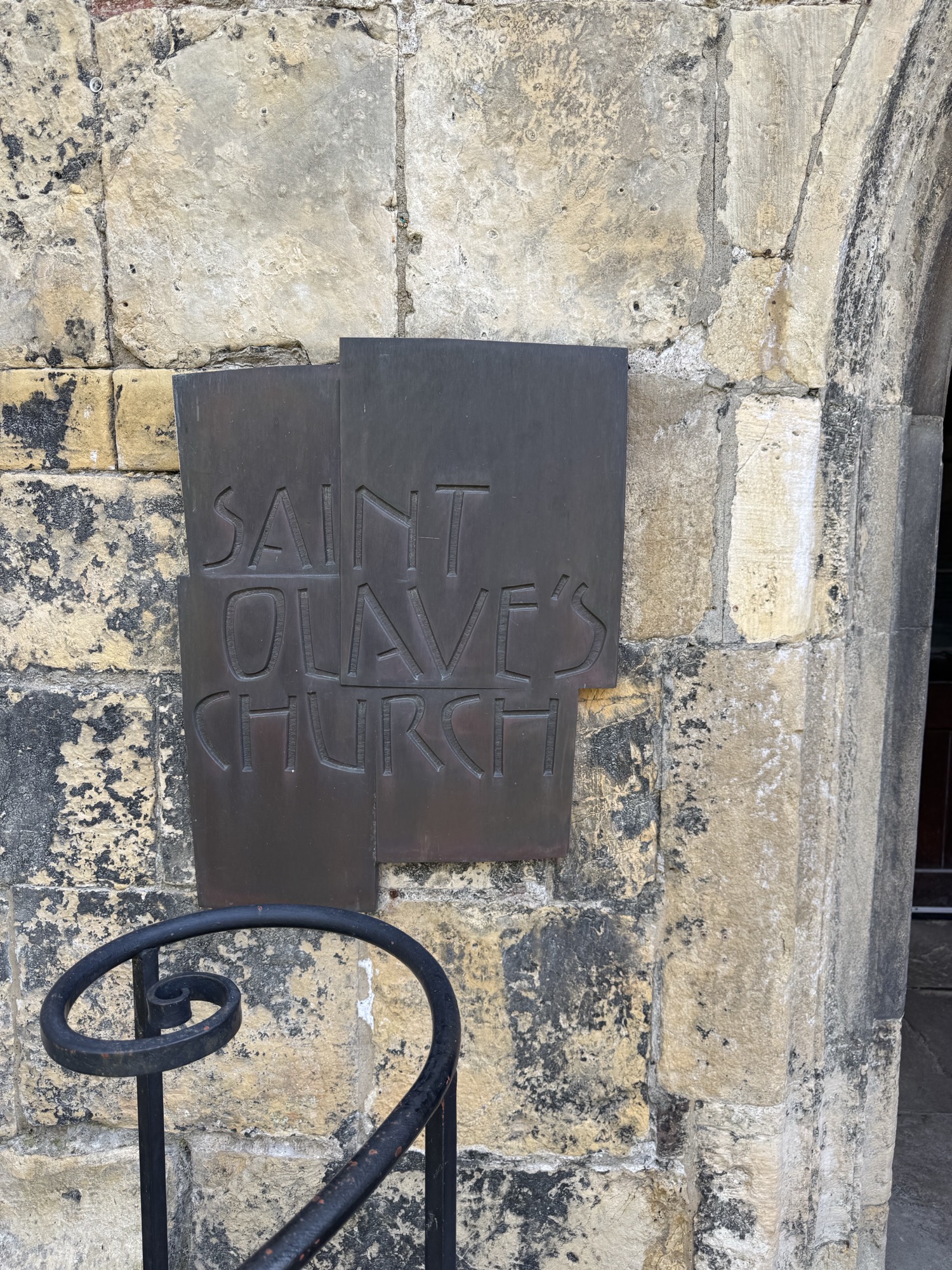
Mediaeval St. Olave’s was small, with the abbey almonry (where food and money – “alms” – were distributed to the poor) built right up against it. When Henry VIII closed all the monasteries and abbeys in 1536CE, St. Olave’s survived because it was just a parish church, and was converted from Catholic to Anglican (Church of England). Even now, with additions made in the 18th century, it’s not very big.
When we got to the church, the organist was playing.
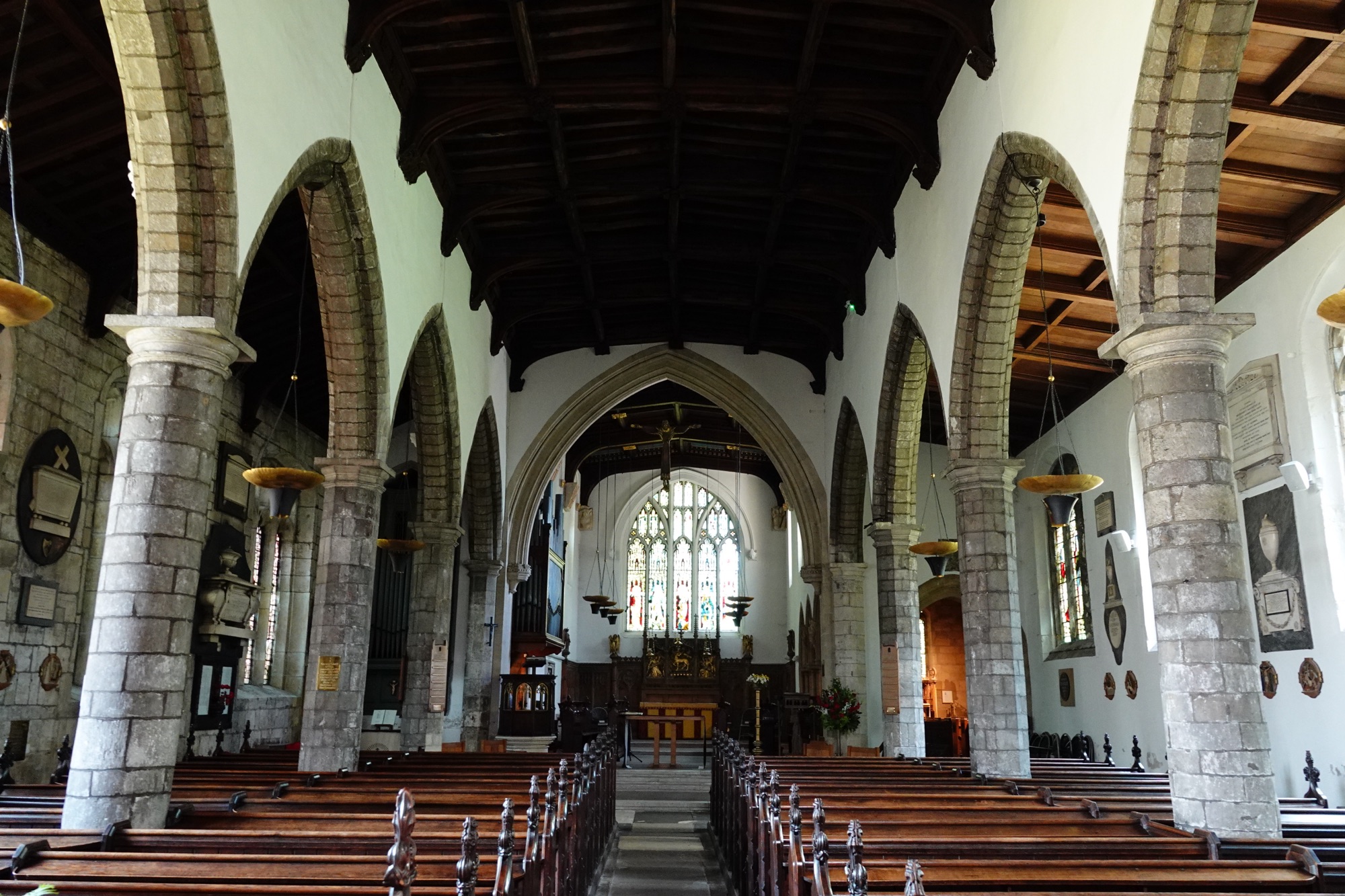
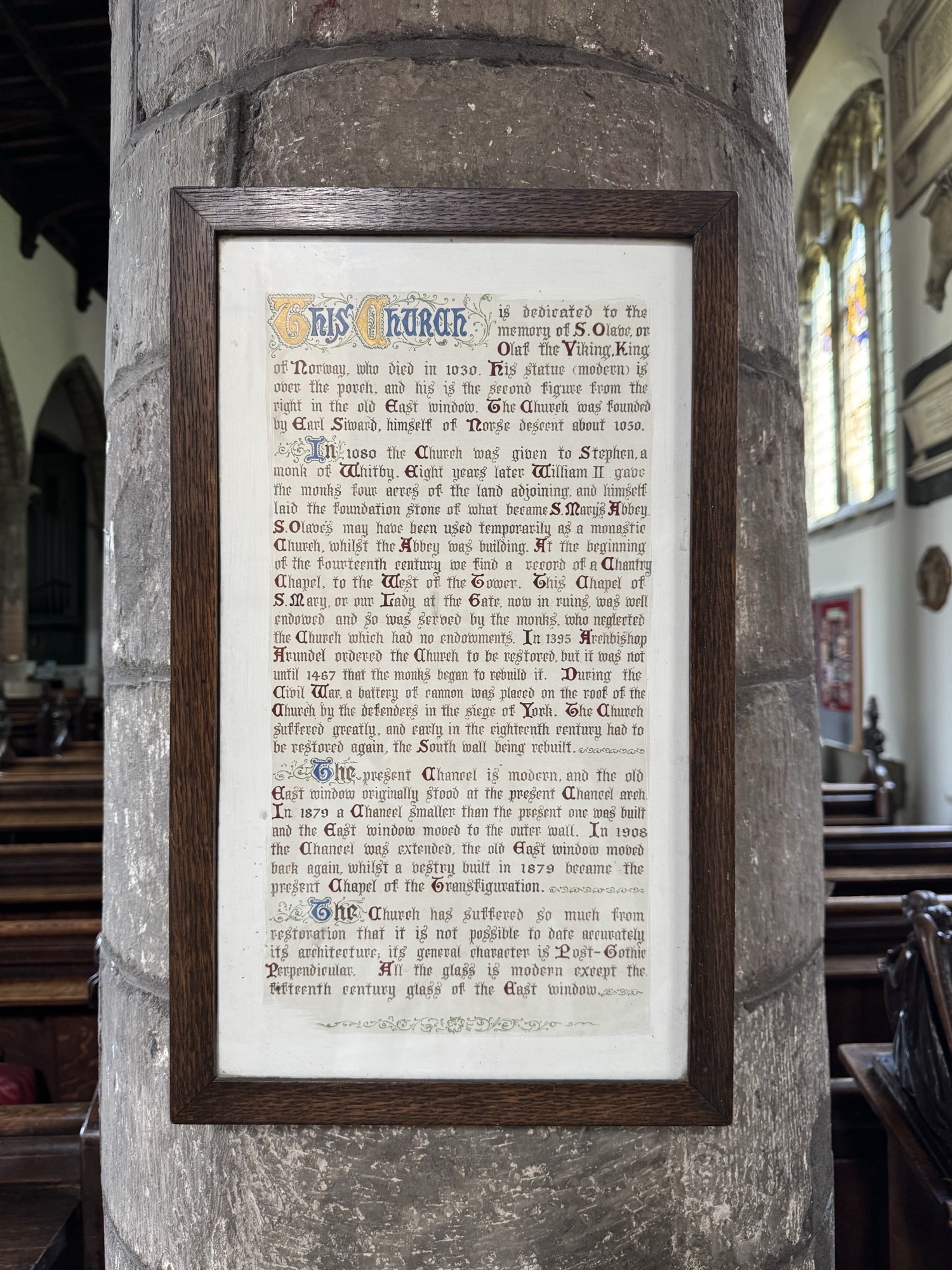
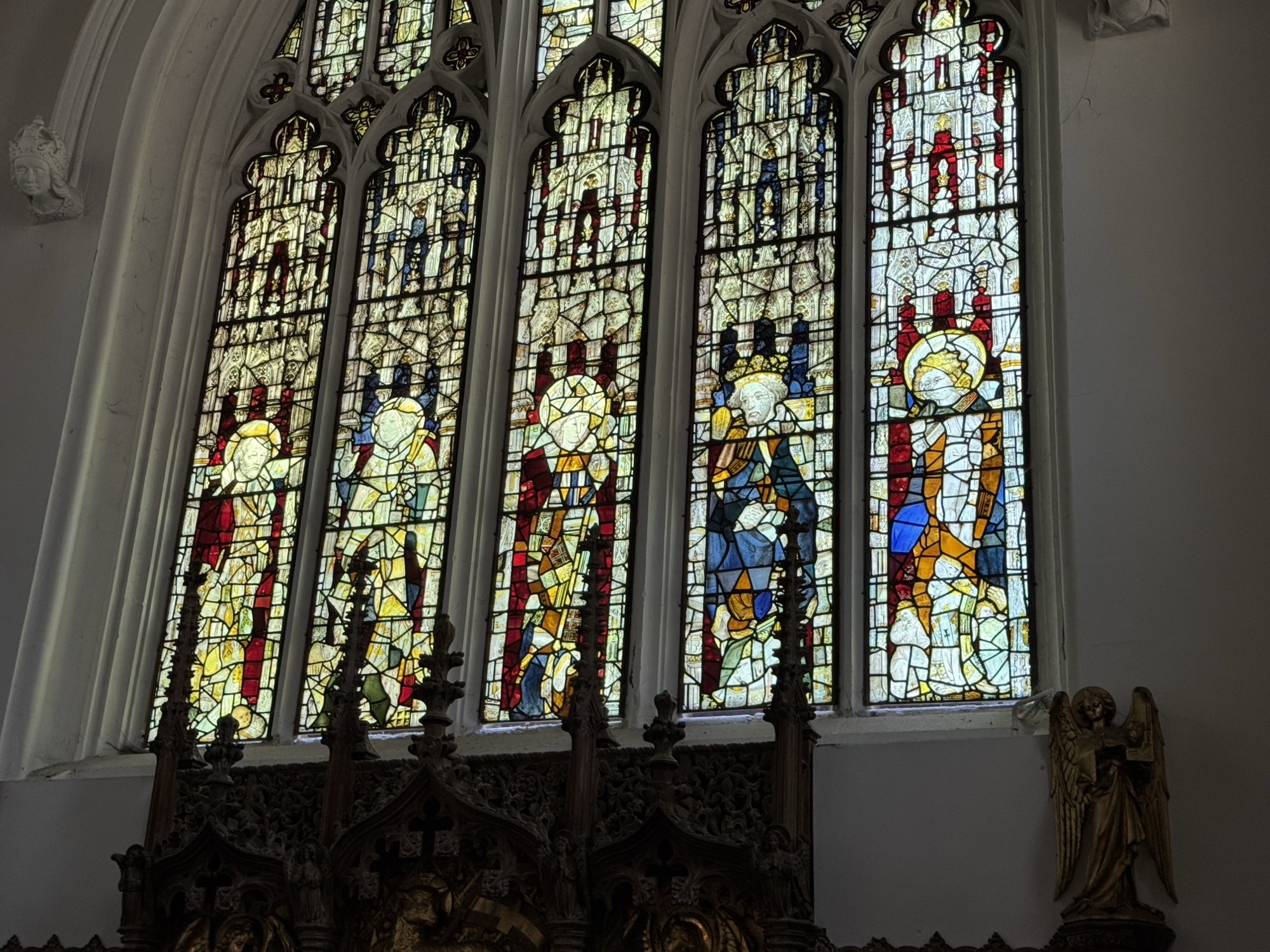
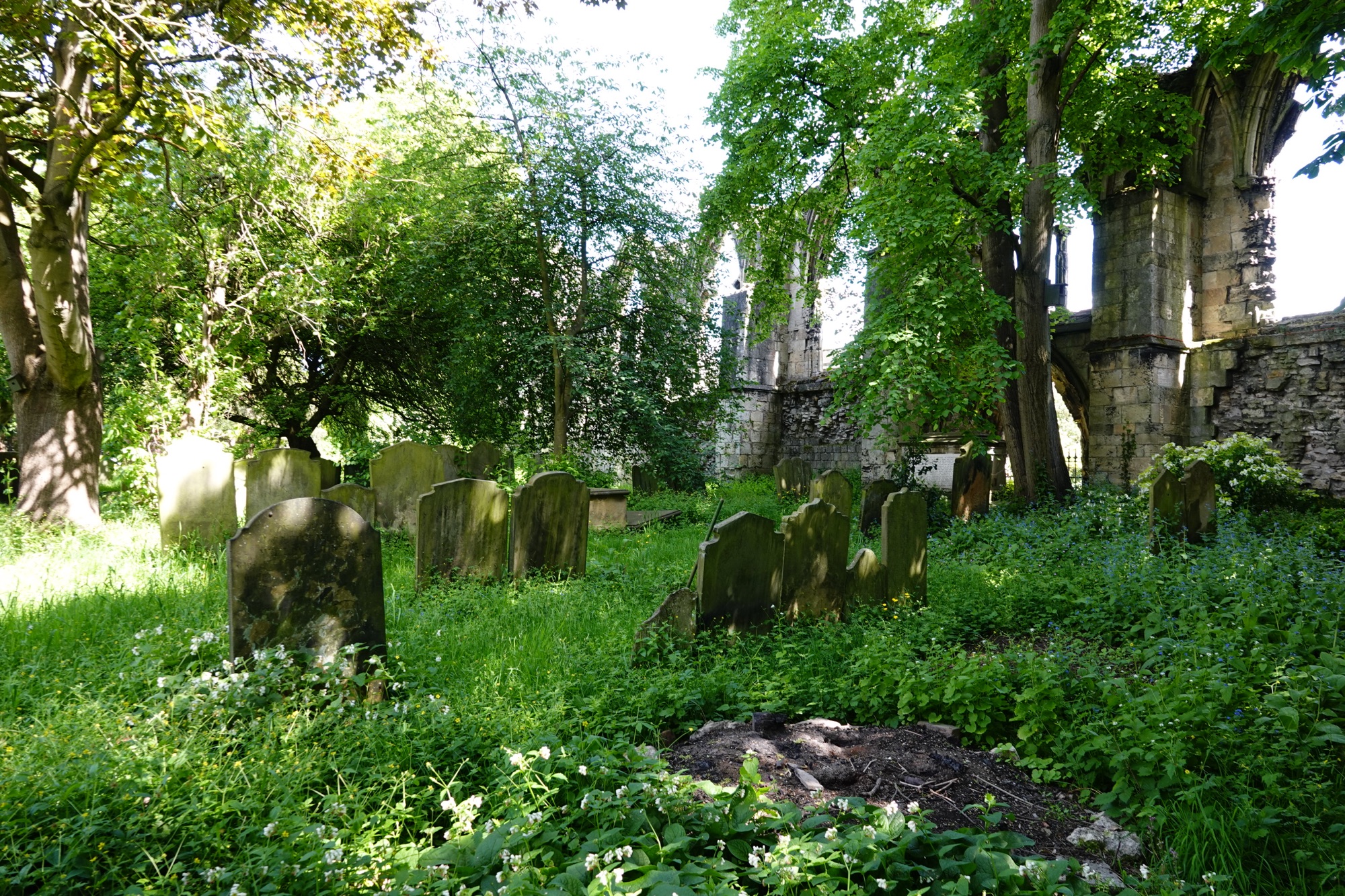
By the time we’d explored the churchyard, where the newest graves date to 1847CE and the oldest to the Middle Ages, a member of the church was preparing for visitors. She took the time to talk to us a bit about the church, mentioning that hand-to-hand fighting had happened in the nave during the siege of York in 1644, when Royalist soldiers were on the roof, and “roundheads” (the parliamentary anti-monarchists) on the street. King Charles I sheltered near here during that Civil War.
While St. Olave still stands, the abbey is in ruins, portions of which stand in the Museum Gardens.
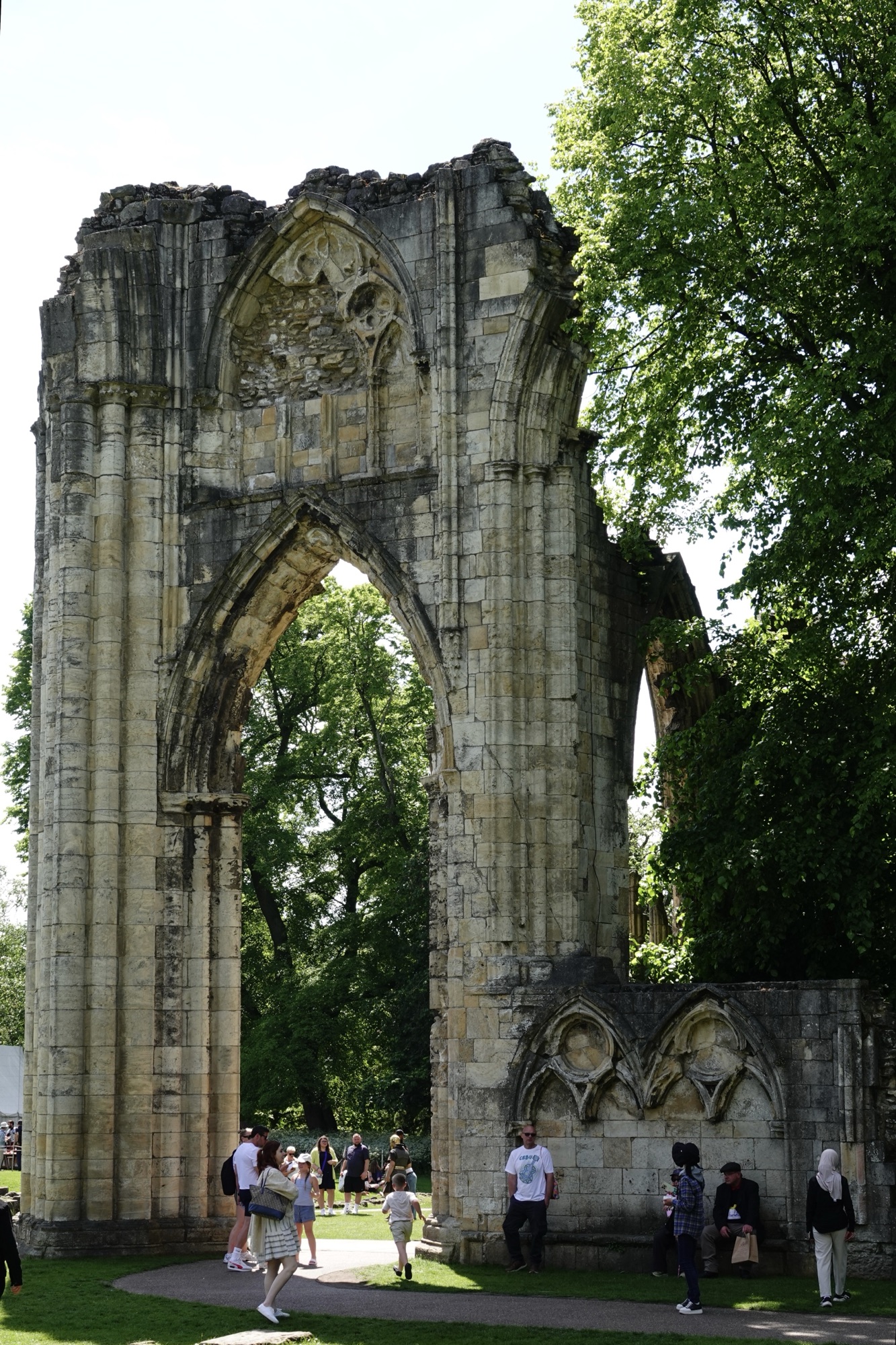
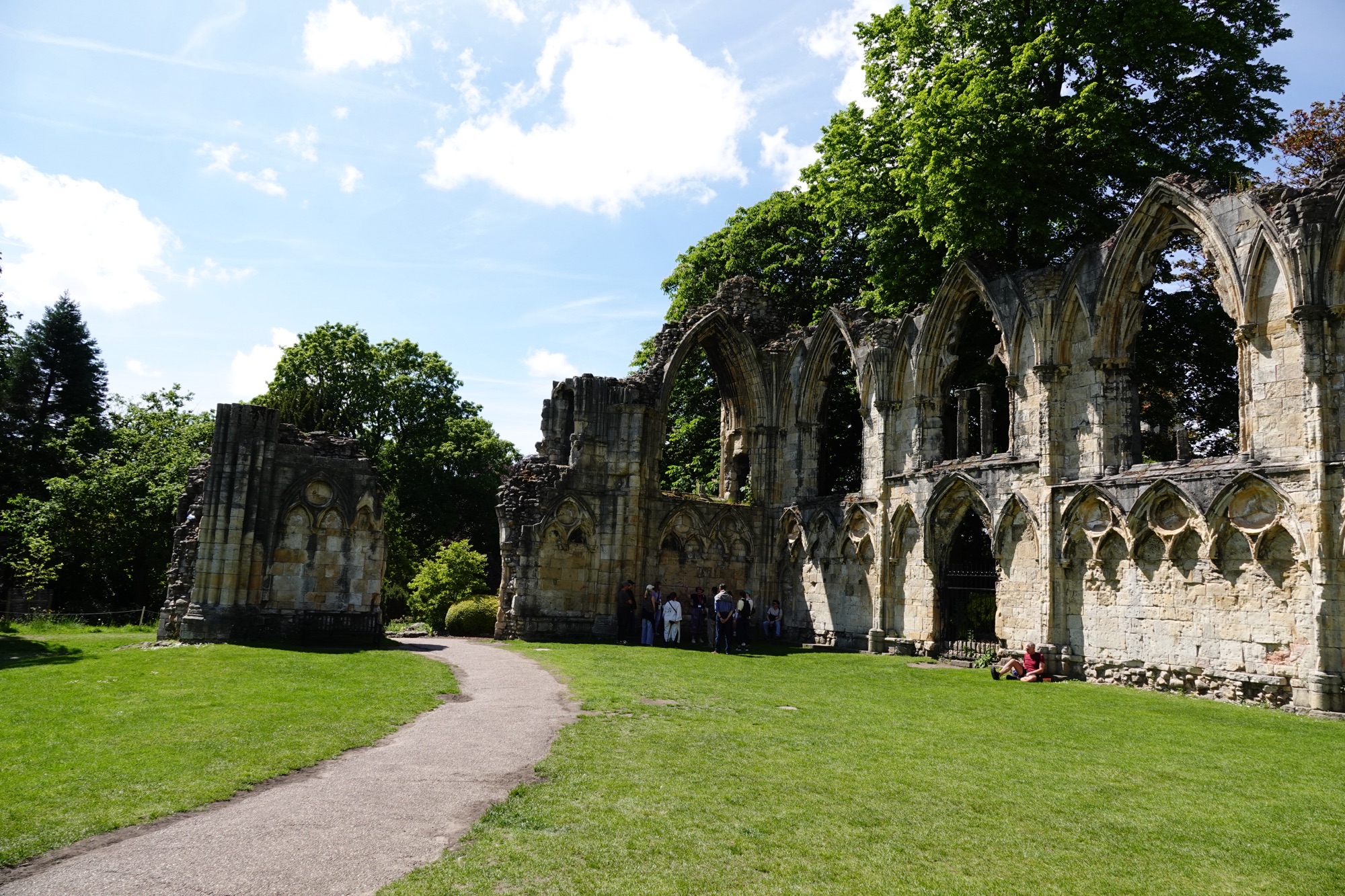
From the church we walked along streets lined with pleasingly symmetrical Georgian homes, Mediaeval walls, and remnants of Roman ones.
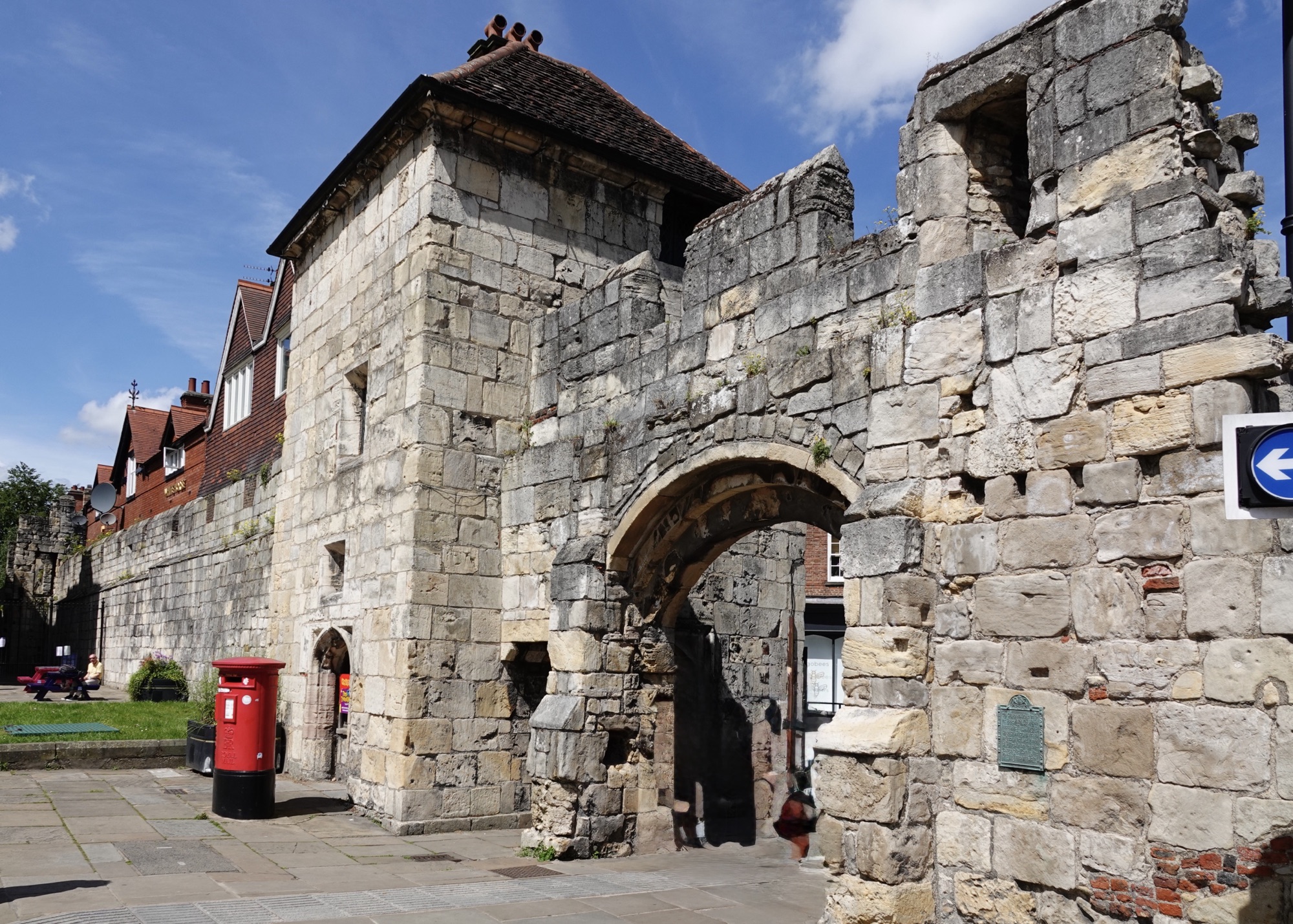
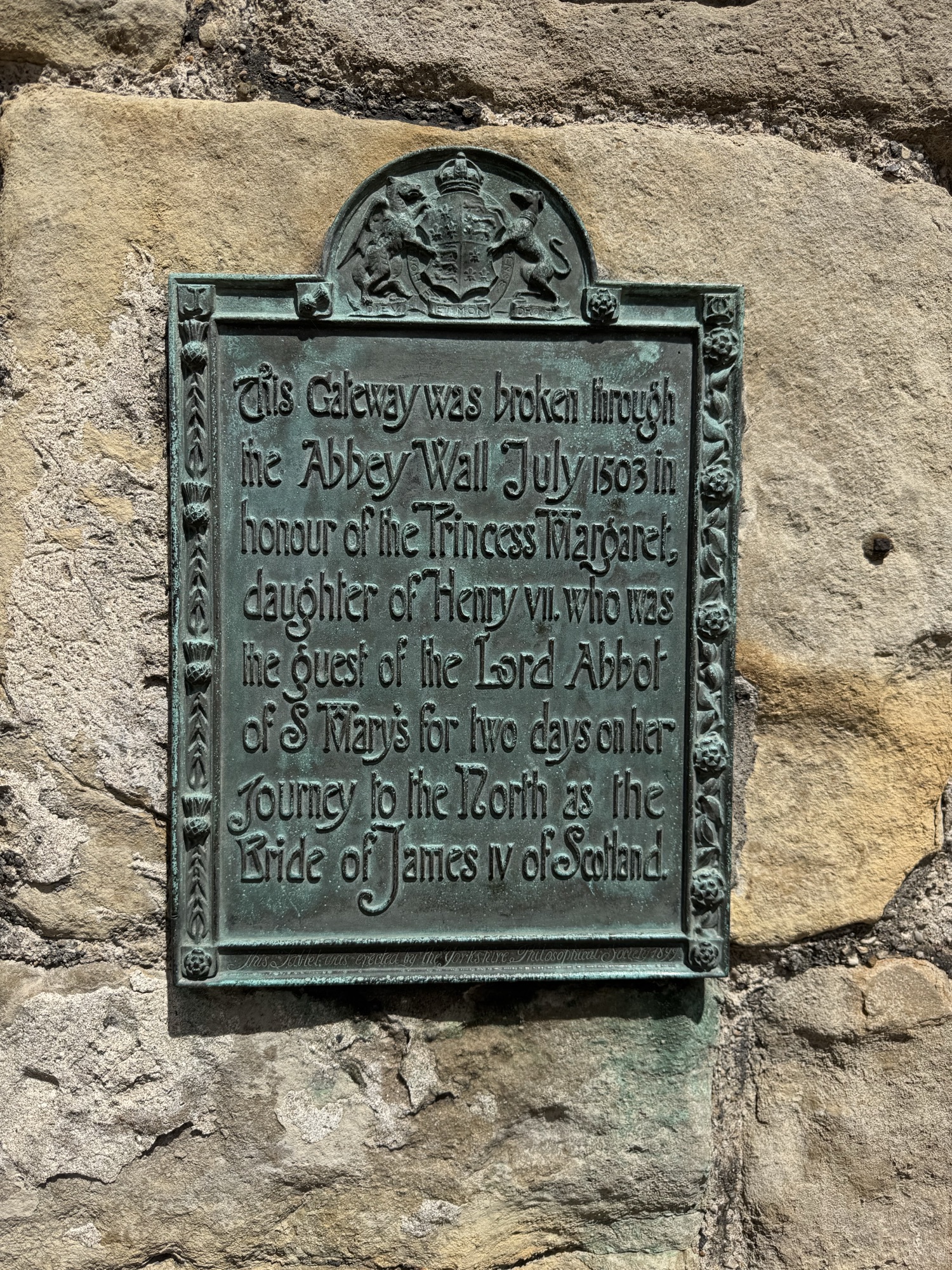
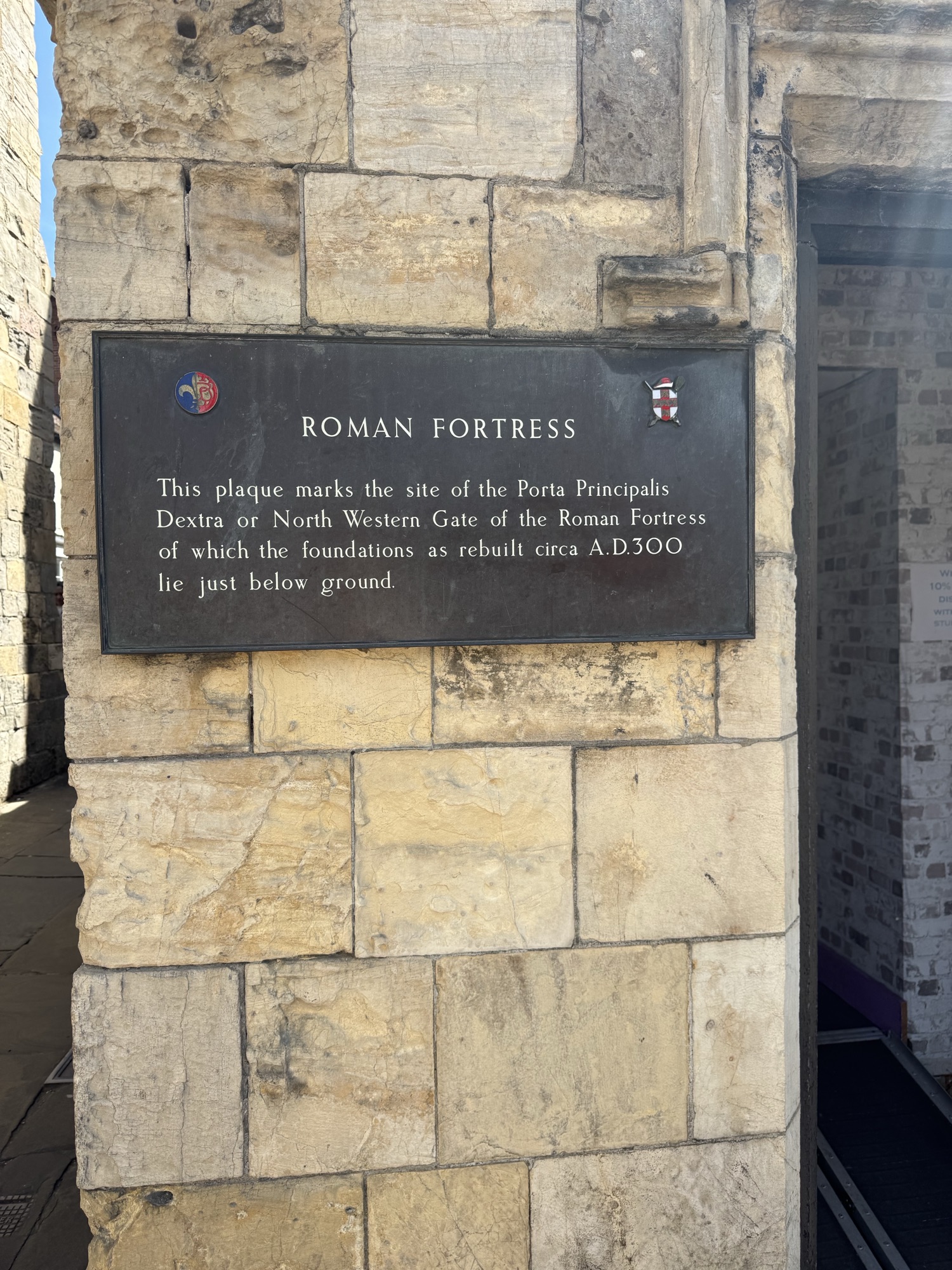
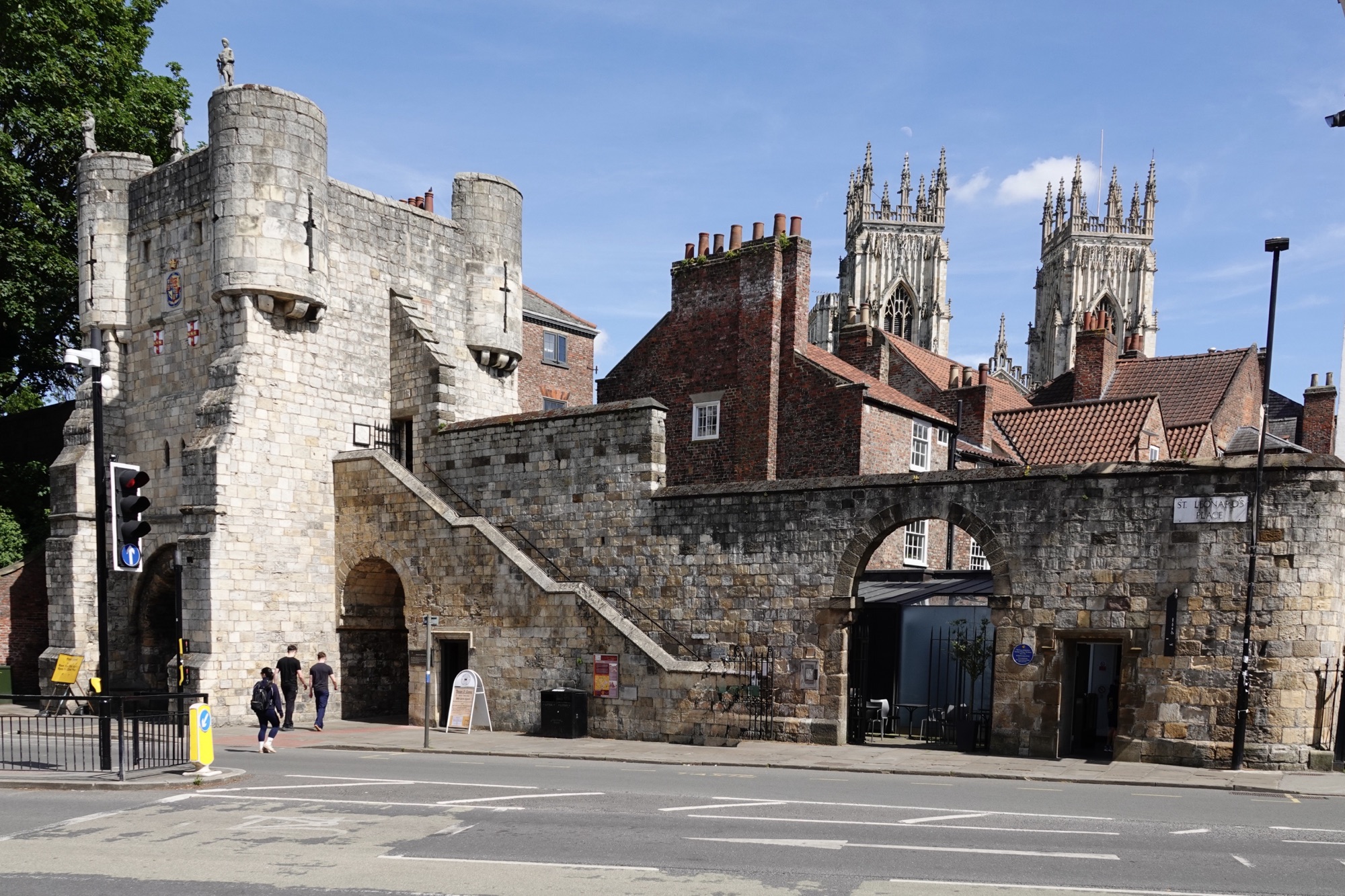
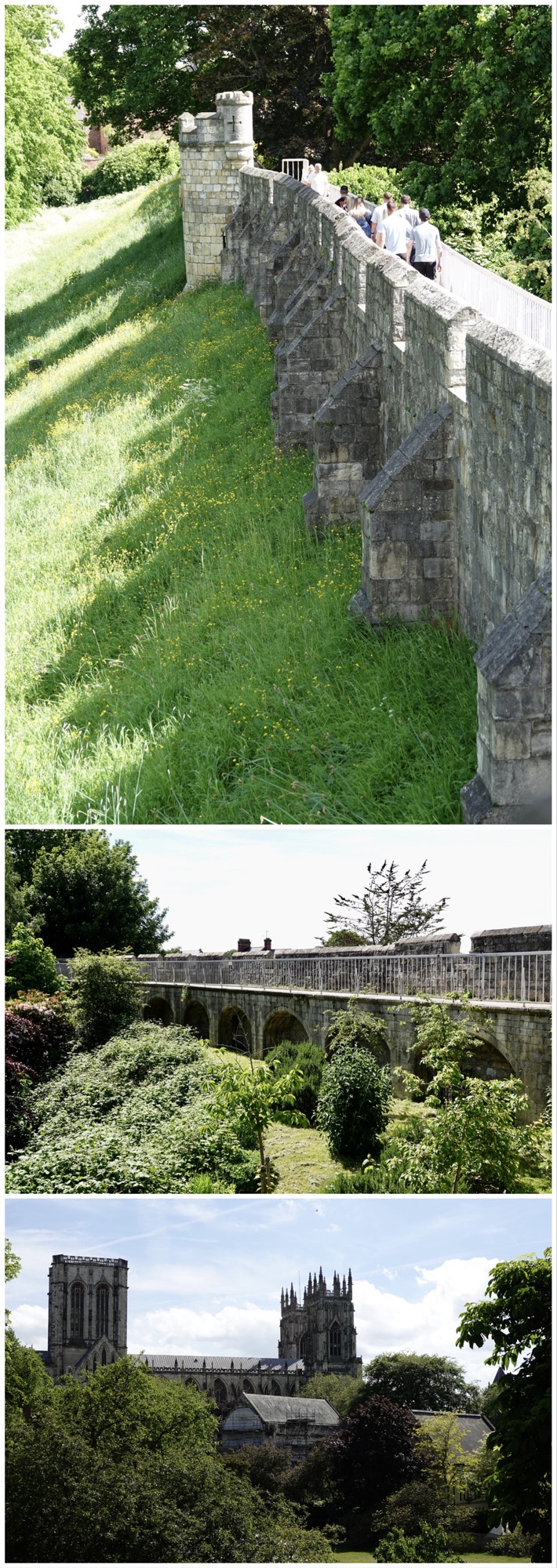
The nearby Bootham Bar, one of York’s historic gates, where we climbed back onto the wall, features visible musket-ball holes and artillery damage sustained during the 1644 conflict.
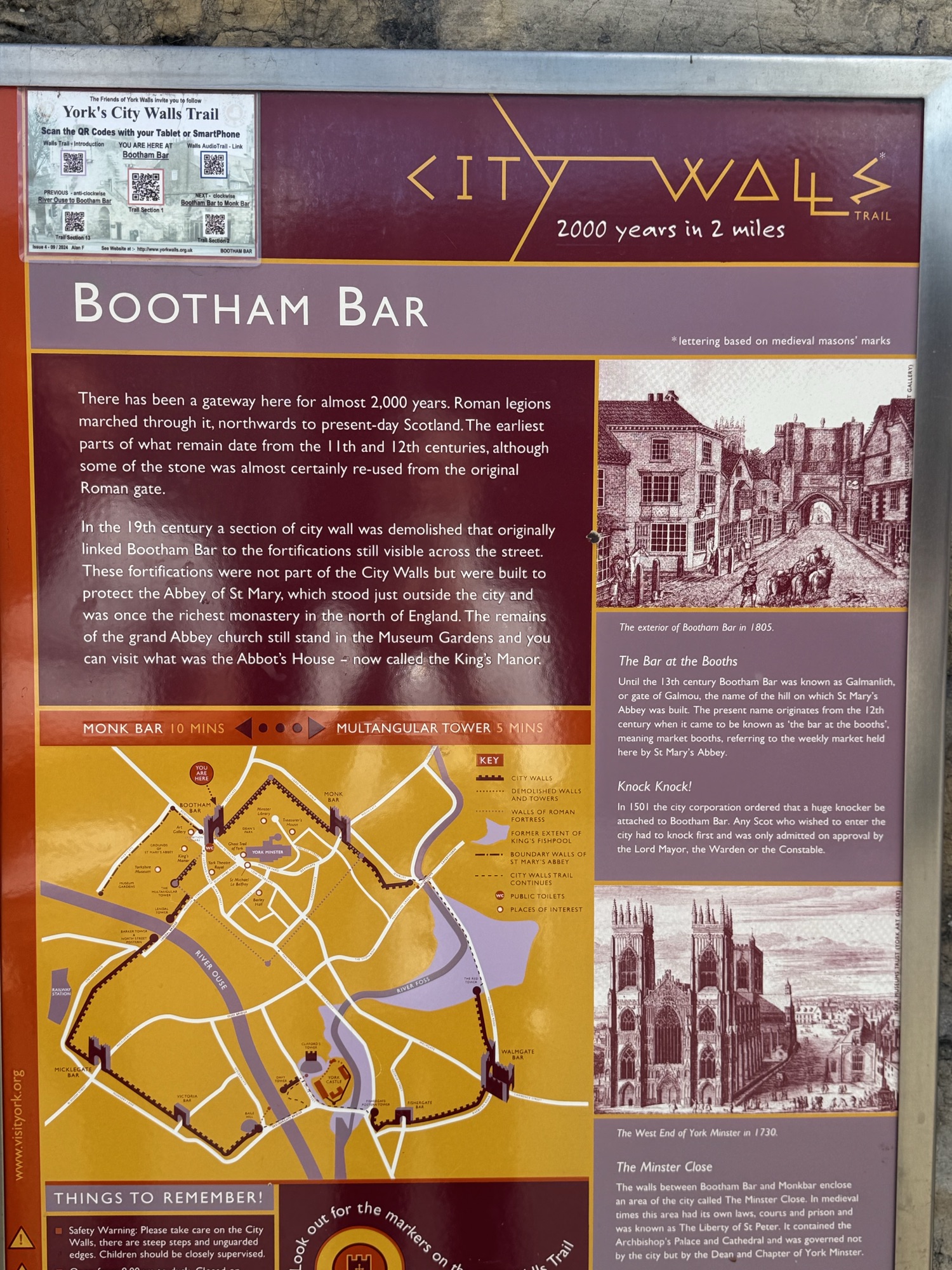
Inside Bootham Bar were several information plaques.
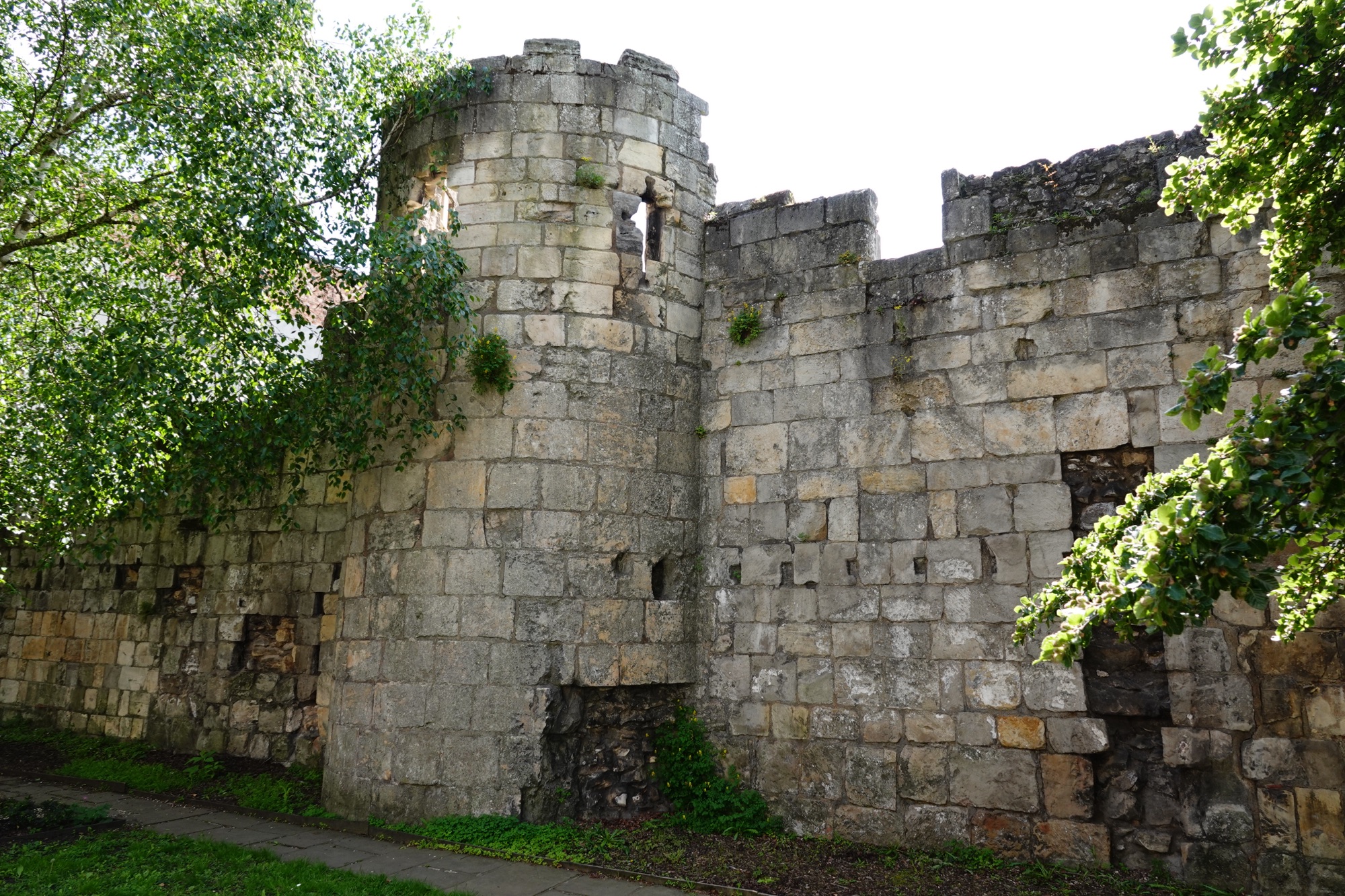
- Over two miles long, the walls of York are the most complete town defences anywhere in England. Succeeding earlier and less extensive Roman and Viking-age defences, the medieval walls were built in stages between around 1250 and around 1350, though there were many later alterations.
- Medieval England had no army or police forces, so York citizens had to guard their walls themselves – by night as well as by day in times of crisis. Each section of wall was watched over by the people of the nearest parishes, while the gateways were entrusted to leading citizens.
- For some Tudor and later York citizens, the towers on the walls provided a home. Three of the four main gateways-Bootham, Micklegate and Walmgate Bars-all once had house-like extensions on their inner faces.
- When plagues and epidemics threatened, York’s walls helped to keep infected strangers out of the city. In the 17th century extra watchmen were hired to guard the city gates and places where the walls could be easily climbed, and to look out for bundles of plague-tainted second-hand clothes smuggled in by
‘rogues and vagabonds’. - In late Georgian and Victorian times, local and even national controversy raged round the walls. Some viewed them as an outdated nuisance, a hindrance to traffic, trams and trains which should be swept away. But others increasingly valued them not only as a picturesque feature of York, but also for their historical importance. Caught in the middle, York Corporation compromised, repairing some parts of the walls but demolishing others. Bootham Bar lost its outer barbican, but a proposal to remove the bar itself was defeated.
- In 1922 York’s walls were at last declared a legally protected ancient monument, and carefully planned conservation began.
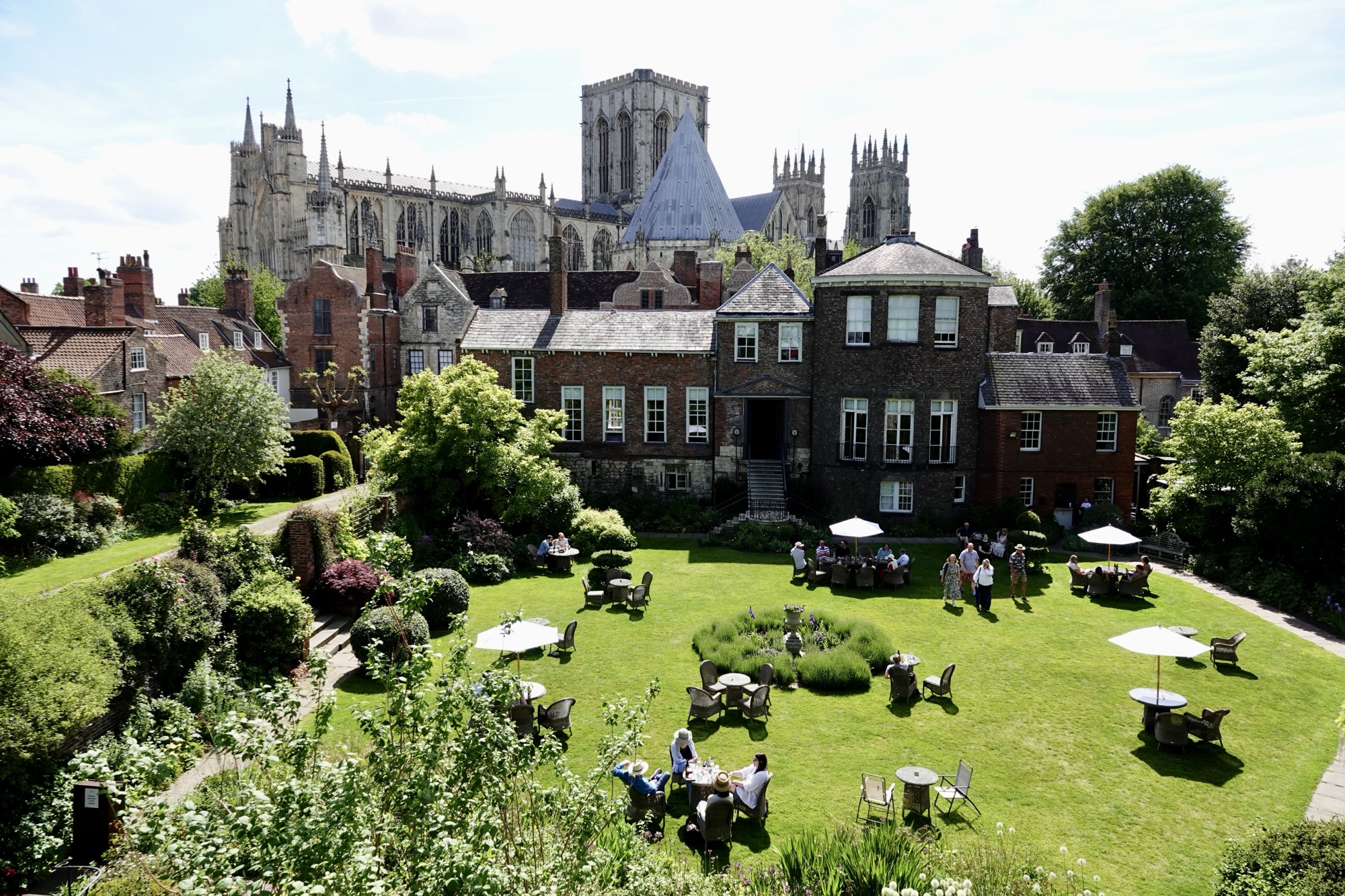
This stretch of the wall is probably the most popular, likely because of the fabulous views of the Minster along the entire length from Bootham Bar to Monk Bar.
We got a peek into the garden of Grey’s Court Hotel.
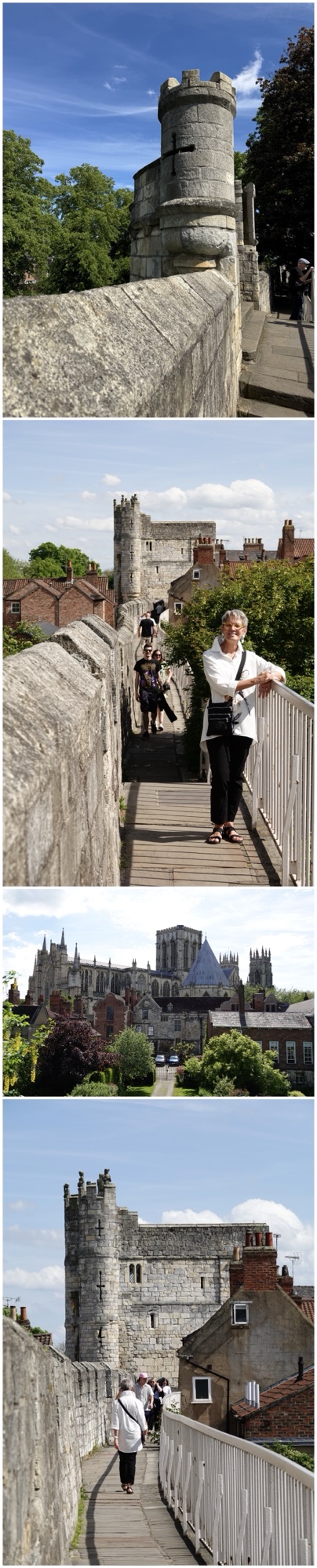
From Monk Bar, the tower in the last building, we descended narrow stone stairs and then Ted headed back to our B&B and I headed to the charity shops along Goodramgate.
Dinner was at The Viceroy, an Indian restaurant that really knows its spices – and how to pour a proper gin and tonic, too.

Tomorrow is Sunday, and our last day in York before heading to Durham for another 4 night stretch.

