Today we took a guided coach tour into the Cretan countryside outside Chania to sample some local specialties and learn a bit about how they are cultivated and produced.
The drive took us up onto the mountains, along roads that – once again – I was glad someone else was driving. I noticed that the passenger in the coach’s front seat was videoing parts of the drive, especially the hairpin turns taken at speed with a sheer drop on one side, while his travelling companion shut her eyes.
Ho hum. We’ve become quite blasé about tour buses on scary mountain roads over the past 4 or 5 years.
It’s not just the artefacts that are ancient on Crete, but also the olive trees.
Our first stop was advertised as “A Step Back in Time: Marvel at the ancient Olive Tree of Vouves, the oldest known olive tree in the world, estimated to be between 3,000 and 5,000 years old.”
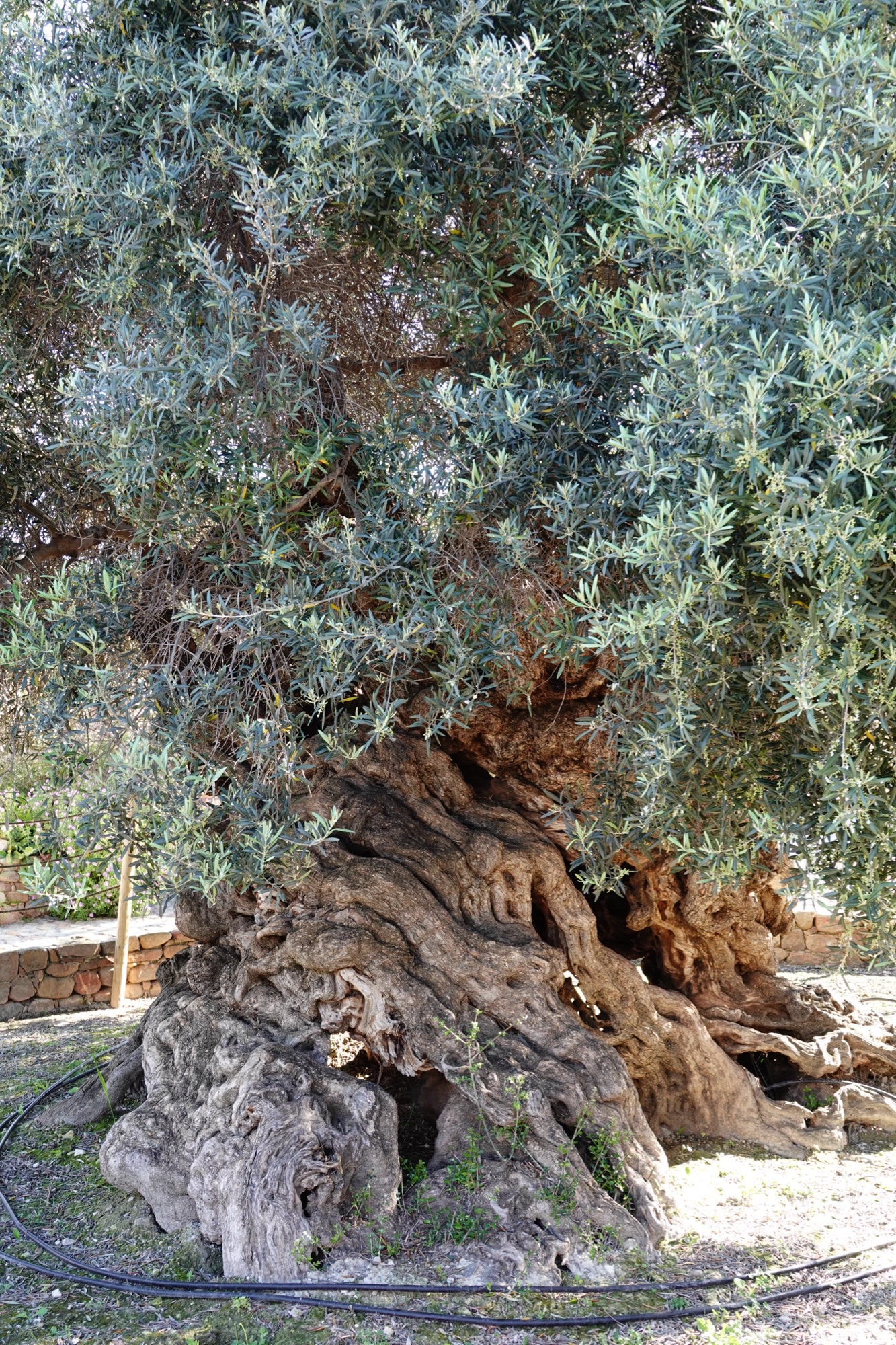
Its gnarled, sculptural trunk tells the storey of Crete’s timeless relationship with nature and tradition.
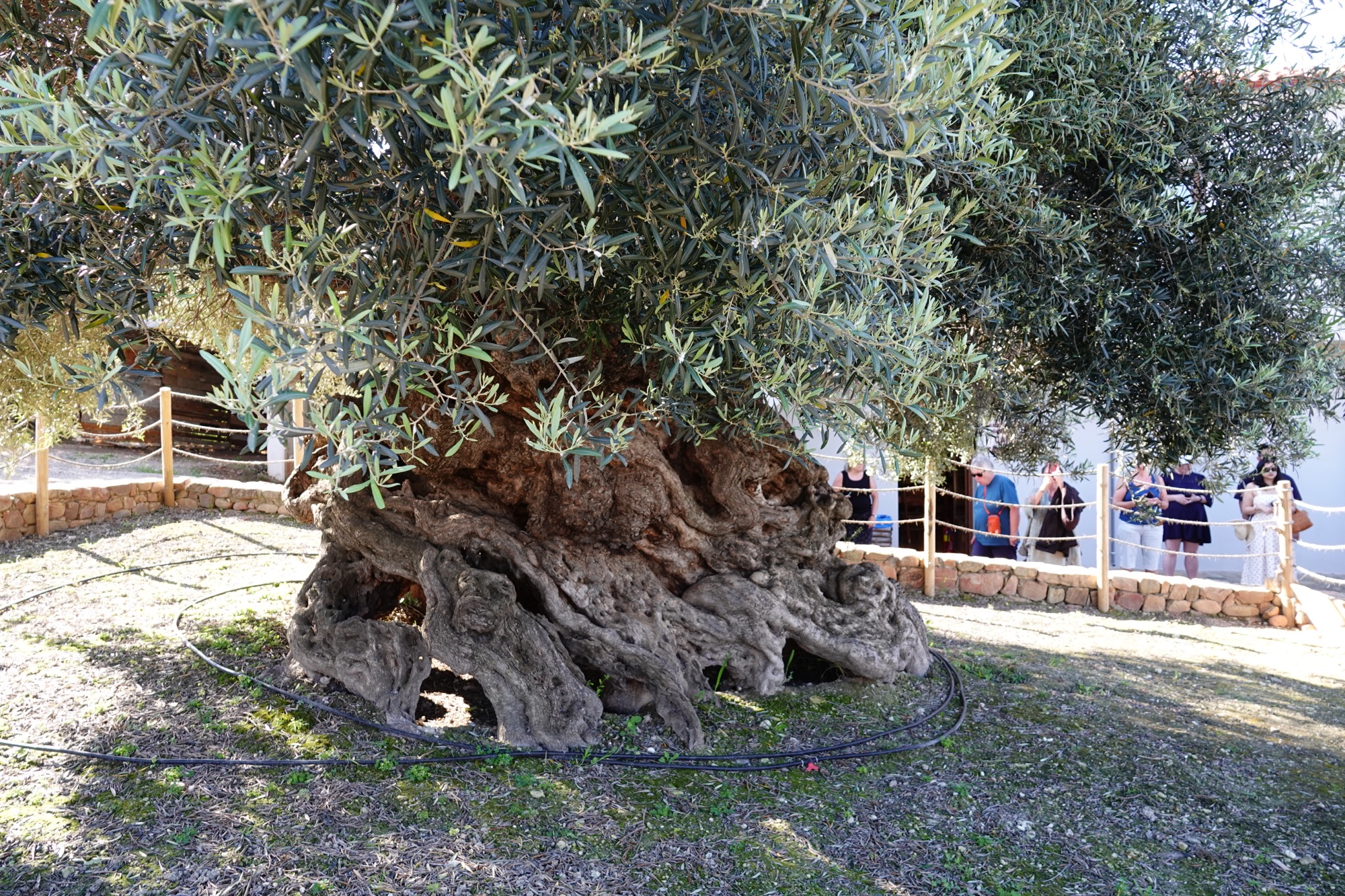
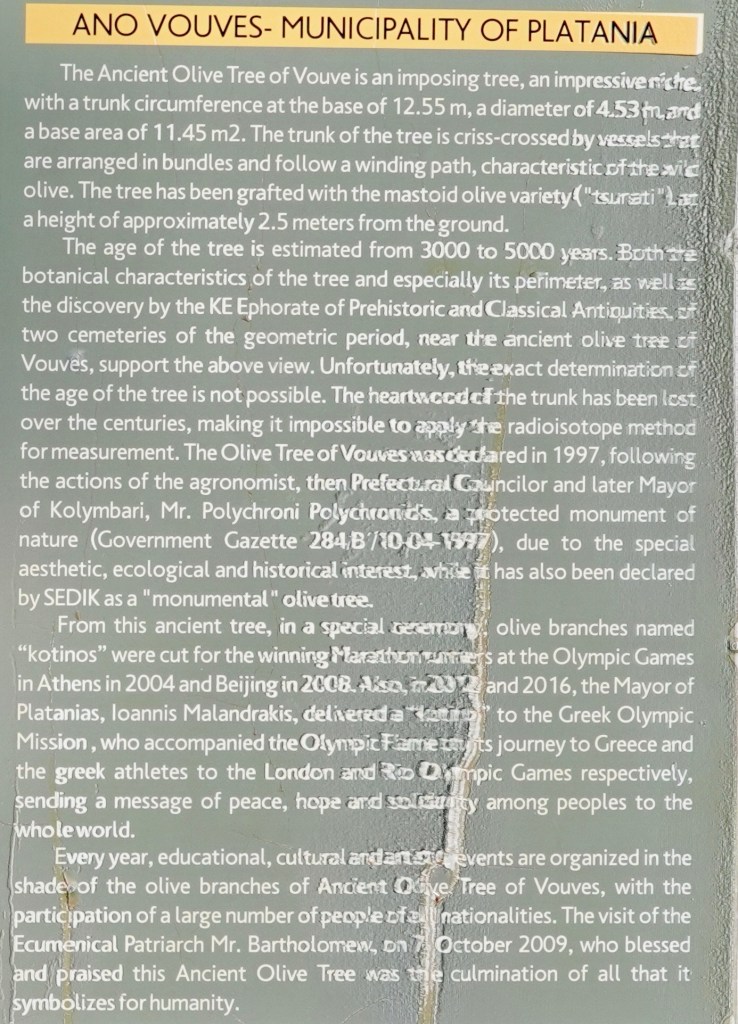
If that age range seems unprovable, especially since the 4m/13ft diameter trunk has long ago hollowed out, preventing anyone from attempting to count 3000+ rings, there was a sign explaining a bit about how the tree’s age was estimated.
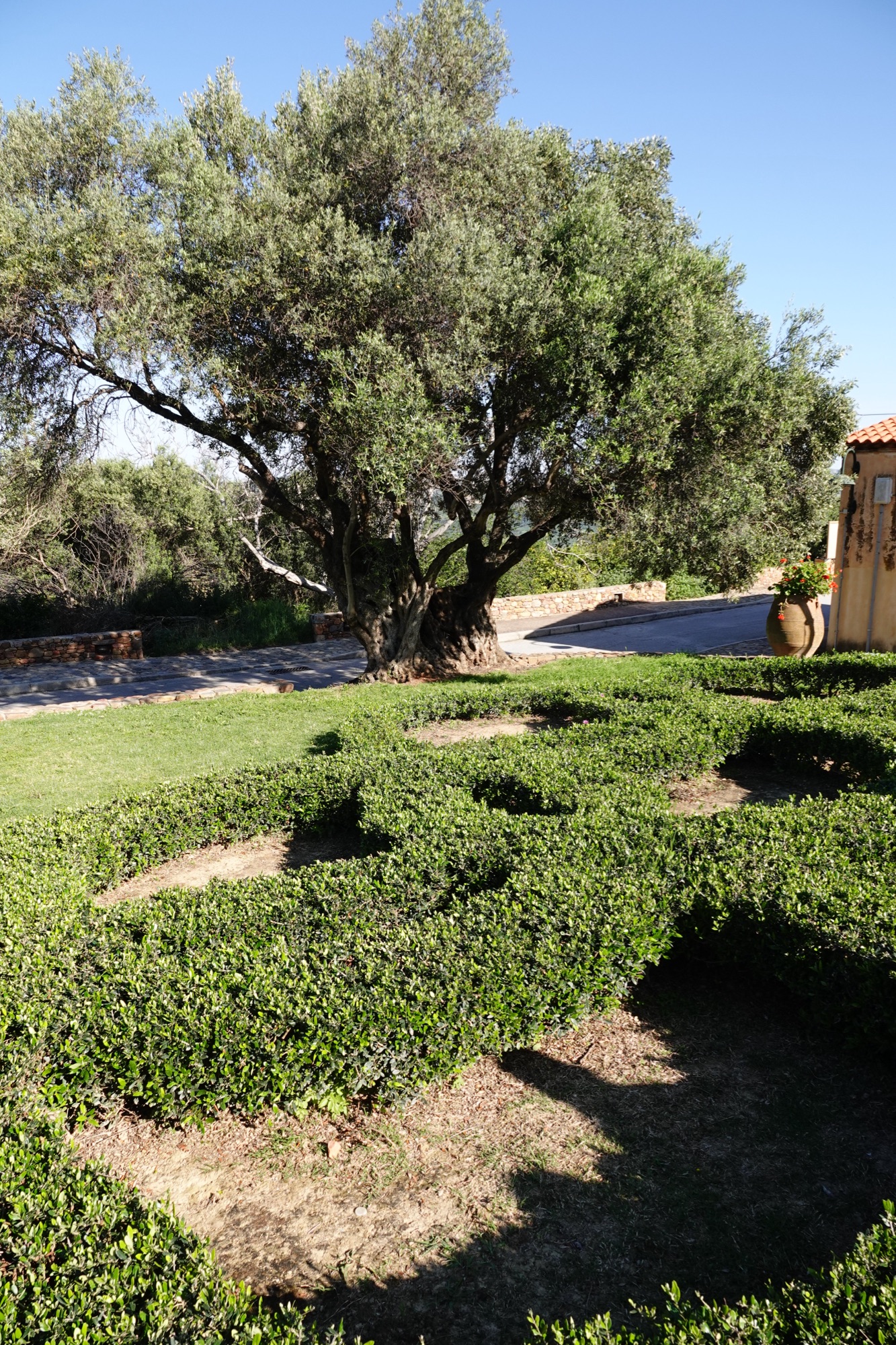
At this stop the process of crushing olives and extracting the oil was explained to us, although not demonstrated. That would come later.
We learned that cold pressing means that the olives are macerated with water that is never any warmer than 21°C. Warmer temperatures extract more oil, but also leach out the vitamin E and antioxidants.
It was reinforced to us that lots of olive oil worldwide is marketed and sold as EVOO (extra-virgin olive oil), but only some of it really is within the acidity range to qualify for that designation.
Here’s what we were told: In order to check the quality of your olive oil put a little bit into a small cup (like a shot glass), cover it with your hand, shake it around a bit, and then smell it. The shaking and warmth will release a scent that should be like fresh grass. Then taste the oil. It should taste a little bit grassy and fruity and when swallowed should leave a slightly peppery aftertaste, with no acid and no bitterness. Anything else might still be virgin olive oil, but not extra virgin olive oil. Real olive oil also solidifies in the refrigerator; if olive oil placed into the refrigerator does not become solid then it has been adulterated with other vegetable oils. But… only test with a little bit. Olive oil should be stored at room temperature, protected from light, and used within a year of pressing. Unlike wine, olive oil does not benefit from aging.
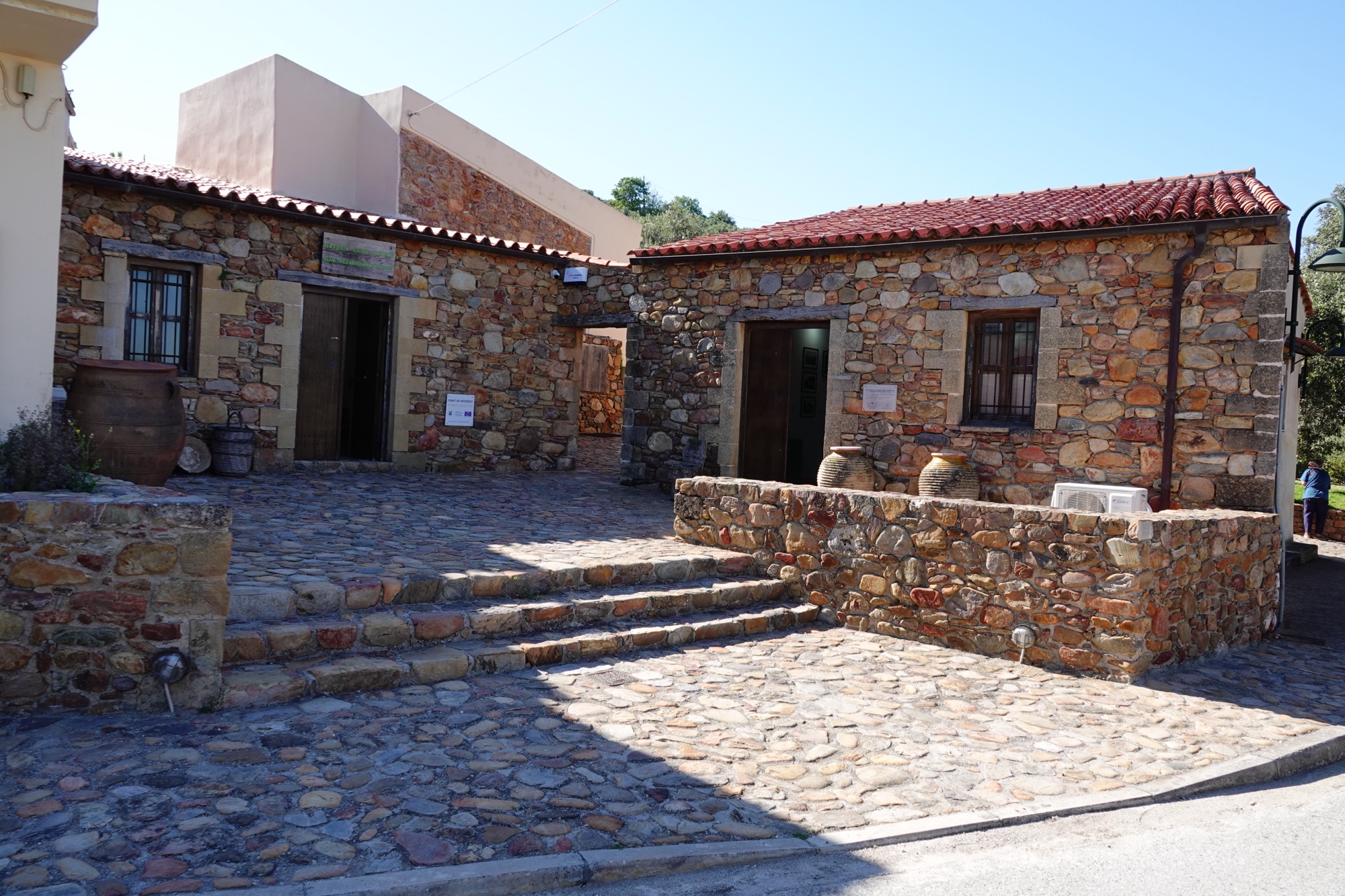
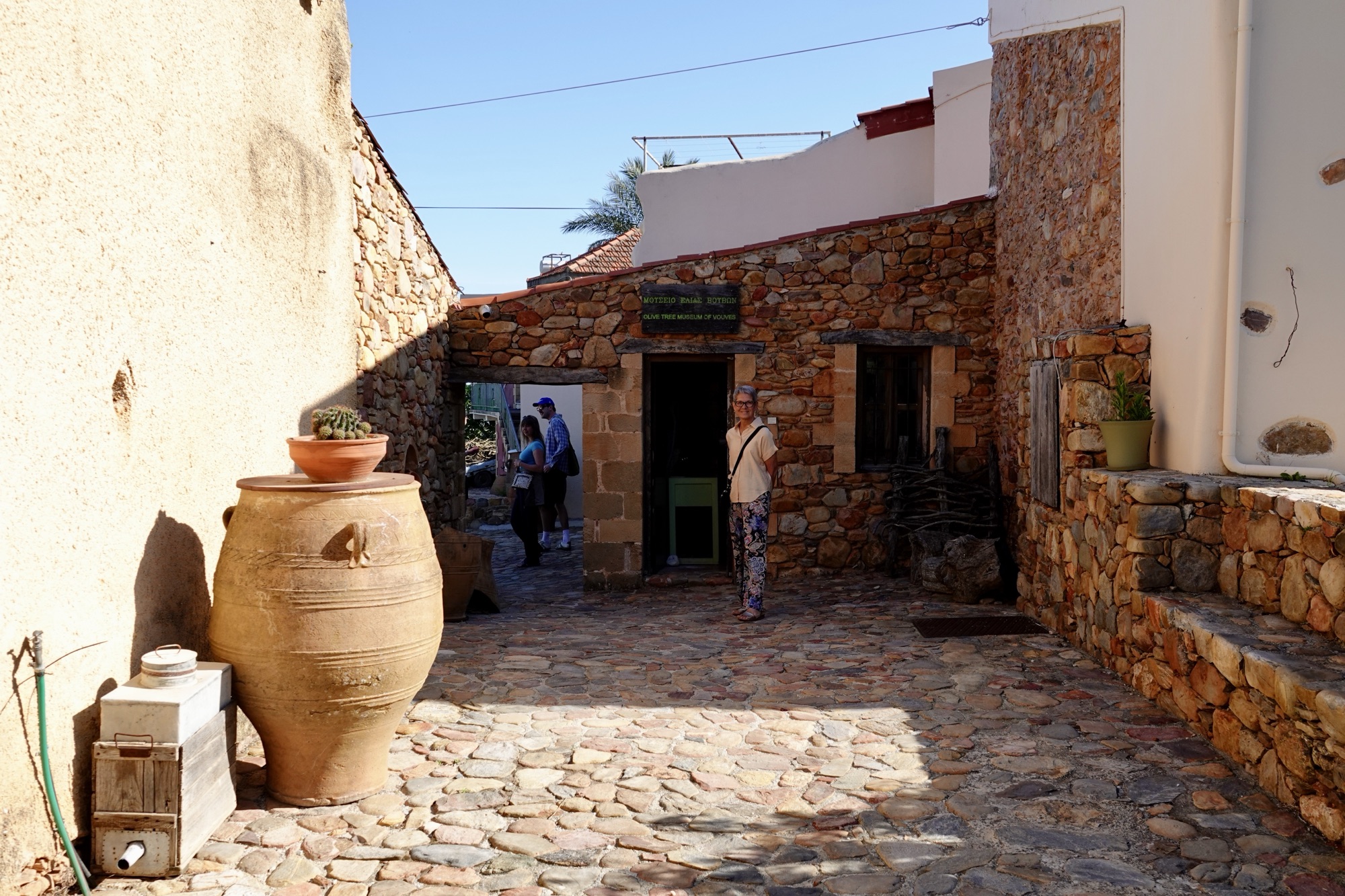
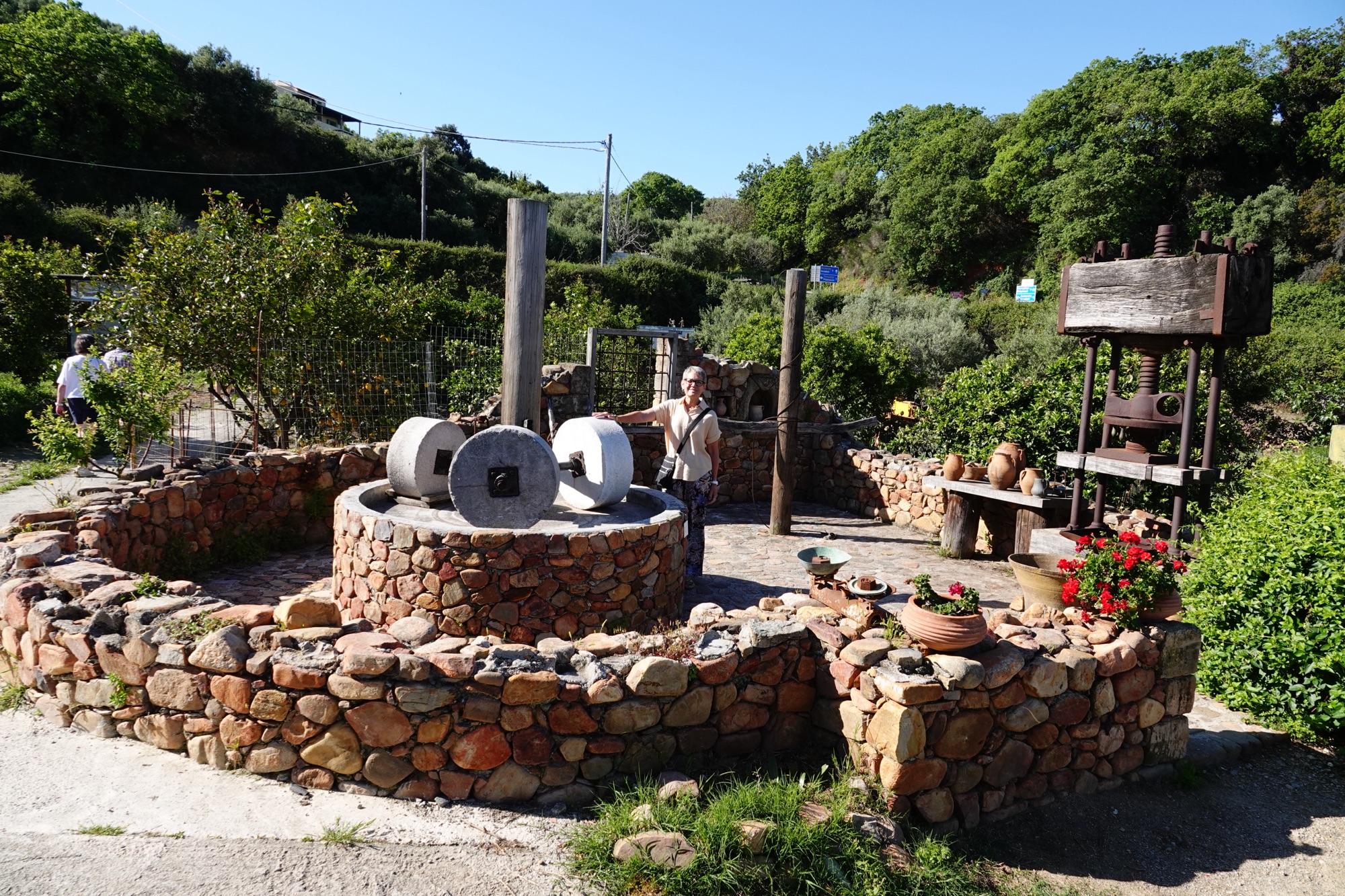
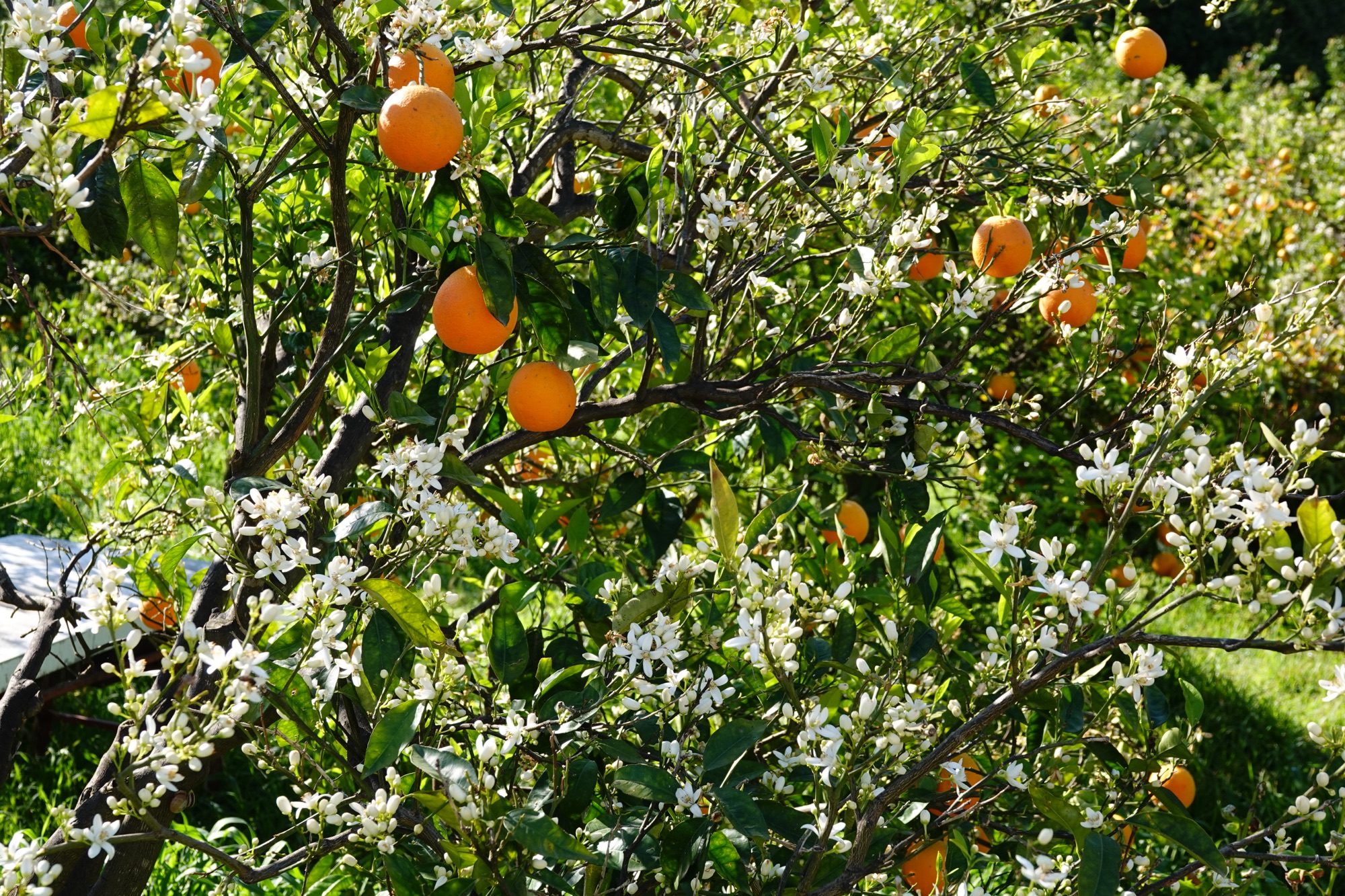
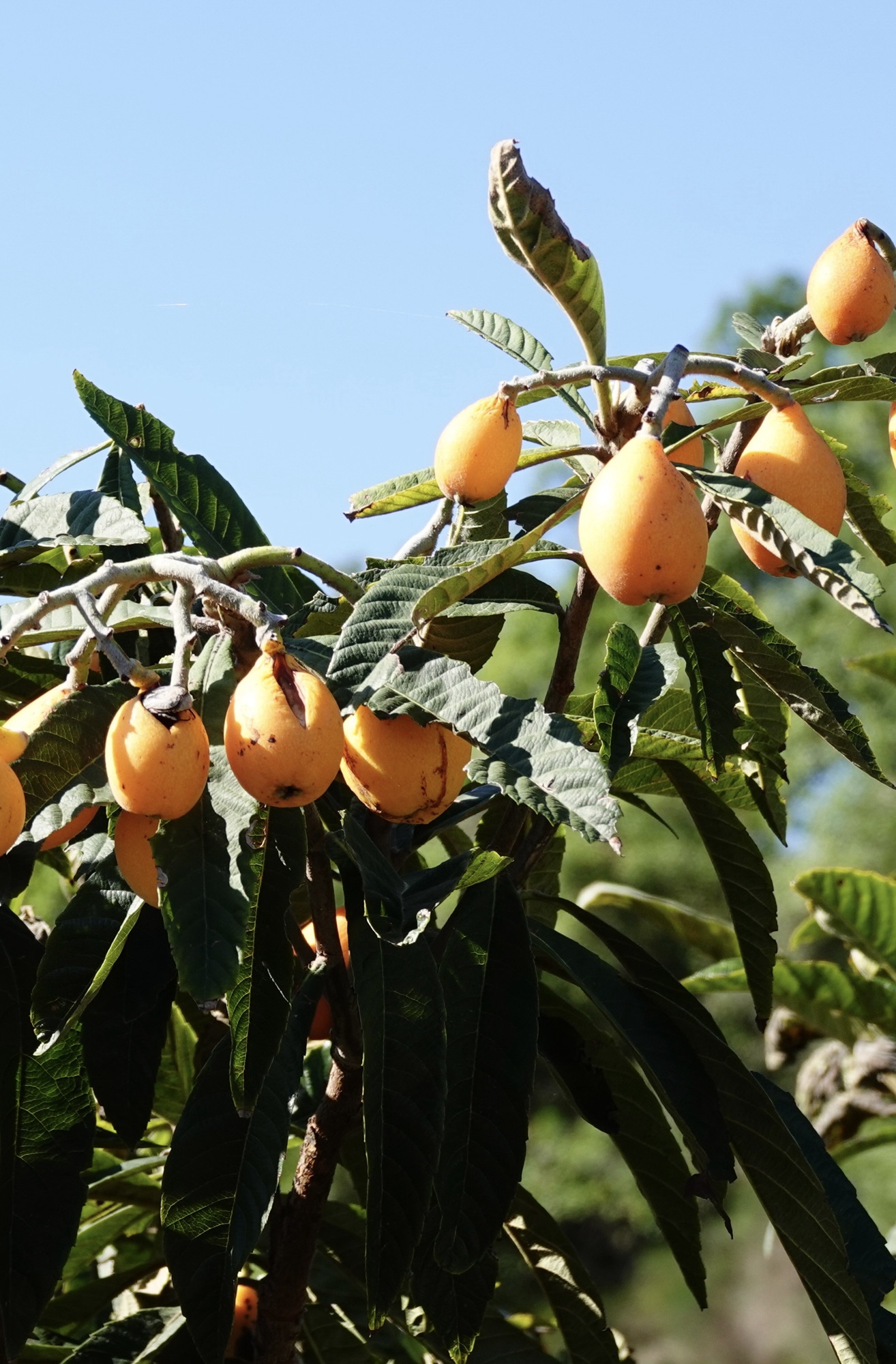
Adjacent to the oldest olive tree and museum was a small orchard containing oranges, lemons, and tangerines, as well as apples and a small plum shaped almost like a miniature mango with a smooth double pit in it that our guide called a Japanese plum. They were just becoming ripe; by peeling off the thin exterior skin we were able to taste them, and found them sweet and juicy. We won’t find them where they don’t naturally grow, though, since they are too fragile to ship.
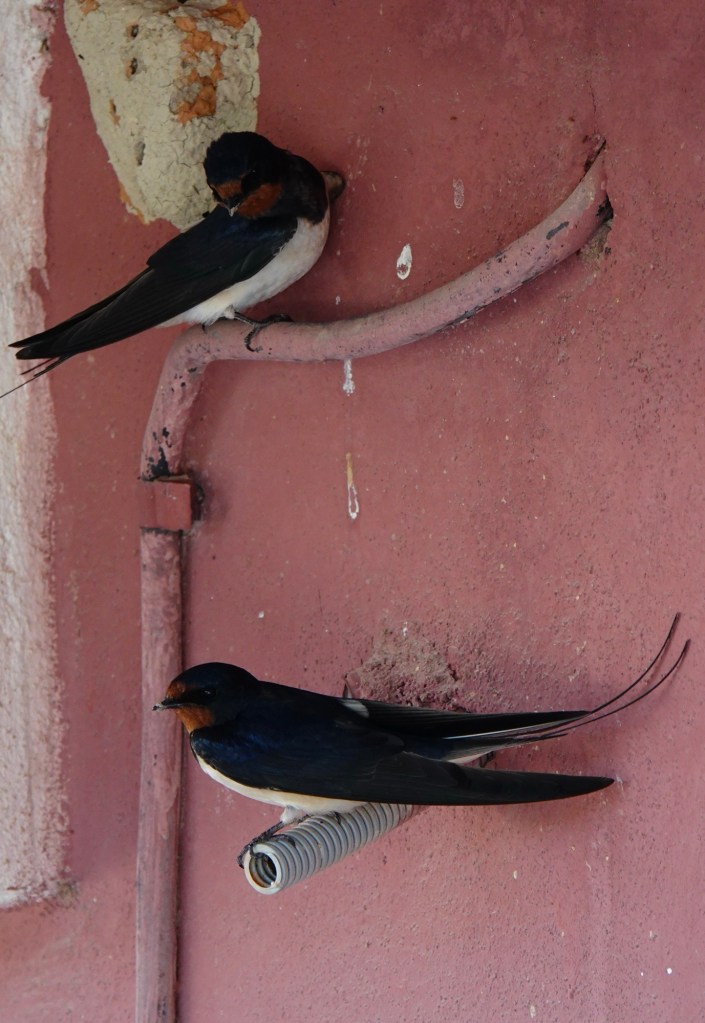
Ted finally managed to get a picture of the incredibly fast little barn swallows that we have been seeing all over Chania.
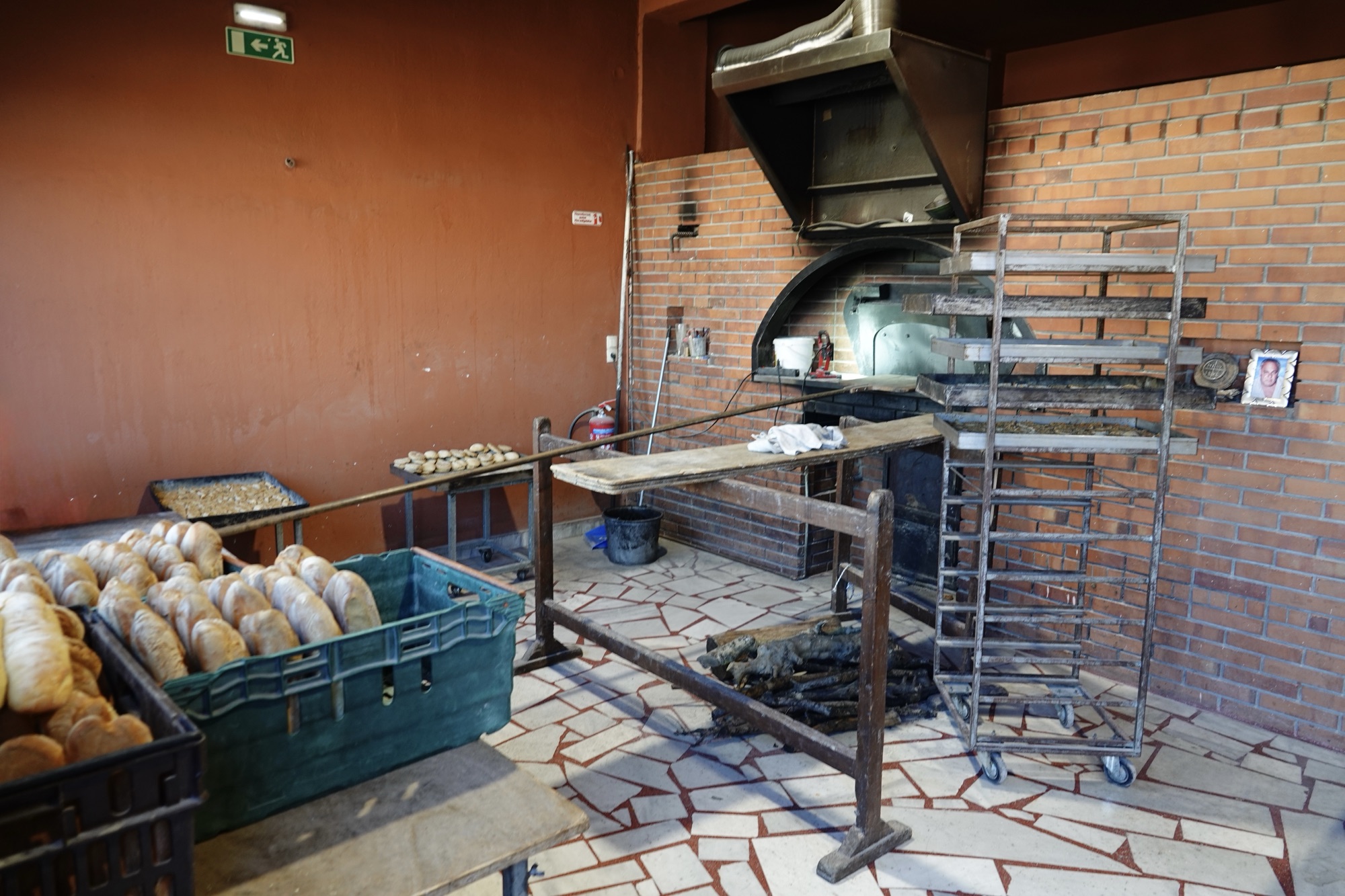
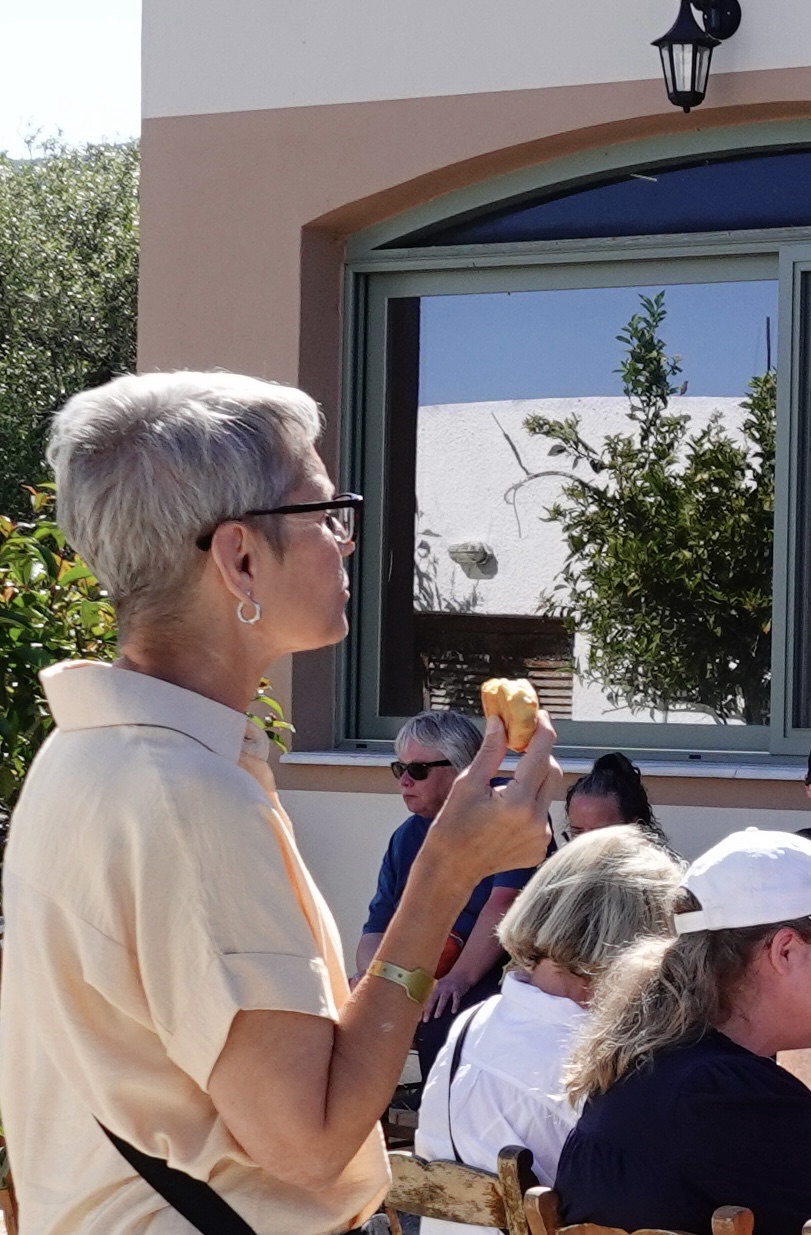
Next we made a brief stop at a family-run bakery where we were given samples of two different traditional Cretan rusks: one made of barley flour, carob, and olive oil, and the other of wheat flour, sesame, and olive oil. Cretans absolutely love these crunchy hard rusks, using them as crackers, snacks, croutons, bases for moist toppings, and in soups.
The bakery’s oven that looked so small from the size of its door could actually hold the equivalent of 270 normal sized loaves of bread – enough for the daily needs of the entire village.
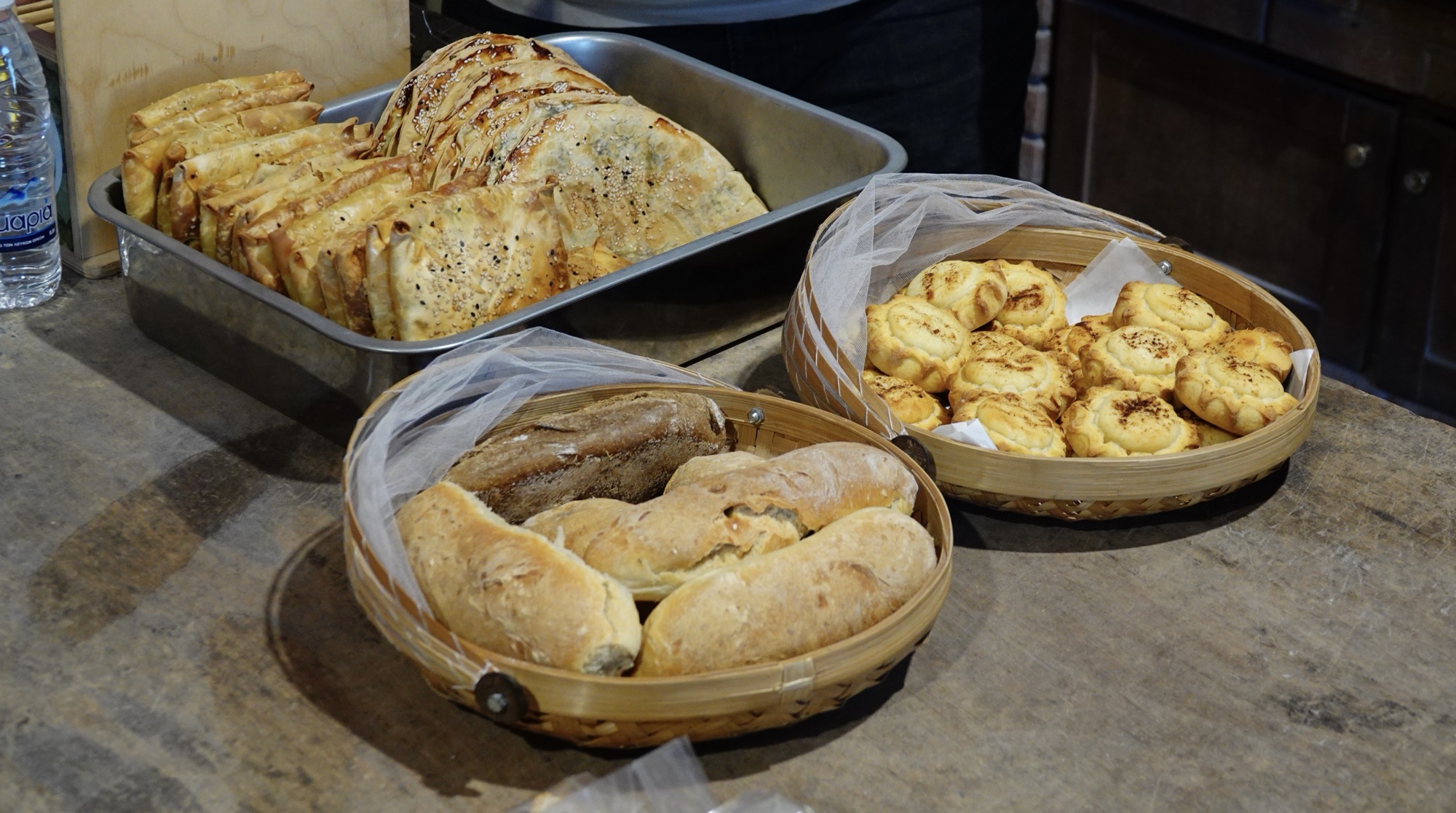
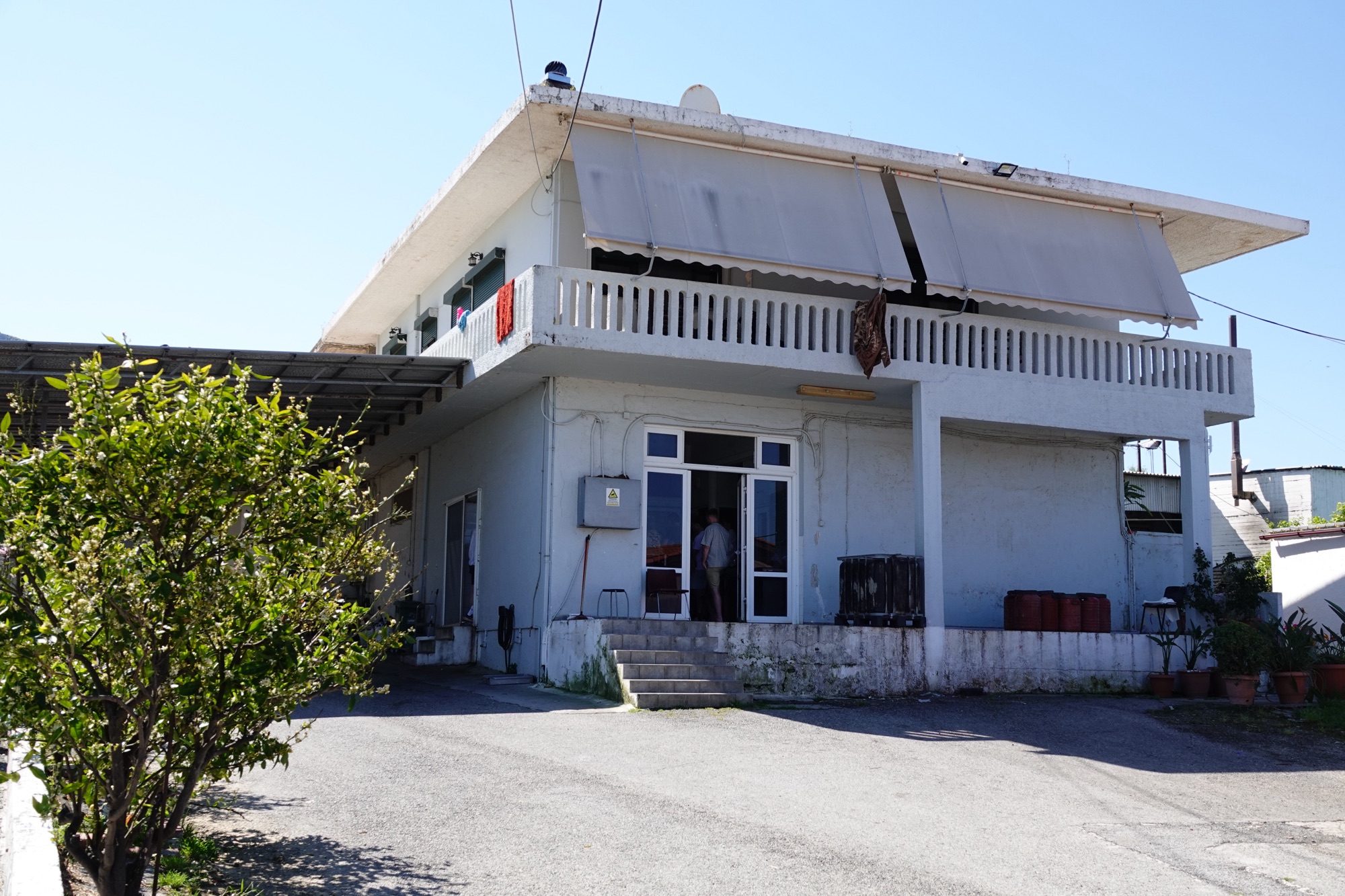
While our group was split into two with half going to the cheese maker and the other half at the bakery, we bought two small Mizithra cheese and cinnamon pies for our breakfast since we hadn’t eaten before heading out on this tour. They were tasty, but surprisingly were done in a short crust as opposed to phyllo pastry.
Then it was our turn to visit the village’s cheese-maker, Mr. Papagiannaki, who is a tiny hobbit-like man (that was actually our guide’s description of him!) of 75 years old, who has been making cheese in this village his entire life.
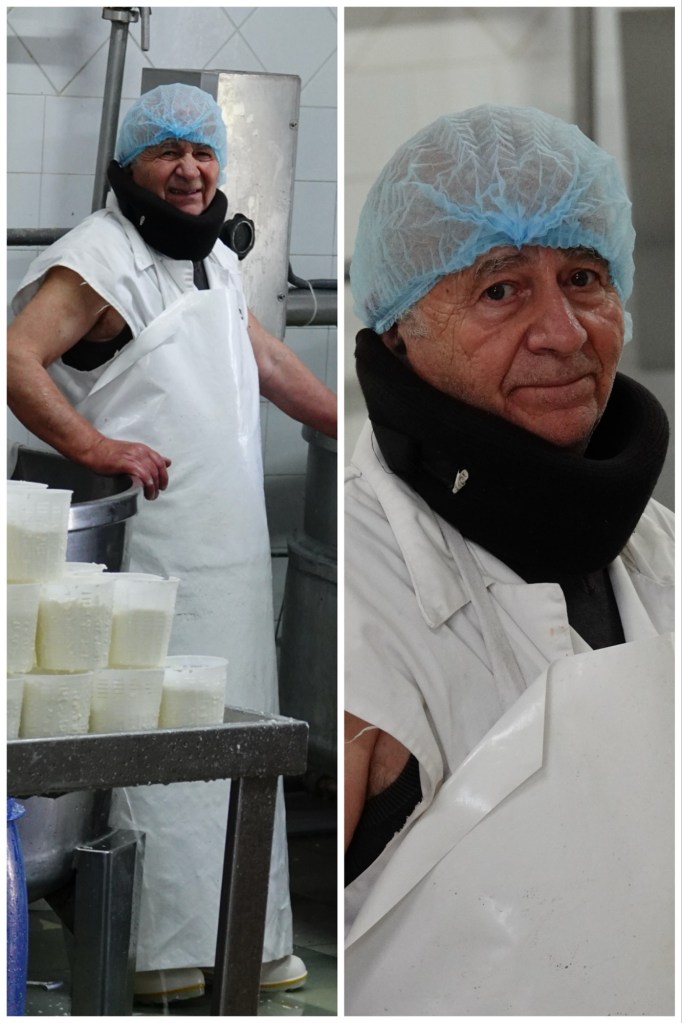
The cheese-maker himself pasteurizes the raw sheep’s milk that is delivered to him.
He knows the shepherds from whom he buys the milk for his cheese, and it is rumoured that he can tell which individual sheep milk came from. People here in the village don’t buy their cheese at a grocery store or a cheese shop – they buy direct from the cheese maker, which is something that’s quite rare in our modern age. Crete is, in many ways, frozen in time.
Once the enzymes are added to the milk and the cheese has thickened into curds, it is pressed into shape and then placed into a salt bath for 2-3 days before encasing in wax.
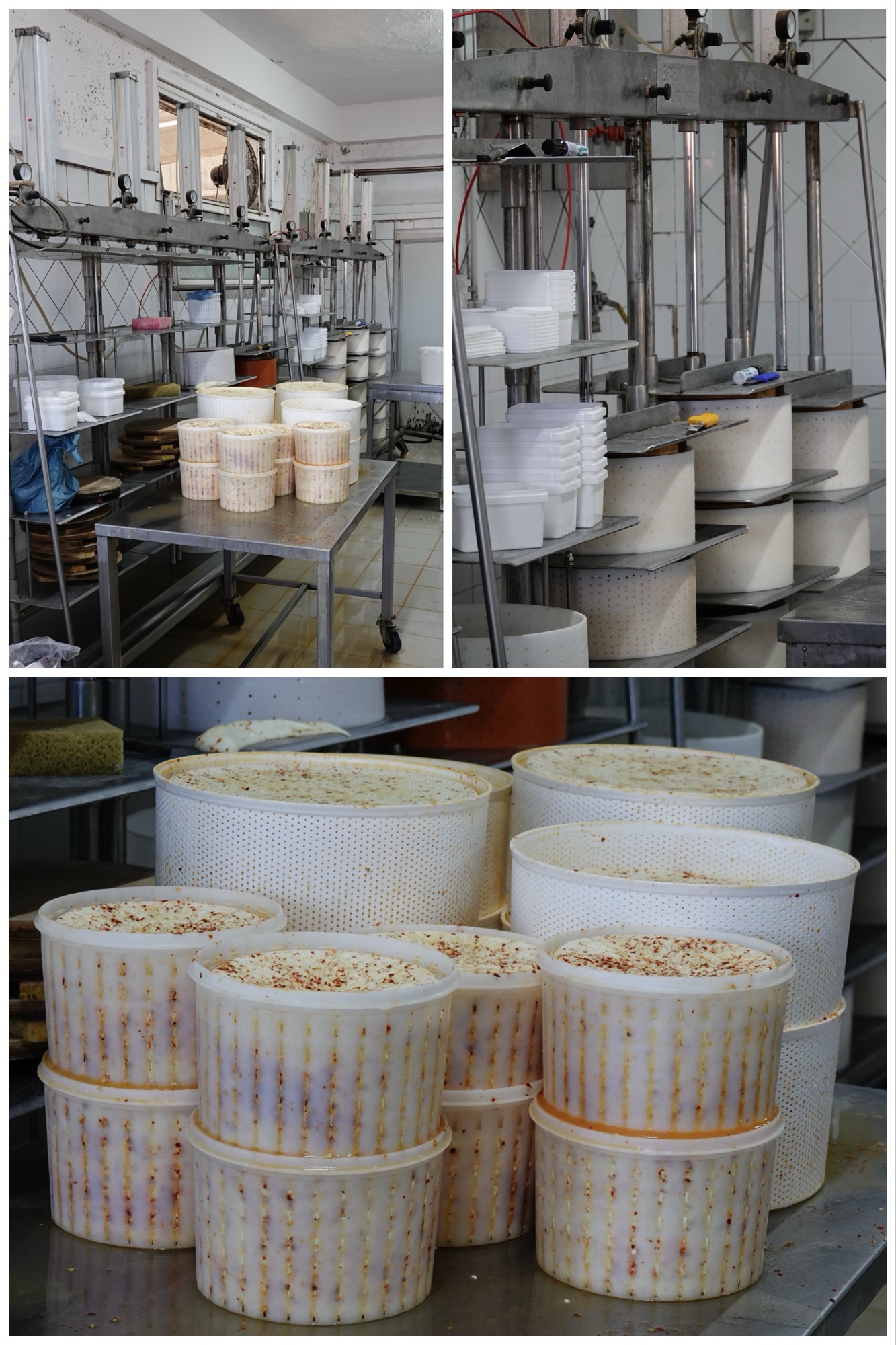
What kind of cheese is being made is completely dependent upon seasonal variations in the sheep’s milk based on their diet. Cheese is not made in the winter at all, because when the grass is dry it means the milk quantity and quality is not as good.
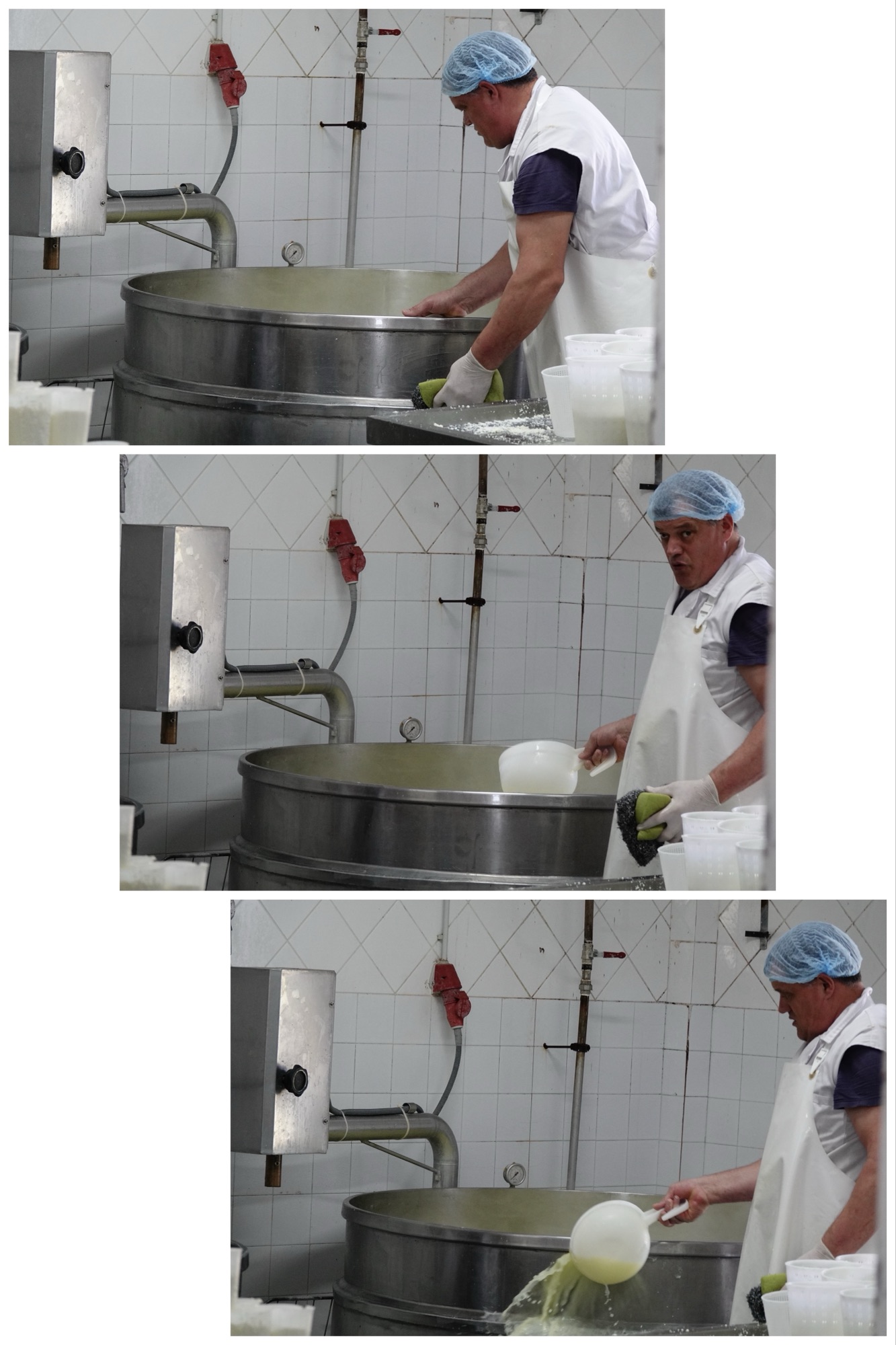
What we tasted was the iconic Cretan Graviera cheese, one of Crete’s few “hard” cheeses.
Our next stop is just a short walk down the road in the same village to Idiosmos, established in 1920, where we had a curated tasting after learning about Cretan honey and olive oil production.
First, honey. We got an explanation of the way beehives are built with the outsides painted in bright floral colors, the top painted white to reflect the sun so the bees don’t overheat, and openings on the side to allow daylight in so that the bees know when to work and when to sleep. The hives are generally raised up off the ground to protect the bees from the temperature changes of the ground below them and to keep the hives from getting soggy.
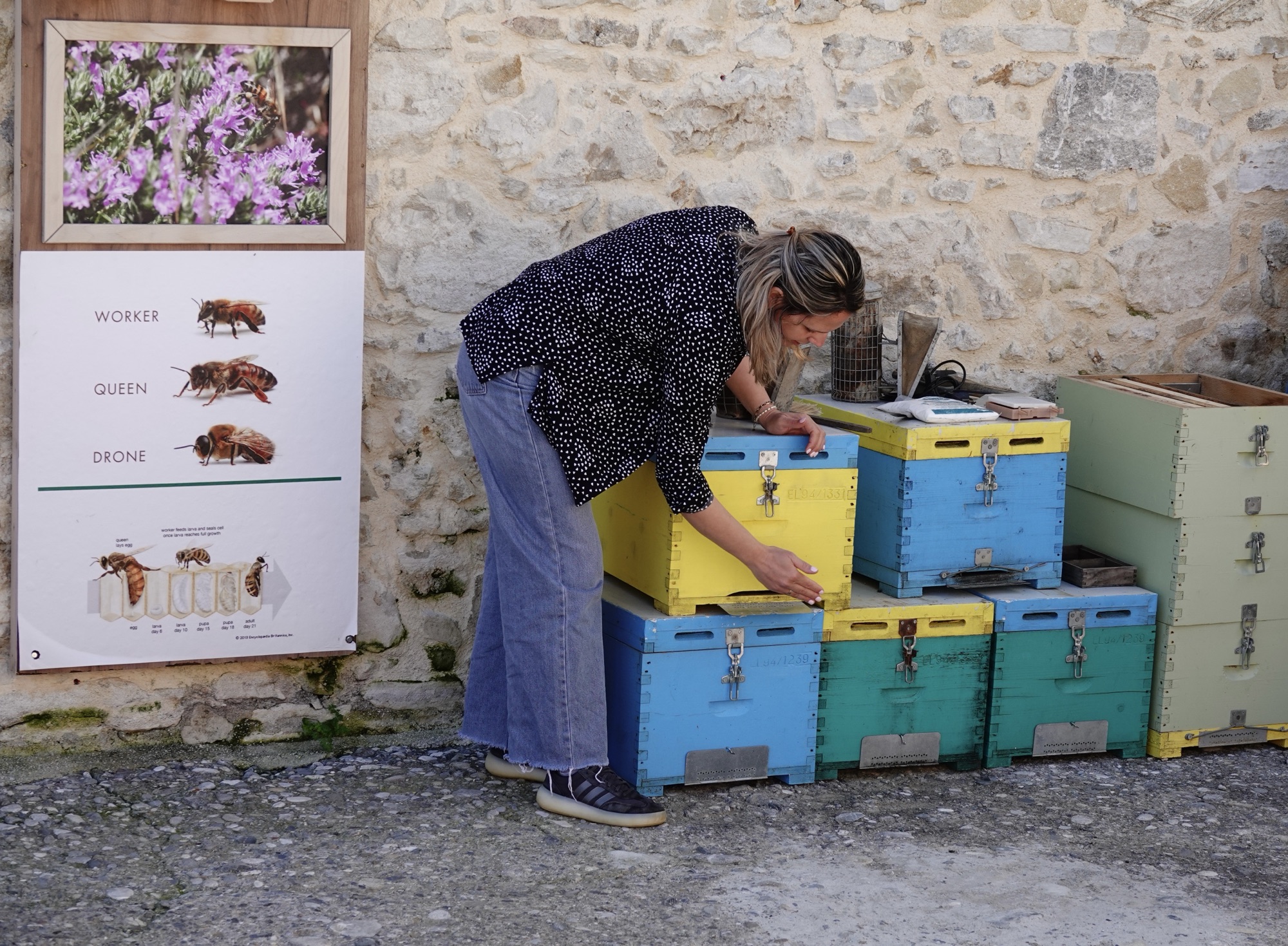
Each hive is stencilled with an identification number, since many beekeepers may have hives in the same field.
The reason the beekeepers use a smoker when they open the hive is that the smoke seems to keep the bees calmer, which makes it easier for the beekeeper to look in and see what’s happening in the hive.
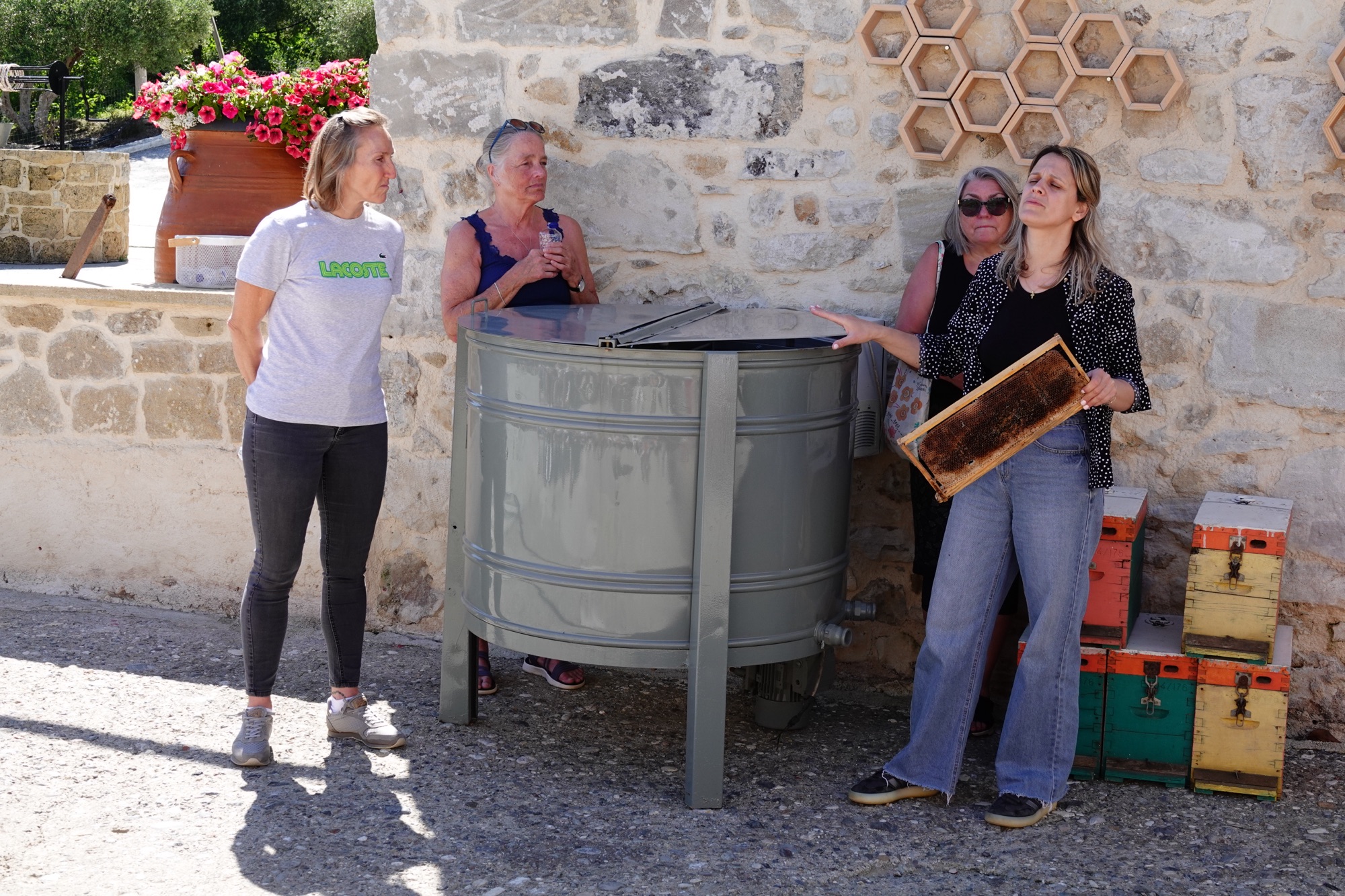
Worker bees are all female. They only live for about 6 weeks and are much smaller than the drones (who do nothing except mate and eat during their 3 month life span).
The honey is extracted from the wax by putting the comb frames, in groups of 20, into a large drum which uses centrifugal force to push the honey out. When we see beekeepers use a knife on the wax it is not to scrape out honey but to remove the wax caps from each of the hexagonal cells. No heat is used during extraction because heat would kill the pollen and the properties that are essential healthy ingredients in raw honey.
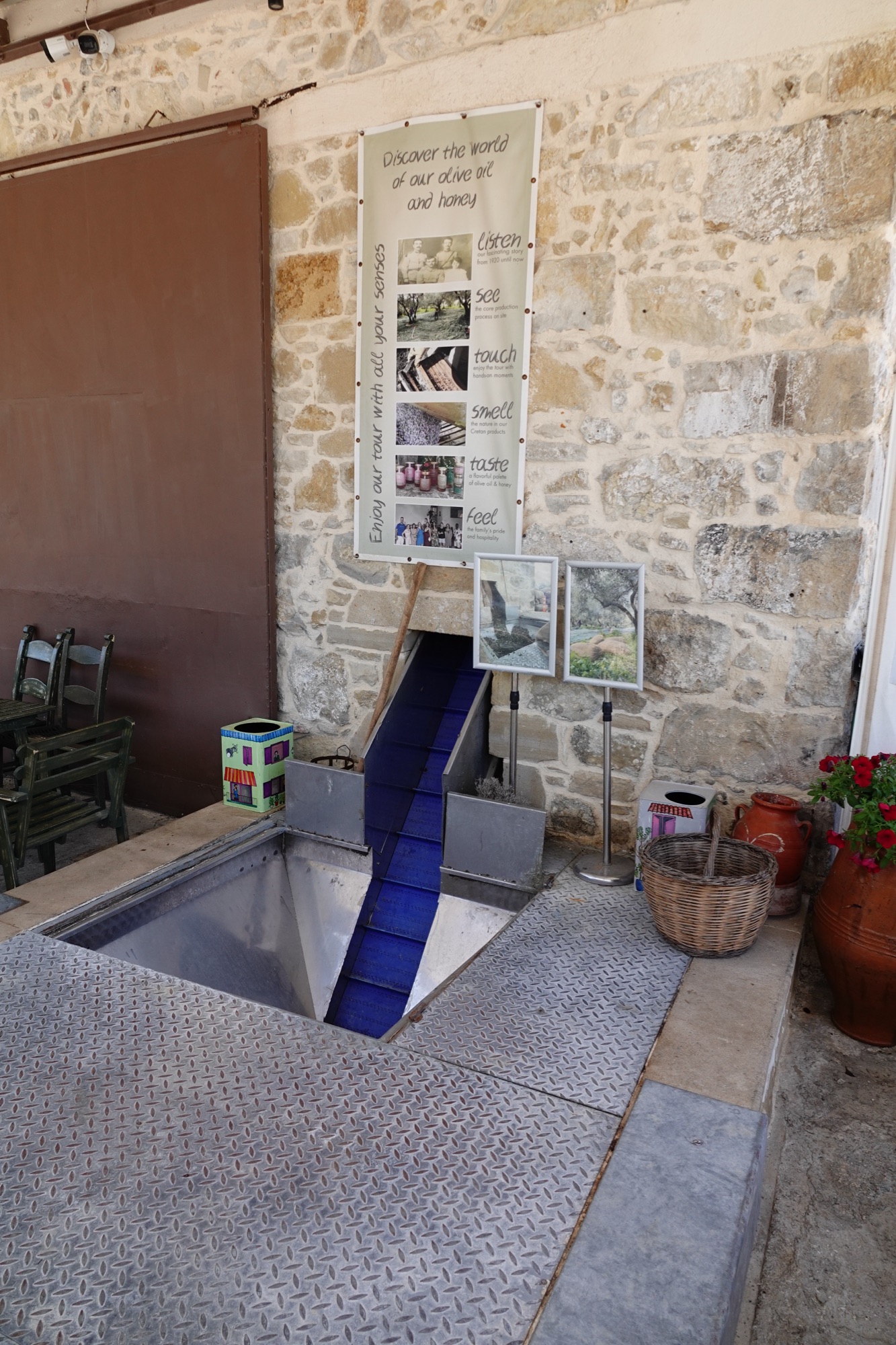
Next we got a look at the modern-day olive oil making process.
Olives are harvested November through January, during which time people who do not have their own processing facilities can bring their olives here. Despite some of the anti-tourist sentiment we’ve been seeing, there was none of that here. The owner talked about how much she loved the “manageable” groups of tourists from April through October, and then simply rolled her eyes expressively heavenward to describe the chaos of the olive season and “farmers” (said with a sigh).
The olives are dumped into a huge chute from where they are drawn along a conveyor belt and through a vacuum system (the blue tube in the photos below) that sucks away detritus – the leaves and twigs that are lighter weight than the olives.
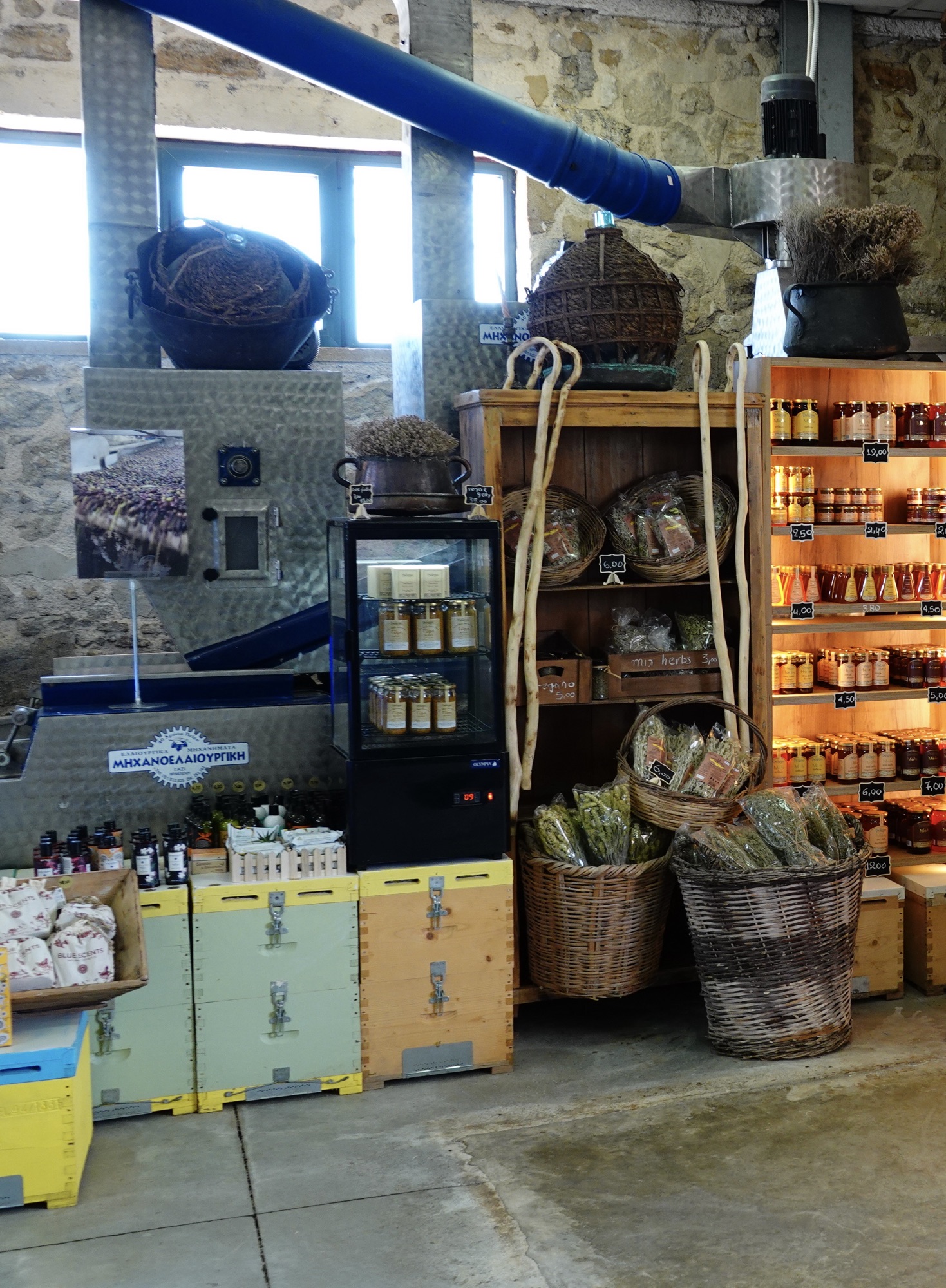
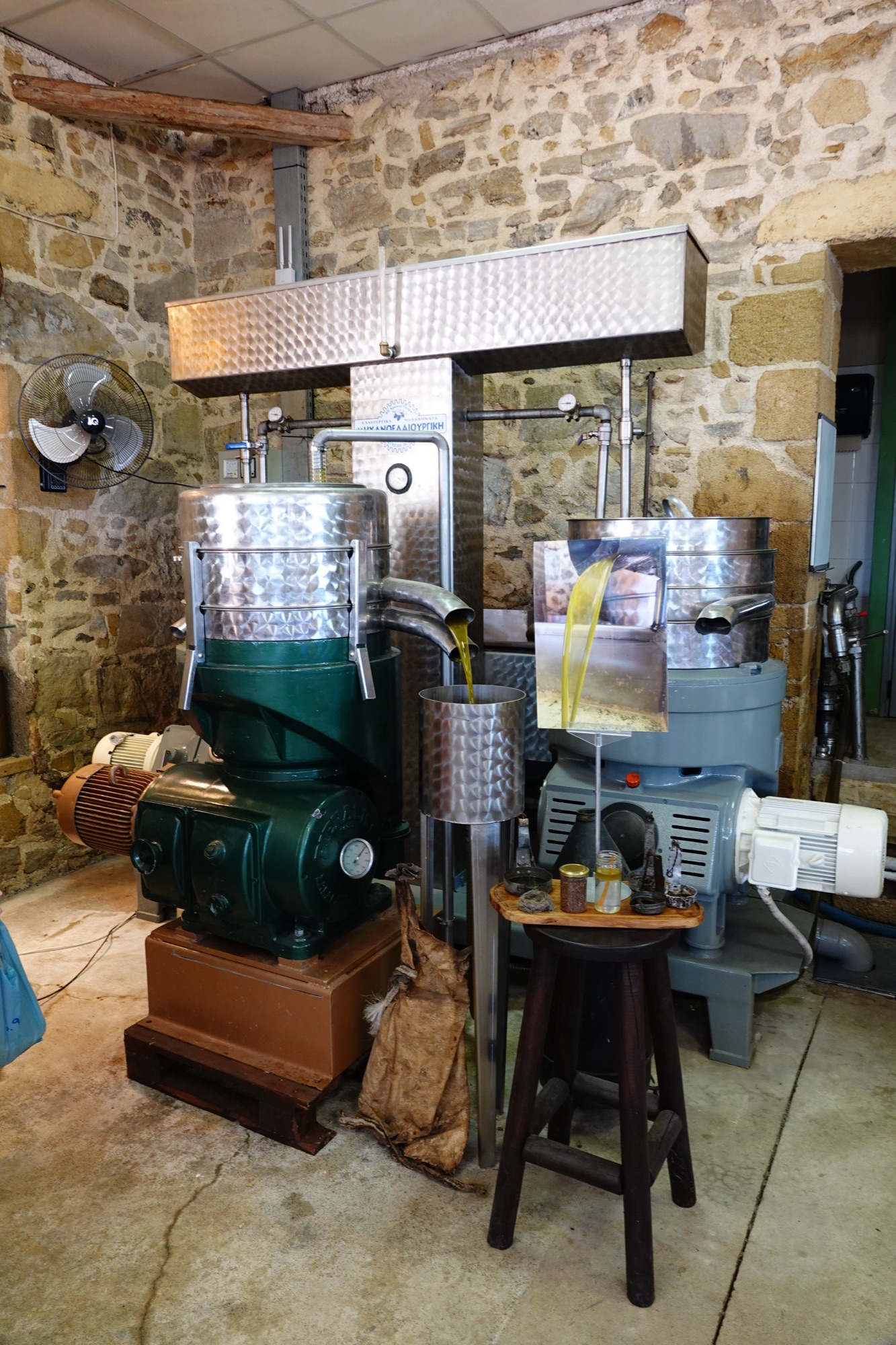
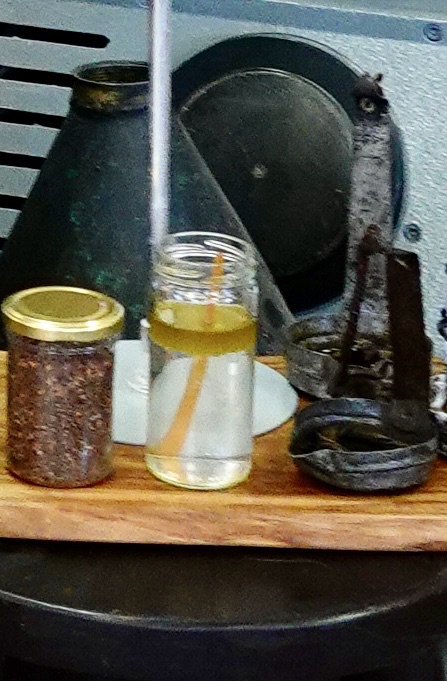
Next the olives are washed before being crushed, complete with their seeds and skin, into a coarse paste. Next comes cold water pressing that takes about 40-45 minutes, after which the resulting slurry is pumped into an extractor which separates all the solids out. The solids get dried and used to create heating pellets. The liquid goes into a centrifuge style spinner which separates the oil and the water into layers, allowing the oil to be siphoned off the top.
Then it was time to taste the honey and the oil. We were given sharing plates that included dried black olives, cheeses, yogurt, sesame bread sticks, and cherry tomatoes, each to be tasted with one of the 8 different honey varieties presented, and chunks of bread to dip into the olive oil.
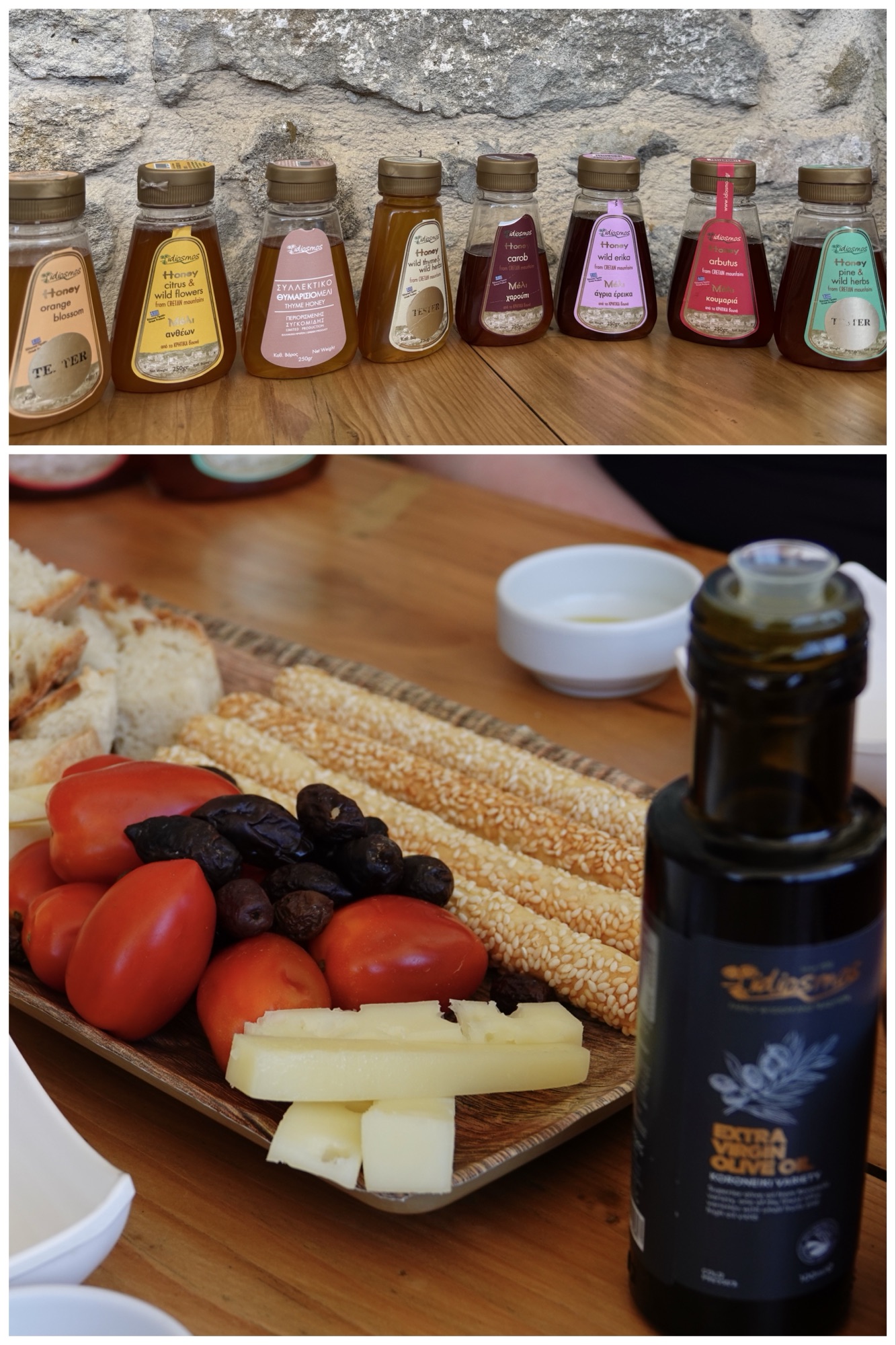
The most interesting combination, to me, was the carob honey with the tomatoes. It tasted almost like balsamic glaze. My favourite was the hard Graviera cheese with the erika (heather) honey.
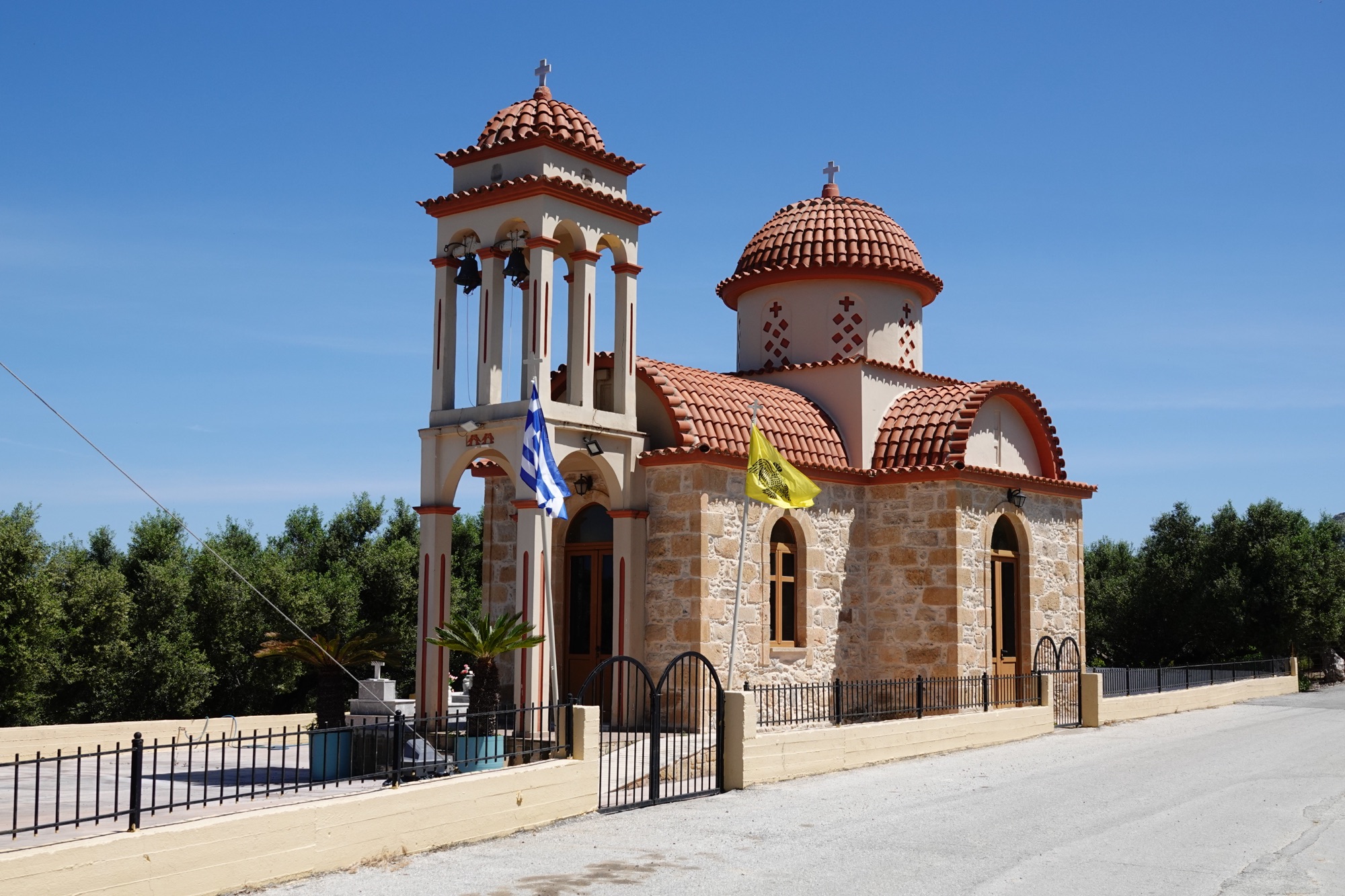
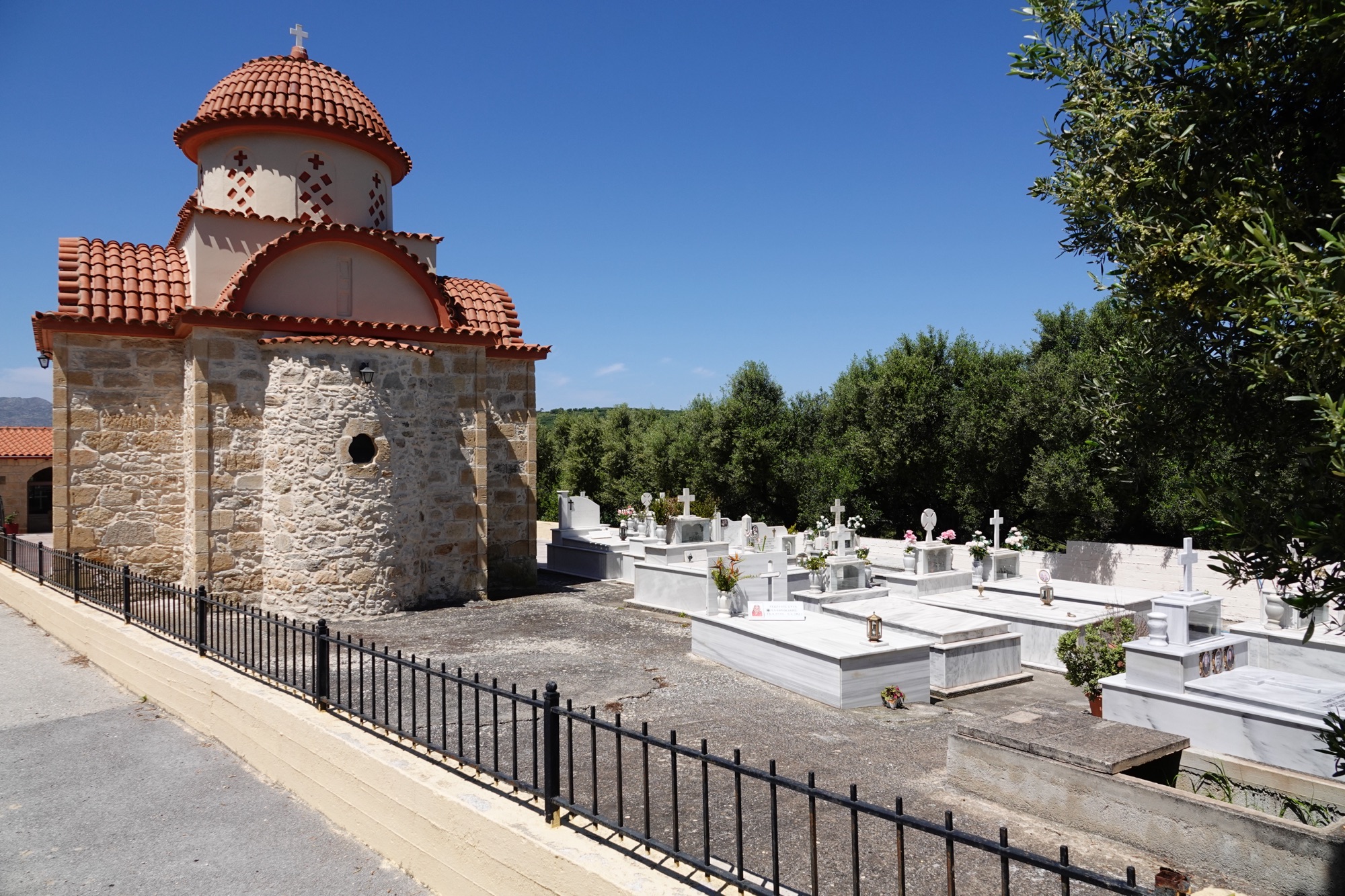
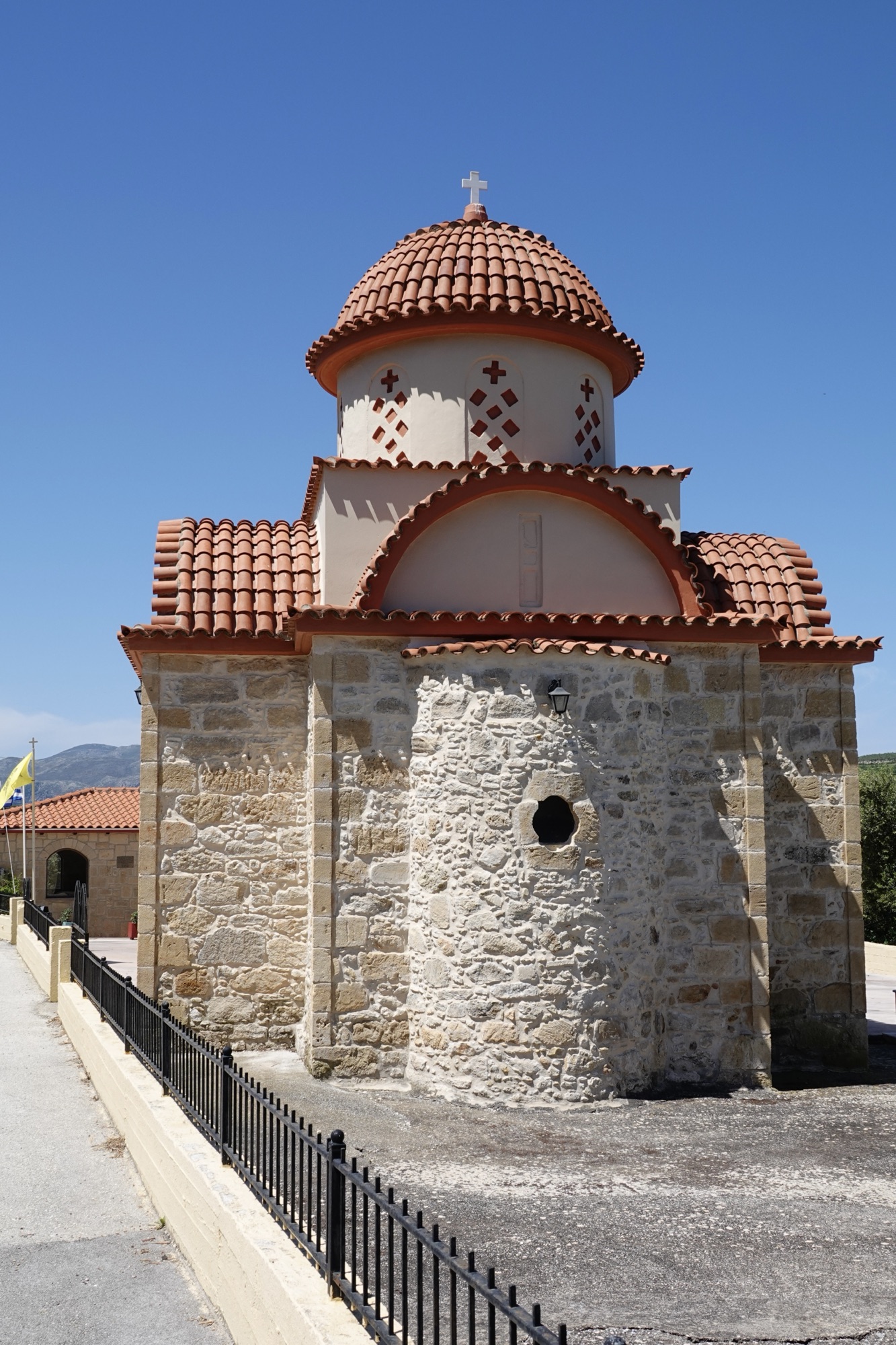
While others were shopping, Ted wandered a bit and found this picturesque local Greek Orthodox chapel and accompanying graveyard.
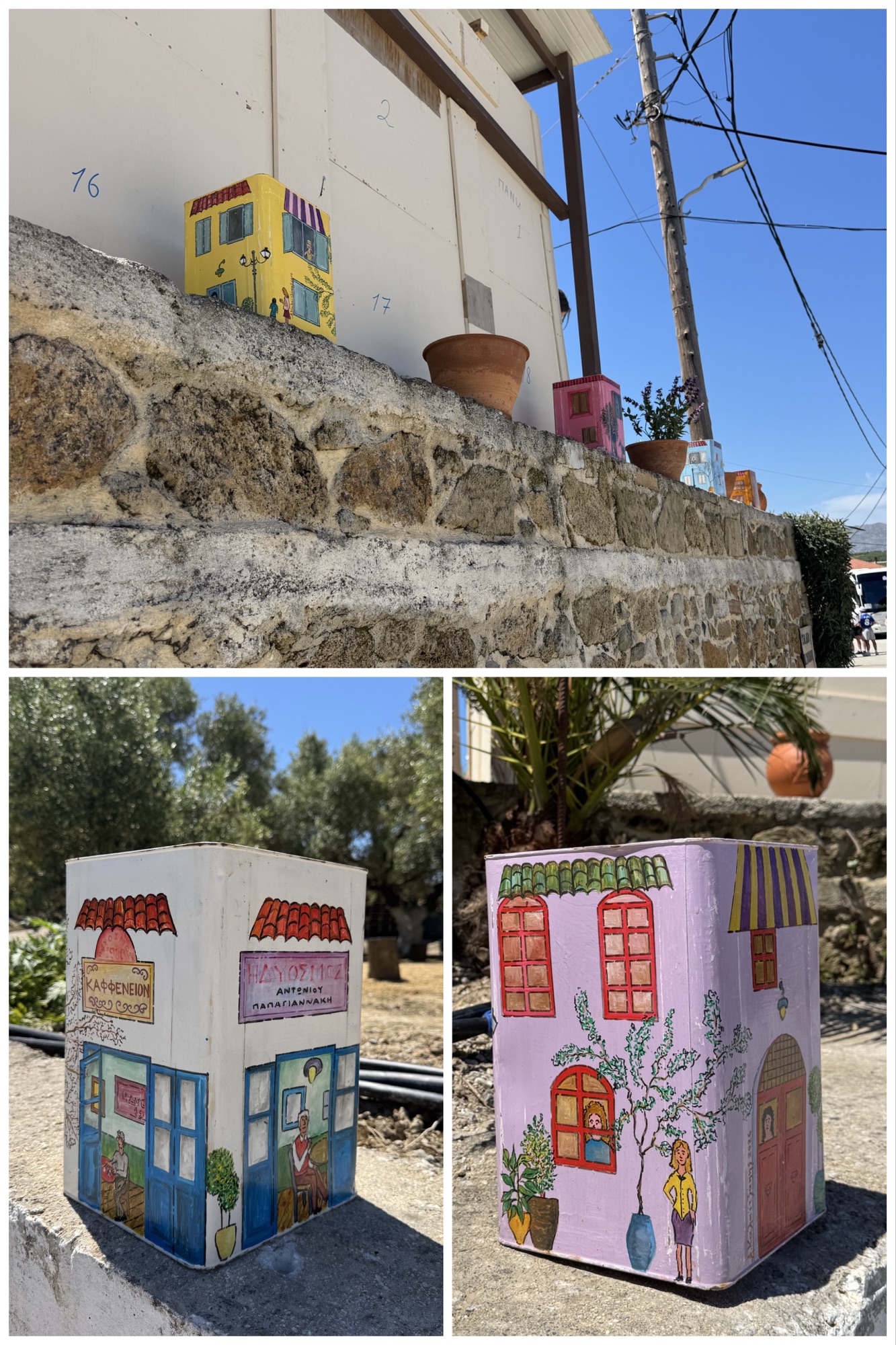
We also noticed that someone had made artistic use of old olive oil tins.
Then it was back onto the coach and back down the incredibly twisty mountain roads to the Pnevmatikaki Winery, almost back down at sea level.
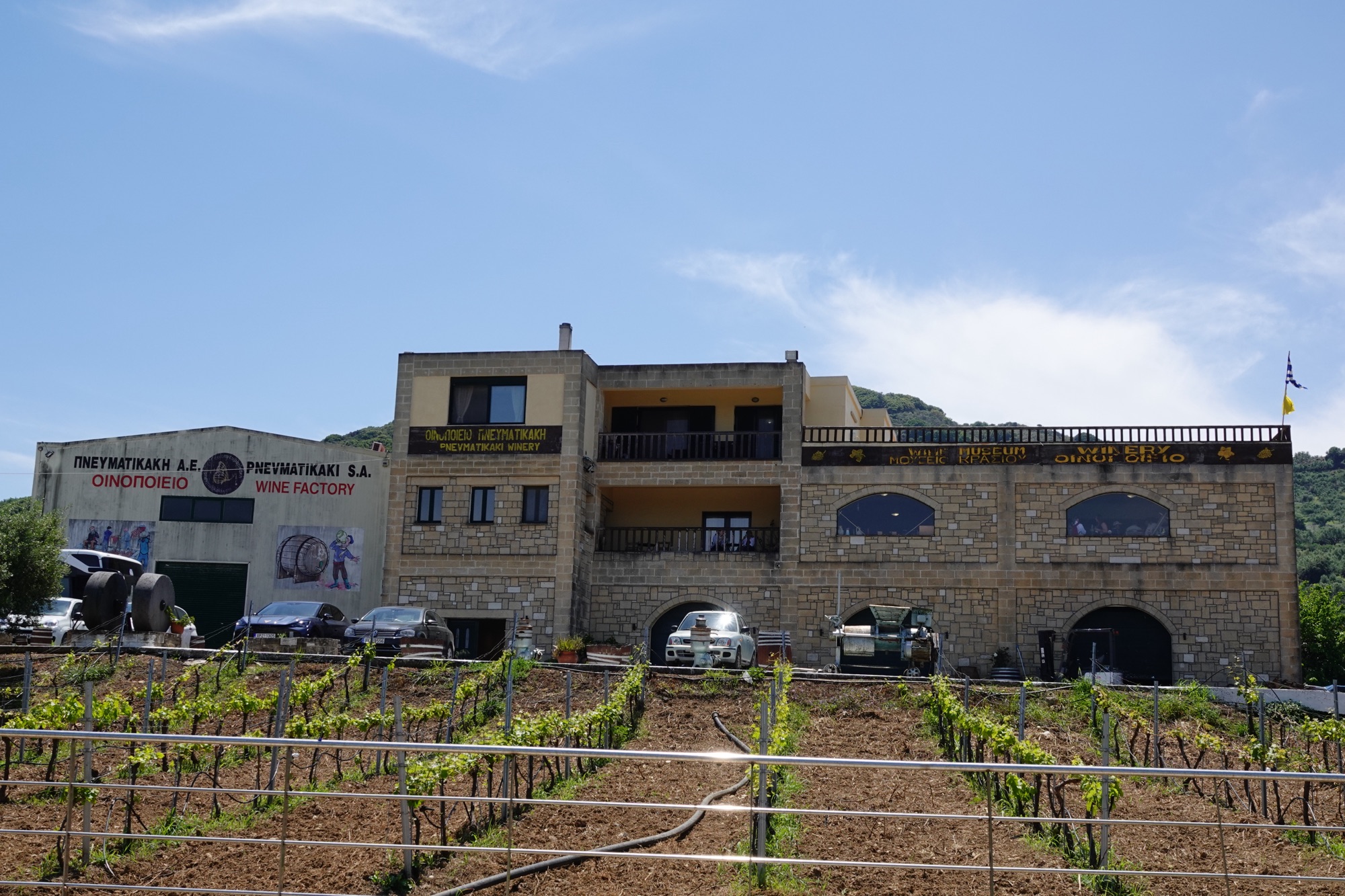
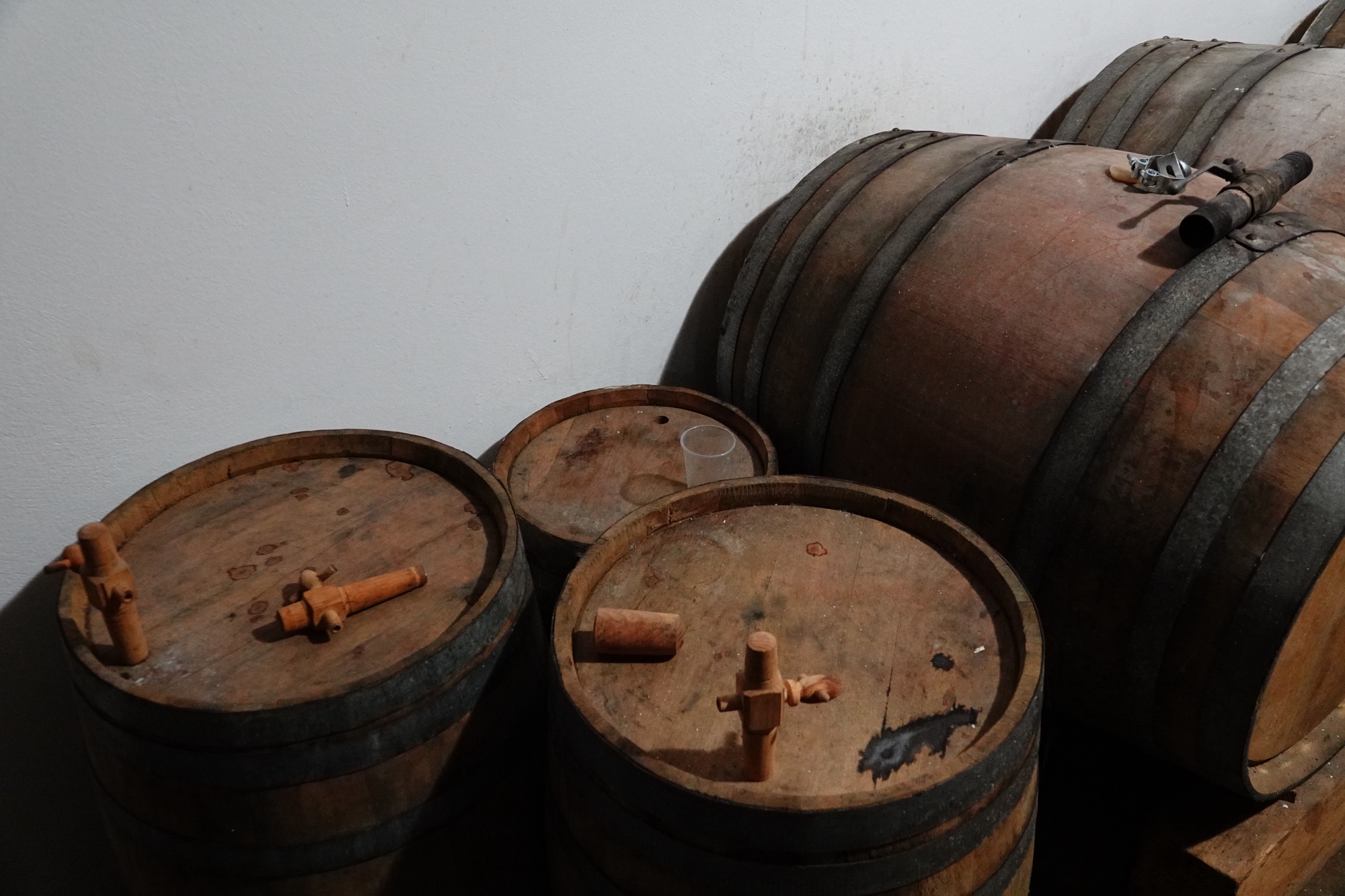
En route our guide told us about some of the island’s endemic grapes, in particular the Romeiko red grape, which dates to the Roman era on Crete and grows nowhere in the world except on the west side of the island near Chania. The grape shares its DNA with Madeira grapes, and the wine produced from it has a rusty colour almost like tawny port. The version we tried later is a sweet wine aged 5 years in old (pre-used) barrels and another 5 in the bottle.
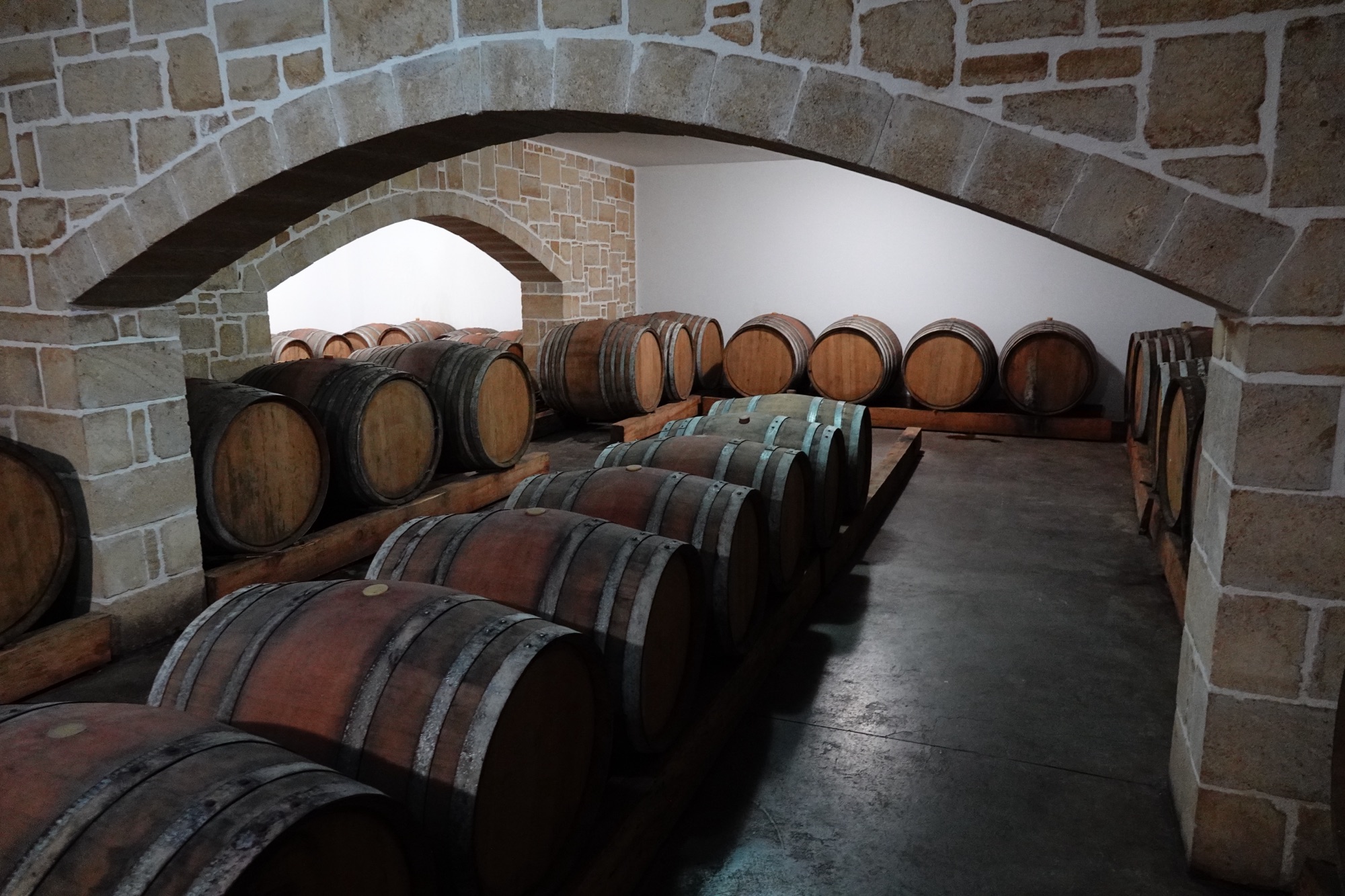
As we toured the cellar, the vintner told us that the winery’s red wines are aged in French oak, but the whites and rosés are kept in their steel tanks to maintain fresh fruity flavours.
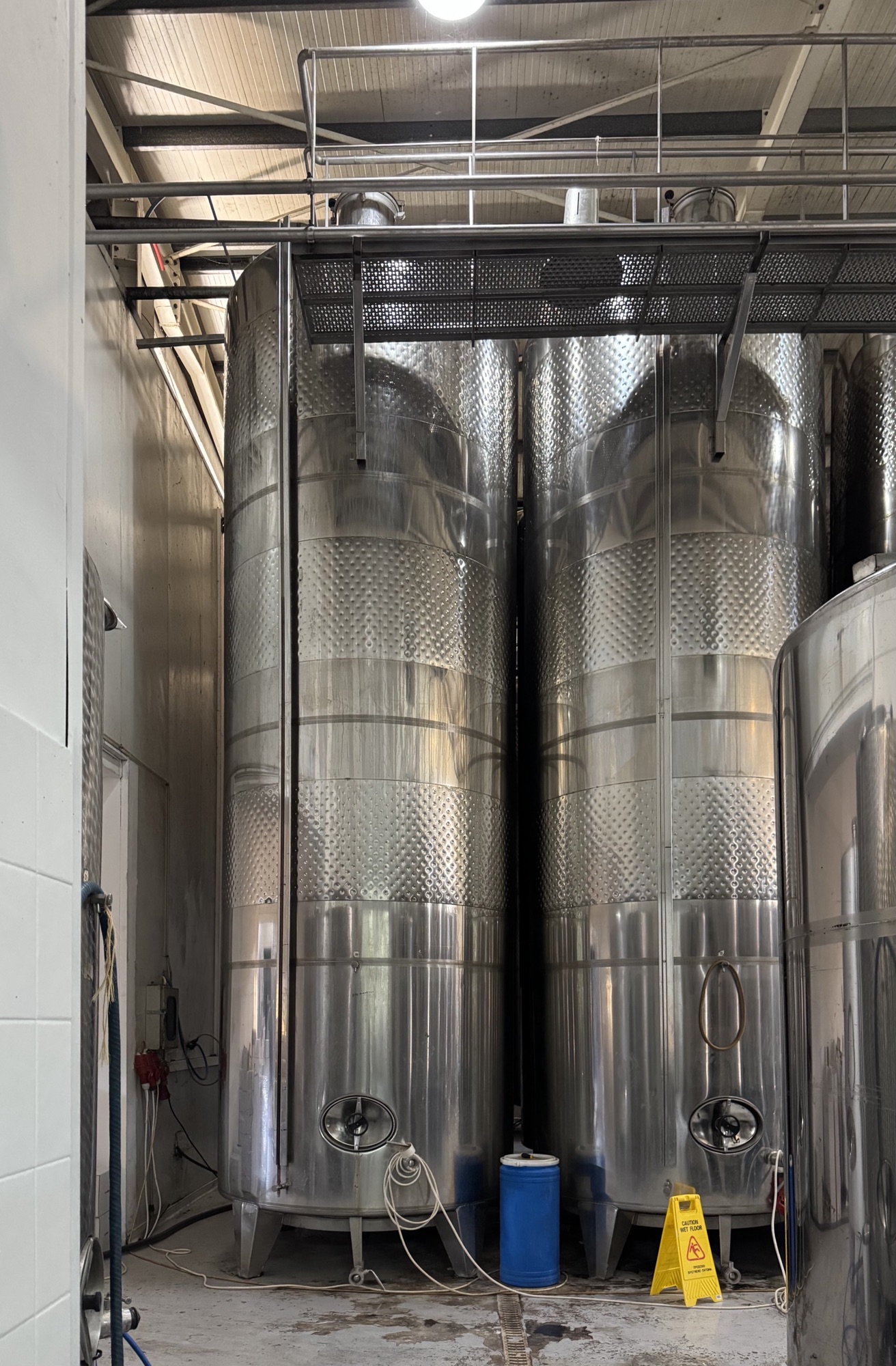
The grapes are de-stemmed and pressed outdoors, then the fermentation and further processes take place indoors.
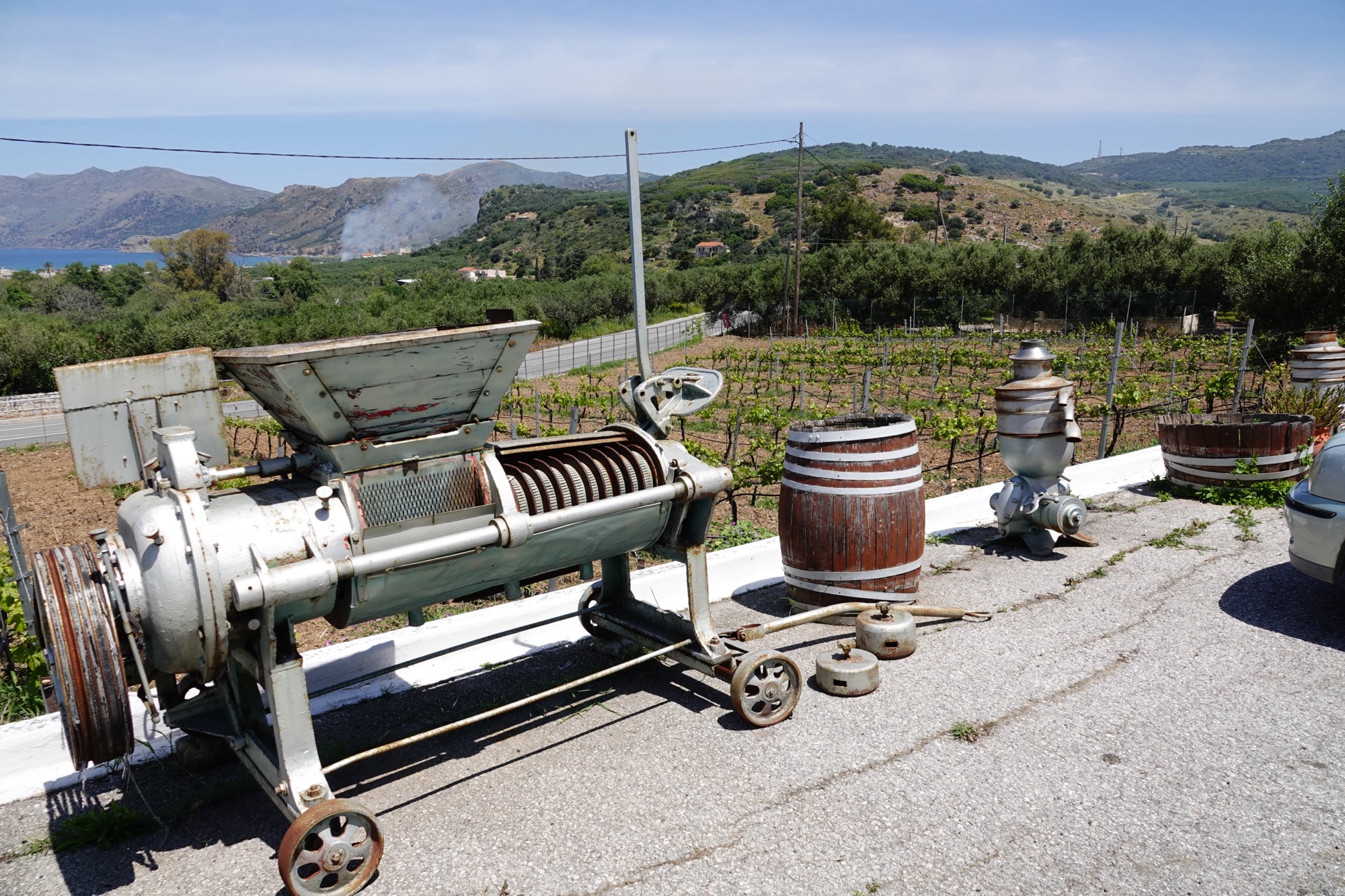
Although this is relatively small winery (producing just one million bottles per year), making it pleasant to visit, it is neither an organic or particularly innovative winery. They use sulphites in their wines and they don’t depend only on natural fermentation, but add yeast in order to create a consistent product year over year.
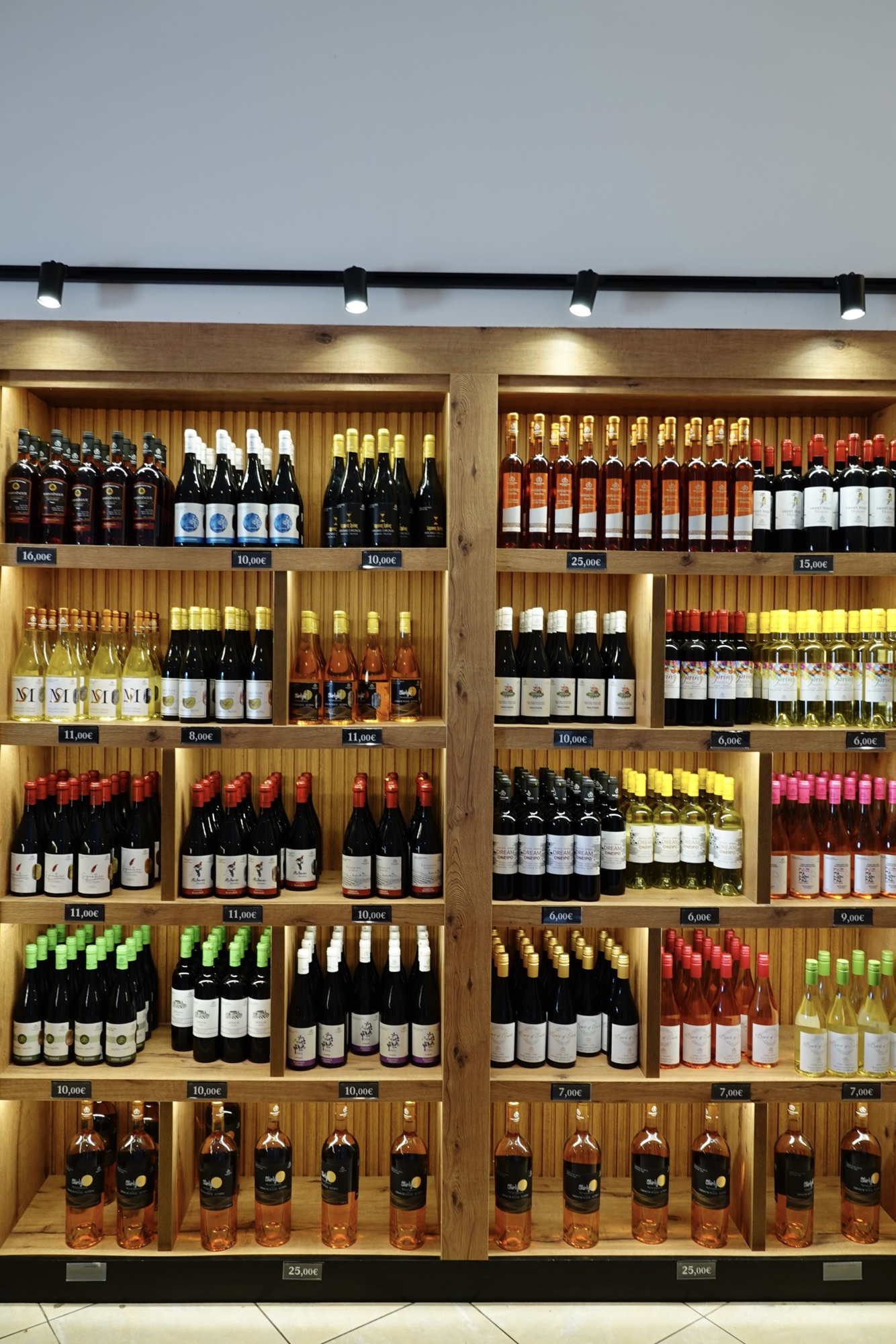
We proceeded to a “self-serve” tasting of 17 types of wine and two types of raki, one with honey. Good grief. The group of about a dozen young Swedish men on our tour had a really good time.
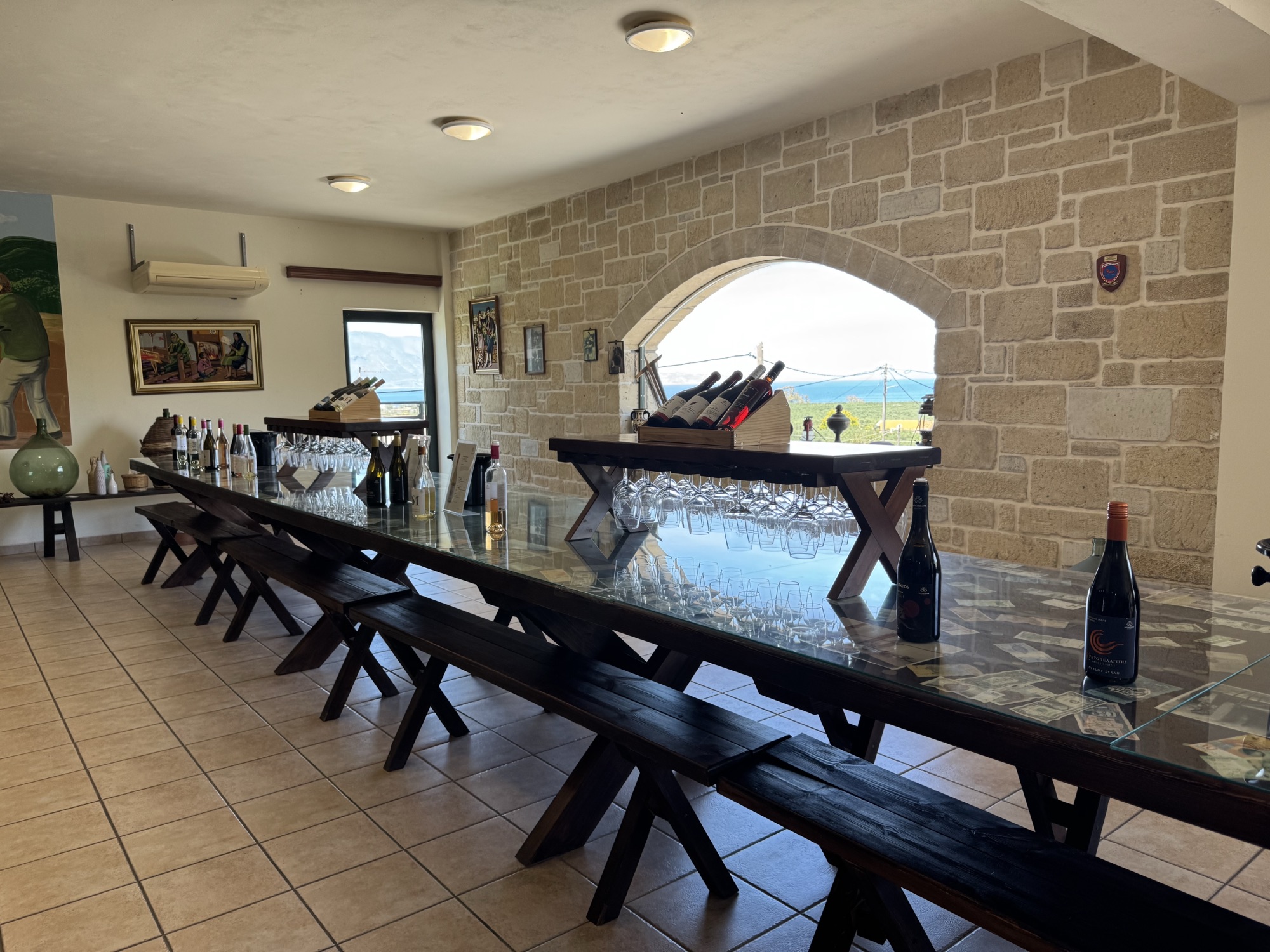
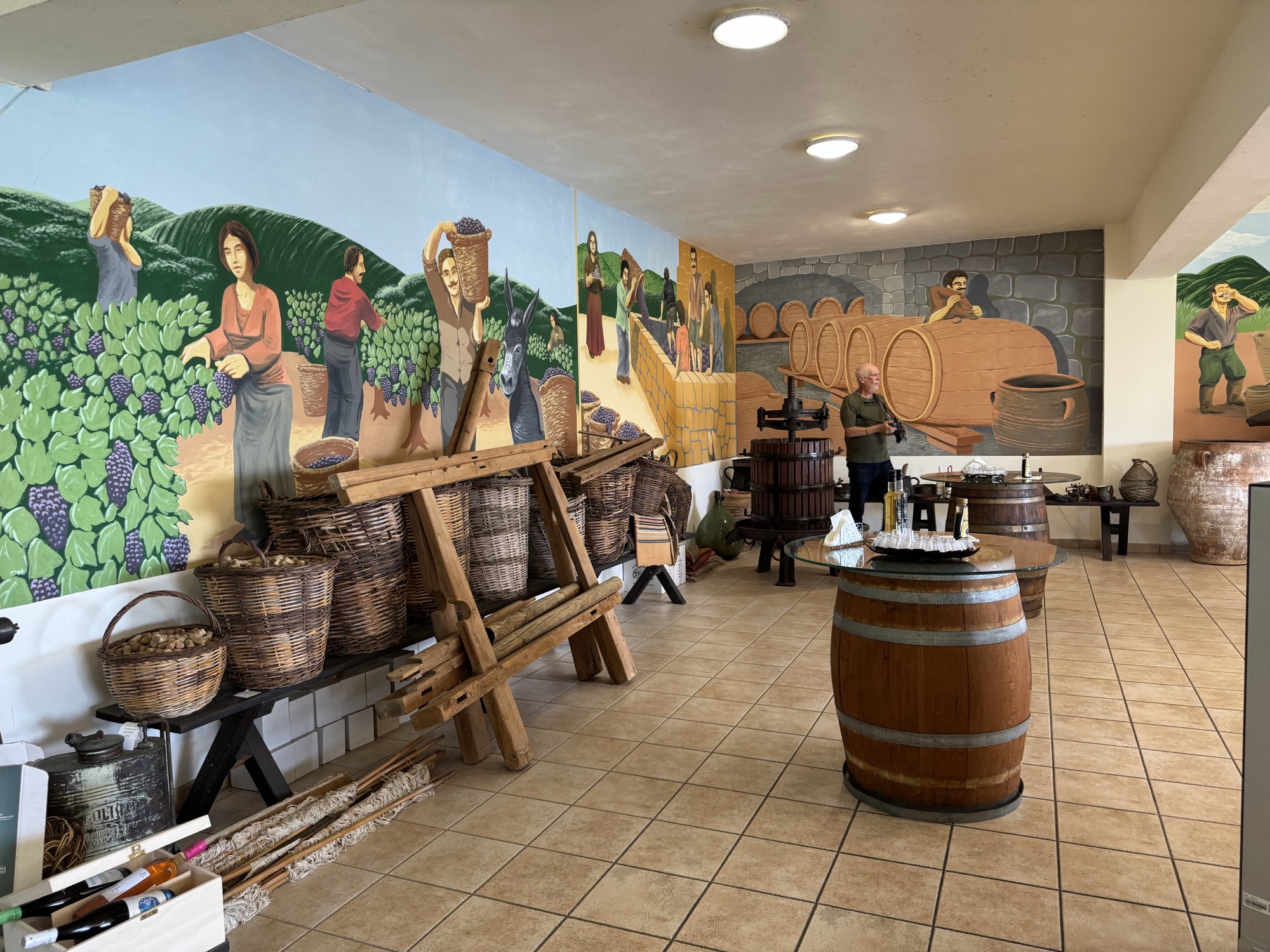
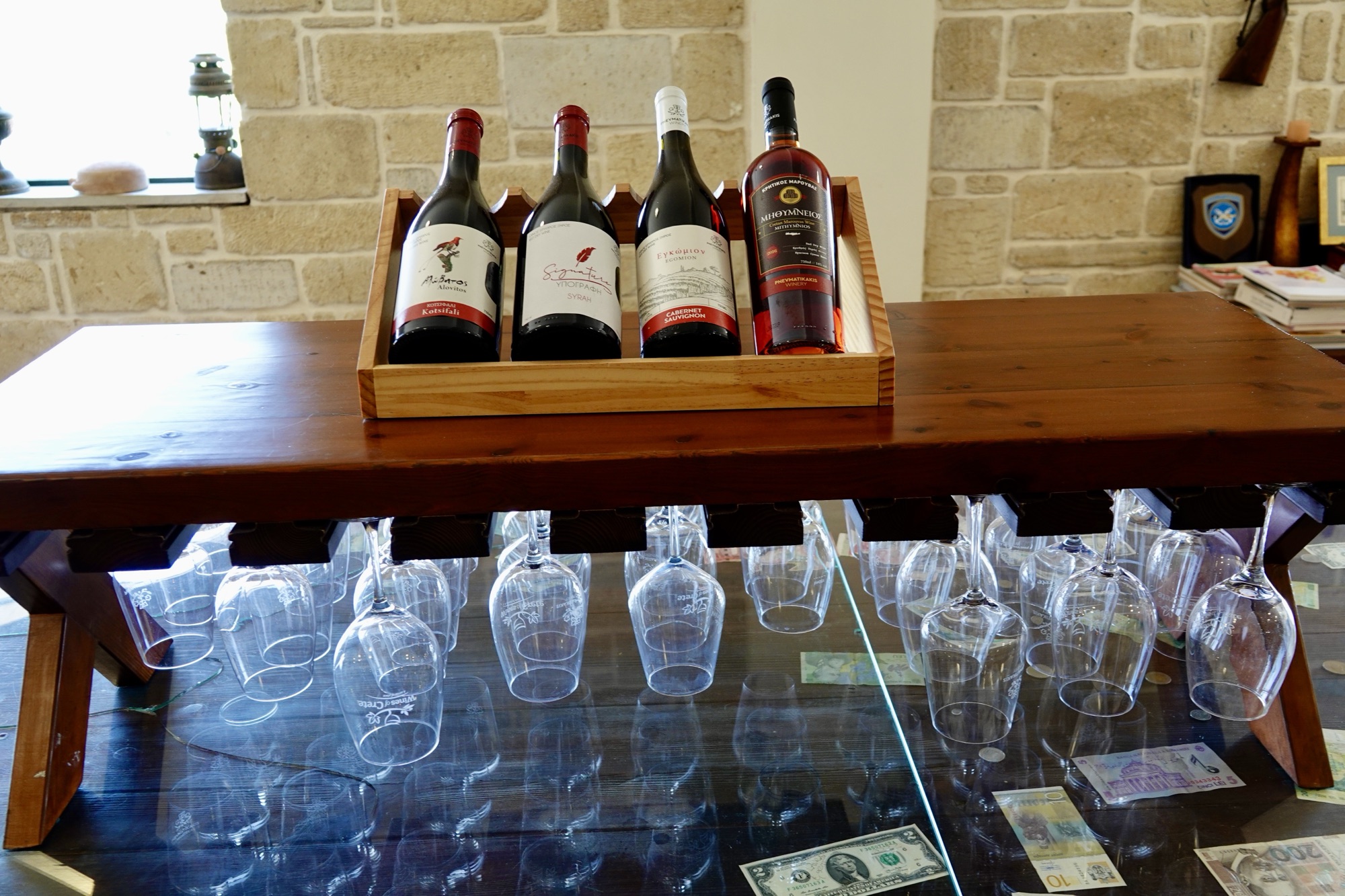
After the selections were described, and our group was let loose with their wineglasses, I was really only interested in trying the Romeiko, because it was described as the most unique. With a 14% alcohol content and its characteristic rusty colour, it reminded me of a dry sherry: not unpleasant but not worthy of buying a bottle.
The wine tasting ended the day’s tour. It was a nice diversion, if much too large a group. Our Swedish/Italian guide, who moved to Crete twenty years ago, knew her stuff and made the day interesting.
We’re prepared to hunker down for a couple of days if the predicted heavy rainfall appears. That meant a trip to the local mini market for potato chips and Nespresso pods, plus downloading another book.
Tonight’s dinner theme in the resort restaurant was Italian. My bowl and plate(s) were filled with minestrone soup, Caprese salad, canneloni, and grilled vegetables, followed by a tiramisu that couldn’t hold a candle to what my daughter-in-law makes. We took our extra-shot lattes to the comfy chairs in the lobby to read for a while.

