Today had everything: history, geography, geology, culture, handicrafts, wine, and food, which was a lot to pack into 9-1/2 hours – and in two languages!
We’d booked a tour through Expedia called “Mountain Villages: Arkadi, Margarites, Sfendoni Cave & Axos”, which was delivered by Spiro, the owner of Spirodon Tours, a small family tour company based in Rethymno. Spiro did the commentary in excellent English and fairly decent German. I was impressed.
The furthest point to which the tour took us was the mountain village of Axos, just over an hour away on the slopes of Mount Ida (one of 5 peaks of Psiloritis, the highest mountain on the island of Crete) but on the way we made several interesting stops.
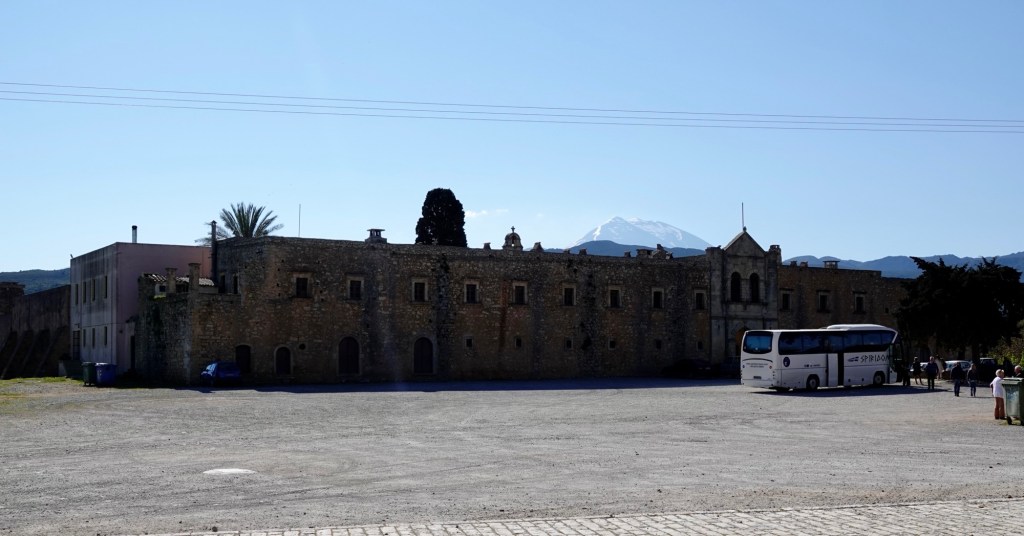
Our first was at the Arkadi Monastery, historically significant for its role in the 1866 rebellion that began the overthrow of the 3-1/2 century long Turkish Ottoman rule of Crete.
The monastery, dedicated to Saint Constantine and Saint Helen, was founded at the beginning of the 13th century.
The current double-aisled church was built in 1587, incorporating Gothic and Renaissance characteristics.
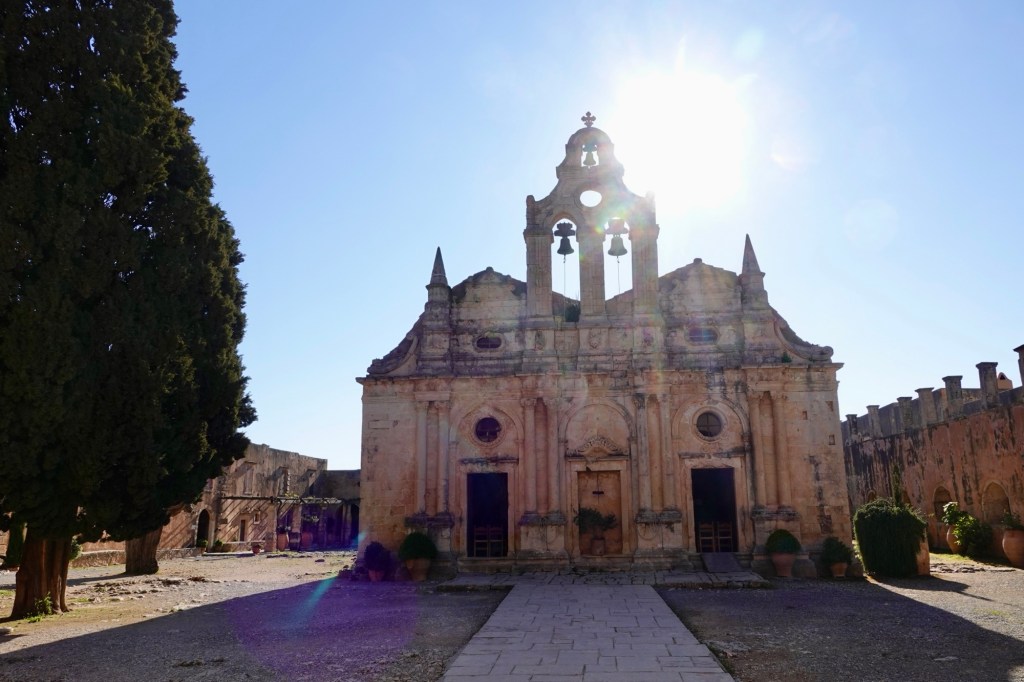
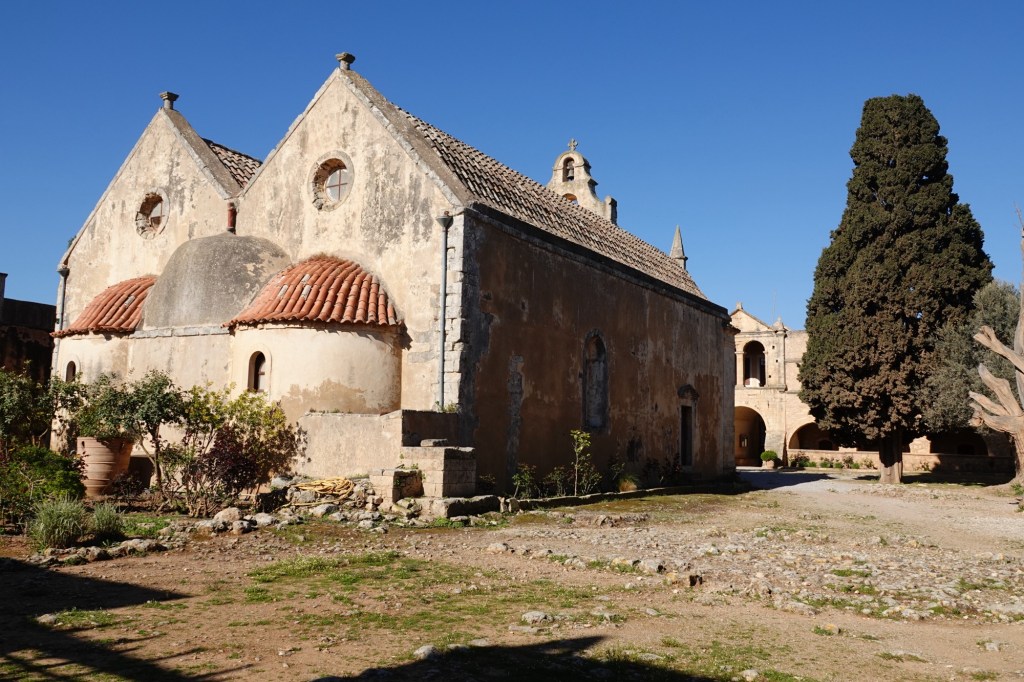
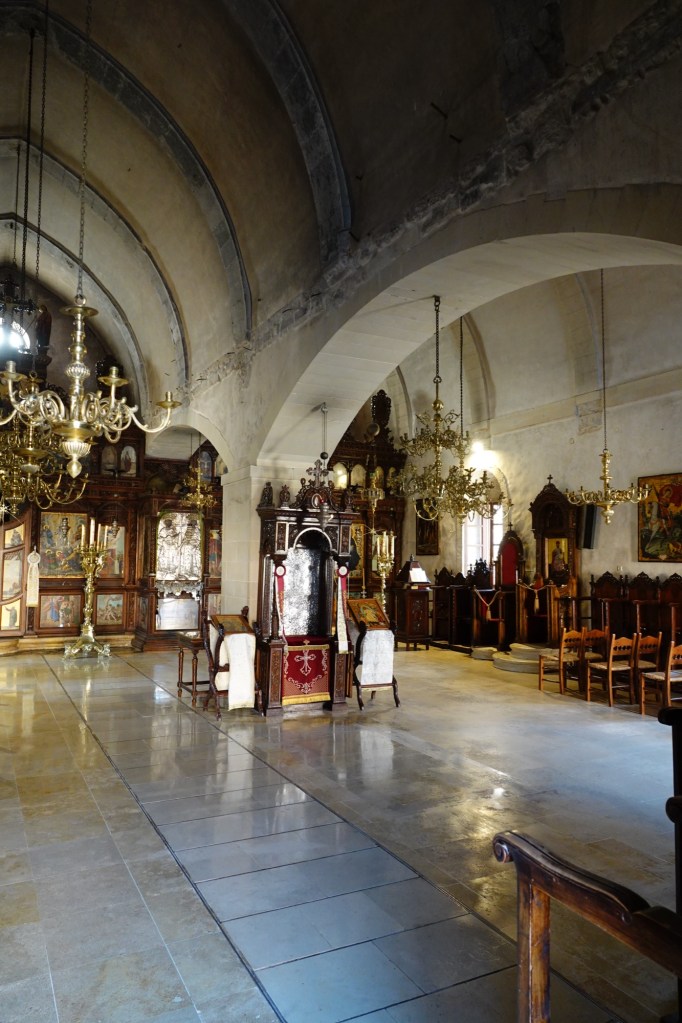
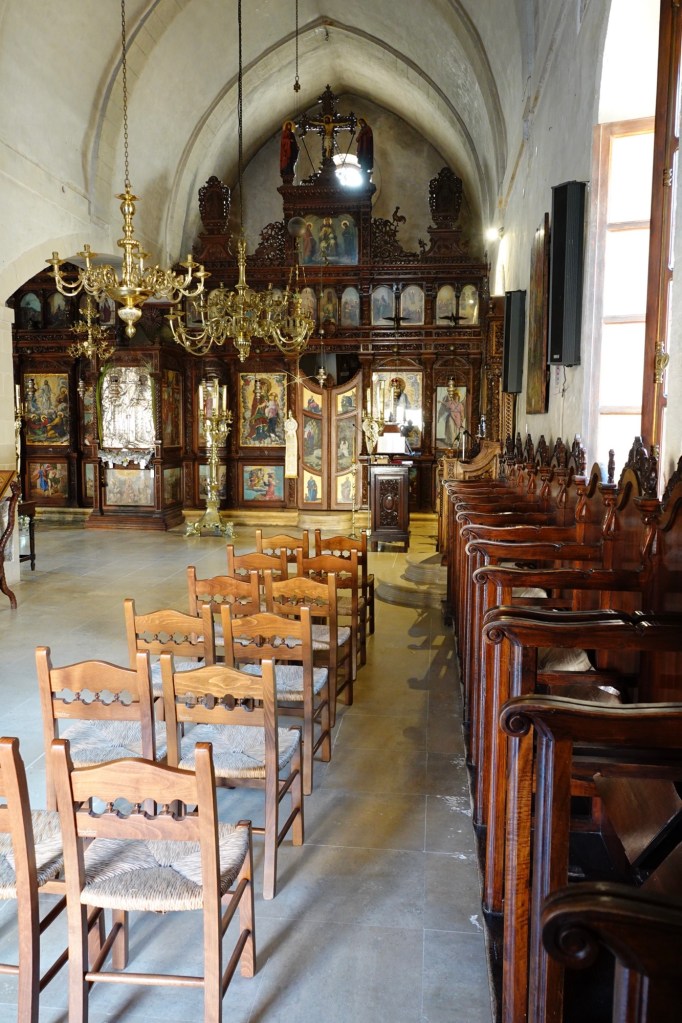
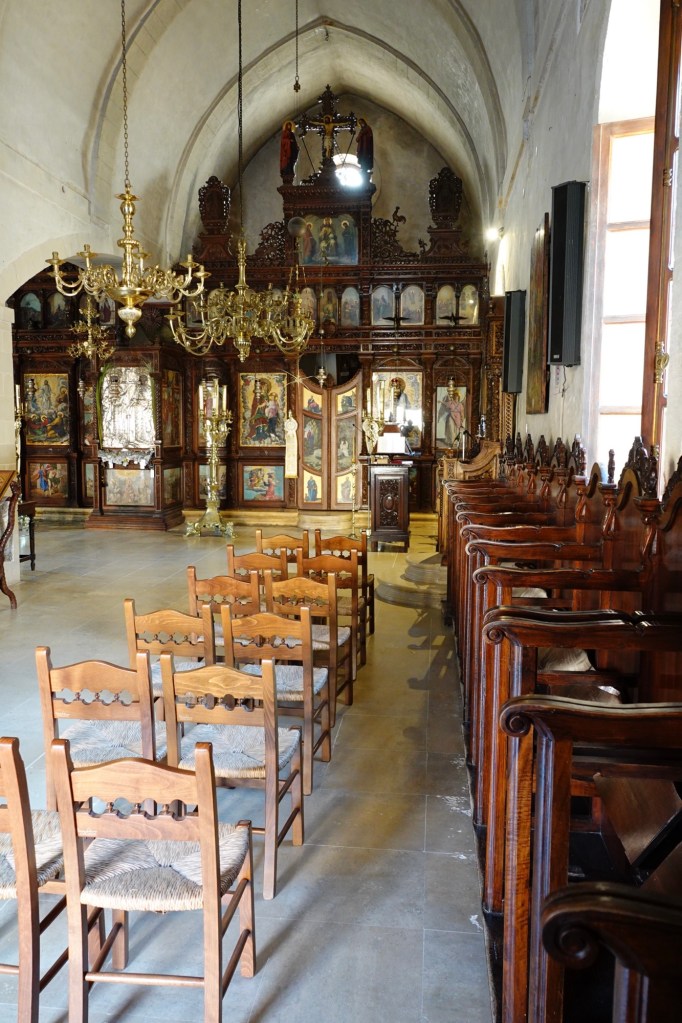
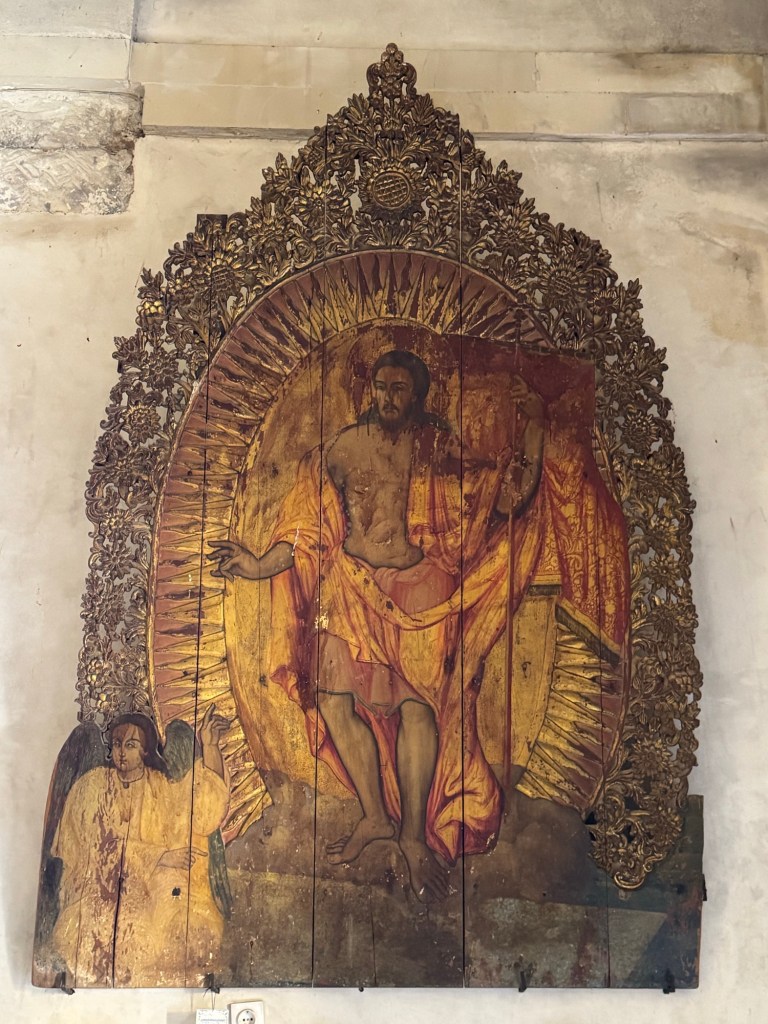
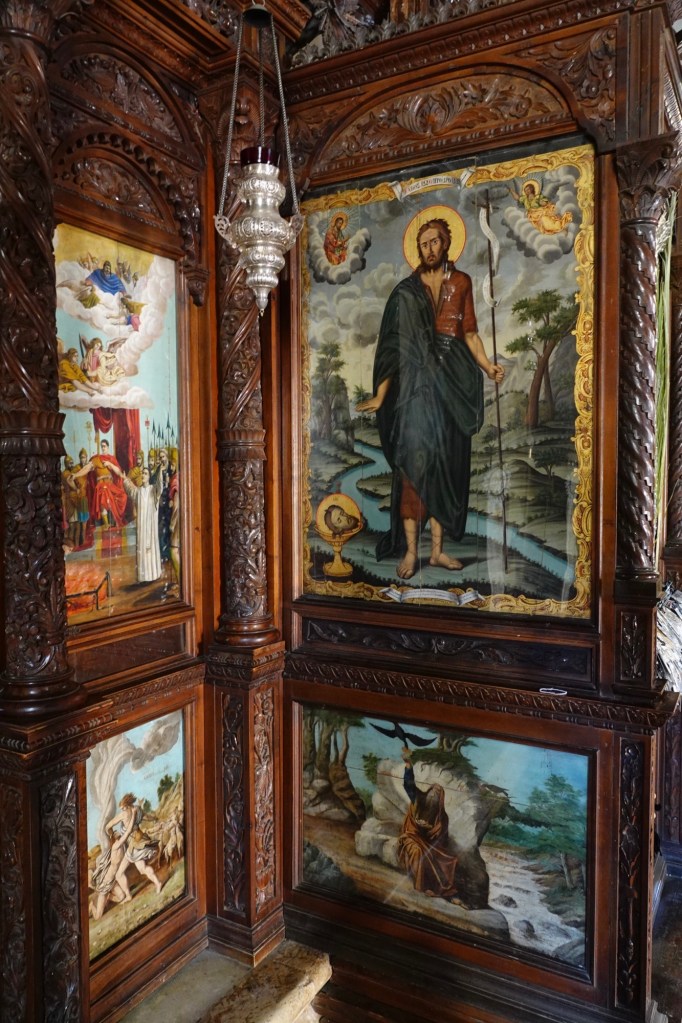
By the end of the 16th century the monastery had been fortified with the kind of Venetian-style walls we can see all over Crete. The monastery continued to operate during the Ottoman period (1669-1898 CE) although permission for Christians to worship was also tied to higher taxation and limited freedoms.
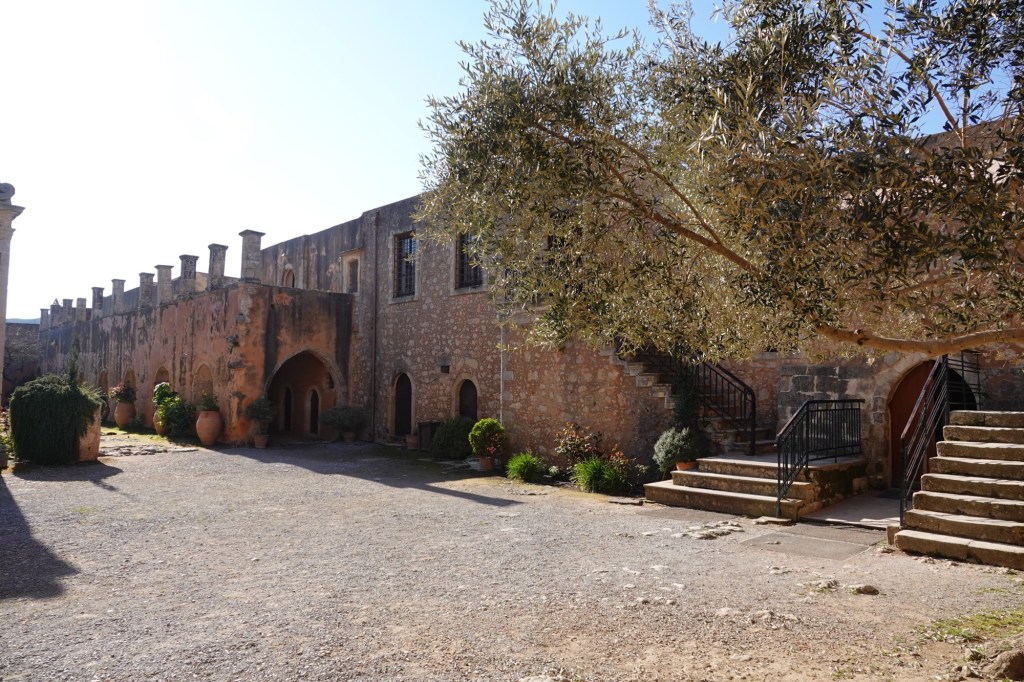
Although a thriving monastery for centuries, there are now only three monks left here. Their cells and the monastery’s administrative offices were the only areas off limits to our tour.
We entered through the West Gate, as people coming from Rethymno (in the west of Crete) would have done centuries ago. The current gate is “new” since 1870, the original having been destroyed by the Ottoman Turks in 1866.
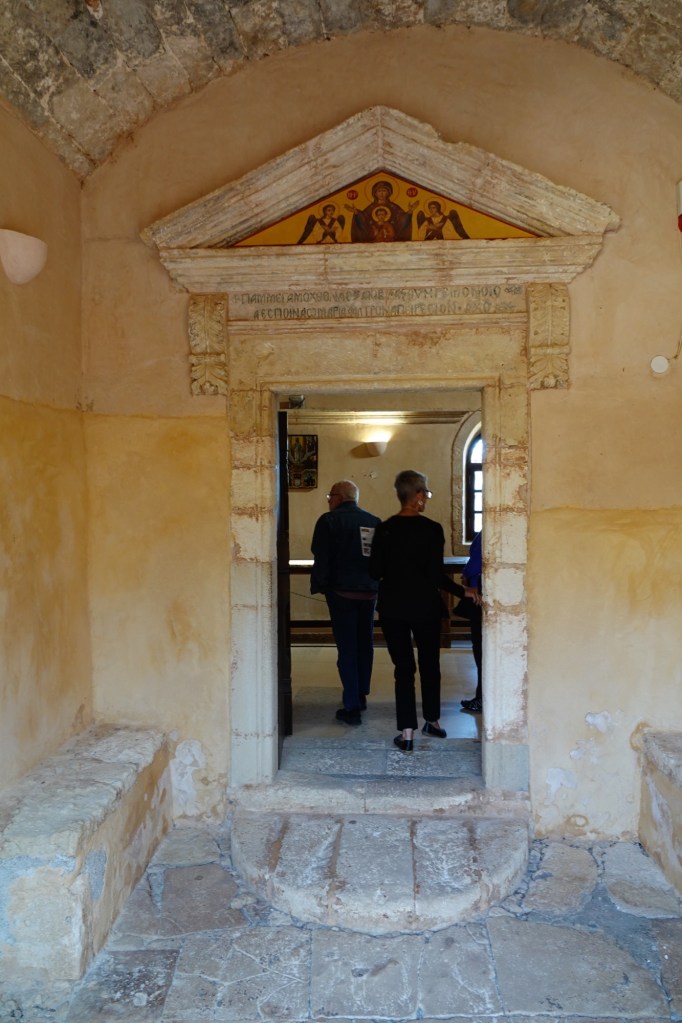
Entering the door to the refectory, a room which has remained unchanged since its construction in 1670 CE.
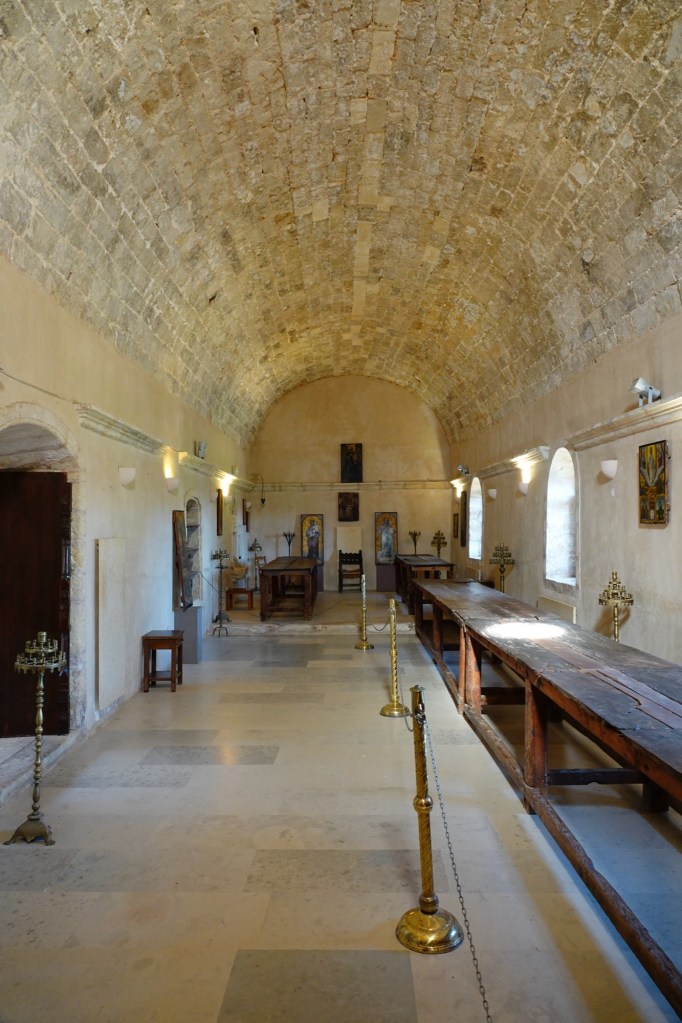
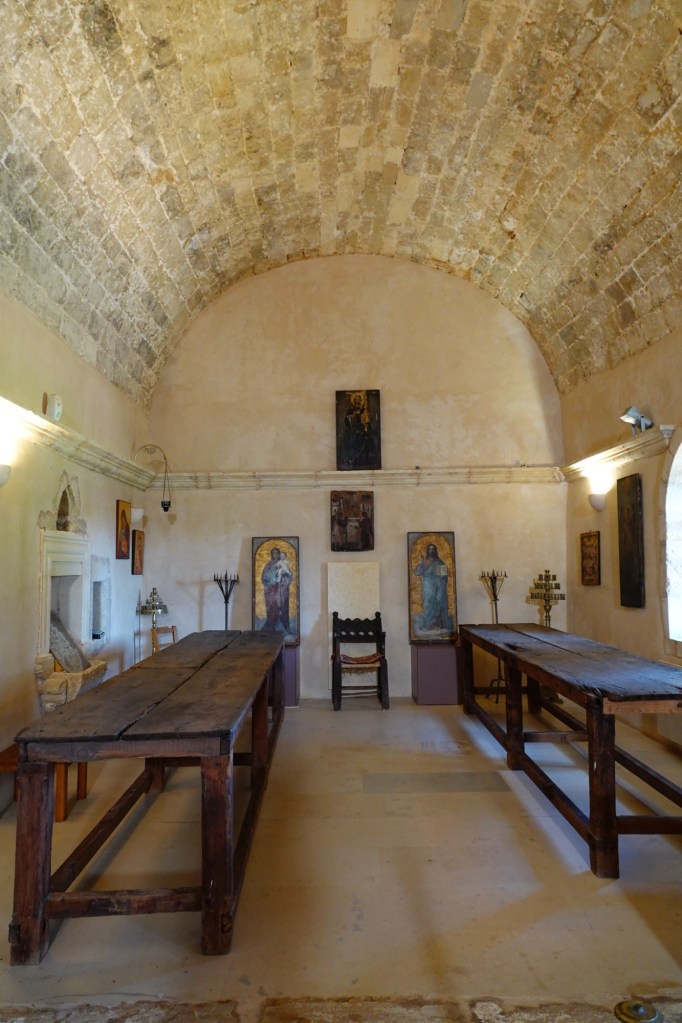
The refectory, with its thick stone walls and vaulted ceiling, was cold even on a sunny spring day.
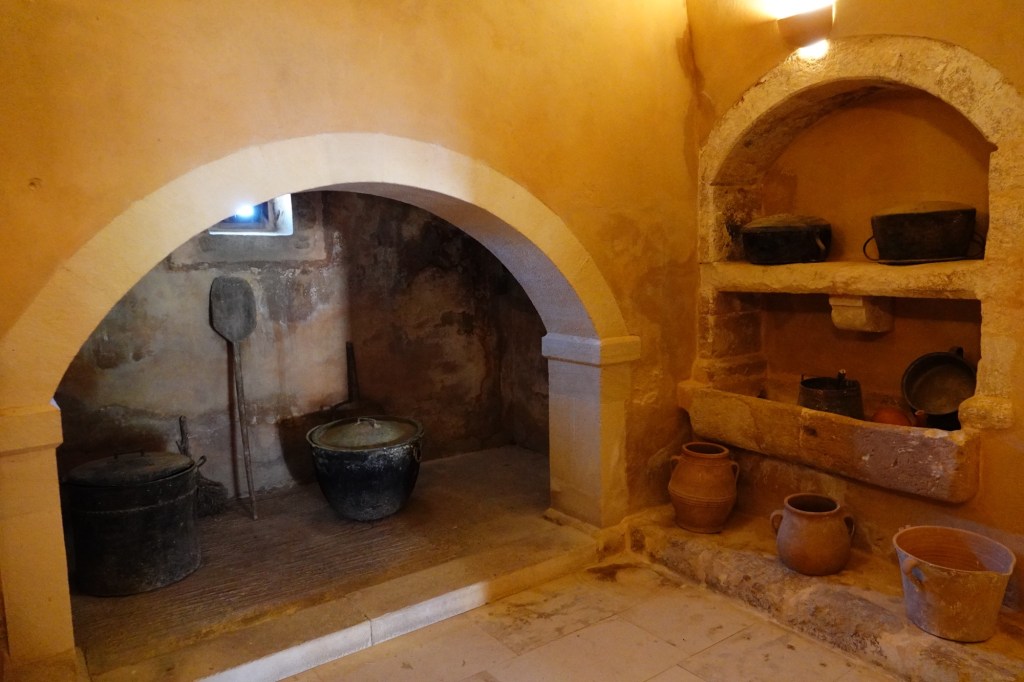
Near the refectory were the cellars: vaulted apartments that included rooms for kneading, baking, cooking, and storage. Pilgrims and passersby would have occupied these apartments when taking refuge with the monks.
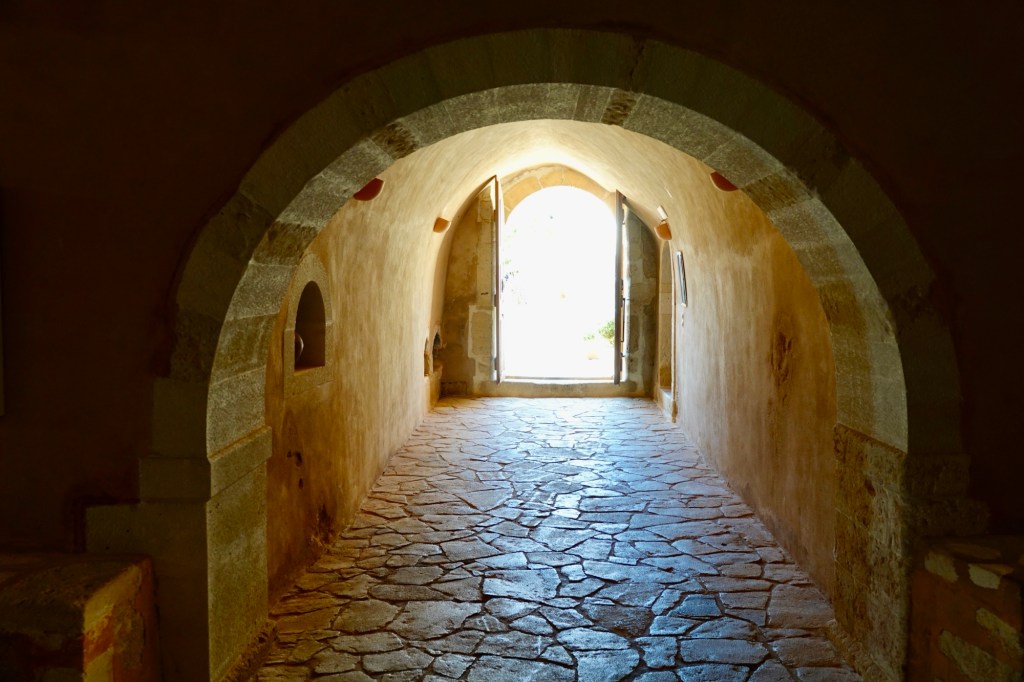
We proceeded through the east gate, which would have been used for both people and animals to gain access to the monastery’s fields.
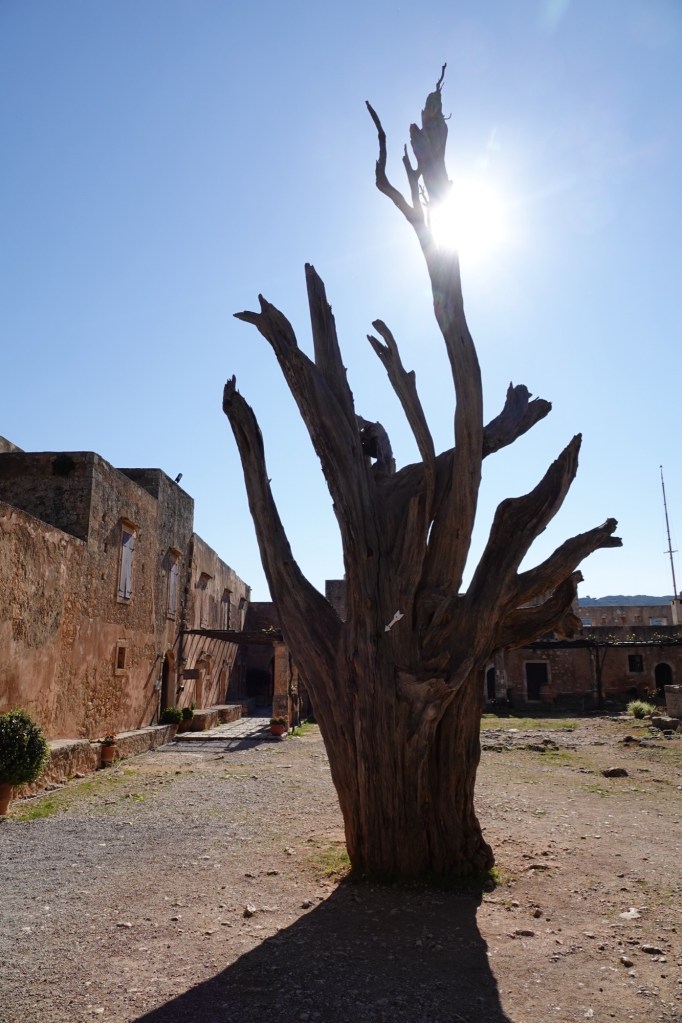
The cypress tree below has stood here since before the Turkish invasion. An Ottoman bullet is lodged in its trunk (marked with an arrow, I suppose to save visitors time)
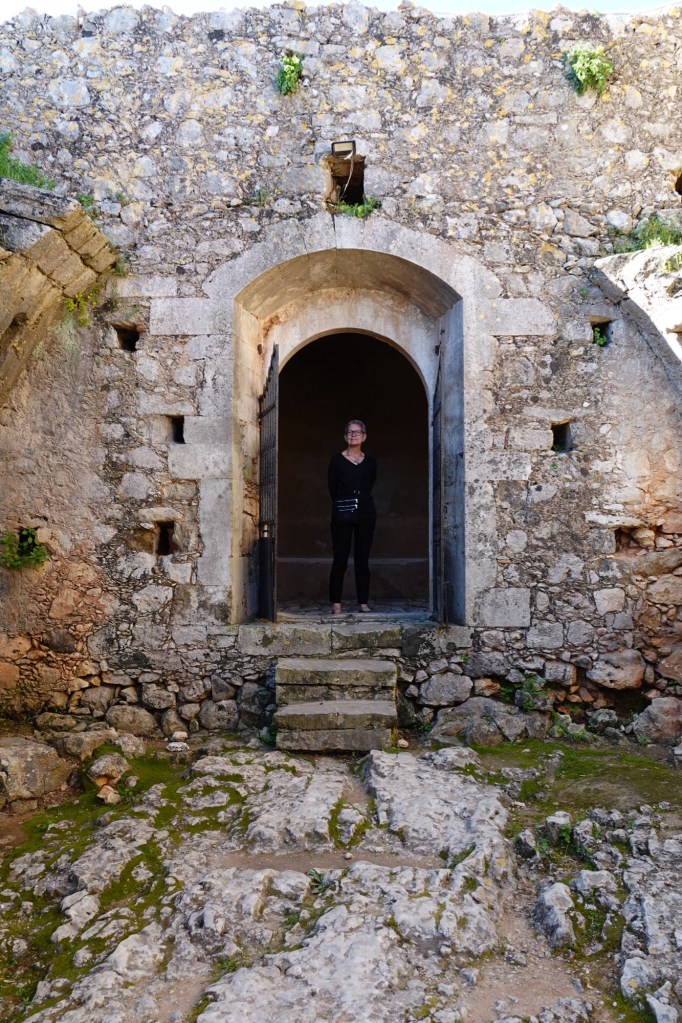
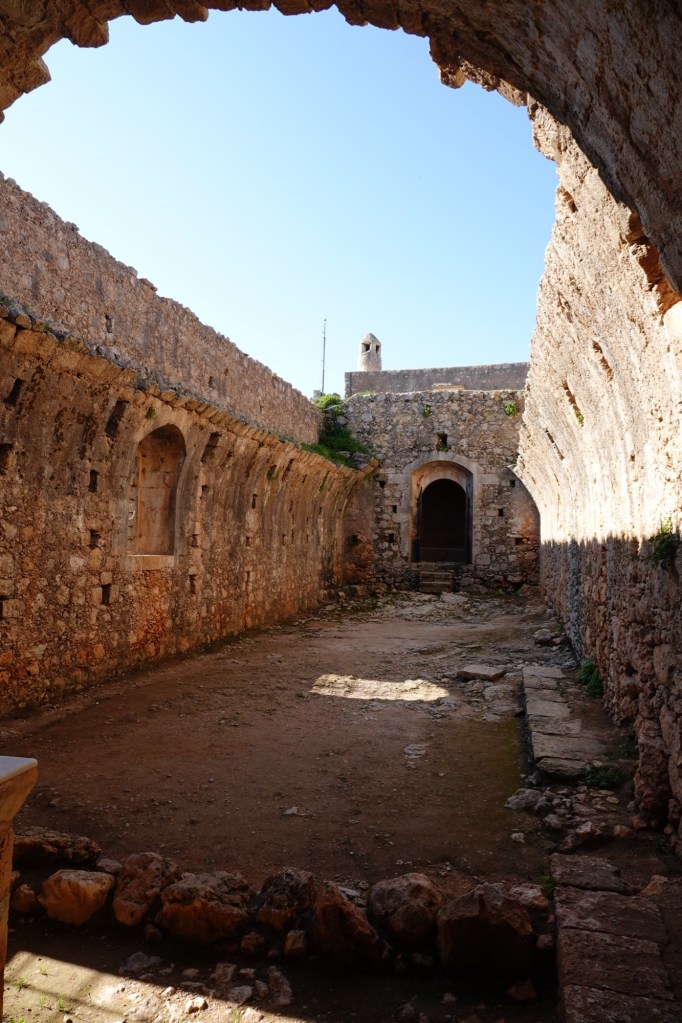
The space below was once a wine cellar, and later housed munitions to be used in the rebellion. On November 9, 1866, with an army of 15,000 Ottomans surrounding the monastery containing 964 Cretans (only 259 of whom were armed men), the defenders in the powder magazine ignited it, choosing to die rather than surrender. When in 1898 the Ottomans were eventually defeated, the monastery was elevated to a symbol of the human values of dignity and freedom and continues to be celebrated for its role in the rebellion.
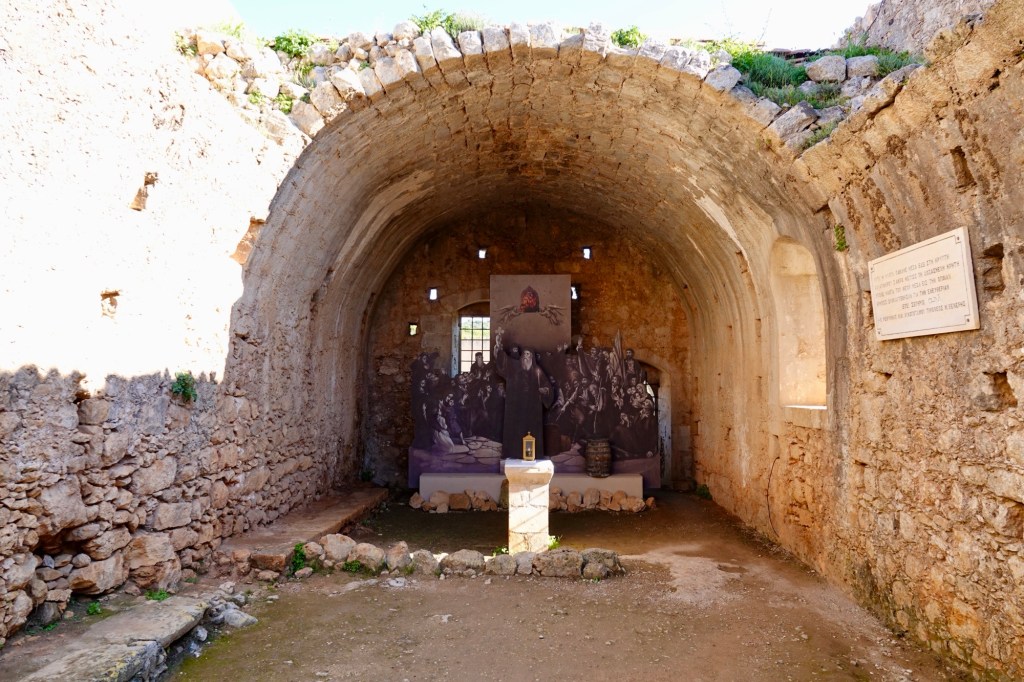
A shrine to the martyrs is located in the alcove at the far end.
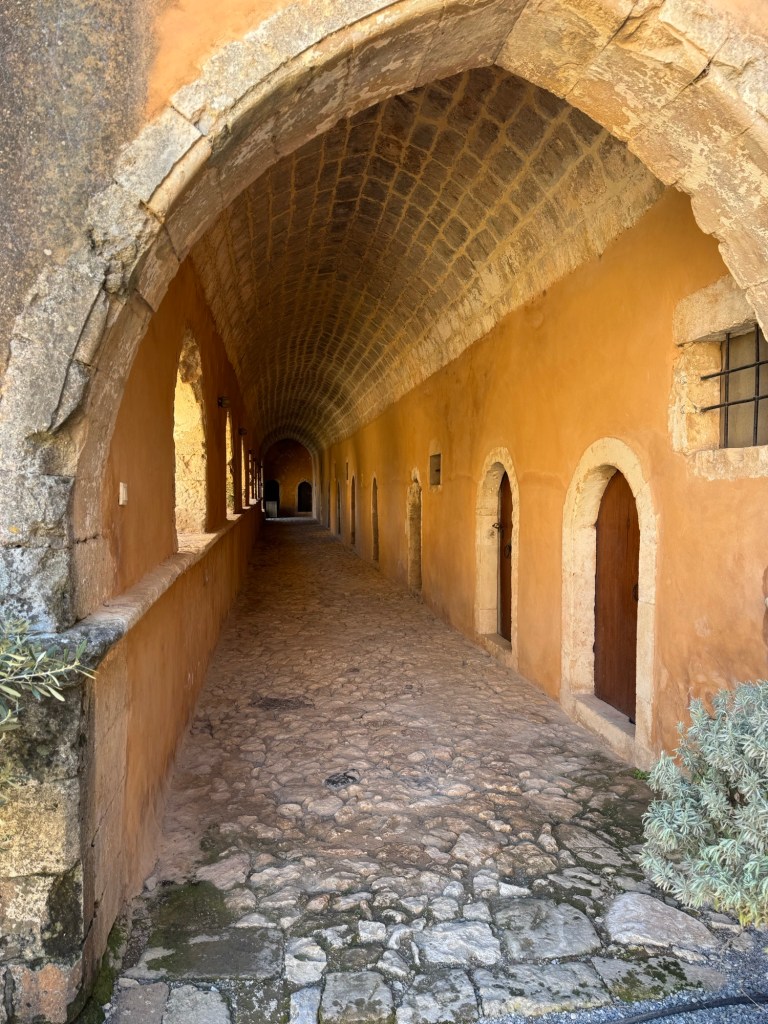
The south wing of the monastery has cells which were used as hospital rooms during the 1866 siege.
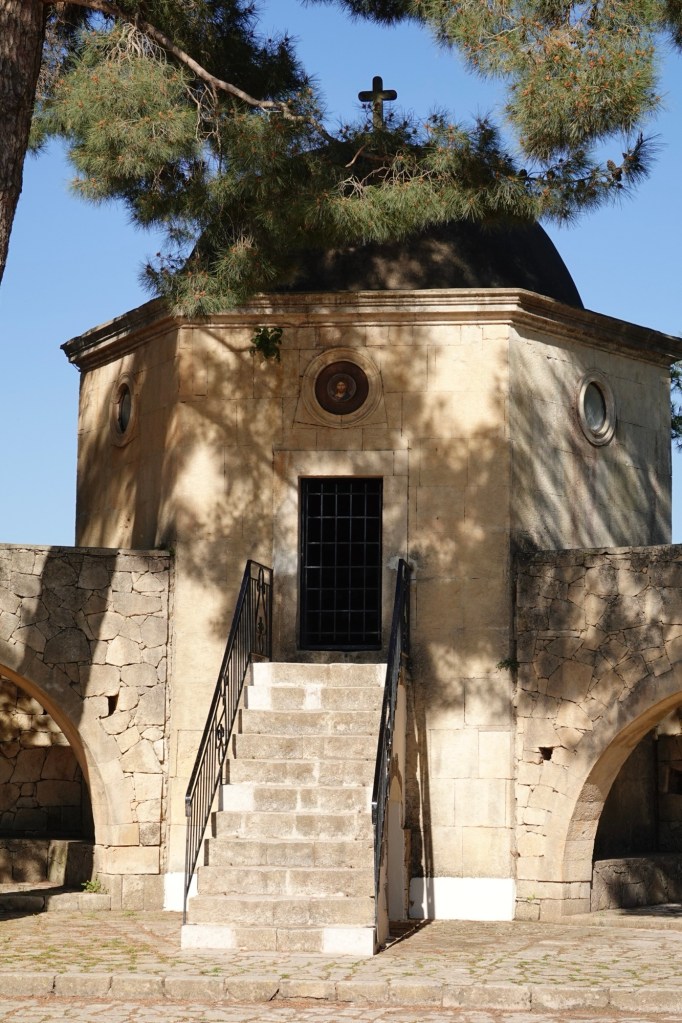
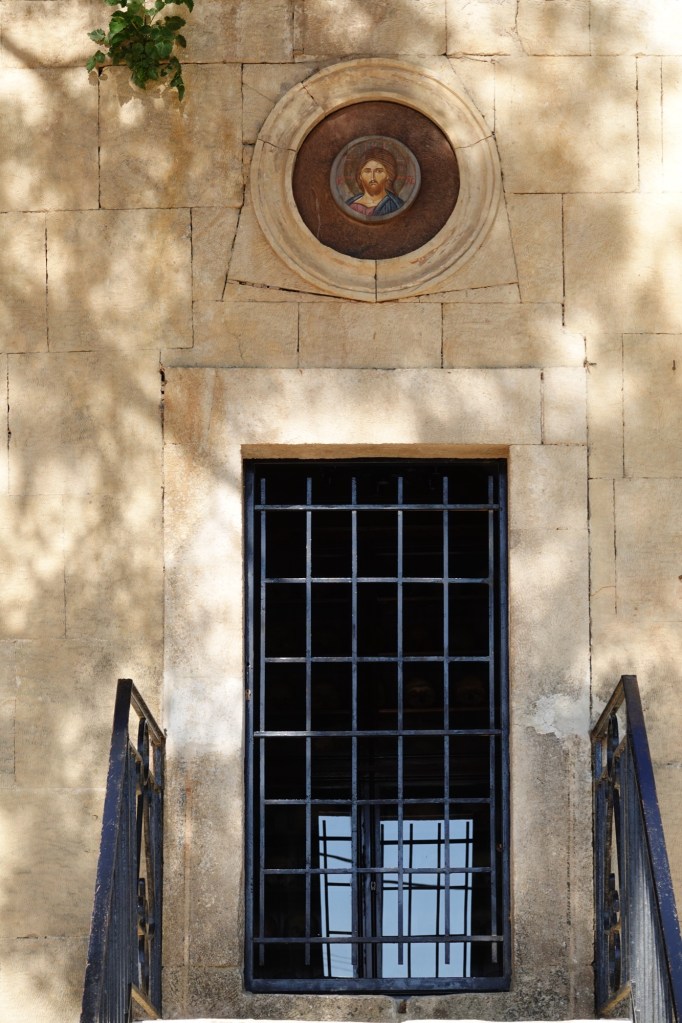
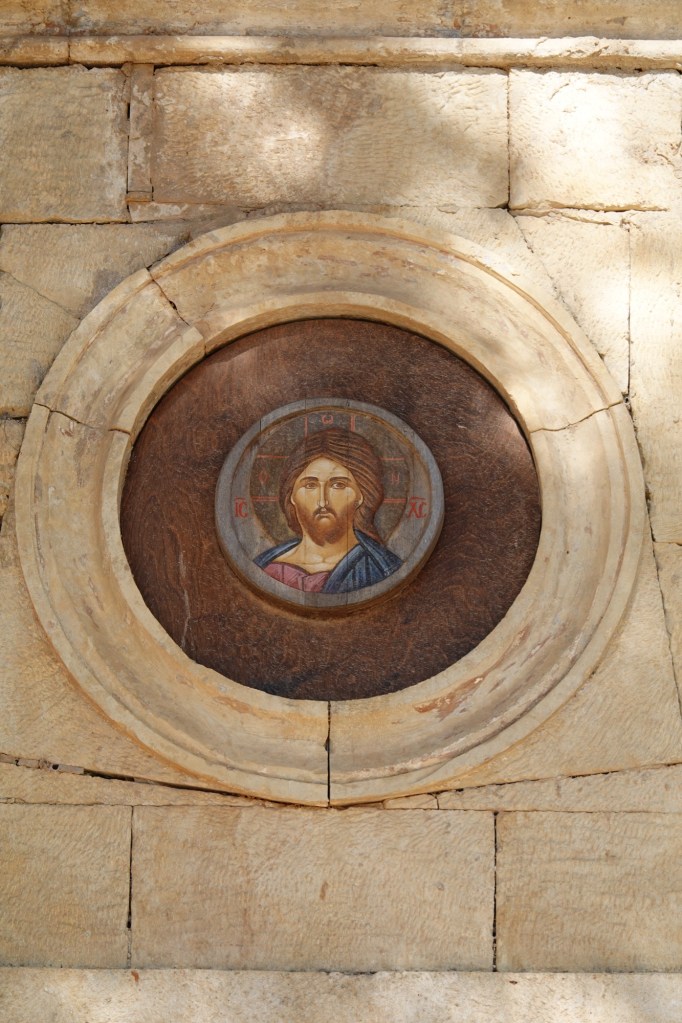
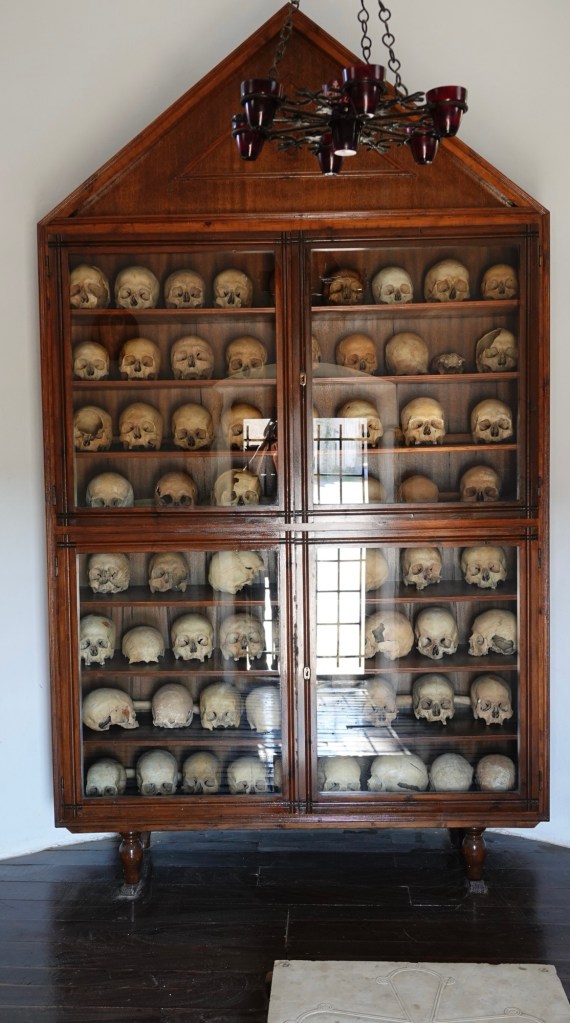
There was a museum within the monastery, but when we realized that it contained mainly icons, church utensils, and guns, we opted instead to peek into the old windmill, which was converted in 1910 into an ossuary housing the bones of the victims of the 1866 martyrdom. The signs at the site referred to it as a Holocaust, but I’d be loath to associate that term with this event.
That completed the biggest component of the history portion of our day. On to some geography.
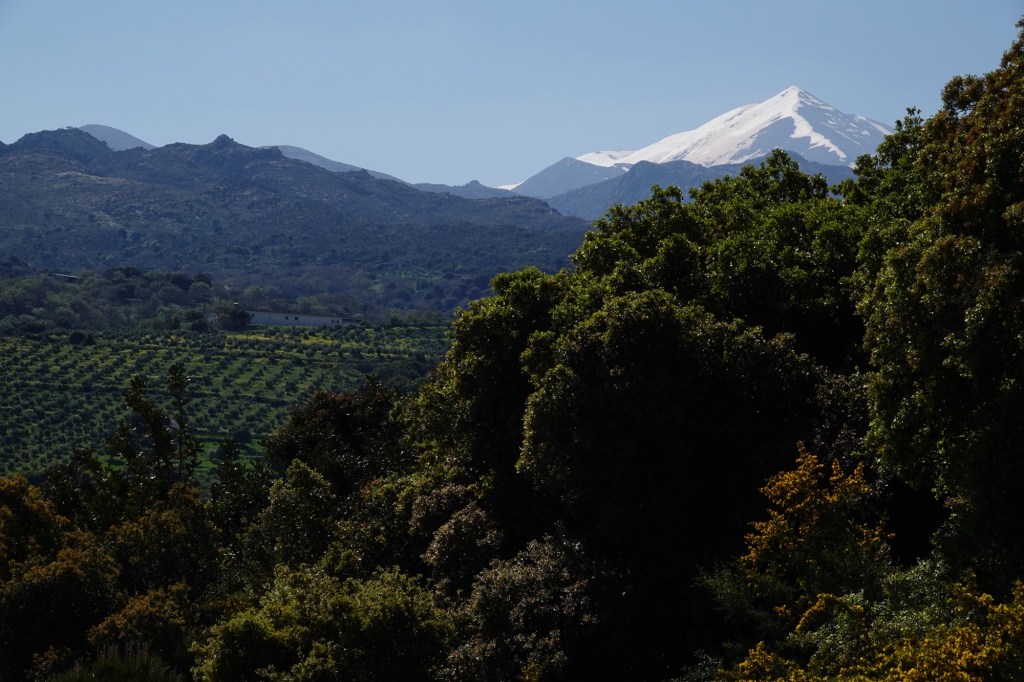
We were headed for several mountain villages, all either on the sides of Psilorotis or within sight of its peaks.
We stopped on a narrow roadside with a view of olive groves, vineyards, and steep gorges, to taste two kind of olives (brined and salted) and bread dipped in extra virgin olive oil with a squeeze of lemon.
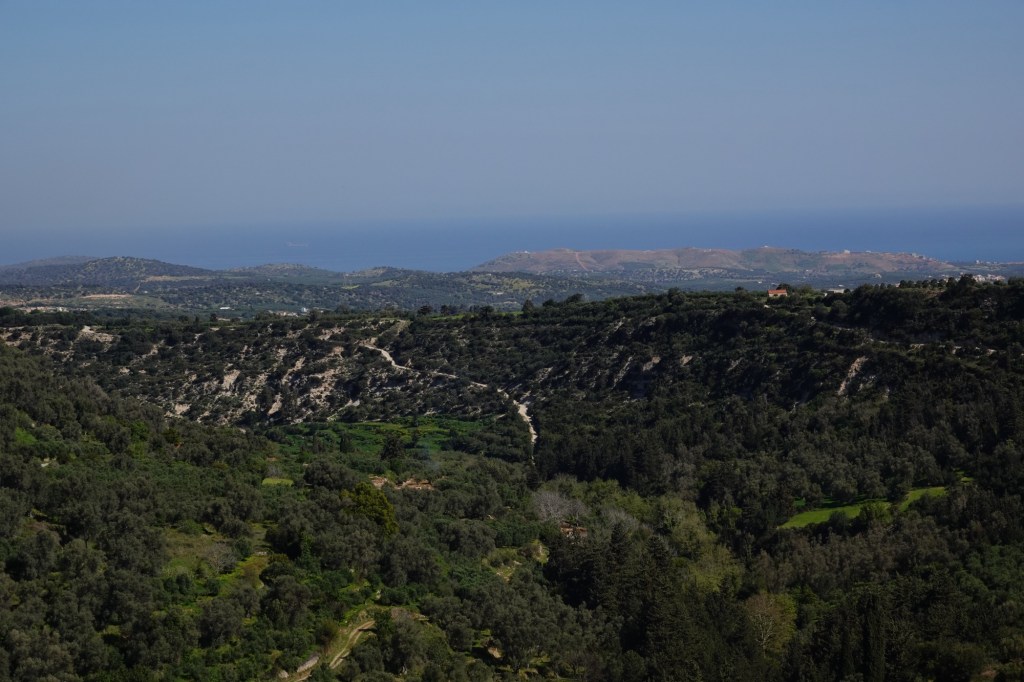
The olive oil and brined olives came from our tour guide/driver’s own orchards – the “competing” salted olives came from his assistant/trainee guide Alexandra.
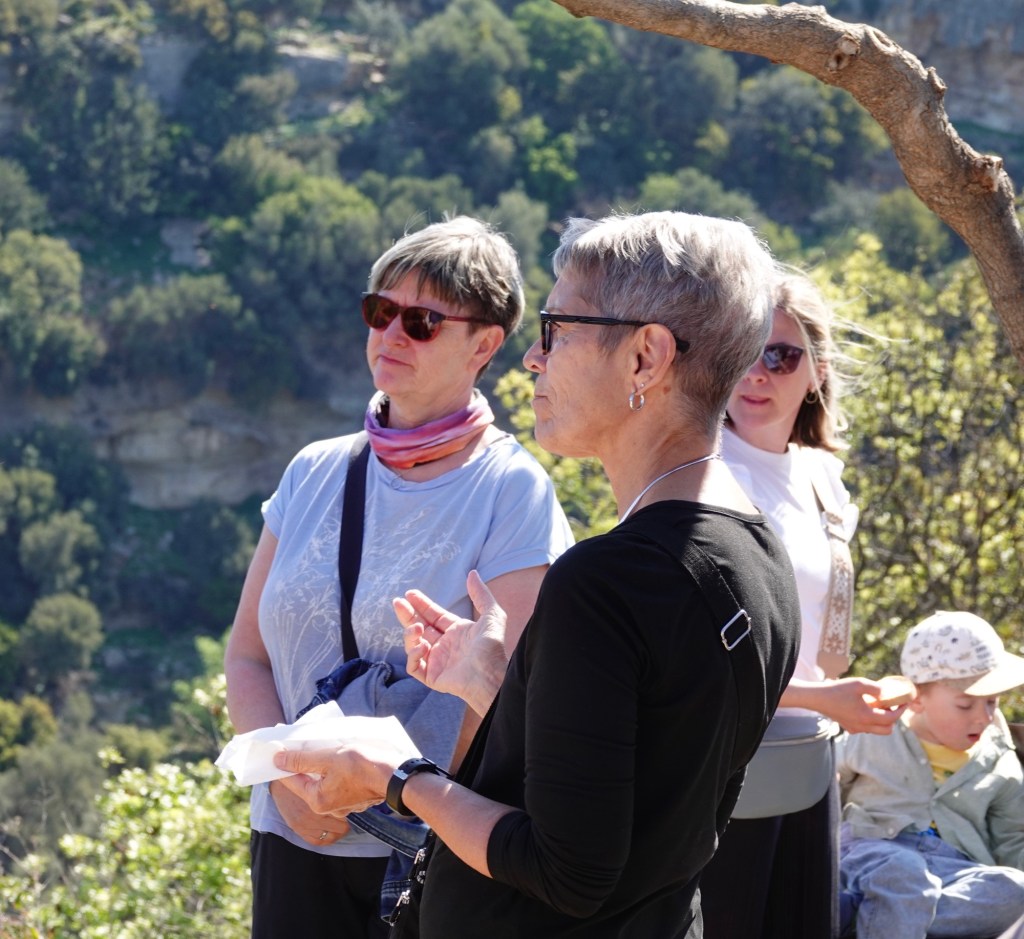
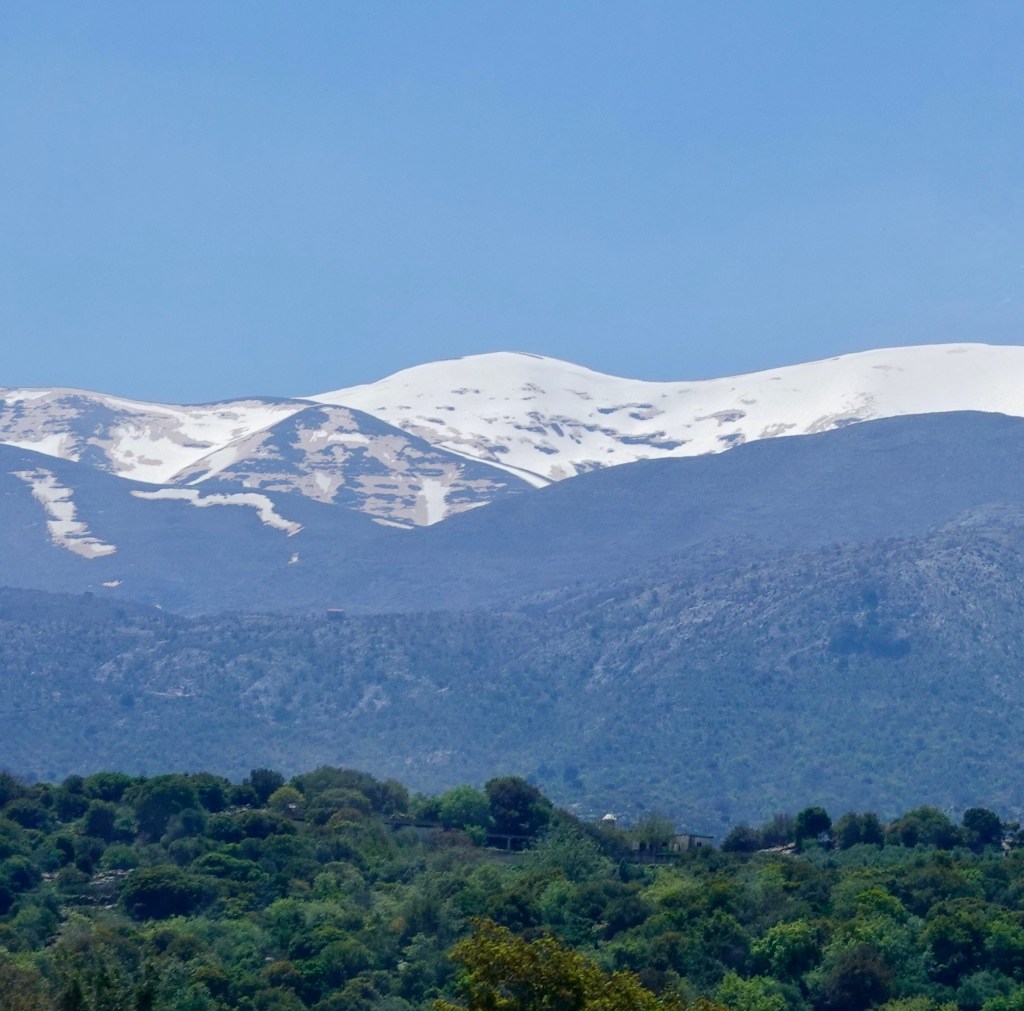
When we flew into Heraklion last week, we both thought that the mountain was covered in sand, and were surprised to learn that it was, in fact, snow. Today our confusion was explained: about two weeks ago a massive sandstorm in the Sahara dumped sand on Crete, including on its mountain peaks. That is why we thought the snow looked like sand. Today we got a close enough look to see both colours: white snow and pinkish Saharan sand.
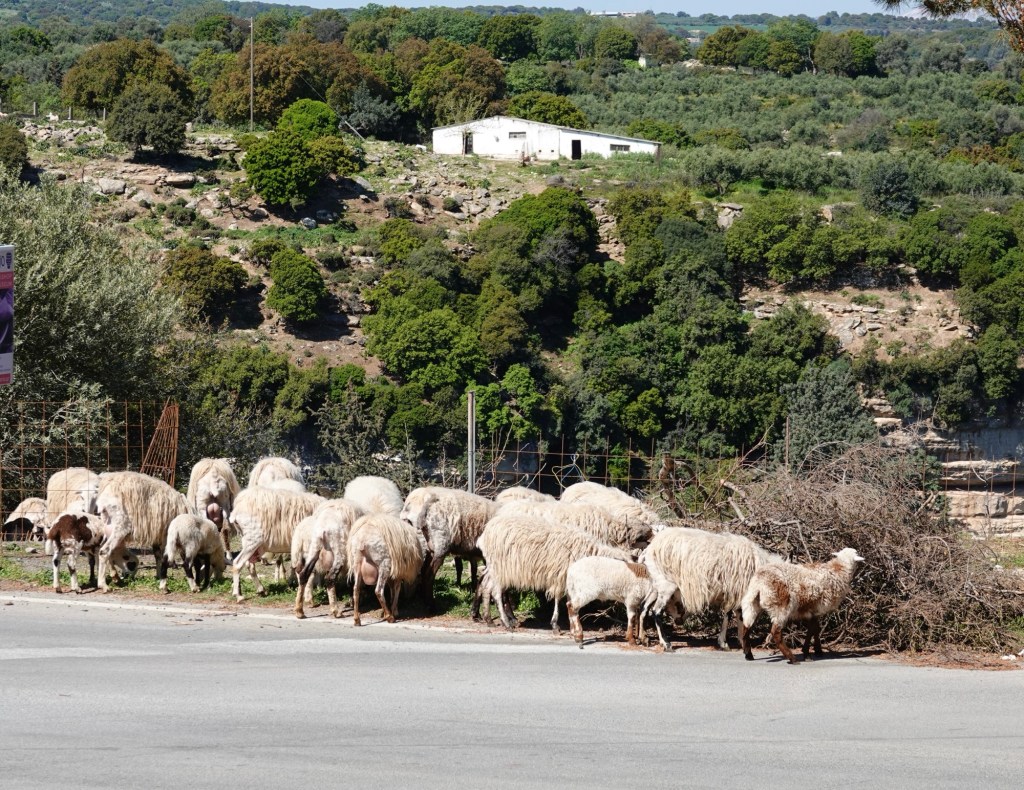
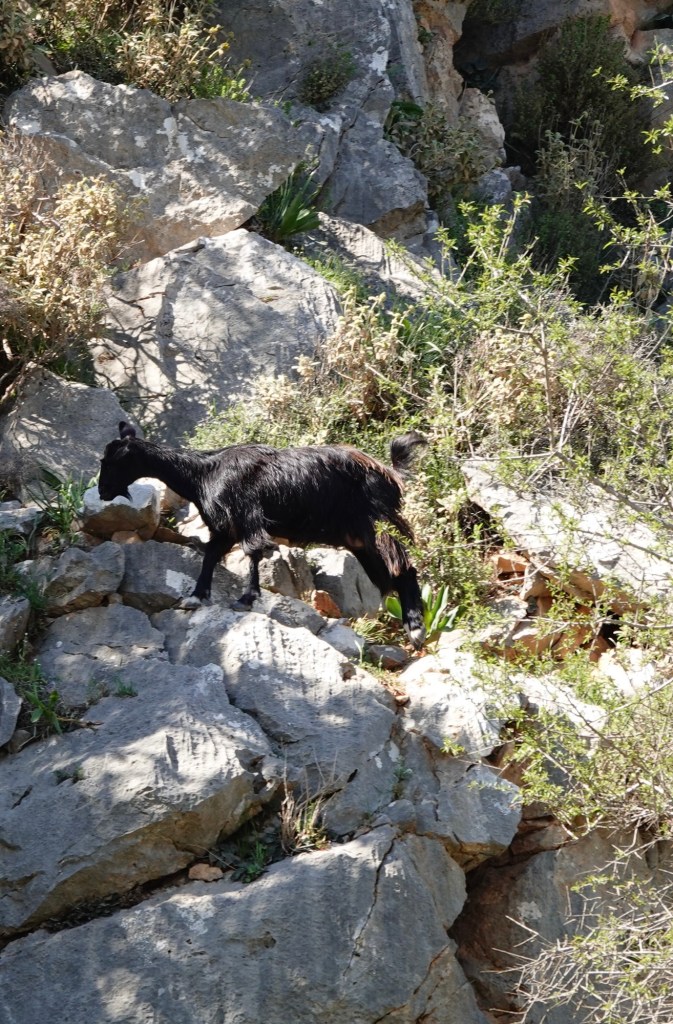
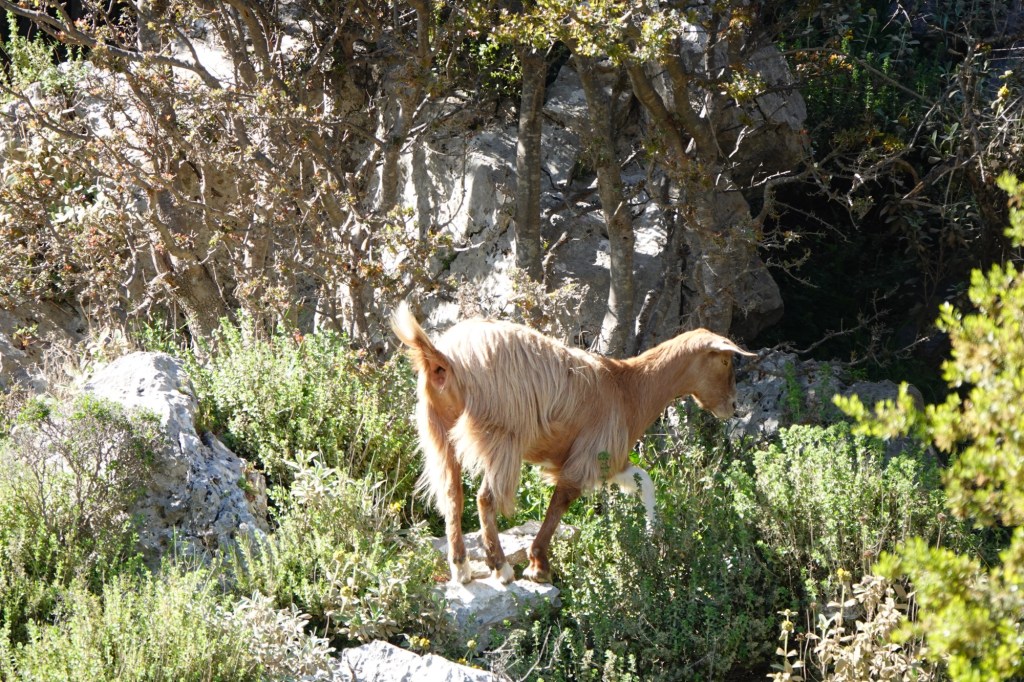
Sheep!! We learned that on Crete the sheep and goats (the former all belled) simply wander freely – no shepherding, no dogs. They simple “choose” to return home each evening for corn, and that’s when they are milked. There are no cattle on Crete. Cheeses are made from sheep or goats’ milk, and very little beef (or meat for that matter) is included in the local diet.
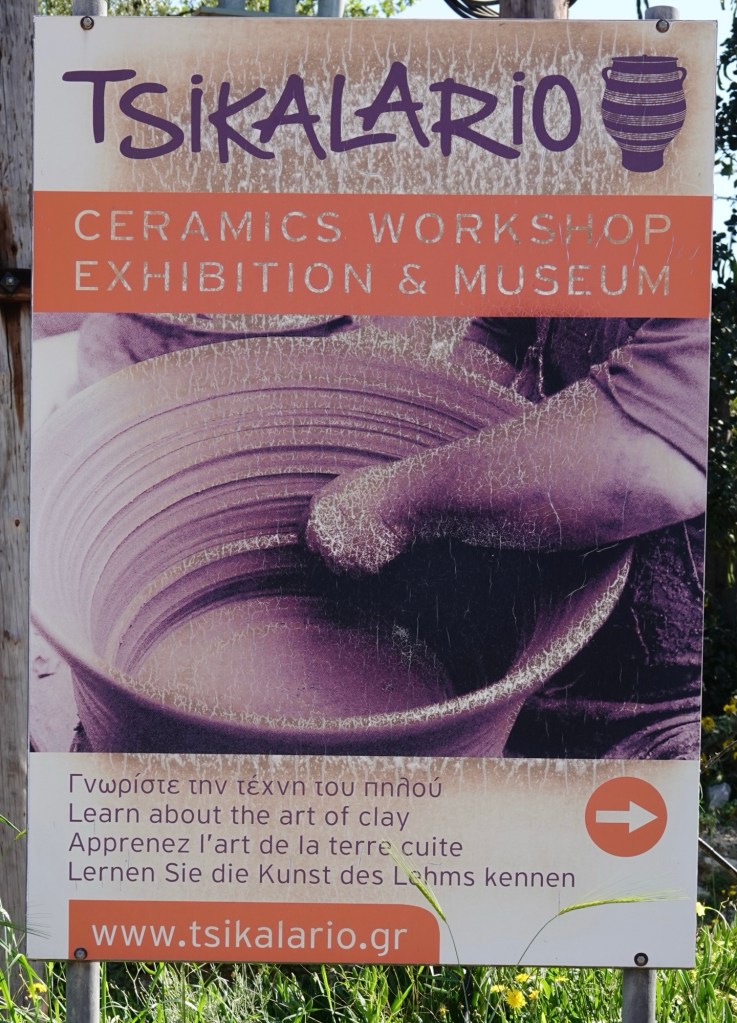
Our next stop switched our focus from geography and agriculture to handicrafts, at a traditional pottery workshop just outside the mountain village of Margarites.
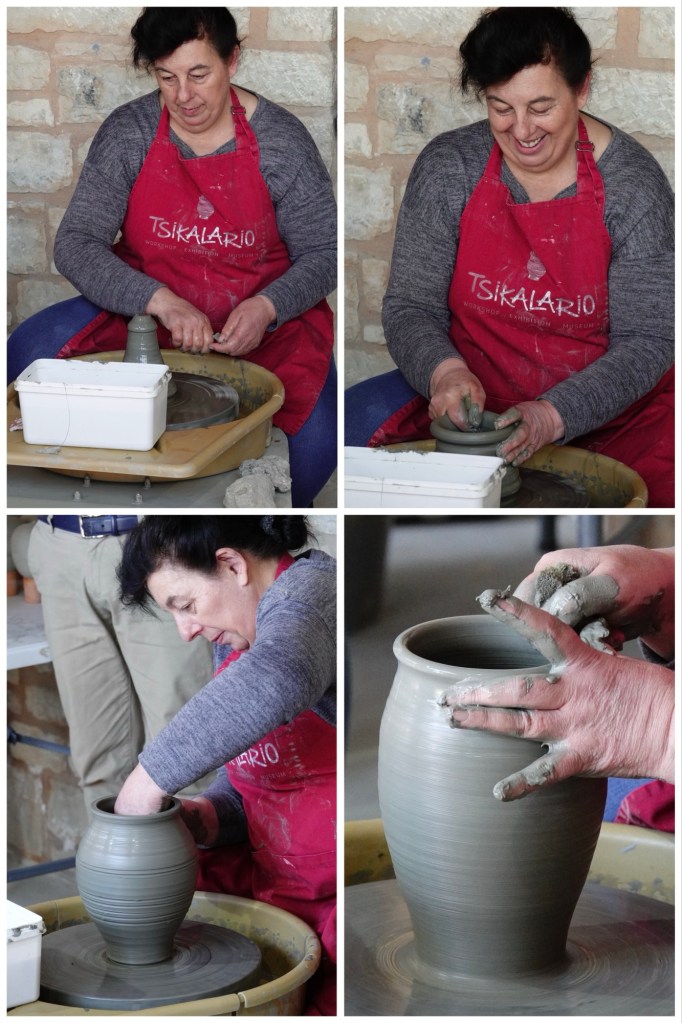
The potter, using raw clay from the mountain plus a bit of water, threw a pot for us on a wheel driven electrically.
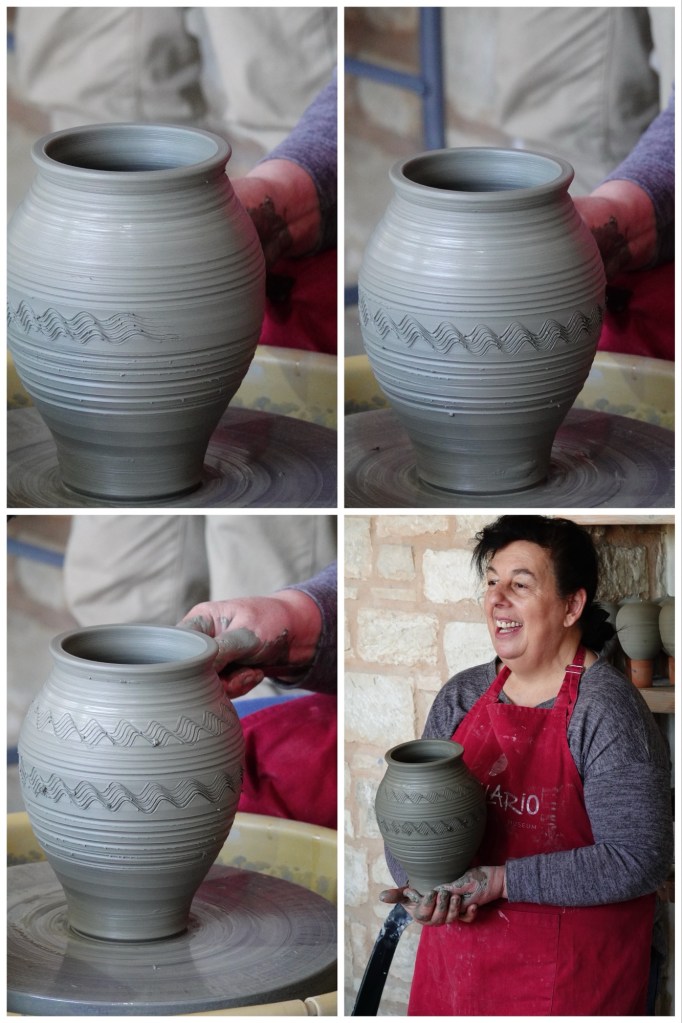
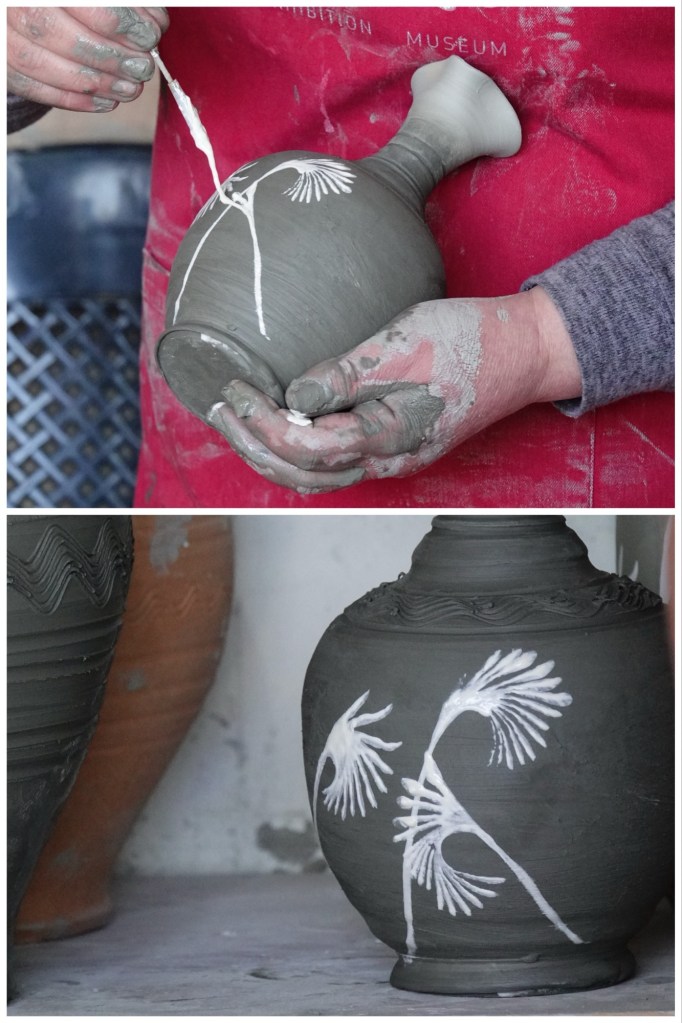
She also demonstrated creating the signature design that identifies the pottery as authentic to Margarites. The flowery pattern is painted on with white clay using a piece of untreated sheep’s wool.
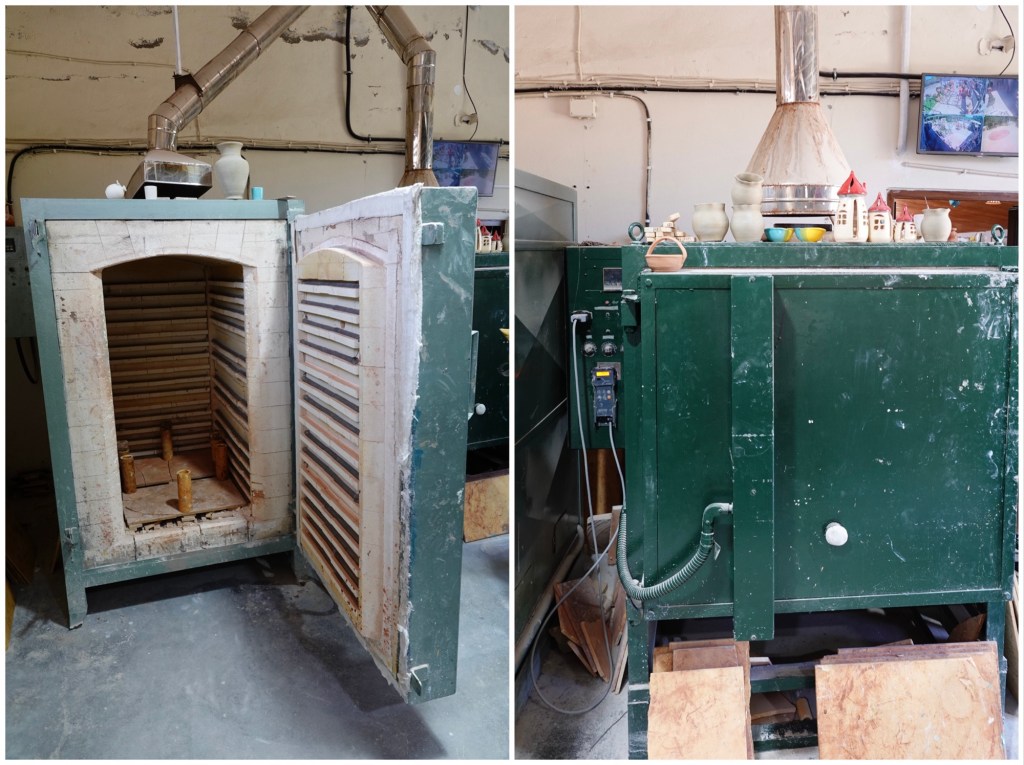
She then took us to her kiln room where she showed us her two modern kilns, one gas-fired and one electric, both of which reach the required maximum 1300°C.
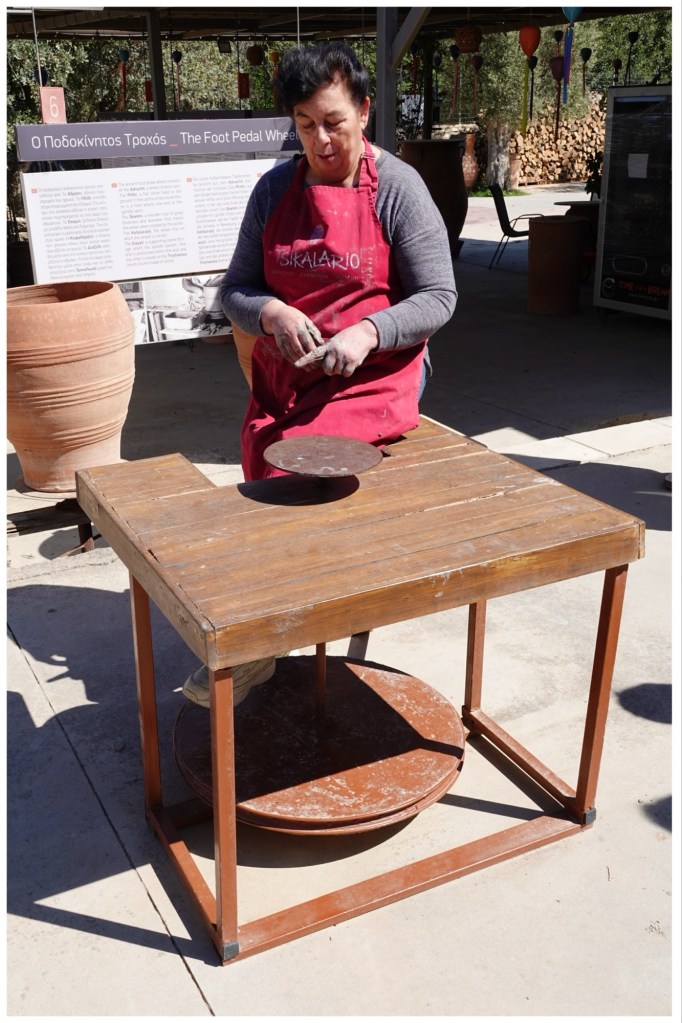
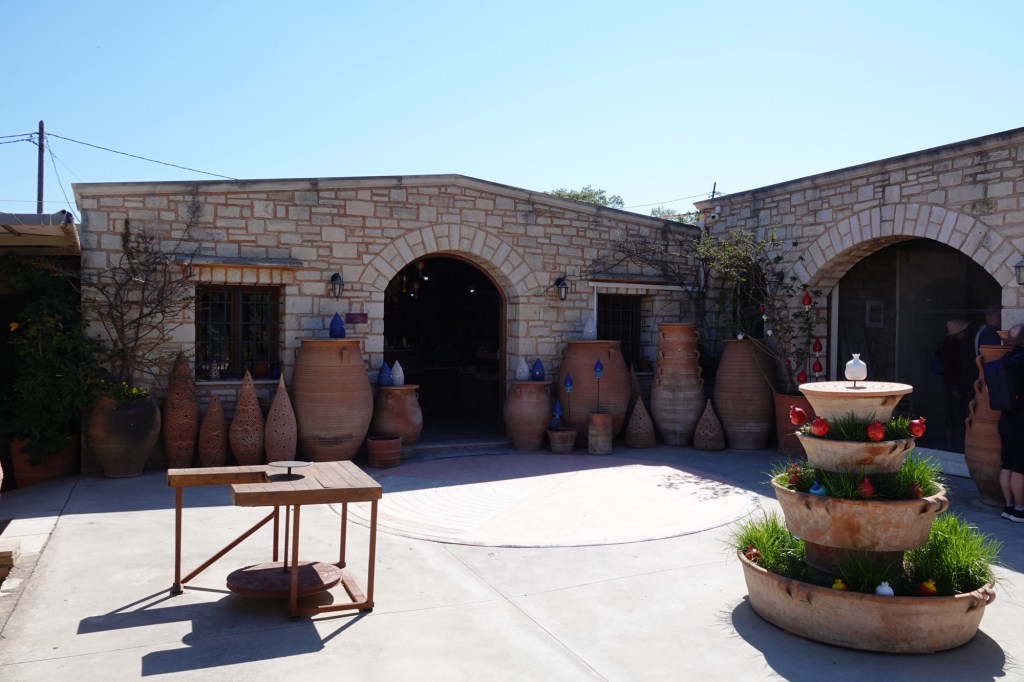
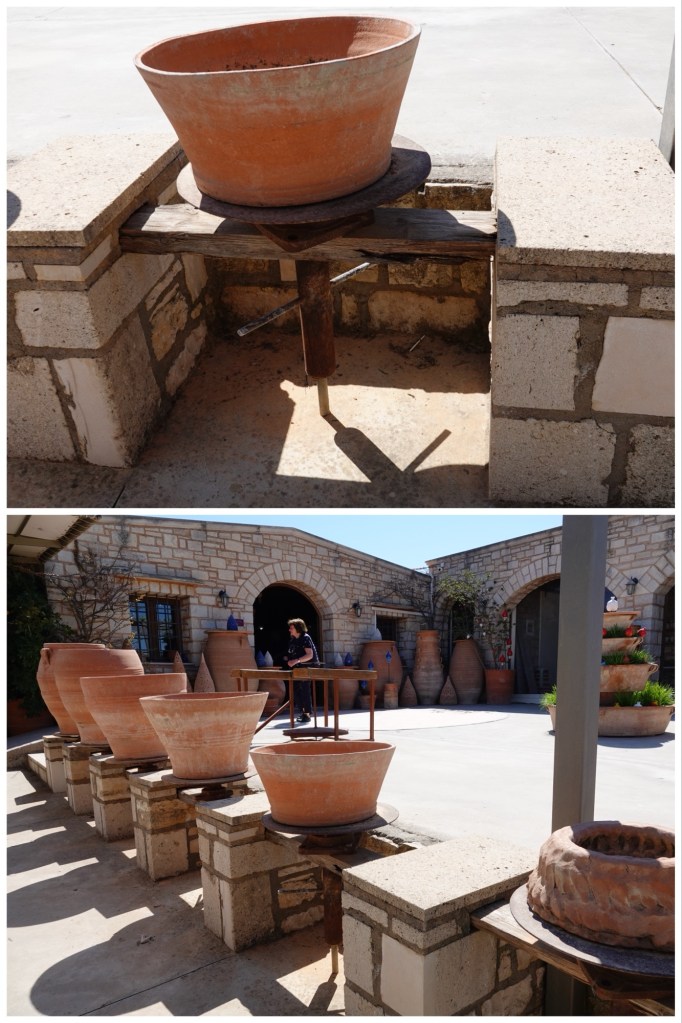
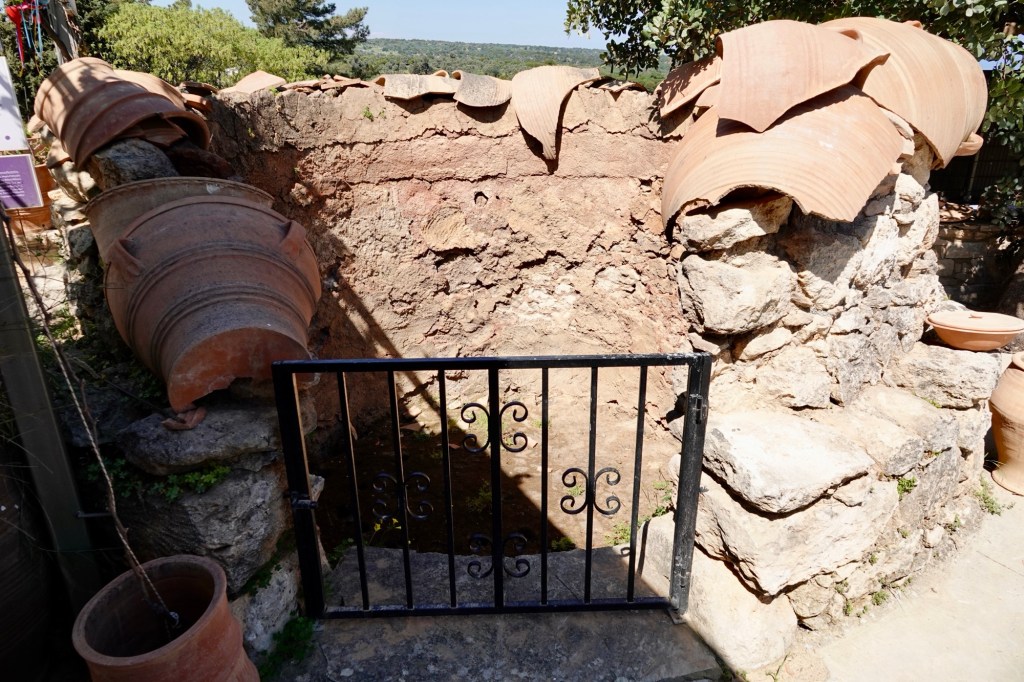
Once we’d seen Eleni’s modern tools, she showed us her old foot-pedal potter’s wheel for throwing small pots, and the two-person (a potter and a turner) versions used to make large jars.
She also showed us her father’s original wood-burning kiln. Interestingly, it had no temperature gauge. Once the wood was burning hot, and the greenware placed inside, the opening was covered with large pieces of broken pottery. During the first stage of firing, black smoke would come out of small vents on the kiln, then grey, then white, and then after 12-18 hours (not an exact science) flames instead of smoke. The flames signified time to extinguish the fire and gradually remove the lid to begin cooling the pieces.
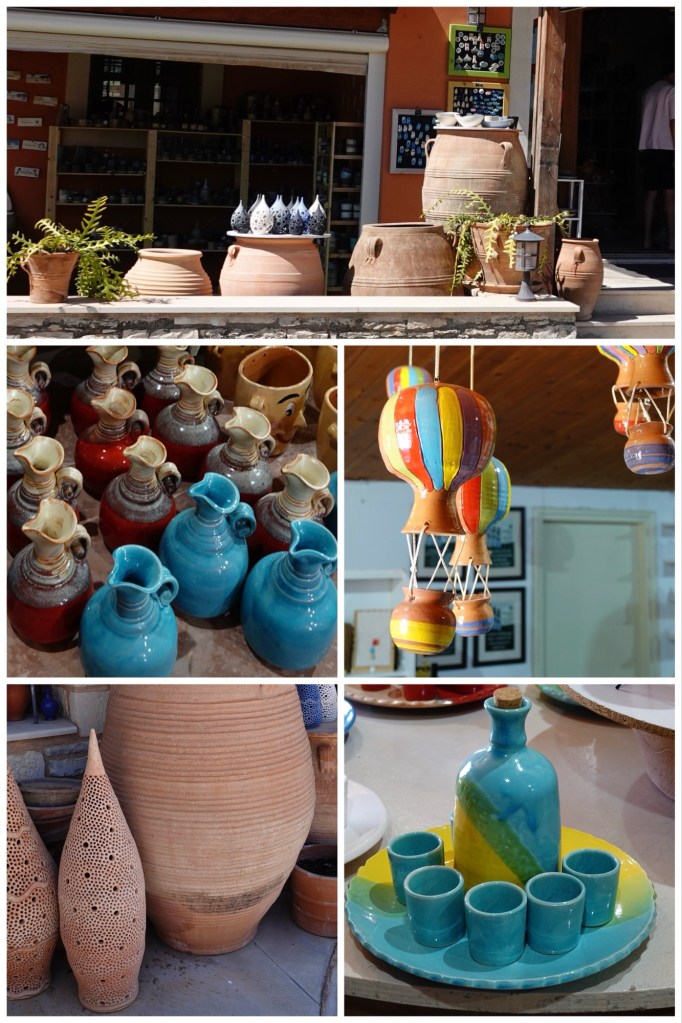
Eleni’s final pieces are mostly utilitarian, although often in bright whimsical colours.
Time for coffee, so time for Spiro to navigate more mountain roads with their hairpin turns, and more village roads where the width of the bus cleared house fronts on either side of the road by mere inches. In one of the villages a particular shop owner on a particularly tight corner intentionally sets his pottery flowerpot at the road’s edge as a challenge. Spiro won – this time.
We were let off the bus at the entrance to Margarites’ “downtown” so that Spiros could find a suitable route to the other end of the business section to meet us after our break.
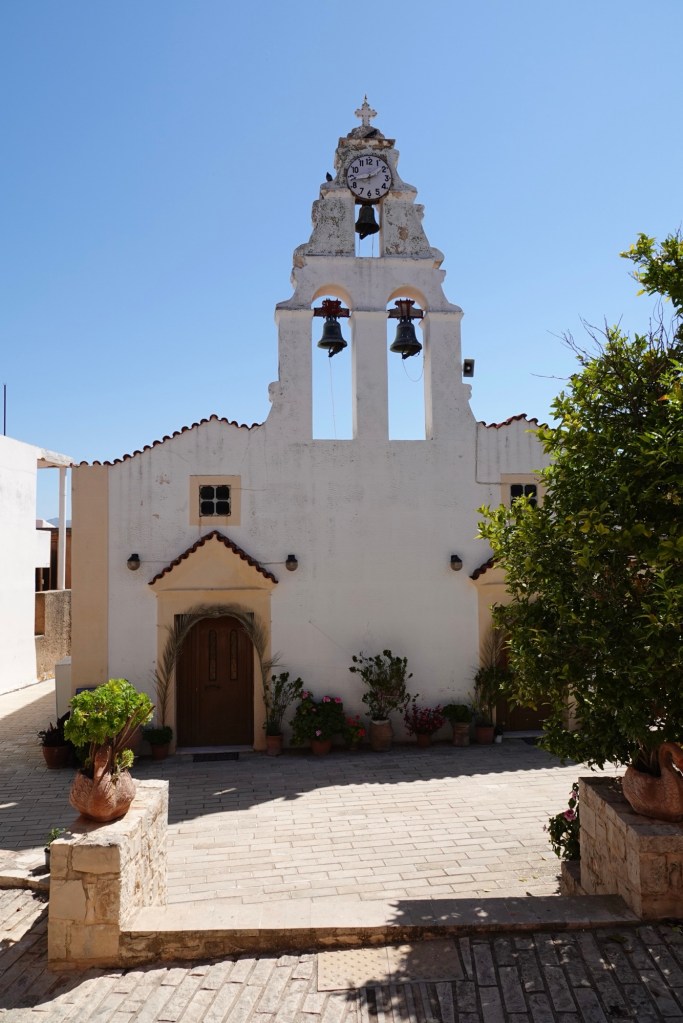
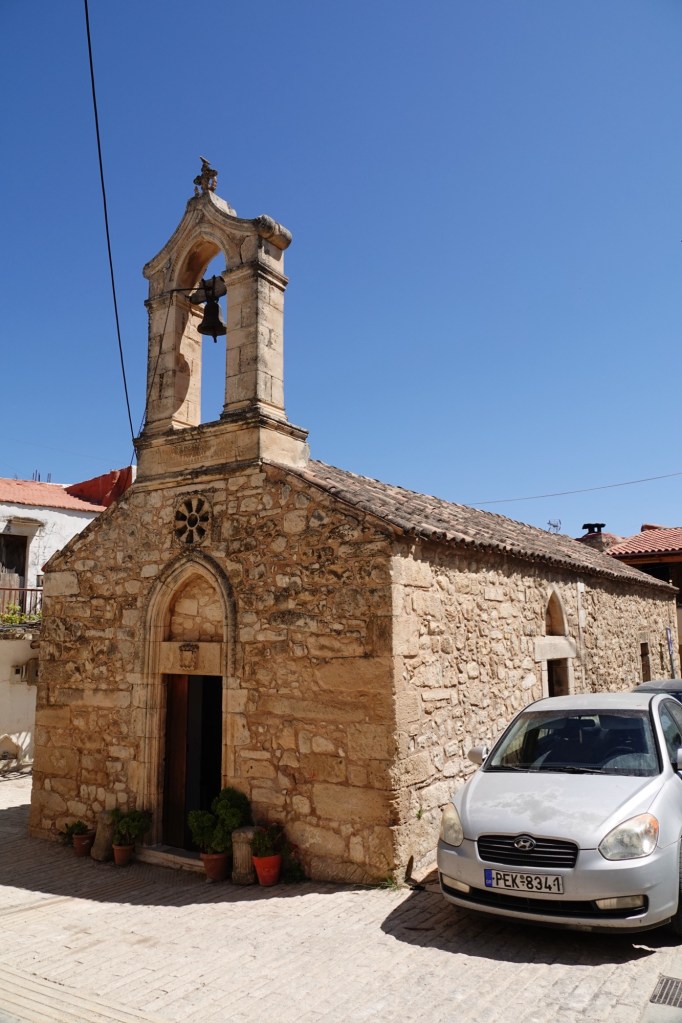
We stretched our legs a bit, peeking into the two tiny local churches before finding an outdoor café for cold water and hot thick Greek coffees.
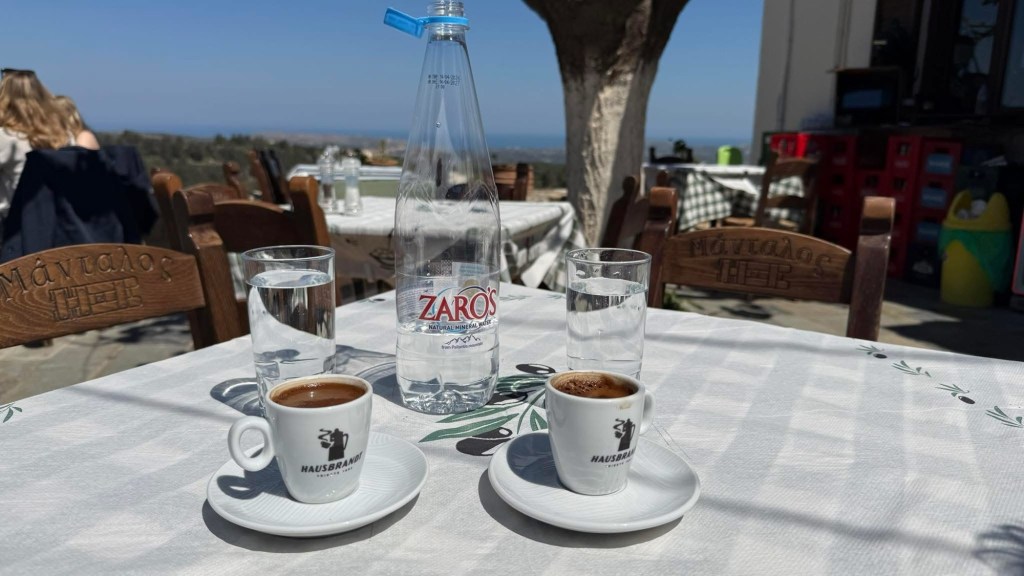
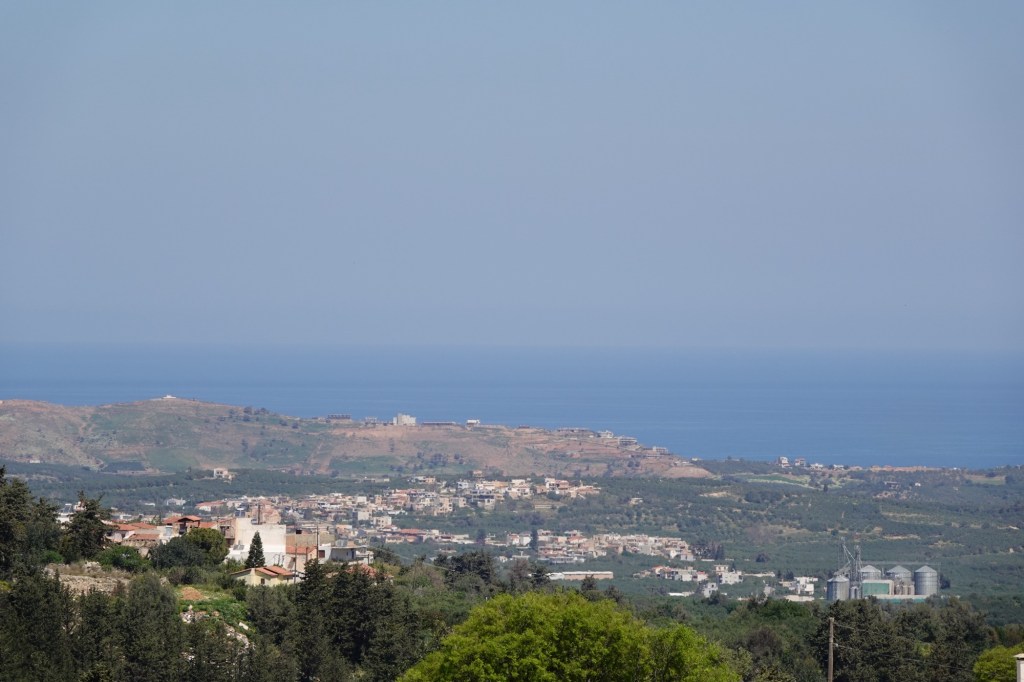
What a view from the café!
Up next: wine.
In the teeny tiny mountain village of Veni, the Barozzi family (that’s a Venetian name that has been on Crete for centuries) has been making wine for three generations.
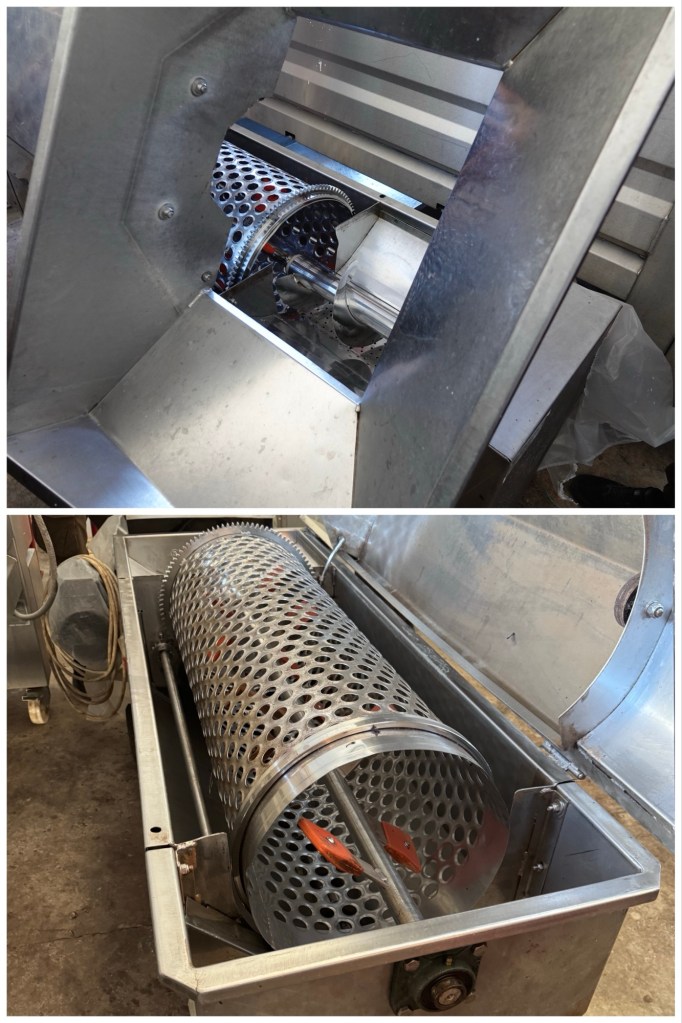
We were shown the modern de-stemming and crushing machine that Dimitri joked had replaced his father’s feet.
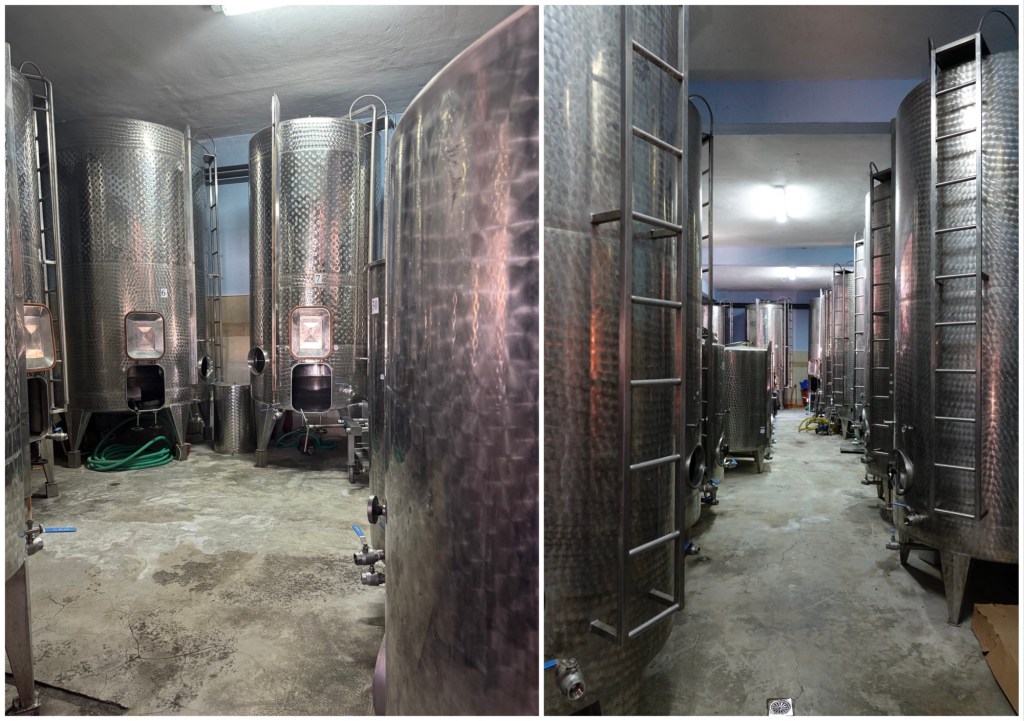
We toured the small fermenting area with its double-walled steel barrels that ensure consistent temperature.
Then it was on to sampling.
They currently make a semi-dry white which we tried and enjoyed, a blended red which we did not try, and a delicious Liastos sun-dried red wine that tasted almost like Ontario ice wine. Even though we’re only here another 4 days, once we’d tasted it we couldn’t resist buying a bottle.
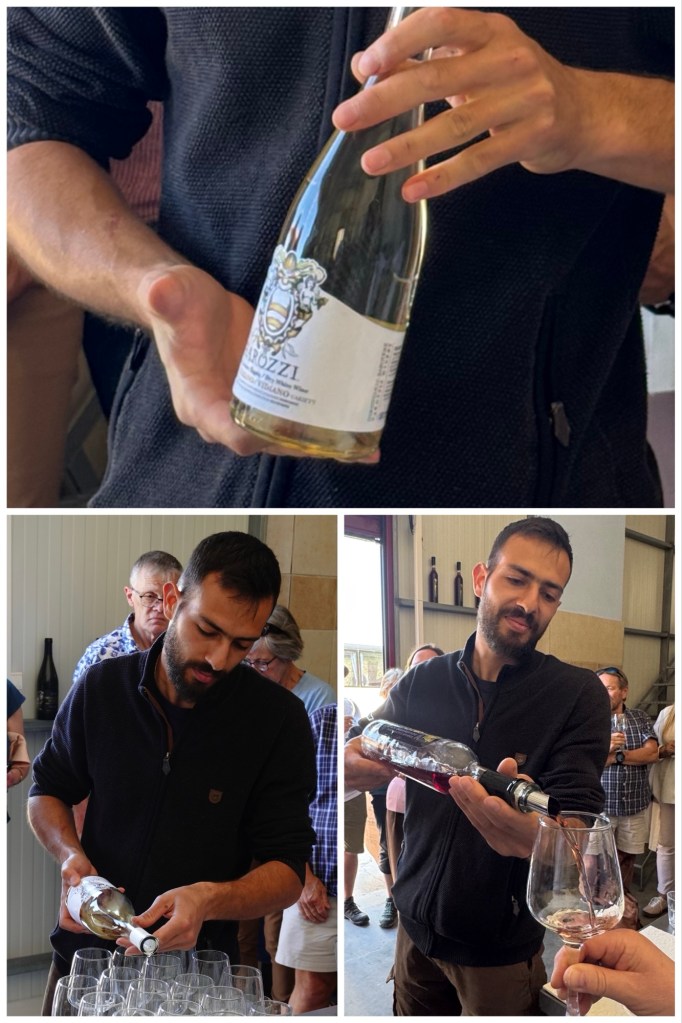
We’d had drinks, so obviously it was time for food and Cretan cultire.
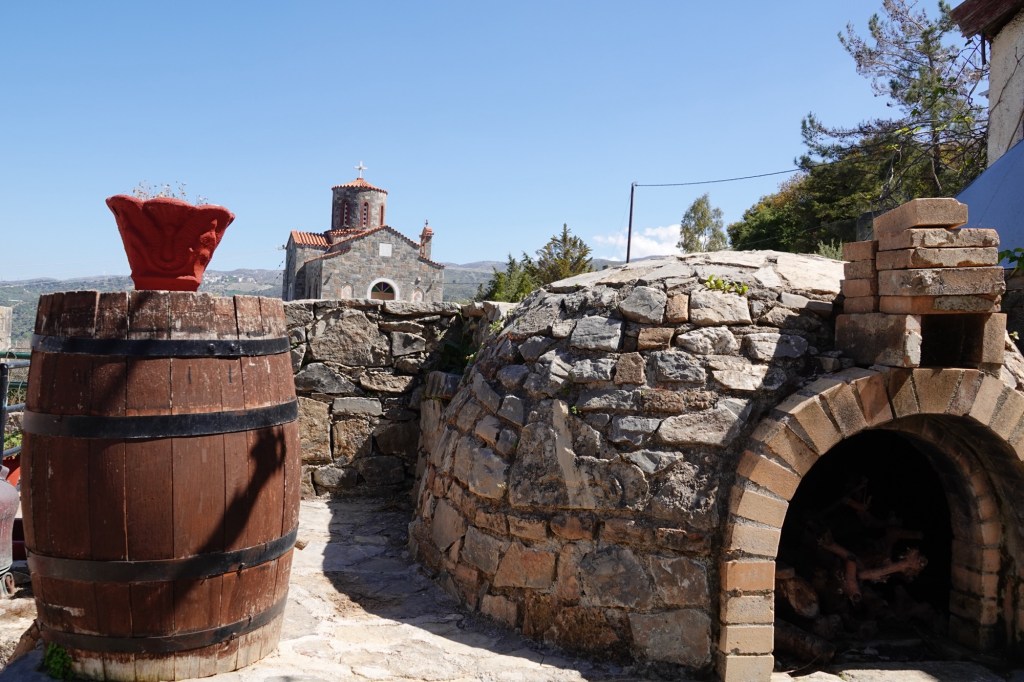
For that, we headed to Axos, a mountain village of just under 400 people, most of whom live in Venetian era buildings dating to the 15th century (modernized, of course). Today’s Axos is on the same hillside as a Minoan settlement that existed as early as 4000 BCE, became a city-state during the classical period, and then an important religious site during the Roman and Byzantine eras.
Our destination, via more twisting narrow roads, was Axos Restaurant, where we were treated to a wonderful €10 lunch of Greek salad, tzatziki, bread, and oven-roasted chicken and potatoes with lemon and olive oil.
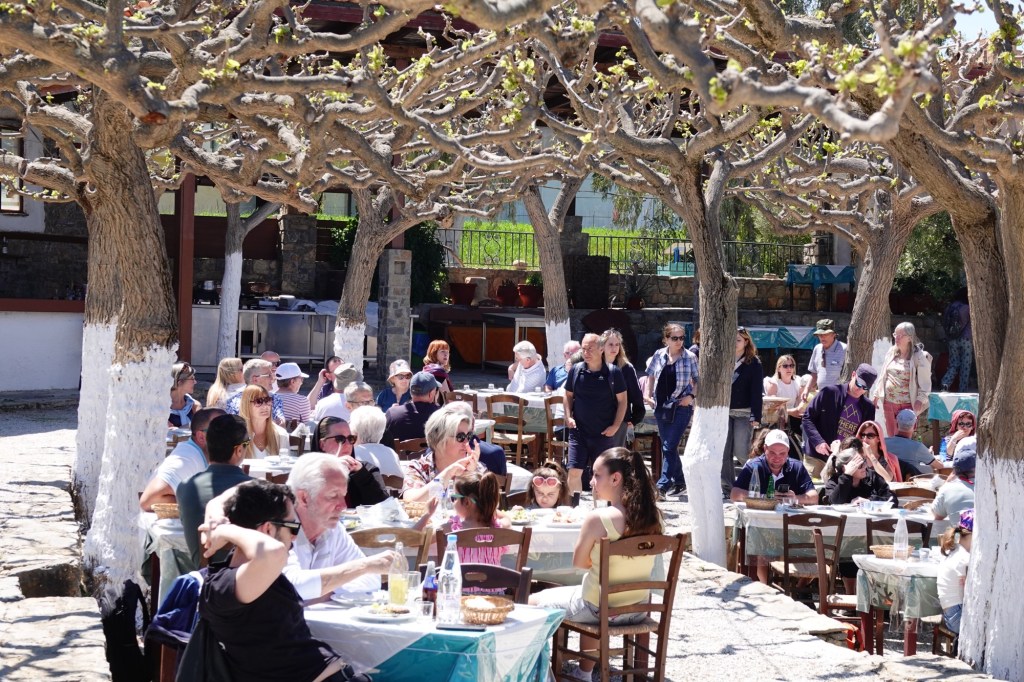
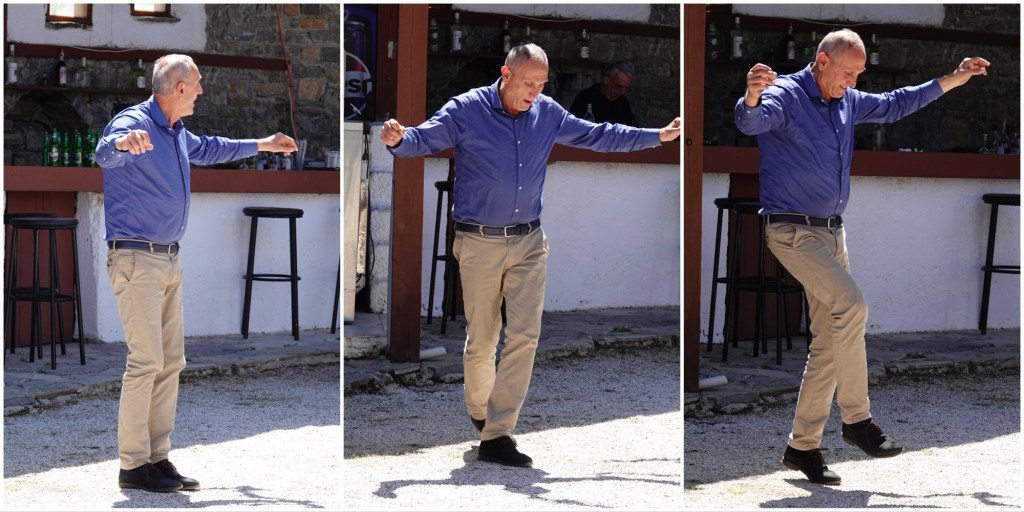
After lunch, Spiro fired up the theme music from Zorba the Greek and demonstrated – slowly at first and then very fast – how he expected us to dance “to help with digestion”. A few brave souls tried – and succeeded admirably. I did the accompanying wrist flexing and finger snapping.
Before leaving the restaurant, the owner George made some fresh cheese (just whole sheep’s milk, boiled, curdled with vinegar) and a simple flour/water/olive oil/raki (for flakiness) dough, and fried stuffed cheese pockets for us. Drizzled with his own thyme honey and sprinkled with sesame seeds they were heavenly.
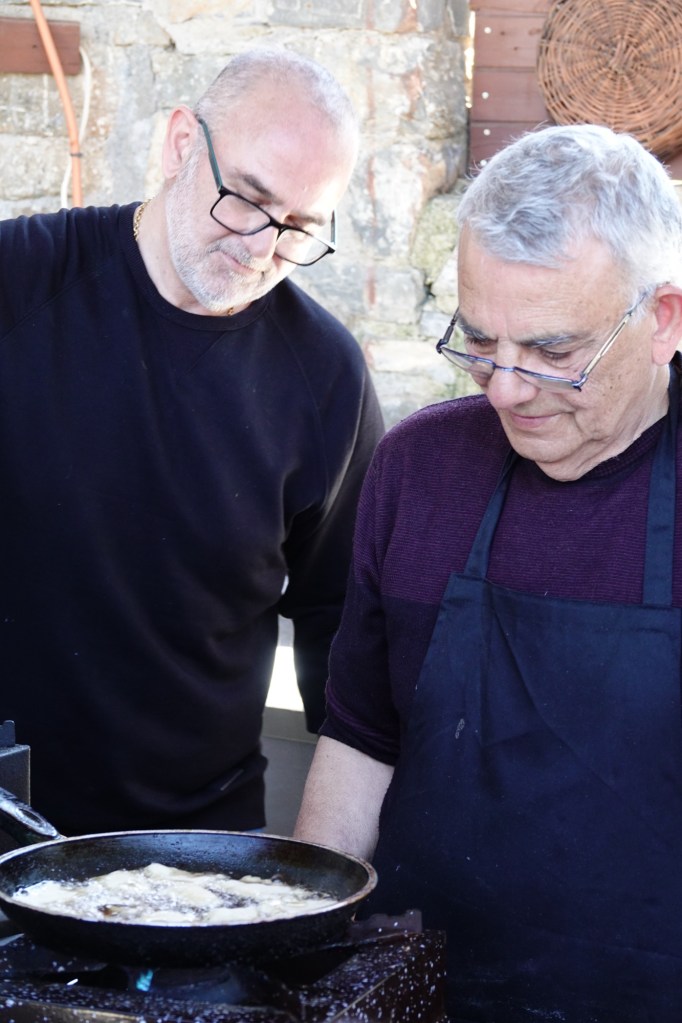
I was busy eating, and Ted was trying unsuccessfully to get a picture of one of the mountains’ white-winged vultures, so there are no pictures of the crispy golden finished product.
We were also treated to a shot of honeyed raki, which was much milder than the unflavoured versions we’ve been experiencing.
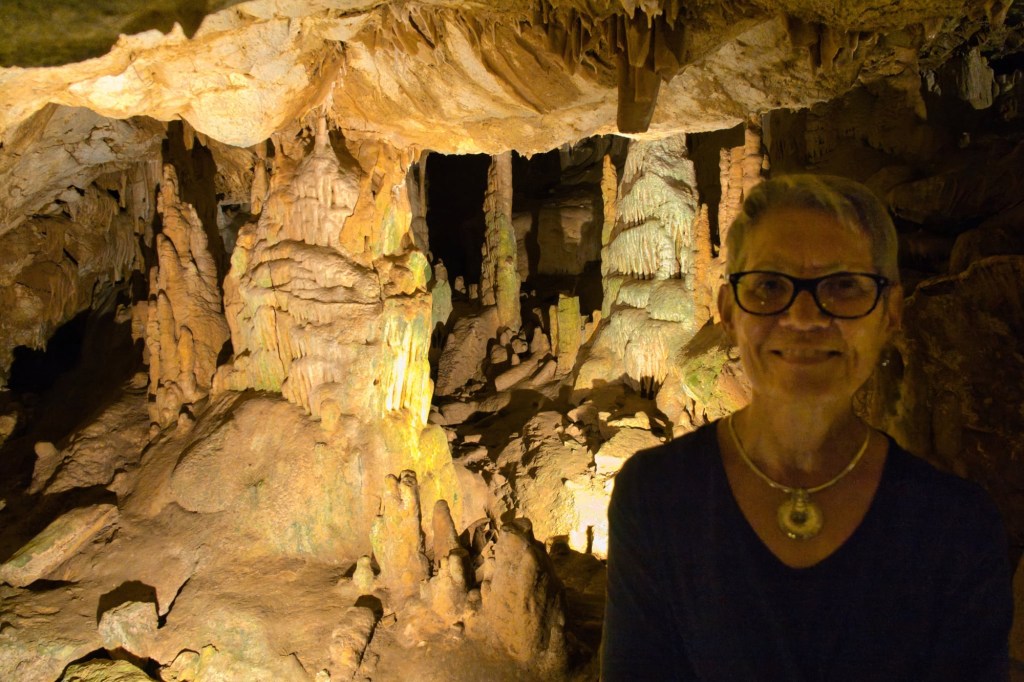
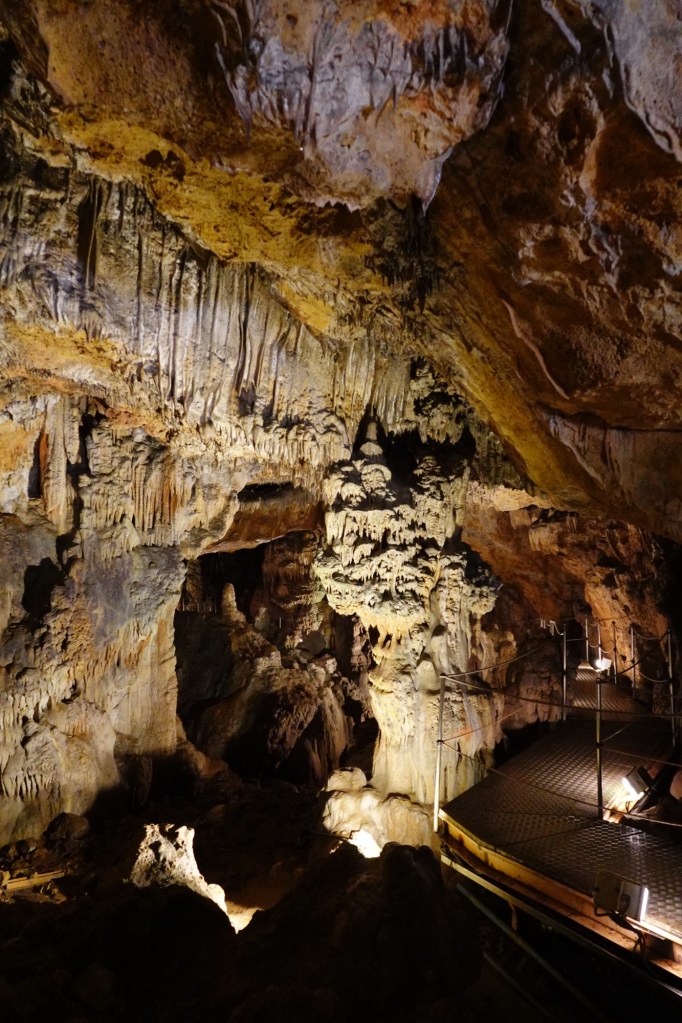
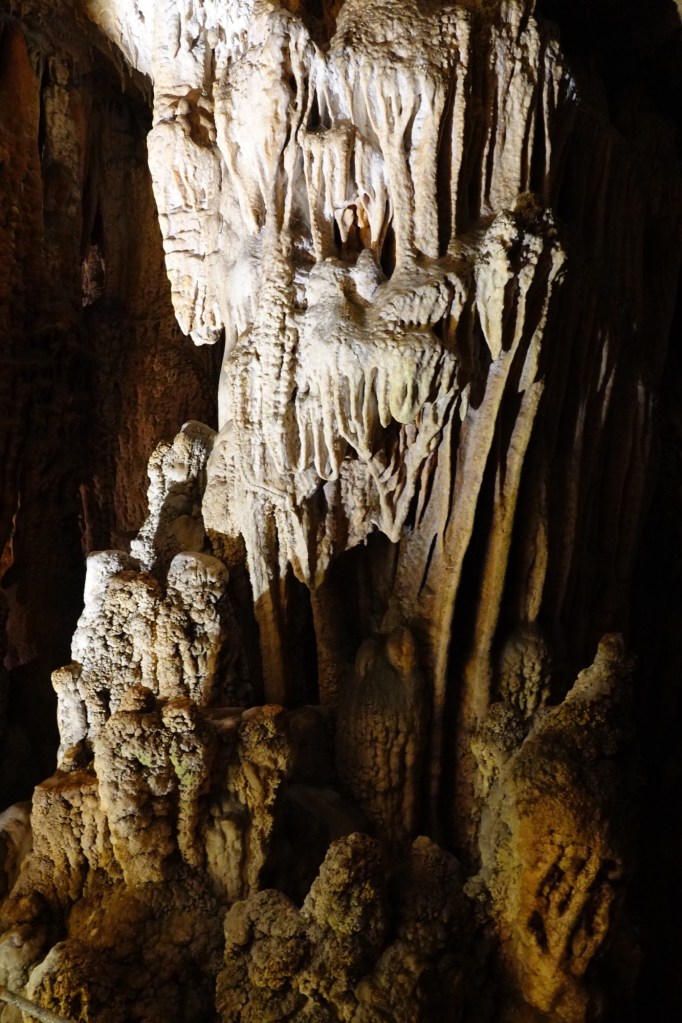
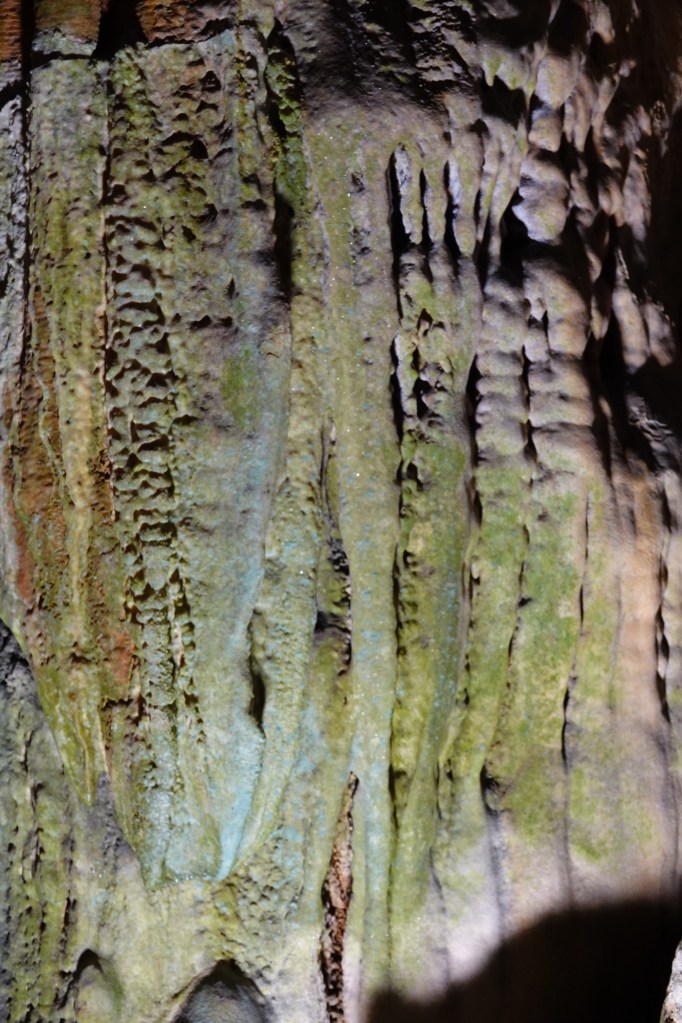
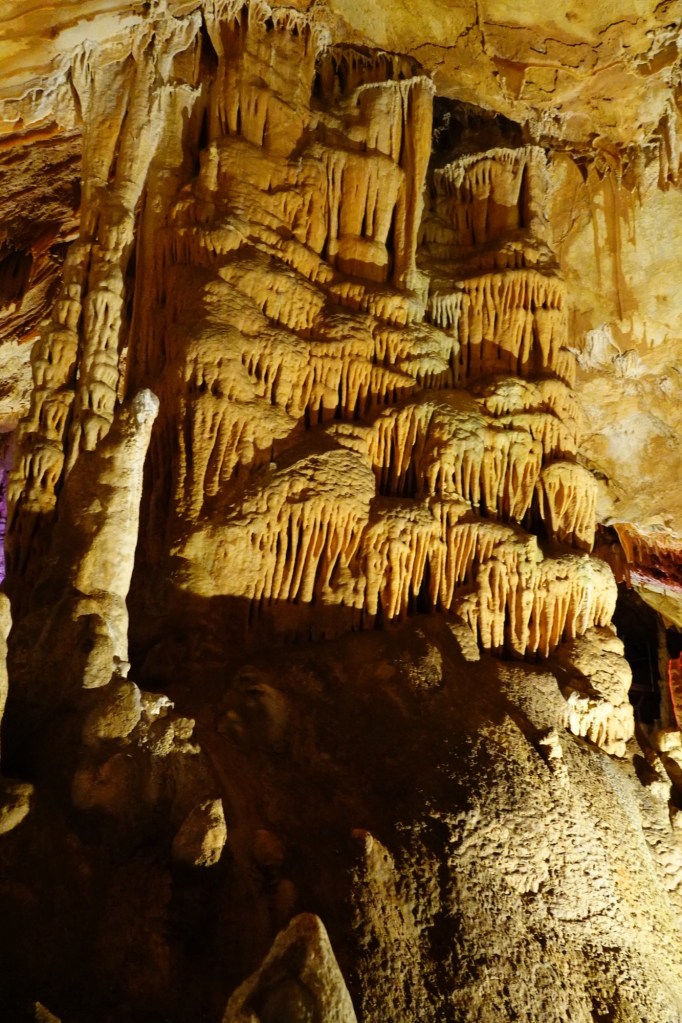
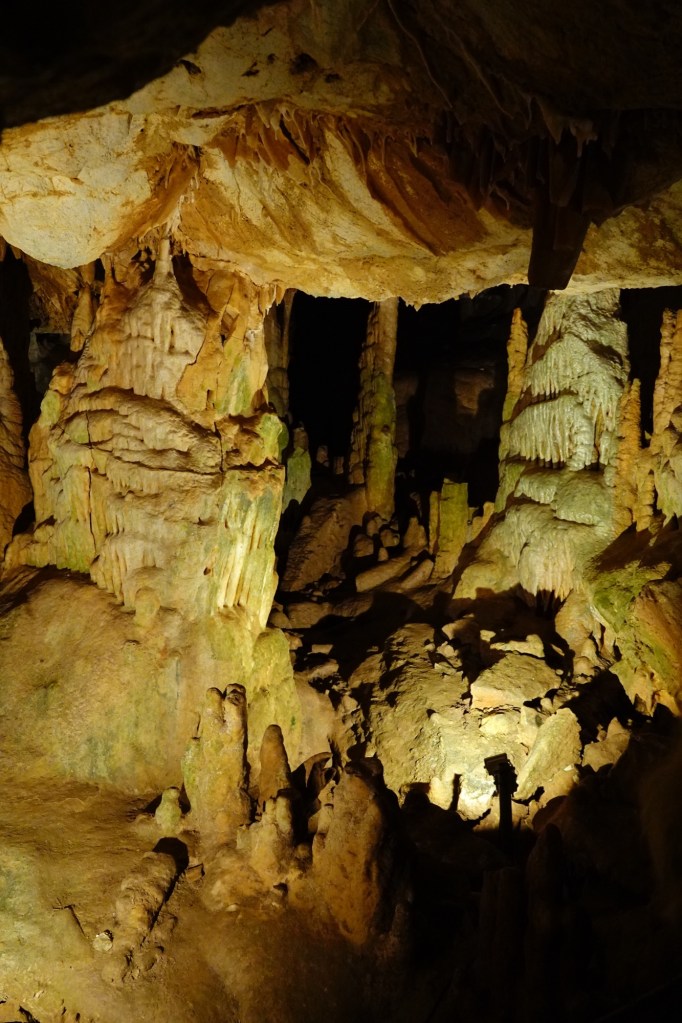
Food, music, and dance accomplished, it was time to end our tour day with some geology: a visit to Crete’s largest tour-accessible caves, the Sfentoni Caves.
The caves are in the mountain village of Zoniana, which we were told translates roughly to “Zeus’ domain” in a nod to the mythology that Zeus was born and hidden from his child-eating father in a cave somewhere in this mountain range on Crete.
On the northwestern side of the parking lot rocky vertical slopes covered with thyme, oregano, thorny burnets, and other plants rise 50 metres up like a natural wall down which goats fearlessly scramble.
About 1/3 of the caves are accessible; the rest are a UNESCO protected natural wonder. Given that it can take 80-100 years for a stalactite or stalagmite to grow just 1 cm it’s no wonder that tourists – some of whom always ignore the rule not to touch the formations – aren’t allowed in the whole cave network. Besides, people scare the bats who need somewhere to hide.
What a day! We’d definitely recommend Spirodon Tours to anyone visiting Crete.

