Right off the bat, I’m going to say that in a complete contrast to how impressed I was by the artefacts in the Heraklion Archaeological Museum yesterday, I was equally unimpressed by Knossos Palace.
The reason? The artefacts in the museum are real, which makes both their state of preservation and their workmanship incredible. The palace, while it is a real excavated complex, has been altered and reimagined so much by the archeologist who did the excavation that nothing about it feels verifiable.
Now that’s out of the way.
The city of Knossos, about 5km south of Heraklion, was the centre of Minoan civilisation and capital of Minoan Crete for almost 2000 years, inhabited continuously from the Neolithic period until the 5th century CE.
Today when we hear “Knossos” most of us think about the Minoan palace that has become such a big tourist attraction, but there was much more going on there.
Knossos had several large palace buildings, extensive workshop installations, luxurious rock-cut caves, and tholos tombs. It was a major centre of trade, maintaining ties with the majority of cities in the Eastern Mediterranean. We were reminded of the variety of coins from other countries that were found here and are on display in the archaeological museum.
But it is the Knossos Palace’s (purported) association with Greek legend that draws us. It may have been the seat of the wise king Minos. Knossos is connected with legends such as the myth of the Labyrinth and the Minotaur, and the story of Daedalus and Icarus. The island of Crete as a whole features disproportionately in ancient Greek myths.
The Municipality of Heraklion’s website explains that: “The earliest traces of inhabitation in the area of the palace go back to the Neolithic period (7000-3000 BCE).The site continued to be occupied in the Pre-palatial period (3000-1900 BCE), at the end of which the area was leveled for the erection of a large palace. That first palace was destroyed, probably by an earthquake, about 1700 BCE.
A second, larger palace was built on the ruins of the old one. This was partially destroyed about 1450BCE, after which the Mycenaeans established themselves at Knossos.The palace was finally destroyed about 1350 BCE by a major fire. The site it covered was occupied again from the Late Mycenaean period until Roman times.”
The first excavation of the site was not conducted until 1878 by Minos Kalokerinos of Heraklion, a bust of whom greets visitors to the site.

This was followed by the long-term excavations (1900-1913 and 1922-1930) of Sir Arthur Evans, an English archeologist who bought the entire site, giving him both time and permission to uncover virtually the entire palace. There’s a bust of Evans on the site too.

Evans carried out an extensive reconstruction project. I didn’t realize exactly what that meant until today’s visit.
Almost every sign on the site had words to the effect “Evans thought”, “Evans believed”, “Evans suggested”, “in his opinion”, and “he supposed”. Modern archaeology has spent decades disentangling what Evans actually found from what he believed he had found. It seems he may have been quite a romantic. Their conclusions to date could be summarized as:
- The pottery, seal stones, and ritual objects found on the site genuinely reflect a sophisticated artistic and religious culture.
- Even though his reconstructions were sometimes speculative, the underlying material is authentic and important.
- His reconstructions were sometimes wildly imaginative. For example, Evans poured concrete, repainted frescoes, and rebuilt entire rooms according to his own vision of “Minoan life.” In fact, Evans may have commissioned some French painters to “repaint” what he called the Throne Room, meaning those wall paintings could be categorized as faux Minoan.
- Evans assigned names like “Throne Room,” “Queen’s Megaron,” and “Lustral Basin,” but those labels reflected his interpretations.
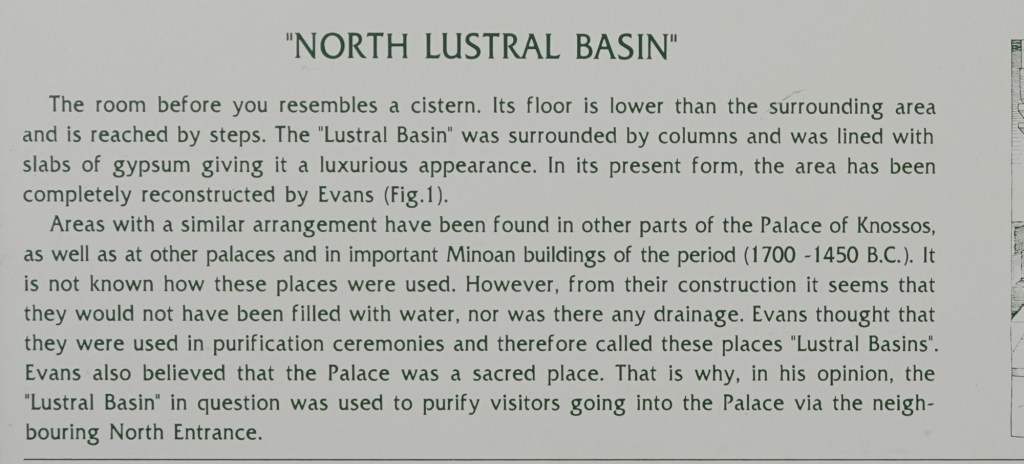
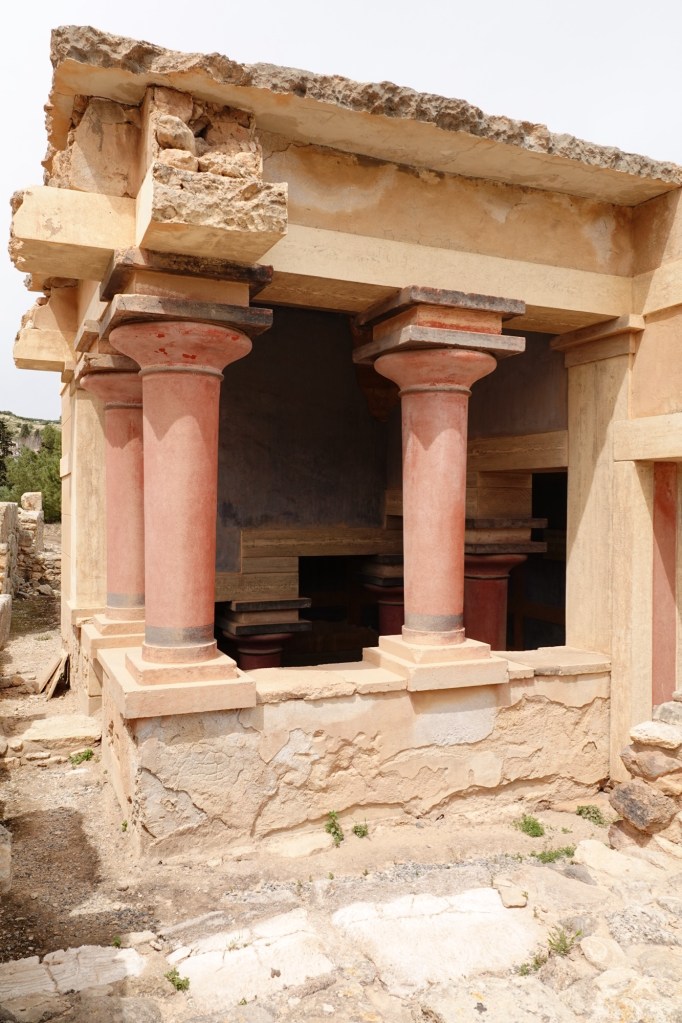
Modern archaeologists often avoid those terms because they imply functions that cannot be securely proven. When we got to the “Lustral Basin” was when I started to have real doubts about what we were seeing; that’s what made me come back to our hotel and spend a couple of hours diving into how modern archaeology views Evans’ findings. - Modern researchers now use the Evans Archive — architectural plans, elevations, and reconstruction drawings — to distinguish original remains from Evans’s interventions. These archives reveal details that were obscured or altered by his restorations. (I’m not so sure “restoration” is even the right word to use.)
- His mythological framing (Minos, the Labyrinth, the Minotaur) was not evidence-based. Evans wanted to believe that he had uncovered the palace of King Minos and the historical basis for the Labyrinth, but modern scholars treat these as interpretive overlays, not archaeological conclusions. Ted and I can verify, though, that the site is labyrinthine.
Overall, Evans’ excavations were certainly spectacular, but his conclusions seem to have been mostly speculation. Call it “educated guesses” … or Gramma answers. Our sons and grandsons will relate to that.
Interestingly, we overheard site-accredited guides – in several languages – stating Evans’ conjectures as fact.
What we visited today is a multi-storey building covering an area of 20.000 square metres, featuring a wide variety of building materials, painted plaster, marble retaining walls, and wall-paintings adorning the rooms and passages.
When I read about the palace, I was struck by the advanced level of technology reached by the Minoans, especially the complex drainage and water-supply systems. After all, we’re talking about something that was designed and built 3500 years ago!
We’d been forewarned to go early enough to arrive when the gates open at 8:30 a.m. and before the tour buses arrive, but since we seem to be off/pre season (until today we’d only run into one tour group since getting here a week ago) we followed our usual lazy Cretan routine of sleeping in and enjoying our morning coffee before walking to the bus station.
Ted is still fighting a cold, and nonetheless gamely heading out each day for a long walk or activity, but it’s tiring him out much more than usual. We figured the chance of crowds was a fair trade for letting him get some extra sleep.
Despite there being two cruise ships in port today, as evidenced by huge lines outside the Heraklion Archeological Museum when we walked past, the crowds at Knossos were quite manageable.
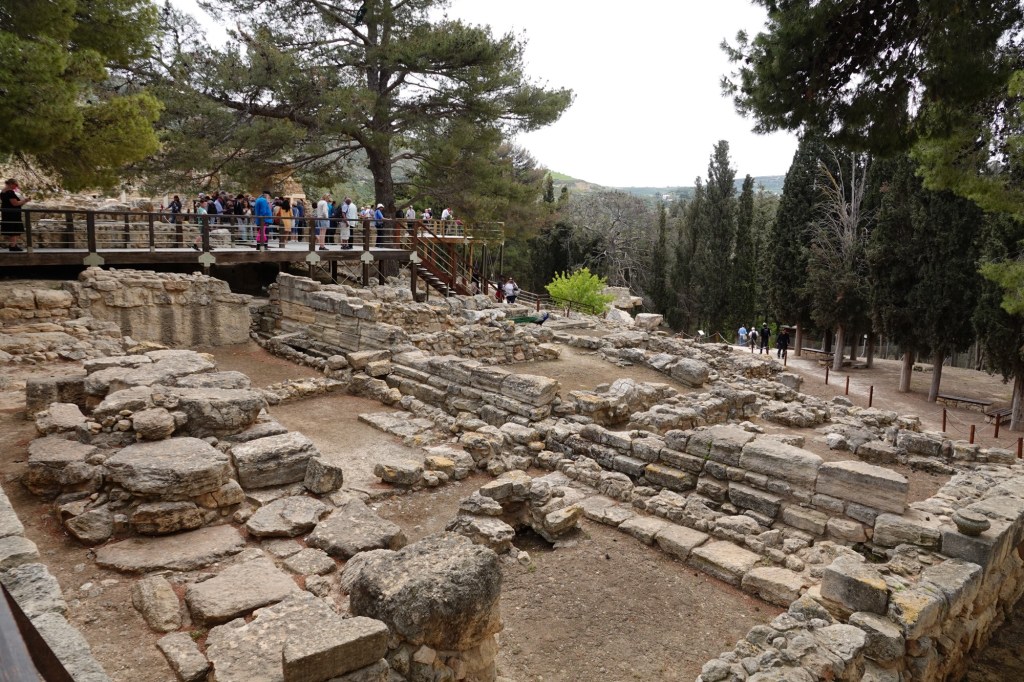
We knew that what we were going to see was the remains of a palace complex, and not its contents. The numerous finds from the palace – all of the exceptionally high quality art, pottery, vessels, figurines, the archive of Linear B tablets, and any original wall-paintings – are housed in Herakleion’s Archaeological Museum, so we saw them yesterday.
Today was all about the architecture.

The court is crossed by the so-called “Processional Causeways”, which stand out from the rest of the paving and intersect each other.
One idea is that processions paraded along them during ceremonies.
The West Facade of the Palace rises up along one side. The facade is constructed of massive gypsum blocks (“orthostats”) set on a plinth. The facade is indented or protrudes corresponding to the interior arrangement of space.

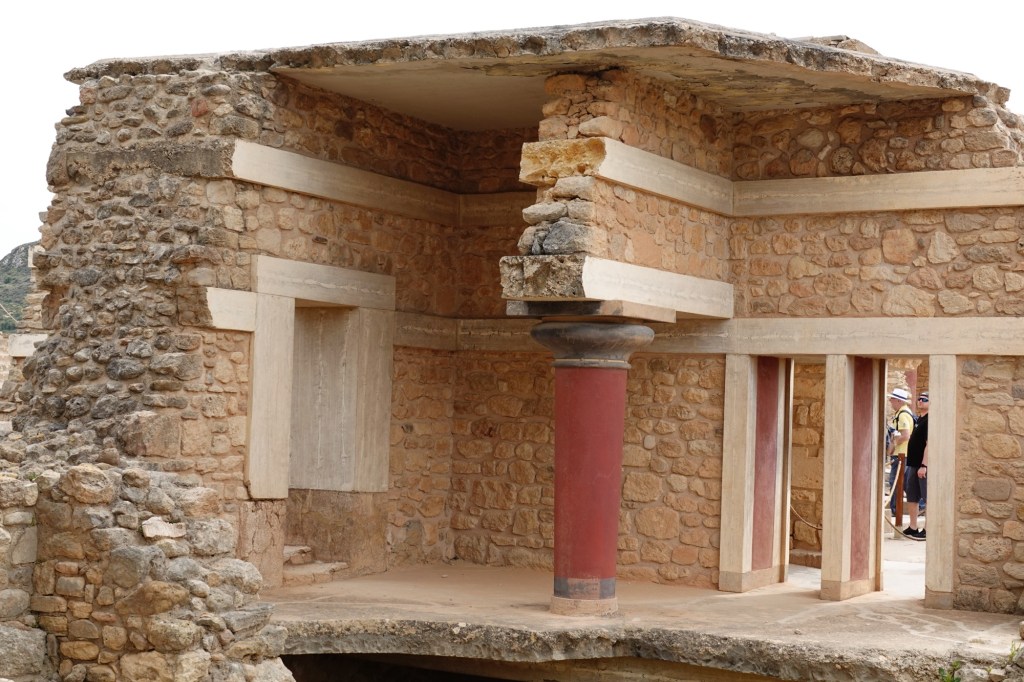
In front of you is situated the “West Porch”. It was a roofed area opening onto the Court, supported by one column of which part of the gypsum base remains.
The east wall was decorated with a bull-leaping fresco. The Porch was closed off by a double door and from here began the long “Corridor of the Procession”. The corridor is so named from the wall painting decorating its east wall and depicting a procession of people holding gifts, and musicians. The floor was very fine. The “Corridor of the Procession”, according to Evans, initially went to the “South Propylaeum” and continued on to the Central Court.

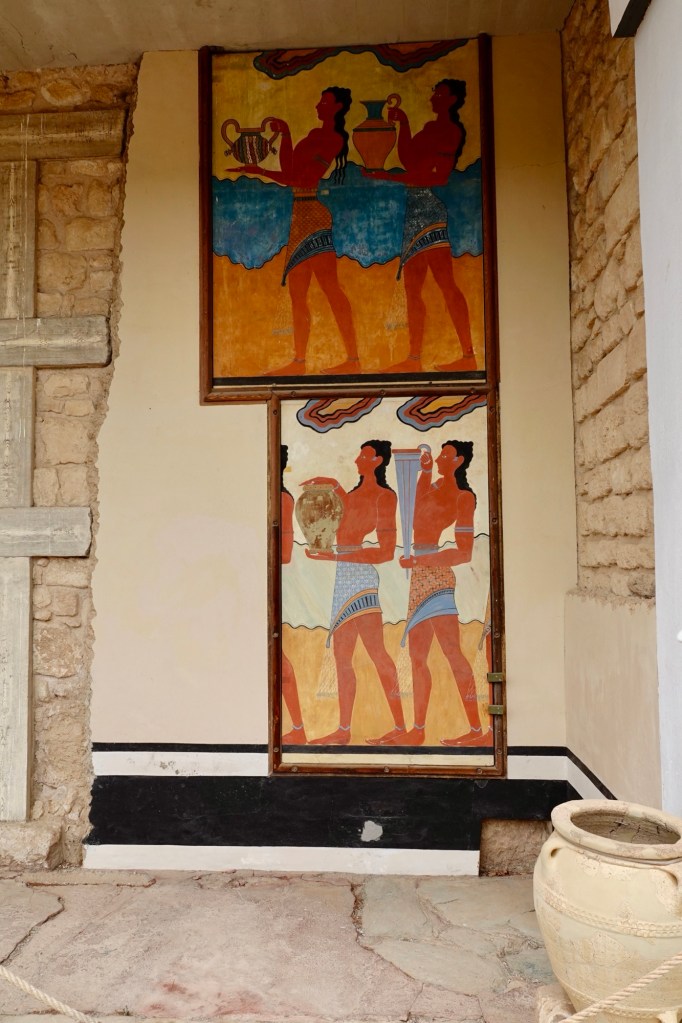
The “South Propylaeum”, as we see it today, is a result of the restoration of Evans who put up a copy of the “Cup-Bearer” fresco here.
The wall painting depicted a man holding a libation vase (rhyton). Its theme is connected with the “Procession Fresco” which, according to Evans, was once here.
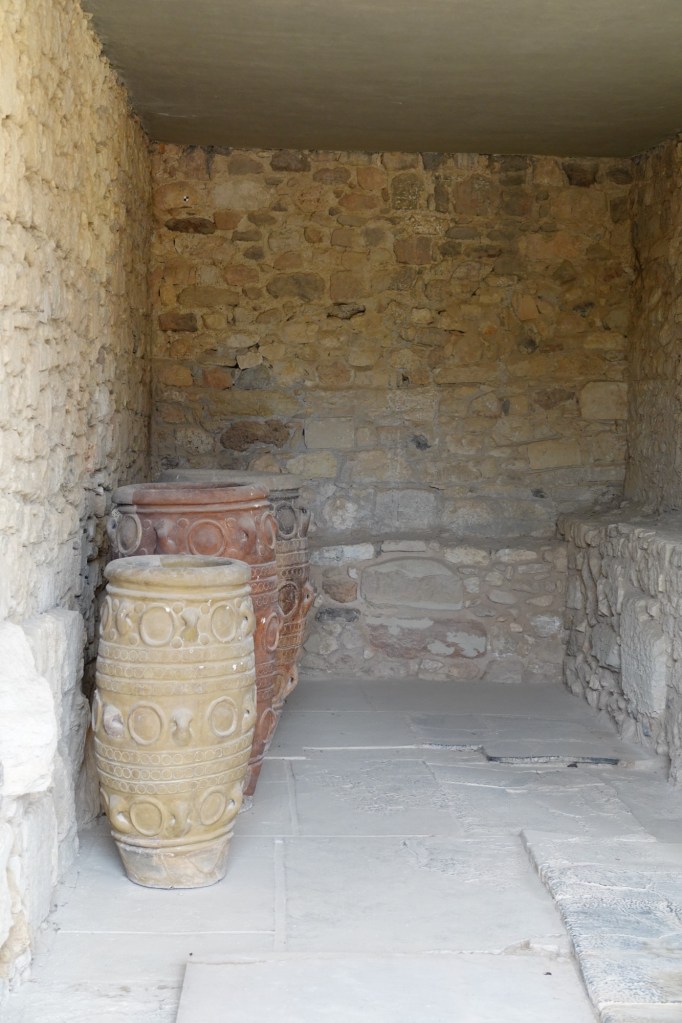
The pithoi (large storage jars) on the east side of the Propylaeum belong to the Postpalatial Period (1450 – 1100B.C.), and indicate that the area was later used for storage.
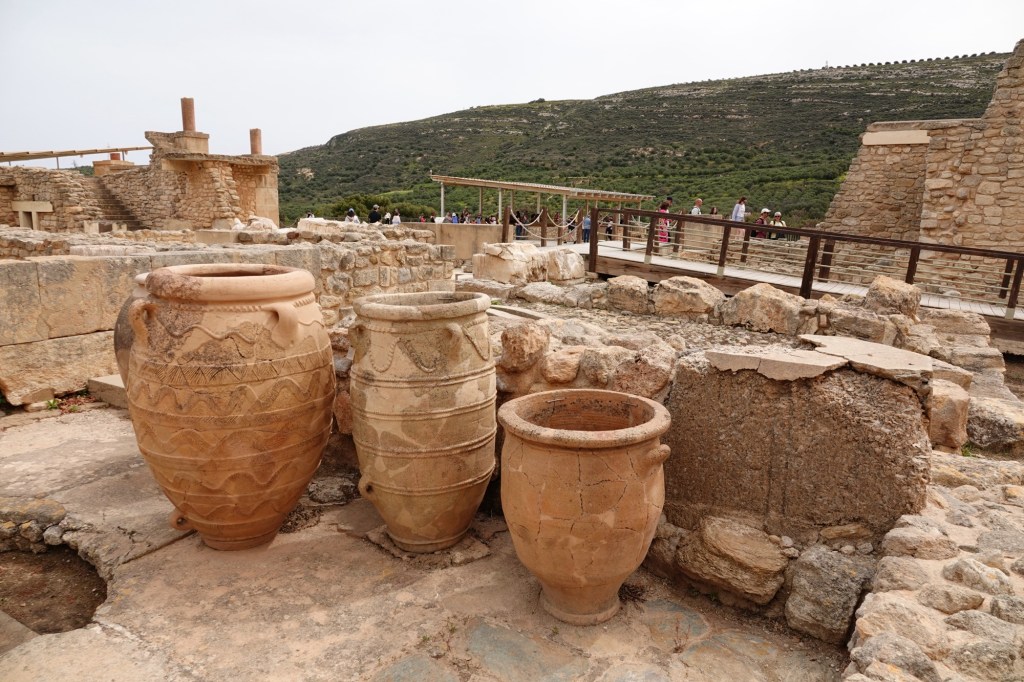
We got a look down into eighteen long narrow store-rooms, covering an area of 1300 sq.m. In the floor of both the storerooms and adjacent corridor, there are ninety-three rectangular cists, the so-called “Kassellas”. From the finds it appears they were used for keeping safe precious equipment and vases. There are also even larger cists in the corridor, internally lined, perhaps to hold liquids. The pithoi (large storage jars) of the “West Magazines” bear witness to the wealth of the Palace. The remains of some 150 pithoi were found, although there is room for about 400. Their contents are unknown,

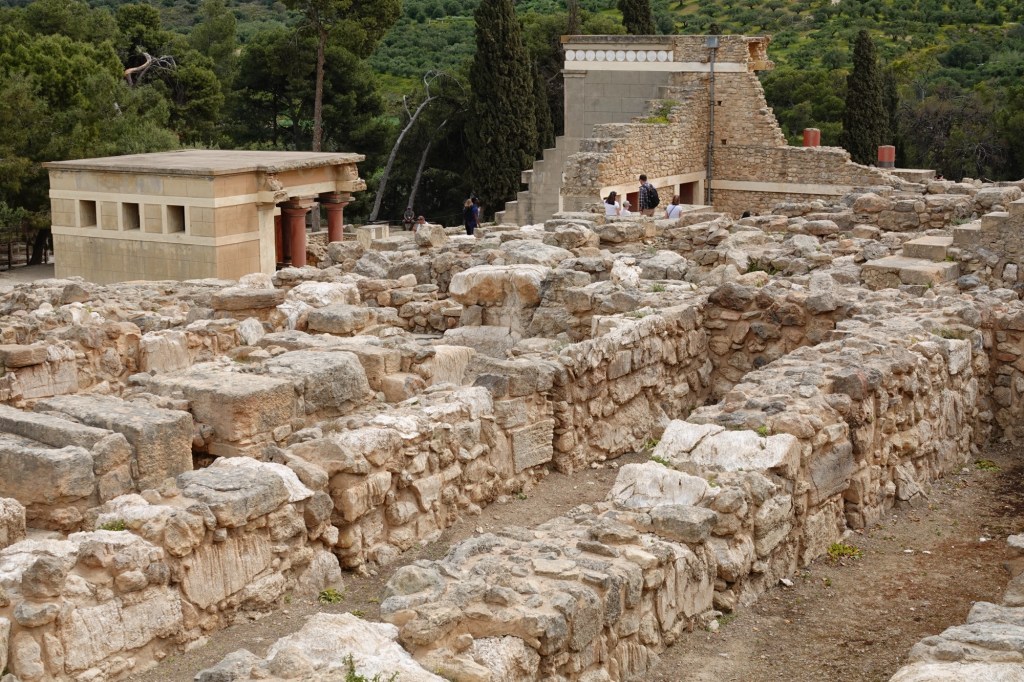

the antechamber of a complex of rooms that Evans named the “Throne Room”. Its name comes from the stone seatfound in the room behind the antechamber.


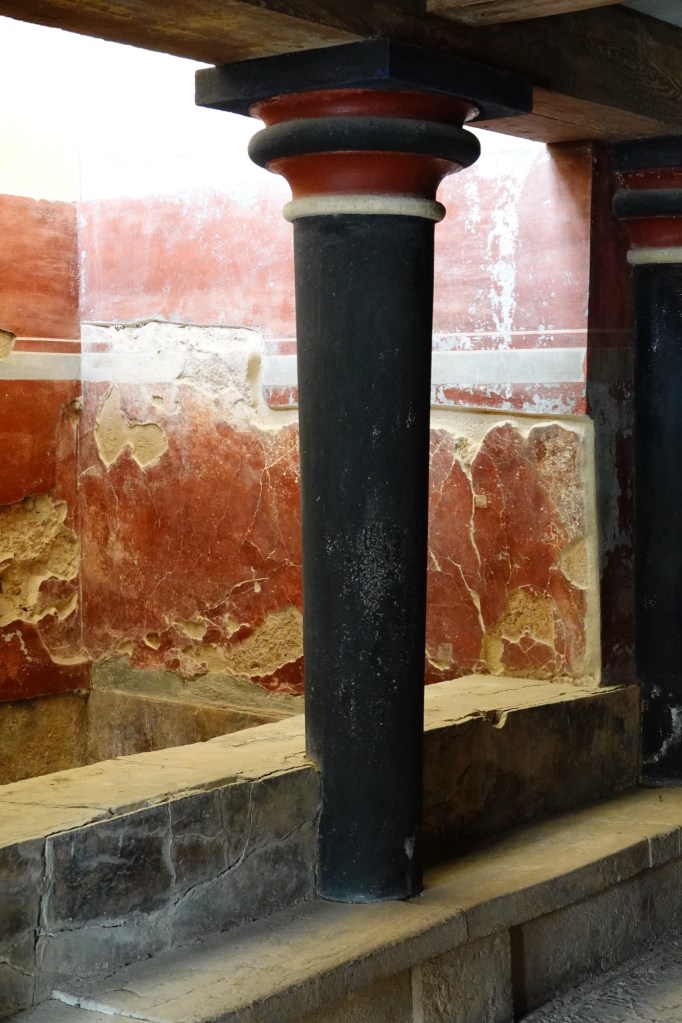
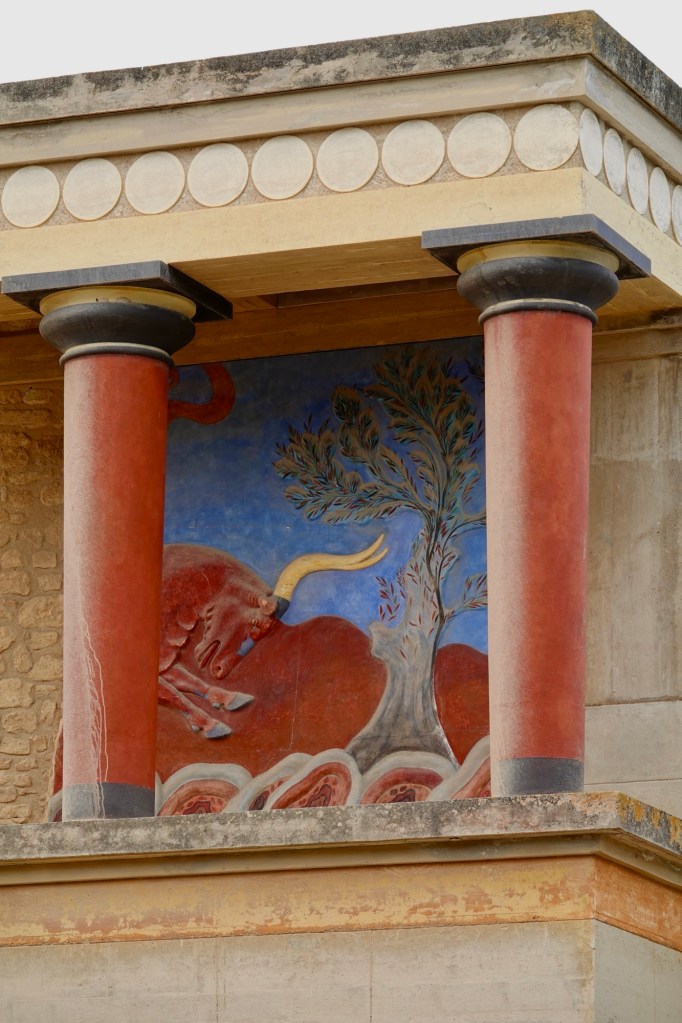
An open air passage linked the Central Court with the North Entrance. It was paved and sharply inclined towards the north. The passage is narrow. Right and left were two raised colonnades known as “Bastions”. Arthur Evans reconstructed the “Bastion” on the west side.
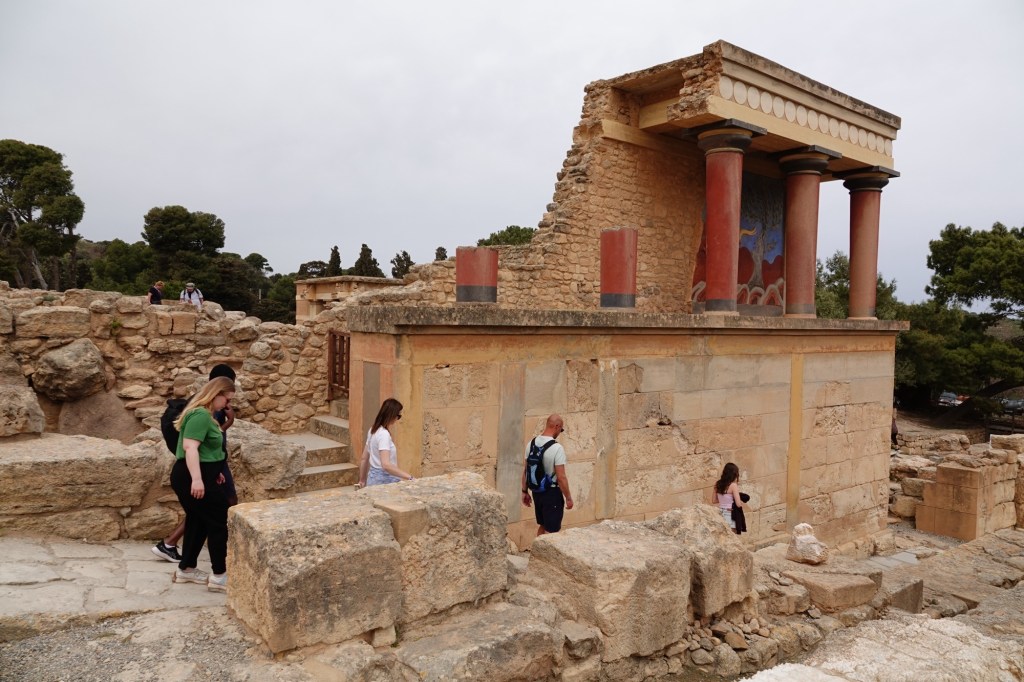
He also placed a copy of a restored relief fresco of a bull here. The wall painting may have formed part of a hunting scene.
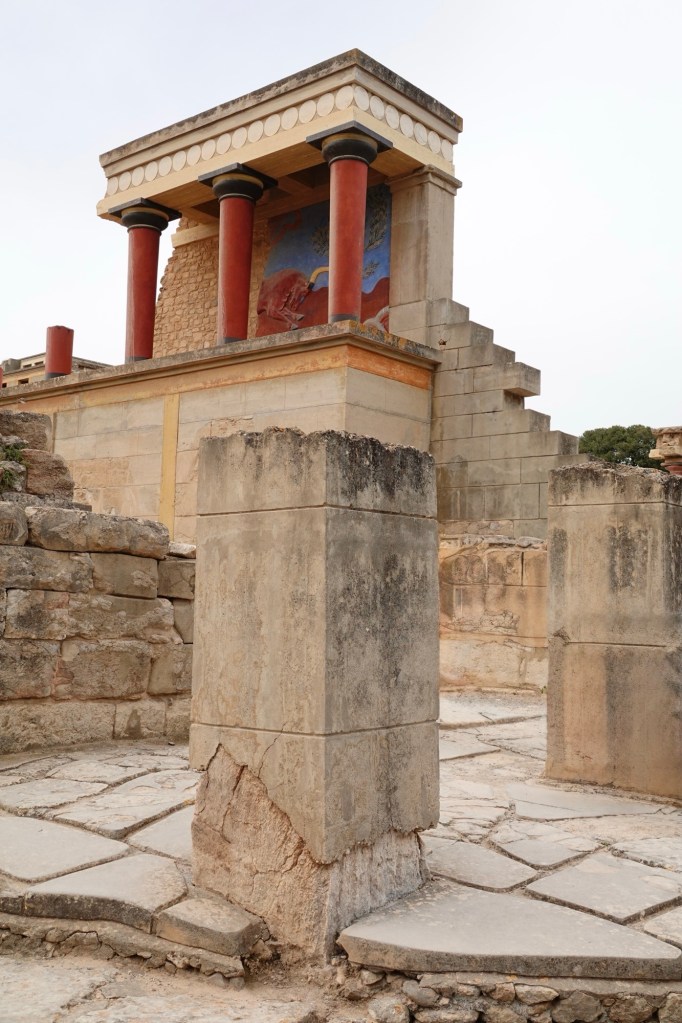

The passage ends in a large hall with ten square pillars and two columns The pillars and columns probably supported a large hall on the upper floor.
Evans suggested that, due to its position on the seaward side, it was here that the produce of seaborne trade would have been checked when it reached the Palace. It was therefore named the “Customs House”.
Below is the sign that made me start to question it all:
The area below was called the “Theatre” by Evans because its shape reminded him of later theatres. It is a platform and rows of steps that form an angle. At the bottom of the steps is the end of a narrow raised road that divides a paved court. Evans believed that the court was used for ceremonies watched by the standing viewers.
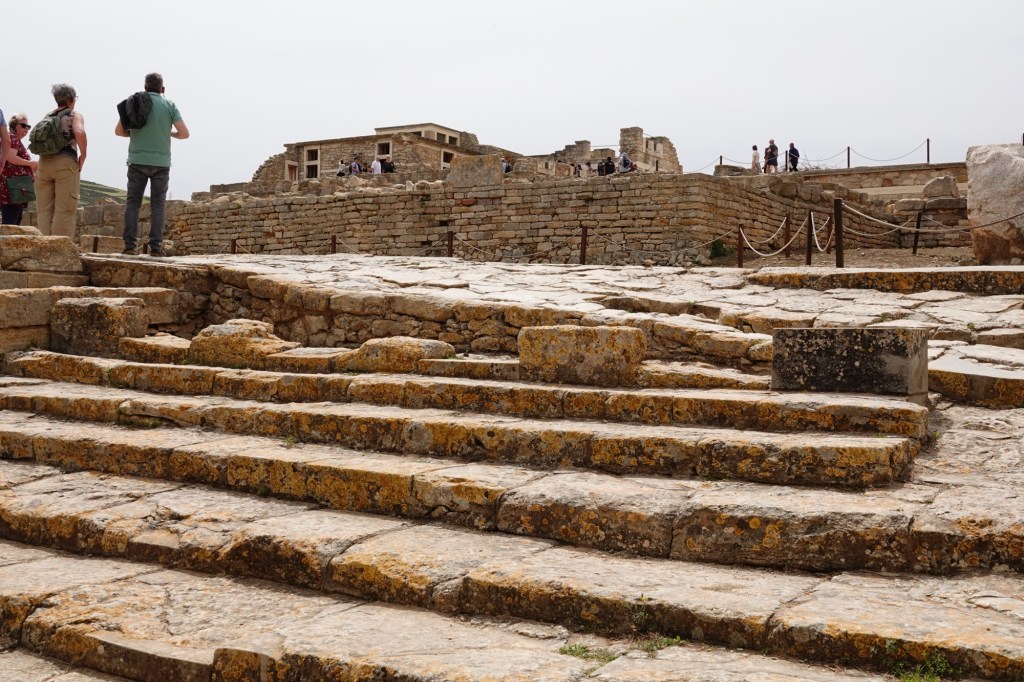
The raised paved road continues in the opposite direction. It passes underneath the modern road to Heraklion connecting the Palace with the Minoan town, which extended to the West and North. Evans named the road the “Royal Road”. Along the length of the road are town houses with workshops on the ground floor and residential areas on the upper floor.

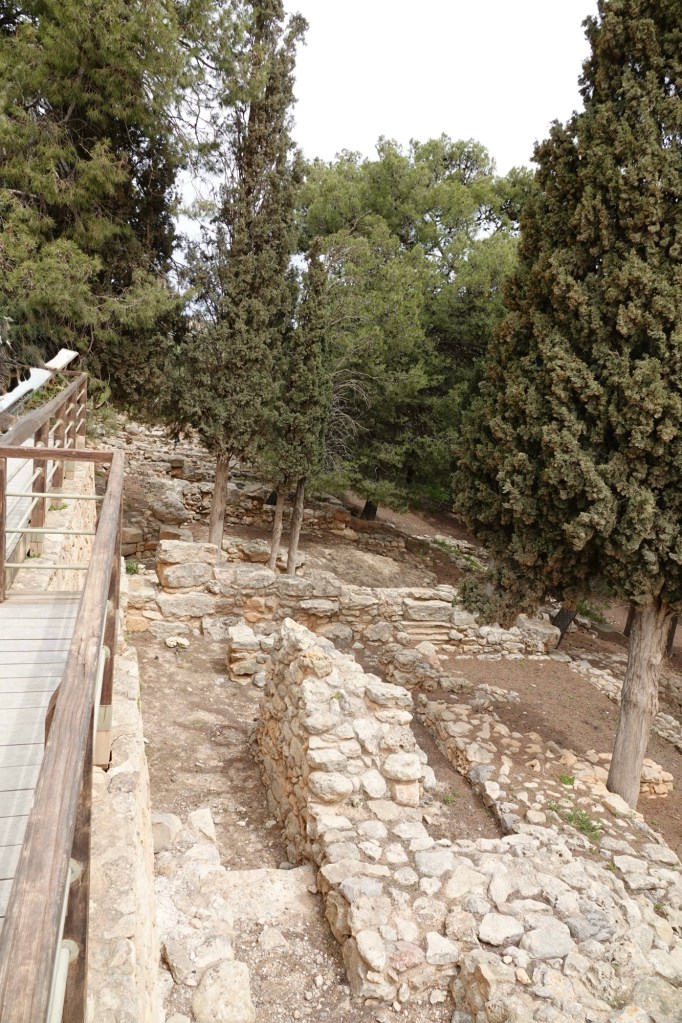
The Royal Gaming Board was found here, a kind of board game made of ivory, rock crystal, Egyptian blue, silver and gold, now in Heraklion Museum.
The Magazine of the Medallion Pithoi took its name from the pithoi (large storage jars) found here, with relief disk and rope decoration, a characteristic of the beginning of the New Palace period (1700-1450 B.C.). A variety of finds show that the place had also been used as a magazine in the Old Palace period (1900-1700 B.C.).
The wing of the palace that Evans thought must be the royal apartments is currently being repaired, since the cement that Evans used is incompatible with the stonework and has been rapidly deteriorating. We were able to walk around the outside and peek inside at portions of the walls.
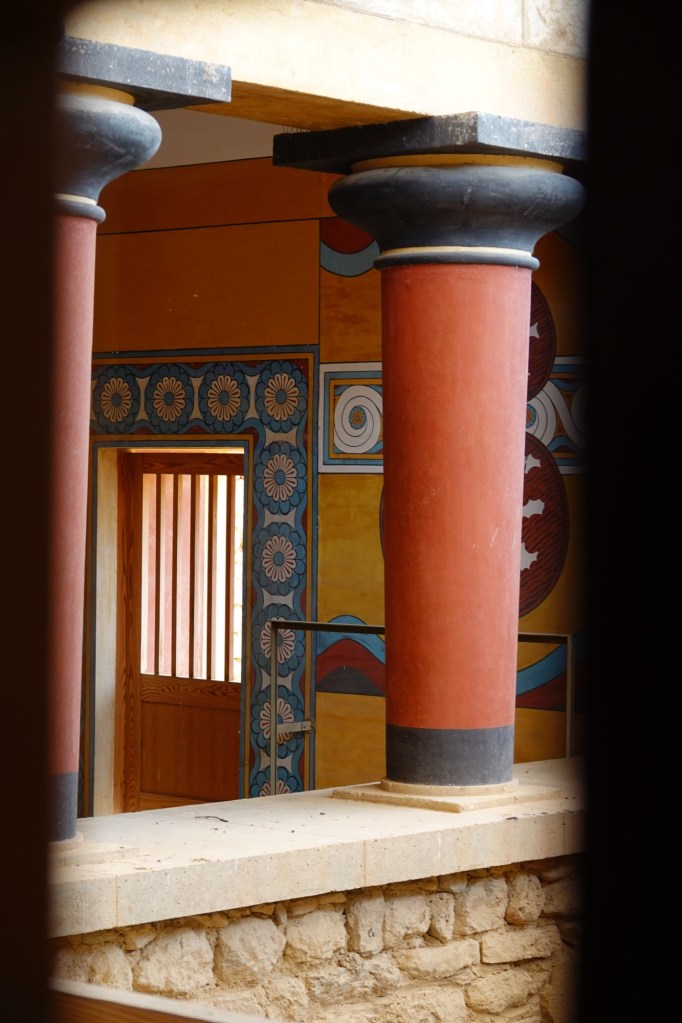
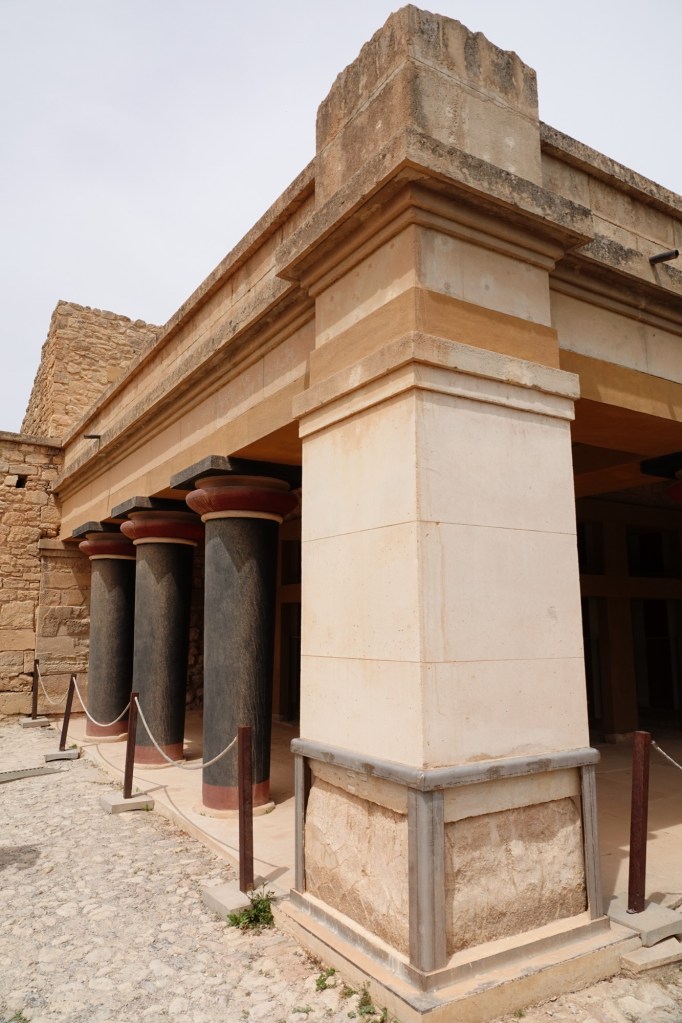


The Central Court (dimensions ca. 50 x 25 m.) is an architectural element common to all Minoan palaces. The Court connects the different wings with one another. There was also direct access from outside the Palace. Part of the paving, which once covered the whole court, is preserved in the northwest and southwest corners. Evans thought that the area must have been for meetings and rituals of “both a sacred and profane character”.
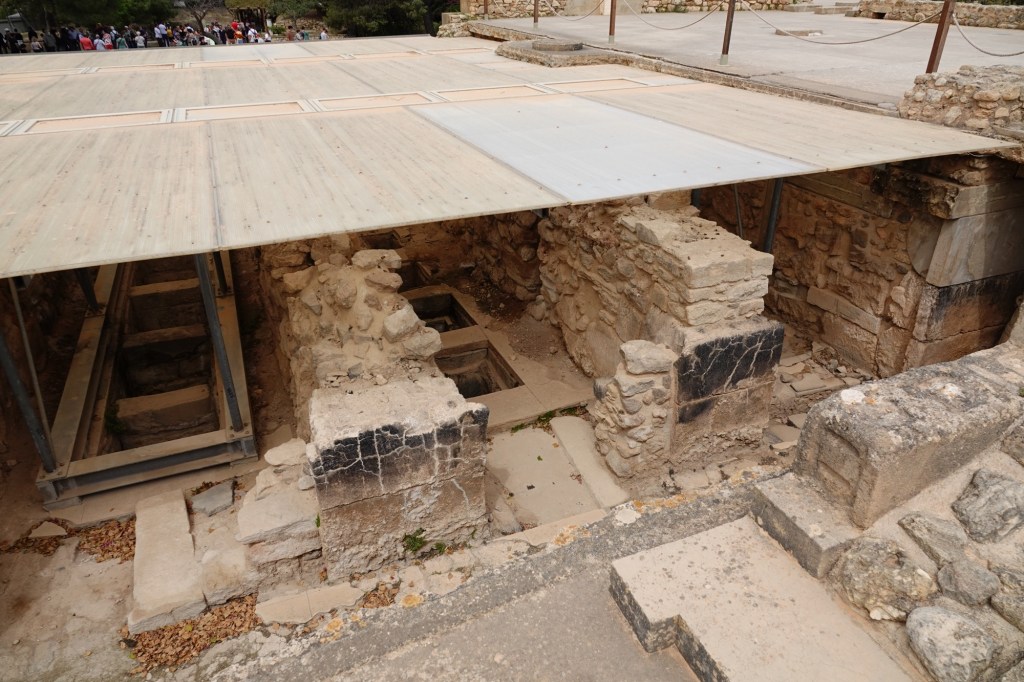
A large part of the East Wing cannot be seen from the Central Court as it is built into the side of the hill on top of which lies the rest of the Palace. It is one of the most interesting parts of the palace because two storeys are preserved below the level of the Central Court. Today, a large part of it has been reconstructed in concrete.

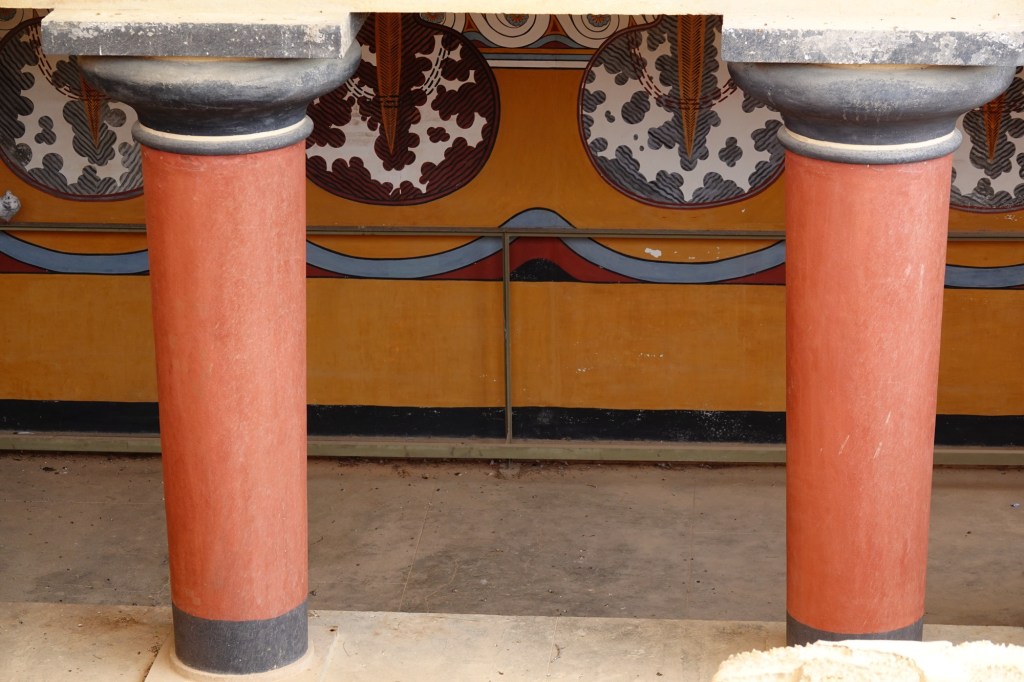
The storeys are connected with one another by means of a system of stairs known as the “Grand Staircase”.The staircase was found during the excavation in its original position.

Another of Evan’s “restorations”:

It was an interesting day, and a lesson in not believing everything you’re told.
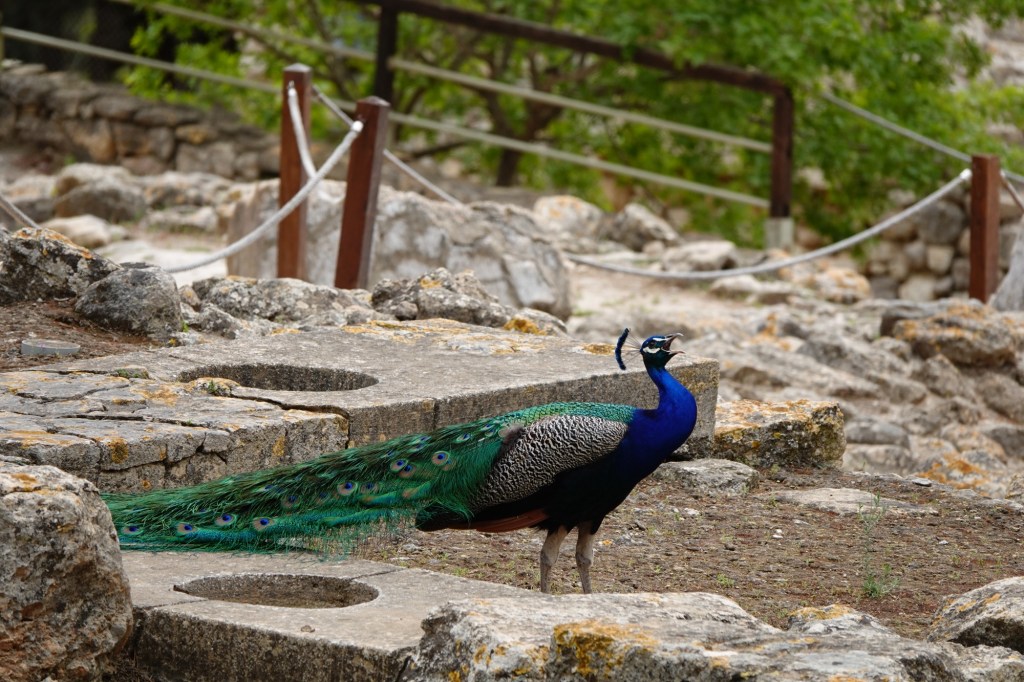
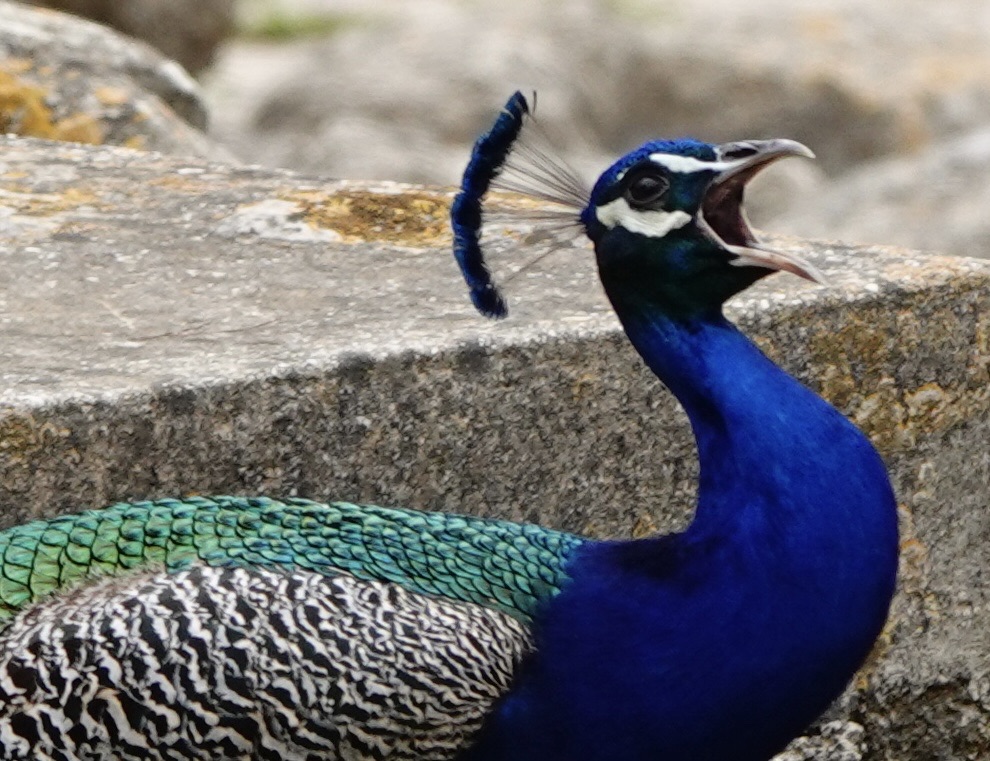
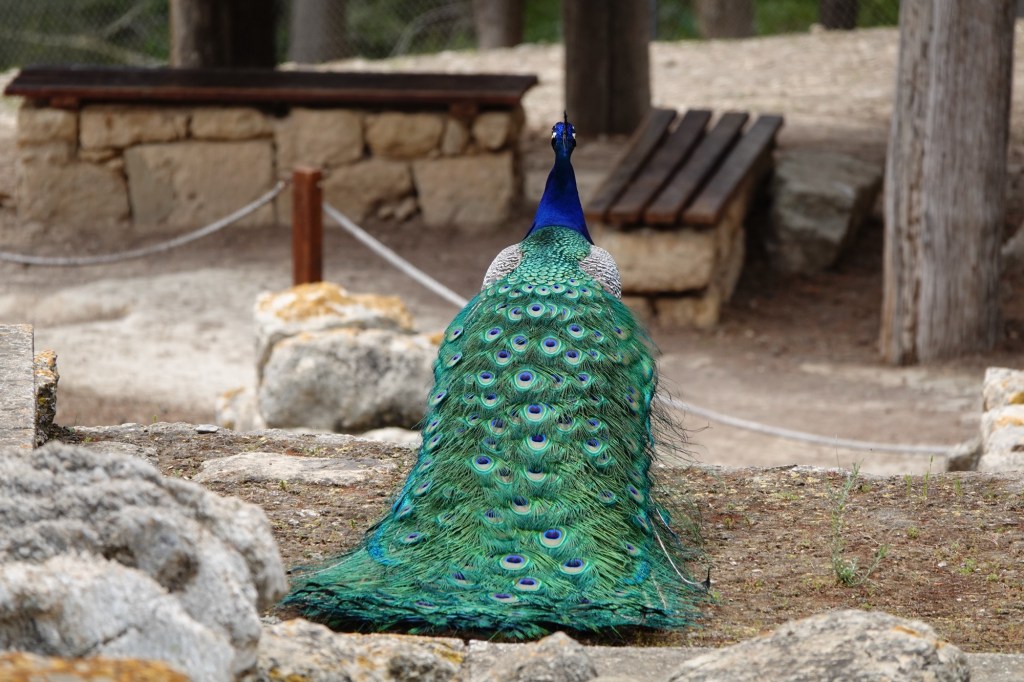
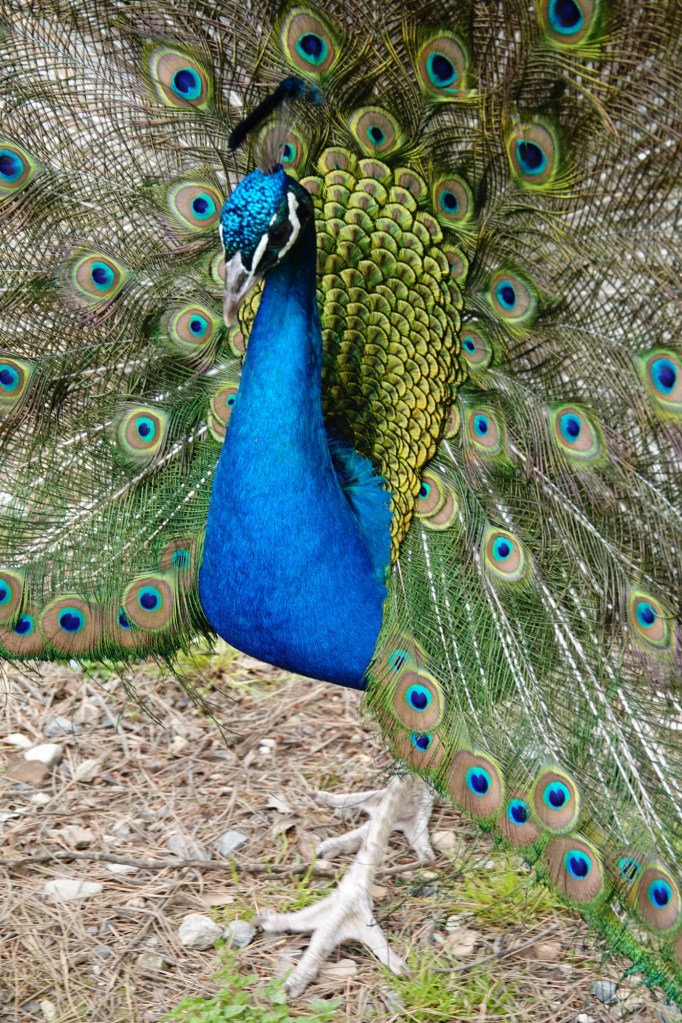
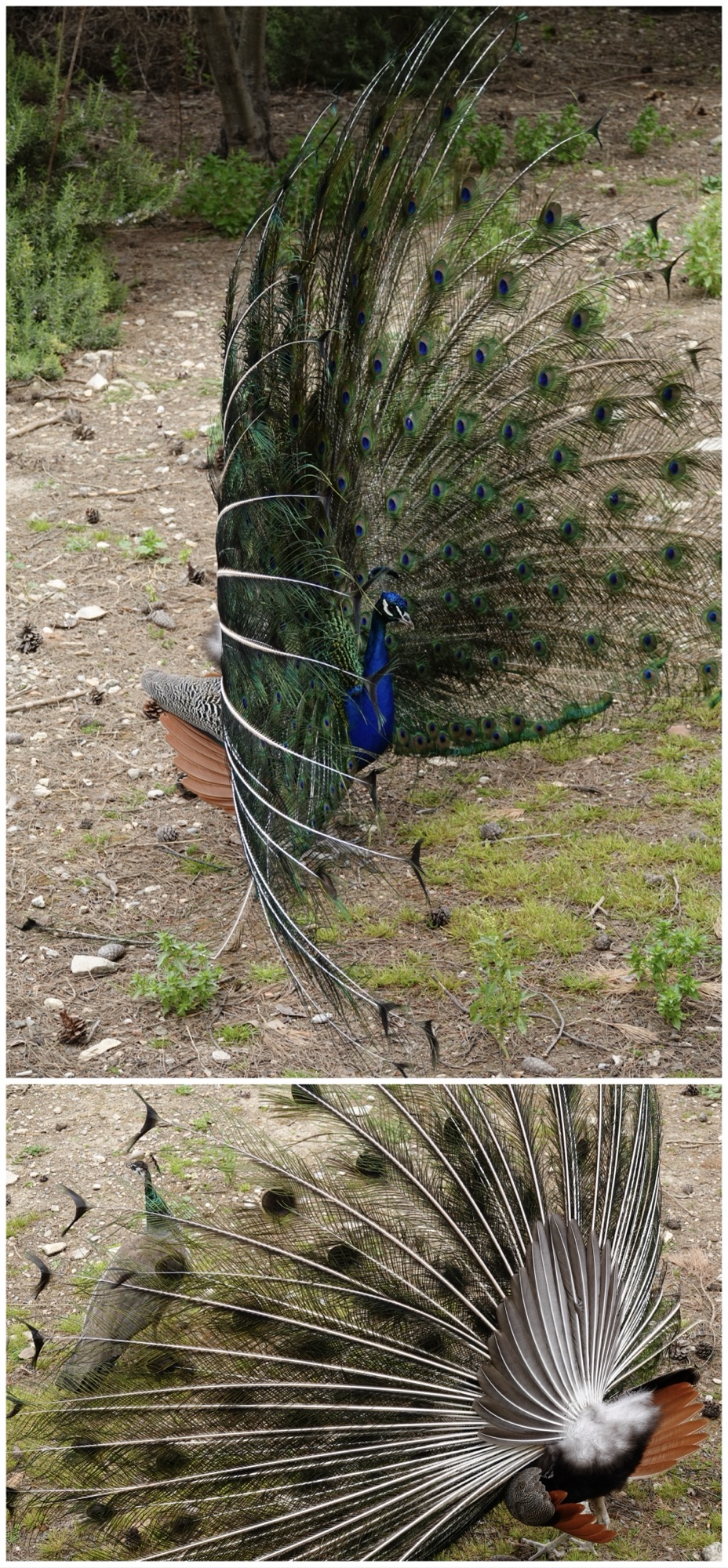
Our greeters saw us off.


Knossos is without a doubt the single most frustrating historical or archaeological site I have ever visited. Thank you for setting the record straight. Those guides should have their licenses revoked!
LikeLiked by 1 person
The arrogance of these guys! Schliemann (sp?) at Troy and Violet le Duc at Carcassone come to mind. Thanks for helping correct the misconceptions I probably still had from my 1977 visit to Crete! It’s a shame that the guides are still sharing these stories. I hope that our Egyptian guides were more scrupulous. Are you still heading on a Nile cruise this fall? You’ll keep them on their toes — but they really like guests who are inquisitive and informed.
LikeLike
We did our Nile cruise last December and had a wonderful Egyptologist as our guide
LikeLike
That’s right — I’m losing track of the years! Our guides were excellent too — both our designated one and the two others taking the other two busloads. I did not get the feeling they were veering away from the scientifically documented to just tell appealing stories — at least not often!
LikeLiked by 1 person
Oh man…. Without being able to search my blog entries I’d be lost in time!
LikeLike