By the time we arrived at the JW Marriott Bucharest Grand Hotel yesterday, we’d been awake for just under 24 hours. Fortunately neither we nor Viking had plans for us beyond getting settled into the hotel and taking a nap.
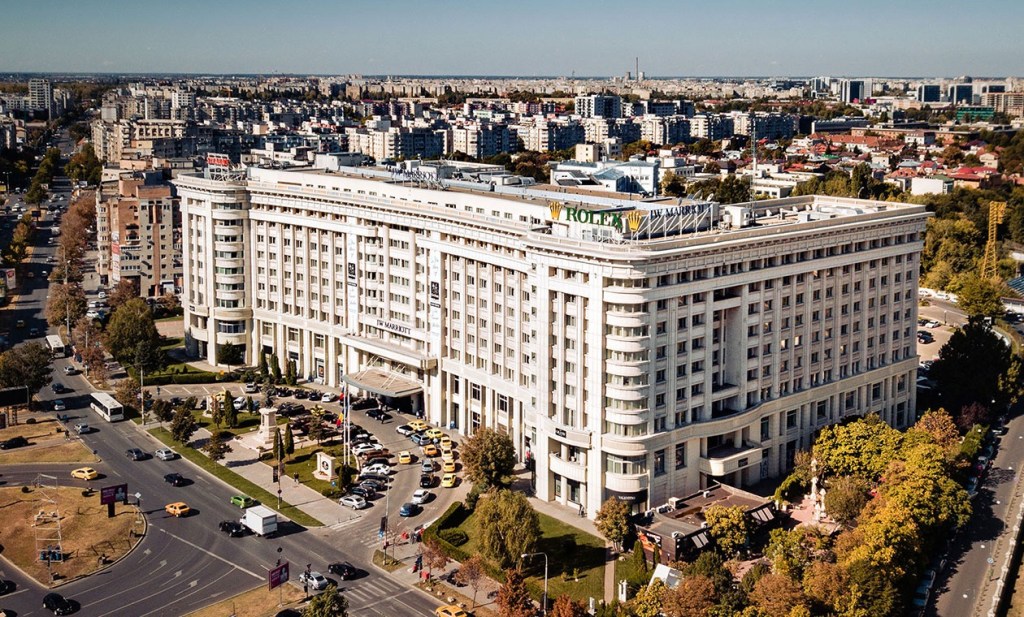
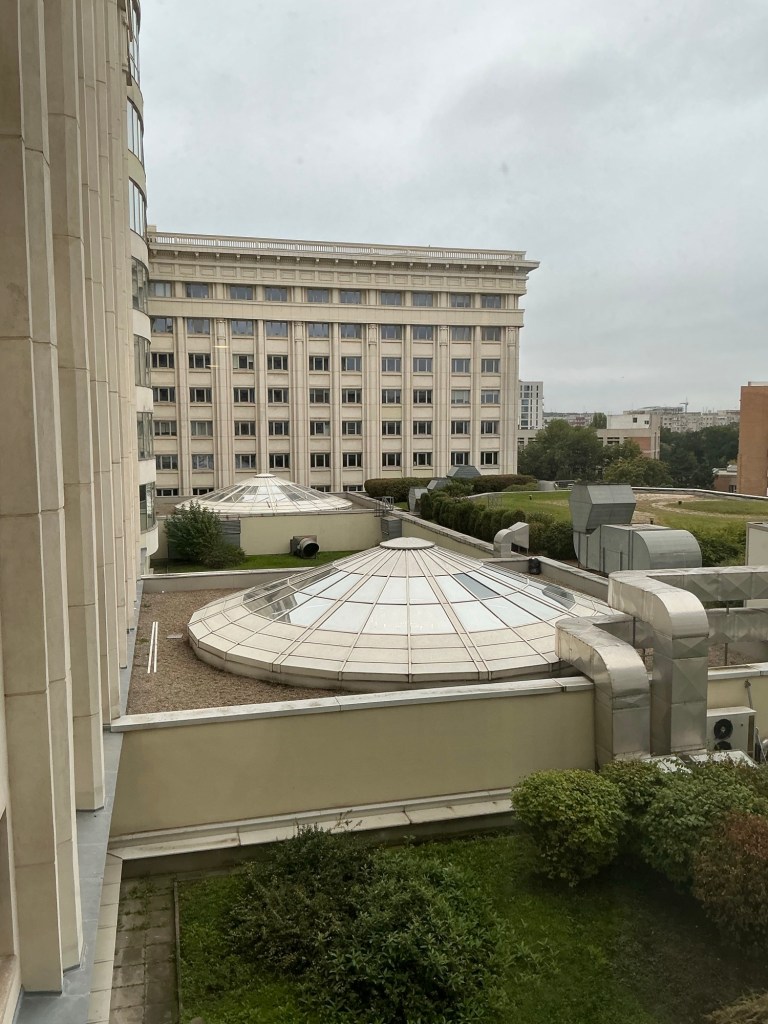
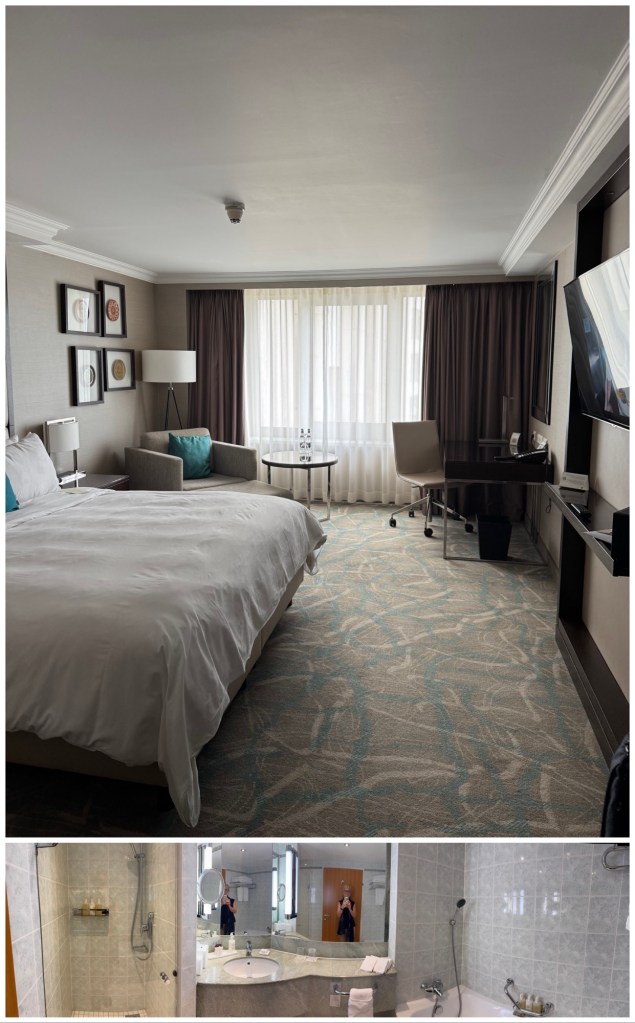
We’d been fed often and fairly well on our KLM flights, supplemented by a snack at Schipol, so it was not a problem that I preferred sleep over dinner, but Ted popped into the hotel’s Italian restaurant for pizza and Romanian beer and brought almost 1/3 of the pizza back to the room for me.

The only downside to my personal room-service, was that it didn’t come with the complimentary limoncello that arrived with Ted’s bill.

Today, on our full day in Bucharest and after a sound sleep in a luxurious king-sized bed, and a wonderful breakfast buffet featuring lots of traditional Romanian options, we wanted to pack in as many experiences as possible, to which end we booked THREE excursions !
In the morning, the included tour “Panoramic Bucharest” involved a scenic drive through the Romanian capital, with three photo stops.
Bucharest is a city of elegant French-style boulevards, lush gardens and green expanses, with history on display everywhere. Under overcast skies it looked quite bleak; when the sun came out its potential shone.
It is also a city where the buildings are still pockmarked with the scars of bullets from World War II and the more recent civil war. It was our first visual reminder (since our visit to Bratislava in 2013) that the Eastern European people who lived under various communist dictatorships after WWII are – unfortunately – no strangers to war in their own backyard. Our guides certainly do not sugarcoat the region’s history.
Our guide Mohamed, who has been guiding since 2002, was an absolute fount of information about Romania.
First of all, we learned that the country’s name is pronounced “Rome-an-ee-a”, which literally means “the Roman people”, the area having been settled by the Romans in 206CE.
We learned that the language is Latinate; Romania was described as “a Latin island in a sea of Slavic”. The religion is 87% Eastern Orthodox, with Transylvania being Catholic due to its Hungarian roots dating from the 3rd century right through until WW1. Although Romania was founded in 1859 by the union of Moldavia with Wallachia, it was later joined by Dobrogea in 1878 and Transylvania and Bukovina in 1918, when today’s borders were established.
The country’s last kings were of the Habsburg dynasty, right through to King Michael who ruled, mostly just as a figurehead, through WWII. The country’s population is now around 20 million but decreasing toward an expected 15 million by 2050, mostly due to economic emigration, despite the country having oil and gas resources and being an agricultural powerhouse and IT hub that result in it having the second largest economy in Eastern Europe, just behind Poland. Mohamed explained the “white”(taxable at 47%) vs “black”(untaxed undeclared cash) income that people in the big cities have, tacitly approved by the government within specified limits.
As far as demographic breakdown Wikipedia shows the country as 89.3% Romanian , 6%, Hungarian 3.1% Roma, 0.3% Ukrainian, 0.1%German, and 0.9% other. Our guide told us that in Bucharest itself, with a population of around 2 million, the two largest groups after Romanians are Turks and Germans. Saxon Germans have a history here dating back to the 11th century; after WWII the numbers drastically dropped. Sadly, with a similar antisemitic culture here as was prevalent in Germany after WWI, there are only about 6000 of the original 75000 Jewish inhabitants still in Romania.
Our guide repeated several times that Bucharest had been destroyed and risen from the ashes three times: when the Ottomans attacked in the 16th century, the Allied bombings in 1944 which damaged 85% of the city, and the 1977 earthquake that destroyed almost 1/3 of the city and provided the excuse for Nicolas Ceaucescu to raze large swaths of the city and evict tens of thousands of people to build his extravagant government centre.
Our first photo stop was outside Ceaucescu’s parliament palace building. At 9 storeys (84m) tall above ground and an equivalent underground, in 1989 USD equivalent it cost $3 billion in materials alone! It was built using 100% Romanian materials, except for the green marble in the senate room, which was gifted to Ceaucescu by the Shah of Iran. We would be back in the afternoon to get a closer look.
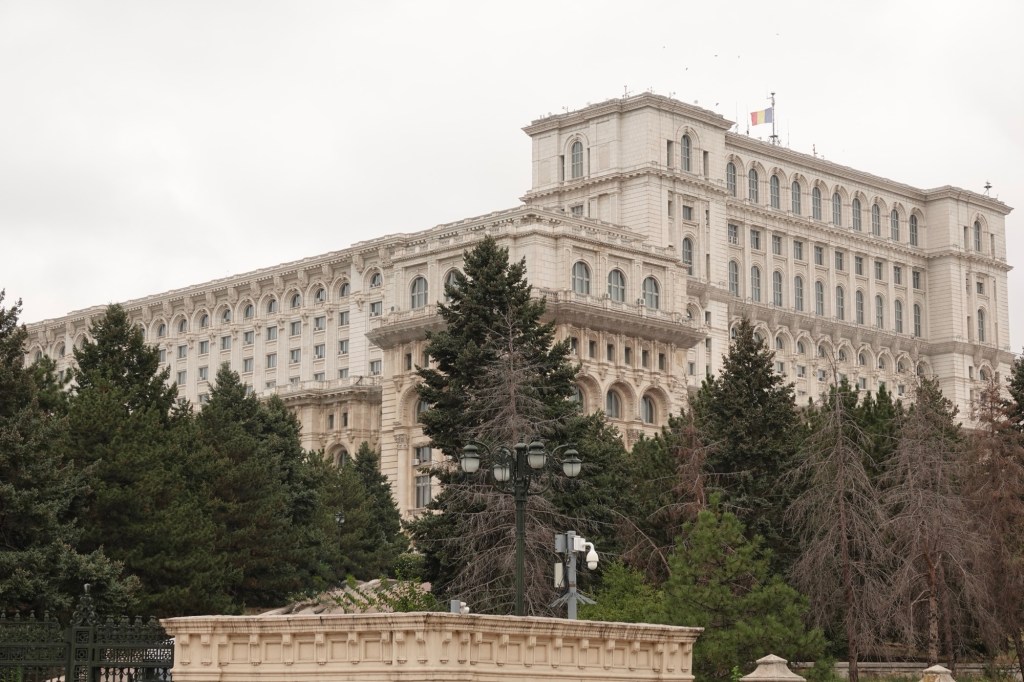
No one really knows what is under the building, except that the lowest floor is a nuclear bunker. There are apparently many tunnels leading from the palace to other parts of the city, but it has all been sealed off for decades.
The Boulevard in front of the palace was modelled partially on the Champs Elysees; Elena Ceausescu wanted to channel France in Bucharest. The 4 km long boulevard includes 44 lit fountains; the cost of electricity means those fountains are rarely lit today. The area was closed today for a ticketed event, the Unforgettable Symphonic Experience in Constitution Square, featuring Andrea Bocelli.
The massive Academia Romana science ministry building opposite the palace, unfinished inside and completely unused, was built for Elena Ceausescu by her husband. She was made minister of science despite having only a 3rd grade education. Nepotism was rampant during the Soviet era.
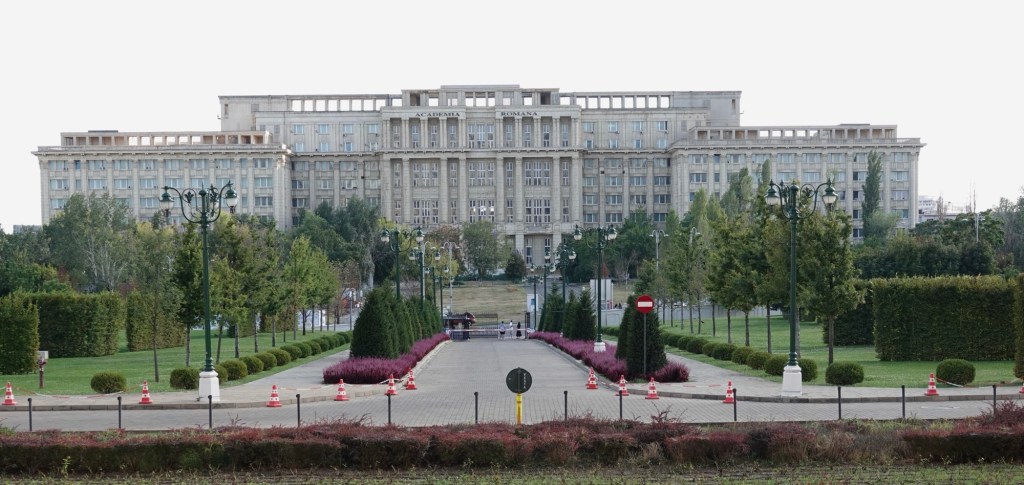
We learned that in 1968 Ceausescu was popular both at home and worldwide due to his condemnation of the brutal crushing by the Soviets of the “Prague Spring” uprising in Czechoslovakia, but by the 1970s he was reviled for his corruption, media control, and use of a brutal police force (the Securitata), plus profligate spending of money on palaces and bankrupting the people – he turned Romania into a virtual prison for the 23 million Romanians until the 1989 revolution.
From the Palace we got a good view of the new Orthodox Cathedral, begun in 2010 and due to open this October. When it does, it will be the largest in Romania.

We drove around Victoria / Victory square, home to the office of the president built in 1957 during the Soviet period. The “victory”celebrated in the square is 1878’s independence from the Ottoman Empire.
Bucharest’s unique Brâncovenesc style is in evidence along Kisselef Street.

From our side of the bus, we could not get a decent picture of the Arc de Triomphe built in 1920 to celebrate the return of Transylvania to Romania after the reallocation of borders by the1919 Treaty of Versailles, thanks to efforts of Queen Mary of Romania (to whom the Castle of Bran was gifted in thanks for her efforts).
But we did get a shot of the Romanian Aetheneum concert hall.

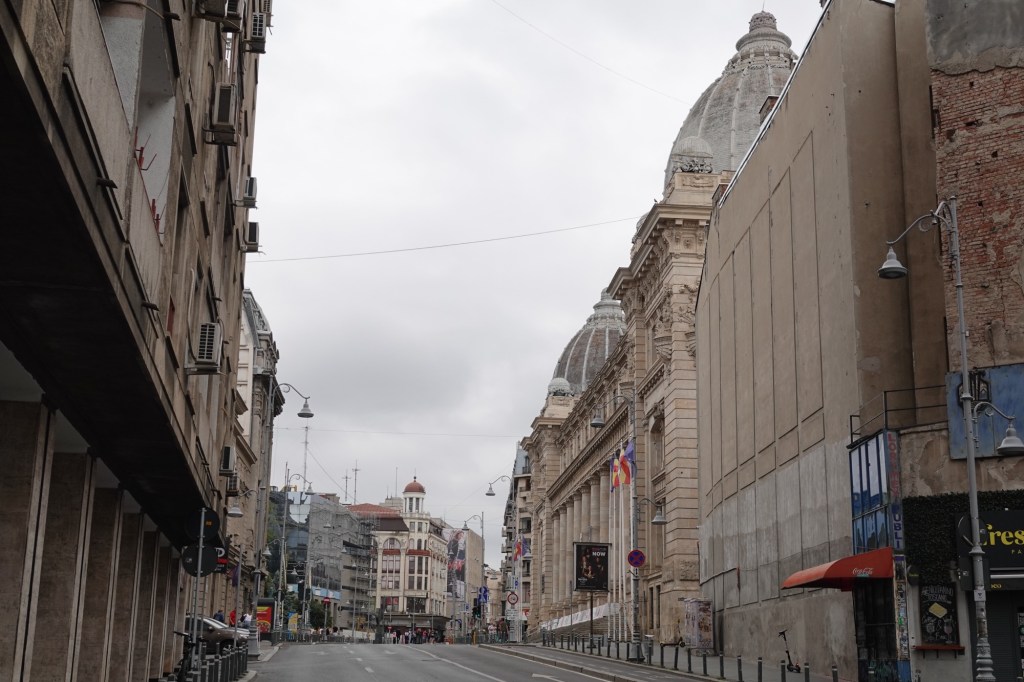
Victoria (Victory) Street gets closed to traffic every weekend to create a pedestrian mall. It was virtually deserted at 10 a.m. this Saturday.
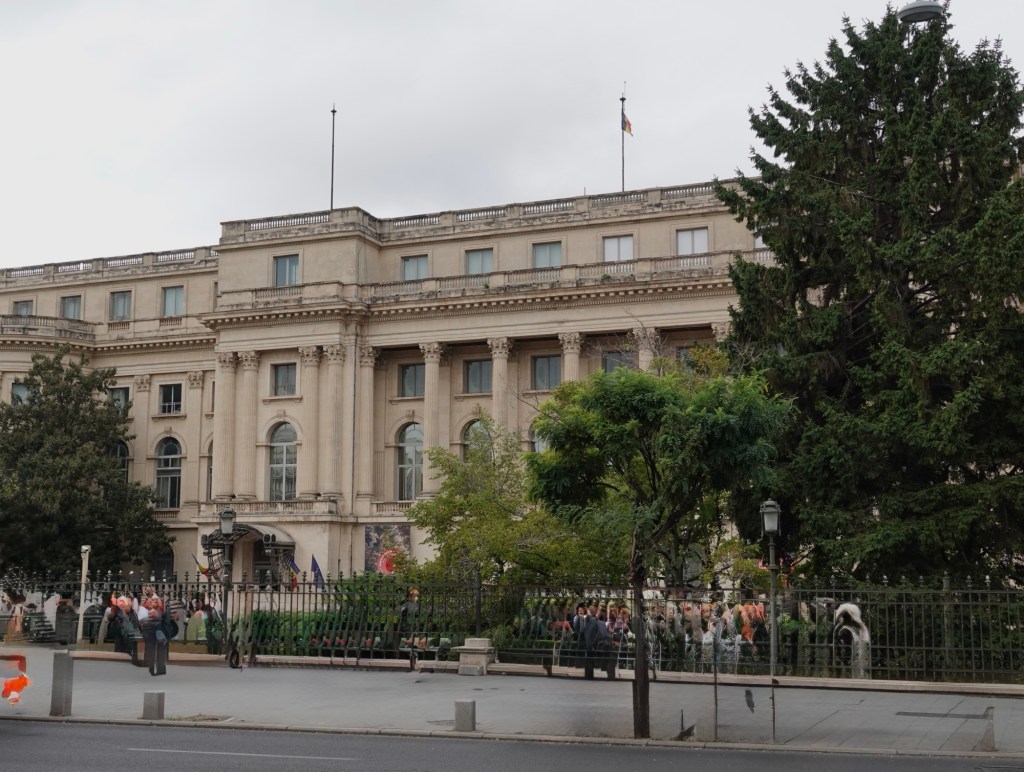
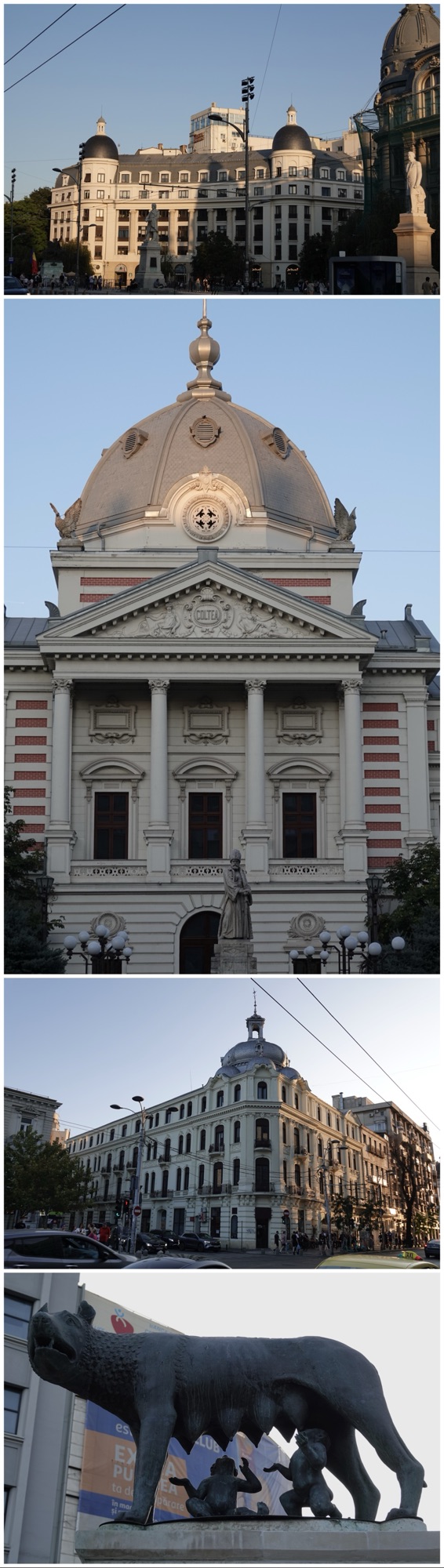
Our next off-bus photo stop was at Revolution Square, home to the National Art Museum built in 1880 as the palace of the Habsburg kings. It was destroyed in the 1944 bombings, but was reconstructed during Ceausescu’s period.
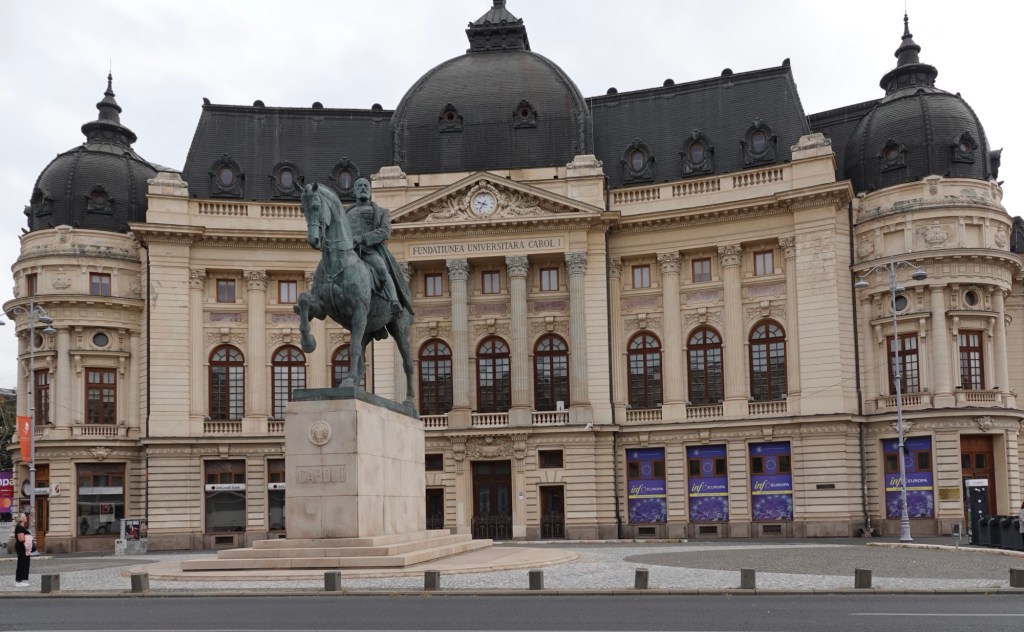
On the opposite side of the street in front of the Central University Library is a statue of King Carol 1 (1866-1914). The horse’s one leg raised raised signifies that the king was wounded in battle (during the War of Independence) and eventually died as result of those wounds. He famously wore a steel crown made of melted steel from the cannon that wounded him.

The obelisk was erected in 2005 to celebrate the 25th anniversary of the 1989/90 revolution, with the steel “potato”representing communist rule being pierced.

Our final stop was a short tour in the Old Town sector.
Our guide told us about Constantin Brâncoveanu, (1654-1714), the last Romanian prince of Wallachia during the Ottoman rule of that part of what is now Romania. He was the one who negotiated anti-Ottoman alliances, first with the Habsburg monarchy, and then with Peter the Great’s Russia. For his troubles he was deposed and beheaded by the Ottomans.
Brâncoveanu was known beyond his politics for harmoniously combining in architecture the local mural and sculptural painting traditions with the Neo-Byzantine style and the innovative ideas of the Italian Renaissance, giving rise to the Brâncovenesc style.
The best examples we saw of this style that we saw were Kretzulescu Church (below) …

… the Stavropoleos Monastery, built in 1724, famed for the intricate detail of its décor. Services here celebrate the monastery’s musical heritage by playing Byzantine music; the church’s choir is recognized the world over and its library houses the largest collection of Byzantine music books in Romania.

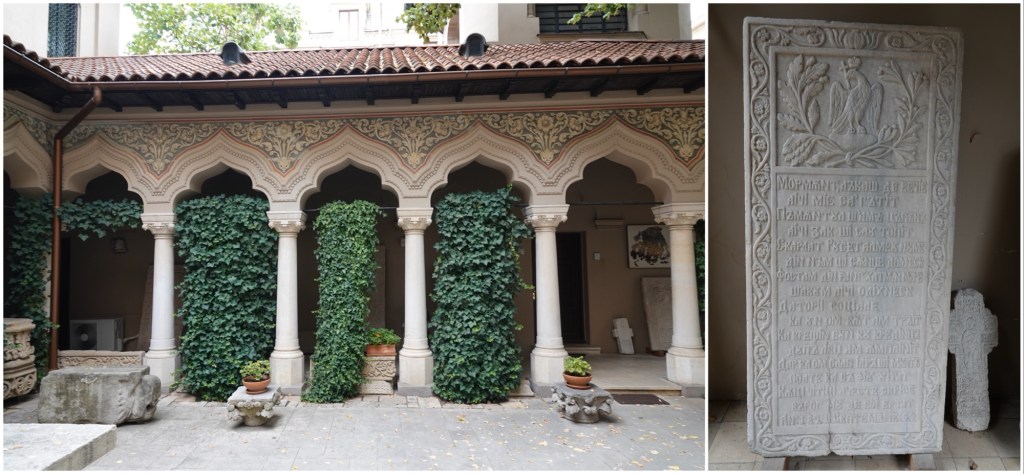
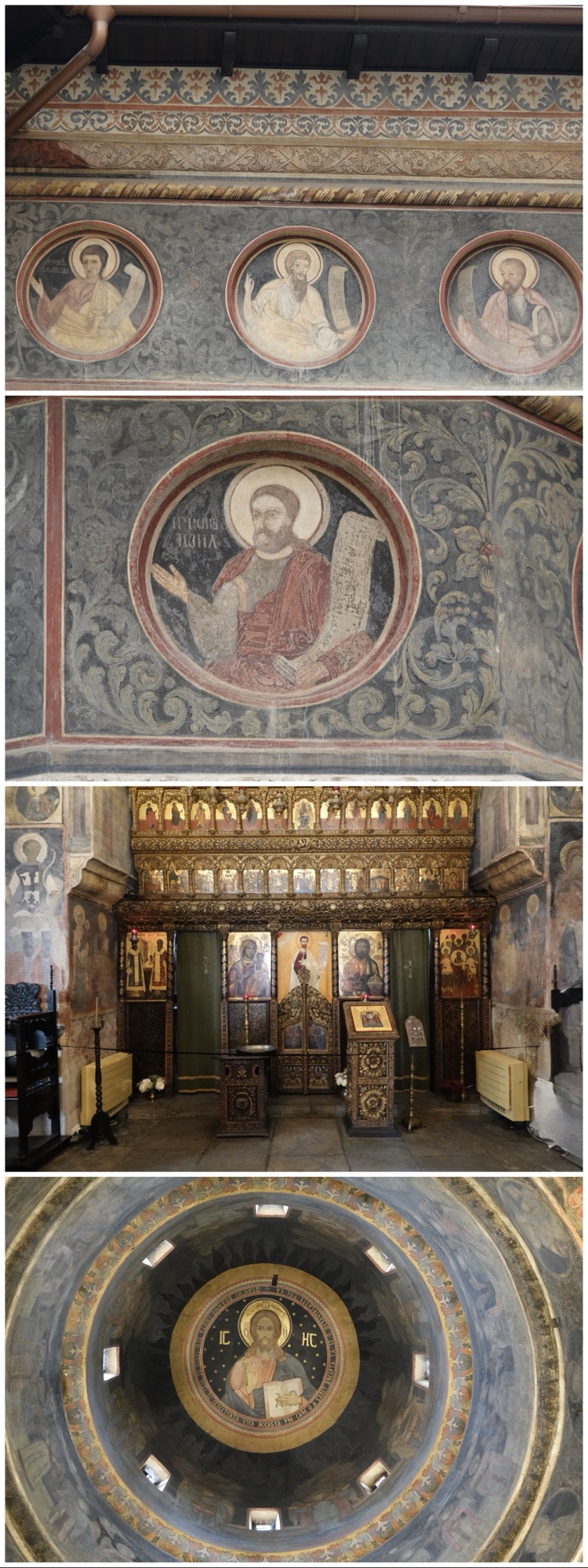
…and Saint Anthony’s Princely Old Court Church, the oldest church in Bucharest, originally built in 1550 in the Byzantine style but rebuilt several times.

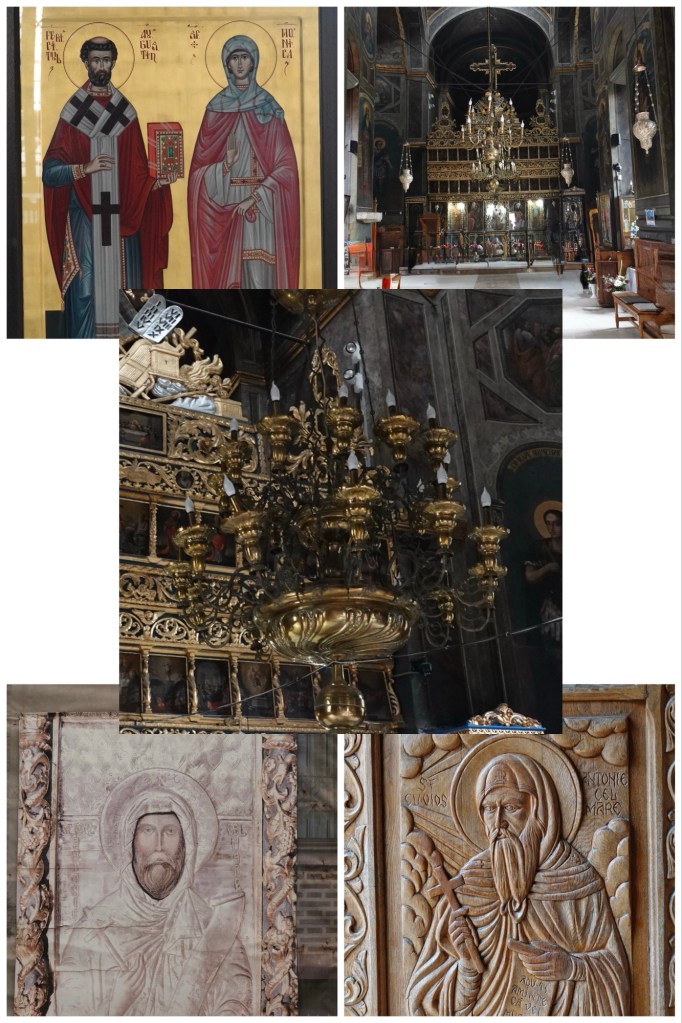
Beside Saint Anthony’s is the actual castle of Vlad III (the “impaler” of 1000’s of Turkish soldiers ). The castle has been behind hoarding under renovation “forever”, and is still not open to the public. We learned that Vlad III did not ever live in Bran Castle in Transylvania; that misconception is totally due to Bram Stoker’s novel.

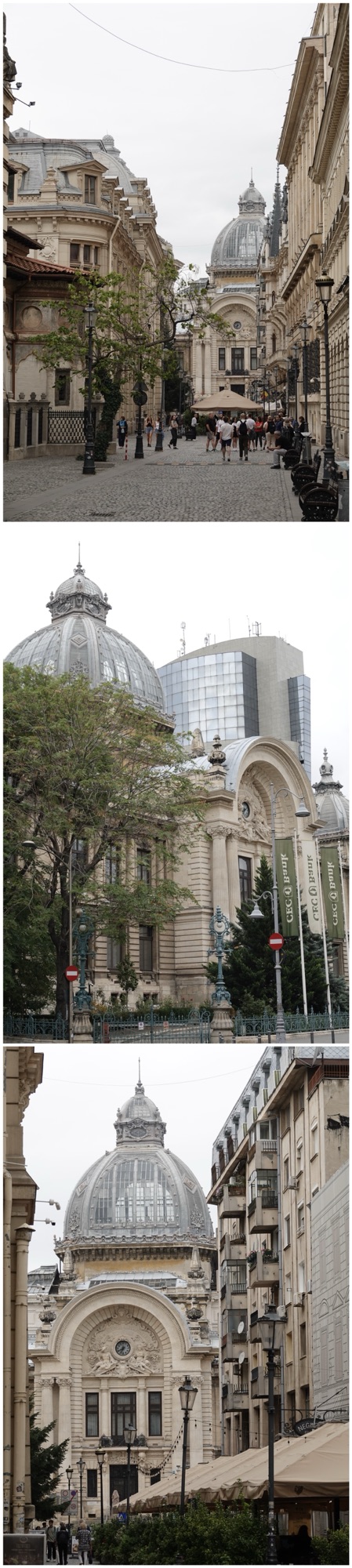
At the opposite end of the street the building with the gorgeous glass dome is the CEC Bank Palace.
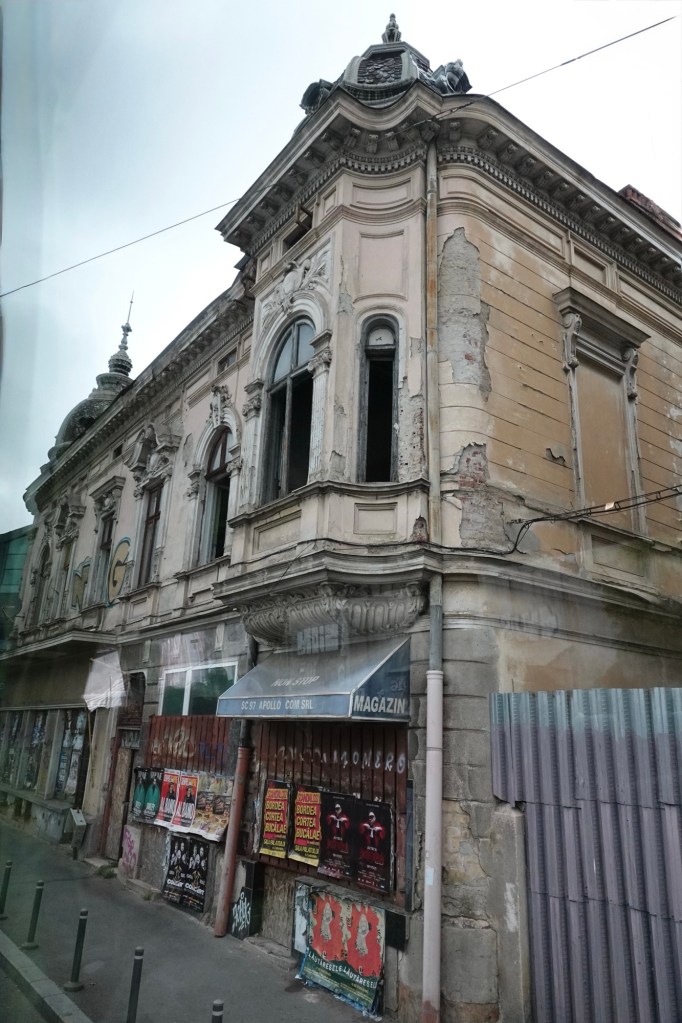
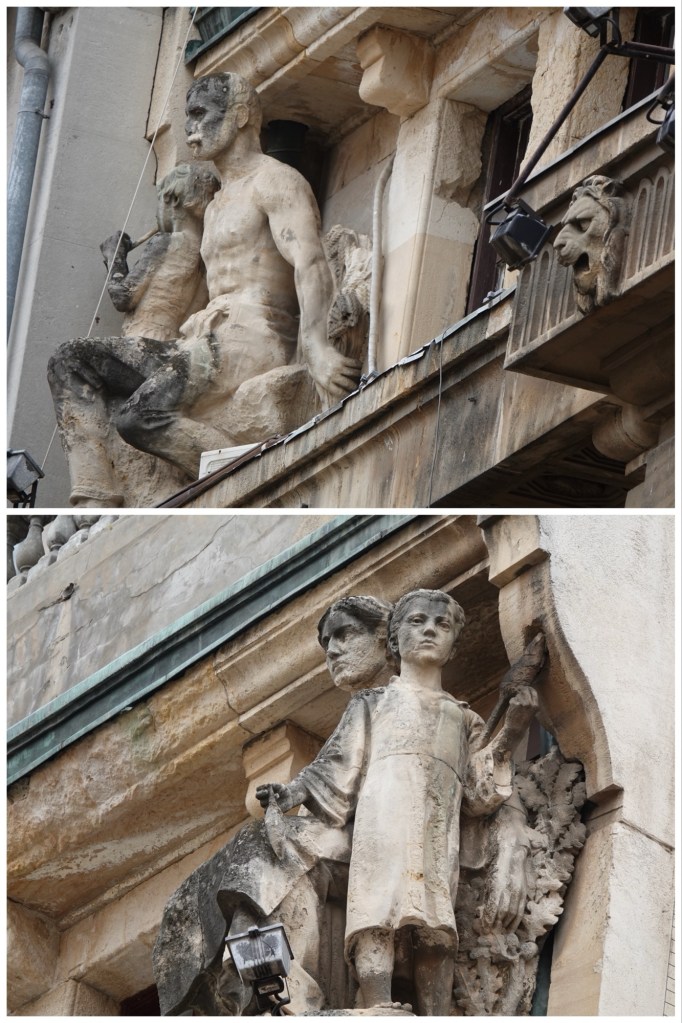
We admired the statues atop the Banca de Credit Roma. Like many buildings in Bucharest, they are in dire need of cleaning.
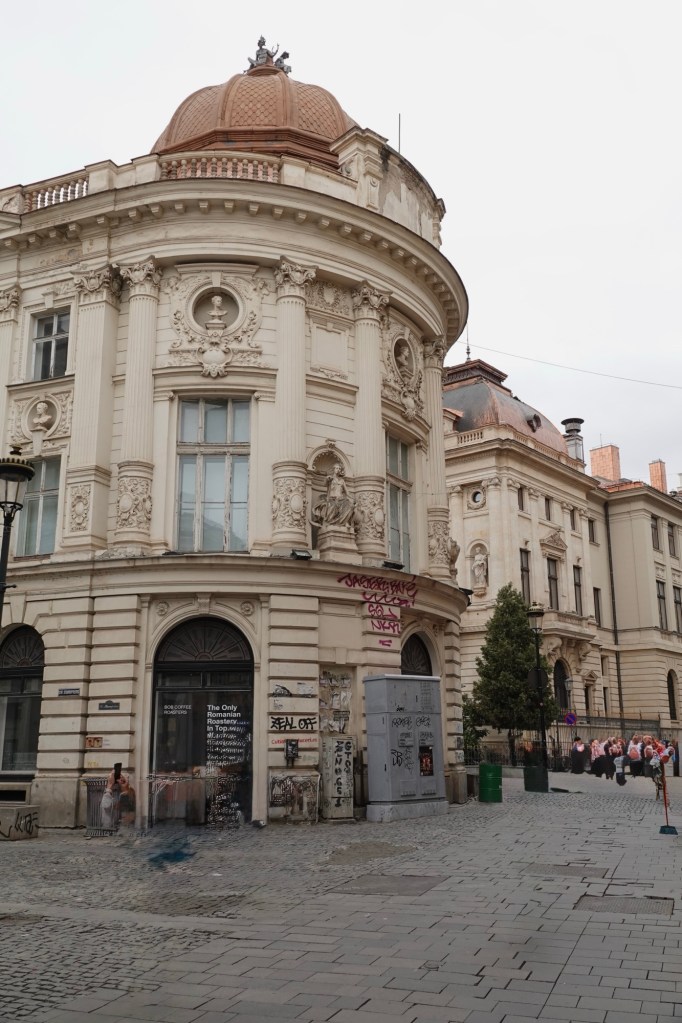
The centre of town, now shops and restaurants, is built on the foundations of all the old palaces. The original renovation and restoration of old town happened during Ceaucescu’s regime, and a second renewal took place in the early 2000’s.

A bit of free time to wander ended our morning tour.
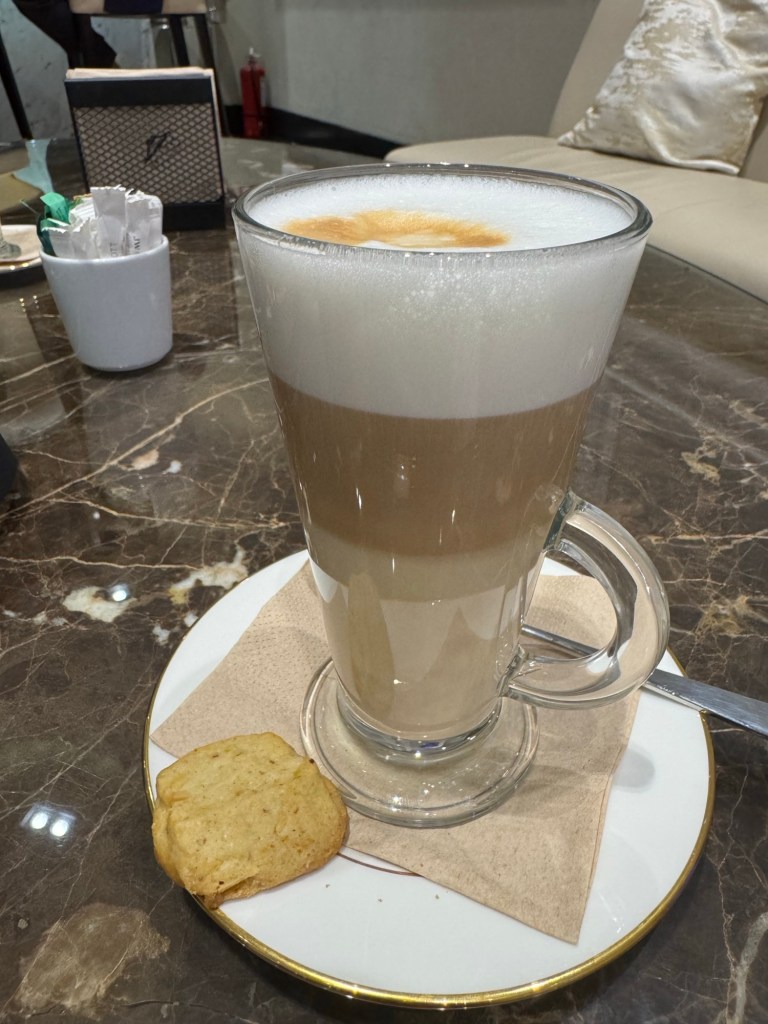
Lunch was not included, and we didn’t have a ton of time back at the hotel before our afternoon excursion to the interior of the “People’s Palace” , which is a separate episode – so we simply had gorgeous foamy lattes in the hotel’s Pavilion bar.
In the evening, we headed out to experience the “Sights & Flavours of Bucharest”. After a short drive, stopping to walk around University Square, we headed to a local restaurant, Lacrimi si Sfinta (“teardrops and saints”) for plum brandy, and appetizers of meatballs, cheeses, and eggplant spread before enjoying traditional Romanian cabbage rolls accompanied by polenta and hot peppers for our main course. Thank goodness for the sour cream provided to cool down the peppers, which were somewhere between jalapeño and habanero on the heat scale.

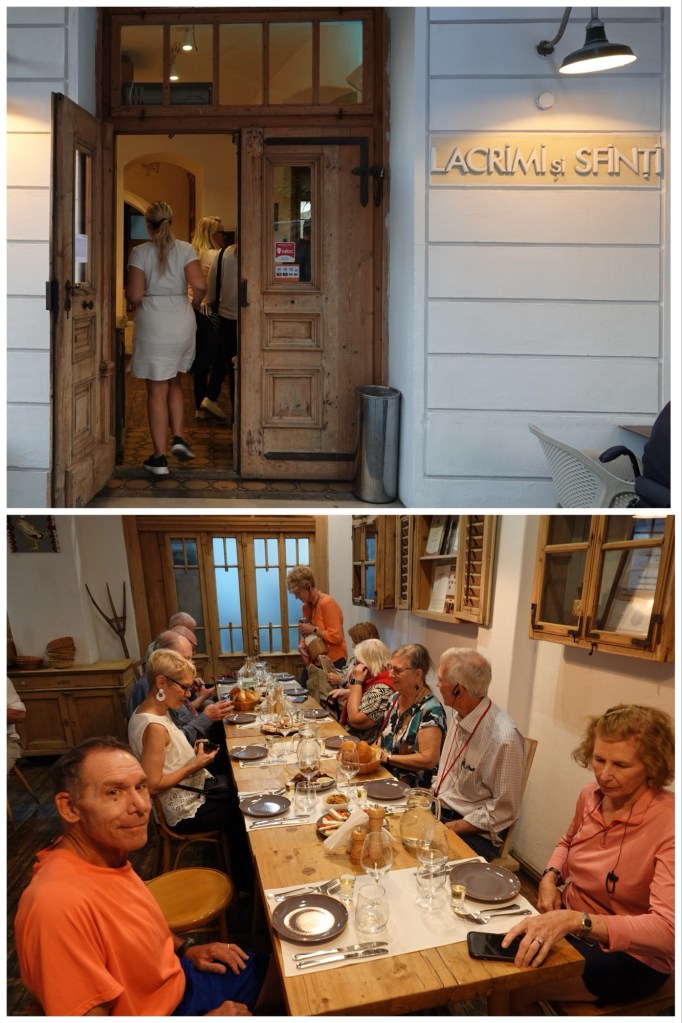

After dinner we reboarded our coach for a short drive to another establishment for classic Romanian desserts, including crepes stuffed with ground walnuts and honey, preceded by more plum brandy followed by delicious cherry schnapps.
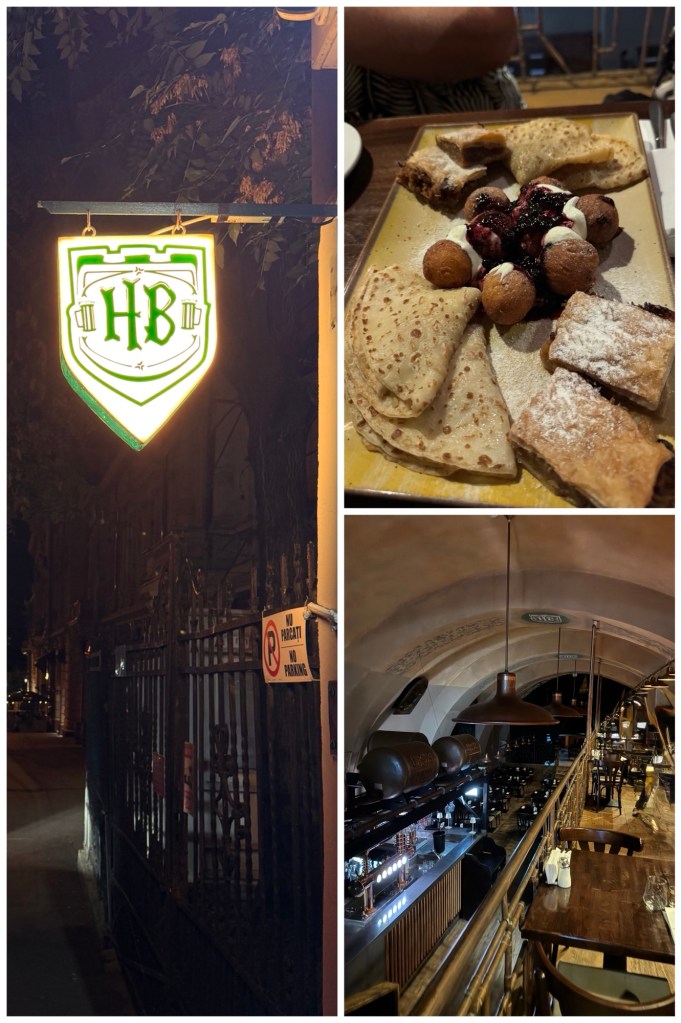
Tomorrow, Constanța. But first, an episode all about Romania’s “People’s Palace”.
 Rose and Ted’s Excellent Adventure
Rose, I’m loving the pictures and the narratives. This is one of the cruises Ken and I have been looking to book. I always look forward to your blog. Best, Chiquita
LikeLiked by 1 person
I’m so glad you are doing this cruise/tour. I haven’t been able to convince my DH that Eastern Europe is where he wants to spend time and money — so I’ll follow along with interest. Your writing and Ted’s pictures still make the best travel blog I’ve found. Thanks!
LikeLiked by 1 person