During our period of non-travel while the world was shut down due to the Covid19 pandemic, I spent some time writing down what I knew about my parents’ early lives and their immigration to Canada. (Episodes 65 through 77).
Last year, son #2 and I travelled to Germany together so that he could see where his grandfather had spent his late teenage years as a DP (Displaced Person) in Lower Saxony in the post WWII British Zone until finally emigrating to Canada (Episodes 691 through 702).
This year, son #1 and I are travelling through Austria and Germany to the places that my mother passed through en route from Hungary to, eventually, Canada.
Time limitations (son #1 already using up 3 weeks of their precious annual vacation time for this) mean that we’re not beginning our trek in Hungary, much as I would have loved to show them Budapest. My mom didn’t ever live there, but would have been “collected” there by whatever agencies were helping to move people out of what would become Russian zones.
All of her travel was by train.
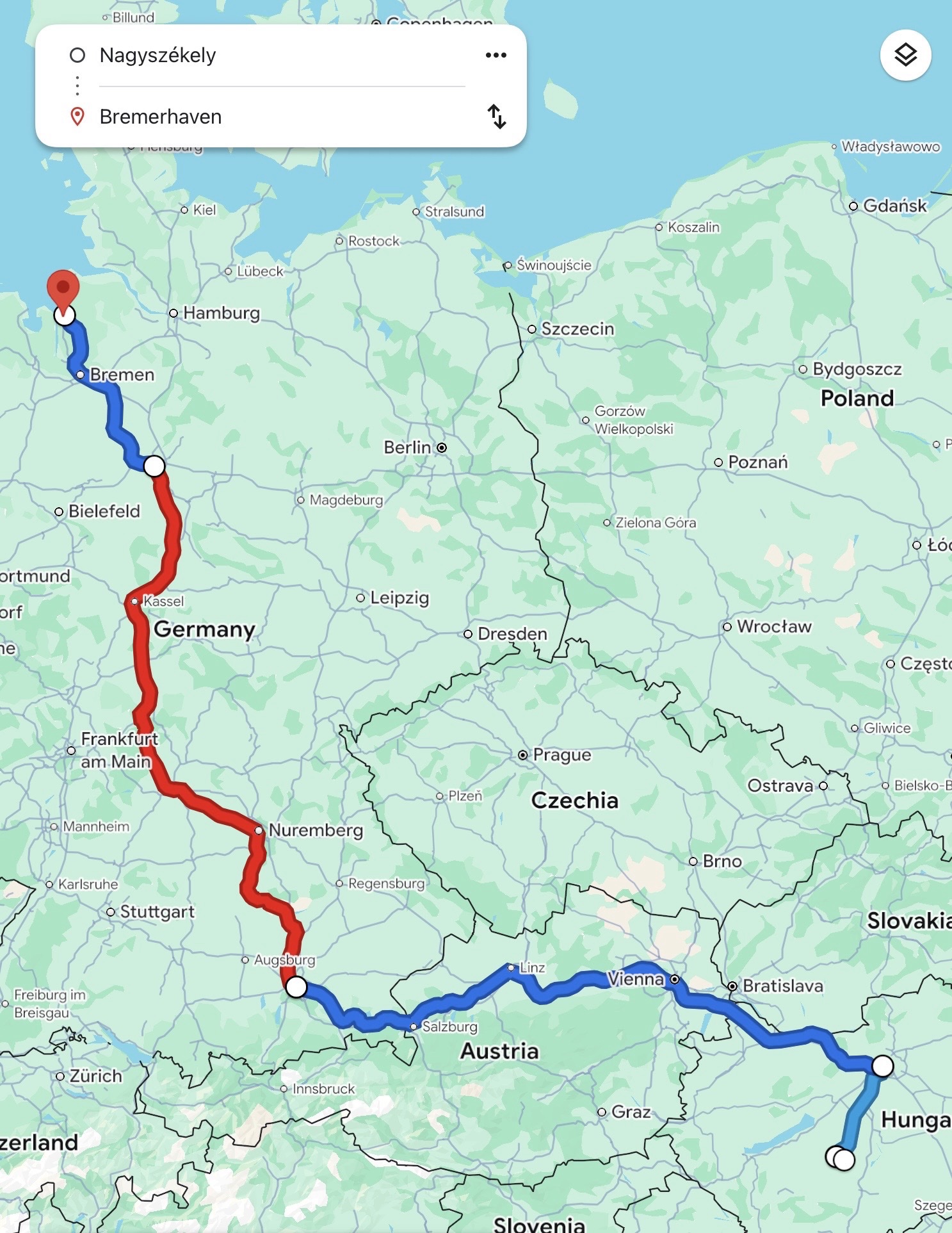
Today the entire trip could be made in about 22 hours, but that was not the case at the end of WWII.
After the war, Displaced Persons (DPs) from Hungary travelled initially to Vienna and then to Bremerhaven via US Army-organized trains, passing through Austria and the American Zone of Germany. These routes often took multiple days, departing from hubs like Linz (Ebelsberg) and passing through assembly centers in Bavaria and central Germany before reaching the Bremerhaven port of embarkation.
While the routes themselves might take days, the entire relocation process could – and often did – take years, while suitable destinations were found for the millions displaced from their homes.
In my mother, grandmother, and great-grandmother’s case, their assembly centre was called Pleinting 85, and was on the outskirts of Vilshofen, just outside Passau, in Bavaria. They arrived there sometime in 1945 (the record below seems to read 1944, but Pleinting 85 was not established until 1945), and my mother finally came to Canada in 1949. It was a further two years before she was able to bring my grandmother to Canada in 1951, and then another three before my great-grandmother was on her way in June 1954. In the interim, Vilshofen became a community of DPs, with children attending school and the local churches hosting weddings and baptisms.
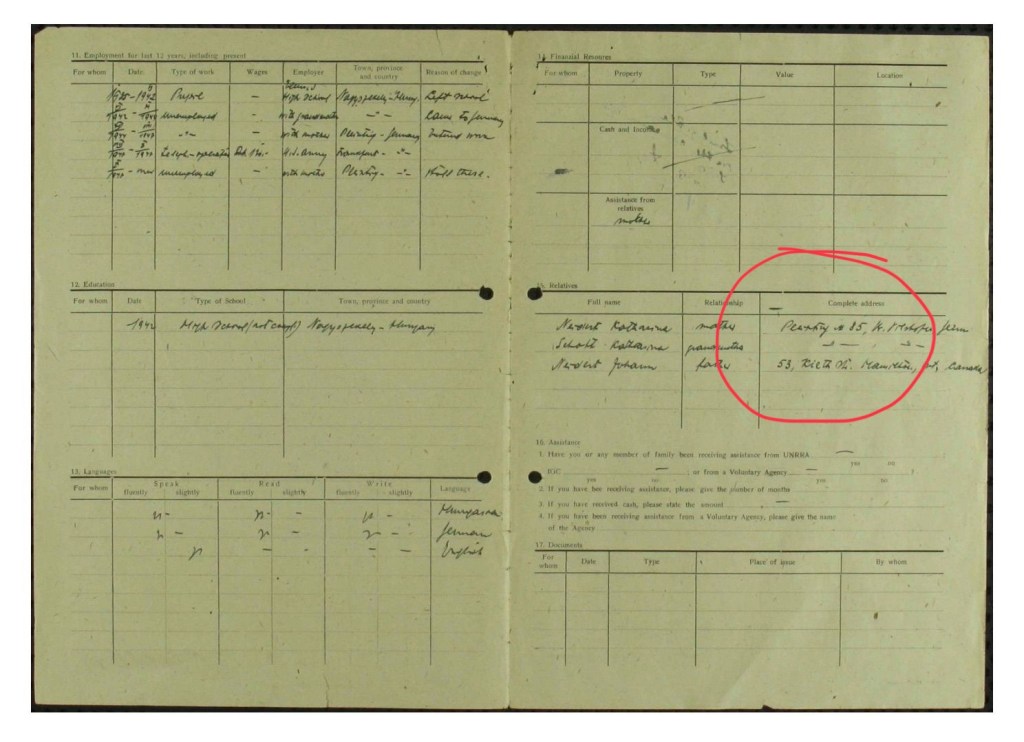
When recalling her life before immigration to Canada, the first place my mom always talked about was Vienna (specifically her memories of Schönbrunn), then Vilshofen – naturally, given the almost 5 years she lived there – and then Köln (Cologne), which was a detour from the usual stopping point of Frankfurt. Her yellow card above shows a short period of working for the US Army in Frankfurt (fourth entry top left), where her English was good enough to allow her to work answering phones, but she didn’t talk about that city or that time at all – only about Köln’s cathedral, so that had to be on this trip’s list.
We’re going to visit the main stops on the train route that my mom would have taken – travelling by train as she did (only not really, because we’ll be in first class carriages) – although not in the same order since we need to create a route that will take us from and back to the Frankfurt airport.
That means our journey, in order, will be: Frankfurt, Köln, Bremen, Bremerhaven, Nuremberg, Vienna, Passau (Vilshofen), and back to Frankfurt.
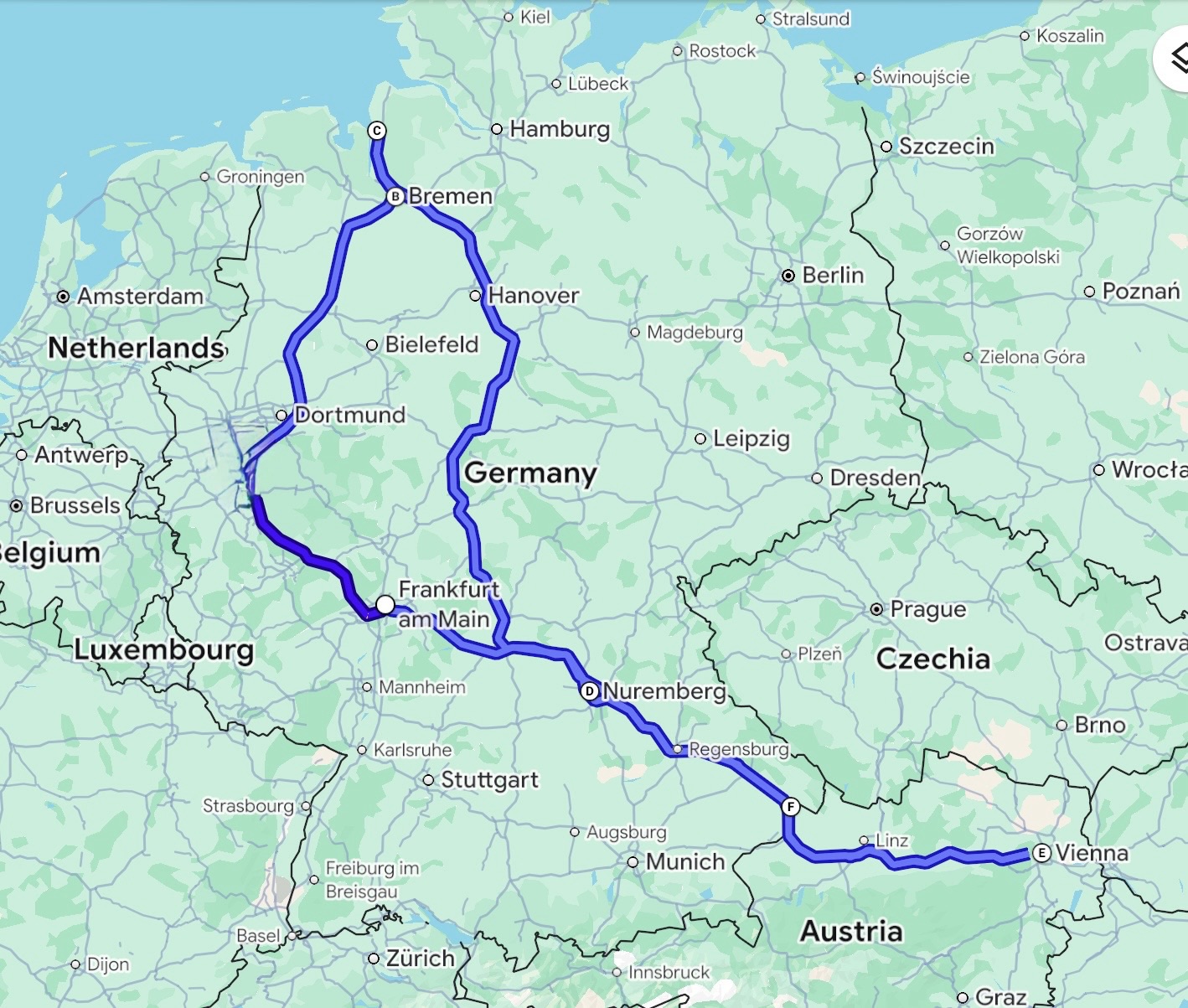
We’ll try to see the things that my mom saw over 75 years ago, and imagine them as they were in 1945-49. Of course, we’ll also enjoy what each of those cities has to offer today, in an age where food, shelter, and entertainment are much more readily available.
Seven cities in 21 days means doing our best to travel light and not need to do laundry beyond what can be done in a hotel sink and dried overnight. One or two of our hotels will have laundry service if we’re desperate.
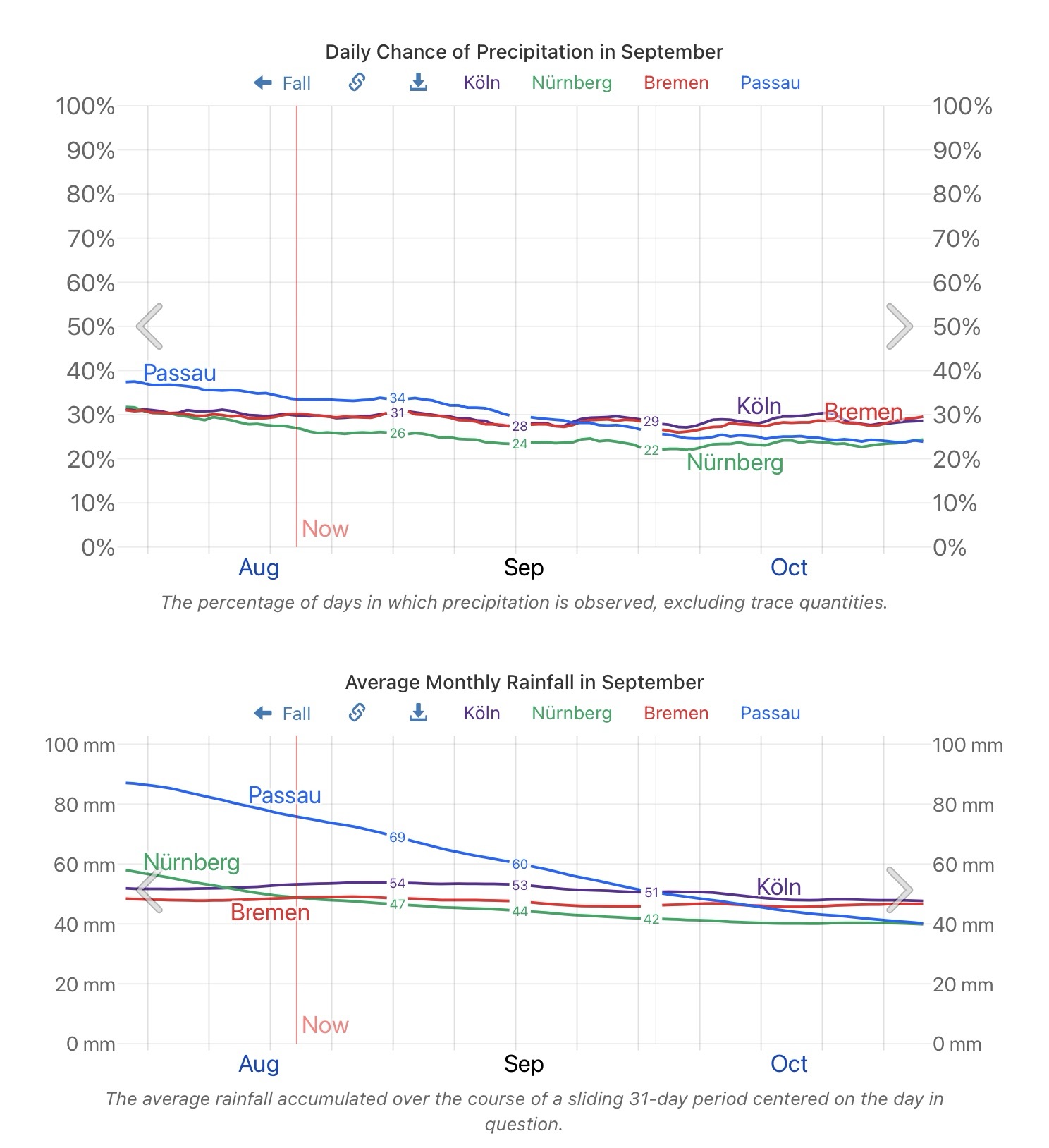
Weather in Europe this year has been anything but typical, but weatherspark.com is a great resource for tracking trends in multiple cities.
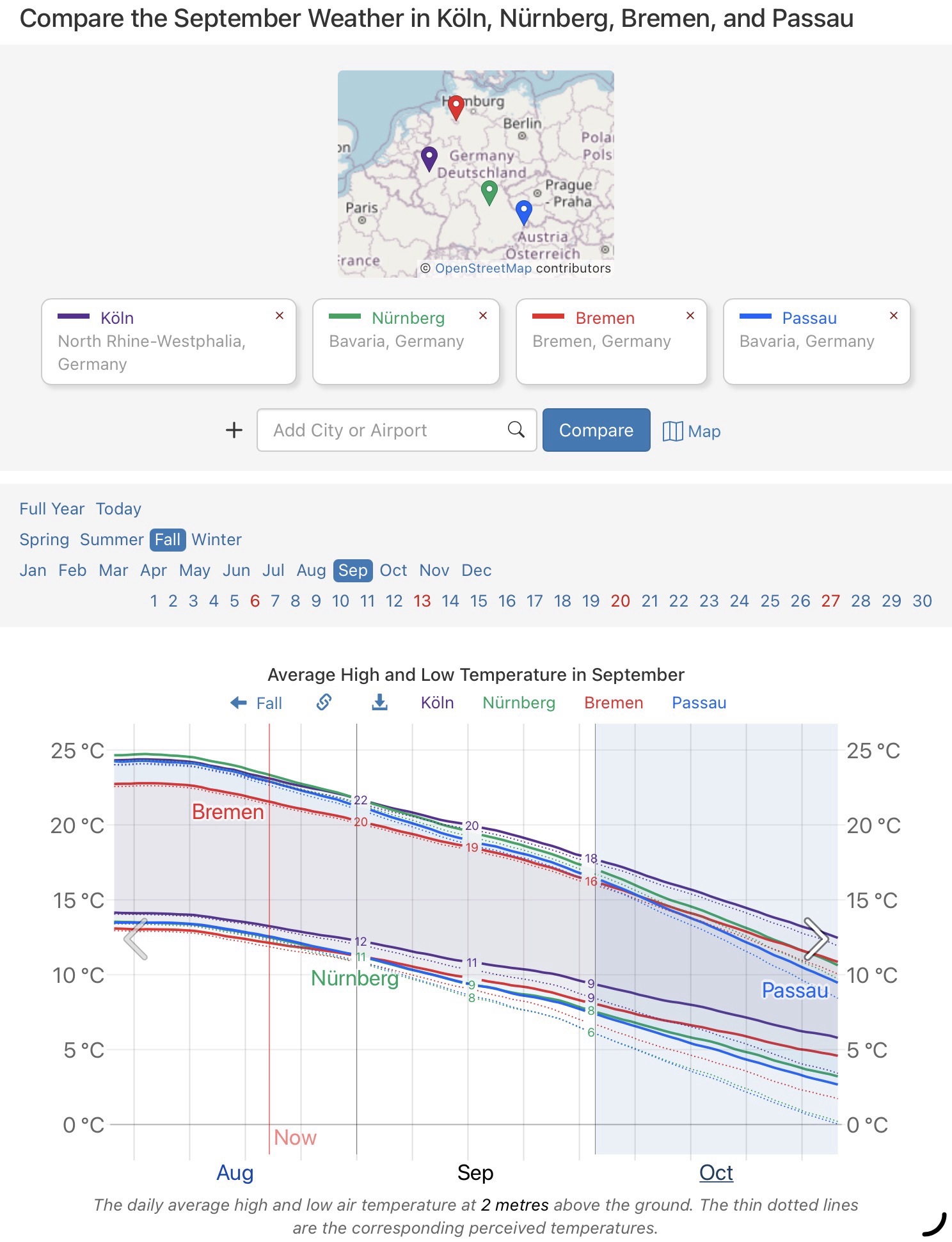
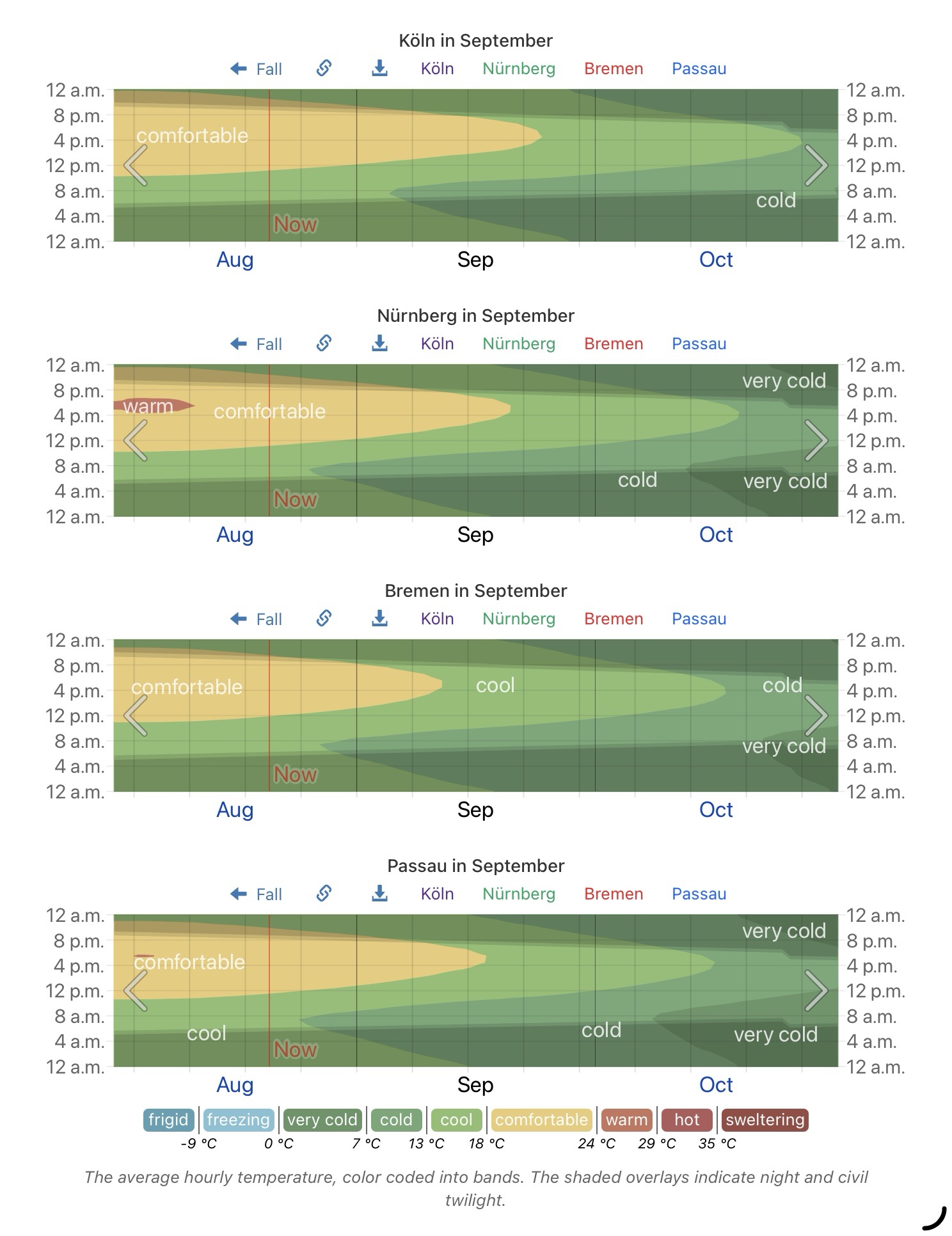
It also has precipitation trends. Given the length of our stay, it’s probably just as accurate as forecasts from my Accuweather app.
Son #1 and I have similar packing plans: two or three pair of pants beyond what we wear in transit (for them, one nice enough to wear to the concert in Vienna to which I booked tickets; I’ll just add some jewellery for that event), and 10-12 lightweight shirts (each of which can be worn twice).
Add undergarments, an extra pair of shoes, a cardigan and jacket to layer as needed, a scarf, a raincoat and umbrella, and our tech gear (phones, tablets, plug adapters, charging cables, power banks, #1’s CPAP machine) – plus toiletry bags and jewellery – and we’re done.
Looking back, my list is essentially the same as what I took for June 2025’s two week long mother/son Germany trip with son #2 (Episode 691), although the individual items only partially overlap. It worked then, so I have high hopes that it will work again. June and September weather are not that different.
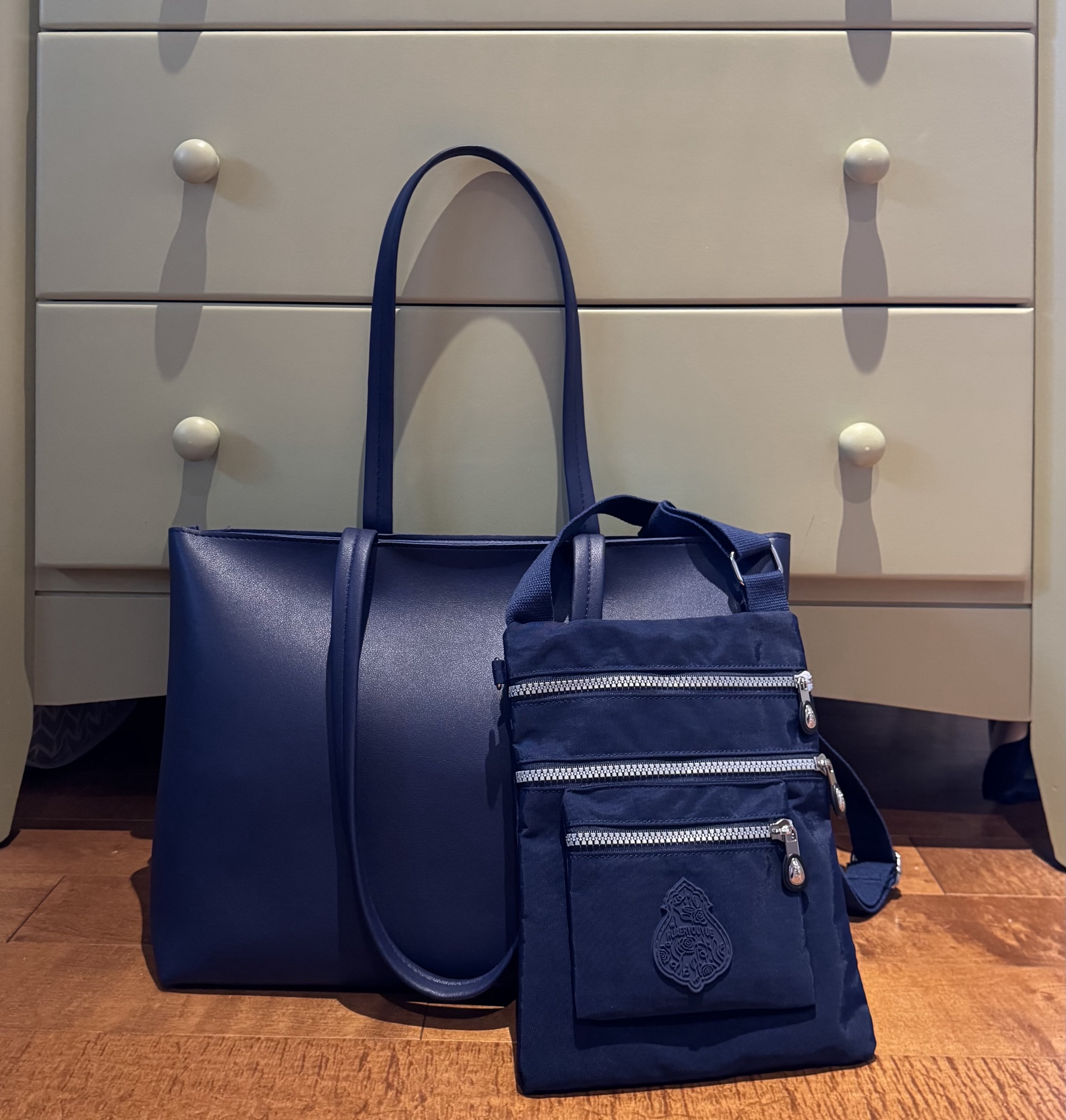
Everything we’re taking translates into a carry-on size bag each, which we’ll check on our non-stop flights, plus a large-ish shoulder/courier bag each as our actual carry-on.
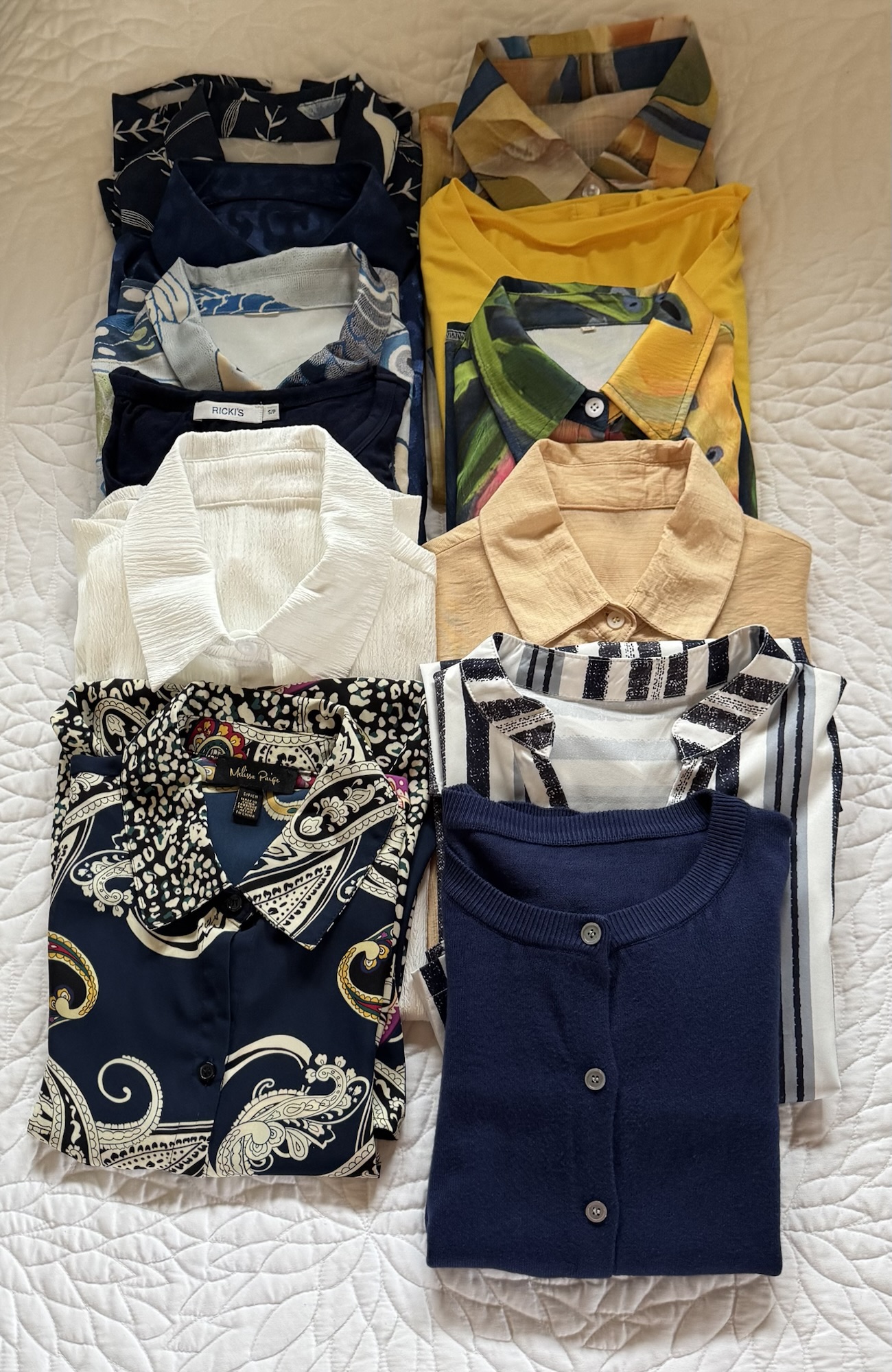
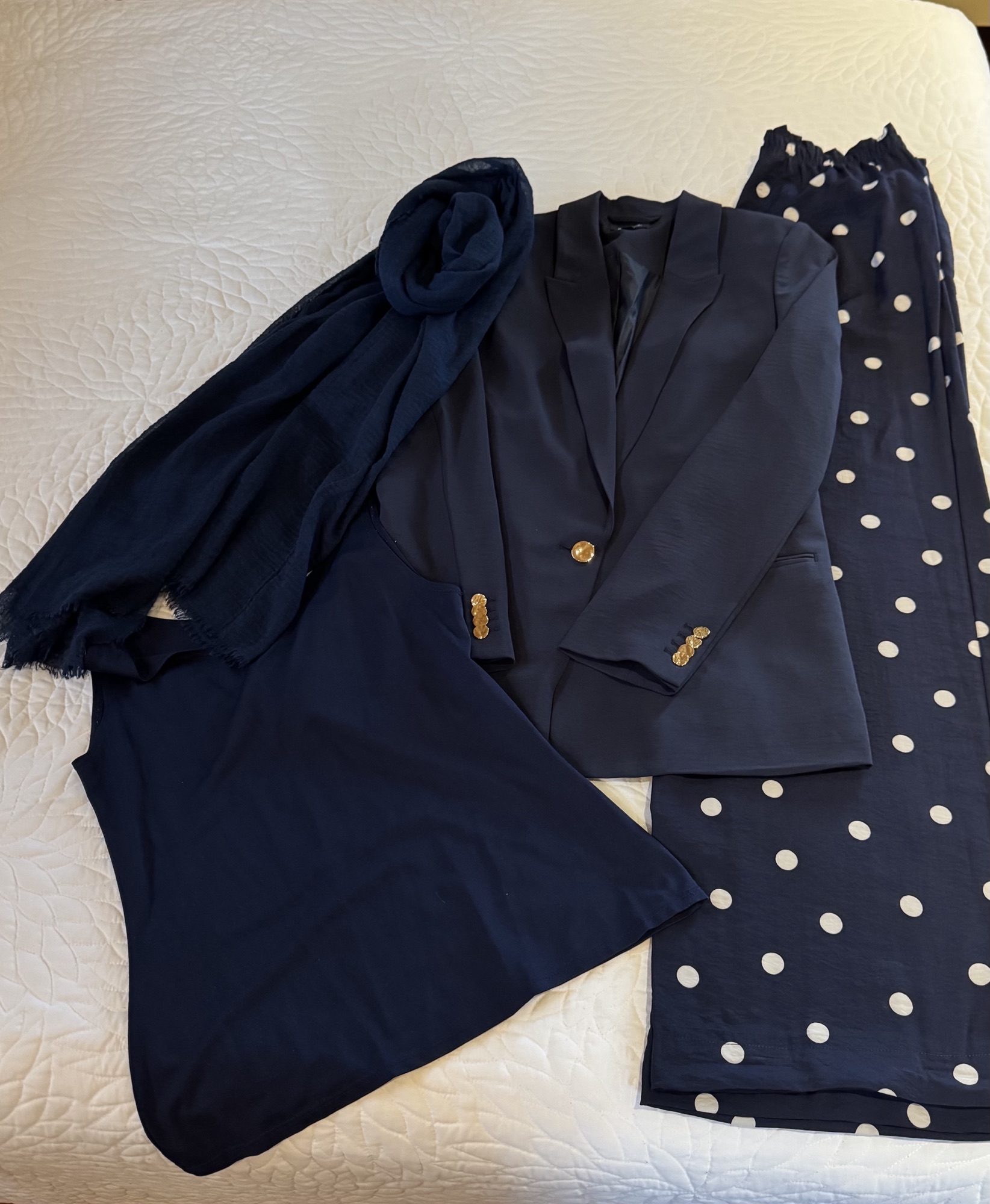
I bought several new pieces of clothing for this trip: a navy linen blazer, tailored pants and jeans in a required new size for comfort – a carryover from our 5 months away this year), a couple of additional shirts, and a pair of wide toe-box flexible soled shoes for the tens of thousands of steps we plan to do.
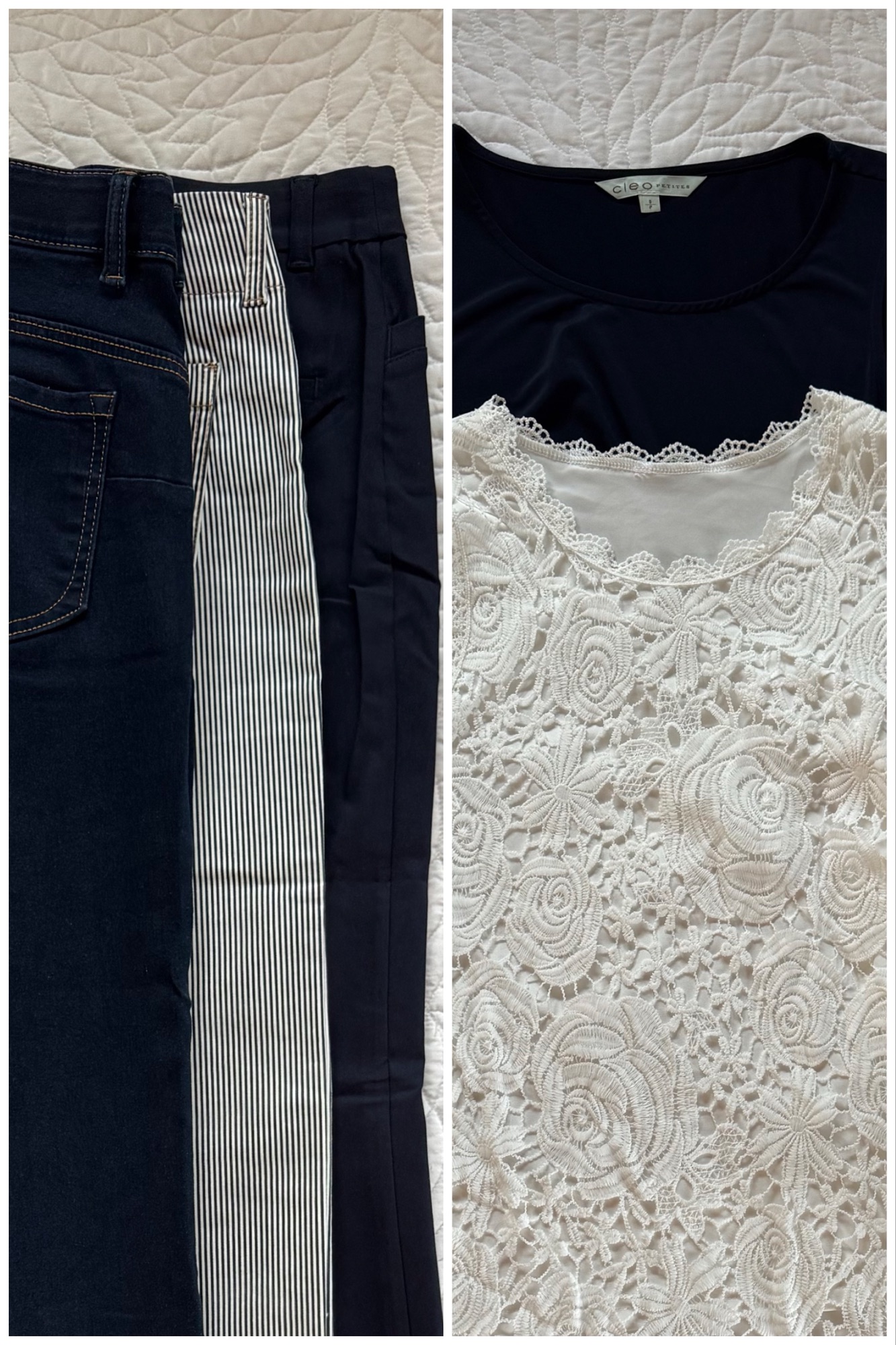
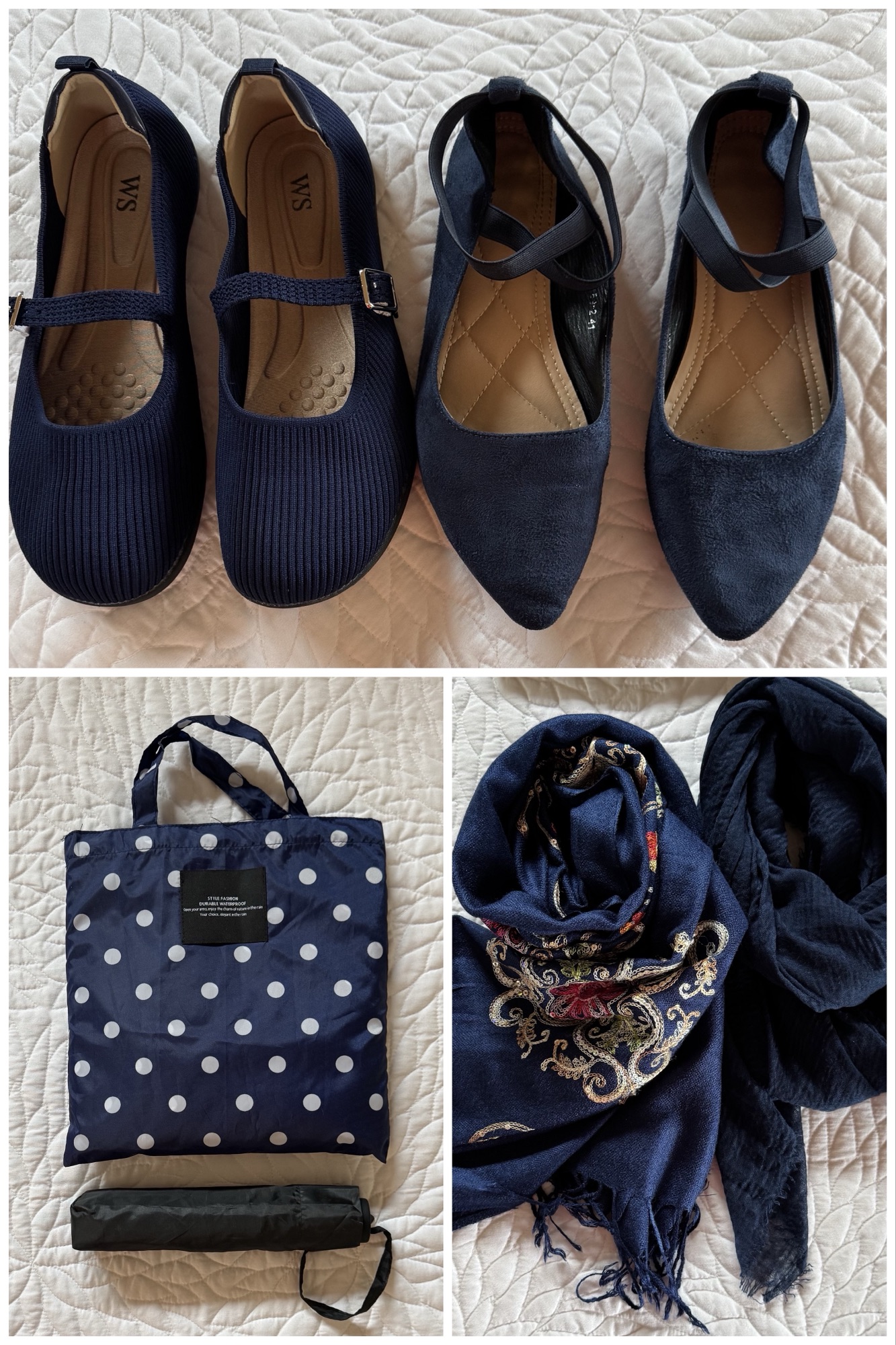
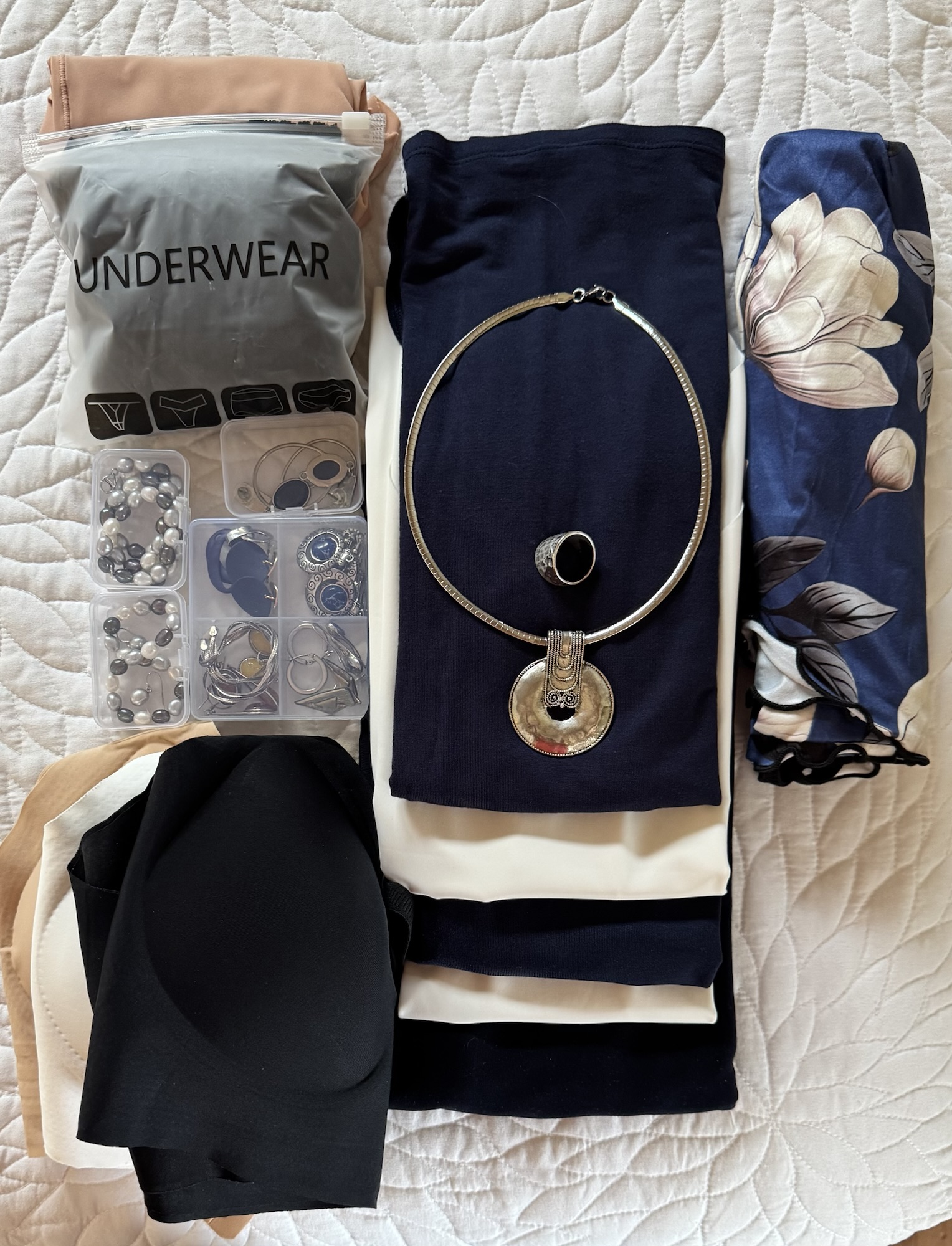
The pre-packing photos may not be exciting, but I use them as verification of what is in my suitcase, should one ever go missing.
I’ll wear my bulkiest shoes (a pair of super comfy Flyflot brand Italian clogs), a pair of soft palazzo pants (that coincidentally match my raincoat), and my blazer in transit. The blazer will be my “travel days” go-to item on trains in Europe as well, conserving suitcase packing space and hopefully preventing too much creasing.
My shoulder bag will hold my iPad, charger and cords, planning journal with extra records of all our reservations, and anything I’ll need for my overnight stay at the airport hotel in Toronto.
As is always the case for me, I’m excited to get going. I’m pretty sure #1 is too.



Bon Voyage! Look forward to your posts! What brand or where did you get your blazer?
LikeLike
Looking forward to following your trip! Where or what brand is your Navy blazer? Looks nice!! Bon Voyage!
LikeLiked by 1 person
The blazer is from Reitmans -on clearance right now! (But dies have to be dry cleaned)
LikeLike
Gute Reise! Eat a wurst for me — with mustard and maybe a dry Reisling! I’m back to vicarious travel till we leave to do Viking’s circumnavigation of Australia over Christmas. I’ve been rereading your posts about Australia — and for a later trip, Malta. Thanks for your writing — with pictures or not!
LikeLiked by 1 person
Oh, many würstchen will be eaten – and a few glasses of Riesling drunk. I’ll toast to you with one of them!
LikeLike
Oh, my German spelling is atrocious!
We just watched a pretty good Australian political thriller – Total Control (2 seasons so far) and I kept telling my husband how much of Canberra I’d already seen thanks to your visit there. We won’t get that far inland on our cruise, but I feel like I’ve been there already. You might enjoy the show.
LikeLiked by 1 person
Dear Rose words fail me what interesting research you have done my story is similar to your family spending time in DP camps after leaving Latvian in 1942 and arriving in Australia in 1949. I have tried to do a brief history for the grandkids but have nobody to ask and memory is scares. Have been back to Latvia and managed to get my original birth certificate 18/2/41 which was very exciting. Look forward to your next episode kindest regards to you and Ted 🌹💕
LikeLiked by 1 person
I’m so glad to have you along on this journey.
I’m very lucky that my sons are interested in our family’s history. I only wish I’d asked more questions when my parents and grandmother were still alive, although on my mom’s side there was great reluctance to talk about those years. I only recently realized how long they were displaced before being able to emigrate. It’s a daunting story. They were much braver than I ever gave them credit for.
LikeLike