Just a 5 minute walk from our hotel is Sydney’s Hyde Park, home to grassy expanses, towering trees, colourful flower beds, wandering Australian white ibis, fountains, monuments, and Sydney’s ANZAC Memorial. It’s a glorious space.
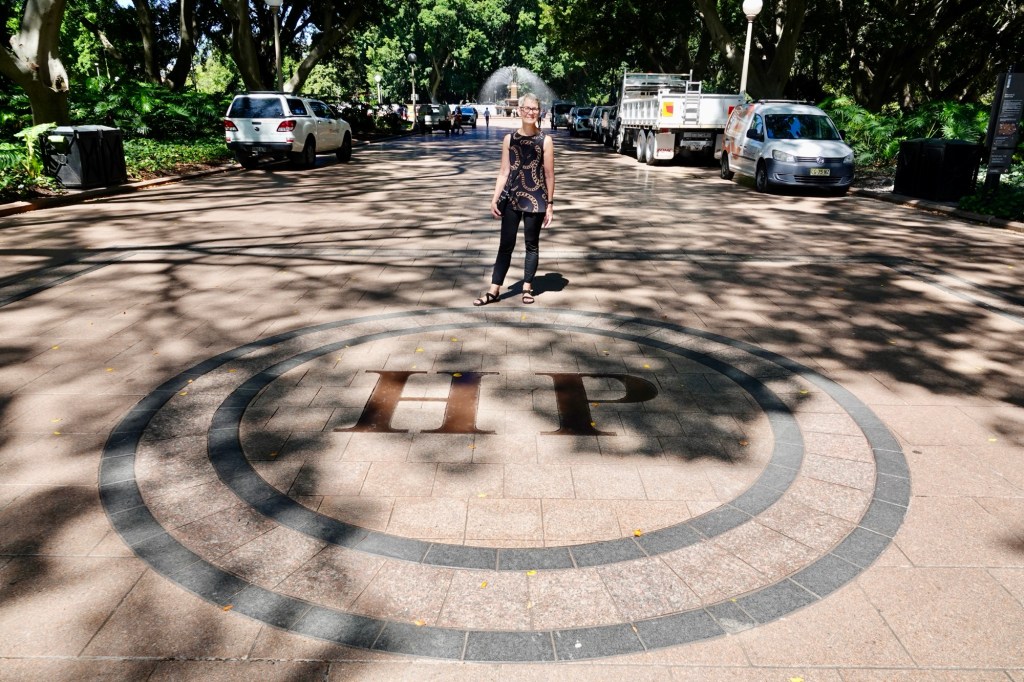
At each end, the park’s entrance is marked with a huge mosaic “HP”, which immediately brought to mind my favourite steak sauce.
Entering the park from the north, what immediately draws the eye is the stunning and dramatic Archibald Fountain. The 1932 Art Deco style fountain, funded through a 1919 bequest in the will of JF Archibald, founding editor of the periodical The Bulletin, and designed by French sculptor Francois Sicard, commemorates the association between Australia and France in World War I.


Archibald was an influential figure in Australia through his popular news magazine, which remained in publication from 1880 until its final edition in January 2008, making it Australia’s longest running magazine. It was described as being “anti-imperialist, protectionist, insular, racist, republican, anti-clerical and masculinist—but not socialist.” When our guide at the ANZAC memorial talked about Archibald’s magazine, he mentioned it’s banner “Australia for the White Man”. I had to check that for myself; Wikipedia verified it.
The fountain is amazing, but I find myself thinking that its donor was less so.
The fountain is huge: a hexagon 18m (almost 60 feet) in diameter. At its centre, backed by sprays of water meant to symbolize the rising sun, is the Greek god Apollo, extending his hand to give life to all nature, surrounded by 3 groups of mythical figures.

The first is Diana with deer and hunting dogs, supposedly bringing harmony to the world.

The second is Pan, with a ram and a goat, watching over the fields and pastures.

The third is Theseus conquering the Minotaur, symbolic of sacrifice for the common good.
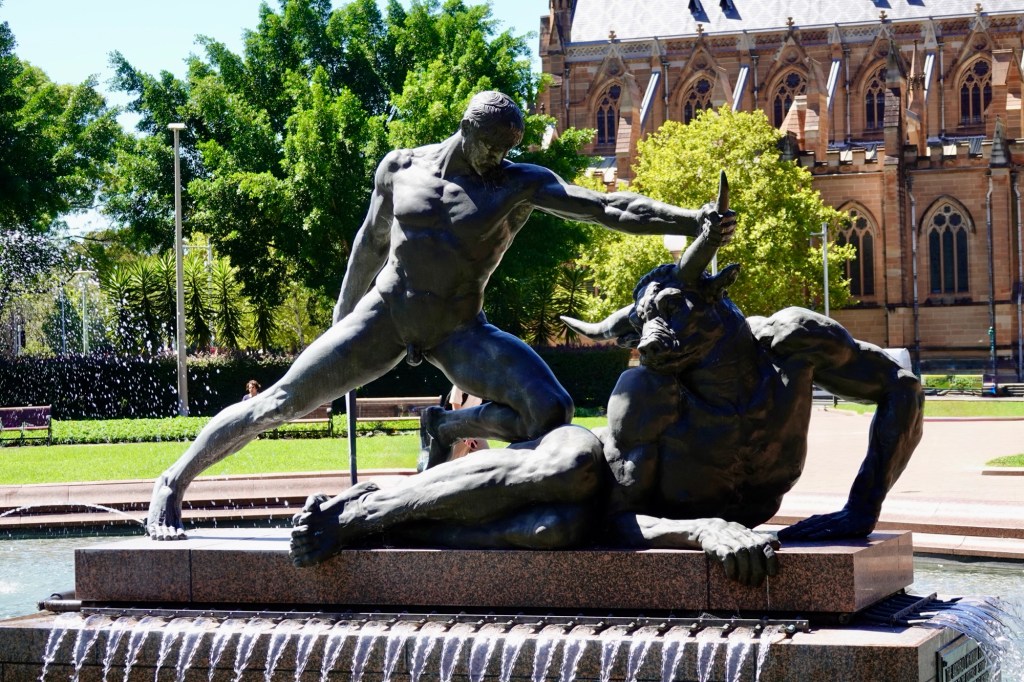
It may or may not be verifiable, but that same Ambassador/guide at the ANZAC Memorial later in the day told us that the fountain’s 3 pools were originally intended to be oriented in a different direction, but that when the memorial was commissioned it was decided that Theseus and the Minotaur would be placed directly in line with the memorial, so that the symbolism of sacrifice for the common good would carry through from mythology to real life.
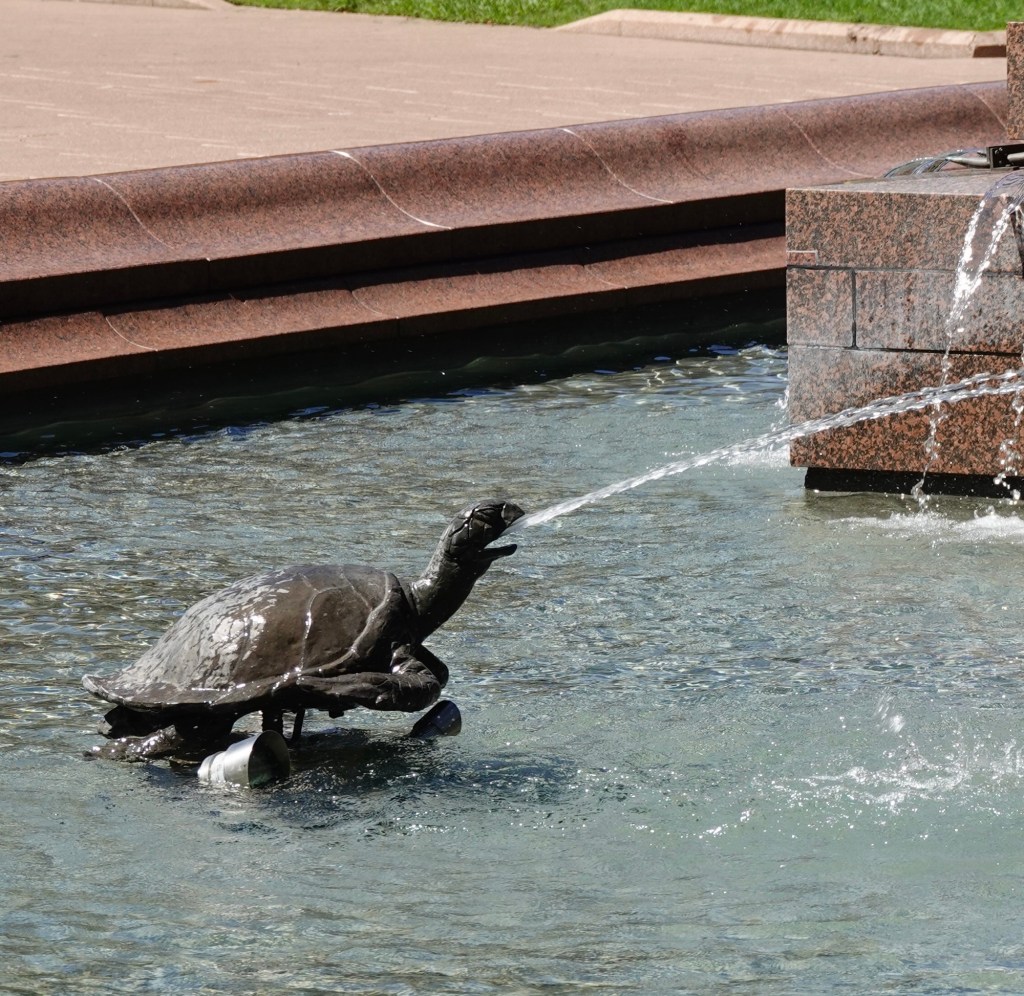
Water sprays from the horses’ nostrils, and from dolphins’ and turtles’ heads. With even today’s slight breeze it was refreshing to stand in the cool mist emanating from the fountain.

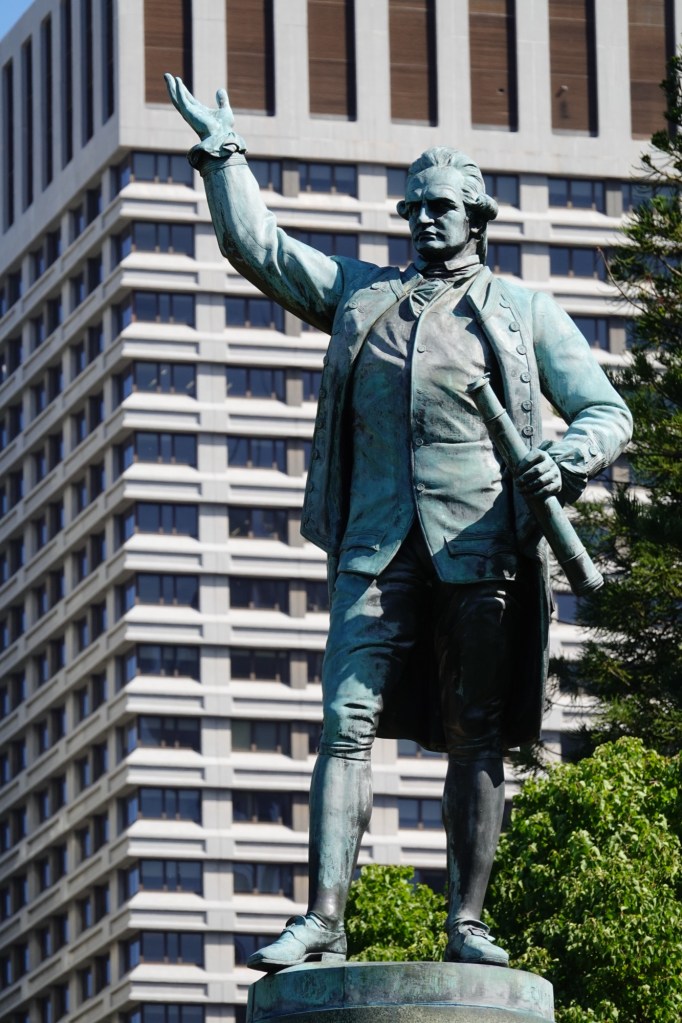
Hyde Park is split in half by Park Street. In the north half, in addition to the Archibald Fountain, there is a huge statue of Captain James Cook, and Sandringham gardens with its fountains dedicated to Kings George V and VI.
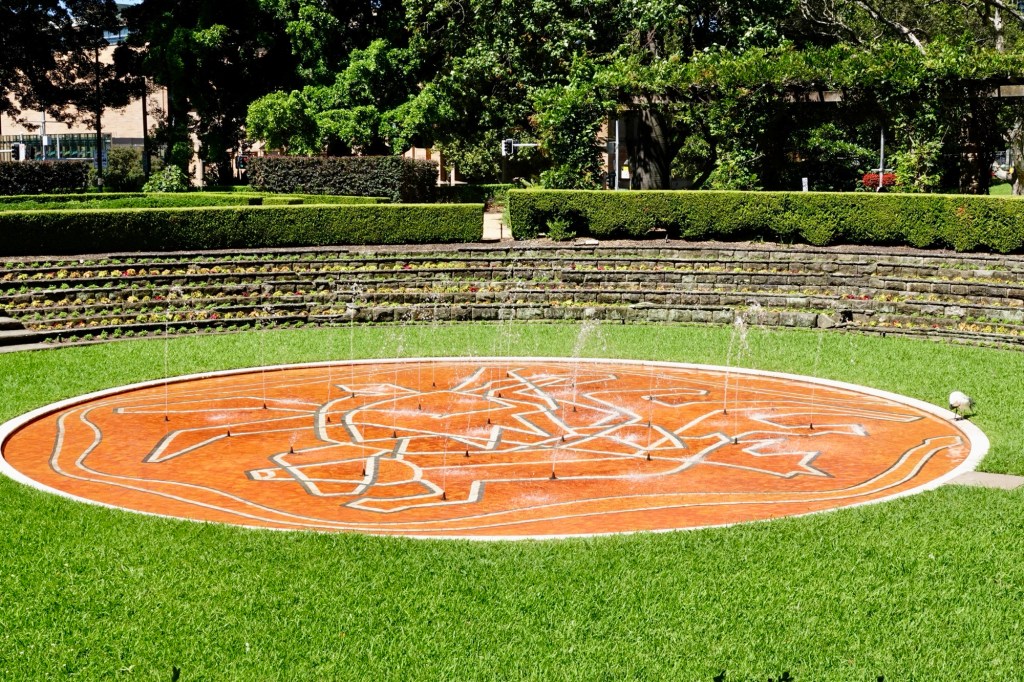
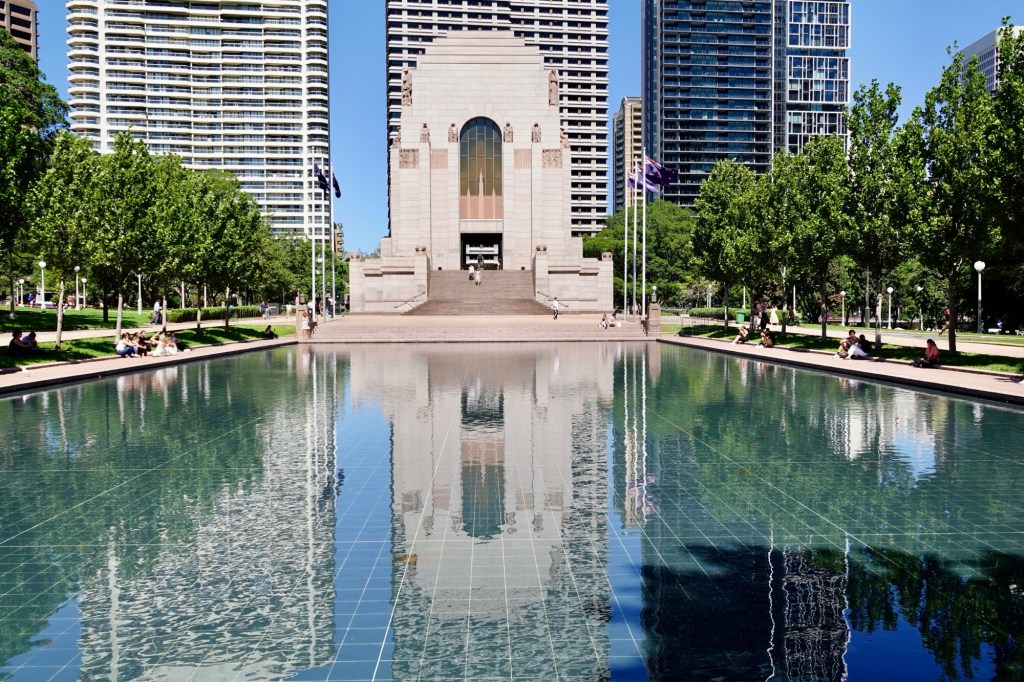
Crossing Park Street to the south half of the park, the ANZAC Memorial and its reflecting pool come into view, but that is not the only interesting monument on the site.
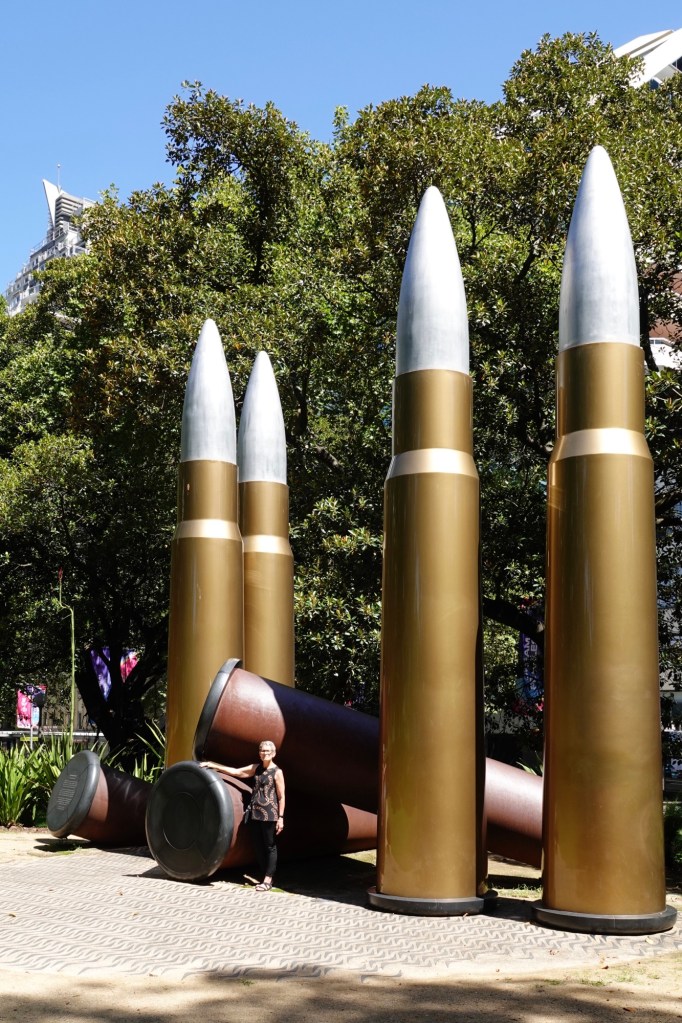
While much smaller, we made quick stops at the Hyde Park Obelisk and the Indigenous Memorial called Yininmadyemi, which translates to “Thou didst let fall”.
There was no identifying plaque on the obelisk, so I had to go to the City of Sydney website to figure out what it was. Hilariously, “The obelisk, irreverently known as “George Thornton’s scent bottle”, was erected in 1857 opposite Bathurst Street. It is an air outlet for the underground sewer cleverly disguised as a full-size replica of Cleopatra’s Needle, the Egyptian antiquity now displayed in London.”

That same website yielded the background for the Aboriginal memorial. “This prominent sculpture by Aboriginal artist Tony Albert aims to acknowledge and honour Aboriginal and Torres Strait Islander men and women who served in the nation’s military…

…The artwork is composed of 4 standing bullets and 3 fallen shells. The arrangement of the bullets represents those who survived and those who were sacrificed, but also references the discrimination faced by Aboriginal and Torres Strait Islander soldiers when they returned to Australia.”
Then it was on to the pink granite ANZAC Memorial. This memorial is different from the others we’ve visited in that it is not a shrine to the fallen – it is a tribute to all who served, including those who survived. To that end, it does not have lists of names; instead it honours soldiers, sailors, airmen, and nurses in more general terms.

The exterior is impressive although, as is always the case, it is really hard to see the details of the sculptures and bas reliefs from our vantage point so far below.

Fortunately, once we got inside the memorial we had the undivided attention of one of the site’s Ambassadors, Bernard, who walked us through the entire building, answered our questions, and explained the significance of each area of the memorial.
Upon entering the memorial, we were in the Hall of Memory/Hall of Silence, contained in a circular space called The Well of Contemplation.

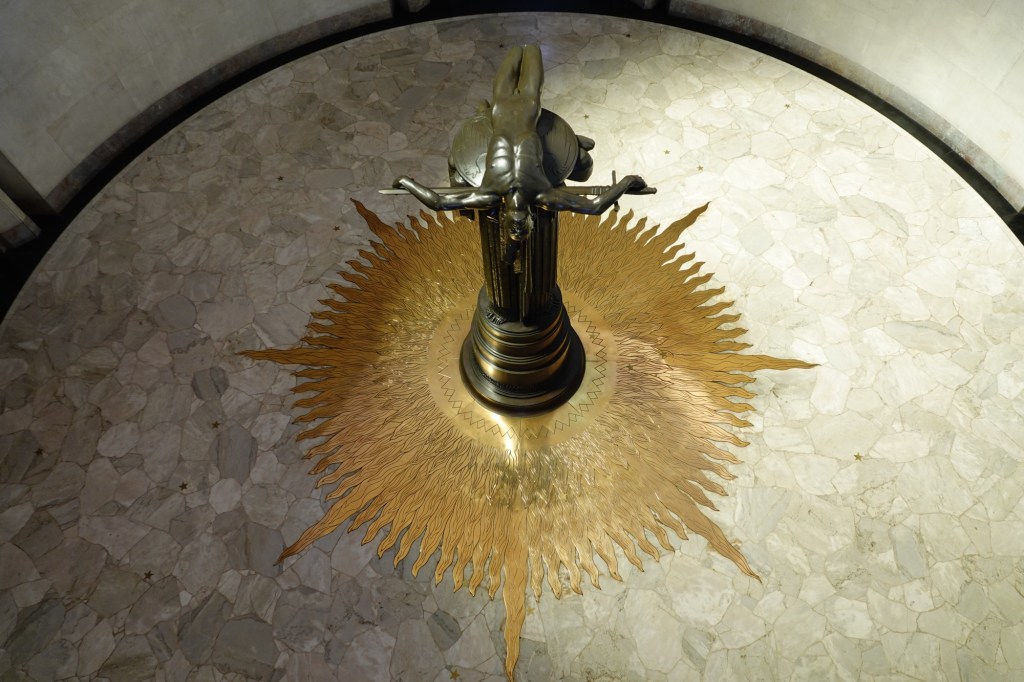
The central sculpture here is called Sacrifice. I recognized the Greek influence in the design, harking back to the Spartan notion that a warrior either returns with his shield or on it. In this case, the fallen warrior on his shield is carried by three women: his mother, his wife, and either his lover or sister.
The three draped female figures are in the stance of Greek caryatids, the draped female figures who act as supporting pillars in places like the Acropolis.
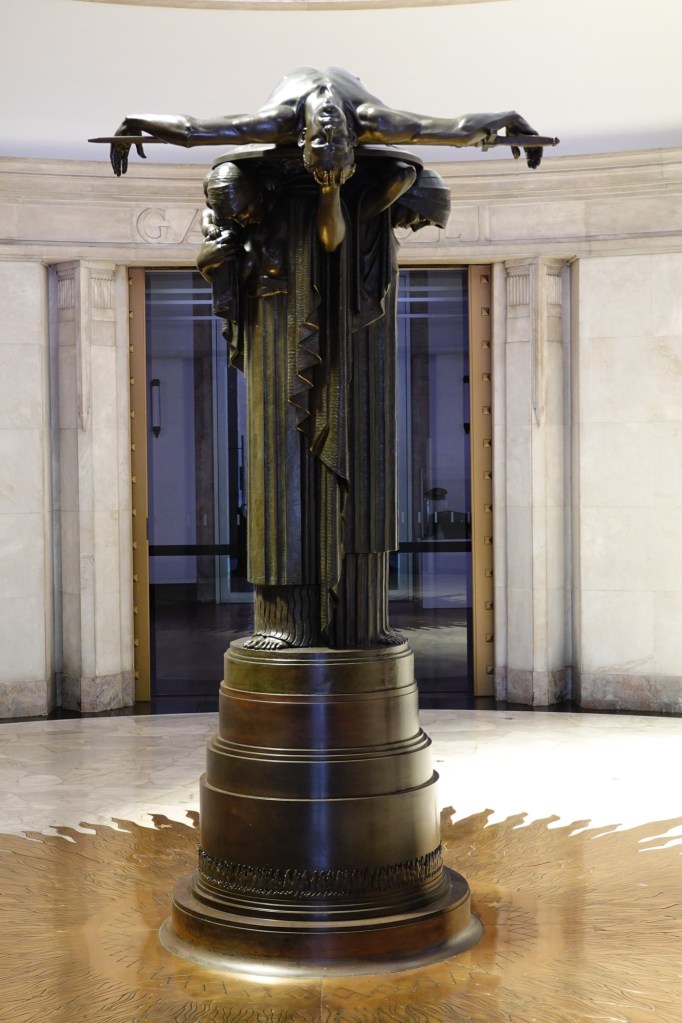
Bernard pointed out that the Mother carries the heaviest load. Not only has she lost her child, but also her support in old age. She carries the body’s central weight on both arms..
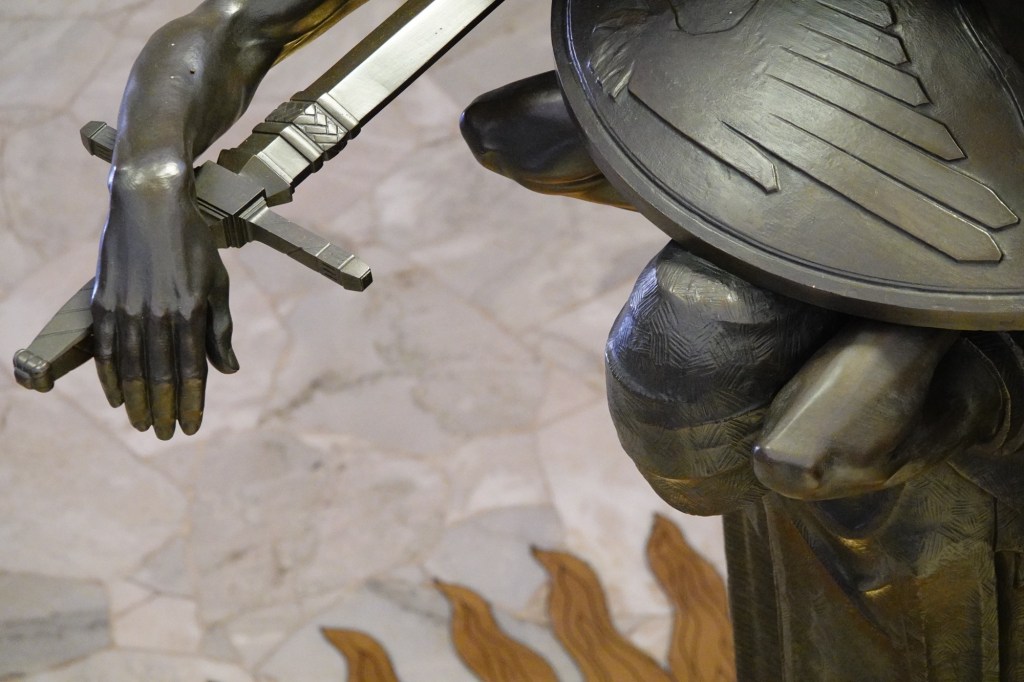
The wife supports her husband’s head with one hand, and holds their child on her other arm.
The third woman holds the body’s feet and also supports the torso.

All three have heads bent in sorrow, and shoulders bent under their dreadful load. Only the child – the next generation – looks forward to a (hopefully) better future created by the sacrifice of their parent.
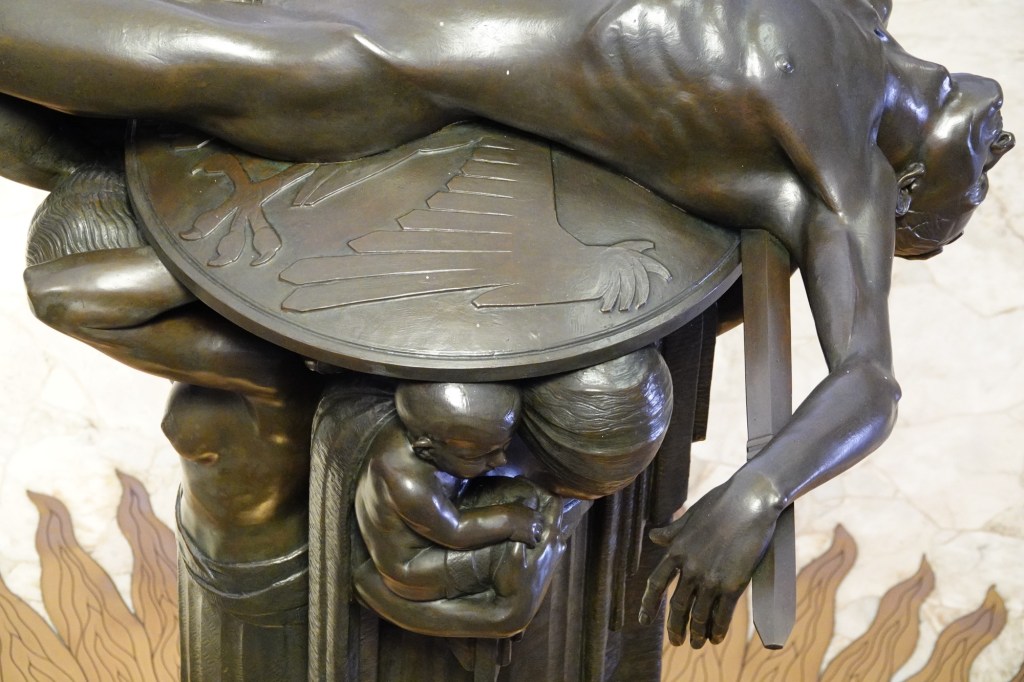
Bernard took us upstairs and pointed out that looking down at the Sacrifice from above requires every viewer to also have a bent head.
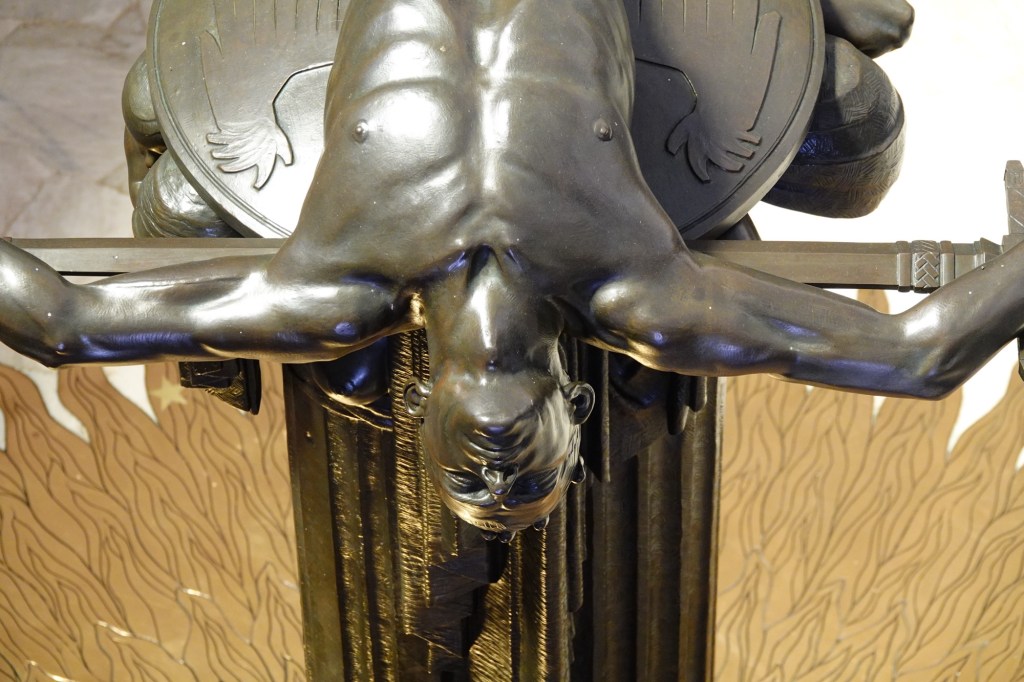
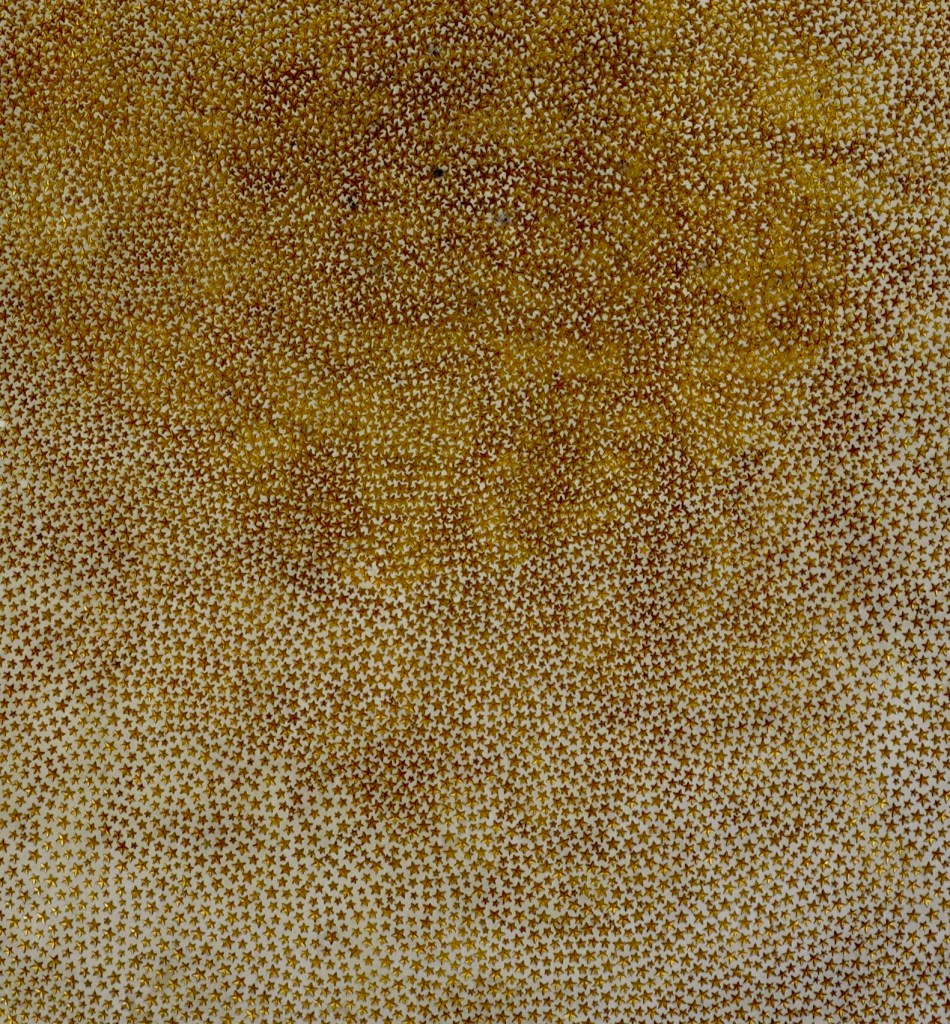
The dome above the statue has 120,000 gold stars, one for each person in NSW who served in WWI. Those stars were not originally planned, but after the stock market crash of 1929 there were no funds for the planned gold leaf dome; instead, citizens of NSW bought stars for two shillings each until the full 120,000 were funded.
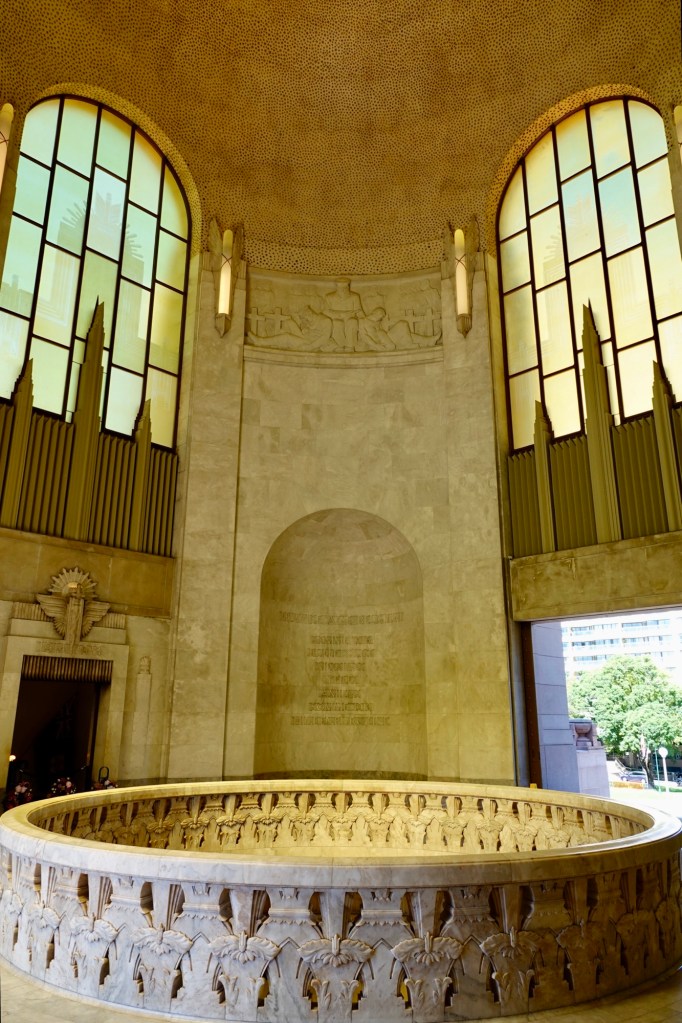
Around the hall just under the dome are 4 reliefs, one for each of Nursing, Navy, Army, and Airmen (in order below). Bernard pointed out that each relief has three layers. The most prominent shows wounded military members being supported by a central survivor. The centre layer has crosses for the fallen. The shallowest layer, with naked figures walking in lines, shows the “walk of the dead”. Their unclothed state is intentional, since the dead no longer have – or need – earthly raiment.

From above, the eternal flame on the floor gleams.
The central portion of the memorial, which included meeting rooms for veterans and their families, was supplemented in 2018 (as a Centenary Extension marking the 100th anniversary of the armistice) by an entire lower level education and museum wing. From the outside, it is possible to look down into the extension’s main hall through a circle of thick glass.

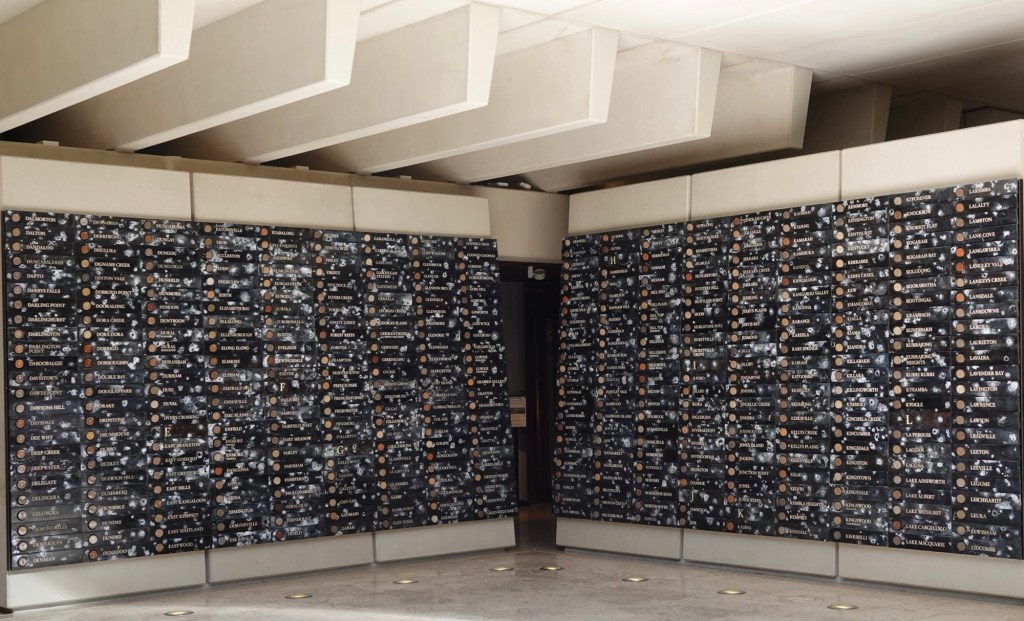
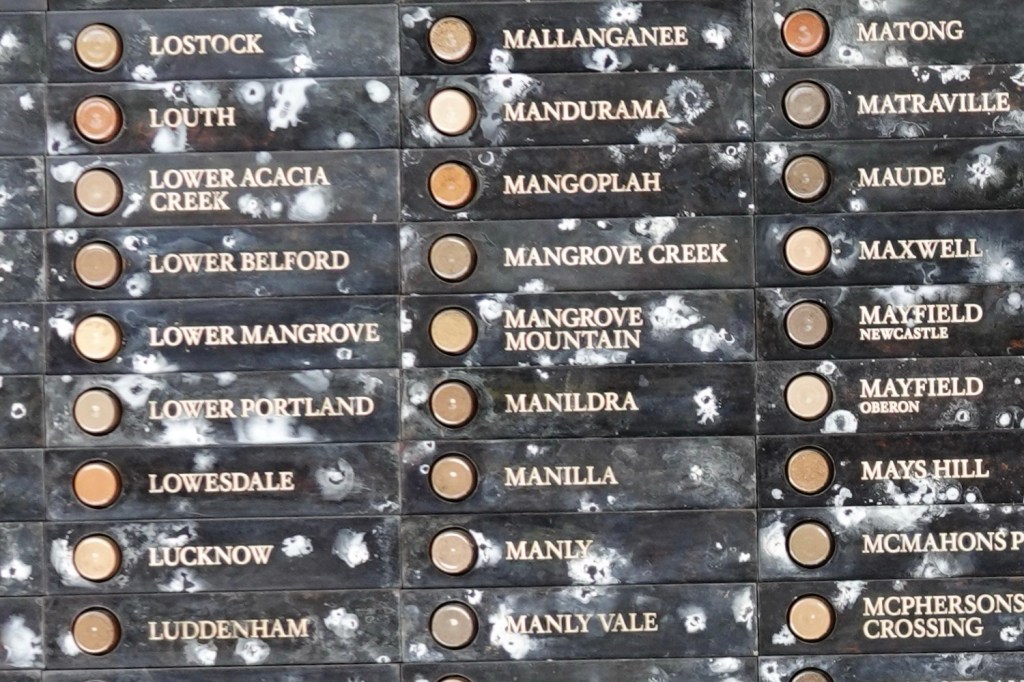
The eight walls of the Hall of Service display not names, but places: soil from 1,701 New South Wales’ towns, cities, suburbs and homesteads given as a home address by First World War enlistees.
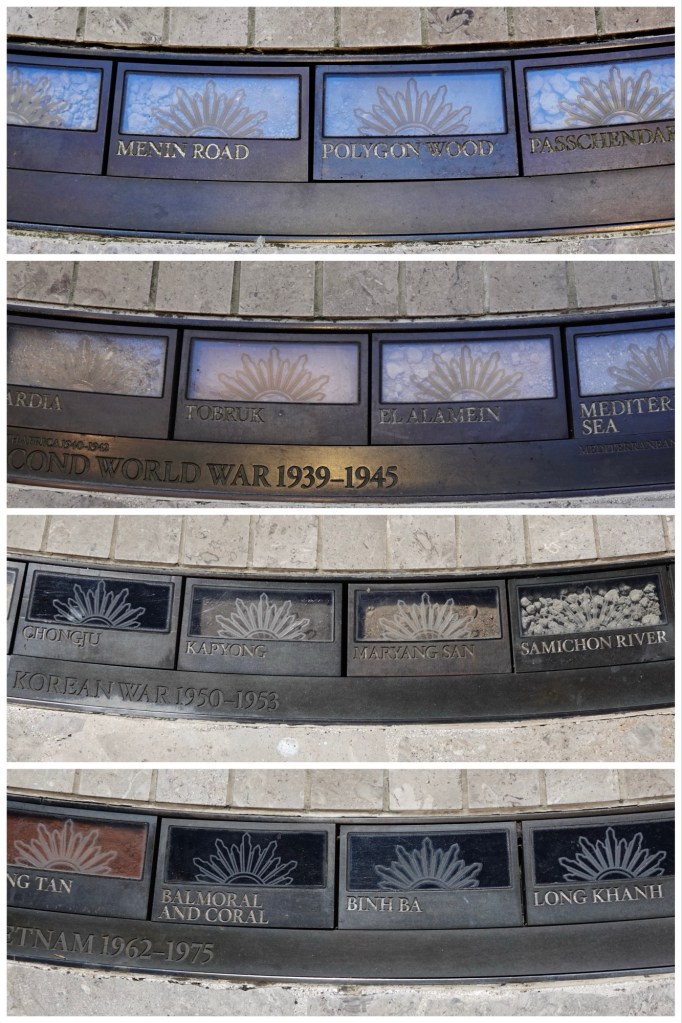
Below them, soil samples from 100 military sites are set into a ring embedded in the floor. The ring’s chronology begins with the colonial wars in New Zealand (1860–66), Sudan (1885) and South Africa (1899–1902), moving through to recent conflicts and peacekeeping missions in Afghanistan, Iraq and the Pacific. In all, conflicts and theatres across 31 countries are represented.

On the other side of the walls surrounding the Hall of Service are copies of the external bas reliefs. They allow a closeup look at the storyline they tell of WWI and WWII. Once the stories are explained, the reliefs become much more meaningful; Bernard was actually in tears explaining them to us – I was right there with him.
The east wall relief illustrates the Eastern Campaigns.
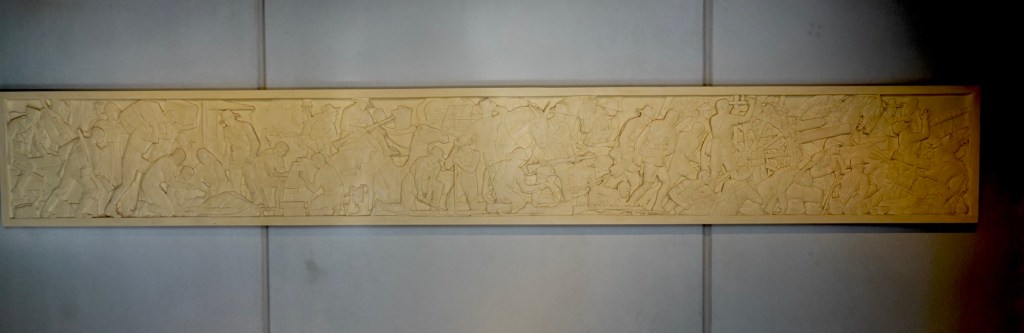
From left to right it details A Naval Landing Party – Chief Petty Officer – Surgeon, Nurse, Stretcher Bearer and Ambulance Driver at Rail head depot – Wireless Signallers in the field – Infantry – Original Australian Camel Corps – Railway Engineers laying light lines (Palestine) – Mule transport with water containers – Light Horse acting as Infantry – Pioneer – Part of a Crew of Hotchkiss Gun – Eighteen-pounder Battery in action (loading) – Signallers with heliograph – Ford with mounted Lewis Gun and Light Horse in attack with Mounted Hotchkiss Gun – Section registering casualties.
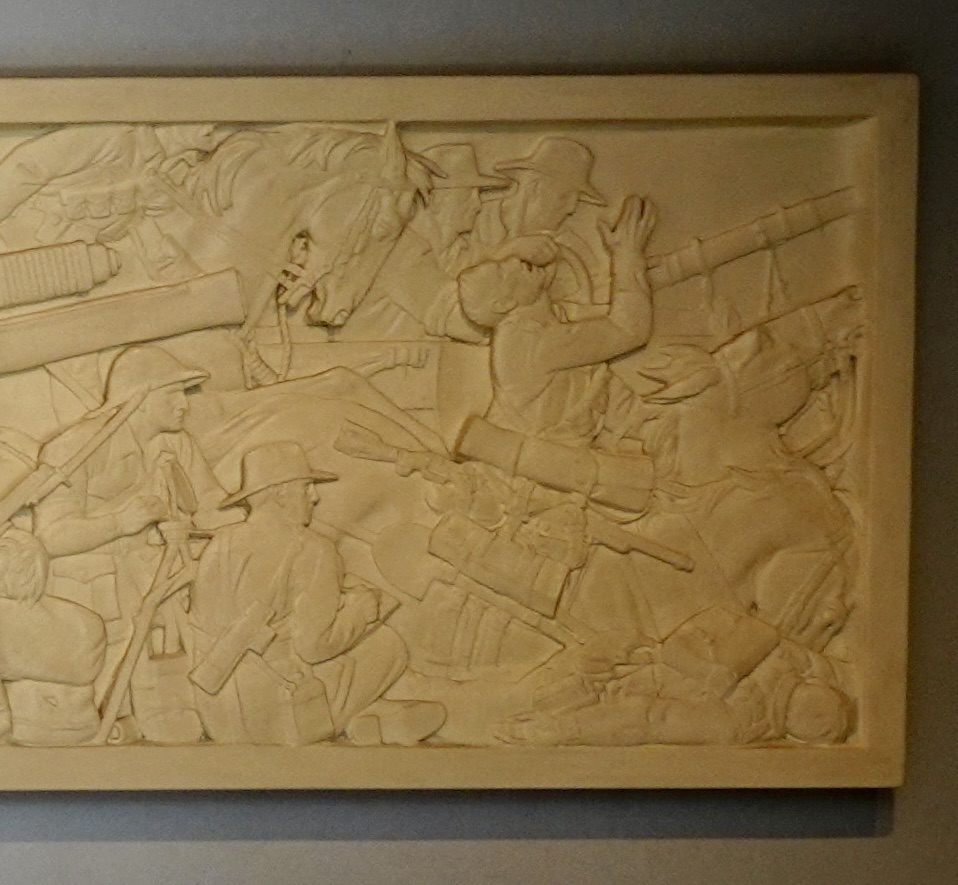
Bernard explained that it was important to the memorial’s designers that those who returned from war could see “themselves” – everyone who fought and suffered together – and not just glorified military leaders.
Similarly, the west wall relief depicts the Western Front.
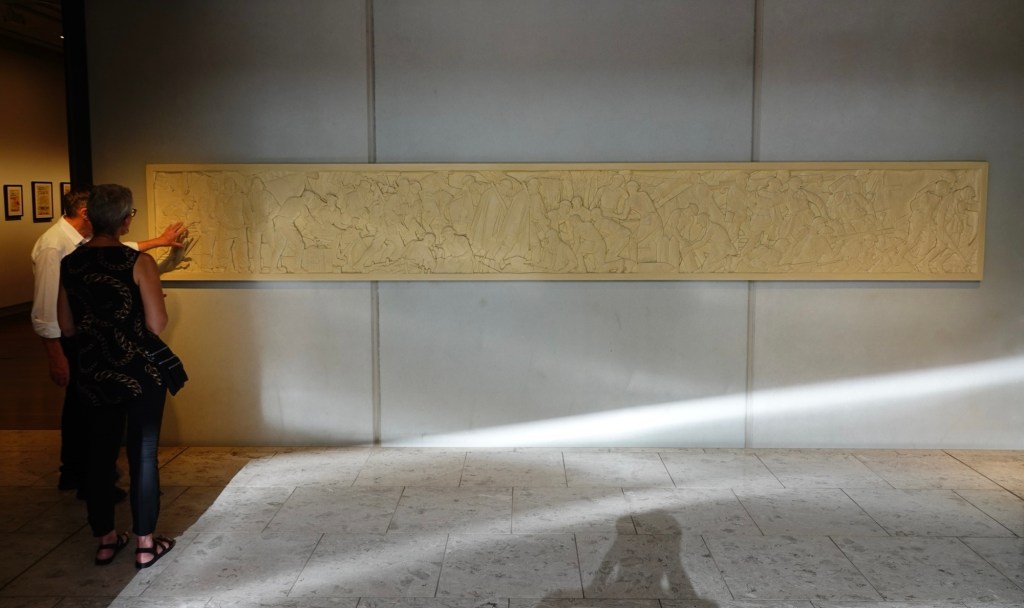
From L to R: A man of a Cyclist’ Company – An Aeroplane, R.E.8, Pilot and Observer with Machine Gun – Pilot, Observer and Mechanic of Air Force – Despatch Rider with Pigeon basket leaving signals H.Q. – Pioneer with duck board – Infantry marching from rest area – Signallers laying telephone wire – Army Service Corps Waggon – Gassed and Wounded leaving casualty clearing stations – Pioneer digging a sap – 8in.Howitzer in action (firing) – Stretcher bearers going forward with stretcher – Bomber throwing a “Mills” (grenade) – A Lewis Gun Crew with Infantry in attack against gas, accompanied by tank.

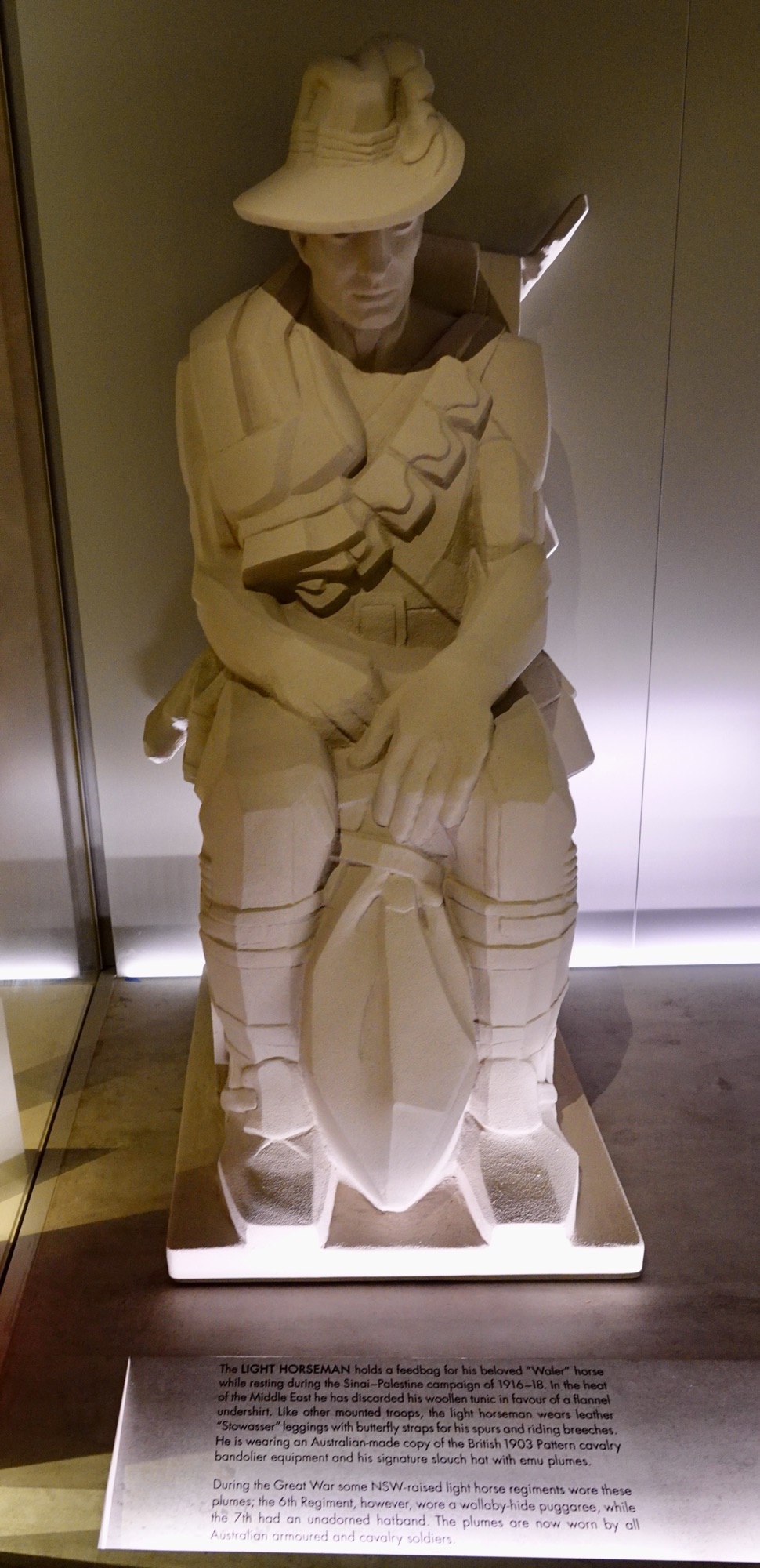
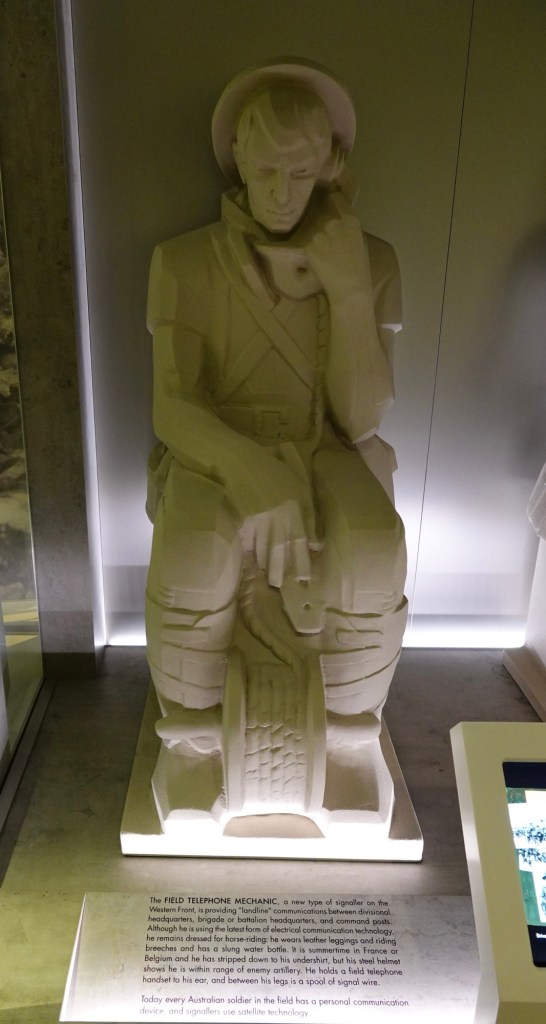
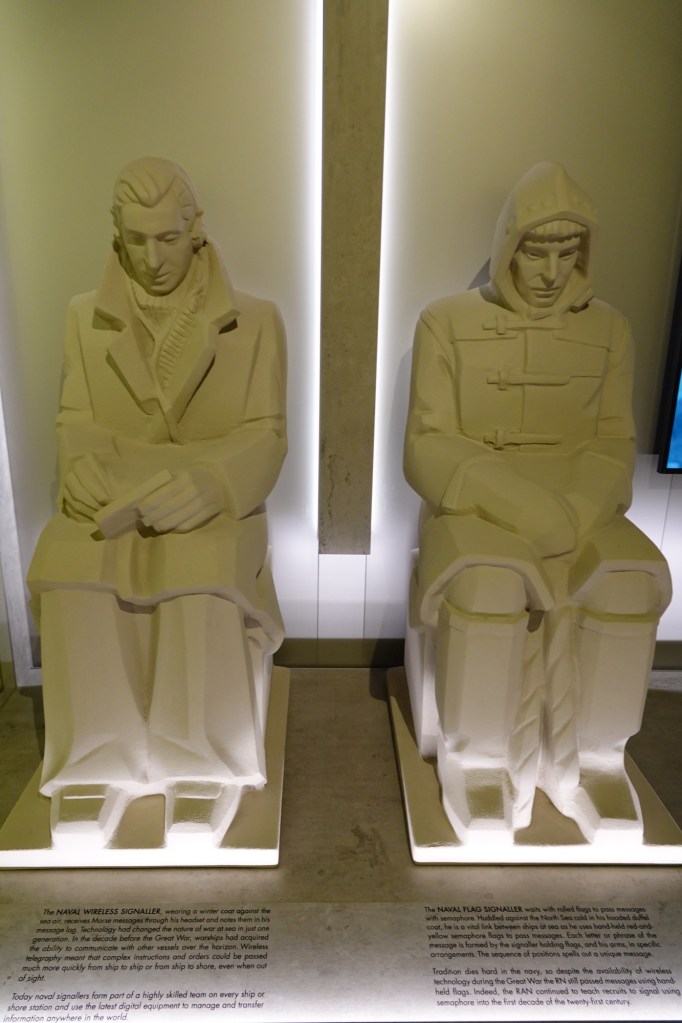
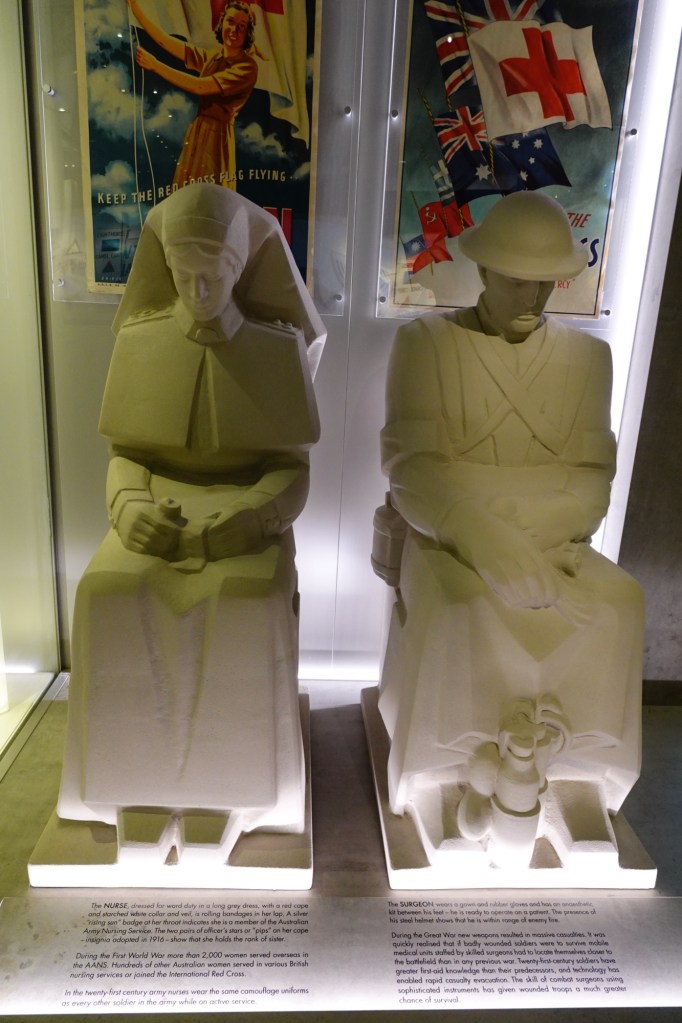
The individual sculpted figures on the exterior are also on display in the exhibit, each with a detailed description. The roles are clearly shown through their uniforms and equipment. Again, the intent was that who returned could recognize themselves in the statues and show their families what they did.

Our exit from the memorial was from the new underground wing, surrounded by flowing water. The memorial really is striking from every vantage point.

Having spent almost two hours having a private tour, we were ready for our daily afternoon coffee break, after which Ted headed back to our hotel, and I continued on to the Hyde Park Barracks to learn about Sydney’s years as a penal colony.
 Rose and Ted’s Excellent Adventure
I loved the idea of the soil samples from all the hometowns and all the battle sites — very moving. The detail and quality of the bas reliefs reminded me of Egyptian tomb reliefs. Thank you for sharing this. Did you learn when the ANZAC memorial was originally built?
LikeLiked by 1 person
Should have mentioned that! The original in 1932-1934, with the addition in 2018.
LikeLike