Surprisingly, our early morning balloon ride was so exhilarating that we didn’t feel at all tired despite our crazily early start ! That’s a good thing, since there was a second excursion today, included for everyone.
Today’s excursion took us to see the temple dedicated to the cow god Hathor, who was the patron of love, beauty, music, joy, motherhood and celebration.
As was prevalent in ancient Egypt, the goddess was worshiped as a triad along with her husband Horus, and her son Ihy.
The temple at Dendera is the best preserved temple found to date in Egypt, presumably preserved so well due to the number of years it was buried in sand. It is also one of the newest temples, a concept which is relative since it is still over 2000 years old.
To get to the temple we needed to drive approximately 90 minutes through rural countryside to traverse the 68km/42 miles to reach Qena.
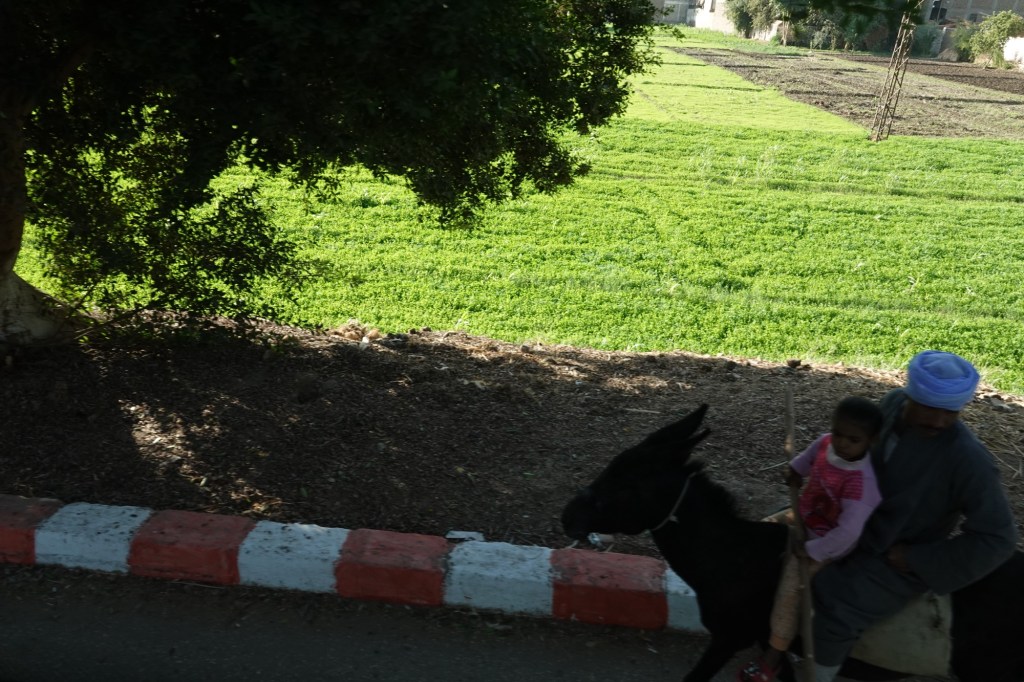
En route we passed small family-owned and run farms of date palms, alfalfa, onions, cabbage, sugarcane, carrots, and yams. We’d learned earlier in the day that school in Egypt is only compulsory until age 14, so the children of farmers often begin working the farm at that age instead of going on to high school and university, although current statistics indicate that 86% of students at least start high school. Parents who can afford it often choose private schools once the obligatory education period has ended.
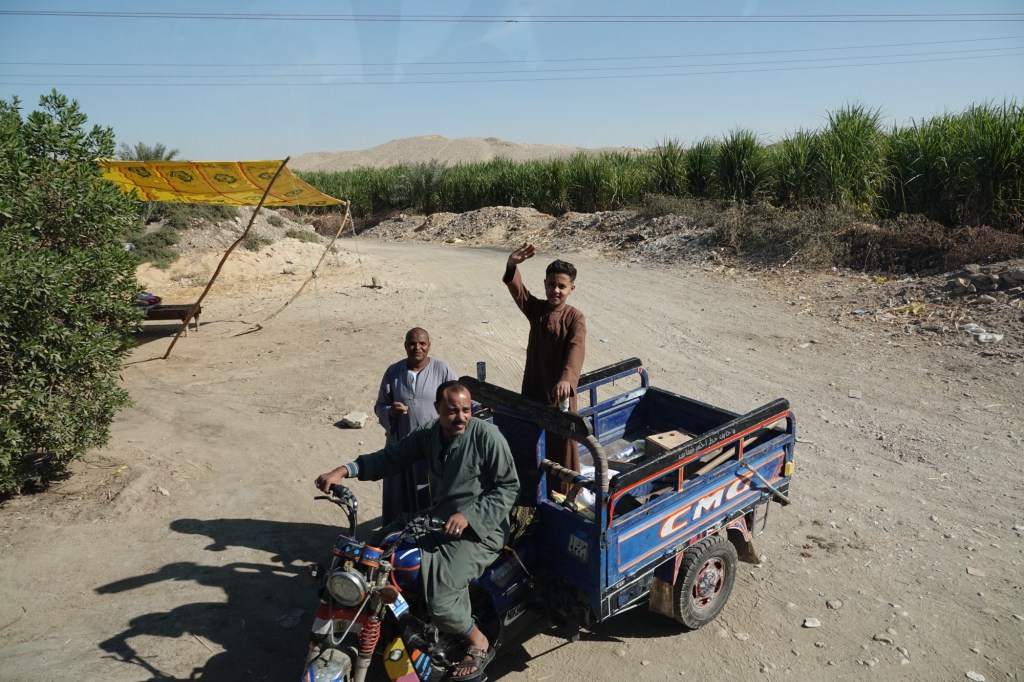
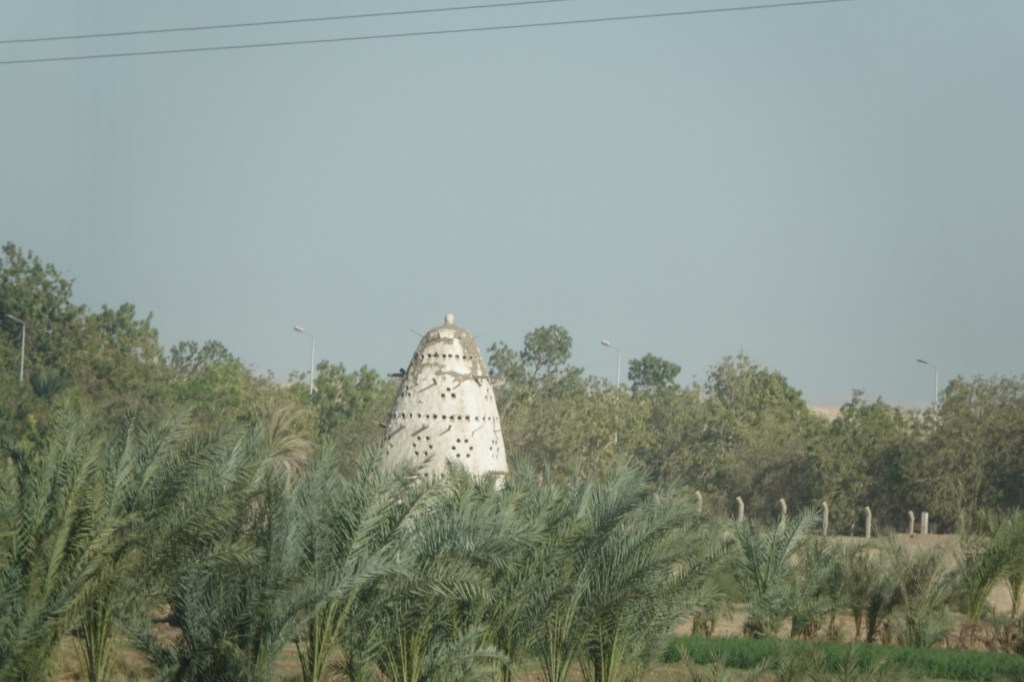
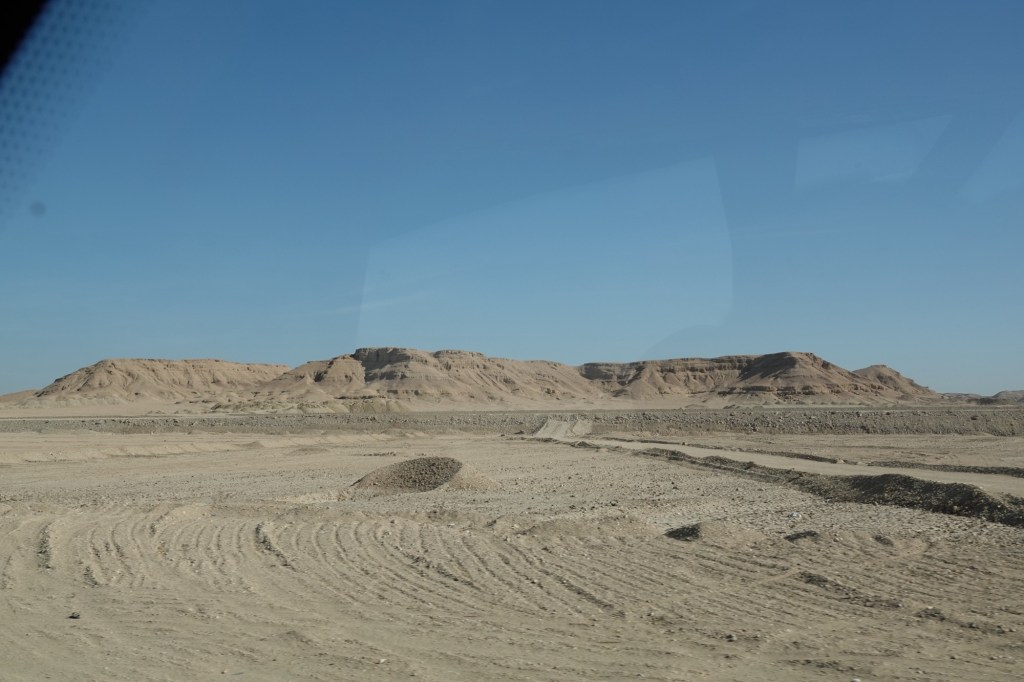
And then… Egypt’s ubiquitous sand.
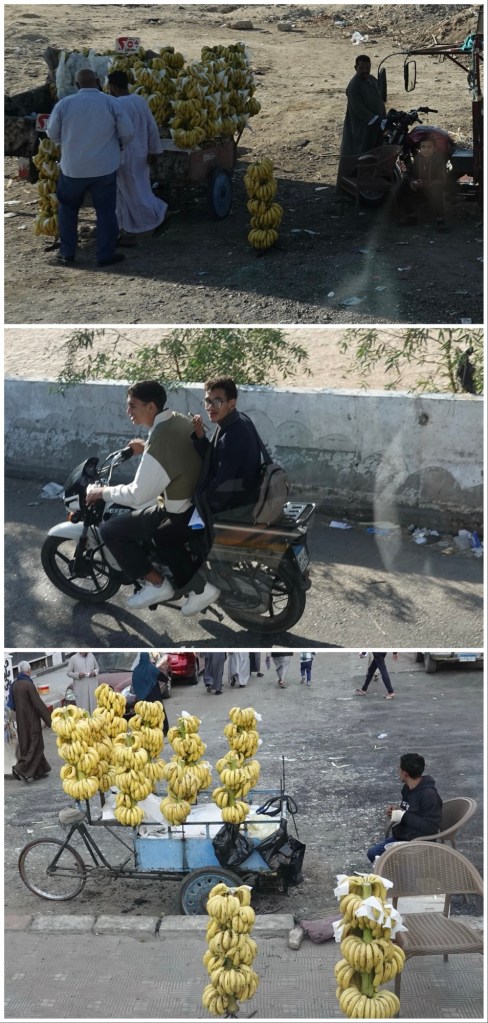
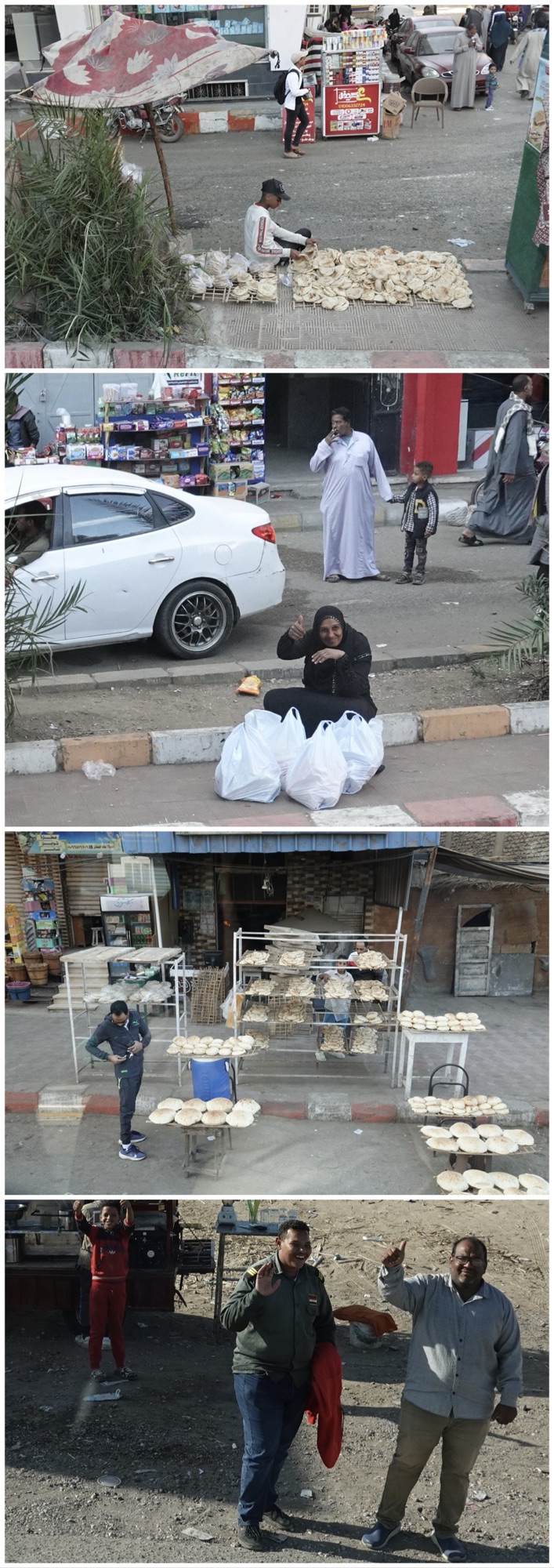
We also drove through some small towns, with what we’re coming to understand are typical scenes of everyday life.
The very first thing we noticed when we reached Dendera Temple was that it is set in an oasis of green. Every other temple we’ve seen has been surrounded 100% by sand.

This is a relatively new temple, founded during the Ptolemaic period during the reign of Cleopatra’s father Ptolemy XII. It was completed between 54 and 68CE, during the reign of the Roman Emperor Nero.
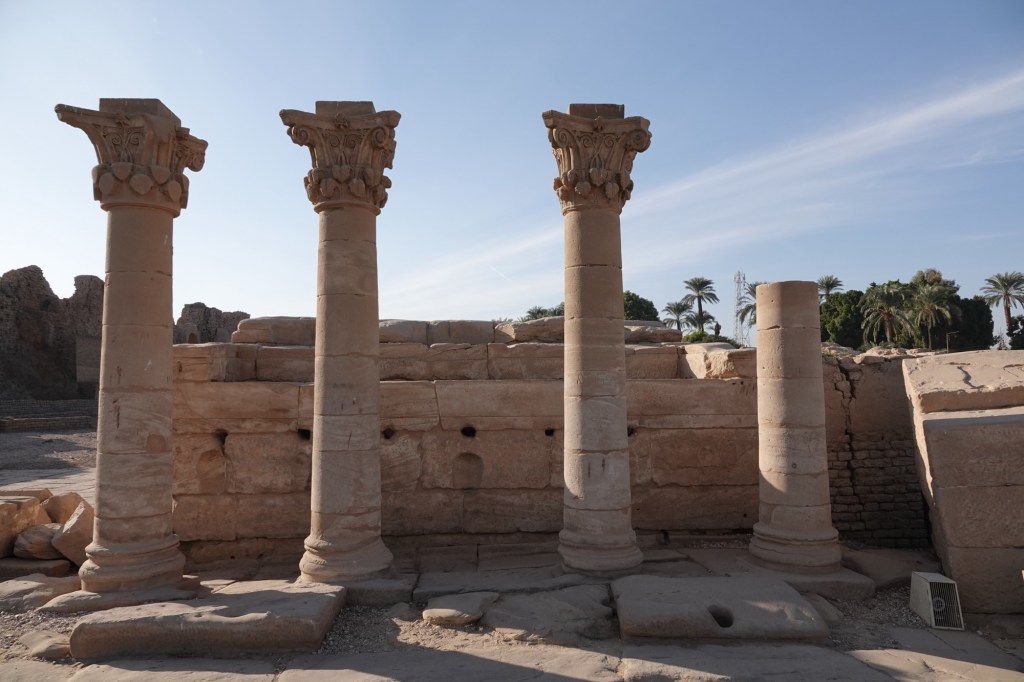
This site is very important for its revelations about the early study of astronomy, having housed the very first depiction of the star signs. The incredible zodiac which we saw today in replica was removed shortly after the temple’s discovery, and “reappeared” in the Louvre in France, where it can still be seen.
This site was blissfully uncrowded when we visited. That meant not only could Ted get good pictures, but we could stay a bit further away from our guide without worrying about getting lost in crowds.
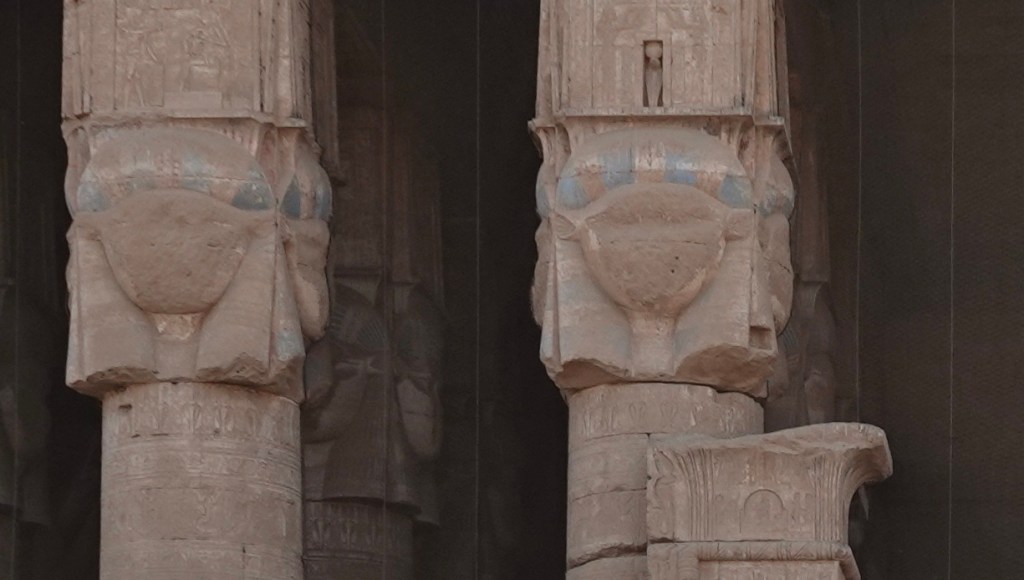
On the temple façade are depictions of Hathor. She was depicted variously as a horned cow, or as a woman’s face with cow horns, or as a young girl with cow ears, a hair wig, and a halo. Her images on the temple were defaced in the first century CE by Christians seeking refuge in the temple. Fortunately, some of the blue pigment survived on the exterior. (Walid promised to talk to us about pigments tomorrow when we’re in the Valley of the Kings.)
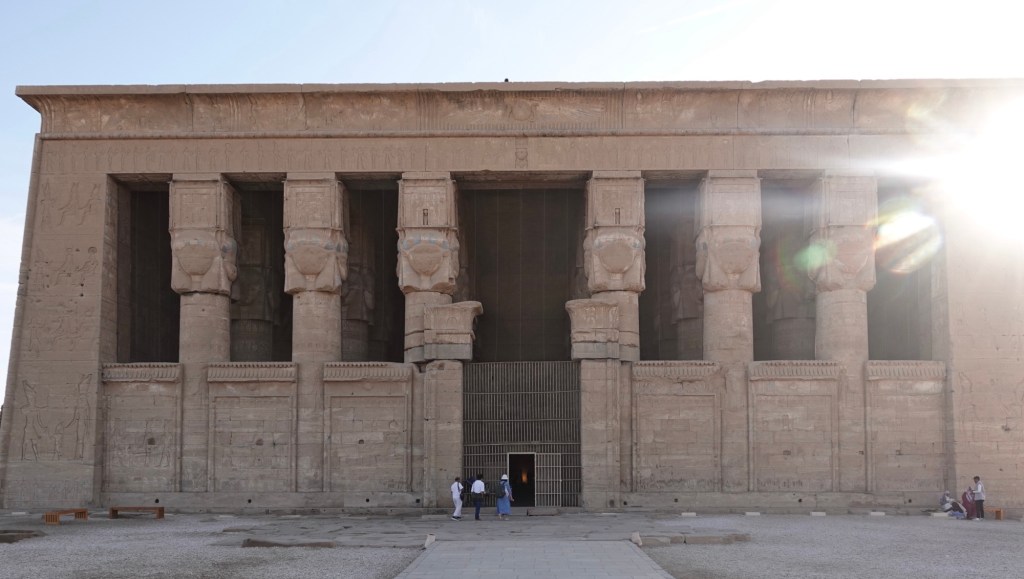
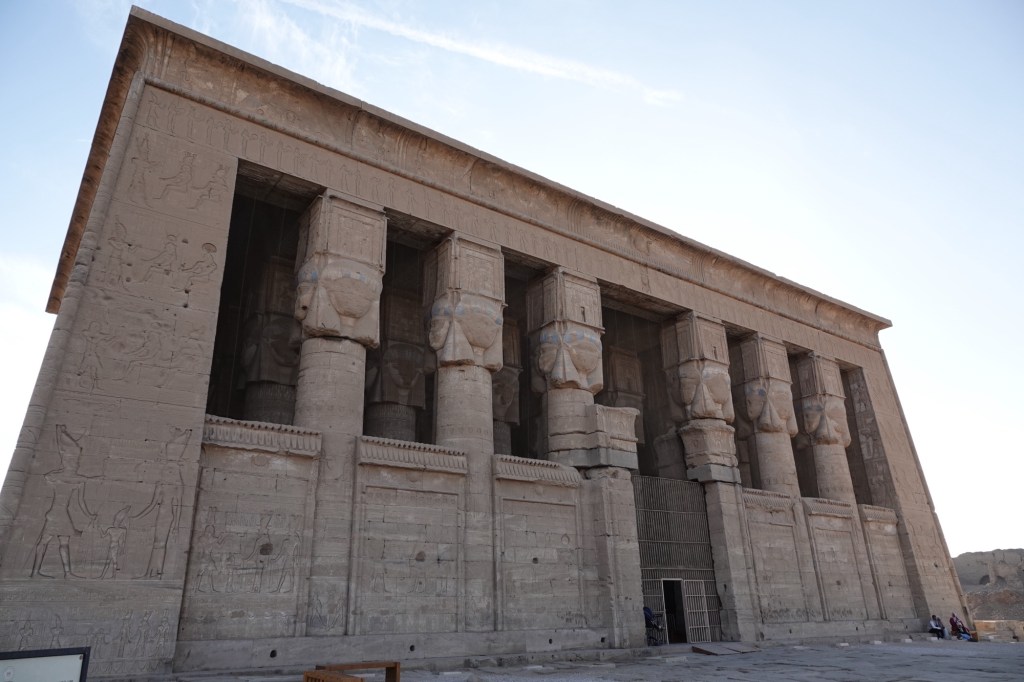
The mud brick wall surrounding the temple has an intentionally wavy top line to represent water protecting the temple.
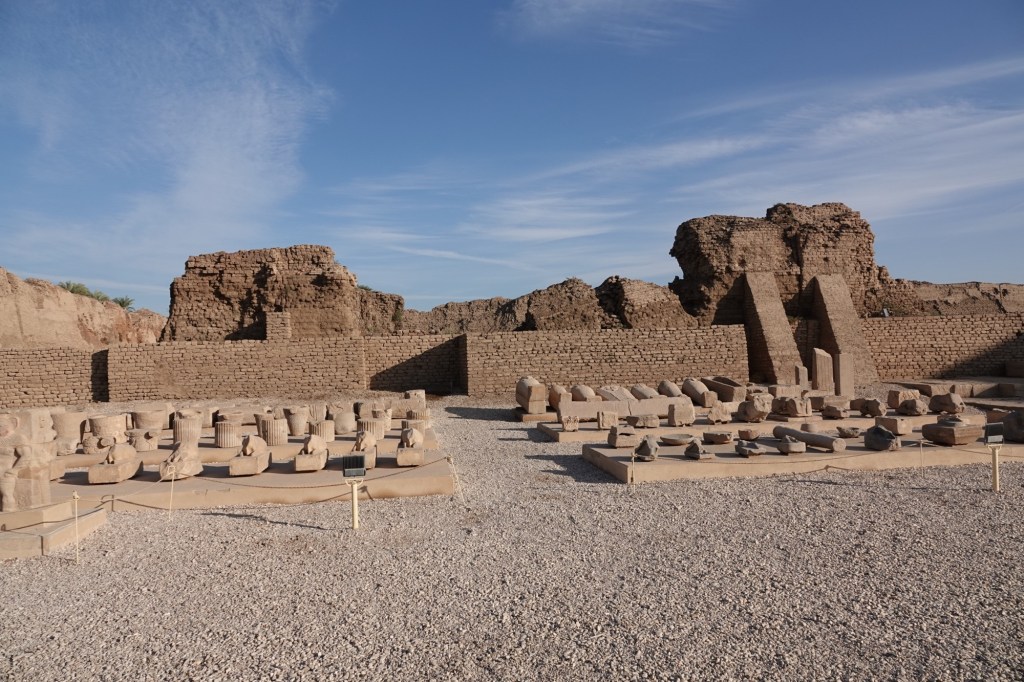
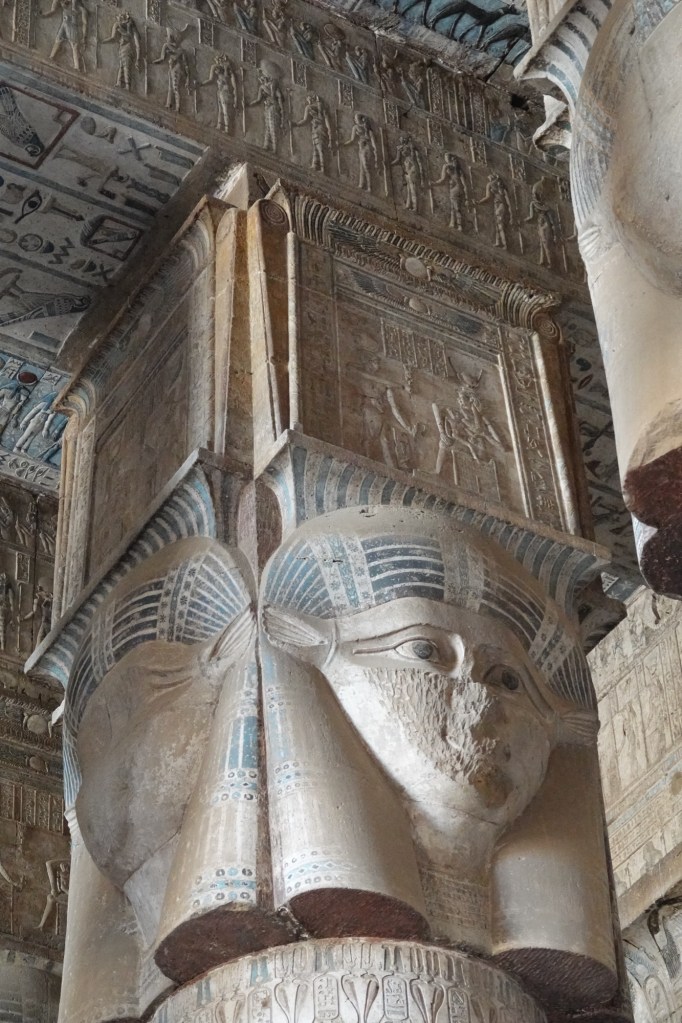
Upon entering the temple, our guide directed our attention to the ceiling, with its depictions of Hathor’s husband Horace, the vulture, painted in vibrant colors, and the tops of the columns where Hathor’s crown still shows evidence of malachite blue pigment. The blue pigment was revealed after a group of university students sponsored by UNESCO removed the sand and black residue that had coated the columns and ceiling.
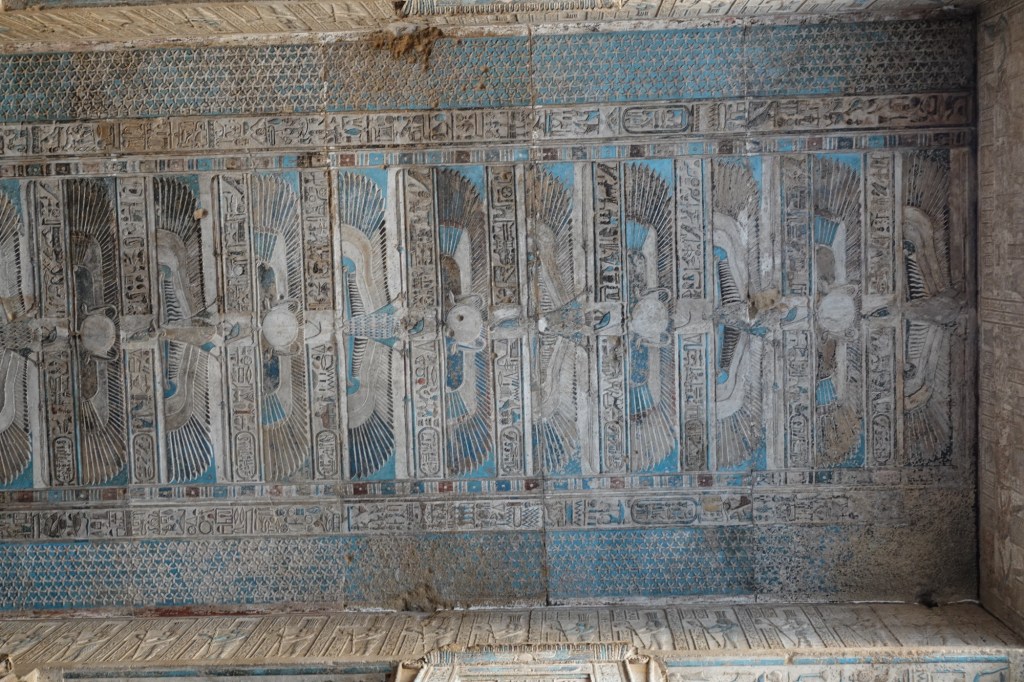
The 18 columns in this entry hall all originally support the ceiling.
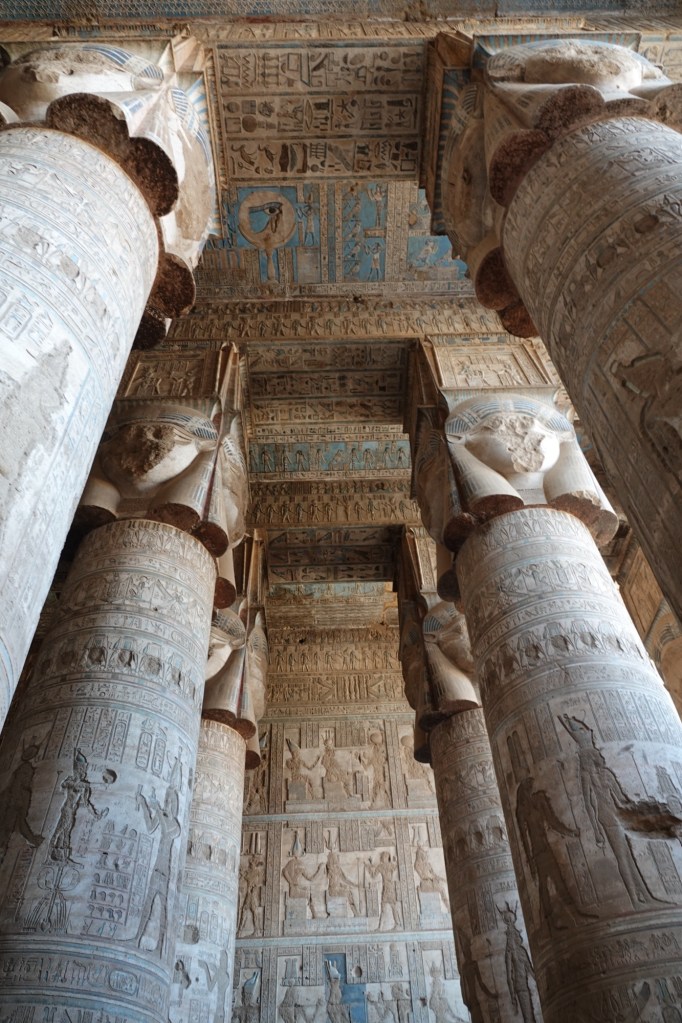
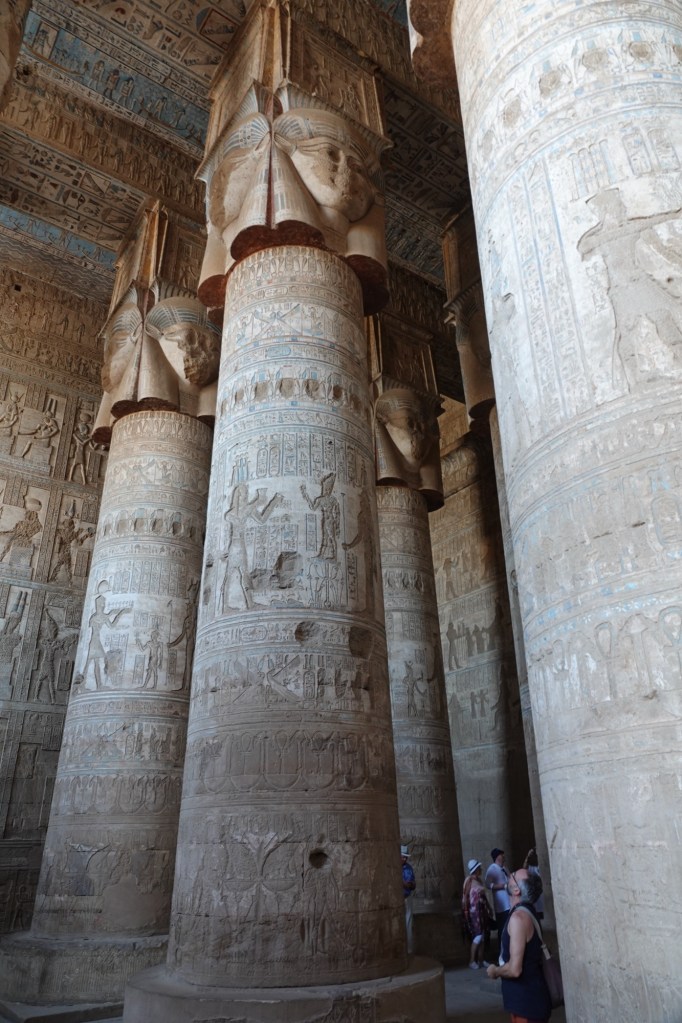
Walid pointed out the most intact face of Hathor on one of the columns.
Present on all of the columns was a ring of alternating hieroglyphs of ankhs, representing life, and what looks like two long legs with the triangular head of a donkey, the latter being the character Waset, for prosperity.
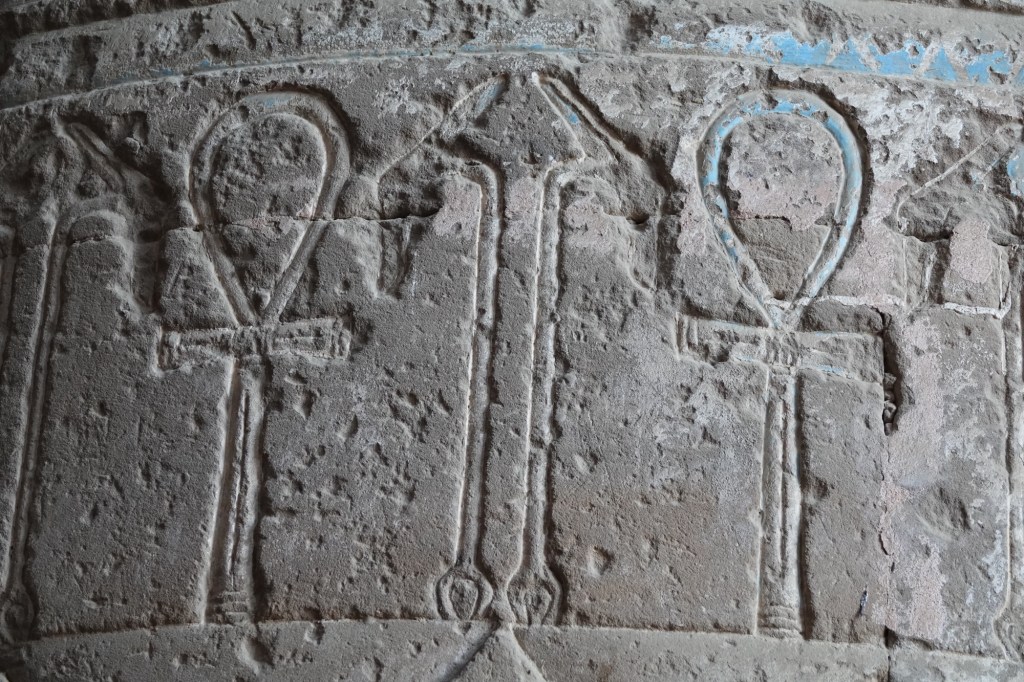
Most of us are familiar with the fact that the ankh represents life, or long life, but very few of us know why. The shape of the ankh is the river delta loop at the top, the crossbar representing the sun’s path from east to west, and the straight lines below it representing the Nile itself. Water, especially in a country that is predominantly desert, truly does represent life.
In a side room, Walid pointed out what he called the hidden gem of the temple. This room would have stored some of the offerings given by the populus, things like oils and food.
Underground are 12 crypts which would have held the more valuable items like precious metals and semiprecious stones.
The hidden gem? Ultrasound has revealed that beneath this chamber are 78 lotus topped columns, 22 feet tall, constituting a temple (identified as built by pharaoh Pipe II) dating to about 2300BCE. It seems the Romans built Hathor’s temple right on top of another ancient temple.

Despite the tour’s description, there was no possibility of accessing anything underground.
We noticed that all of the cartouches on the walls of this side chamber are all empty. That’s because it was built during a time of great conflict between pharaohs who killed each other in competing for rule. No one ruled long enough for any engraving of names to occur.

As we proceeded further into the temple, we noticed that the ceilings were getting slightly lower and the side walls narrower. The shape of the temple is therefore a pyramid, but lateral instead of vertical. By the time we reached the sanctuary, at effectively the “point” of the pyramid, the space would have been extremely dark. Of course, now it is lit for tourists.
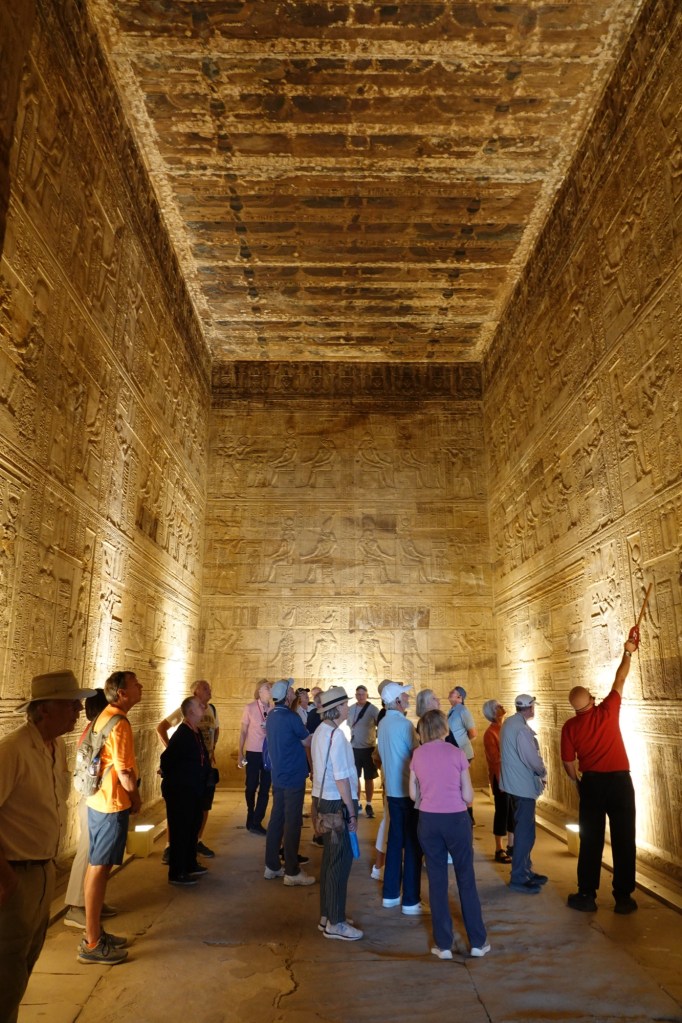
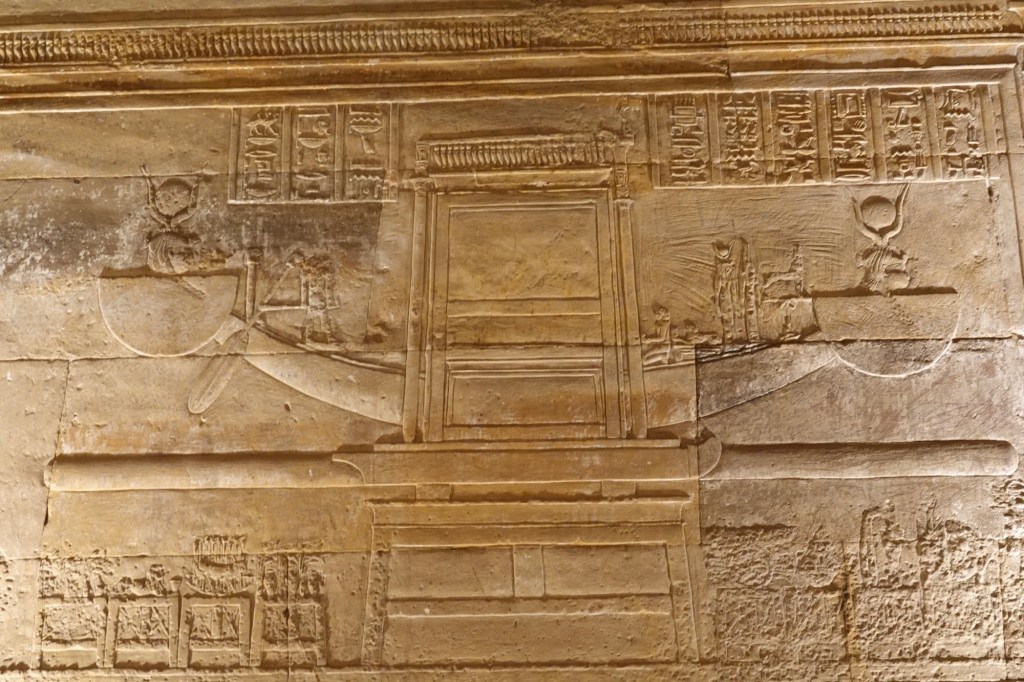
Inside the sanctuary, successive reliefs tell the story of the pharaoh entering the sanctuary. First knocking on the door, second opening the door, third standing in front of the golden statue of Hathor, and then presenting offerings to the God.

Every bit of every wall and ceiling is completely covered with reliefs and hieroglyphics. We were reminded that none of the symbols are here simply for decoration; every single thing has a meaning and tells a story.

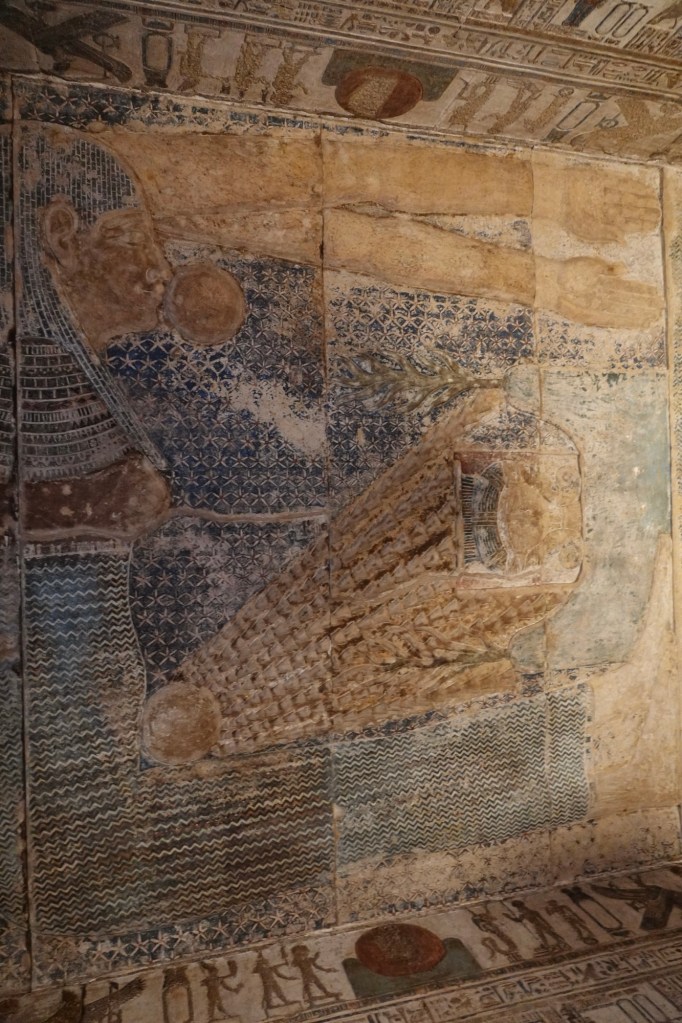
We climbed a short set of stairs into a crypt, where the focal point was the image of the goddess Nut (pronounced “noot”), the goddess of the sky, whose body spans the entire ceiling. She is depicted giving birth to the sun each morning, and eating the sun each night.
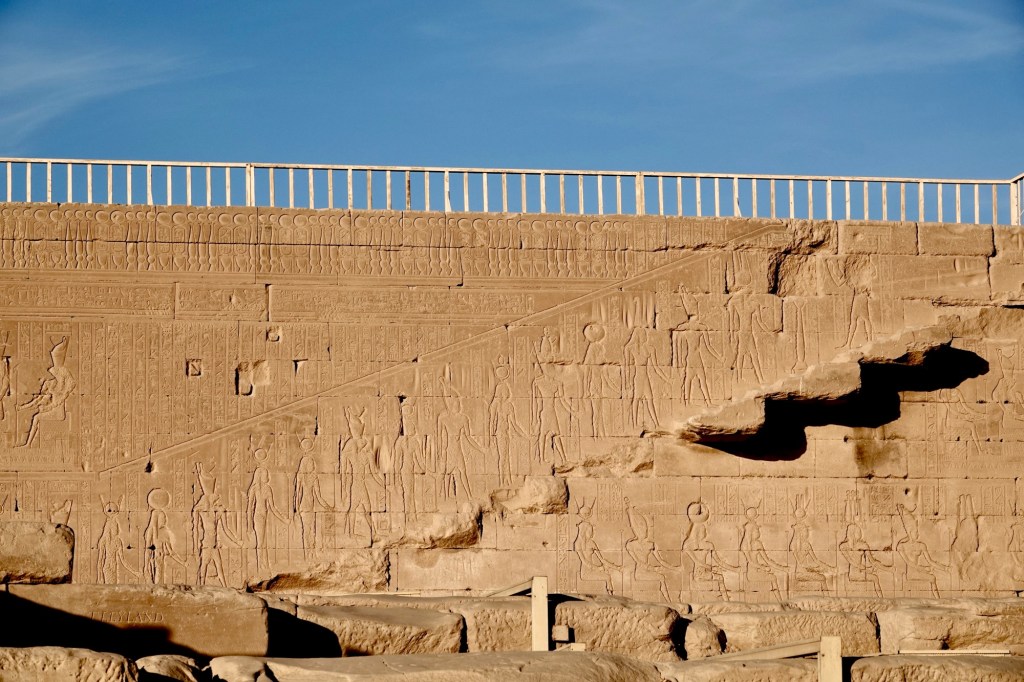
We were able to climb stairs to the temple roof. Looking to the right while ascending, figures of priests walk up beside us on our right.Had we returned using the same staircase, we would have been “accompanied” by priests heading down.
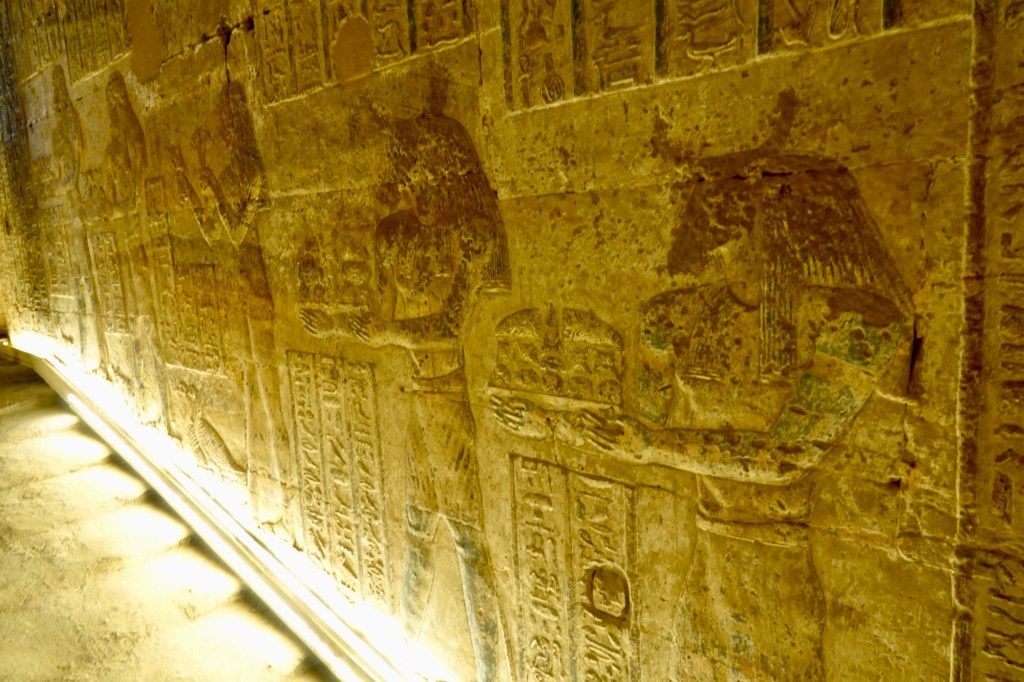
On the roof, we saw a carving depicting all 40 of the Egyptian gods holding hands and walking up to heaven.
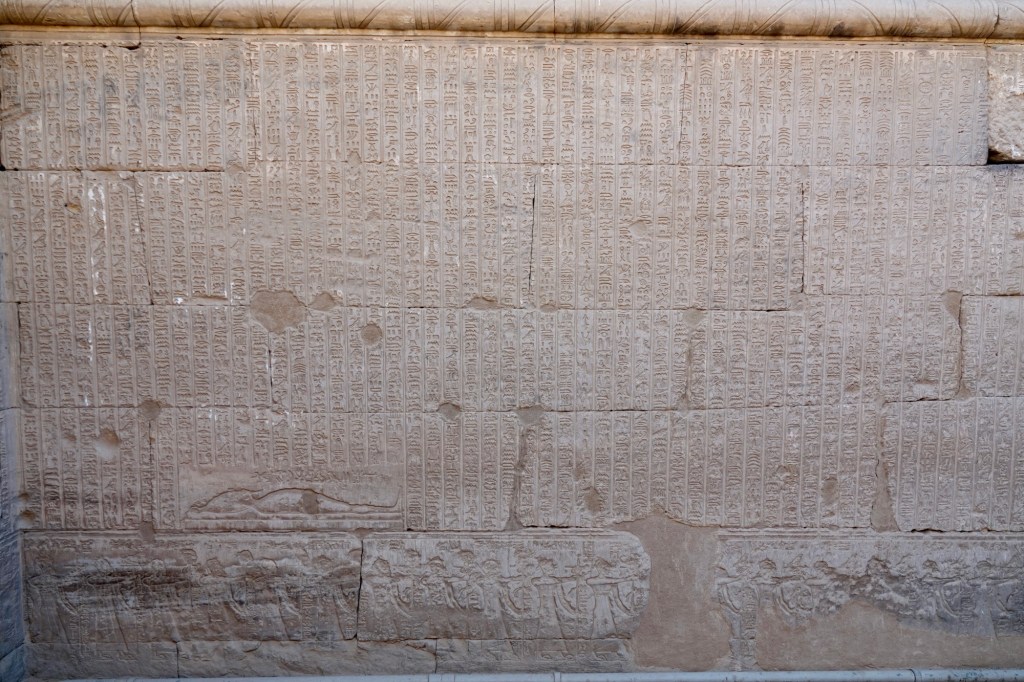
A chamber on the roof has one of the longest hieroglyphic texts found in Egypt. It tells the complete story of the temple , and was translated by two French archaeologists using the Rosetta Stone.
Then, the pièce de résistance, even though we know it is only a replica: the bas-relief Zodiac.

Standing at the 4 compass points of the circle are figures of Isis representing the 4 seasons. Beside Isis on either side is Horus, for a total of 12 figures for the months of the year.
The 24 hands of the 12 figures represent the hours of the day.
The 12 star signs are depicted. This was the first known recording of the signs of the zodiac.
The cumulative number of important elements on the zodiac carving totals 365.
In the Louvre, the stolen artefact has been reassembled ( it was cut into pieces to remove), cleaned, and displays all its original colours.
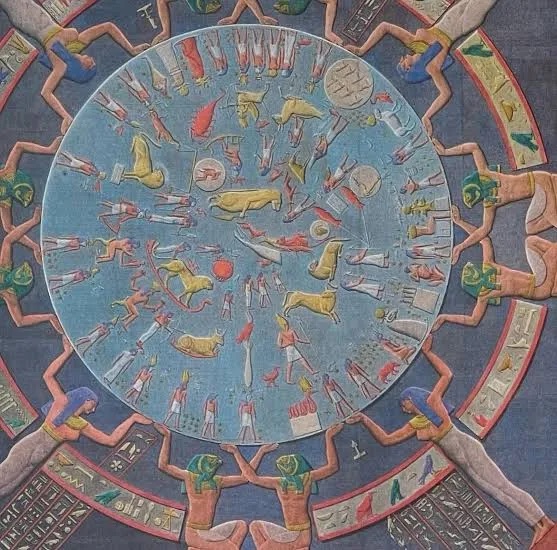
Sébastien Louis Saulnier, an antique dealer, commissioned Claude Lelorrain to remove the circular zodiac with saws, jacks, scissors and gunpowder.The zodiac ceiling was moved in 1821 to Restoration Paris and, by 1822, was installed by Louis XVIII in the Royal Library (later called the National Library of France). In 1922 the zodiac was moved from there to the Louvre. In 2022 Egyptologist Zahi Hawass started a petition to bring the ancient work back to Egypt, along with the Rosetta Stone and other artifacts.”
Once again today, our excursion demonstrated that visiting these ancient sites without a knowledgable guide would be almost meaningless. Having someone point out the highlights and explain their meaning, makes it a truly enriching experience.
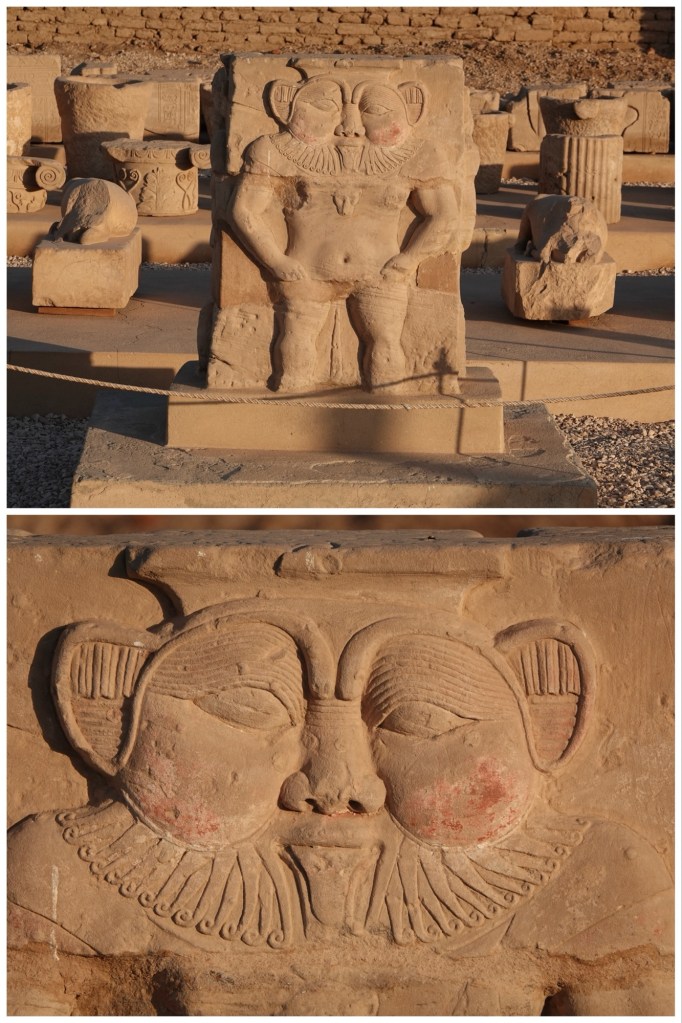
As we left the site there was one more thing to see: a stela with a carving of the god Bes with his short legs, round belly and tongue sticking out. It’s easy to see why he was the god of joy.
It was another long day, made longer by having to wait for a tourist police escort back to the ship at sunset.
Tomorrow, an 08:00 start as we travel to the Valley of the Kings.
 Rose and Ted’s Excellent Adventure
Very interesting to read your daily post in Egypt. So many historical details to illustrate the photos. With so many visits and information, I am wondering how you remember all of it to integrate them in your posts…do do record some comments from your guide, take some notes or simply have a great memory? And how much time do you devote to write your post each day…while there are so much to enjoy during such a journey? Just curious as I spend myself time to write during my travel, but the details on your post make me wonder…Thanks for transporting us to Egypt too!
LikeLiked by 1 person
As I’m listening to our guide, I try to hang back and dictate into the Notes feature on my phone. That allows me just to edit when I start adding Ted’s photos.
LikeLike