We were docked today in a partially commercial port. That can sometimes mean a less attractive place, but the silos here have been painted in a way that makes them quite enchanting.

Although have never been to Bari before, today we took our only optional excursion of this cruise: a full day exploring the interior of Puglia (as opposed to the city of Bari).

During the port talk yesterday, our excursion manager Bradley kept reiterating how “truly” amazing the structures called “trulli” are. His puns were groan-worthy, but the description of the UNESCO site had me even more excited to visit it than when I’d made our booking. I was also excited about the potential of being served Bari’s most famous pasta, orecchiette (little ears), for lunch.
But first we had the fairly long 90 minute ride from the port inland to the first of our stops. Fortunately it was made interesting by our guide, Caterina, and her interesting narration.
Driving past the old town and along the waterfront of Bari before heading inland convinced us that this is an area we would like to revisit to explore more. Getting here is easy from Greece or Croatia by ferry, and Bari also has a commercial airport in addition to its cruise port.
We passed by the Bari cathedral, dedicated to Saint Nicholas, the city’s patron saint. His Saint Day is December 6th. Saint Nicholas was born in Patars Türkiye, so in contrast to the rosy-cheeked jolly Santa Claus we think of, in real life he would have had darker olive-toned skin. We were reminded that his conversion into a white Santa Claus is largely due to the American Coca-Cola Company’s advertising campaign.
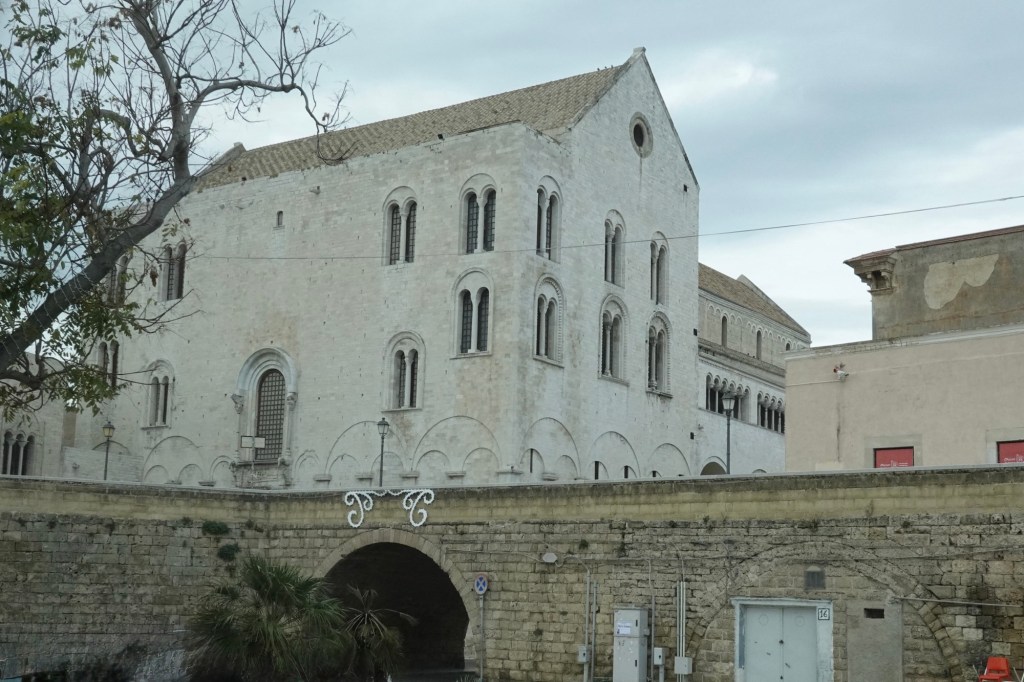
Our guide explained why the Saint is Bari’s patron saint. In 1087 CE, sixty-two sailors stole the relics of Saint Nicholas and brought them here. The fact that the city now had the relics of a saint led to it becoming a centre for Christian pilgrimage. In the Middle Ages, relics were big business, and having them created a huge economy. Not only are Saint Nicholas’ relics here, but the 62 thieving sailors are also buried at the cathedral.
Nicolas is not really all about Christmas. He is the patron saint of children and women too. That stems from two stories: one of Nicholas reanimating 3 children killed by a butcher, and the other of him saving 3 young women from prostitution by paying their dowries. Statues of the saint often depict him with 3 coins on a bible.
Those kinds of stories are what can make a long bus ride pass by quickly.
We drove by some interesting waterfront buildings, not photographable from our side of the bus. We were reminded (as we had been in Sicily and Calabria) that much of the development in Italy occurred during the fascist period under Mussolini. Reclamation of Bari’s waterfront, new theaters, and the restoration of buildings damaged during World War I were the dictator’s priorities for revitalizing the Italian identity.
Our journey took us along SS 16 Adriatica, which is the longest road (as opposed to motorway) in Italy. It too was built during the fascist period. It stretches just under 1000 km from Lecce in the south to Padova in the north, following the route of the Roman Via Appia for much of its length.
Bari is famous for it beaches along the Adriatic sea. Our guide explained that Bari is in the region of Puglia, which is located in the heel of the boot of Italy. Puglia means “dry land”; despite being located between the Adriatic and Ionian seas Puglia’s reputation is due to its lack of surface lakes and rivers. However, about 200m down, springwater is finally reached.
Puglia is one of the 20 regions of Italy; Bari in addition to being the name of a city is also the name of one of the region’s provinces. In Italy, provinces are subsets of regions. On our tour we will also be briefly in the province of Brindisi.
We passed quite a few vineyards of tarp-covered table grape vines, although the premiere fruit crops here are olives and figs. The most famous wine here is primitivo, which is commonly referred to as red Zinfandel. The tarps hold heat in, which helps to ripen the grapes more quickly.

We also drove by olive groves.
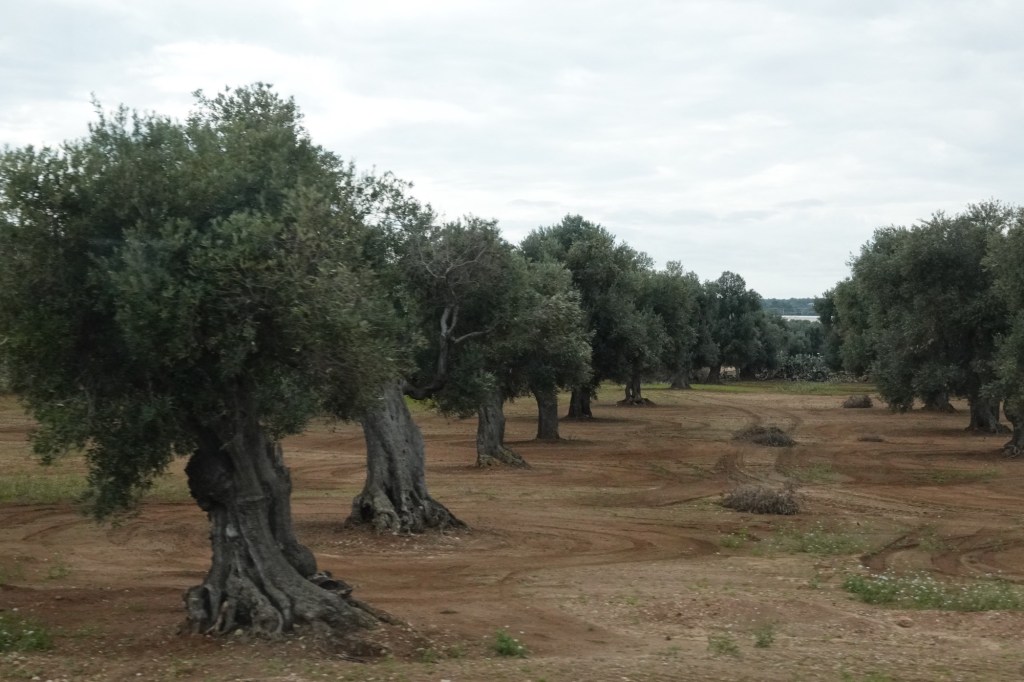
Caterina explained that in Italy true extra virgin olive oil (EVOO) is considered a medicine. It’s not for cooking and frying – not only is it too expensive, but heat negates its benefits. Many Italians take a tablespoon of it each morning, but it must be taken at least an hour before drinking your morning espresso, or all its essential vitamins will simply, as Caterina put it, “end up in the loo“. If ingesting straight oil seems like it would be a ridiculous amount of calories, one tablespoon of olive oil is a maximum of about 120 cal, which is not much different than 1/2 cup of Greek yogurt. Caterina commented that most Italians really don’t eat breakfast anyway; cappuccino and a pastry happen mid-morning for anyone not imvolved in manual labour (they need breakfast!).
In the same way that it is very expensive to produce true extra-virgin olive oil, Catriona explained that it is also an expensive process to produce true Italian tomato sauce – what we in North America would refer to as either tomato juice or passata, depending on its consistency. Italian tomato sauce is made only from tomatoes, salt, and a tiny bit of fresh basil. Any other flavours and herbs (especially garlic, which if added to the juice can react with the acid to make the entire thing bitter) are added only when the sauce is simmered to become the base for an actual dish. A one litre jar of “real” tomato sauce can cost six or seven euros, reflecting not only the amount of work but the number of (ideally) San Marzano tomatoes required to create a single litre. That explains why most Italians make their own. Caterina said “you are what you eat – food is not the place to economize”.
The centuries old olive trees here are considered “monumental” trees, the oldest of which dates to almost 1000 years BCE!! Imagine the stories that a 3000 year old tree could tell if only it could speak. The very old olive trees don’t get taller and taller, but the trunks do get broader and broader, and become twisted and gnarly.

Our first stop was the “white city” of Ostuni, 210m above sea level and about 8km from the coast. Ostuni’s name derives from “new town ” even though it is millennia old. In fact, the skeleton known as “Delia” (also called the “Woman of Ostuni”), recognized as the oldest human maternal skeleton, was discovered here by paleoanthropologists in 1991. She was a young woman, approximately 20 years old, who died in the terminal stage of pregnancy about 28,000 years ago during the Upper Paleolithic period. “New town” refers not to when the town was established, but to the town’s rebuilding by the Greeks after its destruction by Hannibal.
Walking into the city was absolutely magical. Not only are the roads limestone and almost white, but all of the buildings, all of the stairs, the balustrades, and the decoration is limestone that has been whitewashed. It was an overcast day, but in the sunshine the stones would absolutely gleam.

This is by far the prettiest city we’ve been in so far Italy.
The main Square includes the church of Saint Francis of Assisi (the patron saint of Italy) which again is rendered in beautiful gleaming white stone and has statues and sculpture work that is breathtaking.


The main square is called Piazza Liberta (“Liberty Square”).

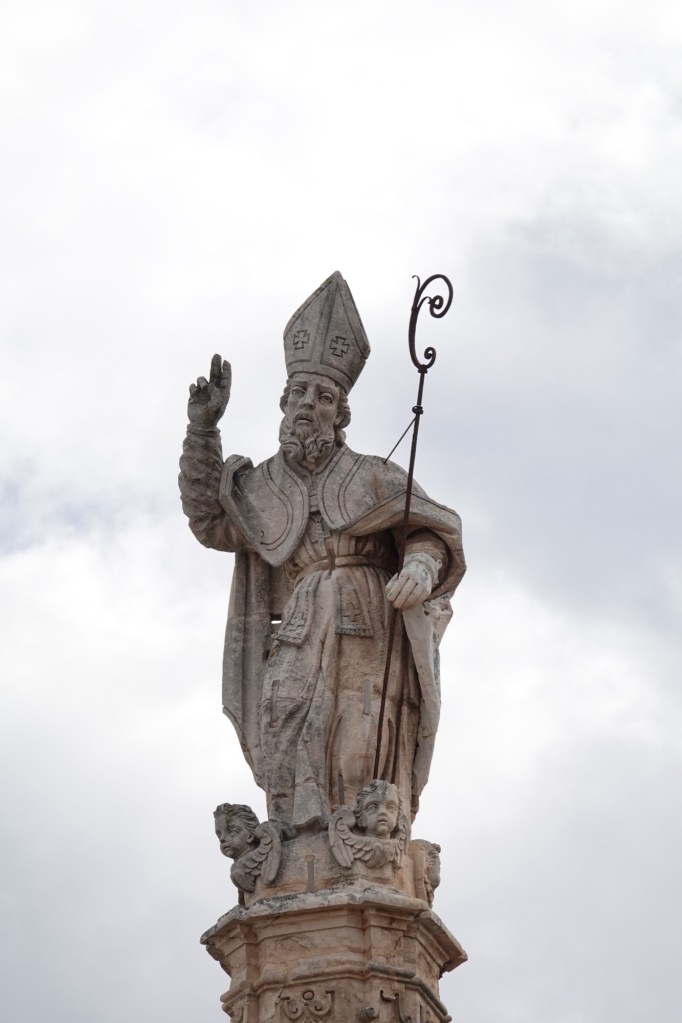
At one end of the square is a huge statue of “Saint” Oronzo, who in legend saved the city from the plague in the 17th century. However, although he was probably a real person who existed at the beginning of the 12th century CE, and is considered the first bishop of Lecce, he was really only reinvented as a “saint” during the period of the counter reformation in the mid 1500s. I remain in awe – and more than a bit sceptical – of how a centuries dead saint intervened in the plague.

The city is a maze of narrow streets and arches – a virtual labyrinth designed this way on purpose to frustrate potential invaders. It is much like a Moroccan kasbah, or perhaps the streets within the walls of old Dubrovnik.
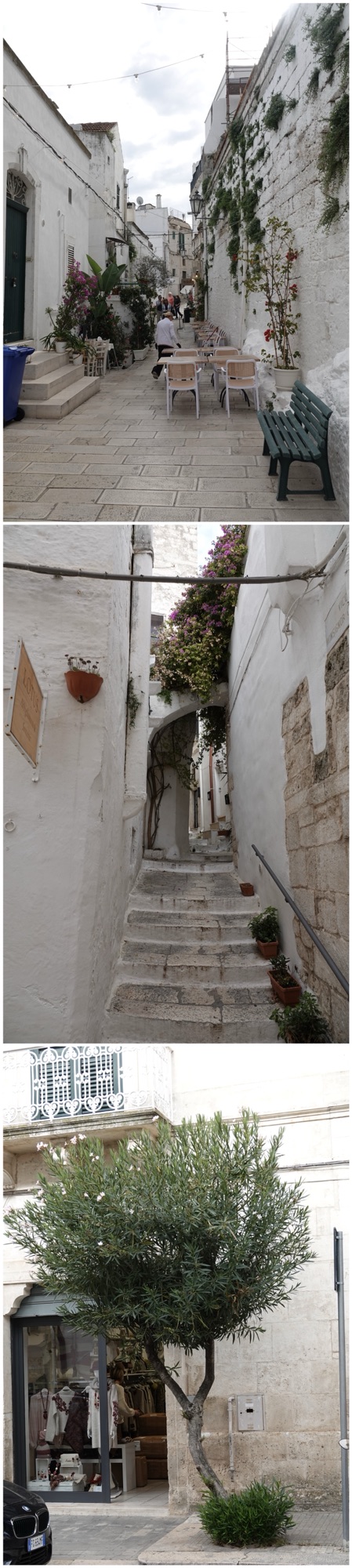
The small alleyways and varied levels of doorways into homes is referred to as spontaneous architecture.

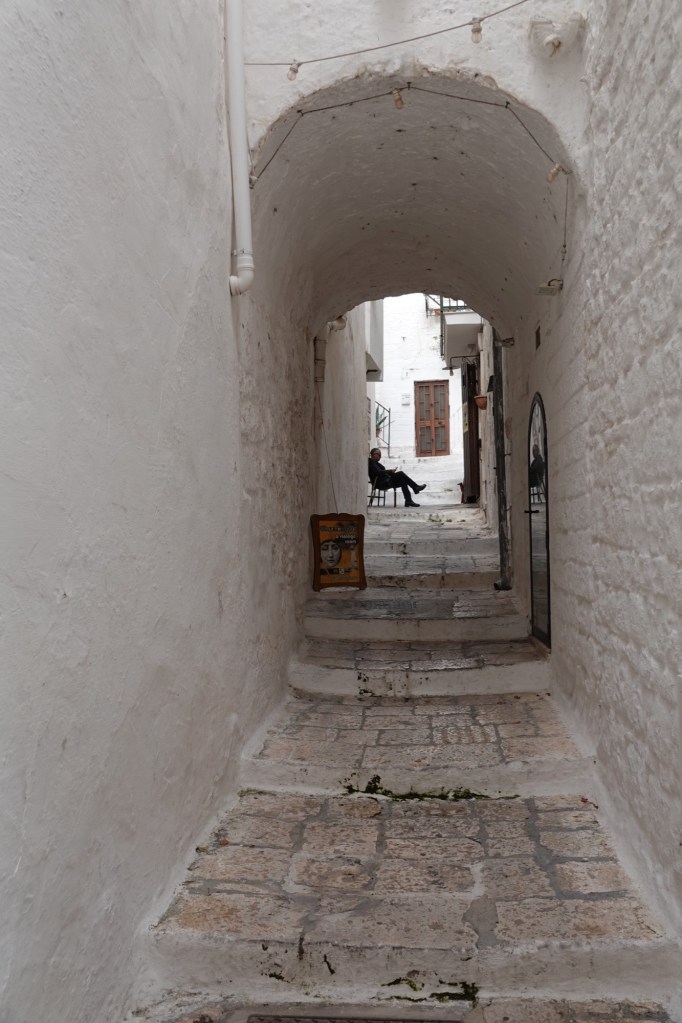
Since the 18th century, no colours are allowed on the buildings here except white. That’s reminiscent of Morocco’s Chefchaouen (the blue city – Episode 437). Not only is the architecture here reminiscent of the moorish style of the Arabic countries that we’ve visited, but our guide mentioned that even some of the words in the local dialect here still carry an Arab influence from the period in the 10th century (900s) when the Moors were here. An unintended benefit of the whitewashing of the city is that lime wash (calcium carbonate) is a disinfectant; it, and not “Saint” Oronzo, likely helped mitigate the impact of the plague. The lime wash also protects stone from moisture. The white colour also adds the illusion of space which is important in the narrow alleyways, and reflects the hot sunlight, keeping the houses cool during the summer months.
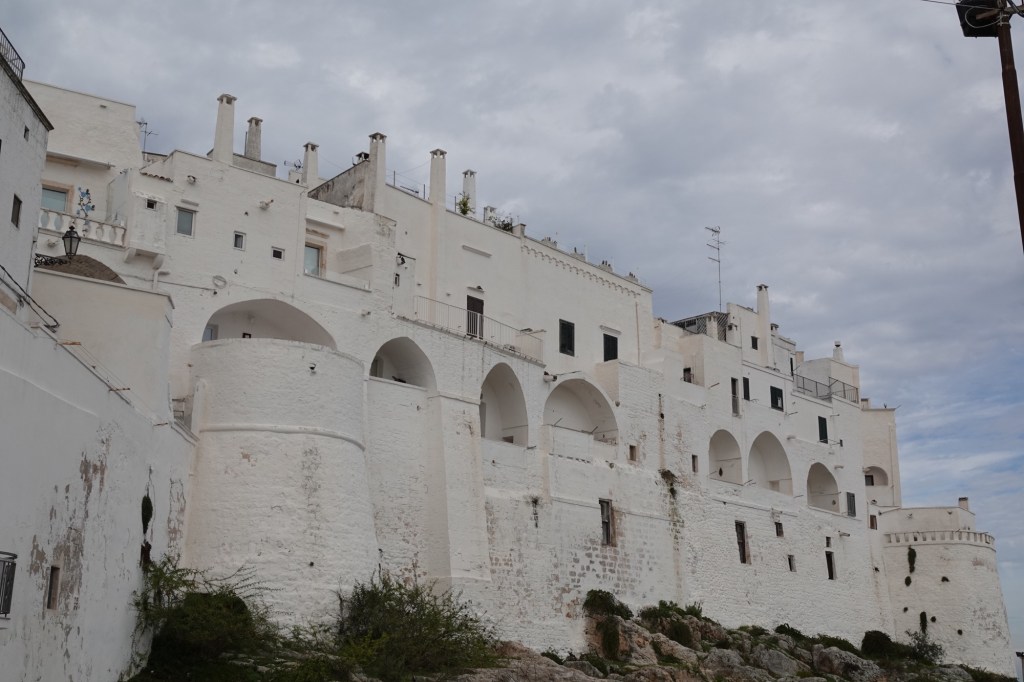
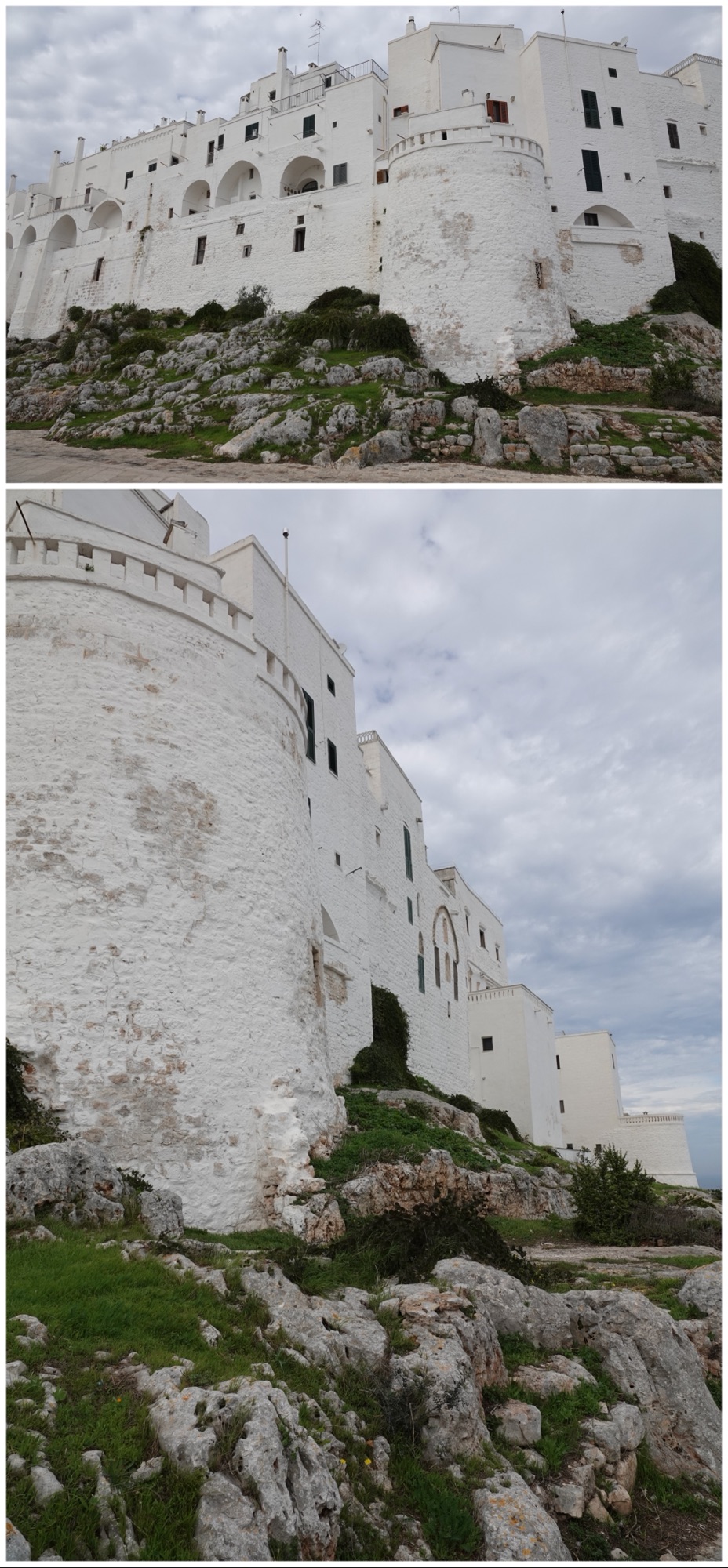
From just outside the city walls, it looks even more like a kasbah (citadel).
Caterina pointed out a white egg-shaped decoration with leaves around it, which sometimes is also found over the doors or windows of homes, but more commonly as smaller versions on a shelf in the marital bedroom. This good luck charm is intended to promote fertility, so that families will have lots of children. Interestingly, one cannot buy it for themselves. It must be a gift. She also quipped that modern families no longer covet these eggs, since they are happier to concentrate on monetary wealth instead of large families.

The “sea” of olive trees that we could see from the top of the hill includes more than 3000 monumental olive trees, which is the largest collection of ancient olives in the world. At one point there were 60 million olive trees in Italy, but a fungus that came from Central America about 12 years ago has killed more than 1/3 of the trees, driving up olive oil prices.
We learned that olive presses were often located underground in this region, because of the ability to maintain a more constant temperature. During World War II, it is rumoured that many Jewish citizens were hidden in the underground olive press areas.

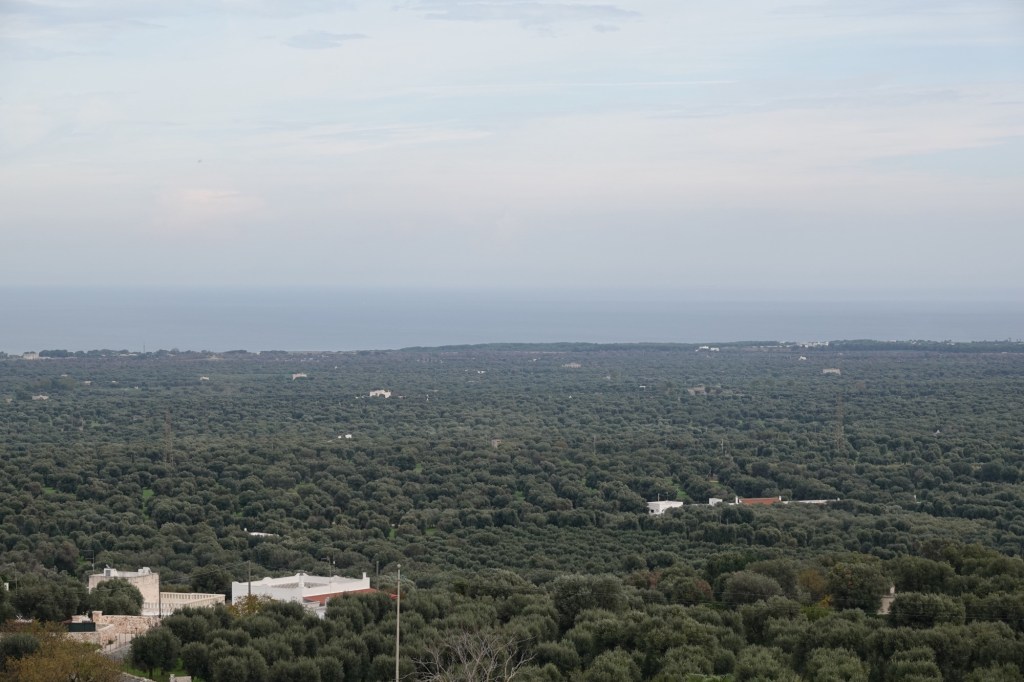
Ostuni originally had four gates through the city walls, we walked through the oldest of them which dates to approximately the 12th century and has a slightly pointed arch.
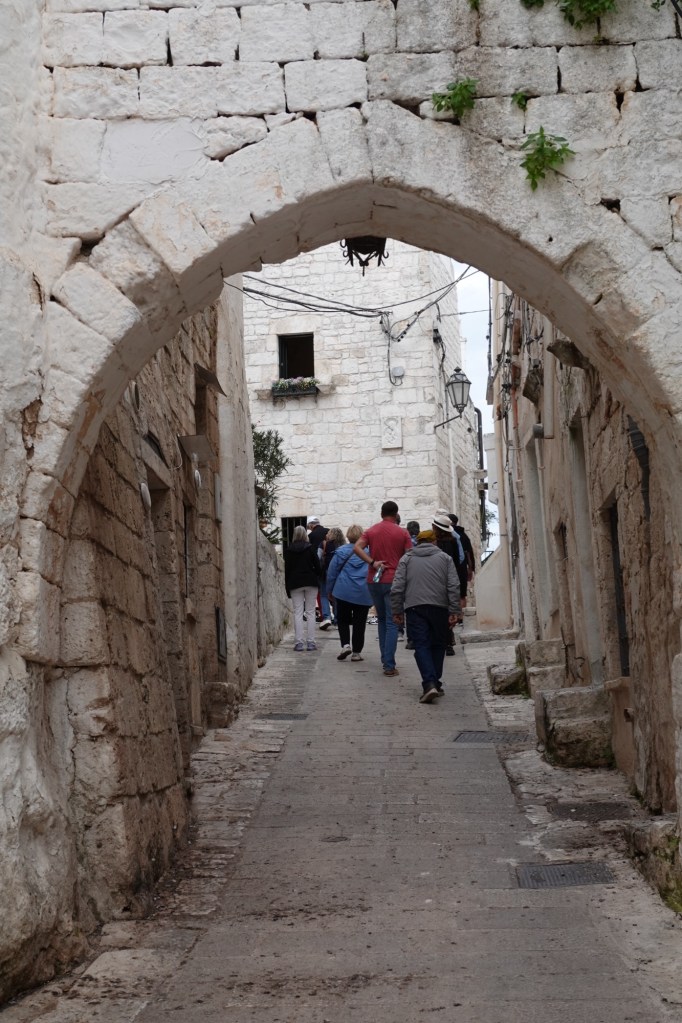
The square tower inside the gate dates to the Norman times.

The mother church of the city is dedicated to the Virgin Mary of the Assumption. It is one of the few things in the city that is not whitewashed because it was built entirely from local limestone, which has a slightly yellow tinge to it. Unlike most of the churches in Puglia, which are Romanesque, this church is flamboyant Gothic (also called “late Gothic”) architectural style.
This church is also unique for having two rose windows, one at the front and one on the side.


In the square in front of the church is a beautiful arch that is almost reminiscent of the Bridge of Sighs in Venice near Saint Marks. The church and the arch are at the highest point in the city. The church dates to the late 15th century.
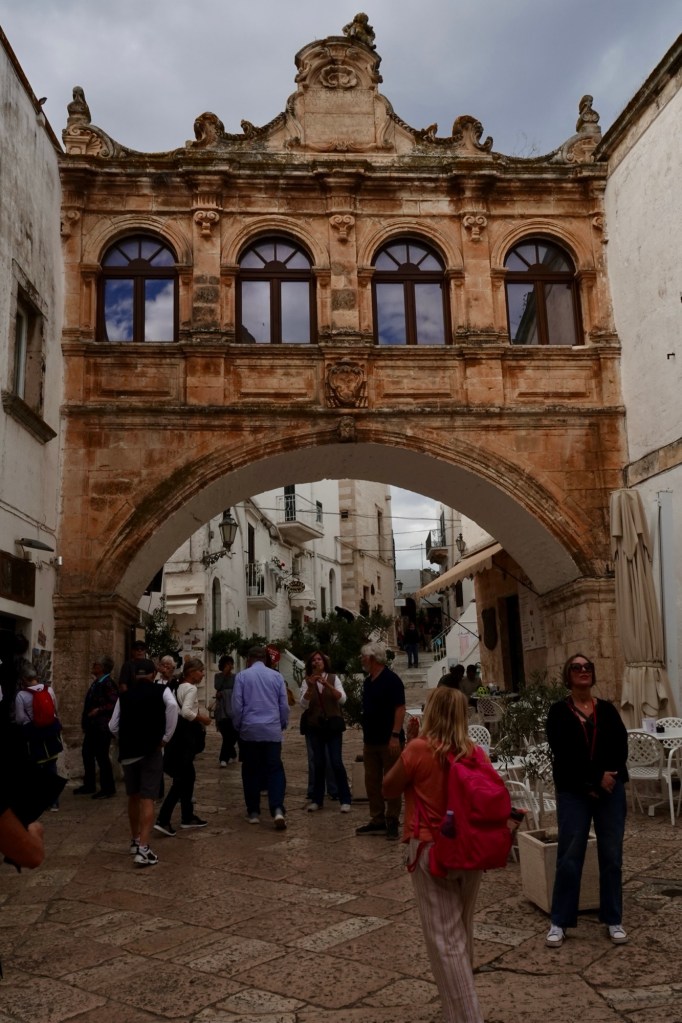
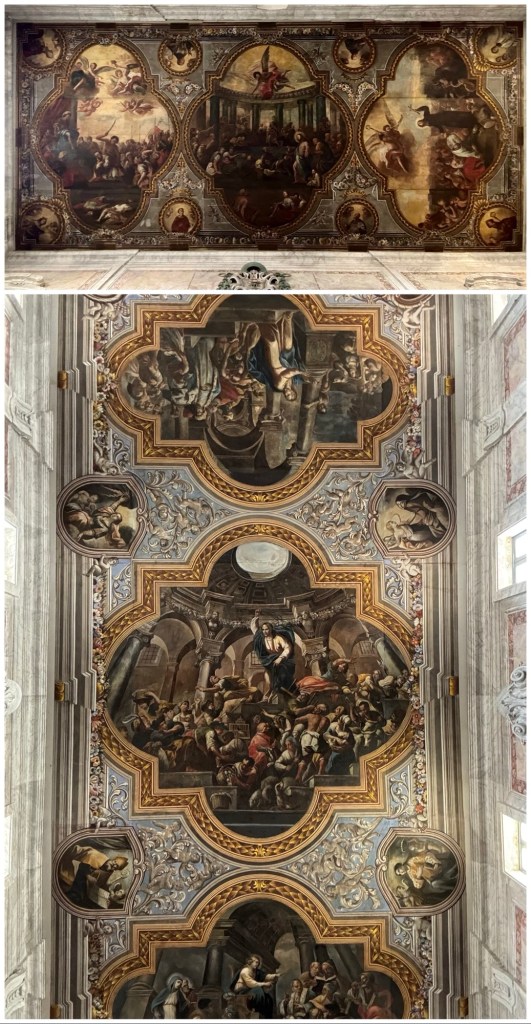
We were able to go inside the church while our group had a 20 minute shopping break.

Inside the church were several notable items.


Our second stop was in Alberobello, at 400m above sea level, where we enjoyed lunch prior to our walking tour. Yes, we got orichiette, served with a broccolini pesto and toasted bread crumbs, followed by thinly sliced roast pork with herbed potatoes, and stracciatella gelato.
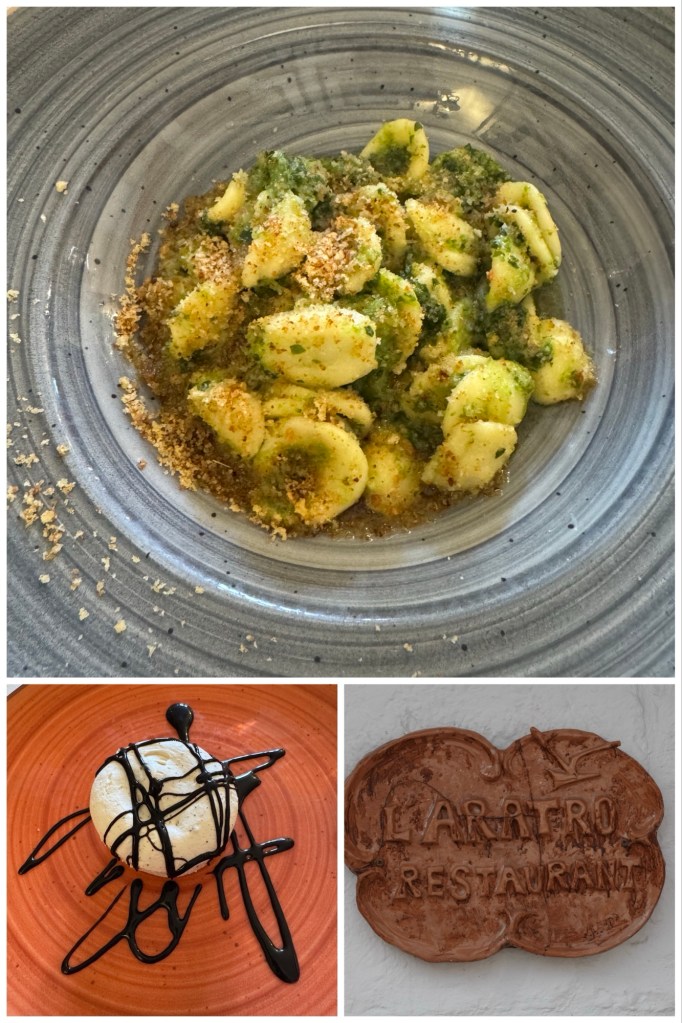
“Alberobello” means beautiful trees and, in this case, it does not refer to olive trees, but rather the oak trees that are prevalent here.
We noticed while driving between the two cities that the olive Groves are particularly well organized, with trees planted equidistant and in straight rows. Our guide explained that this dates back to Roman times when the first large scale olive oil production was begun. The spaces between the trees allow for each tree to get equal sunlight, for the roots to spread far enough to get nutrients from the Earth, and also to give the opportunity to sow other crops between the trees, making the groves an efficient agricultural area.

But the main reason for visiting Alberobello is that it is a city filled with trulli. A trullo (singular, trulli is plural) is a primitive style structure similar to the beehive shaped mud homes that can be found in parts of Africa and Syria, although here they are entirely local limestone.

In the 17th century this area belonged to the Kingdom of Naples, and the Count whose fief Arberobello was would have had to pay taxes to the Kingdom based on the number of homes on his estates. The count (being a stingy tax-evading sort) decreed that the peasants who settled here had to build their houses “dry” (i.e. without mortar) so that they could be quickly demolished at tax time and then rebuilt – a constant labour-intensive process of destruction and renewal. Eventually the Count was relieved of his lands and the town was taken over directly by the King, who allowed the use of mortar to create more permanent residences. The cone shaped design, though, likely came from Türkiye, where tombs often had this shape.
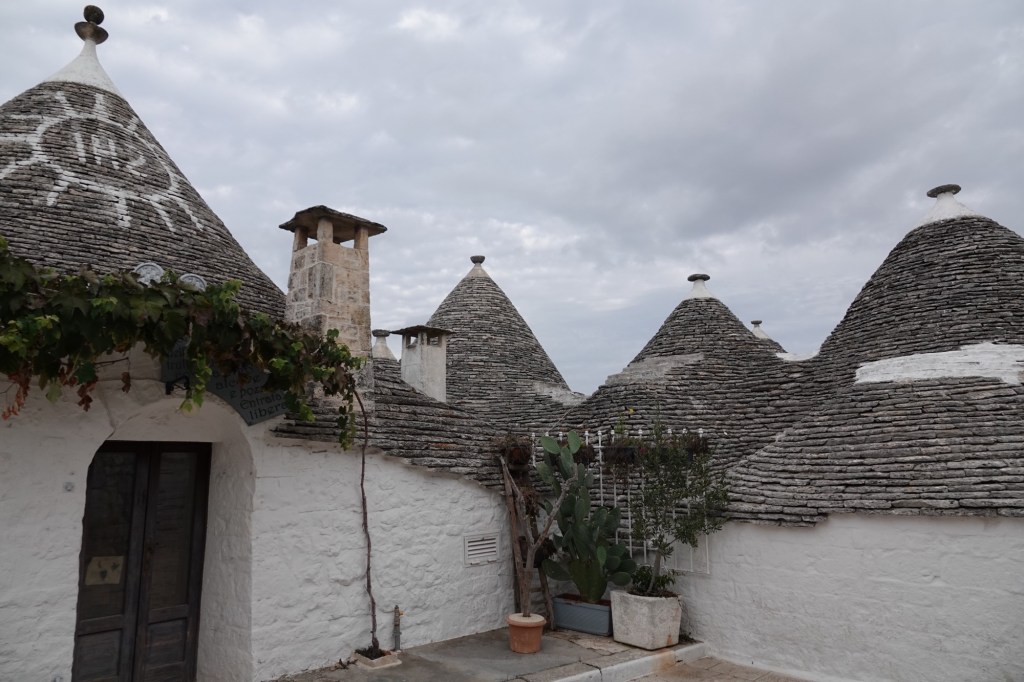
Our guide reiterated that no one is really sure why the cone shape evolved for the roofs here, but looking at the construction without mortar of these dry stone homes it’s hard to imagine any other shape where the stones would have balanced properly to create a roof line in a location where thatch was not an option.
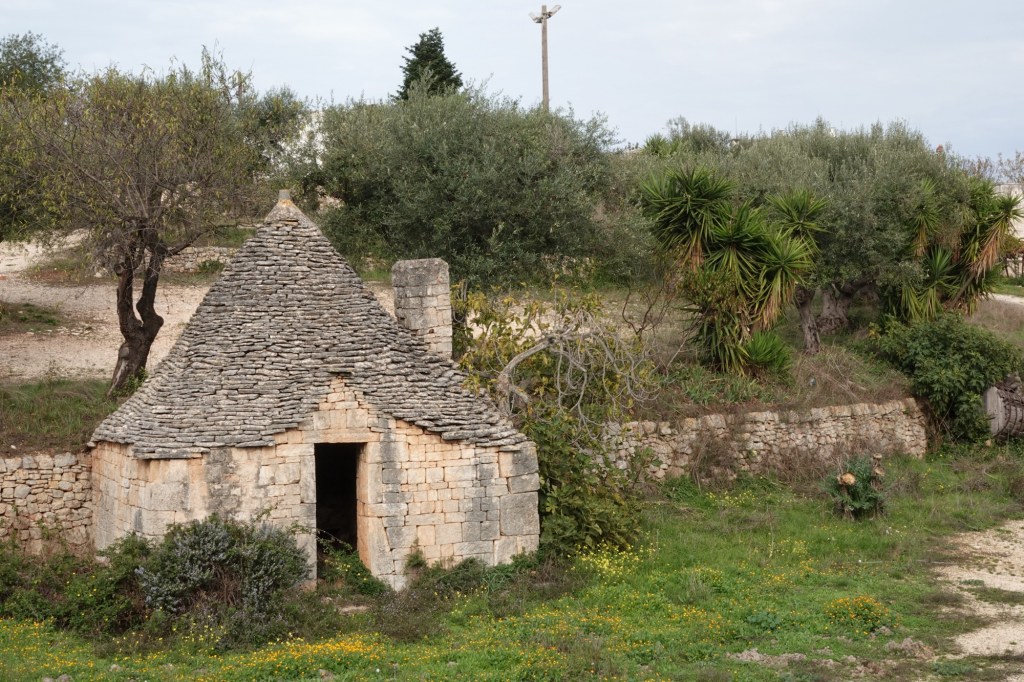
More than anything, the roofs reminded me of a Moroccan tagine pot; I could almost picture lifting them off and finding something delicious inside.
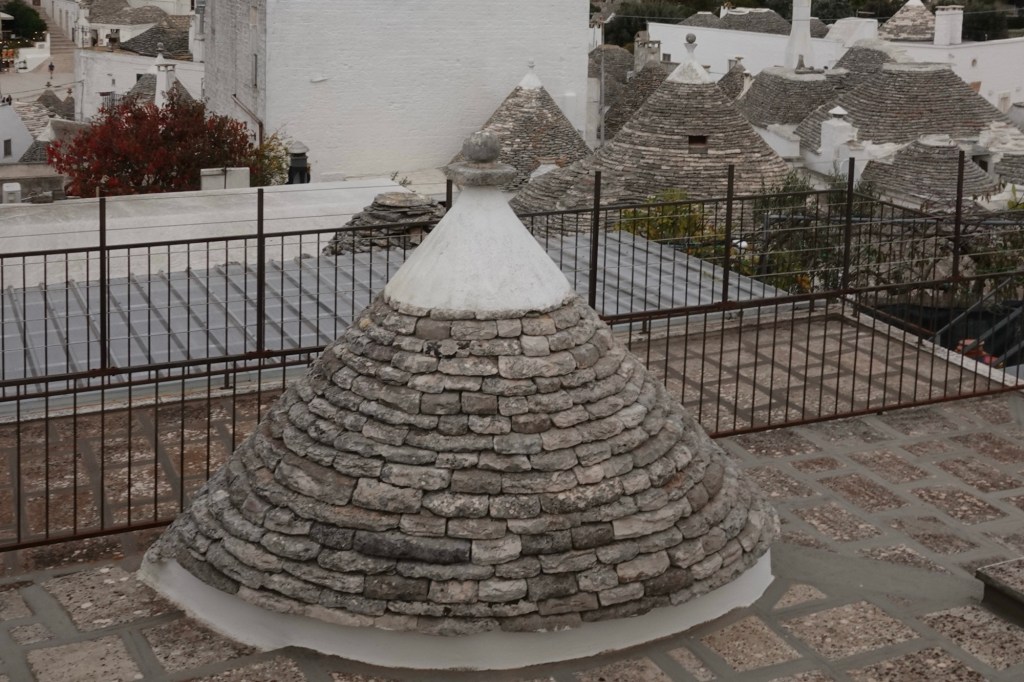
We had a moment or two to pop into a shop where I bought a tea towel for our landlady, but we were also invited to the balcony of the shop to get a panoramic view of the city’s trulli houses, which was truly (pun intended) spectacular.

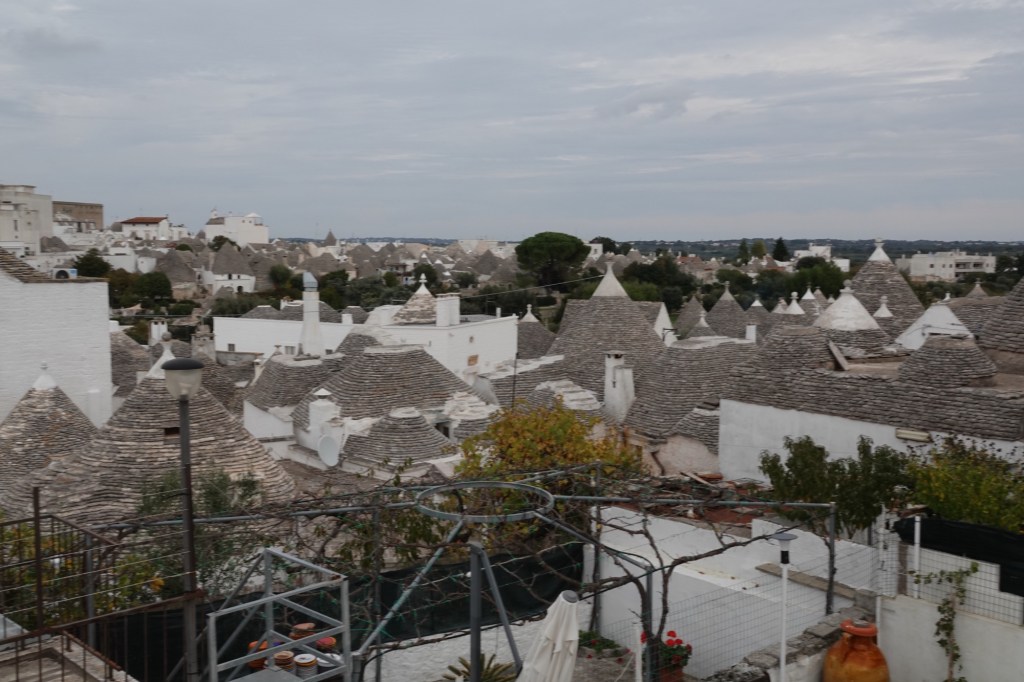
About 400 of the trulli are on the side of the town that was once considered the aristocratic side, and many of these are still in use as family homes; on the “peasant” side there are just over 1000 additional trulli, some of which have been converted into shops and restaurants, a very few still in use as personal homes, and the rest sitting empty.


There are almost no stonemasons left who are both skilled enough and willing to do the backbreaking work of building and repairing trulli.
Inside a trullo, there are no doors; the rooms are all interconnected and accessed by arches in the walls. Often upstairs in a loft area in the roof is what was once known as the “boys room”, most commonly where the children slept.
The legend behind the “Siamese” trullo (below) is that it was occupied by two brothers who were in love with the same woman. When she chose the elder brother, they put a wall in between the two halves of the trullo so that the younger one would not constantly have to be faced with his disappointment.
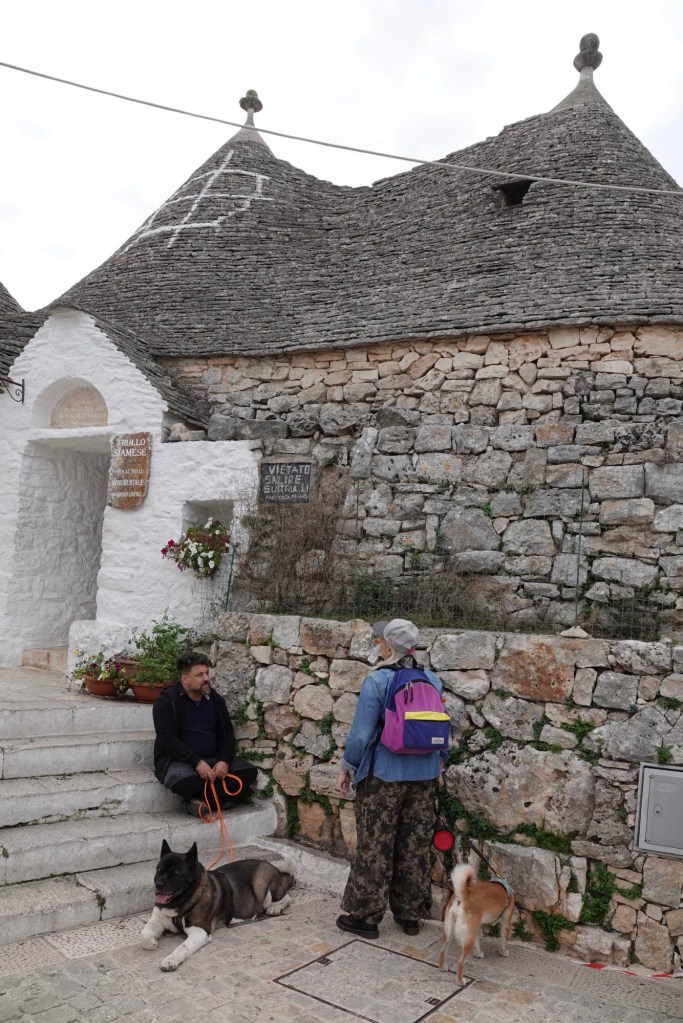
Under each trullo is a water cistern; the stones dug out during excavation of the cistern were used to build the trullo. The walls can be as much as a metre thick, providing natural insulation against both heat and cold. The windows are tiny, providing air circulation but very little light.


Each cone is the roof over a single inside “room”, even if it’s just a bathroom. Our guide explained that she lives in a trullo with 6 cones: living room, kitchen, two bedrooms, and two bathrooms.
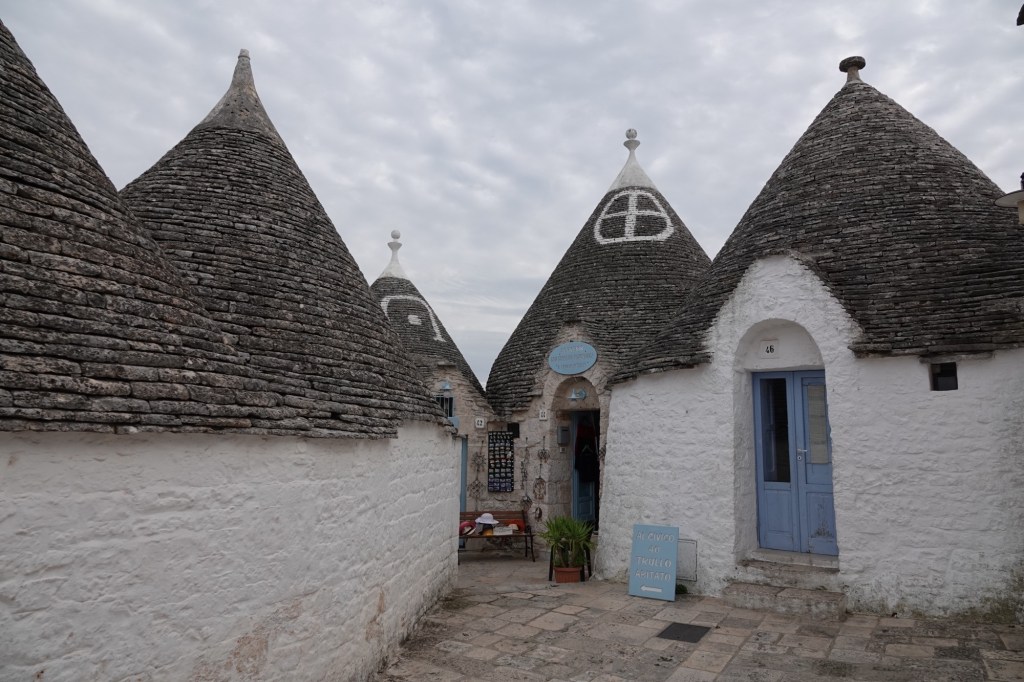
The roofs start out being white, which is the natural colour of limestone, but they darken into gray with time.

The tops of the cones, referred to as pinnacles, sometimes have unique tips. It is not actually known why there are different designs, but it could be the signature of the stonemason, or even an indication of the wealth of the family, or the profession of the person living in the trullo.

Many of the trulli have white symbols on their conical roof. There are over 100 symbols which fall into three types (we were not told what the three types were, but one is certainly religious symbols). The symbols appeared only after World War II.

The symbol on the furthest trullo on the right above is the three branched tree uniting hell, earth, and heaven. The heart is the pierced heart of the Virgin Mary. There is a recognizable Cross. The crescent moon with Cross is a Christian symbol, but it could also appear as simply a crescent moon representing the moon. The lantern with rays of light coming from it represents the Holy Spirit, and the symbol that looks like the sun with rays is actually representative of the host used during Christian mass.
Individual trullo owners can decide what kind of symbol they want to put on their roof, if any.

We visited the only church in the town that is also built in the form of a trullo.

The trullo style church is dedicated to Saint Anthony. The church is quite recent, having been built in 1925. Legend has it that part of the reason the church was built so quickly is that it was built with funds from expats from Alberobello living in the United States trying to ensure that Protestantism would not creep into Alberobello.
Behind the main altar is a fresco depicting the tree of life. The turbaned men depicted on the right hand side of the fresco are the Syrian brothers who were the first doctor and pharmacist in the area.

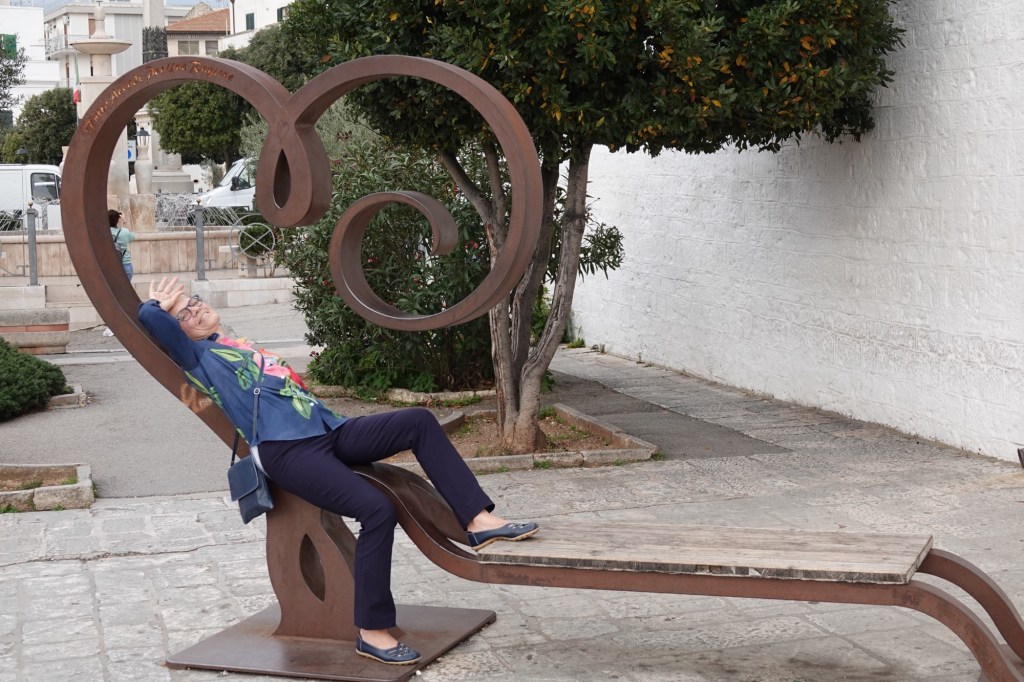
After the end of our excursion, we climbed up to get one last panoramic view trulli rooftops. There was a decorative bench there, so naturally …
As we headed back to our ship, the rain that had held off all day finally arrived – but we were safe and dry in our coach.
Tomorrow we’ll be in Croatia, and lamenting the fact that this all too short cruise is almost over.
 Rose and Ted’s Excellent Adventure
I love seeing and hearing your information about the trulli homes. You looked wonderful in the photos and the photos were wonderful. Thank you for sharing as always.
LikeLiked by 1 person
I need to see those trulli. I’m going to put this short cruise on our list. I have a feeling that we’ll be putting down some deposits while we’re on part 1 of the world cruise. We didn’t book anything on our LA>London cruise this year, but now we’ve got a list.
LikeLiked by 1 person
Ostuni and Alberobello look amazing!
Sooo beautiful…thanks for the excellent tour 🙂
Catriona
LikeLiked by 1 person
What a beautiful place, Rose. I love all the alleyways, of course, and I think those trulli homes are fabulous! Happy Sunday and daylight savings time – all rolled into “a -day-late”! LOL!
LikeLike
What a beautiful place, Rose. I love all the alleyways, of course, and I think those trulli homes are fabulous! Happy Sunday and daylight savings time – all rolled into “a -day-late”! LOL!
LikeLiked by 1 person