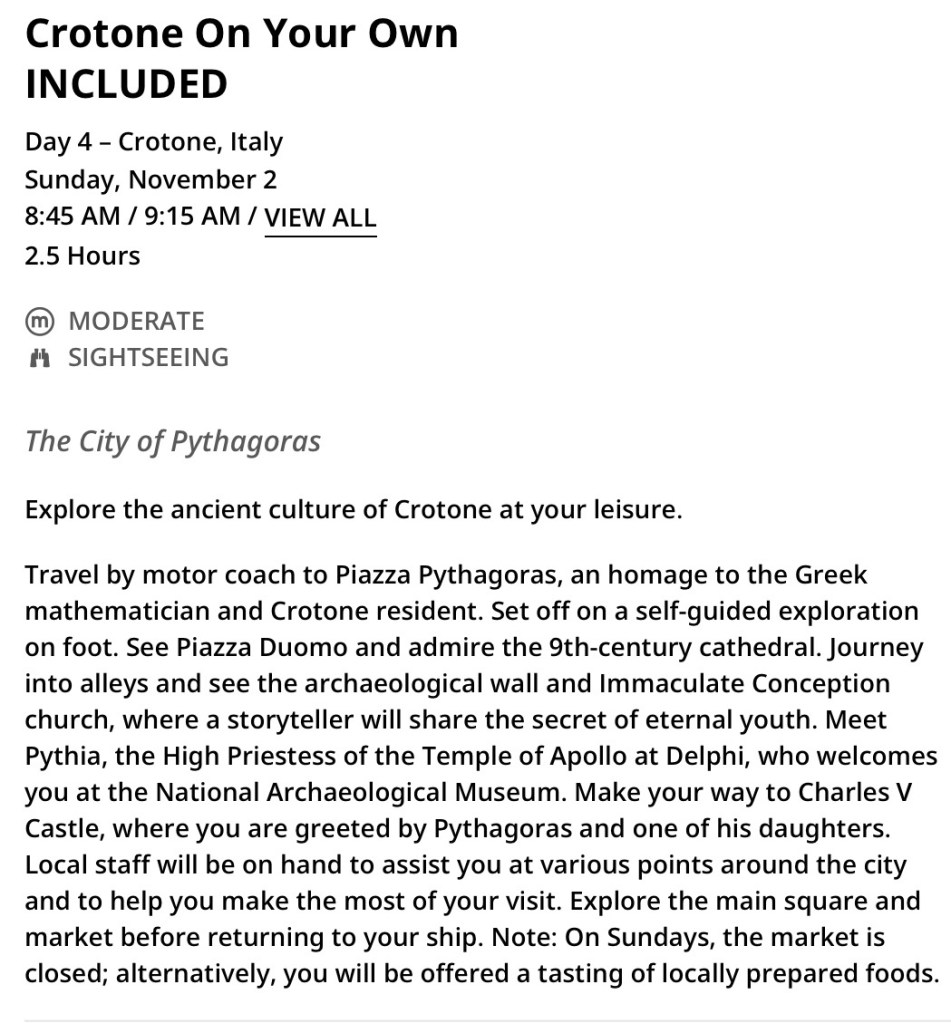
It’s Sunday, so no market.
While our first reaction to “on your own” was to wonder how this qualified as an excursion, it turns out that this specific format is one of Viking’s best reviewed. We were given a map of “must sees” – all at our own discretion of course – and at each suggested site, there were local treats, or interpretive guides, or displays, so that we’d still learn something (Viking does, after all,brand themselves as “the thinking person’s cruise line). The other bonus to this format: no headsets needed!


We were completely free to choose which sites to visit and how much time to spend.
My big question of the day: why is the Piazza Pythagorus (Piazza Pitagora in Italian) not shaped like a triangle? After all those grade 9 geometry classes spent calculating the length of the third side of a right angle triangle for which the lengths of the other two sides were given, I felt bit cheated.
But, I guess, the “square” of the hypotenuse equals the sum of the squares of the other two sides, so I’ll have to reconcile myself to a relatively square piazza.

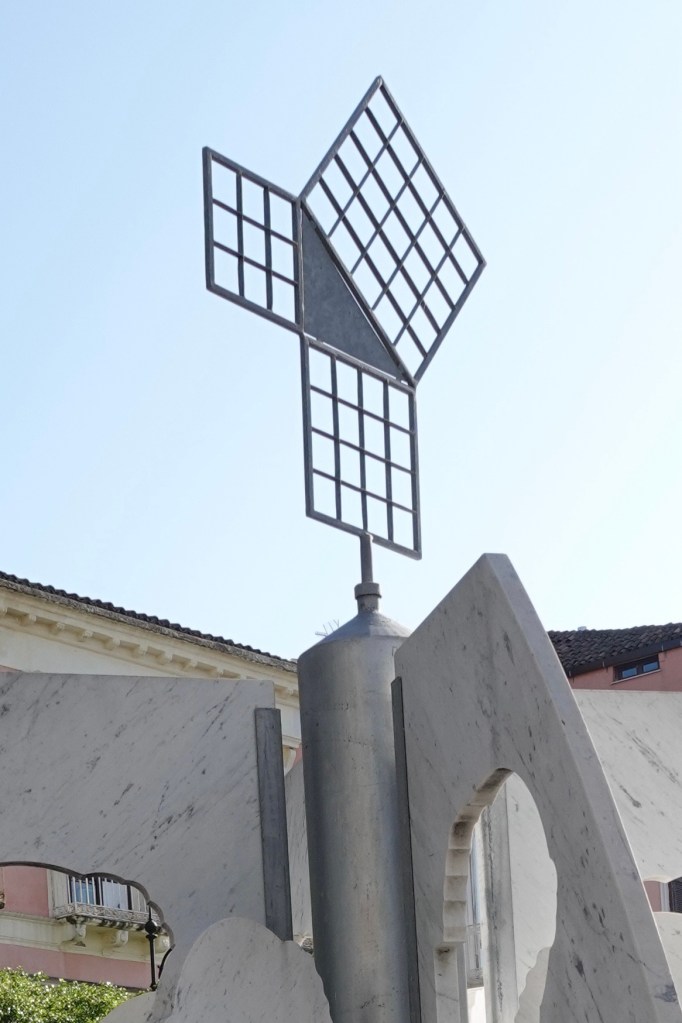
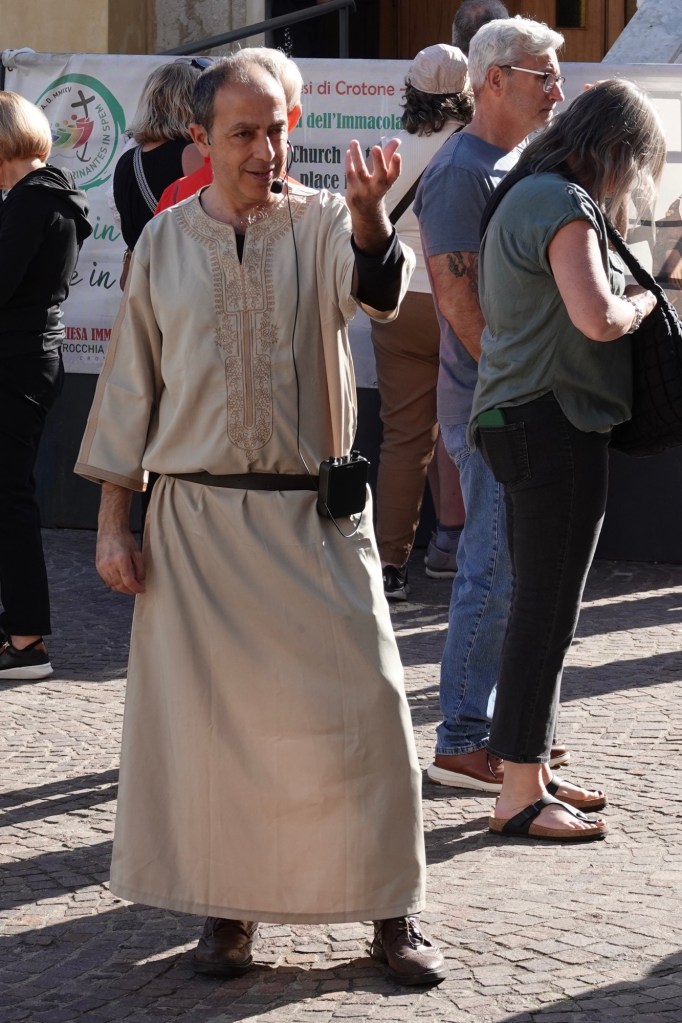
And … was Pythagorus named after Pythia, the high priestess of Apollo’s oracle at Delphi because he, like the priestess, was wise and intuitive? The local actor portraying him assured us that the gods had blessed him with a strong body, a nimble brain, an insatiable thirst for knowledge … and outstanding good looks!

Pythagorus was born in Greece, but around 530 BCE he founded a secretive ascetic school in Crotone. While most people – like me – associate him with geometry, he apparently studied things as widely diverse as the movement of planets and what happens to our souls after we die, but since none of his writings have survived, no one can be absolutely sure what can and can’t be accurately credited to him. It was interesting to be reminded that his “school”, sometimes referred to as a monastery, included both men and women and treated both sexes equally. After all, a philosophy that believes that souls are eternal separate from bodies, and that they can be reincarnated into any life form, needs to recognize that males might return as females; that’s a string incentive to make sure both sexes have equal value and rights! (I’m not sure what it says about me that he gave me a long stare and then suggested I’d be coming back as a python. Beware my hugs, I guess!)
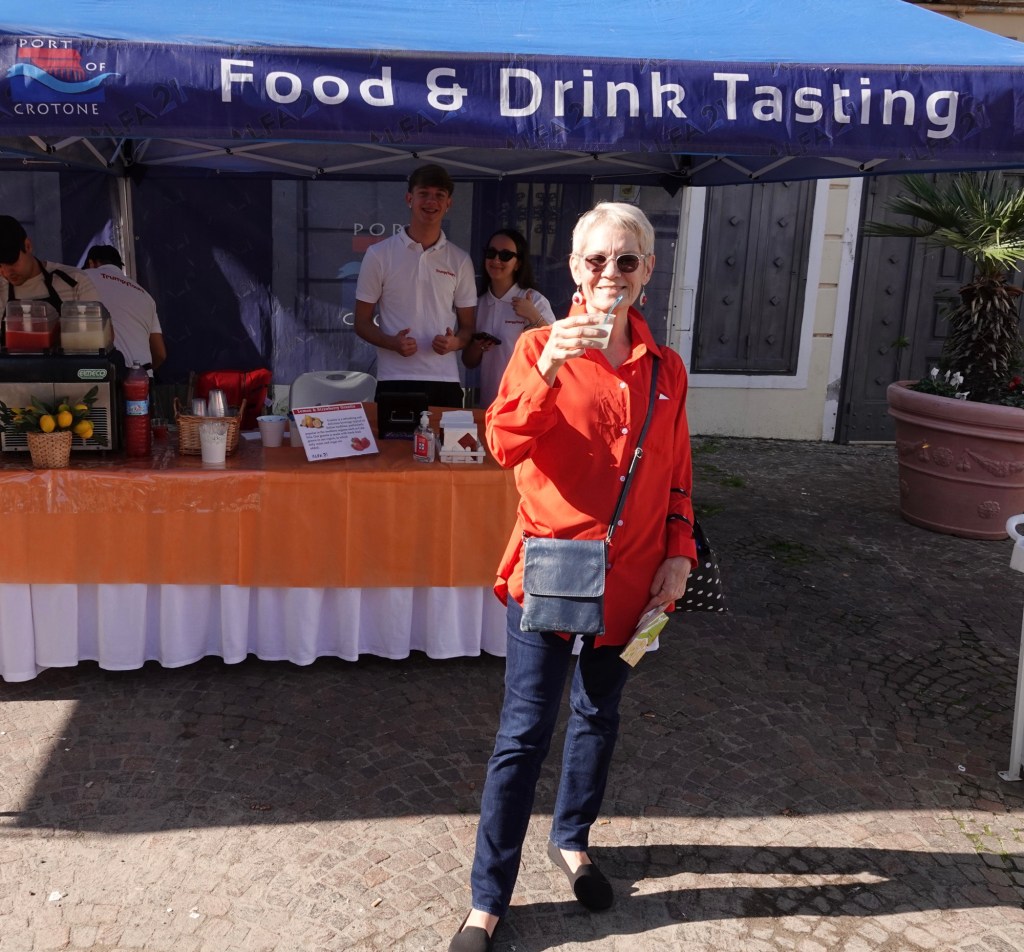
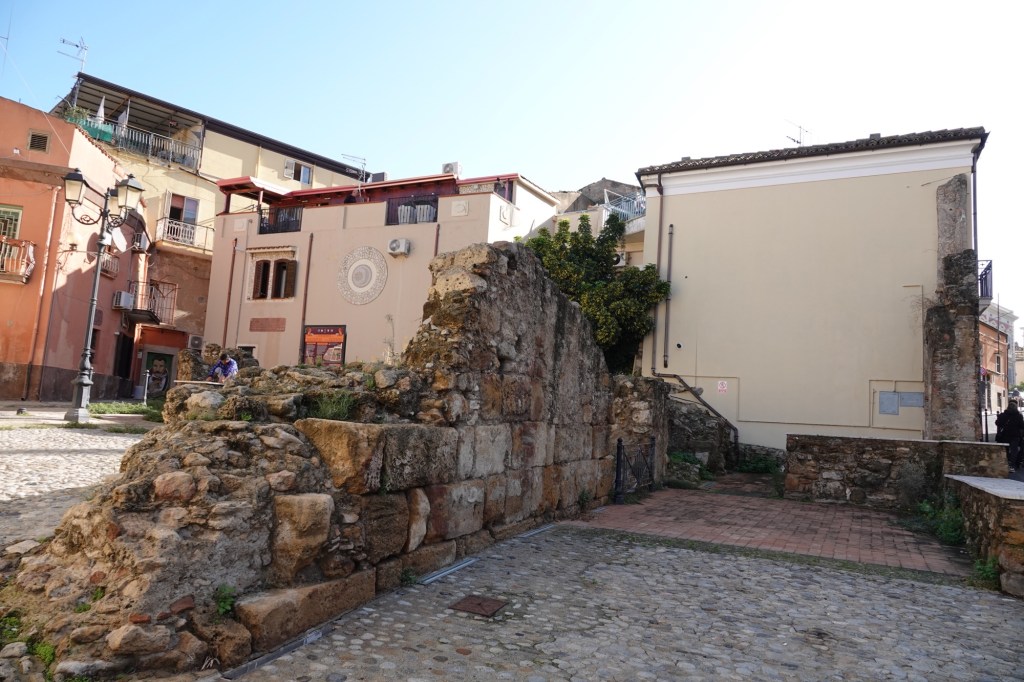
Our tour began with a treat – lemon granita – and the first of our “ancient Greeks”, who gave us the history of the city’s founding around 700 BCE as part of “magna Graecia”, or “Greater Greece”. He also pointed out the nearby Byzantine era walls, and pointed out that all of the churches in town (in this case the Immacolata – church of the immaculate conception) are built on Pythagorean mathematical principals, including a triangular roofline.
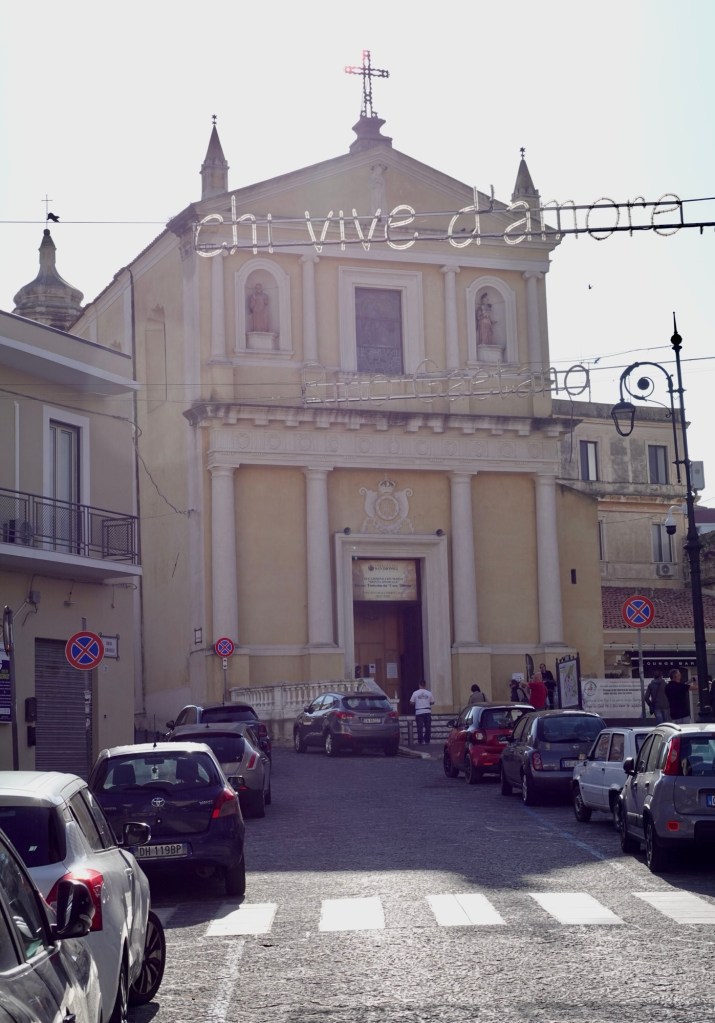
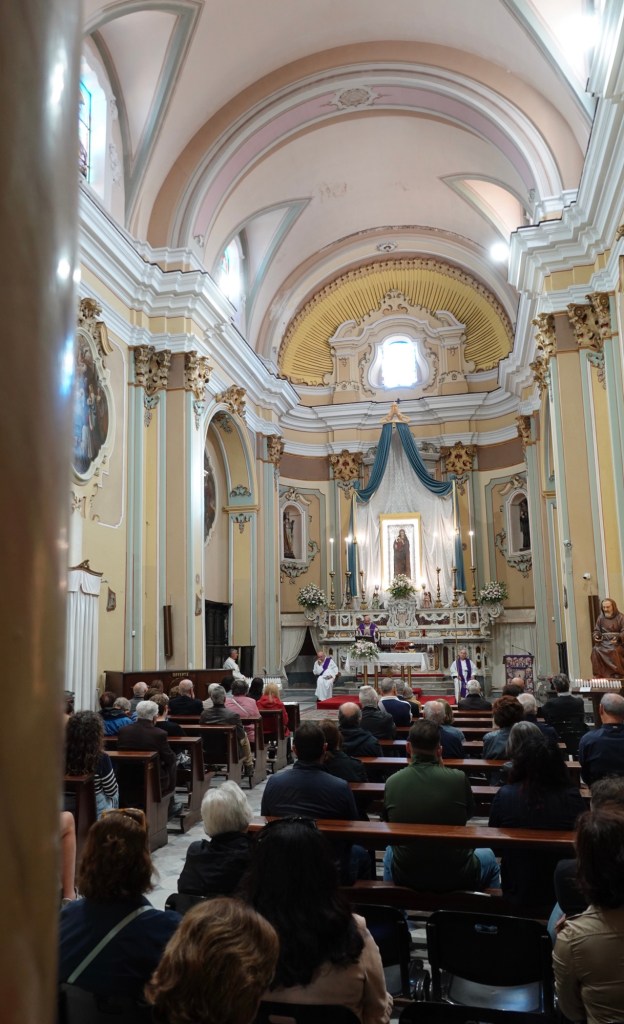
Ted got a very quick peek inside the church before the doors closed for mass.
Above Vittorio Emmanuele street leading to the church were strung an excerpt of the lyrics to a song made famous in Crotone: “Ma il cielo è sempre più blu”, by Rino Gaetano.
Chi suda, chi lotta, chi mangia una volta
Chi gli manca la casa, chi vive da solo
Chi prende assai poco, chi gioca col fuoco
Chi vive in Calabria, chi vive d’amore

Translated into English:
But the Sky is Always Bluer

Who sweats, who fights, who eats once,
Who misses home, who lives alone,
Who earns very little, who plays with fire,
Who lives in Calabria, who lives for love.
We continued along sloping cobblestone streets to the Crotone Archeological Museum. Very few of the signs in the museum were in English (hooray for Google translate!). Many of the ancient artifacts excavated here were found in cooperation with faculty of the University of Austin Texas!
The two things I found most interesting were the ancient horse’s mask and the pottery found in the necropolis of Carrera.


The museum’s pièce de resistance is the gorgeous Diadema Aureo, also known as the Corona di Hera or Hera’s Crown. The discovery was made in the shadow of Calabria’s last column standing, one of 48 that once supported a magnificent Doric temple at the edge of a cliff on a cape extending into the blue waters of the Ionian Sea. The treasure was hidden within a smaller temple just next door. Today, those ancient ruins are part of Capo Colonna Archeological Park, about 13 kilometers south of the center of Crotone.
The diadem is the crown jewel (pun intended) of the find. The ancient tiara in gold foil measures 37 centimeters in length (almost 15 inches) and 5 cm. in height (about 2 in.). It dates from the 6th century BCE.

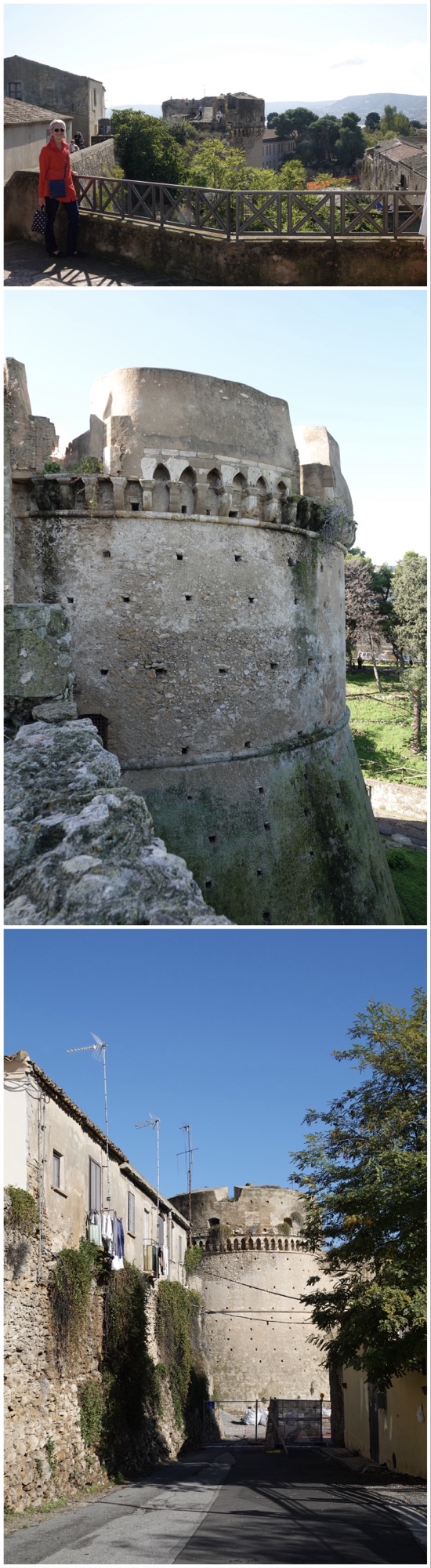
From the museum, we walked to the 16th century castle/fortress of King Charles V, where a female member of Pythagoras’ monastery greeted us.

We wandered the bastions, getting panoramic views of both the city and the waterfront, and descended into the cells where prisoners might have been held.



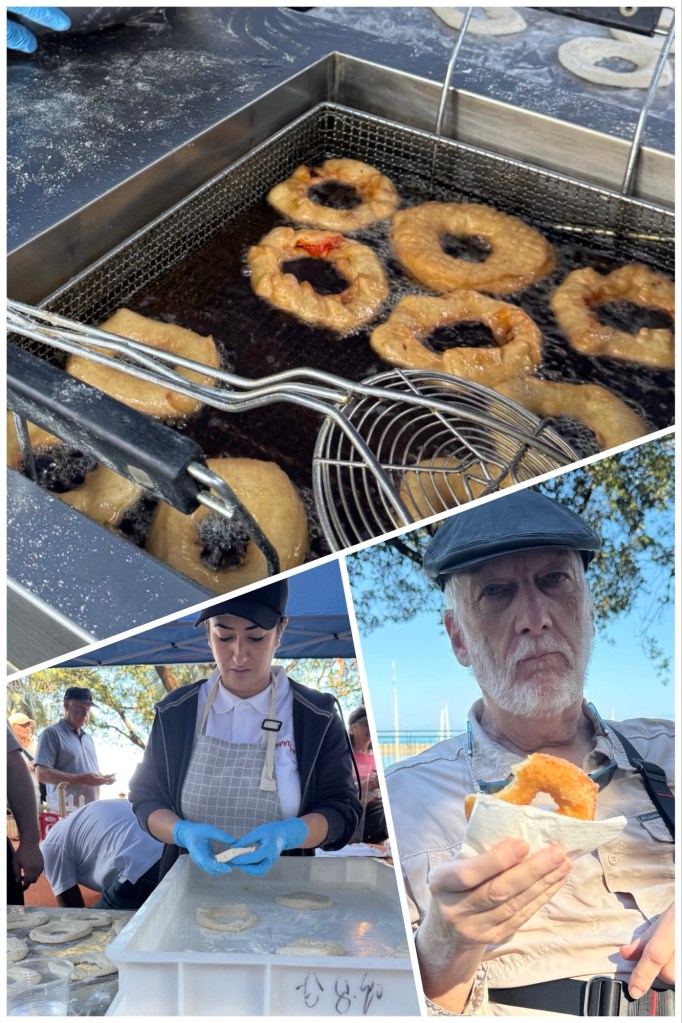
Our last stop was in the town garden, where we were treated to hot and delicious fresh-from-the-fryer crespella and a music by a wonderful local band.

No, I didn’t resist dancing when the chance was offered. Someday I may want to remember that feeling.
After that lovely morning, we simply spent a quiet afternoon just writing and lazing on the ship before the evening’s special surf & turf event on the pool deck.

Resident Guitarist James entertained throughout the event.

There was a show in the theatre at 9:00, but jet lag finally caught up with Ted; he was asleep by then. I listened to the classical duo in the atrium for a while, with a Sambuca nightcap, and then also called it an early night.
Tomorrow we have an 8 hour excursion in Puglia.
Oh, and that secret to eternal youth that we were promised in today’s tour description? According to Pythagorus, it is never to stop questing for knowledge.


Your dancing was wonderful. That was a great idea for the Viking tour. Enjoy, enjoy.
LikeLiked by 1 person
We’d definitely do that format again if it were offered!
LikeLike