Sicily means cannoli, right?
Or maybe Sicily means Godfather movies.
Either way, I’m excited for our first taste of the island.
Interestingly, cannoli date to the 10th century during the Sicily’s Arab/Muslim period, and so are actually more Arabic than Italian. Perhaps that’s where the pistachio garnish originates. There are similar desserts in the Middle East, although Sicilian cannoli with their creamy ricotta filling are in a class of their own.
Once again today our excursion was within walking distance of where we’re docked, so there was no reason not to linger after the formal part was over.

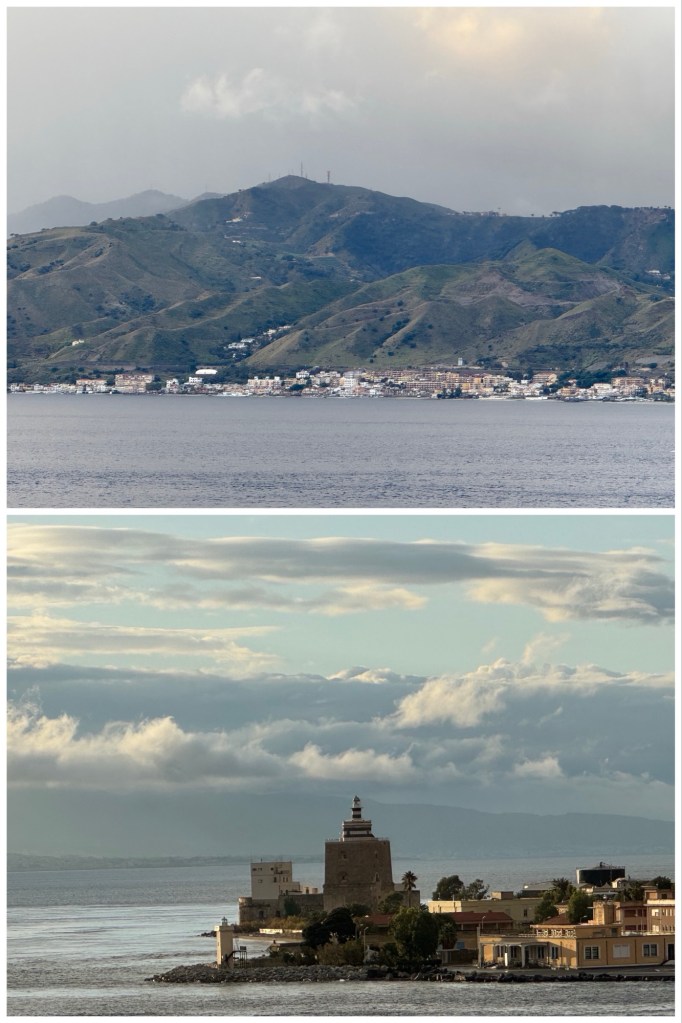
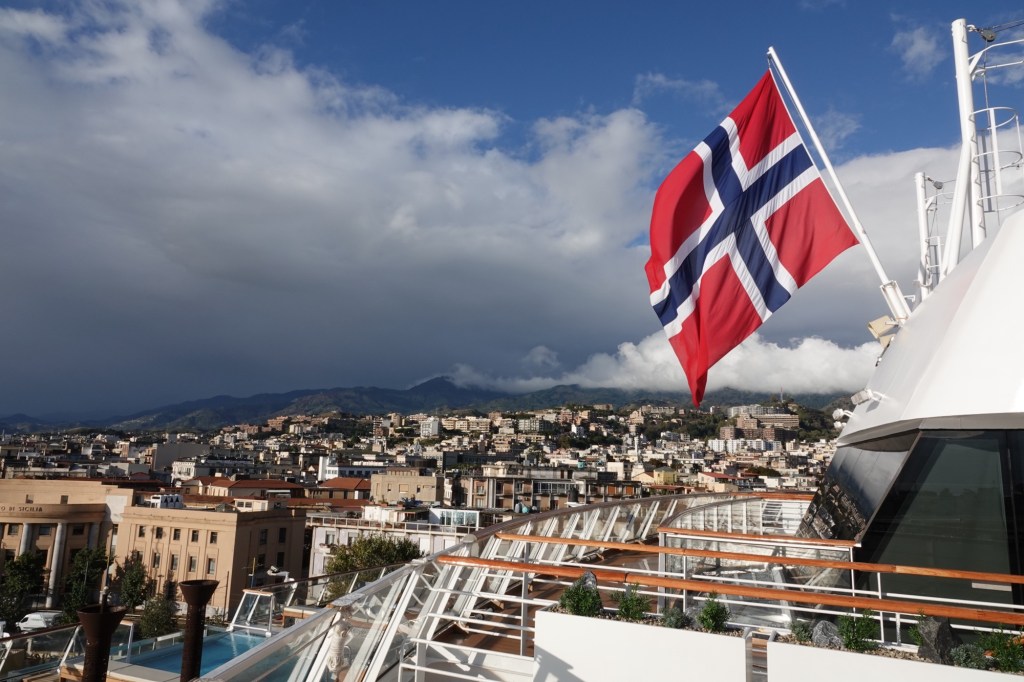
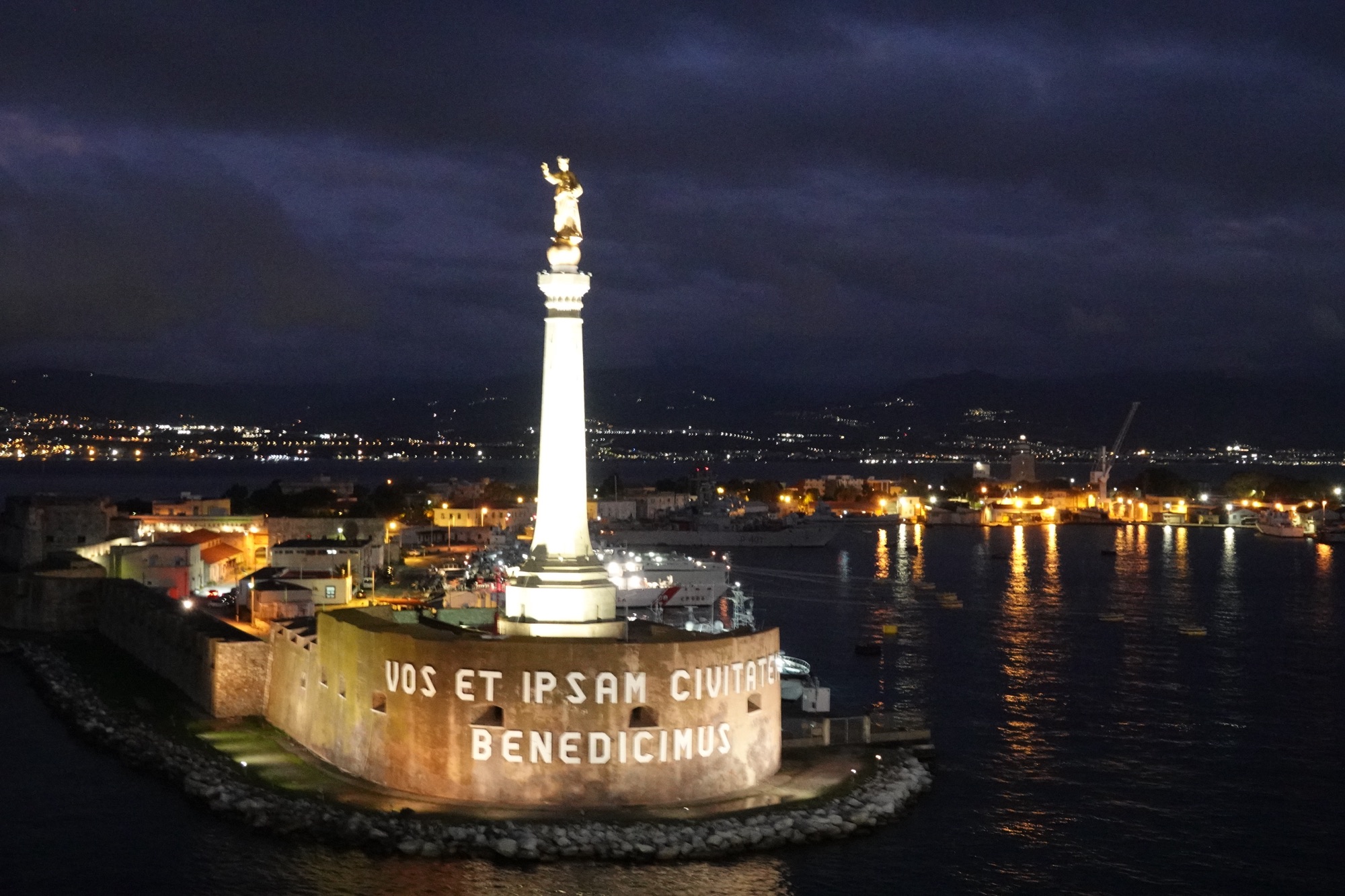
Despite a forecast of morning rain, by the time we reached the port of Messina, the last rainbow was just fading away as the sun broke through and lit up the harbour. It made for a beautiful sail-in.

The gleaming gold statue in Messina’s harbour is dedicated to The Madonna of the Letter, patron saint of the city. According to the tradition, in the year 42 CE Saint Paul came to Messina to spread Christianity. Inspired by his impassioned words, the people of Messina sent their ambassadors to Jerusalem to pay their respects to the Virgin Mary. The Madonna gave them a letter to take back to the people of Messina, promising eternal protection to the city.
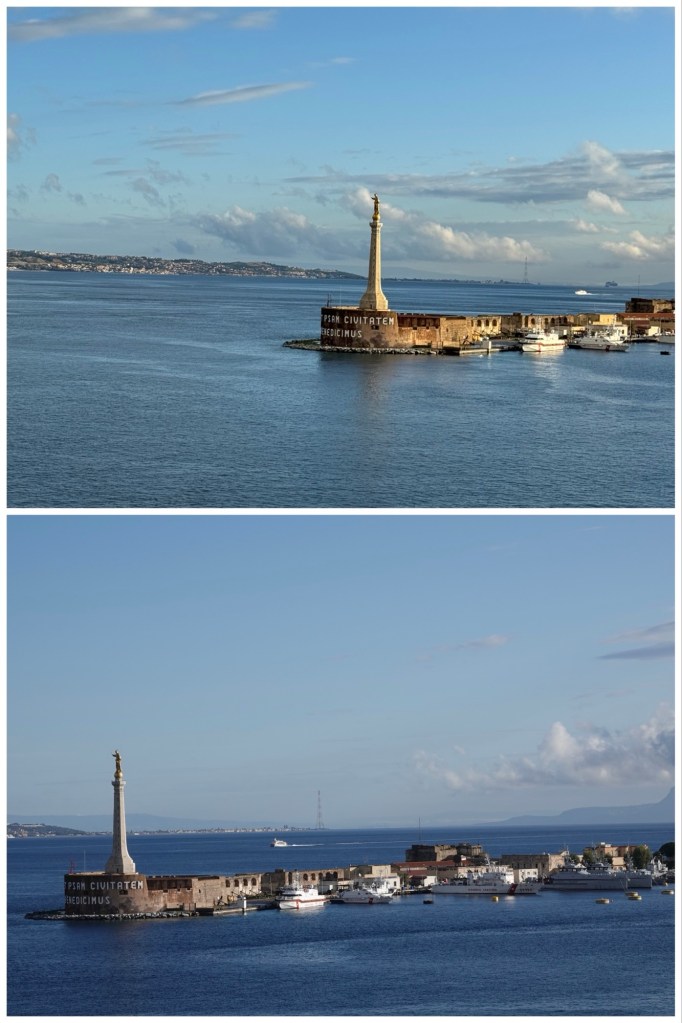
The ending of the letter “Vos et ipsam civitatem benedicimus” ( I bestow my benediction upon you and your city) is written on the base of the statue of the Virgin Mary at the entrance to the port.

We’re not massive fans of panoramic bus tours, but the guides Viking hires generally have a ton of information to share, which almost makes up for the fact that it’s incredibly difficult to get decent photos through the windows of a moving bus. The advantage today was that the bus portion of our tour would at least give us a glimpse of Sicily’s north coast before we came back into Messina for our guided walk.
We drove through the villages of Paradiso and Pace (Paradise and Peace) before reaching Ganzirri, where hundreds of mussel farms dot the smaller of two local lakes.

The villages had an interesting combination of small homes belonging to fishermen, and opulent seaside villas belonging to aristocrats and industrialists. One in particular belonged to the English Sanderson family, whose company (Sanderson & Sons) was the first to export citrus juice from Italy to the rest of Europe. That villa (not pictured) now houses the local university’s departments of chemistry and biology.


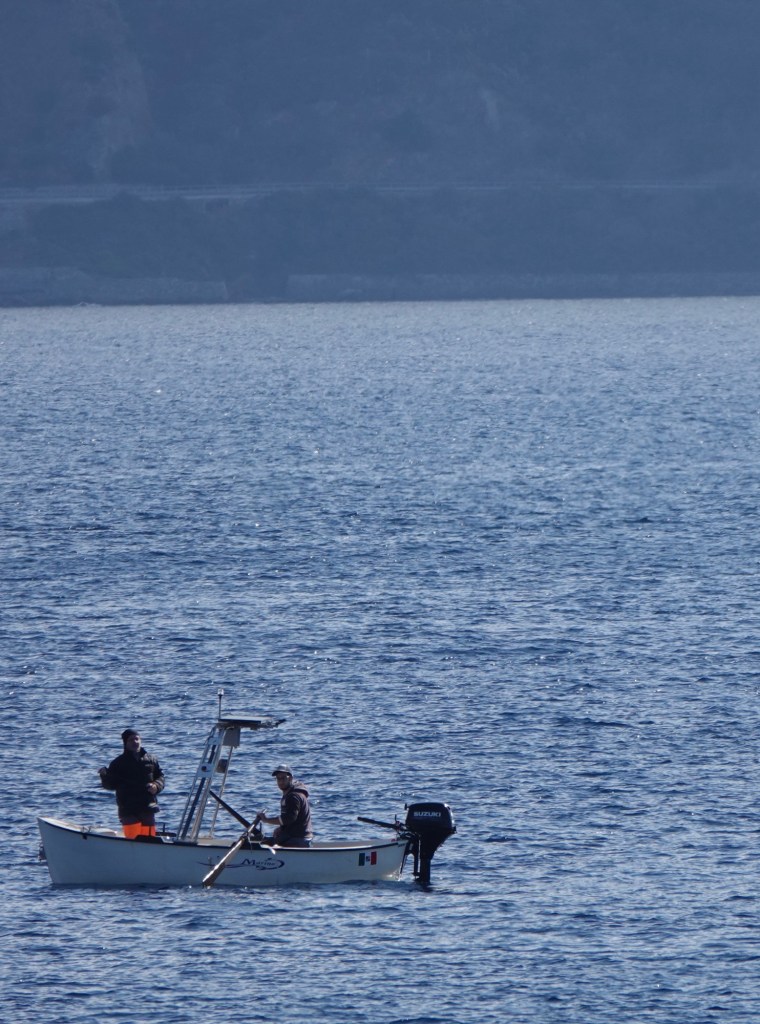
Unfortunately, our guide was obsessed with transportation, and instead of architecture or history told us not only about every ferry company that plied the Strait of Messina, but also an inordinate amount about the potential for a bridge linking Sicily to the mainland in Reggio Calabria – a project first conceived in 1870, and just a few weeks ago turned down by the Italian government as being too expensive. Bureaucracy moves slowly in Italy! Interestingly, she mentioned environmental impacts, relocation of homes, and cost as being factors in the project not being approved, but didn’t say anything about how the bridge might impact the two extremely rich and well-connected families who own the majority of the ferries currently needed because there is no bridge.
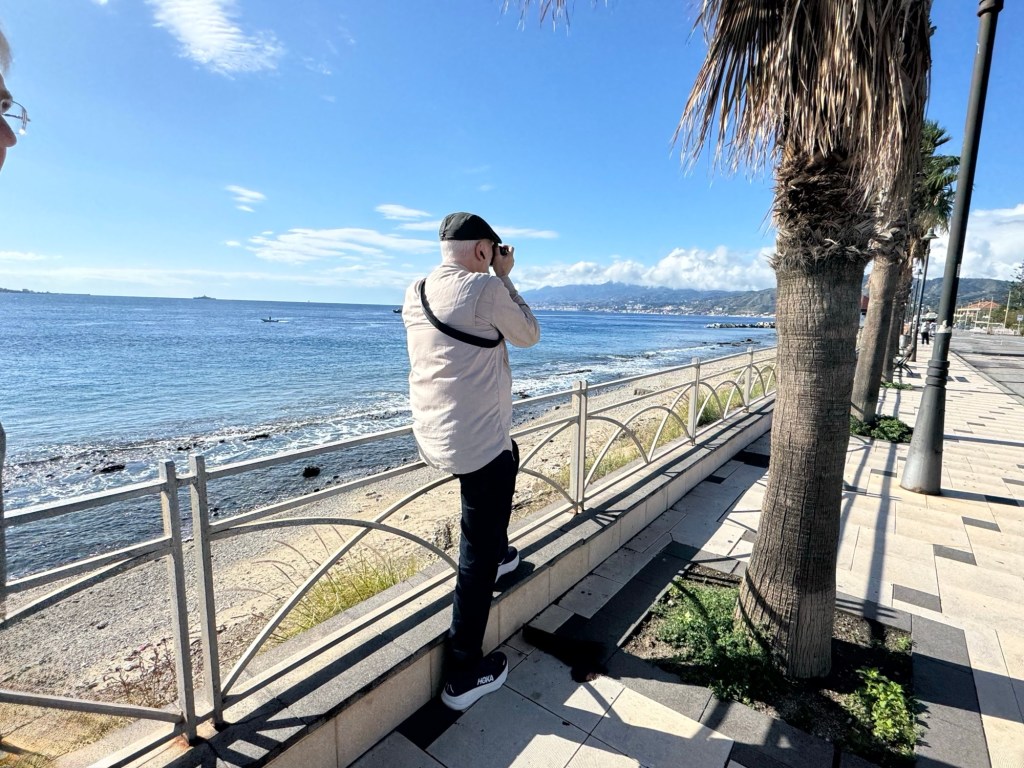
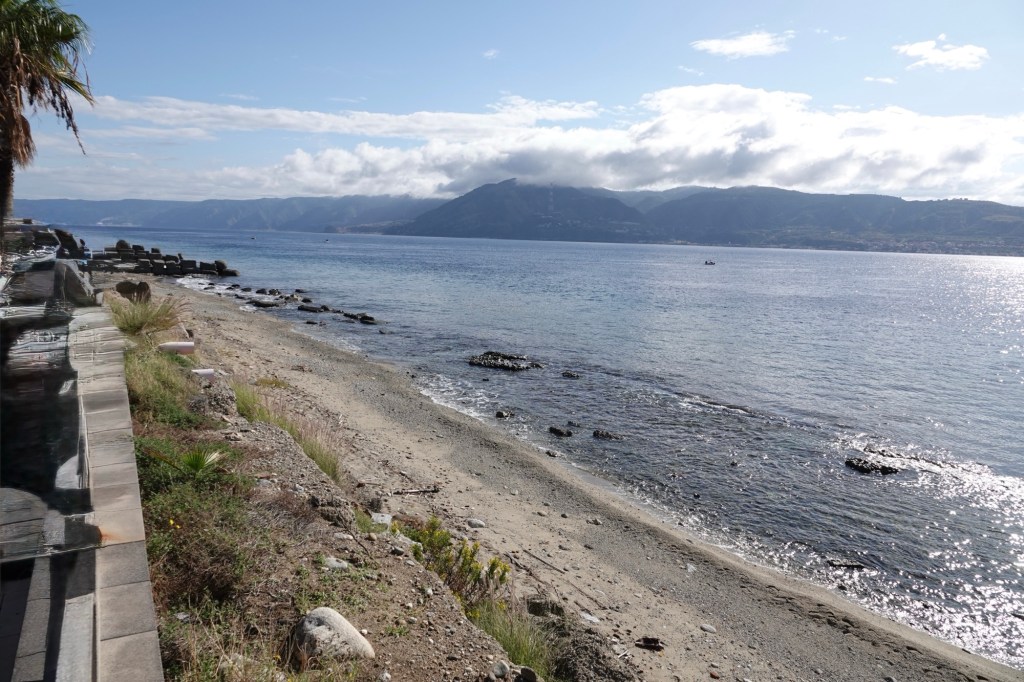

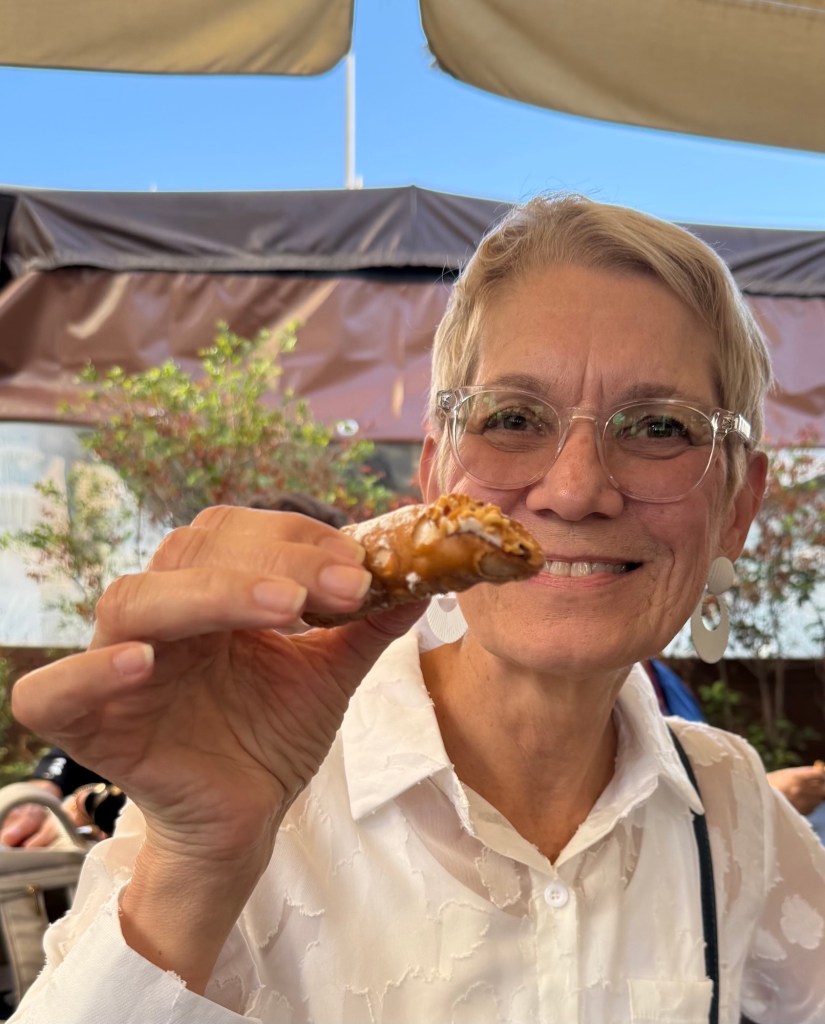
By 11 AM the temperature had reached 27° C, so our stop at a café for refreshing granitas (frozen drinks, offered in coffee, chocolate, strawberry, or tart lemon flavours) and a crispy delicious Sicilian cannolo each (and yes, that’s the singular of cannoli – although normally we’d never need that noun form!) was very welcome.
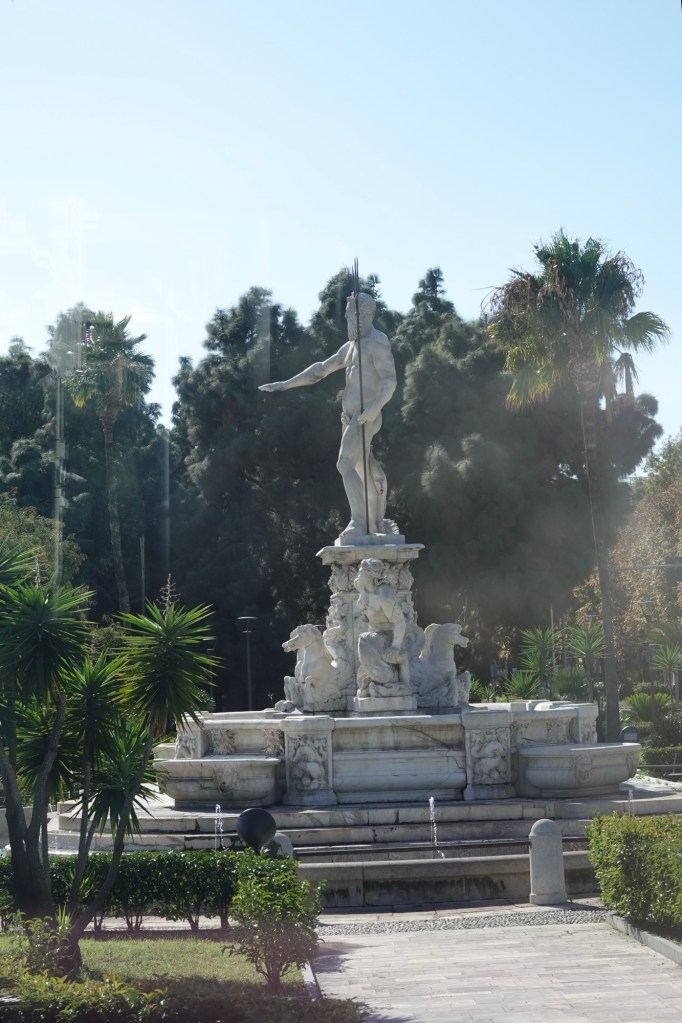
Very near the café we caught a glimpse of the city’s beautiful marble Neptune fountain, which we’d pass again later while walking around on our own.
The streets of Messina were a nice contrast to gritty Naples. To be fair, much of Messina was rebuilt after a devastating 1908 earthquake, and again after WWII.


Then it was on to the main focus of our tour: Cathedral Square.
Our first stop was at the Orion Fountain. We were told that prior to the sculpting of the Trevi fountain in Rome, the Orion fountain here in Messina’s Cathedral Square was considered the premier fountain in all of what is now Italy. It was intended to be sculpted by Michelangelo, but because of other commitments, it was actually Michelangelo’s premier disciple, Giovanni Angelo Montorsoli) who created this fountain in 1547CE. The marble of the fountain is from Carrera, but the dark stone of the animals around the fountain is volcanic rock from Mount Etna. The same sculptor created the Neptune fountain.


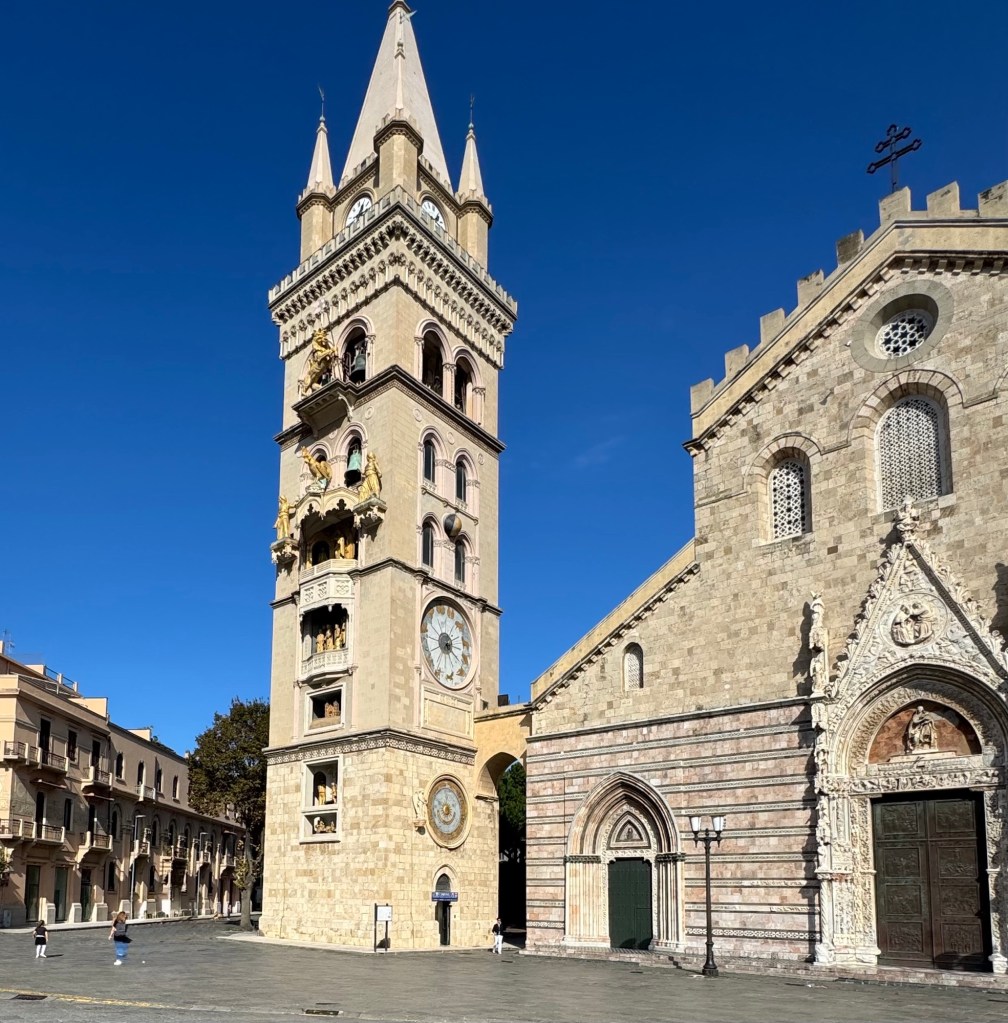
The highlight of our walk in Messina was taking in the noon performance of the carillon in the city’s astronomical clock. Sixty-four golden figures move around during the 10 minute noon hour clock show, accompanied by Schubert’s Ave Maria.
The clock is housed in the cathedral’s bell tower, and was built between 1930 and 1933. Its design mimics the Norman pattern of the original tower dating to 1564 but damaged in the earthquake of 1783 and fully collapsed by 1858.
This astrological clock is at least as impressive as the one in Prague (Episode 367), but the automatons and music are nowhere near as enchanting as those of the glockenspiel in Munich’s city hall (Episode 85).
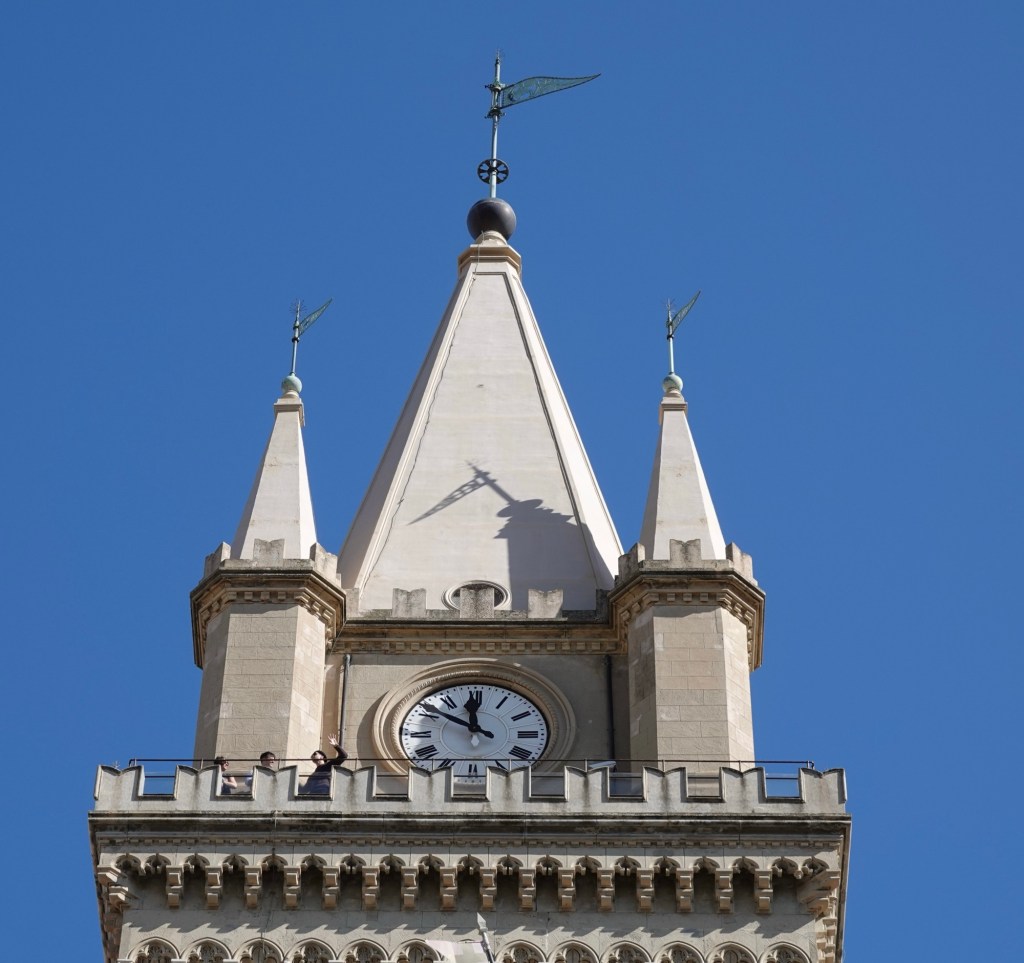
There is a 2.4 m/7.8 ft diameter clock face on each of the four sides of the tower near the top.
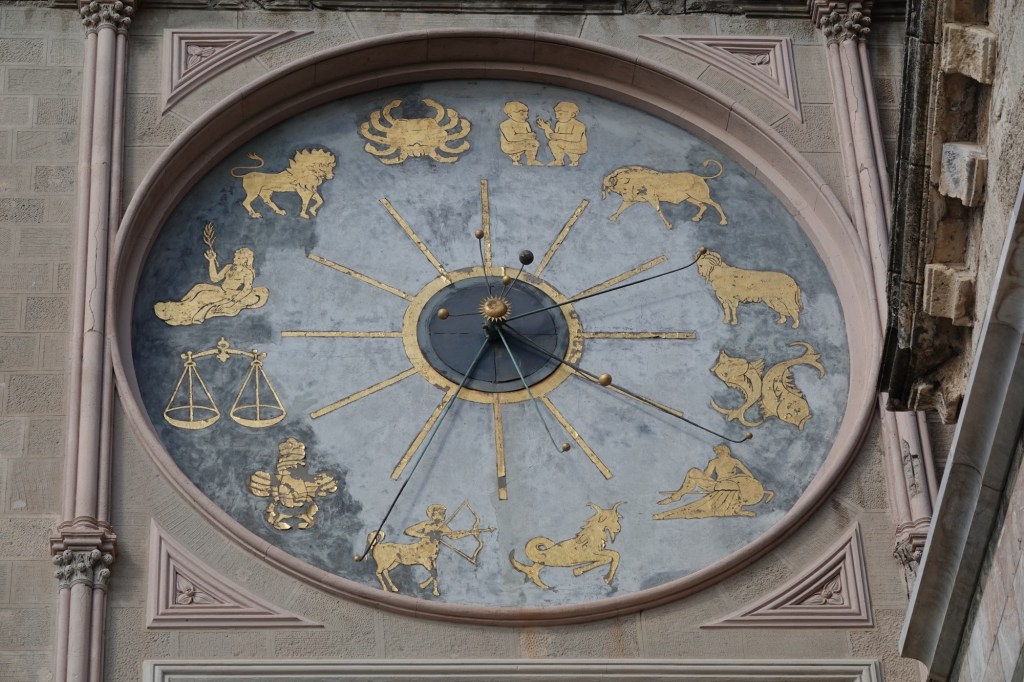
On the side of the tower is the “astronomical” dial. The face is decorated with the signs of the zodiac. In the middle is the “planetarium” showing the solar system (quite hard to see from the ground). The sun is at the center; the nine planets rotate around it at a distance which is proportional to their actual positions in our solar system. The time of revolution is not the same for all planets (just like in real life) but it is perfectly in sync within 1/100th of a second.
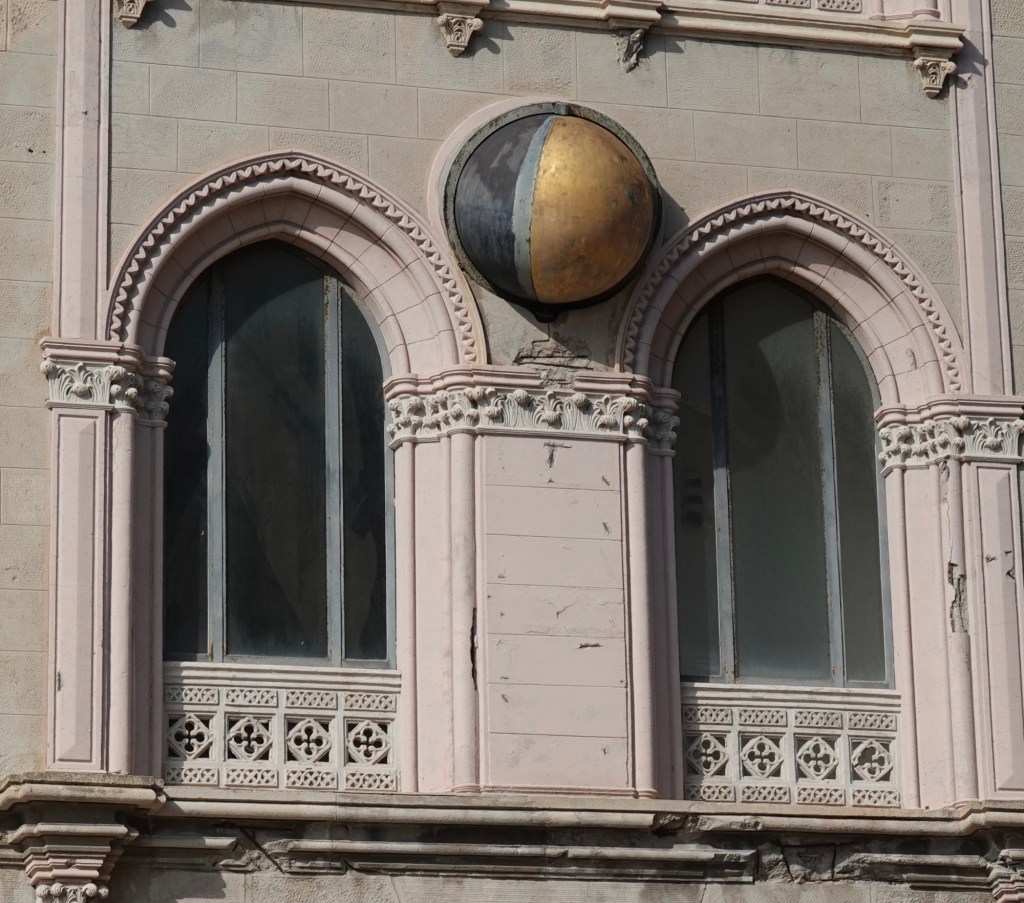
The moon, a 1.2 m/3.9 ft diameter globe, is located above the planetarium between two windows. The globe is subdivided into two hemispheres, one gilded and the other one black (day and night) which move in perfect synchronization with the movements and the relative phases of the moon. The moon rotates on its own axis and performs a full revolution in 29 days, 12 hours, 44 minutes and 3 seconds.
Further down the wall is the perpetual calendar with days, months, years and liturgical holidays marked on a 3.5m/11.5 ft in diameter disk. A marble statue representing an angel points out the day with an arrow. The date changes automatically each midnight.

On the front face of the tower, a gilded bronze 4 m/13 ft high Lion stands at the top as a symbol of the province of Messina and of strength. As soon as the bells have chimed noon, the lion is the first statue to move. It waves the flag, moves its tail, turns its head towards the square and roars, repeating the entire sequence three times.
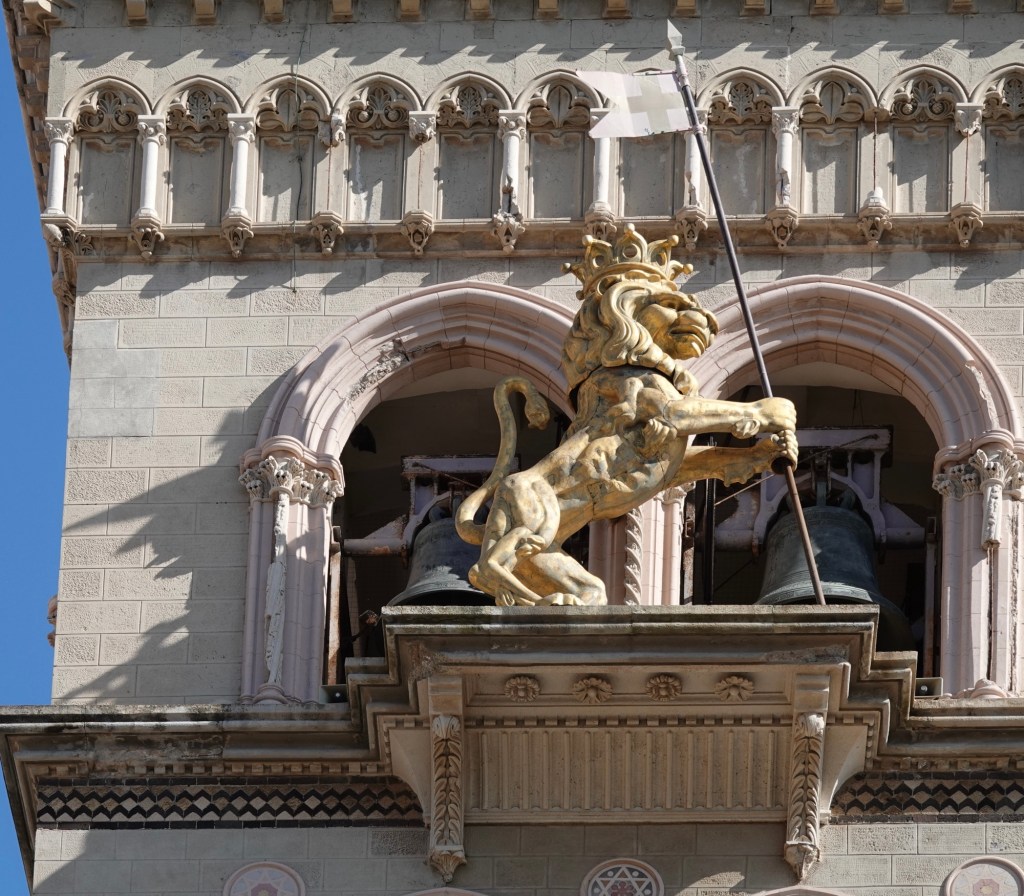
A 2.2m/7.2 ft tall Rooster stands in the centre between the two heroines. It was conceived by the builder as the symbol of the awakening of man. Shortly after the lion has finished its third roar, the rooster flaps its wings, raises its head, and crows – repeating that three times as well.

The “heroines”on either side of the rooster, called Dina and Clarenza, are bronze automata who strike the hours and quarter hours. The two heroines depict actual women who defended Messina during the Sicilian Vespers war. On August 8, 1282, after the Angevin troops which were sieging the city were finally defeated, the women of the city mounted the guard on the bastions of Messina to relieve the exhausted soldiers. The Angevins, taking advantage of the situation, tried to launch a new attack, but Dina started rolling stones down the hill to stop the enemy while Clarenza gave the alarm by ringing the bells, this saving the city. On our visit, Dina (on the left) was not operational.
On the third level from the top, an angel brings the famous Messina letter to the Virgin Mary, followed by St. Paul and Messina’s ambassadors. Each character bows when passing in front of the Madonna.
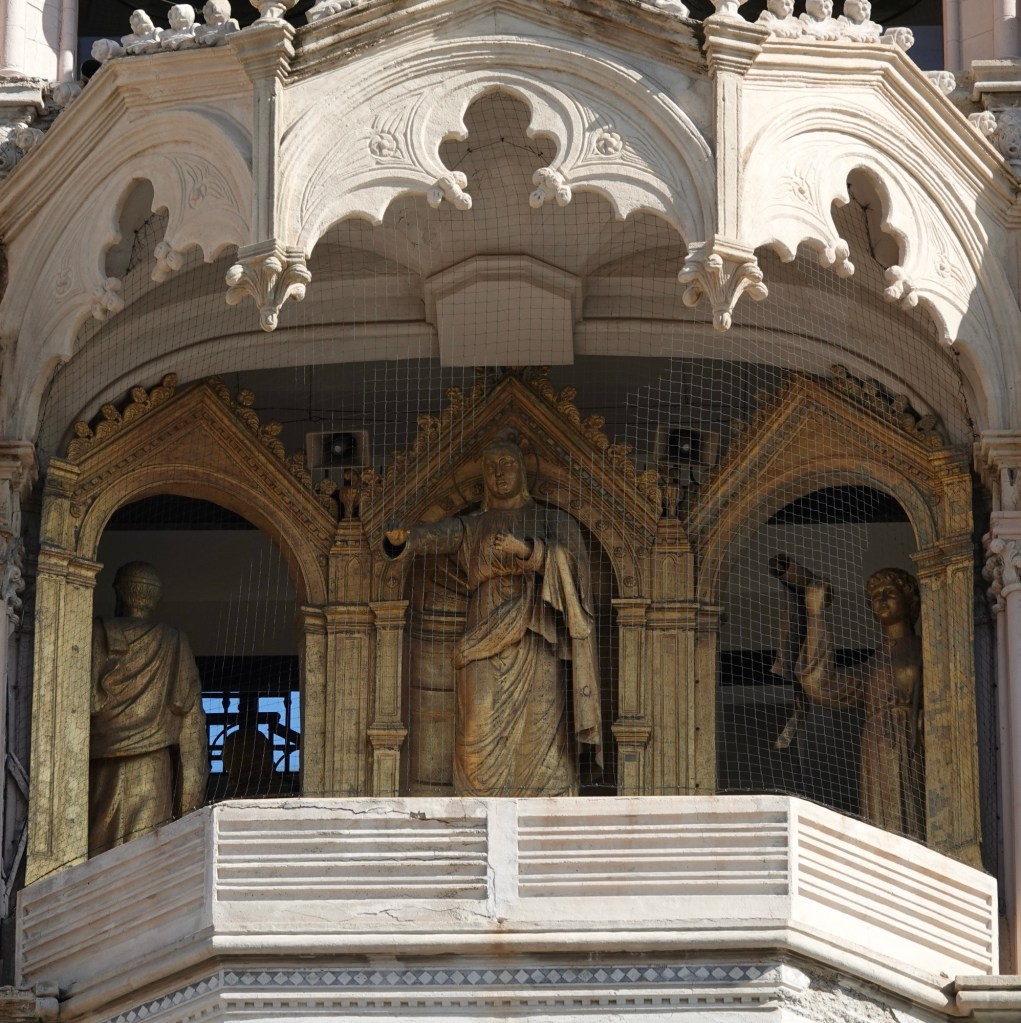
The fourth level down has scenes that vary according to the liturgical calendar. Right now, between Pentecost and Christmas, the scene depicts the descent of the Holy Spirit. The twelve apostles are arranged around the Virgin Mary. A dove, symbol of the Holy Spirit, flies over the Apostles, and flames appear on their heads while they raise their arms. Unfortunately, the mechanism was not working today.
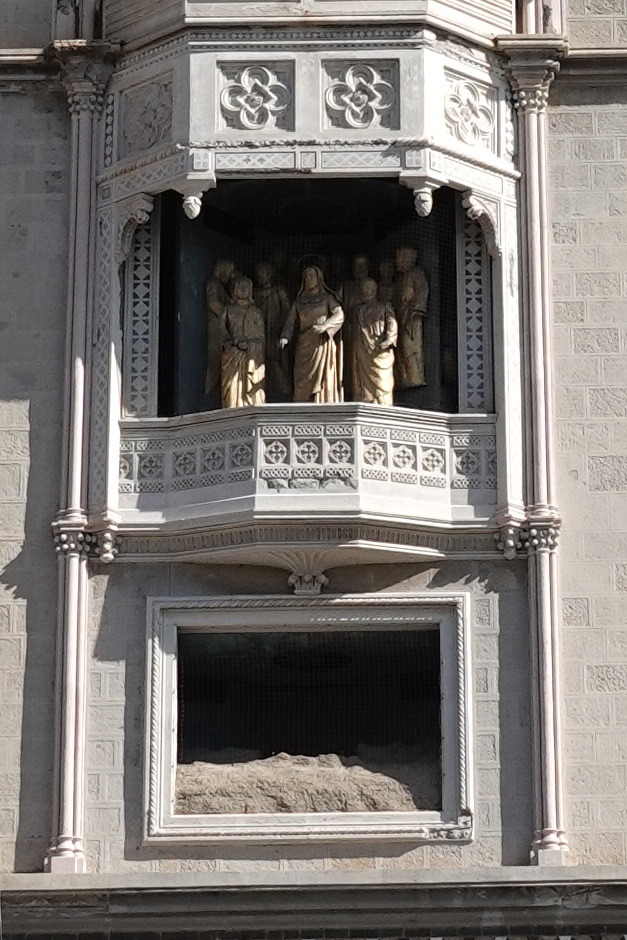
The space below the apostles that starts out looking like a window full of earth, once animated actually depicts the founding of the church of Montalto which stands on the Caperrina hill. According to legend, in 1294 the Virgin Mary appeared to Brother Nicola in a dream, asking him to build a church dedicated to her name. The Madonna told him to gather on that hill all the authorities of the city, because at noon a dove would draw, while flying, the perimeter of the church which was to be built. So it was, and the church was built in no time. The one thing I’ll say is that until I looked up the legend, I wondered why there was an airplane flying over the church. The scale of dove:church is definitely off.
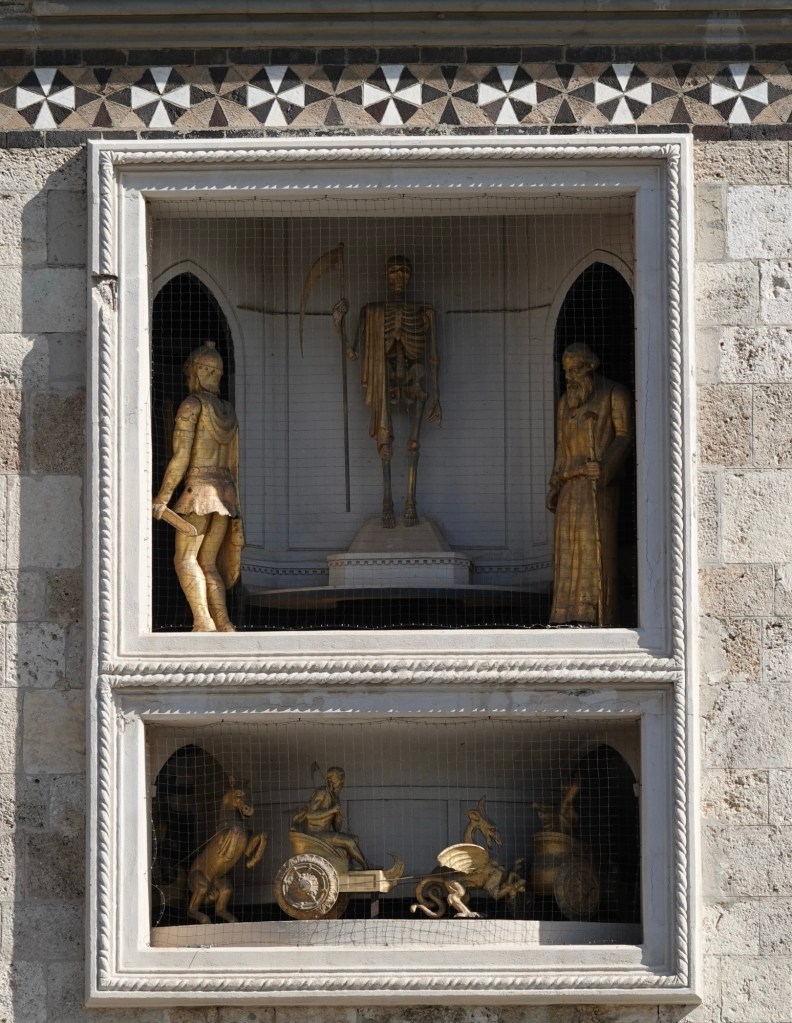
The carousel of the ages of life: childhood (a child), youth (a boy), maturity (a warrior), and old age (an old man), is intended to move a new figure into the centre every 15 minutes, while Death, represented by a skeleton, beats out the course of life with its sickle. It didn’t.
Nonetheless, as Ted’s 12 minute long video attests, the show was still pretty amazing.
After the performance, we had a chance to visit the interior of Messina’s cathedral, open because the 12:15 p.m. mass was beginning. Shortly after completion of mass, the cathedral was closed to visitors.

Of course, we got lots of time to admire the cathedral’s exterior.


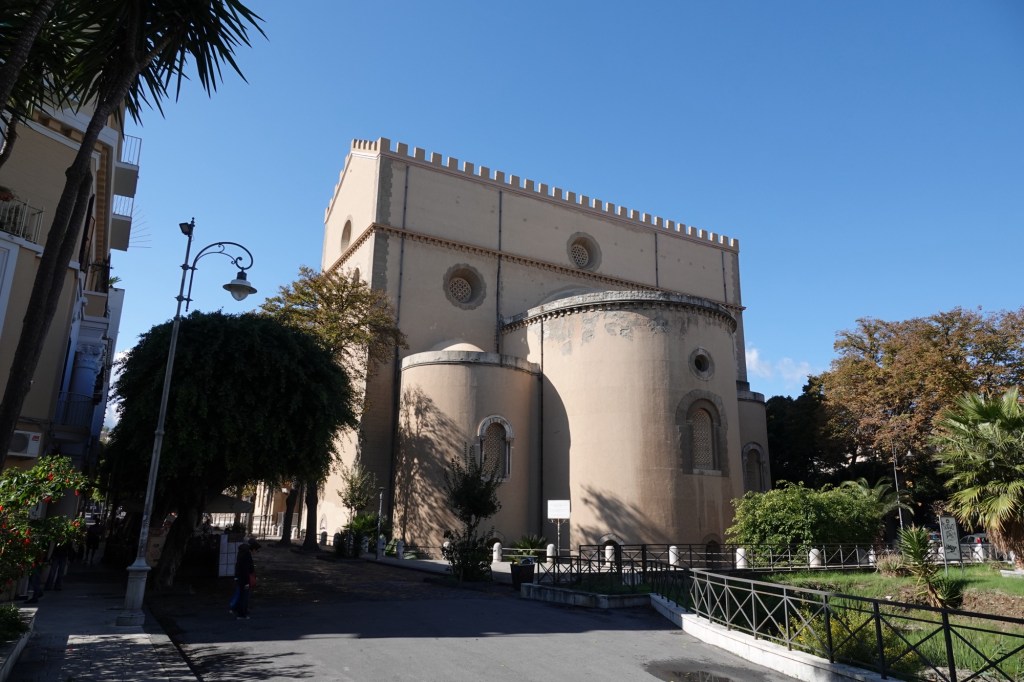
The cathedral was consecrated in 1197 during the Norman period during the rule of Emperor Henry VI of Swabia and Queen Constance of Altavilla. Starting around 1300, the Cathedral of Messina experienced a period of renovation and decorative enrichment. We were amused by the term “period of renovation” when we found out that it lasted for several centuries!
The first major damage to the (finally) completed building occurred in the earthquake of 1783 that destroyed the bell towers.
Then, on December 28, 1908, a 12th degree earthquake (on the Mercalli scale) razed the city of Messina to the ground, causing the death of 60,000 people. I had to look up Mercalli Scale. As opposed to the Richter scale which measures the magnitude (energy released) of an earthquake using a logarithmic scale, the Mercalli scale measures the intensity (damage and shaking effects) using a scale of Roman numerals. XII (twelve) is “Total destruction, with objects thrown into the air and widespread damage to nearly all structures”.
That time only part of the cathedral’s perimeter walls and the apses remained. The rest became a pile of rubble. The new Cathedral was consecrated on August 13, 1929, with the title of Santa Maria Assunta. Only 13 years later, during the 1943 aerial bombing, numerous incendiary bombs hit the Cathedral, resulting in a fire that burned for two days and two nights; the temperature was so high that the marbles burned and the bronzes melted. Many of the works saved in the 1908 earthquake did not survive the fire of World War II. It was up to Archbishop Paino to rebuild the current cathedral. In August 1947, just four years after the destruction, the Cathedral was reopened to worship and Pope Pius XII awarded it the title of Minor Basilica.
Despite the numerous destructions and reconstructions, the Cathedral of Messina remains a thing of beauty – all those disparate elements and styles really work.
The portals and the marble cladding of the facade were completed during that “period of renovation” between the 14th and 16th centuries.
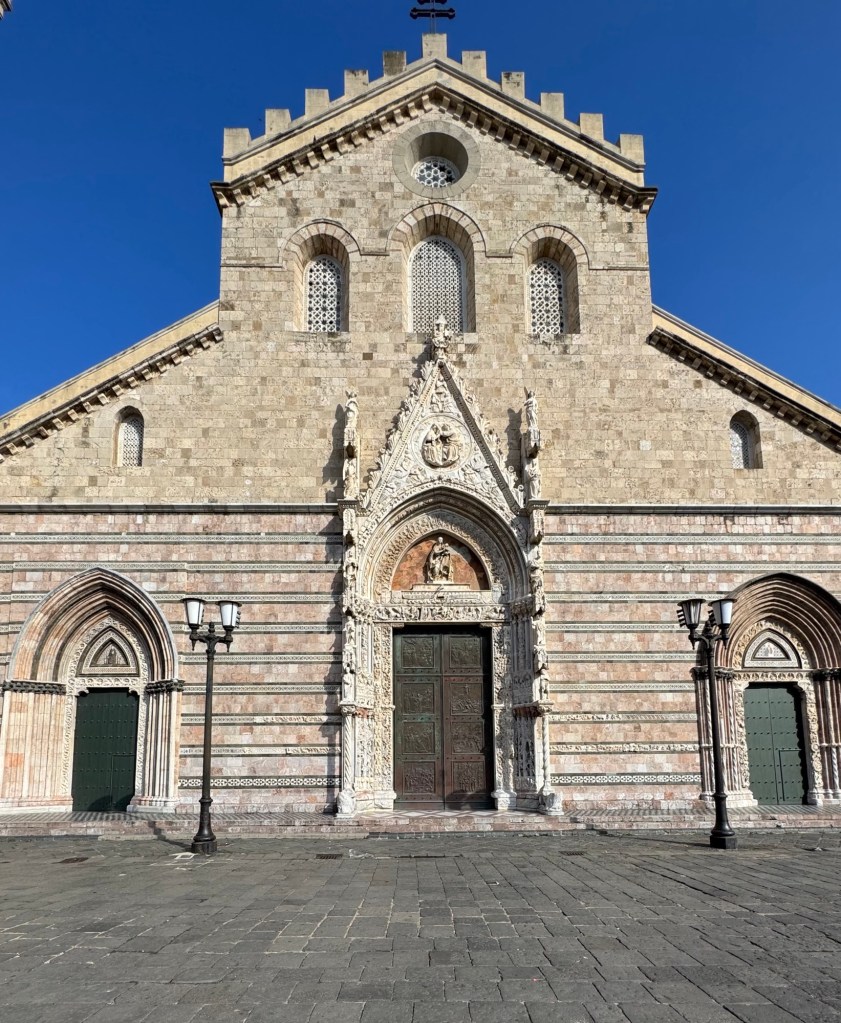
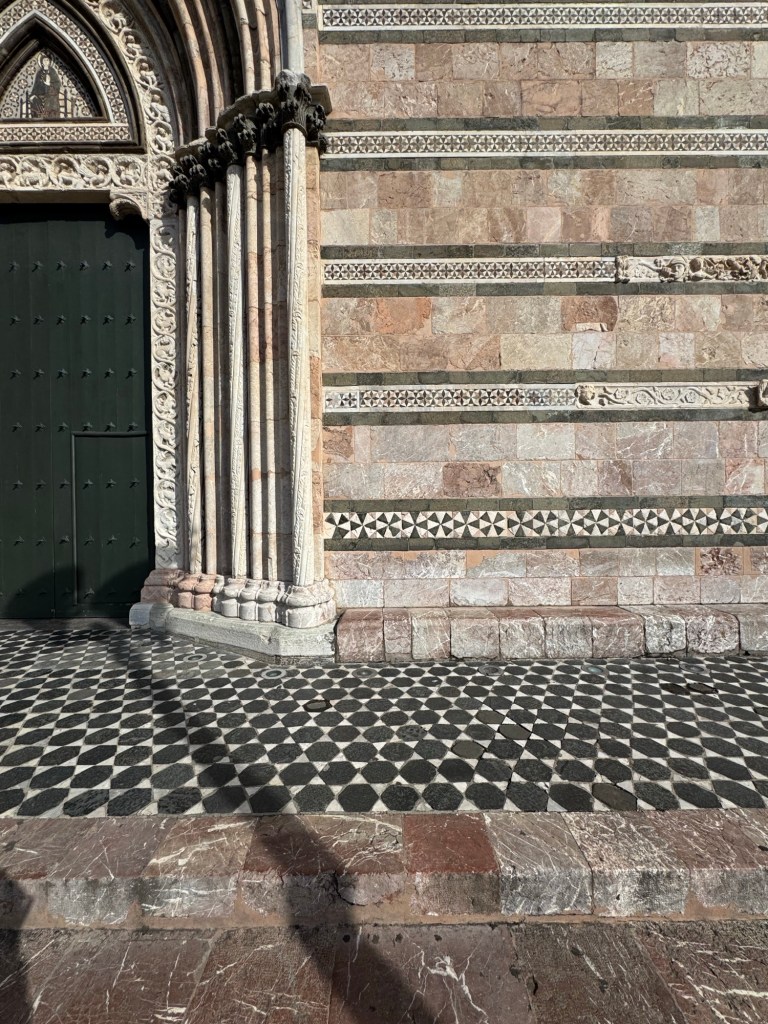

Towards the end of the 1600s, new architectural and decorative elements of typically baroque taste were introduced, which greatly altered the original lines of the temple. The interior now combines clean Norman lines, ornate Baroque elements, and intricate Byzantine designs.

Several funerary monuments of Archbishops survived the various destructions, although the damage to some has obliterated the year they were made. The sarcophagus just inside the cathedral entrance dates to April 1, 1548 CE.

The mosaic (below) in the left apse, dating to the 14th century, is almost entirely original.

Destroyed elements like the statues of the Apostles along the aisles were reproduced; a single original statue survived.


The canopy of the major apse above the altar is partially original.

The altar “monuments” are surviving Italian baroque elements.

The wooden ceiling was faithfully reconstructed using mosaic techniques and in the mediaeval Byzantine style almost echoes the altar.
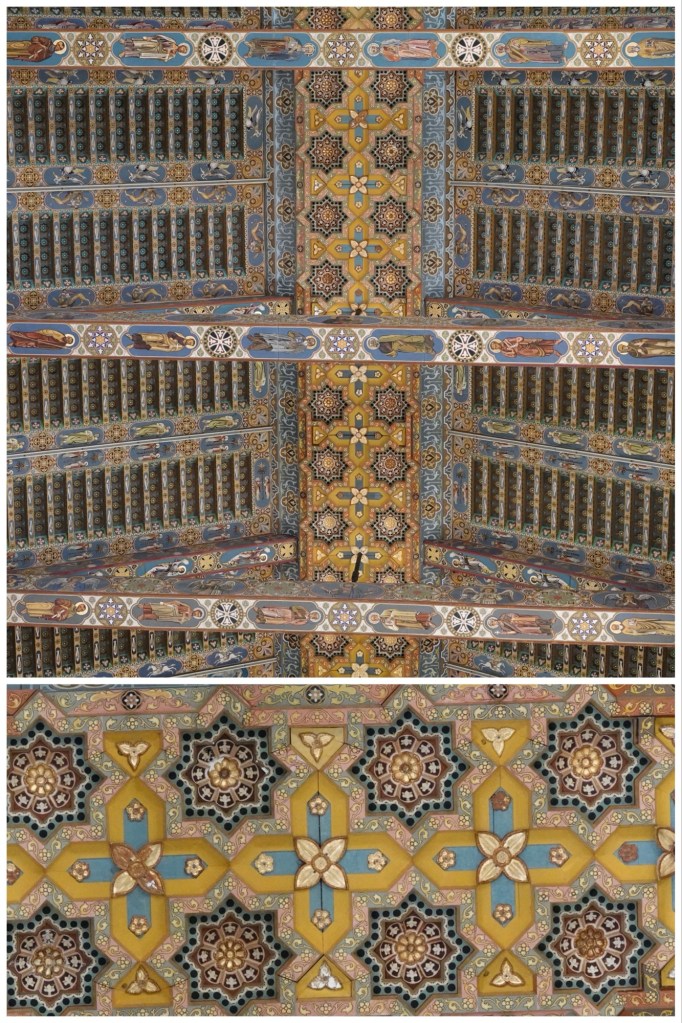
Almost everything we learned about the cathedral was from personal research and a few historical plaques arranged in the piazza. Our guide simply mentioned the original construction dates, WWII damage, and then showed off the cathedral’s organ pipes.
The organ in the church added after World War II is definitely impressive. Although we did not see the organ itself, we were told that it is the second largest in Italy, with 5 keyboards and 16,000 very modern pipes, arranged in groupings like the one pictured below, spread around the church.

That was the end of the official excursion, but Ted and I were definitely not done with Messina. The area near the harbour is lovely, and we had several hours before needing to be back on board, so we simply strolled around taking pictures. Despite being Saturday, and gorgeous weather, the city was very quiet, and almost traffic free.
Plus, there was a cute little pizzeria (Bar San Giacomo) on the square beside the cathedral, which brought to mind “our” pizzeria in the church piazza in Trieste when we lived there for a couple of weeks in 2022. Our waiter told us all about the not-so-friendly pizza competition between Sicily and Naples: Sicily’s crust is much less “soft” than that of Naples. In our opinion and very limited taste-testing, Sicily’s pizza is far superior! (Sorry, Naples.)

The local beer was pretty good too.
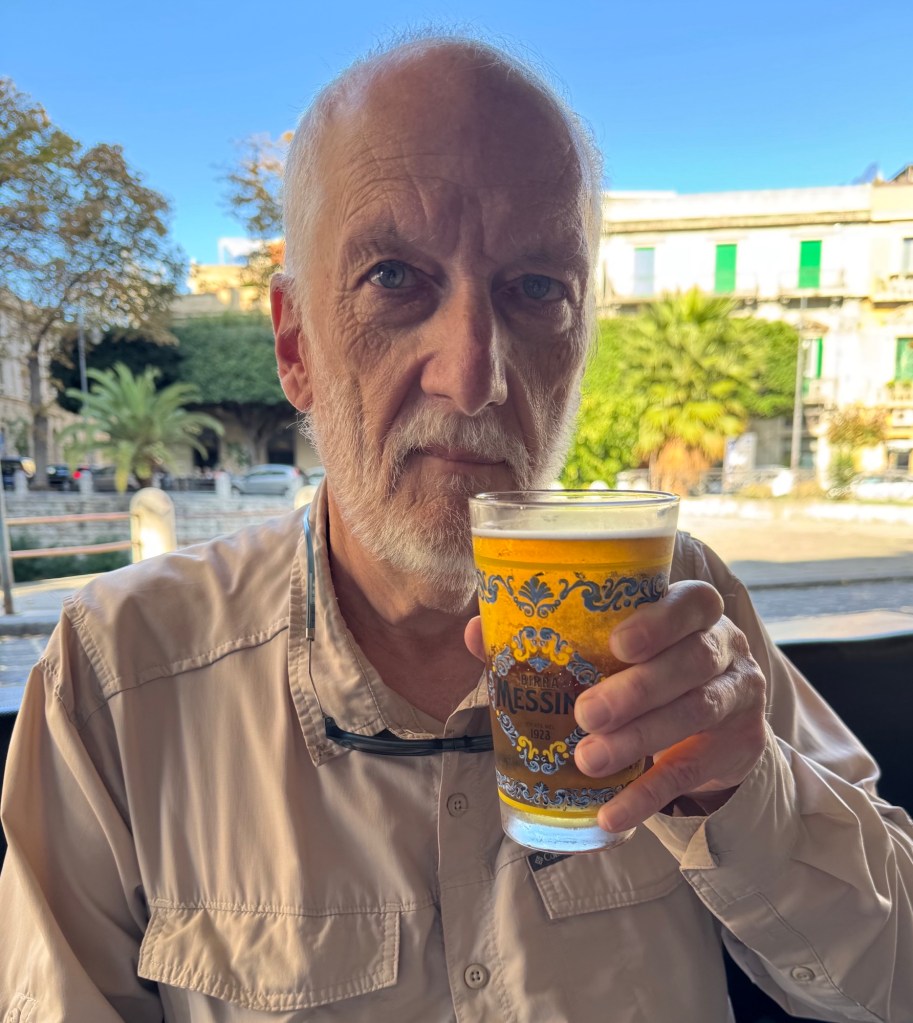
Full of pizza, beer, local interaction, and smiles, we walked along the waterfront area and took a few more pictures, including one with the ubiquitous “I love” sign.

We got a better look at the Neptune fountain in front of the Sicilian government house.


We were curious to see a small park dedicated to Russia. This Monument to the Russian Sailors in Messina commemorates the Russian Baltic fleet that provided immediate aid to the city after the devastating 1908 earthquake. Officially named the “Monument to Russian Sailors, Heroes of Mercy and Self-Sacrifice,” it was inaugurated in 2012 at Largo dei Russi, or Largo Garibaldi. It stands as a testament to the sailors’ actions, which saved thousands of lives in the aftermath of the disaster.

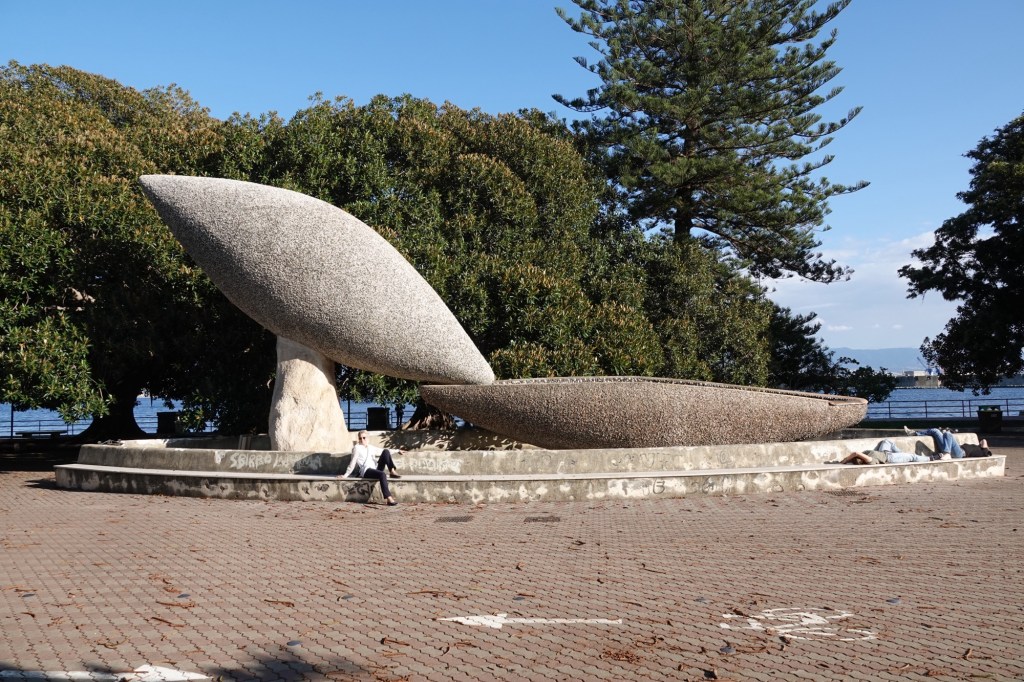
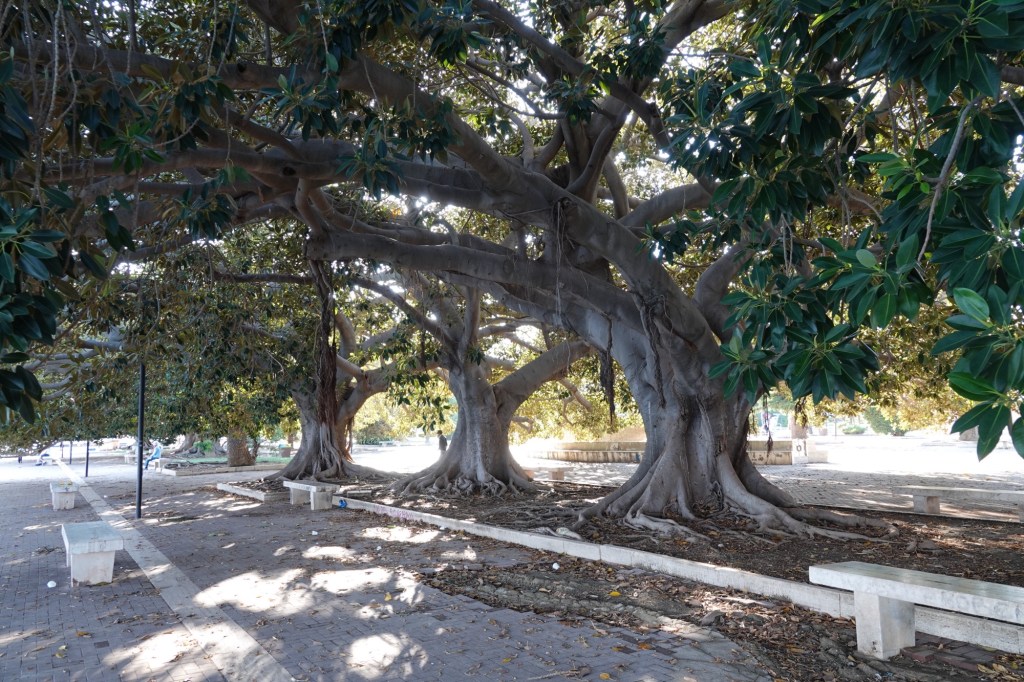

We were back on board in plenty of time of time for a spectacular sail-away.
Based on our truly lovely day in Messina, I’d certainly like to come back to see more of Sicily.
 Rose and Ted’s Excellent Adventure
Must be a bitch to change that clock for daylight savings time.
LikeLiked by 1 person
I can’t even imagine!!(I wish we’d asked!)
LikeLike
It means arrancini!ClayFollow and keep up with our retirement adventuresInstagram: @ClaynMike
LikeLike
Really? We didn’t see arrancini offered anywhere
Can’t believe I missed that!
LikeLike
We had
LikeLike
I always wanted to go back to Messina and Taormina. On my cruise, we went straight to Taormina and never explored Messina itself.
Did you have a choice of tours to Taormina from the ship?
LikeLike
Yes, there was at least one full day tour to Taormina offered.
LikeLike