WARNING: It was a long day. This is a long post.
Vienna. My happy place.
I fell in love with it in 2013 (Episode 87), renewed our love affair over a long stay in 2022 (Episode 302 to Episode 310), and again that fall when we got a quick glimpse of Christmas market preparations (Episode 363).
We signed up for the included panoramic excursion on our first morning here, fully intending simply to use it as an easy way to get into the centre of the city. Once on board, there was an option for 20 passengers to go into the city centre via U-bahn (subway) instead, which suited us perfectly.
The timing of that excursion made us too early for the museum, which doesn’t open until 10:00 a.m., so we stopped for just coffees at Konditorei Oberlaa: a Verlängerter Schwarz and a Kleiner Brauner, resisting all the gorgeous pastries on offer already at 9:45 a.m.

The last time we were here, we thoroughly toured the Natural History Museum, but only made a cursory visit to the Kunsthistorisches Museum (Episode 363), its almost mirror image on Maria Theresien Platz. It is the largest art museum in Austria, so a second visit was definitely warranted. Interestingly, when I looked back at that visit after completing this one, I saw that some of the same items caught the attention of our eyes – and camera – both times.
Emperor Franz Josef commissioned these two buildings, completed between 1871 and 1891, to create a suitable home for the Habsburgs’ formidable collections and to make them accessible to the general public.


In the park between the two buildings is a huge statue of “King” Maria Theresia. Since until she inherited the Habsburg throne there had been no provision for a female monarch, she was crowned “King of Hungary”, and actually referred to officially as “his Majesty”. It seems quite bizarre today, but that was protocol in 1741. That only applied to her Hungarian kingdom though.


It was impressive enough that she was the ruler of the Habsburg monarchy from 1740 until her death in 1780, and the only woman to hold the position in her own right. She was the sovereign of Austria, Hungary, Croatia, Bohemia, Transylvania, Slavonia, Mantua, Milan, Moravia, Galicia and Lodomeria, Dalmatia, Austrian Netherlands, Carinthia, Carniola, Gorizia and Gradisca, Austrian Silesia, Tyrol, Styria and Parma. By marriage, she was Duchess of Lorraine, Grand Duchess of Tuscany, and Holy Roman Empress – but she also managed to give birth to 16 children in 19 years and still implement significant beneficial reforms in her kingdoms.
She deserves her huge statue.
We entered the museum shortly after it opened, checked our raincoats and umbrellas, and joined the hundreds of people already exploring.
The entry hall with its marble floors and domed ceiling open to the higher levels really sets the tone for the galleries to come.

We began our explorations in the Kunstkammer, which occupies Galleries numbered 19 through 37, all labelled in gold Roman numerals above pillared doorways. Kunstkammer translates to “art chamber”, and holds all manner of art objects, with the exception of paintings, which have 15 “galleries” and 24 auxiliary rooms dedicated to them.


As we wandered through the rooms, gazing in awe at countless precious objects, I tried to isolate just a few for Ted to photograph for our “album”.
This reversible mediaeval backgammon/chess board was both beautiful and very unique. We were stymied by how the chess squares that had figures carved within them wouldn’t cause chess pieces placed on them to tip over.

What was interesting about this sapphire ring made in Venice in the 1400s is that there is no precious (or other) metal on it at all; the entire ring is cut from a sapphire.

The two handled vase weighs almost 13 kg and was cut from a single piece of rock crystal in lower Italy in the first half of the 13th century. It is the largest mediaeval vessel of its kind that has survived and was first documented in the collection of King Philip the second of Spain. To give it size perspective , it would hold more than 4 litres/1 gallon of liquid.

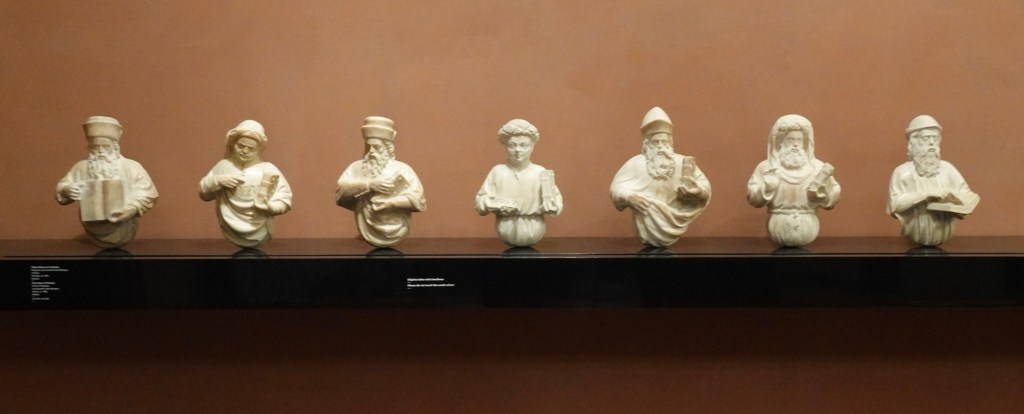
The seven busts of the profits in marble date to Venice around the year 1400.
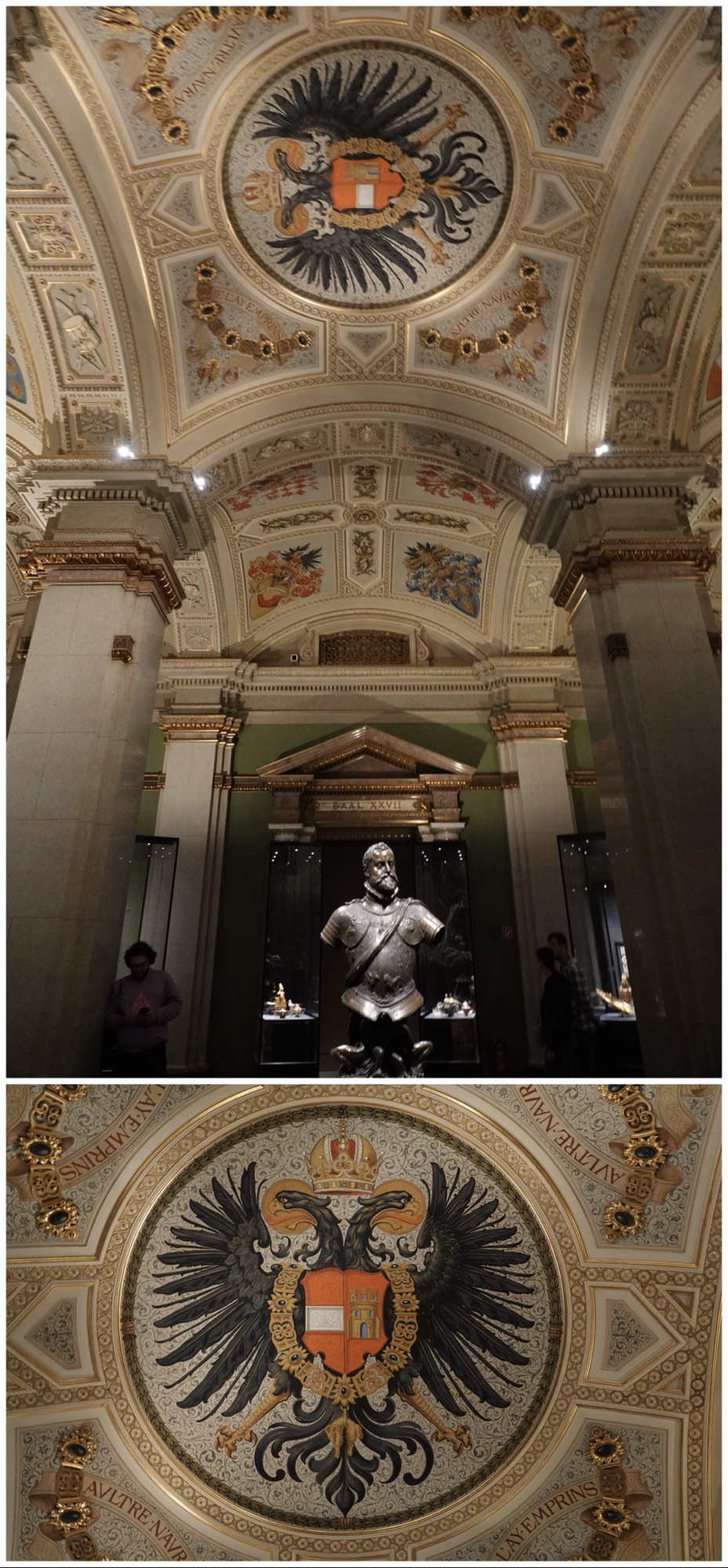
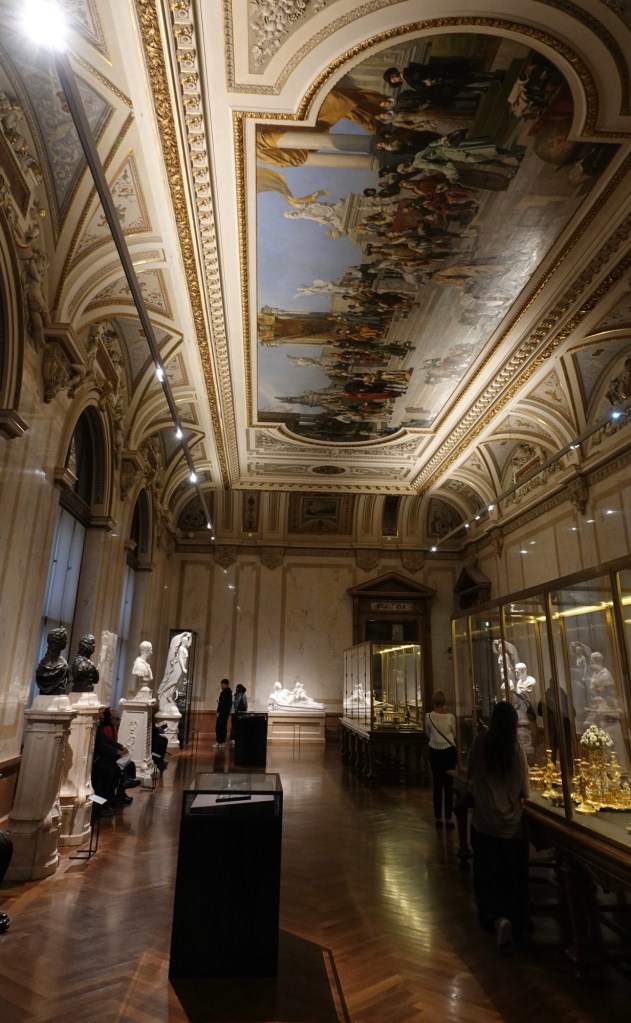
Each individual room of the Kunsthistorisches museum, like those in the natural history museum on the opposite side of the square, has a uniquely decorated ceiling and columns. The building is (almost) as impressive as its contents.

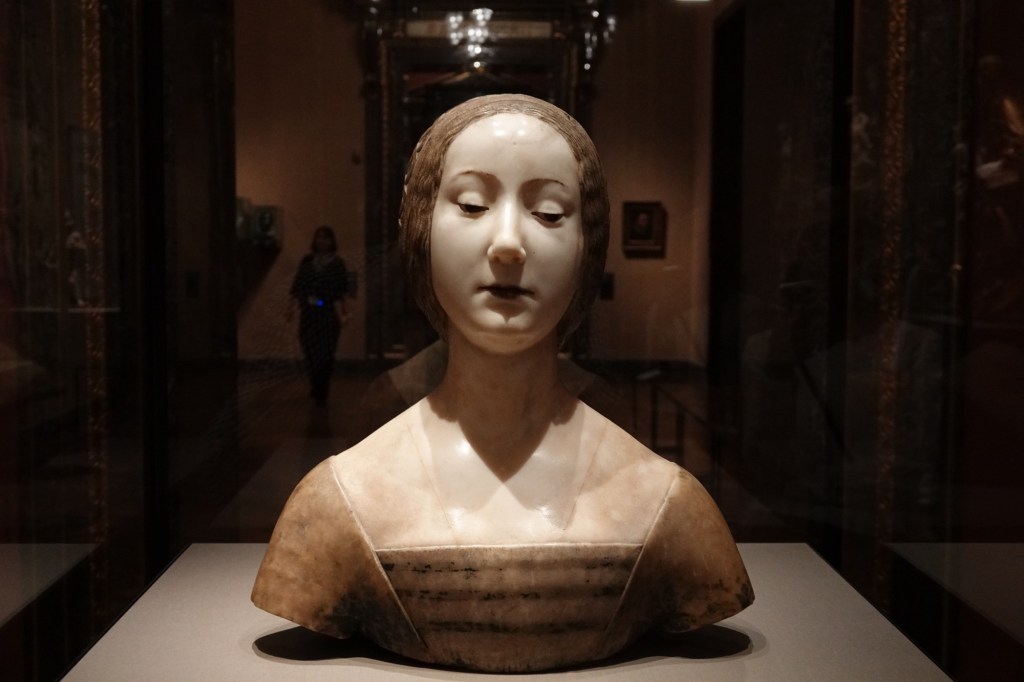
The polychrome marble bust made in Milan Italy in 1490 CE used wax to create the extra colours in the female’s clothing, hair lips, eyebrows and eyes.
The large (at least 3m x 4m) wool and silk tapestry showing the scenes from the book of Tobias was woven in Brussels around the year 1540.

The winged altarpiece from the year 1536 has more pictures in it than any other contemporary German artwork. It was commissioned for the Protestant church at Montbéliard before the reformation categorically banned all images from churches.
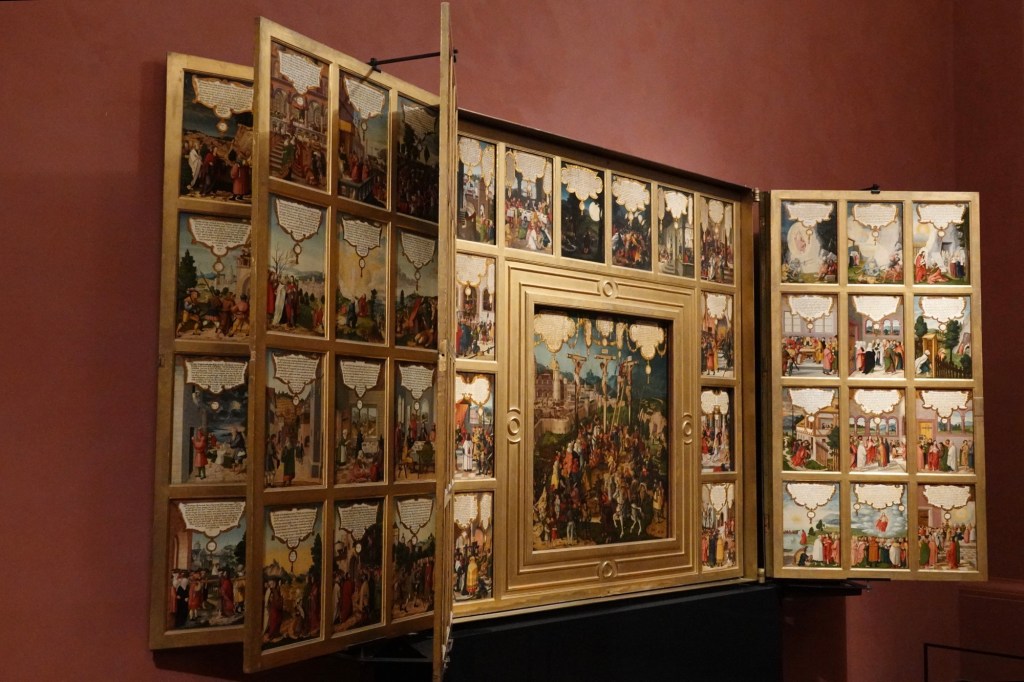
At first glance, with its combination of figures and text, it really does look like a very very old wooden comic book.

I was amused by the partially painted pear wood sculpture of three Cupids playing, which was apparently a popular motif in early Italian Renaissance sculpture. It dates to about the year 1520.

The southern German table clock dated 1545 was made of partially painted iron and a copper alloy and had four uniquely different side panels.

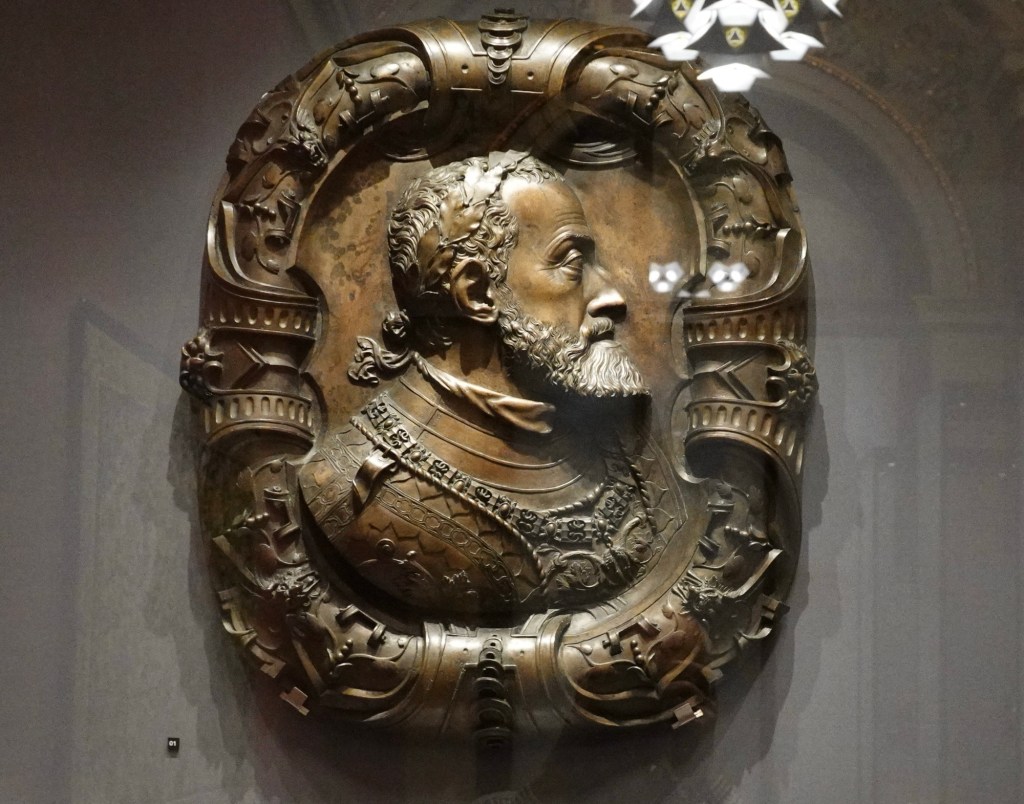
The bronze relief of emperor Charles V dated 1555 shows how an artfully groomed beard can hide even something as otherwise obvious as the very prominent Habsburg chin.
The multi drawer cabinet made of wood, gilded copper, mother-of-pearl, and reverse side glass painting would have contained individual objects of art in itself, making it a Schatzkammer, in the same way that these museum rooms are themselves cabinets of treasure. The cabinet dates to 1560 and was made in Nuremberg.

We moved from rooms devoted to Italian collections to rooms containing German items to those containing items collected in Prague. Everywhere we were reminded of how vast the Habsburg empire really was.
In room XXVI the ceiling is particularly gorgeous, featuring the crest of the Habsburg family in the centre, and surrounded by crests and flora from the many states that comprised the empire.

In the Prague collection were vessels, most dating to the 16th and early 17th centuries, made out of agate, chalcedony, quartz, citrin, heliotrope, and even narwhal tusk, all fitted with gold. It is hard to imagine any of these being used for anything other than decoration, but apparently at least some of the monarchs believed that the natural materials had curative properties that could be transferred into food or drinks served from them.

The chased gold globe is actually two goblets one turned upside down on top of the other. The map on it is the Mercator map of the world and reflects the progressive nature of the Habsburg family with regard to exploration and geography.

The massive gold, silver, mother of pearl, pearl, and garnet basin and ewer set is purely ornamental. It was created in Nuremberg around 1592 CE.

Another set made in Augsburg around 1590 is made from giant clam and scallop shells with gilded silver.

The Habsburg Dynasty lasted around 600 years. That’s a long time to be collecting fantastic objects from within a huge empire. Not only were famous artists from each era commissioned to create works, but the monarchs and their families were inveterate collectors, whether that was of precious metals, precious stones, the best and most beautiful woodwork and sculpture, or natural objects (as evidenced in the natural history museum). The sheer number of items in this museum, and the breadth of the collection, are almost incomprehensible.
The ebony, ivory, gilded bronze, rock, crystal, pearl, and glass coin cabinet of Archduke, Ferdinand II was created in Augsburg around 1580. Ted quipped that it was a pretty fancy piggy bank.

These huge clocks with their ornately painted wooden cases were created in Germany, Austria and Czechoslovakia during the mid 16th century.

The brass bust of emperor Ferdinand III dated 1655 and made in Nuremberg clearly shows the prominent Habsburg chin.

The cabinet of emperor Ferdinand III, made in Nuremberg around 1638, contains cameos of the Princes of the extended royal family.

There are dozens and dozens of individual rooms here in the museum, each one considered a treasure cabinet. In fact, there are so many interconnecting rooms that at times it seems there’s no way to find the exit.
A small statue of emperor Leopold I, made of ivory and created in Vienna around 1690, shows him depicted as the victor over the Ottomans. It is art, but it is also a piece of propaganda. It is, to be honest, also another unflattering depiction of the prominent Habsburg chin.

Marble busts created in realistic images of the Habsburg emperors – especially when they don’t have beards – always make them look as if they are pouting.

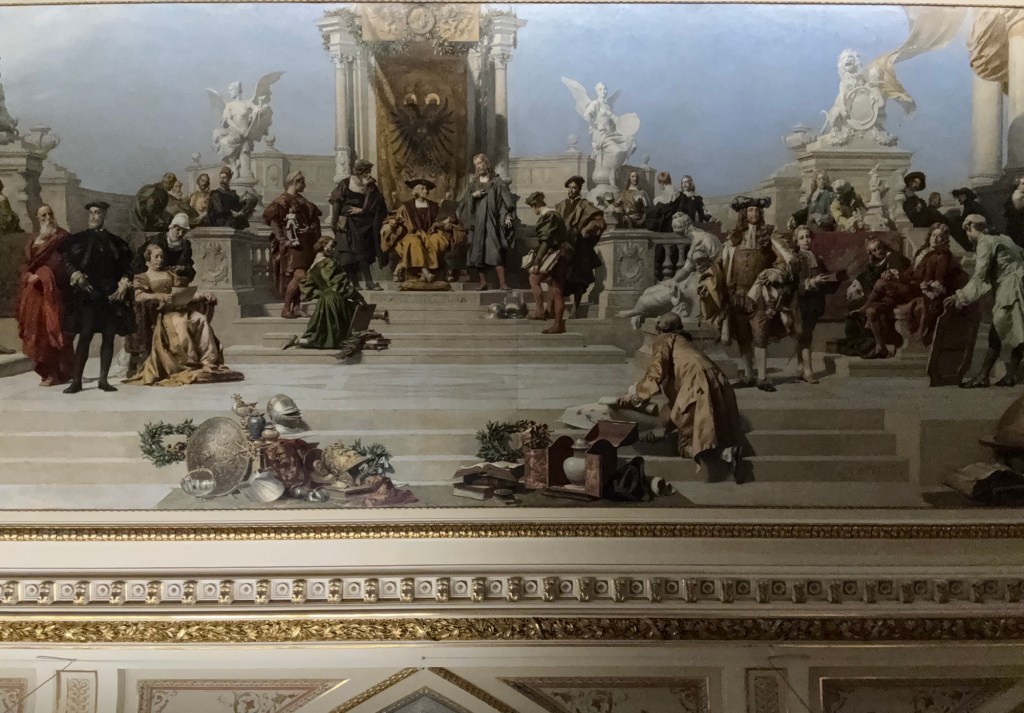
The ceiling in room XIX depicts people important to the Habsburgs.
The three buildings (below) made of alabaster, marble, terra-cotta, and gilded bronze that show the ruins of Paestum date to the 18th century were intended as a table centerpiece. Just wow.


The way Venus is looking at Amor in this marble statue reminded me of the way I was looking at the statue of the cute Napoleonic soldier yesterday in Bratislava.

From the Schatzkammer, we went briefly into the collection of Greek and Roman antiquities. In this particular part of the museum, all of the large interpretive signs were in German only. My reading is pretty good, but what I couldn’t tell from the signs was whether these items had been collected by the Habsburgs or added here post WWI. Certainly some of the exhibits dated to a find in Austria in 1937, so could not have been part of the original collection. That made me wonder what was in these rooms before.

Because I couldn’t figure out the connection between the Habsburgs and these antiquities, we made short shift of the Greek and Roman galleries and headed upstairs into the painting gallery.
Of course, as soon as we exited the gallery, I found the sign explaining it.

When it comes to the providence of items of antiquity, it was interesting that we saw this sign here about items taken from Ephesus, which are so numerous they are housed in a completely separate museum!

If we get to the Albertina museum tomorrow, this picture will be relevant because that museum is named after Duke Albert and Maria Cristina, the archduchess.

On January 18, 1766, Maria Theresia’s favourite daughter writes to her fiancé Duke Albert of Sachsen-Teschen that her Mistress of the Robes had laid out materials in lively colors, “including red”, a colour which the Duke loved, and “so that I may please you in it” – she herself rather preferred darker colours, and she continues: “As for my portrait, I am counting on Bacciarelli coming on Monday and painting me for you.” She only did that for him as she herself was bored “to death by this occupation”. Here is the result.
We’re not going to get to Schönbrunn Palace this visit, but I honestly think that this painting by Bernardo Bellotto from 1759 of the palace façade does not do it justice, particularly because it doesn’t capture the vibrant yellow colour of the palace. The painting makes it look severe and imposing; in real life it is vibrant and joyous.

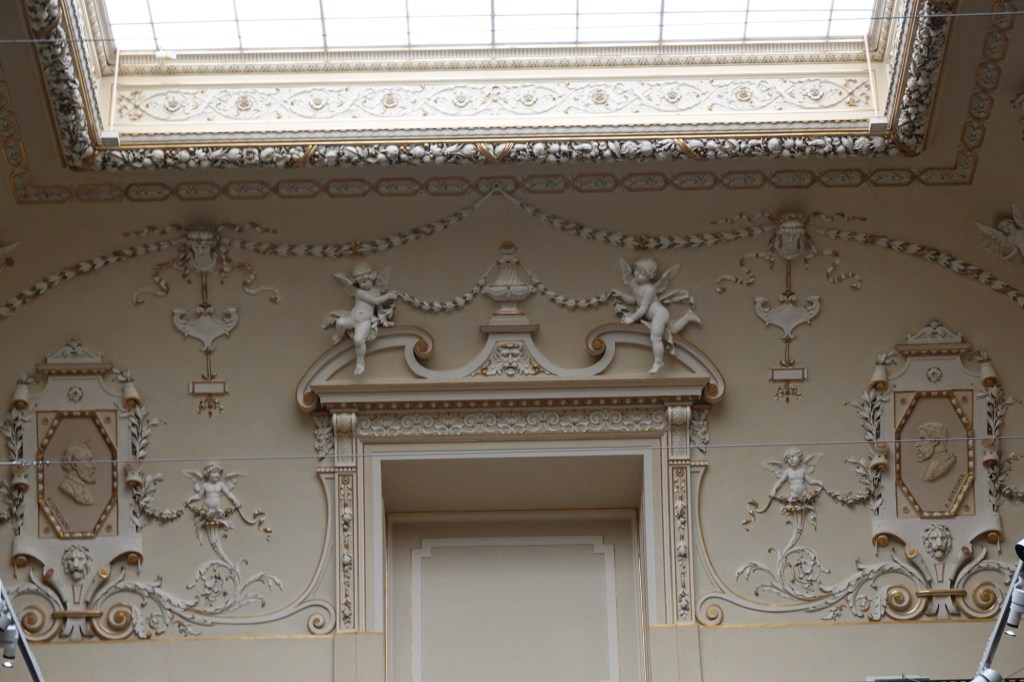
The ceilings in the painting galleries with their skylights and three-dimensional stucco and Papier Mâché reliefs are truly stunning.
Caracciolo’s “Virgin Mary with Child and St. Anne”, painted in 1633, particularly appealed to me for its depiction of the women with olive-toned skin which, refreshingly in classical religious paintings, is more true to women of the Middle East. The artist’s choice of rosy cheeks and red hair (!) for Jesus is more puzzling.


Luca Giordano’s absolutely huge “St. Michael Vanquishing the Devil”, from around 1664. I’m in this photo strictly for size perspective.
Vanquishing things, whether it is devils being vanquished by the archangel Michael or dragons, symbolizing the Ottoman empire and Islam, being vanquished by Saint George, seems to be a recurring thing in religious painting. It’s quite possible that the reason royal families so loved these kinds of pictures is that they themselves were often involved in vanquishing other nations. Just a thought, of course.
The intense colours on the walls in the art gallery rooms really set off the colours in the paintings and highlighted the ornate gilded frames.


Moretto’s painting of Saint Justina. Hmmm. Saints and unicorns. Who knew? And look closely; I could swear she’s wearing flip-flops.
Ahh, Vienna, where an entire gallery full of Titian paintings can be found, and can somehow seem almost “ordinary“. This is “Madonna with Child and Saints” from around 1520 CE

And then a room filled with Raffaels and Garofalos. Why not?
Raffael’s “Saint Margaret” (below) from around 1518 CE. More vanquishing…

… and the decidedly more bucolic “The Madonna of the Meadows” from 1505 CE.
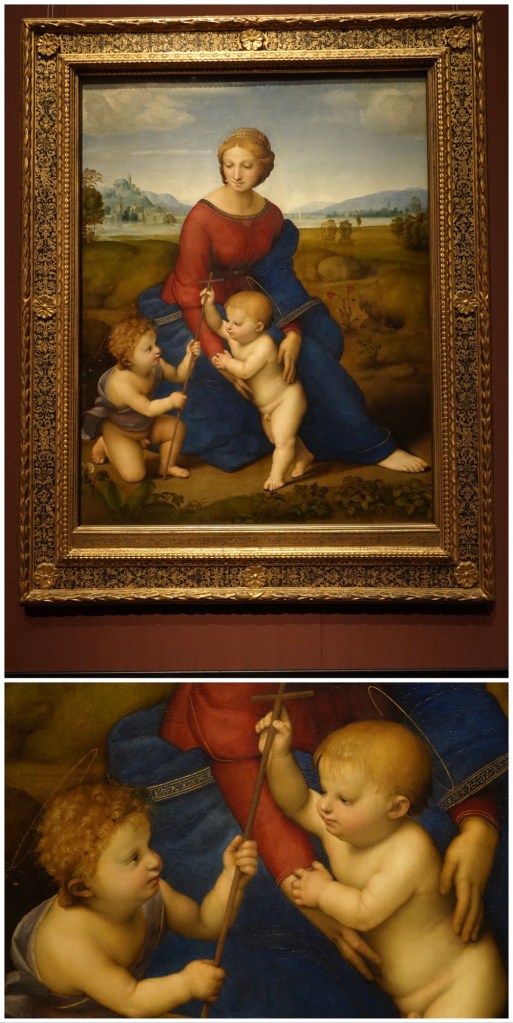
I don’t care what the interpretive sign says about Francesco Mazzola‘s 1534 painting (below) entitled “Bow-Carving Amor”, to me the painting looks exactly like a mother at her absolute wit’s end because her children won’t stop fighting for one …single …second.

As with any absolutely huge art gallery, this one is overwhelming. It makes sense that people buy annual passes so that they can come back and concentrate on just one or two rooms. After a while one finds oneself just wandering aimlessly and hardly looking at the amazing paintings because there are just too many. Nonetheless, when we walked into the gallery with the Velazquez portraits, I definitely stopped and looked.


Velasquez not only accurately captured the textures and patterns of the beautiful fabrics on the incredibly awkward looking gowns that the Spanish royalty wore, but he was absolutely wonderful at depicting children’s faces that look like children’s faces instead of like miniature adult heads set onto a child’s body.

It would be easy to spend days in this museum, but after three hours, we were both feeling sensory overload. It was time to head back out into the drizzly Vienna day and find a café in which to linger over a light lunch.
Ted commented as we were walking around that Vienna feels like home because we’ve been here so many times. The transit system, the streets, and the beautiful architecture all feel like a familiar place. Of course Vienna is always my happy place and he says that I smile here more than I do anywhere else.

We passed by the Austrian Parliament building, which was hidden behind hoarding when we stayed here in 2022 because they were cleaning the statues and the façade.
Today we had beautiful views of the Parliament, if under drizzly skies…
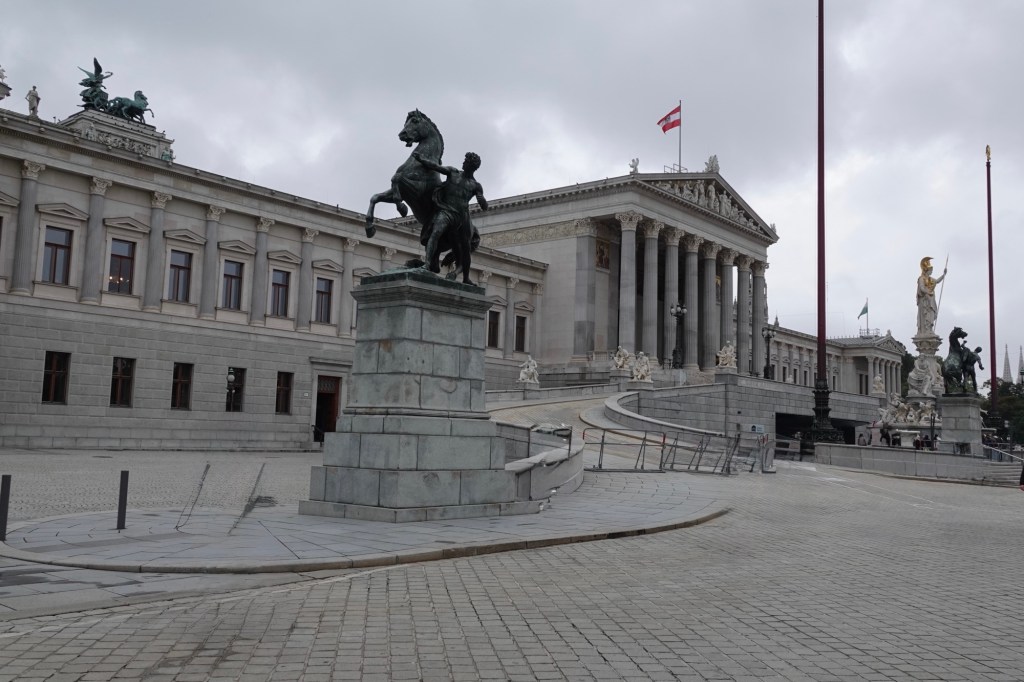
I love the clean lines of the Austrian parliament building. There are just exactly the right amount of columns and sculpture and gilding to make it extremely interesting and yet not fussy.

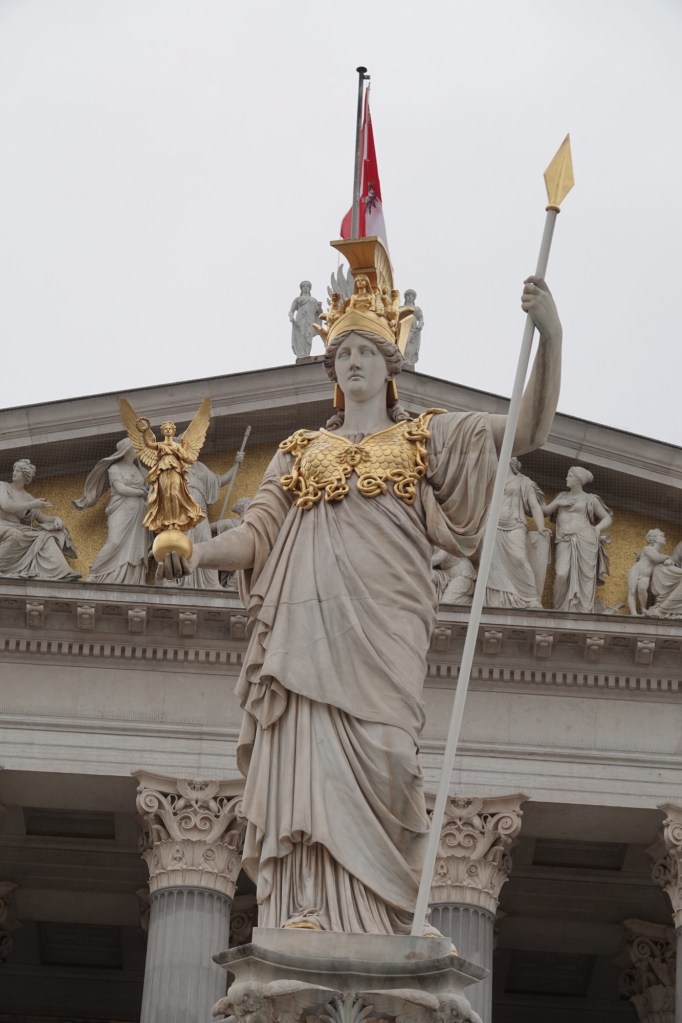
On the other hand, I also love the neo Gothic City Hall for the opposite reasons; it is extremely ornate and yet the white stone absolutely gleams.
We headed over to that City Hall next. It was also covered in hoarding the last time we were here, but in that case it was because of an international film festival going on and giant screens covering the front façade.
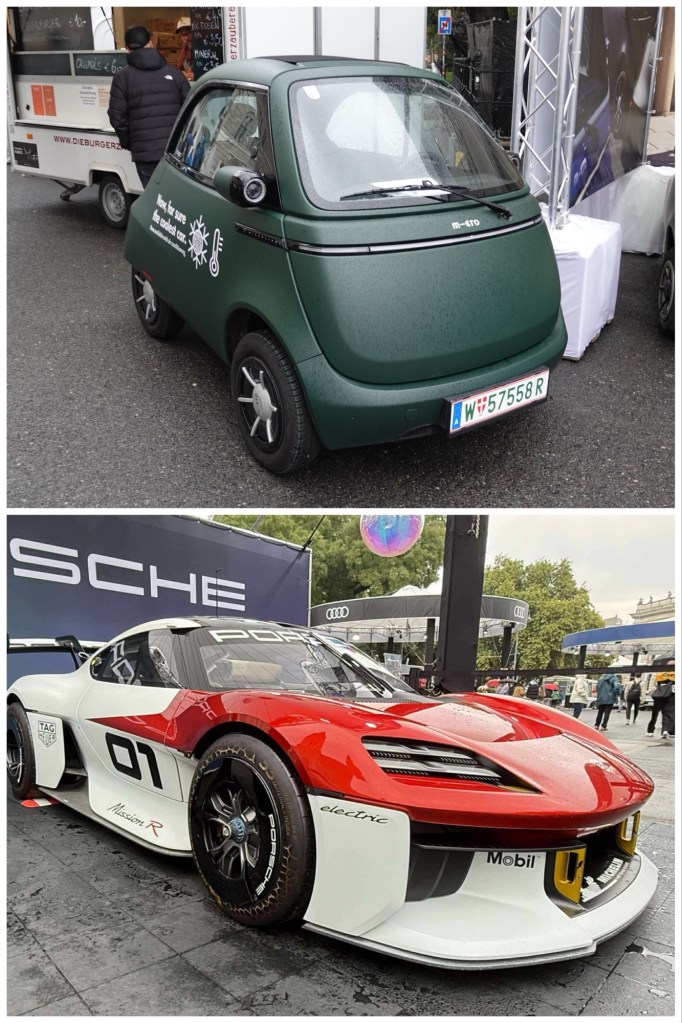
Today there was a sound stage set up, along with multiple tents featuring car manufacturers’ latest clean energy electric vehicles.


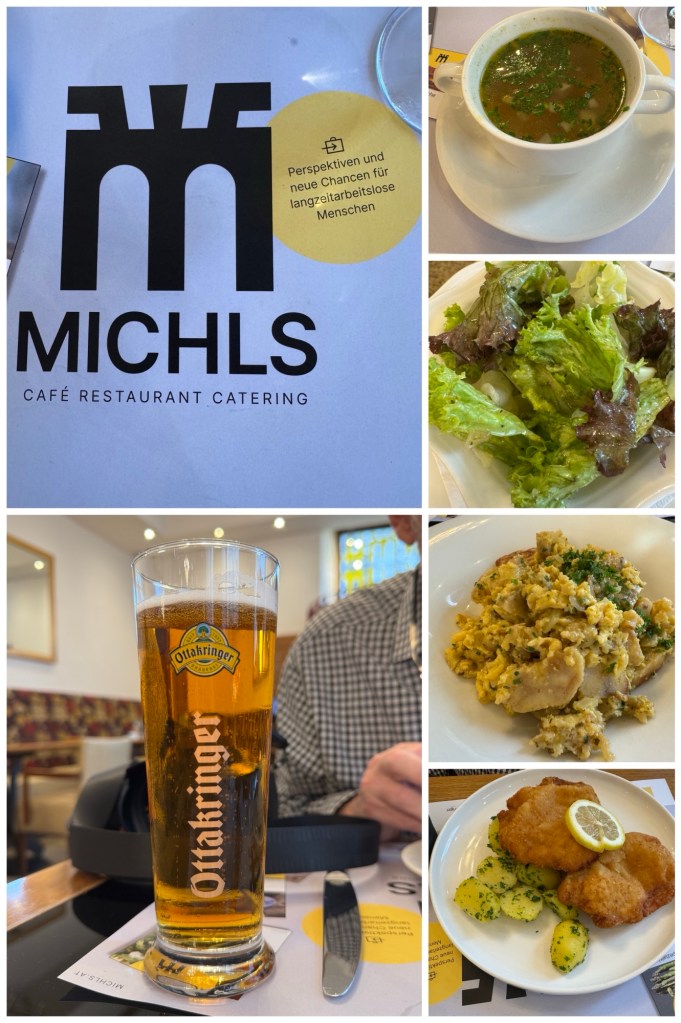
We strolled the streets around City Hall looking for a café, with the rationalization that the City Hall workers would eat somewhere nearby and those places would not be exclusively aimed at tourists. We ended up at Michls, a café/restaurant that is an initiative of Jobbörse | Wien Work , a non-profit social enterprise whose mission (translated from their website ) is “to enable people with disabilities, chronic illnesses, or the long-term unemployed to participate independently in economic and social life.” They are partially sponsored by the Austrian lotteries, the Vienna employment service, and Ottakringer brewery. The menu is limited, but what they do they do well, and their daily specials at €12 for soup and a choice of 2 featured main dishes are tasty and well-priced. The Café restaurant is bright, clean, and comfortable, with leather chairs and even a couple of crystal chandeliers.
Sated, we headed off to explore a nearby Neo Gothic church. As we headed out of the restaurant, the church bells were ringing 3 o’clock in a complex pattern of peals. The Habsburgs were staunch Roman Catholics; as a result, Vienna has something like 240 individual catholic churches, all of them beautiful. What is interesting is that there are so few people here who regularly attend church, despite the vast majority of Austrians identifying as Roman Catholic. All of the churches are open to the public (at least during the day), and it’s OK to go and sit inside just to have a rest. One of the Viking guides who lives here said that it’s quite all right – as long as you take off your hat – to go inside with a takeout cup of coffee and a sandwich (as long as the sandwich is not too smelly) and simply sit, rest, and eat. Of course, you have to take your garbage out with you, otherwise it would be extremely disrespectful.
The Votiv (German spelling) Church, built between 1856 and 1879, is opposite Votivpark, a large grassy square with sculptures and benches surrounded on the other three sides by beautiful multi story, buildings, housing, restaurants, offices, banks, and departments of the Vienna University. Because it was rainy the park was empty, but in general on sunny days, Vienna’s parks are full of people enjoying the outdoor green spaces.

This church was erected as a memorial initiative of Archduke Ferdinand Maximilian, after the unsuccessful assassination attempt in 1853 on his brother the young Emperor Franz Josef I. It was consecrated on April 24, 1879 on the silver wedding anniversary of Franz Josef and Elisabeth (Sisi). The Ferdinand Maximilian who initiated the building of this church is the same Maximilian who was the king/emperor of Mexico from 1864 to 1867.

The inside of the church feels quite Gothic in that it has soaring arched ceilings, but is quite dark. There are wrought iron, or perhaps gilt iron, chandeliers down the center, but they were not lit. The church has no wooden pews, or pews of any kind, but it was set up with folding chairs, perhaps for an upcoming event.


The coat of arms inside the church:

Because it is so dark inside the bright colours and the stained glass windows seem especially vibrant with the outdoor light coming through them.


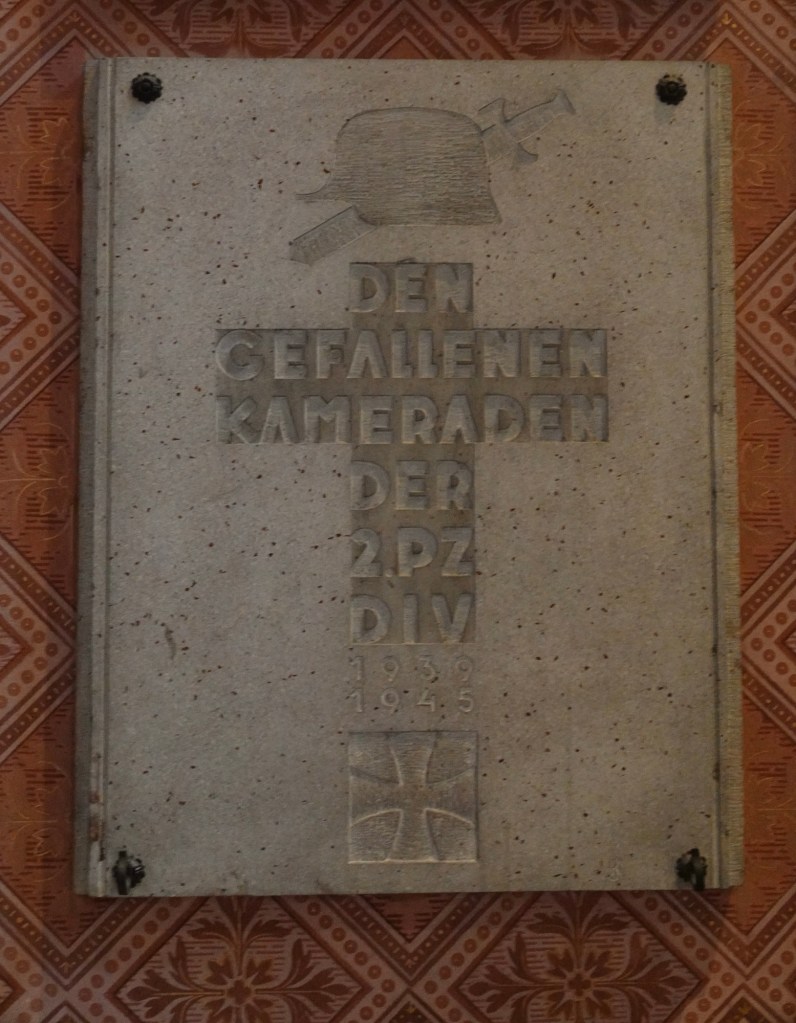
Unique to churches that we’ve visited were the many permanent memorials to those Austrians who fought in WWII, identified by their military divisions.
Even more unique and poignant was the stained glass window dedicated by and to those who suffered political persecution during WWII. We have certainly never seen prisoners in striped concentration camp uniforms depicted on a church window.

The maintenance of historic church buildings is partially government funded through taxation, but each church also has individual initiatives often classical concerts for which tickets must be bought. In the case of the Votiv Church, they have an immersive light show called “light of creation” that is projected onto the incredible interior architecture of the building.
With hundreds of churches in the city, it’s impossible not to pass several even when you’re in the midst of a shopping district full of glove shops, hat shops, wonderful delicatessens, cafés, and high-end clothing stores. We were walking in the Schottenring when we came upon a church named the “Scottish Church” (Schottenkirche).

Of course we went inside. This is a much older church than most we’ve been in. It was a parish church and Abbey dedicated to the Scots in the year 1155CE, although it has been renovated several times, most recently in the 1900s.
The sanctuary is not open to tourists, although we could go into the front hall and look at it through iron gates. Unfortunately, it was also not lit, although it was clear to us that the colours would be spectacular in bright light.

Interestingly, although the church and monastery are called the Scott’s church, it was named for Irish monks who founded it. An interpretive sign in the vestibule explained that, in the Middle Ages, Ireland was called “Scotia maior”, or “the larger Scotland”. It is currently an Austrian Benedictine church.

It’s not just churches that make us stop and gawk of course; it’s also random wonderful bits of architecture. Vienna really is like nowhere else for the sheer quantity of glorious buildings beside other glorious buildings, and yet once in a while a particular sculpture or a particular gargoyle, or a particular embellishment on a column, just makes us catch our breath.

Peek down an alleyway and see another irresistible church building.
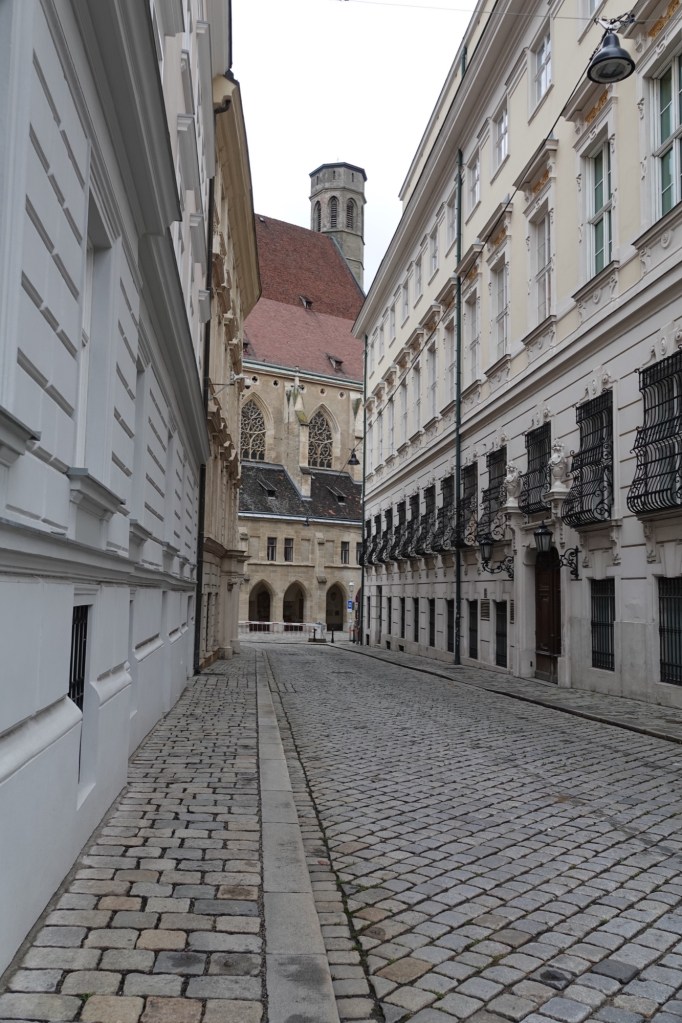
This time it is the Minoritenkirche, the church built in 1784 for the city’s minority Italian community, a congregation celebrating 400 years in Vienna in 2025.

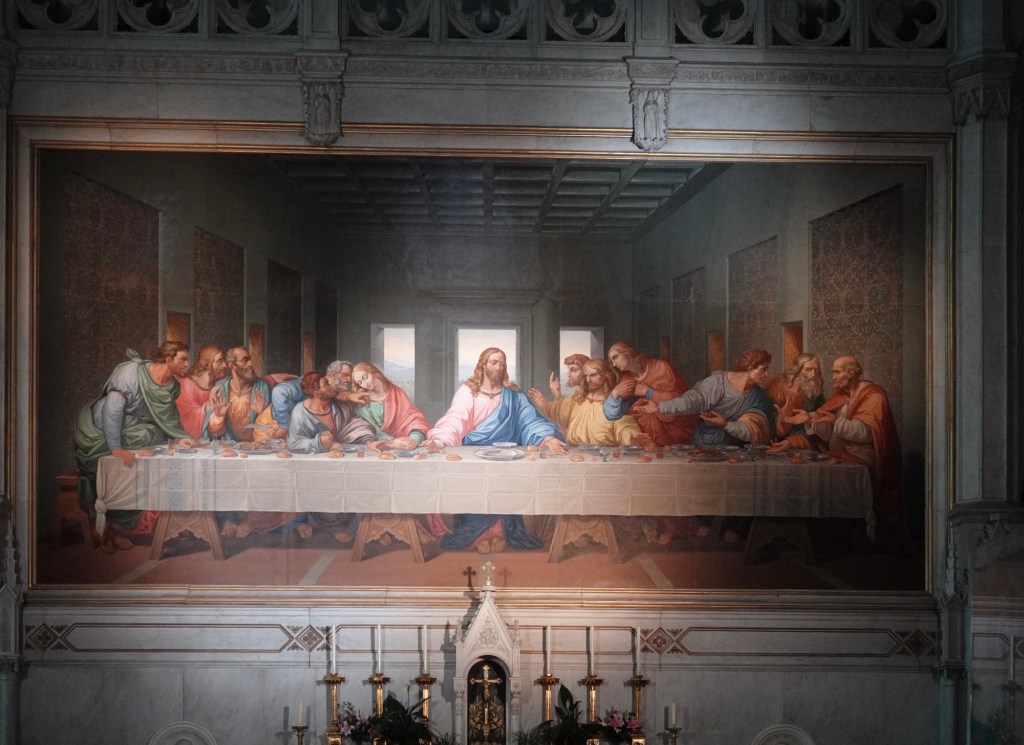
A huge reproduction of da Vinci’s last supper covered a side wall above one of the supplementary alters. A one euro coin put into a control box allowed for illuminating the painting for a few minutes. This church is another one that hosts concerts in the evenings.
We passed through the massive Hofburg complex that now also holds the World Museum, the History Museum of Austria, the national library, the Ephesus Museum of Vienna, and the Papyrus Museum.
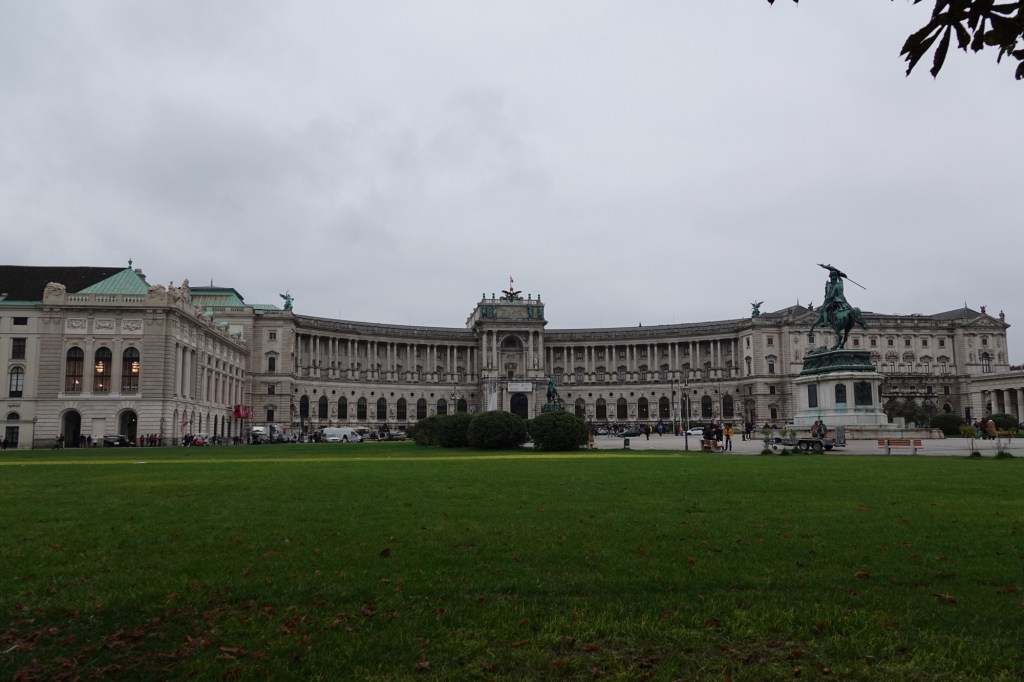
Above the central entrance to the museum complex is an archway at the top of which is the imperial double headed eagle and the Austrian flag.


The massive bronze statue in the square is of Emperor Franz Josef I and is dated 1859. Ted insisted that I go sit on the plinth of the statue, simply to show the massive scale of things here in Vienna.

A second equally huge bronze statue, also of a Habsburg on horseback, depicts Prinz Eugen the victor. The large plaque on the statue indicates that it was erected at the request of Emperor Franz Josef I in 1865.

In the courtyard beside what is now the Sisi Musem, another humungous bronze statue with the Latin motto AMOREM MEUM POPULIS MEIS (my love for my people) on it.

More of the very popular vanquishing of things was depicted in the statues on the wall of the Hofburg at the side where the Spanish Riding School is located.

In between the Hofburg and Saint Michael’s Church is an area of archeological excavation that was only begun when artifacts were found during roadwork in 1990. The oldest remains in this excavation date to Roman times and are a UNESCO world heritage site. The site also includes buildings of the suburbs that once surrounded the fortress called Vindonons, a Renaissance wall of an imperial garden, and the foundation walls of apartment buildings from the early 19th century, all layered on top of each other .

For the evening, Ted had researched music options and purchased tickets to a classical concert at St. Peter’s Church, purportedly just a 5 minute walk from the Hofburg.
Since we were already at the Hofburg, we decided to detour briefly to ascertain where exactly the church was located, thinking that finding it in the daytime would be much easier than trying to reach it for the first time at night. We were right.
St. Peter’s Church is located on a square in the high-end shopping area of Vienna, right between Hermès and Escada on the avenue called Graben.

When we arrived at the church, the 5 o’clock mass was underway, in German, to a congregation of about 200 people. The sanctuary, lit with round lights and candles on the altar was very beautiful, although it is not very large. It’s a good thing we got a couple of photos, because none were allowed during the concert.


We’d done a lot of walking and were ready to find a place to sit for a while, but that meant more walking – past the high-end shops on Graben, and the only slightly more affordable ones along Kärntnerstrasse. There was lots to look at on our route.


Of course, we had to get at least one photo of St. Stephen’s, even though we didn’t visit this time. I’ll take son#1 up the tower next year; Ted and I have “been there, done that”.

Ted teased that every time we come to Vienna, we have to come back to “our” café. In fact, each time we’ve been here we’ve had cake and coffee at L. Heiner on Kärntnerstrasse, which has been an institution here since 1840. It was even granted a royal commission during the Habsburg era.
From the wide selection of desserts we chose a slice of truffle torte, and one of Esterhazy torte, plus a cappuccino and a melange.
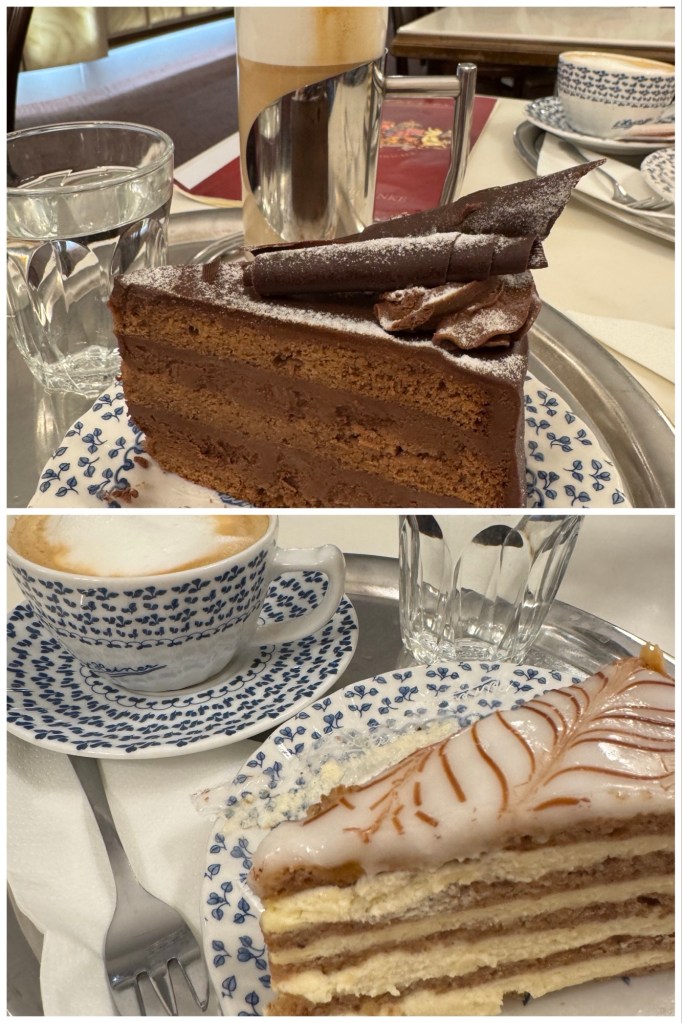
Two days ago in Budapest we learned the origins of the flourless Esterhazy torte had to do with Countess Esterhazy’s desire to have her pastry chef create a dessert that her young son, who always became ill after eating breads or other grains-based foods, could eat. The resulting beautiful cake is made with alternating layers of almond or hazelnut meringue dough (dacquoise) and chocolate buttercream, decorated with a dark chocolate spiderweb design on white fondant – the overall two-tone effect mimicking the Esterhazy black and white coat of arms.
We got to St. Peter’s too early for our concert, but really wanted to get out of the rain. What we got, besides dry, was the chance to enjoy the last half of a “free will donation” concert of gorgeous organ music prior to our scheduled string quartet performance (below).

With concerts going on in multiple churches all over the city, it was wonderful to be part of a sold out event. The audience at the string quartet concert was not only tourists; the Viennese live up to their reputation as music lovers.
We’re comfortable with Vienna’s transit system, and our riverboat is parked within a couple of blocks of both the Vorgartenstrasse U-bahn U1 line station and the Prater-Messe U2 line, so we headed “home” via public transit after the concert.
Strolling under the moonlight that was trying valiantly to battle rain clouds, we got a view unique to the night-time: St. Francis of Assisi Church, within steps of where we’re docked, fully lit.

We walked over 20,000 steps today and are, truthfully, pretty darn tired. Added to that, while Ted’s cold has pretty much abated, it has found a new home in my body and is doing its best to exhaust me.
Tomorrow we have another day of independent exploration in this amazing city, but are thinking we’ll make a late start and perhaps just focus on a single museum visit and one more Viennese café experience.
 Rose and Ted’s Excellent Adventure
Wow! I spent my junior year of university in Vienna 1976-77 and I’m not sure I saw as much as you managed in a day! The city has been very much spruced up since I was there — St. Stephen’s was under wraps the entire time and the whole central city was torn up to construct the U-bahn. I do remember clearly having an Aha moment in about late May when the sun finally came out and I could appreciate some of the Baroque architecture which had seemed like so much cement cake frosting until the sun played on it! Thanks for the very thorough visit to the museum — I loved the way you picked out a few things to highlight. It is totally overwhelming. I had forgotten that Maria Theresia had 16 children! Vienna — and certainly the Hapsburgs were completely over the top.
LikeLiked by 1 person
“Over the top” definitely describes it – but I love every ornate bit!
LikeLike