WARNING: this post has far too many photos of “Bud” (Ted’s nickname for me) in Budapest. Apparently I am good for lending perspective.
We’ve been in Budapest twice before.
The first time was in 2013, when Ted and I made our first ever trip to Europe and took our very first Viking River Cruise. (Episode 100)
That cruise from Amsterdam to Budapest was incredibly emotional for me, since it visited many of the cities locations through which my mother had passed as a displaced person after WWII.(Episode 68)
We returned in November of 2022, when we opted for Viking’s Panoramic Budapest excursion (Episode 365). We chose that same excursion for our first morning here this year, knowing from past experiences that having a different tour guide can turn a repeat excursion into a completely different experience.
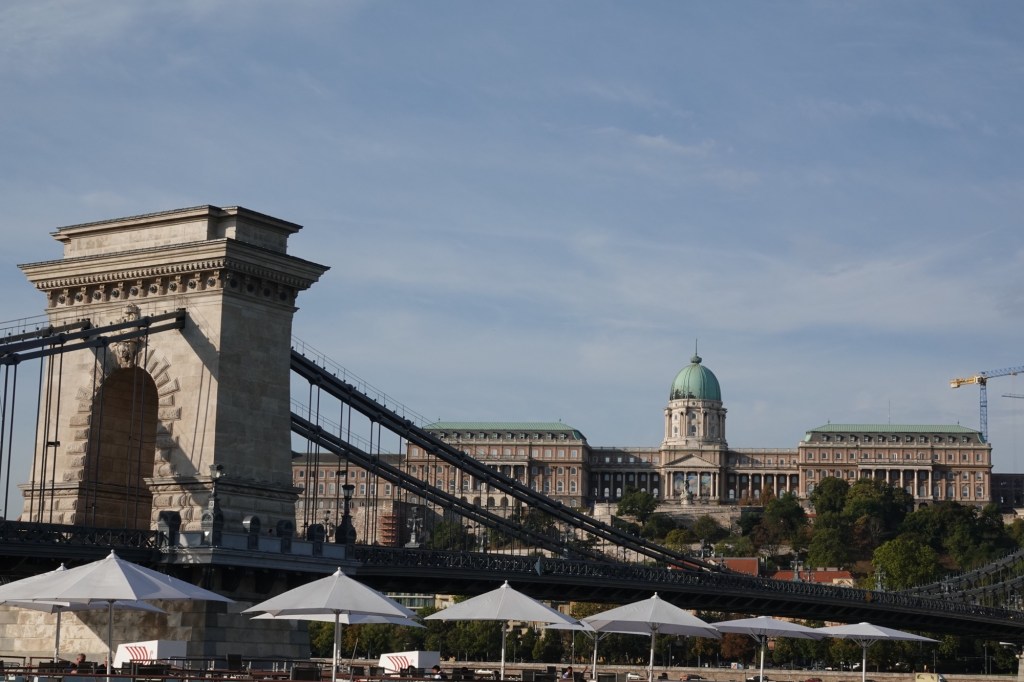
Plus, taking the panoramic tour was the easiest way to get back up to Fisherman’s Bastion and the marvellous Matthias Church, directly across the river from which we were docked, at the Chain Bridge.


But before our tour, as always, breakfast: Mákos rétes today, Hungarian poppyseed pie with a side of plum compote.

We honestly didn’t pay a lot of attention to our guide during our one hour panoramic coach ride, which began on the flat Pest side of the city. It was disappointing that this time, unlike on this tour in 2022, there was no photo stop at Heroes’ Square. Photos through bus windows are not really Ted’s thing.
Instead, we just leaned back and tried to see as many of the stunning Habsburg era buildings as we could.
It’s no wonder that the old buildings are so beautiful here. During the Habsburg era when this side of the city was largely in its development stage it was mandatory to spend 20% of any building’s cost on its exterior decoration. There is a local joke that when the Budapest Opera House was being built, Emperor Franz Josef’s permission was contingent on the Budapest Opera House not be larger than Vienna‘s, since Vienna was the capital of the empire. It is said that on the emperor’s first visit to the newly built Budapest Opera House, he remarked “I should have said it couldn’t be more beautiful as well”.
While there are no pictures of our drive here, I definitely kept a mental list of places I’ll want to show son #1 when we’re here next September.
Once we reached our goal of the Castle District on the opposite bank of the river in the hilly Buda side of the city , and had our tickets to enter Matthias Church, Ted and I said goodbye to our tour group and headed off to explore on our own.
Getting to the Castle District meant driving by a number of apartment buildings built in the communist brutalist architectural style which Hungarians cheekily refer to as “communist baroque”. Our guide told us that the interior walls of the communist apartments her family loved in had intentionally thin walls so that people could listen to each other’s conversations and spy on each other. (On a later tour we were told that in fact the walls originally had asbestos insulation, and then when it was removed – due to being a carcinogen – it simply wasn’t replaced with anything.)

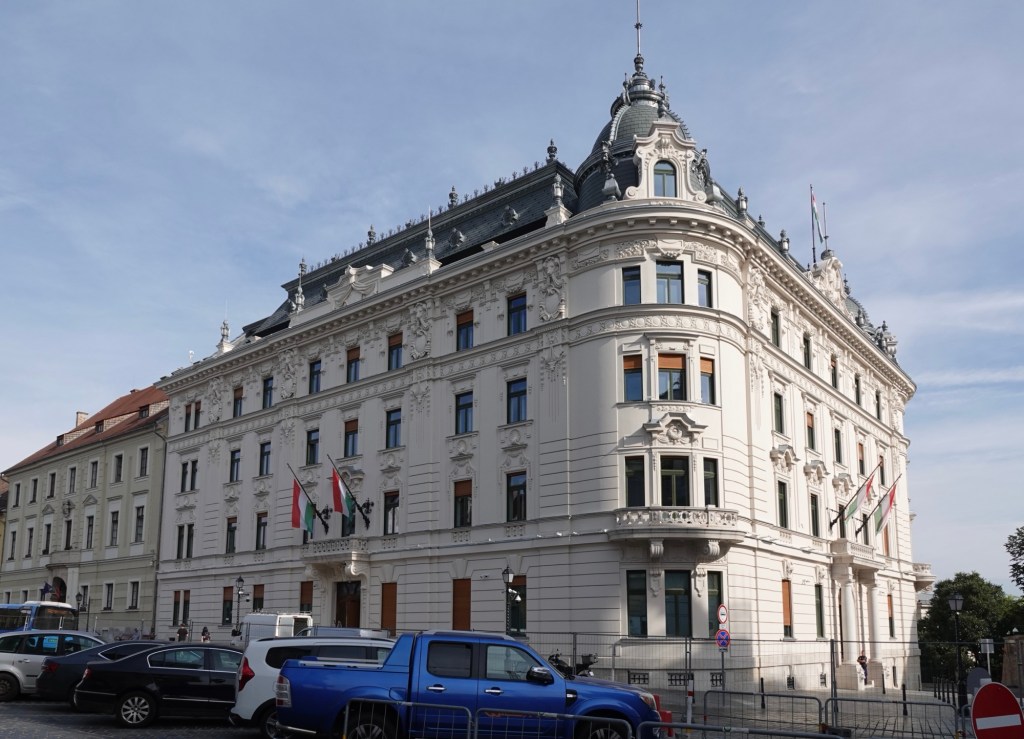
About 2000 people live in the Castle District full-time. They are not allowed to own their homes, but can only lease them, because this is a UNESCO heritage area. The exteriors of the homes are protected under UNESCO rules, and must maintain their historic façades, but can be modernized inside.
We saw some of the old East German-manufactured Trabant cars, which are now considered a quirky reminder of the Soviet era, used for “Trabi tours” in the city.

We walked past the “Honvéd statue”, a memorial erected in honour of the freedom fighters who occupied Buda Castle in 1849. That was a rebellion against the Habsburgs, which the Hungarians lost. Our guide told us that that the Hungarians have historically lost almost every battle they waged. That may explain why they seem to smile less and are more reticent than most other Europeans.

While everyone refers to Budapest’s magnificent church on Castle Hill as the Matthias Church, its actual name is The Church of Our Lady of Buda, dedicated to Mary, the patron saint of Hungary.


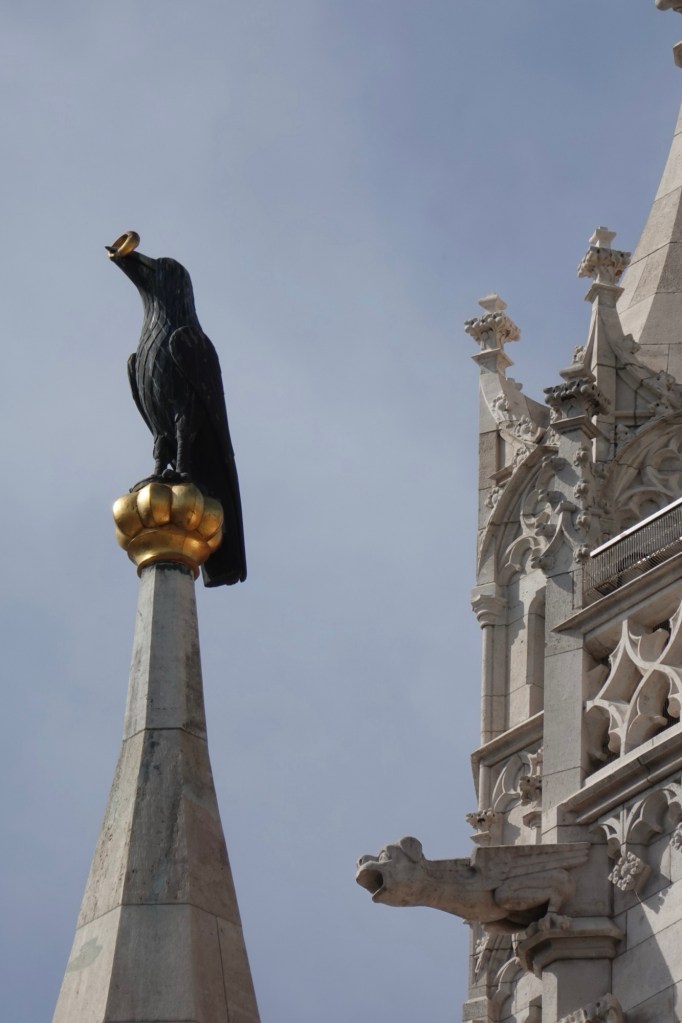
Its common name isn’t in reference to Saint Matthew (which would be Matthias in Habsburg German), but in honour of Hungary’s King Matthias I, the king of Hungary from 1458 – 1490 who attempted to reconstruct the Hungarian state after decades of feudal anarchy. He was nicknamed “Corvinus”, the raven, for his heraldic symbol, which is represented atop some of the church spires.
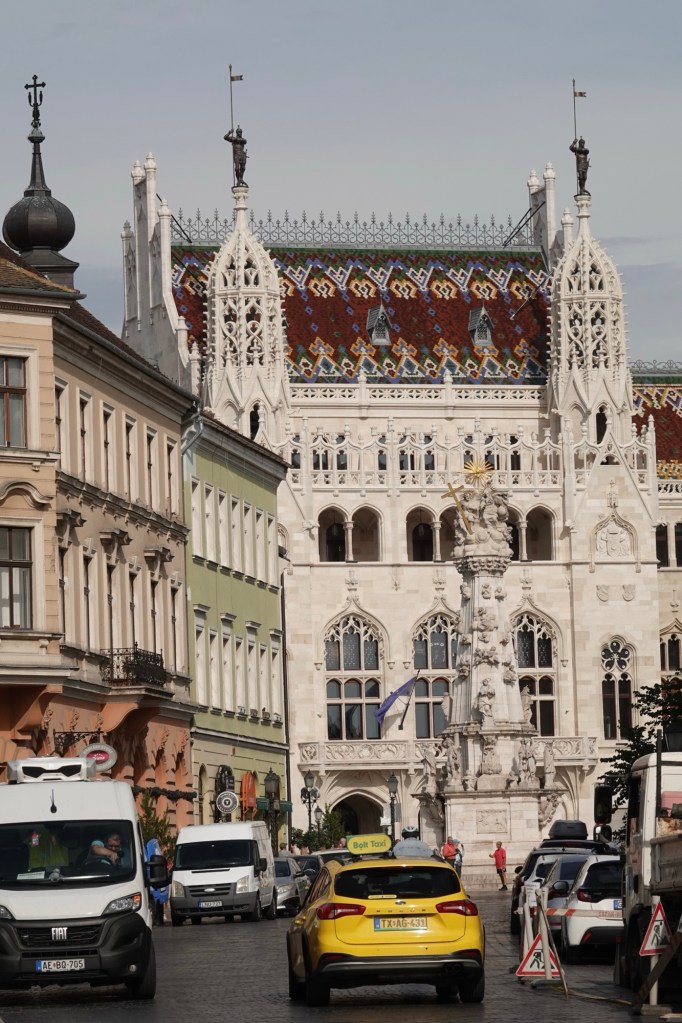
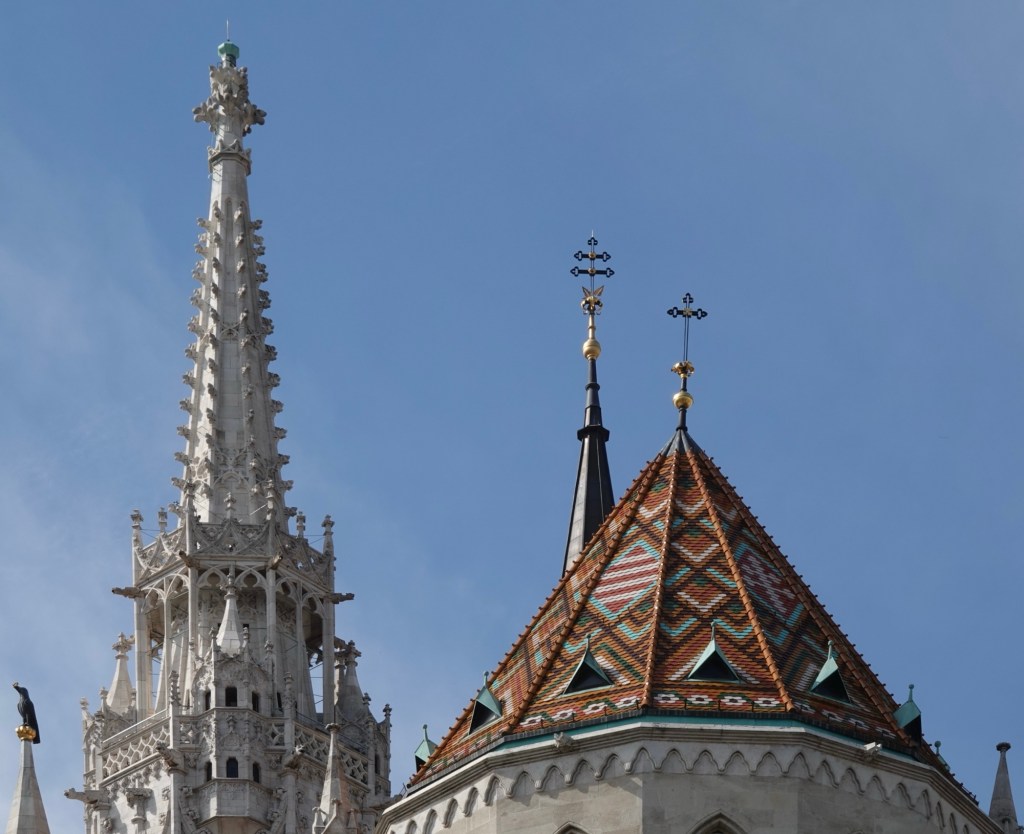
The gorgeous Zsolnay tiles on the Matthias, church and other buildings in the Square are perfect examples of the tiles made in the factory we saw in Pécs.


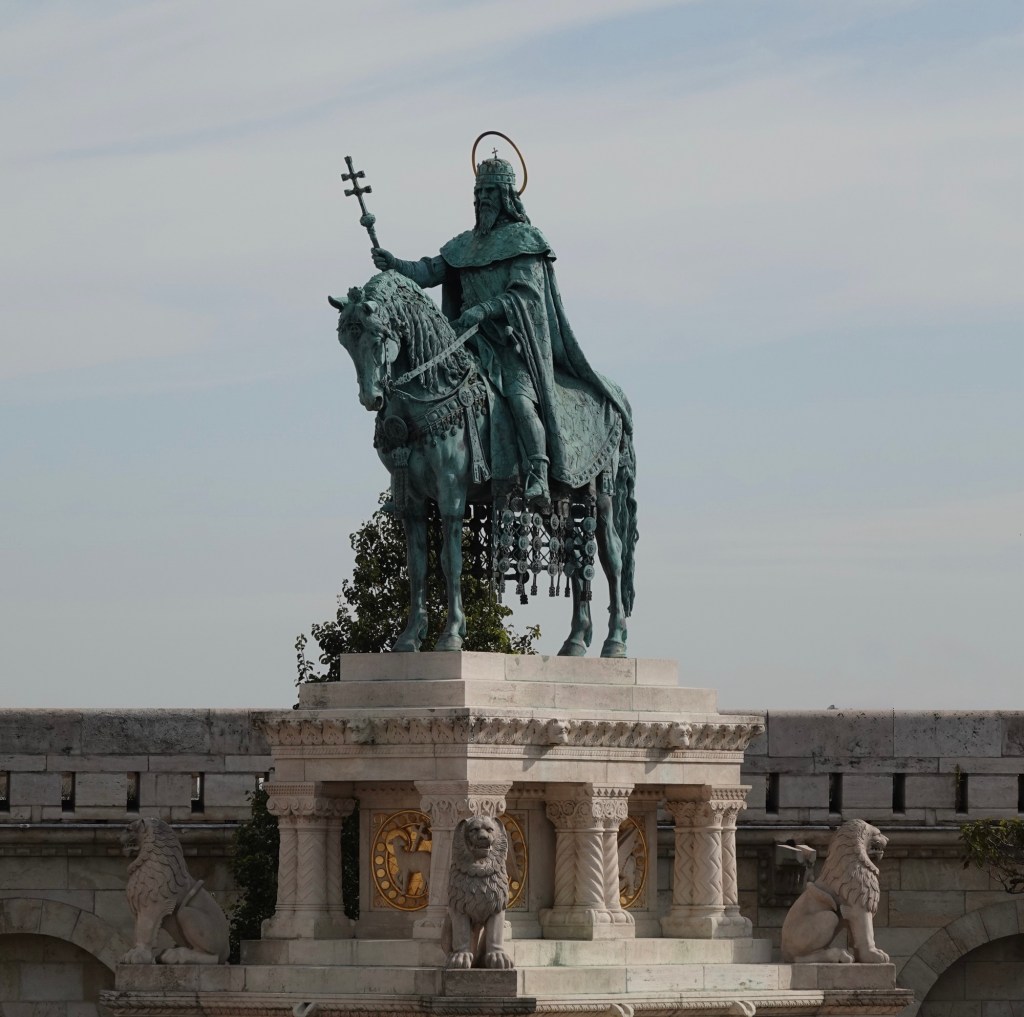
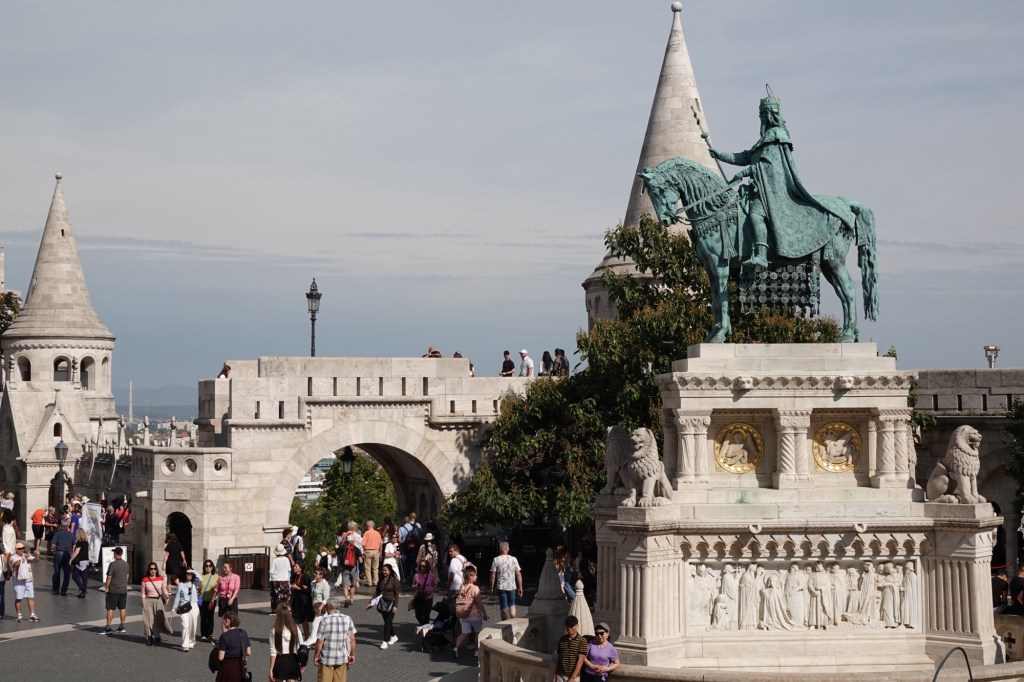
This statue in the centre of the square between Matthias church and Fisherman’s Bastion is of Hungary’s very first king, (Saint) Stephen, who ruled in the years 977-1038.

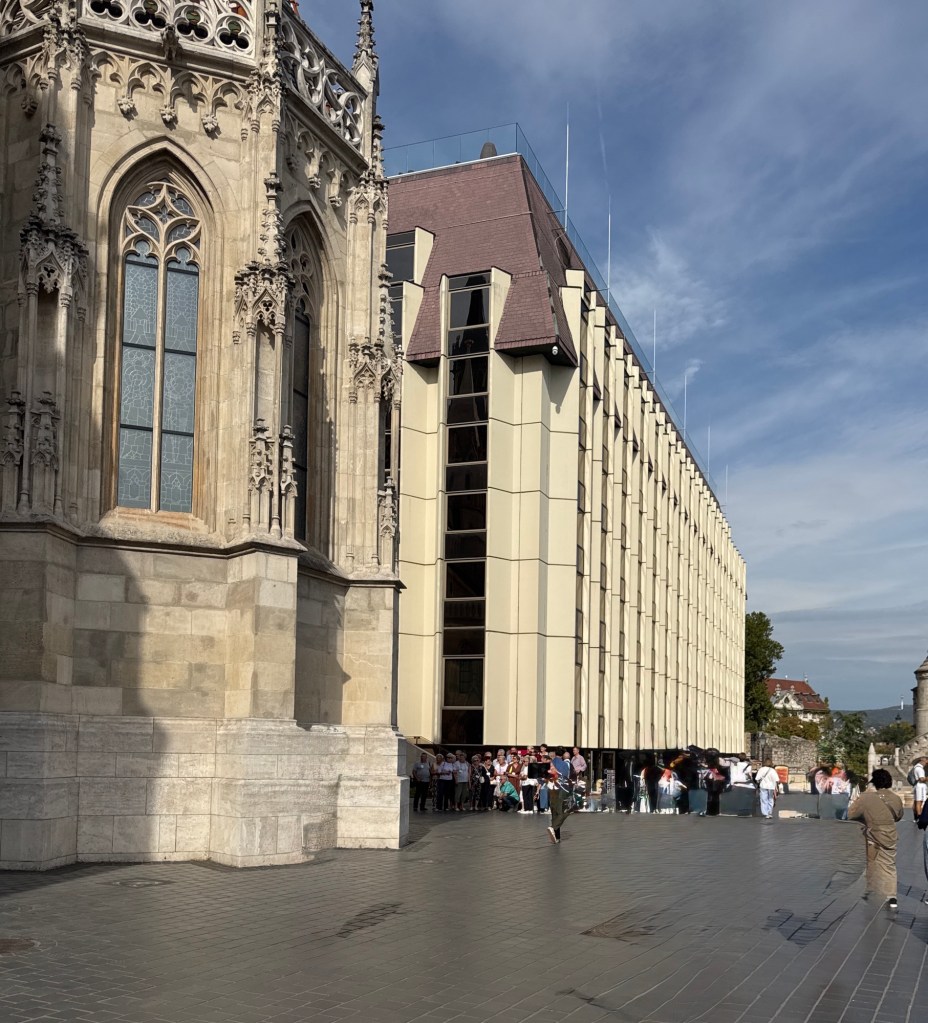
There is a Hilton hotel on Castle Hill, which was only allowed because the hotel chain agreed to preserve the Dominican monastery walls now located within it. The hotel dates to 1976 and, while the colour of the hotel blends in with the surrounding buildings, the architecture is closer to “Soviet Baroque” than it is to blending in with the rest of Castle Hill.
Fisherman’s Bastion was actually never used as a fortification (bastion). It was built in 1896 for the millennium celebrations of the founding of the country in the year 896CE. It is called “fisherman’s” because of the fish market that was located here.

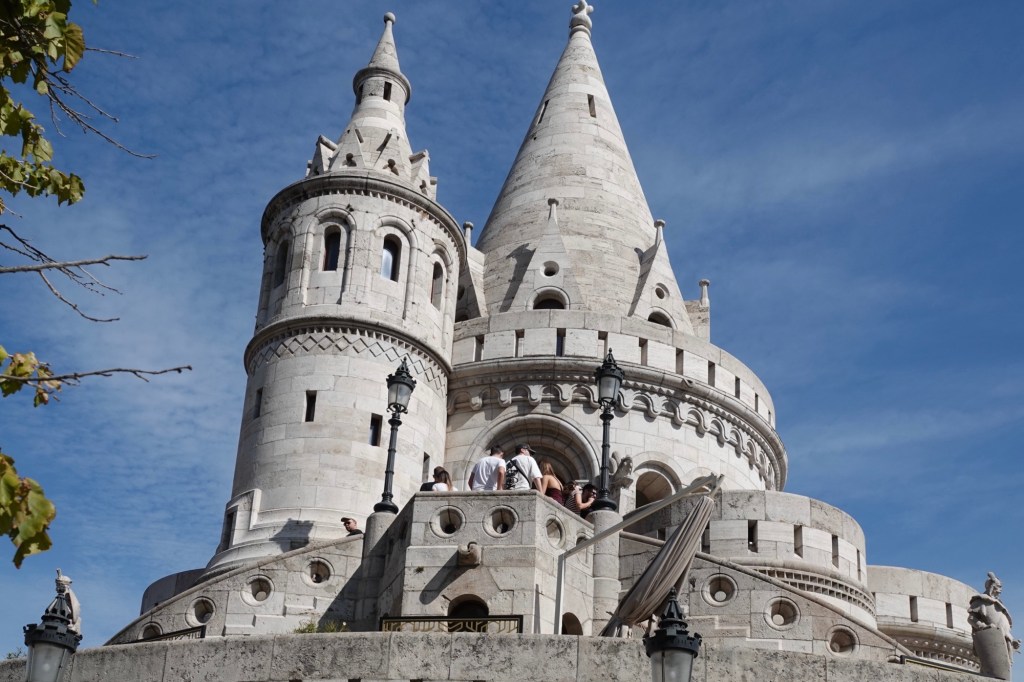
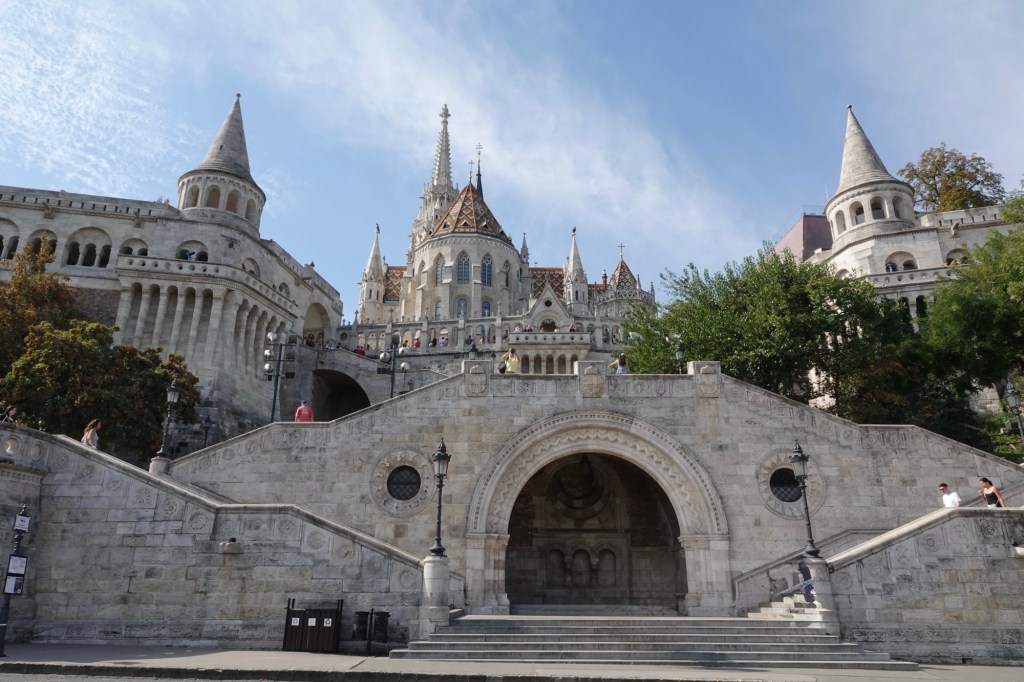
Access to the top of the bastion is now a ticketed area, which is different from our visit 12 years ago when we could freely access that level. We didn’t go up onto the bastion wall, because the view is really no different than it is from 20 feet below.
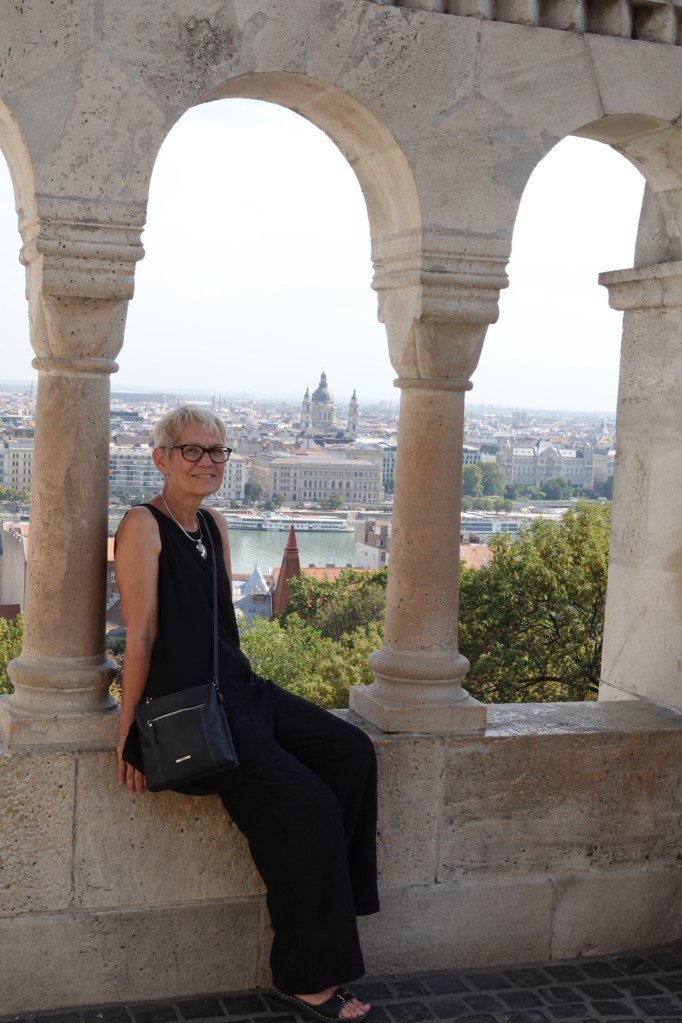
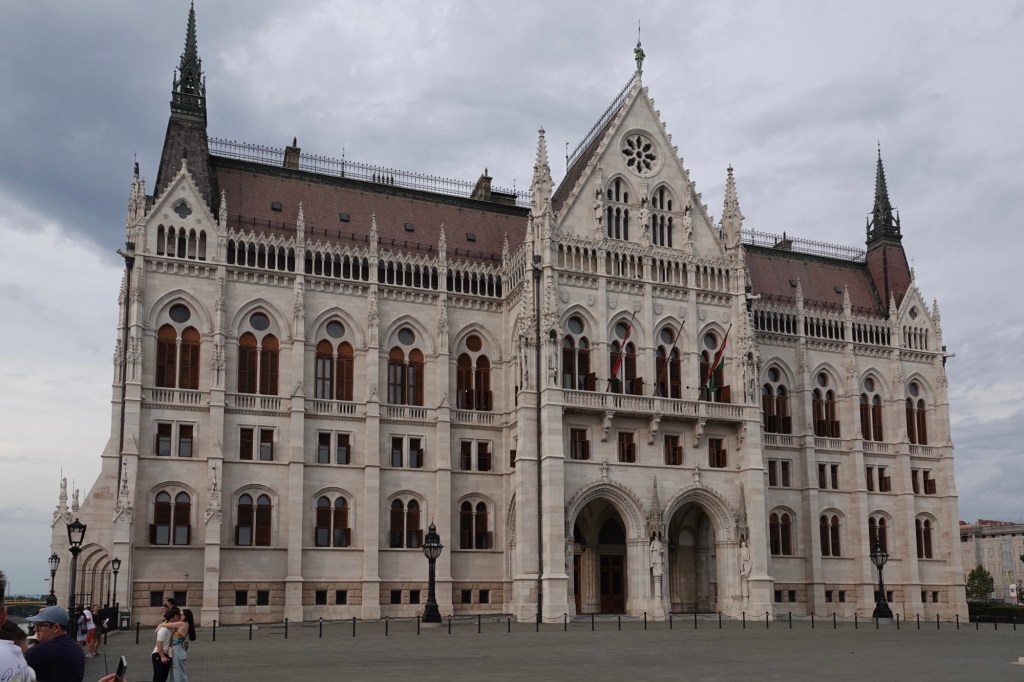
The view of the Parliament Buildings is definitely the highlight…

…but we also got a panoramic view that included the dome of St. Stephen’s.

Our guide pointed out the grotesque gargoyles whose scary faces are intended to scare evil away. There are 96 gargoyles on the church, 96 being the magic number in Budapest and Hungary because of the original conquest by the Magyars in 896CE. Each of the gargoyles is actually a water drainage spout.
Having wandered around the outside, it was time to revisit the inside of the Matthias Church.
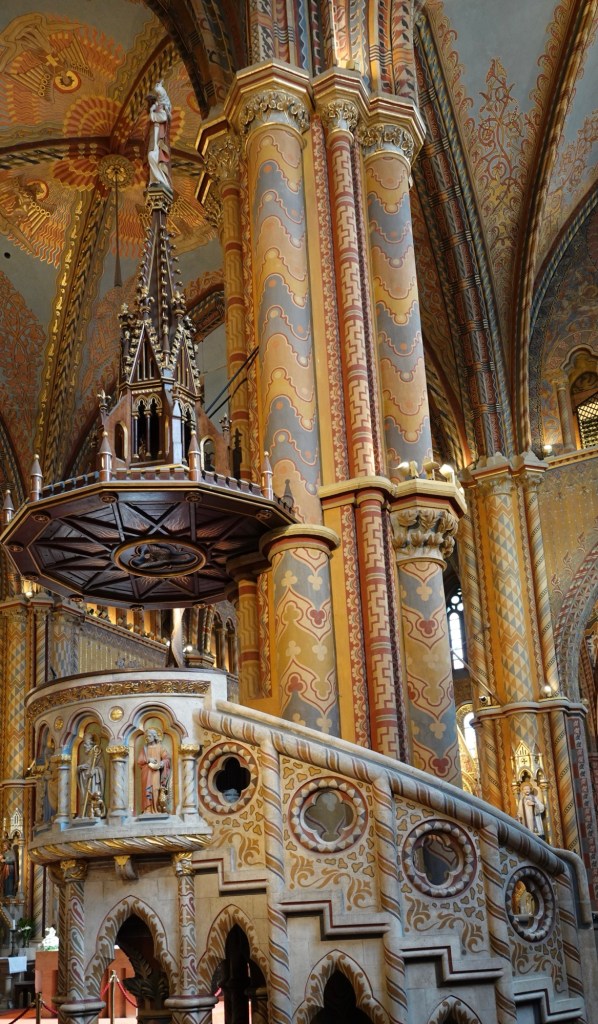
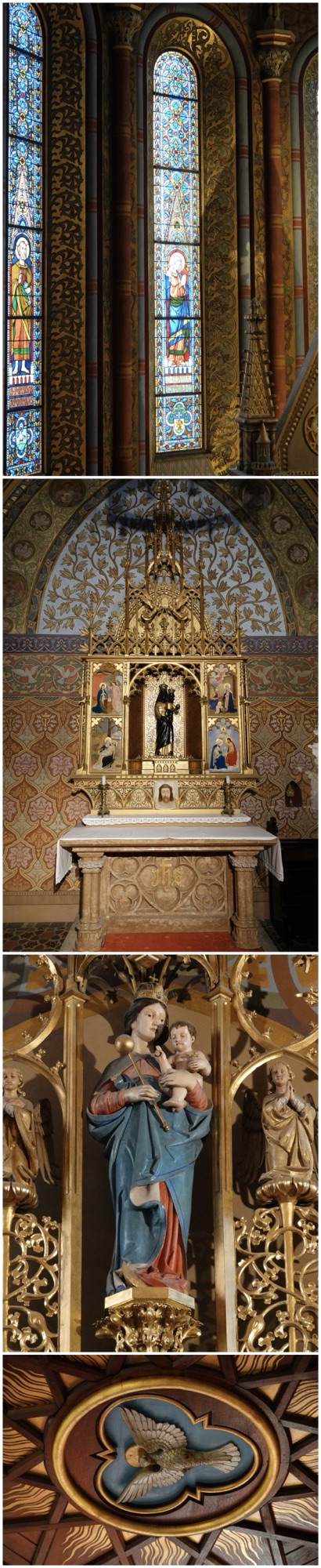
The interior of the church as we see it today was redone in 1896 for the millennium celebrations. All of the painting on the walls, pillars, and ceilings was done by hand, using stencils. It is absolutely gorgeous, but also – as I’d recalled from our previous visit – quite dark inside, lwhich mutes the colours, especially in photographs.



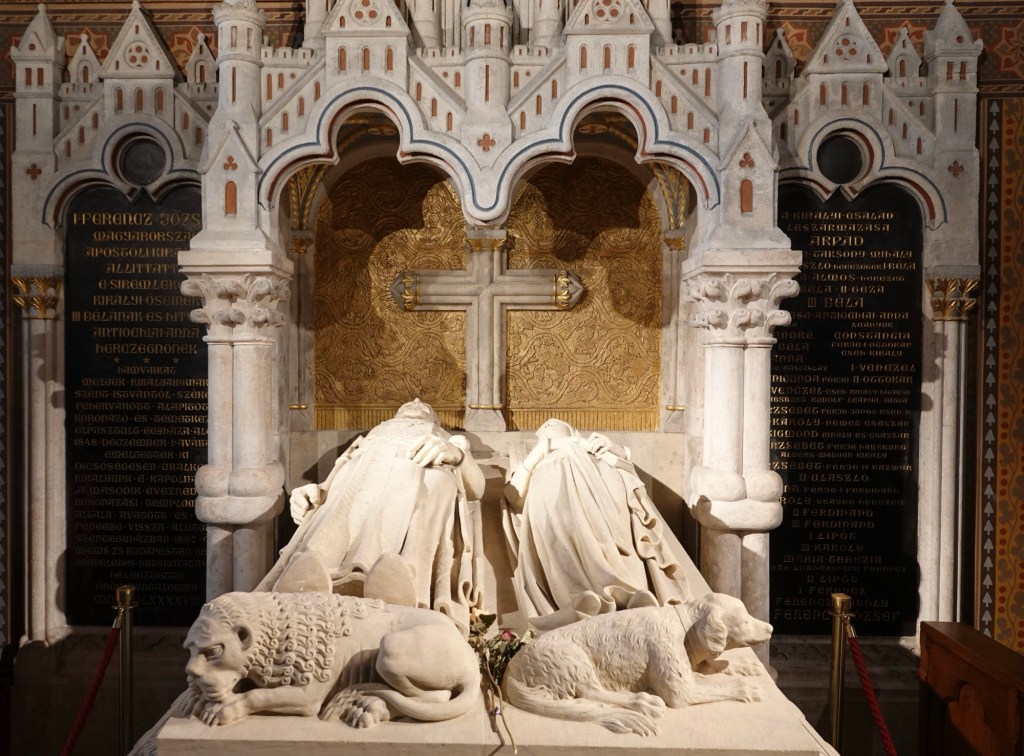
The tomb of King Béla Ill and his wife, Anne of Châtillon, was relocated into a side chapel of the Matthias Church in 1898.
A sign in the chapel explained the unique triptych below: “A special iconographic image depicts the Holy Trinity on the triptych of the chapel. God is sitting on a throne holding his crucified Son in his arms; above them the pigeon symbolizes the Holy Spirit. This type of image is a so-called “throne of grace” representation. On the triptych’s wings the figures of John the Apostle, John the Baptist, Saint Peter and Saint Paul are depicted. The 15th century triptych was brought to the church from Felsöerdöfalva (today Stará Lesná, territory of Slovakia) in 1896” – concurrent with the millenium celebrations.

Once we separated from our tour guide at the Matthias church ,we did some wandering around Budapest on our own. The weather forecast for tomorrow is rain and potential thunderstorms, so we needed to take advantage today.
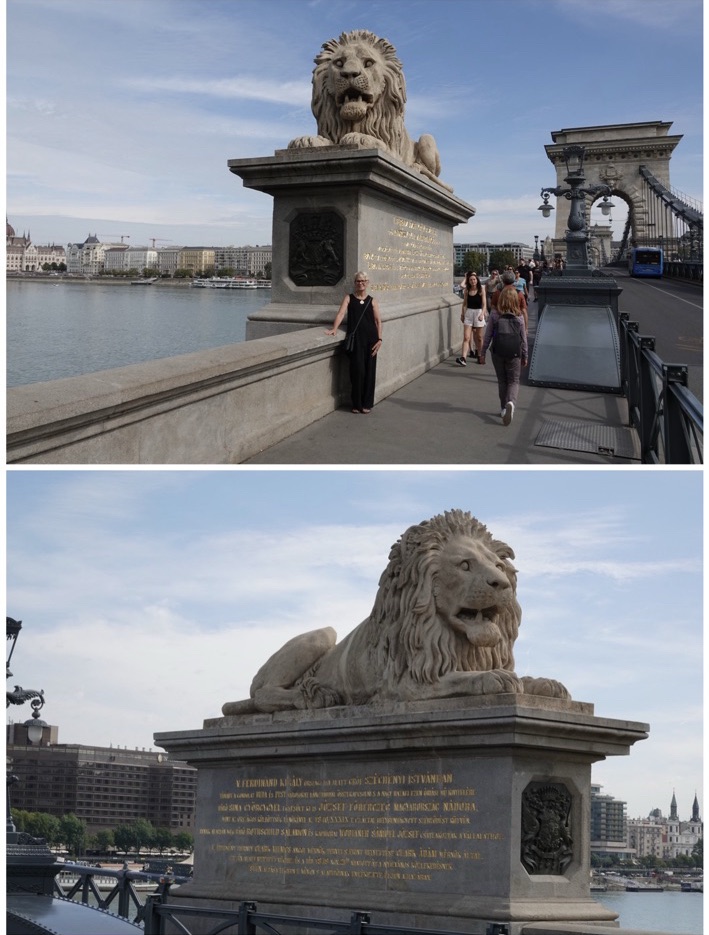
We walked back down to the riverbank from Castle Hill, and then across the Chain Bridge back to the flat Pest side of the city.



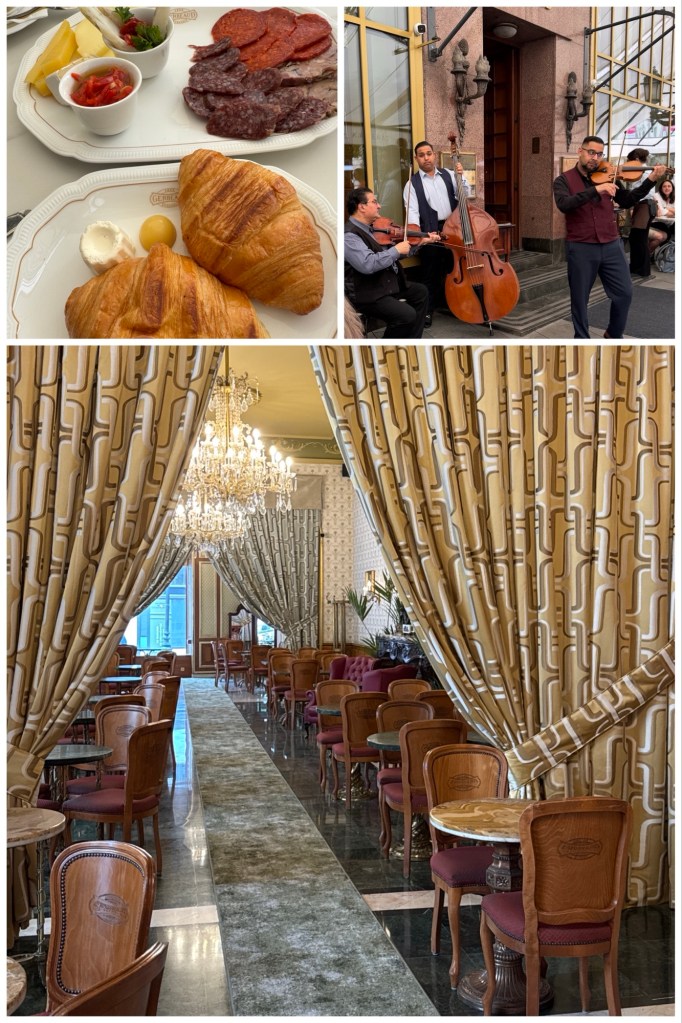
Even though we’d been walking for a couple of hours and were tired, it turned out we’d only done 5500 steps to this point. Nonetheless, we stopped for a late lunch at Café Gerbeaud, which is famous for its original owner having invented Hungary’s iconic “cats tongue” shaped chocolate, and for introducing cognac cherry bonbons to Budapest. We had lunch, but no dessert. Ridiculous!
One of the lovely things about eating at café Gerbeaud was the live string trio playing Hungarian classical and folk music on the patio. We ate outdoors because the weather was gorgeous, but I couldn’t resist taking a picture inside the beautiful café went I went to use their WC.
After our lunch break, our attention was grabbed by an absolutely huge Carrara marble statue in the square near the café. We had to do some research to find out that it dates to 1908, and depicts Mihály Vörösmarty, a renowned 19th-century Hungarian poet and dramatist, seated and holding a laurel wreath and a scroll with the first verse of his poem “Szózat”, surrounded by allegorical figures representing various social classes, symbolizing the unity of Hungarian society.

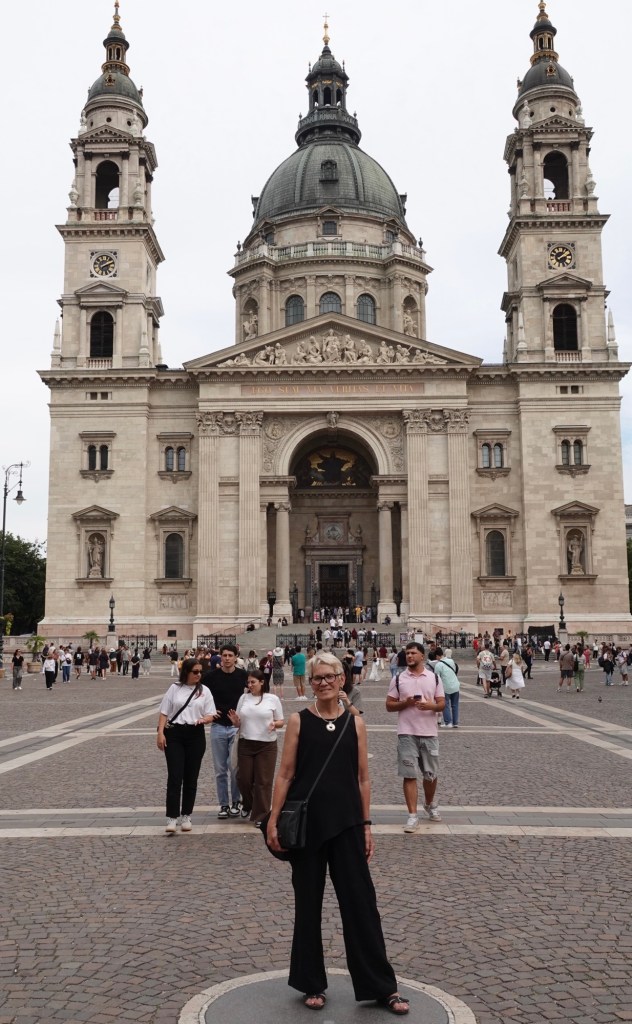
From the statue, we walked to Saint Stephen’s. We’ve been there before, notably in 2013 on our first visit to Budapest, but we have never climbed the stairs to the top to get the panoramic view of the city. That was our plan today.
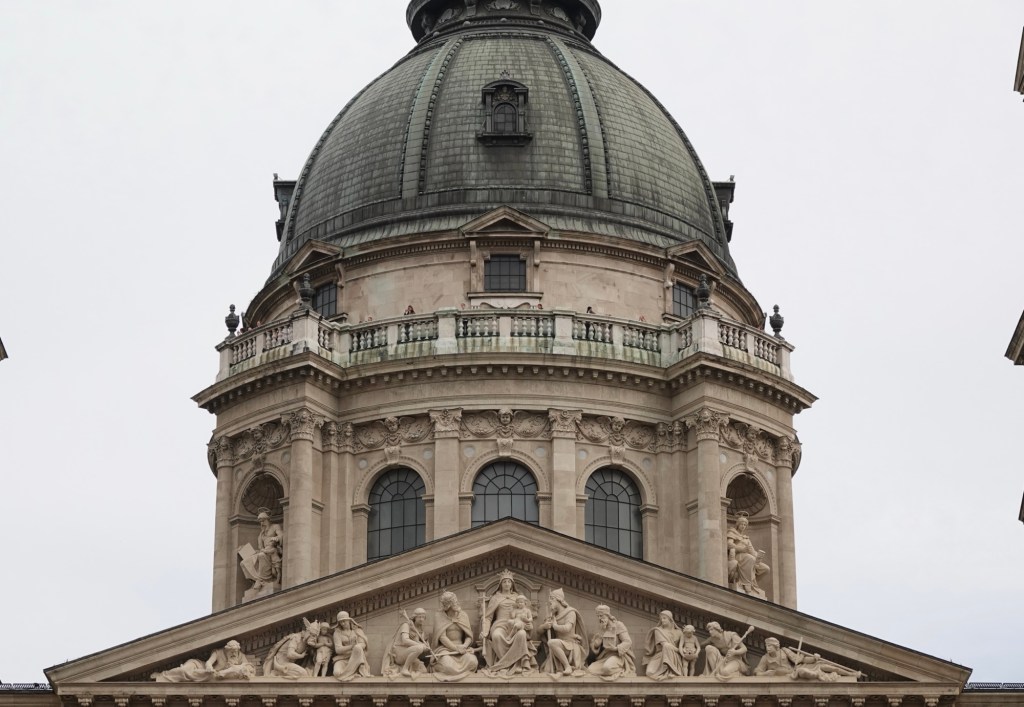
While many churches no longer use real candles, Saint Stephen’s does. As soon as we walked into the church, we could smell melting wax, adding an interesting mood to the entire edifice. It could have been my imagination, but the entire cathedral seemed to smell like warm vanilla.


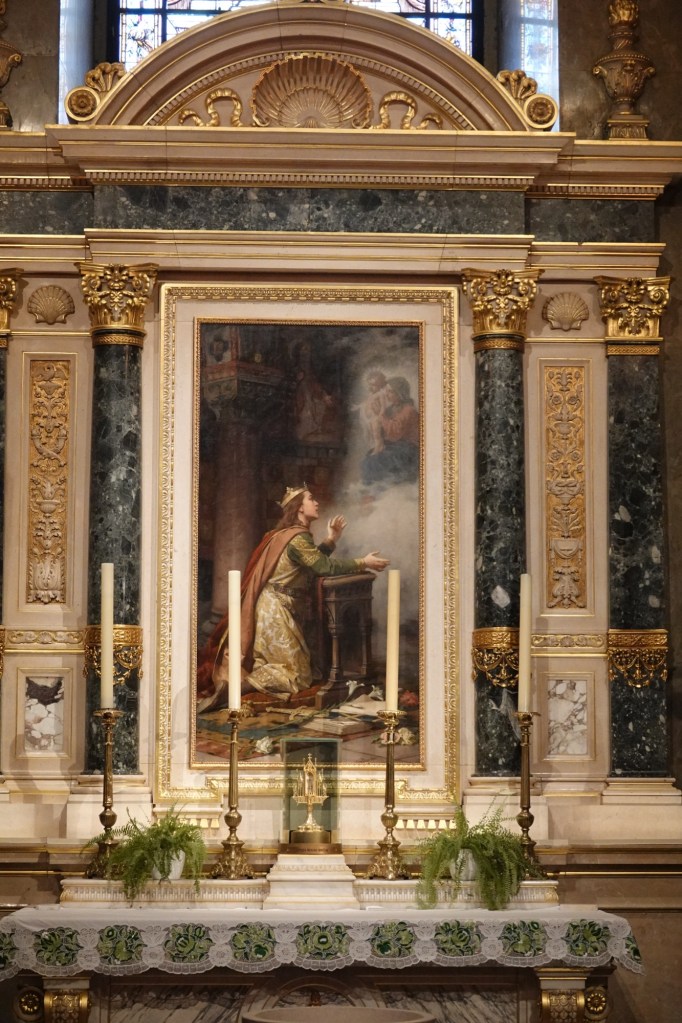
The church with its deep maroon coloured marble and glittering gold leaf really is magnificent. The black, white, and deep red marble of the floor echoes the colours on the walls.

We’ve learned the trick of putting our hands on things that look like marble; if it’s cold, it’s marble – if it’s warm it’s faux. In Saint Stephen’s there is an incredible amount of real marble.

The golden reliquary contains St. Stephen’s mummified hand, which is this church’s holy relic, to which people may choose to make a pilgrimage. The relic itself has done some travelling: from Hungary, to Siebenbirgen in Transylvania, to Dubrovnik, and to Vienna, before being returned here in 1771, with just a short tenure in Austria for safekeeping in 1944. The full story from the National Archives of Hungary is here: The Holy Right

Even the pipe organ is gilded.

Organ recitals and concerts are held here three nights a week at 8 PM. It’s a shame we won’t be able to get tickets to one on this trip, but perhaps when son number one and I return next year we will make it a priority. Ted is already talking about the potential of coming to live in Budapest for six weeks in 2027, when we have a cruise planned that ends in Copenhagen and we’re looking for an extension in Europe. There is certainly enough to see and do here for six weeks, although we are discovering that it is a very expensive city in which to be a tourist.
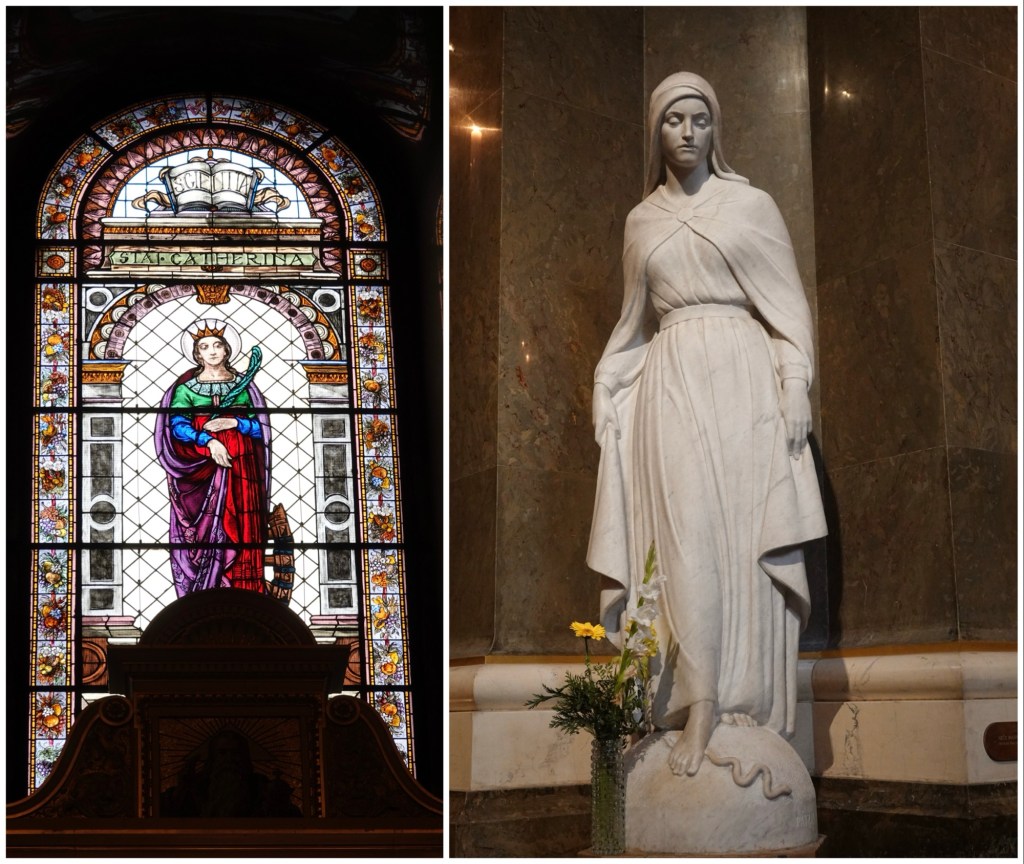
Stained glass, marble statues, and beautifully rendered cherubs (my personal favourite) complete the interior decoration.

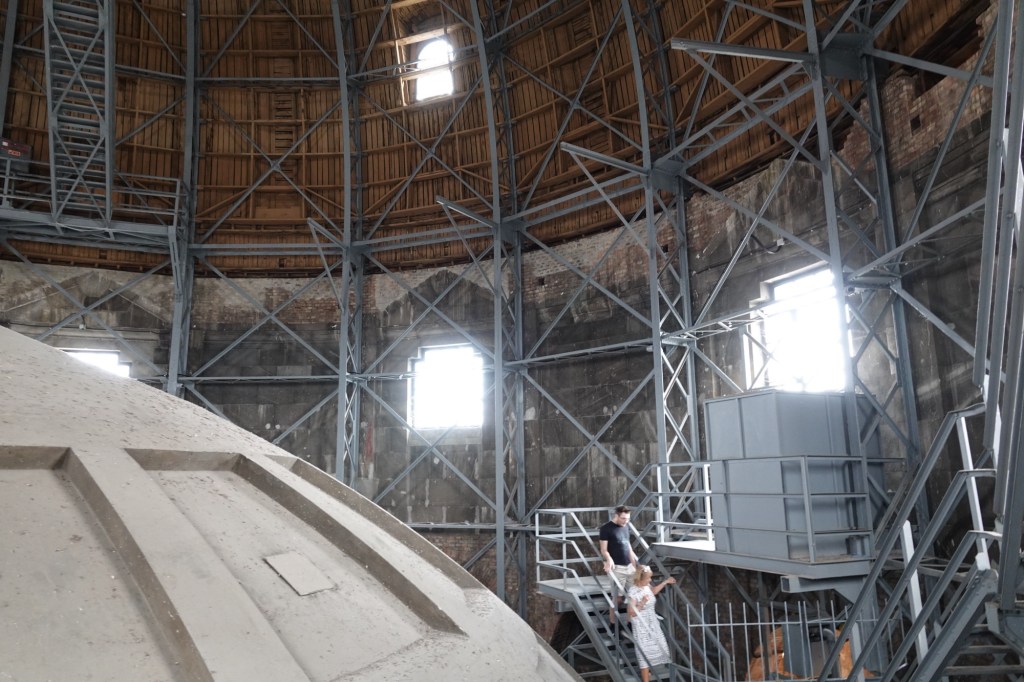
In the end, after touring the church we chose to take the elevator up to the panorama beside the dome,
In portions of the stairways and walkways, we could see previous constructions that looked decidedly less safe than the modern stairs and platforms we were on.
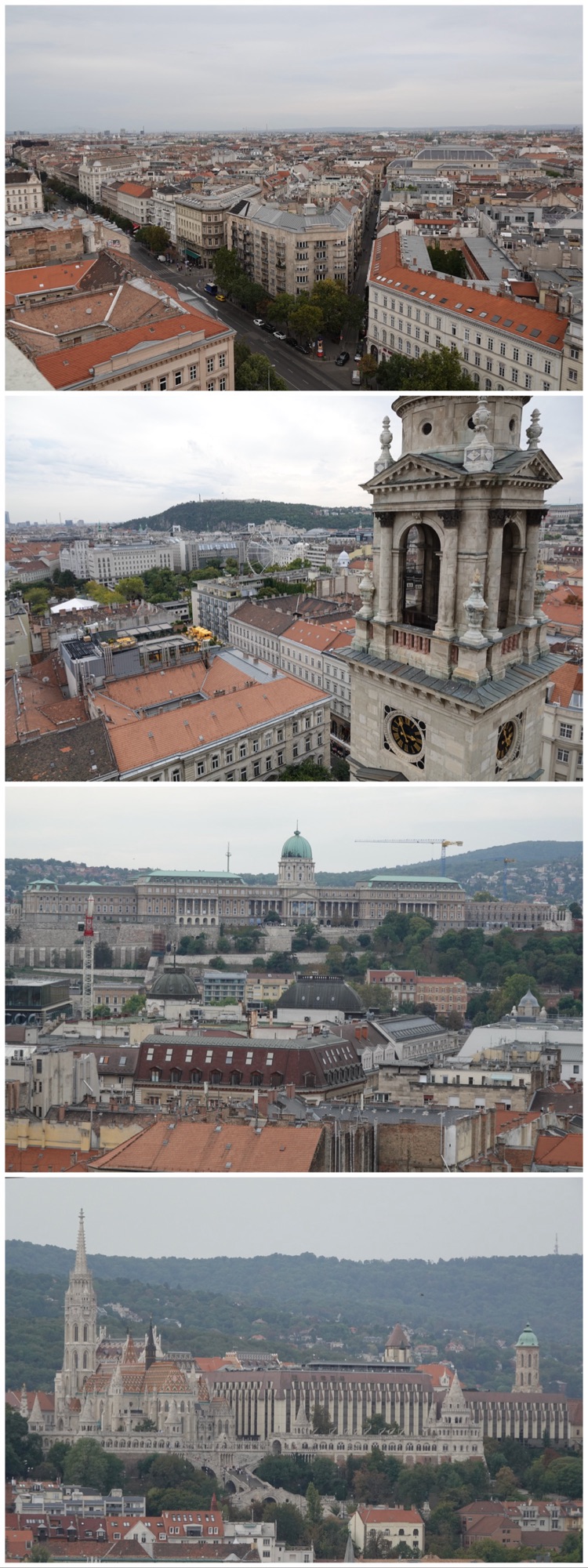
The views from the perimeter platform were spectacular.


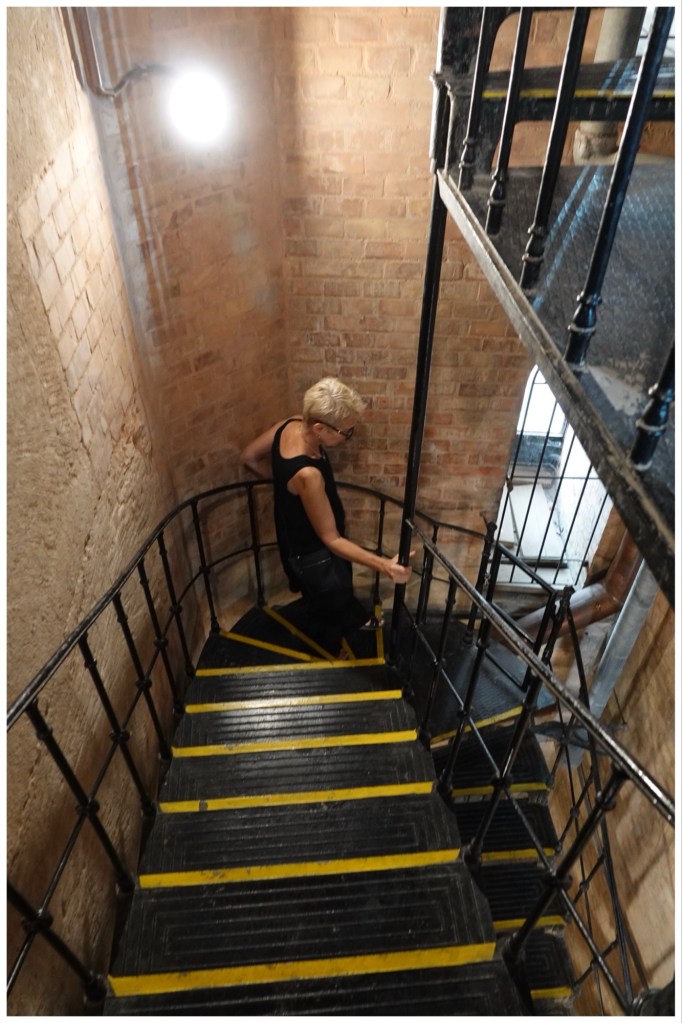
We walked down the 342 stairs – definitely easier than walking up, but I was not particularly happy about being able to look WAY down!
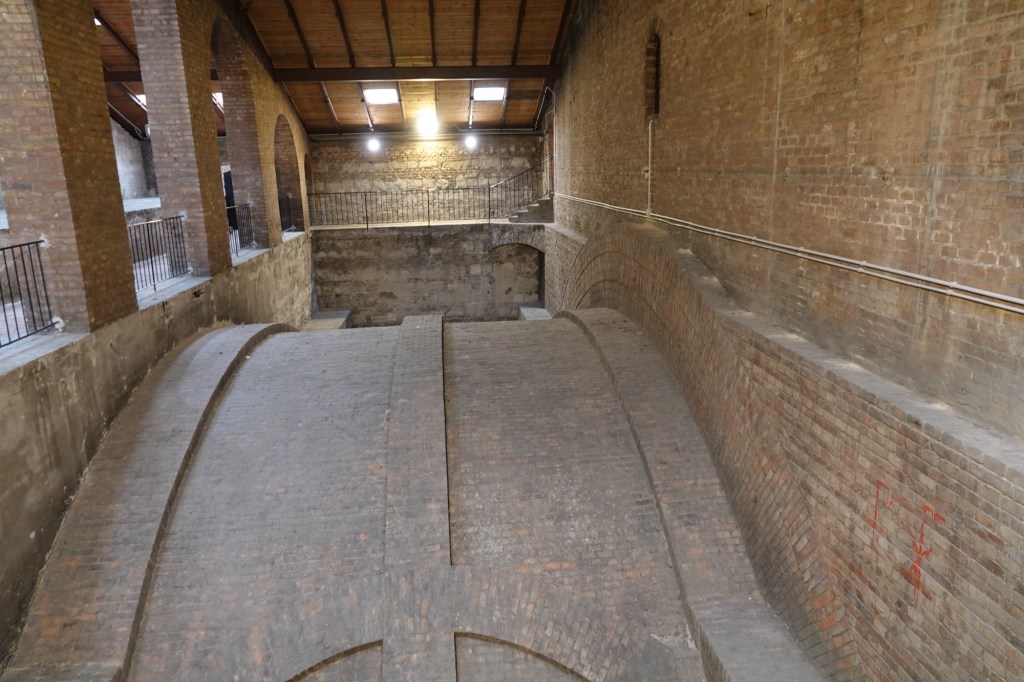
What was interesting, though, was being able to see portions of the church’s exterior construction areas, now protected by wooden roofs.
The plan after our descent back down to street level was to visit the central market hall, but… I got the wrong directions by just typing in “market hall” into Google maps. We took the underground (public transit being free for seniors), and ended up on the opposite side of the Danube in a big Spar supermarket. The building was still beautiful from the outside, but it wasn’t “the” market, and by that time it was too late to go to the “central” market hall, which closes at 6 PM.
Instead of taking the M line all the way back to the ship we got off at Kossuth Square, which is a national memorial site for Hungary, and the location of the beautiful Hungarian Parliament buildings.
The marble and bronze equestrian statue of Count Gyula Andrássy in front of the Hungarian parliament buildings is honestly one of the most beautiful we have ever seen anywhere. Not only is the magnificent horse and writer on top impressive, but the coronation of the Habsburg King and Queen, when the Austro-Hungarian empire was united on one side, and the signing of the Austro-Hungarian Compromise of 1867 on the other, are eye-catching lessons in Hungarian history.


Along our riverbank walk back to the ship, Ted mimicked the pose of the Hungarian poet, Josef Attila, who wrote the famous poem “On the Danube”.

Fun fact here, of which I was reminded by the poet’s name. Folks in our various tour groups kept asking why Attila the Hun was never mentioned in our guides’ history overviews. It’s because Attila the Hun has NOTHING to do with “Hun”gary. The country’s English name comes from a gradual phonetic evolution of the Medieval Latin Hungaria, which itself comes from the ethnonym (I had to look that up – it means the name by which a people or ethnic group is known) Ungarī. Ungarī referred to the Magyars. In German, Hungary is called Ungarn. The H seems to have been added in oral pronunciation and then transcribed that way. In Hungarian, the country’s name is Magyarország. Not a marauding Hun in sight.
Our walking route back to the ship along the Danube took us past the incredibly moving monument to the Hungarian Jews who were killed in the holocaust. The empty bronze shoes on the riverbank never fail to reinforce the fact that humans can be incredibly cruel to each other. Like the Stolpersteine in Germany (and a few other countries), these shoes are the kind of monuments that force people to stop, look, ask questions, and think.
When we first saw these 12 years ago, I remember being in tears. Seeing the line tarnished bronze shoes lined along the waterfront, so vividly evoking the memory of those who stepped out of them to their deaths, was almost unbearably moving and sad. Today the area was quite full of tourists, many simply walking by without looking down, and the shoes themselves were wrapped in yellow ribbons with the date October 7, 2023 on them and the words “bring them home” , as a commentary on the Hamas attack on Israel on that date. I understand the political statement, but in some ways it seems disrespectful to the holocaust memories to co-opt one memorial for another. Just my opinion, of course.

After resting our legs for a bit we returned to a restaurant (Pick Bistro & Langos) across from the Parliament buildings for a dinner of cured Hungarian meats served with cheeses, vegetables, and salt-crusted bread, followed by chicken paprikas, goulash soup, and a langos with cheese. It was far too much food, and while we thoroughly enjoyed it, we didn’t finish it all.

By the time we finished eating, the lights were coming on along the river.

Budapest really is a magical city. We’re glad that we have another full day here coming up.
 Rose and Ted’s Excellent Adventure
Thanks for the time out from the news reports on the UNGA and the terribly embarrassing US representation. I certainly hope to go back to Budapest some day. It seemed a bit dowdy and run down in comparison to Prague where we’d just been — but my husband was also really sick and we missed some good touring, so that’s probably tinted my memories. The riverfront was blocked off and Chain bridge closed, so I want to go back to get a real view of the buildings lit at night, to experience another of the awesome baths and finally see the Fishermen’s Bastion. In the meantime, your great reporting fills the gap wonderfully. Ted’s photos of the tile roofs are amazing!
LikeLiked by 1 person
Always glad to provide that diversion – even here in Europe I’m feeling a bit worn down by it all. Sending therapeutic hugs.
LikeLiked by 1 person
Dear Rose,
As a Hungarian (with Nagyszékely rootes) living in Budapest I have to telll you that your description is fantastic and precise. If you let me I correct 3 misprints: Zdolnay is Zsolnay, Hapsburg is Habsburg and Kossoth is Kossuth. The mákos süti on your picture is mákos rétes. Mákos means with poppy, süti means cookie, There are a lot of ccokies with poppy, this one on your picture is a rétes = strudel.
I wish you a nice trip,
Judit
LikeLike
Thank you for the corrections!(Viking got that poppyseed name wrong, and I just believed them!!)
LikeLike
Hiya Rose! I appreciated your Budapest (day 1) post. We were there last Christmas for a week and totally loved the city. We also talked about staying there for a longer visit, despite the affordability challenge.
As the son of a Holocaust survivor I was also very moved by the Shoes on the Danube memorial – and a bit uncomfortable with the ribbons calling out more recent events. But at least we can have that conversation in a more civil manner than most of what passes for discourse these days.
Looking forward to intercepting in NZ in a few months. BTW, I can no longer message you on FB (it denies me access to your profile or Messenger feed).
Cheers,
Andy
LikeLike
Looking forward to NZ.
No idea what has happened with the FB connection, but if you send me a friend request ….
LikeLike
I would, but your profile is hidden from me. Maybe because you locked it, maybe because we are in Africa, or maybe because Facebook is moody like an adolescent.
So I can’t connect to you that way. Maybe you could friend me at https://www.facebook.com/andy.charles.12/
~A
LikeLike
Not accessible to me either.
LikeLike
Weird. How about WhatsApp? If you email me directly I’ll be glad to share my number. andy@apcharles.com
LikeLike