May 1, 2025. “May Day” (workers’ day) all over Europe.
We were on another almost 8 hour long excursion today: “Panoramic Costa da Morte & Cape Finisterre”. We’ll be ready for our sea day tomorrow for sure.
Our group of 28 and our guide Alfonso set off to explore a picturesque coast with a fascinating history.
Driving through twists and turns almost parallel to the incredibly convoluted coastline, we enjoyed impressive vistas. There were the ubiquitous and contentious eucalyptus tree groves of course (profitable for being fast-growing and highly sought as paper pulp, but not great for the environment), but also the flames from the coastal refinery’s stacks, bucolic green farmland and picturesque towns, ancient castle keeps, and swaths of golden yellow Spanish/Scotch broom – which is native to this area and thus not an invasive plant the way it is in North America.


My favourite things to make Ted look out for were the many stone “hórreos” (pronounced like Oreos, the cookies). Dating back as far as the 13th century, at one time almost every home had one of these in which to store grain, potatoes, and corn. They are raised off the ground on stone pillars to keep their contents dry. The flat stone “plates” atop each column are intended to thwart rodents. Slits in the side walls allow ventilation to prevent rot and fungus.
Almost every hórreo sports a cross at one end and a monolith at the other. The cross beseeches Christ’s protection: the monolith hails the older Celtic gods. People obviously hedged their bets.

What makes these granaries even more interesting is the connection they lend to a theory that Galician sailors, and not the Dutch and English, were actually the first Europeans to land in New Zealand. That fascinating story can be found here.
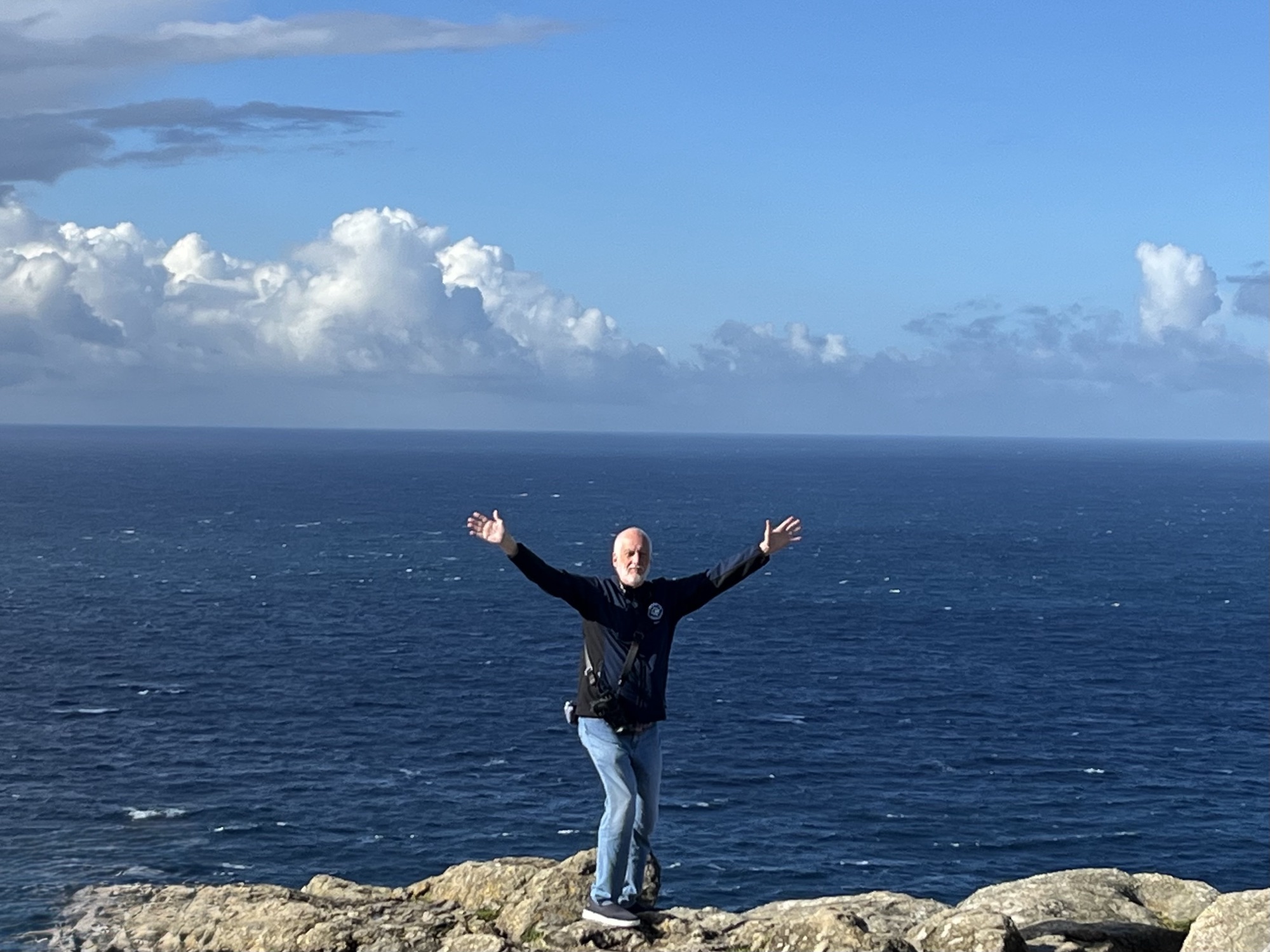
Our destination was Finisterre, the “end of the earth.” Ted always said he’d follow me there!
When the 3rd century Romans reached this rocky peninsula and couldn’t see anything but water and horizon in all directions, they actually thought that they had reached the end of world. They imagined sea monsters in the distance, and a waterfall dropping off the edge into oblivion.

The cape was rocky, and very windy, feeling much colder than the predicted 20°C/68°F. During our hour there it went from sunny, to rainy, to bleak and chilly, back to sunny, and was beginning to drizzle as we left. It was a great demonstration of Galicia’s capricious weather.
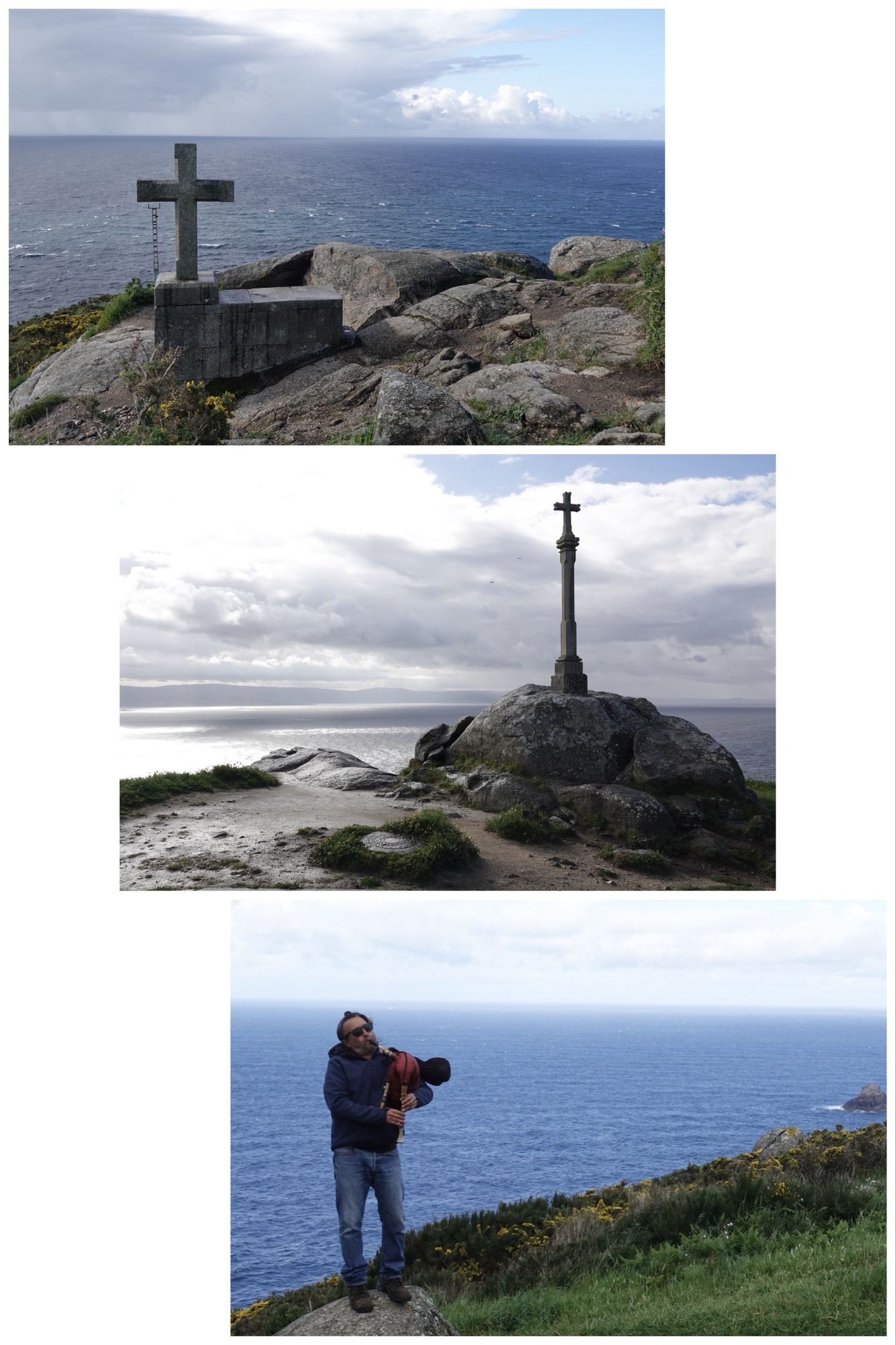
The strong chilly wind – and the bagpipes – brought to mind being in John O’Groats at the northernmost tip of the Scottish mainland, where I also stood beside a stone mile marker.

A lighthouse overlooking the Atlantic Ocean is positioned on the Montefacho promontory, at the tip of Cape Finisterre.


The area is peripherally connected to the Camino de Santiago; after arriving in Santiago de Compostela, pilgrims often continued, and still continue, on to end their journey here in Finisterre.

There is archeological evidence indicating that Iron Age Celts made pilgrimages to this western cape to see “where the sun dies”, since at sunset it seems to disappear over the edge. In fact, that “pagan”pilgrimage may have been Christianized into the Camino de Santiago after the 9th century discovery of what were purported to be St. James’ remains in the old Roman cemetery in the town that now bears his name.
People like to leave mementos of their trek behind: shells, stones, beads… walking sticks, shoes, clothing. They’re not supposed to, of course, and someone ends up with the job of removing them so that the hillside doesn’t end up looking like a rubbish pile.

Our second destination was Muxía (“Moo-shee-ah”), to visit a famous sanctuary overlooking the sea. Sanctuaria de Nosa Señora da Barca is dedicated to the Virgin Mary, Our Lady of the Boat.


Legend has it that when James was having difficulty converting the Celts to Christianity, Mary appeared to him in a stone boat on the water and encouraged him to persevere. I’m not sure how a stone boat floated, but I guess that’s the nature of miracles.
The first chapel here was built in the 12th century, replacing a Celtic shrine.

A new chapel was built in the 17th century, and has been rebuilt several times, most recently in 2015, after a tragic fire on Christmas Day 2013 that left the altarpiece and roof entirely burnt out.

Only the exterior walls were left standing, along with some elements like pews and confessionals. In addition, the lateral altars (below) were able to be recovered, giving us an idea of what the main altar would have looked like.

For now, the main altar is just a photograph hugely enlarged and wallpapered onto the wall.

In 2014, an unusually huge wave flooded the church, hindering speedy reconstruction. WAY upon one of the interior walls of the church was a painting done depicting the 2013 lightning strike and 2014 wave.

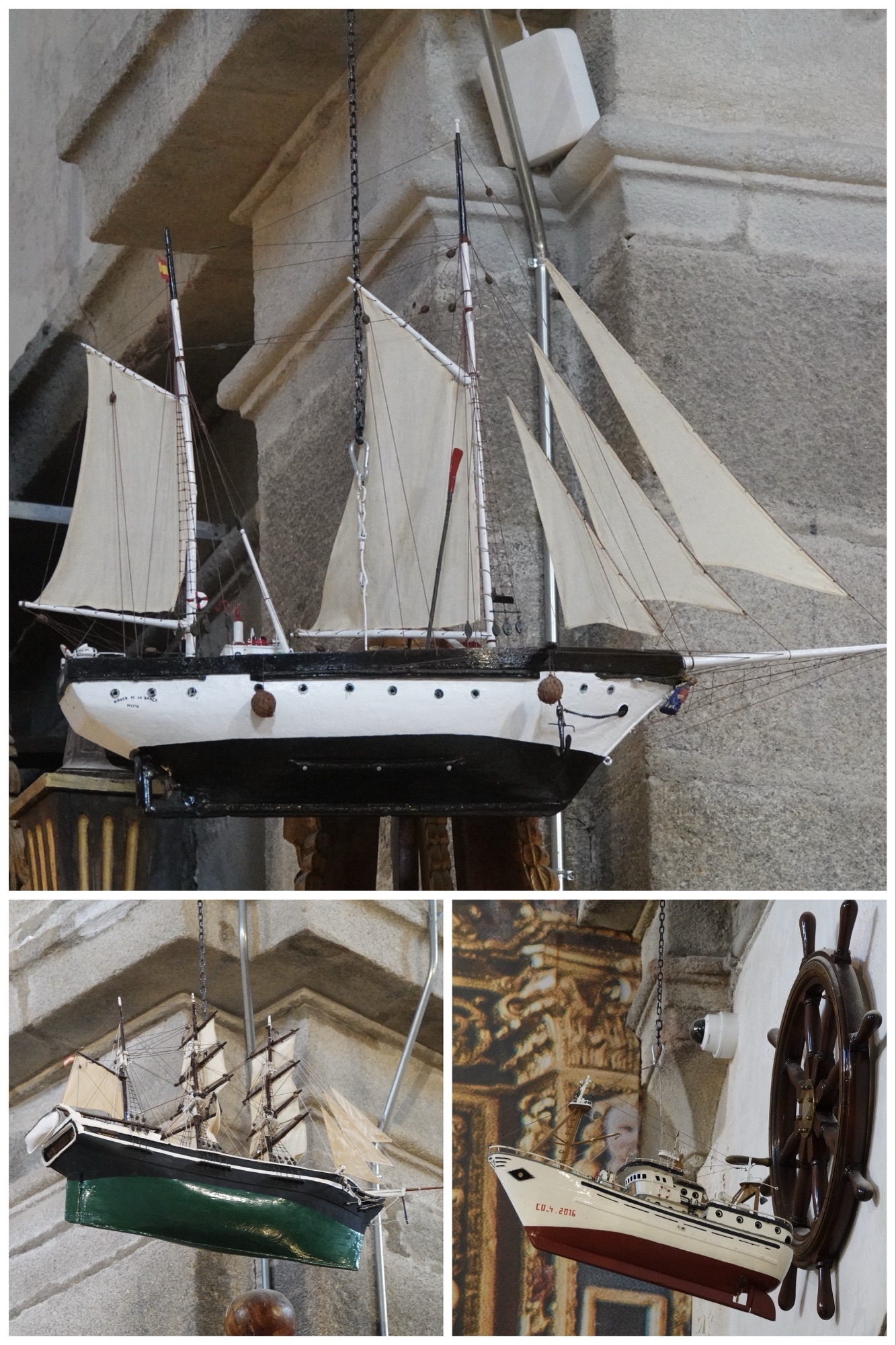
Throughout the church there are scale models of local fishing boats on shelves, in cases, and even suspended from the ceiling of the sanctuary in the hope that Mary will protect the real things. The fishermen’s faith obviously continues despite the church being struck by both lightning and a freak wave.
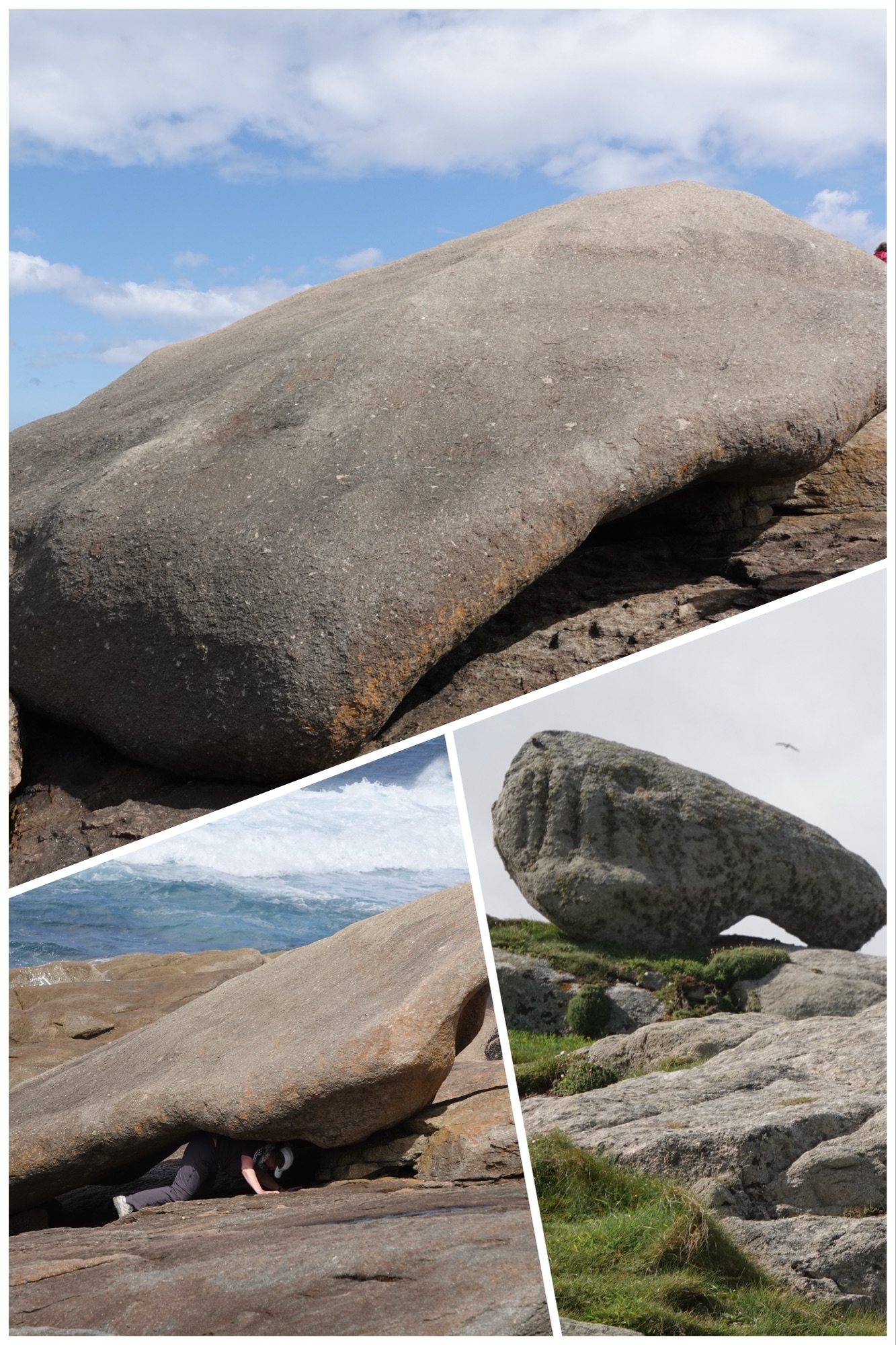
The waters here have a reputation for being quixotic: glassy calm on some days, furious on others, and the setting overall is pretty spectacular.

The rocks here are “magical” stones, which boast curative and prophetic properties: the Oscilating Stone (Pedra de Abalar), the Kidney Stone (Pedra dos Cadrís), the Lovers stone (Pedra dos Namorados) and the Rudder Stone (Pedra do Temón). Those same rocks had meaning to the Celts, but apparently rocks can be Christianized too. The early Christians here claimed they were the remains of the vessel in which the Virgin Mary appeared to James. A pretty big vessel, and again… not floating. I’m obviously too much of a cynic for all this.
The coastline from Cape Finisterre almost all the way to A Coruña is known as the Costa da Morte (Death Coast). Although hundreds of ships have run aground on its rocky shores, it first got its moniker after an English journalist coined it when reporting on the HMS Serpent, a Royal Navy cruiser lost when she ran aground off Cape Vilán with the loss of 173 out of her 176 crewmen.
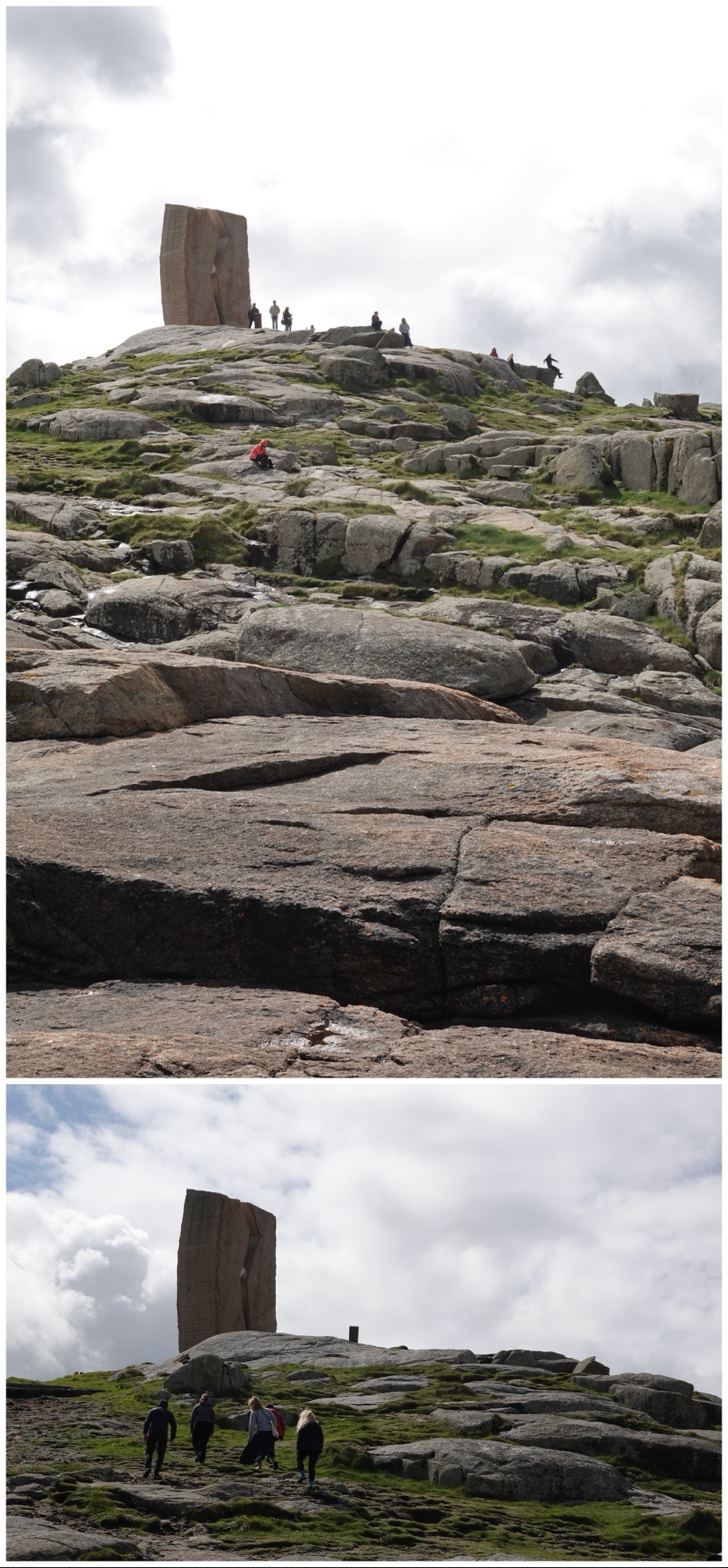
One of the most recent ship disasters here was the sinking of the oil tanker Prestige, carrying 77,000 tonnes of heavy fuel oil, causing a massive oil spill that polluted thousands of kilometers of coastline in Spain, France, and Portugal. A hilltop monument called A Ferida (The Wound) is made of two huge blocks separated by a crack, symbolizing the environmental heartbreak caused by the catastrophe..
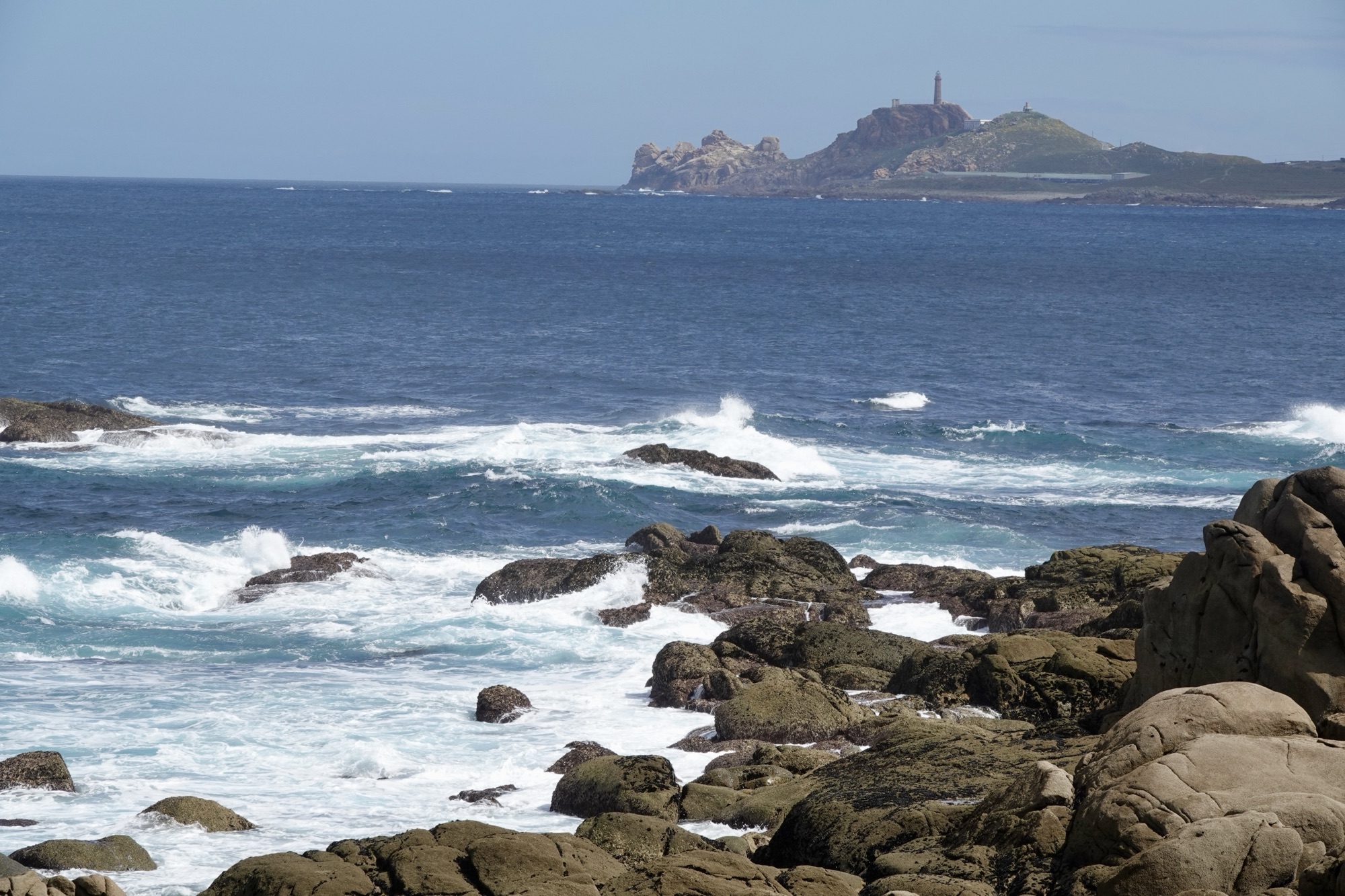
From the sanctuary on the hill we could see the lighthouse on Cape Vilán across the inlet.
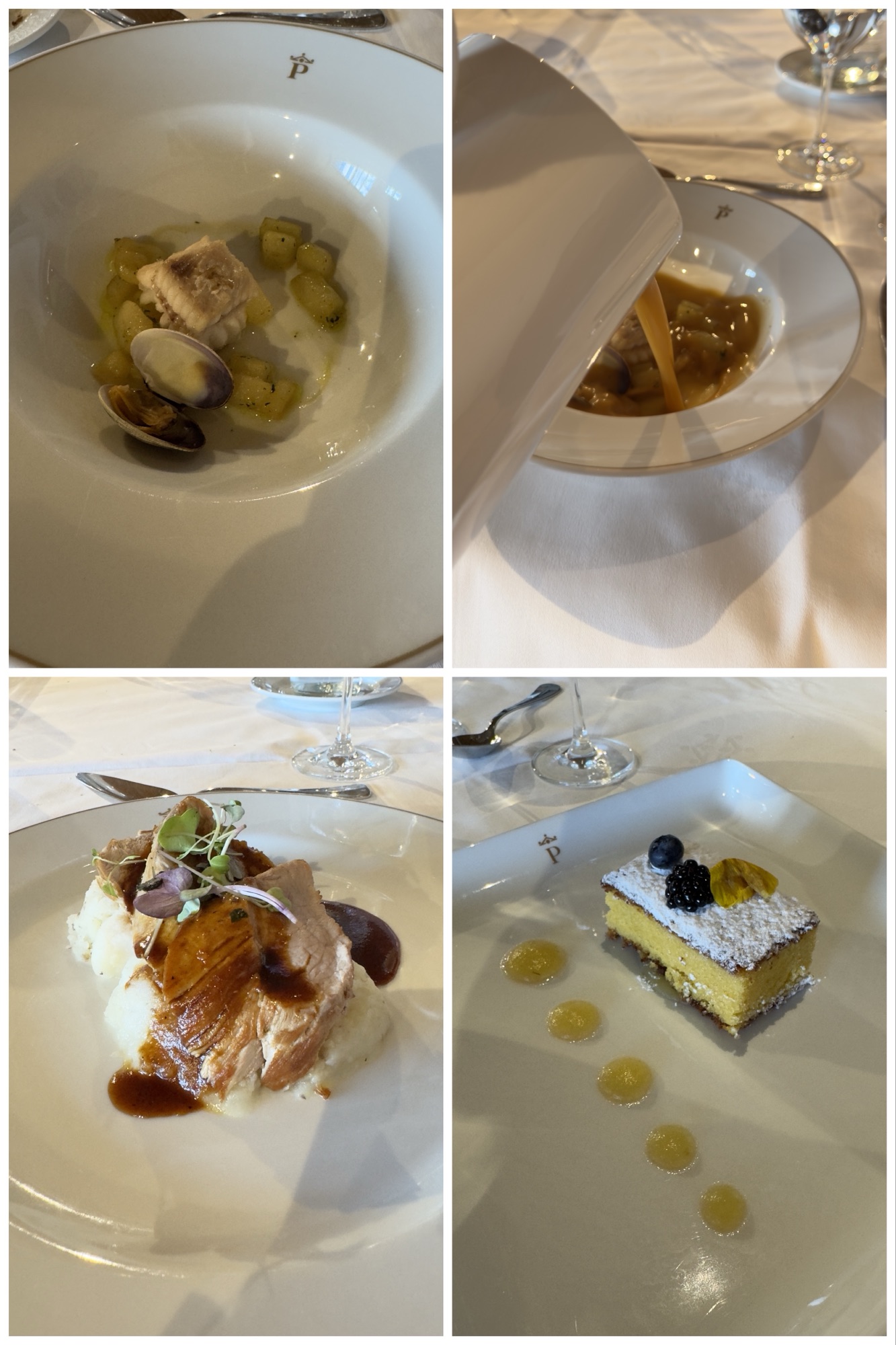
From the sanctuary we drove about half an hour on newly widened twisting roads to a brand new Parador Hotel in Muxia that was funded in part by the government to support tourism in the area. We enjoyed a delicious lunch there before returning to the ship definitely not needing dinner.
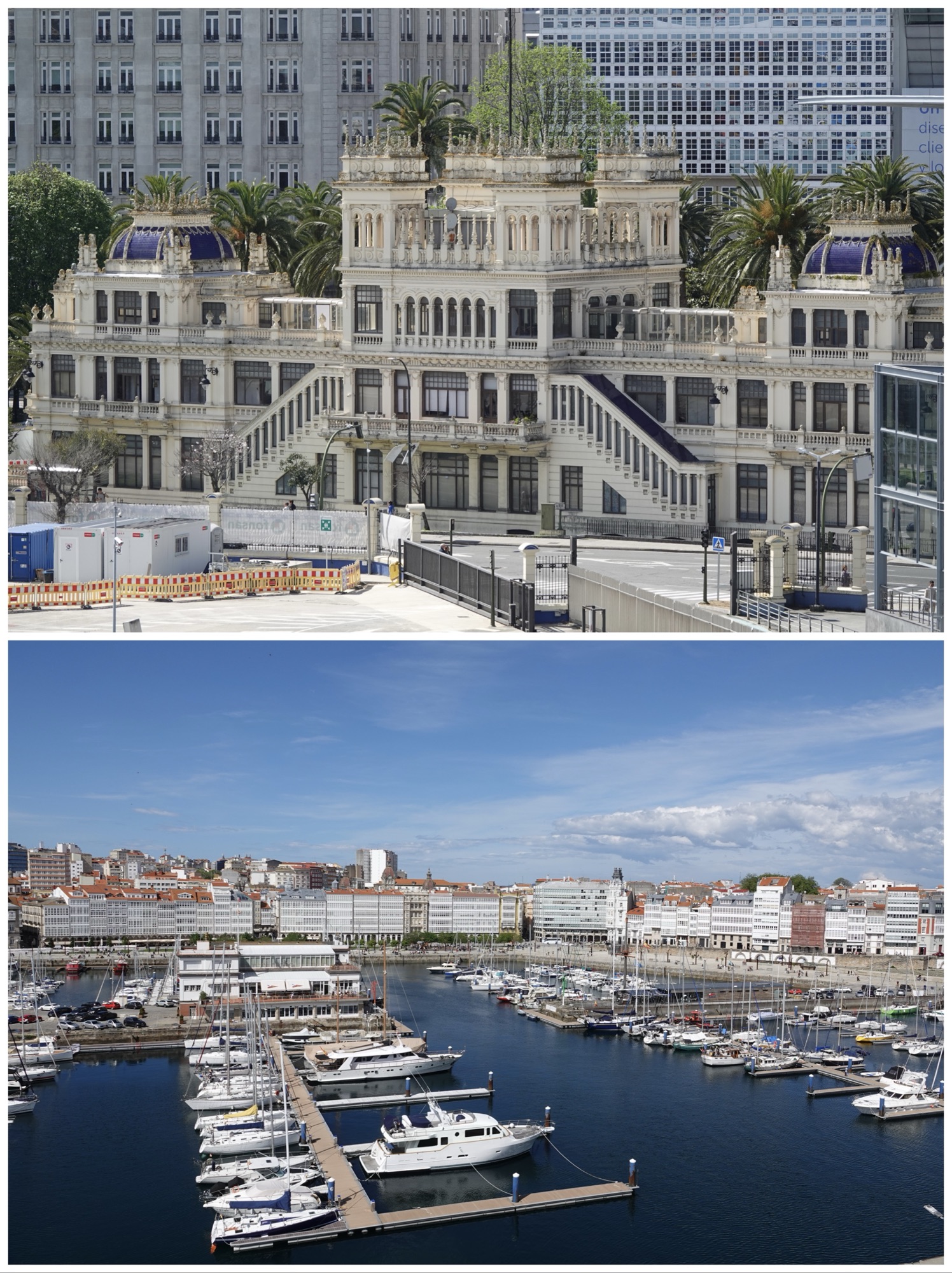
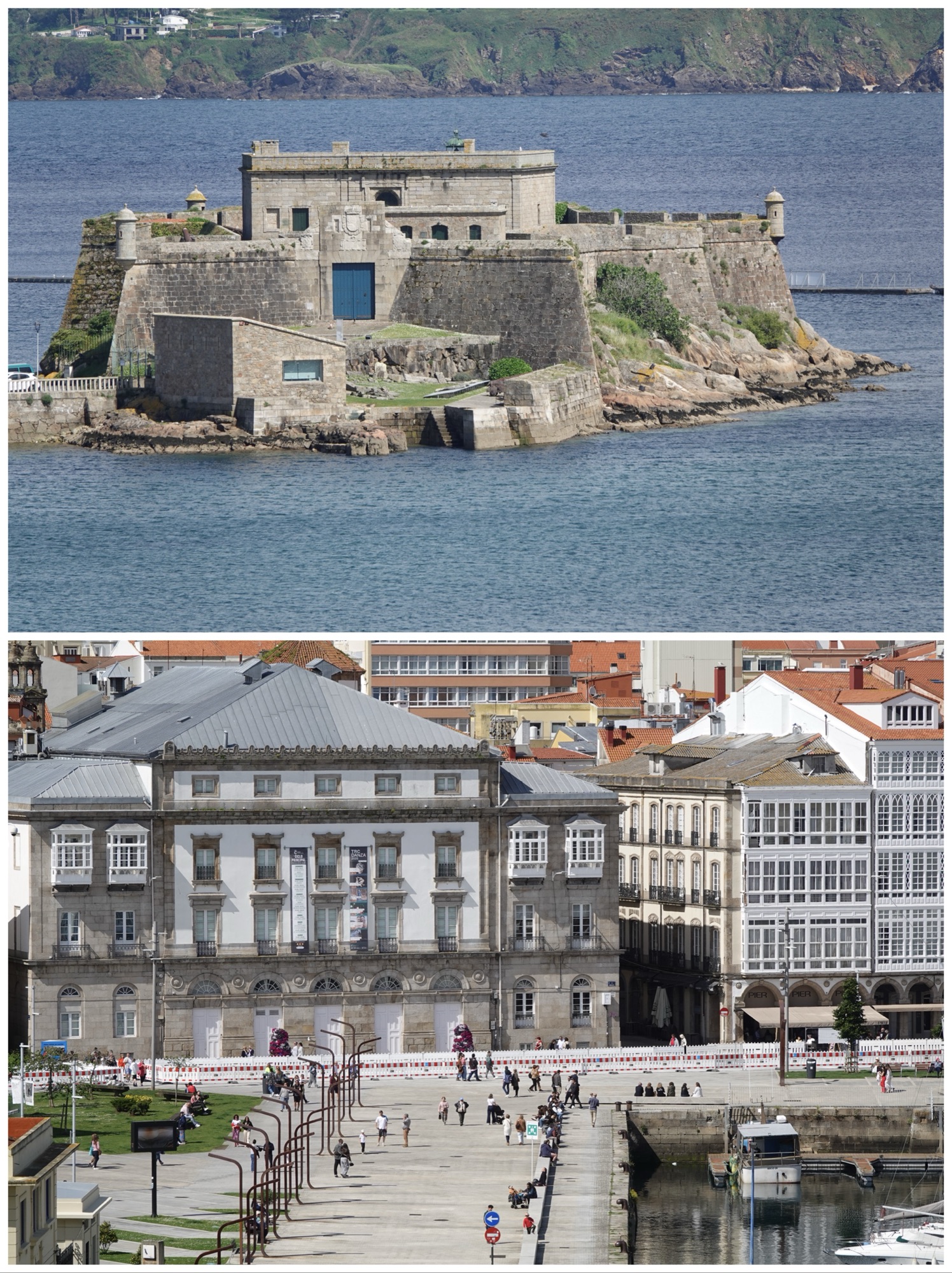
Not spending time over dinner meant that Ted had time to head up to deck 8 to capture a few photos of the city’s Belle Epoque architecture, an old fortification, and the marina, all located around A Coruña’s port.

The fabulous evening entertainment tonight was a one-woman tour-de-force by our incredibly talented Cruise Director Cornelia David.

It was another long, memorable day.
Tomorrow is our last full sea day, which means that everyone ending their journey in London in 4 days will be vying for the laundry rooms. We’re pretty much done, so will just enjoy the special brunch Chef Ali has planned, and get started on packing.


Another fabulous day, Rose, and a great picture of Ted at Finisterre. Love it! When reading about the church, I couldn’t help but recall visiting our sailors’ church in Old Montreal many years ago: Notre-Dame-de-Bon-Secours Chapel. It seems Mary very kept busy blessing the ships on our side too!
Barbie
LikeLiked by 1 person