WARNING: This is a very long entry, because there’s so much I want to remember about today’s places.
——————————————
The power is back on in Spain and Portugal this morning.
As I was talking to Hotel General Manager Marcel this morning, his comments made me realize how serendipitous it was that we had to miss our port of call yesterday.
Had we been in the Algarve when the huge power outage hit, we would not have been able to get tour buses back on time for us to set sail for Porto. That would have meant a delayed arrival here in Leixões, and likely missing today’s excursions altogether. Instead, we were able to dock early this morning, and had the added bonus of being able to explore the quaint waterfront streets of the oldest parts of the city of Matosinhos before lunch, and take our planned excursion after lunch.
After breakfast, we walked through the spiral-shaped port building tiled in hexagonal white tiles that are angled to gleam in the sun.

Since this is a both a cruise and commercial port, we were not allowed to walk around in it. Instead, a shuttle bus took us from the terminal building to the port exit gates. At that point we were right in the town.
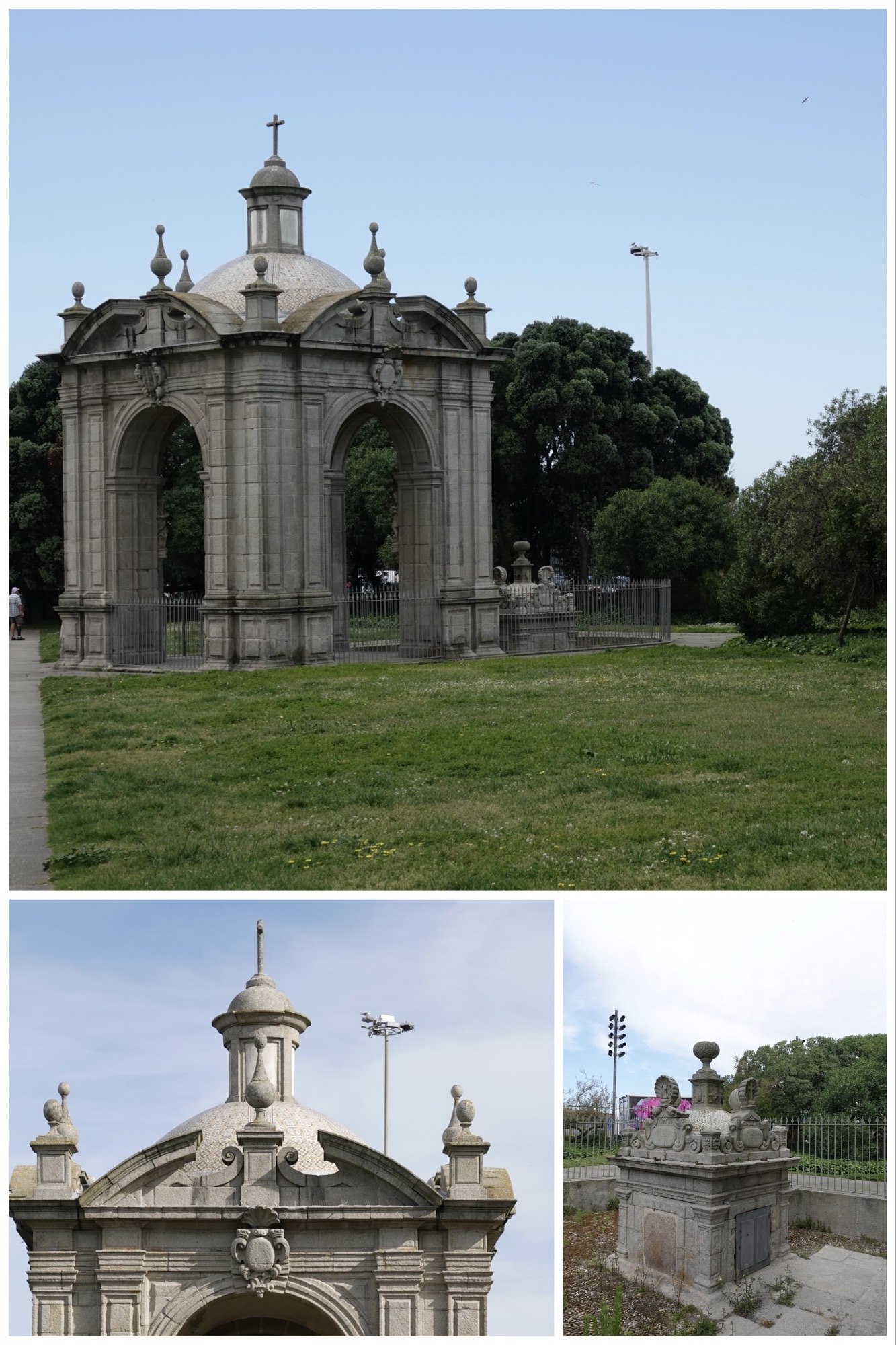
To our left, an interesting structure with an even more interesting story: the Lantern Tower of Senhor do Padrão. The sign beside it reads: “Classified as a National Monument since 1971, “Senhor do Padrão” marks the place where according to legend, on the 3rd of May of the year 124, the image of Bom Jesus de Matosinhos reached the shore. The place was surely important since ancient times but the lantern tower that we can contemplate today was only built after 1758. Its alternative designation “Our Lord of the Sands” is due to the fact that the monument was entirely surrounded by a large beach, thus enhancing its visual impact. The miraculous appearance of a freshwater spring in this spot, in 1733, was the origin of the smaller building next to the lantern tower.”
To our right, a street leading into the town centre. I was enchanted by the variety of tile designs on the old buildings.


Matosinhos is a town whose waterfront sector is under almost complete renovation. We passed dozens of construction sites, some with façades left standing, and others where entire buildings had been demolished. Most of the work permits for demolition/renovation/enlargement had 60 month (5 year) timelines on them. It would be fascinating to return in five years and see the changes.
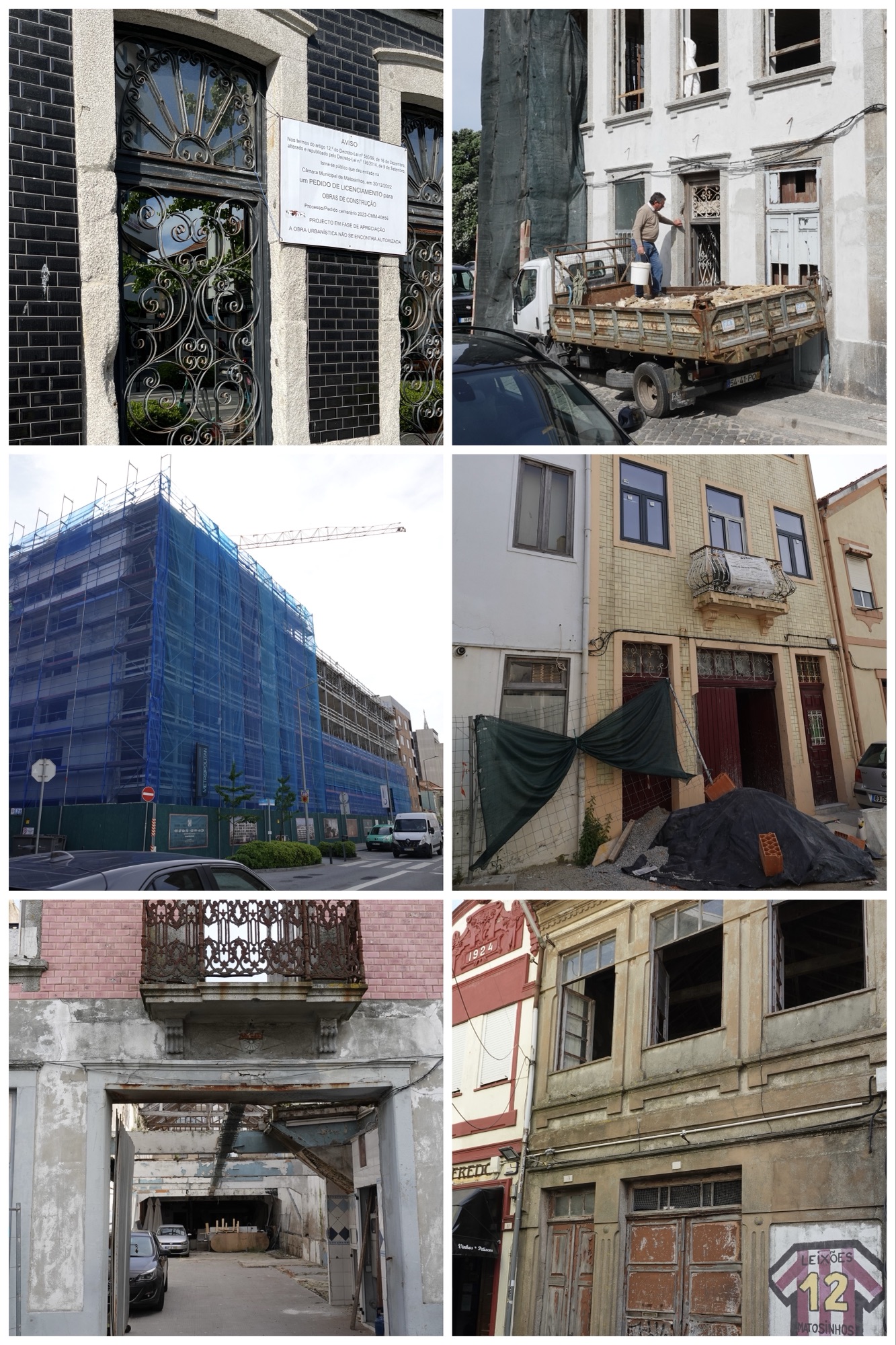
There were plenty of intact buildings too, of course.

The town, but most especially the street parallel to the waterfront, is filled with fish restaurants. Because it was still mid-morning, we were able to see fresh seafood being delivered to the restaurants: sardines, cod, skates, octopus, and more. Grilled fresh fish is the order of the day here; almost every restaurant had an outdoor charcoal grill being fired up so that it would be at the perfect temperature by lunch. Imagine choosing your freshly caught seafood and then watching it being grilled and plated right beside you!
This was the only church we passed in the downtown , and it wasn’t very impressive, although the bell tower was quite tall.

We were almost ready to return to the ship when we ran into our friends Linda and Howard, who gave us directions to the main parish church. Had they not told us about it, we would have missed seeing it.
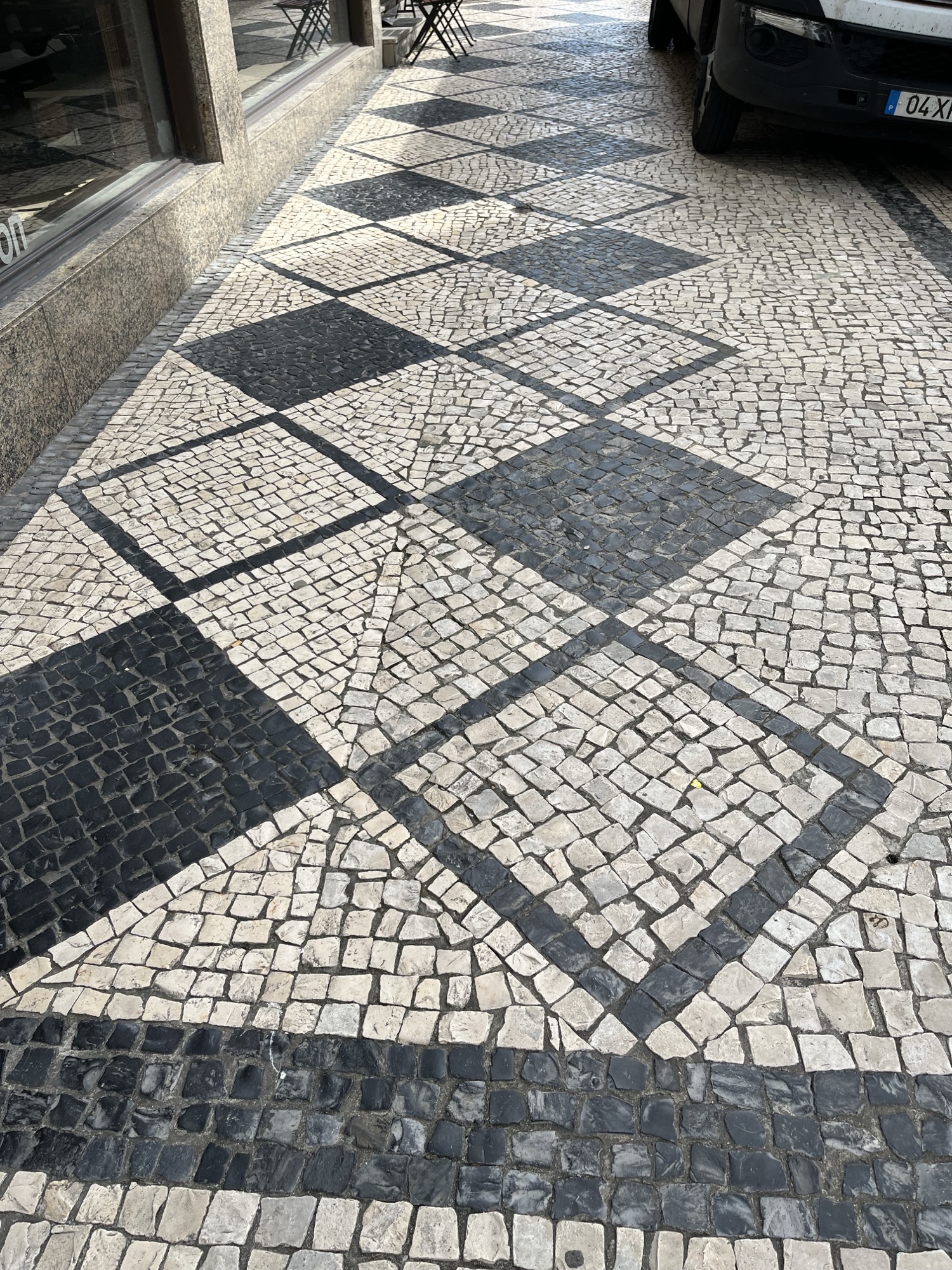
Walking there also took us through the much more modern downtown area with shops, bakeries, offices, and apartment buildings, on streets lined with typical Portuguese basalt and limestone patterned sidewalks.
The Parish of Salvador de Matosinhos is an incredibly ornate Romanesque/Renaissance/Gothic church set in a beautiful plaza that also includes a pergola, grotto, gardens, and administrative buildings.


Inside the basilica, an almost ridiculous amount of gold.
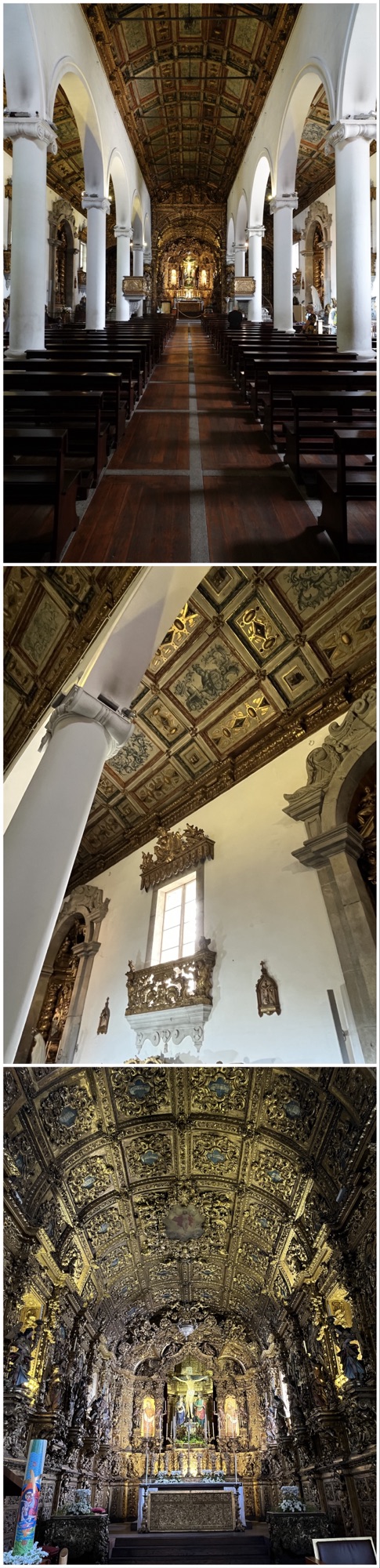

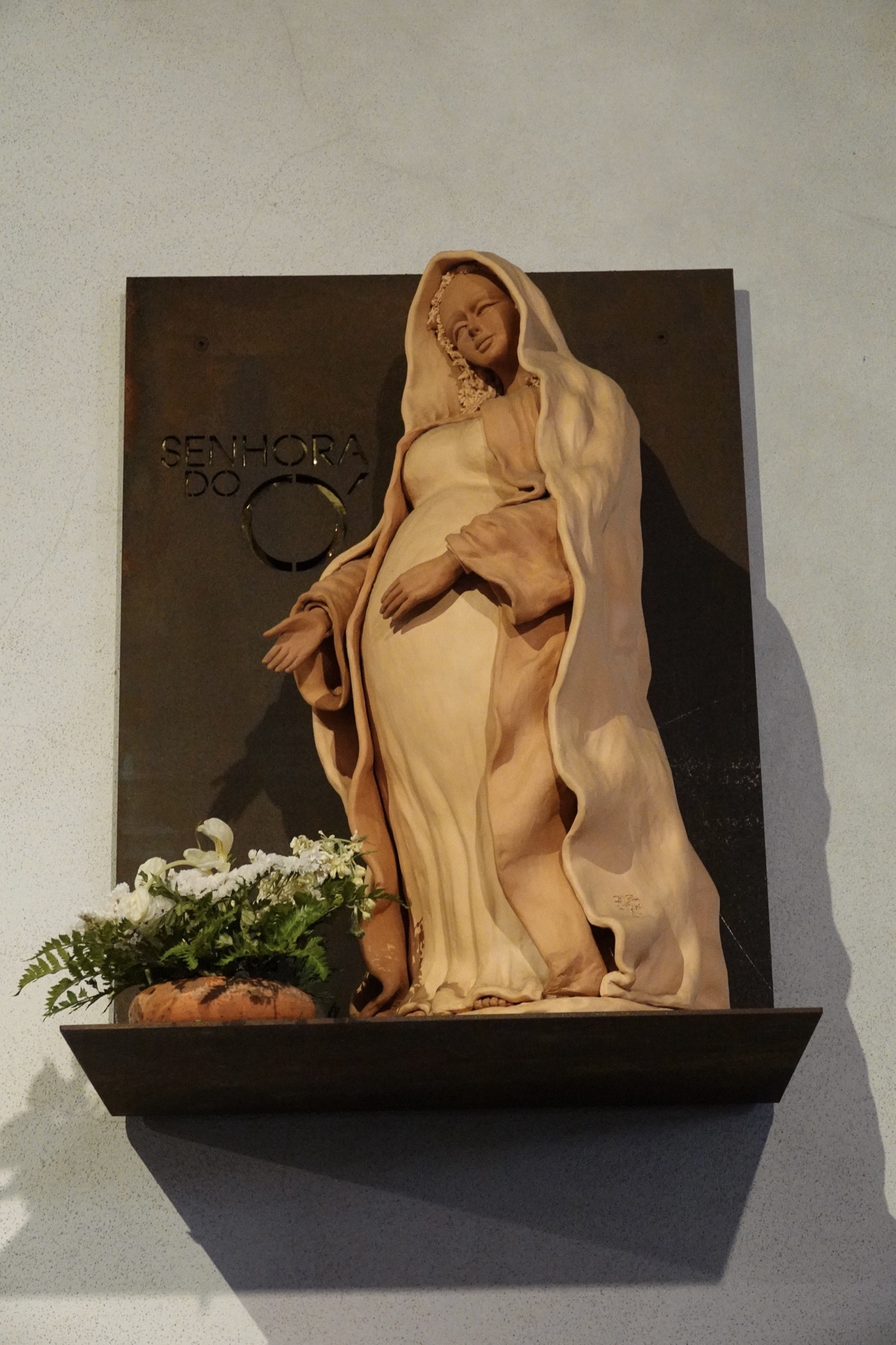
We noticed an unusual statue of Mary, in a very advanced state of pregnancy. We’d learn more about that later in the day.
By then it was time to walk back to the port and grab a quick lunch before our afternoon excursion. En route, I bought two rich flaky pasteis de nata (Portuguese custard tarts) for our dessert.
Because on our last visit to Porto it was all about tasting port and listening to fado, this time we decided to go outside the city on a tour called “Braga & Guimarães Exploration”, featuring two historically significant cities that helped shape the region’s religious and cultural identity.
Guimarães was Portugal’s first capital. While it is known today for its pretty streets, textiles and handcrafts, what wowed us was the architecture, charming streets, and general beauty of the city centre.
The “castle” here was originally built around 950 CE, concurrent with the founding of Guimarães. While it looks imposing standing atop green hills, our excellent guide Manuel (a historian) explained that it would have been surrounded by artisans, cobblers, blacksmiths, markets, and merchants in wooden structures during its heyday. It also looks incredibly intact given its age, but Manuel told us that much has been reconstructed. After the castle/fort was vacated, its stone walls were “quarried” (aka scavenged) by townspeople in order to build other structures. It was much easier to take already cut stone from an unused building than to cut fresh granite.
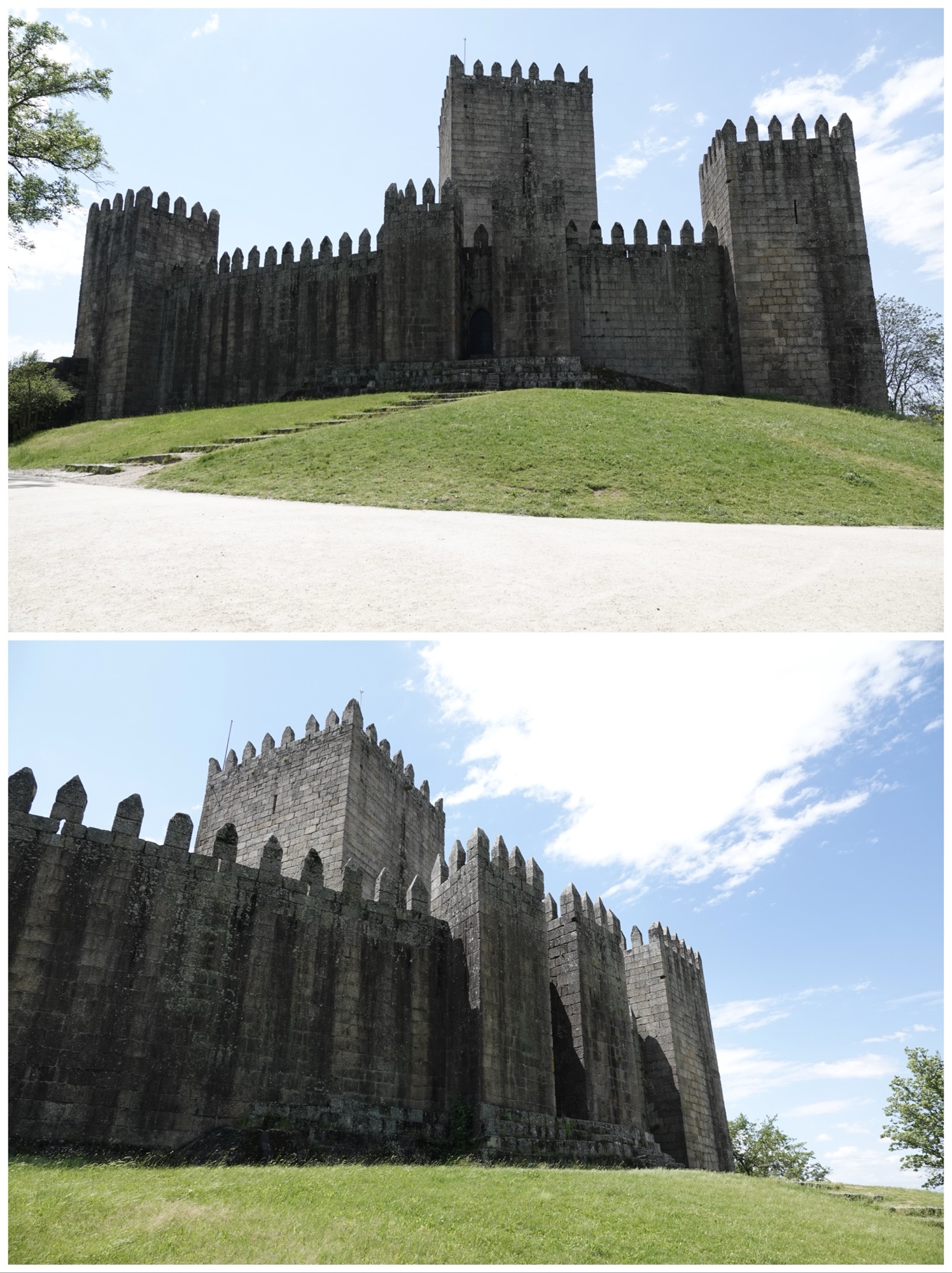

We didn’t go inside the castle walls.
We moved on to the 12th century Romanesque church. Its very plain design and small windows made it an ideal refuge, in addition to being a church. Manuel explained that it would not have looked as austere in the 12th century – its stone walls would have been covered with colourful tapestries.
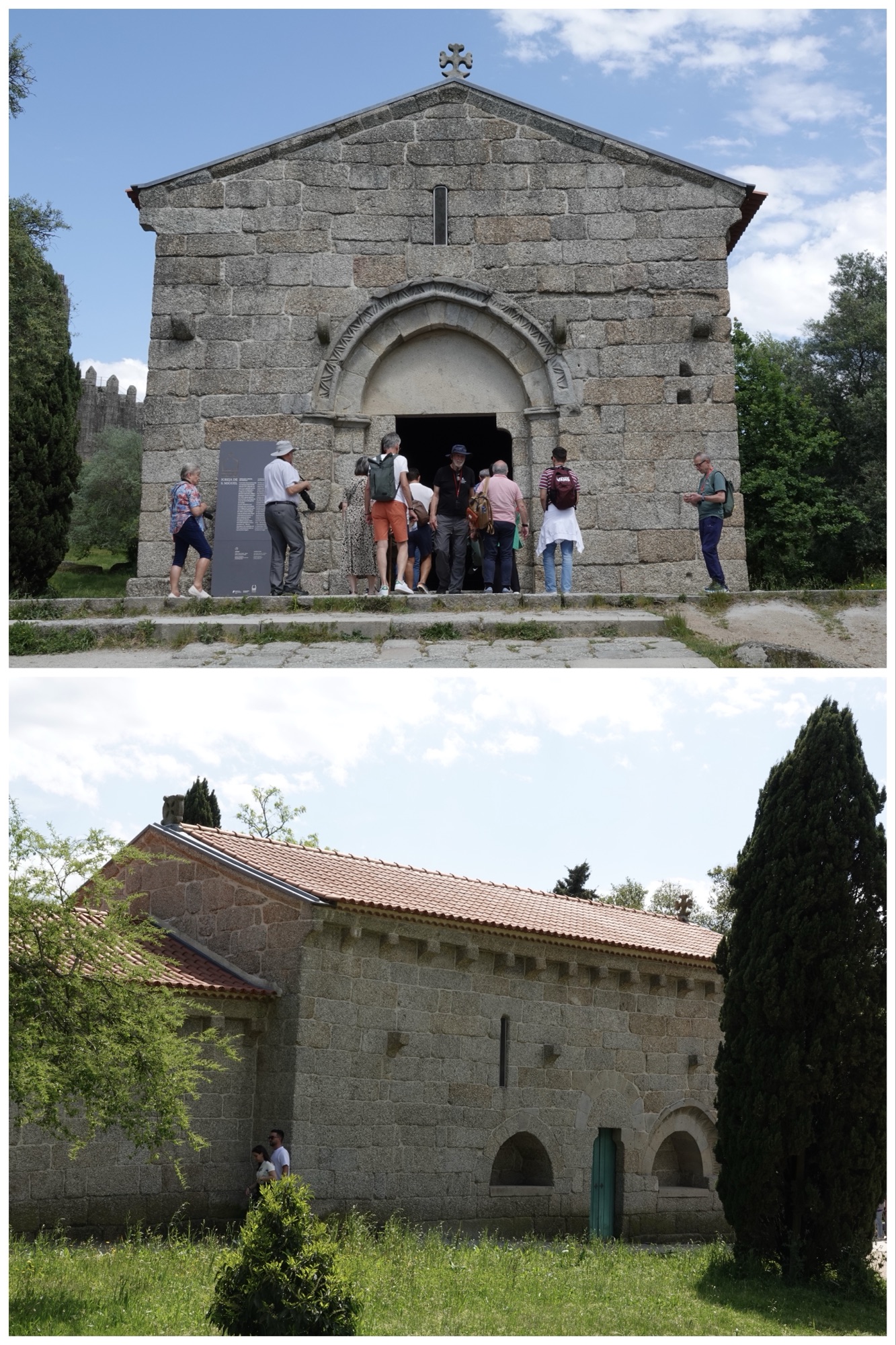
The first document mentioning The Church of San Miguel do Castelo dates from 1216 and its consecration occurred in1239. It was devoted to St. Michael and to the Holy Martyrs Saturnin, Julian and Basilissa, Faustus and Januarius. By 1285, the church was known as Santa Margarida do Castelo. From then on, it was acknowledged both as Church of S. Miguel do Castelo as well as Church of Santa Margarida. In 1664, Prior Diogo Lobo da Silveira removed the baptismal font and took it to the Church of Our Lady of Oliveira. It is believed that the 1st Portuguese King – Afonso Henriques was baptized in it. The font was returned here in 1927.

Manuel pointed out that the altar is attached directly to the chancel wall: there is no apse. The priest, intoning mass in Latin, would have faced away from the congregation.

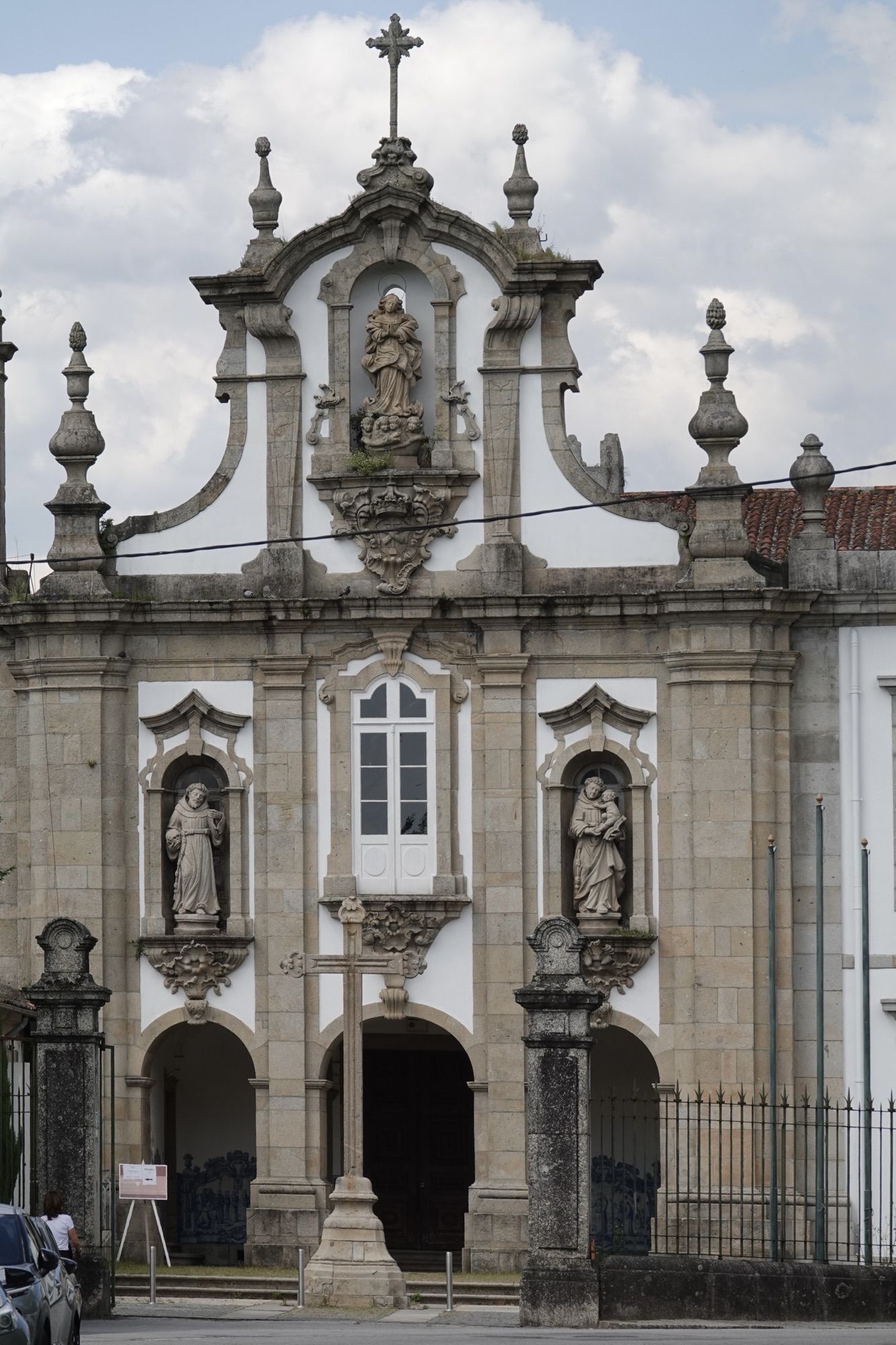
The first of three convents that we saw was the Capuchin monastery of St. Anthony, now housing a charity. Its exterior blends Romanesque and Baroque elements. Although we didn’t go inside, we were assured that there was lots of gold. the convent was built in 1662, but in 1703 the first shipments of gold from Brazil arrived in Portugal, and the church immediately began gilding everything.
Just around the corner was the Ducal Palace of the Briganzas, built in the 15th century. It is absolutely huge, with a footprint 60m x 60m (almost 200ft x 200ft). It, too, has been much reconstructed due to its original stone being scavenged. Manuel quipped that the concept of heritage building preservation is relatively new; in past ages an unoccupied building was simply viewed as construction material. The palace was originally the home of Duke Alfonso, the “natural” son of King João I. It is now officially the residence of the Portuguese president, who prefers to stay in 5-star hotels.
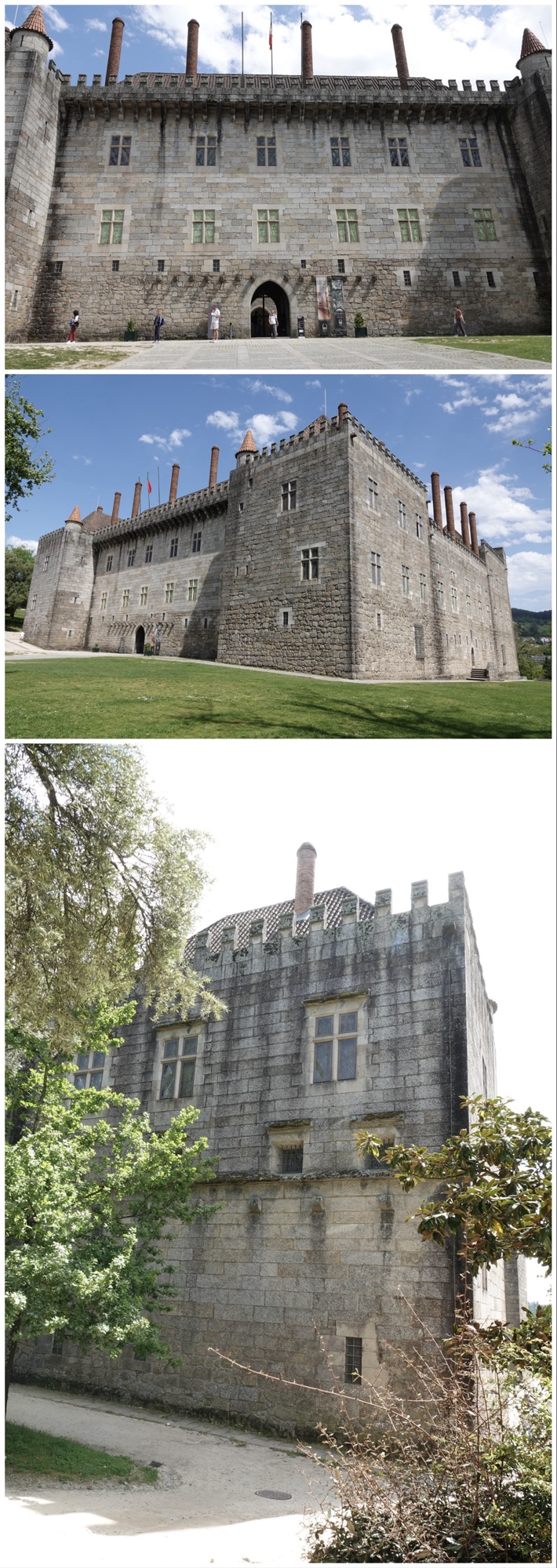
Very near the palace is a statue of King Alfonso I: 7 feet tall and carrying a sword the size of a cannon, as befits a very intentional larger than life image.
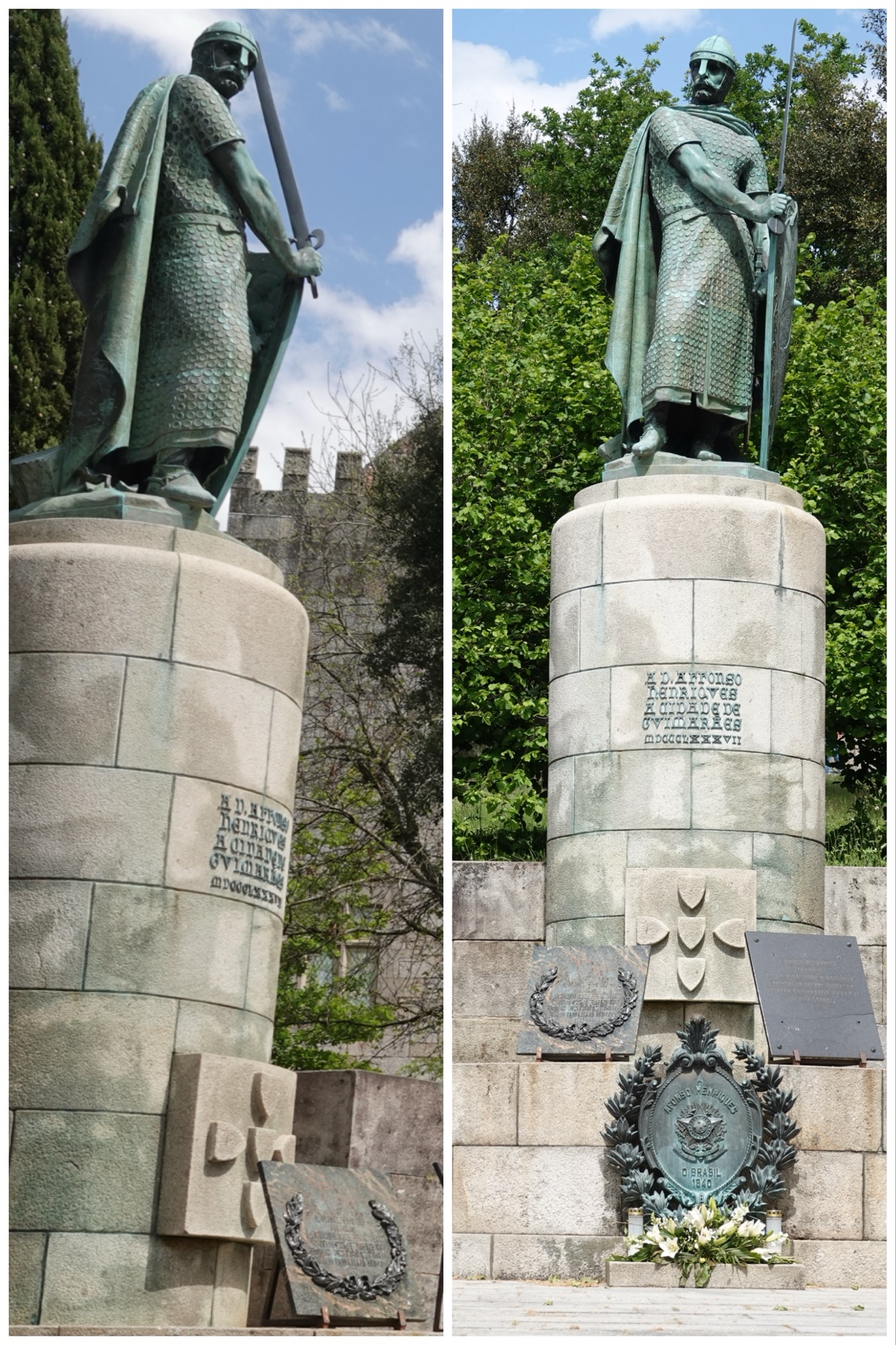
The statue has created controversy over the years for the depiction of short sleeves on his chain mail, which would not have protected his arms in battle.

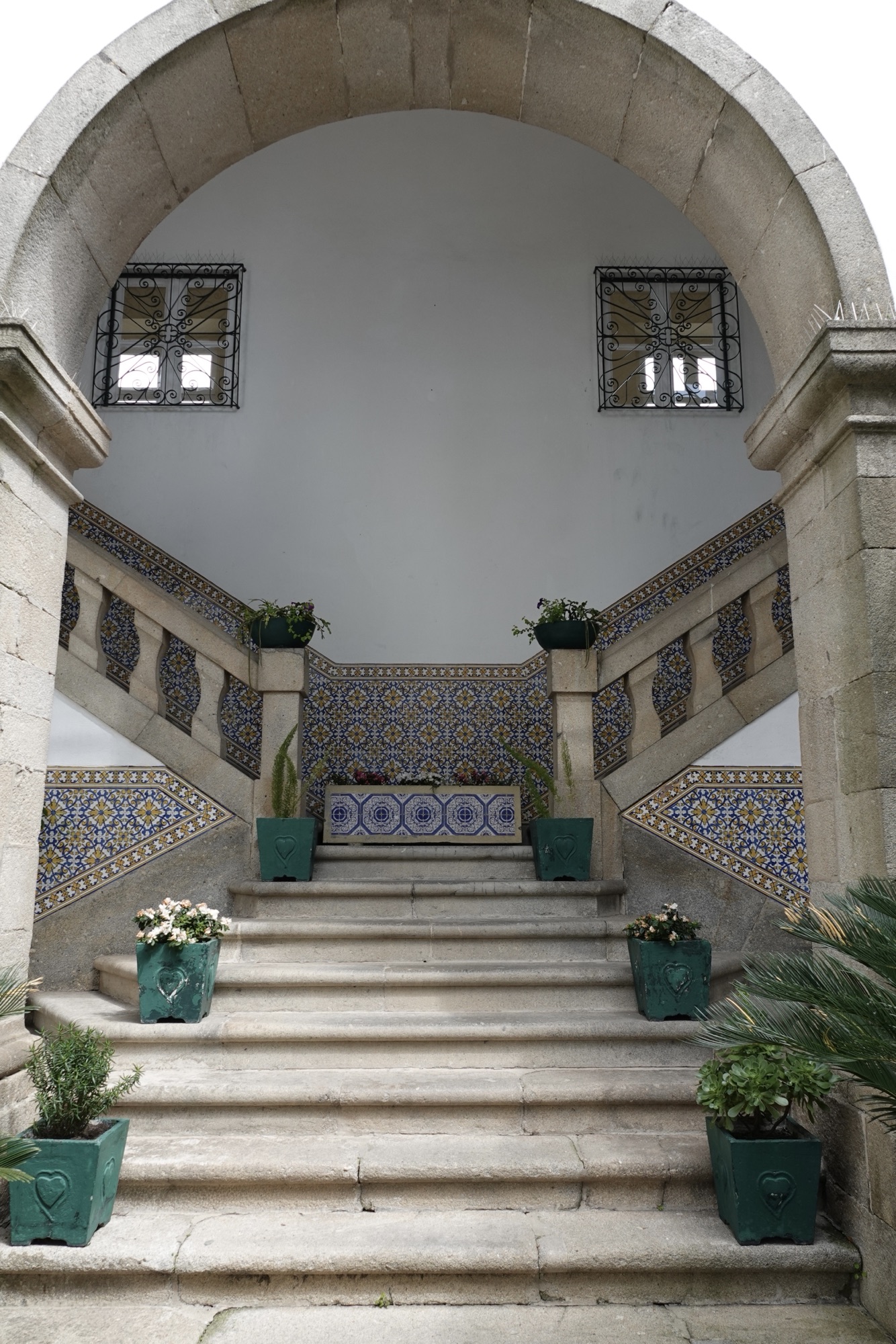
Our second convent sighting was of the Carmelite Convent with its beautifully rendered blue and white tiled depiction of the Virgin Mary; its size relative to me gives some perspective.

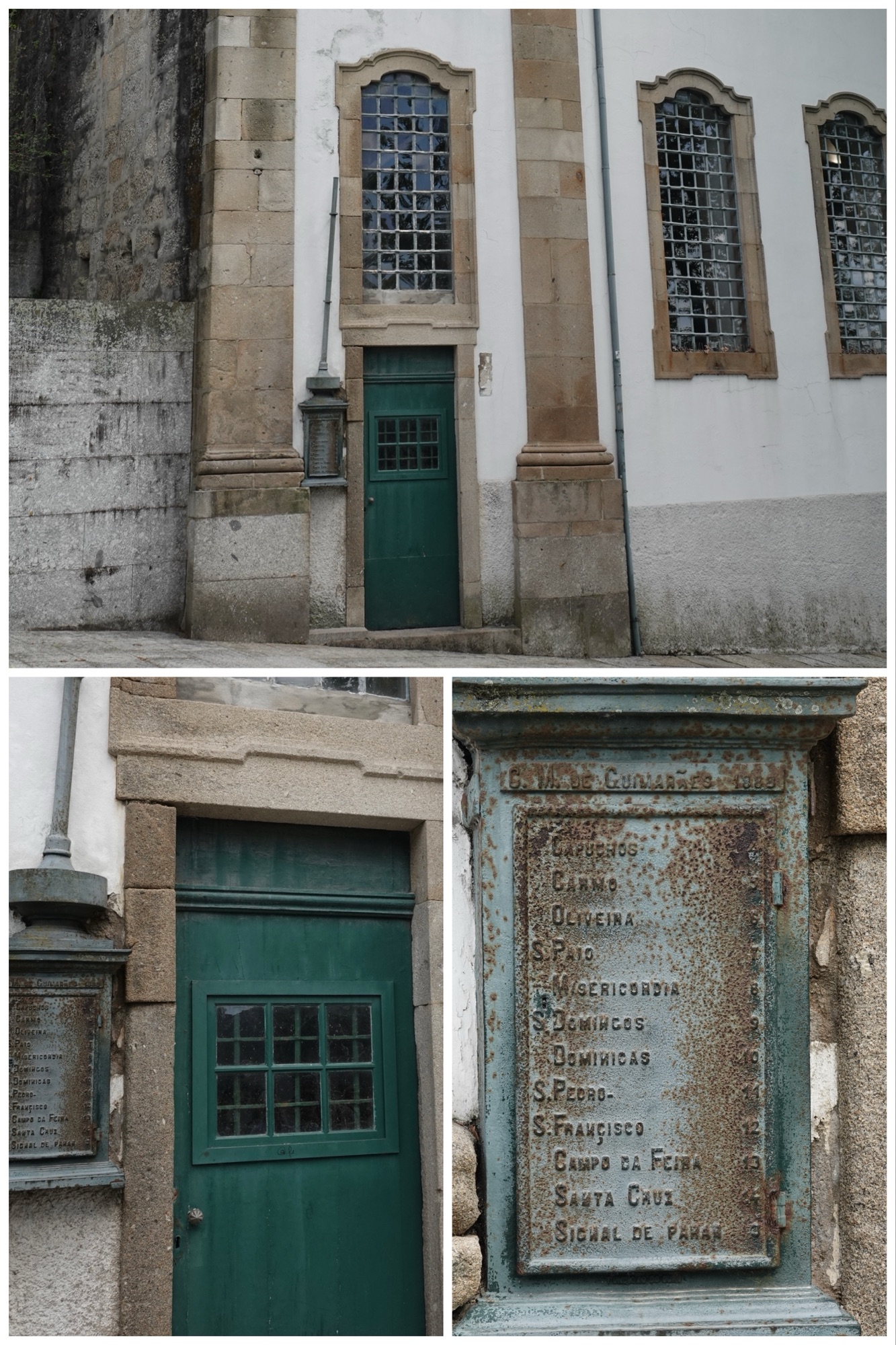
On the wall beside the convent door was a locked box and a pipe that would once have secured a rope attached to a bell. This was the old city’s fire alarm. The number of chimes indicated the fire’s location, to allow a bucket brigade to get water to the right
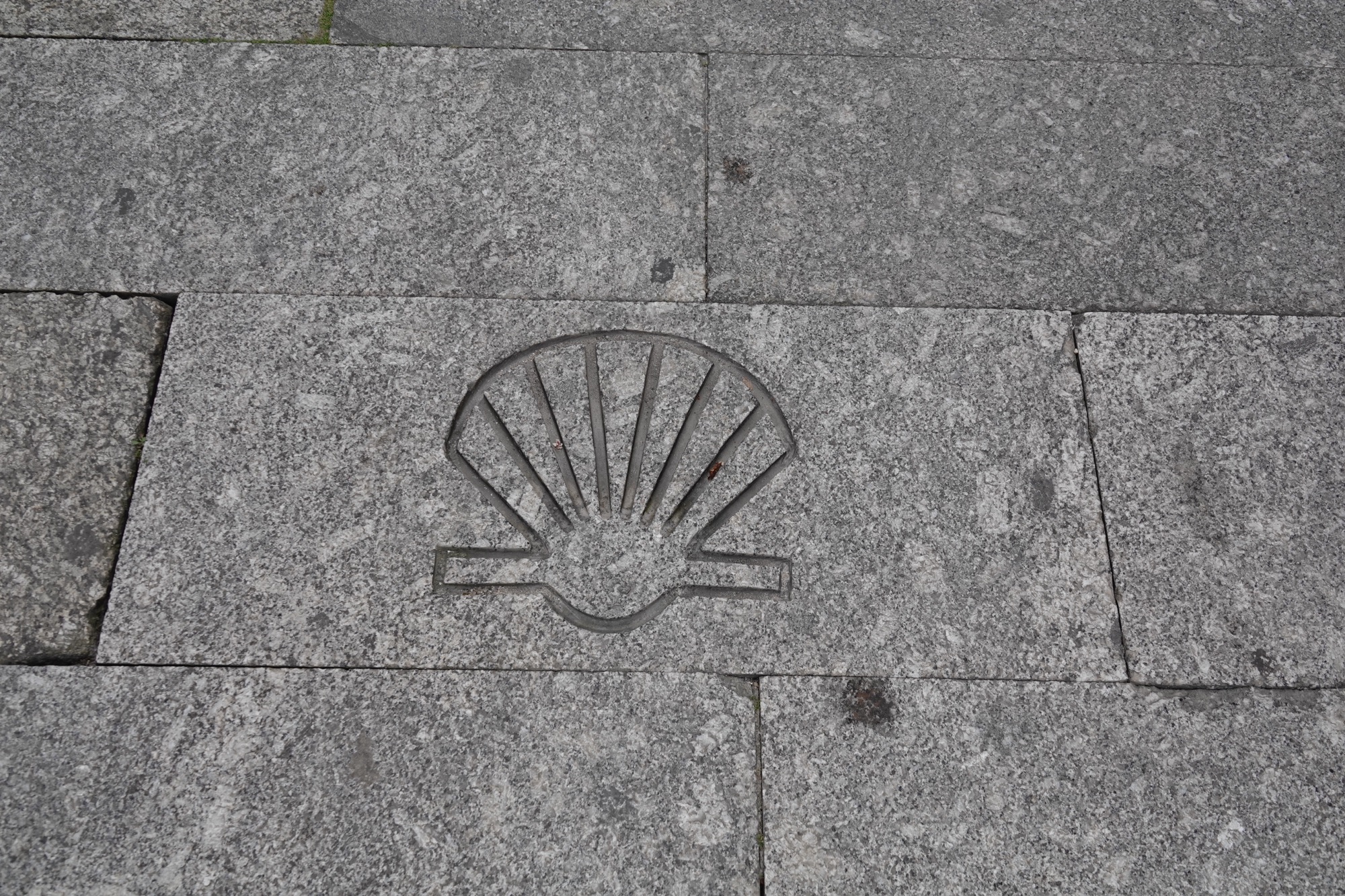
As we continued strolling through Guimarães, we walked through picturesque laneways, one of which had a scallop shell image set into it. That shell is a symbol of St. James (Santiago in Portuguese) and indicates that the laneway is part of the Camino de Santiago, the pilgrimage route from St-Jean-Pied-de-Port on the French side of the Pyrenees and crossing about 770km to Santiago de Compostela in Portugal.
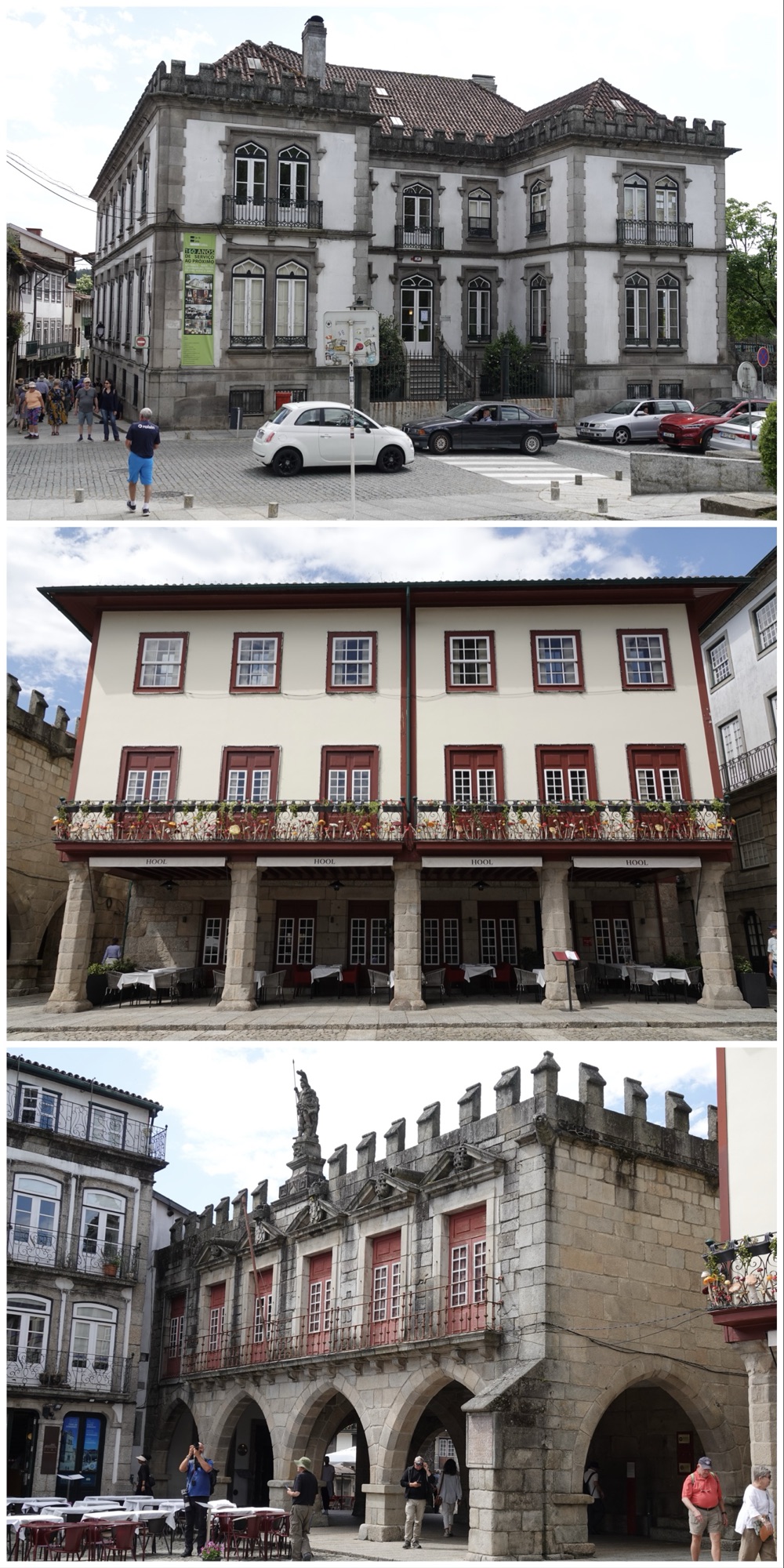
For me, the streets here were reminiscent of our visit to Rouen (Episode 6.3), and equally impressive. The buildings here range in style from mediaeval to rococo to mannerism. It’s an eclectic and yet somehow perfectly cohesive mix.

A unique feature of these streets along the camino are the alcoves containing life-sized Stations of the Cross at which pilgrims can worship.

The third magnificent convent we passed belonged to the order of Saint Clare of Assisi, and is the female branch of the make Franciscan order. The Franciscan orders were the richest in Portugal.

We continued to be assailed on all sides by amazing architecture, including the Church of Our Lady of Oliveira, whose original elements date to the year 950 CE. It was rebuilt by King John I at the end of the 14th century, as a result of a vow made by this king to the Virgin of Oliveira, for the victory of Aljubarrota. The attached tower, with Manueline features, houses on the ground floor the funeral chapel of the parents of Prior D. Diogo Pinheiro. The chancel, of classical architecture, was rebuilt in the 17th century by King D. Pedro II.
The church is classified as a National Monument.

Ahead of us on a hill was the baroque jewel Saint Walter’s Church with its expanse of manicured emerald green gardens.
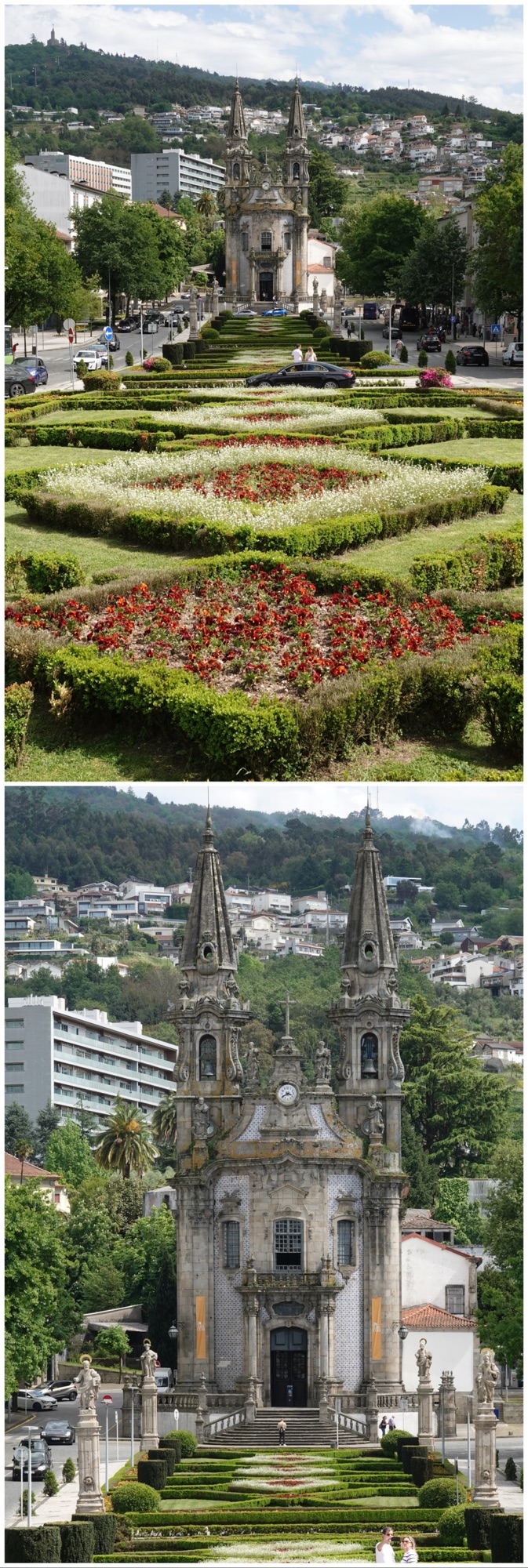

This was a city we’d love to explore further.
From Guimarães we then drove to Braga, about 30 km outside Porto, a 3000 year old Iron Age city that became home to Celts, Visigoths, Romans, Moors, and eventually Christians.
Manuel reminded us that this was not “Portugal” then, but “only tribes, united by common tools, pottery designs, and an untrammelled hatred for each other”. How’s that for evocative use of English by a non-native speaker of the language?
In 16BCE it was established as a Roman seat of power (Roman Heritage Day is still celebrated with parades and live action role play).
We entered the city through the “New Gate”, although there has never been an actual gate – only an arch topped by symbols of the archbishopric. Manuel told us that because of this, in this region of Portugal when someone leaves a door open, the expression is not “were you born in a barn?” as it might be it Canada, but “were you born in Braga?”.

You can tell that this is an archbishop’s city gate by the cross with two horizontal arms, and the number of tassels.

Braga was the seat of the first archbishop primacy on the Iberian Peninsula in the 5th century. For 700 years, the city was governed continuously by archbishops, linking its architectural and cultural development to the history of the Church.
Our excursion destination here was the Braga Cathedral, although Manuel gave anyone not interested in seeing another church the option of free time in the main street shopping and restaurant area.
Ted and I, of course, headed to the cathedral with Manuel.
As with most European cathedrals, its exterior is far too vast, and it is built too close to the surrounding buildings, to allow getting it into a single photo.
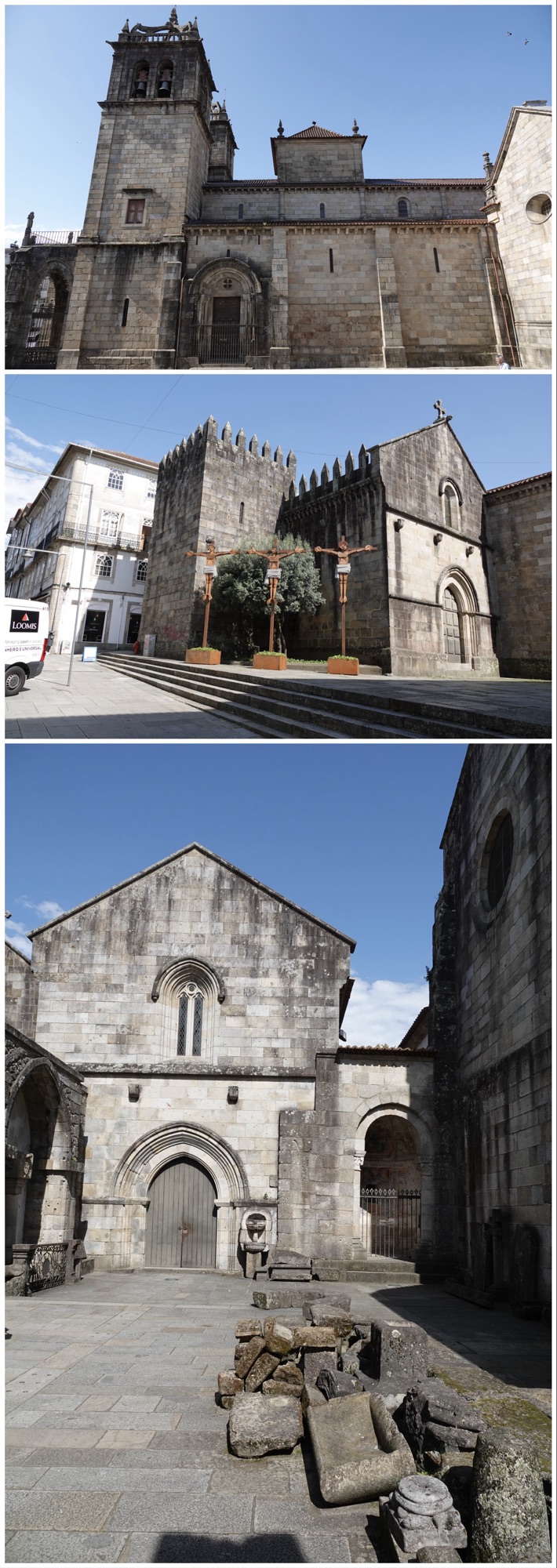
Inside, changes to simplify the opulence of the cathedral were made during a 20th century “purifying” reform and later at the direction of Pope Francis. Given the amount of carving and gilding evident, and the fact that there is a project scheduled for 2026 to re-gild all the wood, it’s hard to imagine what was “simplified”.


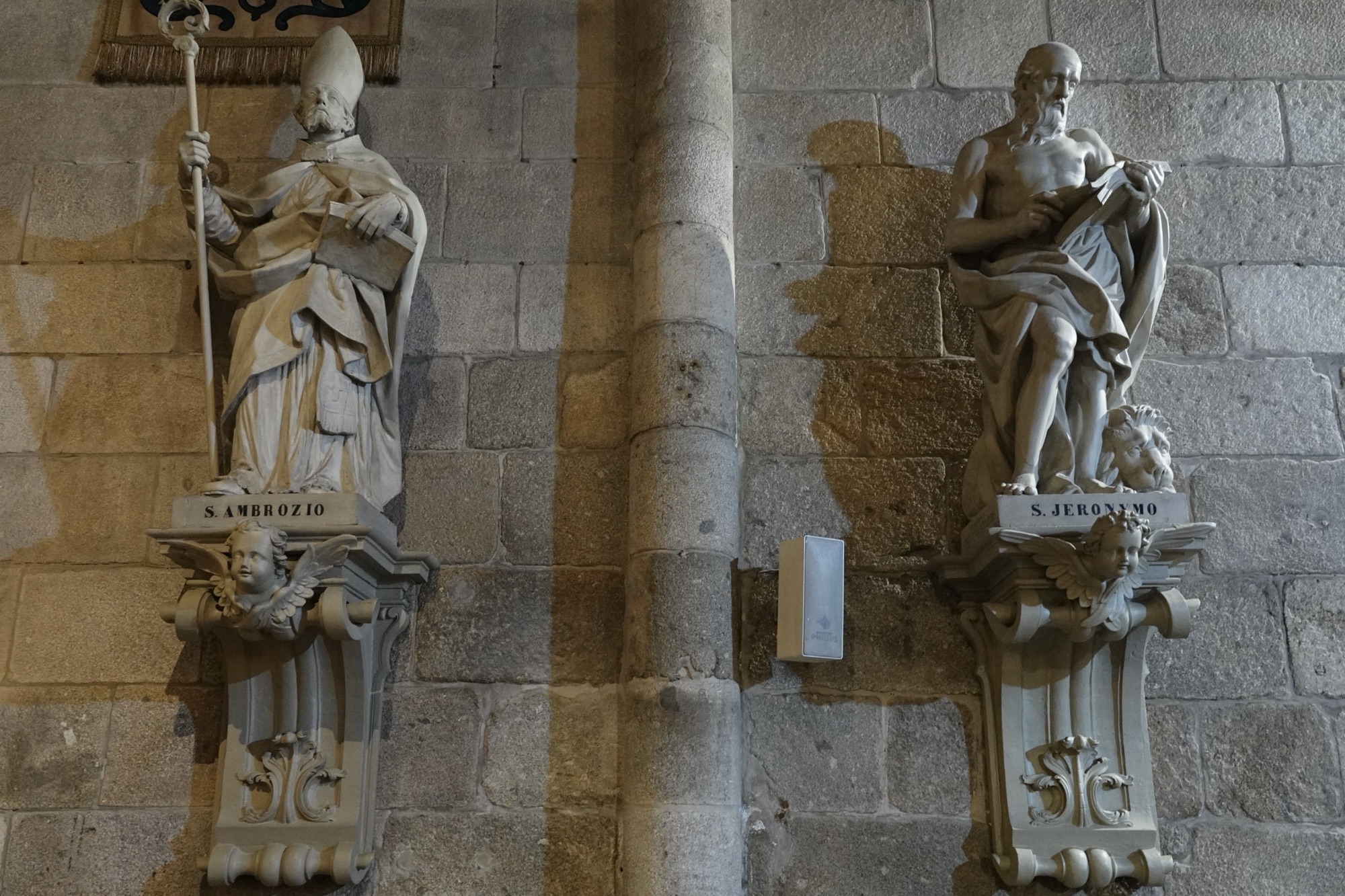
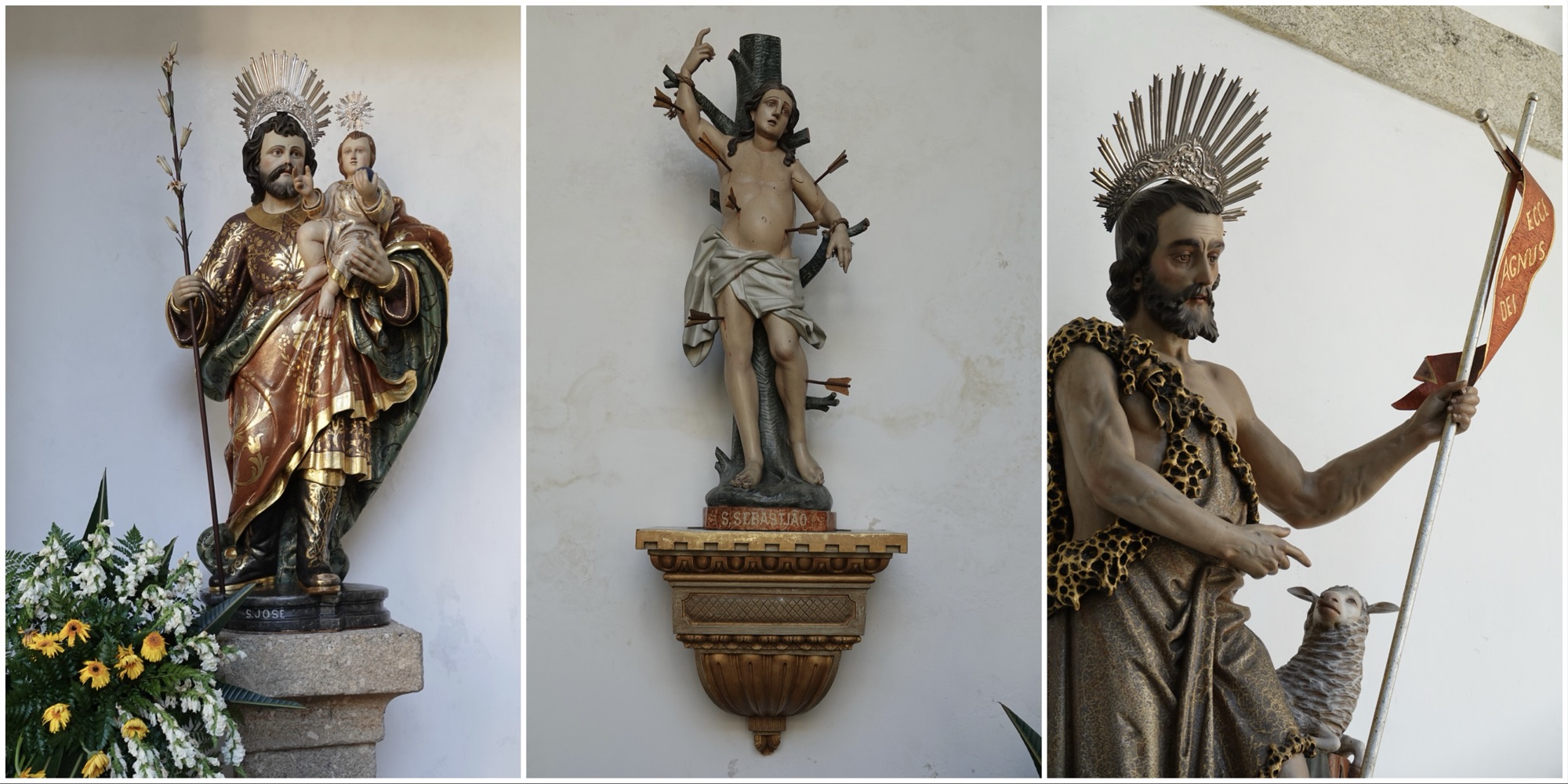
The cathedral had impressive stone statues of saints on its walls, as well as lots and lots of painted and gilded statuary.
Some of the interesting things we saw today that we’d not seen before were a statue inside the cathedral of Mary depicted pregnant, and on the exterior of Mary breastfeeding (a breast bared). Apparently in the 16th century the church banned these kinds of realistic images of Mary as a mother. Statues that survived are mostly because people stole them and hid them away, sometimes worshipping them secretly, until the 20th century when the ban was repealed by Pope John Paul and they could be restored to their original locations.


We got a second look at the cathedral’s gargoyles. Manuel specifically pointed out the one carved so that instead of water coming out of its mouth, it would come out the other end. The gargoyle was specifically placed on the corner of the church pointed toward Santiago de Compostela. That kind of irreverence was something we’d seen before in Köln (Cologne).

Having spent so much time at the cathedral, we had only a very quick look around the rest of the city’s old centre.


While Braga is the older and larger of the two cities, it is Guimarães that stole my heart.
On our return to the port we decided to take a short walk along the wide beach.
We were intrigued by the large bronze sculpture on the sand. Inspired by a painting by the famous Augusto Gomes, a great artist from Matosinhos, the sculptural ensemble “Tragedy at Sea”, by José João Brito (2005) remembers the greatest nautical tragedy ever recorded on Portuguese waters: the tempest of 1-2 December 1947, in which several fishing boats sank off Leiões Port, causing the death of 152 crew members and pain and despair in the whole community. 72 widows and 152 orphans came out of this tragedy.
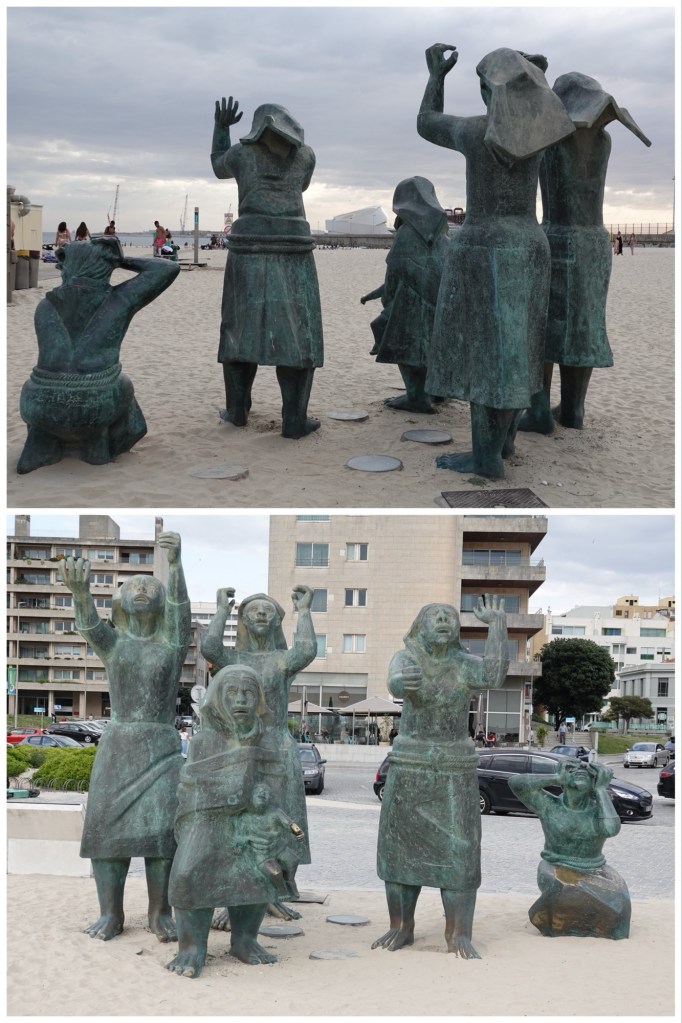
People rub or hold the hand of the babe in arms, keeping the bronze shiny.

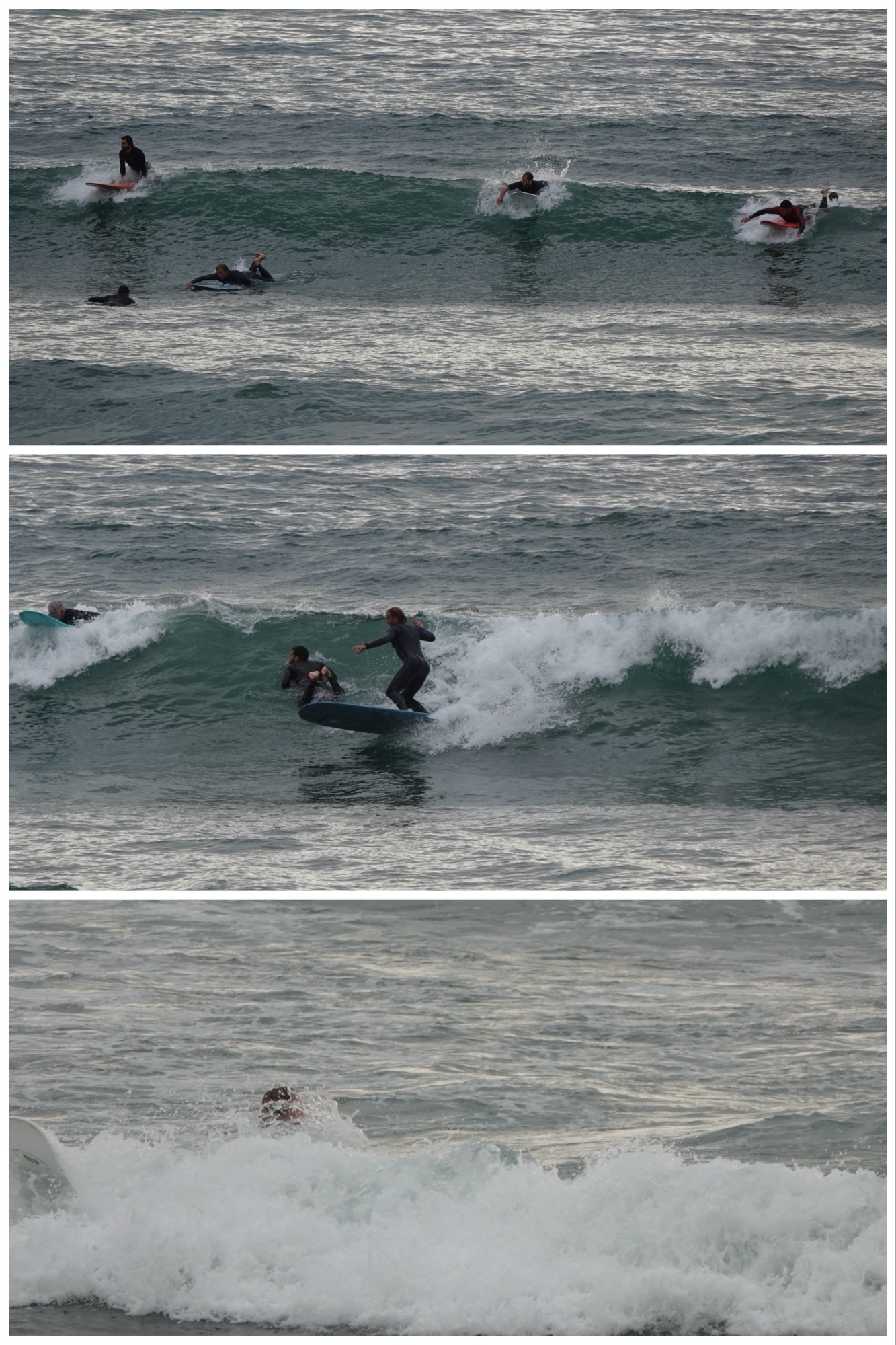
We also got a great view of our ship and the port’s terminal building – and some enthusiastic evening surfers.

After our walk, we called it a night. Late supper in the World Cafe, and then I settled in to write and sort photos while Ted caught Alan’s late guitar set.
We visit Santiago de Compostela in Spain tomorrow.


We were in G&B this time last year. Fascinating histories. Loved getting to revisit through your words and Ted’s pictures!
LikeLiked by 1 person
Rose, thank you for another beautiful and inspiring post.
LikeLiked by 1 person
You are truly amazing with your detail and accompanying photos. Safe travels and thank you.
LikeLiked by 1 person
Thanks for following along!
LikeLike