I was incredibly honoured to take part at 6:00 a.m, this morning in the ANZAC DAY SERVICE aboard the Viking Sky as we near Casablanca, Morocco.
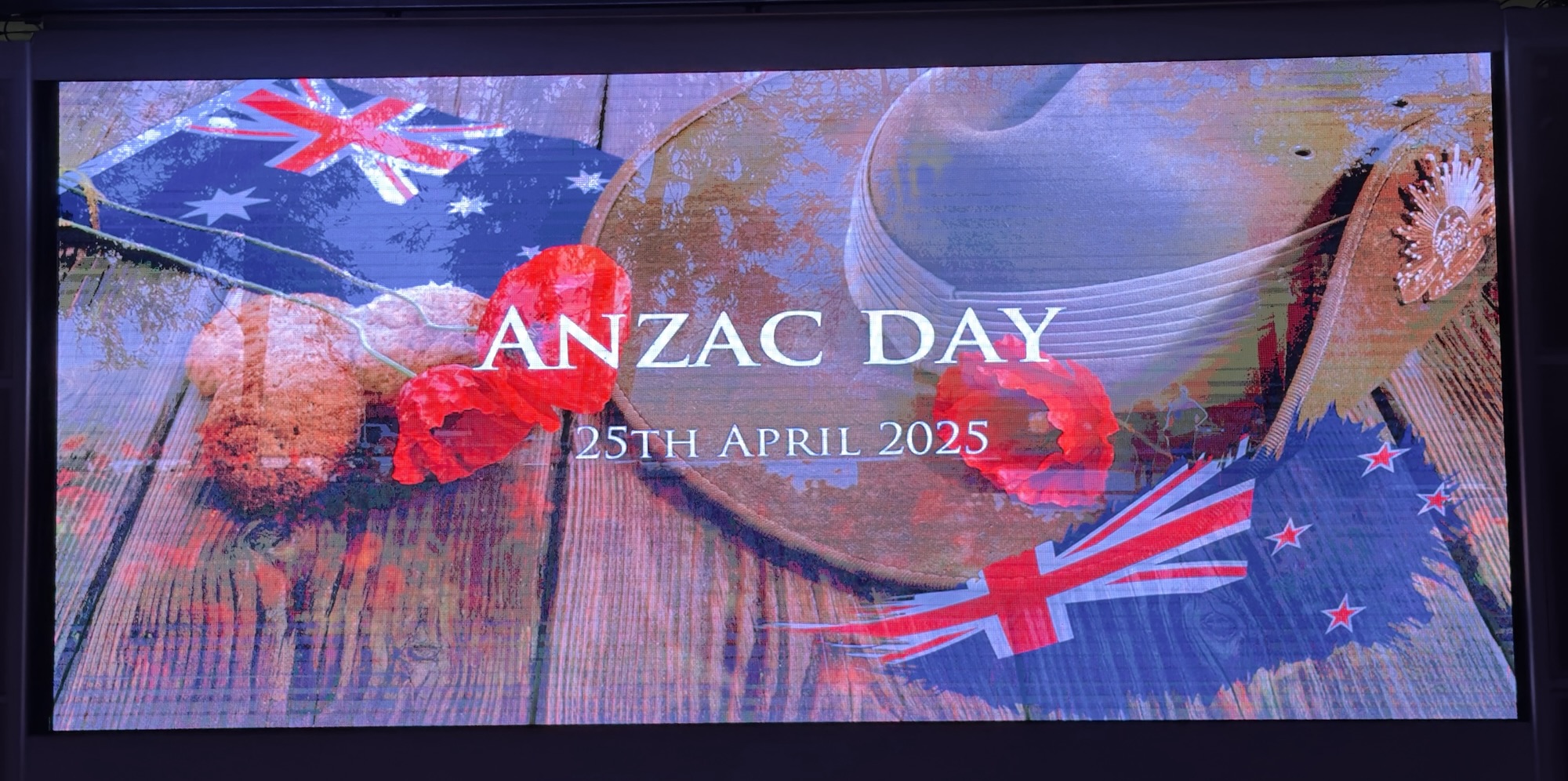
It was especially moving to me because in November 2022 (Episode 351) Ted and I spent a day on the World War I battlefields where Commonwealth soldiers – specifically the Canadians and Australians – toiled side by side digging tunnels beneath the trenches in which they would live and die in the coming years of war.


The ceremony was incredibly moving, and I wanted to remember every moment, so here is the program: (I wrote none of this – it is the work of Rosemary Stockley and Barry Newham, two of our Australian world cruisers.)
April 25, 2025
WELCOME: M. C. Rosemary Stockley OAM
ADDRESS: Wing Commander Barry Newham RAAF (Rtd) and Wing Commander Keith Graham RNZAF (Rtd)
Today we are here to honour a profound chapter in our shared history—a chapter that unites Australia and New Zealand in shared memory and sacrifice. We gather to remember the legacy of the Australia and New Zealand Army Corps, the ANZACs, a legacy hard earned on the unforgiving beaches and treacherous terrain of Gallipoli,Turkey during the early years of the First World War.
Just 3,000 kilometres east of where we stand today lie the Dardanelles—the waters that bore witness to that fateful campaign. For many of us, this is the closest we have come to commemorating ANZAC Day near its place of origin.
The First World War marked the first time Australia and New Zealand fought side by side under the ANZAC banner. On 25 April 1915, in the pre-dawn darkness, our combined forces landed on the rugged coastline of Gallipoli. Their mission was to silence the Turkish guns, to clear the way for the Allied fleet to reach Constantinople. Had they succeeded, the course of the war might have been altered. Instead, they found themselves in a maelstrom of confusion, bravery, and immense sacrifice. It was a moment when the stark reality of war became painfully clear.
That first day was devastating. More than 2,000 Australian and New Zealand soldiers were killed or wounded in the opening hours alone. Our troops fought with grit, courage and determined tenacity with acts of heroism commonplace.
Indeed, such was the heroism of the ANZACs that over the course of the campaign no less than 10 Victoria Crosses were awarded for valor. For those of you who are unfamiliar, the Victoria Cross is equivalent to the Congressional Medal of Honour and is the highest military decoration awarded for valor in the British and Commonwealth forces.
For eight long months, the campaign dragged on in a bitter stalemate, the treacherous terrain and fierce Turkish resistance having halted their advance. Eventually the Allies withdrew, having suffered terrible losses.
The cost of the campaign was staggering: 8,709 Australians and 2,779 New Zealanders lost their lives, with thousands more wounded. But we must also acknowledge the sacrifices of others—the British, the French, and, most of all, the Turkish forces, who lost over 86,000 defending their homeland.
Ari Bumu Memorial, Gallipoli
Those heroes that shed their blood and lost their lives!
You are now lying in the soil of a friendly country.
Therefore rest in peace
There is no difference between the Johnnie’s and the Mehmets to us where they lie side by side here in the country of ours.
You, the mothers, who sent their sons from far away countries wipe  away your tears;
Your sons are now lying in our bosom and are in peace.
After having lost their lives on this land they have become our sons as well.
- Ataturk 1934
In the years that followed, ANZAC Day evolved.
What began as a day of mourning became a time of reflection—a moment to honour not just those who fell at Gallipoli, but all who have served in war and peacekeeping operations since.
Indeed, since the Boer War, over 130,000 Australians and New Zealanders have made the ultimate sacrifice in conflicts around the world. Behind every one of those numbers is a name. A family. A community left to bear the weight of loss.
ANZAC Day is not a celebration of war. It is a solemn reminder of the cost of freedom. It is an opportunity to reflect on the lives we live today—the liberties we enjoy, the peace we often take for granted—and to remember that these things came at a price.
The ANZAC tradition—of courage, endurance, and mateship—remains as relevant now as it was in 1915. In times of peace, our two nations share a friendly rivalry. But in times of war, in moments of crisis, we stand as one. From Gallipoli to the battlefields of World War II, from Korea to Vietnam, from Afghanistan to peacekeeping missions around the world, the ANZAC spirit has endured.
Our servicemen and women have left us a legacy—a legacy of sacrifice, of resilience, of an unbreakable bond between two nations.
As we stand here today, let us take inspiration from their example. Let us remember our own duty—to our nations, to each other, and to the generations yet to come.
The security, the values, the freedoms we cherish—these are not things to be taken for granted. They are a gift, earned through sacrifice, entrusted to us to protect.
Lest we forget.
“IN FLANDERS FIELDS”
(Read by Canadian Guest Rose Brooks)
In Flanders fields the poppies blow
Beneath the crosses, row on row,
That mark our place; and in the sky
The larks, still bravely singing, fly
Scarce heard amid the guns below.

We are the Dead, short days ago
We lived, felt dawn, saw sunset glow,
Loved and were loved, and now we lie
In Flanders fields.

Take up our quarrel with the foe:
To you from failing hands we throw
The torch; be yours to hold it high.
If ye break faith with us who dieWe shall not sleep,
though poppies grow
In Flanders fields.
WREATH LAYING by ship’s Captain Fredrik Nilsson.
M.C. – Please stand for the reciting of The Ode and remain standing for the sounding of The Last Post, the one-minute silence and The Reveille
THE ODE: (Read by Lee Stockley OAM)
They went with songs to the battle, they were young
Straight of limb, true of eye, steady and aglow,
They were staunch to the end against odds uncounted;
They fell with their faces to the foe.

They shall grow not old,
As we that are left grow old:
Age shall not weary them,
Nor the years condemn.
At the going down of the sun
And in the morning,
We will remember them
(All repeat: We will remember them)
SOUNDING OF “THE LAST POST”
ONE MINUTE SILENCE
Speaker: Lest we forget (All repeat: Lest we forget)
Playing of “Reveille”, followed by the national anthems.
NEW ZEALAND
E Ihowa Atua
O nga iwi matou ra
ata whakarongo na;
Me Aroha noa
Kia tau to atawhai;
Manaakitia mai
Aotearoa

God of nations at thy feet
In the bonds of love we meet
Hear our voices, we entreat,
God defend our free land.
Guard Pacific’s triple star
From the shafts of strife and war,
Make her praises heard afar,
God defend New Zealand
AUSTRALIA
Australians all let us rejoice
For we are one and free;
We’ve golden soul and wealth for toil;
Our home is girt by sea;
Our land abounds in nature’s gifts
Of beauty rich and rare;
In history’s page, let every stage
Advance Australia Fair
In joyful strains then let us sing
Advance Australia Fair

Beneath our radiant Southern Cross
We’ll toil with hearts and hands;
To make this Commonwealth of ours
Renowned of all the lands:
For those who’ve come across the seas
We’ve boundless plains to share;
With courage let us all combine
To Advance Australia Fair
In joyful strains then let us sing,
Advance Australia Fair.
THANK YOU: Wing Commander Barry Newham RAAF (Rtd).
Barry was quite emotional as he added a few ad hoc words specific to what he acknowledged are troubled times in which we are living: together we stand and prosper, divided we fall.


 Rose and Ted’s Excellent Adventure
I’m glad I started reading backwards and came upon this — a very moving ceremony, especially as the Wing Commander said, in these troubled times. Thanks for sharing it.
LikeLiked by 1 person
As Aussies, we were very moved by your Anzac Day on Viking. Our country was only 14 years old, and it was our 1st battle. We were fortunate to visit Gallipoli in 2012 on a coach tour of Turkey. We conducted a brief remembrance ceremony while there.
I also read your experiences in The Western Front in episodes 350 & 351. I regret not taking a tour to Ypres during our stay in Brussels in 2010. Australians suffered 38,000 casualties during this five-month campaign.
We will visit the Normandy Beaches in November this year during our Viking France’s Finest River Cruise.
“Lest We Forget”
Brian
LikeLiked by 1 person
If there is an option to do so, choose the Commonwealth beaches to tour instead of the US landing sites.
LikeLike
Rose: yes, I’ve done that as it looked better. Also, we did Utah Beach as part of a private tour on a cruise in 2013.
Brian
LikeLiked by 1 person
Hi Rose,
As a longtime reader of your exploits, I would like to thank you for this particular account.
You have recognised what is a particularly meaningful day for us Aussies and Kiwis and I wish you both continuing safe and healthy travels.
Wayne (from Downunder).
LikeLiked by 1 person
You’re more than welcome. It was truly a honour to be a small part.
LikeLike
Thank you Rose for giving us the program. I have no family that went to war, but am very appreciative of the Anzacs and what they sacrificed for us.
I was lucky enough to visit Gallipoli many years ago. It was truly moving.
Lest We Forget
LikeLiked by 1 person