Lectures and food are chiefly what make sea days so enjoyable for me, and there were plenty of both on offer.
DAY ONE
My first sea day lecture was on the coconut tree, a lecture delivered by Guest Lecturer Laura Lovelock, who joined us (with her new husband, Richard, the onboard naturalist) in Sri Lanka and will be on board with us until London, and gave us a hint of what she’ll have for us.

Laura spent her career as an educator, and her “teaching” style is fun and engaging.
We began by learning that 80% of the 20 million tons of coconut produced by 11 million farmers for the commercial market each year come from Indonesia, the Philippines, and India. Interestingly, Laura shared that we really don’t know where on the planet coconuts originated, first because coconut trees far pre-date humans, second because they float (so can migrate anywhere), and third because they really don’t need soil in order to grow! But, based on a combination of carbon dating, and the habitat of the coconut crab, scientists believe it was in the Indo-Pacific region.

Coconuts are about much more than coconut cream pie.
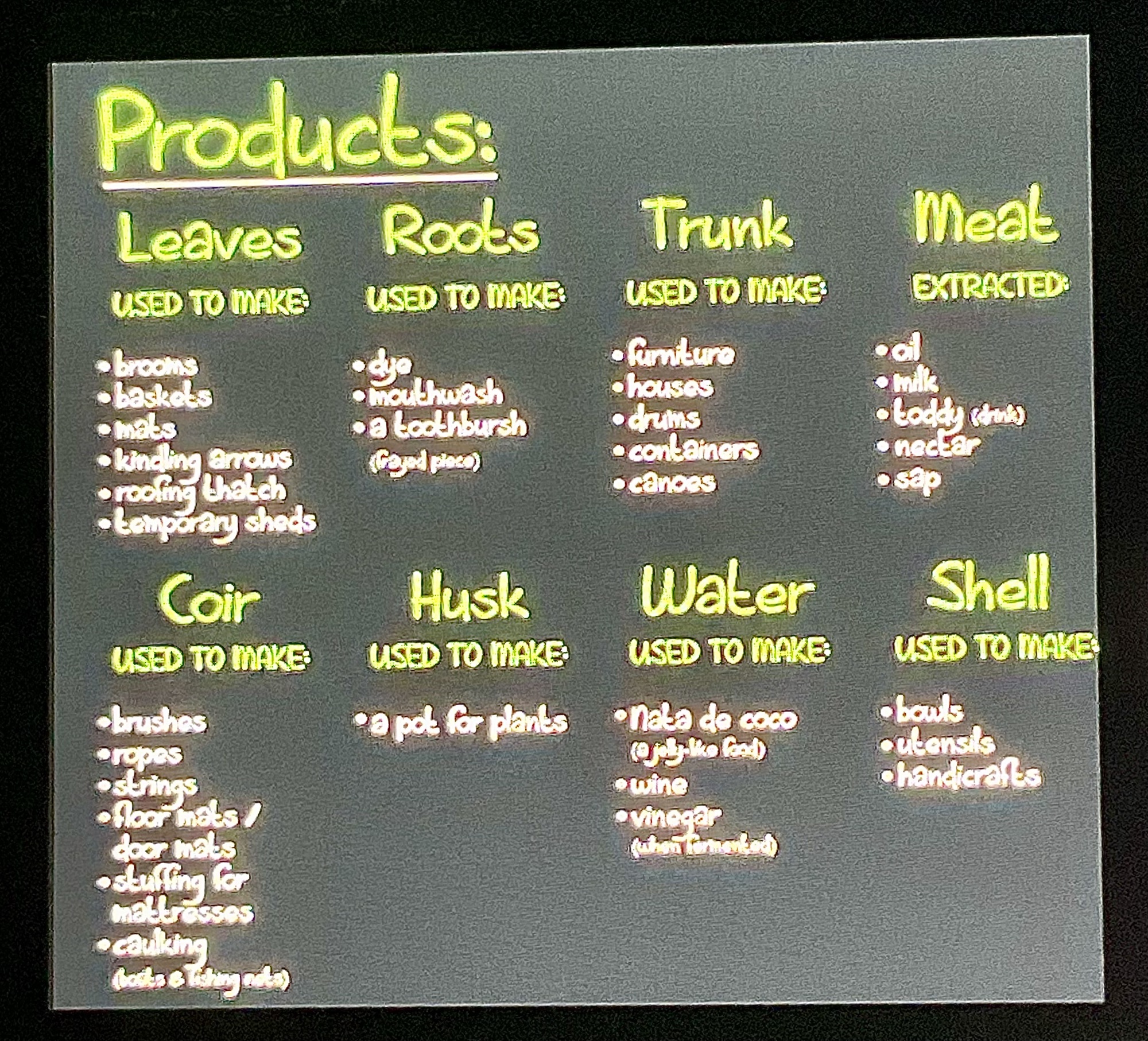
The water is full of minerals and electrolytes, and likely helped early explorers survive. It is referred to as a “canoe crop”. In WWII and in Vietnam, when not enough saline solution was available, coconut water was actually used as a lifesaving intravenous drip.

It’s a fruit called a “drupe”, like peaches, almonds, mangoes, cherries, etc.
There was just enough time to grab a coffee before the day’s second lecture:

There wasn’t a ton of new information in his lecture, but it was interestingly presented, and also fun to see those in the audience who didn’t previously know about the connection between tea and opium react to the British East India Company’s promotion (we’d call them a cartel and their strategy trafficking today) of opium as a currency to pay for tea.
Statistics show that about 6 billion cups of tea are consumed per day, compared to 2.25 billion cups of coffee. The map Howard shared of predominantly tea vs coffee-drinking countries showed Canada as a balanced 50/50. That makes sense given our cultural makeup.
While there was a strong demand for Chinese tea in Britain, there was no trade commodity that China wanted in payment – they wanted silver. Britain did not want to pay in “cash”, but they had access to opium from Afghanistan (part of the Indian colony at that time), and there was a demand for opium. The Chinese emperor, though, had wisely banned opium, knowing that it was a harmfully addictive narcotic. That’s basically what led to both the Opium Wars, and to the theft via espionage by Robert Fortune of tea seedlings from China. Britain then began growing their own tea in their Indian colonies. Today, the biggest tea processing factory is in Dubai.
After all that learning…. lunch. Yesterday, in the Maldives, Chef Alastair bought fresh yellowfin tuna. Today it was part of a fresh tuna station on the Aquavit Terrace.

Whether you call it Jalebi (as we’re used to), jilapi, zelepi, jilebi, jilipi, zulbia, zoolbia, jerry, mushabak, z’labia, or zalabia, this amazingly delicious fried and honey-soaked dough is a popular sweet snack in the Indian subcontinent, West Asia and some parts of Africa. Ted and I might just have eaten a whole plate of them.

Spent a lovely quiet afternoon doing laundry, reading, and scanning the smooth seas for flying fish and dolphins, and then it was magically cocktail hour and dinner time. More food. Always more food. Tonight’s World Café theme was “Chinatown”, so we both indulged in hot and sour soup and I followed up with Szechuan chicken while Ted hit the prime rib station. We ate outdoors on the terrace watching a glorious sunset.

The evening’s entertainment in the theatre was a magician, who by all accounts was wonderful at his first show (which we didn’t attend), but since we’re neither magic nor comedy fans (it’s all about music and theatre for us) we chose instead to go upstairs to deck 9 and stargaze for a while before closing out our night with music in the Explorers Lounge.
DAY TWO
This morning’s early lecture was all about how the European explorers discovered Africa and the Indian Ocean.
Every time I hear the word “discovered” used with regard to a place, I think about reading Elly Griffiths’ Ruth Galloway mystery The Last Remains where a particular line about her town of King’s Lynn in Norfolk made me laugh: “But now the town feels a bit like it has been forgotten, left out of history, like its hero Captain Vancouver, who apparently discovered Canada, although Nelson has a shrewd suspicion that it was there already.”
As we’ve travelled around the world, I’ve become very conscious of what I was taught in middle school history lessons: that the Portuguese, Dutch, or English explorers “discovered” the Americas, Indonesia, China, Africa… pretty much anyplace they hadn’t visited before. Discovering is all about finding something for the first time, which implies something unknown, and yet all these lands were well known by their indigenous populations. I guess, to be fair, when the Europeans got there it was an “aha” moment.
Lecturer Howard Roitman also spoke about the irony: today we know that humanity descended from the cradle of Africa, so those explorers were – in a way – going “home” as opposed to discovering new territory.
And of course, ancient civilizations had already “discovered” each other and created trade routes. Minoan frescoes dating to 1400BCE show a mix of cultures. As Howard quipped about the image below, “no one was wearing black leggings”.

Since there was such an early awareness that there were lands beyond the Mediterranean, it might be more accurate to say those European explorers “found” places that they had no maps for, as opposed to “discovering” new lands. Or maybe it’s more accurate to say that Northern Europeans only developed the urge to “discover” (and trade exotic commodities) much, much later than ancient Mediterranean and Middle Eastern civilizations.
Our lecturer shared lots of maps outlining the various explorations of both the coastline and the interior of Africa.
We’ve crossed the equator twice already on this cruise, and will do so twice more, bringing Ted’s and my lifetime total (so far) to seven – not counting doing it in the air. The ship celebrated this world cruise’s first crossing with the traditional pollywog-to-shellback ceremony, did not acknowledge the second, and on this our third crossing repeated the ritual for those who only joined us in Sydney or Singapore.
Every event is slightly different, but it’s always good fun and worth taking a few photos (Ted had his camera on “burst” mode and took 1,240 !)

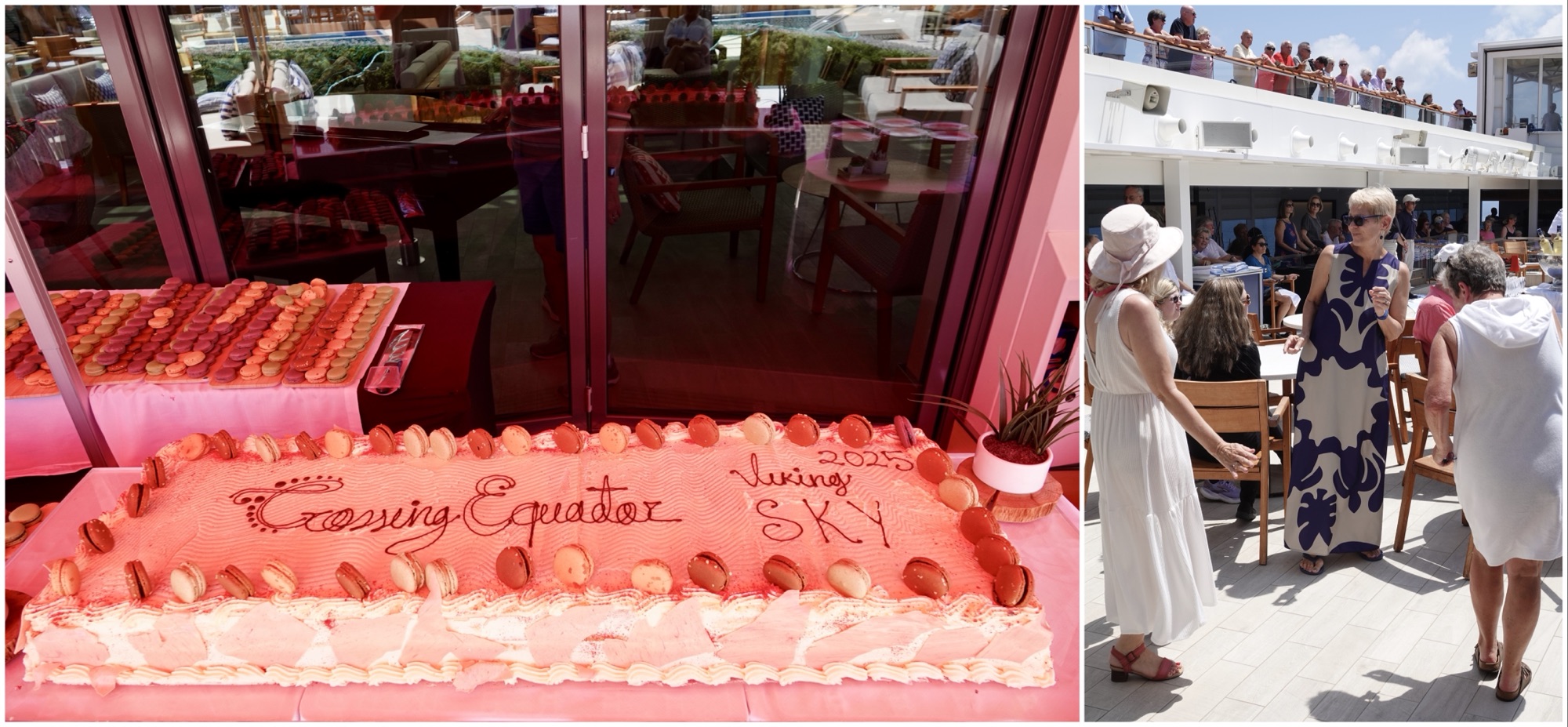


Lots of passengers underwent the rite: kiss or bow to the fish, cross the water, and down a shot of aquavit.

After lunch with friends, and an afternoon spent devouring Lesley Krewe’s book “The Spoon Stealer”, it was time for dinner à deux in The Chef’s Table, where tonight’s menu featured a Chinese theme.
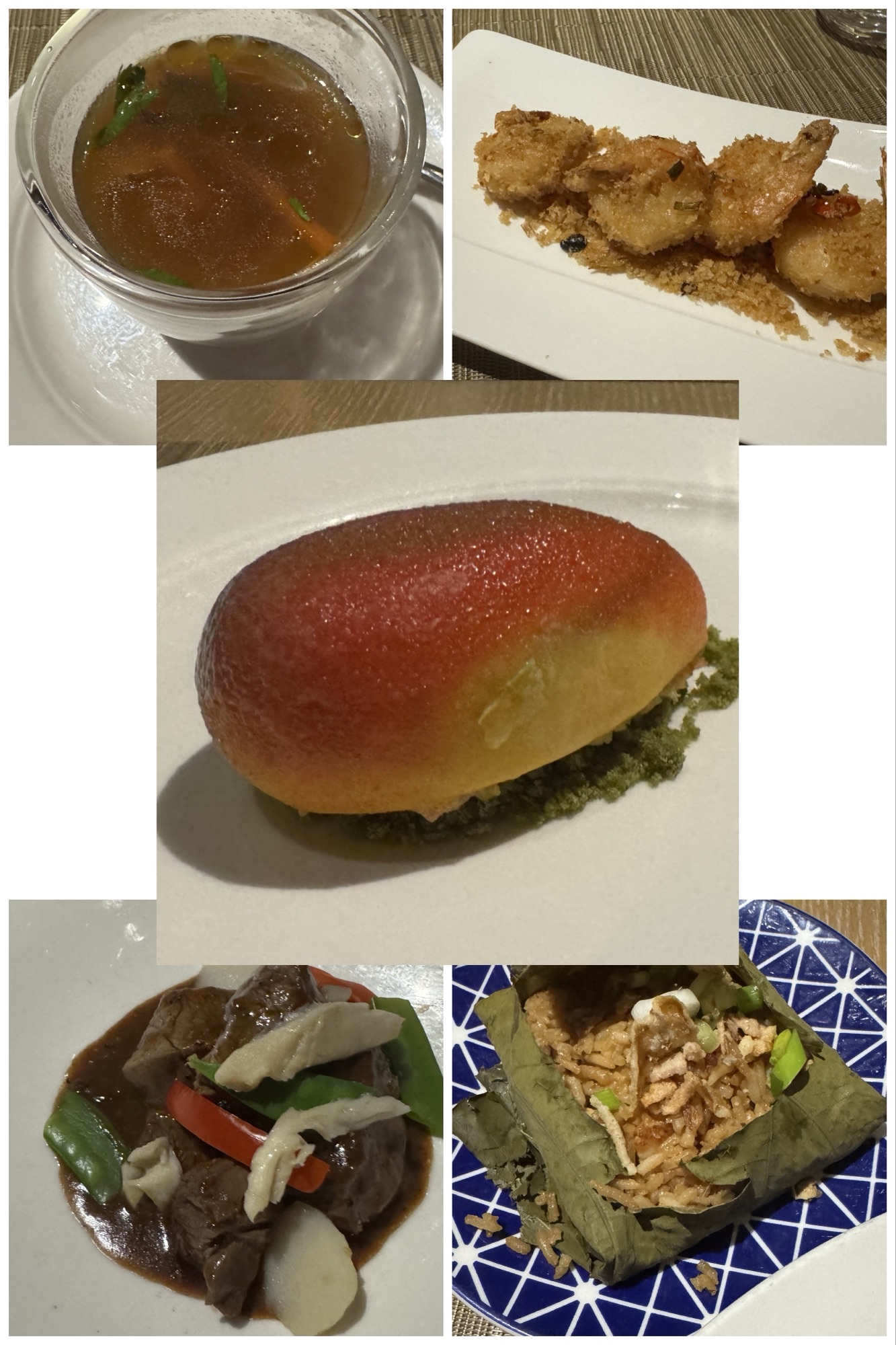
Centre: chilled mango and sago cream with a ribbon of tangy mango jelly, enrobed in white chocolate and decorated to look like a fresh mango.
Not shown: a palate cleanser coconut and lemon grass granita garnished with ginger foam.

Then off to the theatre to enjoy international opera singer Gordana Kostić in her second show, depicting operatic heroines and their search for love … and, all too often, their broken hearts.
With another sea day pending, there was no reason not to end our evening in Torshavn with the band.
DAY THREE
Those morning’s lecture by on-board naturalist Richard Lovelock was all about Africa’s “big five”: the Cape buffalo, the lion, the leopard, the elephant, and the rhino.
The “big” five is not actually related to size, but related – sadly – to the days of colonial hunting, and the 5 animals that were the most dangerous to hunt on foot as trophies. There was a ton of money to be made by hunters like Phillipus Praetorius, who claimed in his lifetime to have killed – or enabled others to kill – 2000 elephants. Teddy Roosevelt in 1909 went on African safari and killed over 11,000 animals (yup, eleven THOUSAND). Today, 20,000 elephants are poached each year as trophies and for ivory, the latter being a multi-billion dollar trade despite being illegal.
As recently as 2004, Britain’s Prince Harry shot a Cape buffalo as a trophy. Richard quipped that that might have been a hint as to Harry’s real personality. Richard is a Brit, so he gets to say stuff like that out loud.
How appalling is it that even today, trophy hunting of the big 5 is still legal, and relatively “cheap” – in dollars, not morality. As an example, 90% of rhinos species have been hunted out in the just the last 100 years. Similarly, in 1975 there were 250,000 lions worldwide, but now there are only 20,000 – and yet hunting them is still legal.

There’s always another side to hunting, though.

Fun trivia facts: Aslan is the Turkish word for lion; Simba is the Swahili word for lion. The two lions outside the New York Metropolitan Library are named Patience and Fortitude.
Since we’ll reach the Seychelles tomorrow, Richard also talked a bit about the Seychelles’ endemic wildlife, and encouraged us to take photos of everything we see, because most of the animals there live nowhere else on earth. The Seychelles were only inhabited by people in the mid 1700s, so there hasn’t been time to introduce too many invasive species.
Richard’s talks – and his photos – are fascinating.
Then it was time for my second haircut of the cruise by the delightful Stefan.
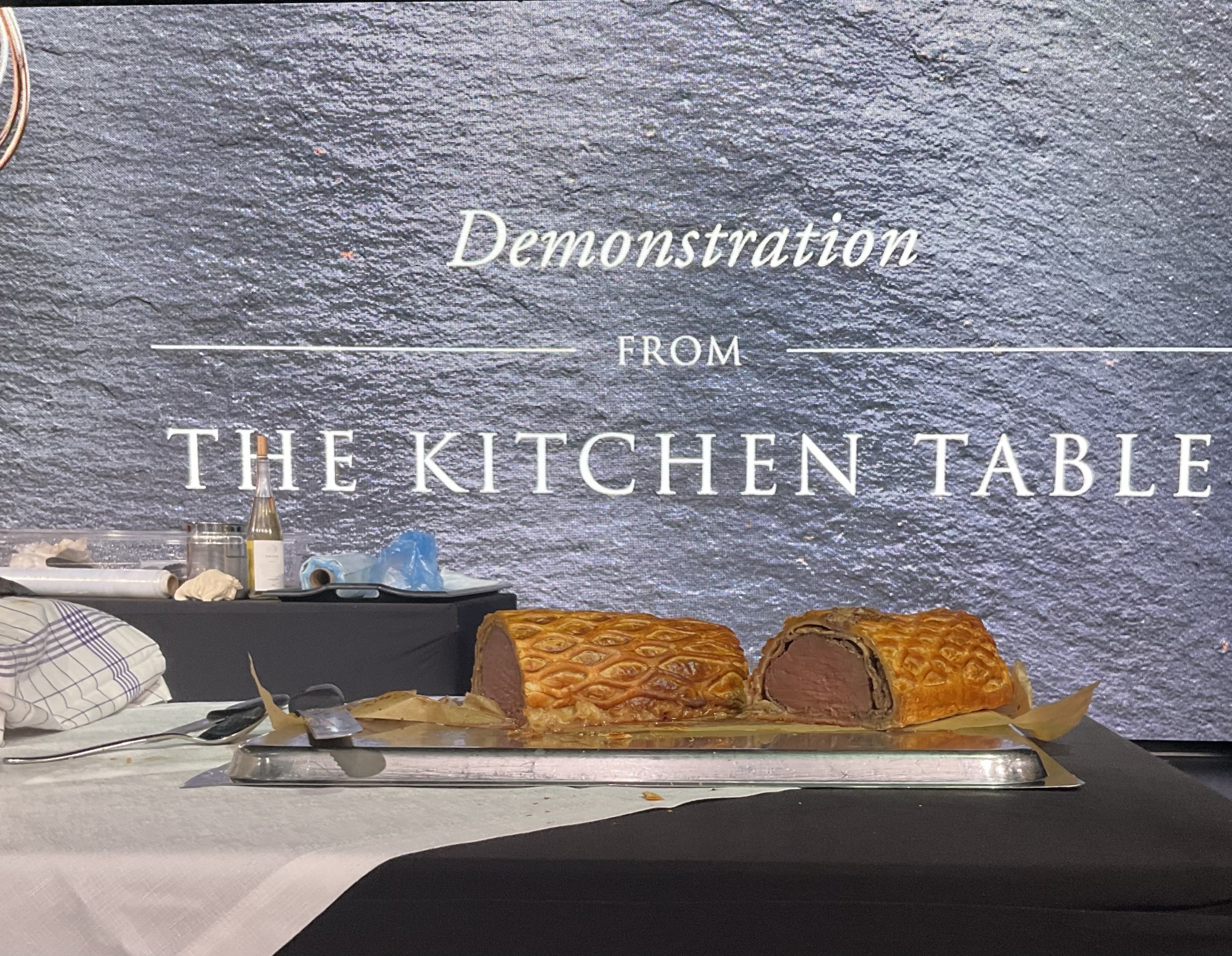
At 11:00 a.m. there was another of the wonderful cooking demonstrations that Viking’s executive and guest chefs present. Today, Executive Chef Alastair made Beef Wellington on stage while we in the audience drooled.
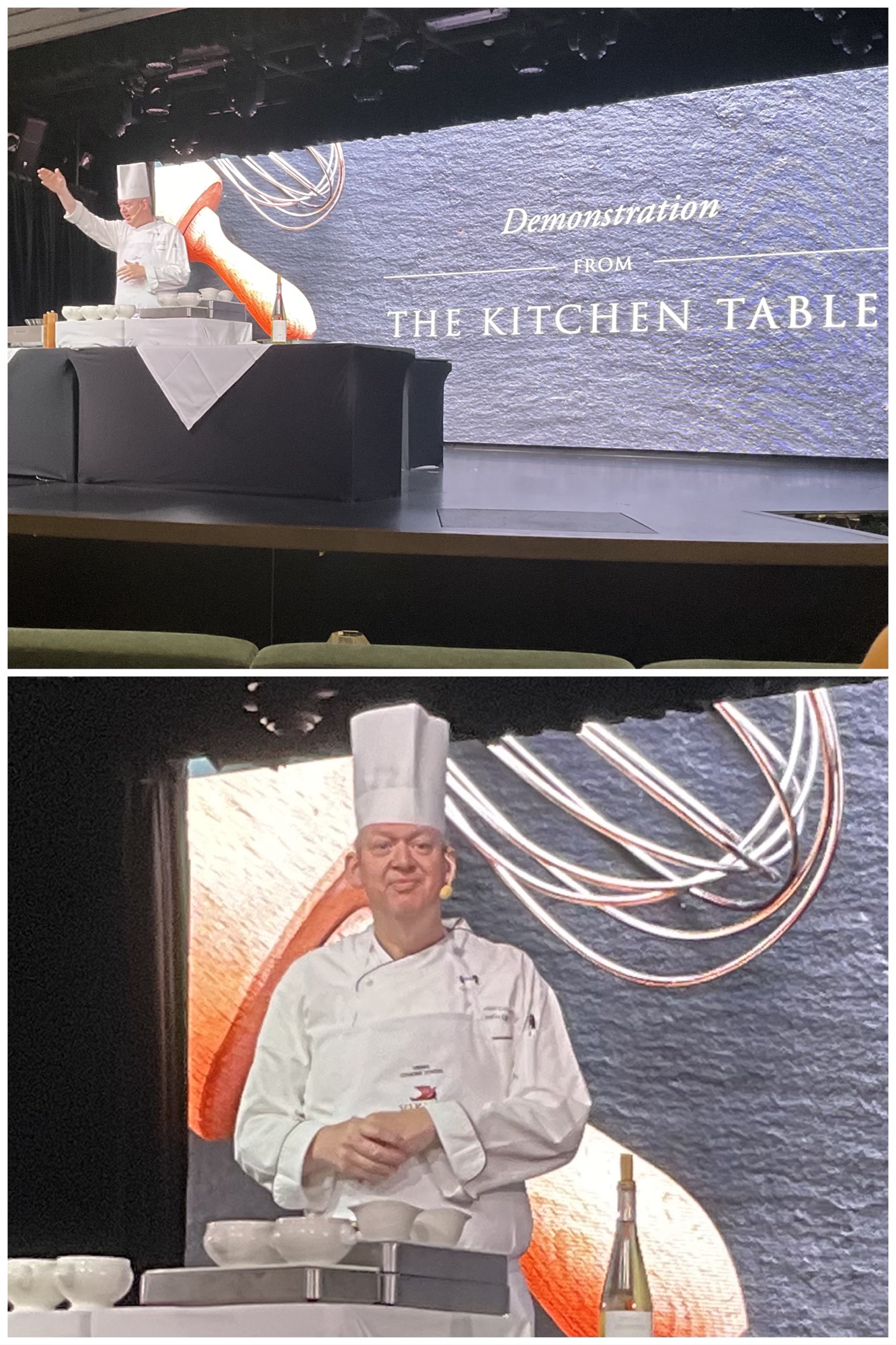
Chef told us he’s been working in kitchens for 27 years, starting as a pot washer, eventually mentored by various chefs. He explained that he’d done most of his training on ships, and become certified at age 40 (he’s currently 53), and that his humble beginnings are why he always appreciates his kitchen staff.
He hilariously made faces and gagging noises while he made the mushroom duxelles with truffles, because he absolutely hates their taste and smell – but he opined that by contrast sautéed garlic, butter, and onions are “a dream come true”. As he dealt with the truffles, he asked how many in the audience liked them, and to those who raised their hands he commented, “well, there’s something wrong with you lot then!” He also detests foie gras, which is why he’d never make traditional Beef Wellington for himself.
The big “Chef’s secret” today? Wrap the dressed beef in a very thin (almost translucent) savoury crepe (maybe with a bit of thyme in the batter) before wrapping it in the pastry, which (in addition to a layer of prosciutto) will prevent the pastry from becoming soggy from meat juices! Chef also fancied up the Wellington with a lattice pastry top because “we’re Viking, so it needs to look posh”. Hilarious.
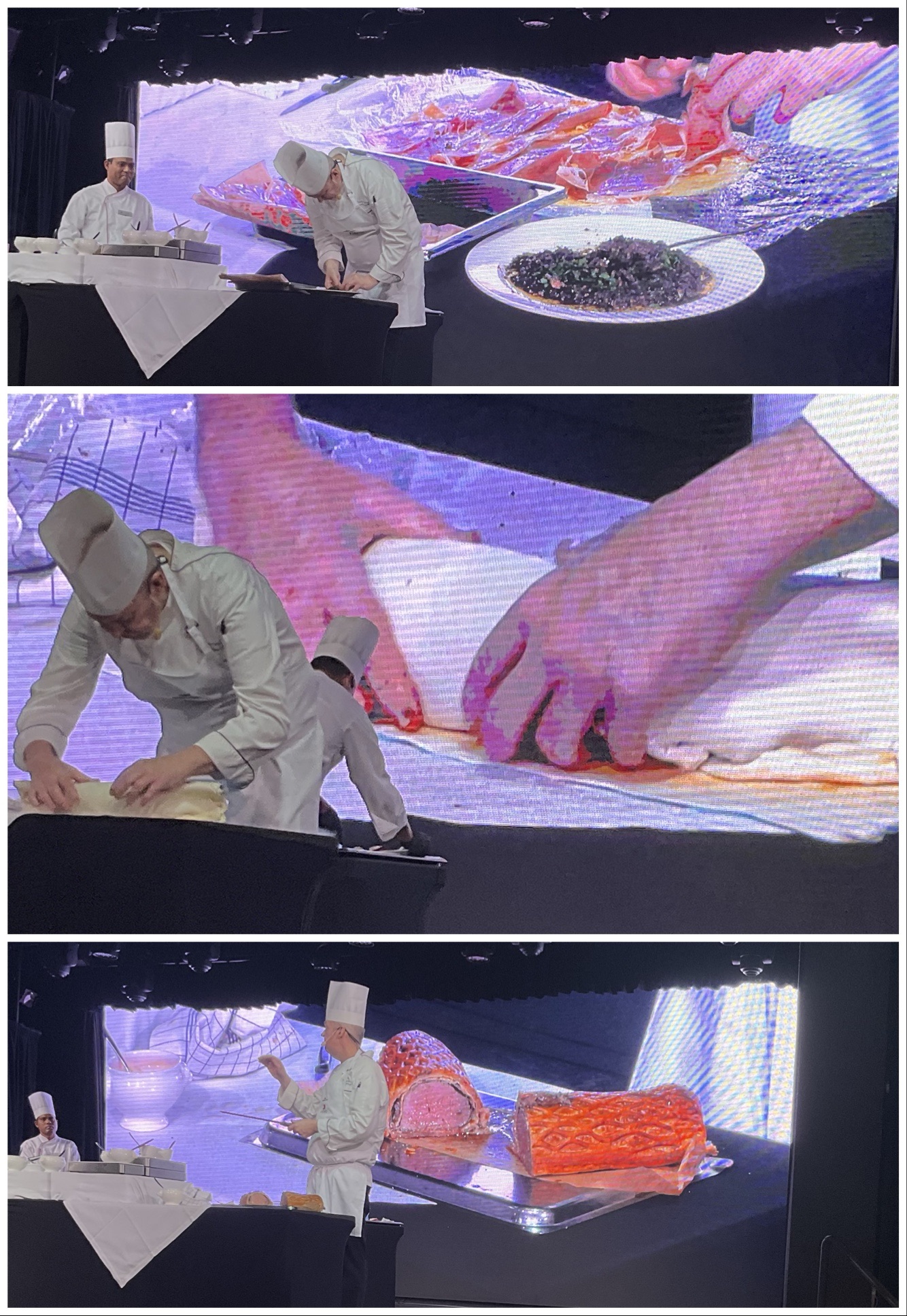
Attending the demonstration meant that we also got the inside information during the demonstration that, when we reach Honfleur in France, Chef will be buying fresh French cheeses and breads and creating a huge cheese event!
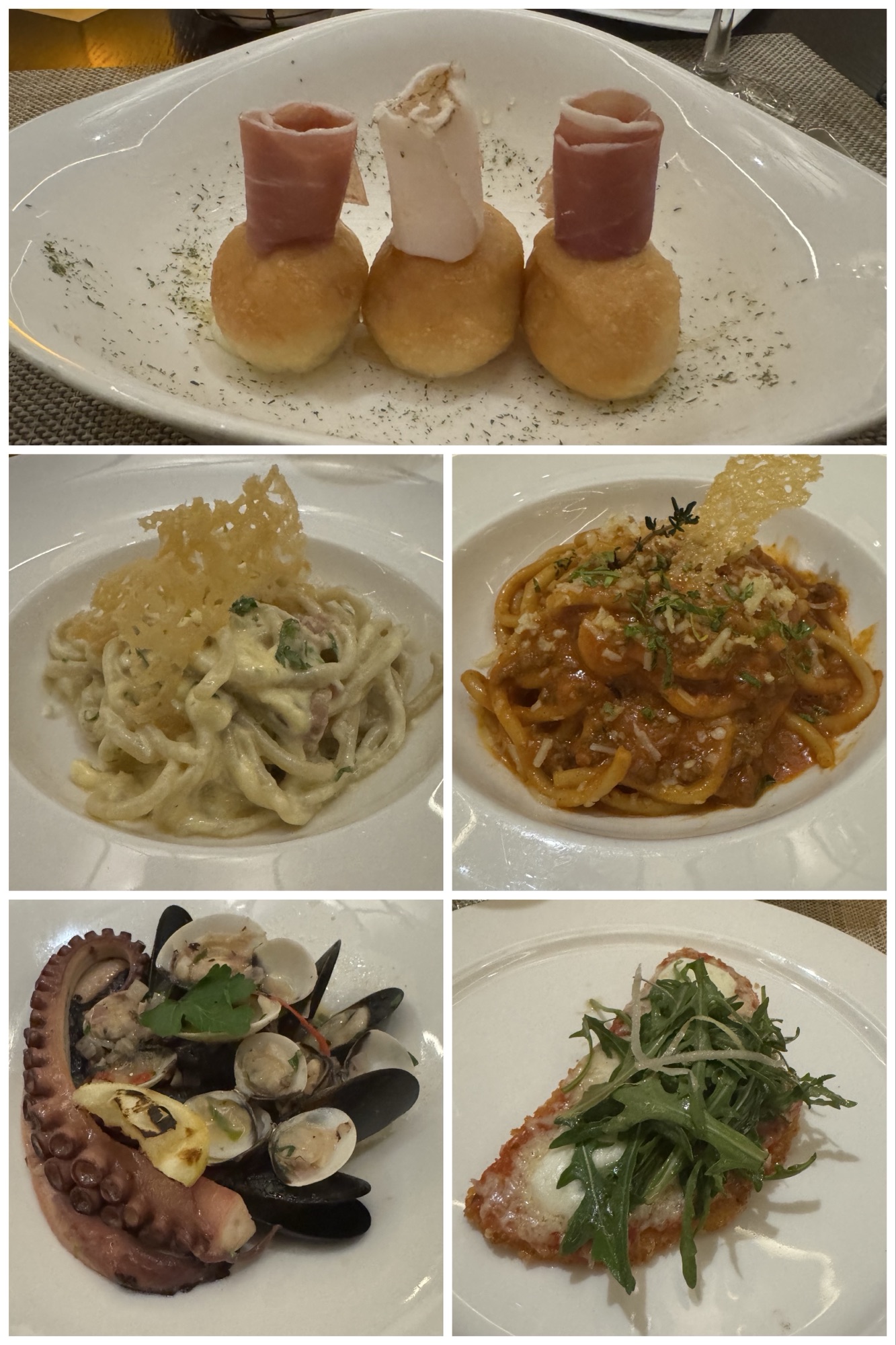
Tonight there’ll be Beef Wellington in both the World Café and the main restaurant, but Ted and I have reservations in Manfredi’s. While we understand the popularity of Beef Wellington, it’s not a particular favourite of ours.
Lunch featured a Caesar salad station with freshly grilled salmon, shrimp, or chicken. Delicious.
In the afternoon, there was a meeting to pack up the books that passengers had bought to help set up the CEFZ School Waldorf primary school in Zanzibar. There’d been some challenges arranging delivery, but eventually the Rotary Club in Mombasa stepped in to help, so the books will go to the intended school. There was inventorying and packing to do in preparation for that transfer.
At 4:30 there was a port talk for the Seychelles – important because we have a 10 hour excursion there for which we need to understand the logistics.
Then, before dinner, it was time to video chat with our #1 in Toronto, who was celebrating their 44th birthday. Gotta love technology that allows us to stay connected no matter where we are in the world…as long as we can keep our timezones straight!
This evening’s entertainment was a high energy show by the Viking Vocalists that had us clapping in time and singing along.

And so to bed. We have a long tour tomorrow.


How lucky th
LikeLike
Sadly, your comment got cut off. Not sure why that happens 😢
LikeLike
I would love to know how you look so adorable and have just the perfect outfits when I know that you pack light. What is your secret?
LikeLike
First, thank you 😆. Less light on this trip, since we’re travelling with everything we own (two 25” suitcases and two 17” carryons), but really the only secret is that warm weather clothes take up much less room than cold weather ones – and I hardly ever wear sleeves!
LikeLike