It was a short day here on Phuket Island, as we once again melted in the heat and humidity.
We began the morning anchored offshore, shuttled to Patong Beach using Thai boats instead of our own tenders. While we’d been told about that ahead of time, we were never told why.
No worries, though. The Thai vessels brought their own pontoon platform to the side of our ship and made it a very smooth operation.

When we reached the beach, we understood why our tenders would not have been suitable. There was no permanent dock, just a series of pontoons tied to each other to form a floating jetty.

At Patong Beach, the shore birds and fishing boats greeted us.

Since we’ve not been in Thailand before, and this is our only stop here on this cruise, rather than just do the included walking tour we signed up for a slightly more panoramic experience, although we knew it would not be in-depth.
Last evening, we took in Dr. Bryan Babcock’s lecture of the history of Thailand, focusing on its monarchy, with its series of forward-thinking rulers who created strong economic alliances around the world. We also learned about the completely bloodless coup that transitioned the country from monarchy to constitutional monarchy.
We learned that Thailand had never been colonized, and that its current King (since 2016) is Maha Vajiralongkorn, known as Rama X (the 10th), the tenth monarch of Thailand in the unbroken Chakri dynasty.
I was always curious about the name change from Siam to Thailand. (From HistoryToday .com) “People speaking one of the Tai group of languages settled in what is now Thailand around 1,000 years ago. The name Siam came from a Sanskrit word, syam. It was adopted by the Portuguese from the 16th century and became the accepted geographical term.” Siam officially changed its name to Thailand in 1939 to reflect a stronger sense of Thai nationalism. Somehow, maybe because I watched The King and I obsessively, I’d thought that name change was much more recent.
On to Phuket ( pronounced “p-hoo-kett”, not “foo-kett”). That’s actually the first thing I learned!
We had a short scenic drive past beaches and shops which would later be filled with tourists. Our charming guide Pui explained that Patong Beach is a party town that doesn’t really get going until about 2 p.m. and then keeps going until 4 a.m. At 10:00 a.m. when we arrived, all those partyers and business owners were still sound asleep.
Phuket is Thailand’s largest island, and its western side has a low mountain ridge called the Nakkerd Hills. Those hills protect the eastern side of the island from monsoons coming in off the Andaman Sea (part of the Indian Ocean), but also made our drive across to Phuket Town interesting.

Our main destination for today’s tour was Wat Chalong (Wat Chaiyathararam). “Wat” simply means temple. The second word can be a location or a deity.

It’s not just one building, but an entire complex of shrines adorned with carvings and gold. They look quite different to the pagoda-shaped shrines we saw in Petang.
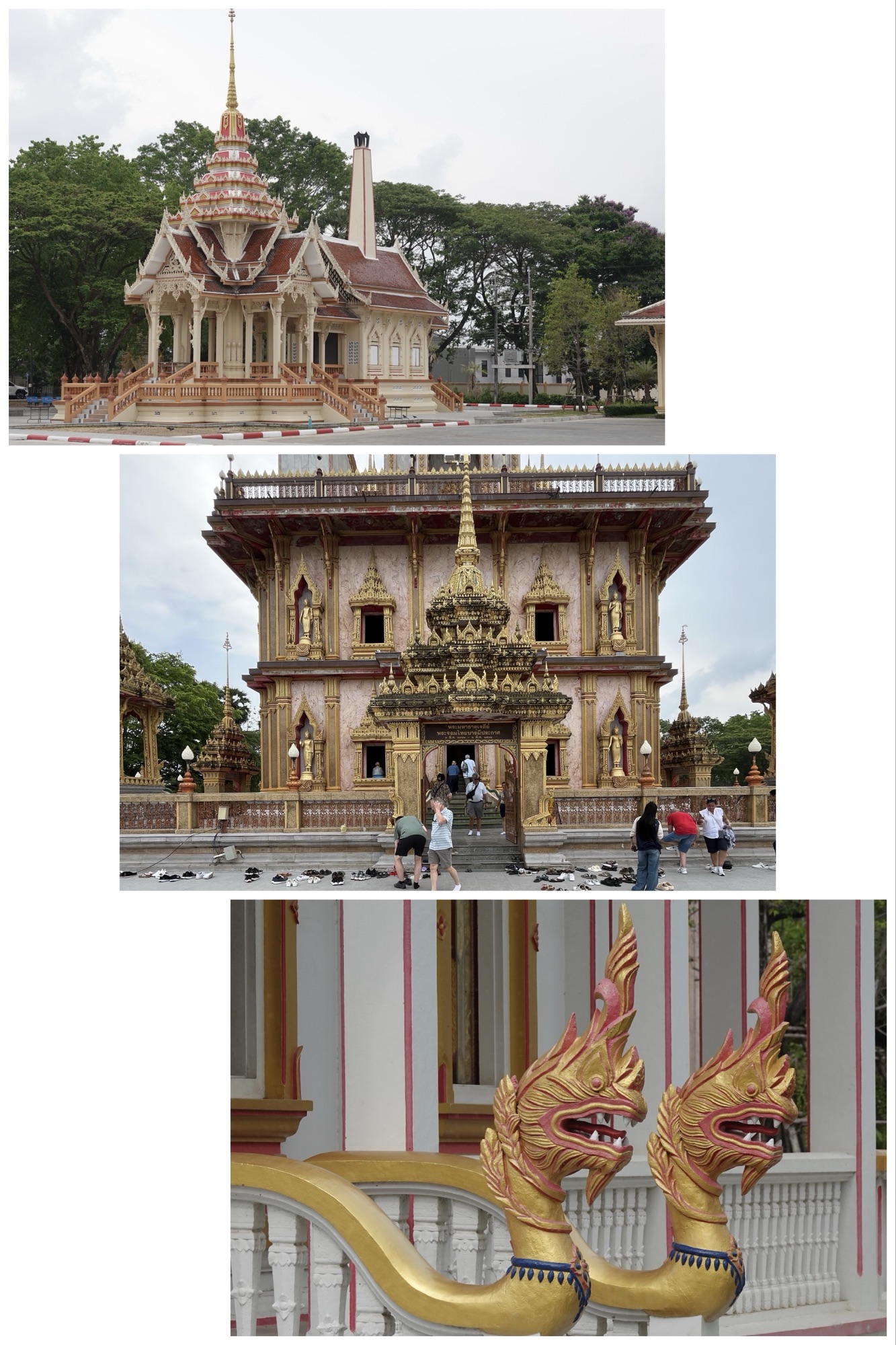

Our guide did not narrate our visit to the complex; we were free to enter any open buildings – shoes off and shoulders covered of course – but not the building in which the monks were engaged in prayer.

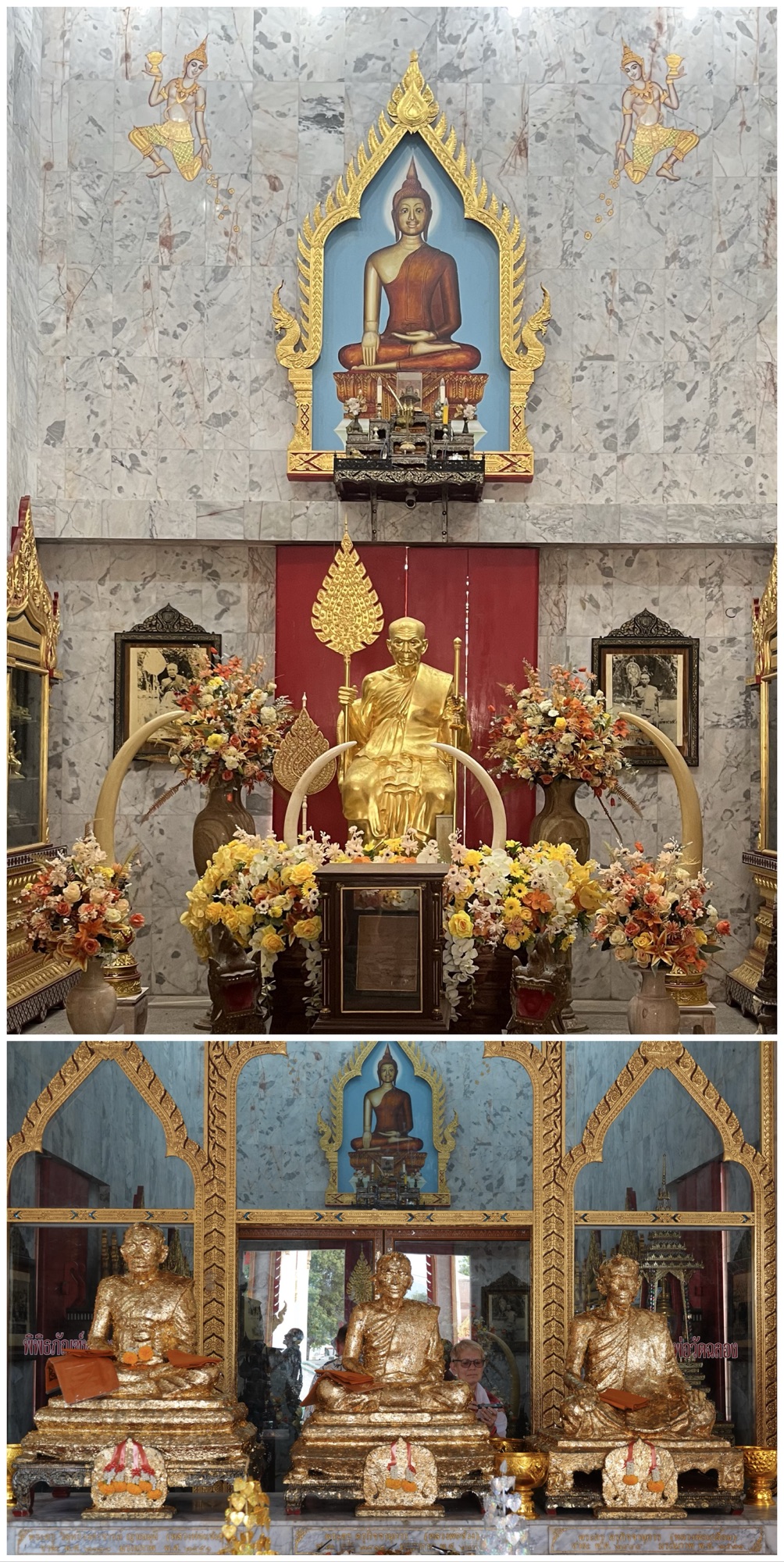
Inside the main temple is a splinter of bone said to belong to the Buddha, and three bronze statues depicting monks who protected Phuket’s inhabitants during the 1876 Ang-Yee Rebellion of Chinese mine workers.

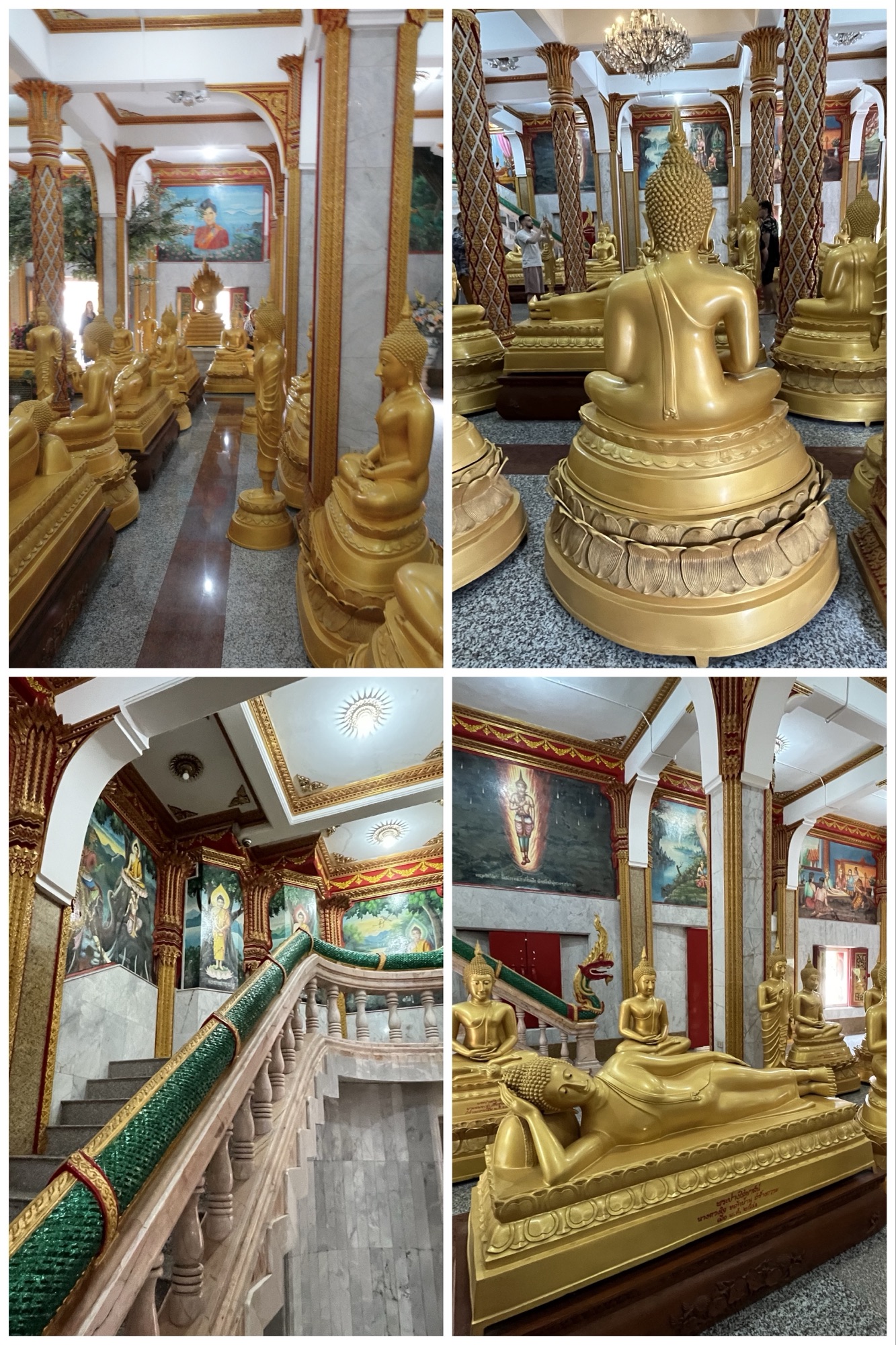
The last temple we went into – very briefly because we needed to get back to the bus on time – was absolutely crowded with golden Buddhas depicted in every position, including a reclining one.

During our entire visit we could hear (but not see) monks chanting the first 5 precepts of Buddhism: promises not to kill, steal, commit or cause adultery, lie or gossip, and drink alcohol. Our guide explained that she was already in big trouble as a Buddhist, because she regularly kills mosquitoes.
Our guide talked quite a lot about how the precepts of Buddhism affect everyday Thai life.
We learned that:
- The Thai culture is one of gratitude, which creates an inherent respect for their parents and elders, who are seen as having made their lives possible.
- There is an acceptance that nothing is permanent, so both happiness and sadness are welcomed as part of a full life.
- Good deeds do not negate bad ones. Karma can be good or bad, and may not affect a person directly, but could equally touch the people or things they love.
- Most Thai males become Buddhist monks at some point in their lives. Being a monk is not a lifelong commitment.
- Buddhist monks cannot touch females – not even their family members – unless it is required in order to save a life or aid someone in distress.
- It is harder to be human than to be the blind turtle in the Buddhist parable who beats nearly impossible odds to emerge from a floating wooden yoke in the ocean once every 100 years through a tiny hole to breath.
Back on the bus, our guide made the correlation between offerings and good deeds. We’d been seeing gold leaf sold as offerings to the Buddha. Pui told us that rather than make obvious offerings in front of the statues, there is a parable that talks about placing gold behind the statues. Once there is enough there, it will shine to,the front; similarly, enough good deeds will create a good world.
After visiting Wat Chalong, we drove to the west coast of Phuket to visit Kiew Tien Keng, a really visually crowded and almost gaudy Chinese Taoist shrine at Sapan Hin park.

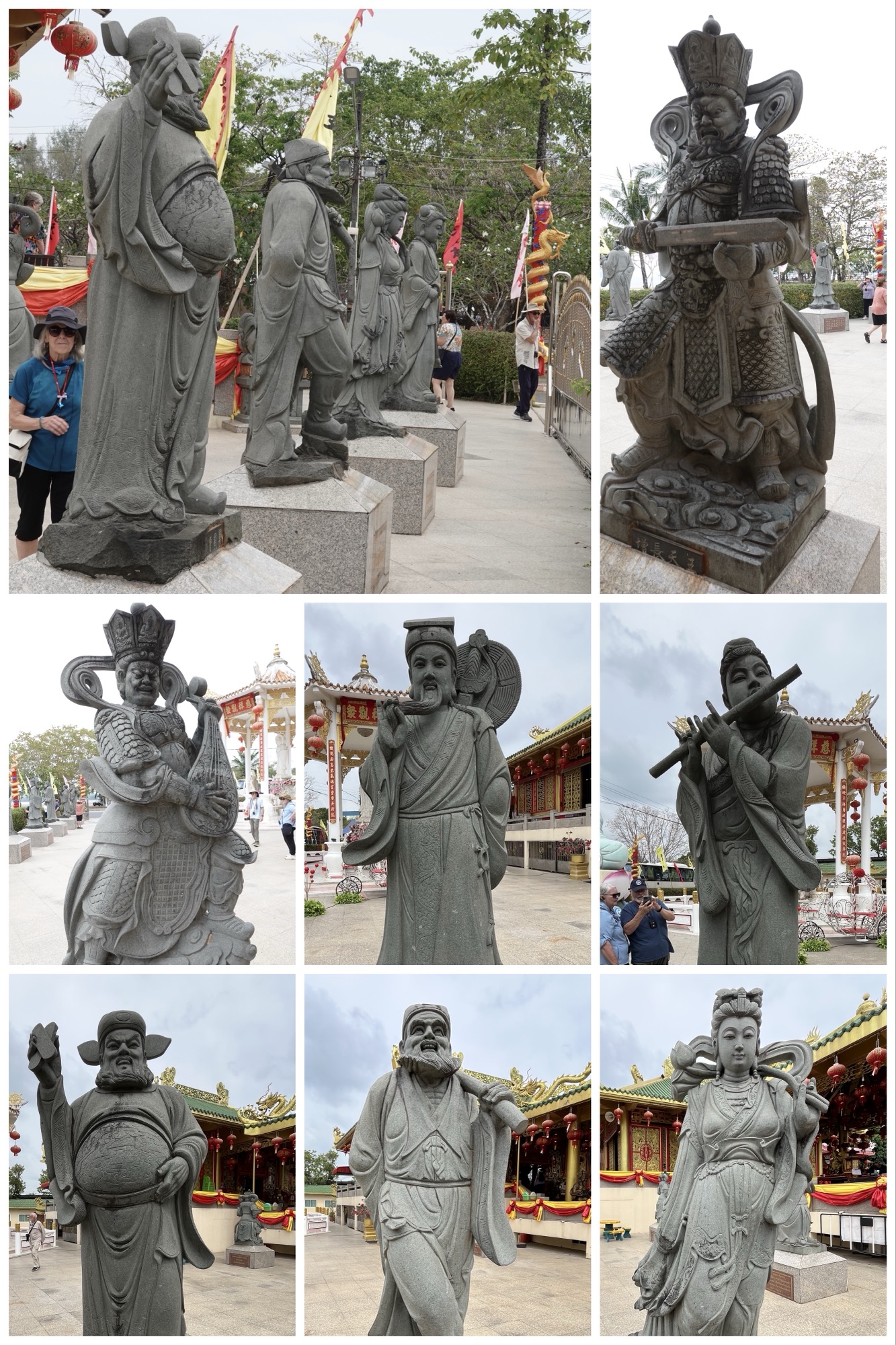

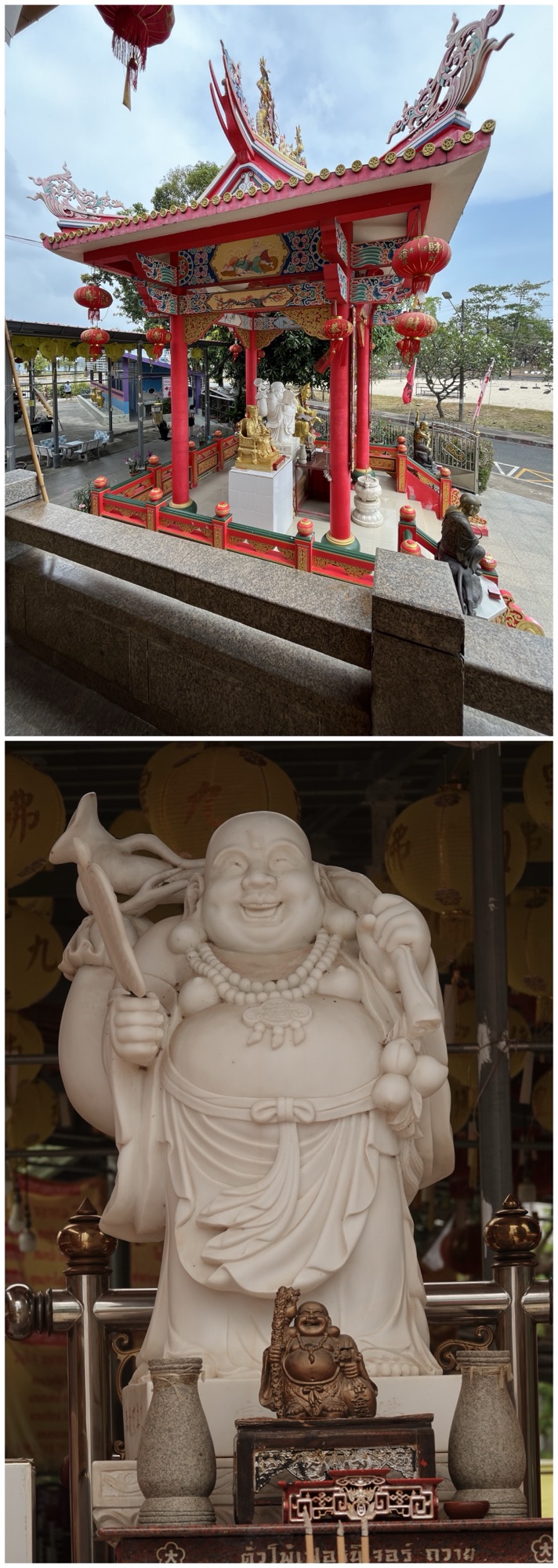

The reason there are so many Chinese in Thailand is that they came as workers (“coolies”) in the tin mines, mostly during the reigns of Rama III and Rama V.
Those workers and their families brought with them their Tongsi (“Tongs”, or family associations) who created social networks to support each other, and built temples that were different from those at which the Thai people worshipped.
Our guide explained that Thais espouse Theravada Buddhism, which believes that the Buddha, who was after all a human, died and went to nirvana and left us his teachings. Most Chinese in Thailand espouse Mahayana Buddhism, which believes that the Buddha is still alive in male and female forms (the goddess of mercy being one) to actively help people. In simplistic terms, Theravada Buddhists believe Buddha is a saint; Mahayanas believe he is a saviour.
The huge Buddha statue here is made of 17 TONS of marble, and stands 5.2m/16ft high. Buddha is depicted sitting on an open lotus, with closed lotus buds and what look like mud balls beneath.

Once we were back on the bus, Pui told us the significance of the lotus flower in Buddhism.
A tall blooming lotus is the most beautiful, like an open-minded person ready to learn. A lotus just above the water is like an open-minded, but one who needs more knowledge. A lotus on the water is an open cup – empty mind – that needs much instruction. And finally, a lotus in the mud is a closed mind; it cannot grow so just becomes food for the turtles.
That information lent some perspective to the lotus tile floors we’ve seen in so many Buddhist shrines.
Offerings of closed lotus flowers are often made. In that case, the closed flower petals are peeled back and folded to become more beautiful. Piu demonstrated that for us. She also explained that the flower offering should be gently tossed, not just laid down.

We’d been focusing on religious sites. Now it was time first architecture, shopping, and food!
We drove into Phuket Old Town, where surprisingly well-preserved shop houses on Thalang Street have been converted into a vibrant retail and restaurant hub.


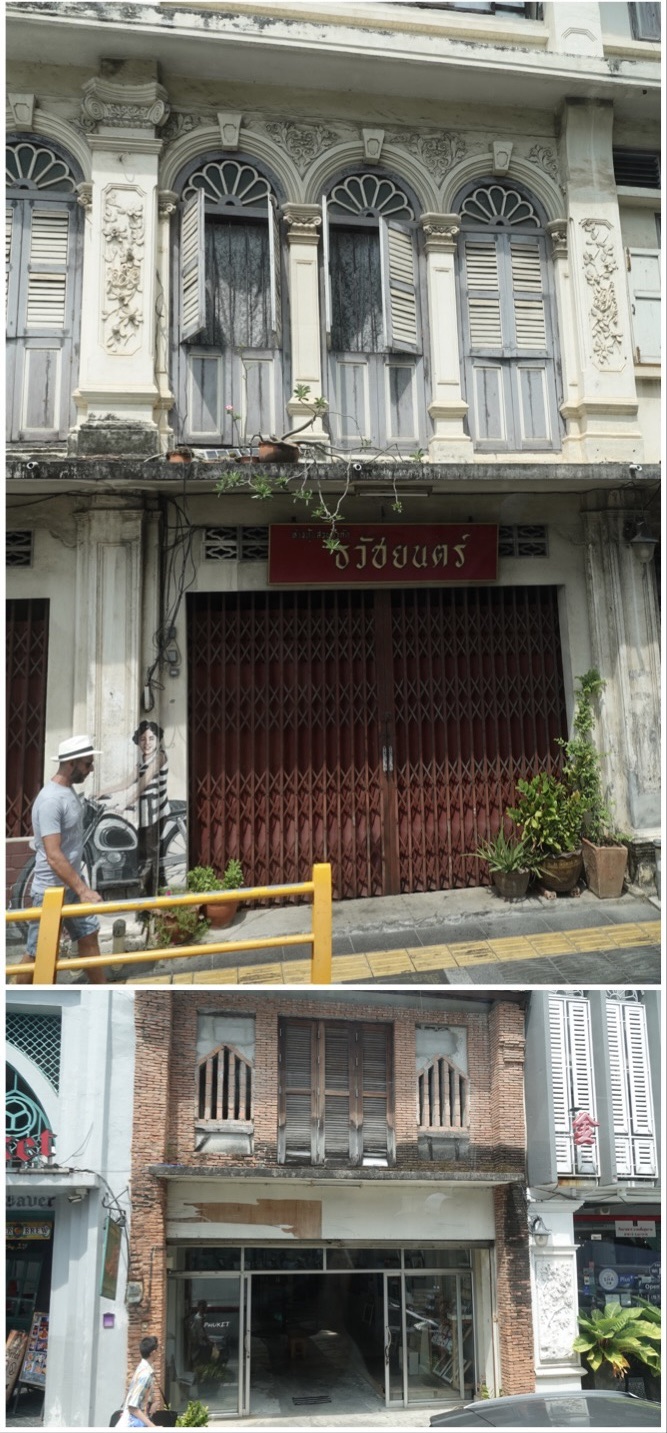
Our group had the option to stop for a cool drink in a shady garden, but Ted and I chose to walk to Soi Romanee, a side street that was once a famous red-light district. Today, it is a destination for Instagram influencers and people looking for picturesque cafés and retail therapy (I partook in some of the latter).

Viking doesn’t include much shopping time in their excursions, which means that sometimes a quick impulse buy turns out to simply have been a donation to the local economy. That’s likely the case with my Malaysian purchases, but I think the items I bought on Soi Romanee will actually be keepers.
Our last official tour stop was 30 minutes at a large store called Rich Home, which had everything from custom made teak furniture to dresses, menswear, athletic wear, lingerie, souvenirs, candy, jewellery, and herbal remedies and lotions. Upon entry, we were each given an iconic blue IKEA shopping bag in which to collect our purchases. Hmmm.
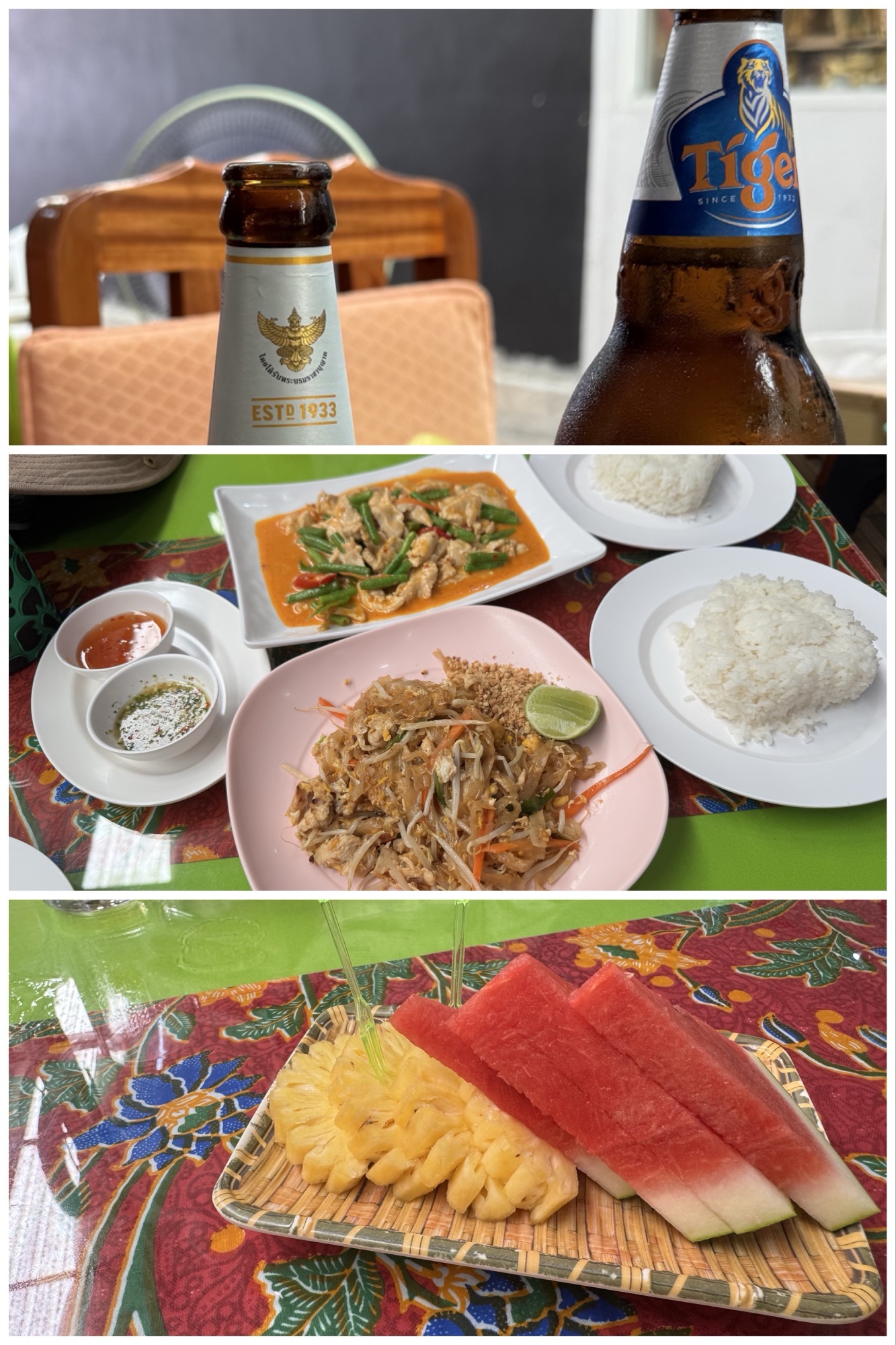
When we arrived back at Patong Beach, Pui recommended a local restaurant called Da No. 1, where we grabbed a delicious lunch of chicken pad thai, red curry chicken, rice, and a couple of Thai beers.
I took the opportunity on our way back to the tender to walk in the surf of Patong Bay.

Even though we were back at the ship by about 2:30 p.m. we were exhausted. I keep thinking we’ll get used to the heat, but – maybe because we’re returning to air conditioning each night – every day it’s a new learning curve for our bodies.
We’re headed into two sea days before reaching Sri Lanka.


We were whining about the weather and told th
LikeLike
Please comment by email if you can. Still can’t figure out why, but your comments are always cut off
LikeLike
You have reminded me how very much I love Thailand, especially the watermelon and pineapple that is the sweetest I have ever found. And the beautiful, softspoken, and kind and gentle people. A favorite world destination for me. Thank you for writing so eloquently about your journey.
LikeLiked by 1 person
You summarized it perfectly!
LikeLike