We know several American couples who have chosen Kuala Lumpur as their second home, and there are plenty of expats living here, so we were very curious about what makes it so attractive to them.
Our hope was that our Viking tour would give us some perspective.
In order to prepare myself, yesterday I took in the onboard lecture by Nitza Lowenstein about Malaysia’s rich cultural diversity.
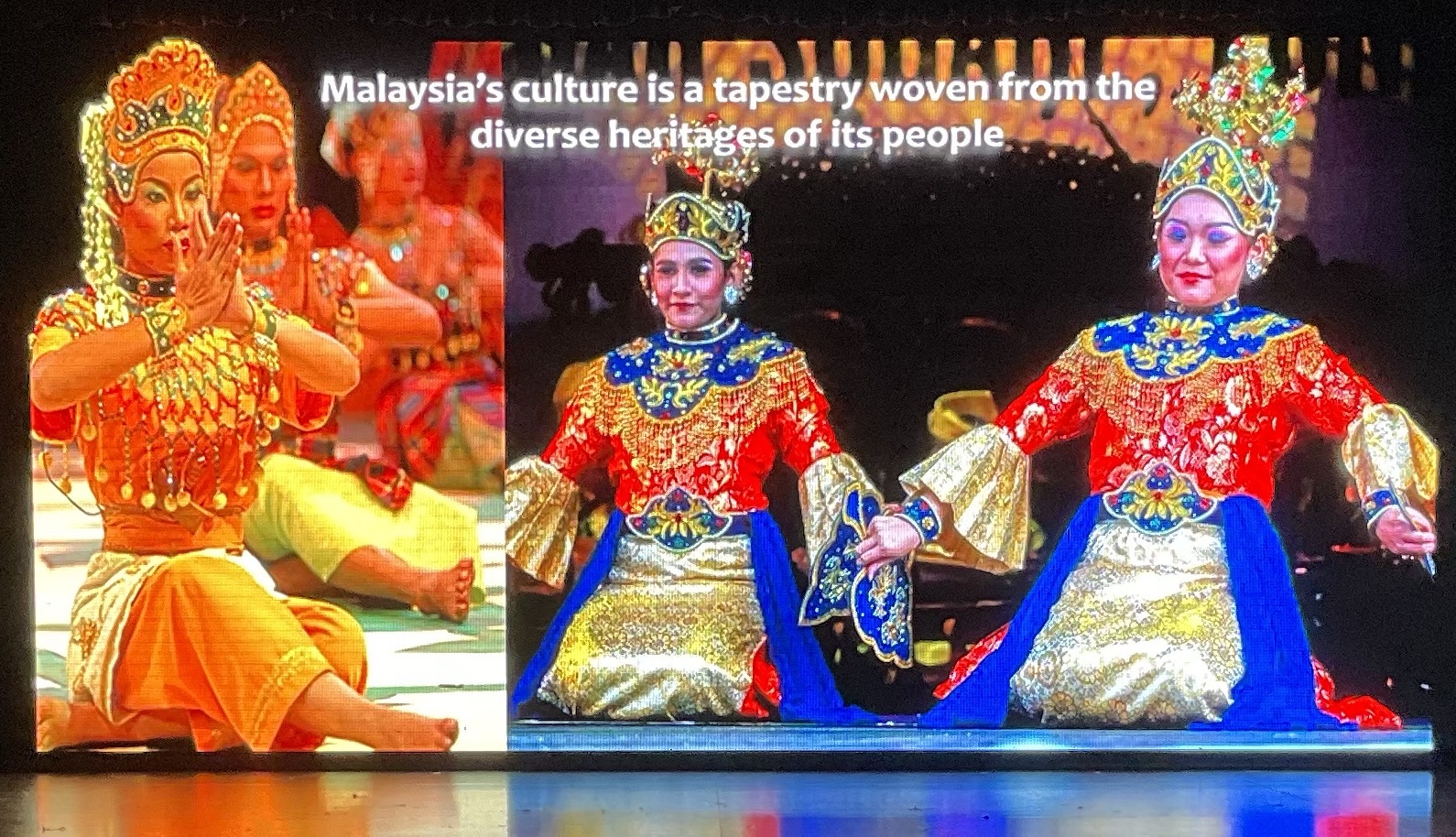
Malaysia is located on the Malacca Strait, which has always been an important trade route in Indochina. That logically led to a mix of all the cultures using that route. The Islamic influence, originally brought through traders, dates to the 13th century, and has virtually overtaken the earlier Hindu tradition. In the 15th century the Portuguese dominated the strait, in the 16th century the Dutch, and subsequently also the British. The Anglo-Dutch Treaty of 1842 effectively defined the borders of what we now call Indonesia (Dutch) and Malaysia/Singapore (British).
The largest ethnic group here are of Malay origin; the constitution requires that all ethnic Malays be Muslim – by law. Nitza commented that “what you actually think no one cares, but you are legally Muslim”. A non-Muslim marrying a Muslim must convert, and legally cannot convert back even if they divorce. Otherwise, freedom of religion is enshrined in the constitution. At 23%, the next largest ethnic group is Chinese, and they are considered the economic power in Malaysia. Almost 7% of Malaysians are East Indians, about 12% are indigenous peoples, and there are also some Eurasians.
The government here is a federal constitutional monarchy, with a King who is in charge of the Islamic religion and is commander-in-chief of the military, and a Prime Minister who is the administrative leader. Elections are held every 5 years, but what I found far more interesting was what our tour guide explained: the King changes every 5 years too! At the time of Malaysian independence, the western portion of the country (“Malaya”, as distinct from the eastern portions attached to Borneo) has 9 sultanates. Rather than argue about which Sultan would rule, the 9 take turns on a 5 year rotation!
Each Sultan has his own palace and homes in his own province, but moves into the national palace in Kuala Lumpur during his 5 year “rule”. His wife becomes Queen Consort.
Nitza talked a lot about the various traditional costumes, and diverse wedding ceremonies, none of which we are likely to see, but were nonetheless interesting (and involved some very pretty photographs). We will, however, likely see examples of the many varied architectural styles and varied foods typical of each ethnicity.
That was a lot of information!
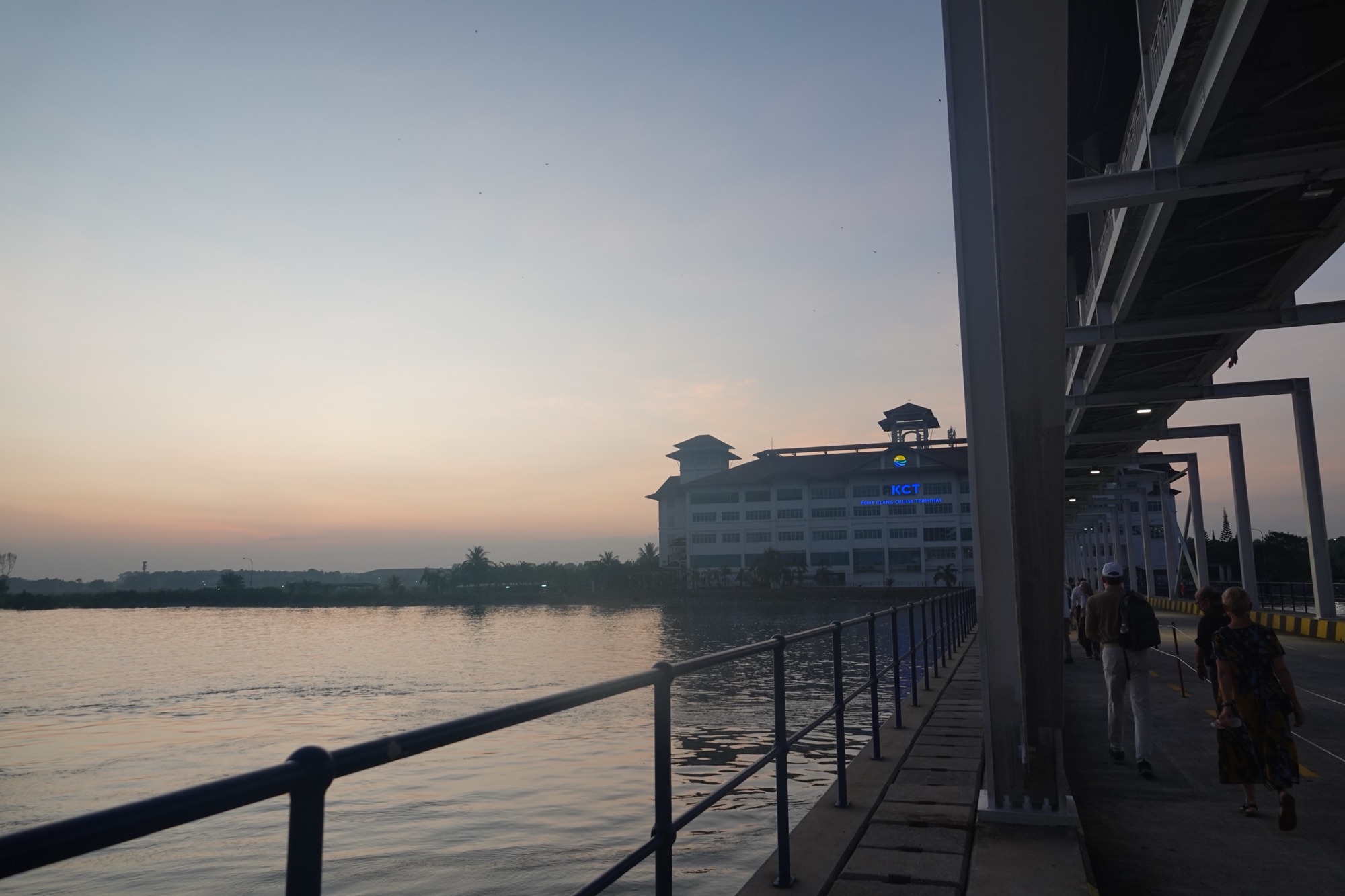
We docked in Port Klang just before 7:00 a.m., and our excursion spanned 7:30 until 3:30, so we can definitively say we had a full day!
Weather? The prediction was for a sunny morning, and a rainy afternoon. High temperatures reaching 36°C/96°F. We’re almost getting used to hot and steamy.
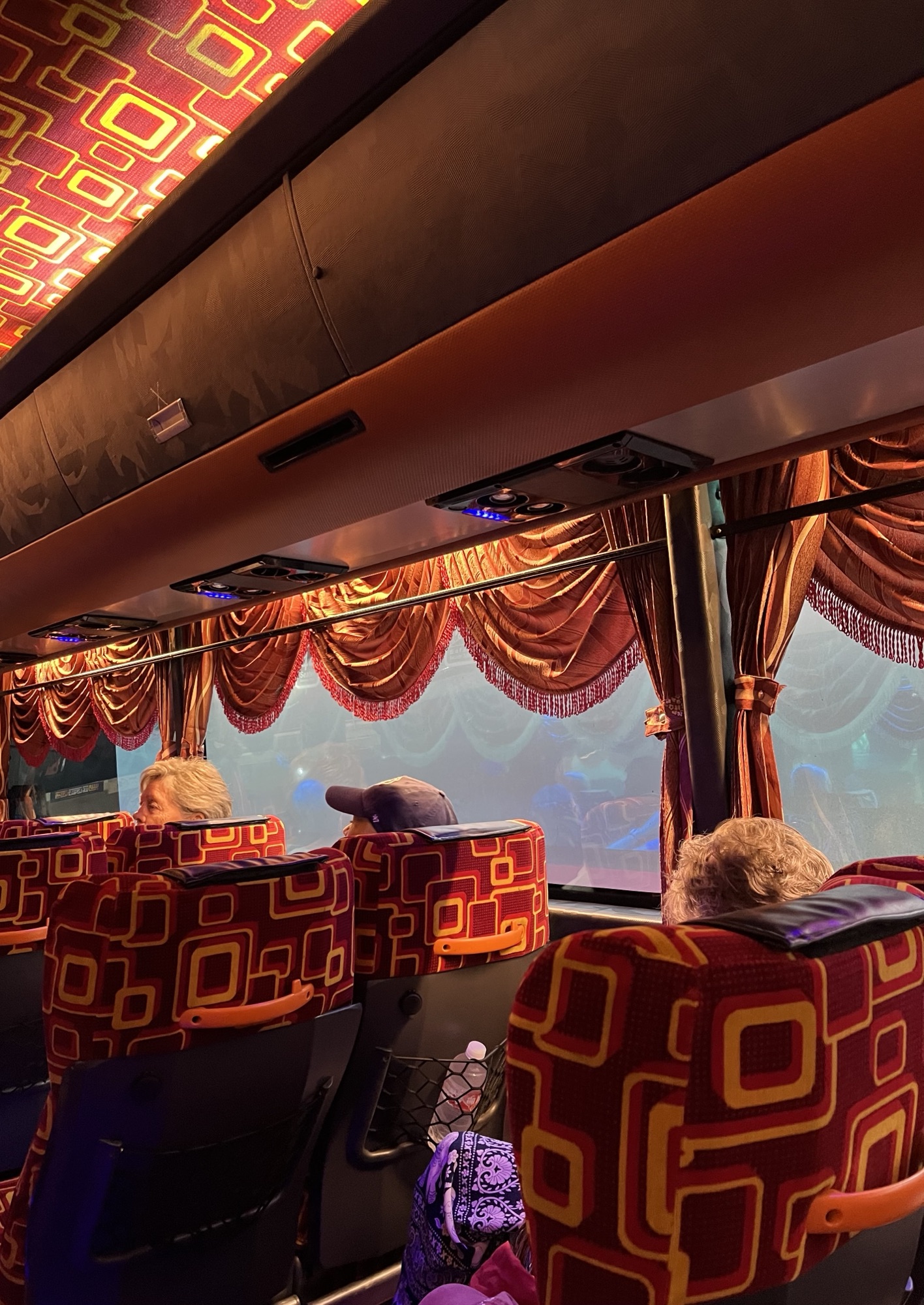
Our guide was far less talkative than most that we’ve had. Since I was sitting near him, I asked – and he answered – several questions, but he made no effort to do so over the microphone to the whole group.
Here’s some of what I learned:
- Education is free for the first 11 years of schooling. Both genders go to school.
- There is both public and private health care. Public care requires a token “administration” payment of 1 Malaysian ringit, worth 0.32 CAD/0.22 USD.
- There are no unemployment benefits; everyone is expected to work.
- Petroleum refining is the biggest industry. Petronas is the national petroleum company. The Malaysian government sets the per litre price of gas, and it is the same everywhere in the country.
- The government only builds public housing when needed to move people out of slums.
- There are more jobs than Malaysians willing/able to do them, so immigrant labour is brought in from Bali and other parts of Indonesia, India, and Bangladesh.
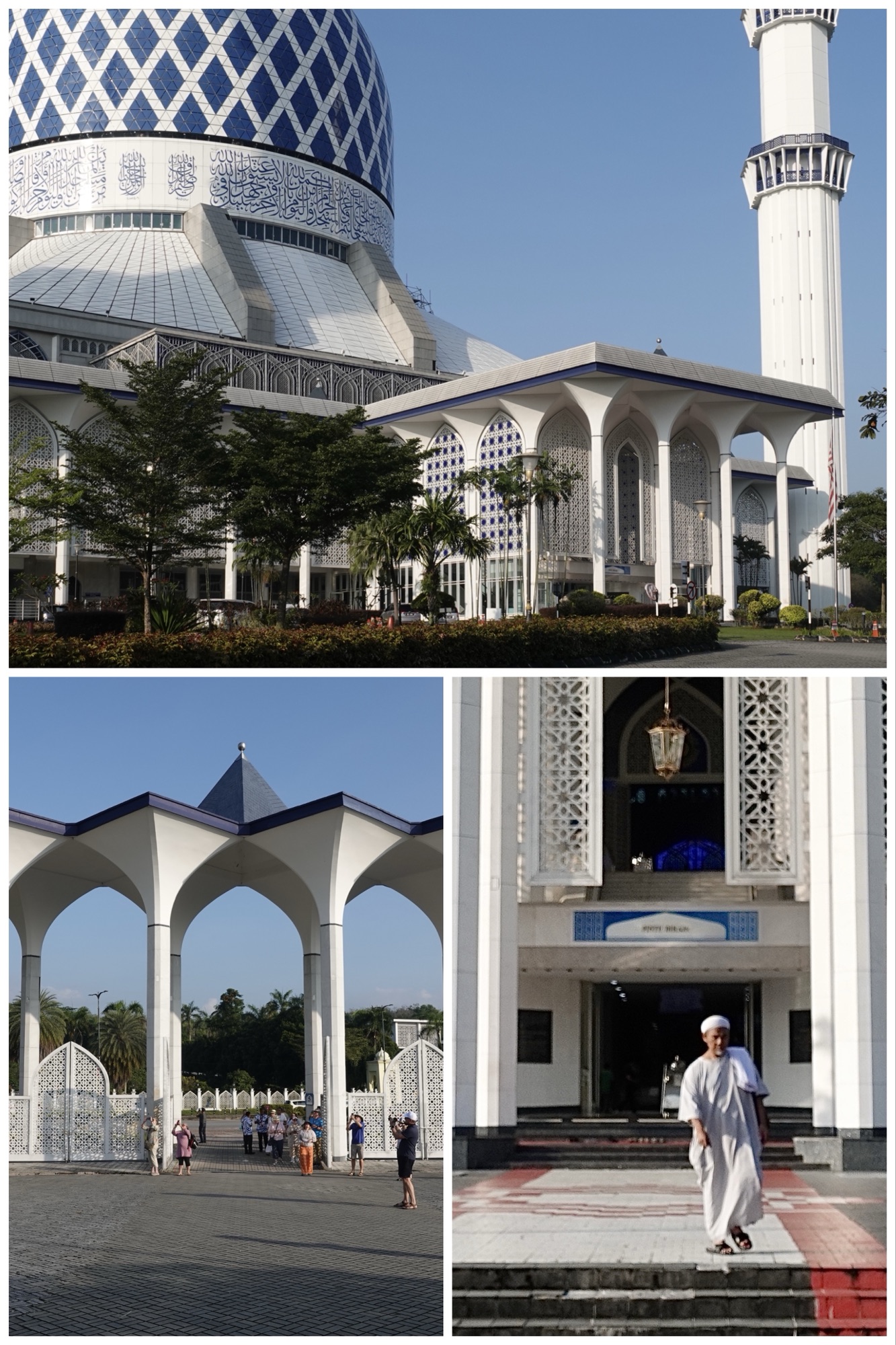
We rode from port past impressive new developments, and lots of active building sites, to a photo stop at the landmark Blue Mosque, which has the largest dome in Southeast Asia. Blue, we were told, is the colour of unity.
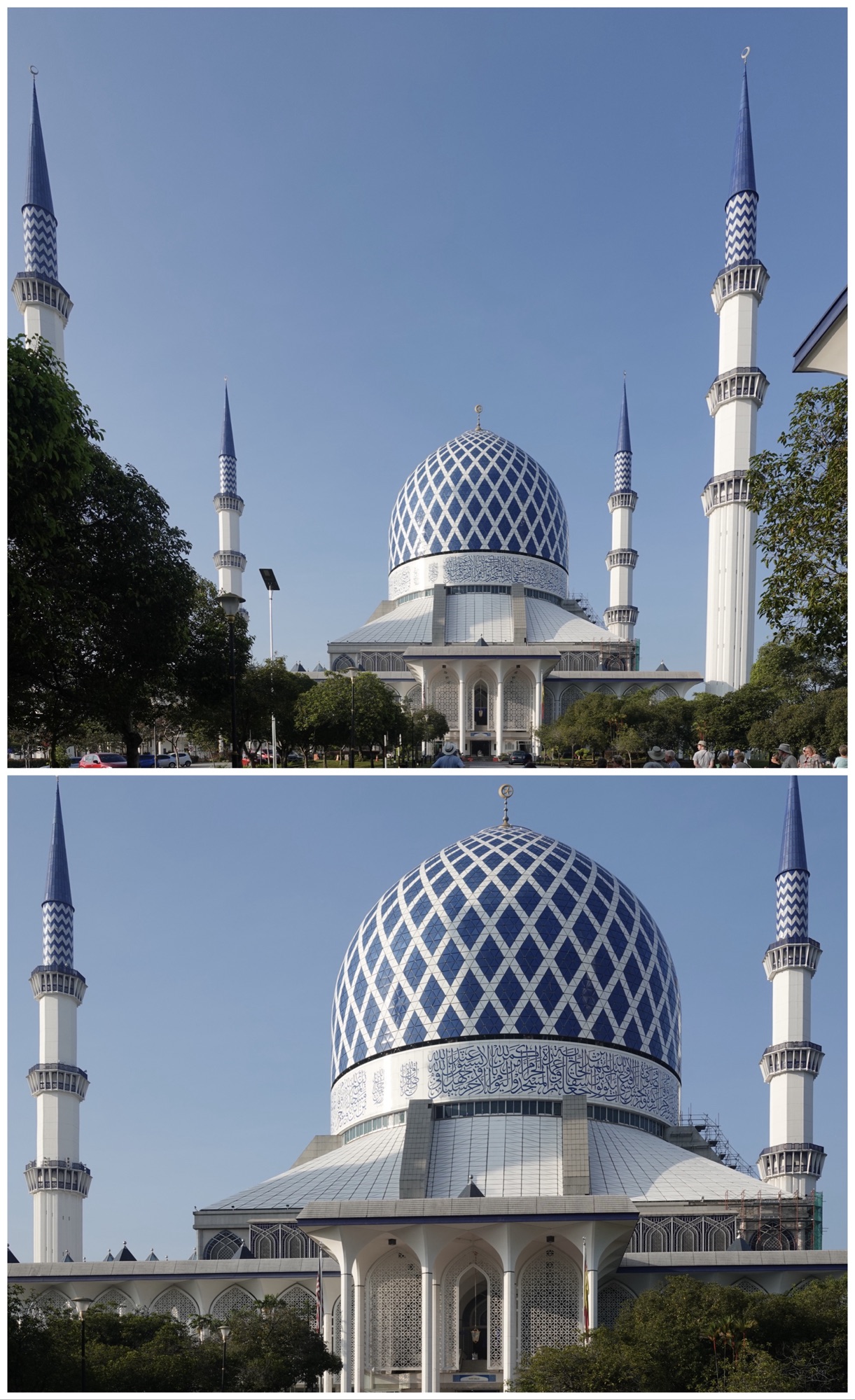
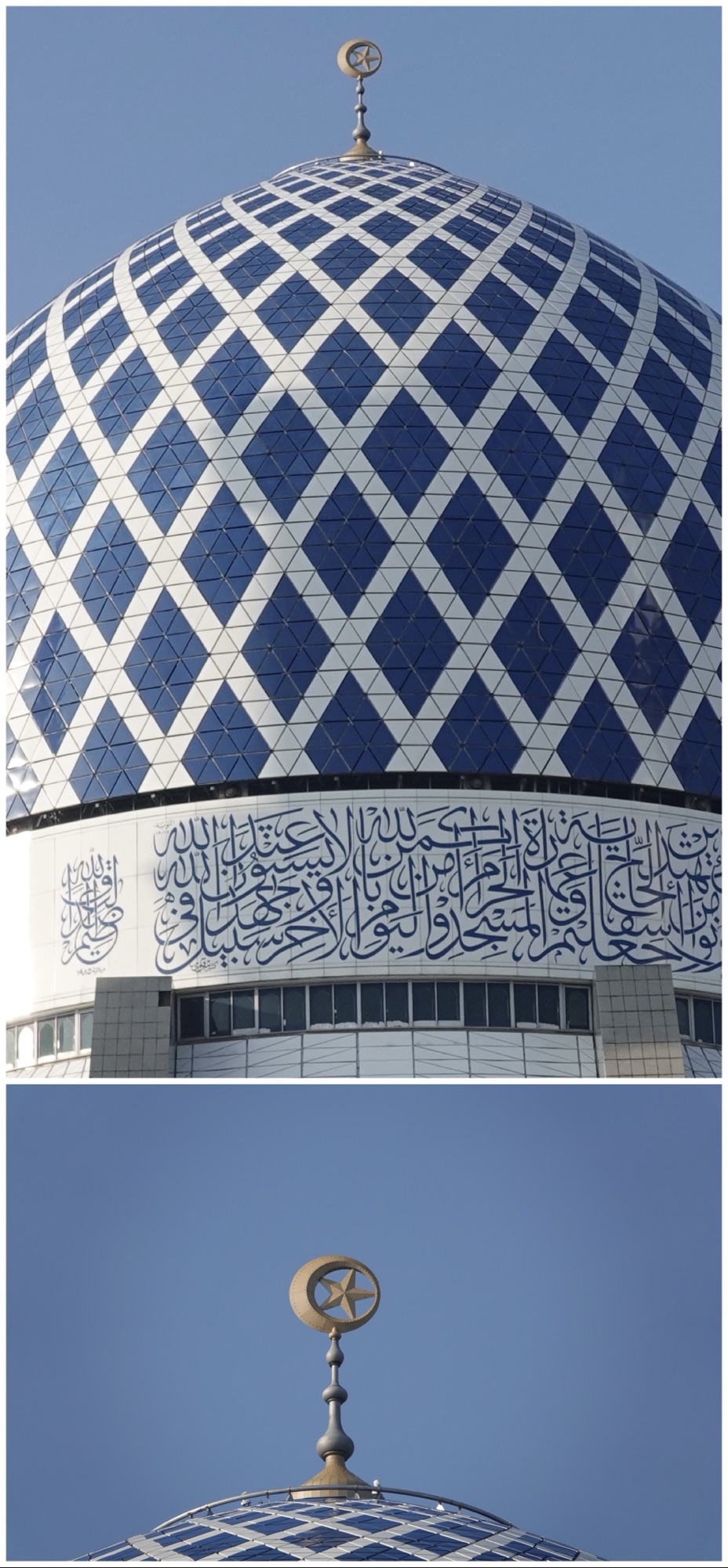
The mosque can hold 24,000 worshippers, on 3 levels: 10000 men on the ground level, 8000 men on the second floor, and 6000 women in the mezzanine. On Fridays during Ramadan, the overflow (!) prays in the outer yard. Today was the third day of Ramadan, so as tourists we were not allowed inside the mosque during this holy month.
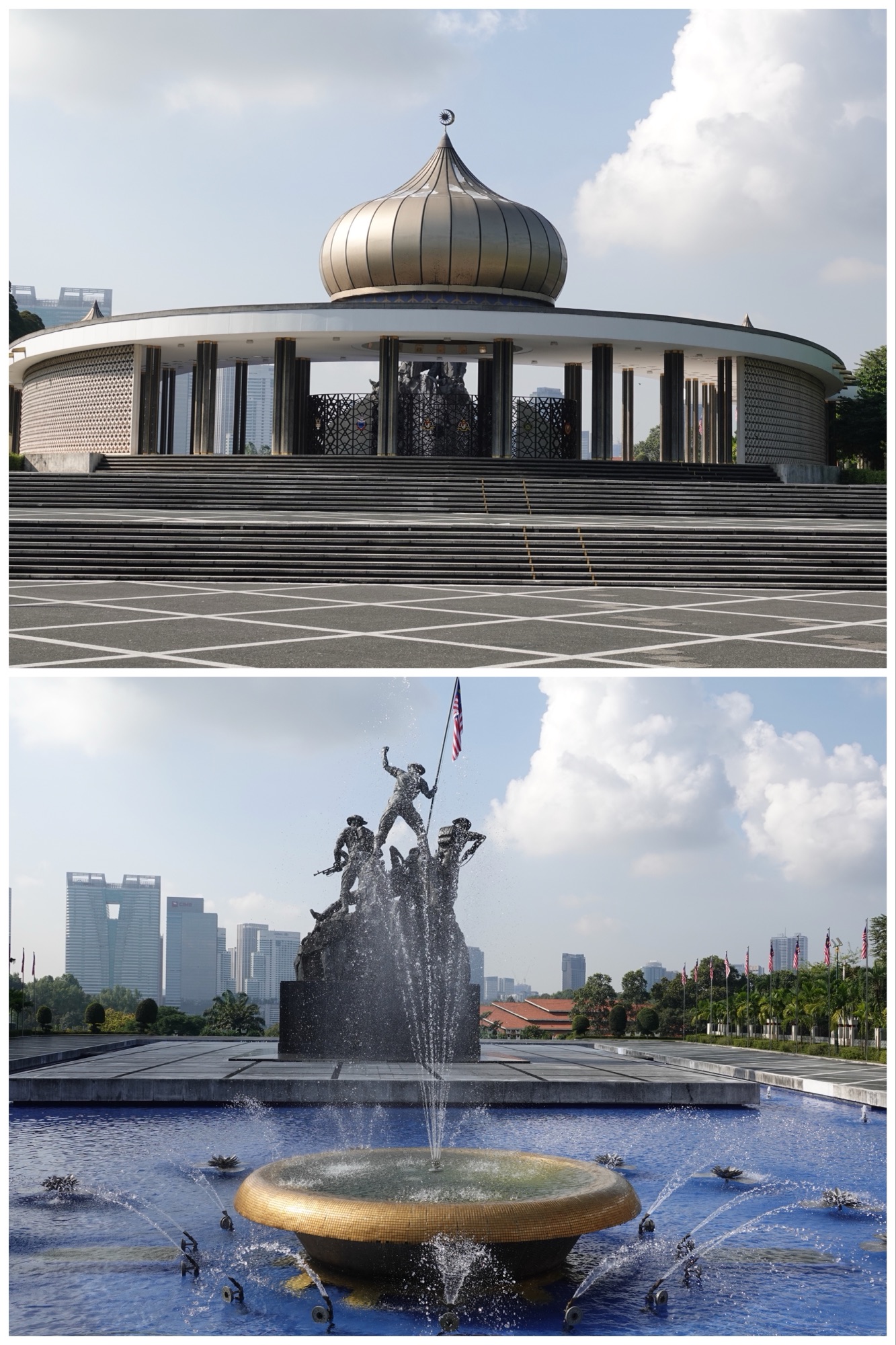
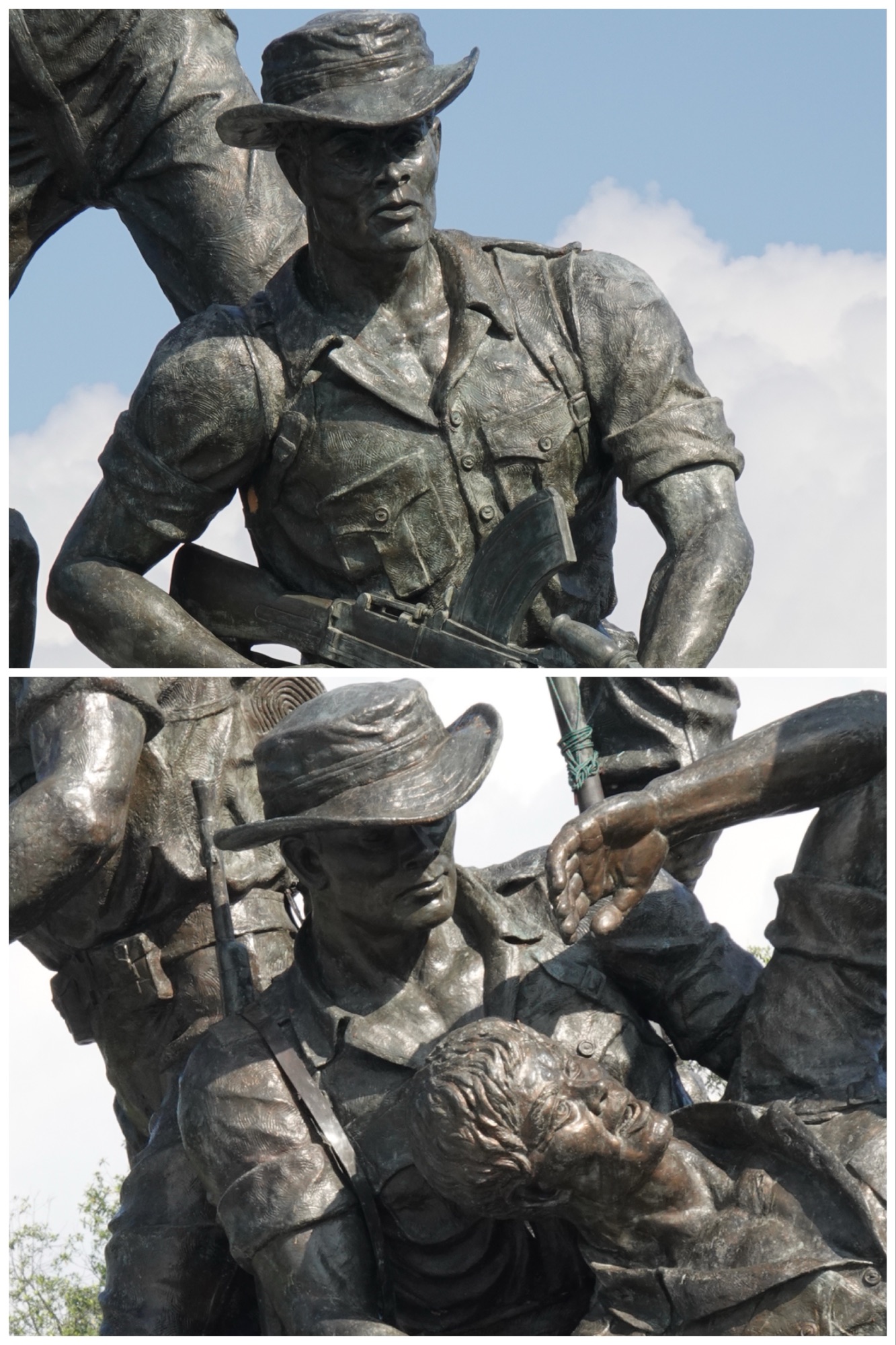
Our next stop was the National Monument, a bronze statue honoring soldiers who died during the Communist Insurgency in the 1950s. It was designed by Felix De Weldon, who also created the Iwo Jima monument in Arlington, Virginia.
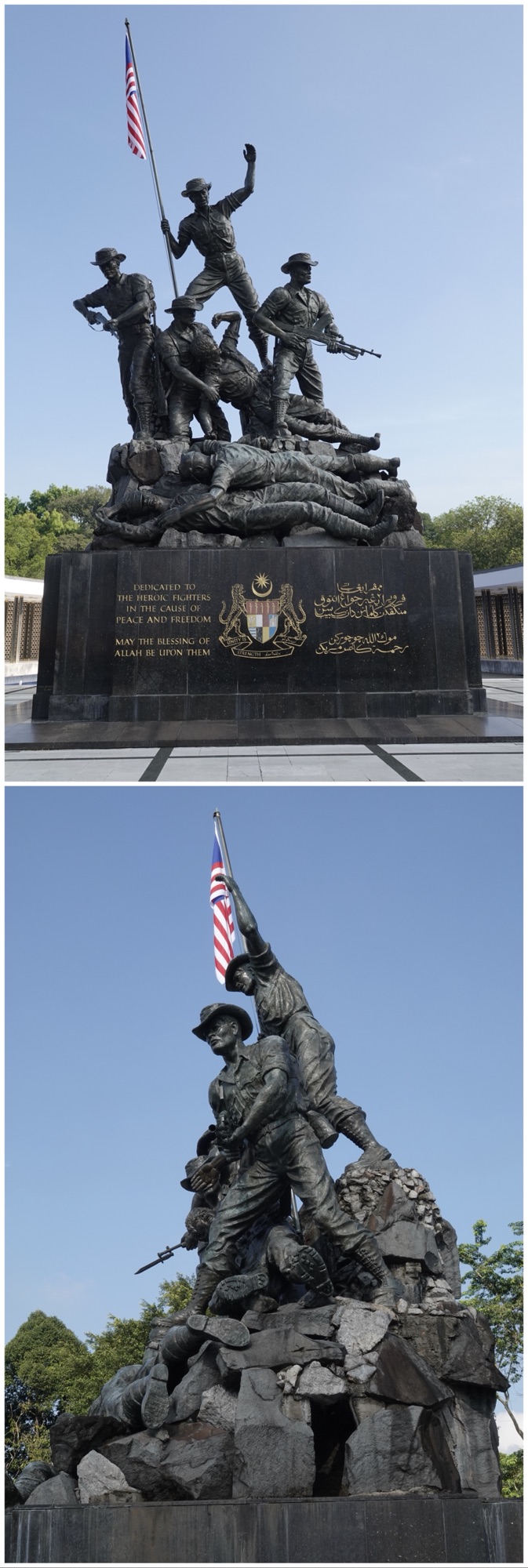
Unfortunately, De Weldon either didn’t know what Malaysians looked like, didn’t care to find out, or took the Malaysian Prime Minister’s request for a monument like the Iwo Jima one 100% literally, because the soldiers all look North American.
The cenotaph that the British erected during their tenure was moved to this same memorial park when its initial location interfered with road development.
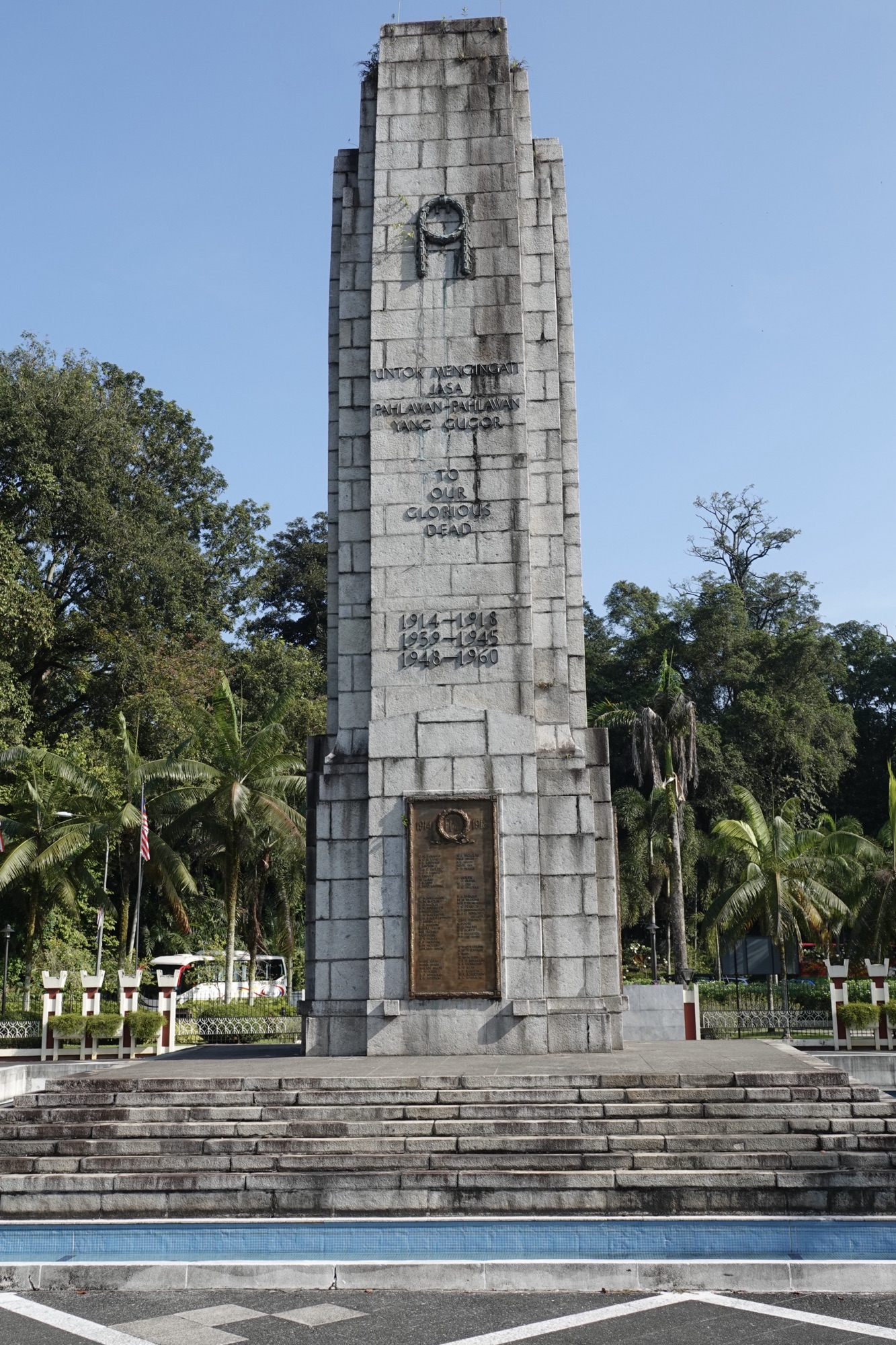
Both memorials are dedicated to lives lost in WWI, WWII, and the period of Malayan Emergency that lasted from 1948 to 1960.
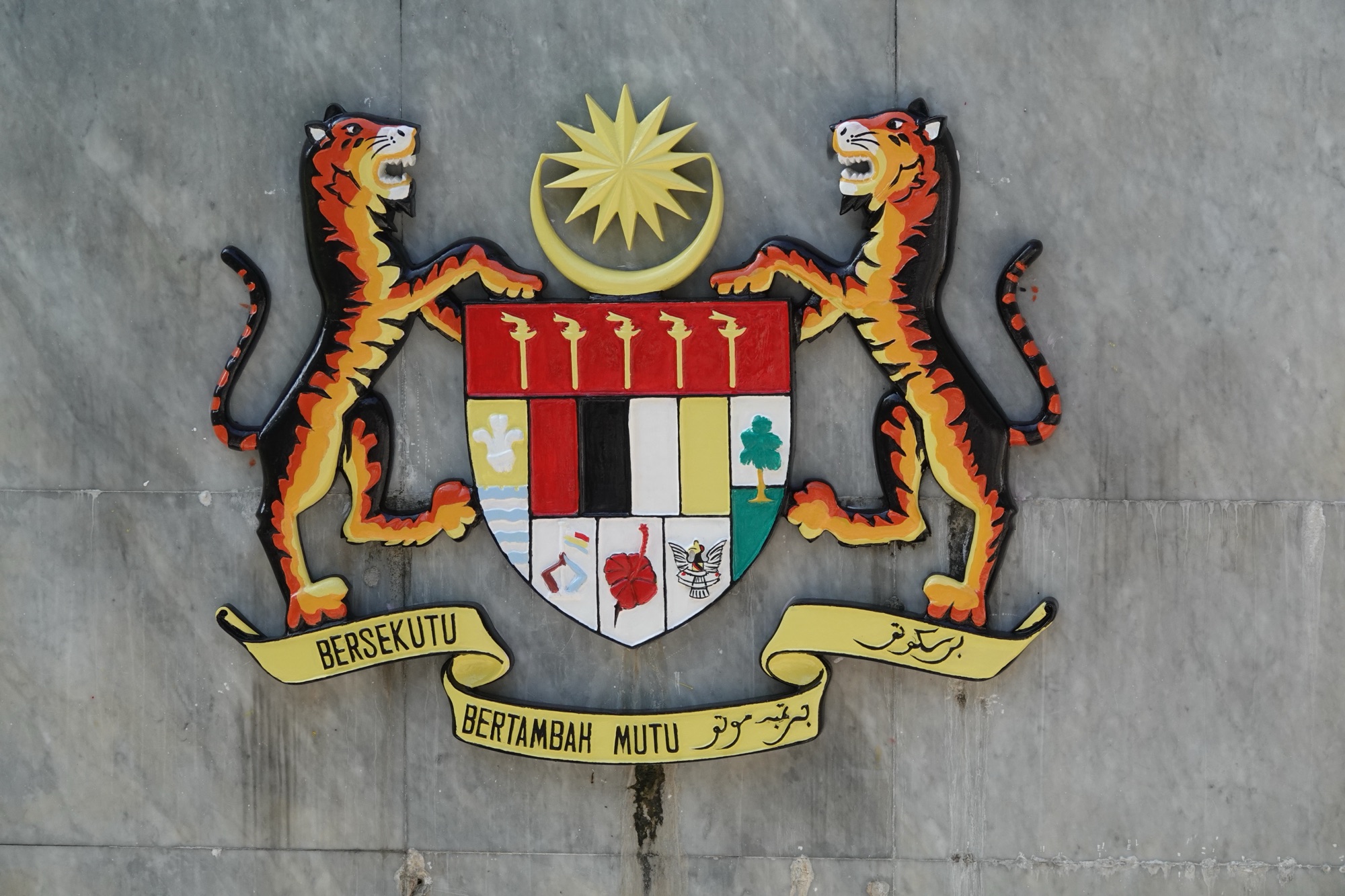
At the entrance to the monument was Malaysia’s official coat of arms.
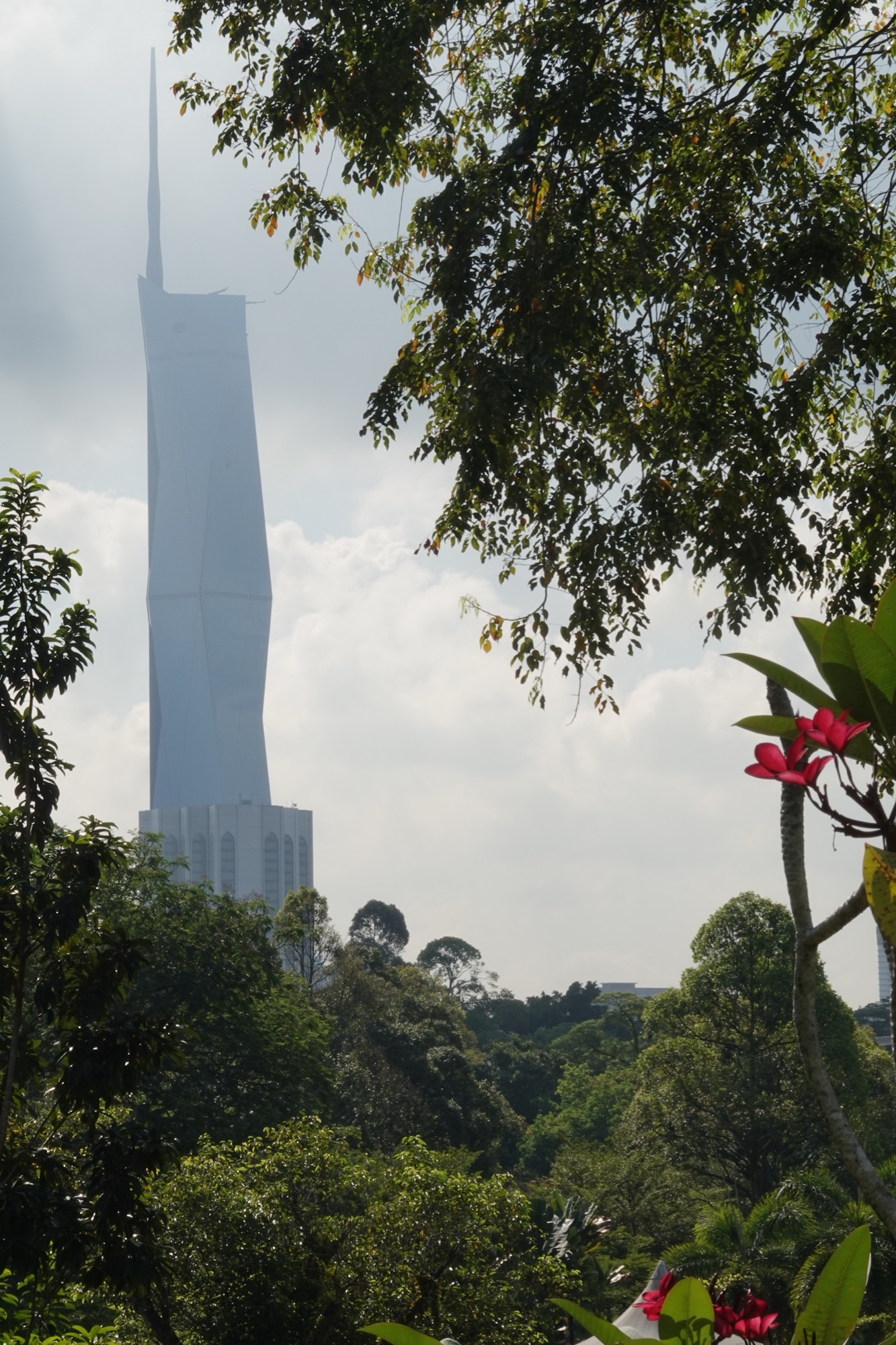
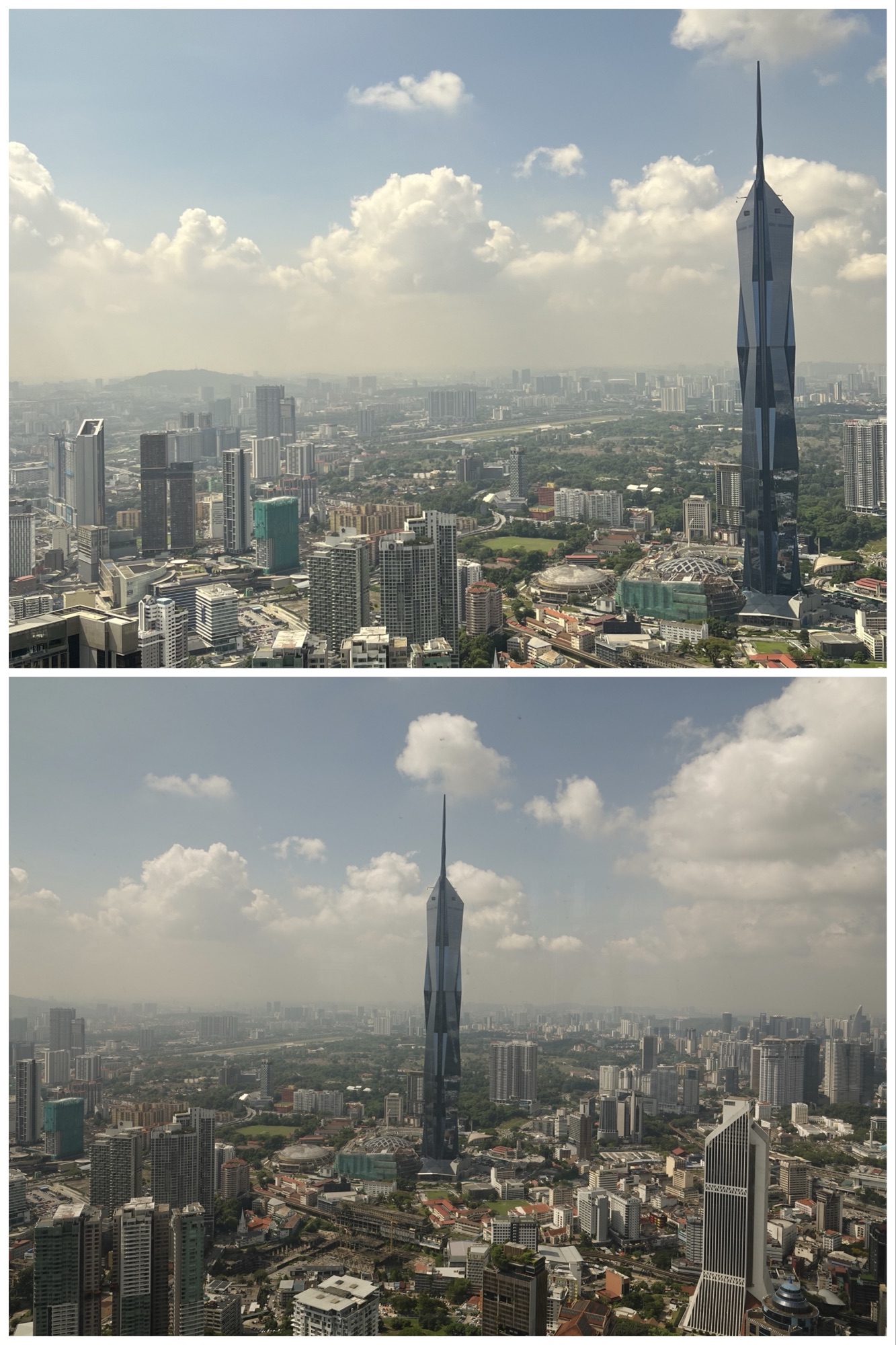
We noticed Independence Tower, which at 118 storeys and 680m/2230ft high is the world’s second tallest building. Its top was actually partly obscured by clouds!
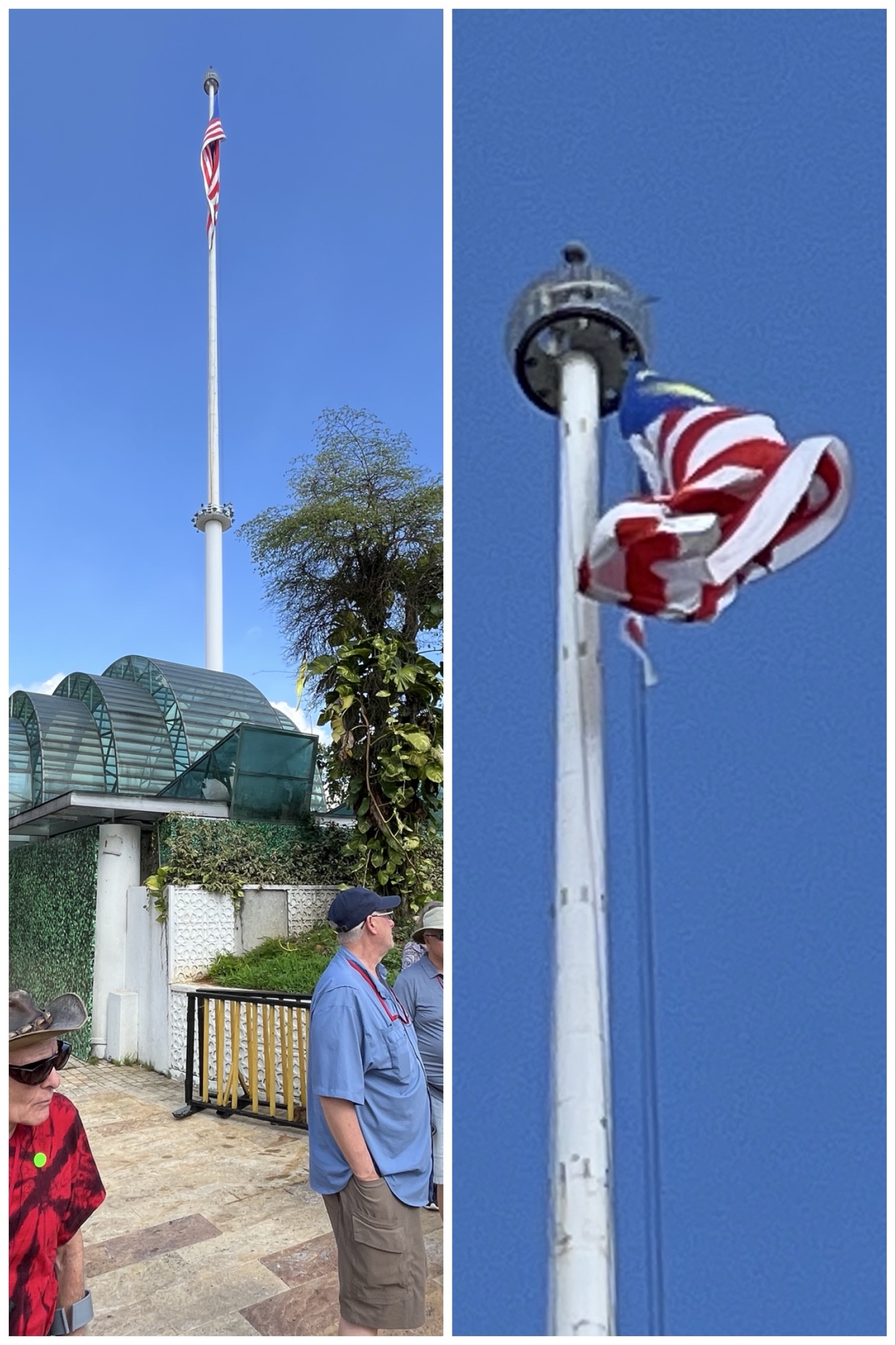
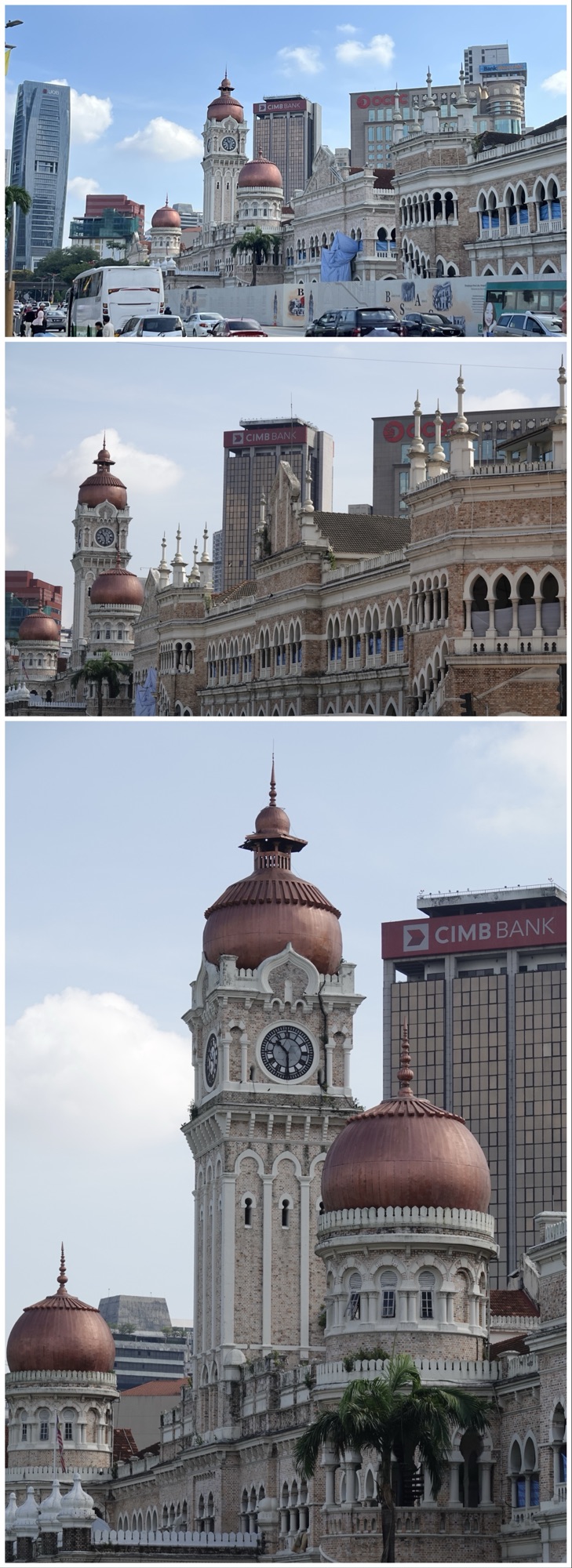
At Independence Square, we had another photo stop to see some of the well-preserved British buildings, as well as the huge Malaysian flag atop its 95m/312ft tall flagpole, one of the tallest in the world.
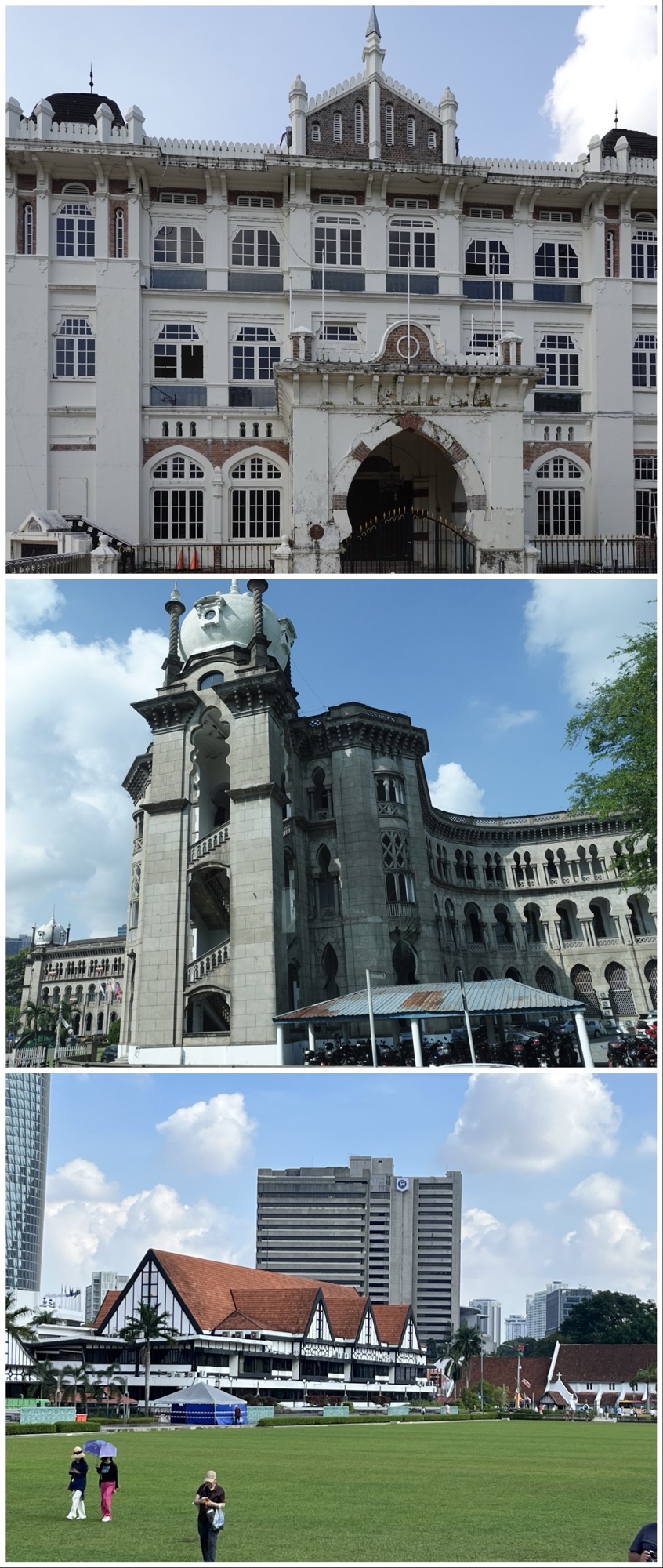
The buildings in this area were built by the British around 1910 as government offices and trading company headquarters, and many were used as offices by the Malaysian government until 1997 when new facilities were built in a different location in the city. It was explained to us that they are a maximum of 2-3 storeys tall – in stark contrast to today’s skyscrapers – because of the weight of the brick and stone construction at a time when steel reinforcing was not yet used. They now stand mostly empty waiting for a new purpose. In the meantime, they have been declared UNESCO heritage buildings.
Kuala Lumpur is divided into three sections:the Golden Triangle (central business district), the financial district, and the “green lung” full of parks and trees.
We stopped to photograph the confluence of the two “muddy rivers” that gave Kuala Lumpur its name (literally “confluence of muddy rivers”).
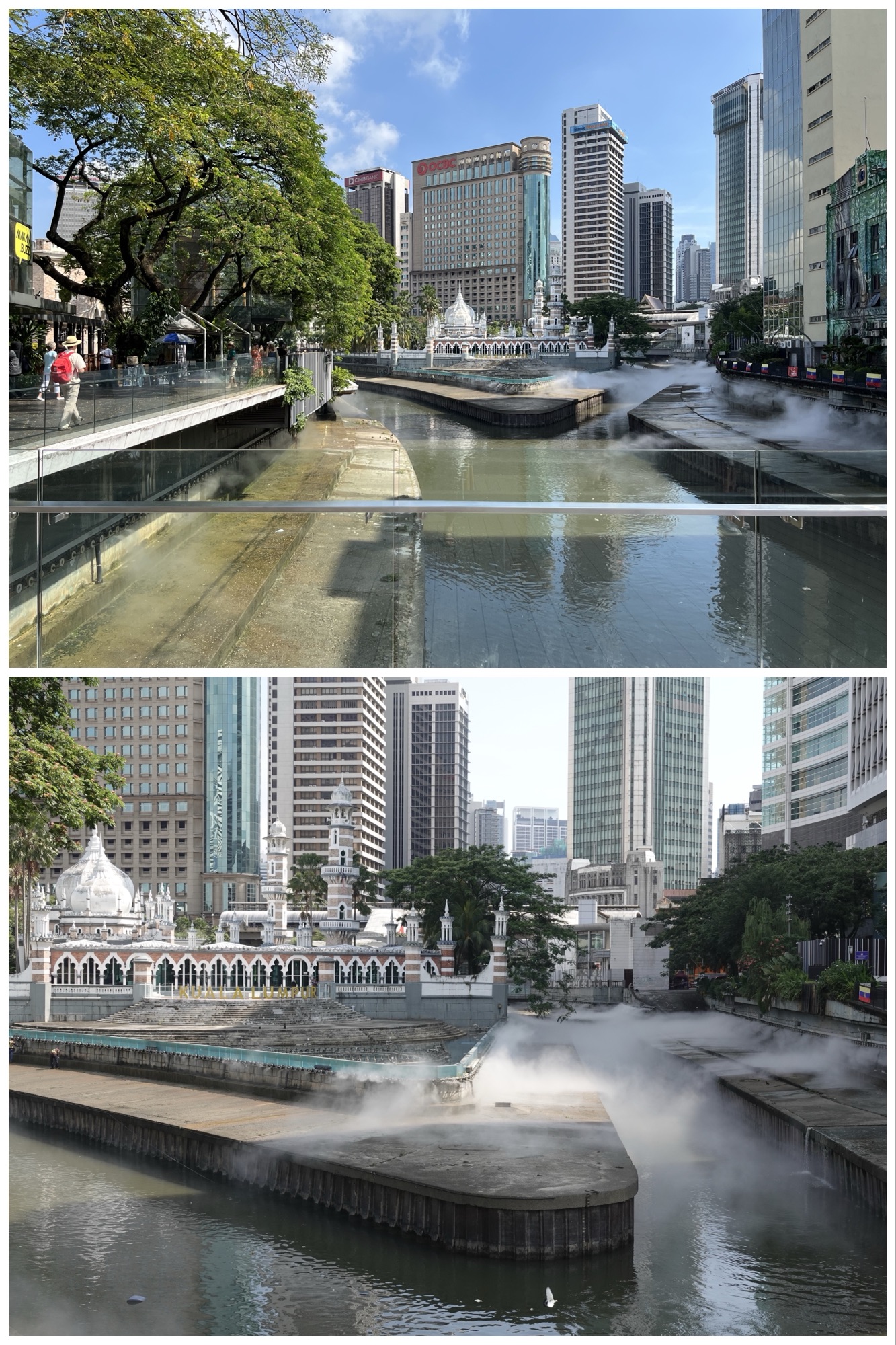
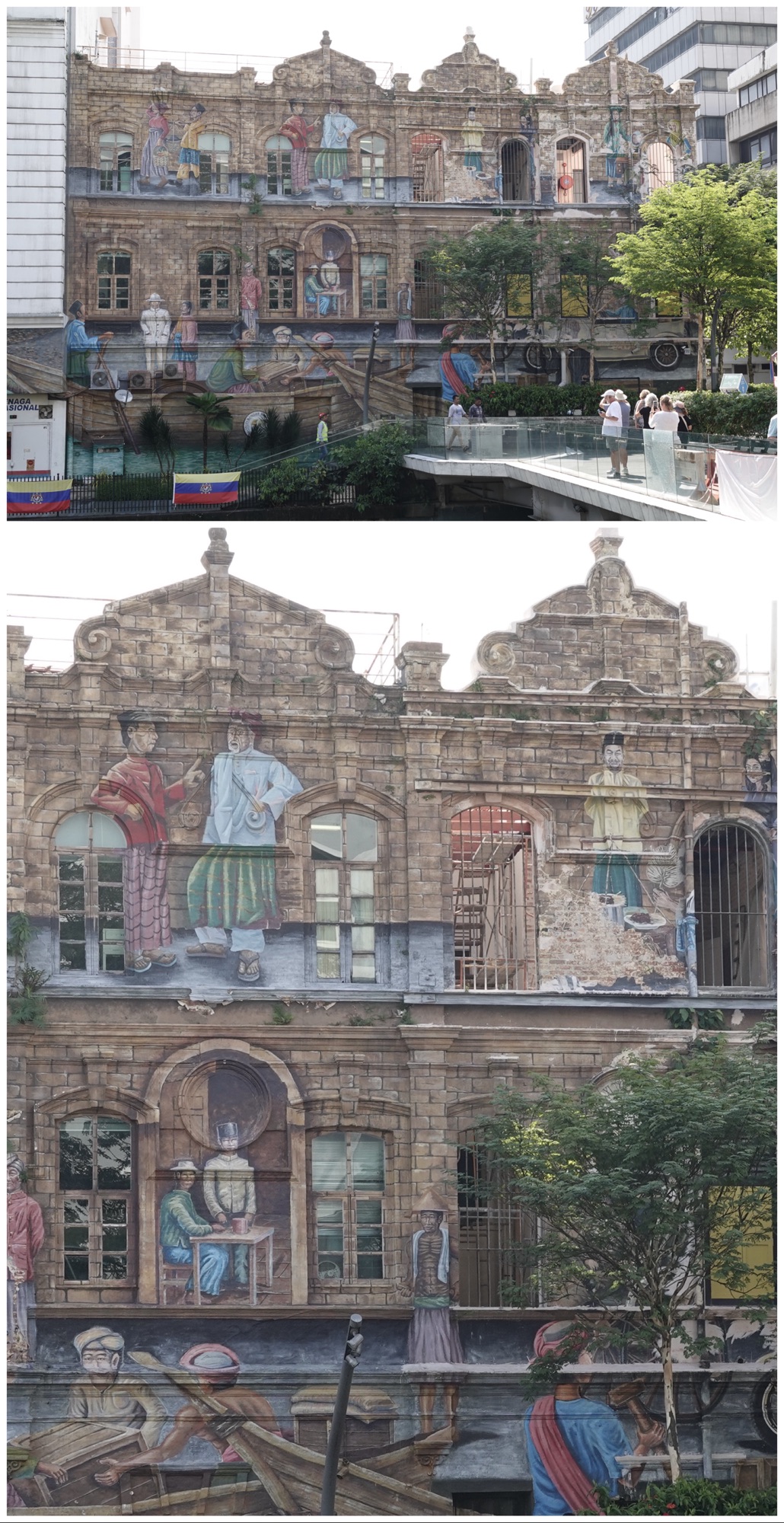
One of the buildings along the river was covered in a mural depicting colonial era activities that would have happened in and around it.
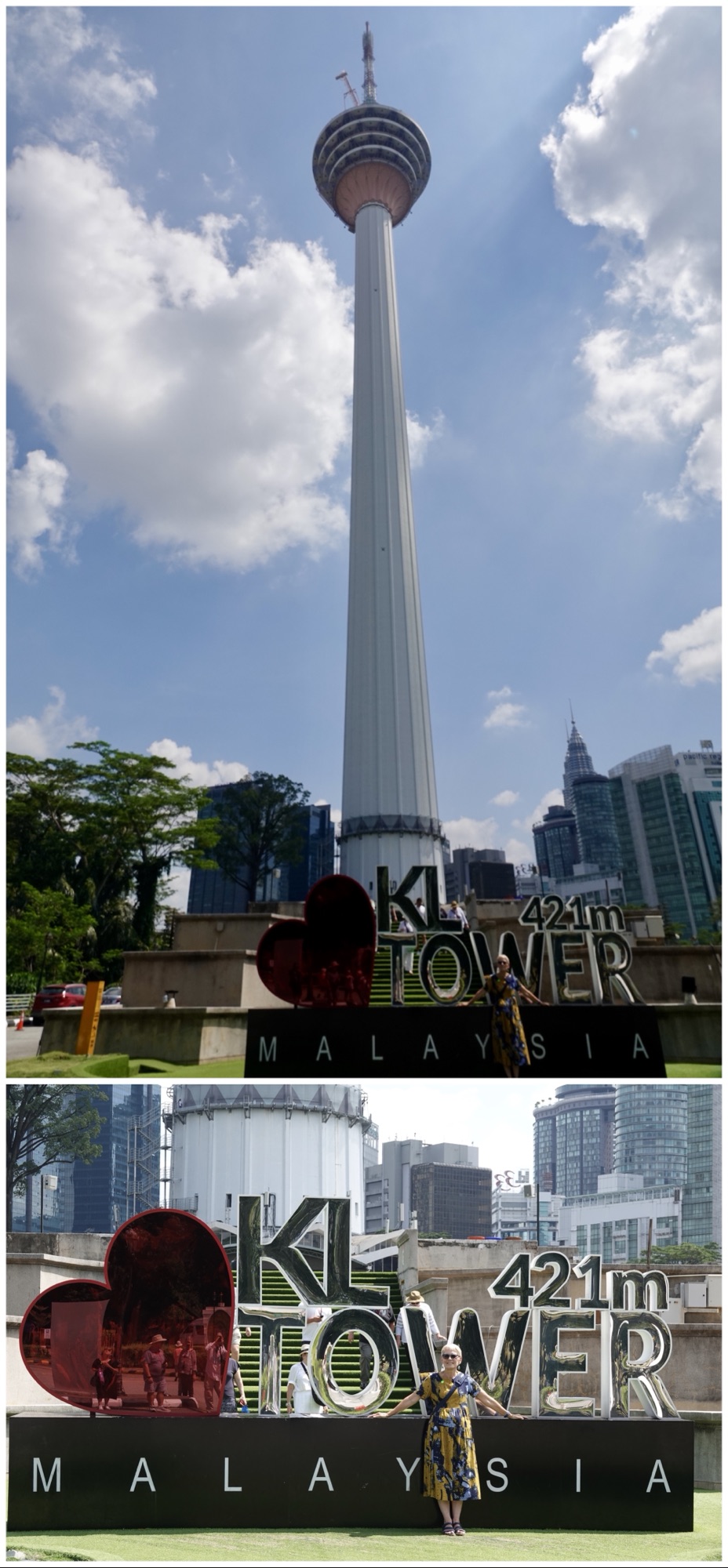
We drove a short distance to visit the KL tower, where we rode the elevator to the observation deck of the 421m/1380ft tall tower for some spectacular 360° views.
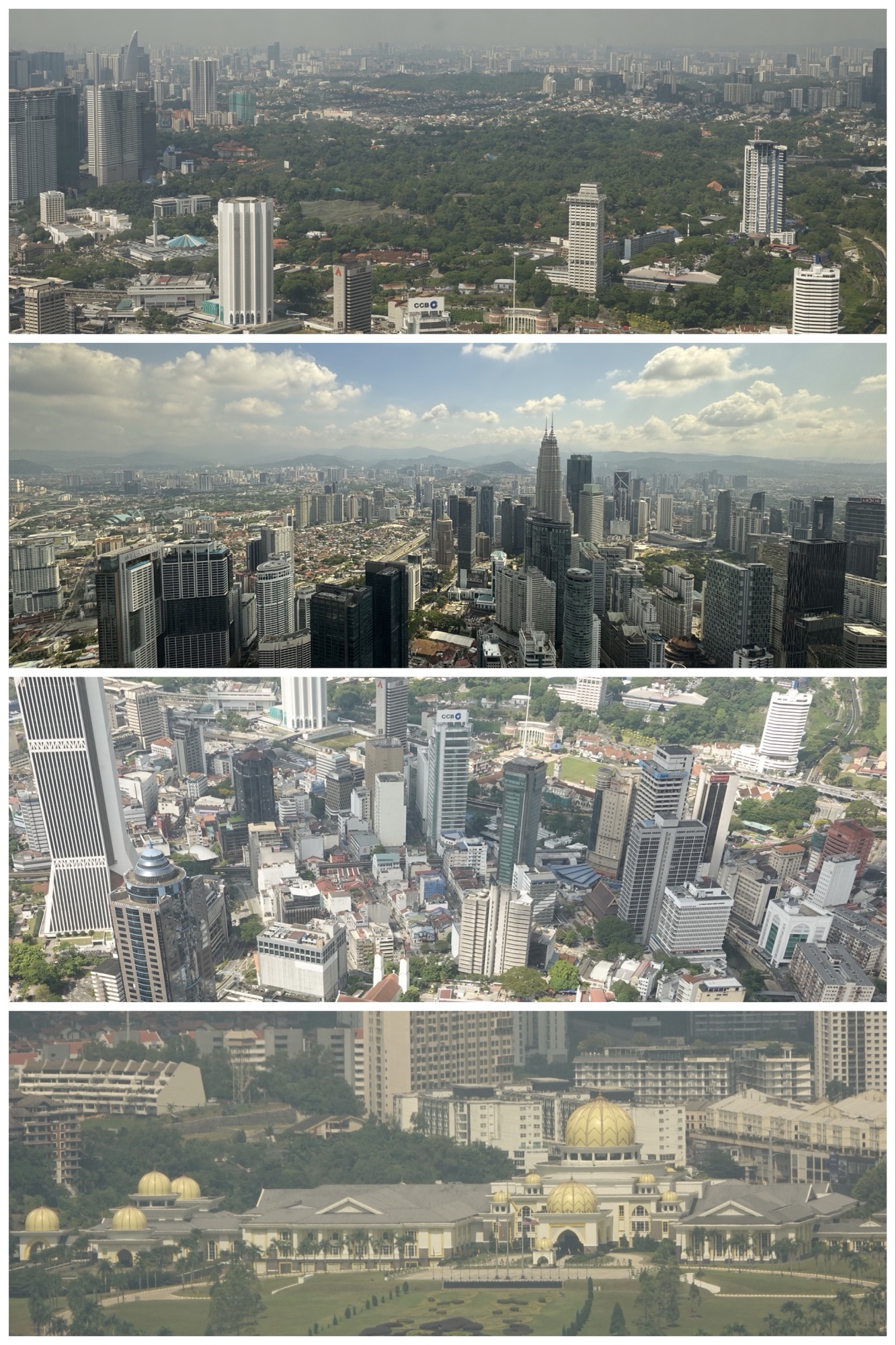
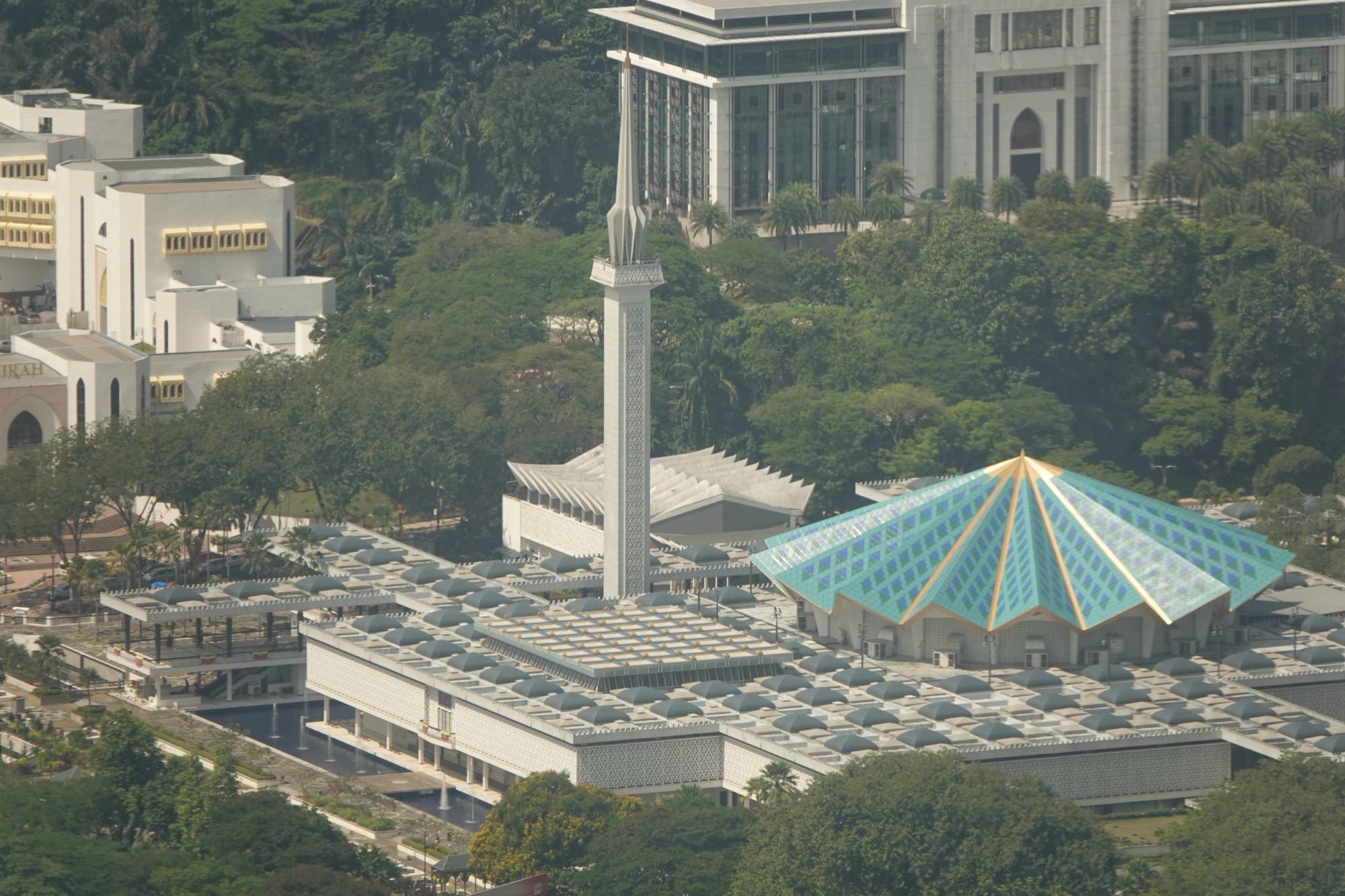
It was obscured by buildings when we were at street level, but once we had a bird’s eye view, we could see the turquoise umbrella-shaped roof of the National Mosque, which is unique for not having a dome.
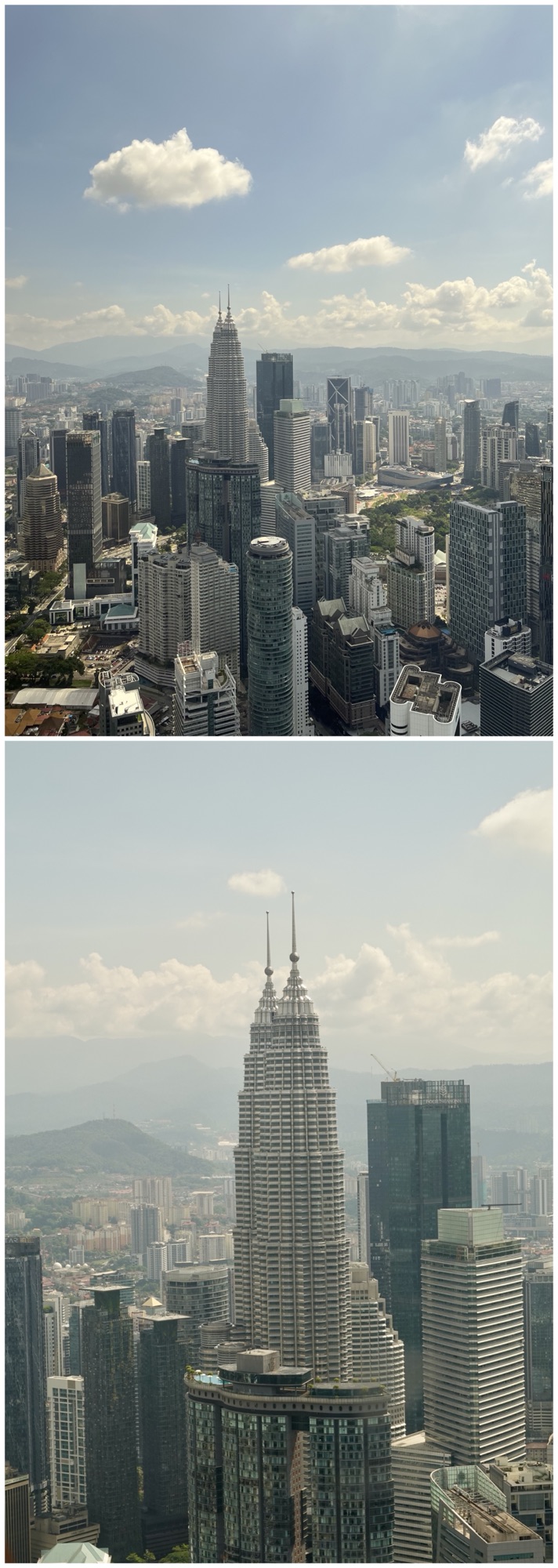
We got a decent view of the world’s tallest twin skyscraper, the Petronas Towers, from the observation deck…
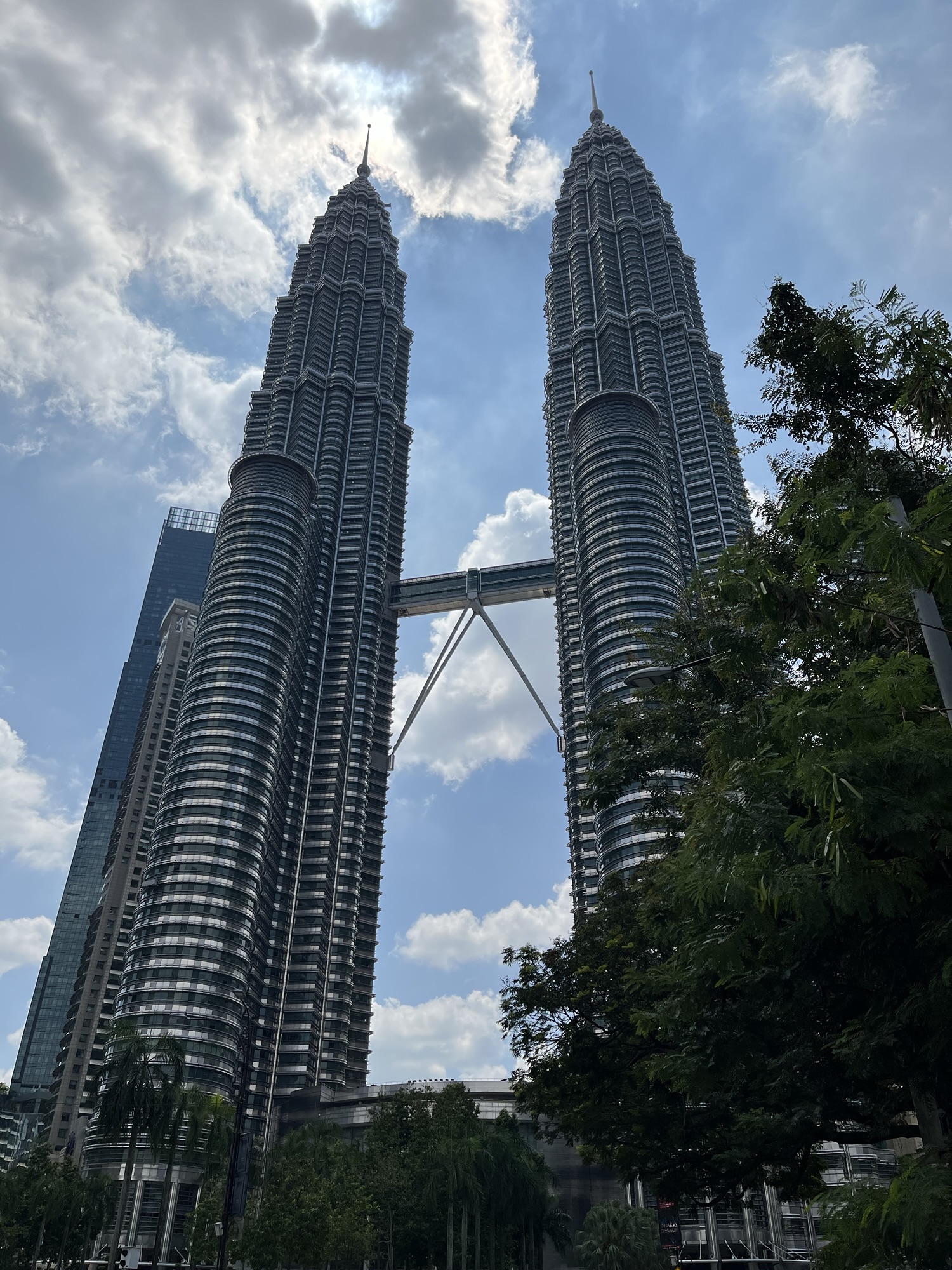
… but, of course, we nonetheless made a quick stop for a photo of the towers unobstructed by glass.
Near the Golden Triangle, we had time at the Karyaneka Handicraft center to window-shop the pewter, crystal, glass, and silk and cotton batik textiles. I again didn’t buy anything.
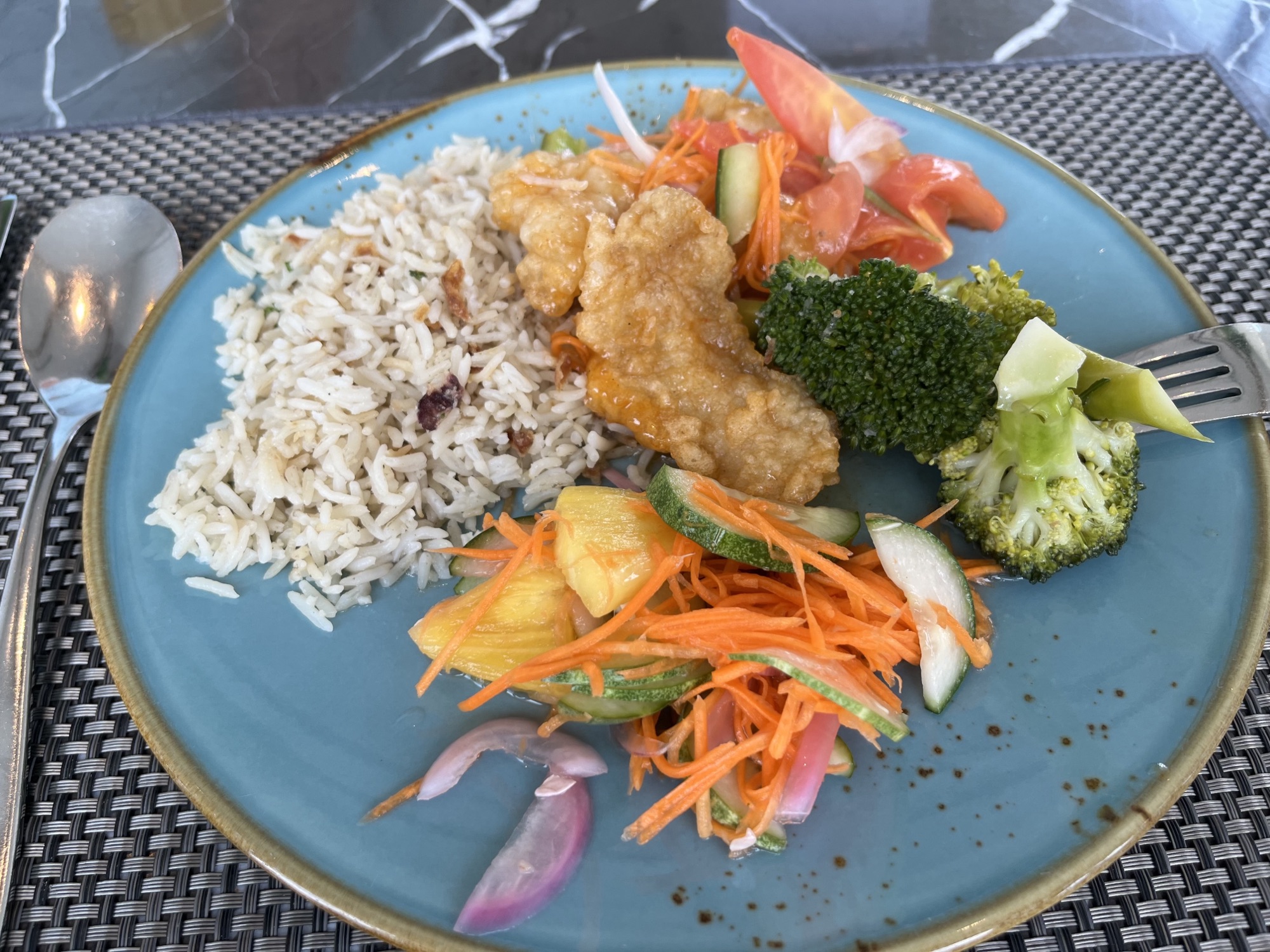
Before returning to port, we had a lovely buffet lunch on the 41st floor of the Capri Hotel.
Our guide talked a LOT about KL’s traffic, but having come from Jakarta just a couple of days ago, none of us thought it was bad at all.
Nonetheless, on the way home our bus driver seemed determined to beat the afternoon rush hour. I was sitting in the front seat, so could clearly see the needle on the speedometer pushing 125 kph (as high as the dial went) while a man who had been fasting since before sun-up drove one-handed, leaving his other free for the horn. It was a thrill in itself.
So why do I think so many people come to Kuala Lumpur? First, in my opinion, it felt much more liveable than Singapore, and only marginally less clean. There are a variety of cultures and modes of dress on the streets, and a diverse food scene. English is widely spoken. Malaysia has a strong economy, 36th in the world based on GDP and more trade intensive than Denmark, Norway, Sweden or Germany!
The most important factor though may be the country’s willingness to accept foreigners as residents. There is an actual program called MM2H (Malaysia My Second Home) designed to attract retirees, expats and investors – all of whom must meet specific investment (snd health) standards.
Bottom line: our one day in KL was enough to convince me that I’d like at least a week or two to explore further.
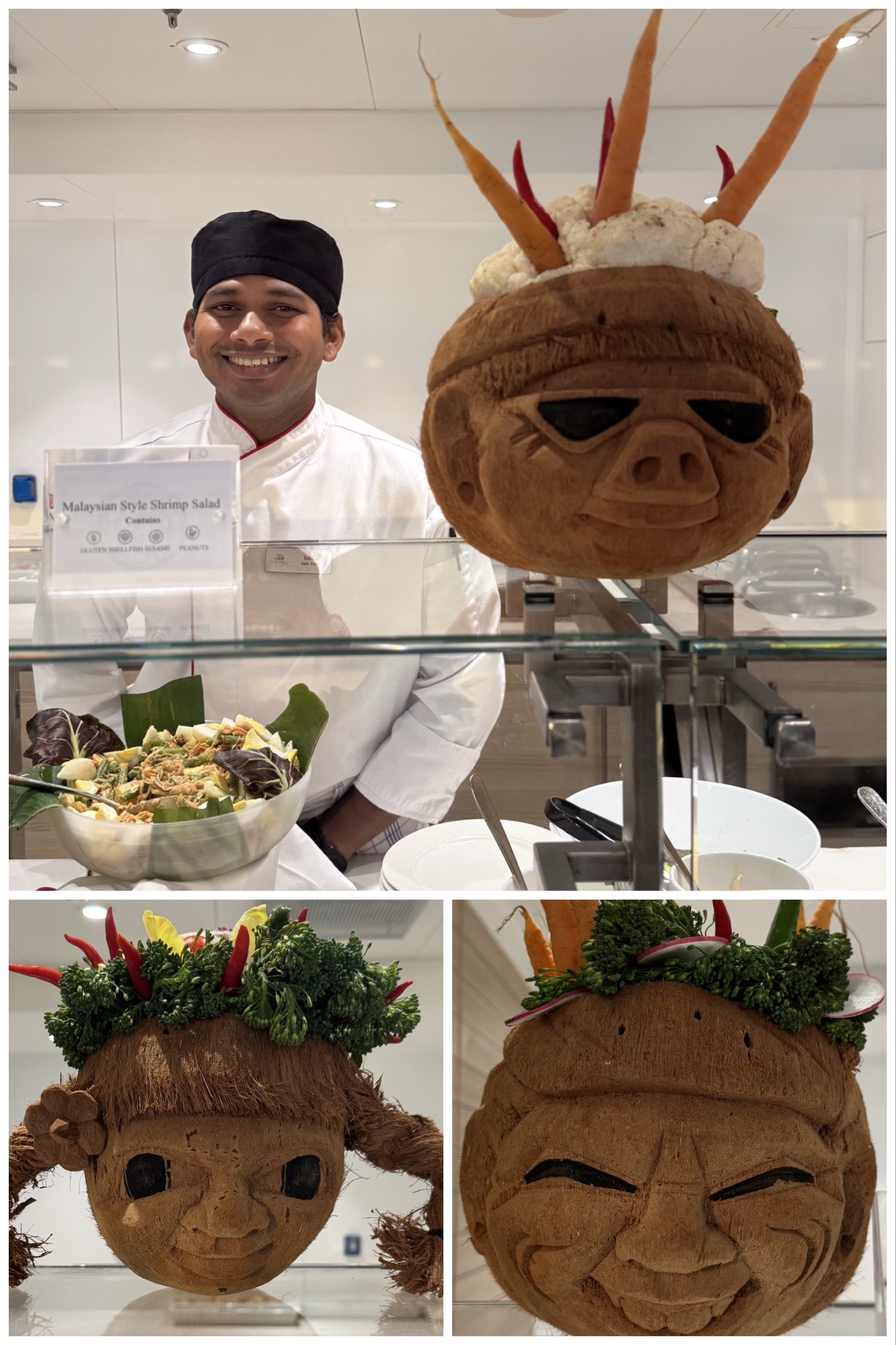
After returning to the ship and resting up a bit, it was time for a delicious assortment of Malaysian dishes, presented with whimsical carved coconuts.
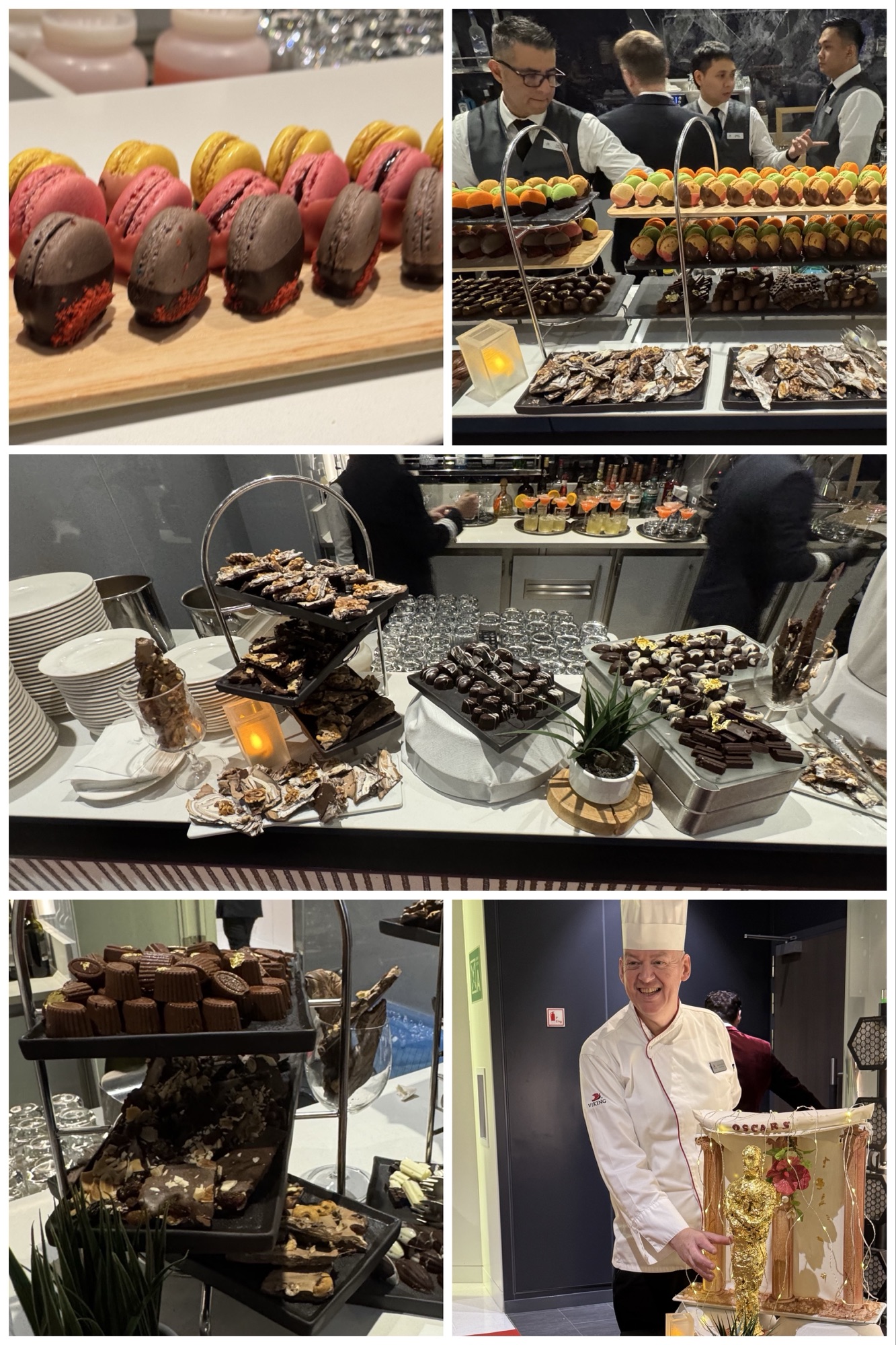
The evening ended with an Oscar viewing party complete with decadent treats: macarons, hand made chocolate truffles, and signature cocktails.
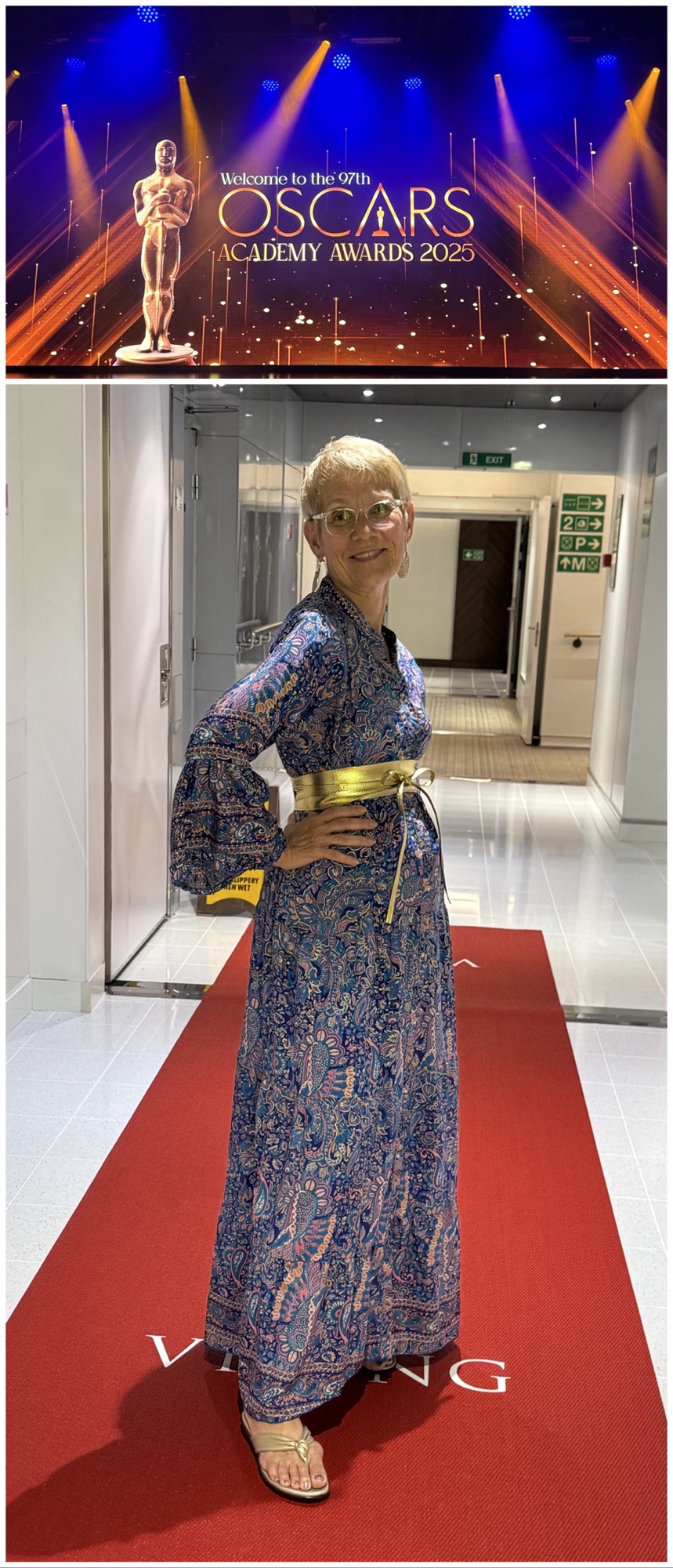
Since Viking doesn’t do formal nights, it was a rare chance to put on the glam… and walk the red carpet!

 Rose and Ted’s Excellent Adventure
Kathleen…she was the best on our TA prior to the WC
LikeLiked by 1 person