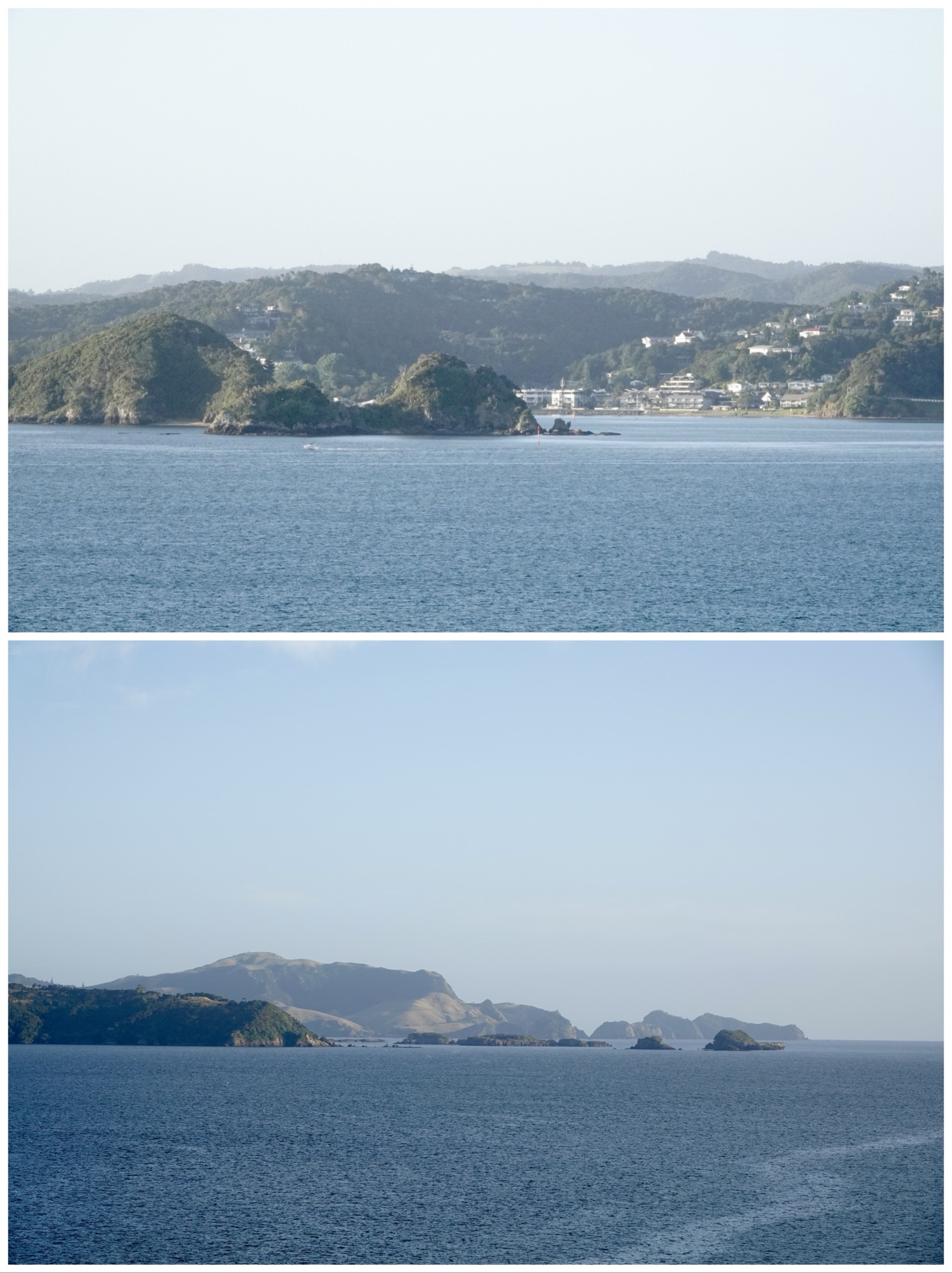
We’re not only in New Zealand today, but actually in the place where in 1840 the Māori signed the first treaty agreement with the British. In 20th century terms, this agreement is now being seen as “an agreement, not a treaty as recognised in international law” and “In general terms, interpreted as having established a partnership between equals in a way the [British] Crown likely did not intend it to in 1840. Specifically, the treaty is seen, first, as entitling Māori to enjoyment of land and of natural resources and, if that right were ever breached, to restitution. Second, the treaty’s quasi-legal status has clouded the question of whether Māori had ceded sovereignty to the Crown in 1840, and if so, whether such sovereignty remains intact.”(https://en.wikipedia.org/wiki/Treaty_of_Waitangi)
This is a common concern around the world when historic agreements were made between countries or cultures with much different languages and concepts of land ownership, as well as unequal balances of power.
Today was a two-excursion day.
In the morning, we took the included tour to view the historic Kerikeri Basin, visit New Zealand’s oldest buildings, admire Rainbow Falls and view the ornate Hundertwasser public bathrooms.
We had a very laid-back Māori guide in the morning, who gave us lots of freedom to simply explore the short photo-stops without a lot of narration. His calm demeanour didn’t change even when we got held up almost half an hour by road works.
This area of northern New Zealand is absolutely gorgeous, reminding me at times of the sheep-dotted glens and bens of Scotland, and at others of the forests, water, and winding roadways of Muskoka in Ontario.
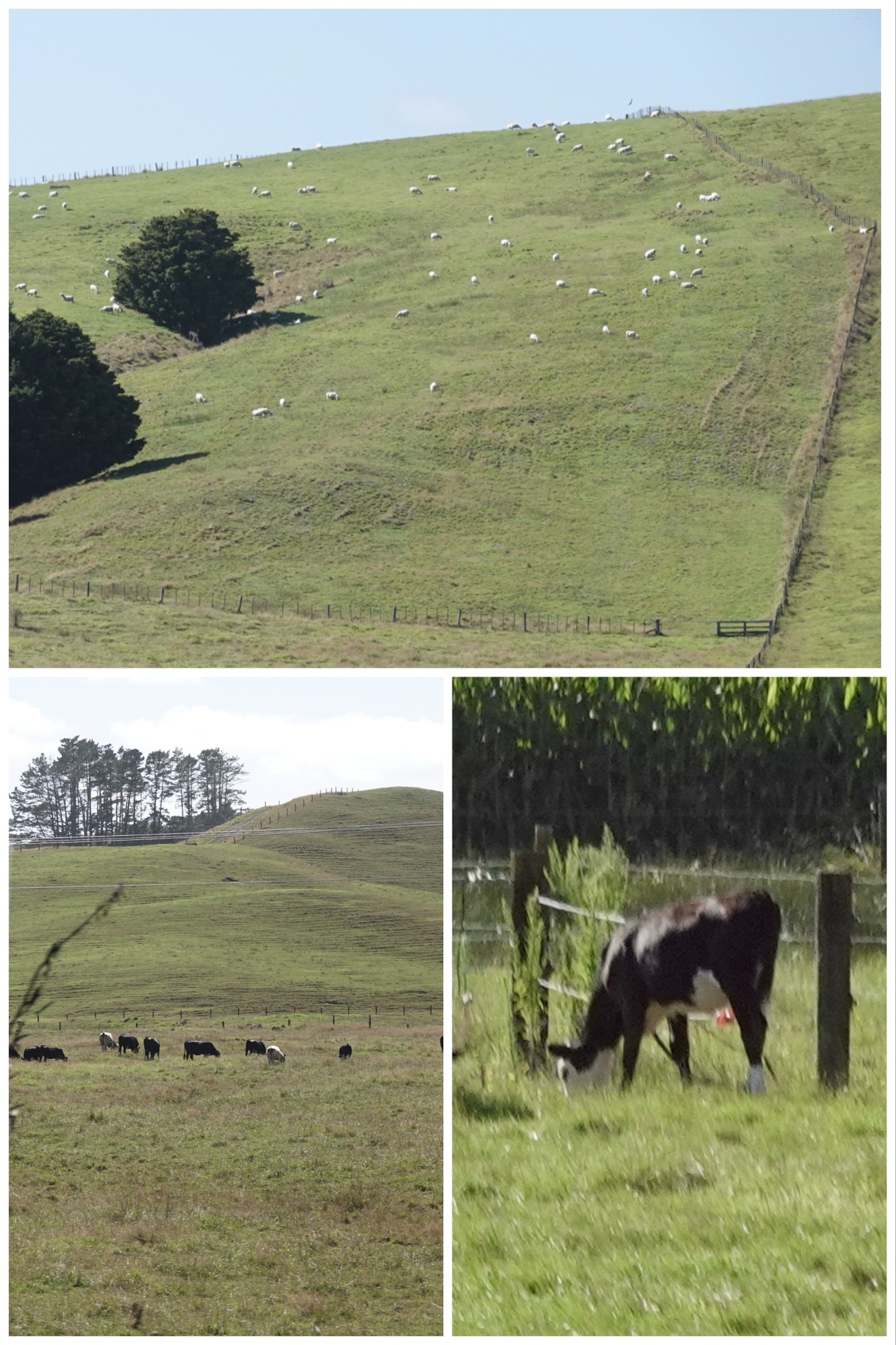
The towns here are small; the largest, Kerikeri, is only 8000 people, although it is growing, encroaching on the agricultural lands where sheep and cows graze. There are Holstein and Guernsey cows for milk, Hereford and Angus for beef. Beyond meat processing, which has become largely industrialized (going from 2000 employees at its peak to just 100 now after automation), and the export of milk, citrus, and kiwi fruit, there is a stone quarry and a growing forestry industry centred around New Zealand pine trees, which grow on a 30 year cycle. There is no real manufacturing industry. Many of the inhabitants of the Bay of Islands area work in Auckland, and most take commuter planes to get there, since the main highway between here and Auckland regularly floods. The landscape is gorgeous and the lifestyle seems idyllic – single storey homes on large plots of land surrounded by lush greenery and lots of cafés – but the weather is not always as gorgeous as it was today.
Our first stop was at Te Ahurea, across the river from the area’s famous stone house, and adjacent wooden house, which are two of New Zealand’s oldest buildings.


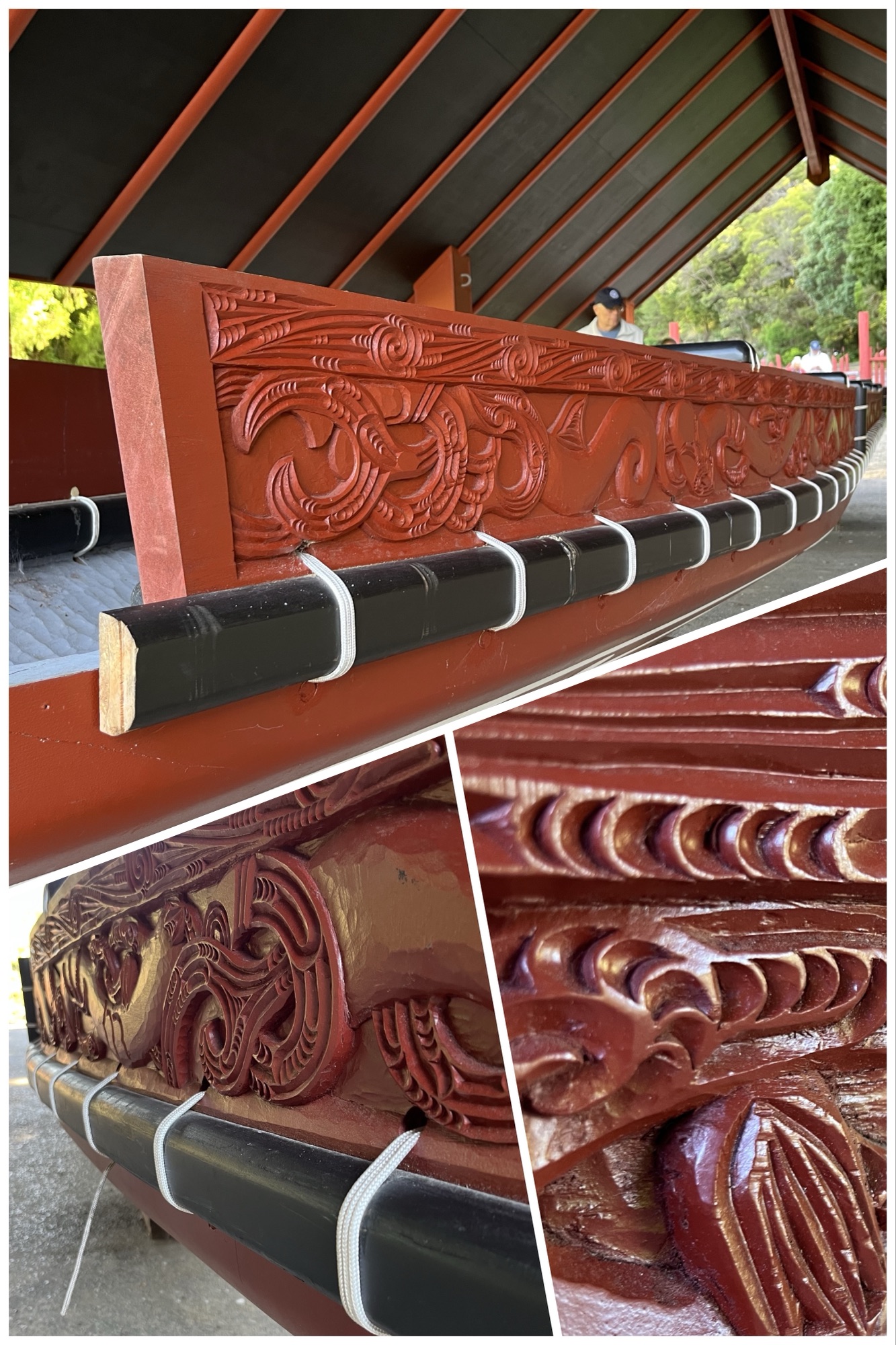
From there we went to Rainbow Falls, in a truly spectacular nature conservancy.

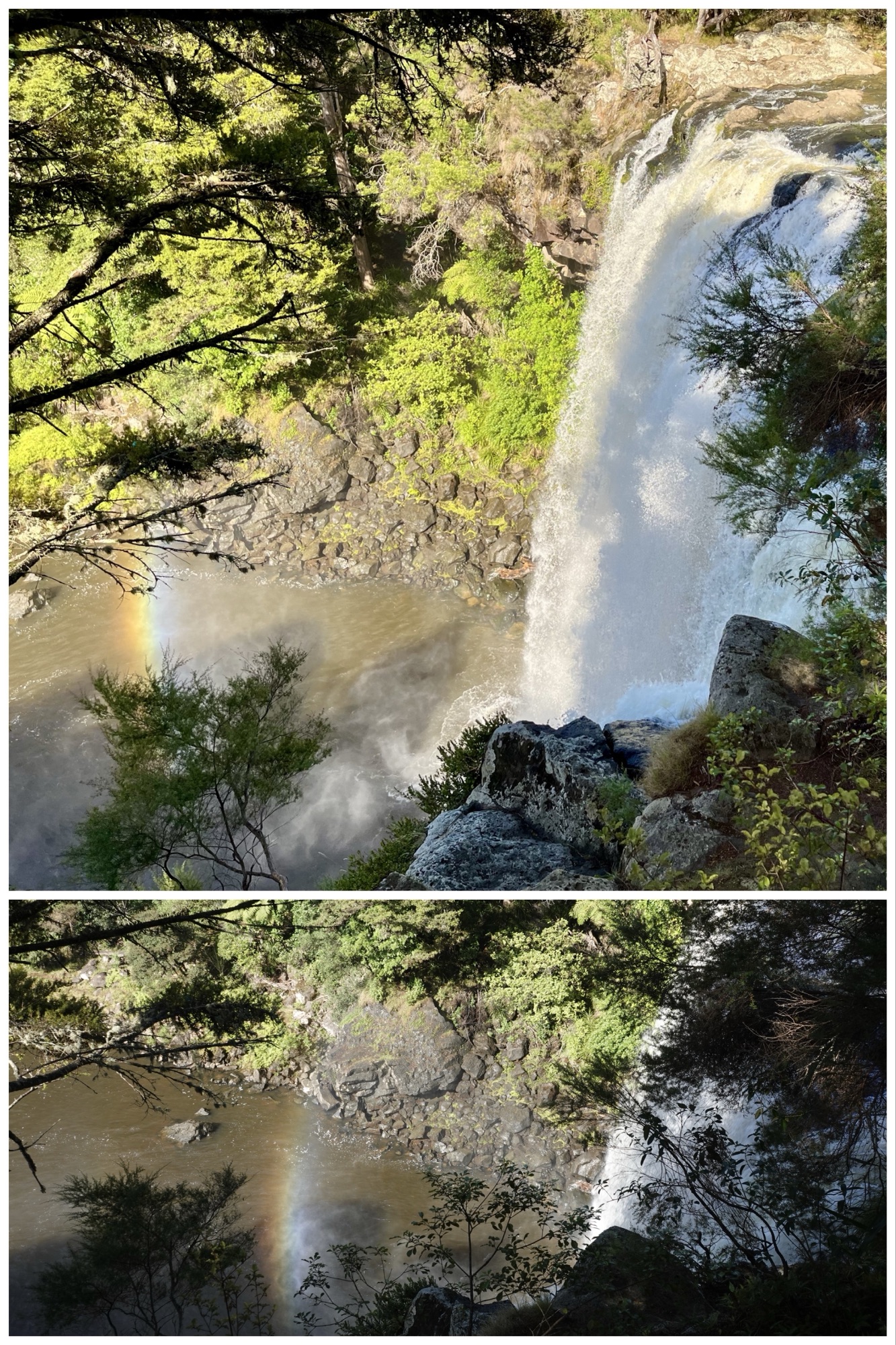

Then it was on to our last stop: Kawakawa.

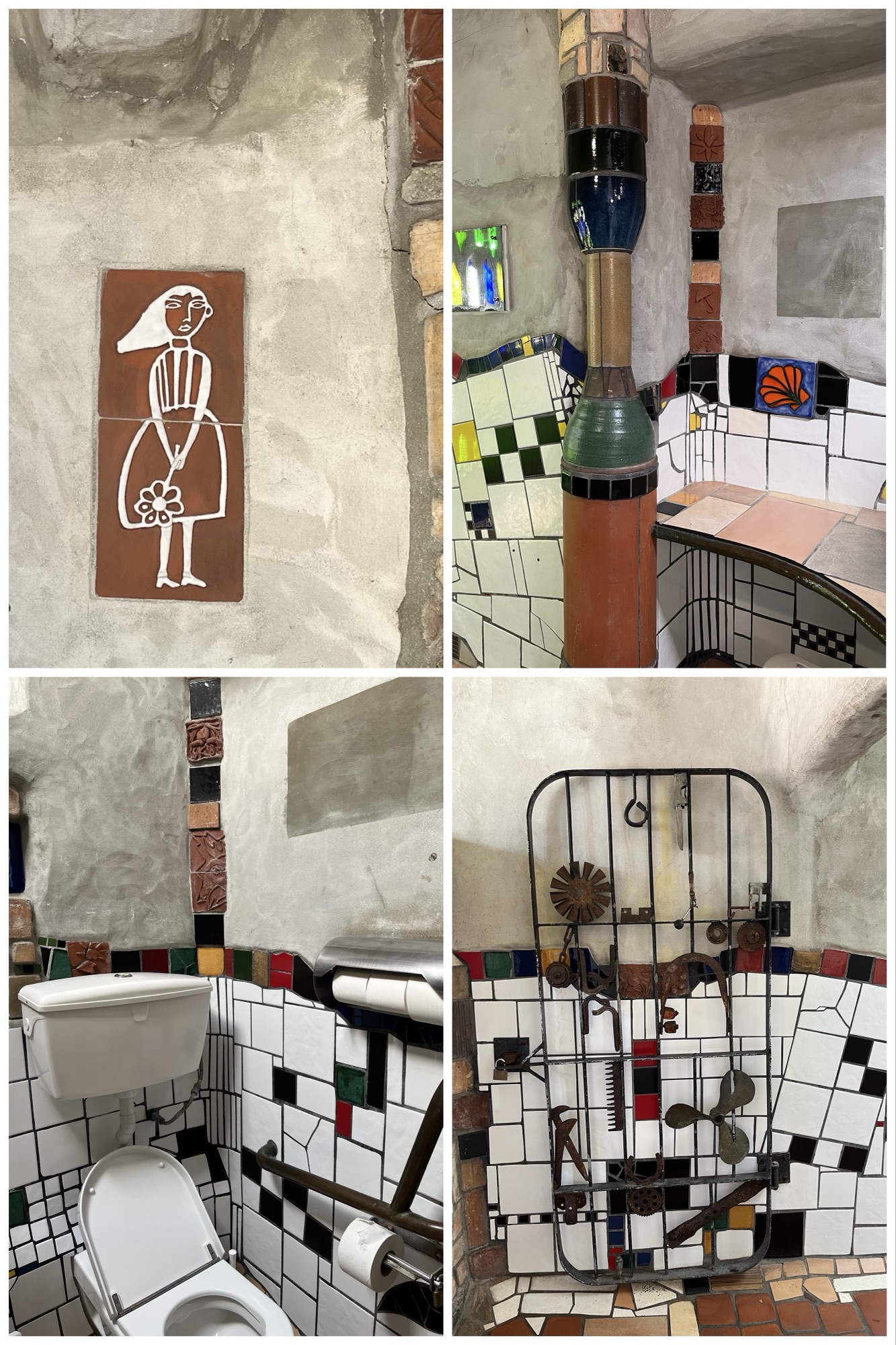
If bathrooms were never something you thought you’d want to tour, this may just change your mind! The town of Kawakawa is internationally celebrated for its ornate public bathrooms designed by Austrian architect Friedensreich Hundertwasser, a former resident of the town. That mouthful of a name, which is actually his chosen pseudonym) translates to “Peace-loving Hundredwater”.
Hundertwasser’s architecture would have been right at home transplanted into Antoni Gaudi’s Parc Güell in Barcelona. Both made similar use of curving nature-inspired lines, recycled materials, coloured glass and tiles, and whimsical designs. Hundertwasser was born 2 years after Gaudi died; although I could find nothing to verify it, seeing his work makes it impossible not to think that he was inspired by Gaudi’s work.
Apparently Hundertwasser wanted to build a lot more here, but the local councils were less than impressed.
We stopped beside the Hundertwasser Memorial Park buildings, which house a museum, library, and modern bathrooms. Architectural designer Pip Bolton expanded on the environmental ideologies of the late artist and architect, using natural materials with a low environmental impact.
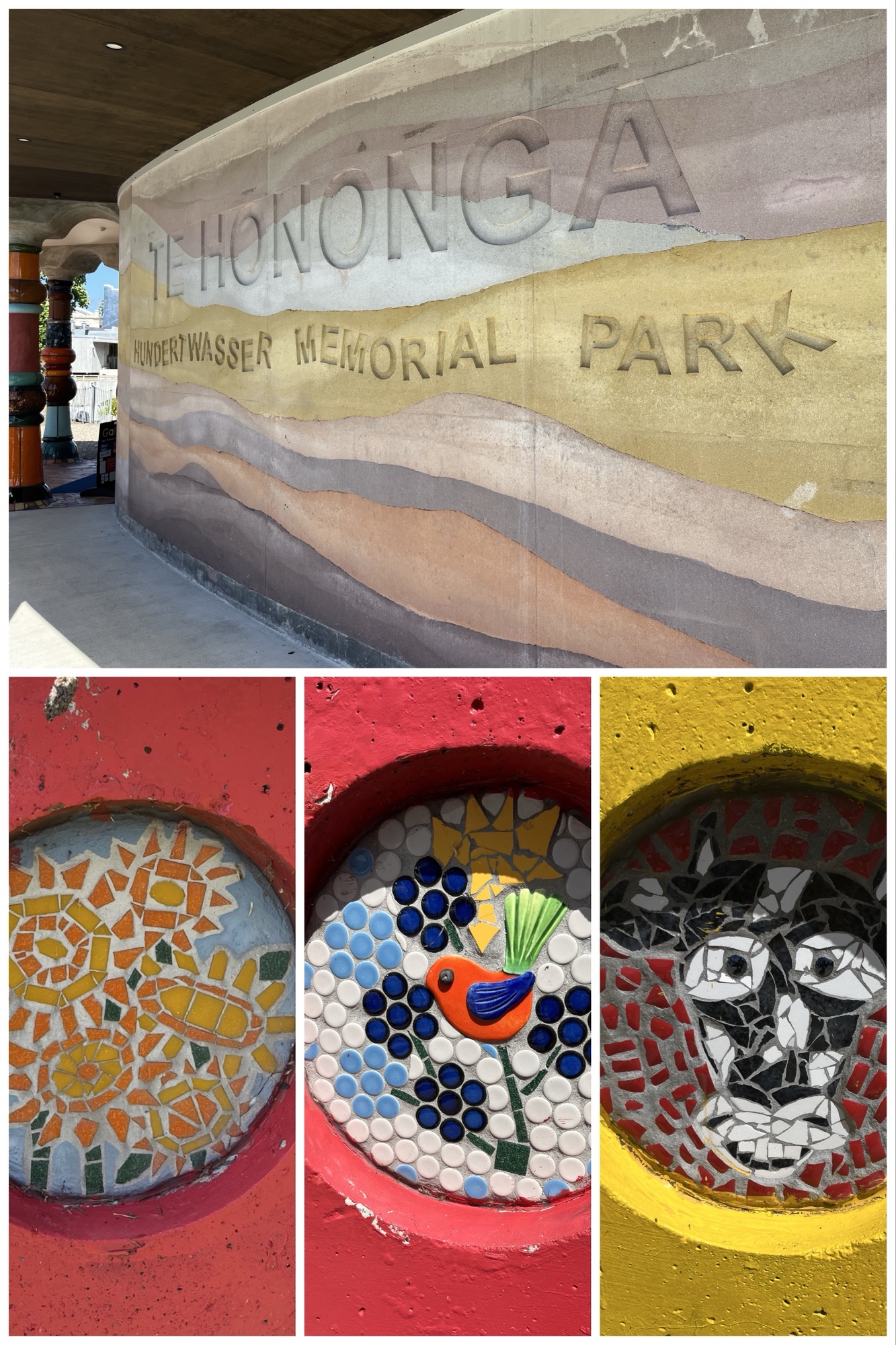


Some folks thought the new building was the tourist attraction, but we immediately noticed the signpost…
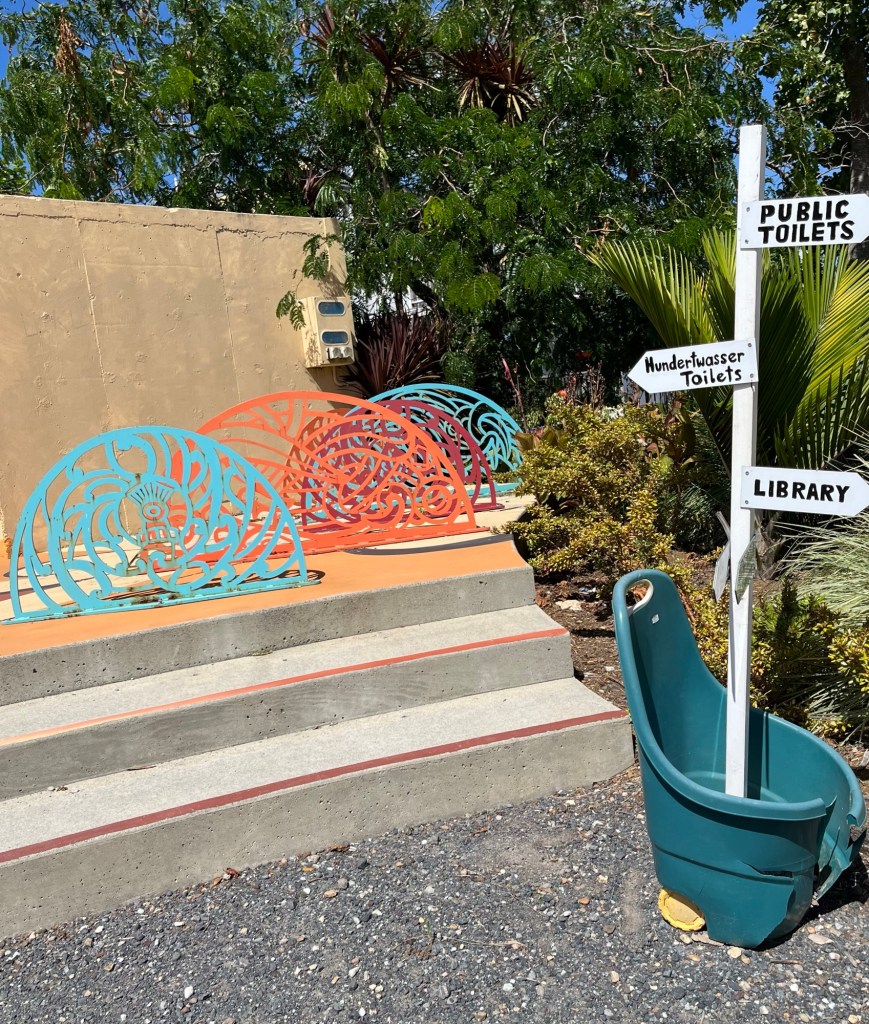
…so off we scurried to be (almost) first to visit the “original” bathrooms, the toilet block building which was the last structure Hundertwasser designed and built before his death in 1999, and his only building in the southern hemisphere.


The afternoon took us from the ridiculous to the sublime, as we headed to the Kawiti Caves, home to impressive rock formations and thousands of luminous glowworms. Formerly known as the Waiomio Caves, this series of caverns is set in a massive limestone outcrop located on private property owned by descendants of Māori chieftain Kawiti.
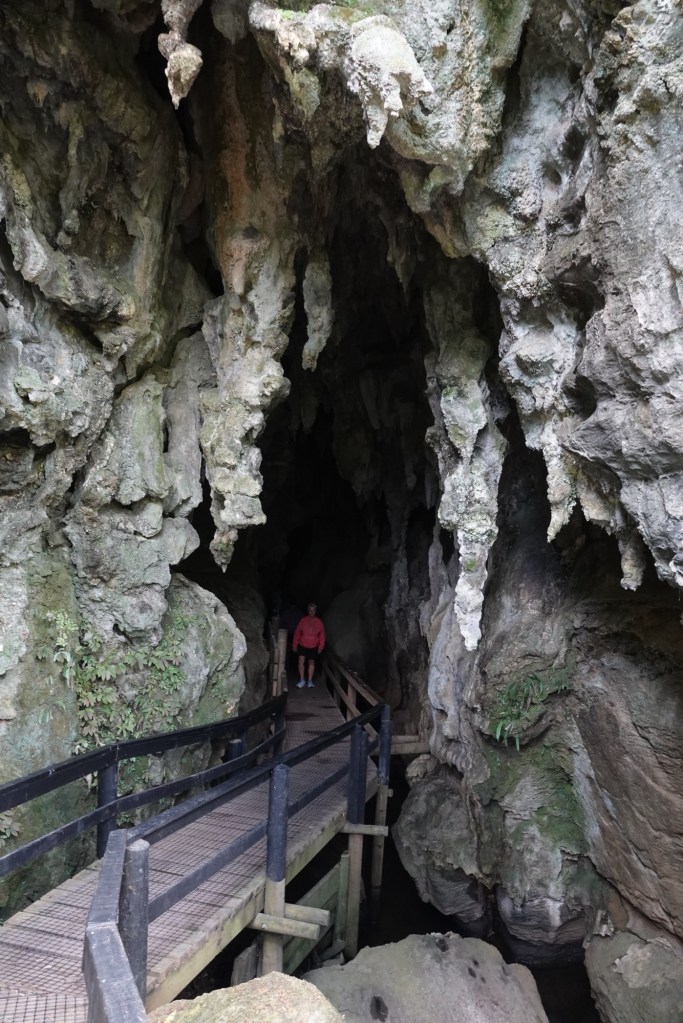
The glowworms are extremely light sensitive, which means no photography, and without a flash the image would just be black, so we’ll have to rely on this description to tweak our memories.
Imagine standing in the semi-dark, lit only by a couple of hand-held lanterns, surrounded by huge limestone rocks dripping with moisture so loaded with minerals that it will eventually make new rock grow. Now turn off the lanterns.
As your eyes become used to the pitch black, look up and see a “sky” seemingly full of more stars than you’ve ever seen before.
Focus on a single point of light and watch as it slowly fades and then reappears.
It’s truly a magical sight.
Each of those lights is a glow worm. The white lights are the youngest. The “moody blue” are the adolescents, and the green are adults. At their maximum length they are each about the size of a matchstick.
As far as we know, they exist only in New Zealand and Australia, and they are not actually “worms”. They’re the bioluminescent larvae of fungus gnats, an insect that looks like a mosquito. The larval stage lasts almost 11 months. There are two types of fungus gnats – those that feed on fungi like mushrooms, and those that are carnivorous and feed on other smaller insects. The glowworms in New Zealand and Australia are the larvae of the carnivorous fungus gnats, and even eat each other in some cases!

After the cave exploration, we stopped back in Kawakawa, and learned that it is not just famous for bathrooms, but is nicknamed “Train Town” because the Bay of Islands Vintage Railway runs down the middle of its main street on the way to Opua. Given the two things for which the town is famous, I’m glad they chose a nickname related to the railway.
We’d “done” the bathrooms, so took the opportunity to head to the Kawakawa Bakery to grab a couple of hot flaky sausage rolls for lunch, and explore the way small downtown area has embraced Hundertwasser’s quirkiness, with tiled benches, murals, and interesting lamp posts.

On our tour of the region we didn’t see any kiwi fruit, although we passed by an orchard. We also didn’t see any kiwi birds, which are nocturnal. We did, however, see several kiwi green tour buses. Close counts.

After returning to the pier and tendering to our ship, we had dinner with new acquaintances Paul and Claire, and took in a wonderful musical showcase featuring Broadway tunes performed by our Viking Vocalists.
We reach Auckland tomorrow morning.
 Rose and Ted’s Excellent Adventure
Enjoying your journal of your journey. And seeing some places we visited in this part of NZ as well. You saw a lot in one day! For me, the highlight of that area was the Treaty Ground. Enjoy the rest of the NZ stops!
LikeLiked by 1 person
We only realized at the end of our day, hearing from other passengers, what we’d missed. It may be worth a ferry ride/flight from Auckland next year!
LikeLike
You already have a return trip to NZ planned! How wonderful! We took 2 trips, 2 months each. Had such a a wonderful time.
LikeLike
I’d love to pick your brain about itinerary. You have my email, right?
LikeLike
I’m not sure I do? mine is pollyalida @ gmail – or message me on fb. Happy to share our itineraries and travel journal.
LikeLike
My wife just turned me on to this site. We will be doing this trip in December.
Very well done!
LikeLiked by 1 person
Happy to have you following along!
LikeLike
We are on the next trip as well. Following Rose and Ted is so much fun and so enlightening. Linda Tanner, Atlanta
LikeLiked by 1 person
felt like I was right back there. Such a lovely area! Thanks for sharing!
LikeLiked by 1 person