I’m hoping that by the time we reach L.A. I’ll be back to 100%, but for now my laryngitis persists and I’m wearing a mask whenever I’m in a big group like in the theatre. I’m definitely not the only one coughing, and one or two other passengers are also wearing masks.
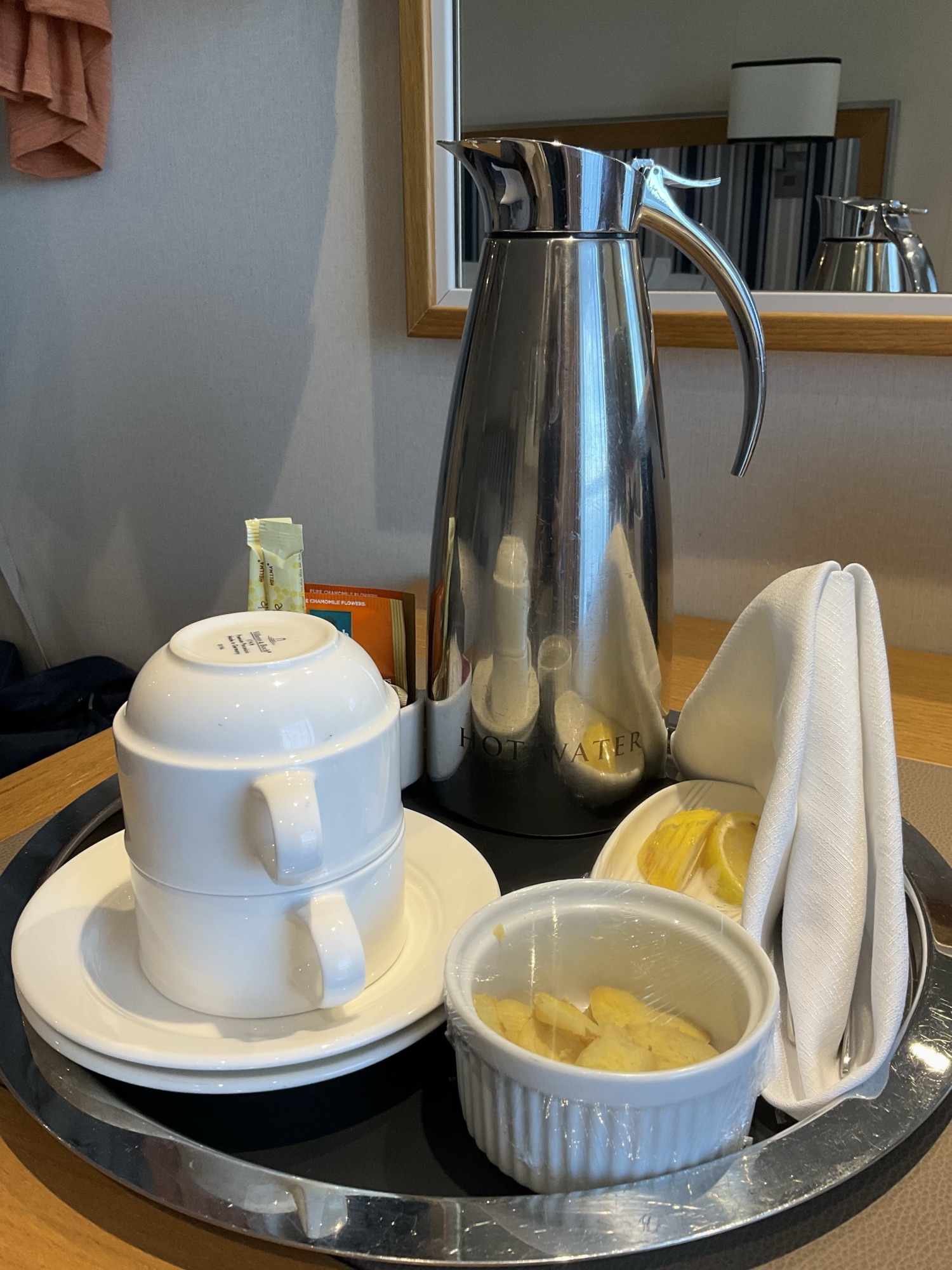
Kathleen, the very sweet bar waitress in the atrium and Explorers Lounge, is keeping me supplied with chamomile tea and honey in lieu of my usual creamy lattes.
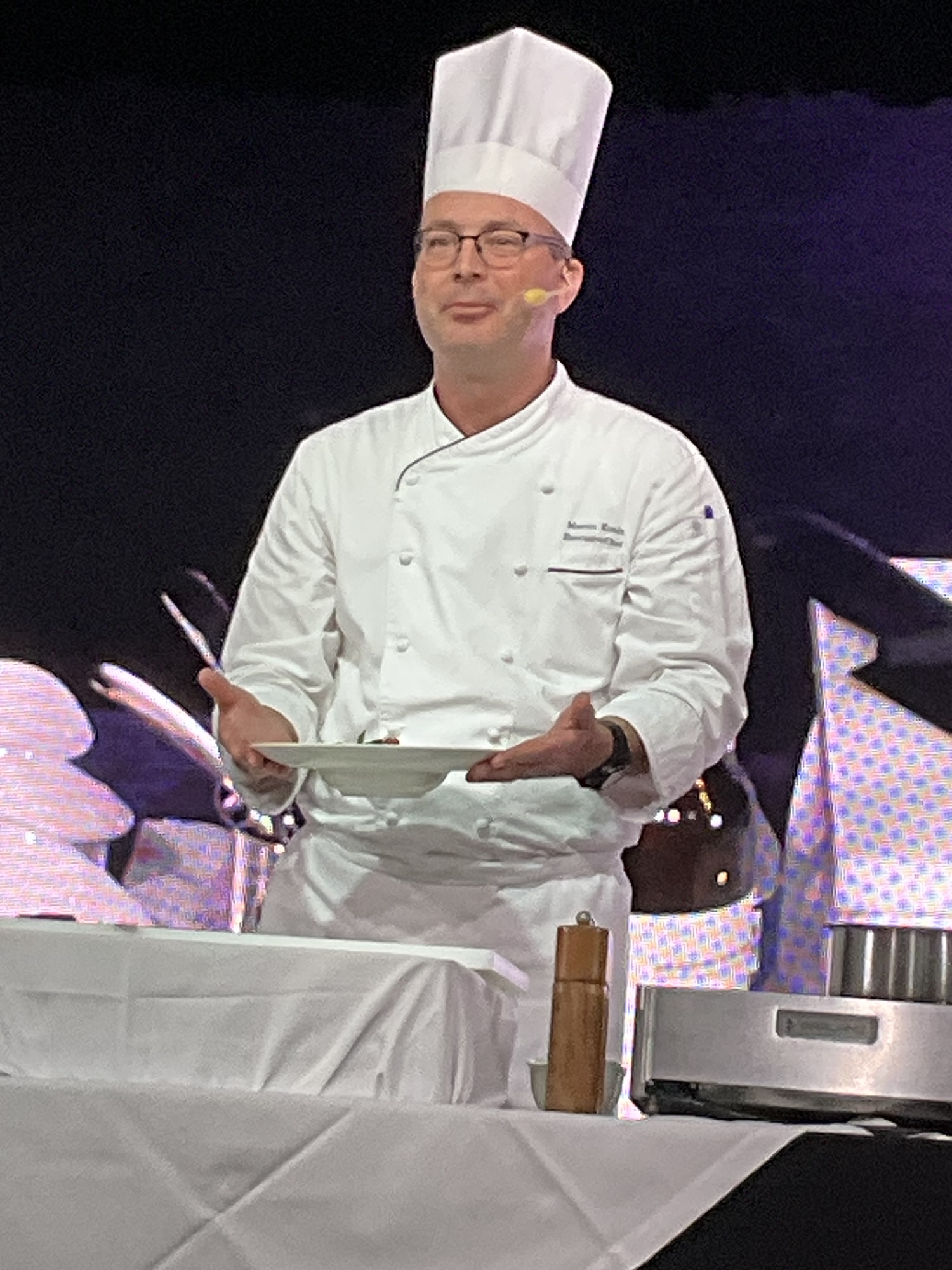
I really enjoyed the cooking demonstrations on our prior Viking cruises. This morning the only one of this Panama Canal leg of the cruise took place, with Executive Chef Martin Kusin sharing two of his favorite recipes, Filet de Boeuf Rossini and Penne Fresche all’Arrabbiata, as well as some secrets to the art of making delicious culinary delights. Martin leaves the ship in L.A., but if past routines hold true the incoming chef will also offer occasional demonstrations on sea days when there are no other special culinary events planned.
Even before the demonstration, watching the crew set up a functioning “kitchen” on the stage, complete with portable induction burners is a show in itself, and a reminder of how much more efficient any cooking process is when the prep work is done ahead of beginning to cook and the kitchen well-organized.
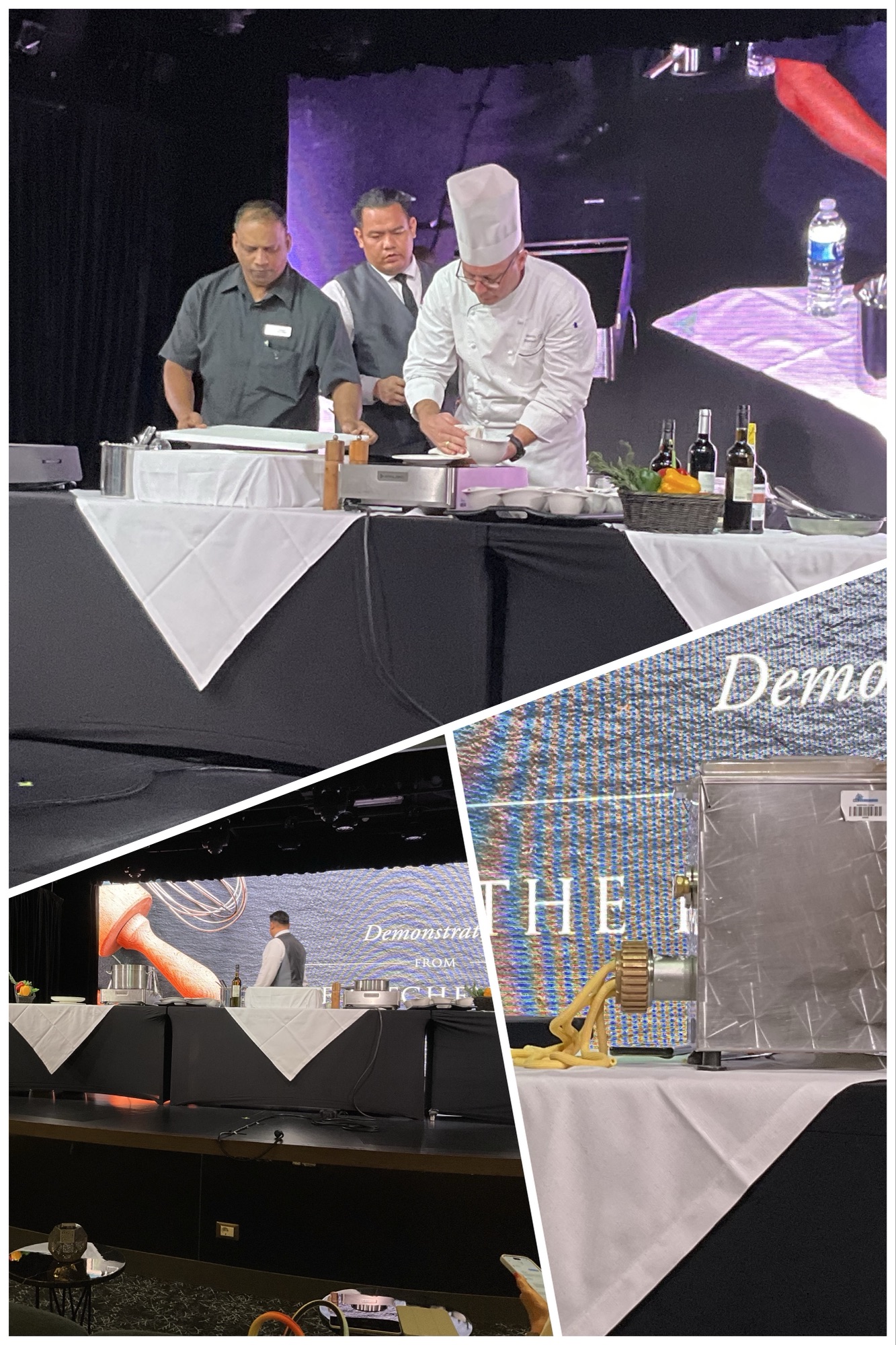
Martin showed us the creation of some of his mise-en-place, the ingredients that are prepped in advance to be “ready in place” as needed during the cooking process. Today, that meant chopping onions and garlic, slicing chili peppers, halving tomatoes, and prepping herbs.
Today’s first dish was Penne Fresche all’Arrabbiata. Chef Martin did his fresh pasta-making demo using the actual pasta machine that is used to make the pasta in Manfredi’s every night. He quipped that he’d been warned not to break it.
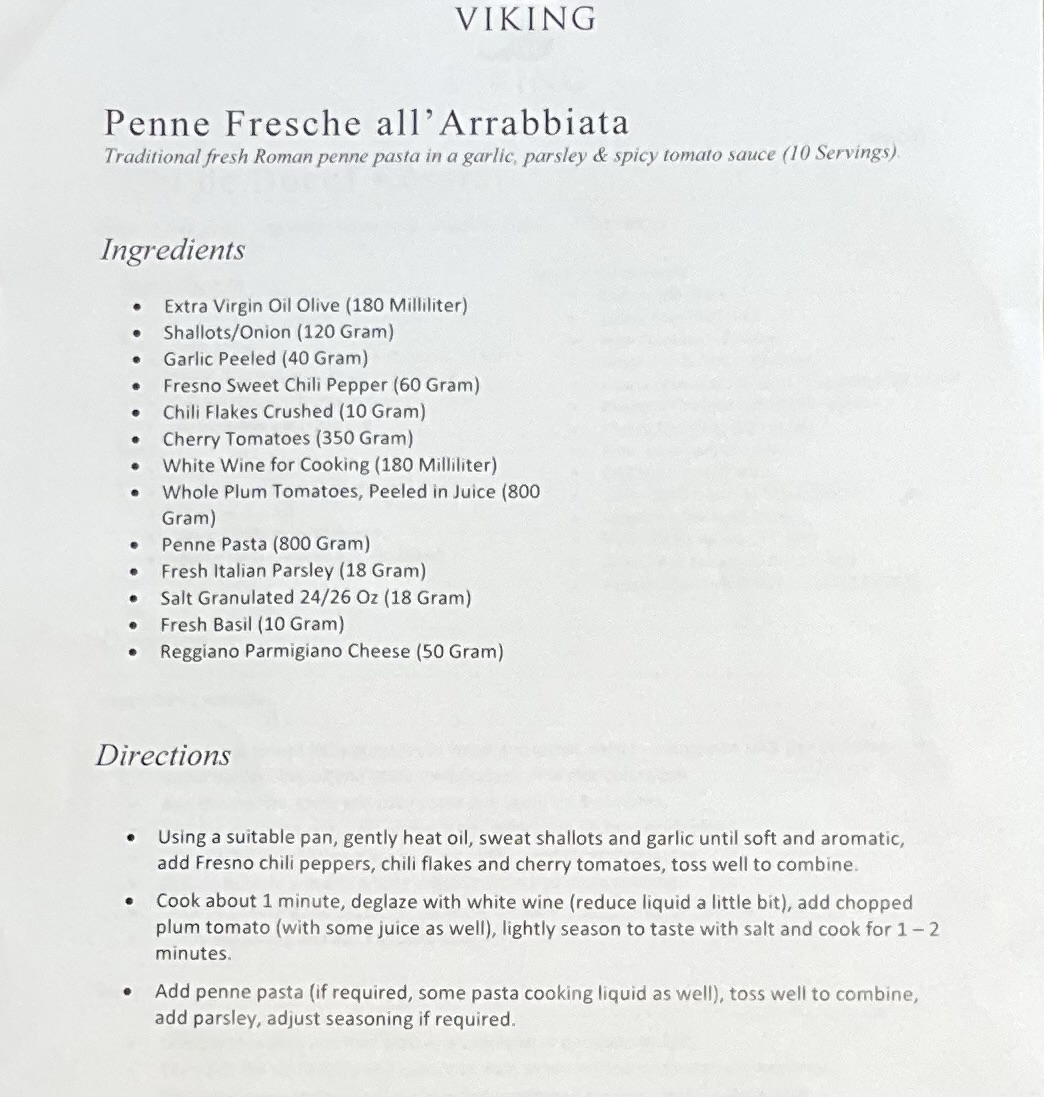
Cooking term #1 of the day: chiffonade, which means cutting very thin strips but of different lengths, as with irregularly shaped basil leaves, as opposed to julienne, which is cutting ingredients (like carrots) into thin strips of equal lengths.
Term #2, al dente. I always thought “dente” referred to tooth, and so al dente to a slightly firm feel when biting the pasta, but al dente actually means “to the point”. Chef Martin explained that if you cut a piece of cooked long pasta that is perfectly cooked, you should see a small “point” in the centre of the strand that is slightly undercooked and hence firm. Biting a piece still works, even though it is not the translation; throwing pasta at a wall does not – and Martin does not allow his sous-chefs to throw food!

One of Martin’s “chef’s tricks” is to always slightly roast any spices that he uses. It both brings out the flavours and allows the use of smaller quantities to achieve those flavours. He stressed the importance of de-glazing the pan to ensure all the lovely roasted flavours are incorporated into your dish and not left on the bottom of the pan, no matter what you’re making. You can deglaze with stock, or vinegar, or wine, depending on the recipe. Wine, of course, is always the first choice because you can have a sip or two while you’re deglazing. More on that topic from Chef later.
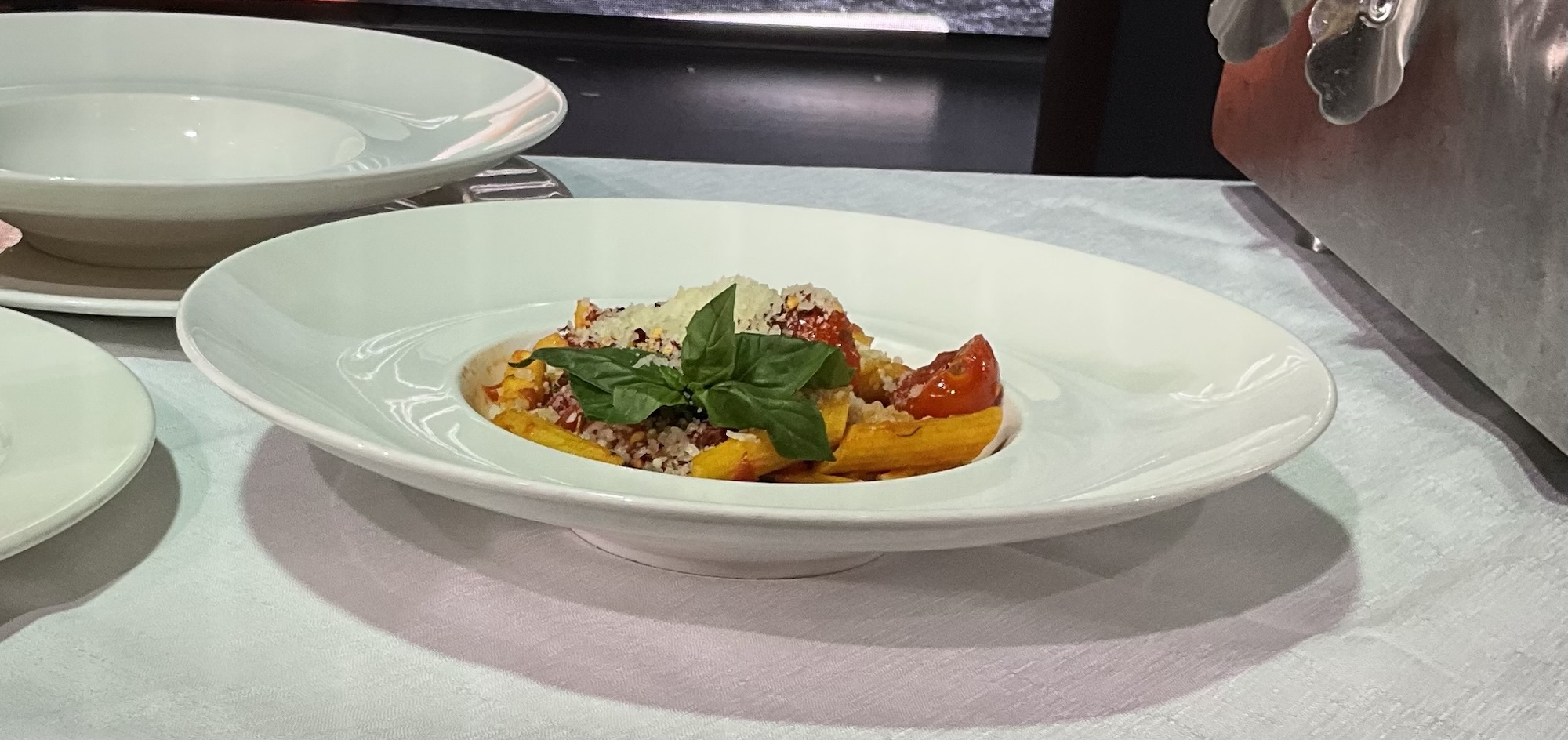
Chef Martin certainly has a sense of slightly warped humour. Since he knows that his set-up crew will want to eat any dishes he makes during these demonstrations, he loaded the penne all’arrabbiata with chili, and then “hid” the chili flakes under parmesan cheese and a decorative sprig of basil. Ouch!
The second recipe being demonstrated is accredited to Auguste Escoffier, the famous chef, restaurateur, and culinary writer who introduced the idea of having separate “specialized” cooking stations in his restaurants. This is the organization now used in most large kitchens, including Viking’s, where there are separate sous-chefs specializing in fish, meat, soups and sauces, etc.

Martin’s meat trick for entertaining at home is to pre-cook a steak to one degree less cooked than desired (e.g. rare if you actually want medium rare) and then quickly “finishing” it once dinner guests have arrived. That ensures not only that meat is served hot, but also that the cook doesn’t have to spend their entire evening in the kitchen.
As Martin deglazed his pan with Madeira, port, and red wine, he shared the difference between a very good chef and an excellent one. A very good chef uses all the wine for cooking; an excellent chef keeps at least half to drink.

Interesting tidbit: on every Viking ship, the veal stock used as the base for every brown stock or demi-glace is made on board. Each batch uses 200 lbs (just under 100 kg) of roasted veal bones, and simmers for a full 48 hours. No wonder those sauces and gravies taste so good!
Who looks after all those time-consuming processes? There are 106 chefs/cooks on a Viking ocean ship, on contracts ranging from 4-6 months in length. A regular working schedule is 10 hours per day, 7 days per week. It’s not for the lazy!
When plating, Chef Martin reminded us not to go overboard on arranging vegetables on the plate, because “vegetables are overrated”. Ted would certainly agree!

After watching food being cooked, it was time to go and eat; Martin’s penne dish was being featured in both the main restaurant and the World Café – in both cases with the chili flakes on the side.
Ted and I met for lunch, and then I stayed behind, drinking yet more tea (and chatting to folks who’d joined our table) while he headed off to help a fellow passenger with an iPhone project.
As I was leaving the World Café, Nasser, the head waiter, overheard me talking with Talent (“my” Pool Grill cook), about the fact that my laryngitis was improving although the accompanying annoying cough persisted. He immediately got on his pager and arranged for lemon, fresh sliced ginger, honey, chamomile tea bags, and an insulated pot of hot water to be sent to our room. You have to understand that I requested none of that. “Pampered” doesn’t begin to express how we’re looked after on this ship.
After drinking about a gallon of restorative tea in our room, I couldn’t face going to high tea in the Wintergarden, so I headed instead to Robert Cribb’s lecture on whaling. We’re in prime whale migration territory in this part of the Pacific, where whales – now protected – flourish – so the topic is timely.
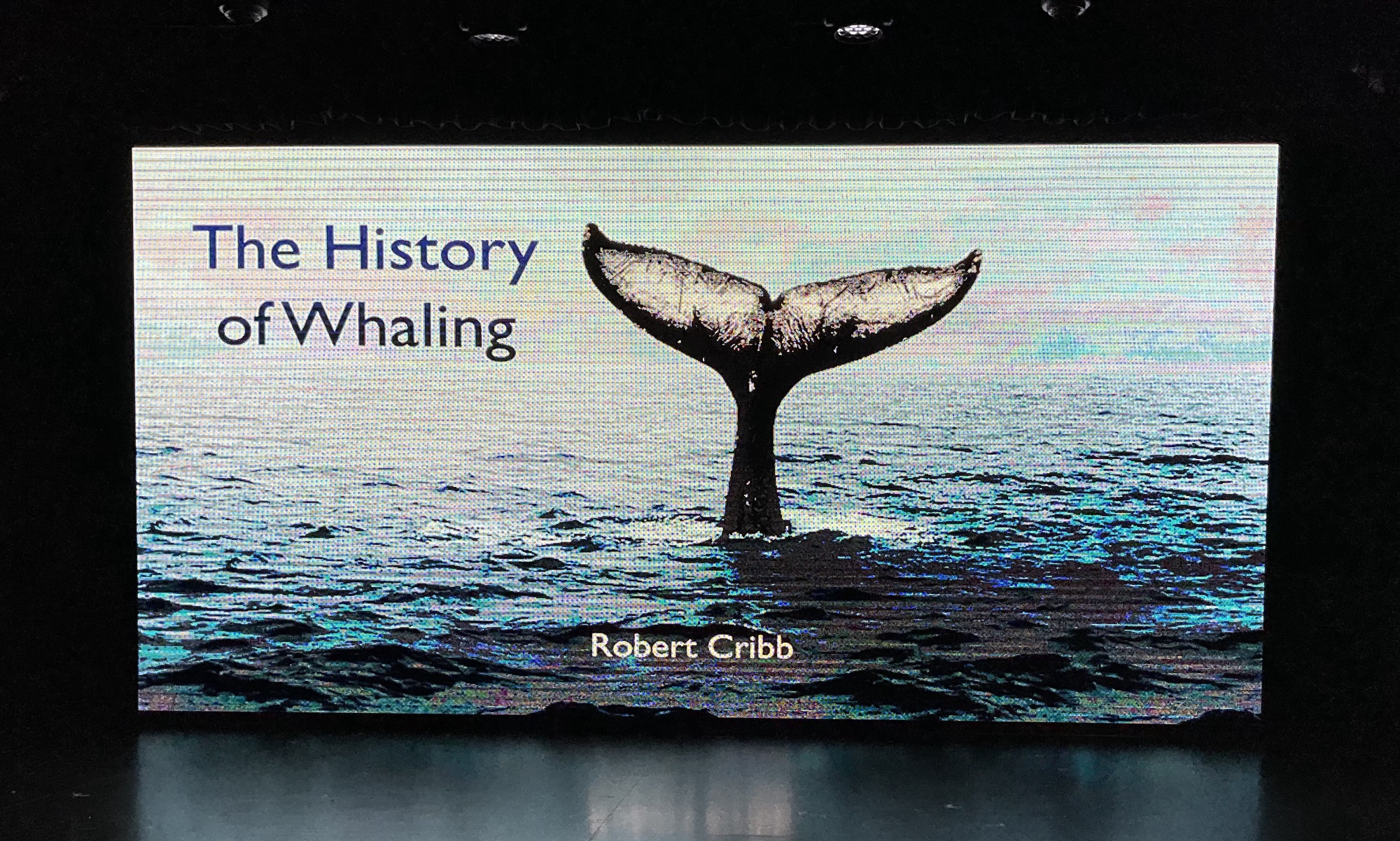
It really wasn’t about whaling, per se, but about humans’ interactions with whales throughout history. Robert quipped that he really wanted to write a lecture from the point of view of whales, but he simply couldn’t get into those mammals’ minds the way he’d have liked. He started his talk WAY back at the evolutionary processes that we think led to a land mammal returning to the sea and eventually evolving into whales.
He humorously touched on the many Jonah and the Whale legends that exist in multiple cultures and religions, as well as the 6th century Irish legend of Jasconius and St. Brenden, where St. Brenden mistakenly thinks a whale (Jasconius) is an island and tries to set up a camp on it.
As early as 6000 BCE, there were Korean carvings depicting whale hunting. While whales are now protected in the Americas, the Inuit, some Indonesians, and the Faroe Islands populations continued to hunt/harvest whales well into the 20th century.
Interestingly, most early depictions of whales show two spouts. We learned that only right whales actually have 2 spouting blowholes. They’re now very rare, but at one point they would have been the most commonly seen whale since they are slow, they like to swim close to shore, and they have a very high blubber content, so when they die they float on the water’s surface and are more likely to wash up on shore.
Traditional whaling likely had only a minimal impact on whale populations, but in the 15th century the Basques began “commercially” harvesting whales in the Atlantic, selling whale oil all over Europe. Basque dominance over whaling was soon supplanted by Americans whaling off New England in the era around the time of the American Revolution. The lighthouses of the Atlantic coast used sperm whale oil, which burned brightly with no smoke or smell. Whale oil also proved to be a particularly good lubricant; the Hubble Telescope has parts lubricated by whale oil!! (Hopefully that was collected from beached whales, but Robert was not giving any guarantees on NASA’s behalf.)
Commercial whaling was a harsh era for both whalers and whales, but in 1859 when oil was discovered in Pennsylvania, it would have been logical for whaling to decrease. Instead, industrial large-boat whaling simply replaced smaller commercial whalers. While crude oil had displaced whale oil as a source of light and heat, for several decades 84% of the world’s margarine was made from whale oil. Detergents and soaps were made from whale oil. Fertilizer was made from whales. In WWII, whale even became a meat alternative in Britain.
Whales were treated like minerals, and were equally a non-renewable resource.
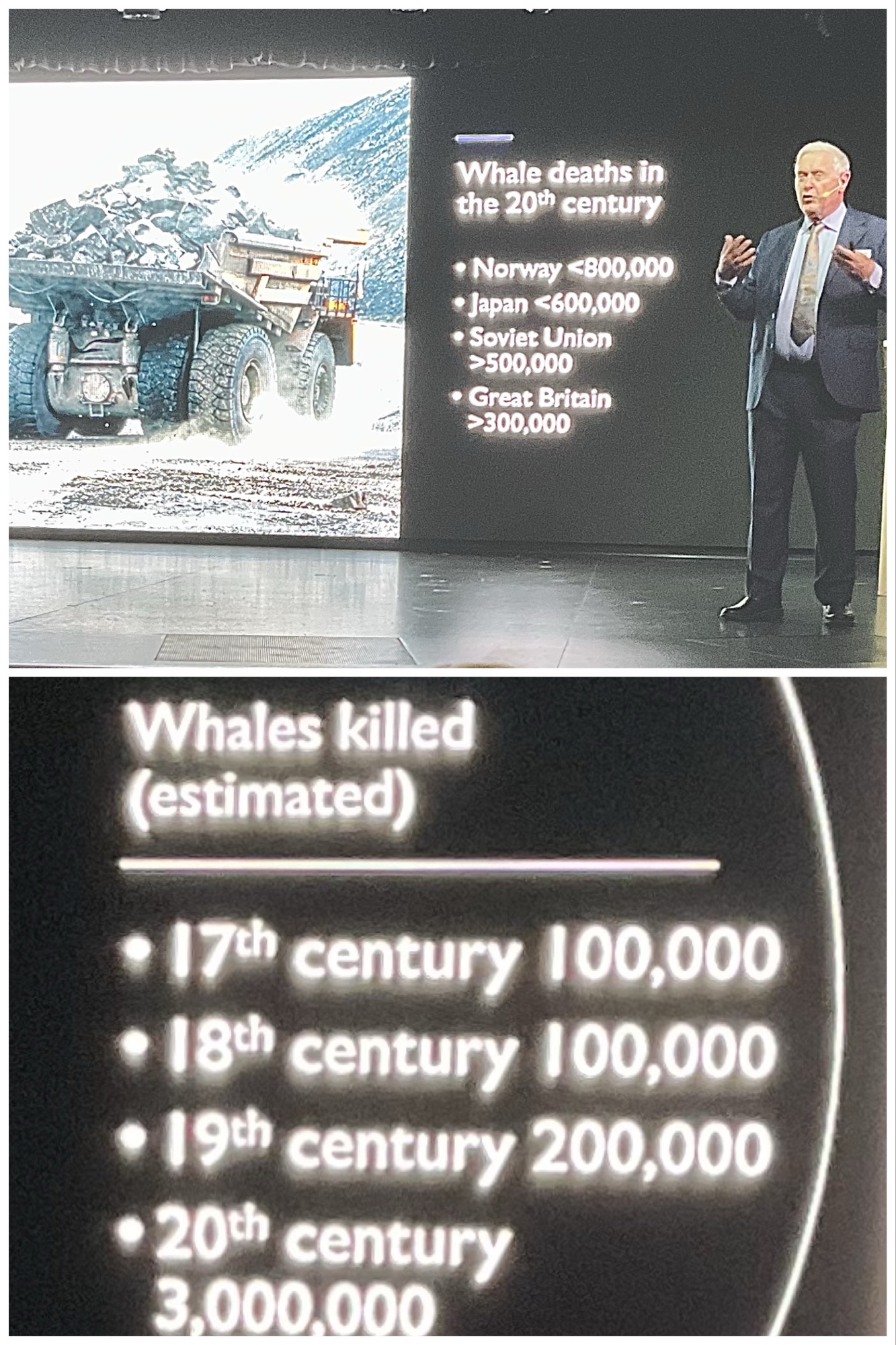
In 1946, the International Whaling Commission was formed, more interested in dividing up access to this “resource” than in any kind of conservation. That of course has changed since Greenpeace in the 1970’s.
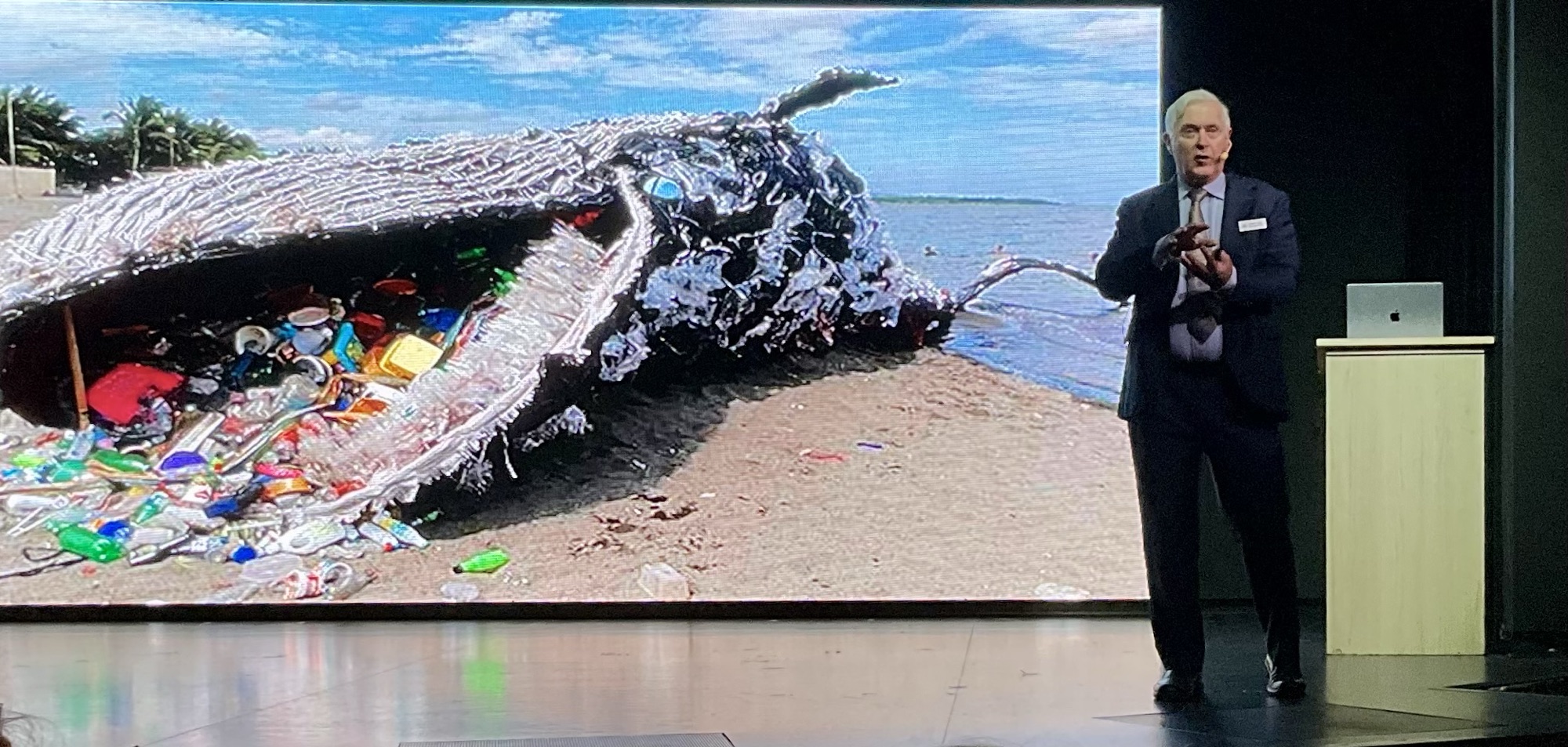
One of the biggest current threats to whales is plastic pollution, which is especially dangerous to baleen whales who “filter” their food.
Robert left us with food for thought: given what we are learning about whales, including the fact that they seem to have a real “language”, should we be affording whales – and perhaps other mammals, more respect, and status as “partners” on earth?
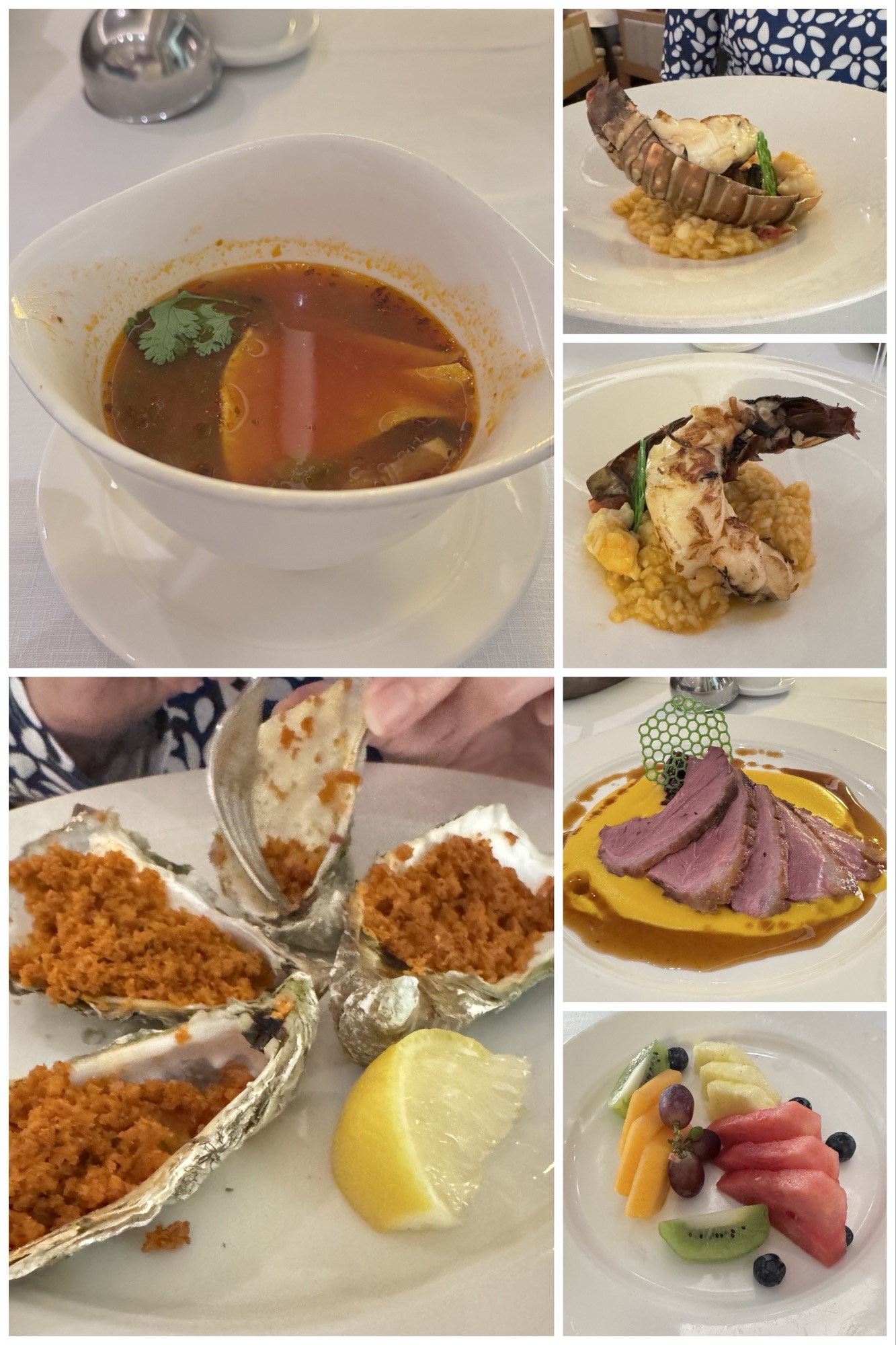
Dinner tonight was another testament to the talent of the culinary staff on board. We ate in the main restaurant and each dish was perfect.
To top off our night, a champagne farewell to crew and passengers disembarking Los Angeles in two days, a thank you to the Viking Sky crew, and The Beatles Songbook performed by the Viking Vocalists backed by the in-house Viking Band.


Tomorrow will be a packing day for about 400 disembarking passengers and around 100 crew heading on vacation, as we prepare for docking in Los Angeles on January 5th. That means a low-key day on board, and maybe a day off from writing the blog too, since I’ll likely just spend the day reading and eating.
We’re excited about welcoming lots of friends from the 21/22 World Cruise on board on January 5th to join us on the next 121 days of this adventure.
 Rose and Ted’s Excellent Adventure
Hi Rose,Weâre looking forward to meeting you
LikeLiked by 1 person
Thanks Rose, I’m learning so much from your blog. I’ve been to several places you’ve visited, but I’m learning new things that I either forgot or didn’t absorb. See you soon
LikeLiked by 1 person