Once again, we’re in a port we’ve visited before with both Viking and Holland America. On past visits we’ve done the Panoramic Tour, the Walk In The Clouds aviary, the Andalusian Horse Show, and once just wandered around on our own (Episode 50, Episode 154, Episode 173, Episode 174, and Episode 561).

This time, we could have chosen the Starbucks Coffee experience, a butterfly garden, an aerial tram, a crocodile-sighting river cruise, a wildlife sanctuary, or a relaxing beach break, but I just booked the included Panoramic Tour again. During this first leg of the cruise, with ports we’ve mostly visited before, it’s mostly about relaxation and economizing.
The tour description read:
“Get acquainted with Costa Rica’s natural and cultural gifts on this scenic ride into the country’s Central Valley. Your sightseeing drive by motor coach begins by heading east to Esparza, a picturesque town founded in 1574 by the Spanish that is now known for its hardworking people. Local dancers will greet you at the city park dressed in traditional costumes, and you will also have time here to browse among the crafts stalls for the perfect handmade memento of your trip. Your picturesque roundtrip journey will take you along the deep blue waters of the Pacific Ocean and past mango farms and cashew plantations.”
En route to Esparza, where we would be treated to the itinerary’s promised traditional dance performance – by a children’s troupe called Gotas de Esperanza (“drops of hope”) – our multilingual guide Allan (coincidentally the same tour guide we had in 2022) shared lots of interesting information about Costa Rica, starting with some geography.
Despite being a small and fairly narrow country, Costa Rica has five mountain ranges. The one visible to us in Puntarenas was the Cordilla Talamanca (Talamanca Range), which is the beginning of the 7000 mile long Andes. These are tectonic mountains, formed by two plates pushing against each other and forcing the land up, so there are no volcanoes here.
The Cordilla Central, the Cordilla Guanacaste in the north, and the Cerros Escazú (Escazu hills) are all volcanic. There are 112 volcanoes in a country of just 19,732 square miles; just 3 are active. That volcanic soil makes Costa Rica ideal for growing high elevation arabica coffee beans, but Costa Rica represents only 1% of current world coffee production.
The mountain ranges divide the country into Caribbean and Pacific regions with significantly different climates, although because of the proximity of Costa Rica to the equator neither side has “seasons” beyond wet and dry.
After that, Allan changed topic to history.
In pre-Columbian times, about 45,000 people of 7 different ethnicities, each with their own language, lived here. New research indicates that these peoples had a mix of Asian and African DNA, leading Allan to say that Costa Ricans have “always been a mixed people.
We remembered from our visit to Peru that near the Peruvian town of Nazca, an ancient pre-Columbian system of aqueducts called puquios were built and are still in use today. On our bus ride today we learned that there is a complex network of uncovered and covered aqueducts still functioning in The Guayabo National Monument of Costa Rica.
Columbus gave the country its name “Rich Coast”, mistakenly believing the country had gold and jade because of the jewellery worn by the people he observed on the coastline. While there are no significant gold or jade deposits here! The country is rich in “Pura Vida” (pure life) which is evident in the smiles of its inhabitants.
Costa Rica actually contains one of the planet’s 5 blue zones, places where people live the longest. Much of that may be due to the fact that access to potable water is considered a constitutional right here, and 96% of the country has access to both clean water and electricity – as well as education. Since 1870, Costa Rica has had free and mandatory public education from kindergarten (1 yr) through elementary (6 yrs) to high school (ranging from 3-6 years). The literacy rate is an admirable 97%!!!
At this point, we’d reached our destination for today’s cultural event. Esparza is a small rural community whose economy is based largely on mangoes and beef cattle, whereas in Costa Rica overall agriculture is being transplanted by medical device and computer chip manufacture and export.
The town has a lovely public square, in front of its small cathedral, in the style of Spanish and Italian cities. This was once the hub of the community’s social life.

The square was decorated for the Christmas season, and also had a beautifully painted coffee cart on display.

Today, as a performance venue, it helps to bring much-needed tourist dollars into the town.
I’m really glad we did this tour again, because the dancers in the little town of Esparza were enchanting, if somewhat “serious” in demeanour with the responsibility of representing their entire town to a bunch of old white tourists. On a previous visit, it was a teenage dance troupe that entertained us, and they seemed far less daunted by the process.

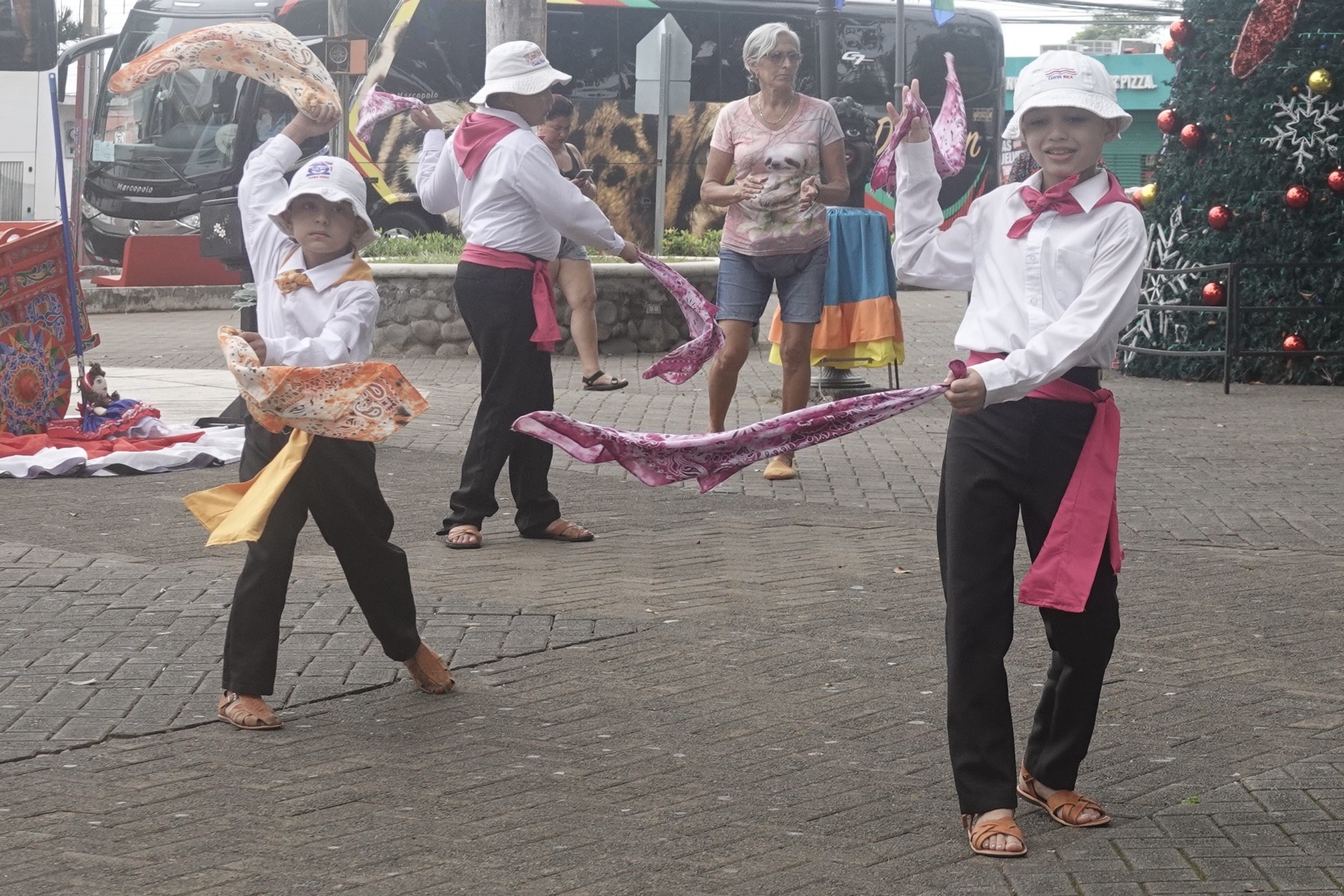
The children performed 4 dances, the first of which was called El Cafétal (the coffee plantation). In the dance, the boys’ scarves represent machetes; there are too many obvious reasons to list why actual machetes are not something with which children – or anyone! – should dance.
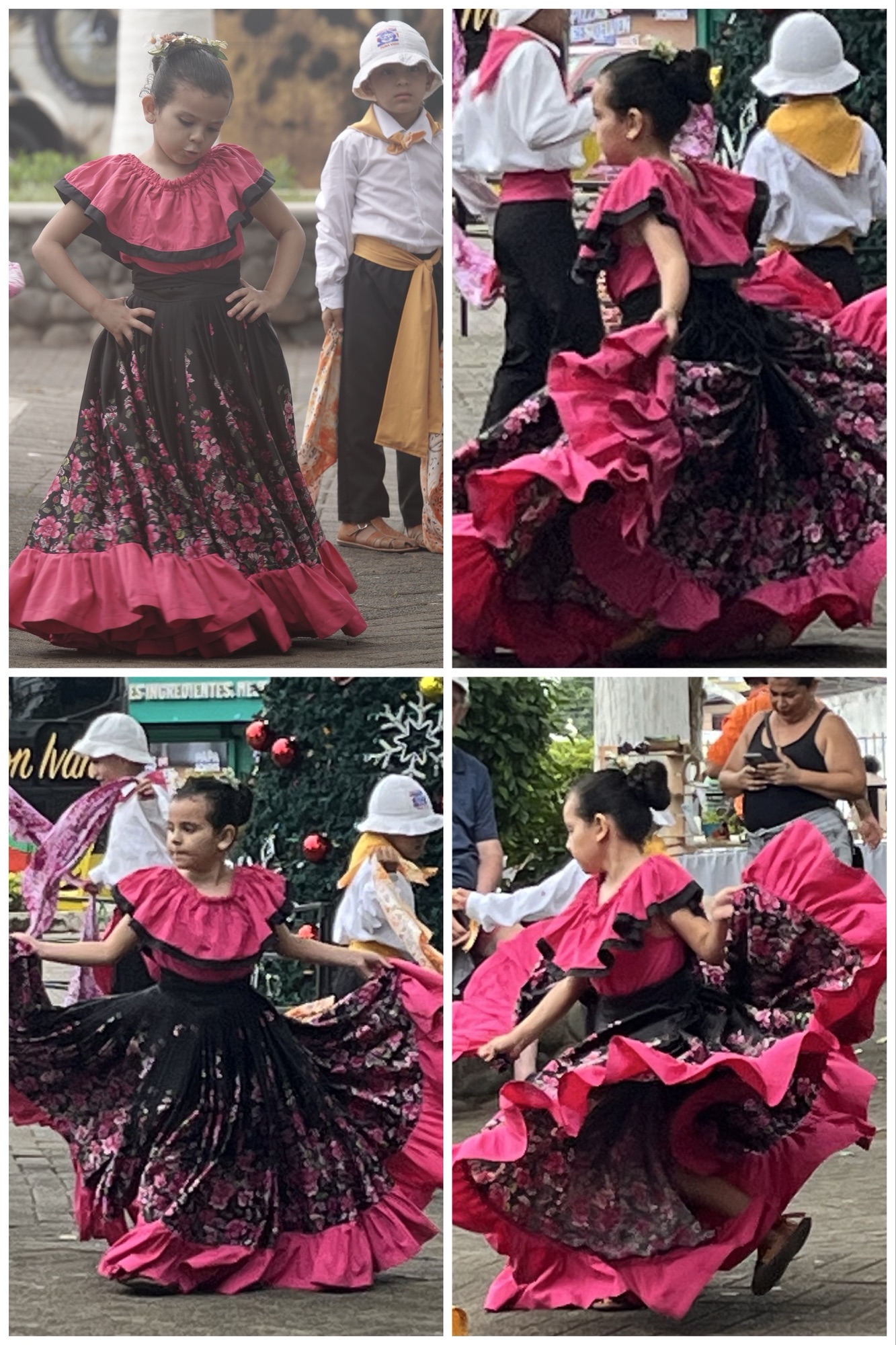
The gorgeous skirts worn by the girls were historically “one size fits all”, with enough fabric gathered into the waist to allow expansion, and a tradition of simply adding extra flounces whenever additional length was required.


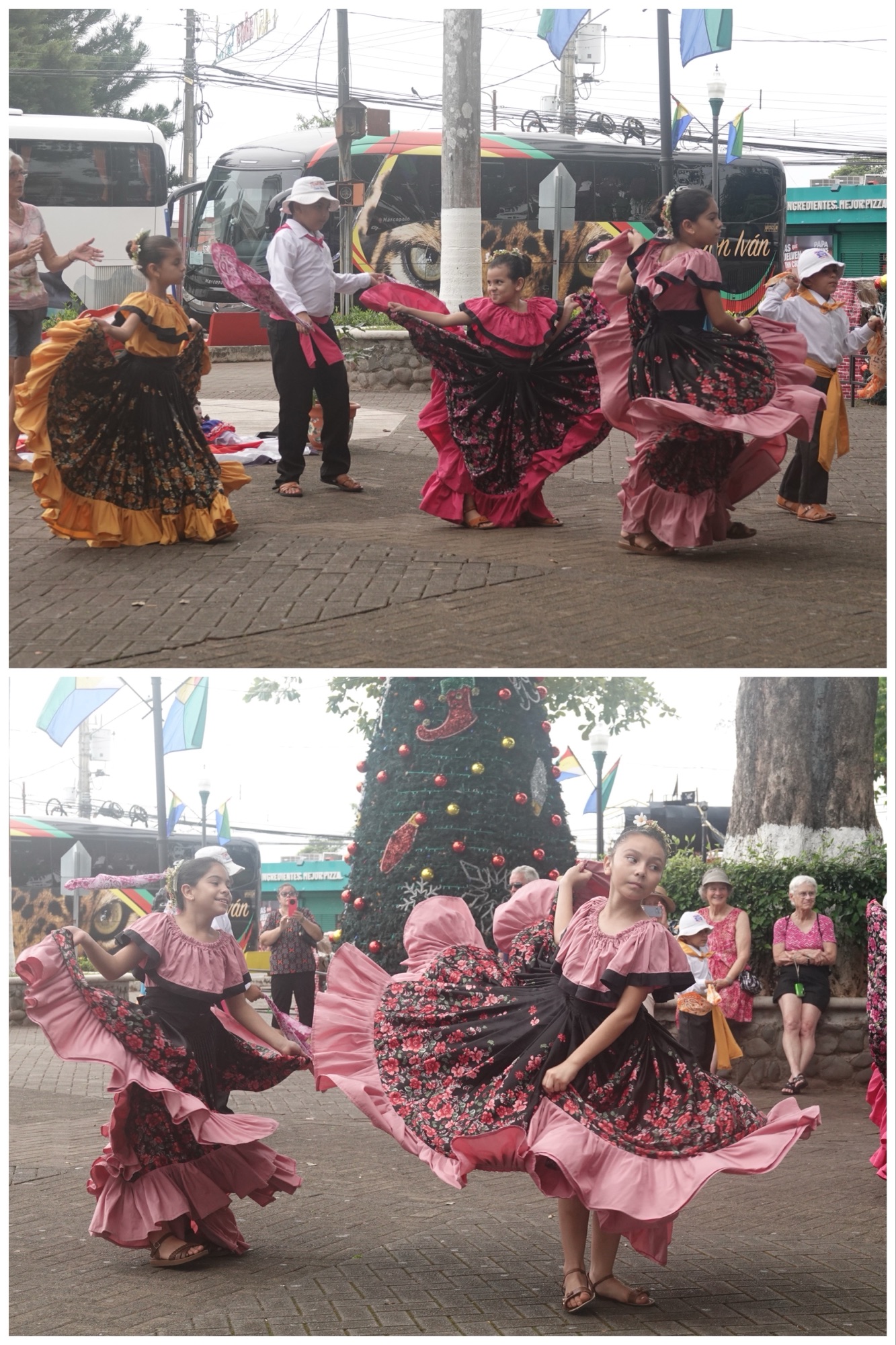
The final dance, done in a ring with audience participation, was called El Pavo (the turkey). One person stands in the centre of the ring, doing a sweeping motion with a “broom”. Tradition says that if a young man is “swept”, he will never marry. Dancers hold hands and move with the music, first to the right, then to the left, and then into the centre while making turkey gobbling sounds. While the group is in the centre, the broom is handed over to a new person and the circling begins anew.

Bottom left: oh, the shame. Bottom right: the “reward”.
The person left holding the broom when the song is over is the “turkey”. It’s not the first time I’ve been called that.
Allan then talked about what happens to the turkey! Apparently it gets anesthetized with very strong sugar cane rum, and then “sacrificed” for dinner.
I was okay with getting “marinated”, but not so keen on the whole sacrifice concept. Luckily, all I got for being the turkey was a symbolic broom.

We had a few moments to visit the church, where a wedding was about to be held.

Once the wedding party was inside, our young dancers came to sit on the steps of the church. After the pressure of dancing for an audience was over, the children’s relief was palpable….
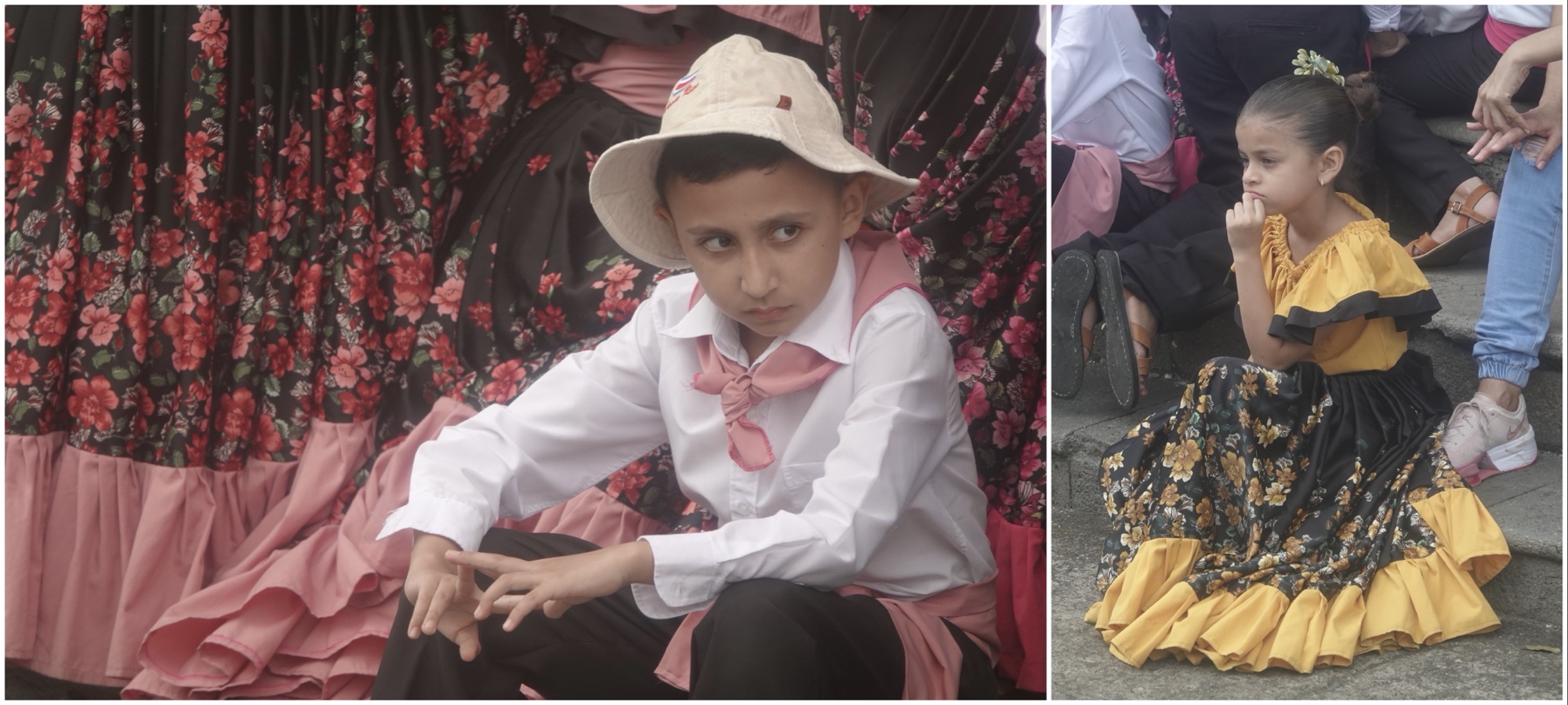
… which might be why we got such enthusiastic goodbye waves!

En route back to the ship, Allan explained that although Costa Rica is still 45% Roman Catholic, both church and civil marriage is recognized. Couples may choose either, or even both! If they choose neither, their relationship is considered a “Common Law” marriage after 3 months of cohabitation. Additionally, men are responsible for the financial support of their children to age 25, and DNA testing is mandatory, so there is no shirking of duty allowed. In the 21st century the trend has been for the age at which women marry going up, and the number of children per family going down.
As we passed one of the country’s jails, Allan told us that Costa Rica’s judicial system follows the Napoleonic process: guilty until proven innocent! The maximum prison sentence is 50 years, and there is no death penalty.
By the time we returned to the ship, I felt we’d learned a few new things, which made this another successful excursion experience.
I grabbed a light(ish) lunch of curried prawns before settling in to write up my notes.

Tonight was a barbecue event on the pool deck, but we’d reserved our first Manfredi’s dinner of the cruise, so we stuck with our original plan, and dinner was every bit as amazing as we’d remembered.
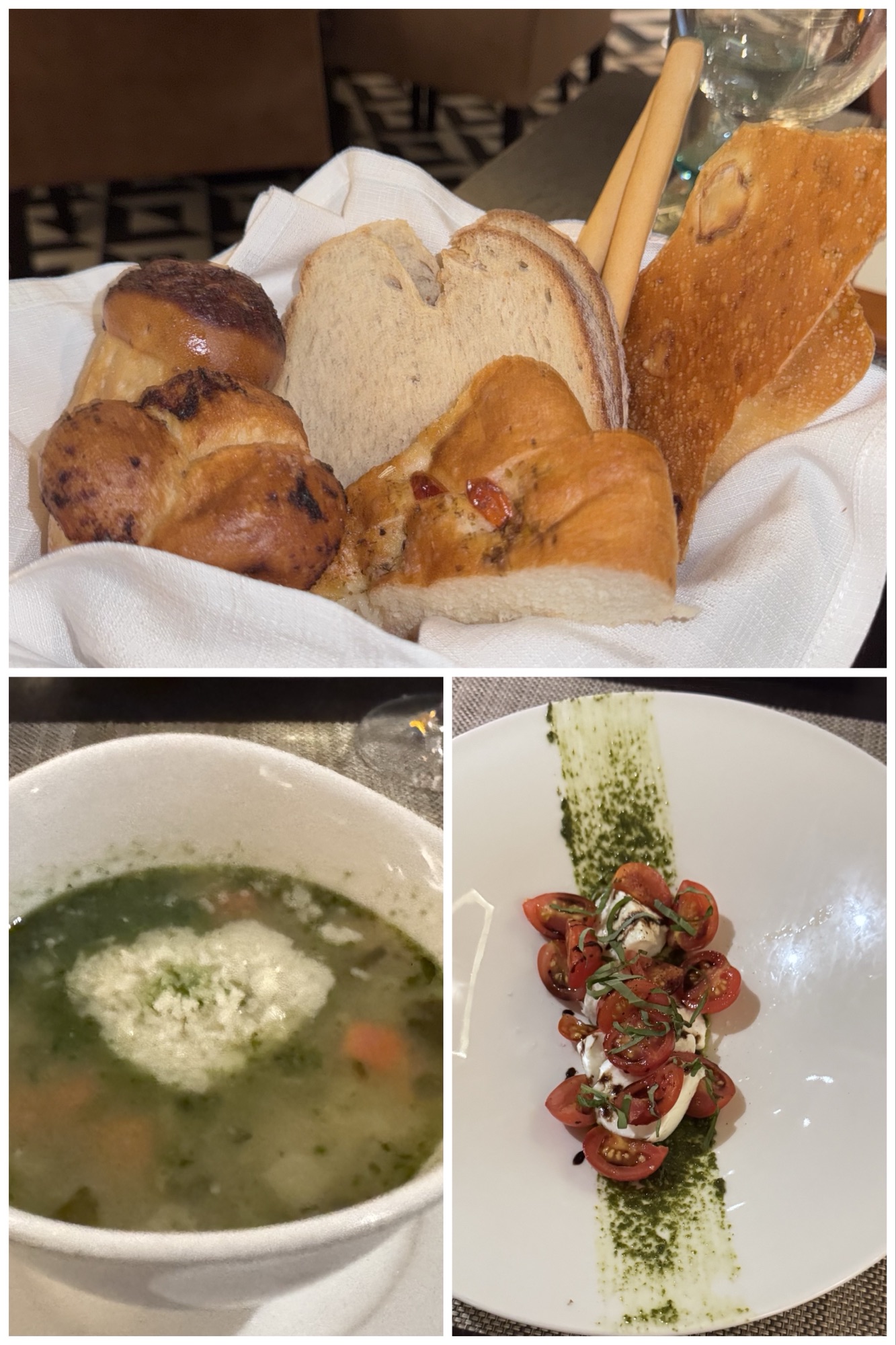
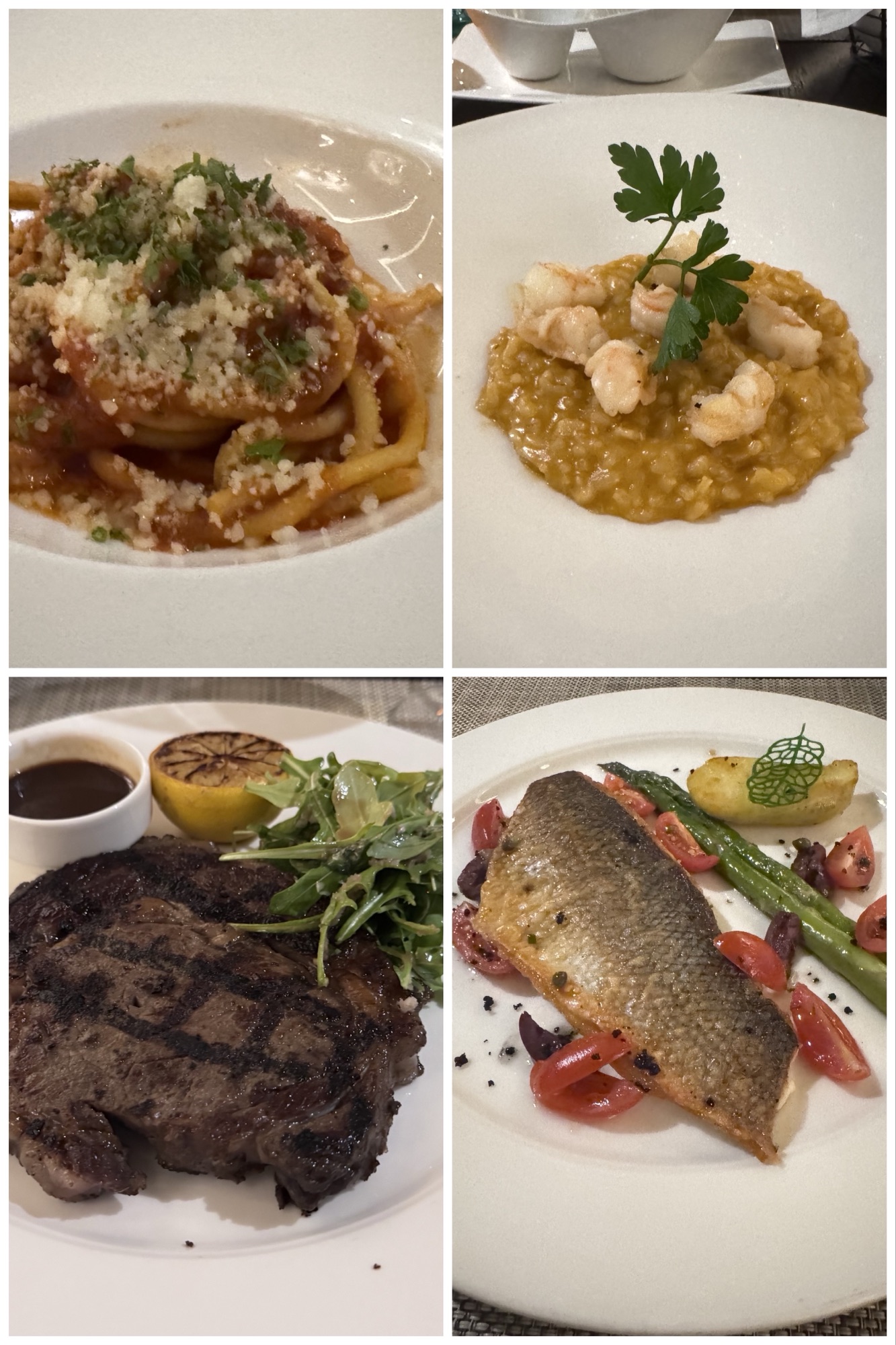
risotto cooked in a shellfish broth with shrimp, parsley & lemon zest.
Bottom – main courses. Left: Viking Bistecca, thick cut rib eye coated in garlic oil and rubbed with porcini mushroom powder, kosher salt, brown sugar & red chili flakes. Right: Branzino alla Mediterranean,
seared crispy skinned sea bass with cherry tomatoes, potatoes, black olives, anchovies & parsley

After that sumptuous dinner, it was time for the Viking Vocalists’ second production show, a thoroughly enjoyable country music themed show called “Southern Sounds”.
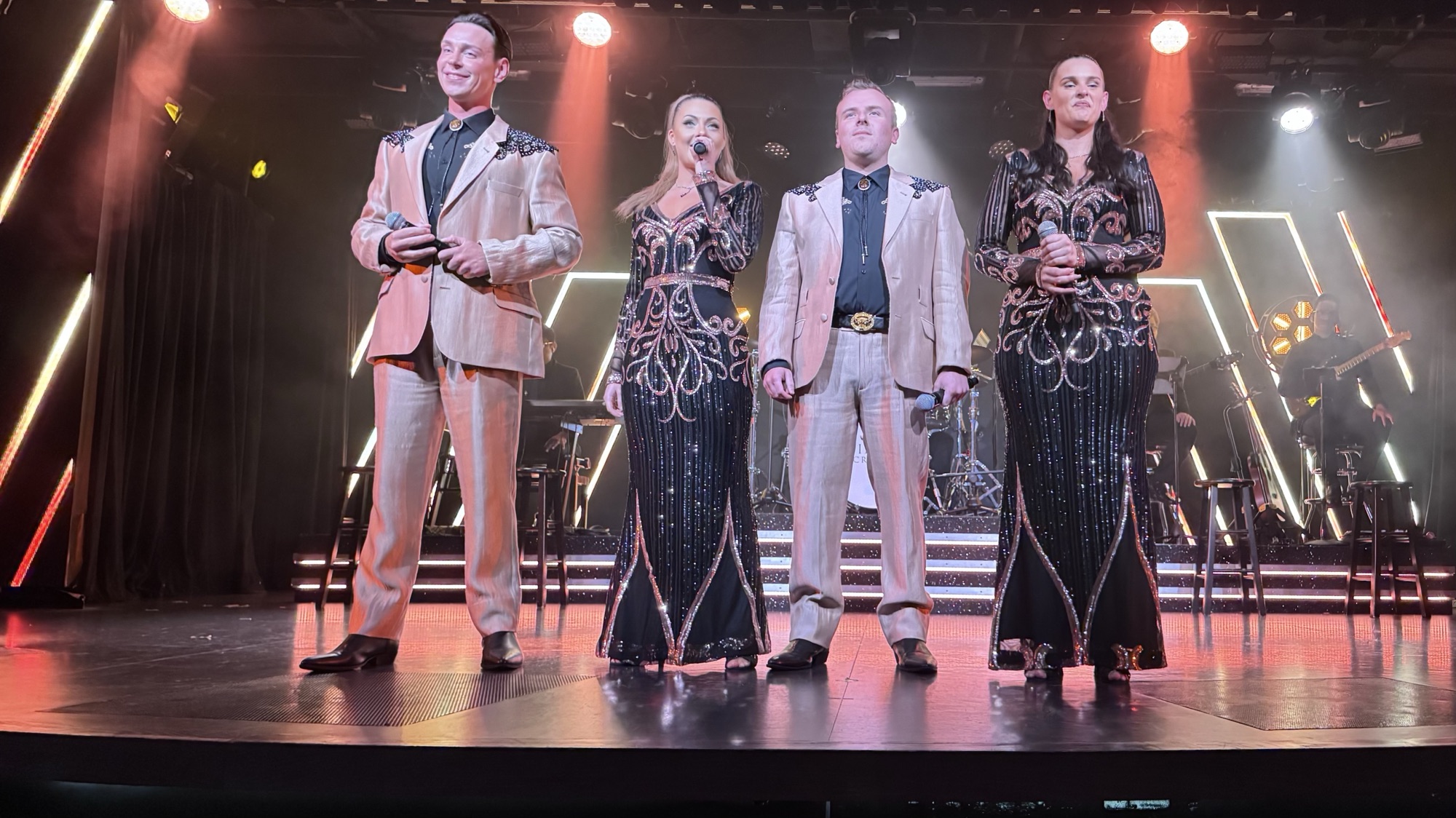
We’re heading into four straight sea days en route to Cabo San Lucas, which means we can sleep in, so it was off to Torshavn for more music before calling it a night.
 Rose and Ted’s Excellent Adventure
Glad to know a little more about that Florentine steak’s rub — I think the umami from the porcini mushroom powder might be the secret to it! Enjoy the sea days…
LikeLiked by 1 person
The photos of the children dancing were wonderful as was your explanation. I feel like I am with you on the excursions and hope to go to Manfredis when we are on our cruise in April. Stay safe and enjoy. I look forward to your blog.
LikeLiked by 1 person
Thank you for the kind words! I know you’ll love Manfredi’s … no one doesn’t!!
LikeLike