We’re officially in Portugal today, and, after a long stretch of sea days, ready to do some exploring! To that end, we booked a full day tour to cram in as much information and sightseeing as we could.

We learned in the destination talk earlier in the cruise that the Azores were formed by the clash of 3 tectonic plates under the Atlantic (the North American, European, and African/Nubian plates). Like the Hawaiian islands, the Azores are volcanic, and the sights we saw today related to that topography were incredible!!
There are 3 groups totalling 9 islands in the Azorean archipelago. We visited São Miguel, the largest island in the easternmost group.
Our morning started early (for me, anyway), headed off the ship at 8 a.m. to board our coach. Princess’ process for organizing the excursion groups was perfect – pretty much the same system Viking use, and light years away from Holland America’s completely dis-organized process.
We began in the port city of Ponta Delgada, which is both the largest city in the Azores, and the capital. Although the Azores are part of Portugal, they attained autonomy in 1974. Their remoteness (they’re almost as far from Lisbon Portugal as they are from Morocco and Newfoundland!) means their population has managed to avoid many of the continental struggles plaguing Europe over the past century, while also maintaining a distinct culture and dialect.
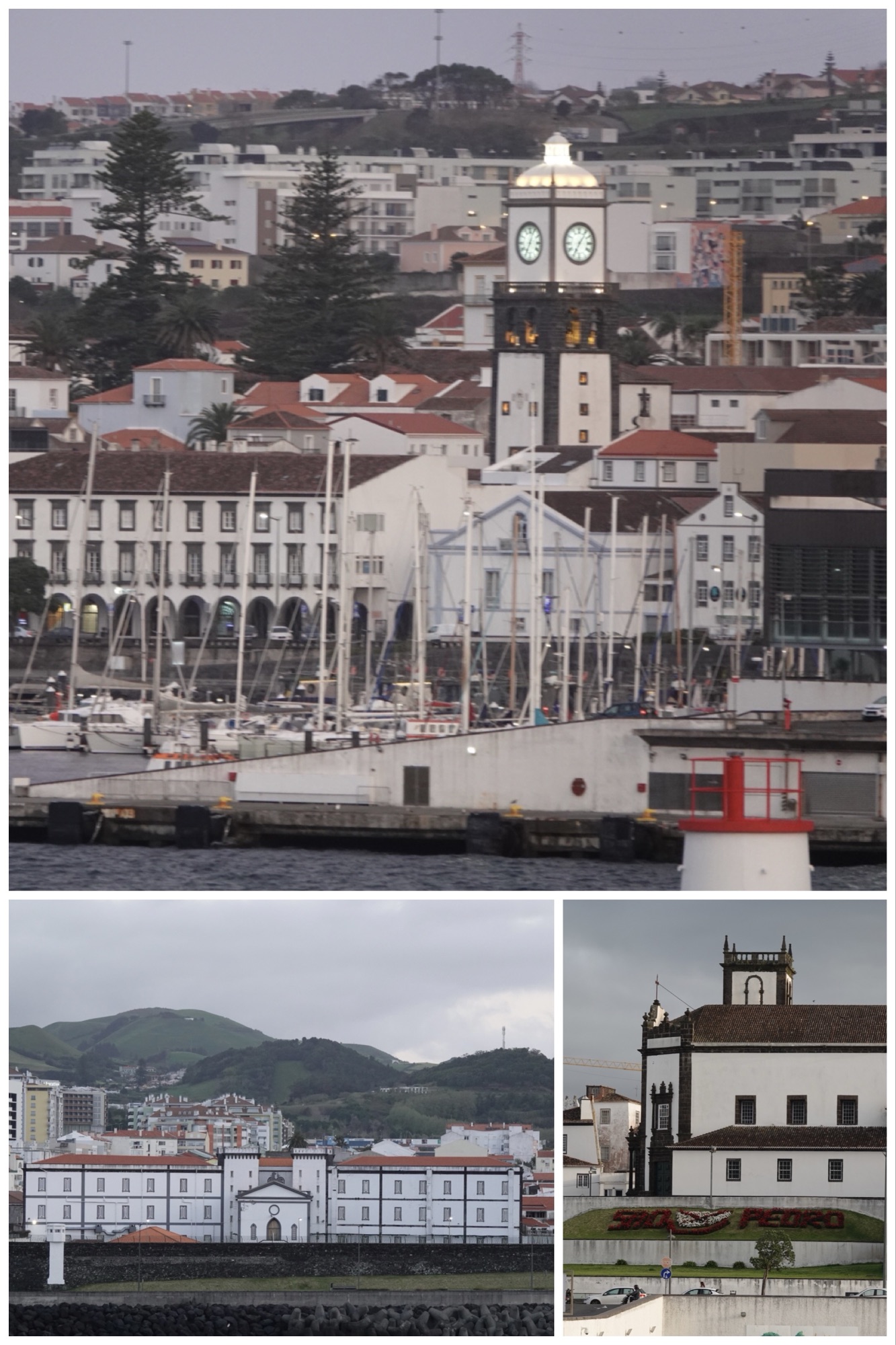
One of the first things we noticed in Ponta Delgada was the black & white buildings. There are two reasons for the black and white: the black basalt which is the only natural building material on the island, and Dictator António de Oliveira Salazar (ruling from 1932-68) who wanted all buildings painted white like those in his home town. Prior to that, the buildings here were brightly multicoloured, like many port cities ; although that remained the style even after Salazar,a few rebellious owners have begun repainting their homes in yellows, blues, and greens. This helps brighten the town on overcast days like today, days that our Cruise Director describes as “moody European”.
As we drove from Ponta Delgada to our first stop in Ribeira Grande, our guide gave us a bit of history of the Azores’ economy. After the uninhabited archipelago was discovered by the Portuguese in the early 1400s, it became an important shipping stop for re-provisioning and ship repairs. One of the first export products was the indigo blue paint pigment produced from woad, a gold-flowering plant prevalent on the islands. After that was replaced by artists using cobalt blue, there were several other “golden” ages of agriculture: grain, oranges, tropical fruits (especially pineapple), tea (the only tea plantations in Europe), and most recently dairy products. We learned that there are about 100,000 cows on the Azores, and only about 250,000 people! Today, tourism has overtaken the dairy industry as the biggest economic driver. That’s a potential problem. Agricultural exports depend on people needing to eat, while tourism depends on people having disposable income.
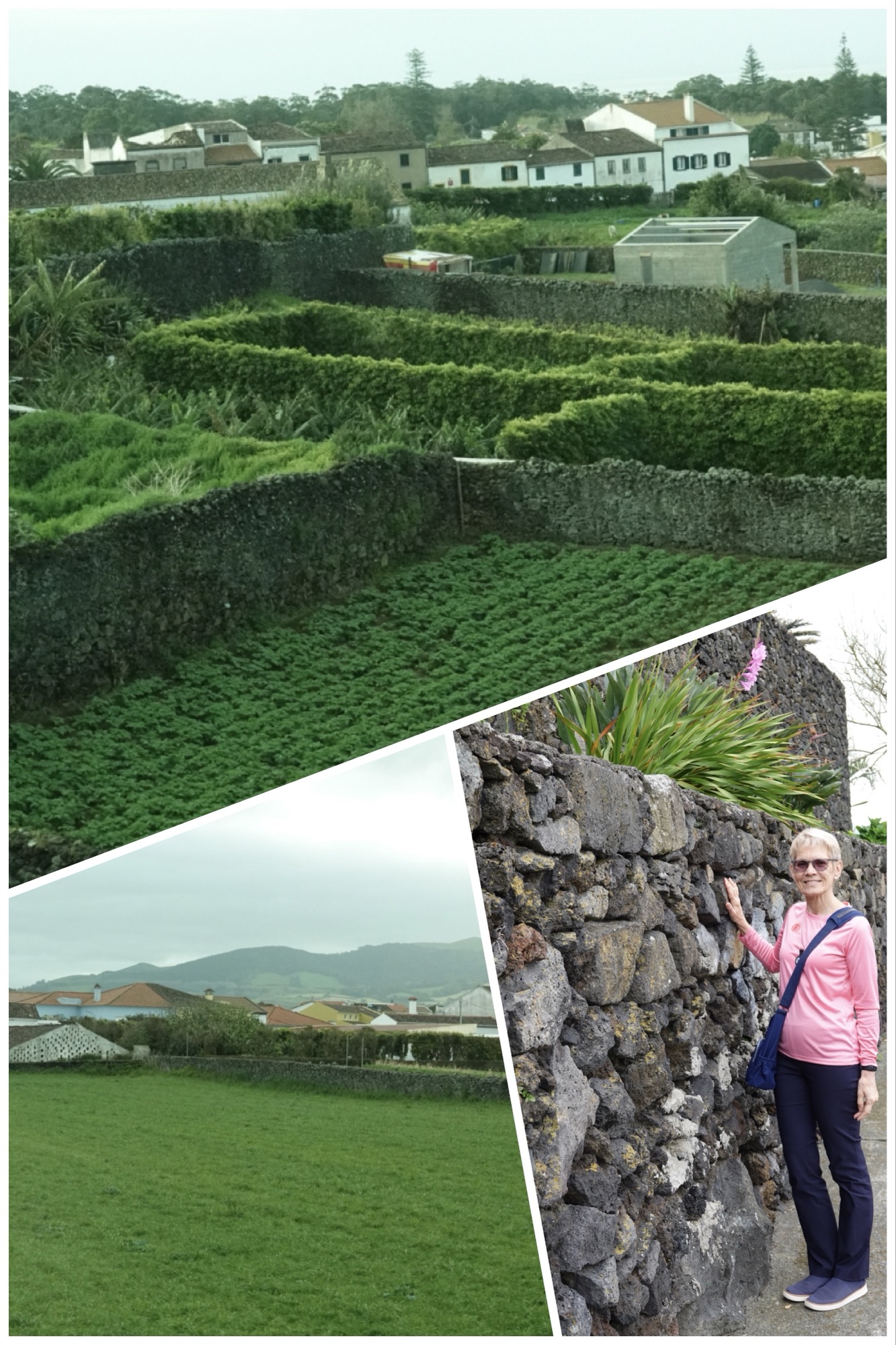
Our guide, Miguel, pointed out the black stone walls that seemed to be everywhere on the landscape. Once the island began to be settled by the Portuguese, one of their biggest challenges was clearing the volcanic stone in order to plant crops and graze cattle. The rocks were first used to build homes, but there were so many that they were eventually piled/organized into walls. The dark stone walls served 3 purposes: regular walls as boundaries, taller walls to prevent delicate orange blossoms from being blown away by the wind, and others as insulation for grape vines – something which apparently gives the “always warm” grapes a unique taste when made into wine.
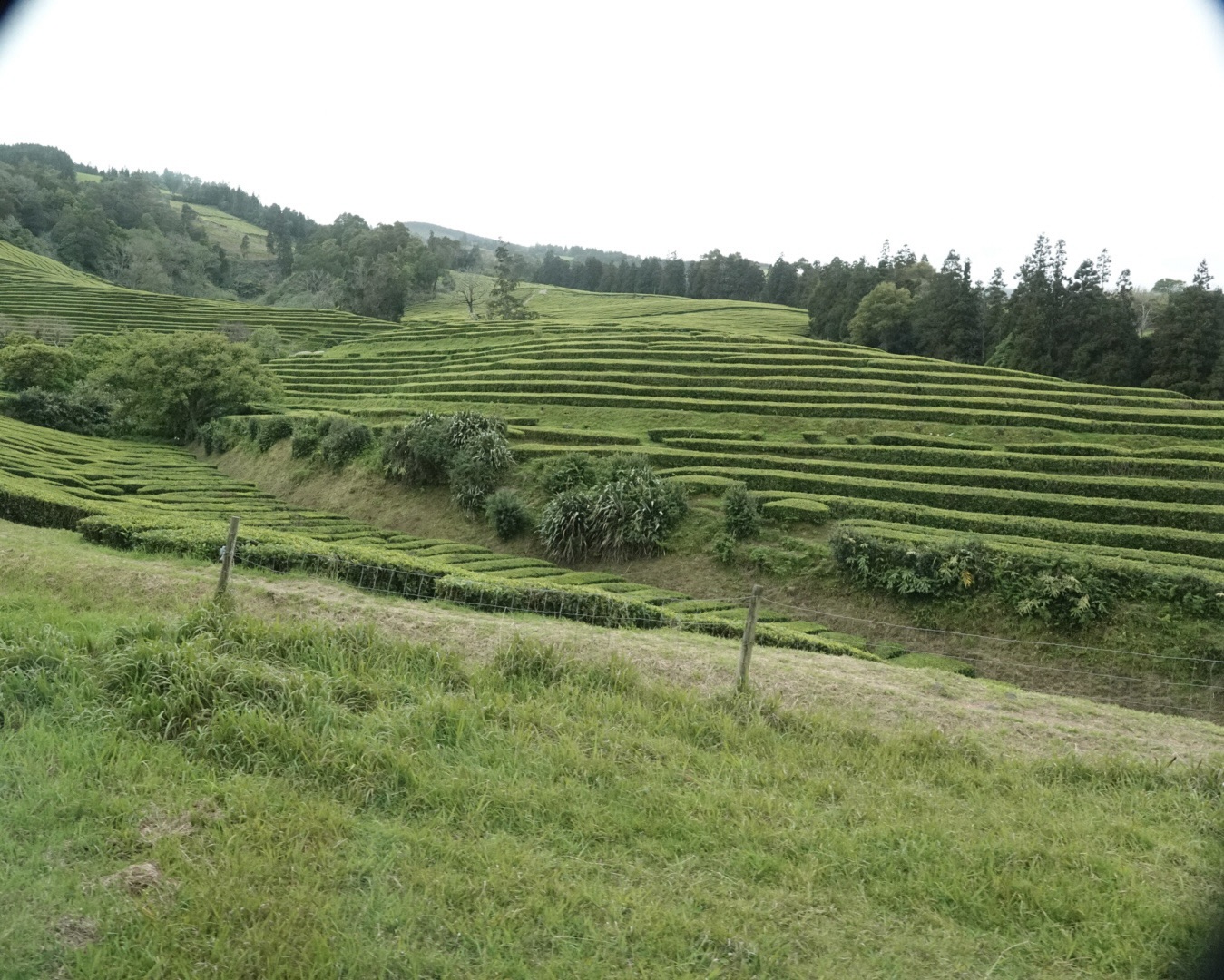
We drove past Cha Correana, the biggest tea plantation/processor still in the Azores.
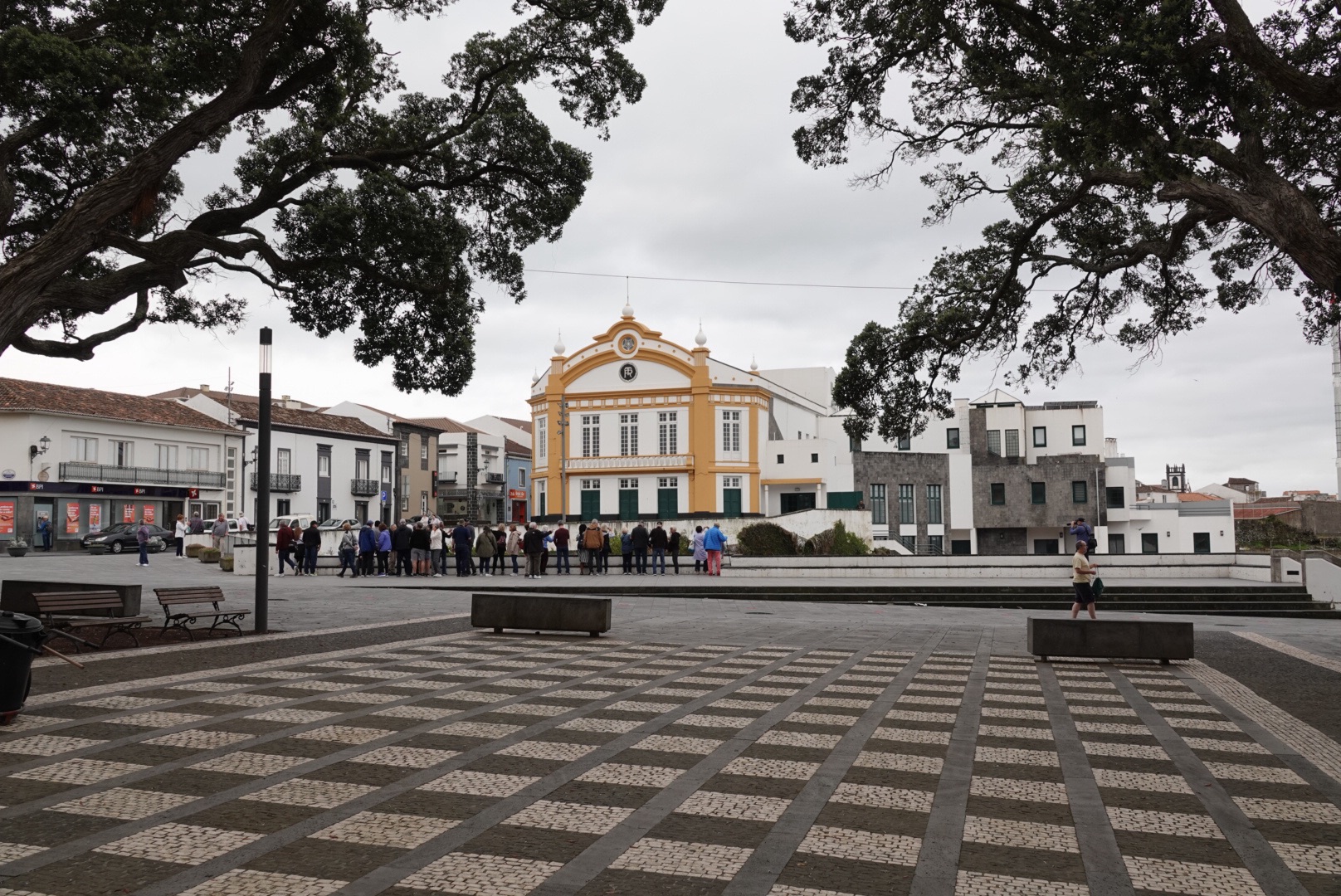
Ribeira Grande is a picturesque town, which is amusingly mis-named. Its name means “big river”, but the Azores do not have big rivers; Ribeira Grande does, however, have a lovely stream.

Our guide explained that Ribeira Grande has the 4 essentials that define every Azorean town: a church, a bandstand, a Casa de Povo (house of the people, or community centre), and a soccer field! He stressed that there was no guarantee that either the bands or the soccer teams were any good.

Miguel also talked about the black and white sidewalks, characteristic of Portuguese towns. In the Azores, only black basalt is available; white limestone must be imported, which means that a town’s prosperity can be measured by how much white is incorporated into their sidewalk designs. Conversely, in mainland Portugal it is the limestone which is endemic, so designs are often the “negative” of those seen in the Azores.
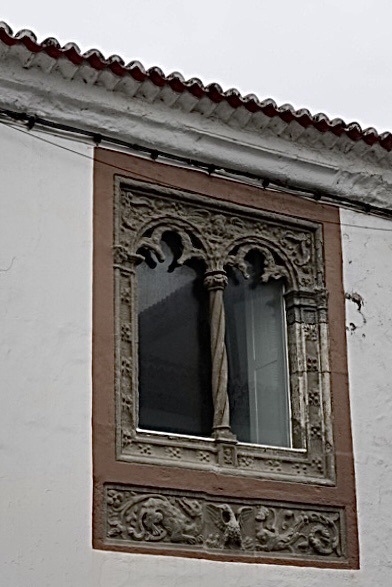
The town’s “mystery window” was brought to our attention. Most of the windows in the Azores have iron balconies, courtesy of trade with ships’ captains, since there are no iron deposits in the islands. This particular window is much more ornate than any of the others, supposedly acquired as payment for extraordinarily expensive ship repairs. The mythical-looking animals worked into the design are the result of iron workers who had never been to sea interpreting the descriptions of sea creatures that they’d heard from visiting sailors.

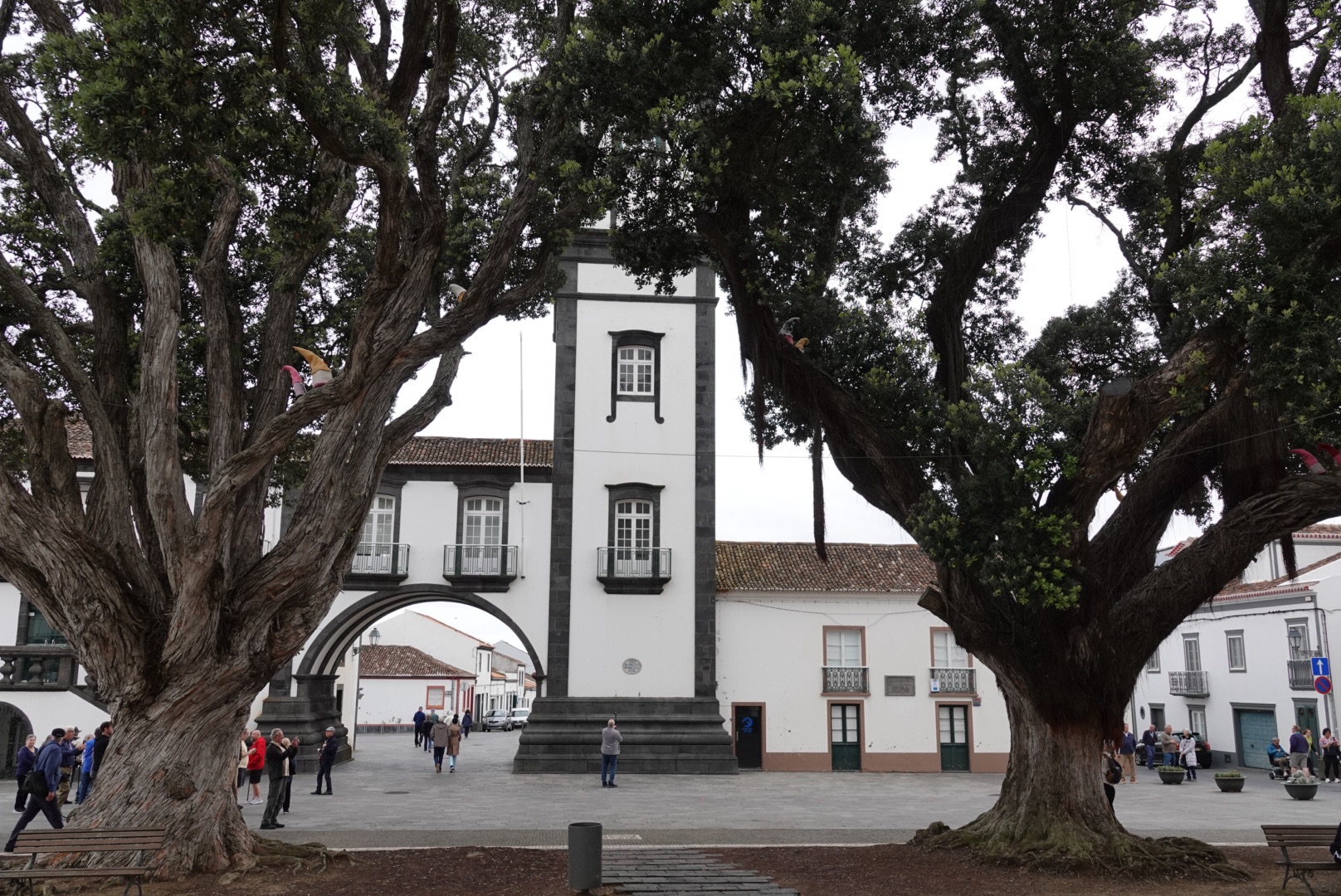
City hall (below) retained its bell, despite Salazar wanting all of them removed, by sheer procrastination on the part of the mayor. The mayor actually lives in the city hall, on the second floor. We were told that at one time there were so many miscreants in town that the jailers were just as important as the mayor, and also got to live there.
While Ribeira Grande was nice, it was Furnas that was breathtaking.
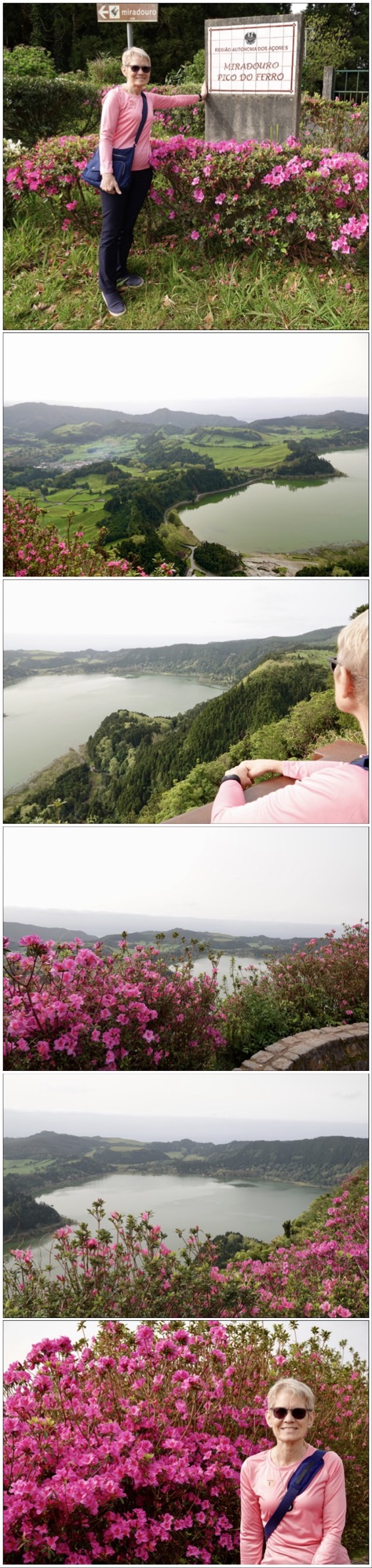
Our first short walk and photo stop was to the scenic overlook at Pico do Ferro (“iron peak” because of the high iron content in the soil and water) , where the crater lake surrounded by a park absolutely filled with pink azaleas was just the appetizer.
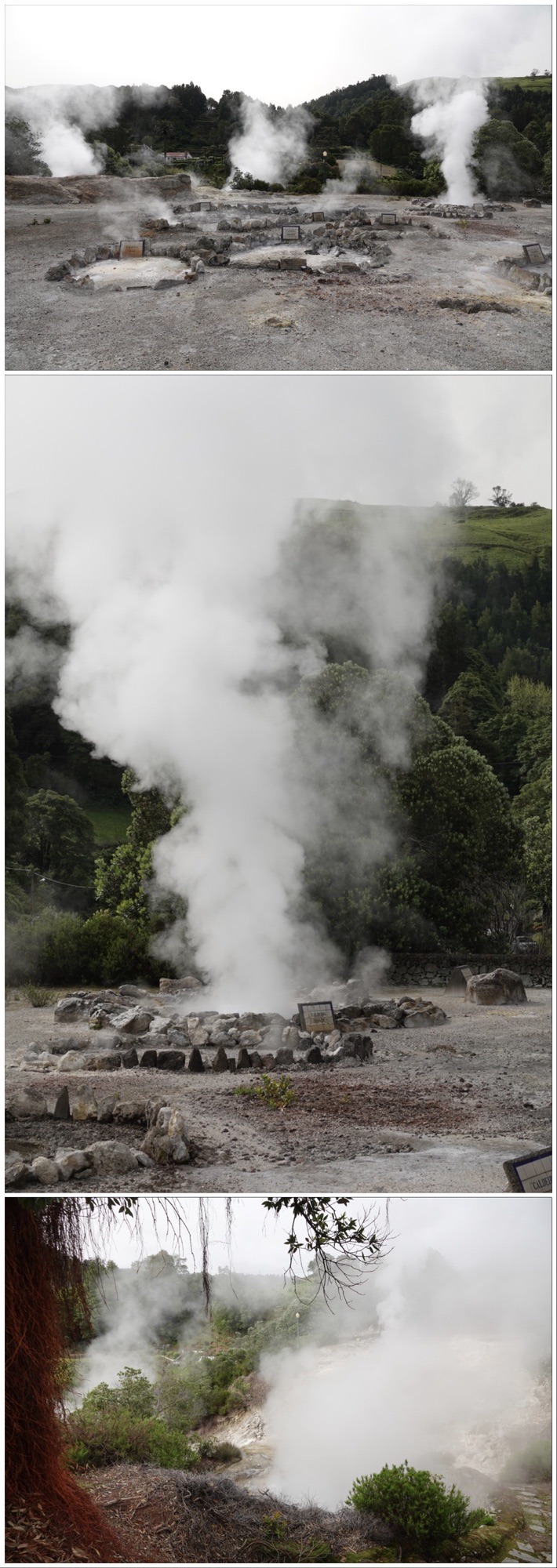
Ted and I had experienced volcanic steam vents in Hawaii in January , but they were nothing compared to this!!

Furnas sits on top of a dormant volcano that heats the underground streams to the boiling point – literally! We saw boiling pools of sulphurous water, bubbling streams, and absolutely huge steam vents made even more impressive by shooting up against a backdrop of verdant green trees. The town definitely has a distinct egg smell to it, but within about 10 minutes nose-blindness kicks in and it doesn’t seem so bad.


A hundred years ago, people would have brought sealed pots or bags filled with food and cooked them directly in the boiling water. We joked “probably not pasta, though!” The water is hot enough to scald butchered chickens to allow them to be easily plucked, although we were assured no one does that anymore.

The other really unique thing about Furnas is its mountain streams. The hot springs (up to 100°C/212°F) in town are sulphur-rich ground water heated by the volcano (no wonder early Catholics in the area thought it was hell breaking through!), but the cold springs at 16°C/60°F are mountain-fed, mineral-rich, and slightly effervescent.
I tasted 3 of the many cold springs – locals come and fill jugs, despite having modern plumbing and drinking water – and my favourite was like having a tap that dispensed Perrier.

It honestly was one of the most magical placed we’ve ever visited.
From the centre of town with its spectacular steam vents, we drove to Terra Nostra Botanical Gardens. Despite the 200+ varieties of camellias not being in bloom, walking among the greenery, ponds, and waterfalls was lovely.
The gardens’ origins date to 1775, when Thomas Hickling, a wealthy merchant from Boston (later Honorary American Consul in São Miguel), built his small house, christened “Yankee Hall”, and began bringing in North American plants. In 1848, the property was purchased by the Visconde da Praia, who built a new house where Yankee Hall stood. He and his Viscountess enlarged the original two hectares of garden to its current twelve, and continued bringing in plants from all over the world. There have been periods of neglect since then, despite a Portuguese royal visit in 1901, but the gardens are now beautifully maintained by the Terra Nostra company, who employ horticultural staff trained at England’s Kew Gardens.


Just listen to this water!!
We also walked around the geothermal pool, always naturally at 28°C/82°F, where lots of folks were just lolling in the warmth. The water looks off-puttingly brown, but is perfectly clean; it just has an extremely high iron content.

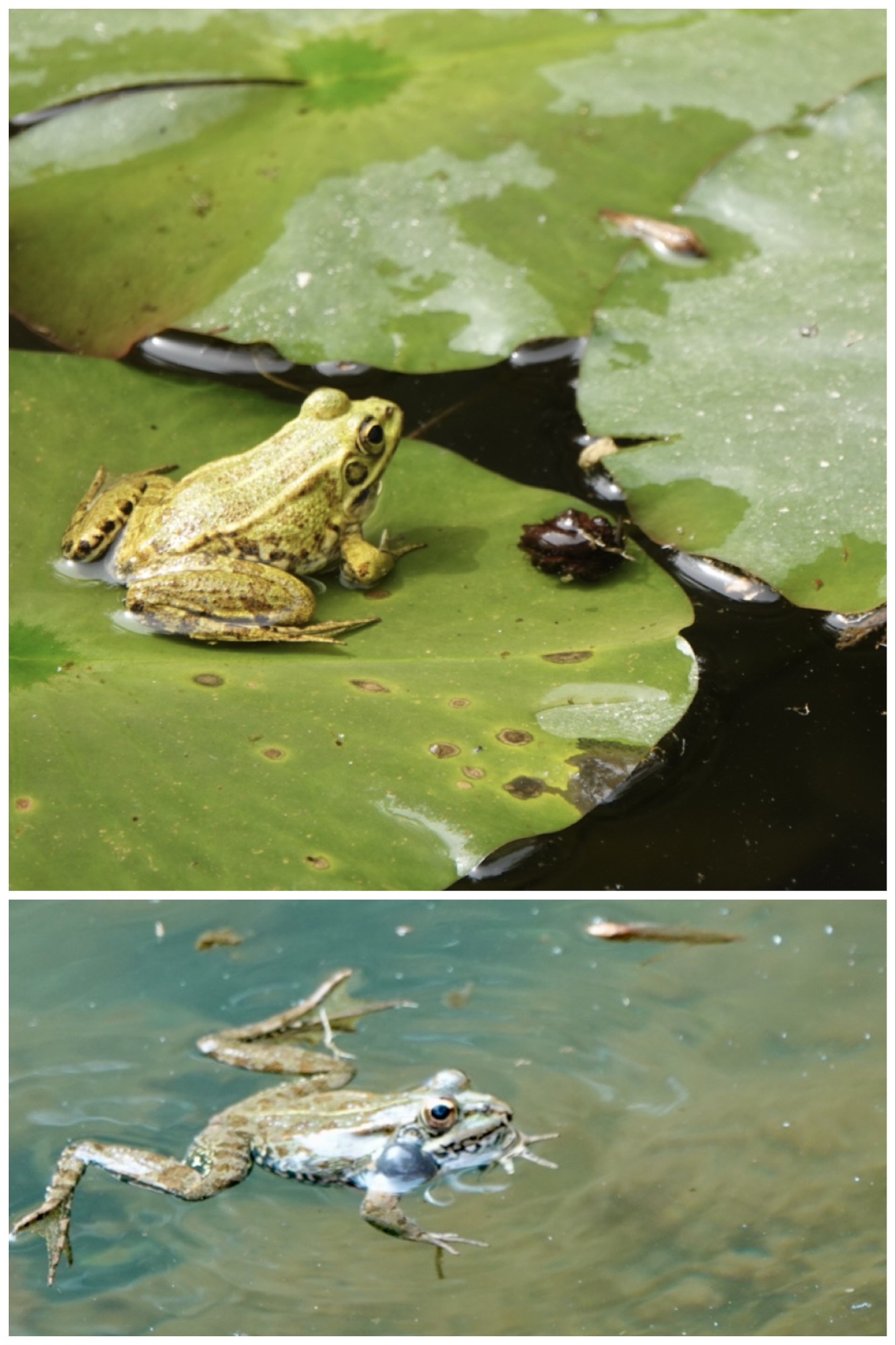
We were intrigued by the bizarre croak/quack/purr sound coming from the water, so I had to record it.
It took quite a while before we actually saw any of the noisy frogs.
Along one of the paths, we could enter a beautiful mossy grotto.

Fortunately for Ted, who has been missing getting the chance to photograph birds, there were a few in the gardens.

There were also a few wildflowers along the streambank.

Bottom left: water arum. Bottom right: Jersey lily.
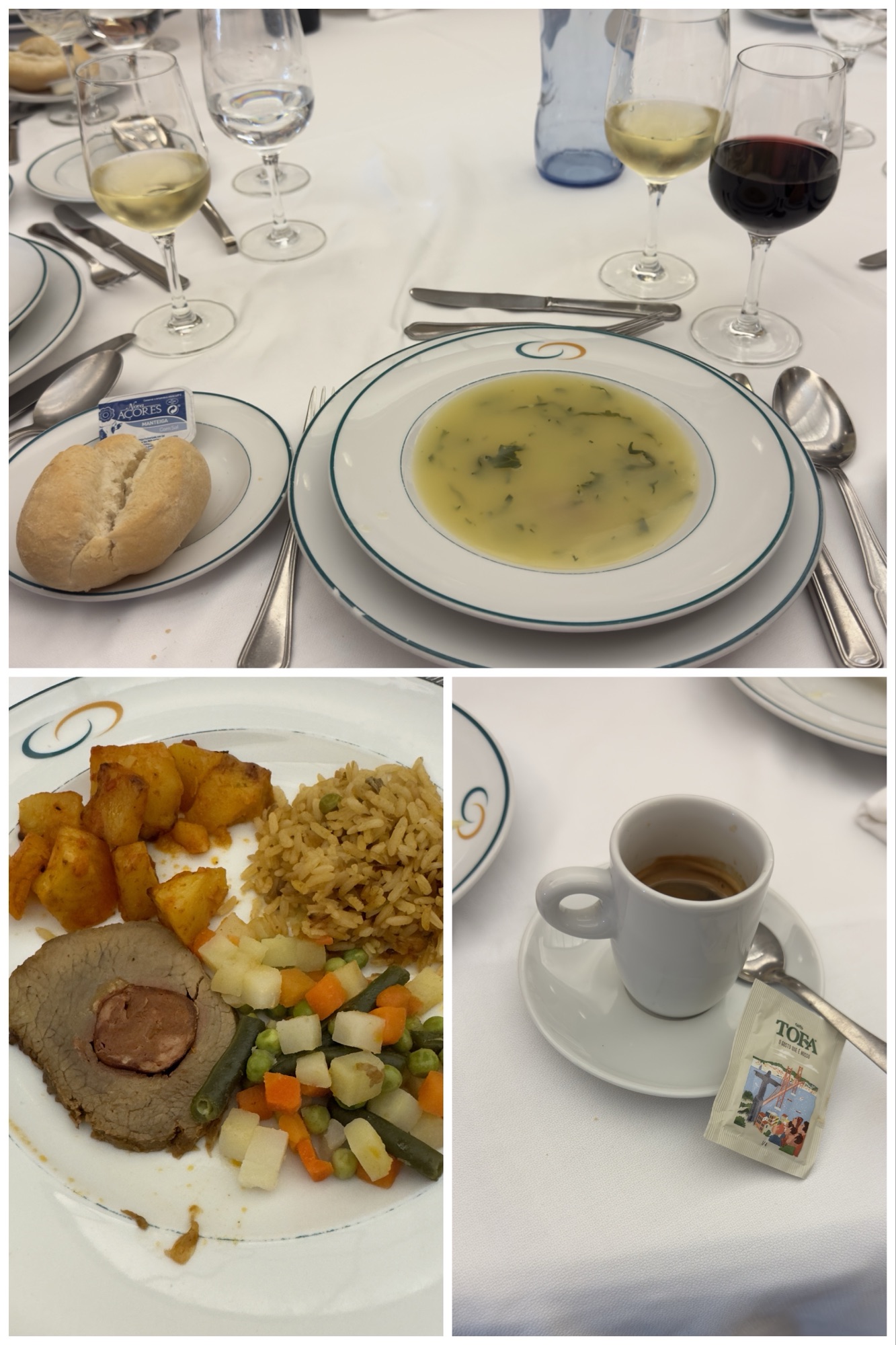
We managed all of that in about 5 hours! A really nice “typical farmer’s lunch”, served family style and with Portuguese wines, came next, included as part of our tour.

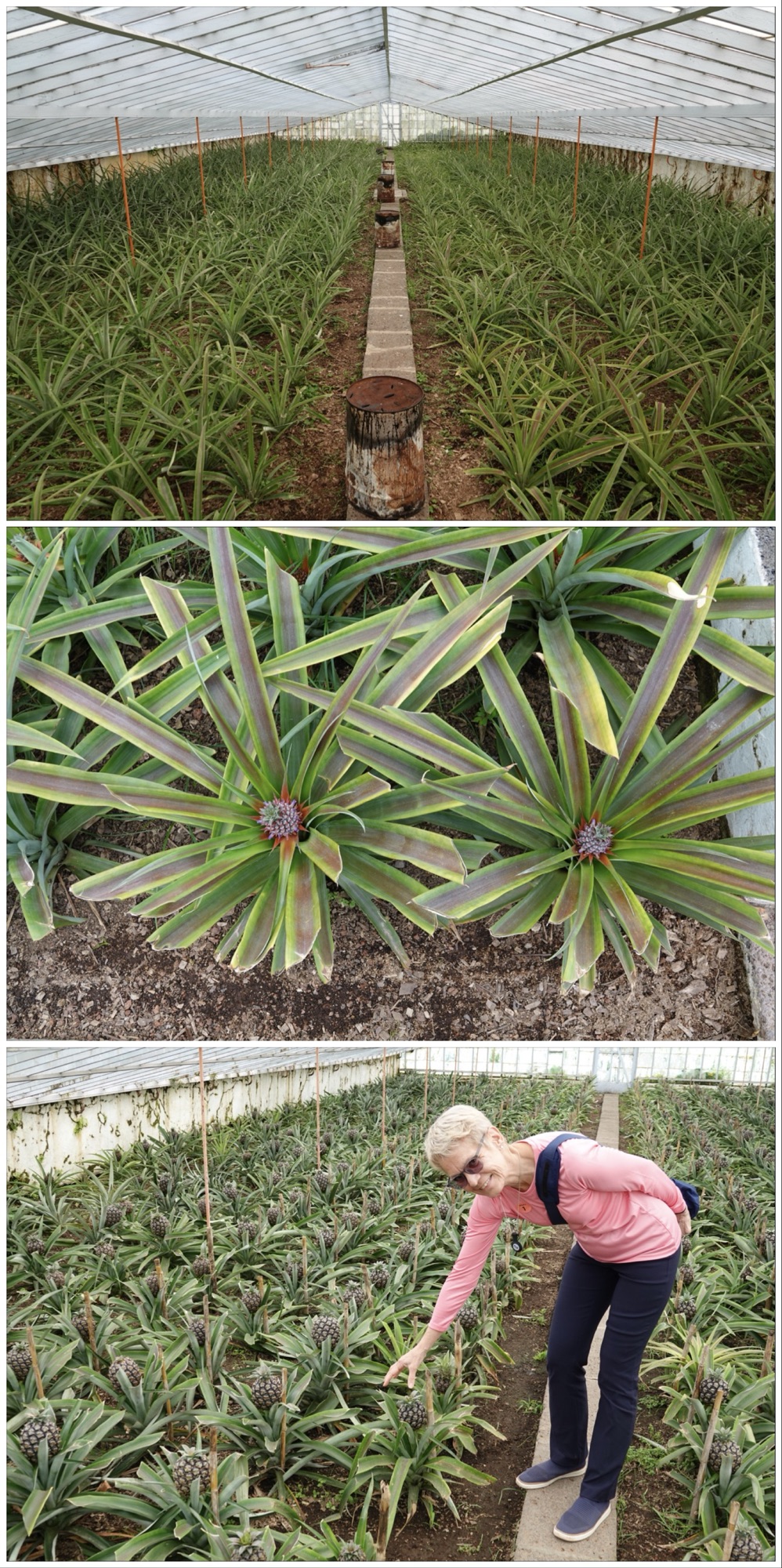
Our last stop before returning to the ship was at a pineapple plantation completely unlike anything we saw in Hawaii. Here in the Azores pineapples are cultivated in greenhouses; approximately 2000 of them, each containing about 1000 plants. That sounds like a lot of fruit, but each plant produces just a single fruit once every 2 years. Most of the fruit gets exported to Europe, but Azoreans also eat a lot of it, both as dessert and in regional dishes like black pudding with pineapple.

Centre: a portion of pineapple stalk, planted in composted pineapple leaves. Tiny pineapple seedlings will be grafted into these, similar to trees growing on nursery logs. Bottom: greenhouses separated by a water reservoir. There are small gold fish in the water, both to eat mosquitoes, and as a way to verify the water’s purity and ability to sustain life.
One of the most interesting things we learned was that after about 6 months of growth, the seedlings undergo special fertilization: fumigation by smoke! Smoking the plants in a closed greenhouse for up to a week tricks them into thinking they’re experiencing a wildfire, so they flower much more quickly than usual. It’s a natural survival technique adapted for cultivation.
Our tour really packed a lot into the day, leaving us tired out and ready for a drink in the Good Spirits bar. Ted ordered a Sandia en Fuego, made with tequila, serrano pepper, watermelon, lime, and agave, garnished with watermelon cubes, a fresh jalapeño slice, and black Hawaiian volcanic salt. Yum!

An atypically quiet buffet area tempted us to have a really casual dinner up there tonight. It was Indian flavours for me (lamb biryani, chicken korma, cauliflower aloo gobi, and lentil dal, with freshly fried-to-order chapatis), and cold cuts, bread, and cheeses for Ted. Easy peasy.
We headed to the theatre early, having learned that be 30 minutes before showtime the best seats are already occupied. Besides snagging good seats, we got to meet some more great, friendly people, this time Pam and Bo from Montgomery, Alabama.
What happens when an Englishman, an Irishman, and a Scotsman walk onto a stage? A blend of folk/country and sea shanties that’s exactly the kind of music Ted and I enjoy. Their final number, a rousing, clapping version of The Gambler had everyone cheering.

Obrigado, Açores means “thank you, Azores”. We’re thankful we had the chance to visit this beautiful place.
And now to bed. We’re headed into 2 more days at sea before reaching Lisbon on April 16th.
 Rose and Ted’s Excellent Adventure
Wow! A lot of really interesting things packed into one day. Thanks for sharing them!
LikeLiked by 1 person
Azory – moje marzenie. Cieszę się, że mogę je zobaczyć “Twoimi oczami”. Bawcie się dobrze, z niecierpliwością czekam na kolejne wpisy!
LikeLiked by 1 person
So beautiful! And many Polish tourists visit here!
LikeLike
<
div dir=”ltr”>
<
blockquote type=”cite”>
LikeLiked by 1 person
Sounded like a really great, well-organized day! Better than most of the days you described on Holland. Good that you’ll have a couple more sea days to rest up. It should be interesting to hear what other passengers thought of their experiences. Thanks!
LikeLiked by 1 person