Two of the smaller museums in Balboa Park are the Automotive Museum, and the Model Railway Museum. Spoiler alert: of the two, the latter was definitely my favourite, probably because it was so unique.
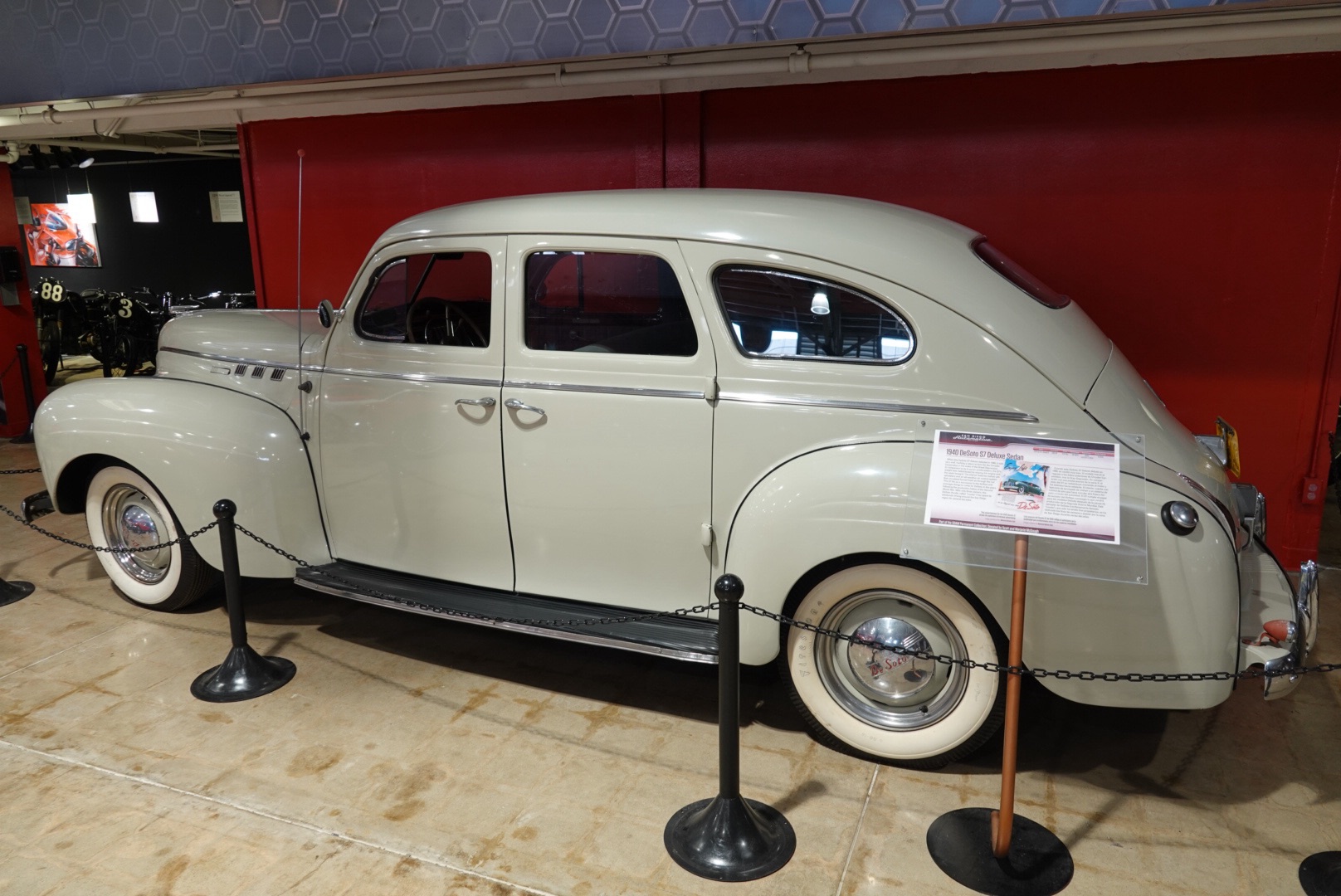
The Automotive Museum isn’t really about vintage cars, which was what we might have expected, but more about “customized” vehicles. They’re nonetheless beautiful, but most have been highly modified as opposed to restored. They are displayed in what was originally the California State Building, constructed for the 1935-36 California Pacific International Exposition.

Each vehicle, or themed group of vehicles, has its own story, which makes it interesting beyond just the cars and motorcycles themselves. The exhibits are rotated at least twice each year, so it never gets stale, although there are a few permanent exhibits. We noted at least two cars that were so new their “stories” were not yet printed on placards.

If you remember cars so big you had to notify the port authority before parking them, then you’d love the cars in the San Diego Lowriders exhibit: three heavily-customized Chevrolets that were “dropped”. What Ted and I couldn’t imagine (beyond how many suitcases would fit in those trunks and how much leg room there was in the back seat), was how these cars could ever be driven on San Diego’s hilly streets, where we constantly hear newer low-slung cars bottoming out.

Speaking of huge cars, there was a Lewis DeSoto Conquest, displayed under a massive ad proclaiming “New Now for ‘65, A Grand New DeSoto Conquest with More Power, More Luxury, More Decadence. Serving our quest for dominion.”
If you’ve never heard of this model, it’s because it never existed. It seems as if it could be a Chrysler prototype, but it is actually a 1965 Chrysler New Yorker customized in 2004 by artist Lewis DeSoto, and is considered a “sculpture”, on loan from the Petersen Museum in Los Angeles. The car is a driveable piece of art intended to teach people about the complicated history of the Spanish conquest of what is now Florida. I was so mesmerized by the car itself, and the imagery and history, that I completely forgot to ask Ted to take a photo of it. (You can find some here LewisDeSotoConquest) There are subtle messages in the car’s design: gold threads in the upholstery, a depiction of the smallpox virus and a sword in its badge, and the inclusion of a portion of the text from the Spanish document Requerimiento of 1510 included in the fictitious advertisement and bill of sale. If you don’t remember that statement from history class (I’m pretty sure my grade 7 teacher completely skipped over it when we learned about DeSoto), you can find it here: requerimiento1510. The last paragraph is nothing short of brutal.
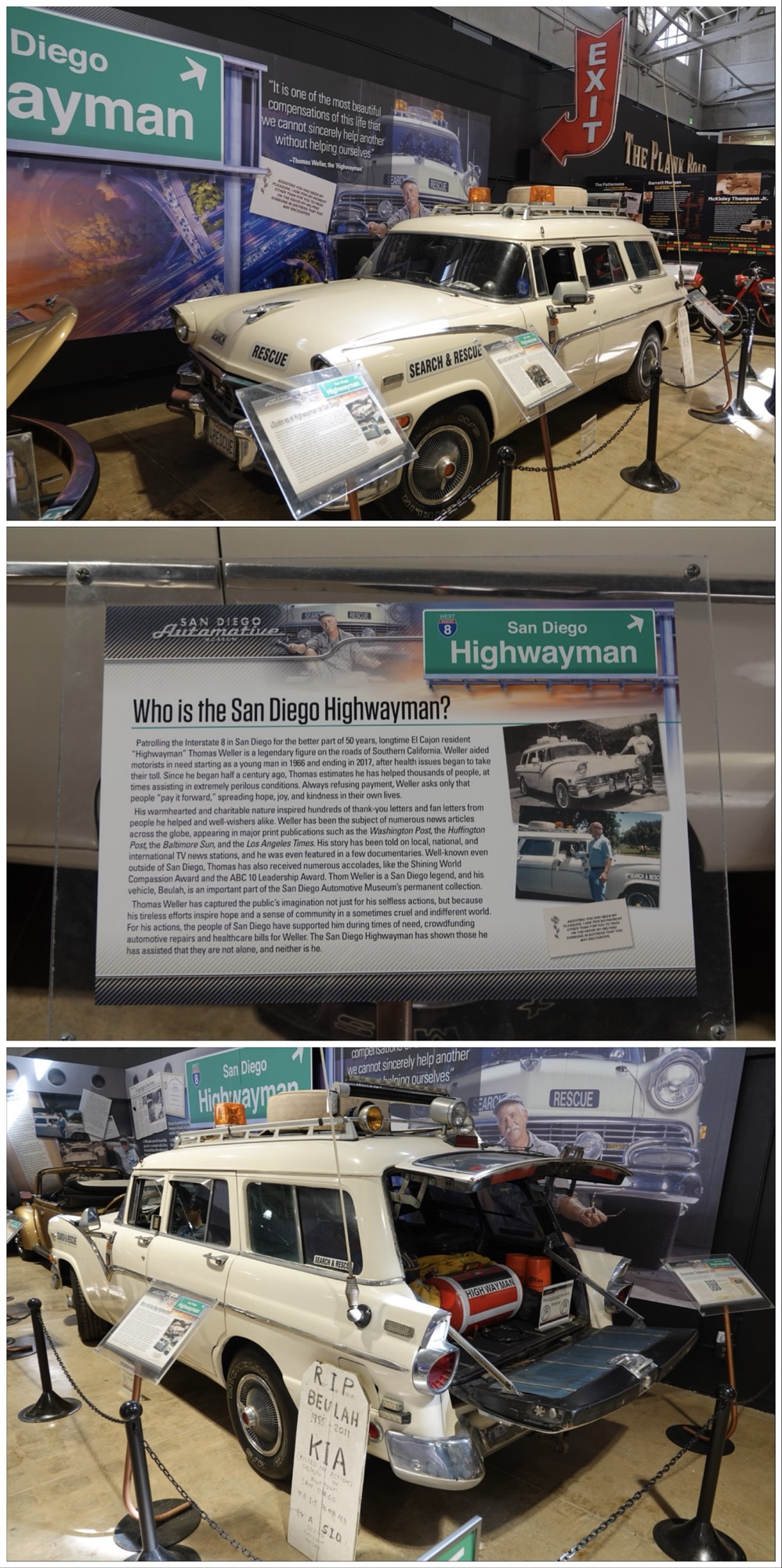
On to more cheerful themes, and a San Diego legend: “The Highwayman”. Thomas Weller was a good samaritan who performed roadside rescues on San Diego’s Interstate 8 for over 50 years, until 2017. Inspired by his own rescue from a snowbank in Illinois as a young driver, he returned the favour for the rest of his life, accepting no payment for his services beyond a promise to “pay it forward”. His rescue vehicle, a 1955 Ford Country Sedan nicknamed Beulah, was truly a custom car, combining components from 10 different models, including a 1957 Thunderbird V8 engine and a 1960 Chrysler roof rack.
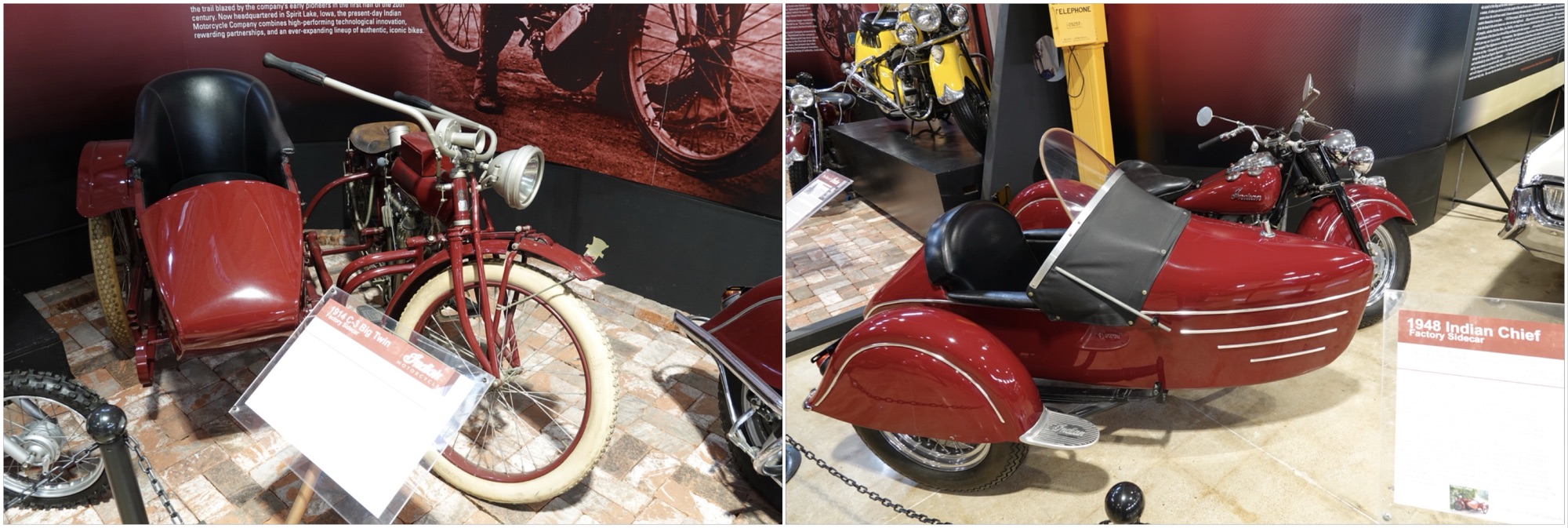
There was an entire alley of motorcycles, but the ones that intrigued me were all Indians: an eye-catching bright yellow model, and the comparison between a 1914 and 1948 motorcycle with sidecar. Look at the tires!

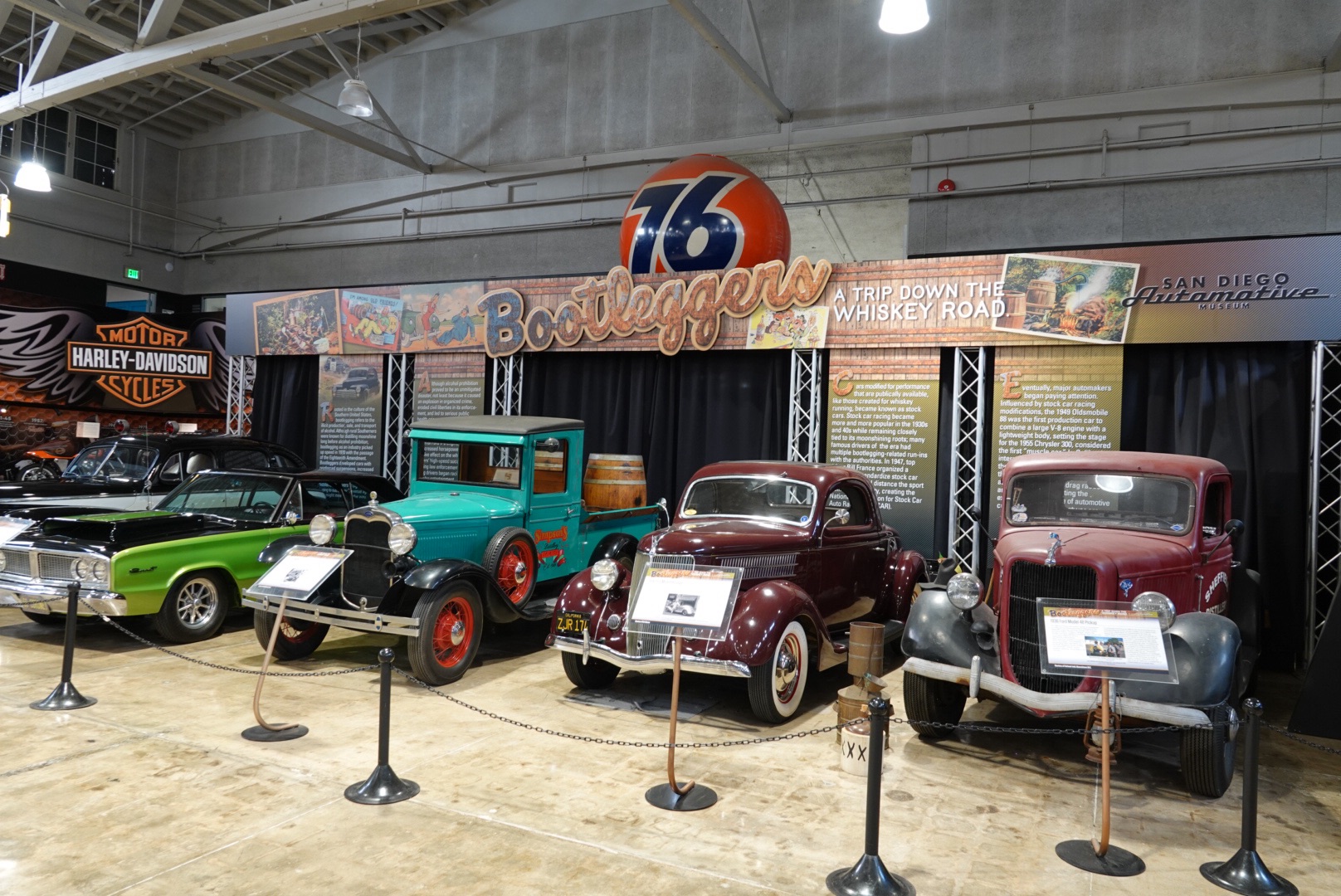
I don’t suppose I expected a display focussed on bootlegging in an automotive museum, but here it is! We learned from these various vehicles that the need for fast maneuverable cars to run whiskey led to many of the features considered standard today – but also gave rise to the first Nascar racers! We also learned that Henry Ford, apparently a teetotaller, inadvertently created the perfect whiskey-running cars: easy to maintain, easy to modify, and nondescript enough not to attract attention.
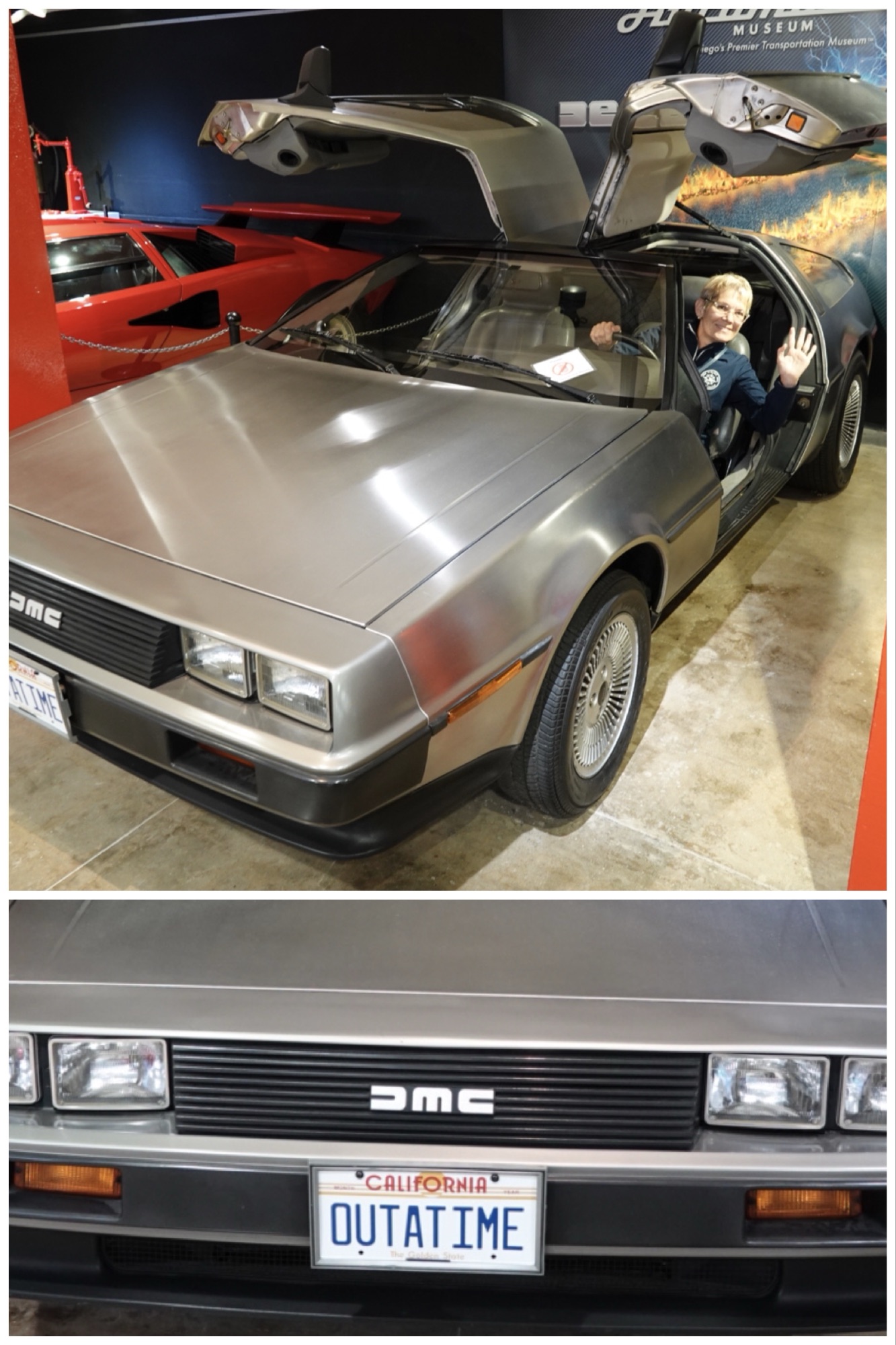
For anyone who loves long road trips, the exhibit of the 1947 Cadillac known as “Louie Mattar’s Famous Car” is inspiring.
This incredible completely customized car included everything: electric stove, fridge, washing machine, chemical toilet, ironing board (because who in the 1950s could afford to be without one?), medicine cabinet, and a kitchen sink! There was a shower on the right running board, and a drinking fountain at the rear taillight. It took 7 years to complete Mattar’s vision for his car, but it allowed him to make 2 famous non-stop drives: San Diego to New York, and Anchorage to Mexico City, which he touted as a way to unite the people of the US, Canada, and Mexico.

The last small exhibit before the museum’s exit focussed not on a vehicle – although I was fascinated by the water bag on the front of the Model T – but on a unique kind of road, made of wooden planks.

In 1915, 13000 wooden planks were laid in two parallel tracks, each 25” wide, spiked to wooden cross pieces underneath, between San Diego and Los Angeles. The road was supposed to provide a reliable way to cross the area’s shifting sand dunes, and hopefully be easier to maintain than macadam (tarmac). Apparently there were a number of plank roads in Canada in the 1800s, because there was just so much timber available. Unfortunately, the Plank Road lasted barely more than 6 months before needing significant repairs, and the idea of wooden highways was pretty much abandoned.
We took a quick coffee and sandwich break, which brought us to the tiny Café on the Park, located in the Casa del Prado, which houses several museums.
Just down the stairs was the San Diego Model Railroad Museum, which we expected we could quickly walk through before heading home. After all, how much could there be to see?
It turns out the answer is A LOT. This is the largest model railroad museum in North America, and I found it absolutely fascinating. I’ll admit I never really understood the attraction of having a model railway in the basement or garage, but this museum is on a whole different scale! (No pun intended, but it does have O, HO, and N scale exhibits).
The museum is 27,000 square feet of trains, tracks, and trestles in 6 different set-ups.
I was absolutely mesmerized by the level of detail in the layouts, from big items like canyons built to painstakingly accurate 1/160 scale, to the tiniest embellishments on the faces and clothing of the figurines and animals populating the sets.
All of Ted’s photos in this museum were shot through glass, which caused lots of reflection. Each layout had at least one member from its specific model railroad club working inside it, although some were too engrossed in their ongoing builds to talk to museum visitors.
The first layout we came to was the Cabrillo & Southwestern. This is an O scale (1/48 actual size) “fantasy” set-up, meaning it is the largest gauge model, and in an imagined land and cityscape. The layout features a double track main line, a narrow gauge branch line and a mountain district. The layout is 120 feet long and covers 13 scale miles in mainline track. It represents California circa 1955, but as an aggregate as opposed to any real location.


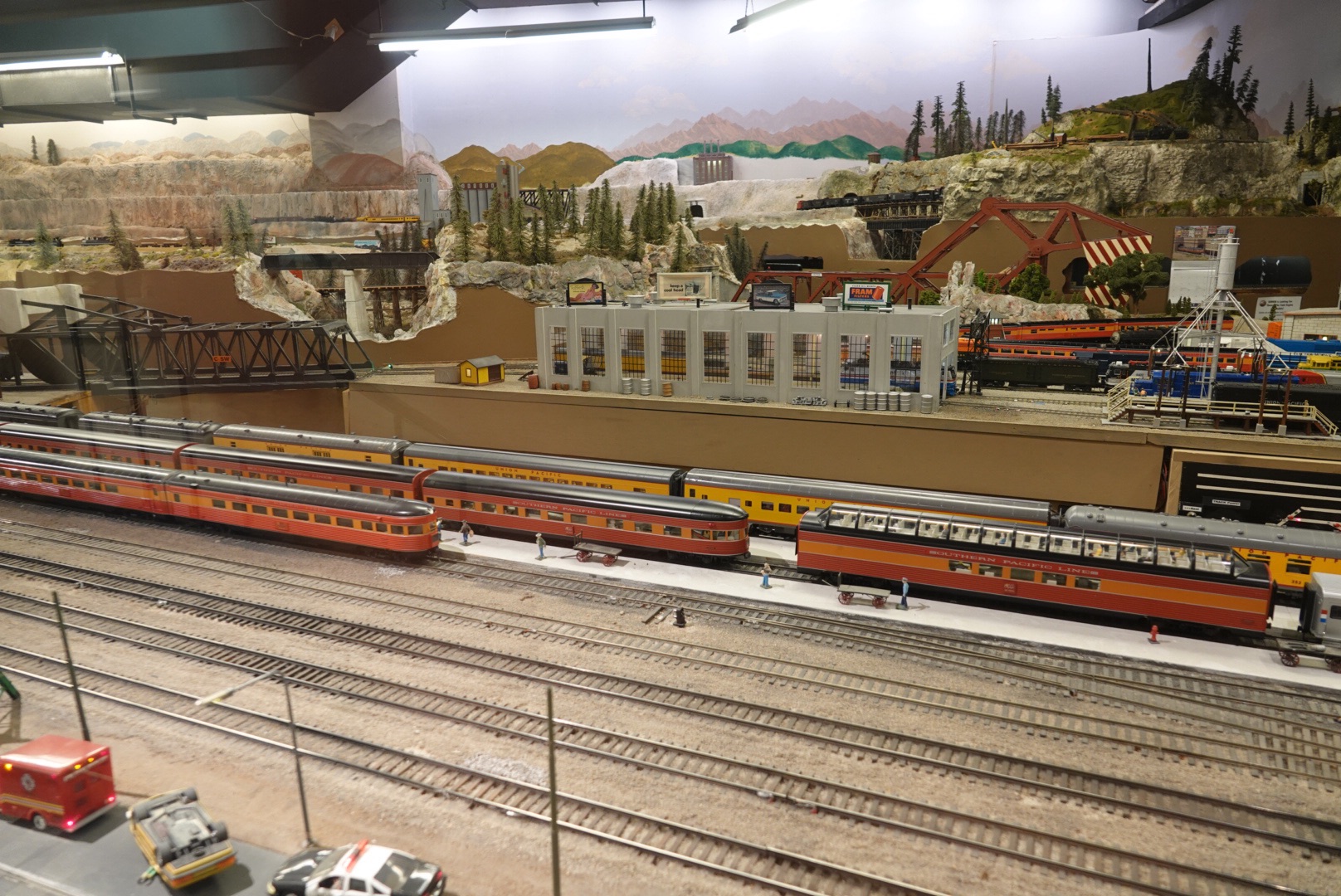
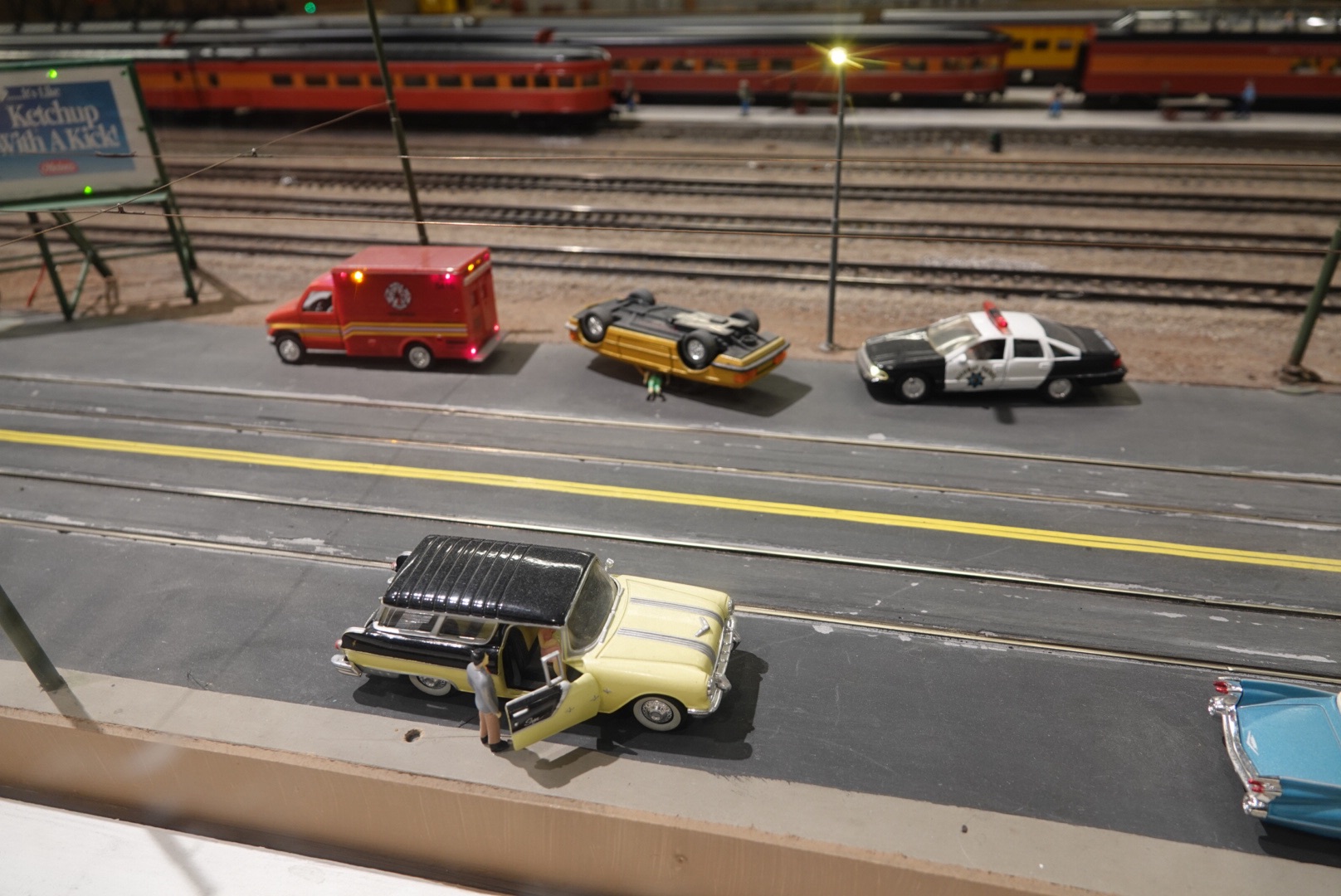
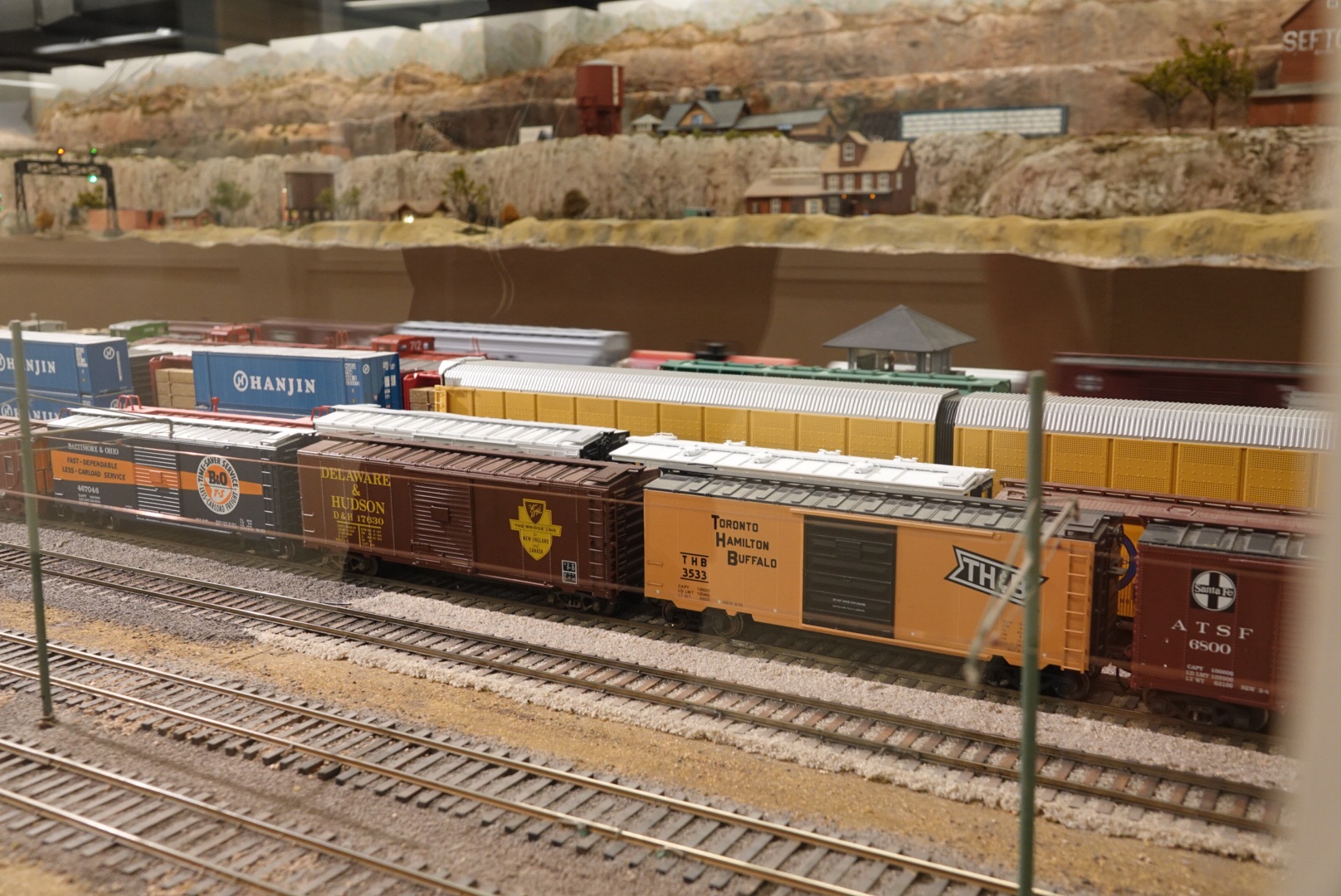
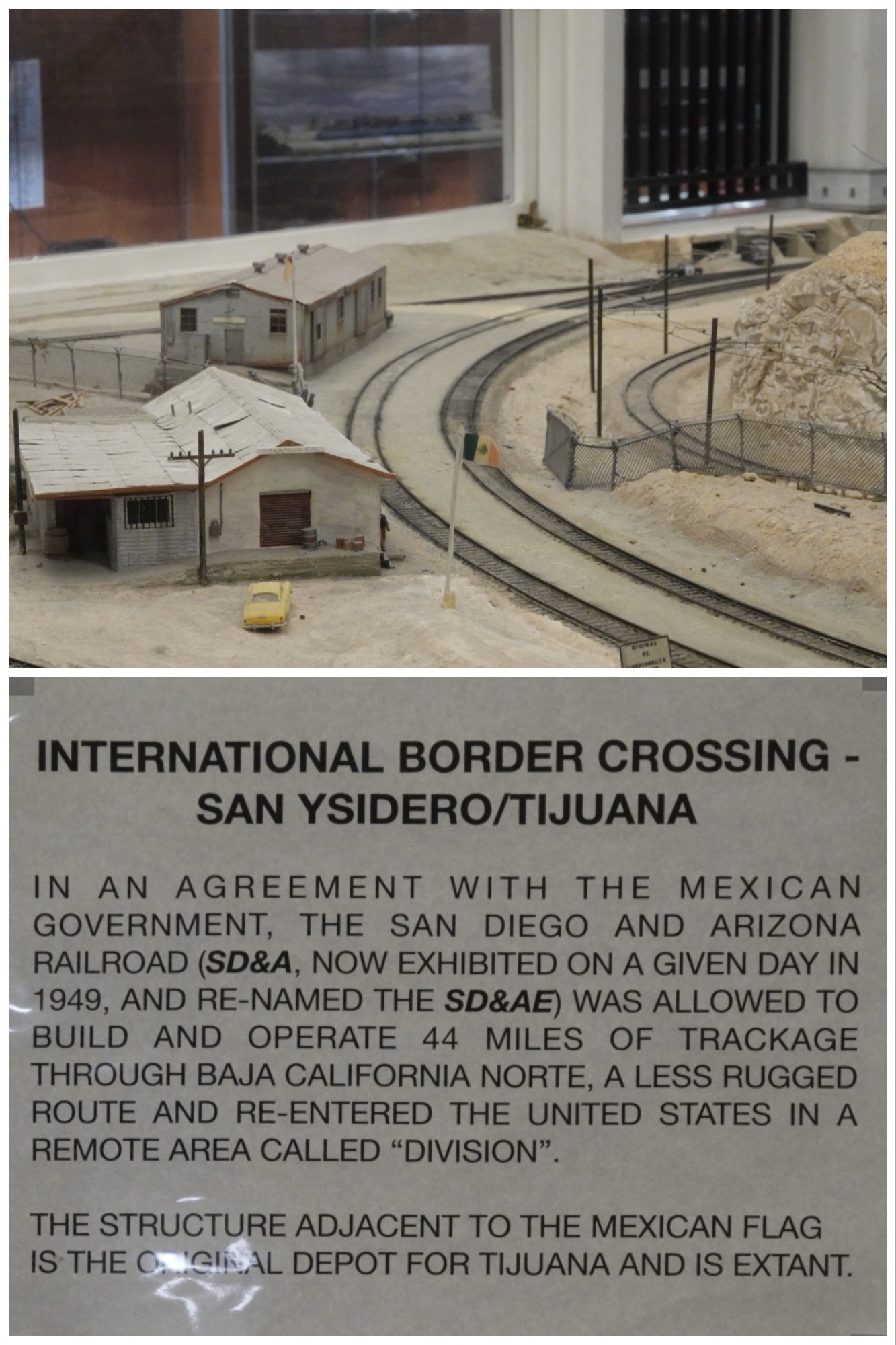
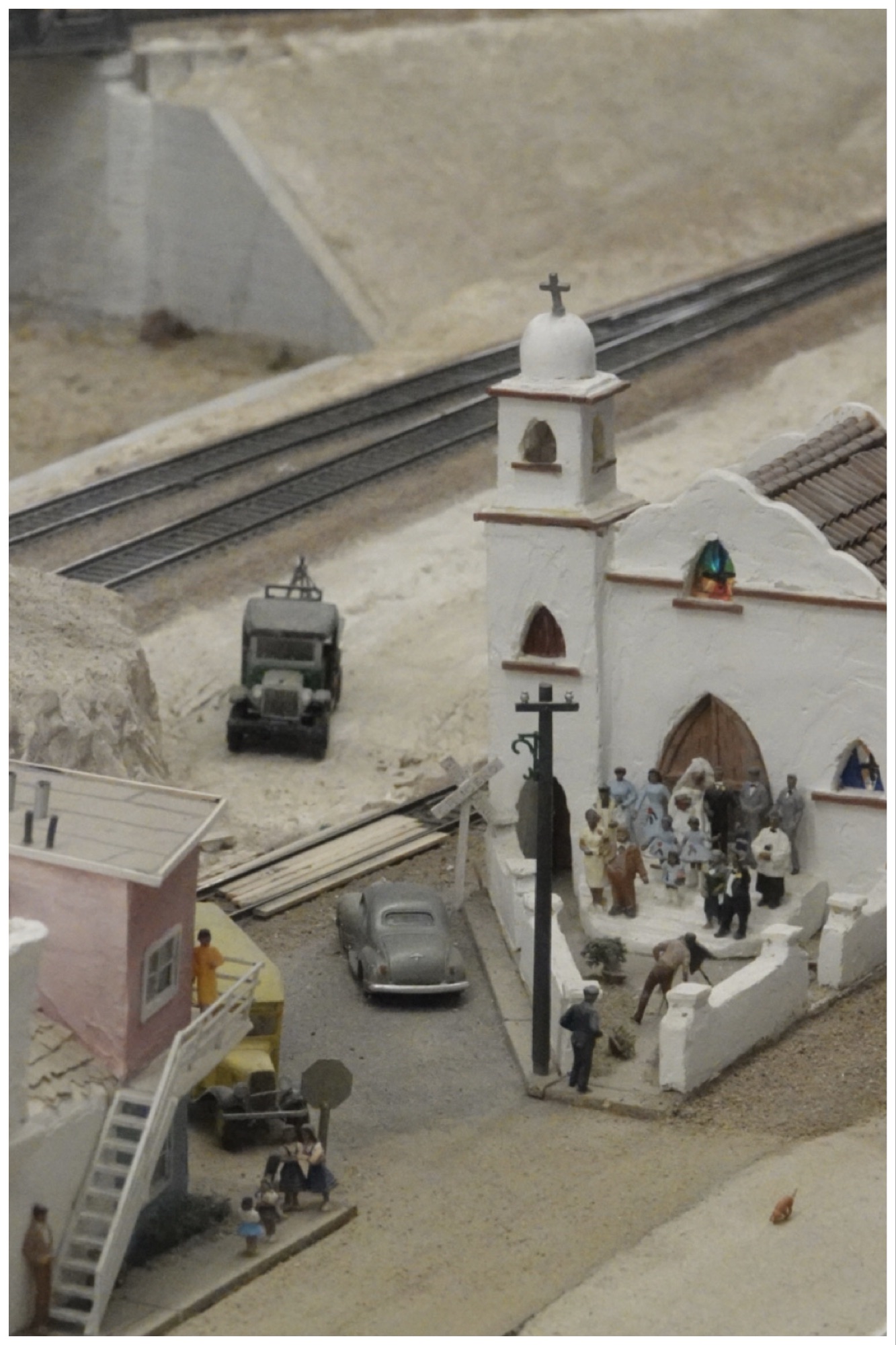
The San Diego & Arizona Eastern is an HO gauge (1/87 scale) railway, which means that the teeny tiny details are even more impressive – and even more difficult to photograph through glass. It models San Diego to El Centro in the 1950’s. This layout is 142 feet long and covers 15 scale miles in mainline track. The track even has a Mexican border crossing.
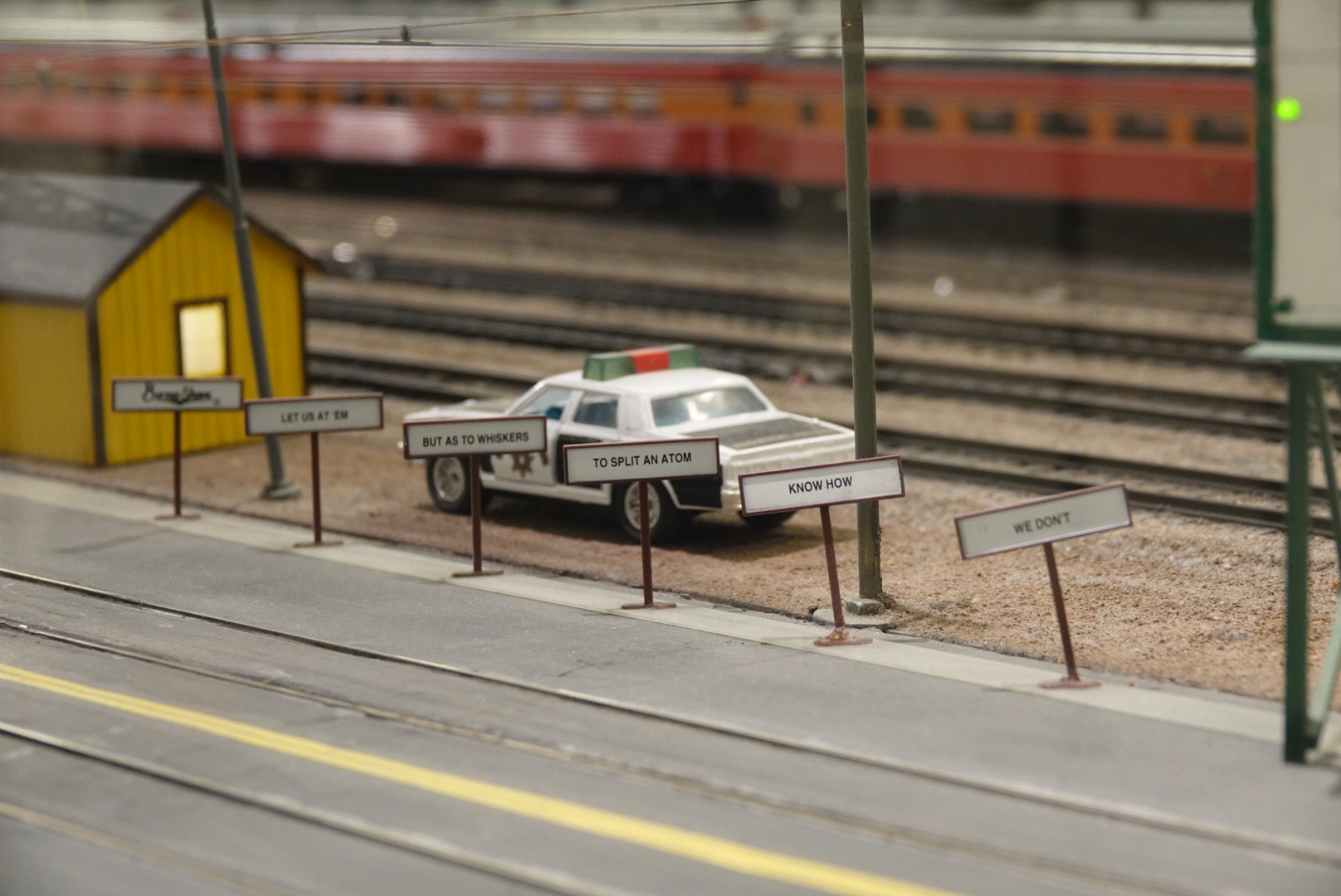
This set-up was a lot of fun, with dozens of individual little dramas playing out trackside. This sign at just one of them shows the level of detail these hobbyists achieve:


The Southern Pacific on the Tehachapi Pass exhibit is a highly accurate replica of Southern California’s busiest single track mountain railroad. The Tehachapi Pass runs through the Tehachapi Range of the Sierra Nevada Mountains and is famous for the Tehachapi Loop, where because of the steep mountain grade the railroad was designed in a spiral loop – replicated in this model.
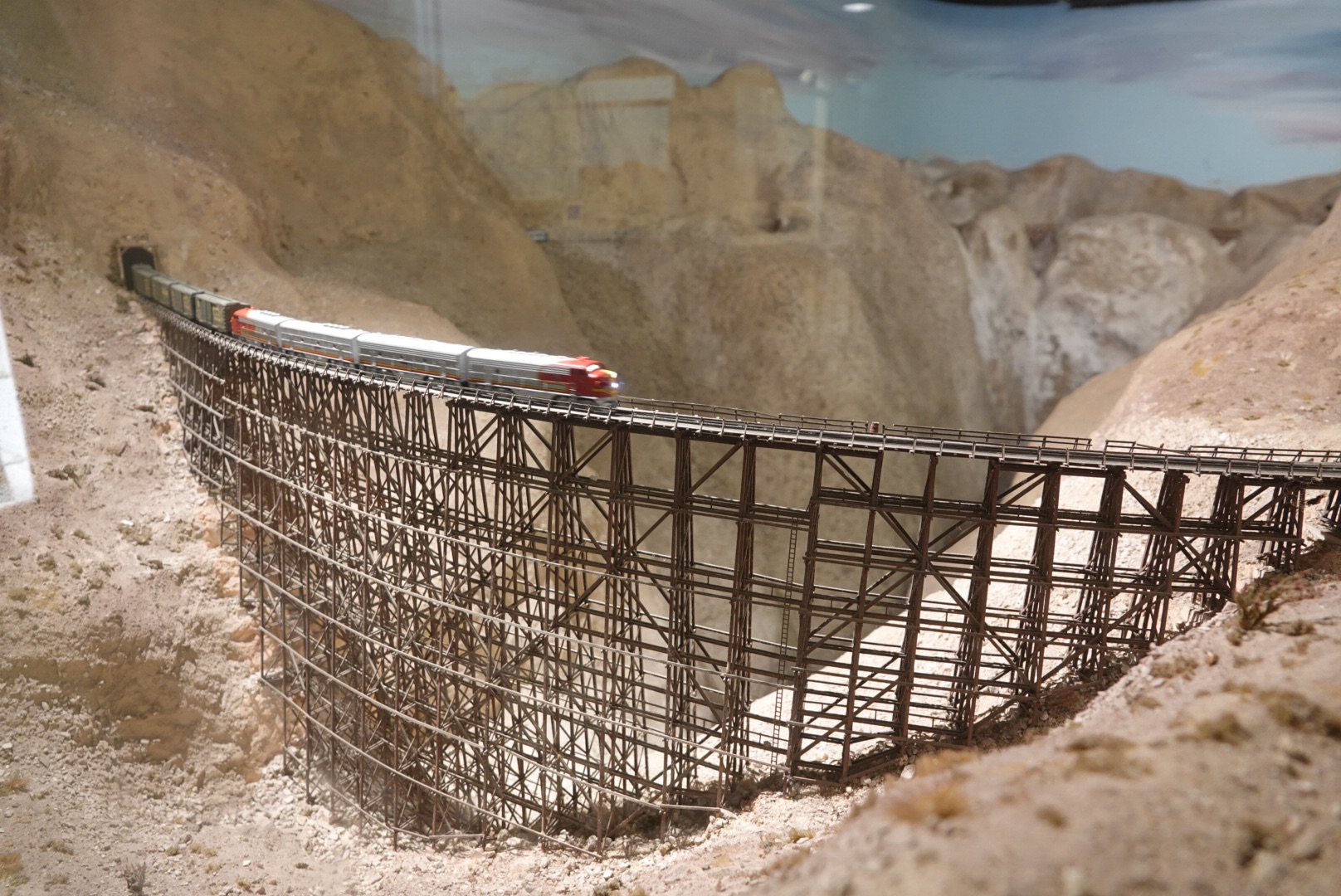
Pacific Desert Lines is an N scale (1/160) model of the original 1855 route that was surveyed and planned for the San Diego & Arizona Eastern Railroad but was never built.
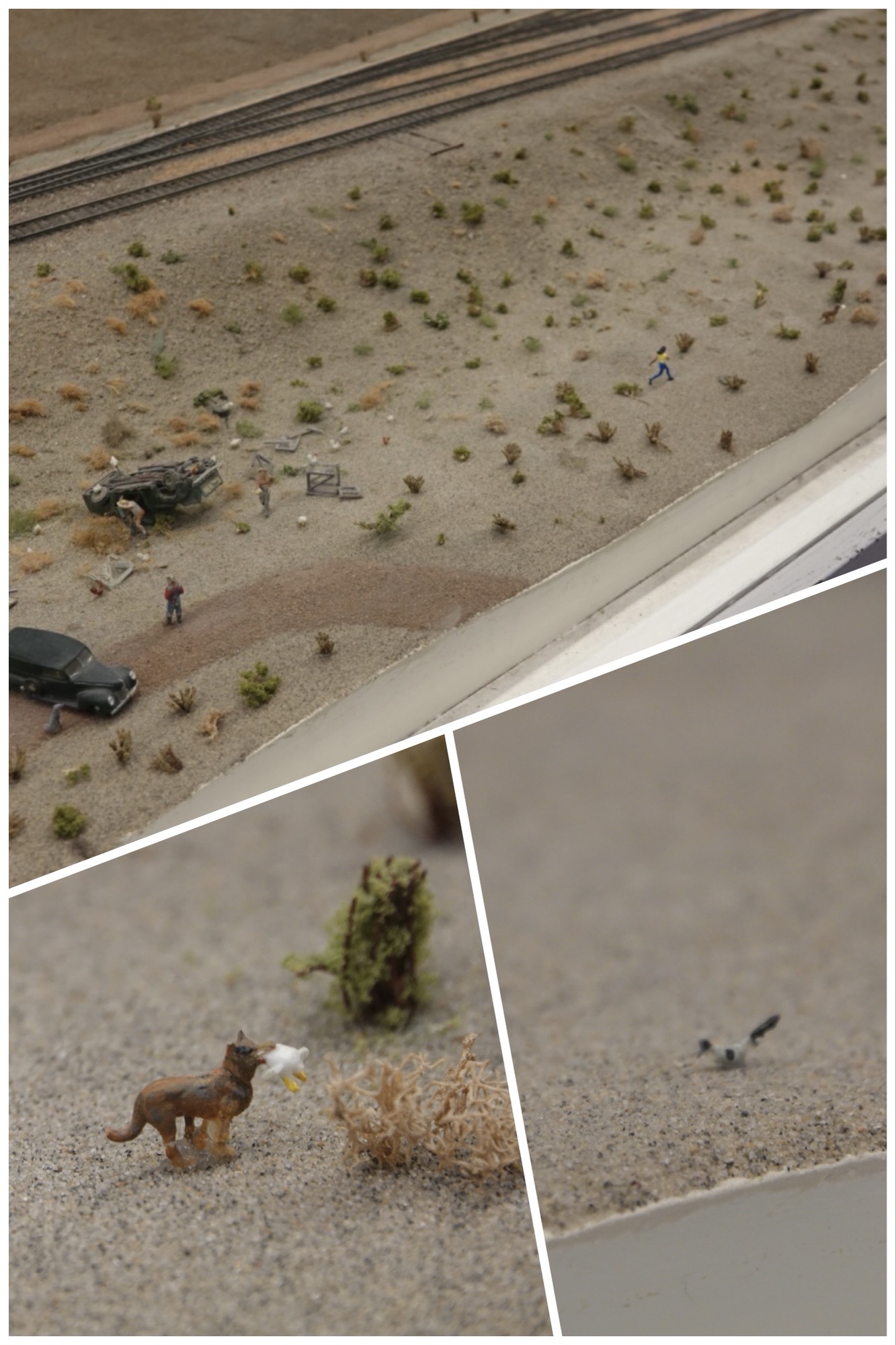
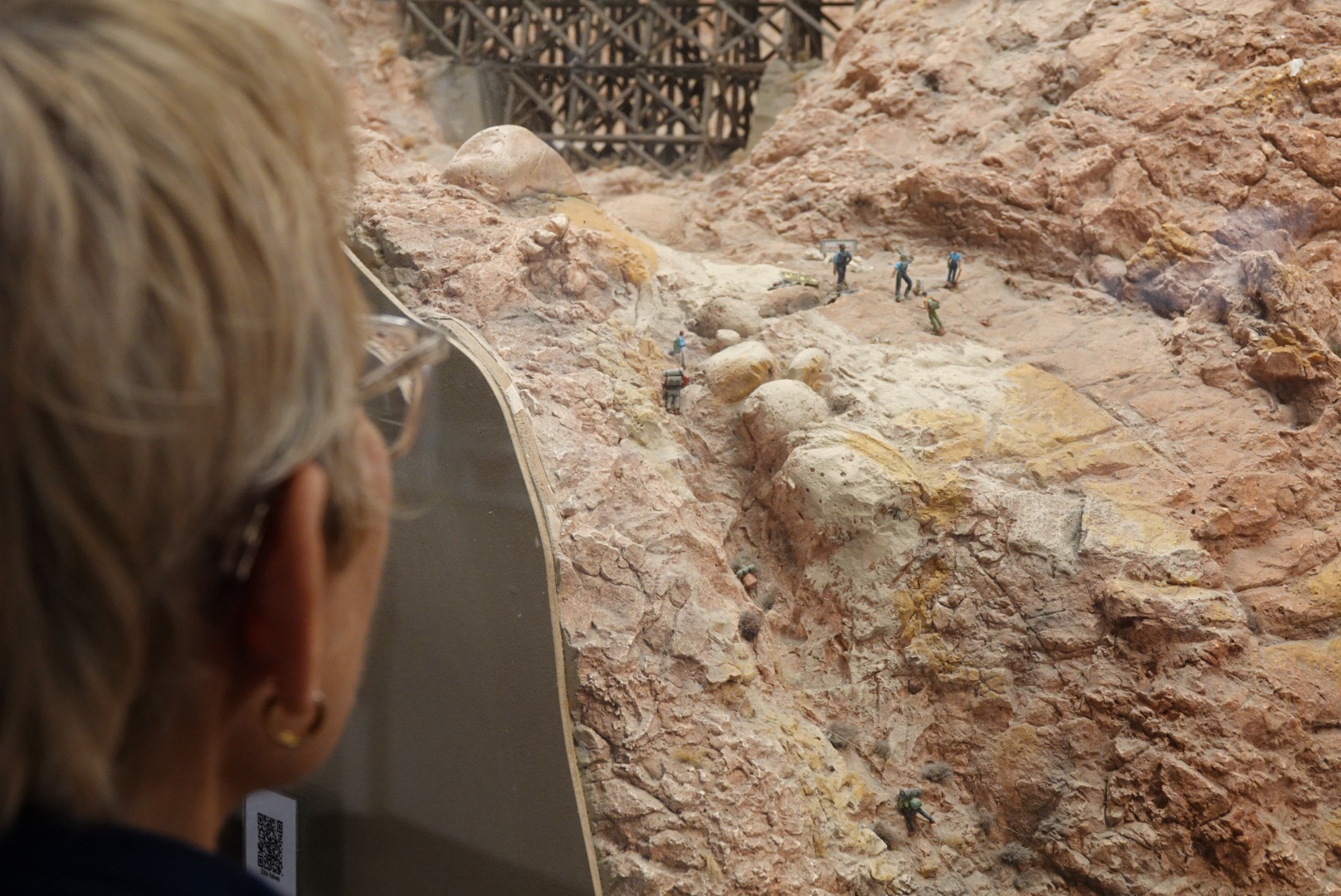
More model railroader humour: there’s a 1/160 scale shark in the swimming pool below!

The Toy Train Gallery fantasy layout features O Scale “Lionel Type” toy trains running on 3 rail O gauge track. Although the display itself was so covered by really distracting Valentine-themed toys, candy, and kitsch that it was the one display I didn’t enjoy, it did teach us about 3-rail tracks, which are apparently easier for hobbyists to work with.
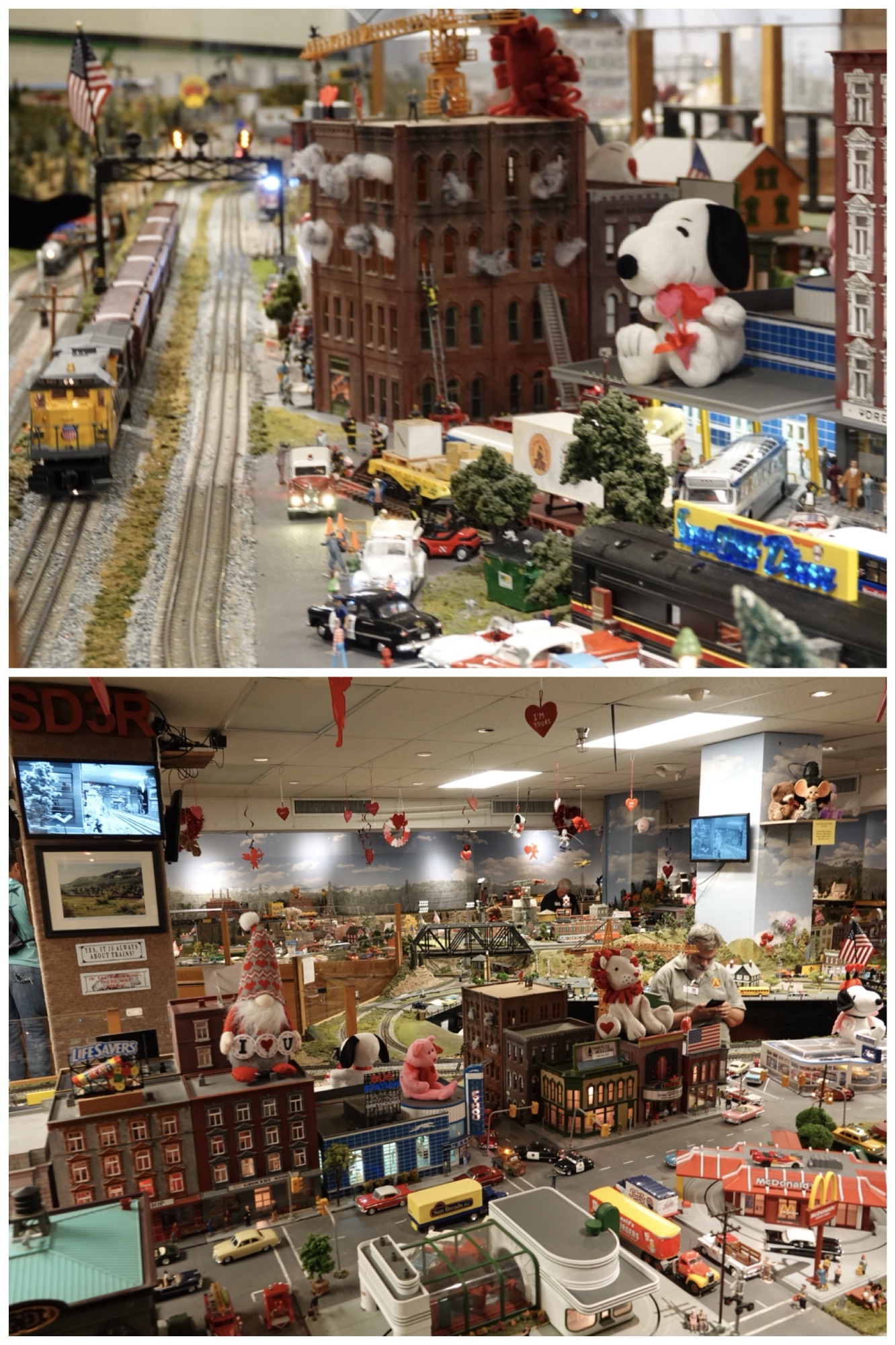
The big advantage for three-rail track is that it allows a train to enter a loop through a turnout and then exit through the same turnout in order to change the train’s direction. With two-rail track, when the track reverses on itself, this causes a short circuit. With three-rail track, because the center rail remains constant and the outer rails are electrically identical, this causes no problems. The third rail can also be used to add accessories to layouts. The disadvantage, of course, is the lack of realism.
We were getting tired, and ready to catch the #3 bus home – otherwise I could have spent hours watching the trains and peering into tiny imaginary lives, picking out details and making up stories.
That completed our planes, trains, and automobiles trifecta, even if it was slightly out of order.
 Rose and Ted’s Excellent Adventure
I’ll bet your grandsons will love all the pictures from these days of vehicular transportation! What a concentration of transport museums! Even Washington DC only has Air and Space.
Is your month already feeling short? What’s next?
LikeLiked by 1 person
What a fabulous day, Rose. The miniatures look like so much fun.
LikeLiked by 1 person
They really were – and representative of thousands of hours of work!
LikeLike