October 3 Itinerary: Our tour of Casablanca, Morocco’s largest city, begins at the old Medina – a labyrinth of streets, barbers, butchers, ironmongers and grocers. Nearby is majestic Mohammed V Square with its combination of French and Moorish architecture. We also see the Royal Palace and the famous Hassan II Mosque situated directly on the ocean – the world’s third largest mosque. Then we proceed to Morocco’s capital – Rabat, the seat of the Royal Family and home to many palaces and mosques. Our city tour will show us the imposing exterior of the Royal Palace – official residence of King Mohamed VI, and the Royal Mausoleum of Sultan Mohammed V – the man who led Morocco to independence – and the exquisite Hassan Tower.
🐪 🐫 🐪 🐫🐪 🐫🐪 🐫🐪 🐫🐪 🐫🐪 🐫🐪 🐫🐪 🐫🐪 🐫🐪 🐫🐪 🐪 🐫🐪 🐫🐪 🐫
Our day started with a cold buffet breakfast, which included a delicious (but decidedly strange aquamarine coloured) mint yogurt, msemen (flatbread), apricots, raisins, fig compote, and fresh cheese (similar to ricotta) with black sesame seeds and honey. Then it was off for a very full day.
In the morning we had a panoramic city tour of Casablanca, narrated by our English/French/Arabic-speaking guide for the next two weeks: Fouad (pronounced almost like “faux Ed”). Fouad has already outlined an exciting and educational itinerary for us, liberally sprinkled with “inshallah” (God willing), since according to the Quran all future events must be described using that proviso.
Casablanca is the largest city in Morocco, at just under 4 million people, although it is not its capital – that honour goes to Rabat. Its location on the Atlantic makes it a perfect centre of business and economy; it has a large artificial port for shipping and cruises, as well as a bustling airport.
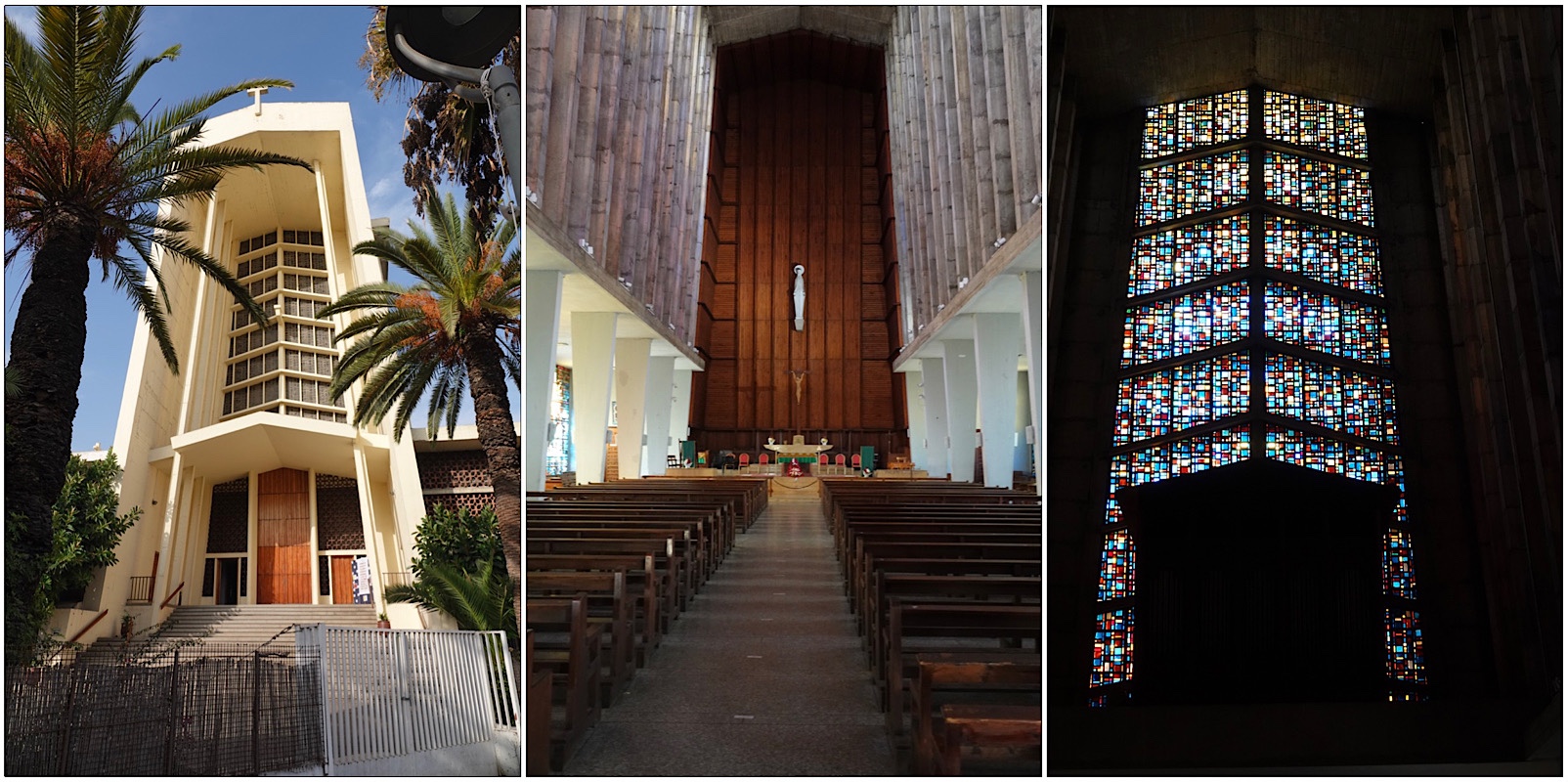
Our first stop was completely unexpected: Notre Dame Roman Catholic Church, built in 1954, not long before the end of the period of French occupation of Morocco. The church is not large, but is VERY tall, with stained glass side walls designed by French designer Gabriel Roi.

As we headed toward the Habbous Quarter, our guide pointed out the signs on a government building. Three languages are represented: Arabic, Berber, and French. Only the Arabic is read right to left.
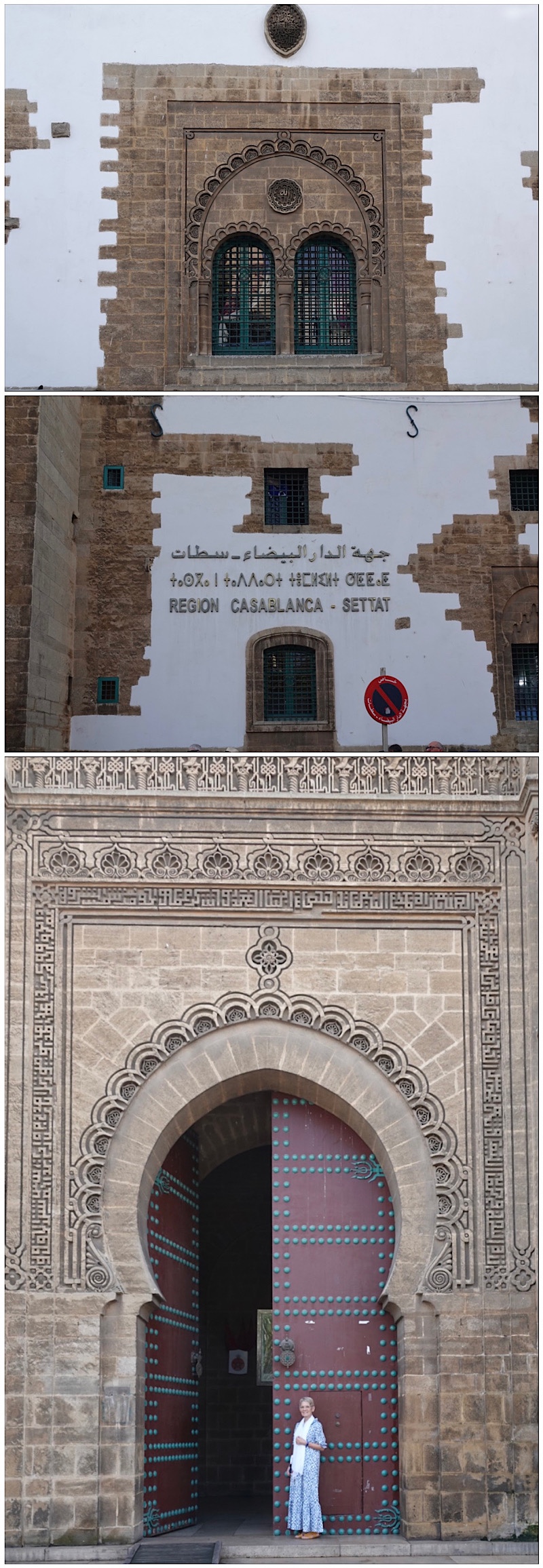
The city was first settled by Berbers in the 7th century BC, founded by Mohammed III, but what modern day tourists visit is a city reconstructed in 1756 after a devastating earthquake destroyed it. It has been constantly modernized in the ensuing centuries. There was no written Berber language used in Morocco until 2003, when Tifinagh became the official scripted alphabet, under an initiative of King Mohammed VI to acknowledge the importance of the Berber heritage.
We took a walk through the Habbous Quarter, established in the early 1900s by the French, on land donated to the city by a wealthy Jewish businessman. The area is now used largely as affordable housing.


We’d been forewarned by other travellers that Casablanca was dirty, and that Moroccan street vendors and beggars were aggressive, but neither was today’s experience. In fact, we found the city very clean, even in the poorer neighbourhoods of the Habbous, and vendors respectful.
From the Habbous Quarter it was a very short walk to the King’s Casablanca palace, where we were only able to walk around the exterior and photograph the ornate bronze and tile entry doors. The King is rarely here except to perform investitures.


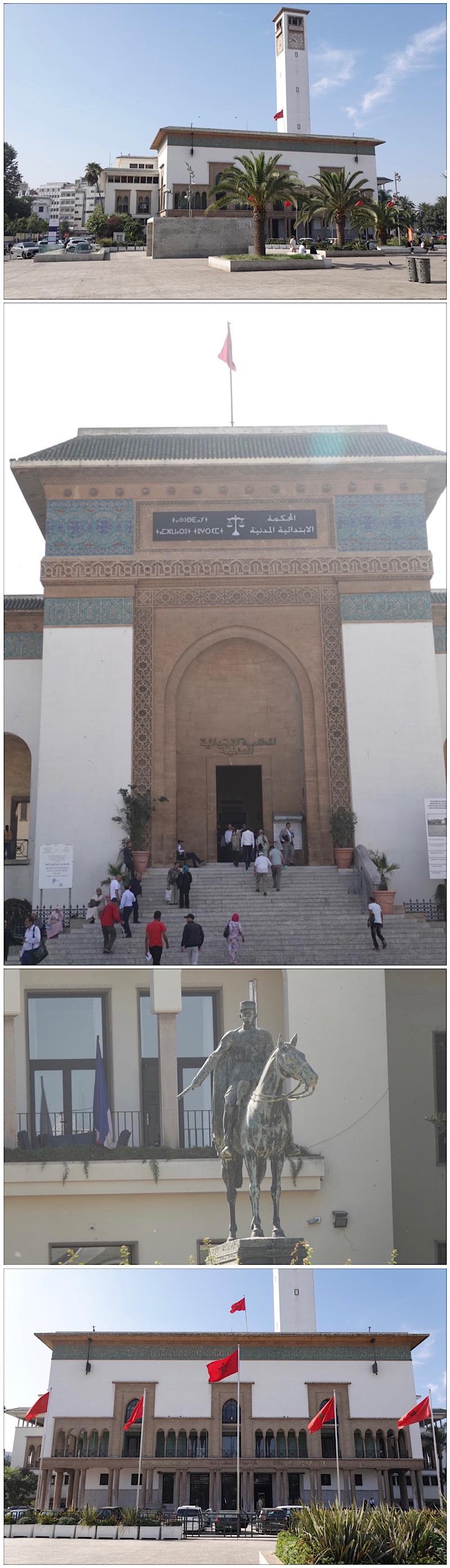
We reboarded the bus and made a quick stop at Mohammed V Square, named after the current King’s grandfather.

Casablanca’s is particularly large.
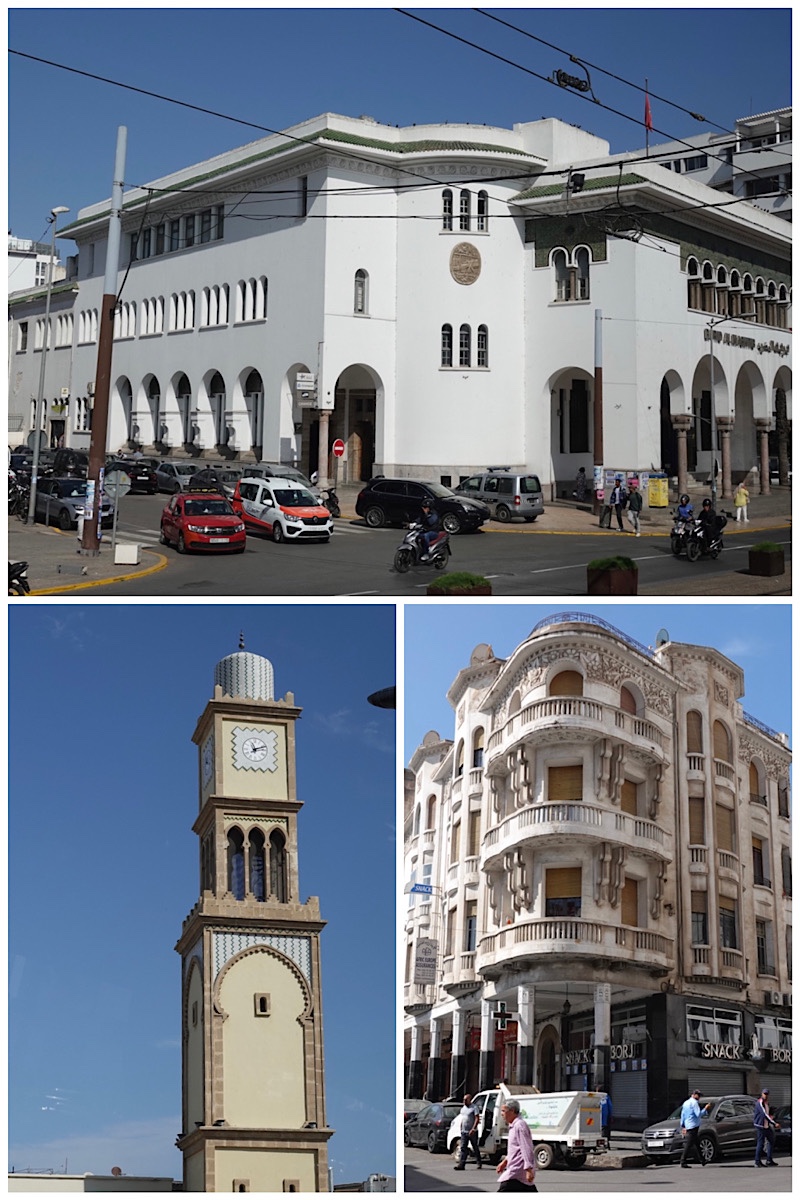
Surrounding the plaza are the Hall of Justice, the Ministry of the Army, the French Embassy with its statue of Charles DeGaulle on horseback, the Casablanca city hall, several bank head offices, and the brand new opera house (which is waiting for the King to officially open it).

In the square was a traditionally costumed Berber water seller, with his goatskin water sack.
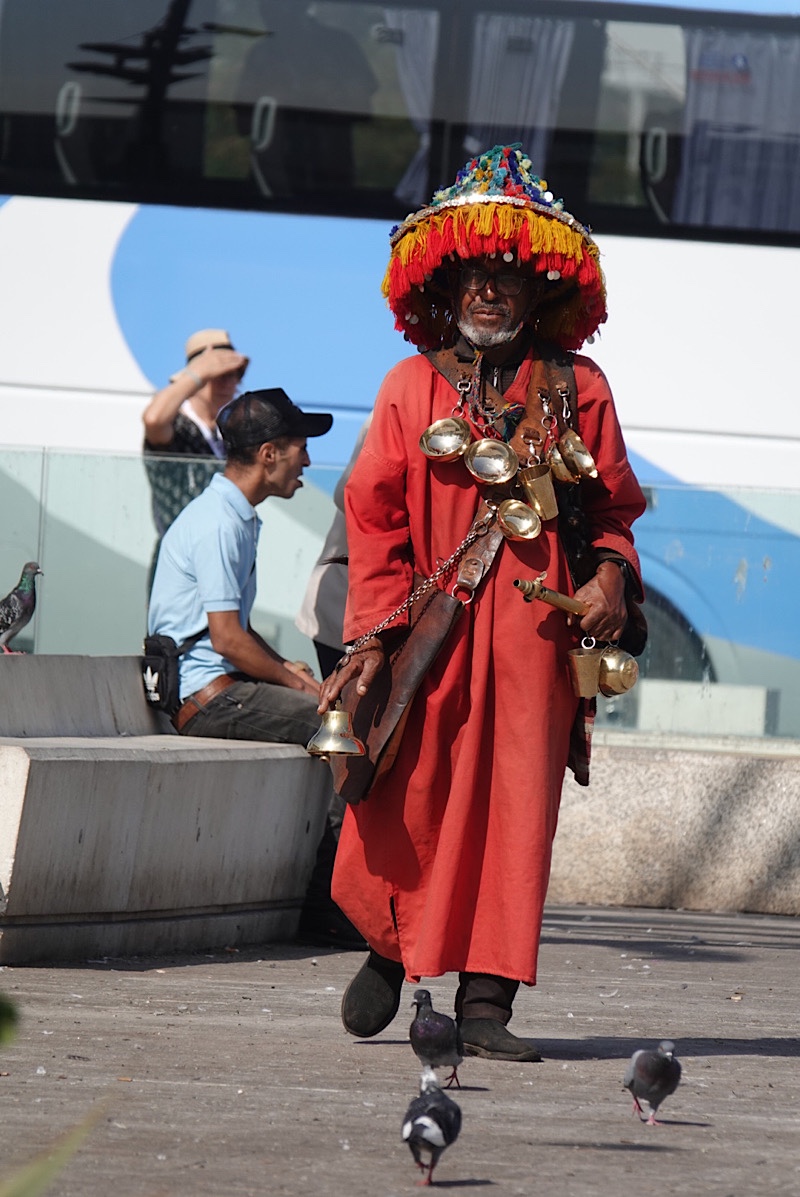
Our next stop was the Marché Centrale, dating to about 1914. At one time it was a bustling marketplace for the French in the city, but now it exists mainly as a fish and meat market. In addition to the many seafood stalls, there was also a horse-meat butcher, traditional since the French occupation. Our guide indicated that camel is also eaten in Morocco, but there was no evidence of that here. It was absolutely the cleanest and freshest smelling fish market we’ve ever been in.

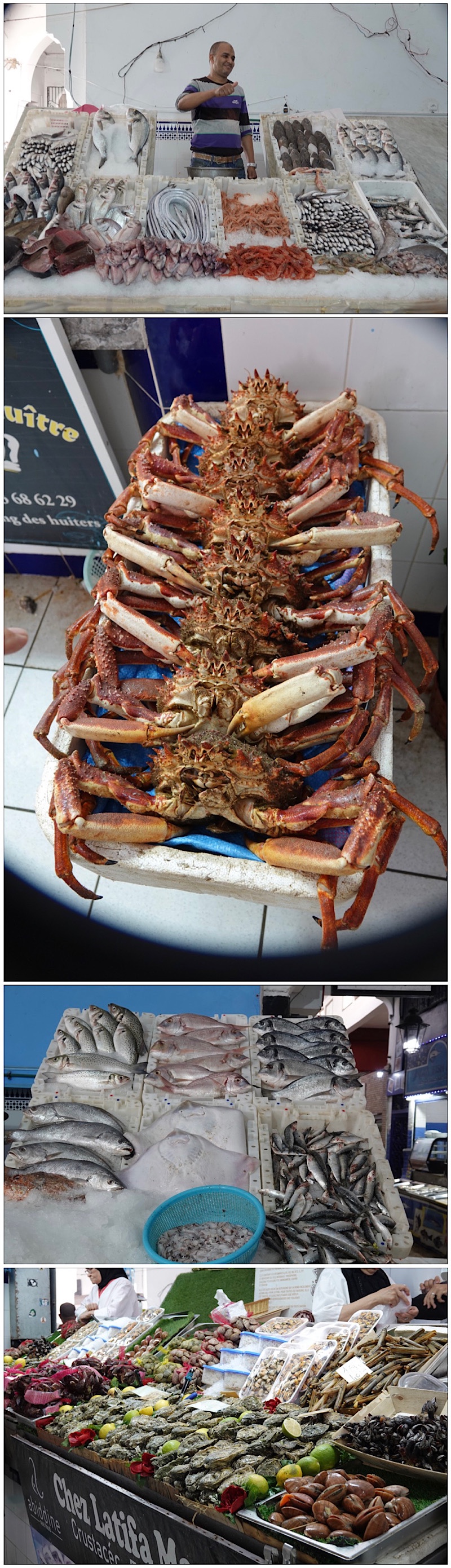
Yes, we passed by Rick’s Café. It’s not the one from the movie of course, which existed on a Hollywood set, but it’s still a big tourist attraction!
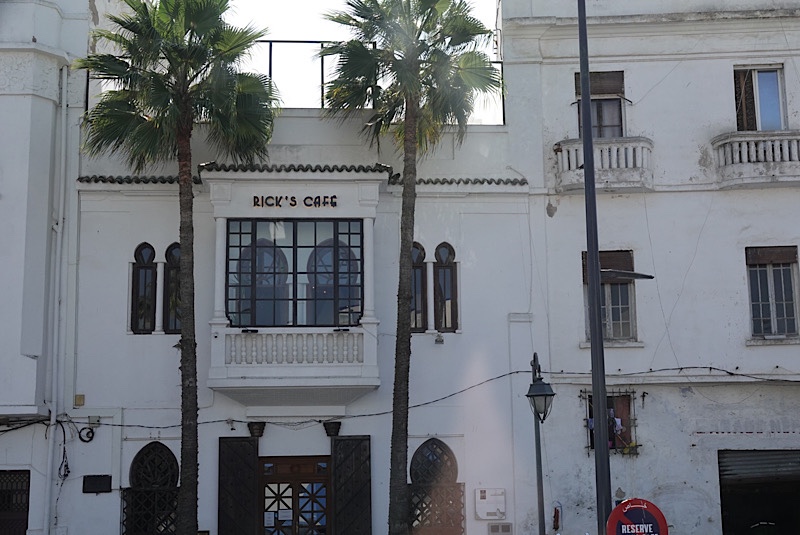
Our tour then proceeded to the huge and beautiful Hassan II Mosque. Only viewing of the exterior was included in our itinerary, but for an extra 130 Dirham (about 13 USD/Euros or 18 CAD) each, most of our group, at Fouad’s suggestion, opted also to see the interior.

The minaret rises majestically towards the sky with a height of 200 m, making it one of the tallest minarets in the world. Its facade is clad with Roudani travertine meshes, as well as a green glass paste in the form of a mosaic.
It is surmounted by a 15.5 m high Jamour (a spire which can symbolise the sun, moon and stars or the four elements – earth, wind, fire and water – but most often is simply decorative) of three golden balls from which springs a laser beam with a range of 30 kilometers oriented towards Mecca (the qibla).
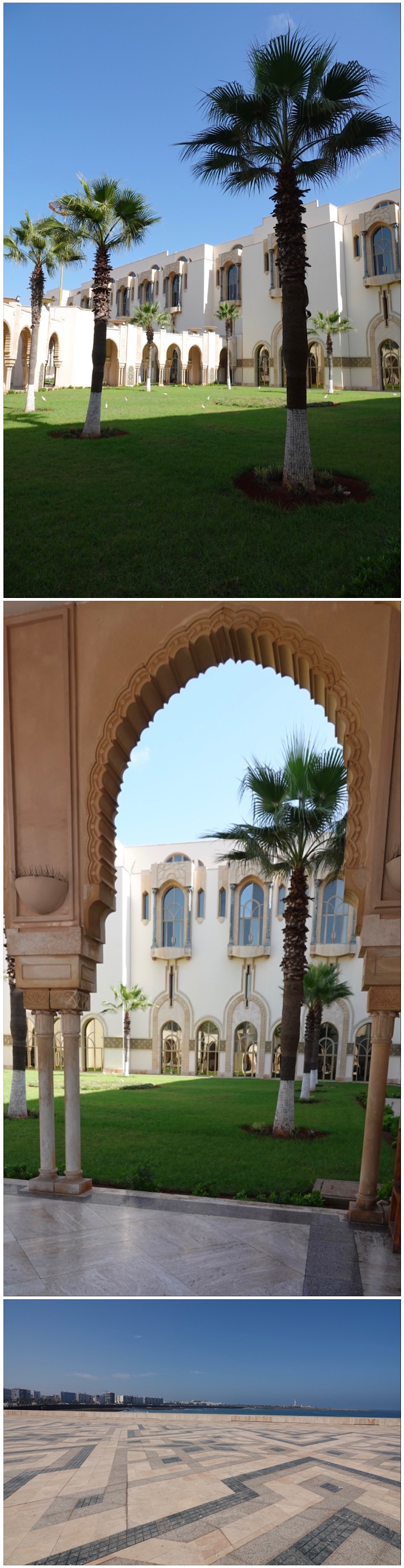
The mosque’s website describes it as “a prayer room with an area of 2 hectares”. The guided tour allowed us to see the Prayer Room, the Hall of the Minaret, and the men’s Ablution Room. Much of the wording used in my descriptions below comes from the website. The photos are all Ted’s.
The Prayer Room is located in the heart of the building, and designed according to a rectangular plan of 20,000 m2 (200m long by 100m wide) with a capacity of 25,000 faithful. 20,000 men worship on the main floor, and two suspended mezzanines on either side of the central nave, built on a total area of 3550 m², have been fitted to accommodate 5,000 women, who access the balconies via escalators. During Ramadan, when praying at the mosque – instead of at home – is obligatory, another 80,000 people can be accommodated in the courtyard!

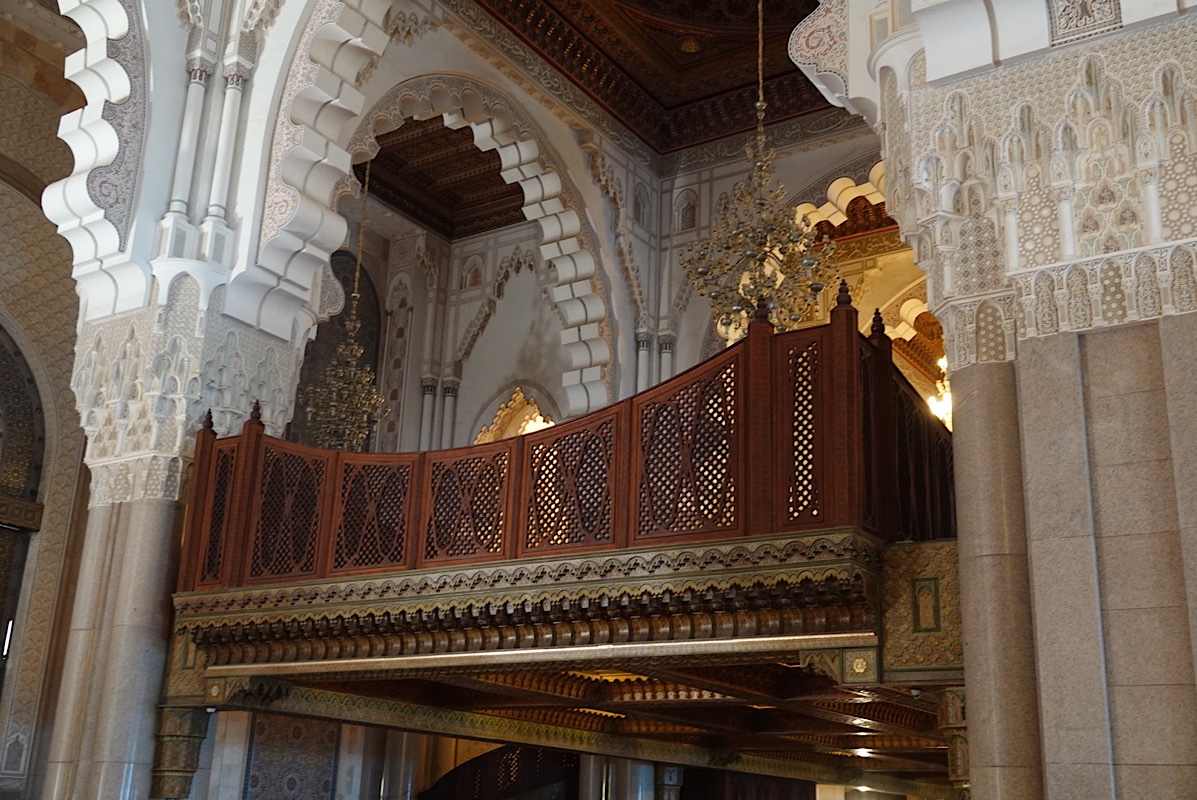
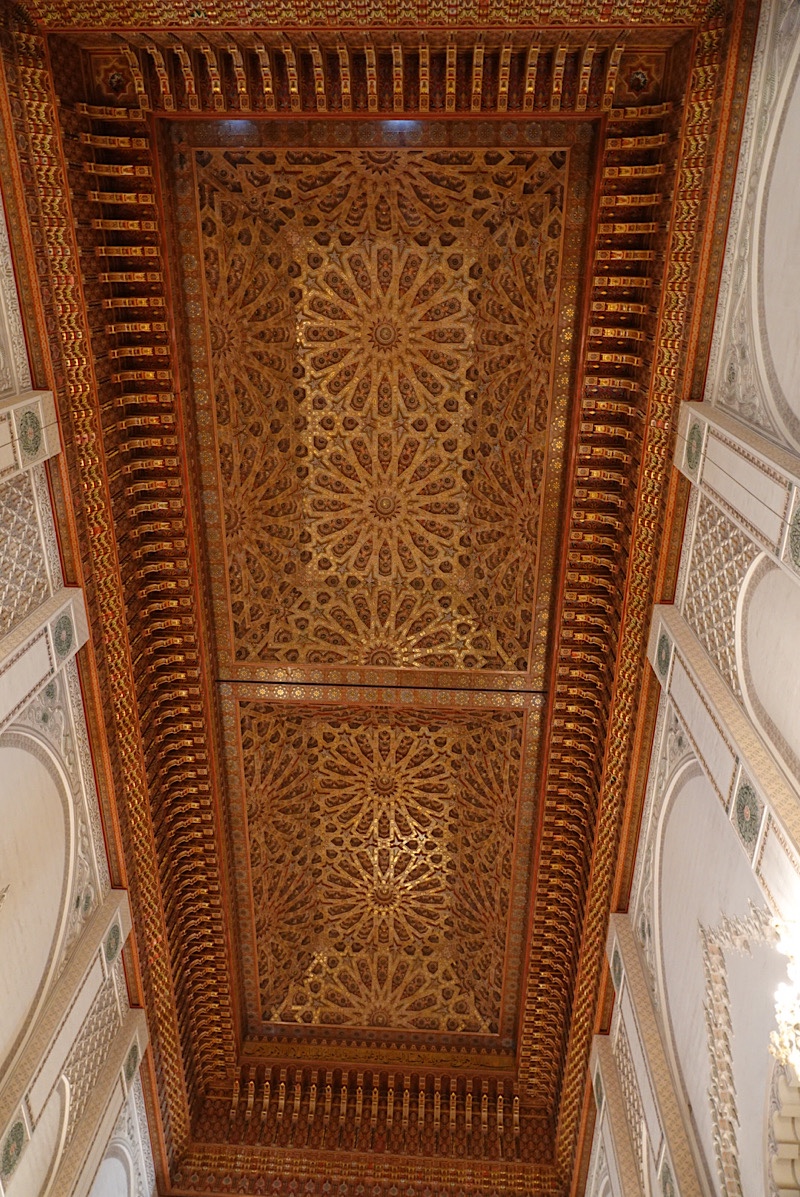
The Prayer Room has an opening roof (below – note the “seam” in the centre where it splits) that transforms its center into a sunny patio like the old constructions of Arab-Andalusian architecture. It was closed today, but is regularly opened during Ramadan prayers.
In addition to light from the open roof, the prayer room is illuminated by magnificent Murano chandeliers, and glass doors overlooking the Atlantic Ocean.
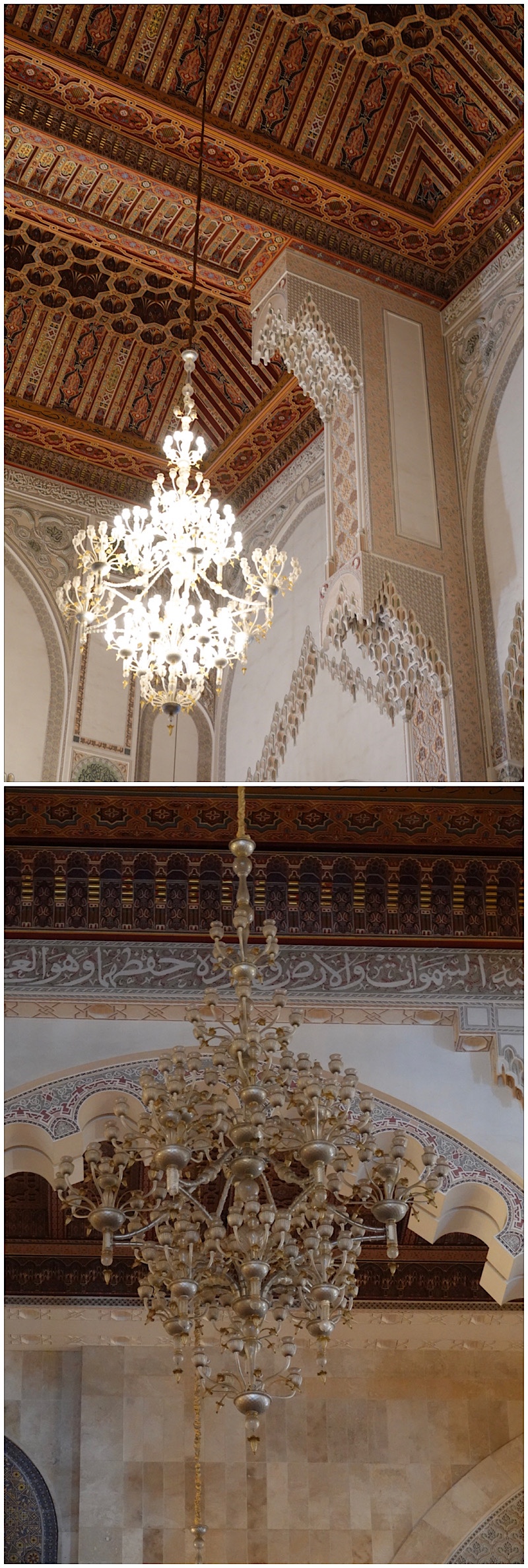
It is decorated with a succession of carved, painted or zouaké (sculpted) wood ceilings and domes, chiseled plaster arcades, Zellige (cut tile) wall panels with geometric composition, as well as titanium and brass doors; to all these decorations are added friezes decorated with Koranic verses in calligraphy.


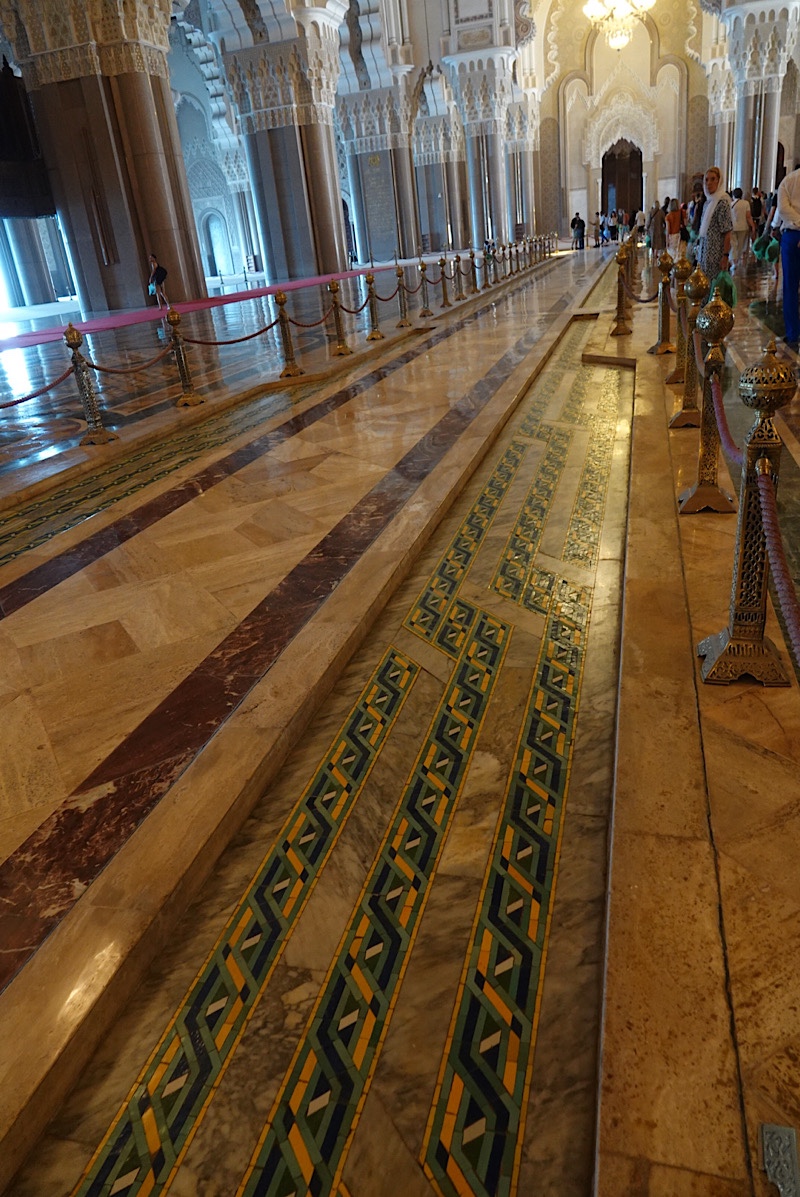
It is equipped with a heated floor covered with marble, granite and travertine reproducing the design of a Moroccan carpet crossed by a Seguia (channel) of water, with glass openings overlooking the ablution room. With the roof open, and water running through the seguia, those in the mosque are in touch with earth, water, and sky.
Located in the basement below the minaret is the ablution room, where the ablution (ritual cleansing) ritual is carried out. It can accommodate 1400 people at once. It consists of 41 marble fountains in the form of lotus flowers, as well as 600 water points in a rich decor of Zellige and Tadellakt (calcified lime used to coat pillars and walls).
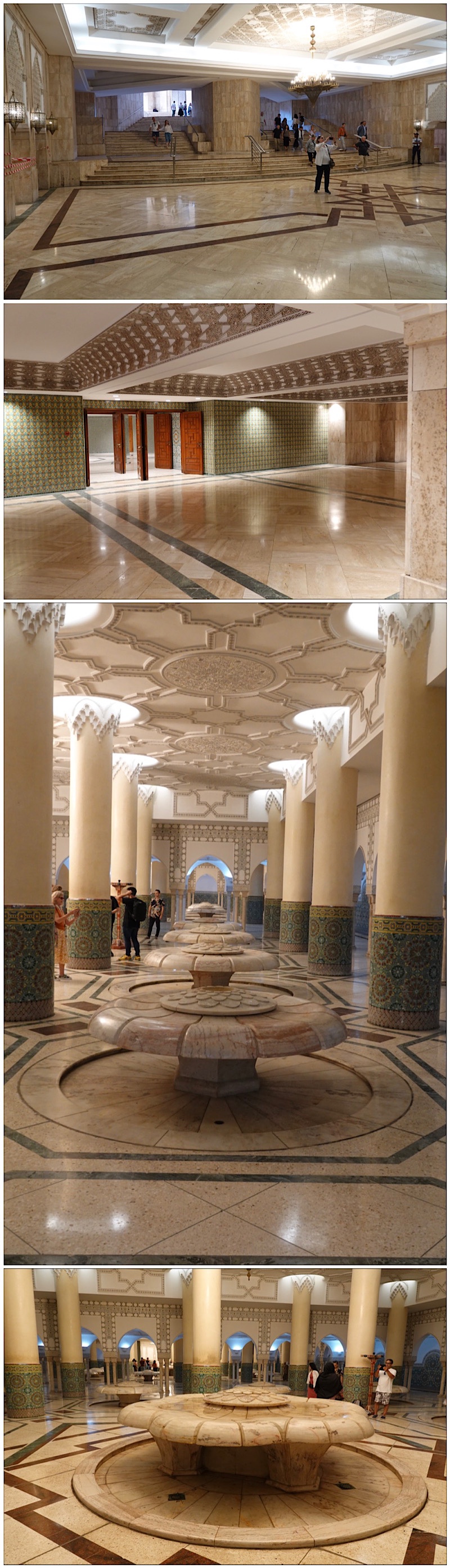
Our last stop inside the mosque was down the stairs past shining mosaic walls into the minaret tower itself (below). Once, muezzins had to climb to the top of the minaret of their mosque to issue the call to prayer; now they use a speaker system at the base of the minaret. Nonetheless, this mosque has an elevator in the minaret tower, to allow cleaning staff to access it. The technical equipment that operates the roofs, lights, and the 360 speakers in the mosque is all housed in the minaret tower.

We made a welcome lunch stop between Casablanca and Rabat, where we ate decidedly non-Moroccan paninis and French fries overlooking the Atlantic. Fouad joked that if we looked REALLY hard we might catch a glimpse of Canada. Although the high today was only around 25°C/77°F, under bright sunshine reflected off the sand it felt much hotter.

After the lunch break, the afternoon’s activity was a city tour of Rabat. There are 9 UNESCO World Heritage Sites in Morocco (Moroccan UNESCO sites) of which Rabat is the first that we tour. By the end of our stay here we’ll have visited at least 7 of the 9.
On the 90 minute drive to Rabat, many of us cat-napped, since the scenery was mostly residential housing. The exterior of most apartment buildings is quite boring: plain whitewashed concrete. As was explained to us in Saudi Arabia, and confirmed by Fouad here in Morocco, the Muslim practice is to have very plain exteriors, so as not to create jealousy or flaunt wealth. Interiors, however, can be quote sumptuous. The exceptions, of course, are royal palaces and the ocean-front homes of some of the government ministers!
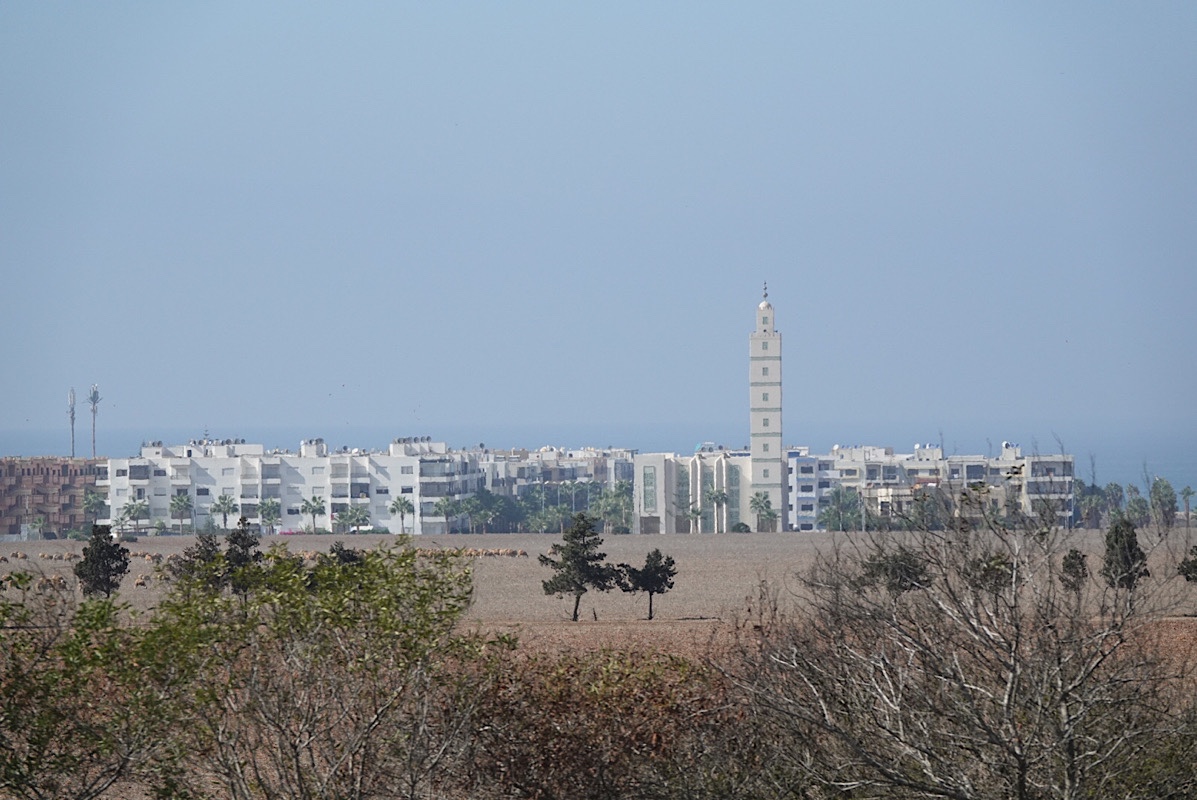
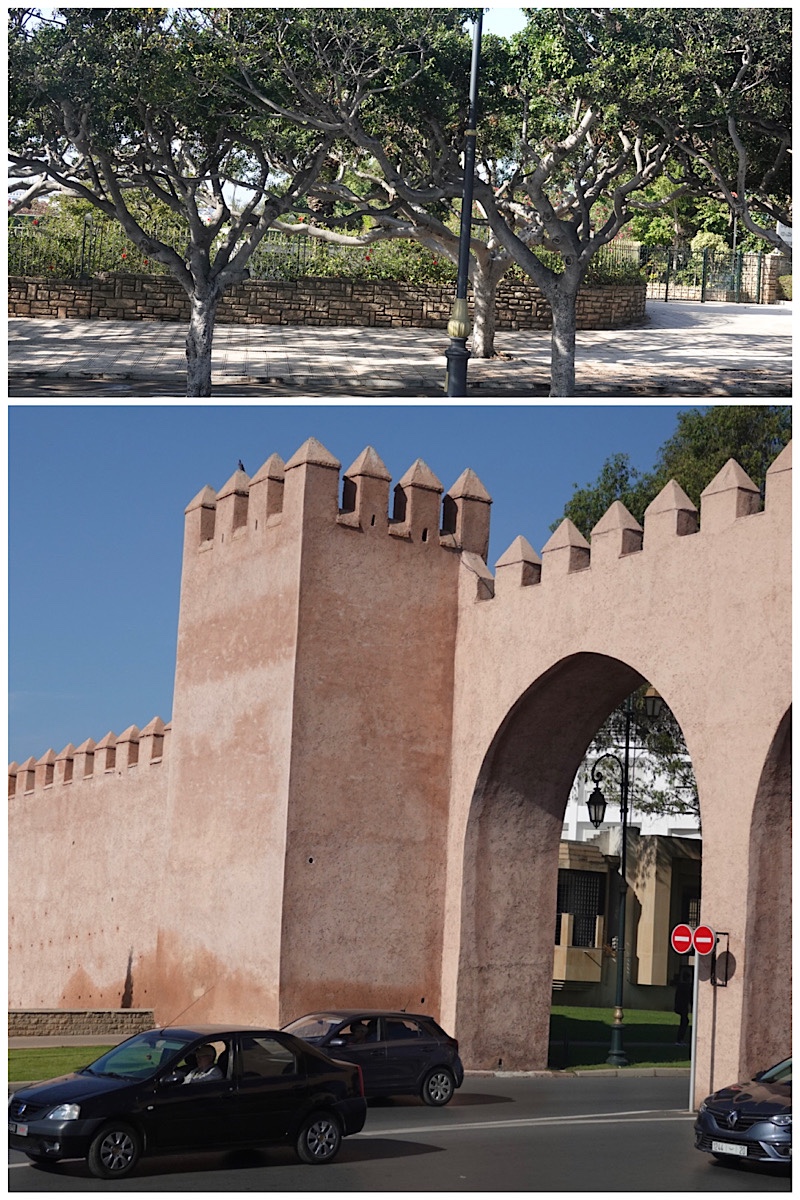
In Rabat, we stopped first at the royal palace, but could not get close since the King was due to arrive. We did learn that people know when the King is coming because the police put on their white gloves!

Next we visited the site of the Mausoleum of Mohammed V, and the famous Hassan Tower, which is the incomplete minaret of an mosque commissioned by Abu Yusuf Yaqub al-Mansur, the third Caliph of the Almohad Caliphate, near the end of the 12th century. The tower was intended to be the largest minaret in the world, and the mosque would have been the largest in the western Muslim world. When the Sultan died in 1199, construction on the mosque stopped. The minaret was left standing at a height of 44 meters, and the rest of the mosque also left incomplete, with only the beginnings of several walls and 348 columns being constructed. Walking through the columns felt a little bit like being in the much more ancient sites of Ephesus or Caesarea Maritima.

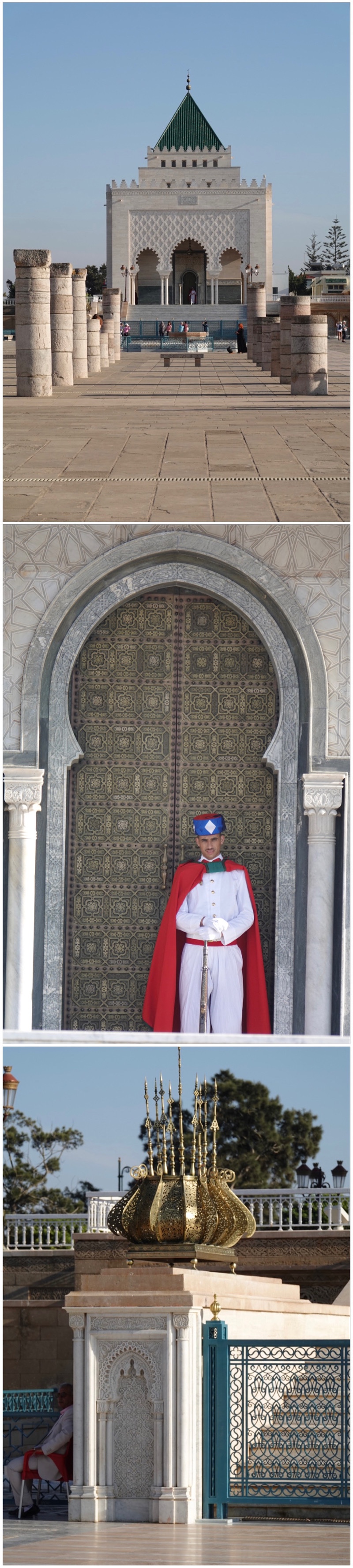

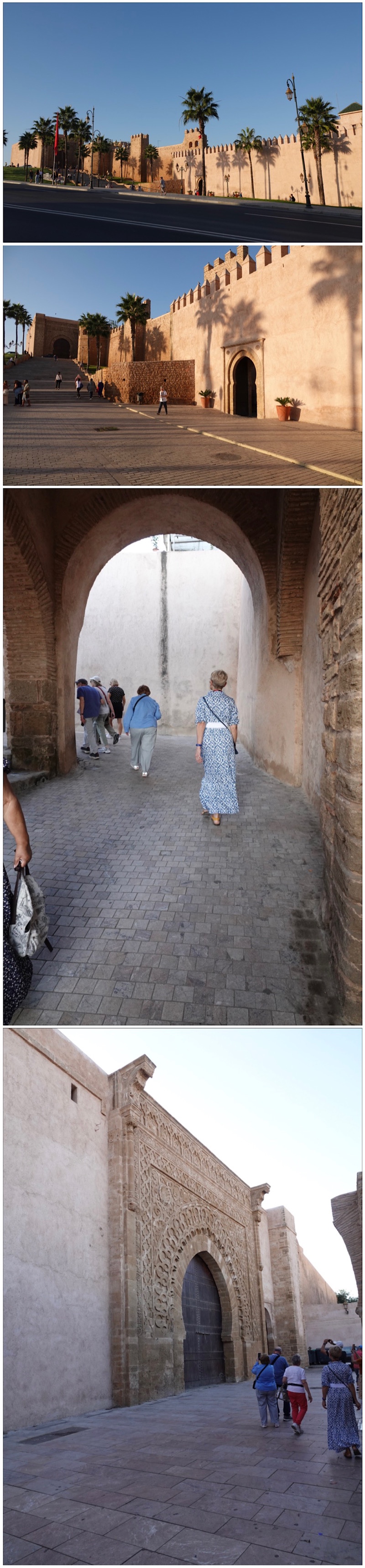
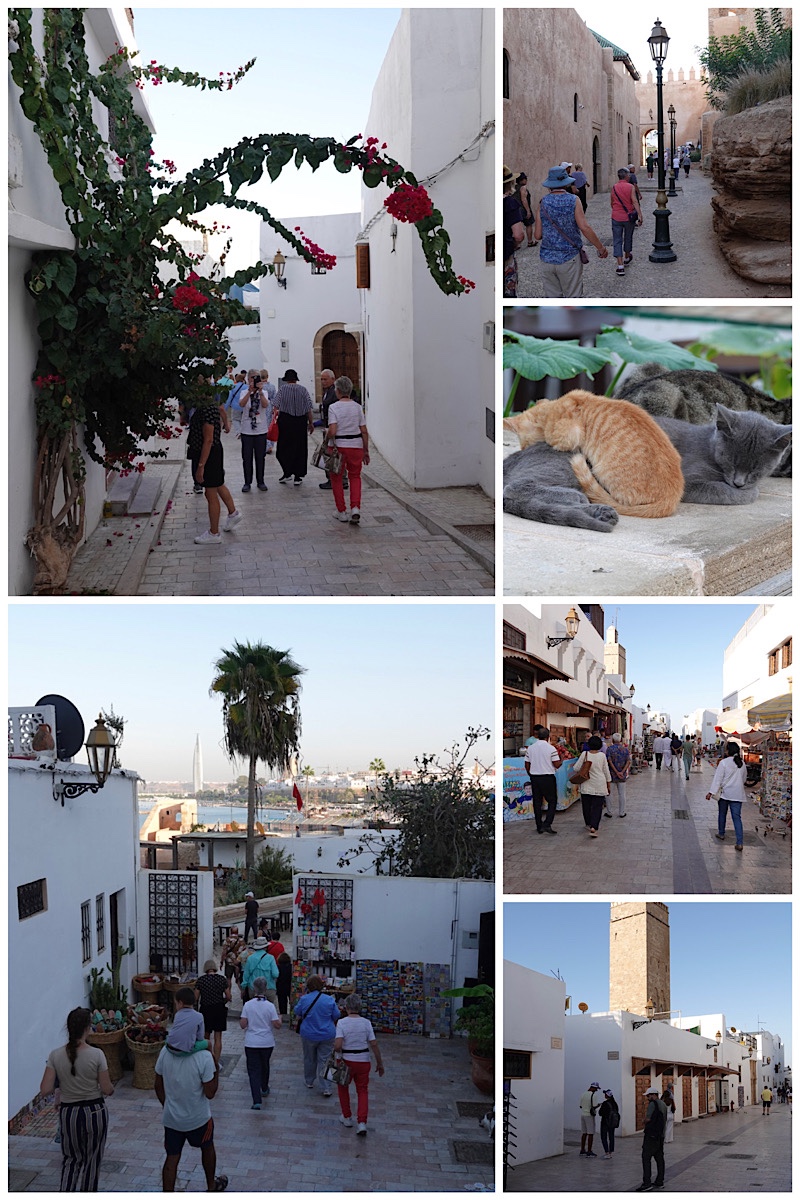
Our last stop of the day was the Kasbah of Loudaya/ Kasbah of Andalusia, the fortress city which welcomed the thousands of Muslims, moors, and Jews expelled from Spain by Christians in the 12th century. It remains a working kasbah, with shops and restaurants in many of the street level buildings, and residential apartments above.
Our accommodation overnight in Rabat was the Farah Hotel, a decided downgrade from our hotel in Casablanca. Our room was simply a standard hotel room, and several couples in our group had the same issue we experienced: NO TOWELS! Not one. After alerting the concierge desk in person (in French!), we received …. a bath robe. Further discussion with the chambermaid who delivered the robe finally got us two thin, well-worn bath towels. At least now we can shower.

Dinner was equally lacklustre, and – sadly – buffet style again. While the food was warmer than yesterday, and the flavour of the lamb tagine quite nice, there was no effort at all at nice presentation, and they ran out of dessert. On the up side, tonight was a wine included night and since Ted doesn’t drink, I got 2 glasses!!
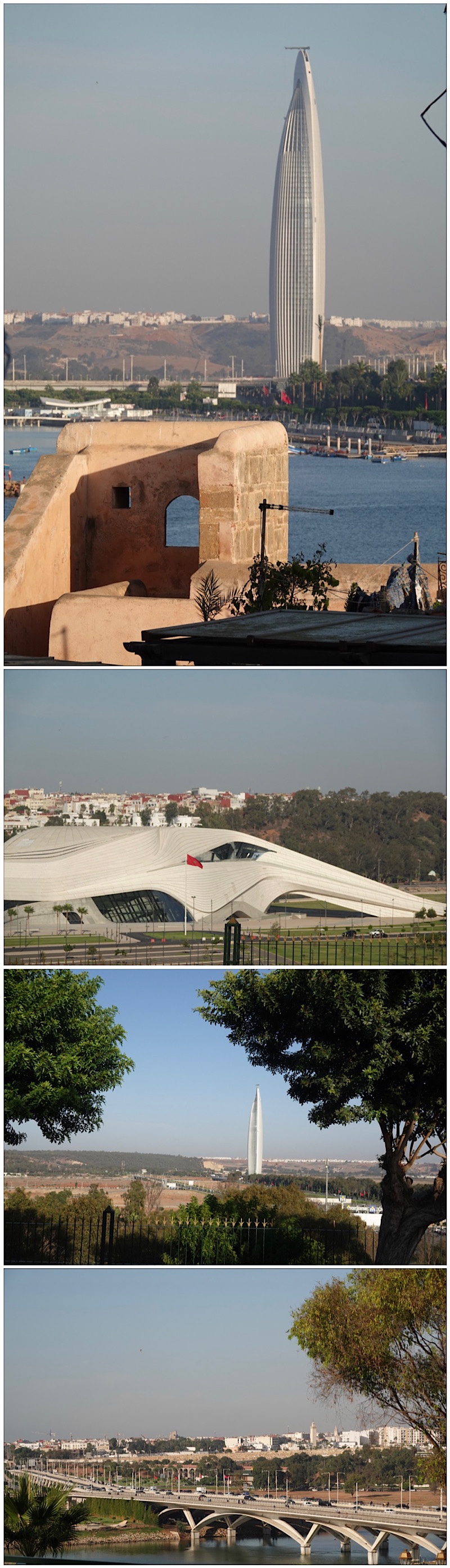
Ted got some lovely shots from the top floor of our hotel after dark, including the Hassan II Tower, the mausoleum, the opera house, and the old city walls.

With the exception of our hotel, a fabulous day!,
 Rose and Ted’s Excellent Adventure
Thank you for this post. Almost better than being there.
LikeLiked by 1 person
Amazing!
– 111 Rykert Crescent East York ON ON
LikeLiked by 1 person
Wendy said exactly what I wanted to say! Gorgeous, interesting photos all around. I can’t help but wonder whether the poor would still be poor if the world’s religions had put more into investing in their lives and less into architecture and symbols of wealth — however stunningly beautiful. Even the Buddhist temple compounds in Vietnam and Cambodia struck me this way… We are so lucky to be able to travel to see them, though! I’ll probably come back to read about your trip when my own is over so I can do it on this bigger screen. We’ve made a decision to travel with phones only this time. Thank you and bis später!
LikeLiked by 1 person
Interestingly, 2 of the Muslim countries we’ve now visited, Saudi Arabia and Morocco, seem to have current rulers who are actively creating the infrastructure and housing needed to life their people up. Hopefully it works as intended.
LikeLiked by 1 person
I loved the interior shots of the mosque. What a stunningly beautiful building! I don’t think we’ll ever get to Morocco so I really appreciate the chance to travel there vicariously with you.
LikeLiked by 1 person