One advantage of cruising with a line that has been coming to Alaska forever is that we get prime spots in each harbour. Holland America’s Koningsdam and Eurodam got dockside priority today, while Princess passengers had to tender into port.


We had another terrific Holland America excursion today in Alaska’s Salmon Capital. Our tour group of 36 boarded an Alaska Gray Line bus with driver/guide Byron, a retiree from Idaho, and were informed and entertained with local history, stories, and legends for the next 2-1/2 hours.
Our destination was Totem Bight State Park, where a number of Tlingit and Haida totems, and a clan house, have been recreated. We sometimes think of totems as being something permanent that was destroyed, but in fact totem poles made of red cedar normally last only 60-80 years, since softwood cedar rots from the inside. If a totem pole fell, it would be left to erode, returning to the land from which it came. The “new” poles are hollowed out, eliminating that rot and extending their life to 100+ years.
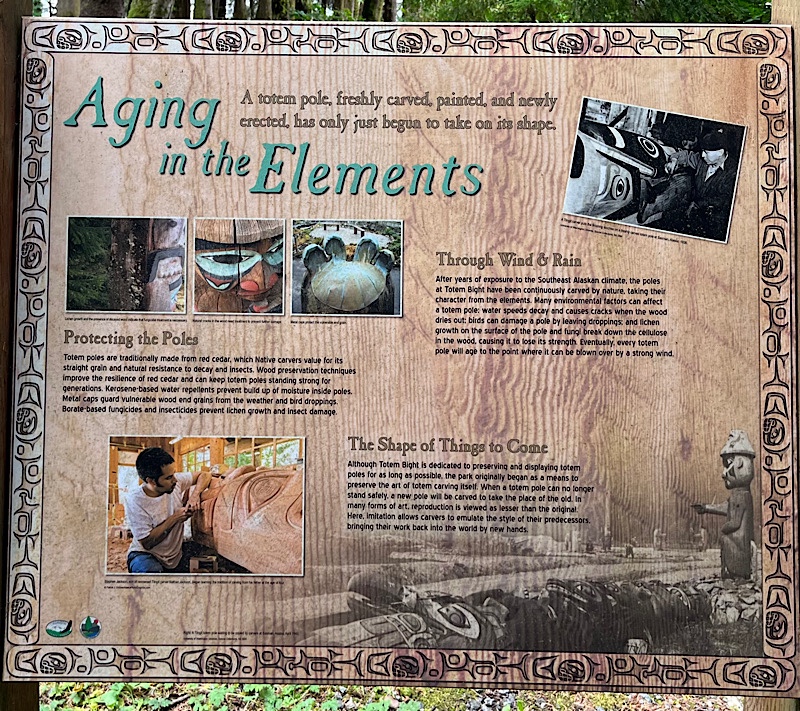

The park is located in old growth forest (we’re still within the boundaries of Tongass National Forest) populated mainly with Sitka pine (different from Sitka spruce), Western hemlock, and yellow cedar. Because there is only 3-6 feet (1-2 metres) of topsoil on the rock island that is Ketchikan, the trees send their roots horizontally; when the roots of adjacent trees intertwine it gives them great stability.

Re-creating genealogical and story poles only really began in about the 1930s, when people started to worry about both the stories and the carving arts being lost. Prior to that, especially in the early 1900s, religious missionaries and the U.S. government actively discouraged Alaskan natives from practicing the culture of their ancestors.
While it is fascinating to hear the story of each pole interpreted orally, master Tlingit carver Nathan Jackson has been quoted as reminding us that the clans now have written language, so the stories can be handed down in a way that was originally not possible. When a new pole is carved, its story is written down, and placed in a bent-wood box inserted into the base of the pole.
Once a master carver had created a totem pole, colour was added. The women in each clan were tasked with chewing salmon to release the oils that would be combined with natural pigments from salmon roe, hematite, clam shells, lichen, graphite and copper. Black is the primary colour: red is for secondary elements; and blue-green is for tertiary highlights. In the rare cases where yellow was used, that was a pigment traded from Europeans.
We heard the stories of 13 of the 14 of the poles here in the State Park – most of them in great detail and with much humour injected into them by our guide. The descriptions below are the drier (and shorter!) versions taken from the State Park pamphlet.
Pole 1. Thunderbird and Whale. This mortuary pole was originally from the old village of Klinkwan on Prince of Wales Island, recreated by master carver John Wallace in the 1930s, and again by Nathan Jackson in 1990 (the pole pictured below). It depicts the mythological Thunderbird with a lifeless killer whale in its talons.

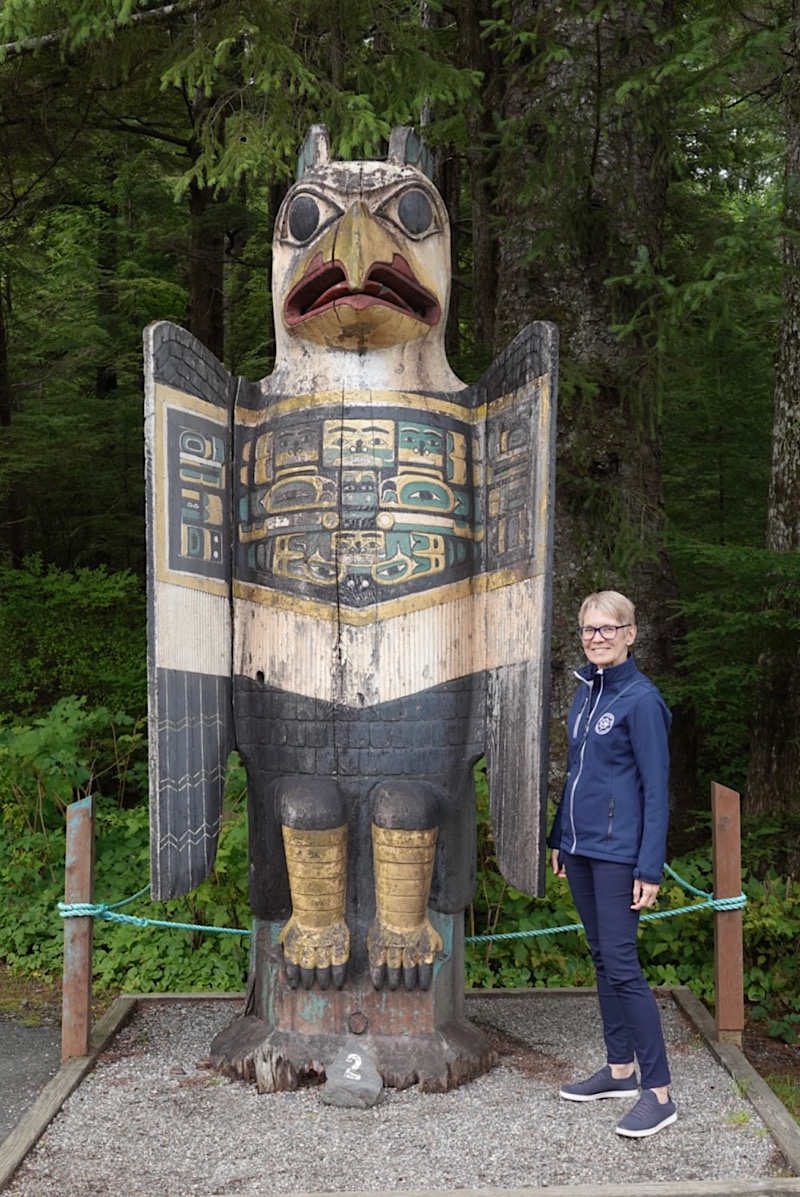
Pole 2. Eagle grave marker, originally from the old Haida village of Howkan, and copied by JohnWallace, who added the Chilkat blanket design on the eagle’s breast. The ashes of an important clan member would have originally been placed in a bent-wood box inside the pole’s base, or buried under the pole. As evidenced by my height beside these poles, they were not very tall. House poles were much taller, and external clan poles could reach 70ft/21m in height, making them easily visible to travellers on the water.
Pole 3. Man wearing bear hat. This Tlingit grave marker was originally copied from one on Cat Island by Tlingit carver Charles Brown, and then re-created in 1995 by Israel Shotridge. It depicts a man of the Bear clan wearing a large hat surmounted by a bear’s head and surrounded on the brim by painted whales.

Pole 4. Wandering Raven House entrance pole, on the Tlingit Raven clan house. The low oval entrance was a good means of protection, and was typical of native homes prior to the adoption of western-style homes. The pole represents several important stories in Tlingit lore. At the top is a depiction of Raven clutching a box containing the sun that he stole from a greedy Chief to bring light to the world.

We spent a short time inside the reconstructed clan house with its 4 identical house poles (that would not originally have been the case). Four or five families of up to 40 people (about the size of our tour group) would have lived in this house, with a central fire for heat and individual cooking fires. Smoke would have escaped through the hole in the centre of the roof. Our guide demonstrated how floor slats could be lifted to reveal storage spaces for clothing, cooking utensils, blankets, and more.

Pole 5. The “pole on the point” is a 68-foot /20.7 metre tall original design by master carver Charles Brown. At the top is a Tlingit shaman wearing a headdress of bear claws and a fringed apron. The figures below him each represent a different Tlingit legend. A pole this tall would have been easily visible from the water, and announced that a “medicine man” lived with this clan. Think drop-in clinic.

Pole 6. Blackfish Pole symbolizes the story of the origin of the blackfish (orca). The original was copied from the pole that stood in front of Forested Island Clan House on Tongass Island.

Pole 7. The original Land Otter Pole was designed and carved in 1947 by John Wallace of Hydaburg, telling the Haida story of a man captured by the Land Otter people. The hero, at the top, wears a dog-skin headdress. This copy was done by Nathan Wallace in 1996.

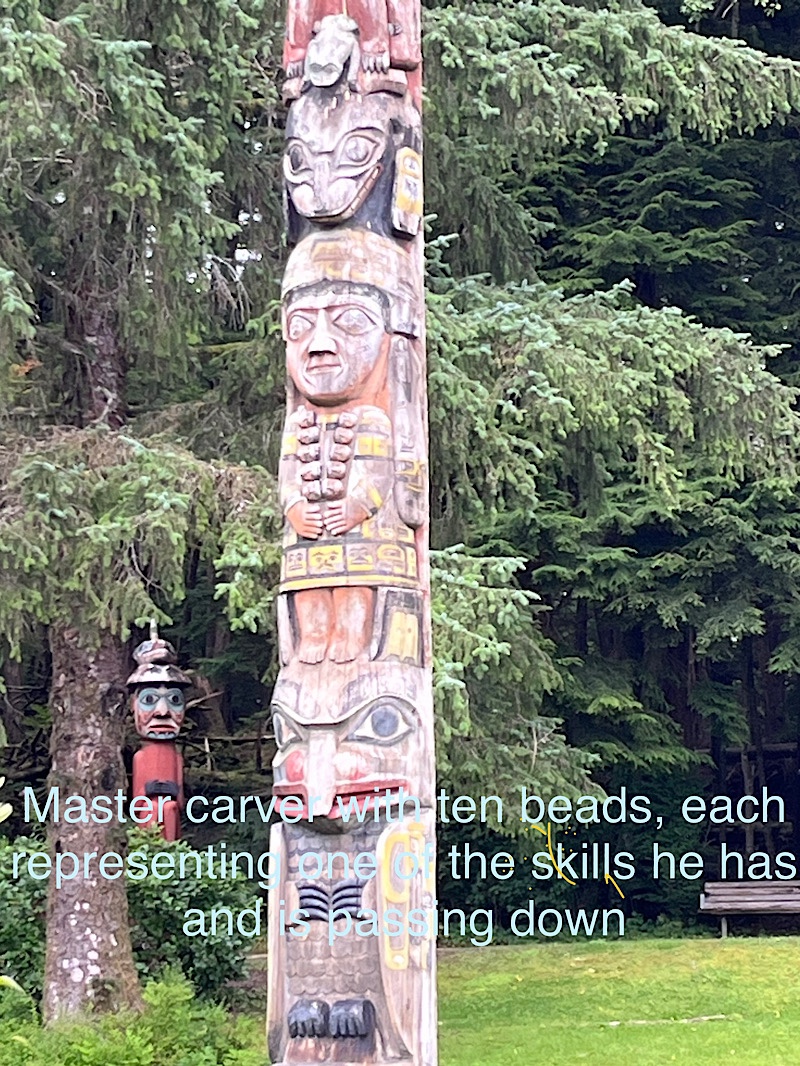
Pole 8. This Master Carver pole, designed and carved by John Wallace in 1941, tells the story of the legendary master carver who taught woodworking to the Haida people.
Pole 9. The sea monster pole resembles an original pole from the deserted Haida village of Klinkwan, depicting a village watchman standing guard at the top with two eagle crests, while the rest of the pole depicts the undersea world.


Pole 10. Raven at the head of Nass. Copied from a Tlingit pole on Tongass Island, a chief in a spruce root hat tops the pole, while at the base is the raven who shapeshifted in order to steal the sun from the chief and give light and warmth to all the people.

Pole 11. Kaat’s Bear Wife, a pole copied from Tongass Island, depicts a bear and tracks. Kaat was a mythological Tlingit warrior who married a bear. Their union eventually gave rise to polar bears, brown bears,and black bears.

Pole 12. The Kadjuk Bird Pole was copied from Cat Island. The fabled bird sits atop an undecorated pole that symbolizes the lofty habitat of the bird and the high esteem in which it is held. Frog Woman, who created the first salmon, is at the bottom of the pole.

Pole 13. This Tlingit Halibut Pole honours the Halibut House people of the Nexadi clan. The original pole stood in the park from the Civilian Conservation Corps era of the 1930s until 1970 when it was replaced by carver Nathan Jackson. The square pole is characteristic of the people of Tuxekan, where the pole originated.

We had a bit of free time to check out the park store, the visitors’ centre, and a few more carvings. I tried to match the stern look of the animals carved into the bench.

Before it started to rain, we had time to wander around Ketchikan.

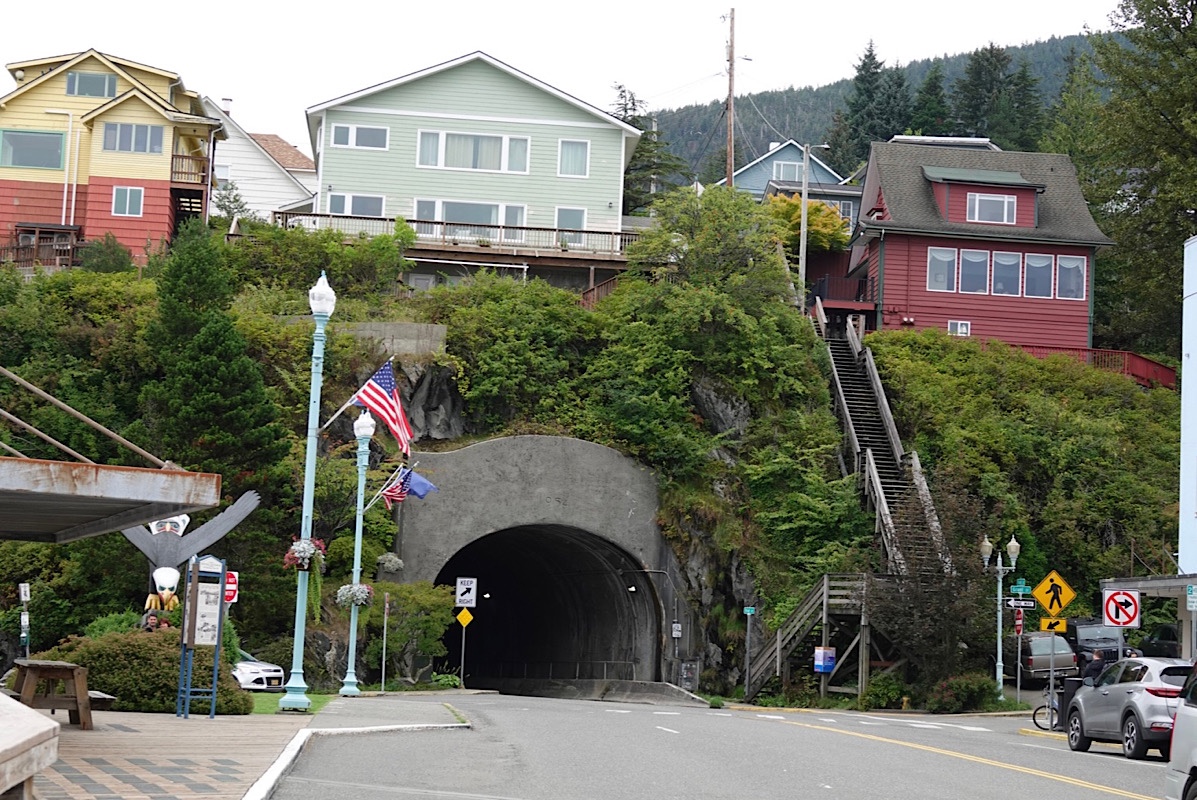
Coming from the harbour, the first totem that greets visitors is one our guide liked to call the “moon eagle” because it appears to be mooning newcomers!
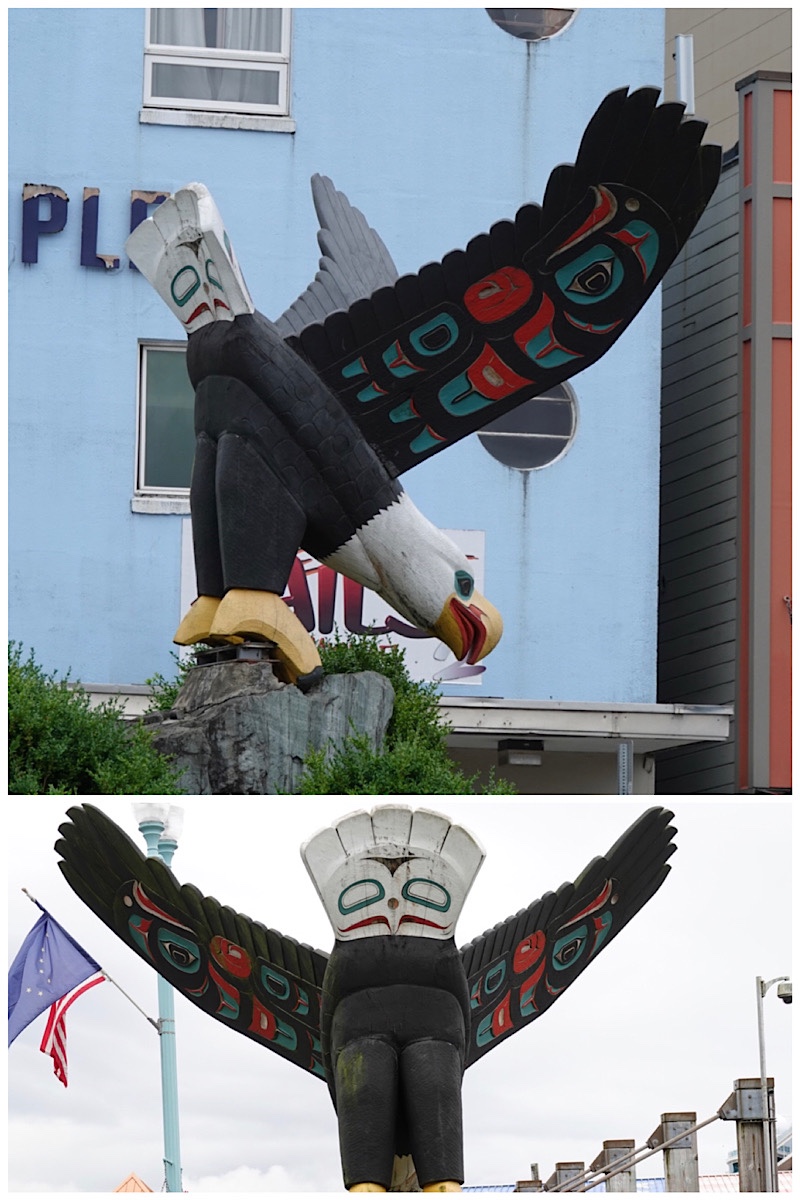
Ted and I walked up to Creek Street, which used to be home to multiple brothels (it’s now all shops and galleries) until prostitution was outlawed here in 1954.


We continued along Salmon Walk from where we had a terrific view of hundreds of spawning silver (aka Coho) salmon, at least a few of whom we’re smart enough to use the fish ladder instead of struggling up the rapids.

Ted commented on how nice it was to be in a place without high-rise buildings. There are two eight-storey buildings in Ketchikan, which used to be housing for the (now defunct) pulp mill’s workers, but from May until September the tallest things in the town are the cruise ships!

After another wonderful exploration day, we returned to Tamarind for another excellent dinner, and even got the chance to chat with the chef responsible for our delicious food.

What a lovely end to our Alaskan journey. Tomorrow is a sea day as we return to Vancouver.
 Rose and Ted’s Excellent Adventure
What a fabulous trip, Rose. I love your day in Ketchikan – the totems are fabulous, and you’ve told their stories wonderfully.
LikeLike
What a wonderful trip! I lived in Whitehorse Yukon for a few years in the early 1980’s. We used to drive over to Skagway to do some hiking or camping or fly to Juneau for baseball. An amazing part of the world. Your pictures have reminded me I need to return one day for a visit!
LikeLiked by 1 person
Thanks for taking us along. Felt a bit drier today. Given how long the Tlingit have been in Alaska and given the short life of a totem, much history must have been lost along the way. Sad.
LikeLiked by 1 person