Itinerary: We head north to the town of Drumcliff and visit the grave of the poet W.B. Yeats, who set many of his poems in and around Sligo. We then enter Northern Ireland and visit the Belleek pottery factory, known for its exquisite cream-coloured china. We will also stop at a sheep farm to watch a sheep dog demonstration and learn about the different types of sheep and herding techniques. Our next two nights are in Letterkenny, Donegal County.
☘️☘️☘️☘️☘️☘️☘️☘️☘️☘️☘️☘️☘️☘️☘️☘️☘️☘️☘️☘️☘️☘️☘️☘️☘️☘️
High 22°C/Low 10°C. Sunny.
About a 90 minute drive from our hotel in Westport, we arrived at St.Columba’s Church in Drumcliffe, County Sligo, famous in modern times as the burial place of Ireland’s first poet laureate, William Butler Yeats, but there is a much longer and richer history here.
St. Columba, who Ted and I first “met” on the isle of Iona in Scotland (Episode 29i – Iona) was educated here, and it is here that he first rebelled against the rules by making an unauthorized copy of a manuscript from St. Finnian in 561 AD. That action set in motion “The Battle of The Books”, thought to have been the first case of Copyright theft in Ireland. Today copyright infringement is not settled by bloody battles, but things were different then, and the resulting battle on the slopes of nearby Ben (Mount) Bulben made the local river “red with blood”. The Druid King of the day intervened and ruled in favour of St. Finnian, owner of the original manuscript. St. Columba (clearly not yet a saint!) fled to Iona, where he set up a monastery to assuage his guilt, hoping to convert an equal number of pagans to Christianity as Christians had died in the battle.
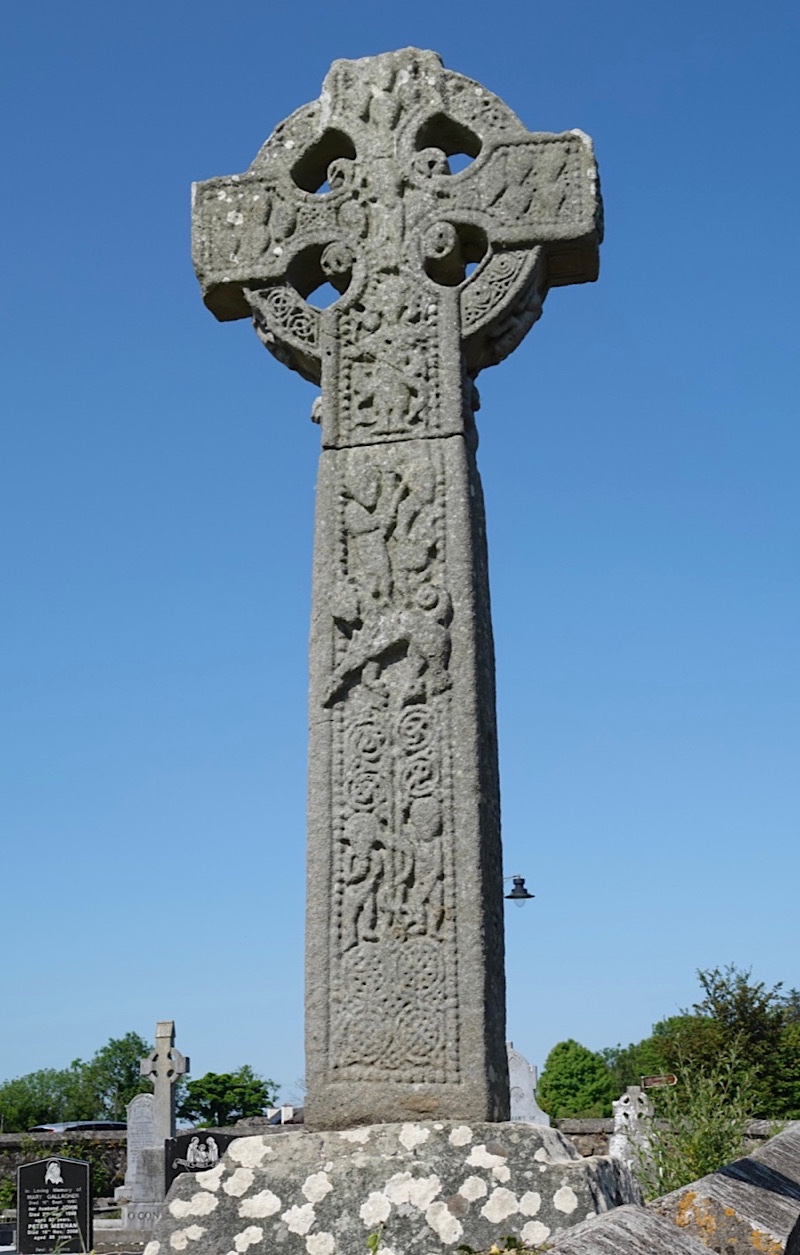
In 574 AD, St. Columba returned to Ireland and founded a monastery here in Drumcliffe. only a partial round tower remains today, along with the “high cross”, a Celtic cross that escaped Cromwell’s 17th century destruction of religious symbols. This cross was a “teaching” cross, where the local people were taught bible stories through depictions carved in the cross. From the bottom up, we could still clearly see Adam and Eve, Daniel in the lion’s den, and the crucifixion of Christ.
The current St. Columba’s Church was built in 1809, likely on the site of an earlier church, using local stone and remnants of the monastery. The east wall of the church, behind the altar, boasts a painted mural (restored in 1999) in lieu of a stained glass window.

We asked about the eagle-shaped lectern, which we’d also seen in Trinity Church in Westport, and were told that it is a common feature in Church of Ireland pulpits, representing both the strength of faith, and reaching in flight for heaven.
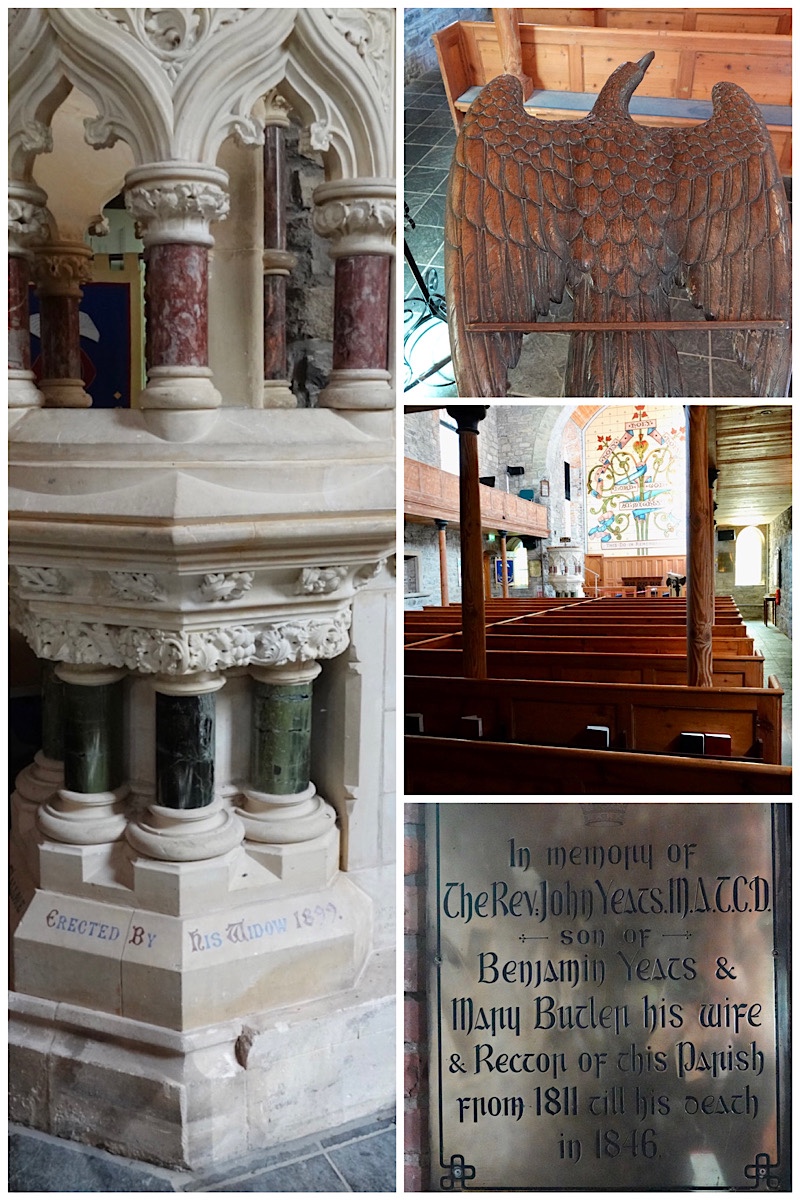
Upon his 1939 death, William Butler Yeats was initially buried in France, but at his own request reinterred here in 1948. No, he didn’t speak from beyond the grave, but his son knew of his wishes to “be planted in Sligo” and was aided in relocating his body by the Irish Foreign Minister. His wife George (Georgie Hyde-Lees) is also buried here. W.B.Yeats great-grandfather had been rector of the church jere in the early 19th century.
VI

Under bare Ben Bulben's head
In Drumcliff churchyard Yeats is laid,
An ancestor was rector there
Long years ago; a church stands near,
By the road an ancient Cross.
No marble, no conventional phrase,
On limestone quarried near the spot
By his command these words are cut:

               Cast a cold eye
               On life, on death.
               Horseman, pass by!

W. B. Yeats, “Under Ben Bulben” from The Poems of W. B. Yeats: A New Edition, edited by Richard J. Finneran. Copyright 1933 by Macmillan Publishing Company, renewed © 1961 by Georgie Yeats. Reprinted with the permission of A. P. Watt, Ltd. on behalf of Michael Yeats.

From Drumcliffe we headed to the Atlantic Sheepdogs demonstration at the farm of Martin and Trish Feeney. (Meet the shepherd) This may have been the most fun you can have in Ireland without a drink in your hand!
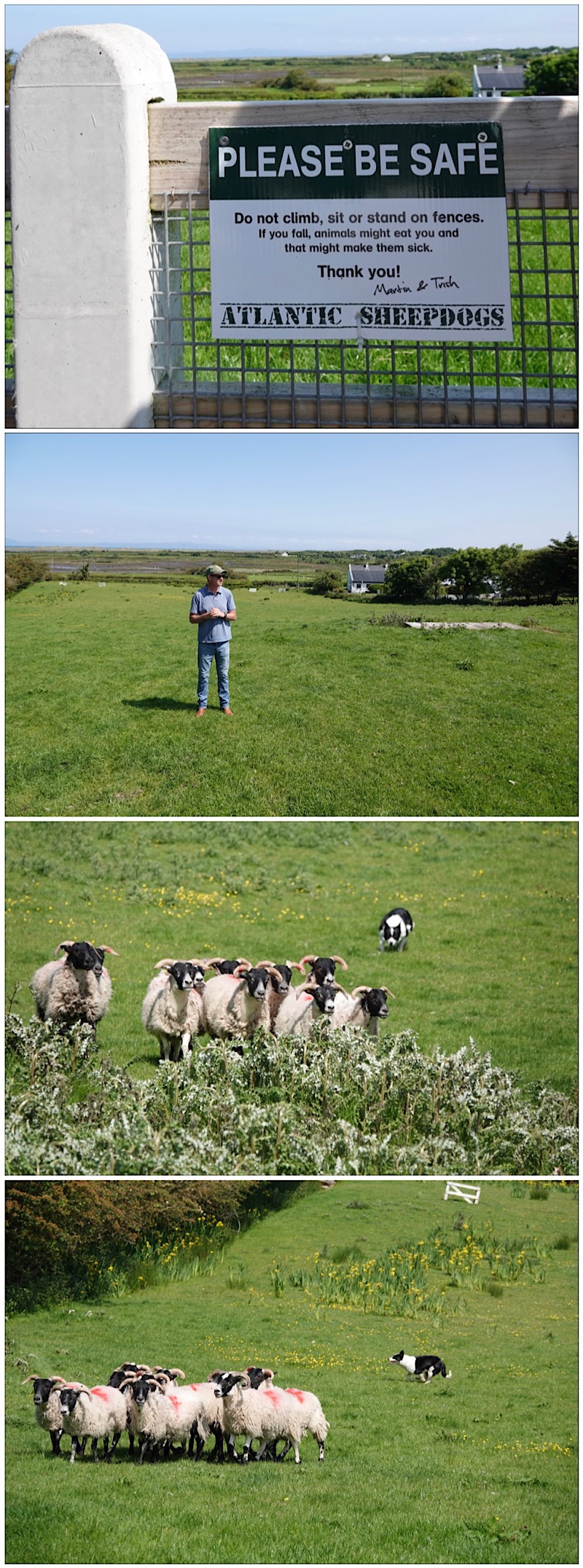
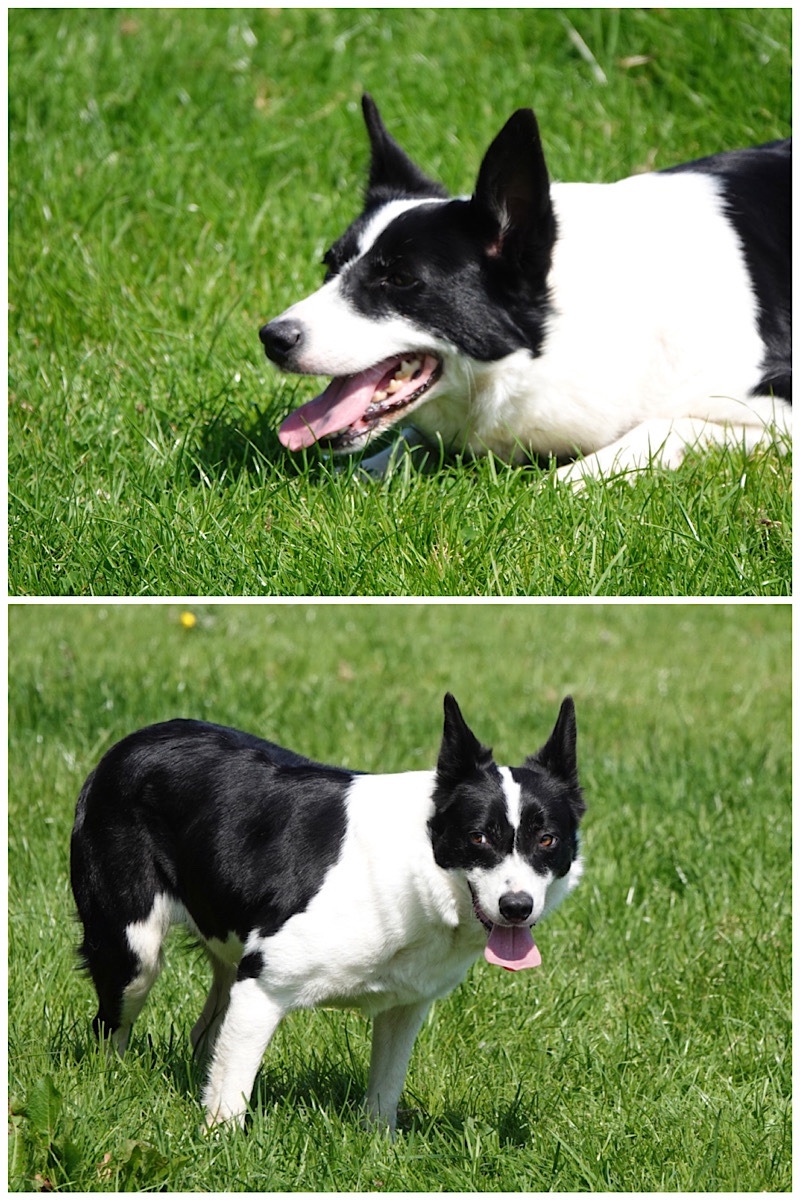
Michael and his family own more than 900 sheep, and currently have 3 working, 2 young, and 1 “retired” Border Collies. Mo, the three-year-old female collie we met, demonstrated her herding instincts, directed by Michael’s whistled instructions. She would herd the sheep without instruction too, simply because it’s what she was born to do, but Michael can let her know which and how many sheep wants!
It’s quite hilarious watching this very small dog race around the field in order to “sneak up” on the sheep, who, once they realize the tiny “predator” is nearby, immediately huddle into a group. From that point on, all the dog needs to do is approach the group from different directions in order to steer them.
Mo’s intense stare and slinking approach would intimidate us too, were she not so darn cute! Martin joked that she had 2 speeds: working, and completely bonkers. He also said she had more brains that it logically seemed would fit into her tiny head. We could all see the affection between man and dog.
Martin’s sheep are all marked with a red “F” for “Feeney”. Mo doesn’t care whose sheep she retrieves from the mountain, but their owners might!

We were introduced to several kinds of rare sheep breeds that would be dying out were it not for farmers interested in their preservation: Jacob’s sheep with their multiple horns, darker furry-looking Soay sheep that “shed”their wool, and several other breeds, but almost all the sheep on the Feeney farm are Scottish blackface, with a few Suffolk and Blue Leicester.

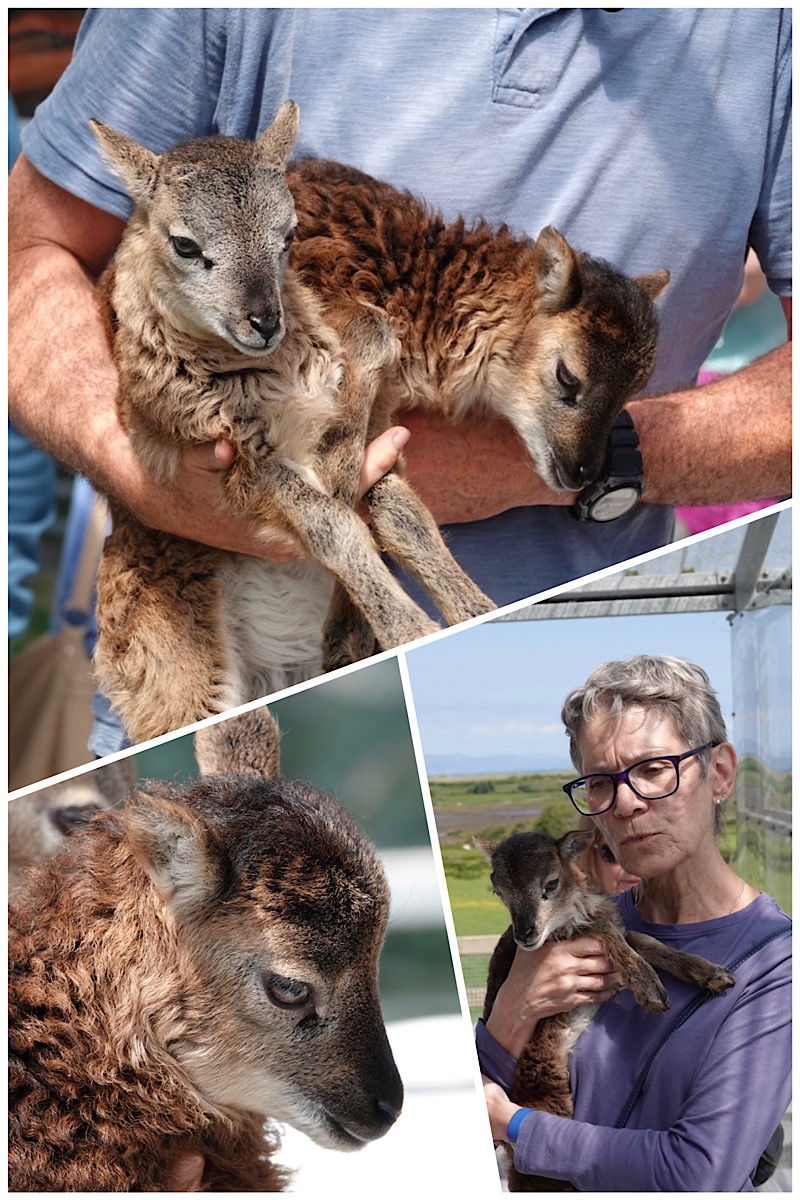
Feeneys raise their sheep to be sold as breeding stock, but almost all sheep raised in Ireland are for meat. Martin explained that their wool is almost worthless; on his farm they use it as a weed deterrent and fertilizer. Once non-shrinking warm alternative yarns were developed, wool was often shipped to China to be used as stuffing or insulation, but the price is so low that it no longer makes sense even to do that.
Irish wool sweaters are famous – and very expensive – but Martin explained that one good-sized farm could supply enough wool for all the knitters in Ireland. The more popular merino wool comes from sheep in Australia and New Zealand; merino sheep are not suited to the Irish climate.
Still, the sheep need shearing once each year to prevent bug infestation, wet rot, and heatstroke.
Our last stop of the day was an afternoon visit to Belleek Pottery.

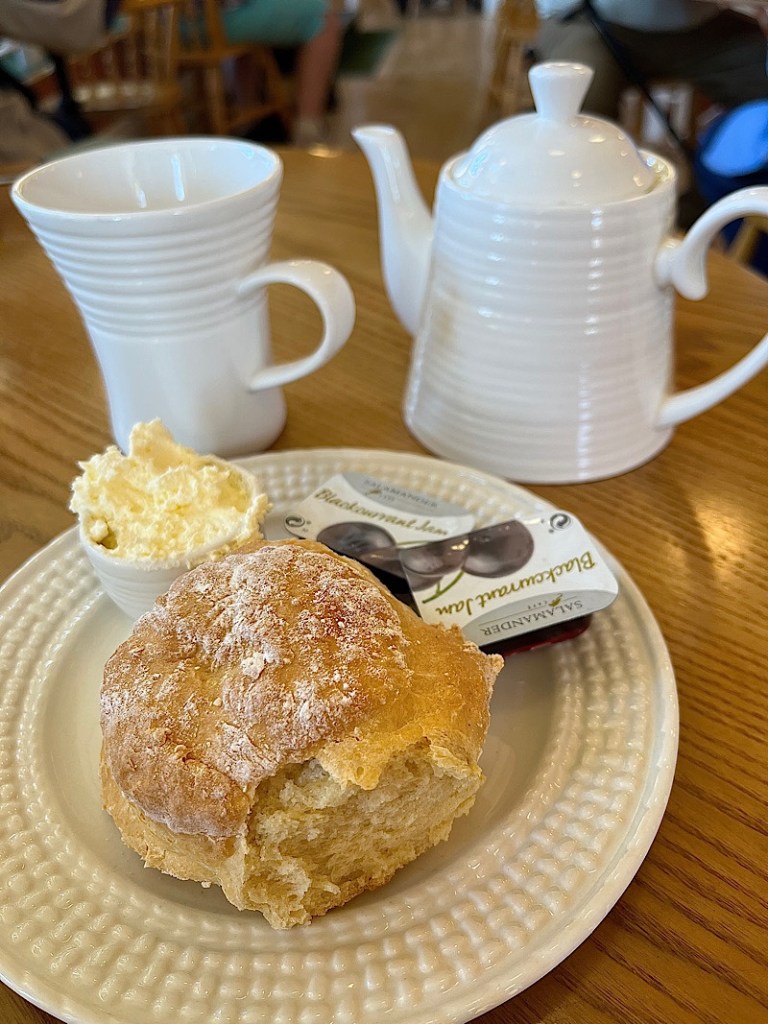
Despite enjoying a quick tea break there, Ted and I both felt the stop was a waste of time, since it was Saturday and the factory is closed on weekends. Without a live demonstration, the stop was nothing more than a short and very dated film, with crackly sound, and a gift shop. In our opinion, our tour manager would have been wiser to find an alternative activity – after all, there’s lots we haven’t seen in Ireland, and Donegal Castle (just as an option) would have been directly on our route.
Our hotel for the next 2 nights is the stationhouseletterkenny, quite a basic hotel right across from Letterkenny’s Dunnes department store (Ireland’s equivalent to Walmart).
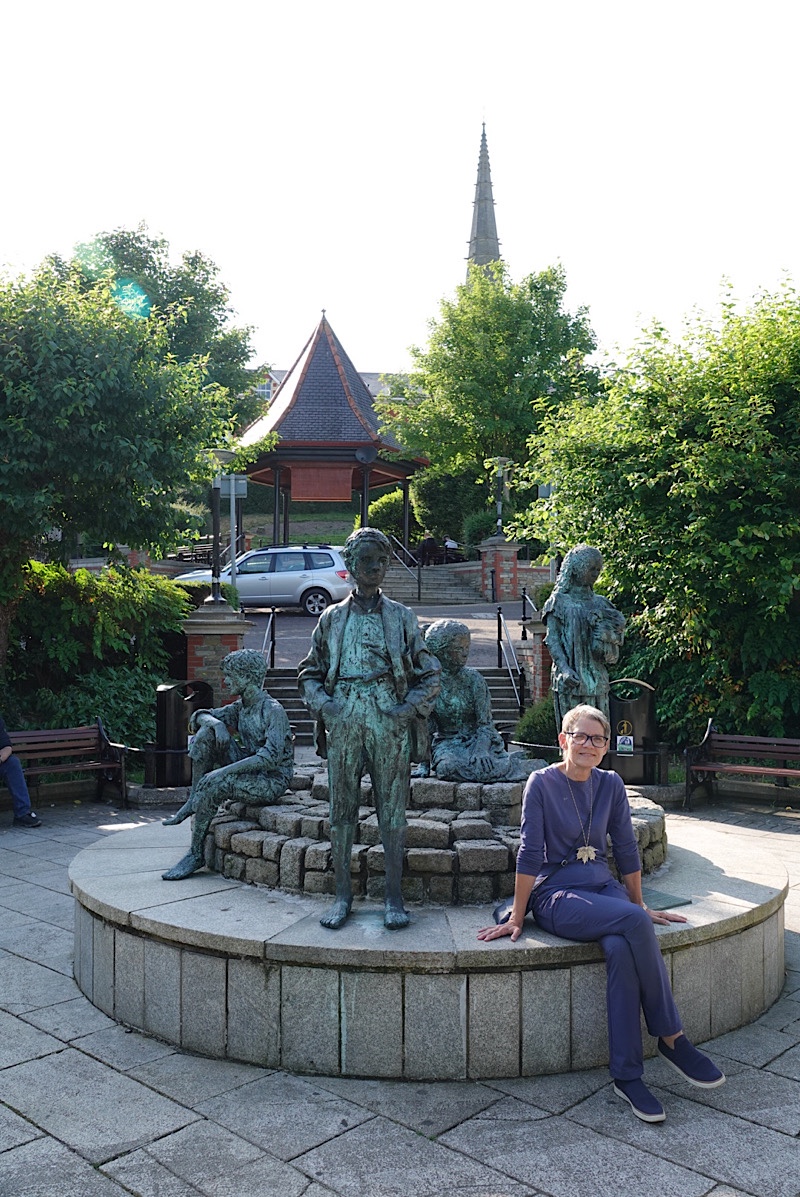
In nearby Market Square, we were surprised to find a group of statues representing the emigration of local Irish to the Klondike!
About a kilometre into town we found Cathedral Square, where the neo-Gothic cathedral of St. Eunan & St. Columba, completed in 1901, dominated the hilltop.
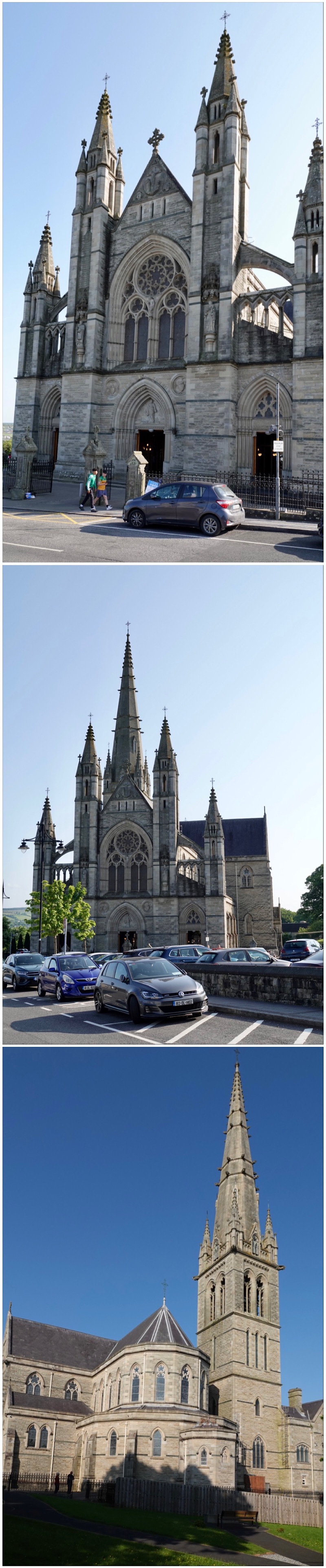
I was captivated by its gargoyles – something we haven’t seen on other Irish churches. There was a Saturday evening mass in progress, so we couldn’t tour the interior.

Across the street from the cathedral is massive Celtic cross and the 18th century Church of Ireland Conwal Parish Church.

After our group dinner in one of the hotel’s conference rooms, we headed back to our room to relax. Tomorrow we tour Derry.
 Rose and Ted’s Excellent Adventure
The “Please Be Safe” sign is so funny! Can you send it to me?
LikeLike
On it’s way!
LikeLike
Sounds like a fun day – especially the part at the Feeney’s. Just one question… How did you ever manage to give that little lambkin back? I would have just melted!
B.
LikeLiked by 1 person
Well…… she was too big for my pocket!
LikeLike