Episode 853 – Heraklion’s Amazing Archaeological Museum
I’m speechless.
What can be said about being faced with 7000 years of civilization?
That it is magnificent – almost overwhelmingly so – is a given.
That it reinforces the sheer hubris of modern civilizations who think that, simply by being industrialized and having access to modern technology, they are automatically more “advanced”, is an education.
In addition to the history, the artefacts, and the beauty, there is the museum itself. The museum’s brochure explains that “the Heraklion Archaeological Museum was founded at the turn of the 20th century to house the first Cretan Antiquities Collection. It was rebuilt in the 1930s …and met acclaim as a groundbreaking example of modernist architecture. Extensive restoration work began in 2001 and was completed in 2014.”
There are 27 spacious rooms displaying sculptures and large artefacts in the open, and smaller and more delicate items in large glass cases. Ted noticed right away that because the cases are all designed with interior lighting, he was able to take pictures without glare and with minimal reflection. I noticed that the glass was so clear that on a couple of occasions I didn’t realize it was there until bumping my head on it. (My apologies to whoever is in charge of keeping it smudge-free.)
WARNING: This episode has a LOT of photos, and a lot of museum signs that will help me remember what we saw. All descriptions in quotation marks are copied intact from the museum.
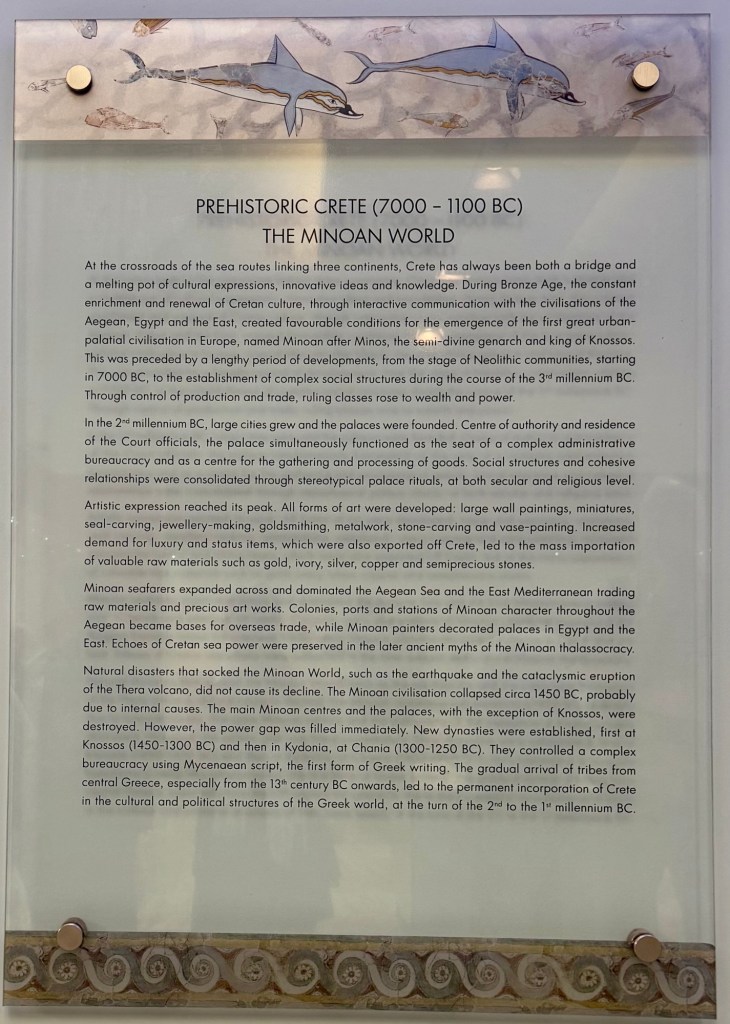
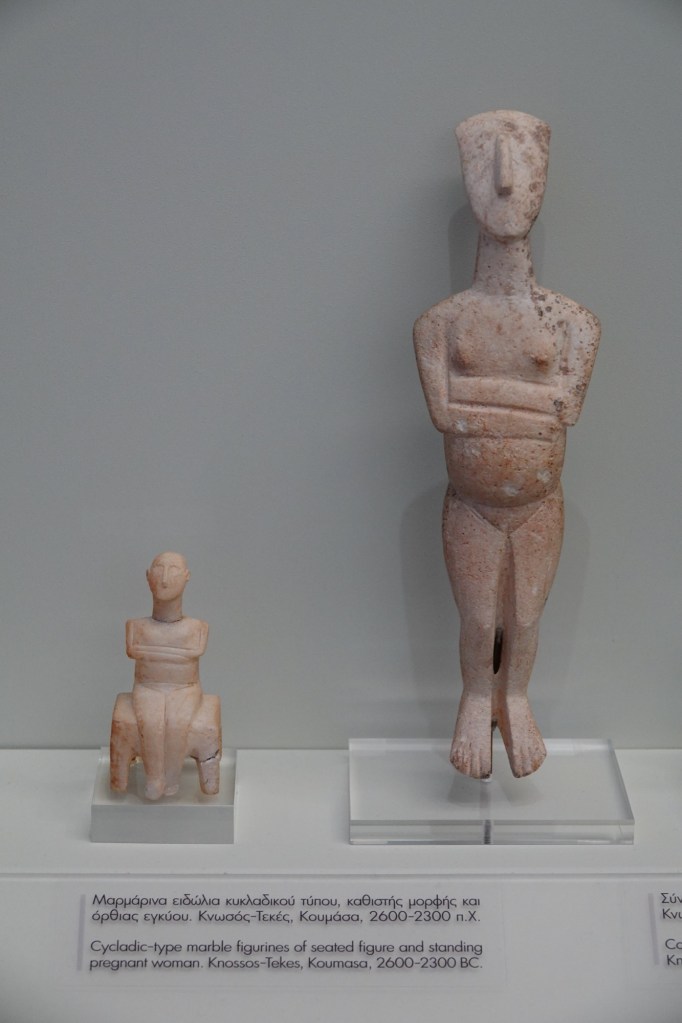
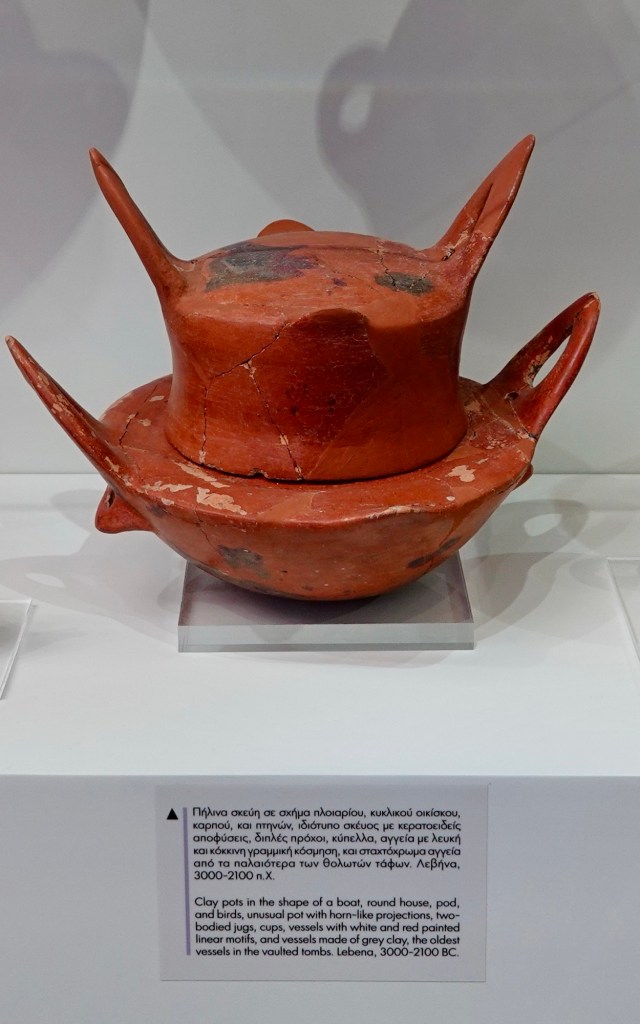
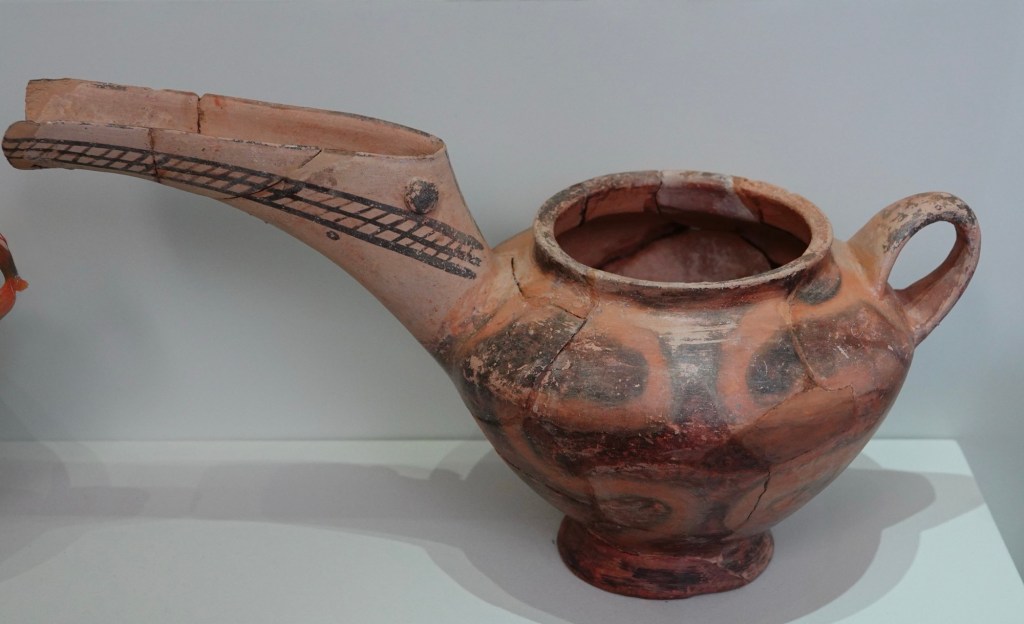
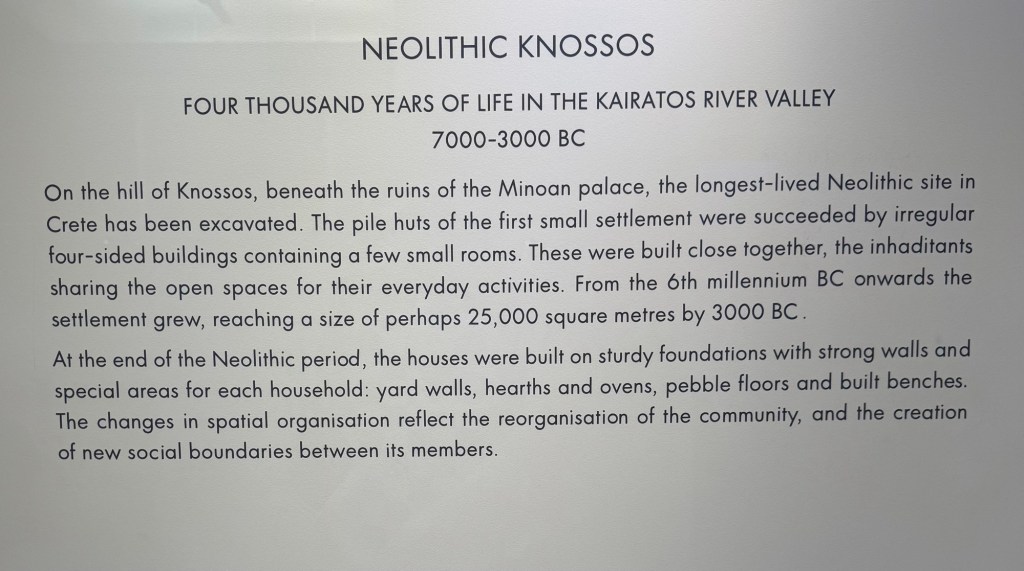
Rooms I and II housed exhibits from the Neolithic and Early Bronze Age on Crete (6000-1900BCE). That means the oldest items are eight thousand years old!
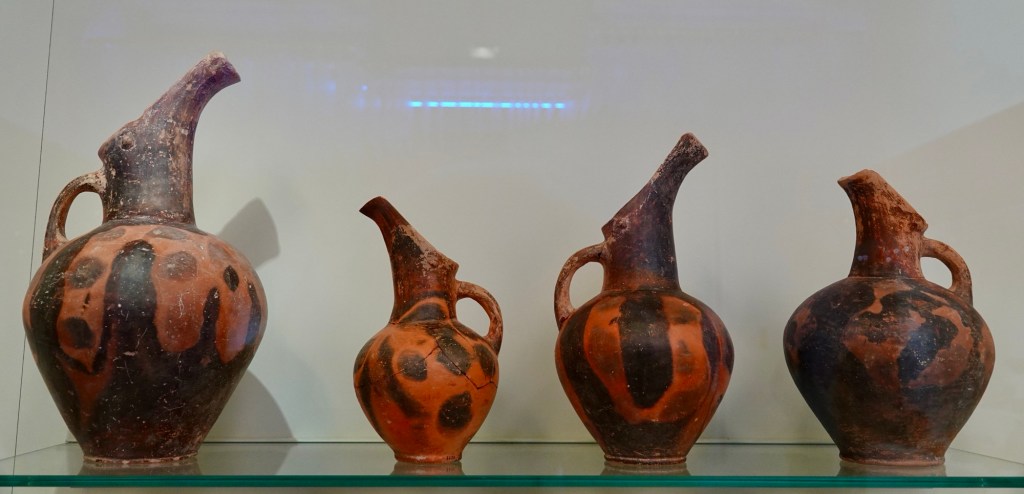
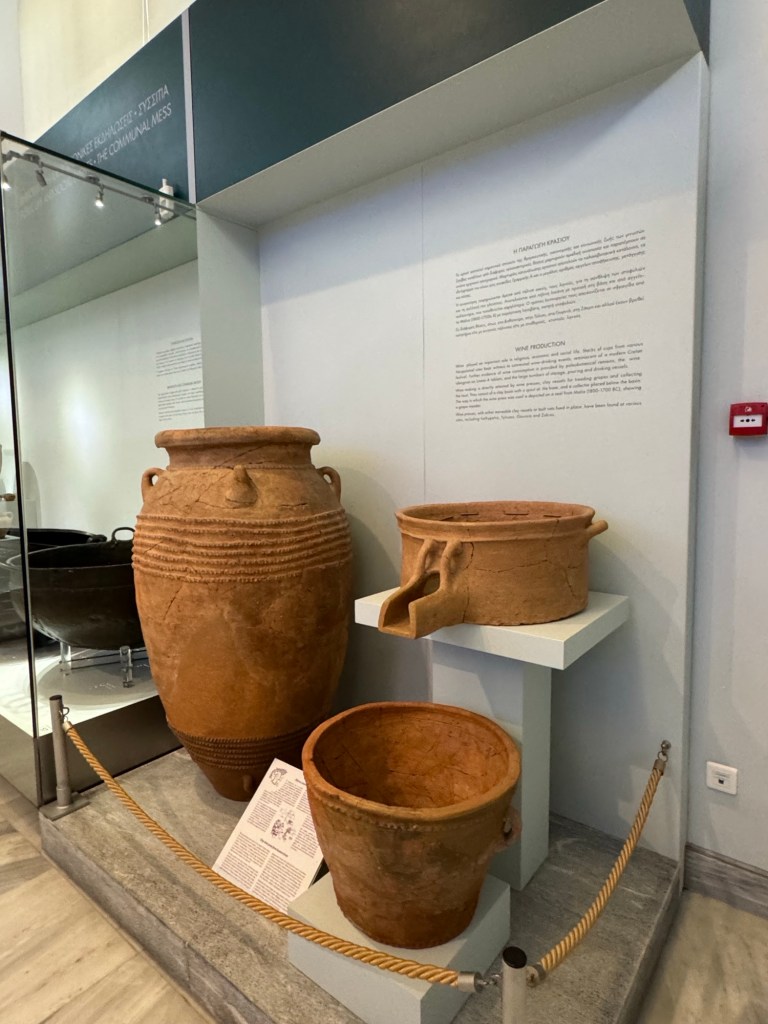
Specialized “teapot” style wine vessels with elongated spouts specifically designed to aerate wine.
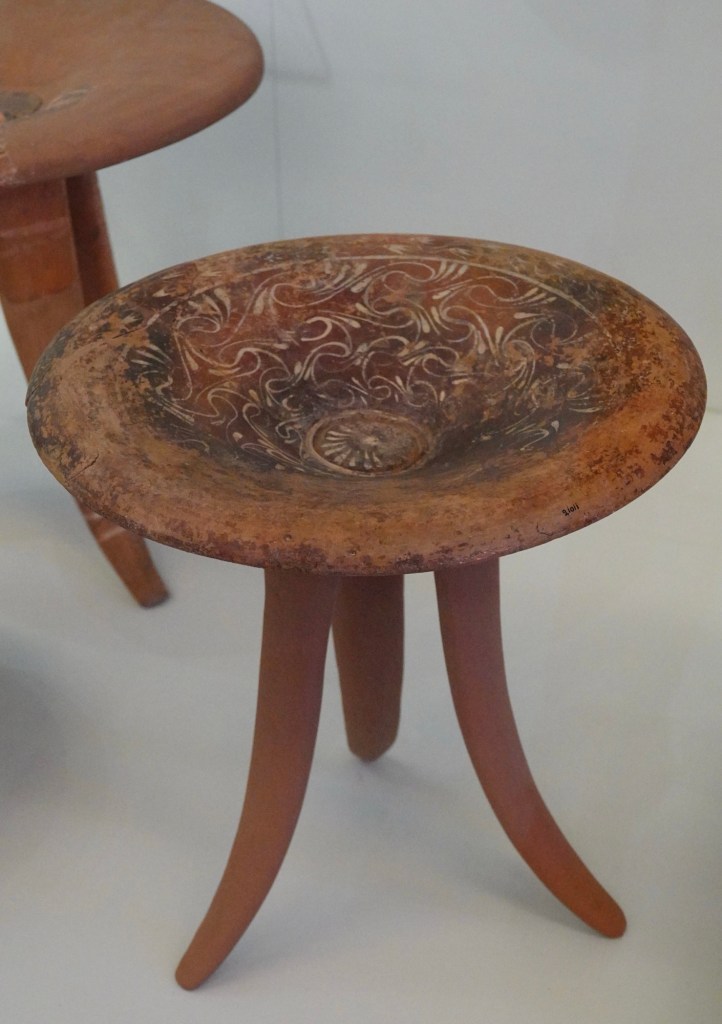
Clay tripod fruit-stand with a particularly decorative white floral and foliate composition and basin – strainer with drainage hole for the collected liquid. Malia, Quartier M, 1800-1700 BCE.
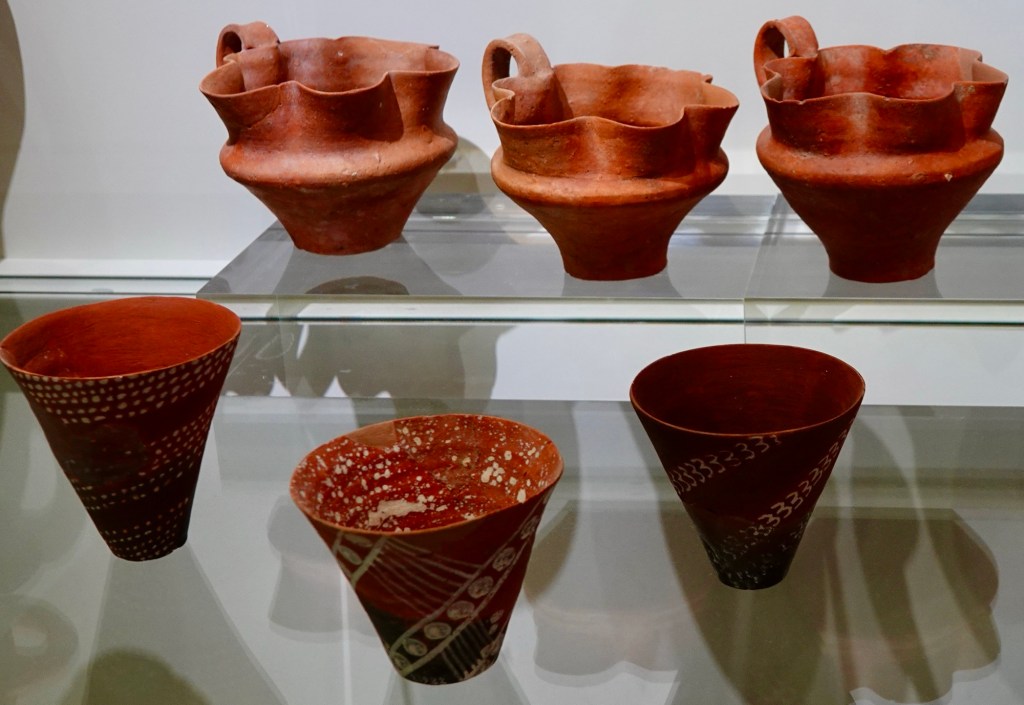
Vessels of reddish clay imitating bronze prototypes, typical products of the Pediada pottery workshops. Smari, Kastelli, 1900-1800 BCE.
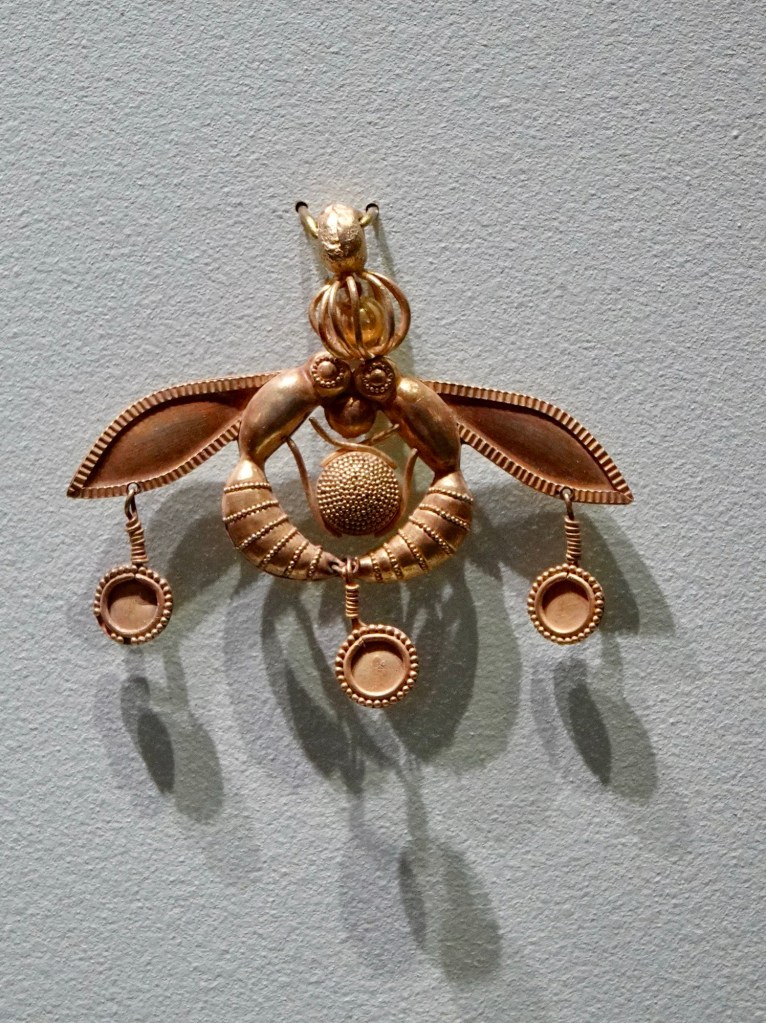
The piece below amazed us, not only because of how old it was, but because of the detail in a piece only about 25mm (1 inch) wide!
“This famous gold ornament from Malia is a pectoral pendant consisting of two bees depositing a drop of honey in their honeycomb. They are holding the round, granulated honeycomb between their legs and the drop of honey in their mouths. On their heads is a filigree cage containing a gold bead, while small discs hang from their wings and the sting. This is a true masterpiece of the jeweller’s art, combining repoussé, granulated, filigree and incised decoration. Malia, Chrysolakkos necropolis, 1800-1700 BCE”
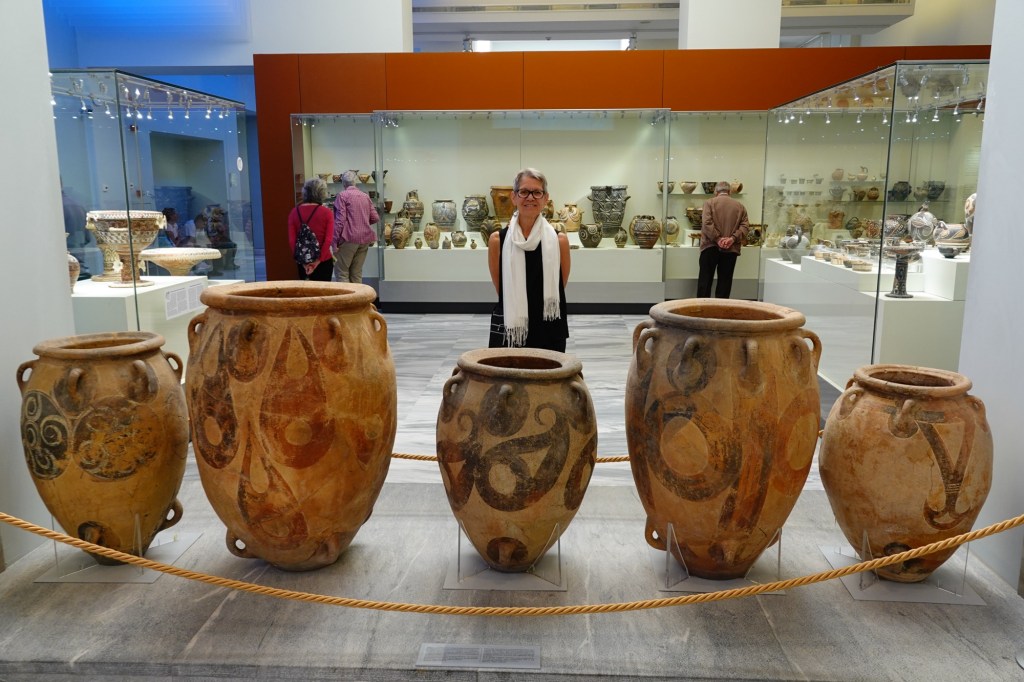
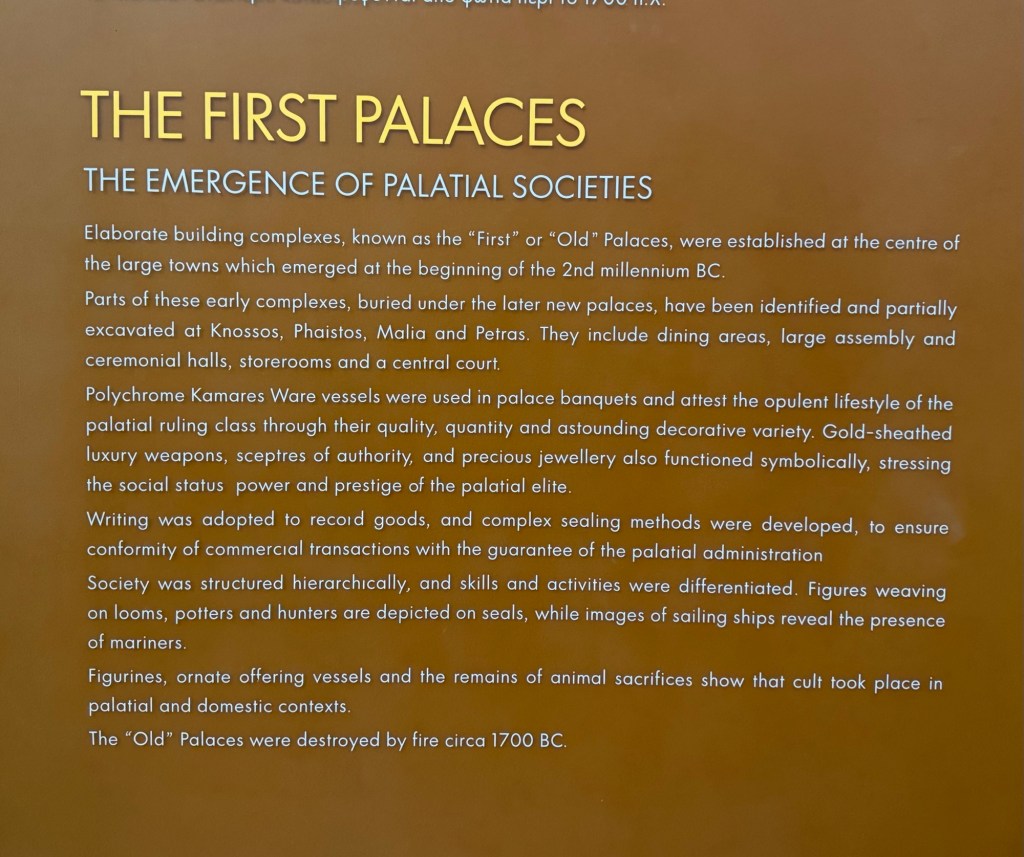
Room III contained “every day” items during the time of the foundation of the first palaces of Knossos, Phaistos, and Malia (1900-1700BCE). In pride of place are polychrome clay vases called Kamares Ware. That clay ware also formed the royal dinner service of Phaistos.
I’m there for size perspective.
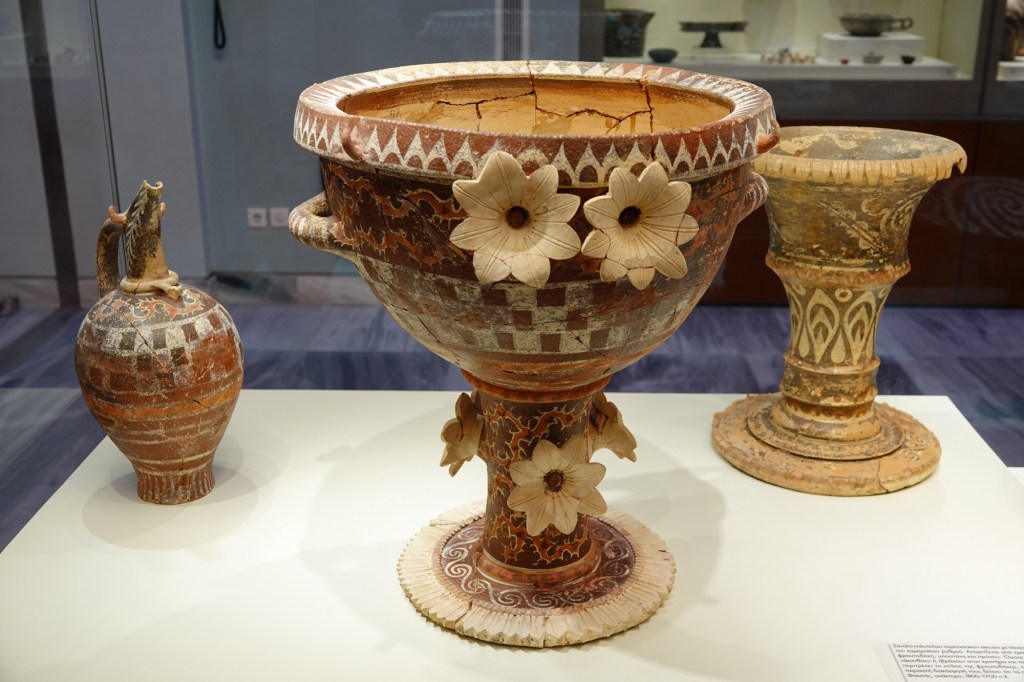
Set of luxury Kamares vessels for banqueting ceremonies from Phaistos richly decorated with polychrome and relief patterns. The set consists of a krater with appliqué lilies, a large fruit-stand, a dish stand and a ewer. The “chessboard” and “acanthus-lead” or “rock” motifs on krater and ewer are similar on both vessels, while the same lacy decoration is displayed on the rim of the fruit-stand and dish-stand and the base of the krater. Seen in pairs, these vessels bear similar decorative motifs, an indication that they were made by the same artisan as matching pieces of the same “royal dinner service” Phaistos, palace, 1800-1700 BCE
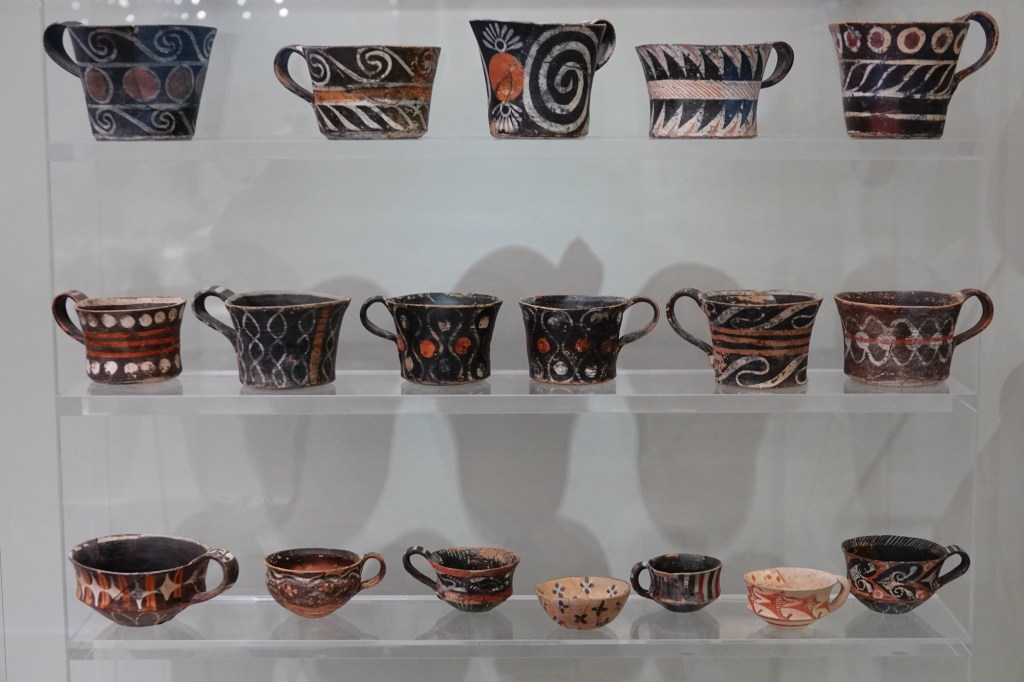
Kamares Ware cups, looking absolutely modern despite being 4000 years old.
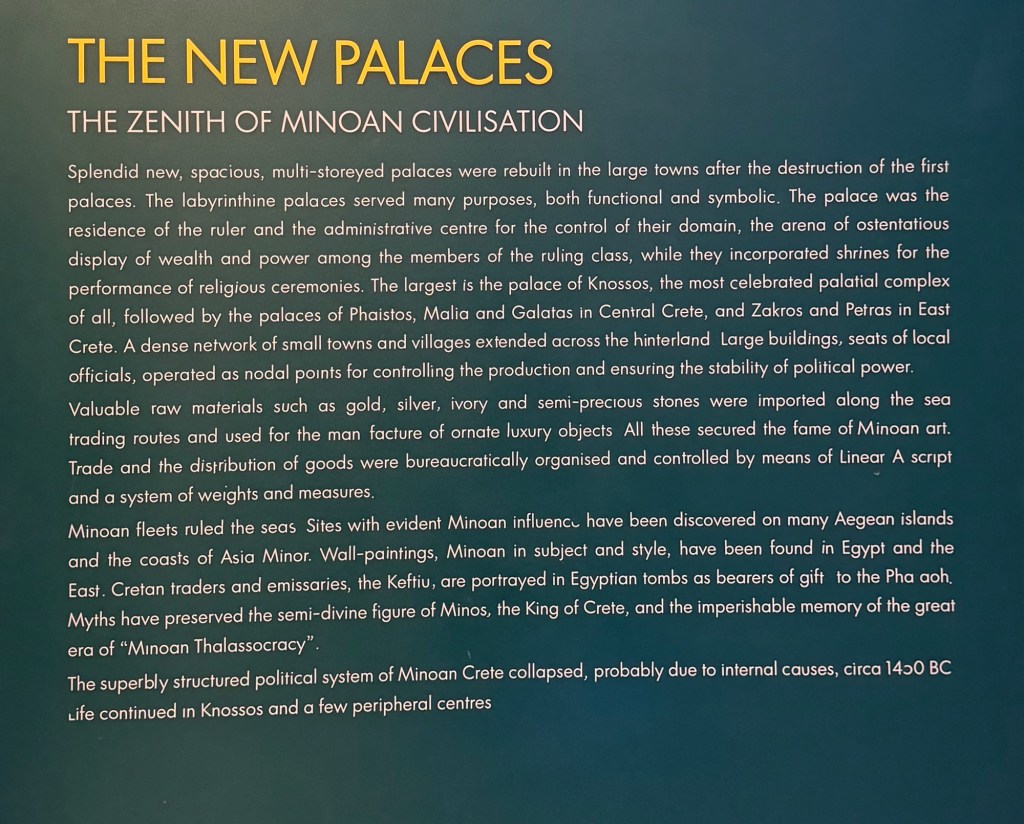
Rooms IV and V highlighted the consolidation of the palatial system 1700-1450BCE.
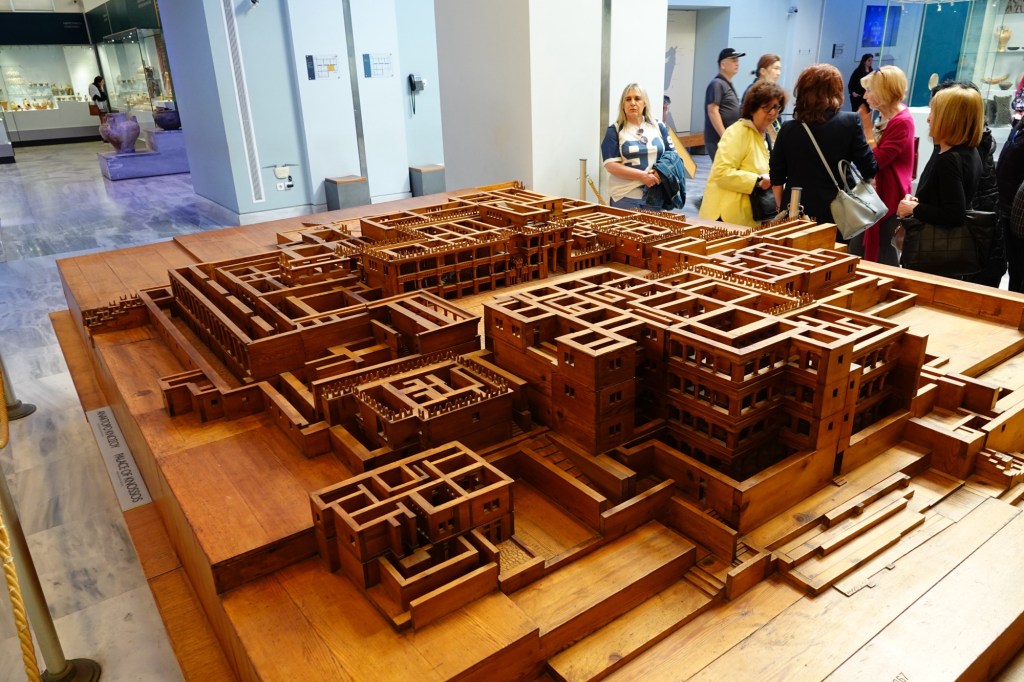
The labyrinthine floor-plan of Knossos Palace.
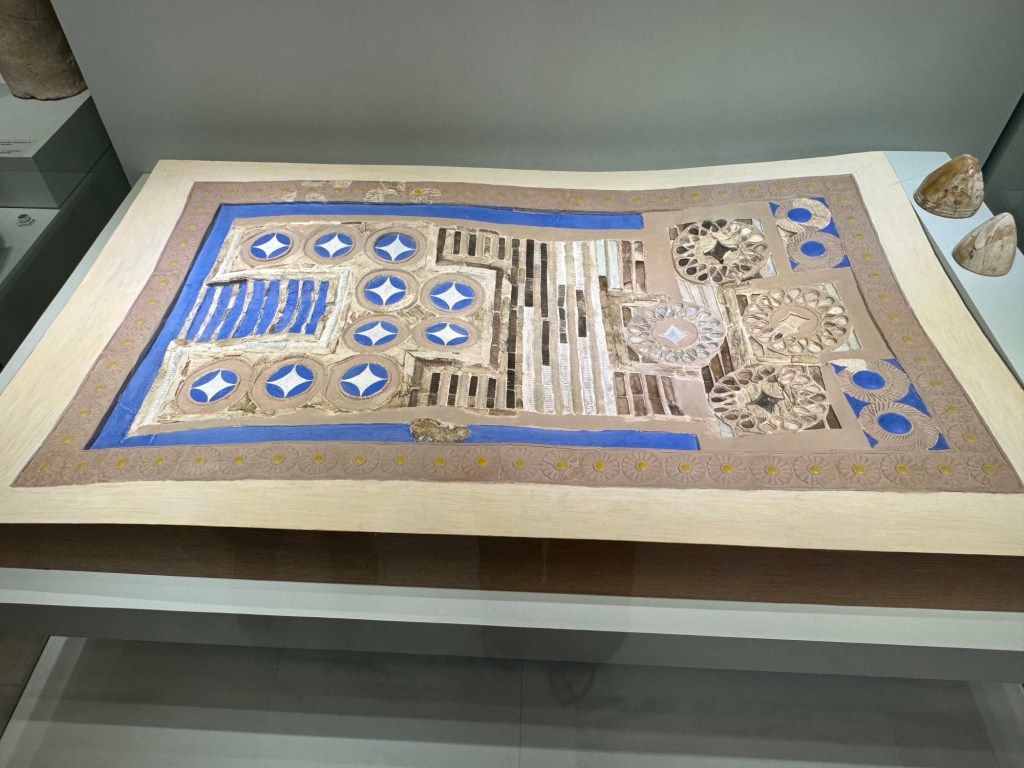
A board game inlaid with ivory, blue glass paste and rock crystal, plated with gold and silver. Four large, conical ivory gaming-pieces correspond to circular areas of the “Draughtboard” This is a particularly complex and luxurious artefact, which bears witness to the high standard of living in the palace and the artistic capabilities of Knossian workshops. Similar, simpler objects have been found in Egypt and the East. Palace of Knossos. 1700-1450 BCE
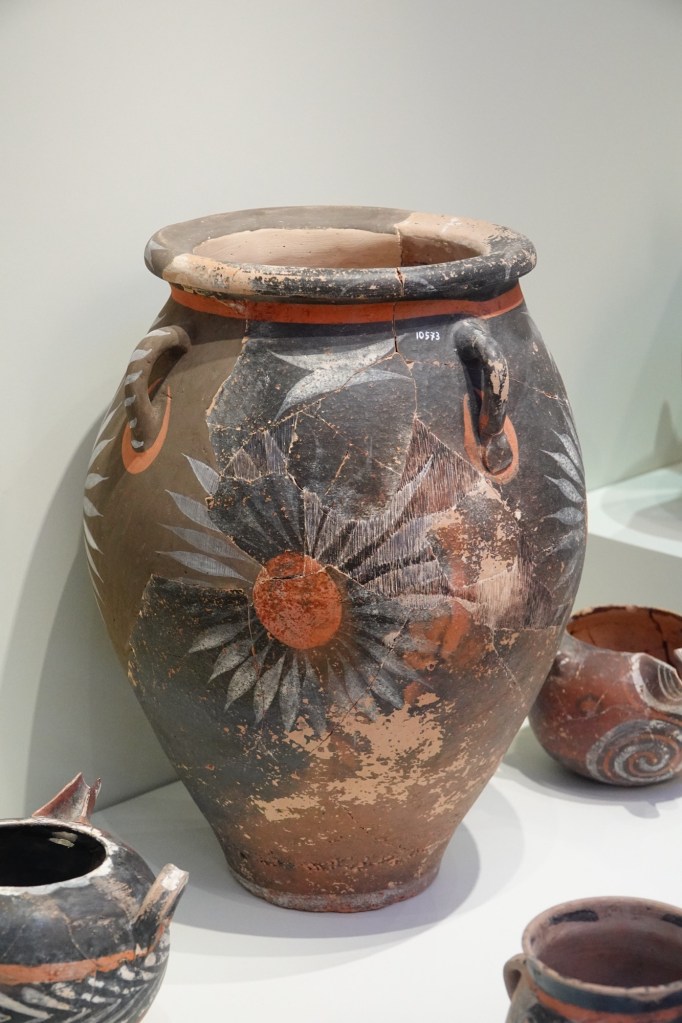
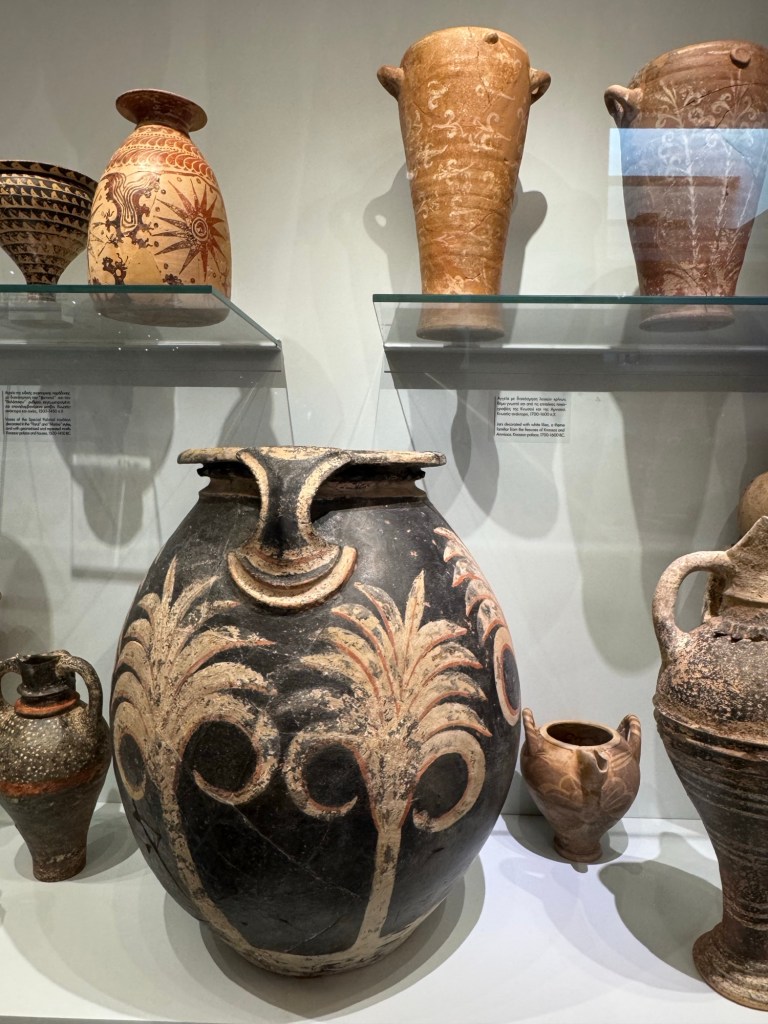
Jars decorated with white lilies, a theme familiar from the frescoes of Knossos and Amnissos. Knossos-palace, 1700-1600 BCE
Splendid clay and stone vases and elaborate bronze vessels bear witness to the wealth and high living standards of the upper class.
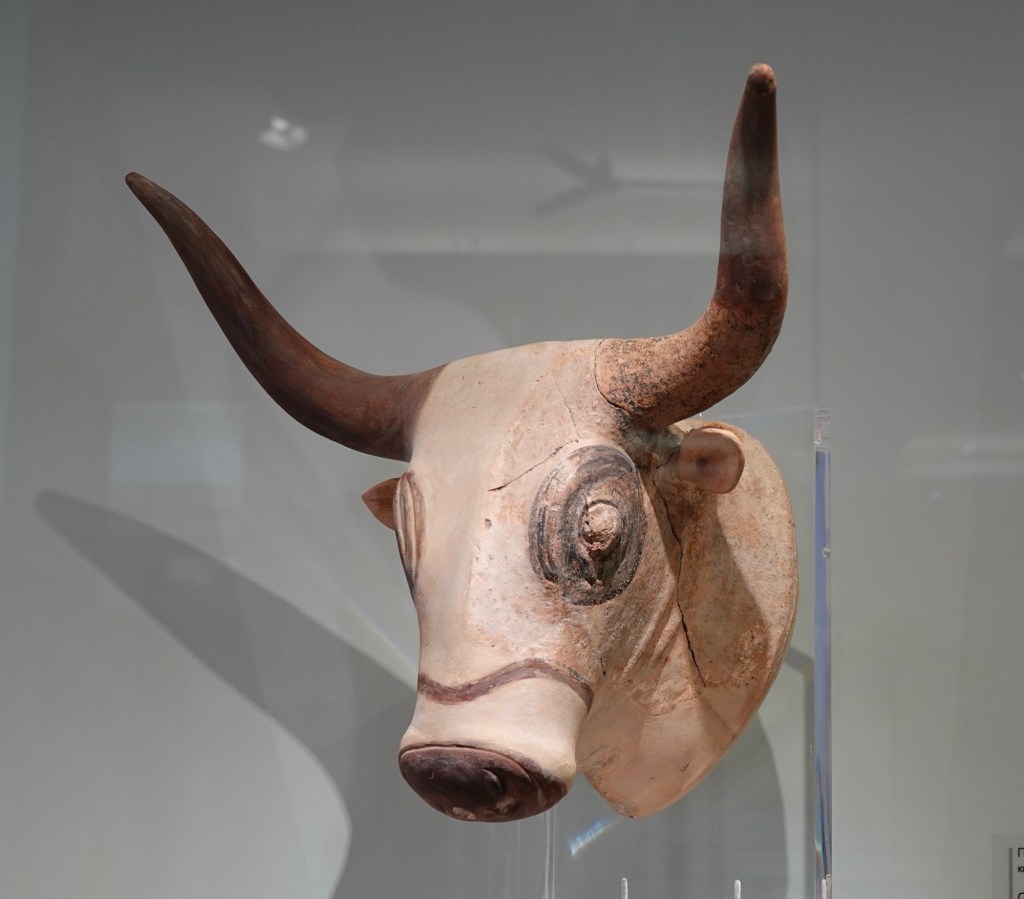
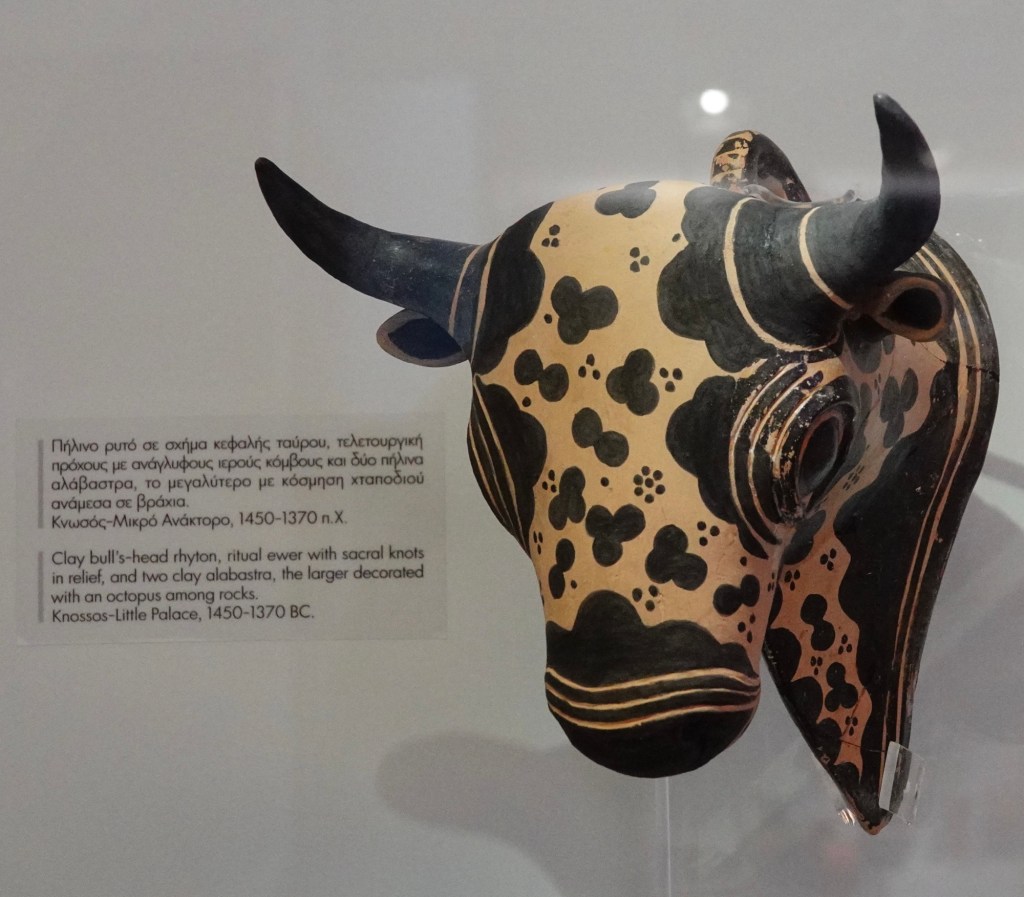
Clay bull’s head rhyton – libation vessel. Mochlos, 1500-1450 BCE
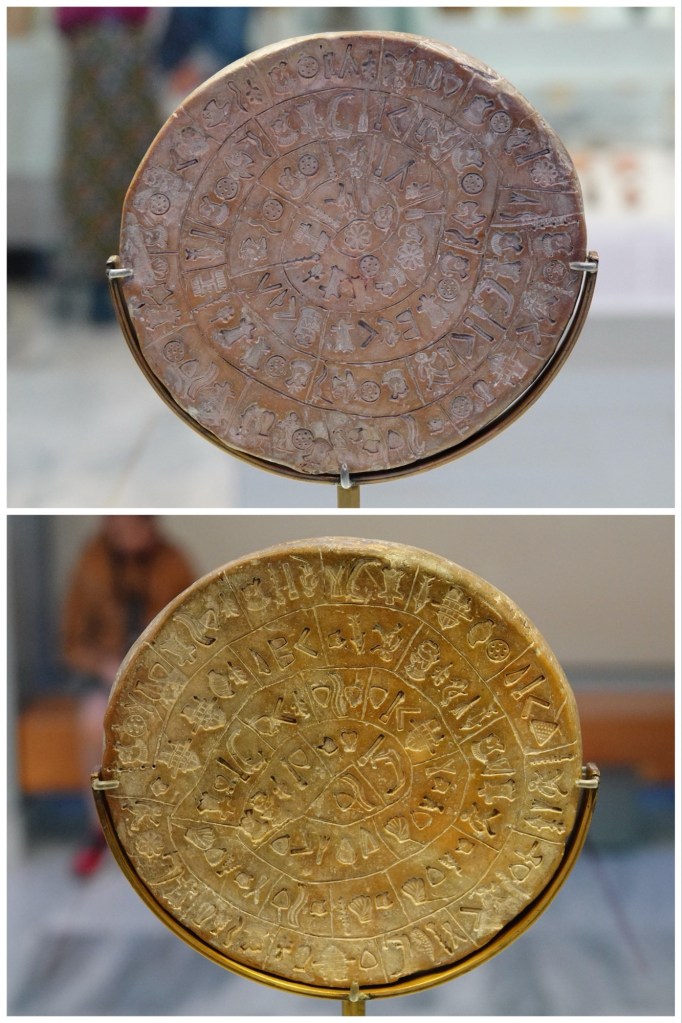
“The enigmatic inscribed clay Phaistos Disc takes pride of place in the history of Cretan scripts. It bears forty-five pictorial signs, arranged in different combinations into sixty-one groups, separated by incised lines, presumably representing words. The signs were stamped in a spiral configuration on both sides of the disc by seals on soft clay. Experts have not yet come to any definitive conclusions regarding the contents of the inscription and its relationship to Cretan scripts. The repetition of certain combinations of signs provides the most persuasive evidence that the inscription is a hymn or a text of magic character. Early 17th century BCE”
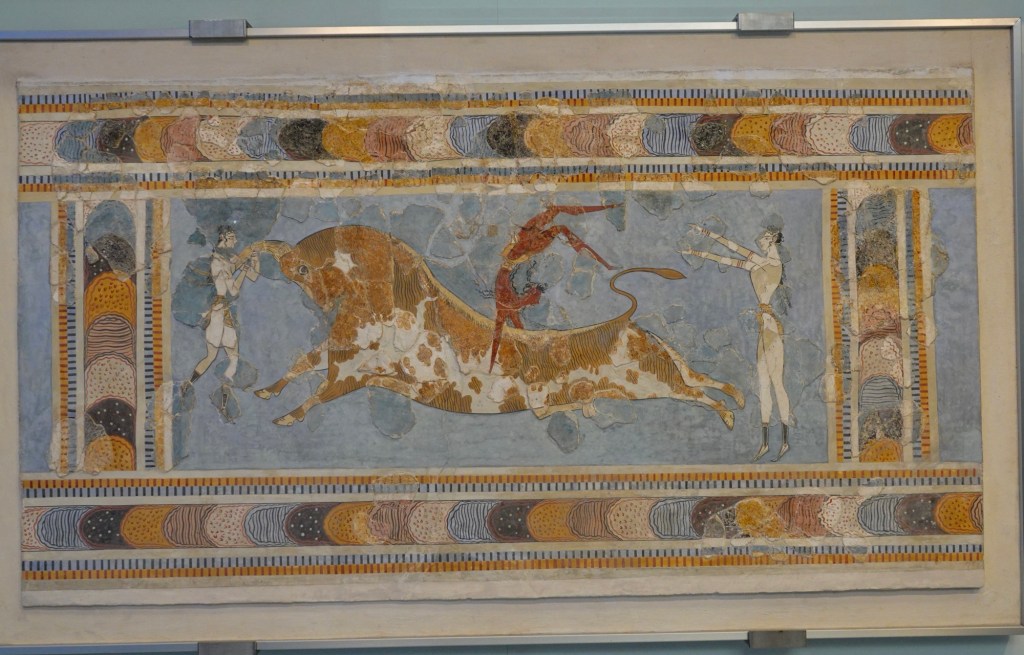
Room VI was dedicated to sports and spectacles. Bull-leaping (not bullfighting) was a major sporting event.
THE BULL-LEAPING FRESCO is a bull-leaping scene vividly depicting how the spectacular sport was performed. There are three participants, two white-skinned women and a brown-skinned man. One of the female athletes is restraining the bull by the horns to reduce its speed and prevent the leaper, performing the dangerous backwards somersault, from being gored. The second female athlete, behind the bull, is waiting with outstretched arms to catch the leaper as he lands. The fresco was found on the east side of the palace of Knossos, together with fragments of others depicting different stages of the same sport. Knossos-palace, 1600-1400 BCE
I’m not sure it qualifies as a sport, but there were also artefacts related to wine-making, including some wine storage jugs that would please my cousin Susan (and me).
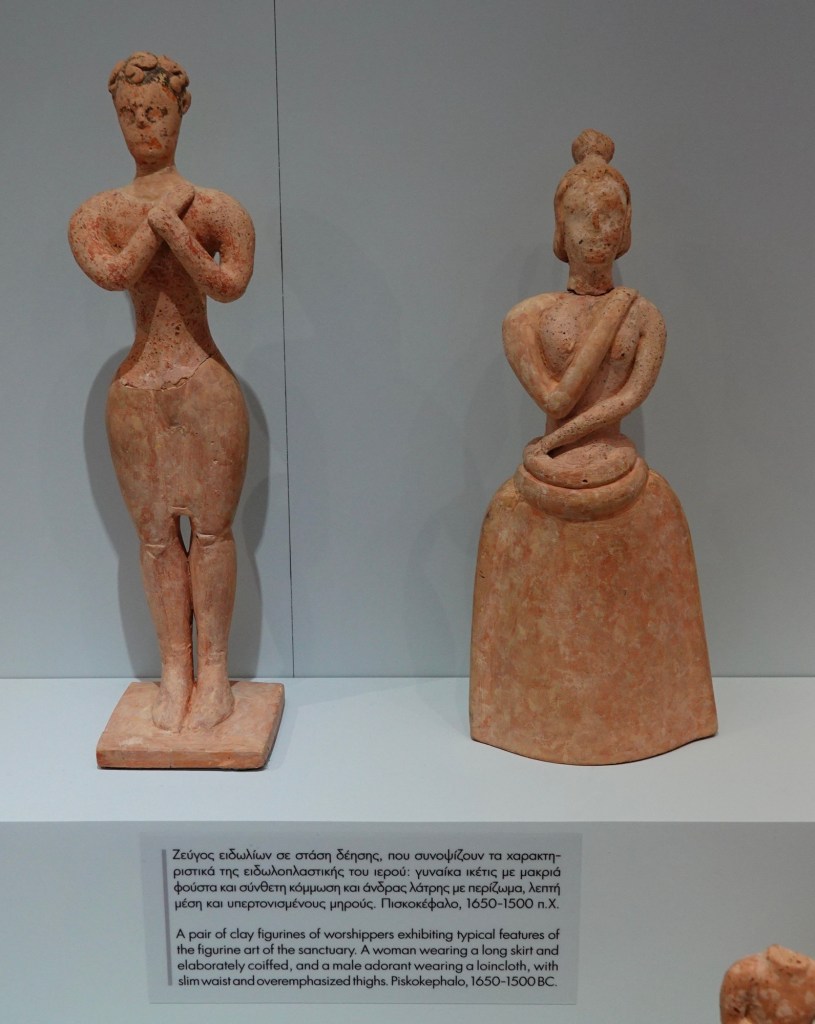
Rooms VII and VIII featured items related to Minoan religion, IX through XII featured items related to cemeteries and burial rituals.
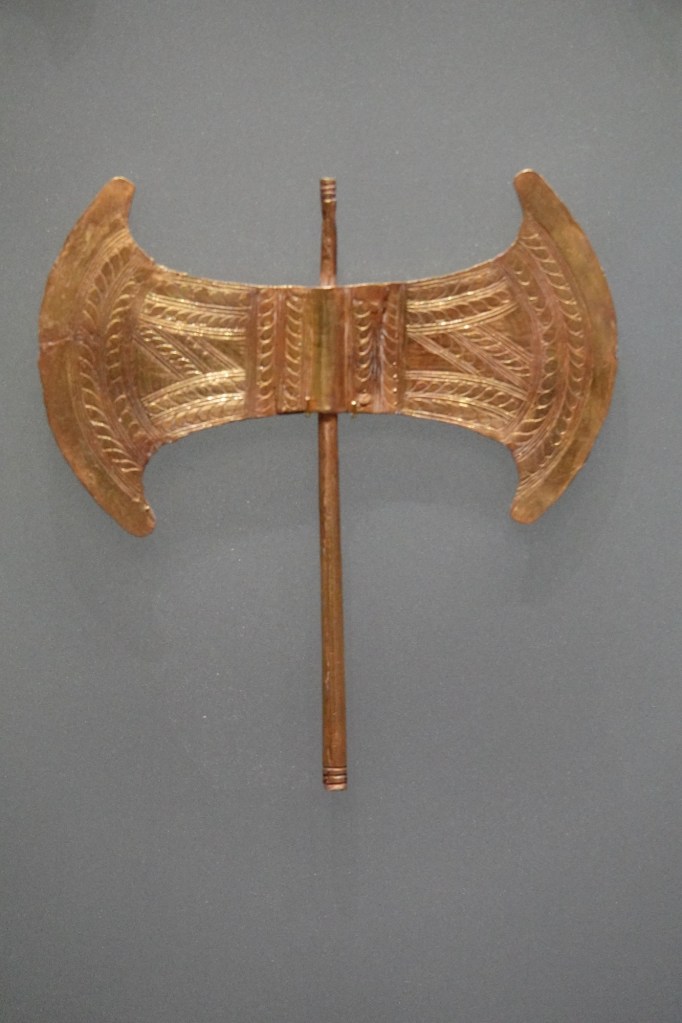
Strangely, axe heads, including ones fashioned in gold, were votive items.
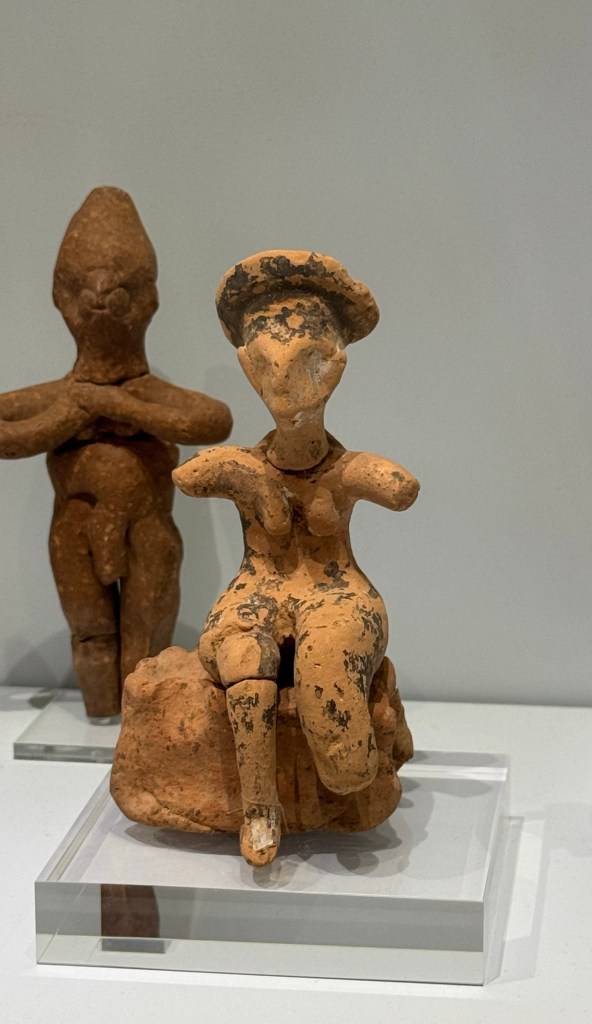
A female figurine with a swollen leg, seated on a stool, illustrates a plea to the deity for healing. 1700-1500 BCE.
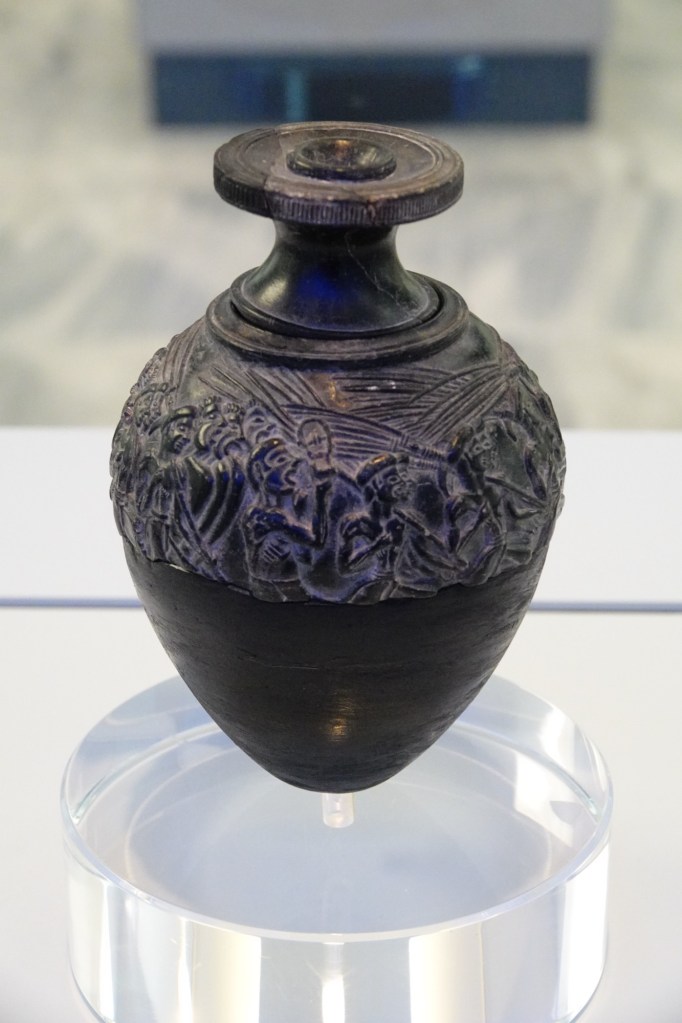
THE HARVESTER VASE Black steatite rhyton with relief depiction of a procession of twenty-seven men carrying harvesting and winnowing implements. A group of men sings to the accompaniment of the sistrum, a musical instrument with rattles sounded by rhythmical hand movements. At the head of the procession is a man carrying a staff, an official or priest, wearing a ceremonial mantle with a scale pattern. The procession may form part of a religious festival for the blessing of the new harvest by the deity. Hagia Triada, 1450 BCE
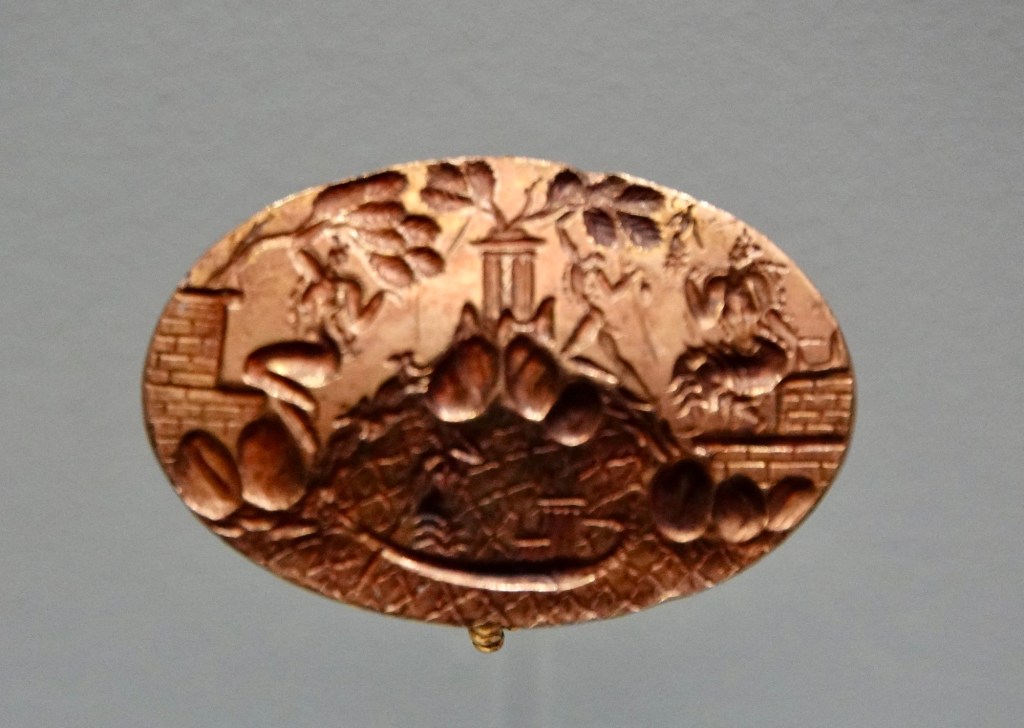
“The so-called Ring of Minos is a masterpiece of Minoan jewellery-making and an artwork of paramount importance for understanding religious iconography. The composite image on its bezel summarizes the three levels of epiphany. The goddess is depicted hovering in the air in miniature form, seated on a stepped platform topped with horns of consecration, and rowing and steering a boat with a seahorse-head prow. Two scenes of tree-cult by a male and a female enrich the composition. The passage of the goddess through the three natural elements of air, land and sea serves as a symbolic unification of the mortal world and vividly imposes the message of Minoan power over land and sea. Knossos, 1450-1400 BCE”
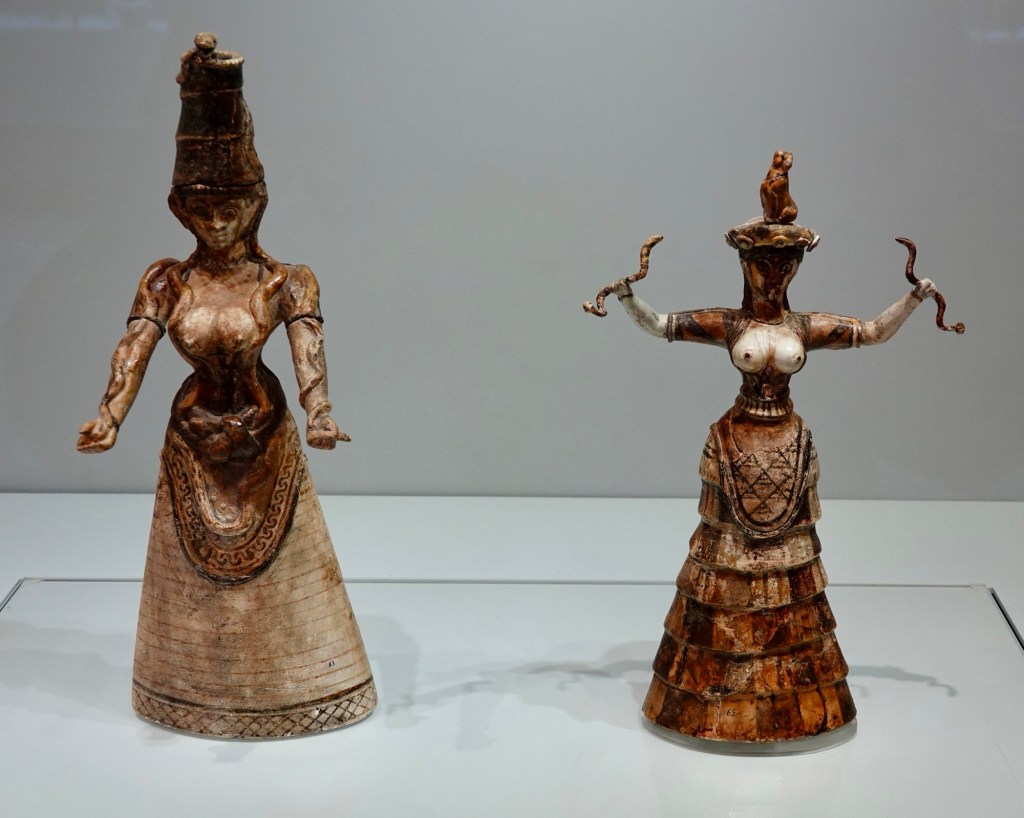
The most important cult objects from the Knossos Temple Repositories are the figurines of the “Snake Goddess”. They are named after the snakes twining around the body and arms of the larger figure, and the two snakes that the smaller figure holds in her upraised hands. Knossos-Temple Repositories, 1650-1550 BCE
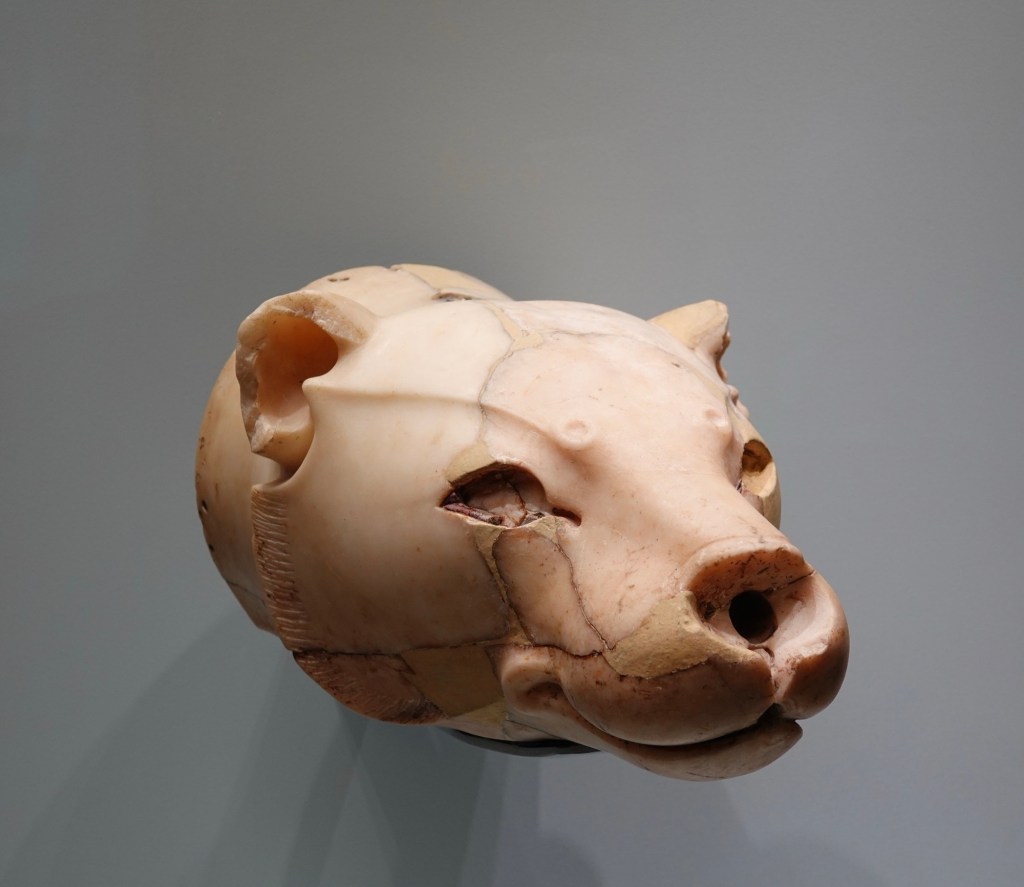
Lioness-head rhyton of translucent limestone with a hole in the muzzle for pouring out the liquid offering. An exquisitely modelled work, a typical example of the specialised stone-carvers’ skill in faithfully rendering the original. The nose and eyes were originally inlaid with materials which have not survived. Knossos-palace, 1600-1500 BCE
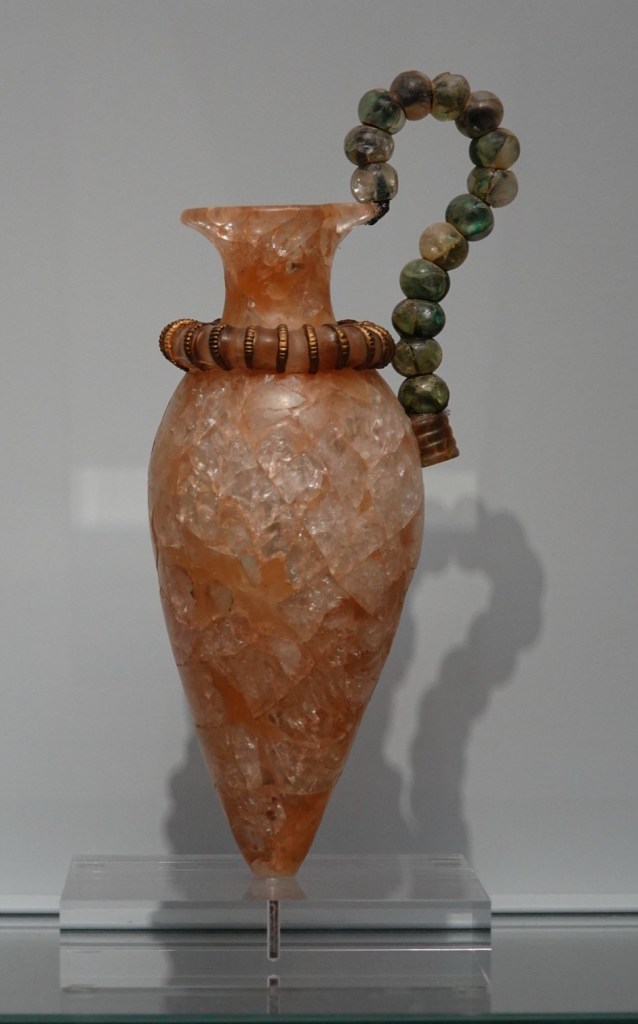
Small luxury rhyton of rock crystal, a piece of technical and artistic perfection. The ovoid body is made from a single core of the hard stone. The neck, produced from another core, is attached to the body by a ring of crystal beads and gilded ivory discs. The raised handle consists of spherical crystal beads threaded onto a bronze wire. Zakros-Central Sanctuary Complex, 1500-1450 BCE
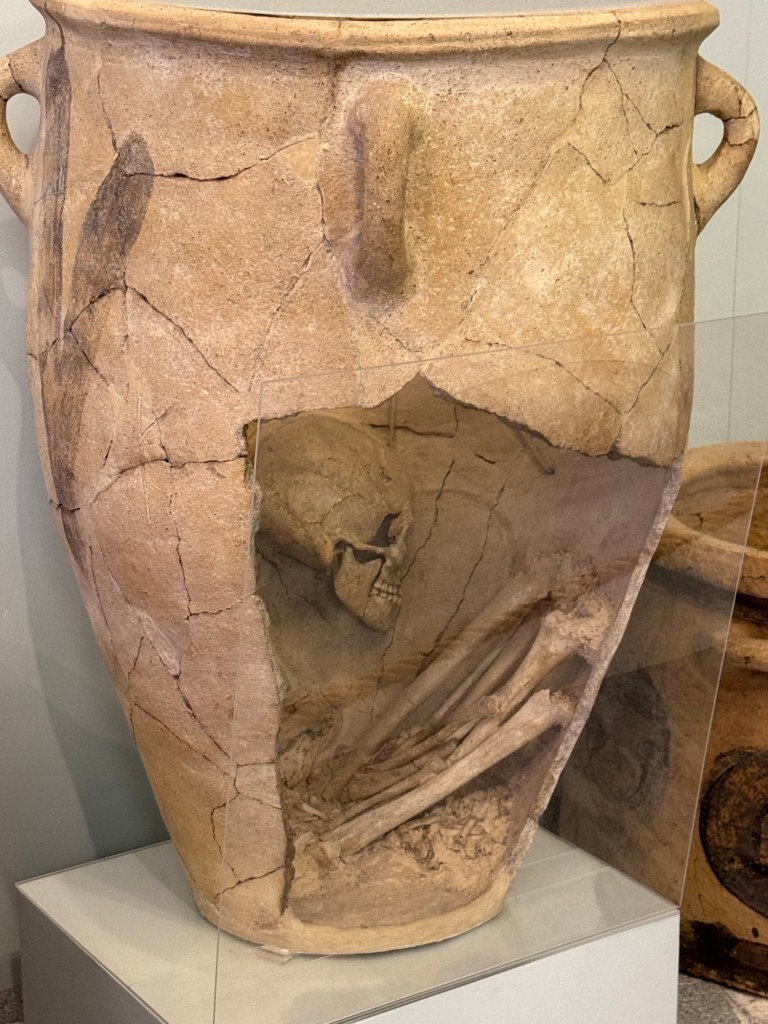
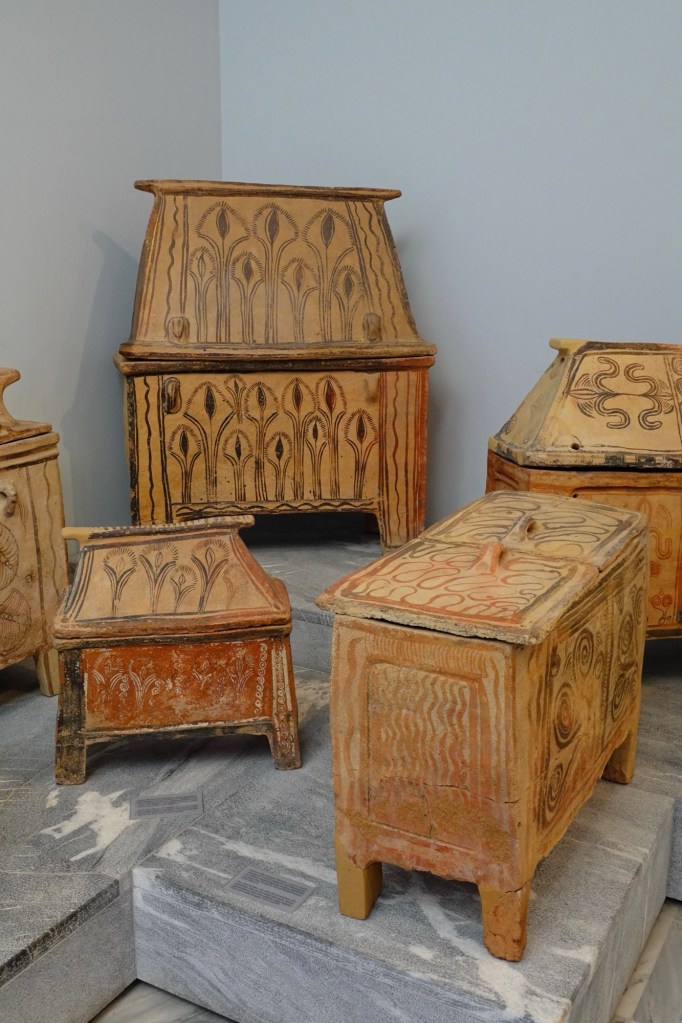
During the Neopalatial period (1700-1450 BC), the dead were laid to rest in wooden coffins, on beds and biers, and also in wide-mouthed pithoi and clay larnakes, as examples from the Knossos area and East Crete attest. The body above was placed and perhaps trussed in a foetal position in order to fit inside.
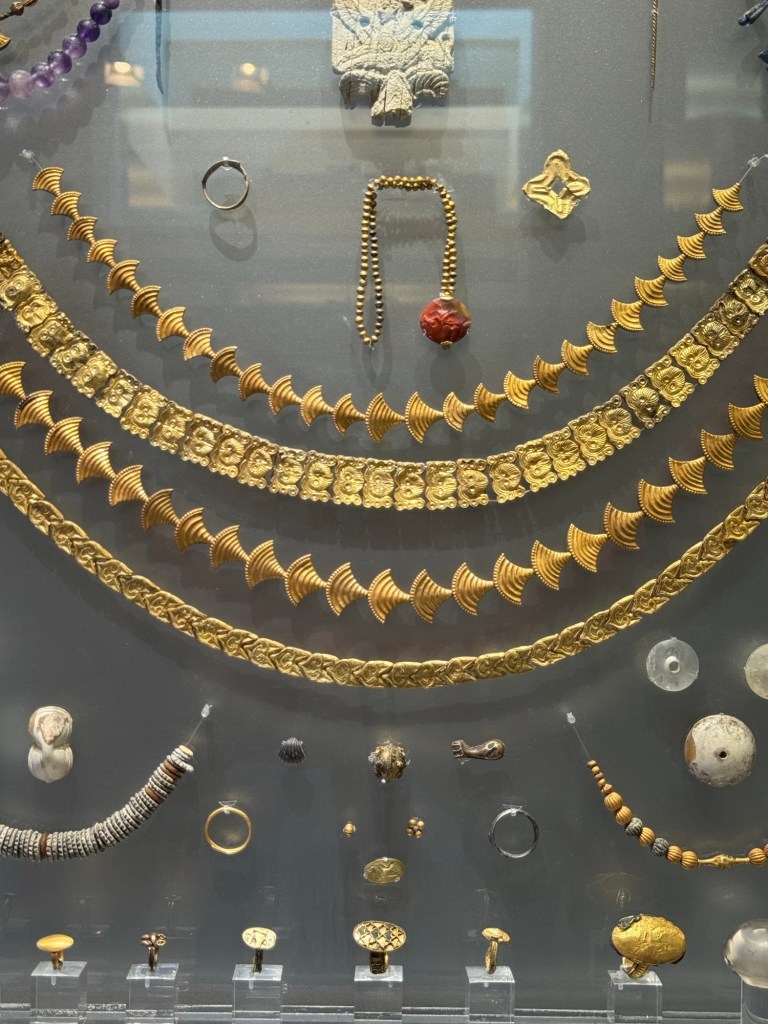
Much of the jewellery in the museum was recovered from cemeteries, not from the palaces.
Necklaces of gold, amethyst, sard (a hard stone similar to carnelian) , glass and faience, rings, earrings, gold and silver pins, ivory combs, bronze mirror, razors and tweezers. Cemeteries of Knossos-Later Papoura, Isopata, Mavrospilio, Sellopoulo and Katsambas, 1400-1300 BCE.
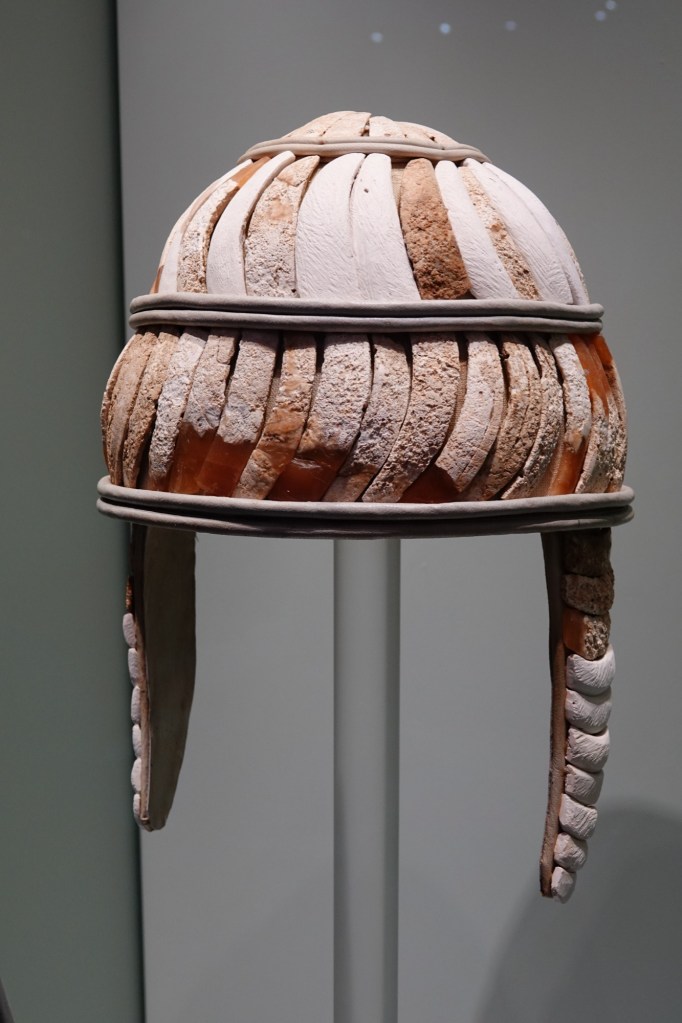
The boar’s tusk helmet below looked nothing like what I’d imagined when reading The Iliad.
Restored boar’s-tusk helmet with cheek-guards, of which the boar’s tusks are preserved, cut into regular pieces and pierced to be sewn onto an inner leather base. Such was the helmet of Cretan hero Meriones, described in Homer’s Iliad. Its special structure indicates that the boar’s-tusk helmet was primarily a symbol of rank and office rather than a standard element of defensive equipment. Apart from Crete, similar helmets have also been found in Mainland Greece.
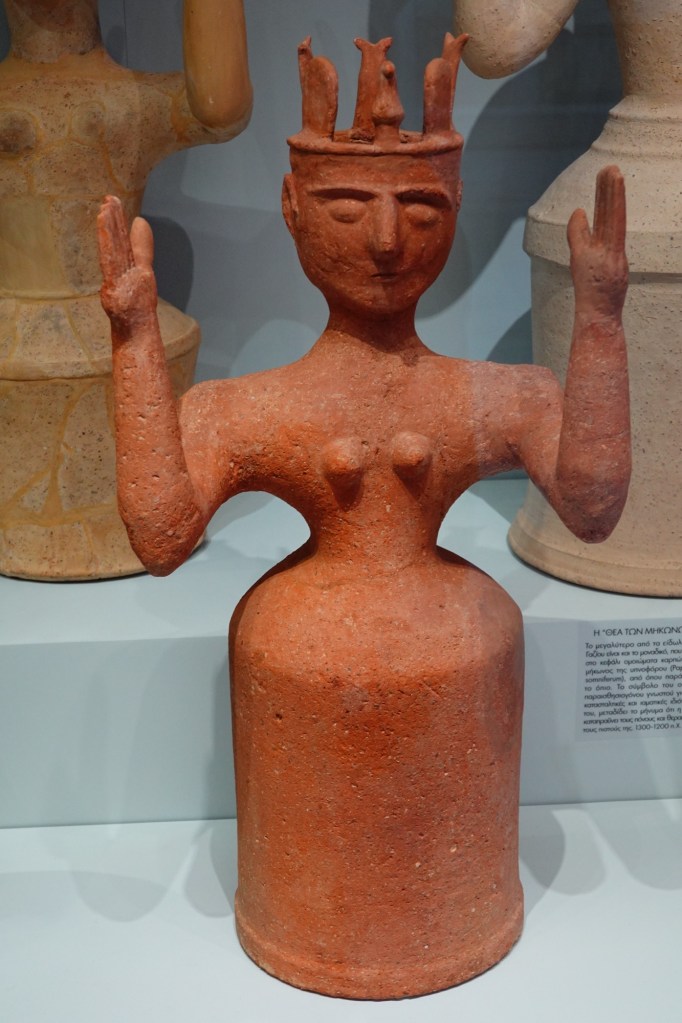
The goddess depicted with upraised hands.
Within the displays related to funerary practices were “coffins”. Clay larnakes imitate the wooden coffins used for burial during the previous period. There are two types of larnax: the first is in the shape of a wooden chest with a gabled lid, while the second resembles a bathtub. The deceased was placed in a foetal position, perhaps signifying the symbolic return to the beginning of life in the primeval womb.
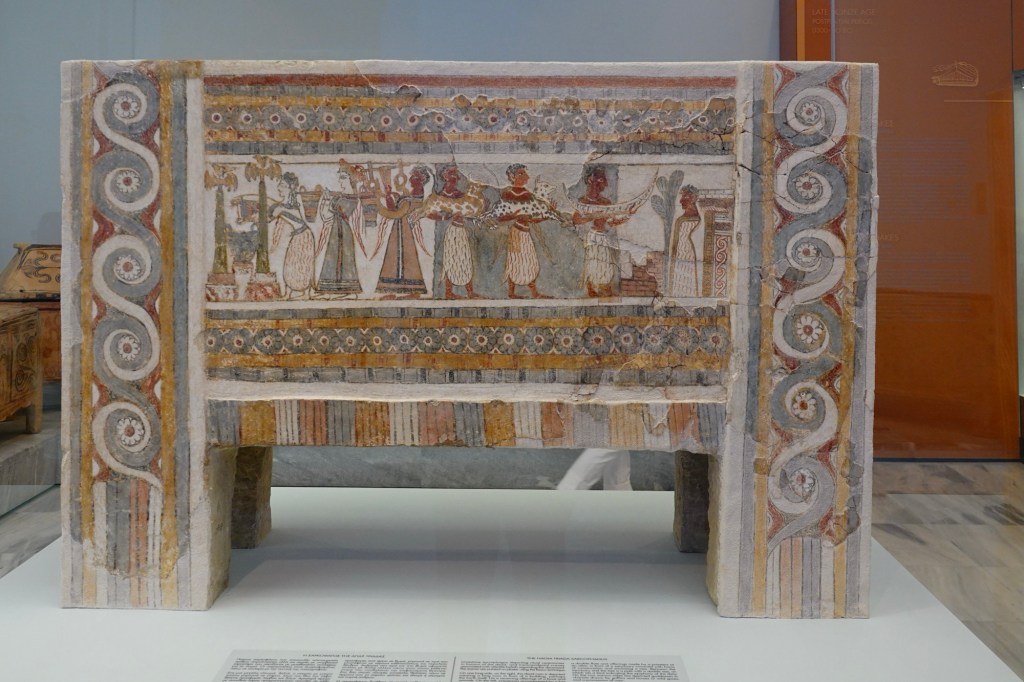
THE HAGIA TRIADA SARCOPHAGUS Limestone sarcophagus depicting ritual ceremonies in honour of the dead, and transcendental scenes associated with afterlife beliefs regarding the deceased. The scenes are painted on plaster using the fresco technique.
Once we got to room XIII, only half way through the museum, our heads were already exploding with the sheer amount of history we’d viewed, and now our senses were assaulted by Minoan frescoes.
While there were many beautiful frescoes, we were often puzzled by how an entire fresco could be extrapolated from the small sections that survived.
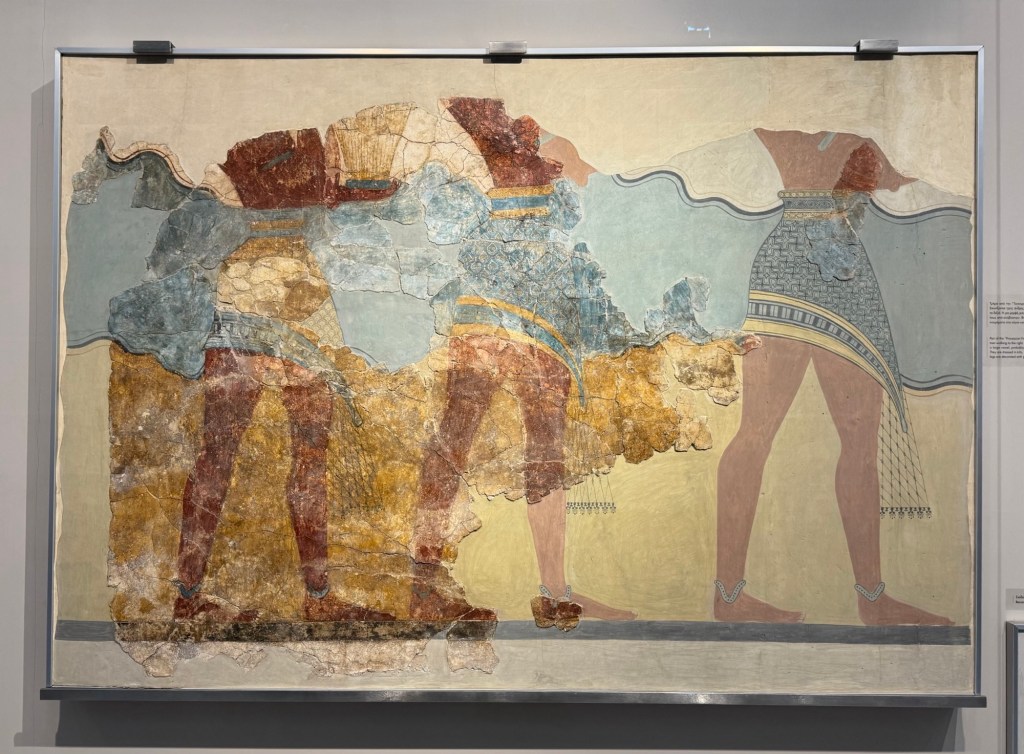
Part of the “Procession Fresco” showing three men walking to the right. One of them carries a large vessel, probably made of alabaster. They are dressed in kilts, while their arms and legs are decorated with jewelry.
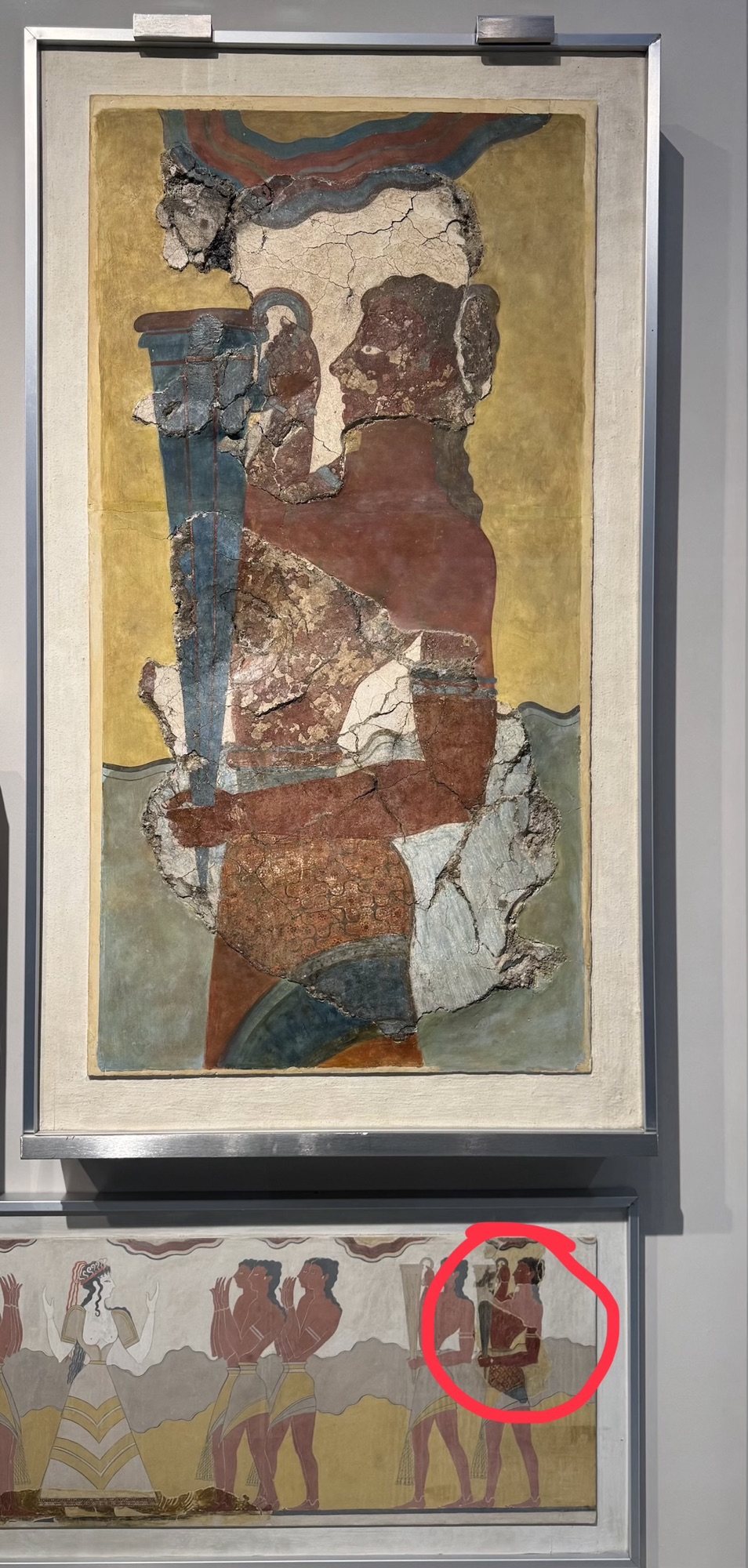
The “Cup-bearer”, a figure from the “Procession Fresco”, shows a youth with long black hair, naked torso and a richly decorated kilt carrying a large silver rhyton, a ceremonial vessel. This is the only life-size figure in a Minoan fresco whose head and torso are preserved.
Rooms XIV to XVII advanced us to the Early Iron Age (11th century BCE) and took us into the 4th century CE, by which time Crete had been absorbed into the Roman Empire.
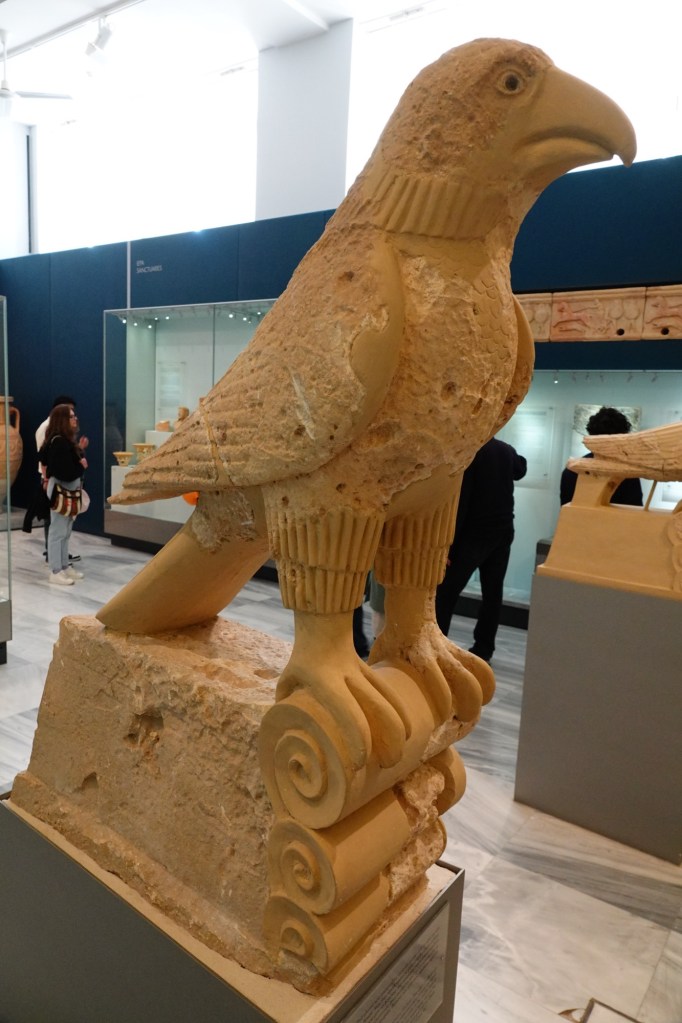
Limestone sculptures from the sanctuary of Zeus Thenatas at Amnisos representing an eagle and a falcon. They were probably placed on top of tall rectangular columns in the sanctuary area in order to be visible from a distance. They were the symbols of Zeus and Hera respectively, as can be deduced from their depiction together with the two great gods of the Greek pantheon in various representations. Archaic period, mid 6″ cent. BCE
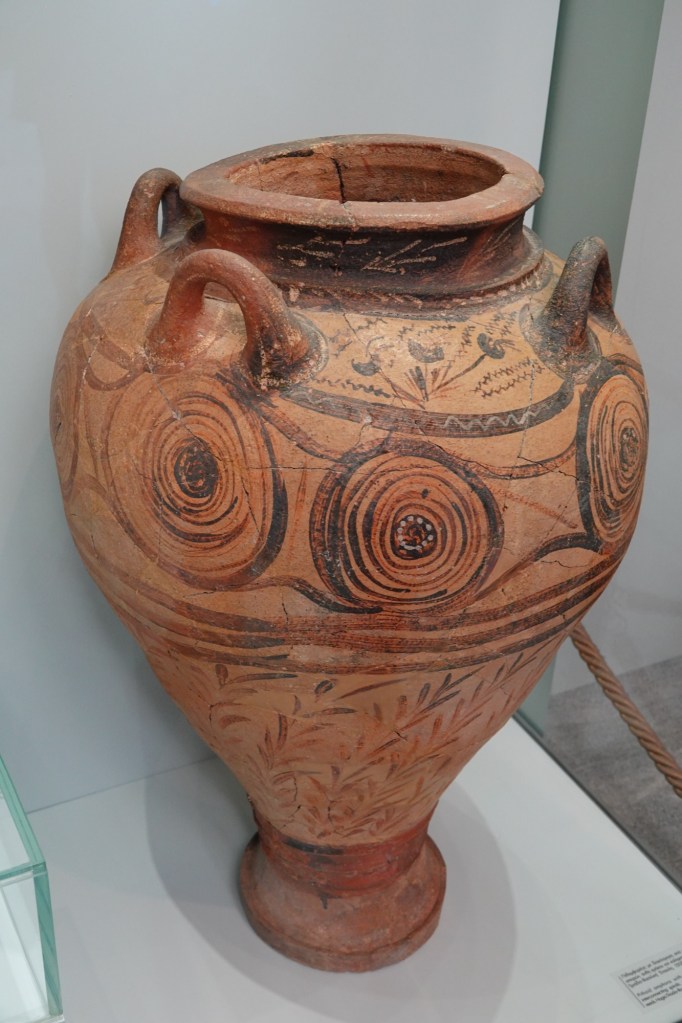
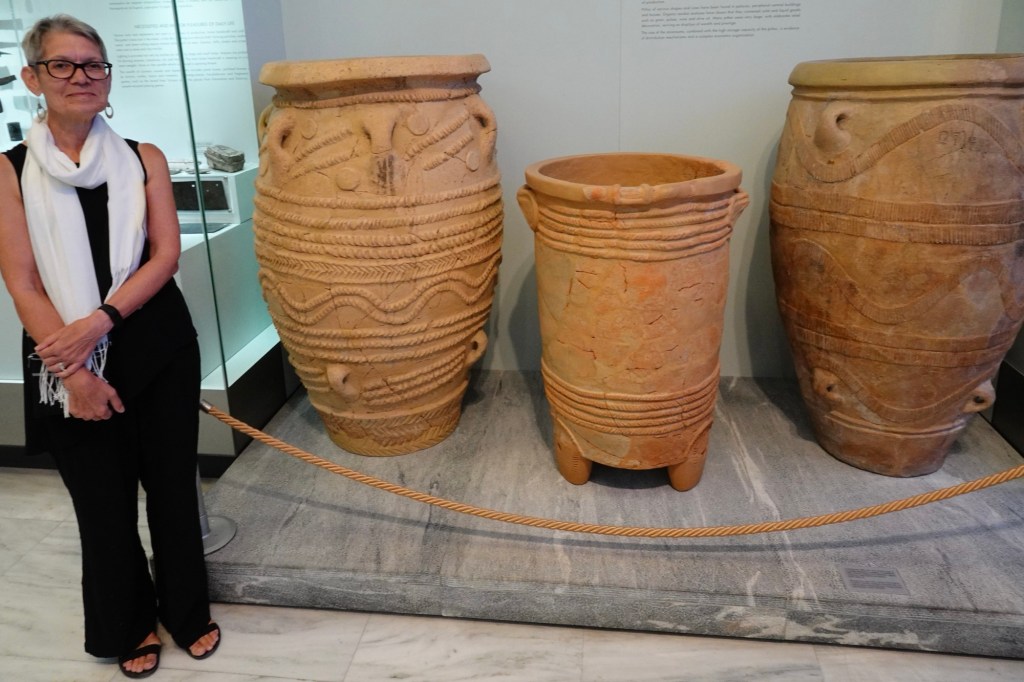
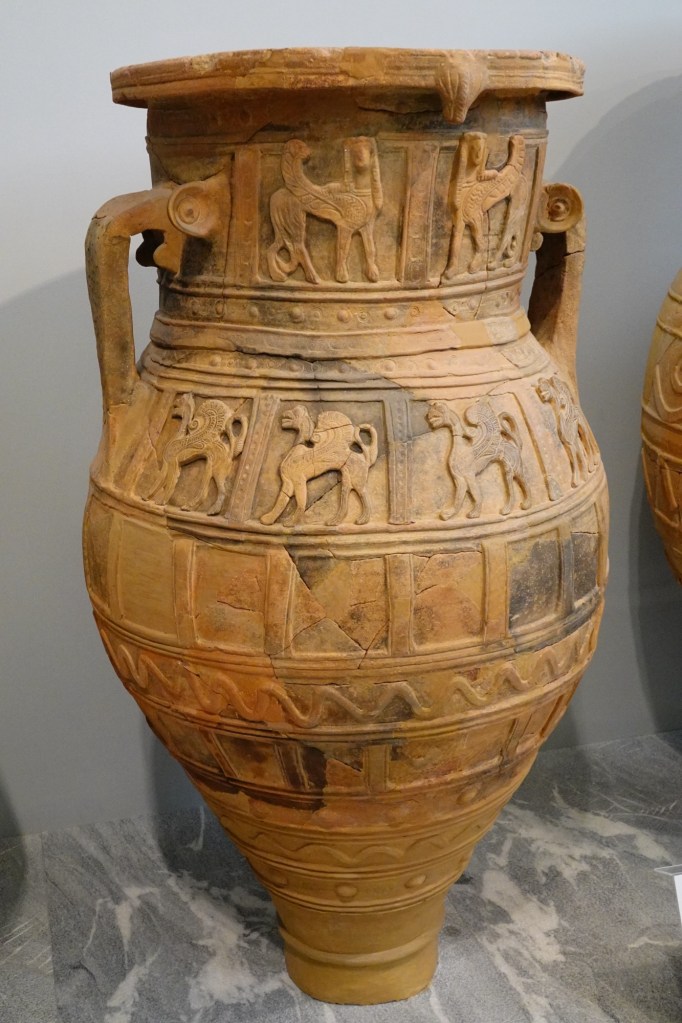
Pithoi were large clay vessels used to store and preserve liquid and solid goods. The great Archaic pithoi (7th – 6th cent. BC) have bands of relief decoration on their bodies and necks. Their themes include fantastic creatures, animals and geometric shapes, and reflect the greatness of the art of the Archaic period. Large decorated pithoi belonged to the category of luxury vases and were symbols of prestige and status for their owners.
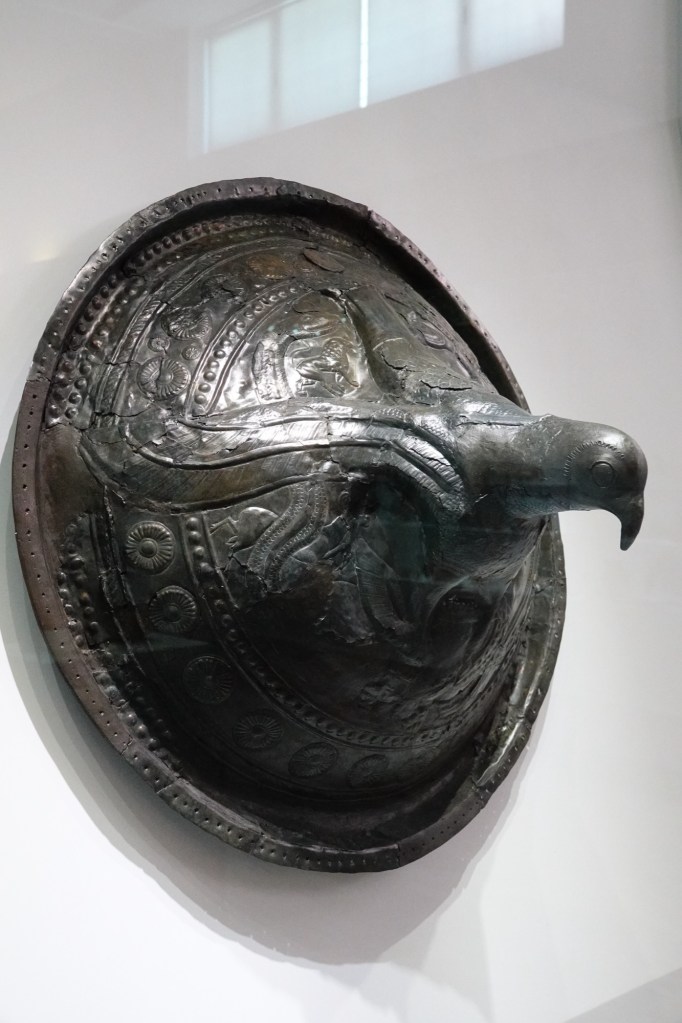
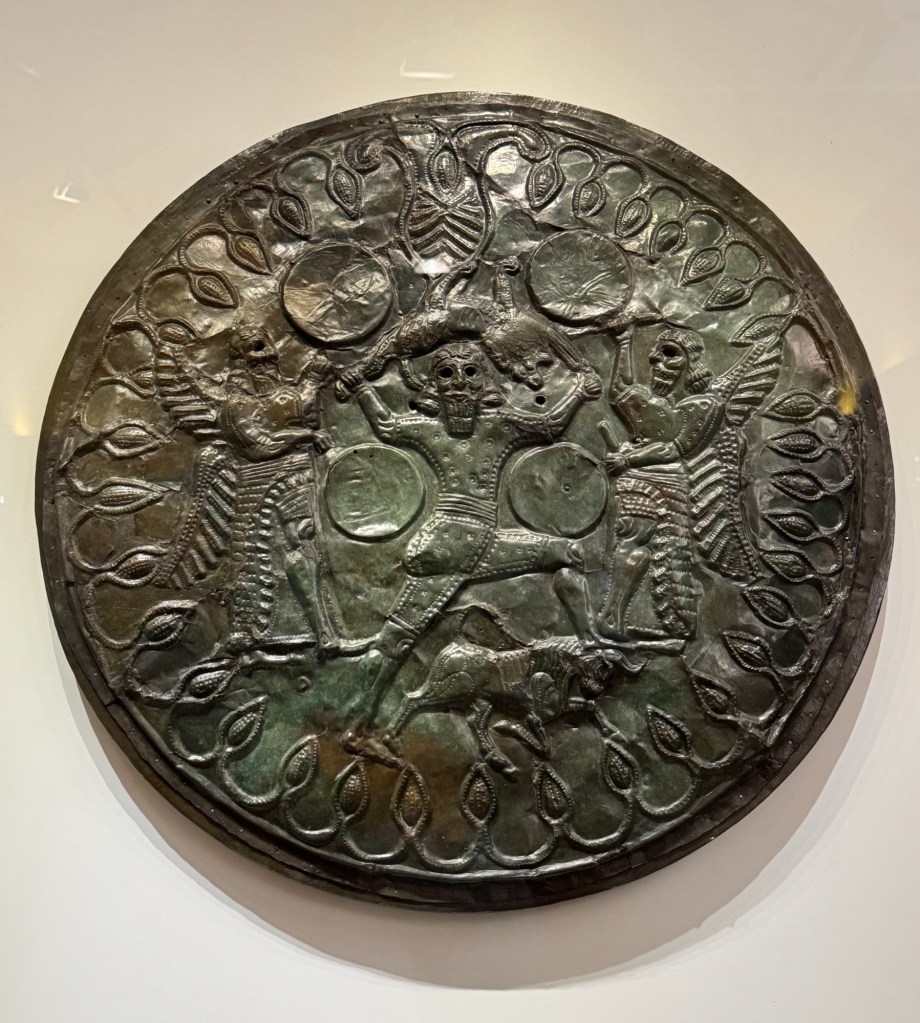
The bronze shields from the Idaean cave, with hammered and incised decoration, served as lavish votive offerings. Their ornamental repertoire, mostly of Assyrian influence, includes frontal animal heads in high relief. The shields of the Idaean Cave are thought to be the products of a local workshop or of foreign craftsmen versed in eastern iconography, itinerant or established in Crete. They are dated from the late 9th or early 8th to the mid 7th century BCE
The bronze “drum” from the Idaean Cave, a votive offering, betrays strong iconographic and stylistic influences from contemporary Assyrian art. Its shape, however, and the winged daemons flanking the central figure and beating drums are a direct allusion to the Kourtes, the daemons who beat drums to drown out the infant Zeus’ cries and prevent his father, the child-eating Kronos, from finding him. Similarly, the central figure, treading on a bull and taming a lion, is identified as the Cretan-born Zeus. Geometric period, late 8th century BCE
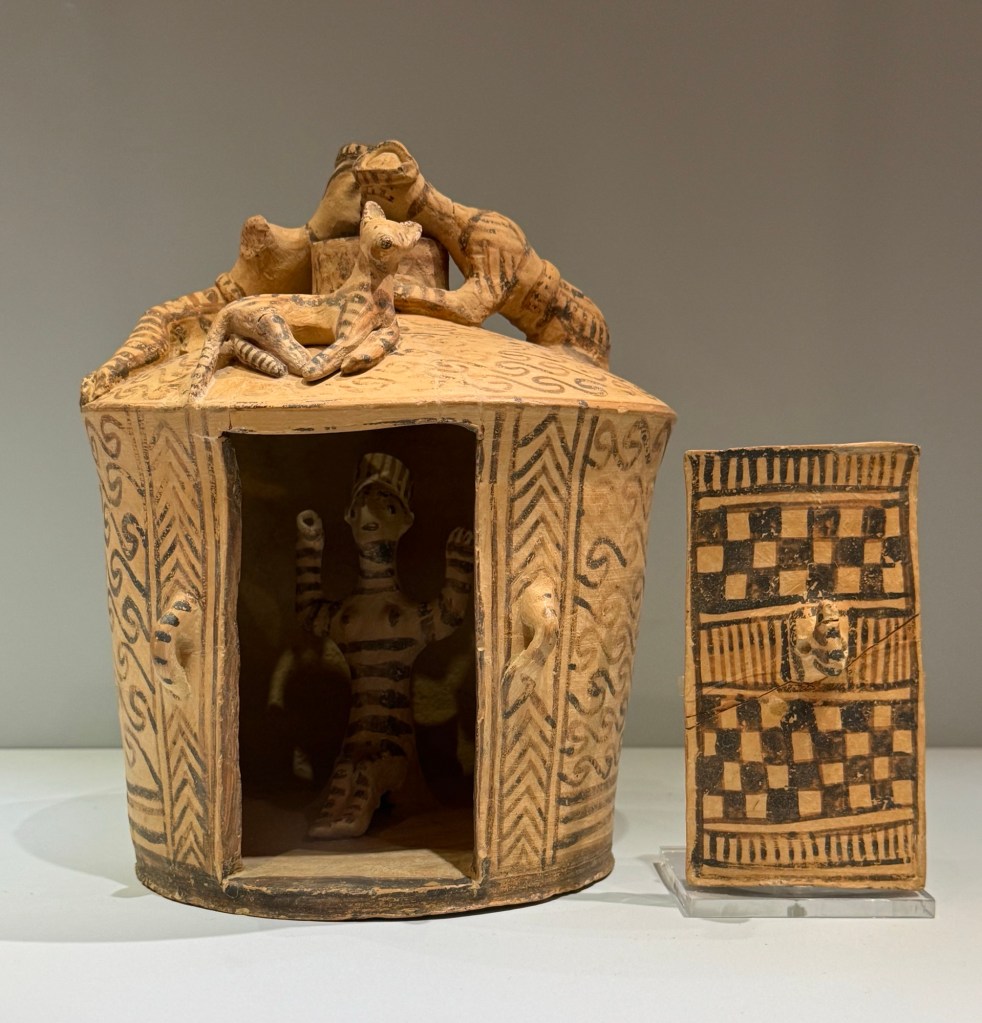
A circular shrine-model containing the figurine of a goddess of the type with upraised arms. Two prone male figures, perhaps worshipers, and an animal beside them observe the goddess through the opening in the roof. Circular shrine models date back to the Minoan period, the oldest known example to 1700 BC. The arrangement of this example probably echoes beliefs about the forms of contact between the terrestrial world and the underworld and ways of evoking the goddess-protectress of the deceased. It belongs to the Giamalakis Collection but certainly originates from a tomb in the Archanes area. Geometric period, late 9th cent. BCE
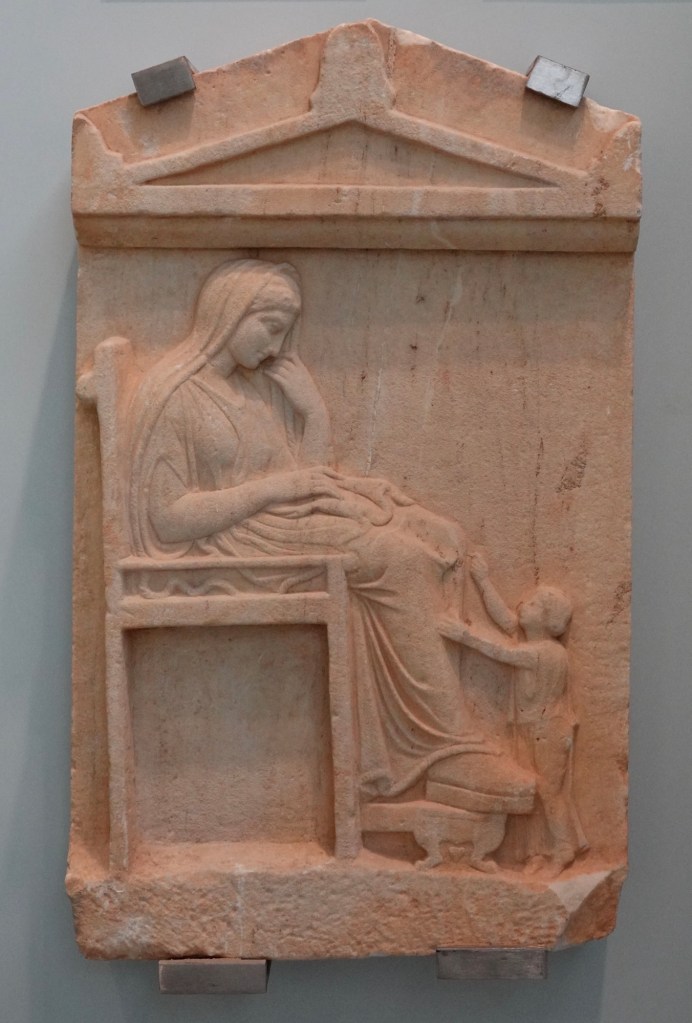
Grave stele with pediment top depicting the deceased in tunic and cloak, resting her feet on a footstool. A young woman standing before her extends her hands towards her. Lasaia, Late Classical-Hellenistic period, 4th-3rd century BCE
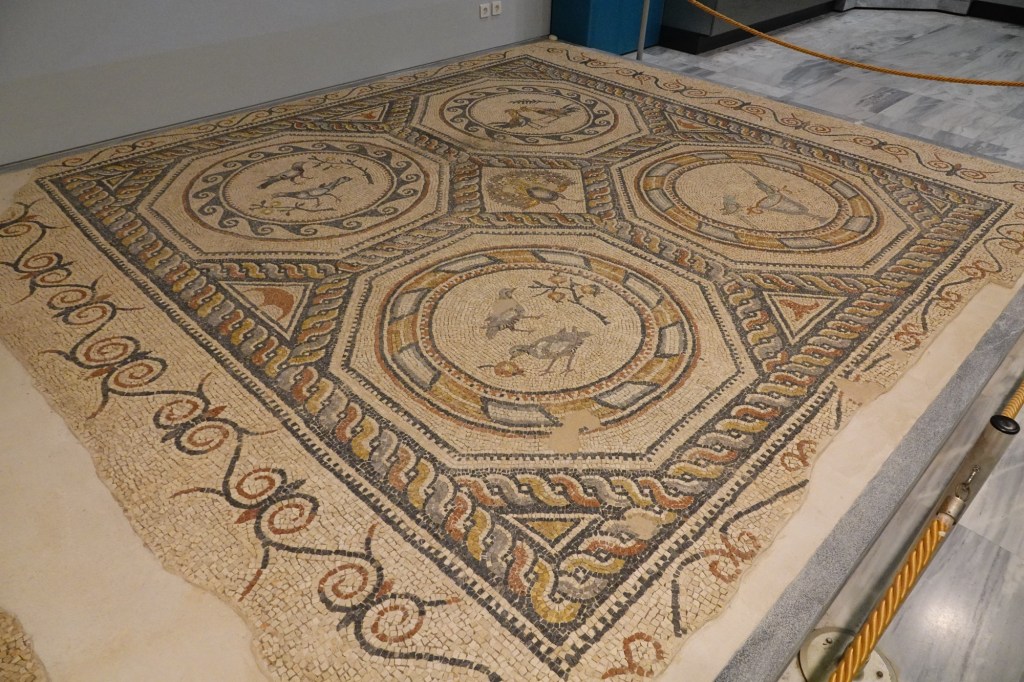
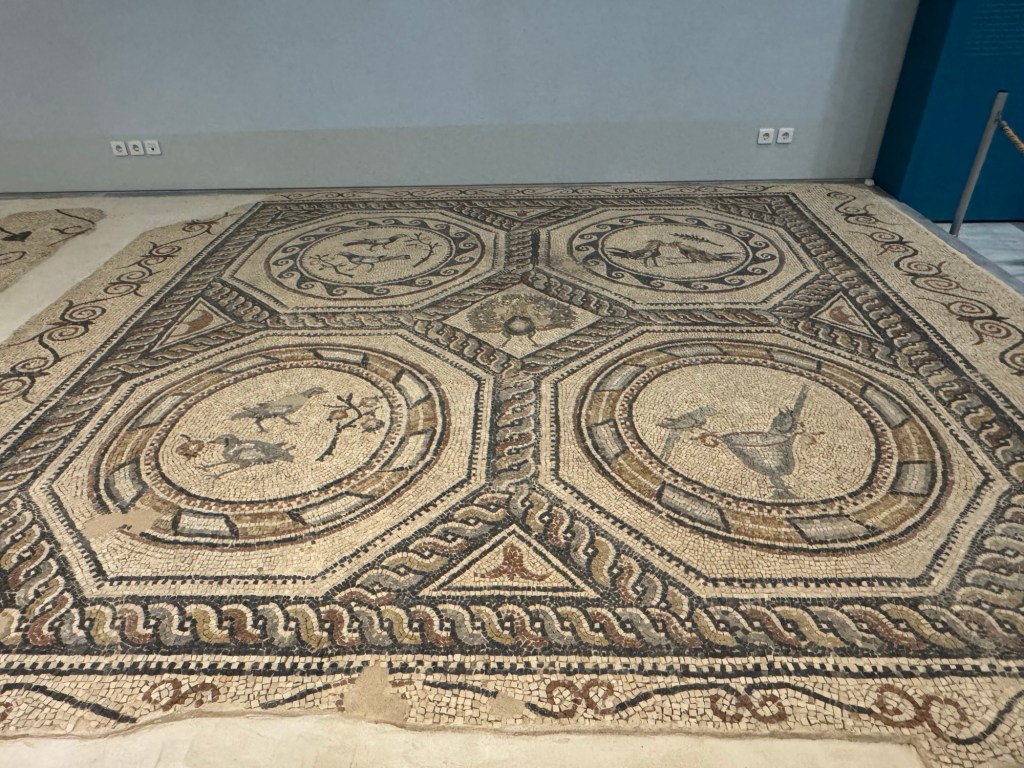
We were wowed by the mosaic floors from two adjacent rooms of a Roman complex at Chersonissos.
Other fine examples in Crete were discovered in the Villa Dionysus at Knossos and in houses at Kissamos, Chania, with scenes from the Dionysian cycle, Attic comedy and Greek mythology. Chersonissos, Roman period, 2nd century CE.
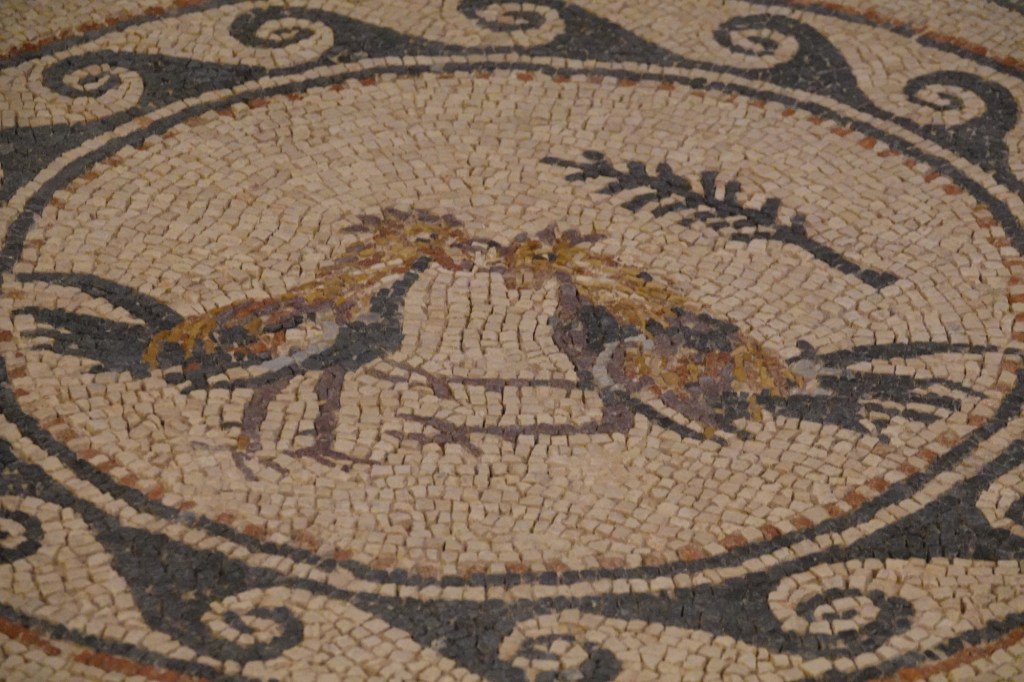
The larger one depicts incidents from the life of birds, symbols of joy, at a time of prosperity: a peacock displaying its plumage in the centre of the arrangement is surrounded by birds approaching fruit-laden branches, while others drink water from a cup and two roosters fight for dominance.
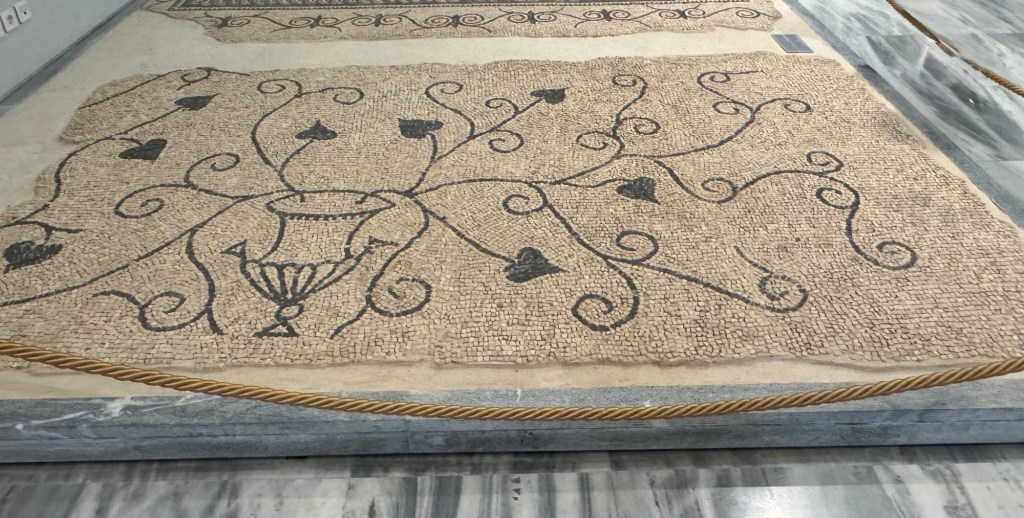
On the other mosaic, ivy spears spring from a vessel.
We moved fairly quickly through rooms XVIII to XXII, the Roman era being less fascinating to us because we’re more familiar with it from previous tours to Roman era sites.
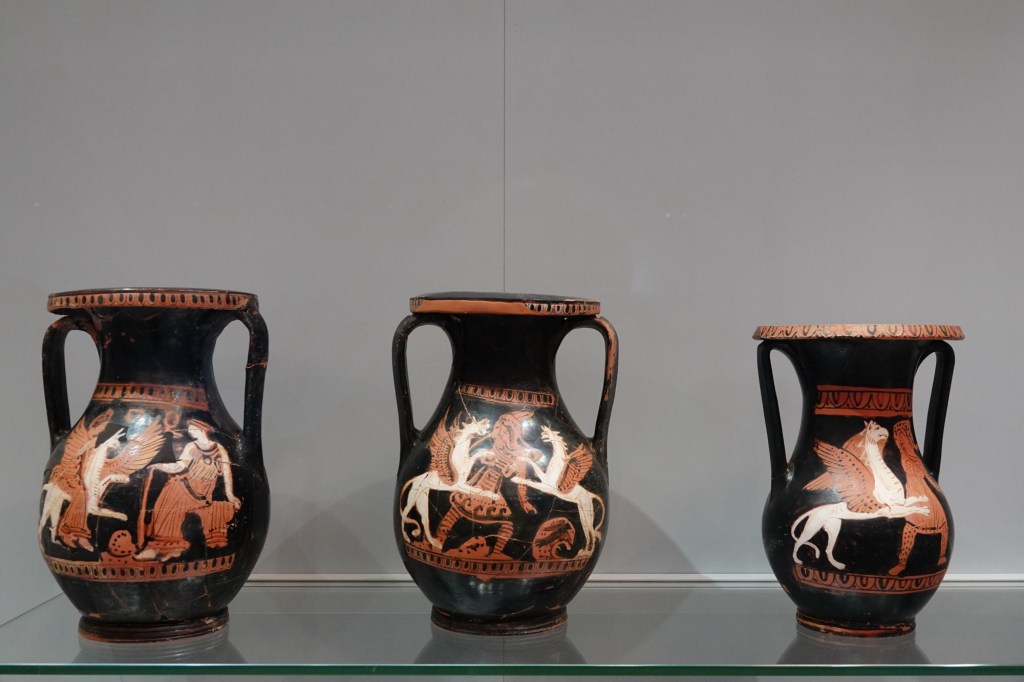
We’ve seen many examples of this kind of Roman-era pottery.
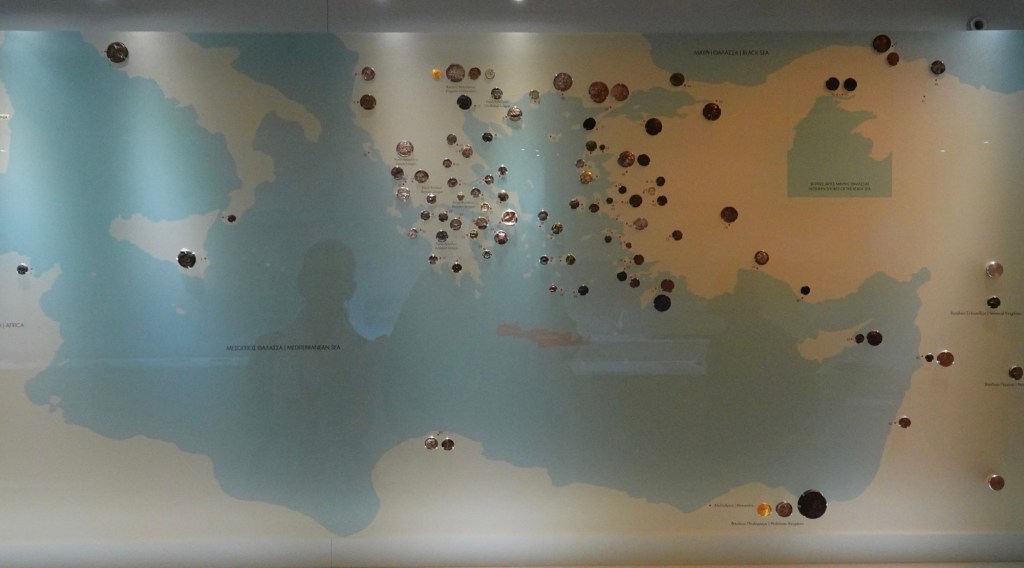
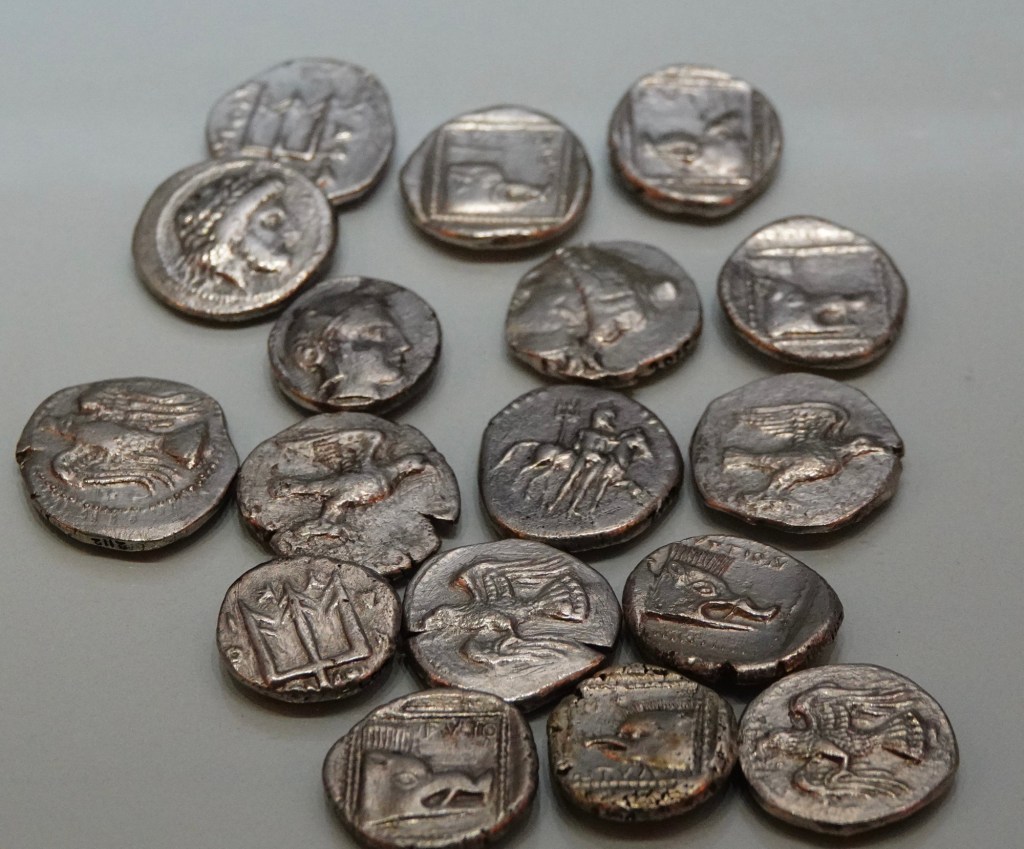
We were interested in the coin displays because they demonstrated how interconnected the ancient world’s trade was. There were coins from all around the Mediterranean, Middle East, and Northern Africa.
FOREIGN COIN-FINDS IN CRETE (6th -1st centuries BCE)
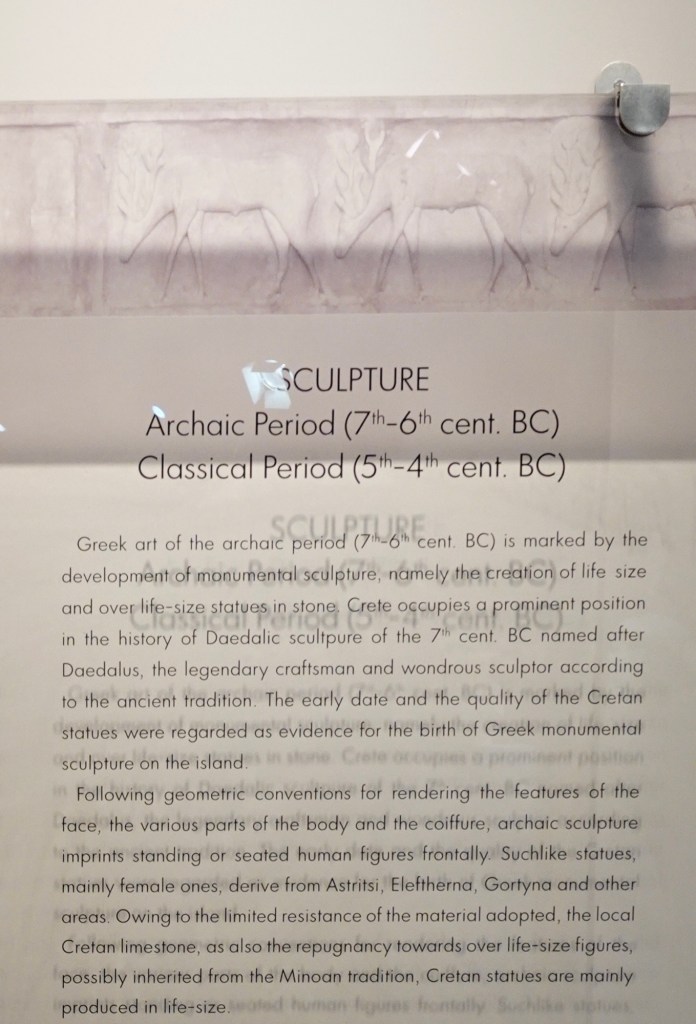
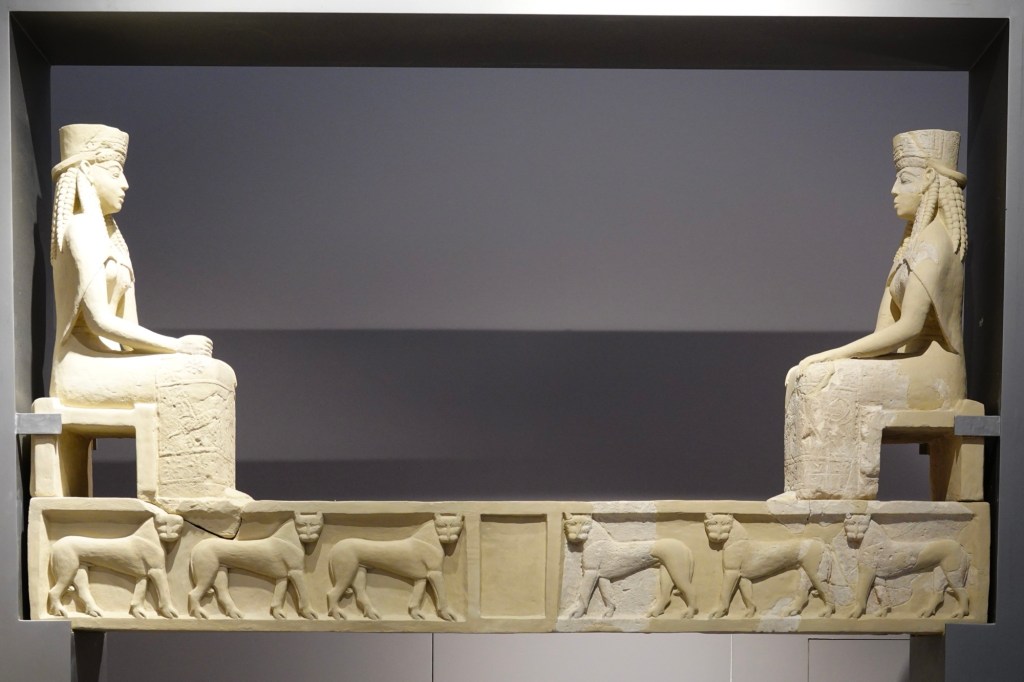
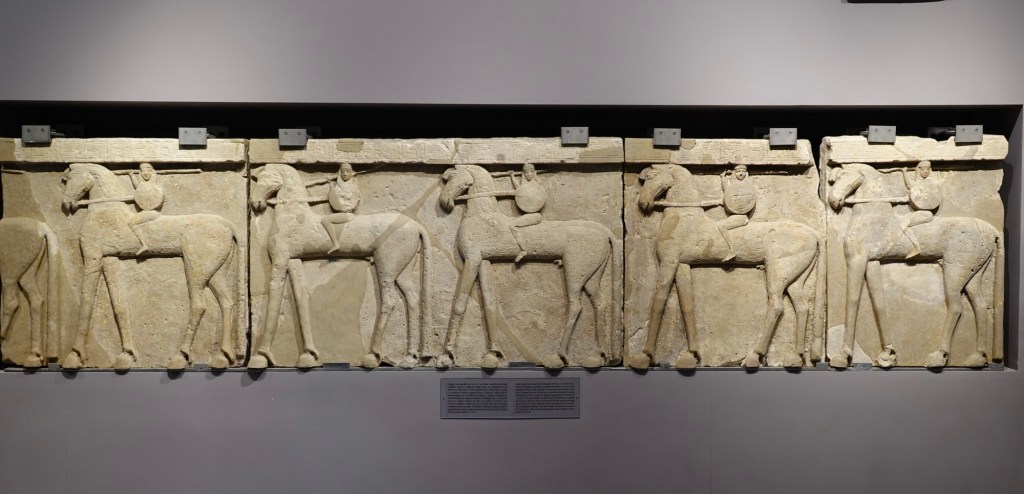
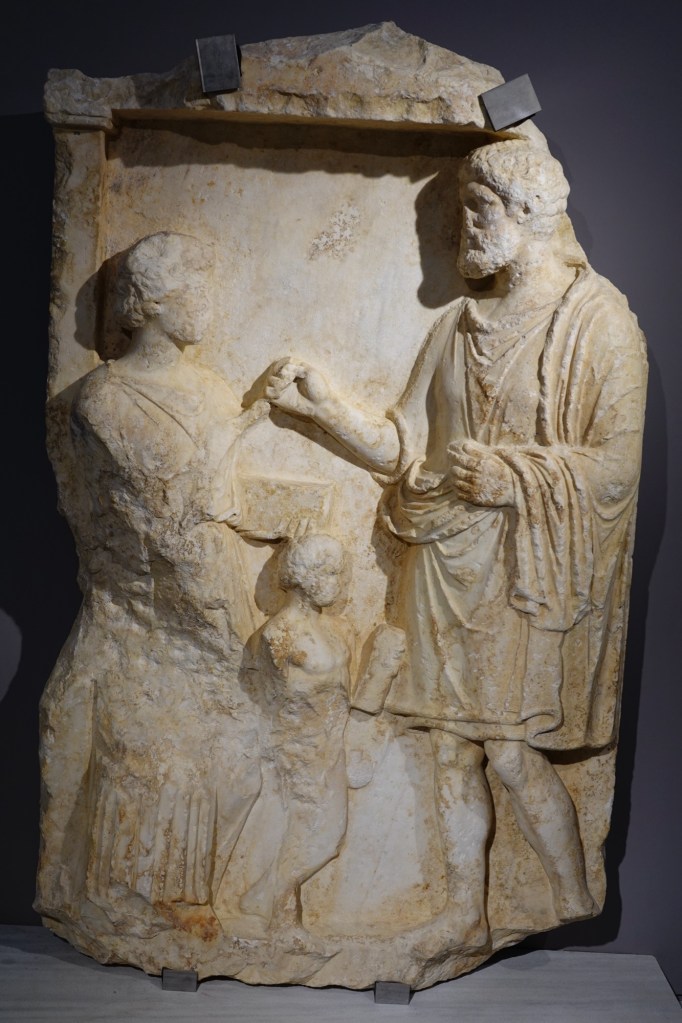
Our last stop in the museum was in the two sculpture galleries.
Marble gravestone in the shape of a small temple. It is decorated with a relief farewell scene between the dead man and his wife and child. The man is depicted in tunic and cloak outstretching his right hand. The woman carries a small jewelry box and the child a writing board and an aryballos, small pot containing oil, which was used by athletes. The representation follows iconographic prototypes of Attic equivalents. Herakleion, Classical period, mid 4th century BCE
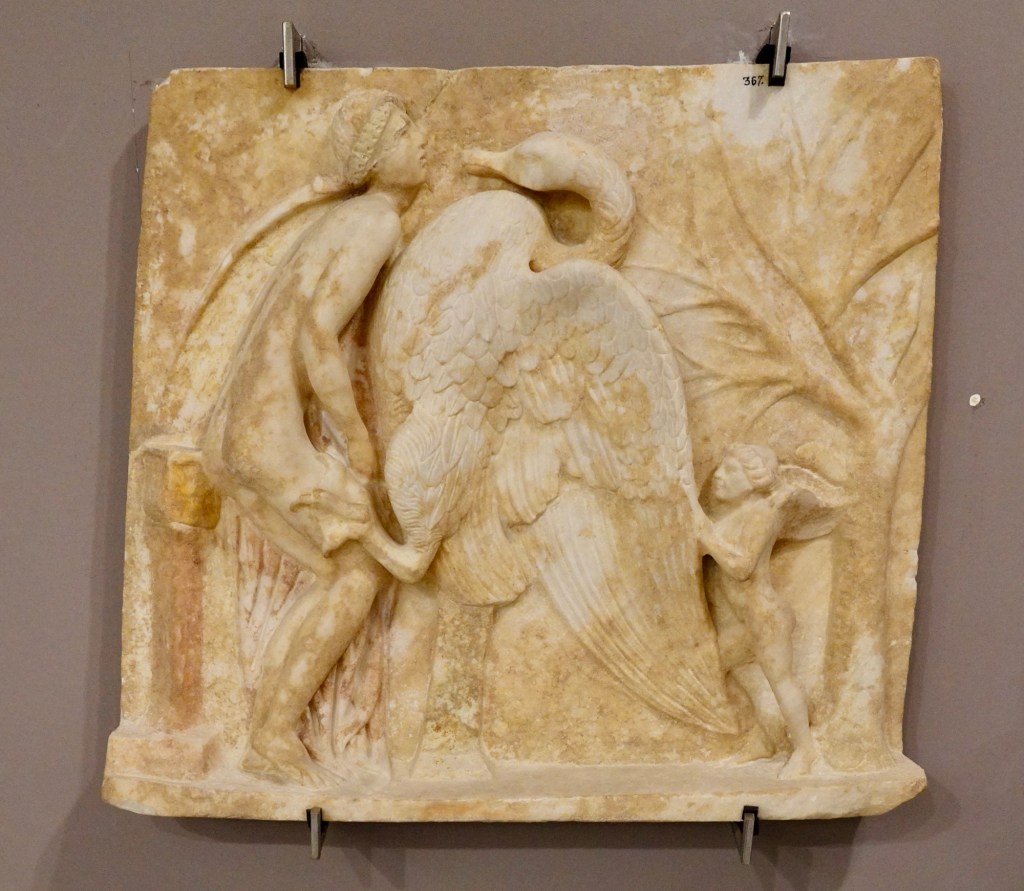
Marble relief plaque depicting the sexual union between Leda and the Swan, who is driven by Eros. A popular subject in antiquity, it narrates one of the many myths about the affairs and metamorphoses of Zeus. When Zeus fell in love with Leda, the wife of king Tyndareus of Sparta, he was transformed into a swan and supposedly persecuted by Venus, the goddess of love, he fell into Leda’s arms for protection. Their union gave birth to Dioscuri, Castor and Polydeuces, and to Helen of Troy, who became the cause of the Trojan War. Knossos, 1st – 2nd century CE.
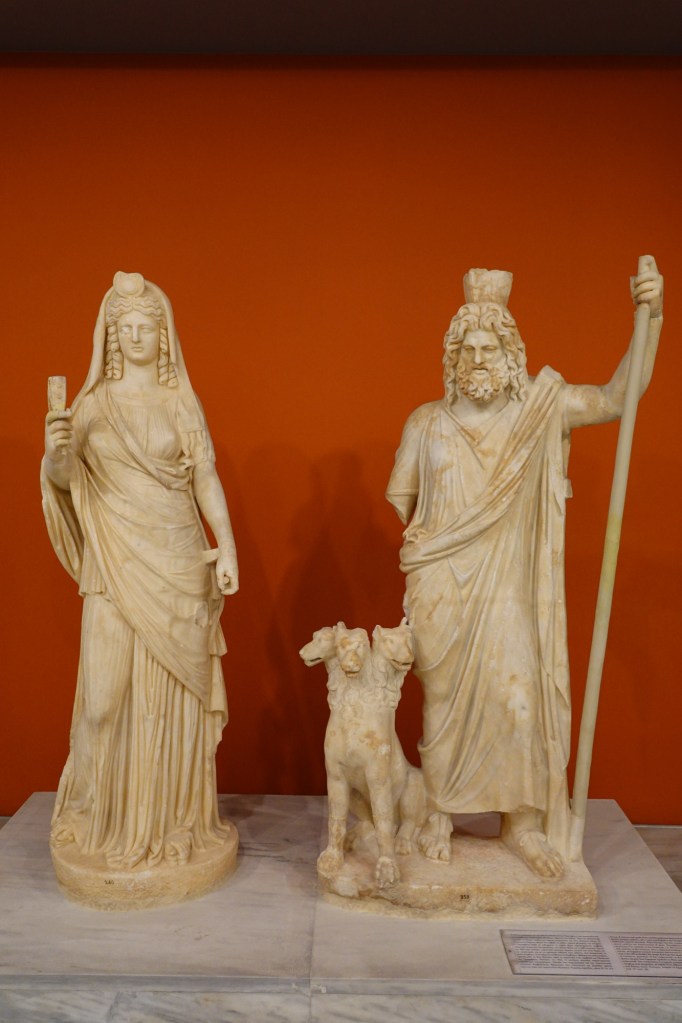
Group of statues with gods Pluto and Persephone depicted as the Egyptian deities Sarapis and Isis, who were worshiped in the Greek world from the Hellenistic period onwards. Gortyna, Temple of Egyptian Deities, Roman period, mid 2nd century CE.
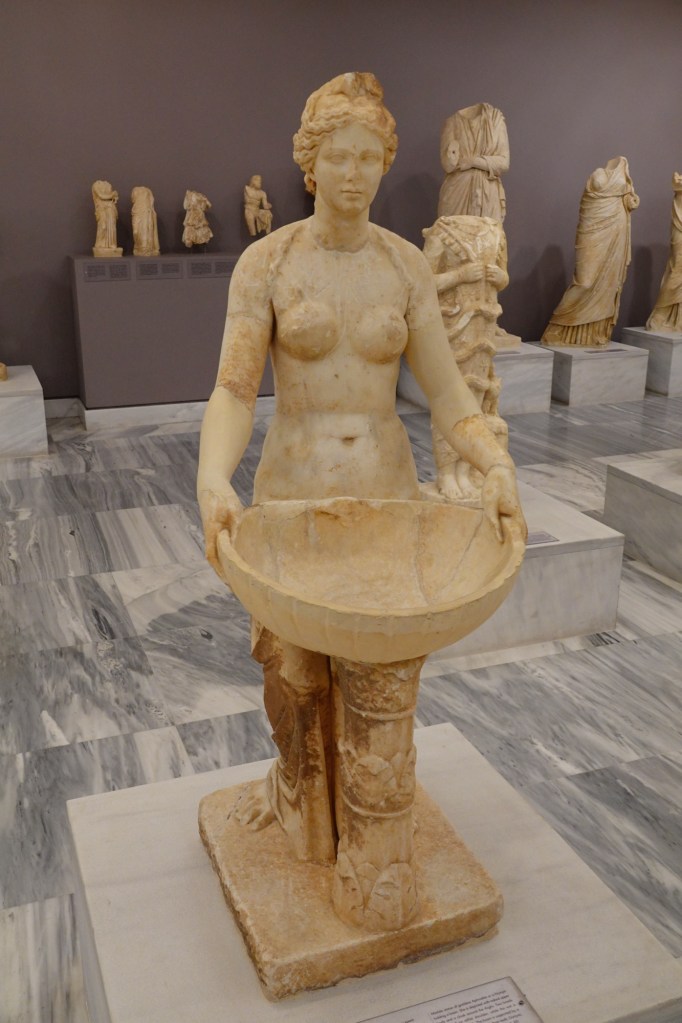
Marble statue of goddess Aphrodite or a Nymph holding a basin. Gortyna, Nymphaeum, Roman period, late 1st century CE.
As many photographs and signs as I’ve included here, they represent only a small fraction of what is on display in the museum, but hopefully they will evoke more memories when we look back at them.
So glad that you made it to the Heraklion Archaeological Museum. I think it is one of the most stunning museums I have ever seen. Unfortunately I last visited in 2012 when the remodel was underway – can’t wait to revisit, especially after your fantastic descriptions!
Hope you make it to Phaistos, too. It isn’t as flashy as Knosos – but it is much more real.
There is so much to see in Crete. DW haven’t seen the Idaean cave, for instance… Speaking of caves, if you want a real adventure, seek out the Cave of Eileithyia, assuming it is actually open. Eileithyia was the goddess of childbirth – there are foundations within this small cave – I’m not sure if they were birthing chambers or places of worship. You’ll need to bring your own lighting.
Your blog is incredible! I feel as though I am attending a university seminar….only this time it is a “seminar” that really interests me. Thank you for taking the time to write it.
Thank you for your lovely words. When Ted and I are too old to continue this lifestyle, it might be nice to pretend we’re attending seminars as we reread and relive our adventures.

 Rose and Ted’s Excellent Adventure
So glad that you made it to the Heraklion Archaeological Museum. I think it is one of the most stunning museums I have ever seen. Unfortunately I last visited in 2012 when the remodel was underway – can’t wait to revisit, especially after your fantastic descriptions!
Hope you make it to Phaistos, too. It isn’t as flashy as Knosos – but it is much more real.
There is so much to see in Crete. DW haven’t seen the Idaean cave, for instance… Speaking of caves, if you want a real adventure, seek out the Cave of Eileithyia, assuming it is actually open. Eileithyia was the goddess of childbirth – there are foundations within this small cave – I’m not sure if they were birthing chambers or places of worship. You’ll need to bring your own lighting.
LikeLiked by 1 person
Not sure we’re prepared for anything where we need our own light source – on this visit, anyway!
LikeLike
Your blog is incredible! I feel as though I am attending a university seminar….only this time it is a “seminar” that really interests me. Thank you for taking the time to write it.
LikeLiked by 1 person
Thank you for your lovely words. When Ted and I are too old to continue this lifestyle, it might be nice to pretend we’re attending seminars as we reread and relive our adventures.
LikeLike