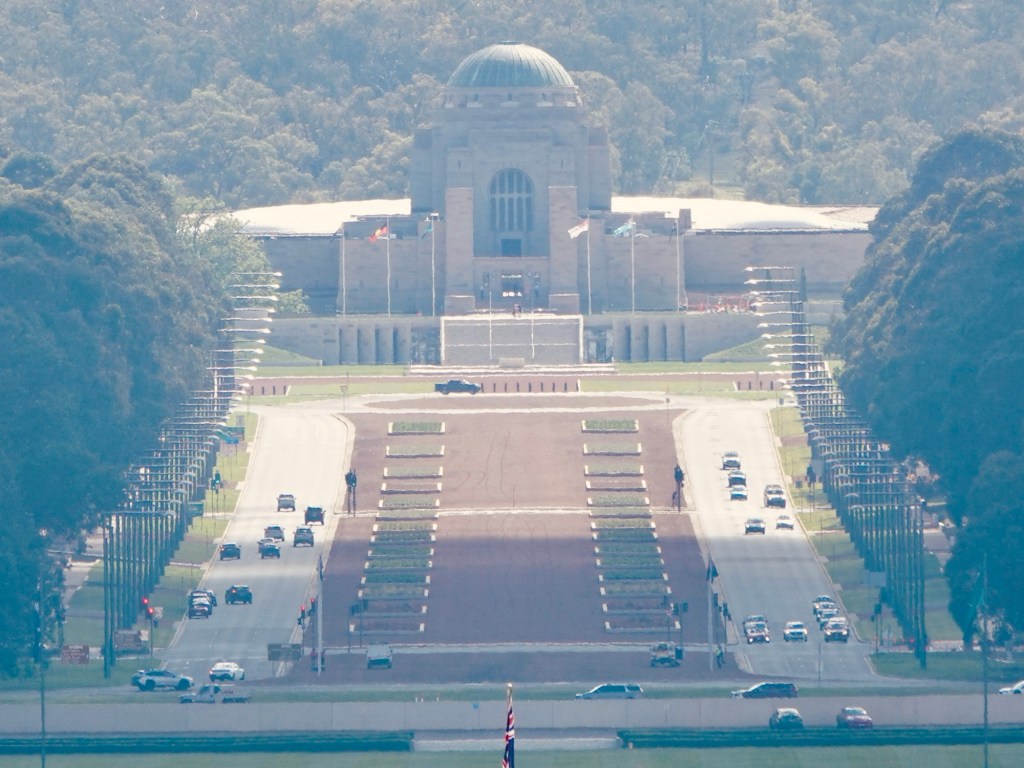
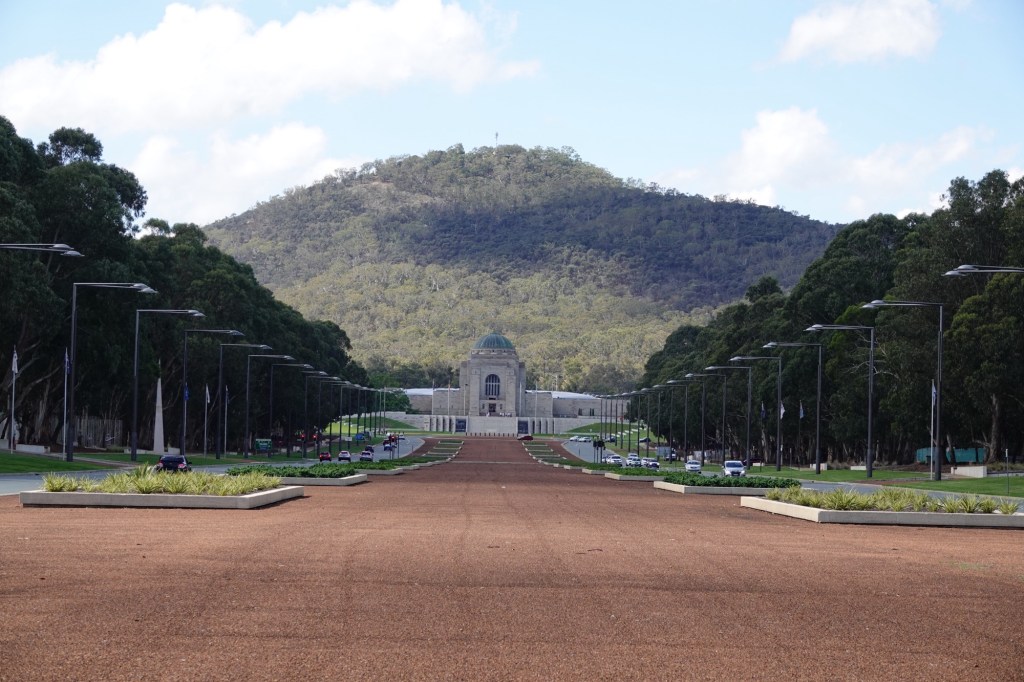
Australia literally has a “way” of remembering: ANZAC Parade, which stretches from Constitution Avenue to Limestone Avenue where it ends directly in front of the Australian War Memorial.
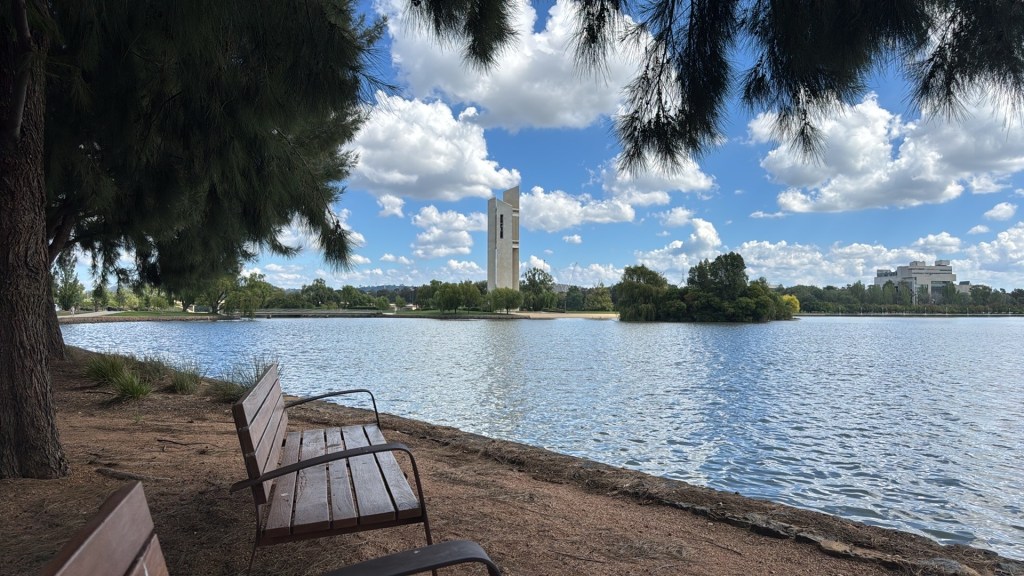
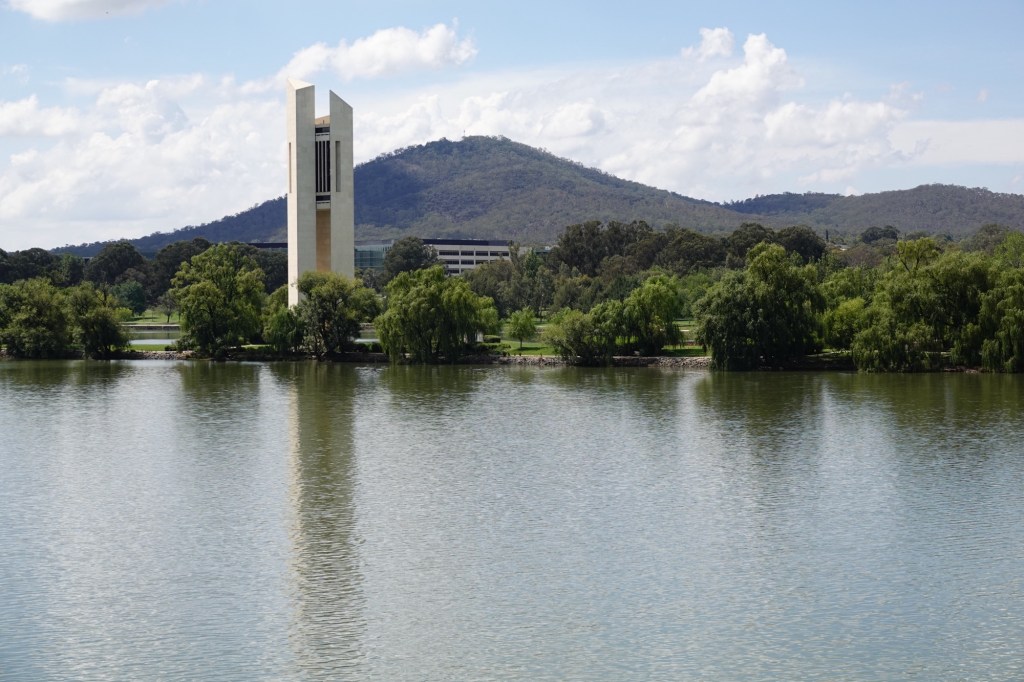
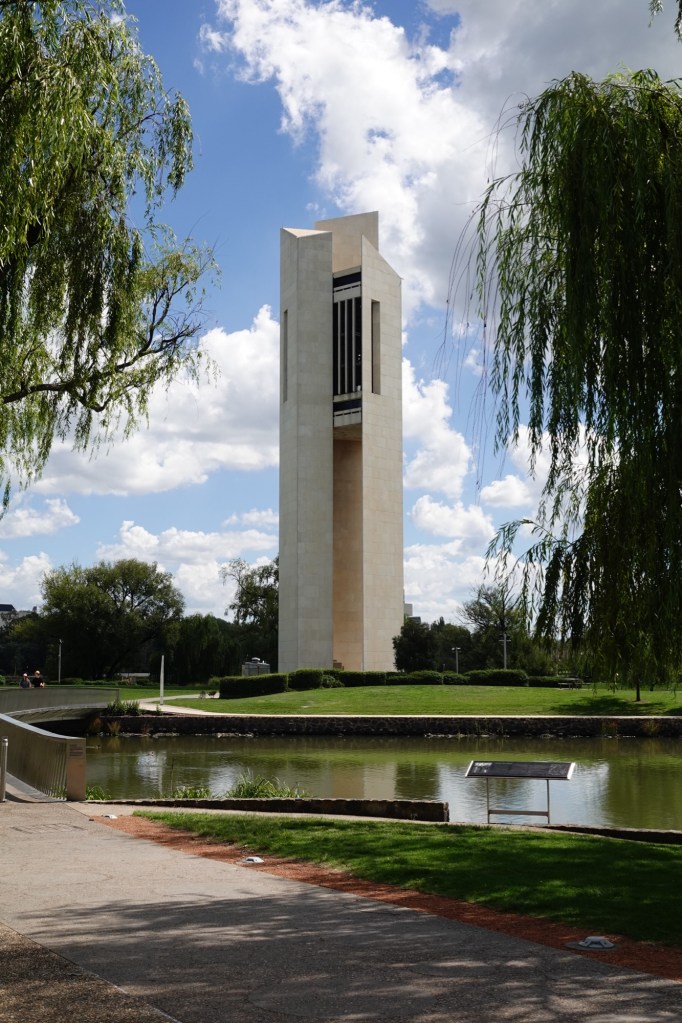
It was along hot walk from Parliament House across the river to ANZAC Parade. We stopped to rest at the water’s edge and listen to the National Carillon (on Queen Elizabeth II Island) chime 3:00 p.m.
We noticed several small memorials along the shoreline before reaching the larger ones on the Parade.
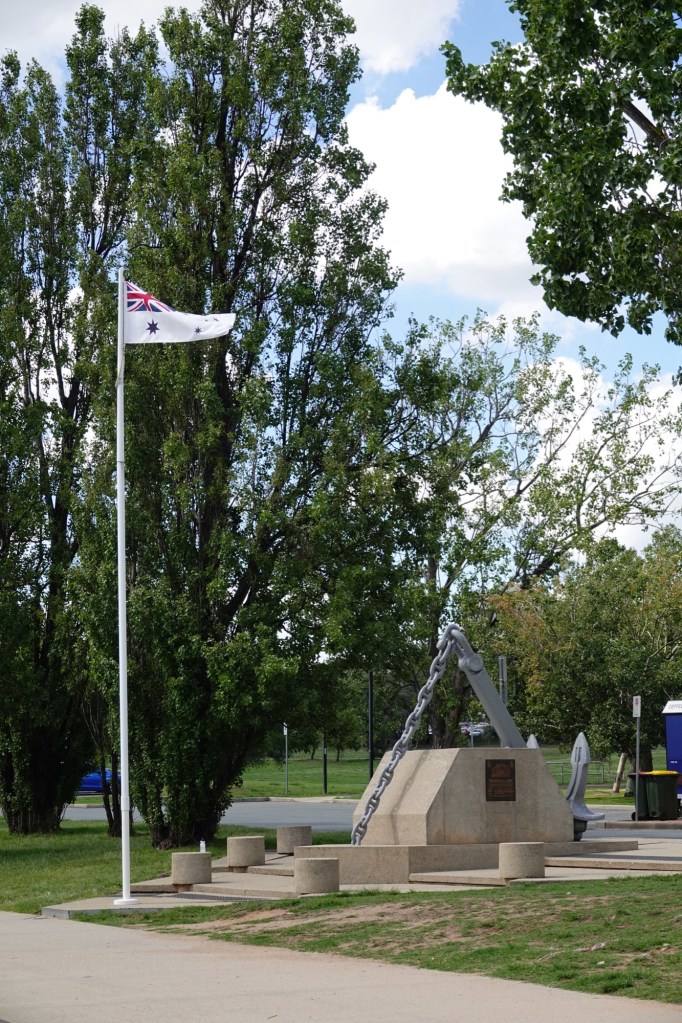
Once we reached the Parade’s beginning at Constitution Avenue, Ted and I criss-crossed the boulevard, determined not to miss any of the memorials.
THE NEW ZEALAND MEMORIAL
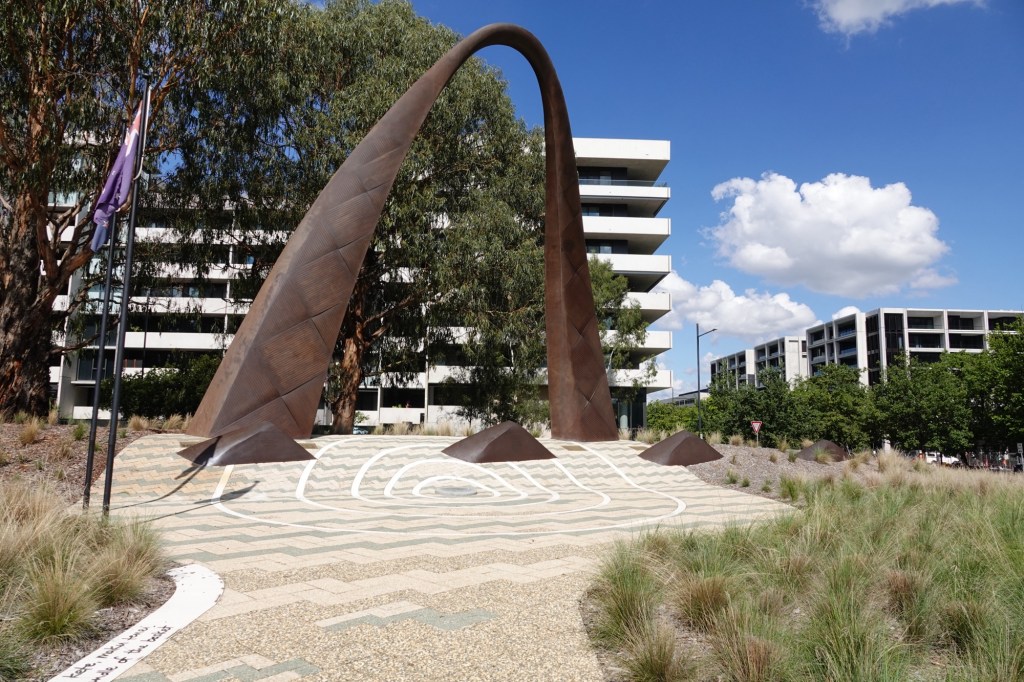
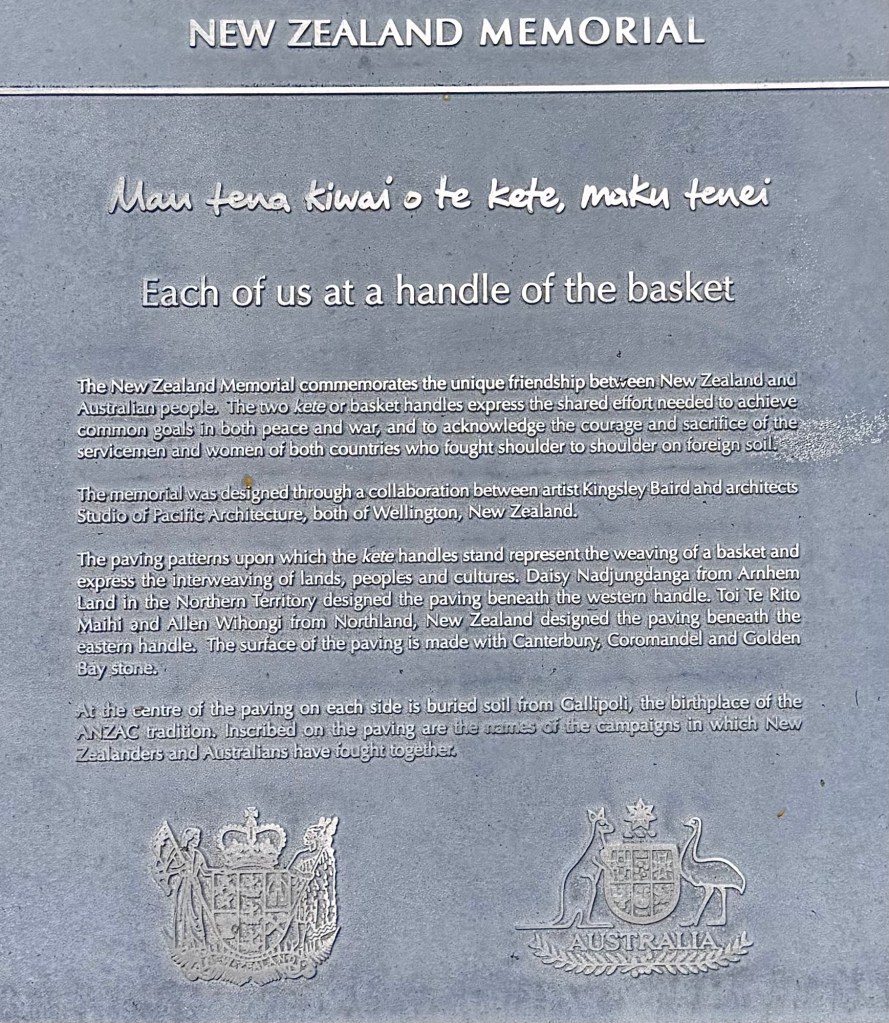
Those who know me know that I am a big proponent of statues and memorials, and of using those physical items to get people interested in engaging with the stories they tell, whether those stories are good or bad. Physical representations, like illustrations in books, are an especially good way to get children’s attention, and get them asking questions.
It may be an impression based on a very small sample size, but it seems to me that Australian students know more about their country and its relative place in the world at a younger age than North American students. Perhaps we are not doing our children a favour by removing statues or “uncomfortable” displays instead of giving them context.
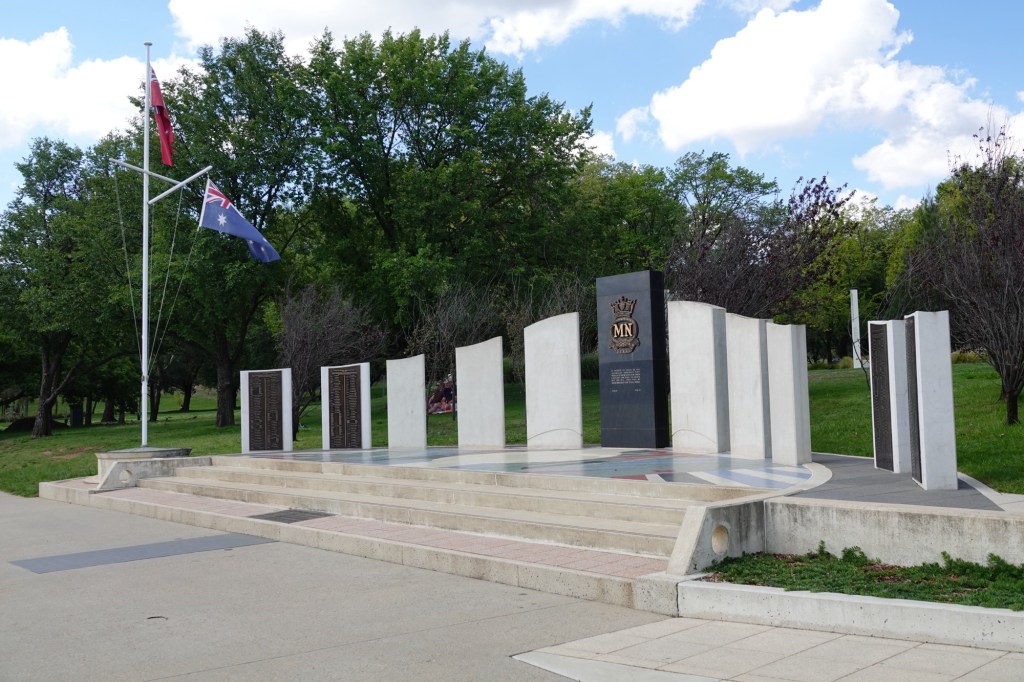
THE AUSTRALIAN PEACEKEEPING MEMORIAL
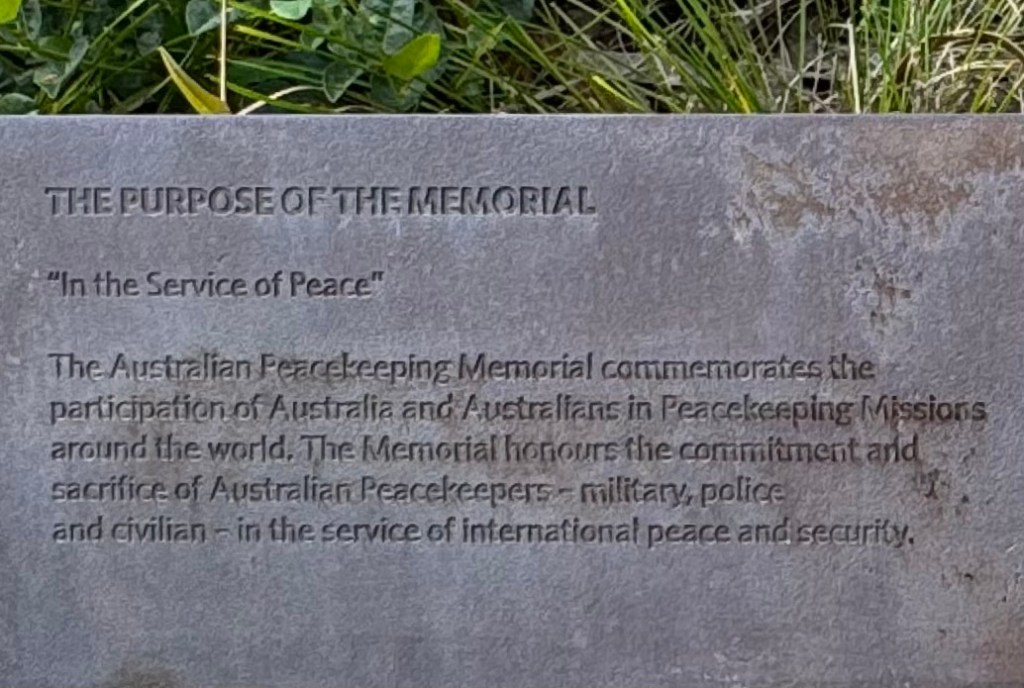
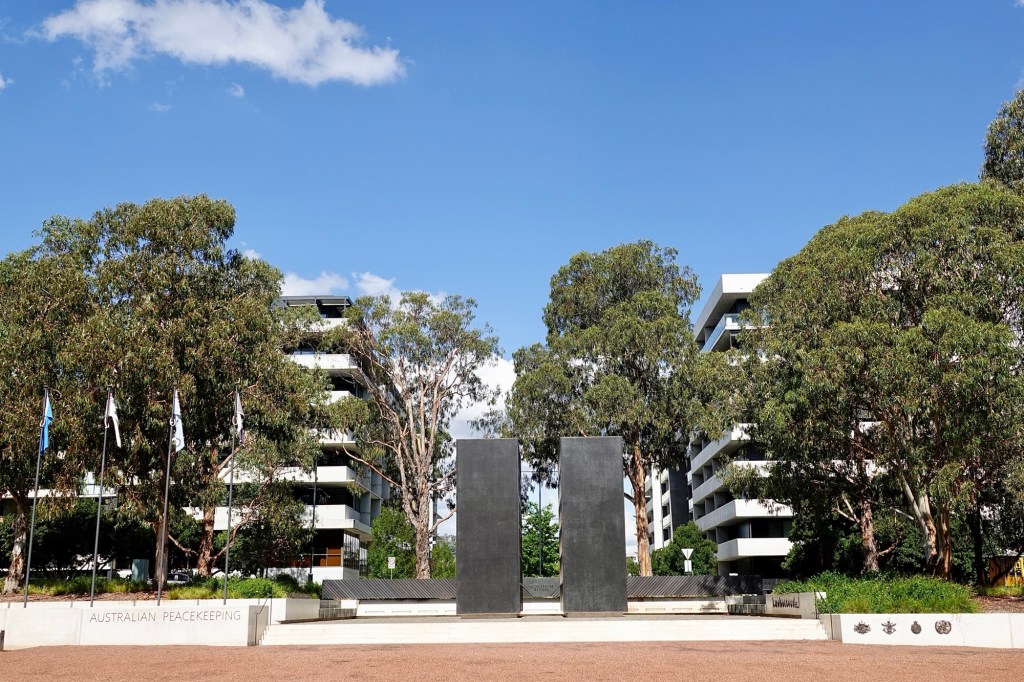
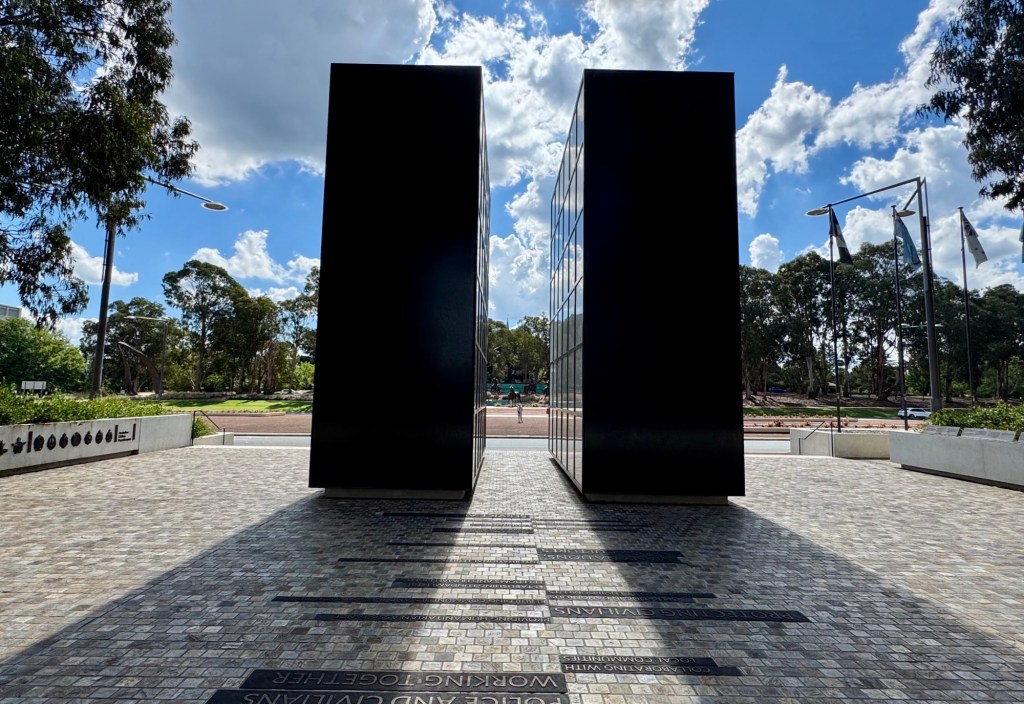
Set into the tiles under the two black plinths engraved with names of those who died while serving on peacekeeping missions are strips of dark stone with brass words that represent the lofty goals of peacekeepers. Among them were: Police and civilians working together; Providing humanitarian assistance; Rebuilding communities and infrastructure; Establishing fundamental freedoms and human rights; Collaborating with local communities; Protecting civilians. The tiles on the other side of the plinths listed the ideal qualities of peacekeepers. Among those were: Courage & Valour, Initiative & Resourcefulness; Commitment; Impartiality, Openness & Fairness; International Legitimacy & Credibility; Compassion & Respect.
Each one of those tiles could be the jumping off point for a discussion.
THE BOER WAR MEMORIAL
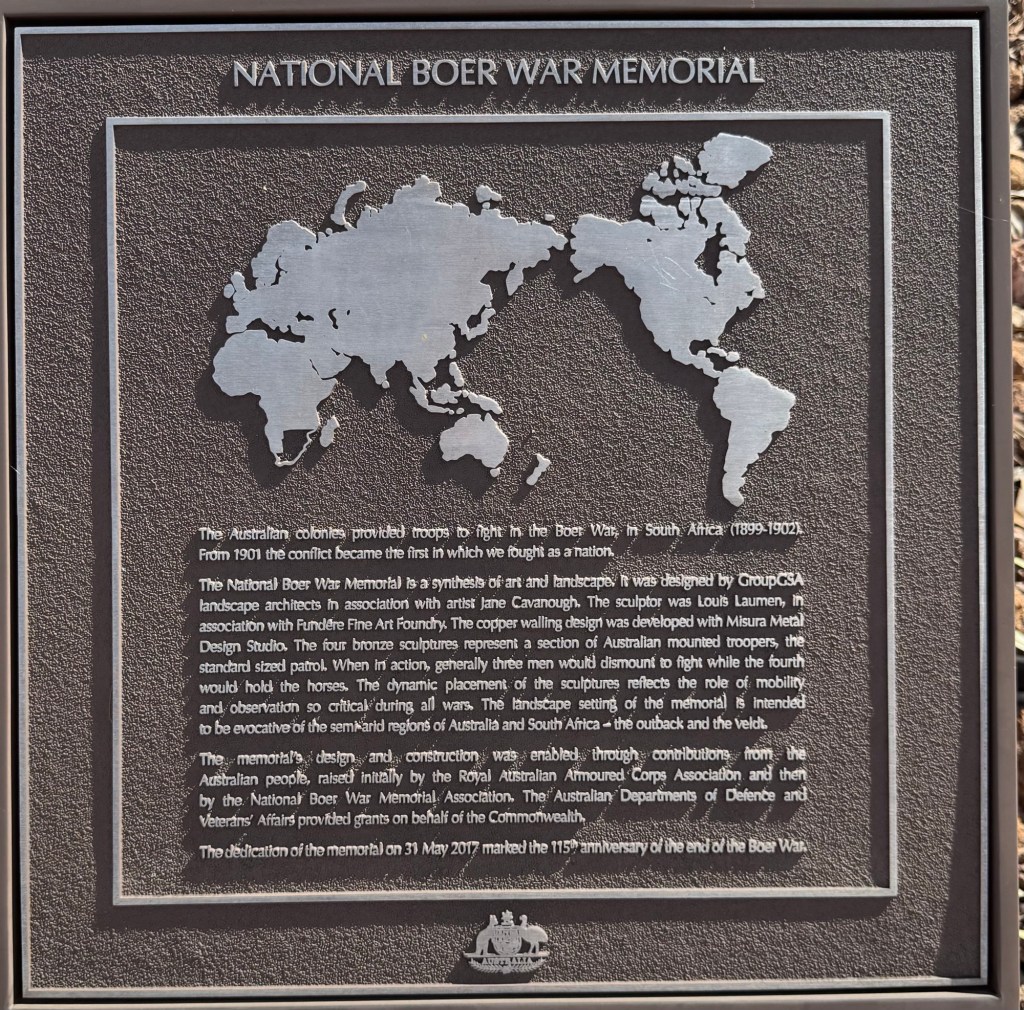
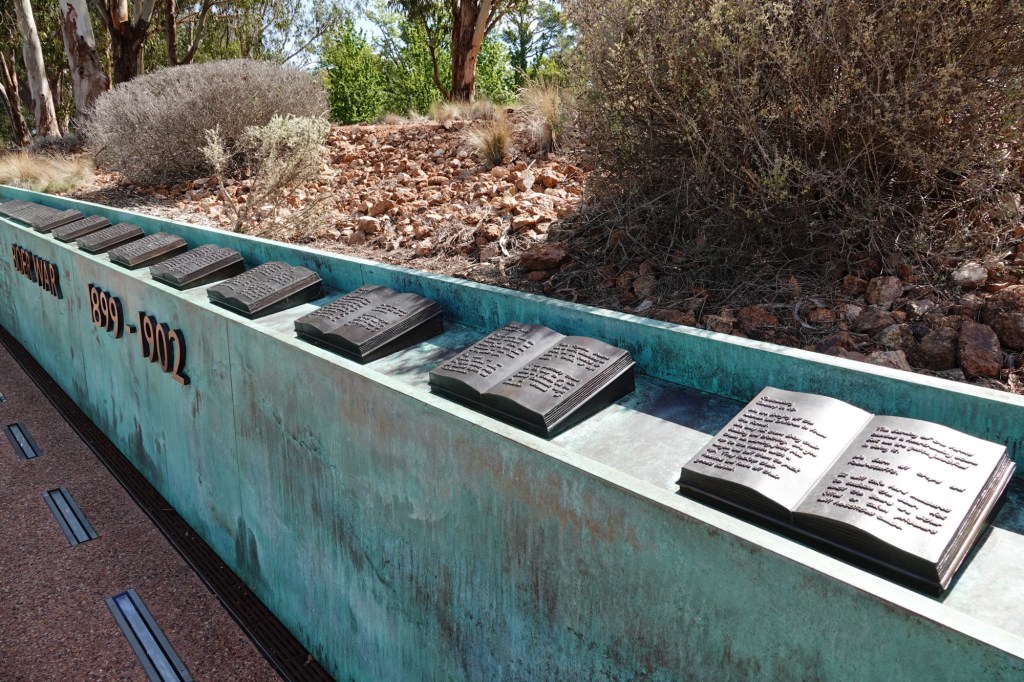
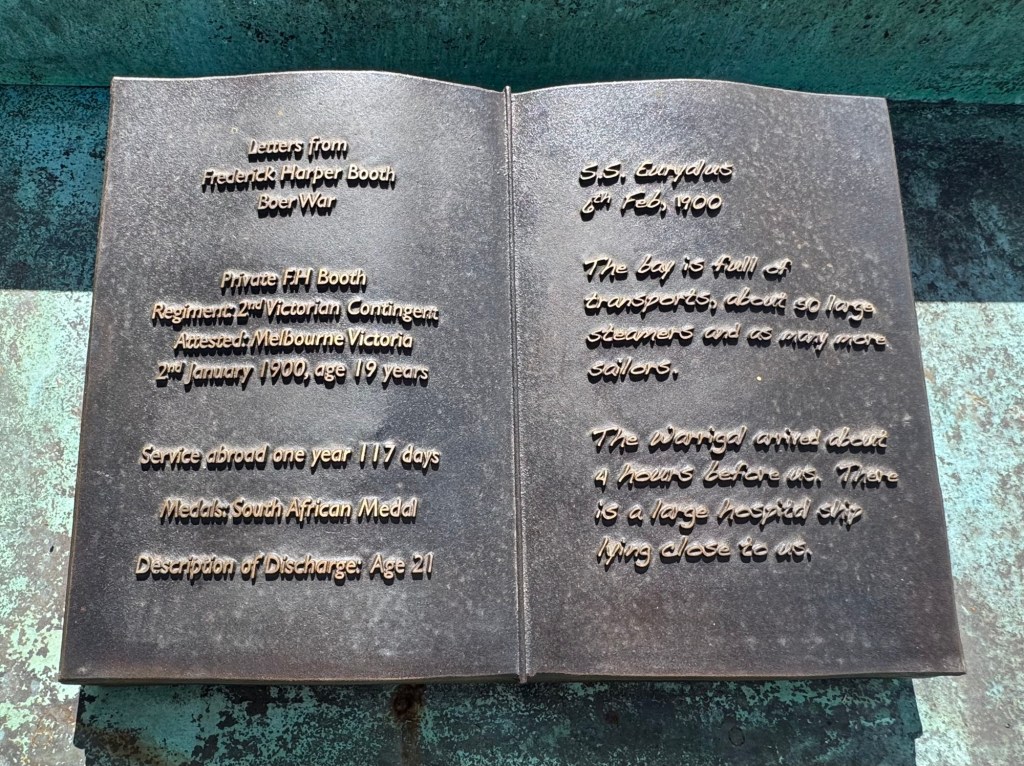
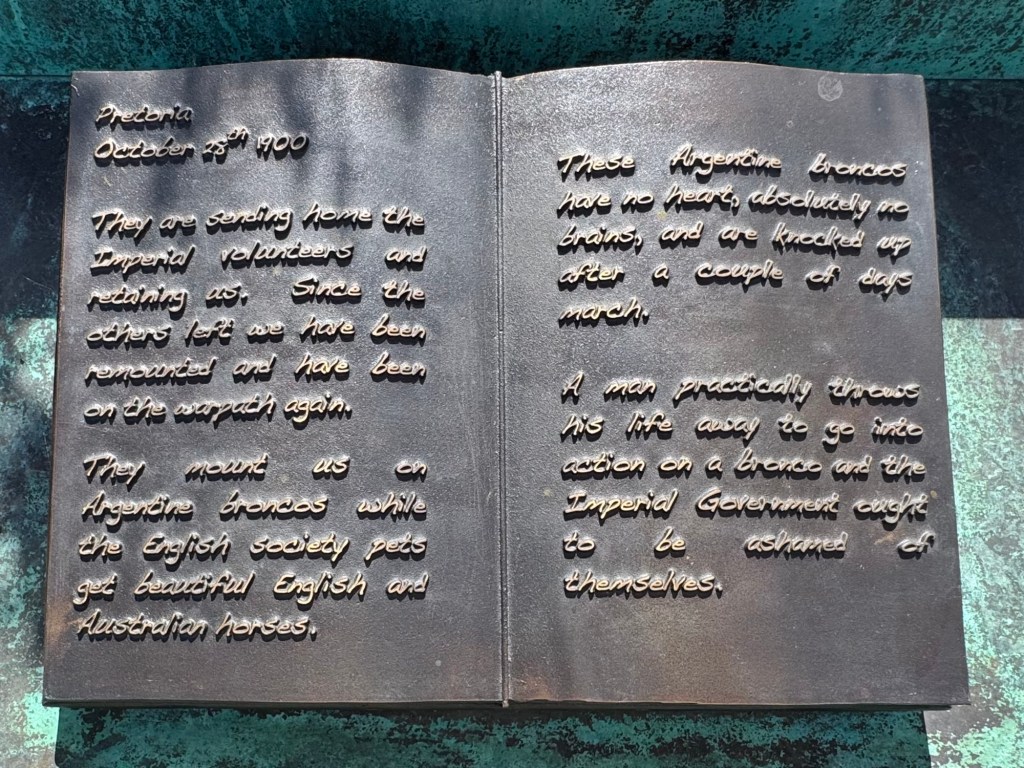
The National Boer War Memorial, which depicts a patrol of mounted Australian troopers, is dedicated to all those affected by the South African War of 1899-1902. Commonly Known as the Boer War, this was a significant event in Australian history, since it was the first major conflict in which Australia fought as a nation. Before Federation in 1901, Australian soldiers and nurses who served in South Africa came from individual Australian colonies.
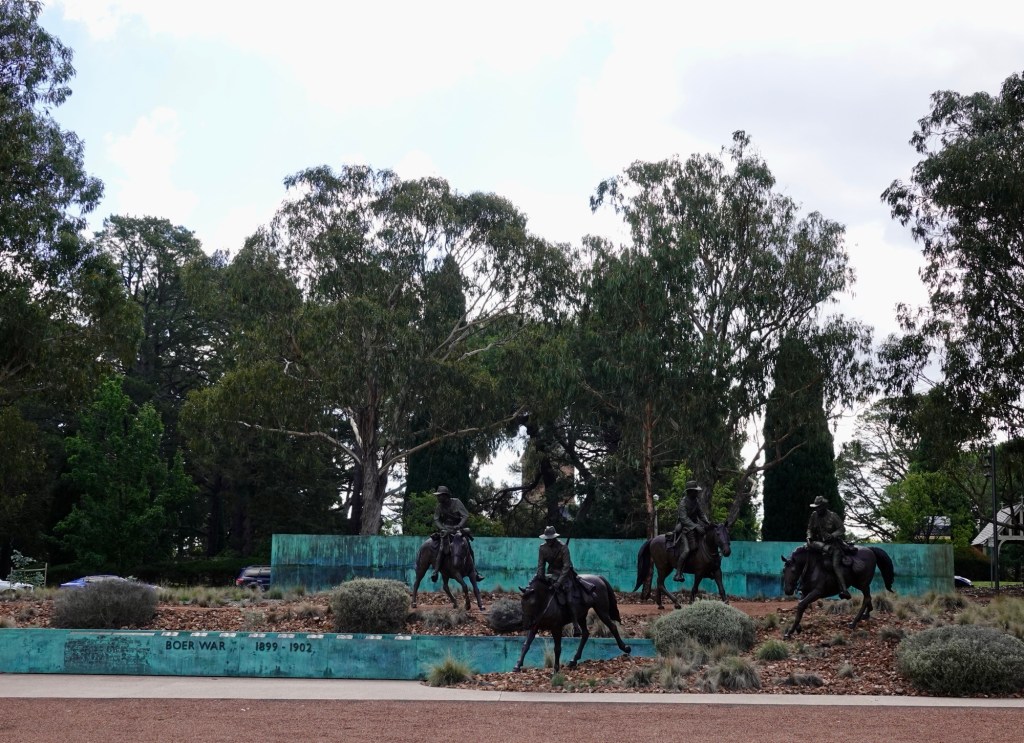
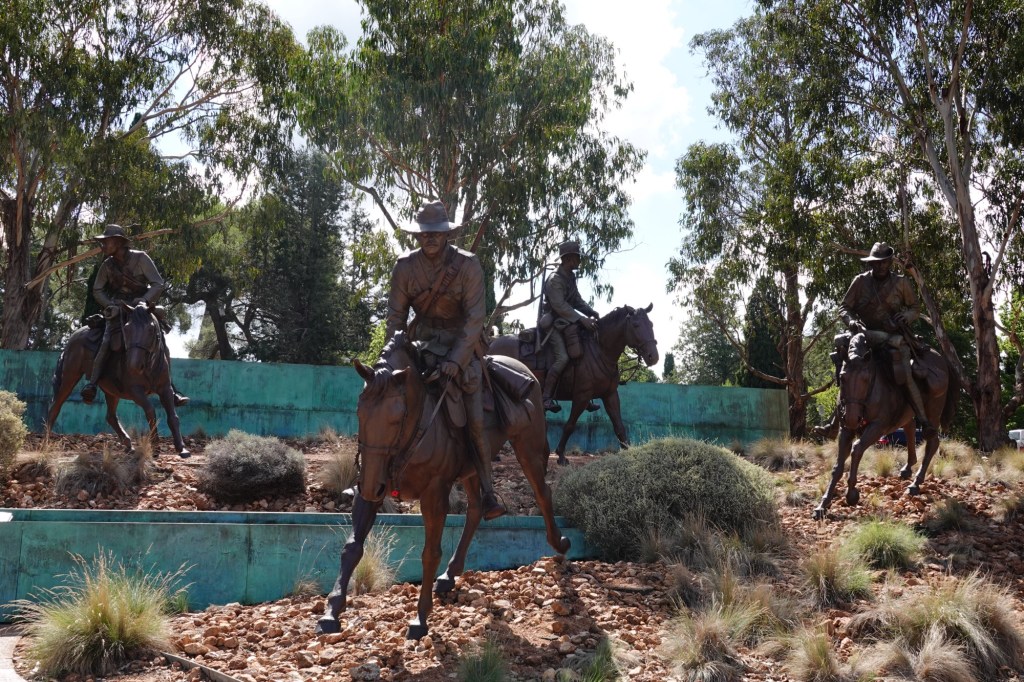
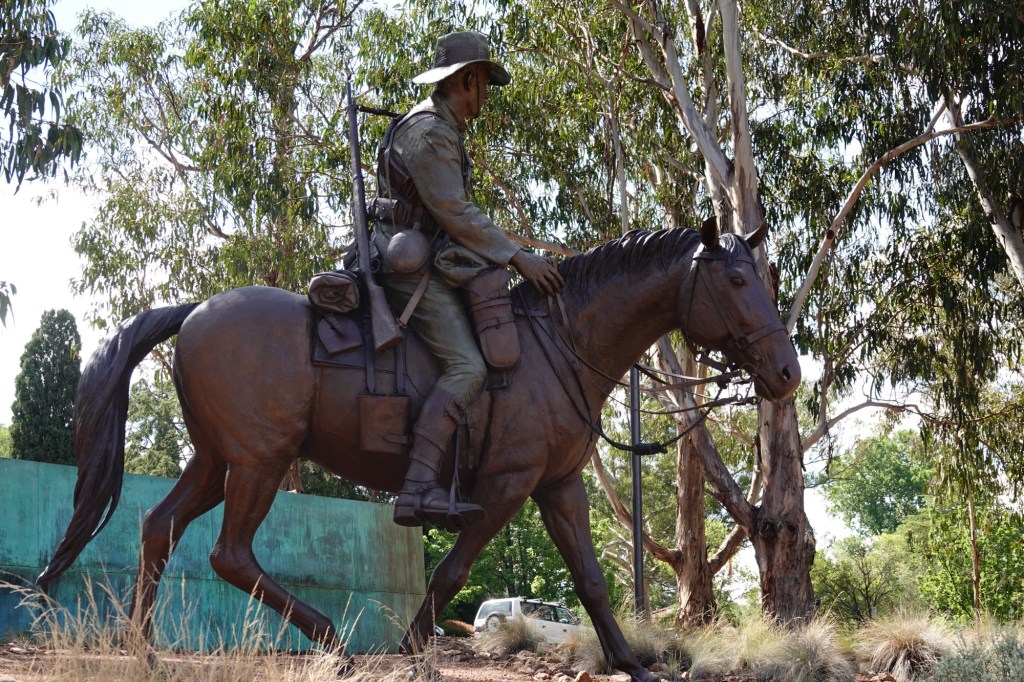
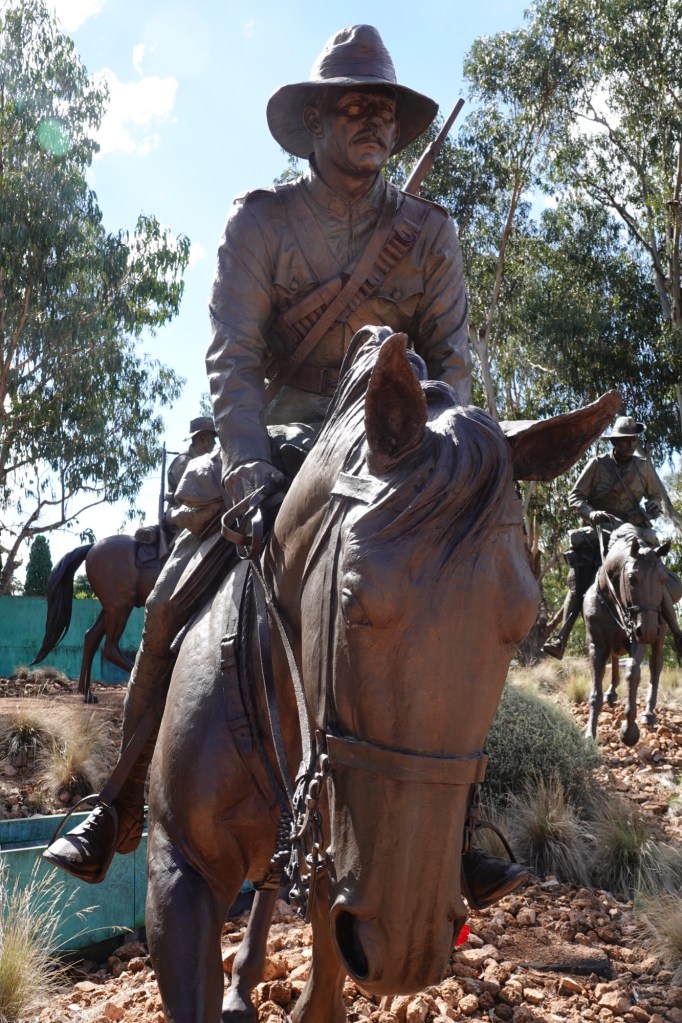
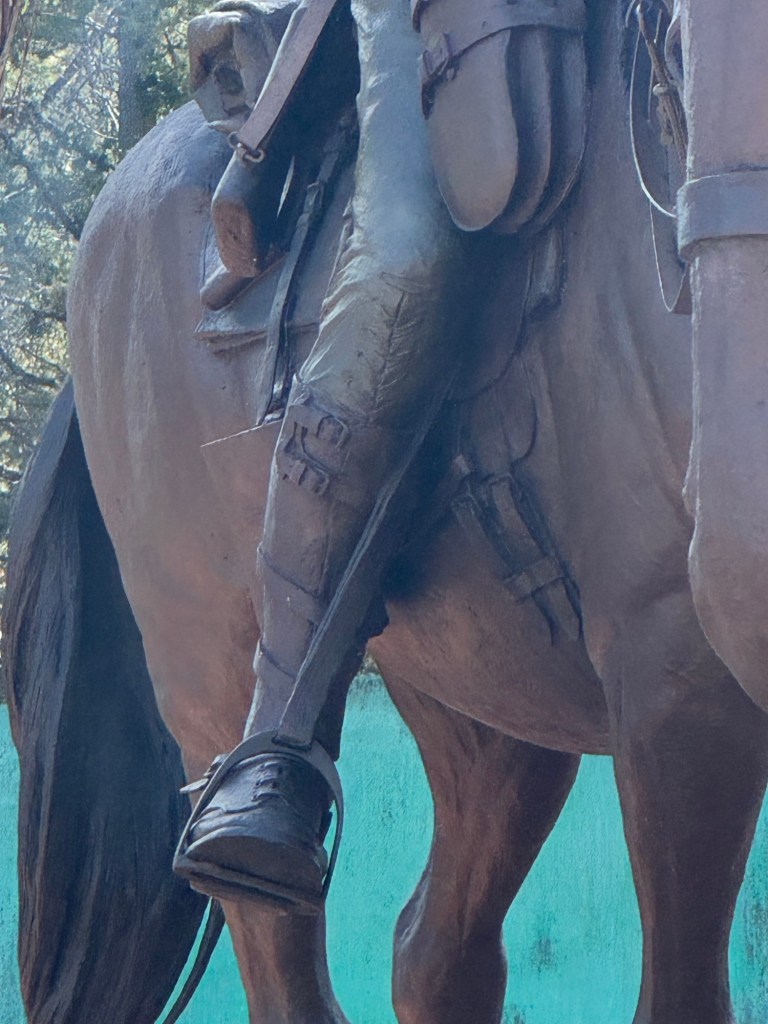
While it is the massive and incredibly detailed sculpture that initially draws the eye, it is the words surrounding the monument that really bring to life the sacrifices of war.
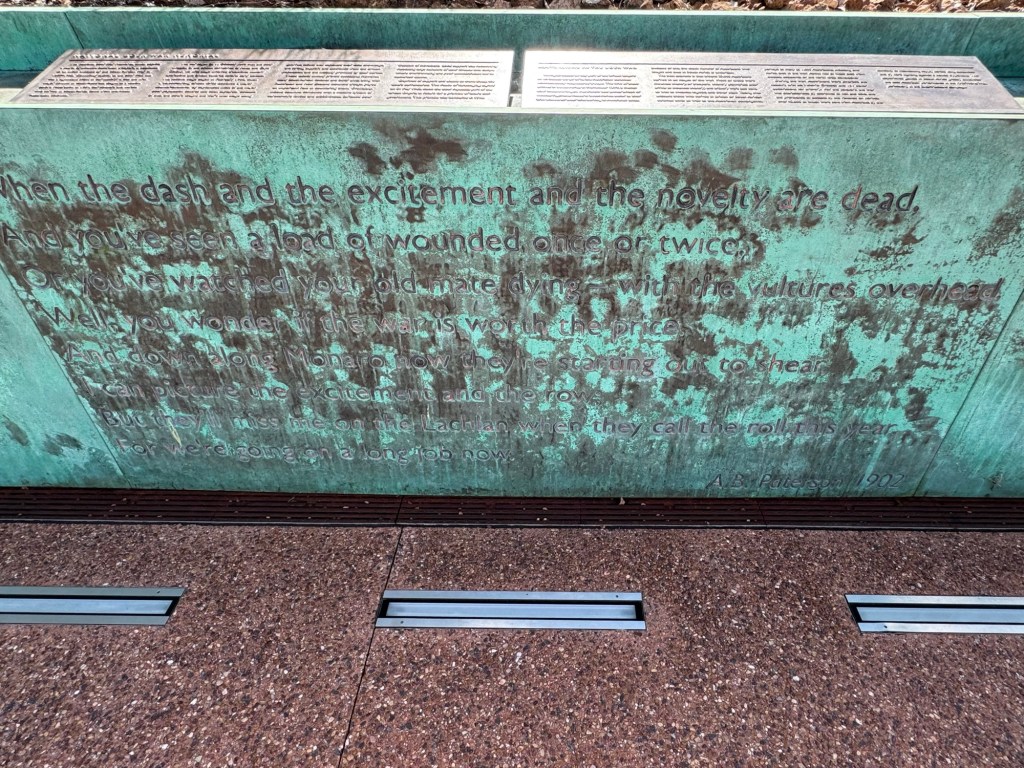
When the dash and the excitement and the novelty are dead,
And you’ve seen a load of wounded, once or twice,
You’ve watched your old mate dying with the vultures overhead
Well, you wonder if the war is worth the price
And down along Monaro now they’re starting out to shear
I can picture the excitement and the row
But they’ll miss me on the Lachlan as they call the roll this year
For we’re going on a long job now.
- A.B.Paterson 1901
THE WWI MIDDLE EAST CAMPAIGNS MOUNTED TROOPS MEMORIAL
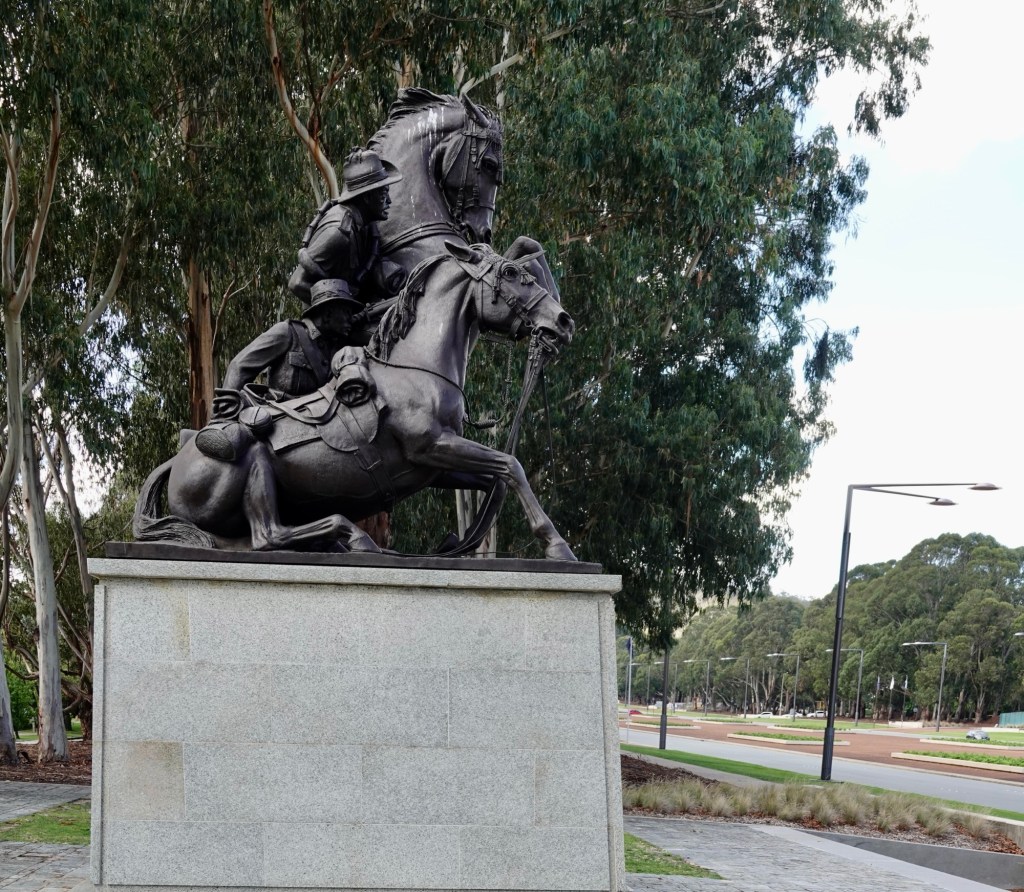
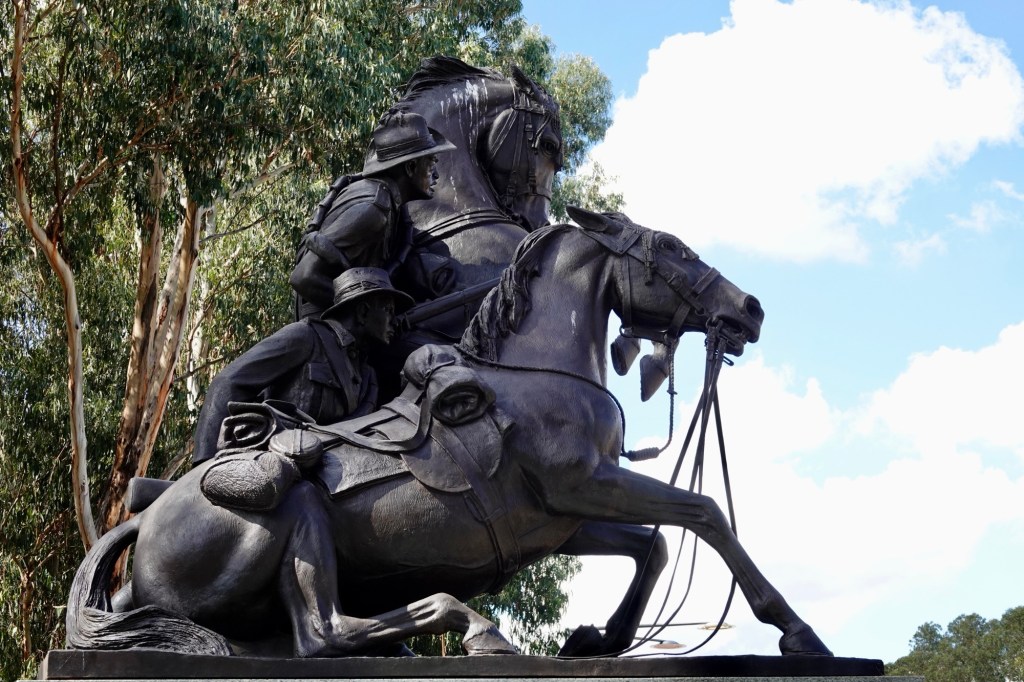
This statue is a copy of one originally forming part of a memorial which was erected at Port Said, Egypt, and unveiled on 23 November 1932. The original bore the inscription: “Erected by their comrades and the governments of Australia and New Zealand in memory of the members of the Australian Light Horse, the New Zealand Mounted Rifles, the Imperial Camel Corps and the Australian Flying Corps who lost their lives in Egypt, Palestine, and Syria 1914-1918”
The statue was irreparably damaged in 1956 during the Suez Crisis. The remnants were brought to Australia and this replica constructed in two bronze castings. It was installed here on the original masonry base, and unveiled in 1964.
THE RATS OF TOBRUK MEMORIAL
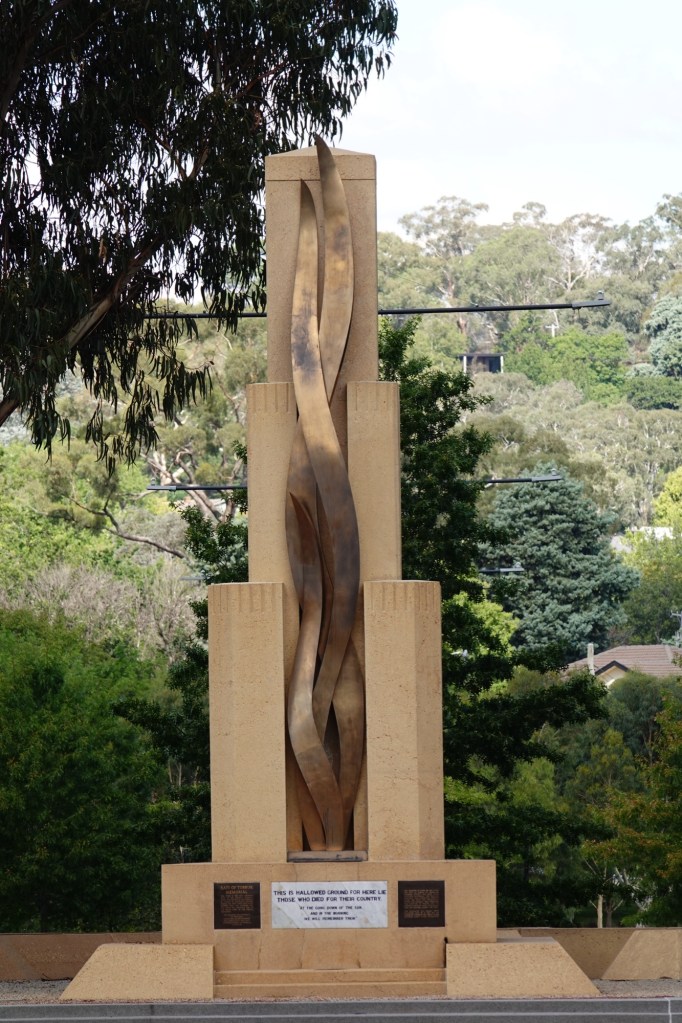
The sandstone pylon with its gold stylized flame honours the Allied forces—including Australian, British, and Indian troops—who defended the Libyan port of Tobruk for eight months in 1941 against German forces, and commemorates the 680 Australian soldiers who died during the siege.
But this one confused us.
Rats?
A bit of research solved the mystery.
The memorial emphasizes the troops’ defiance by embracing the epithet “rats”, which was a term used by German propaganda to try to dishonour them.
THE VIETNAM MEMORIAL
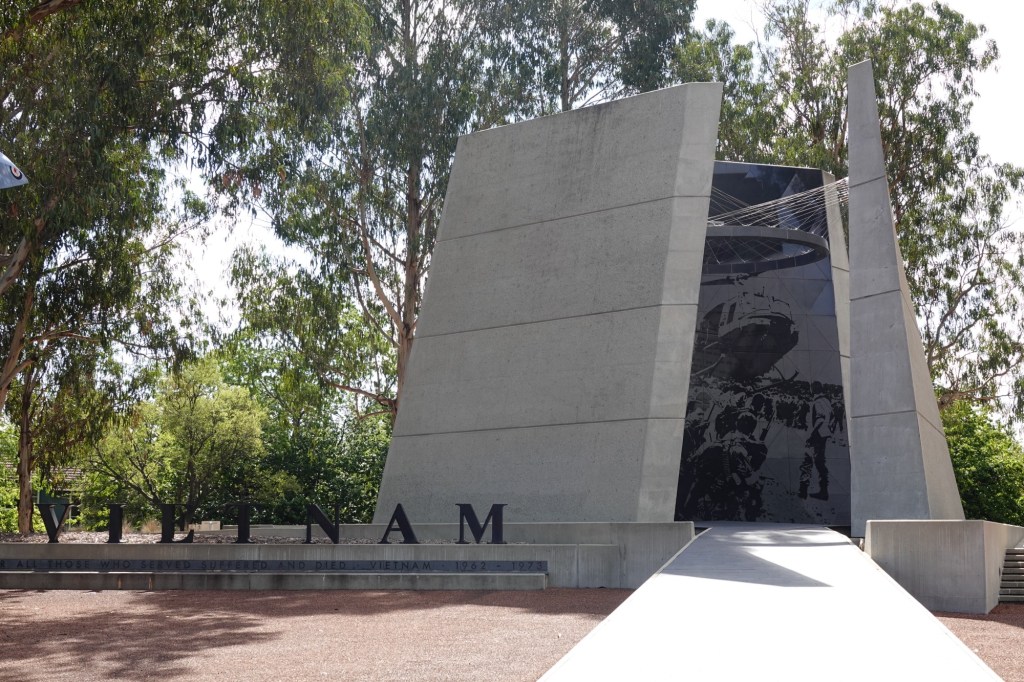
There is little doubt that this memorial was, to me, the most beautiful, despite being outwardly quite plain .
The combination of images, words, water, and sky – all emphasized by being able to enter the centre of the memorial and look up at a suspended circle containing the names of all the Australians whose lives were lost in Vietnam – made it incredibly effective.
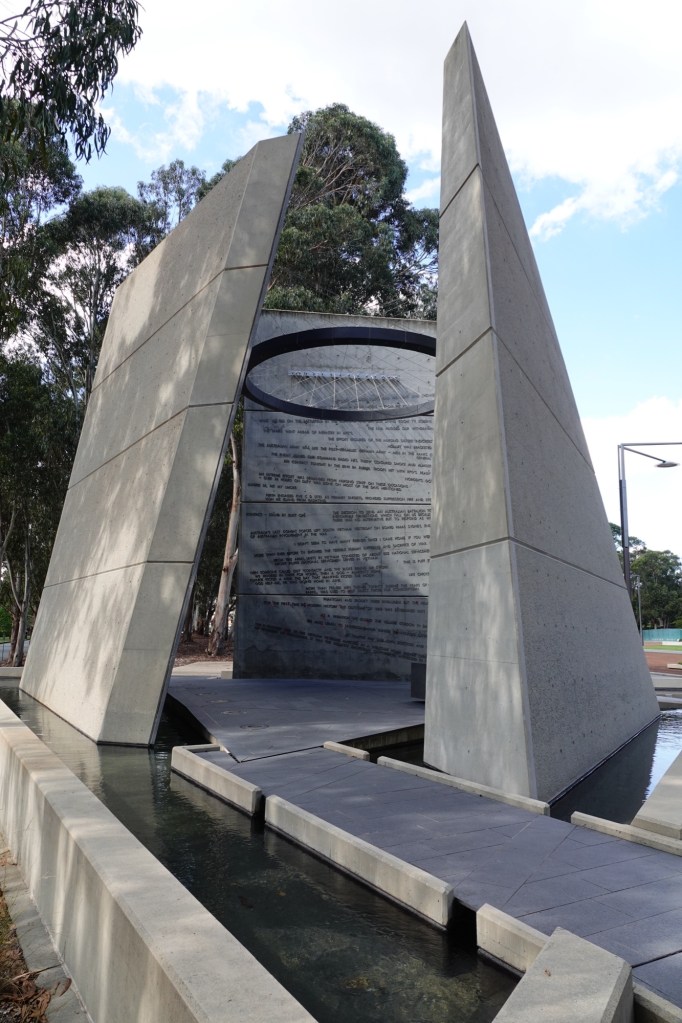
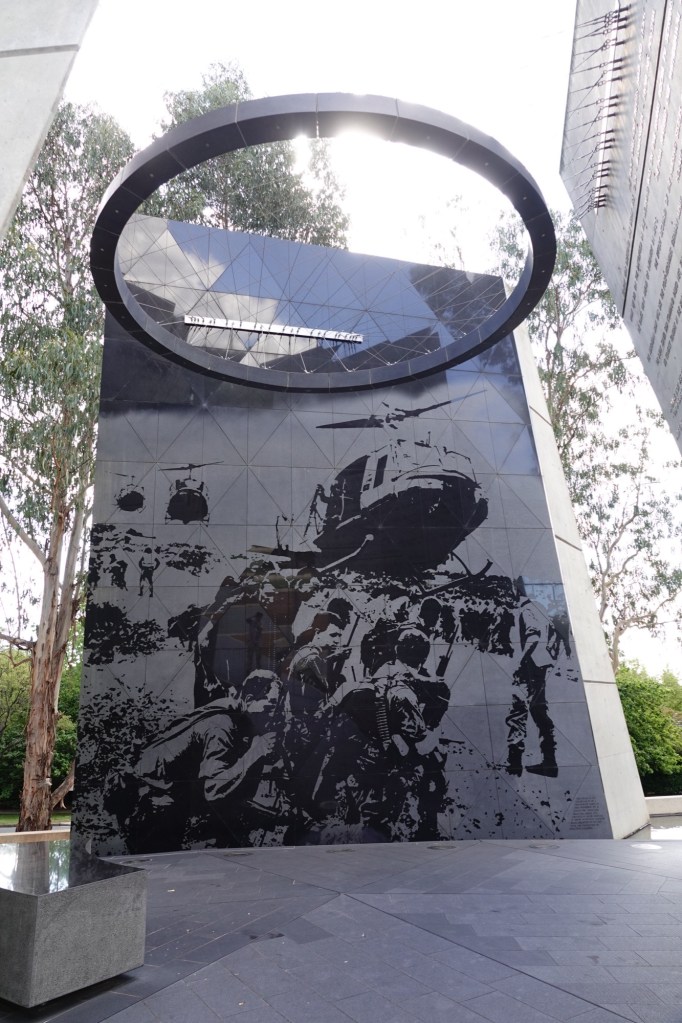
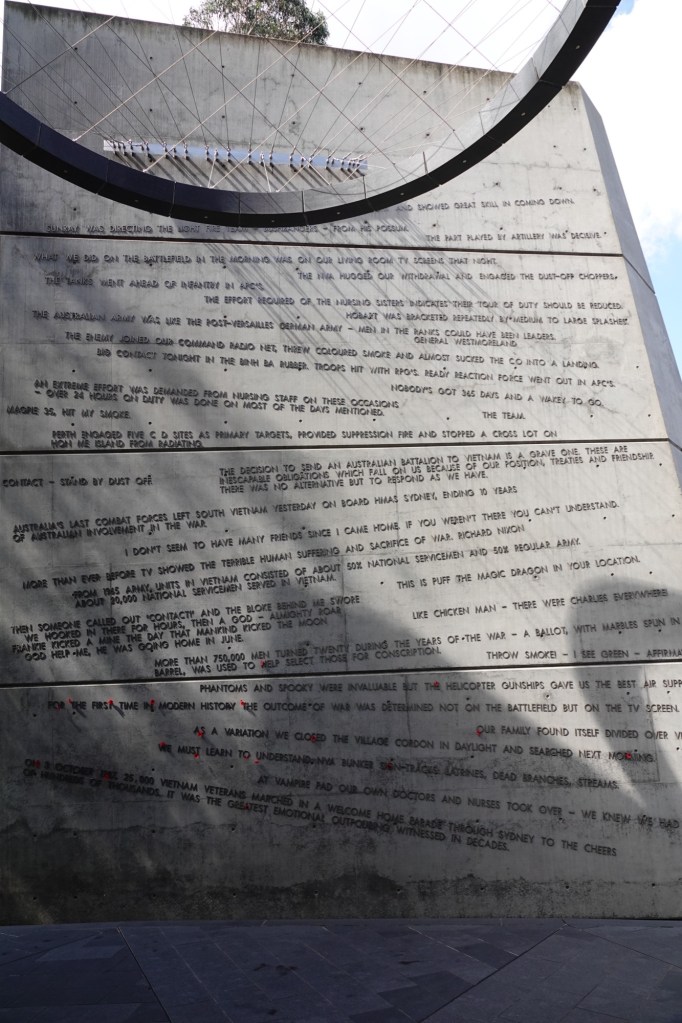
Some of the quotes from the wall shown in the photo below:
- What we did on the battlefield in the morning was on our living room TV screens that night.
- The Australian Army was like the Post-Versailles German Army – men in the ranks could have been leaders – General Westmoreland
- The decision to send an Australian battalion to Vietnam is a grave one. These are inescapable obligations which fall on us because of our position, treaties, and friendships. There was no alternative but to respond as we have.
- Our family found itself divided over Vietnam.
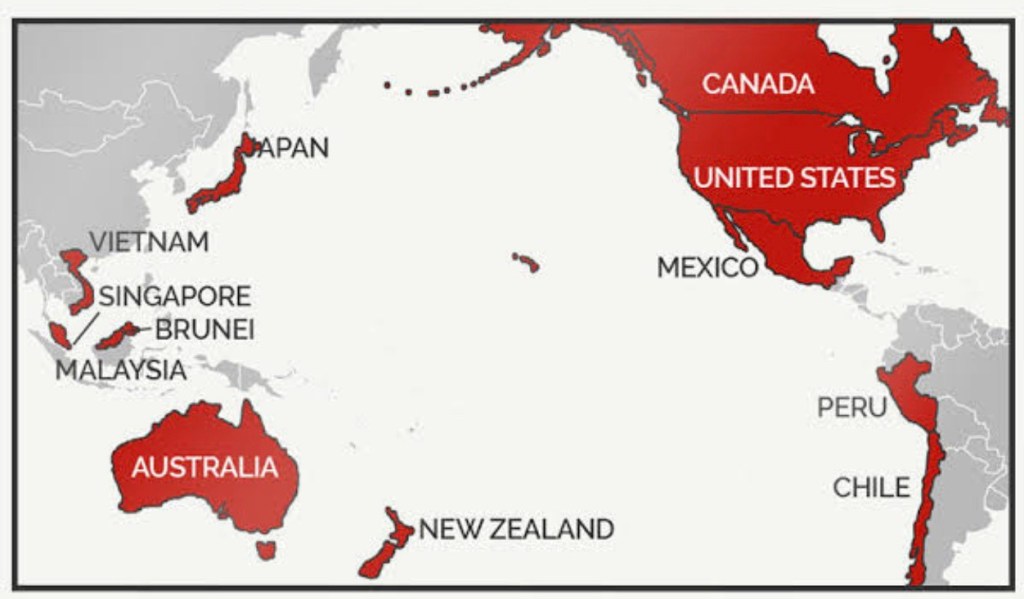
The memorial also answered a question I had a couple of days ago about why Australia joined the war and Canada did not. It was not just about alliances with the USA, but about geography. The potential path of communism travelling from China or North Vietnam to Australia is a much shorter one than across the Pacific to Canada.
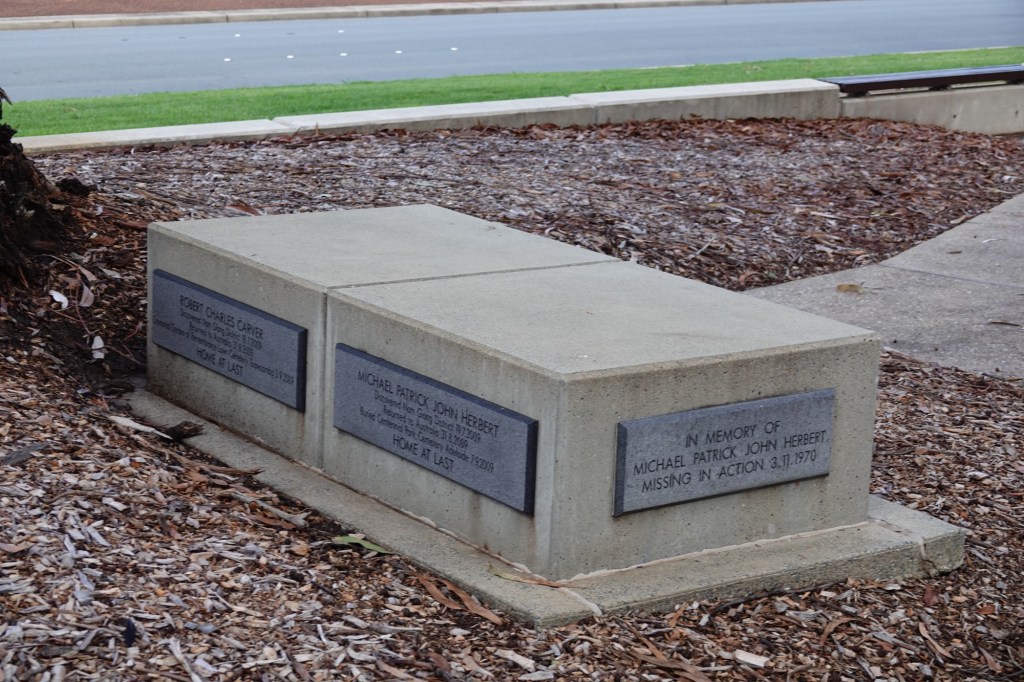
As was the case after the two World Wars, many bodies of fallen soldiers were recovered (if ever) only many decades after the wars ended.
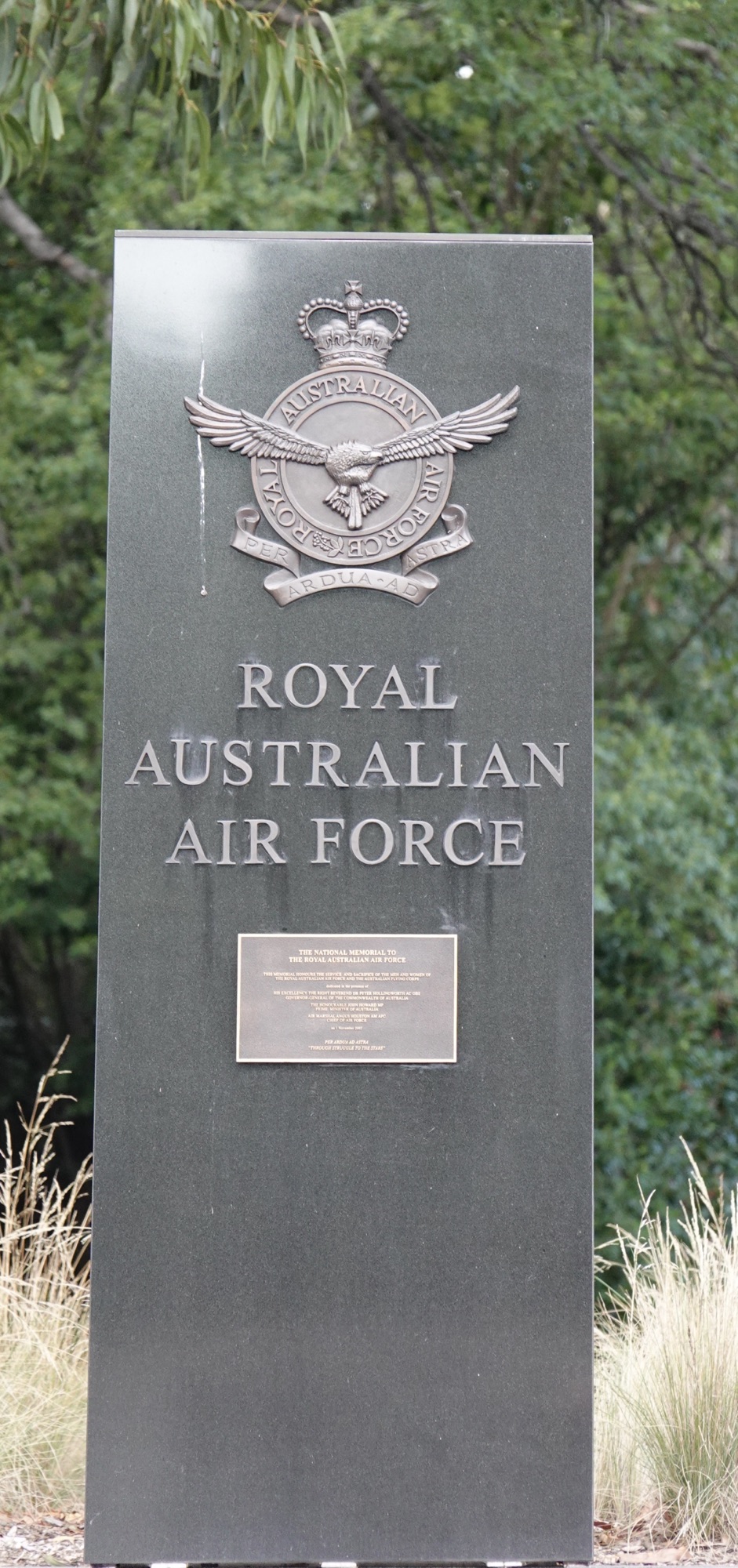
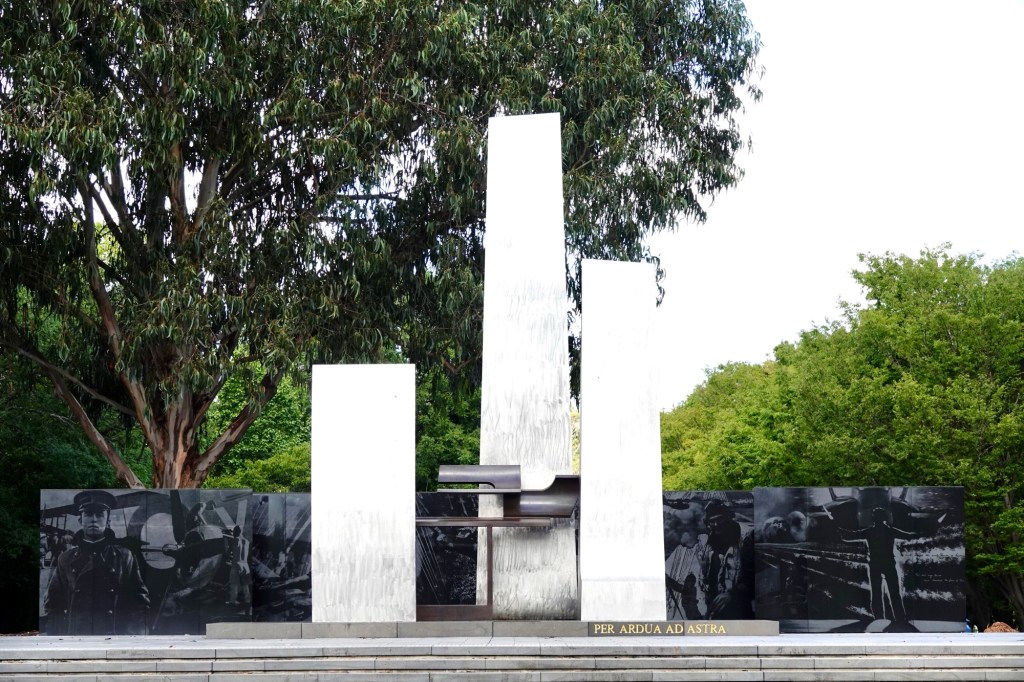
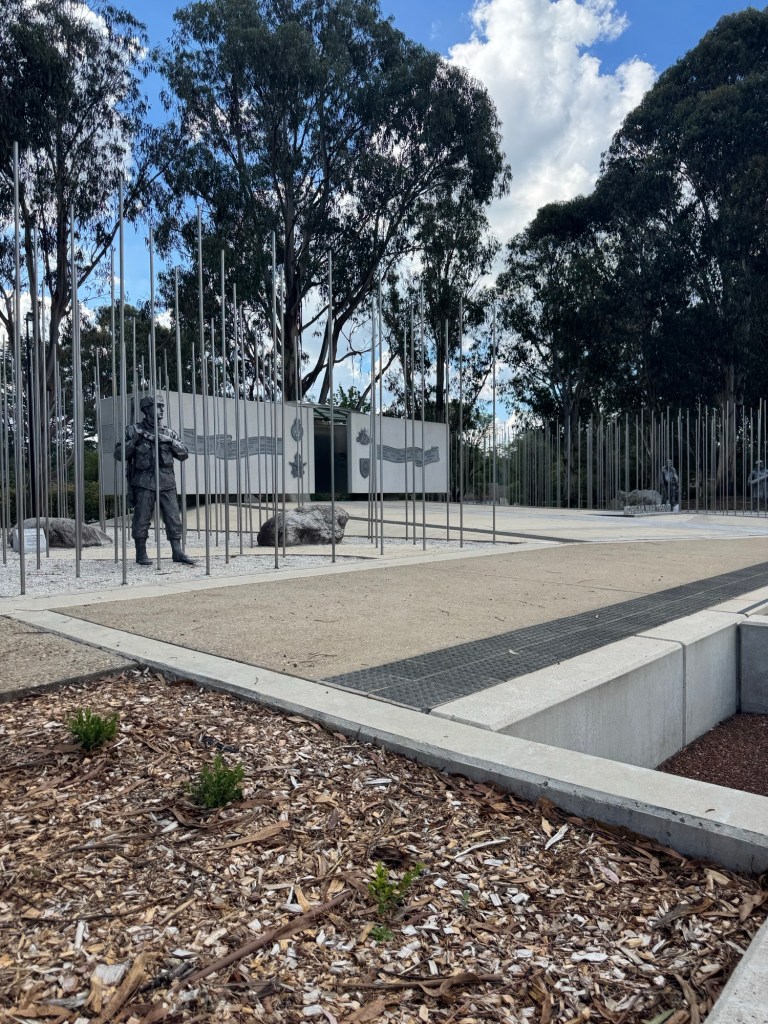
THE ROYAL AUSTRALIAN AIR FORCE MEMORIAL
THE KOREAN WAR MEMORIAL
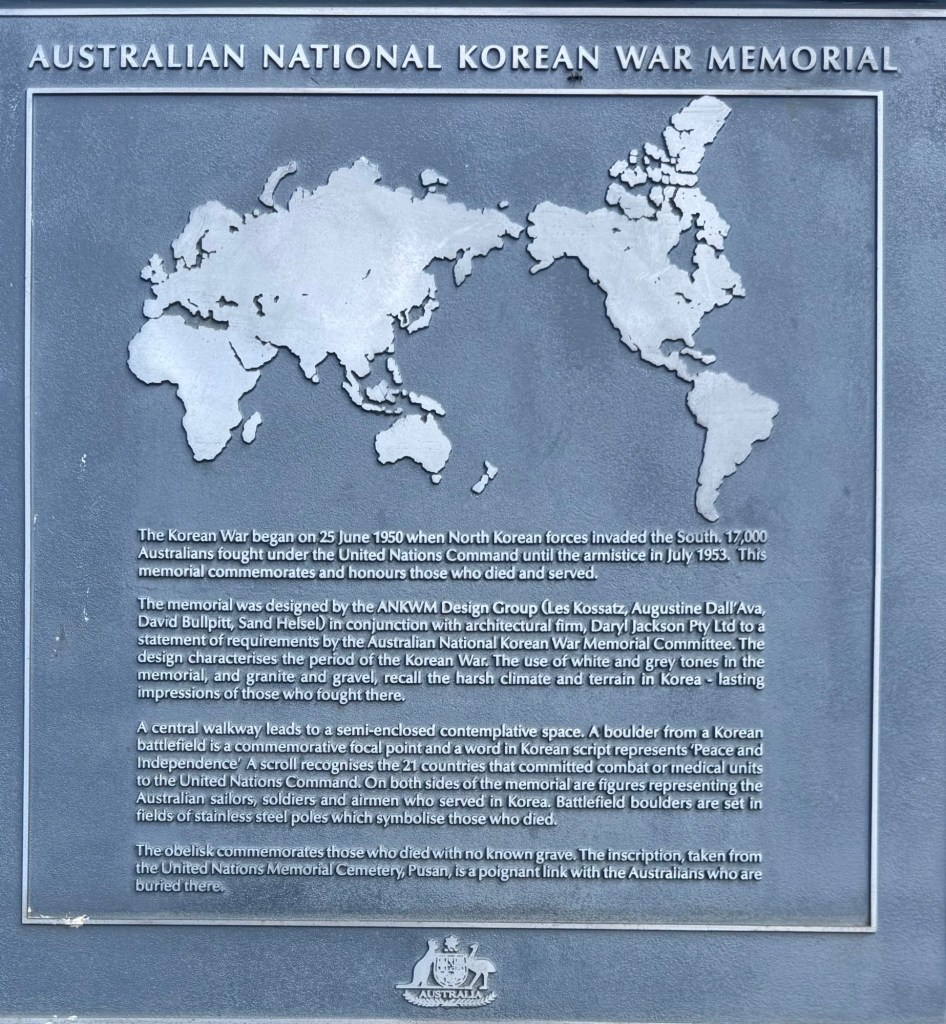
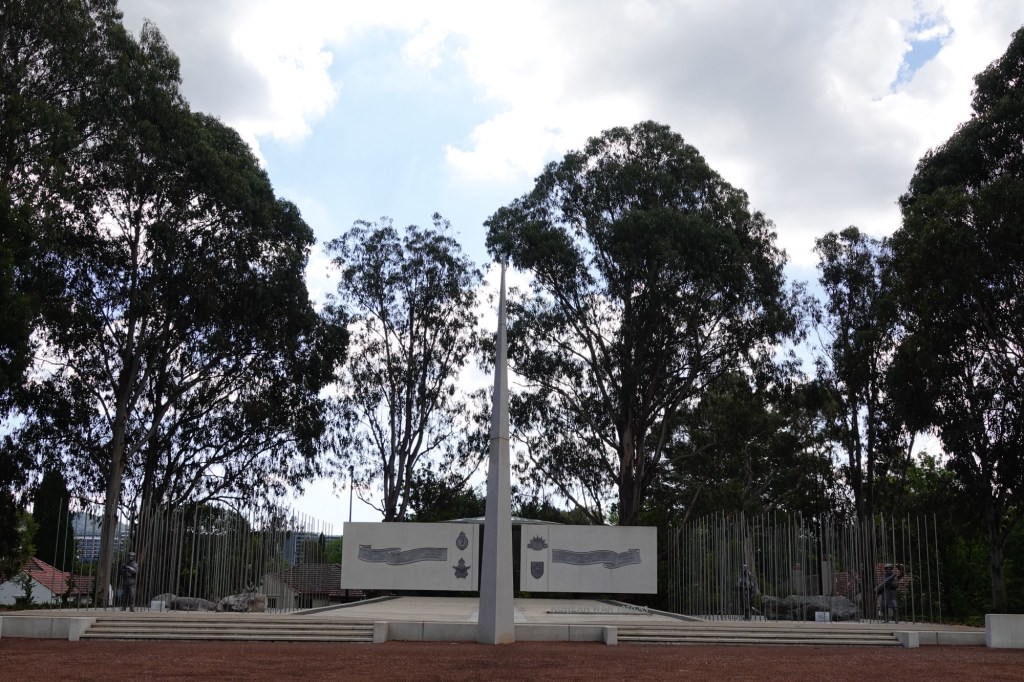
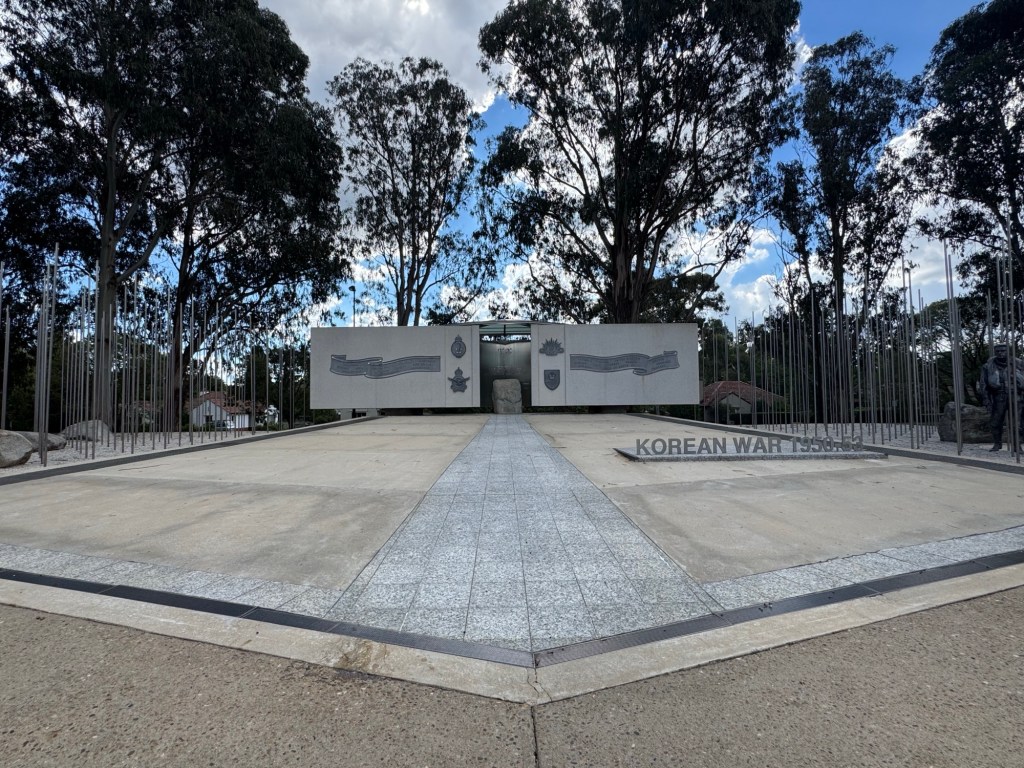
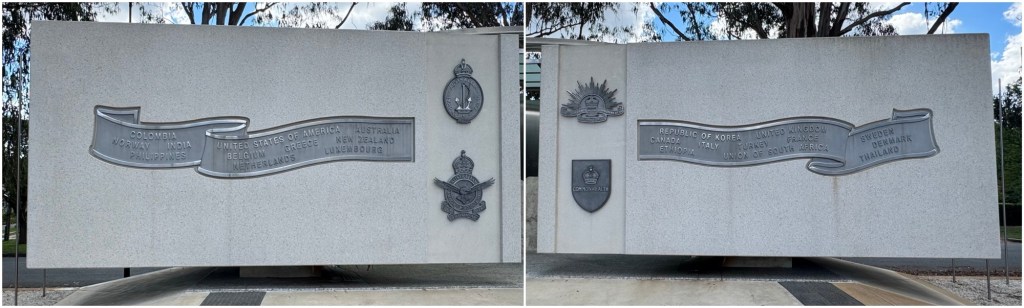
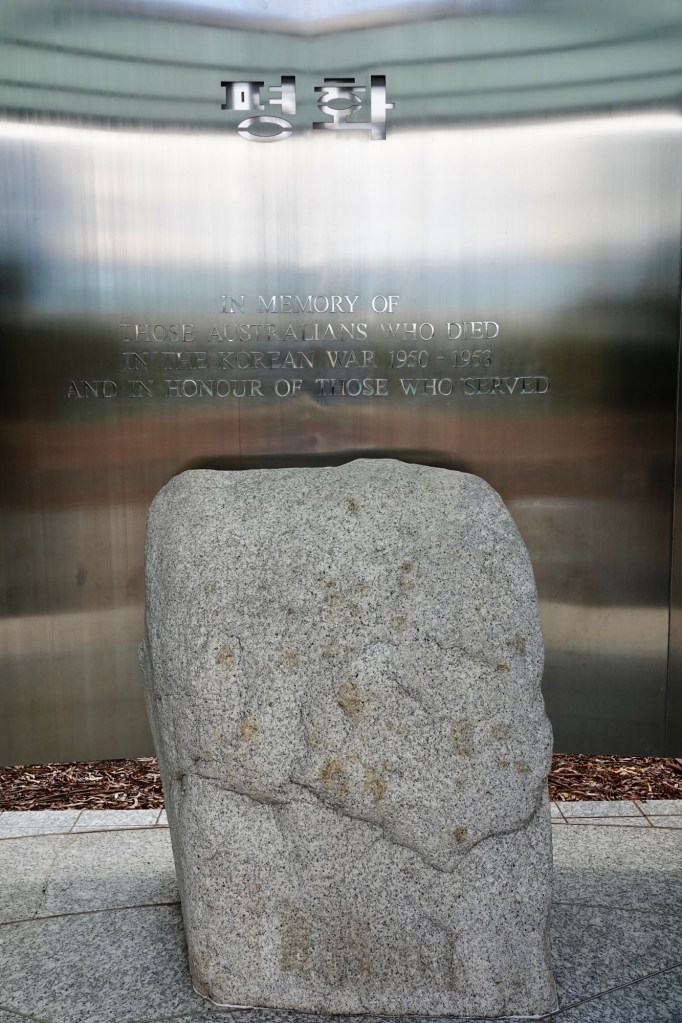
I hadn’t consciously realized until reading the information inside this memorial that the Korean War was the first occasion that members of the United Nations “acted collectively to repel aggression”. While commemorating the fallen Australian troops, the exterior of the monument also honoured the nations alongside whom Australia fought.
THE AUSTRALIAN SERVICE NURSES MEMORIAL
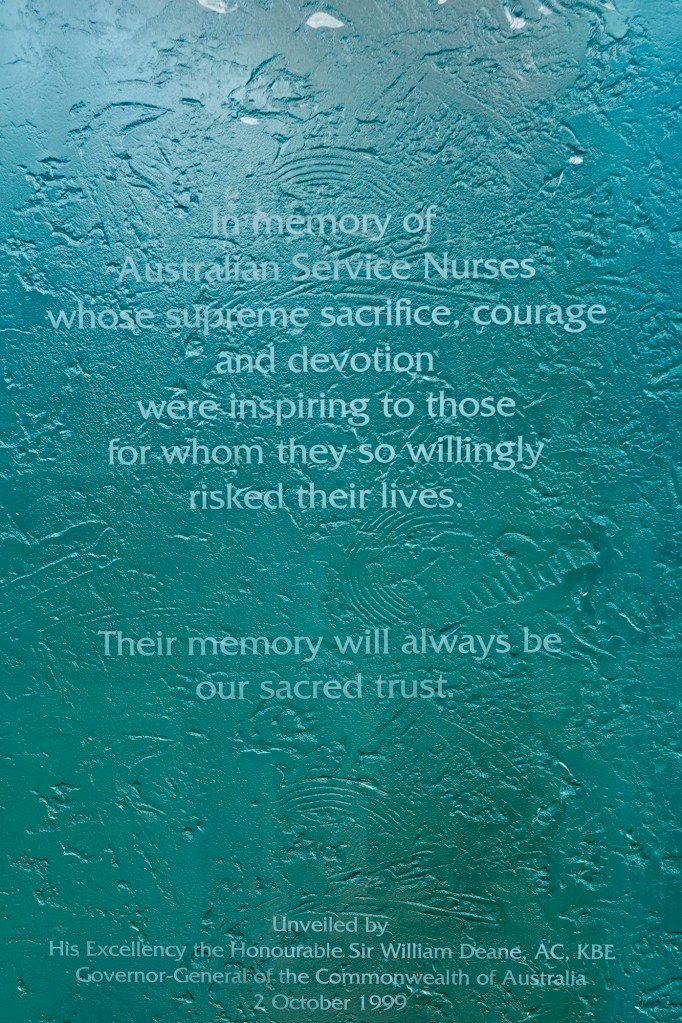
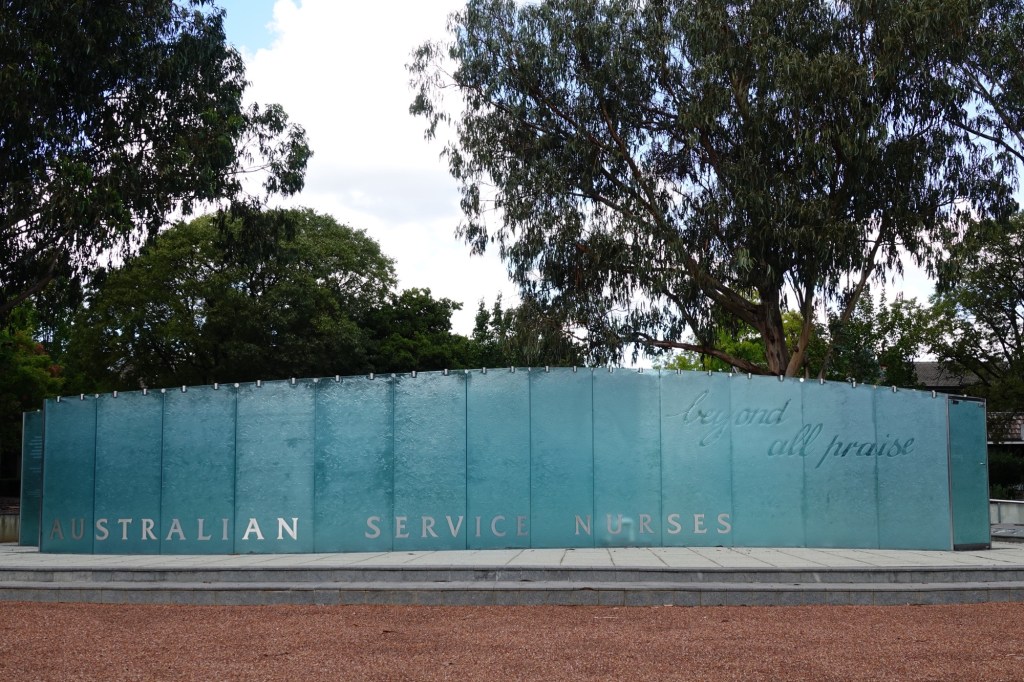
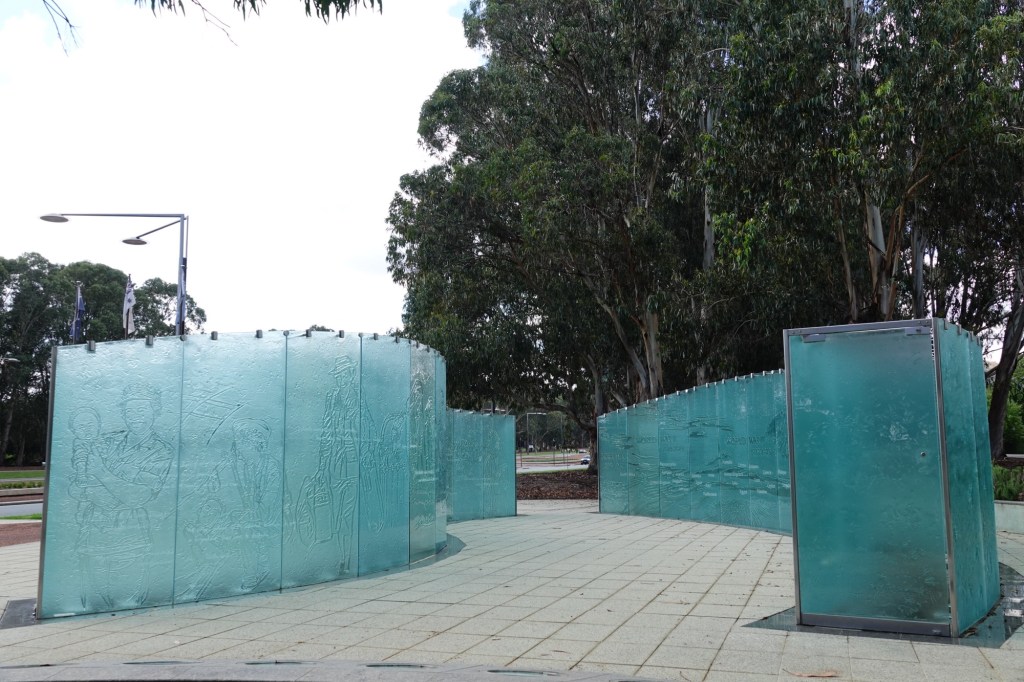
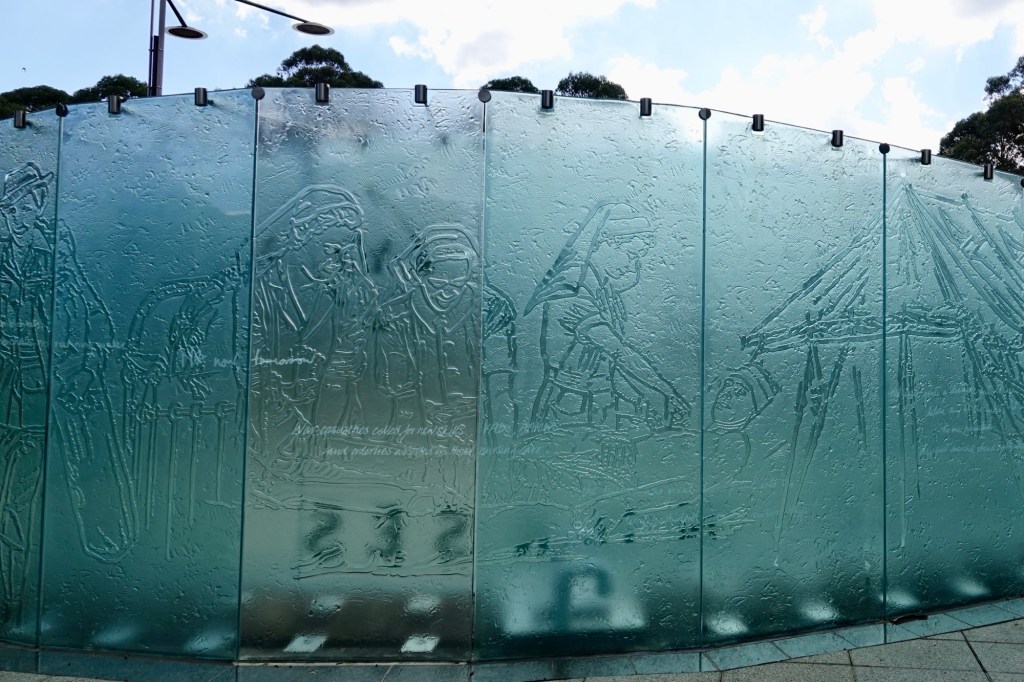
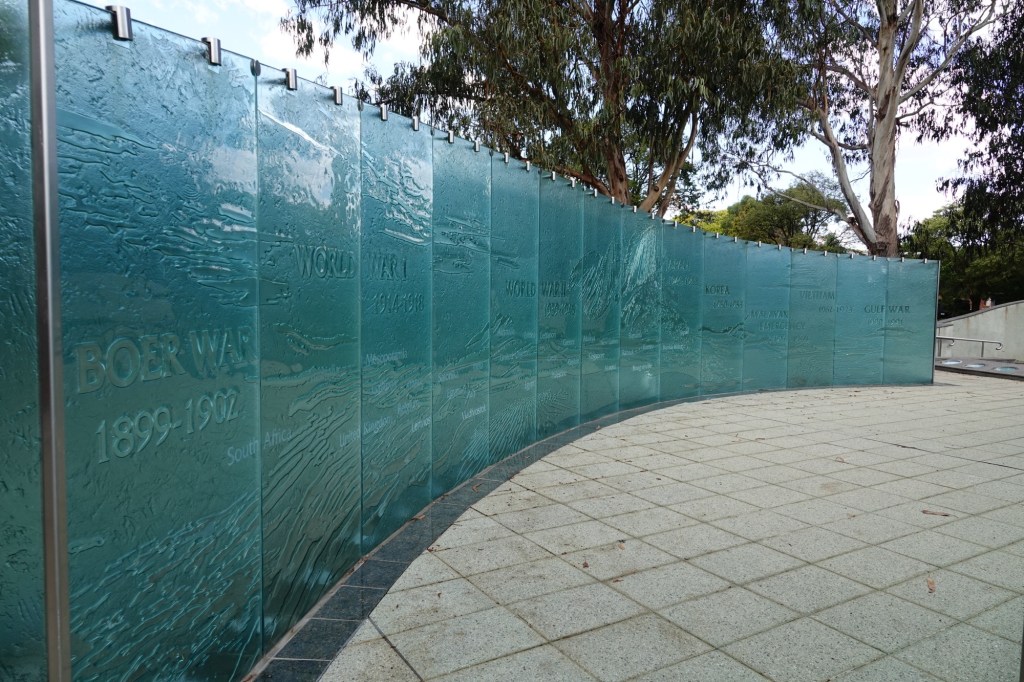
Over and over we’ve seen recognition of the contribution of nurses to the war effort. The monument on ANZAC Parade is made of wavy glacier-blue glass, etched with names and images. The colour itself suggests calm.
THE ROYAL AUSTRALIAN NAVY MEMORIAL
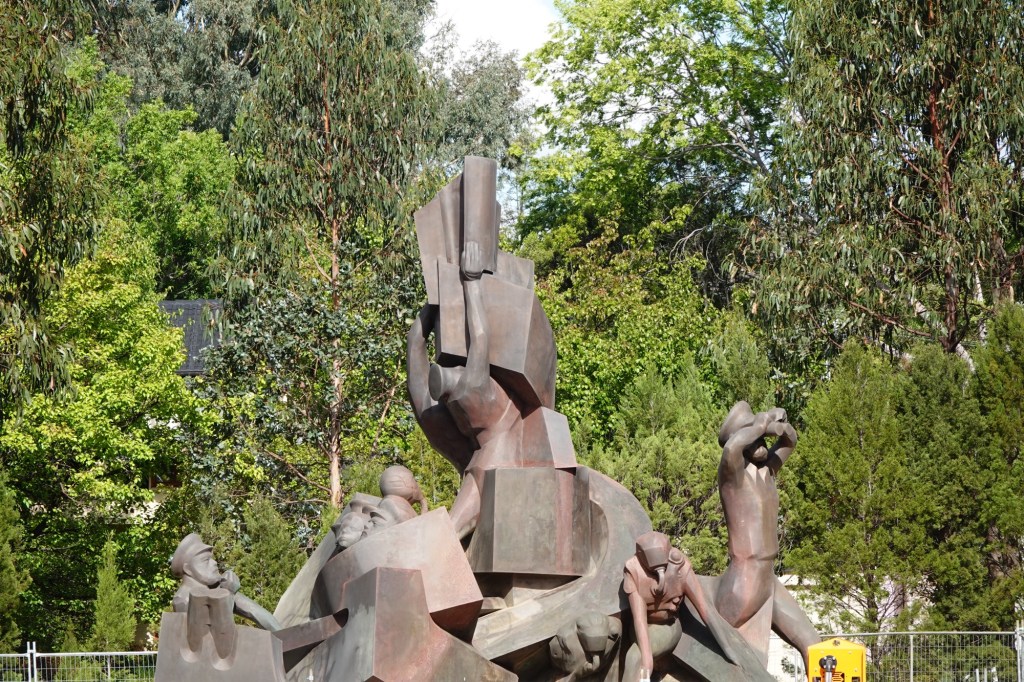
Unfortunately, we couldn’t get close to the RAN Memorial, “Sailors and Ships – Interaction and Interdependence,” because it was surrounded by hoarding while being restored. The best Ted could do was zoom in to what was visible above the barrier.
The bronze sculpture was unveiled by Queen Elizabeth II in 1986 to mark the 75th anniversary of the formation of the Navy, and commemorates all naval servicemen and women who have served to protect Australia in both conflict and peace.
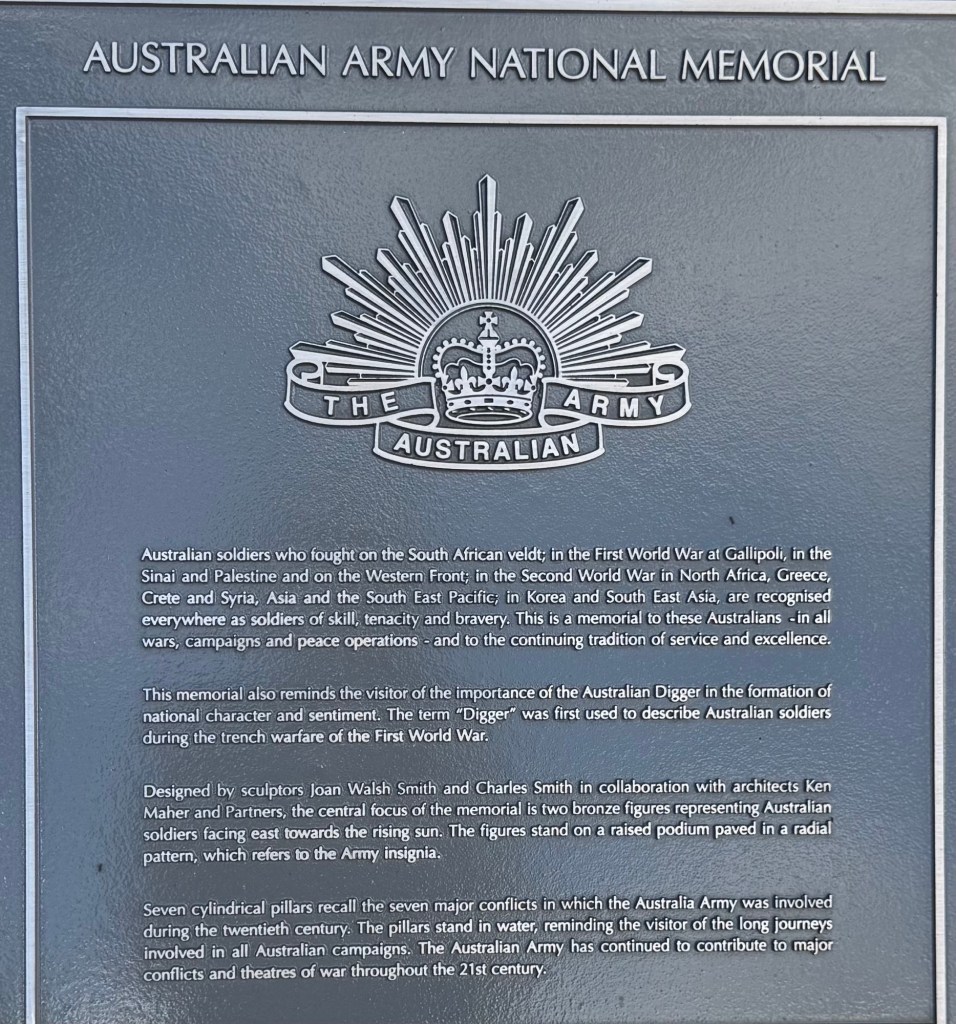
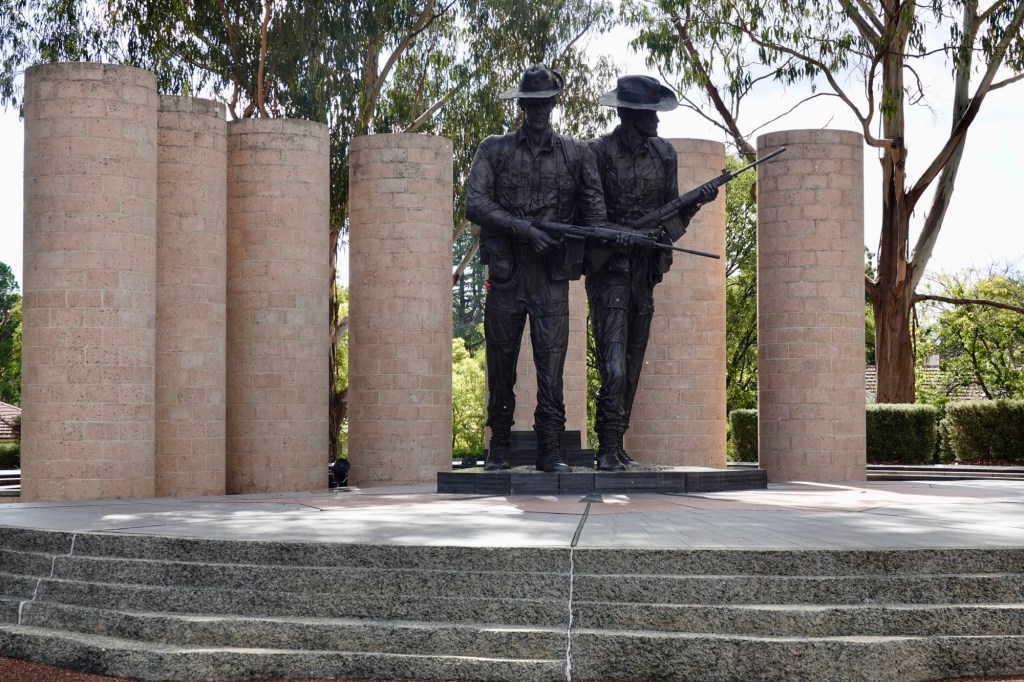
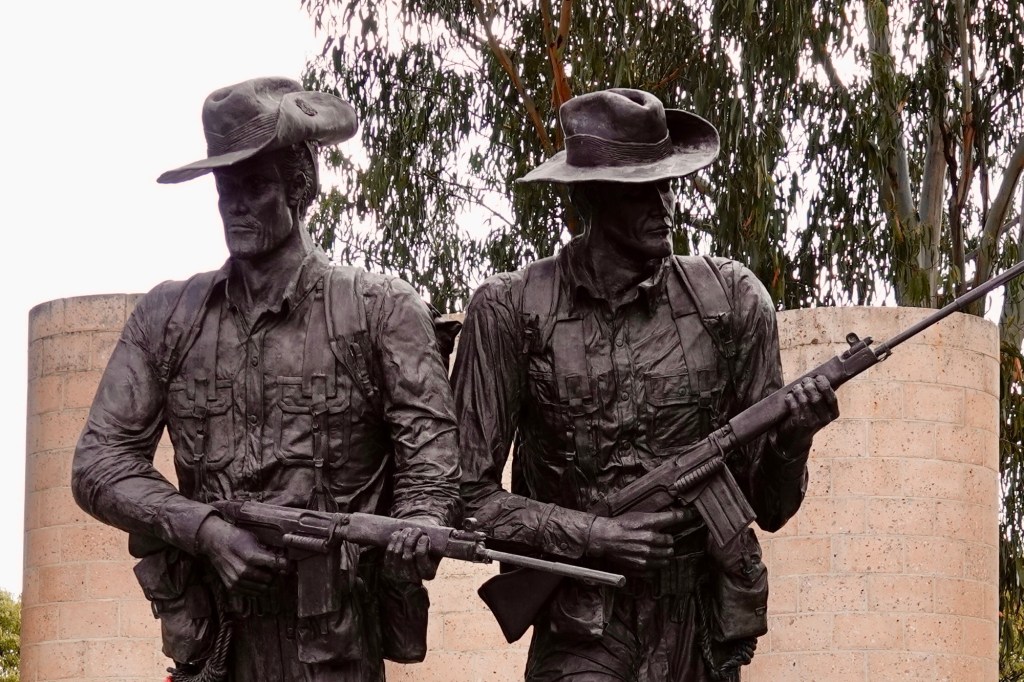
THE AUSTRALIAN ARMY MEMORIAL
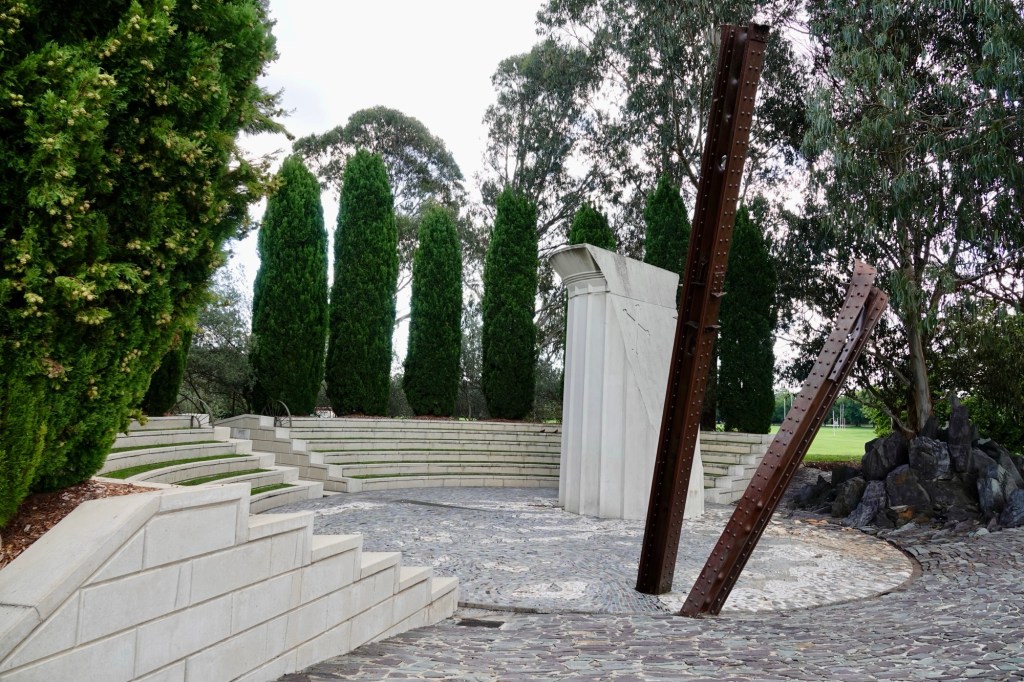
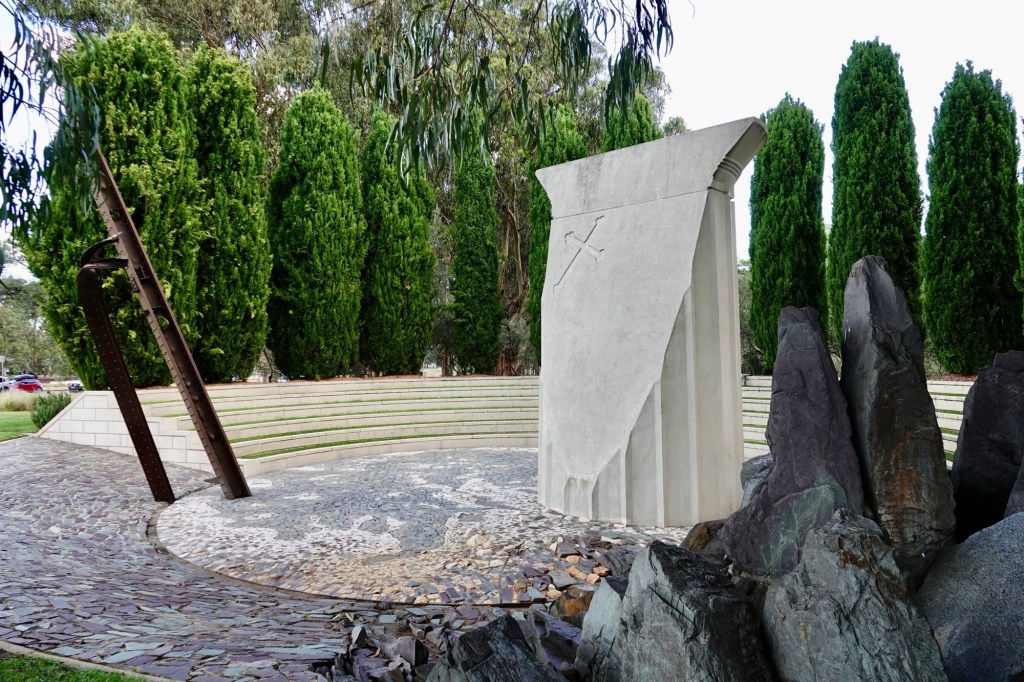
THE AUSTRALIAN HELLENIC MEMORIAL
In the future, when I think about how much symbolism can be incorporated into a single monument, this memorial is what will come to mind.
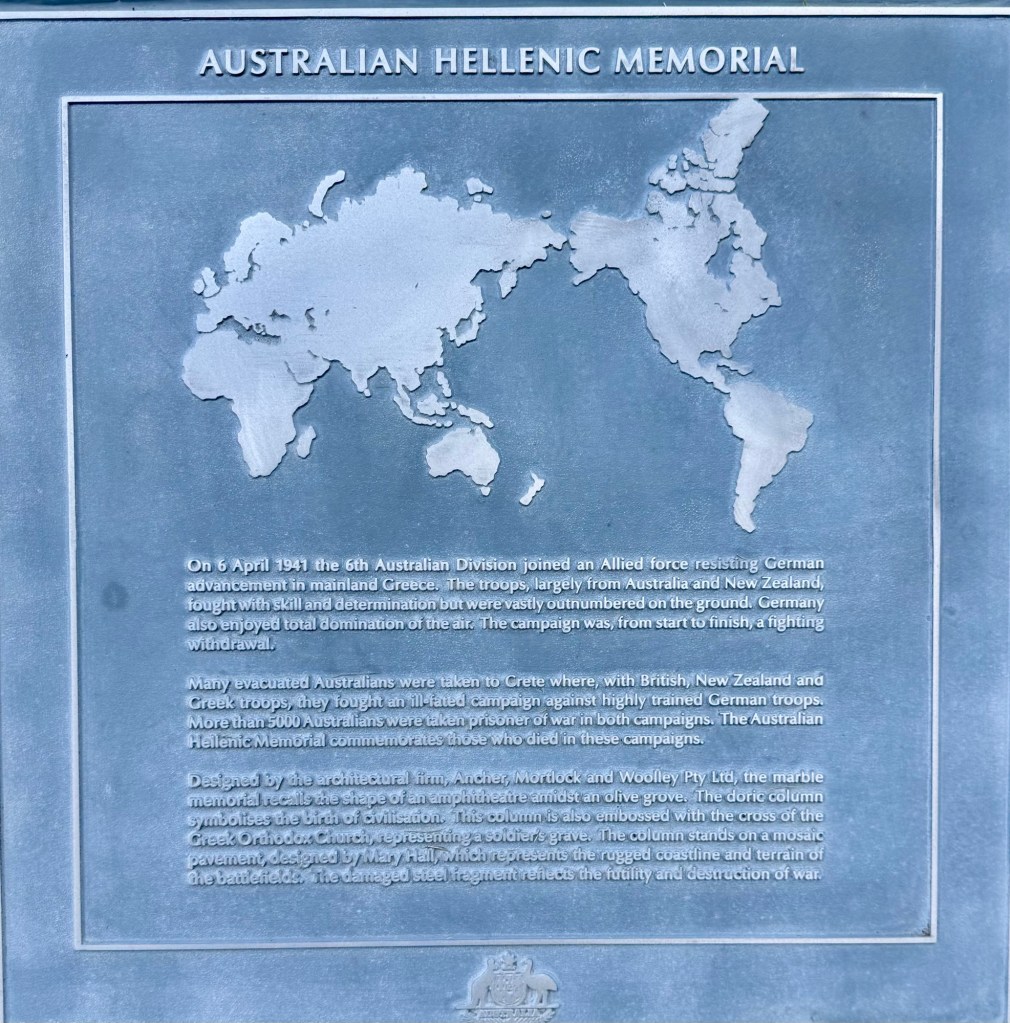
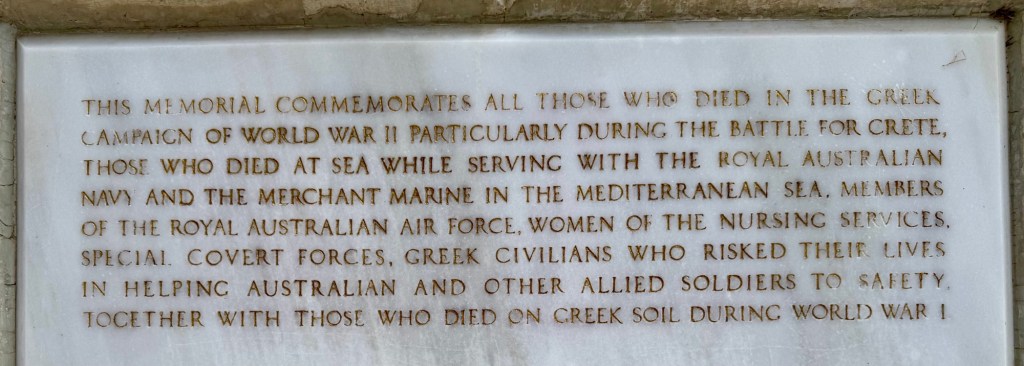
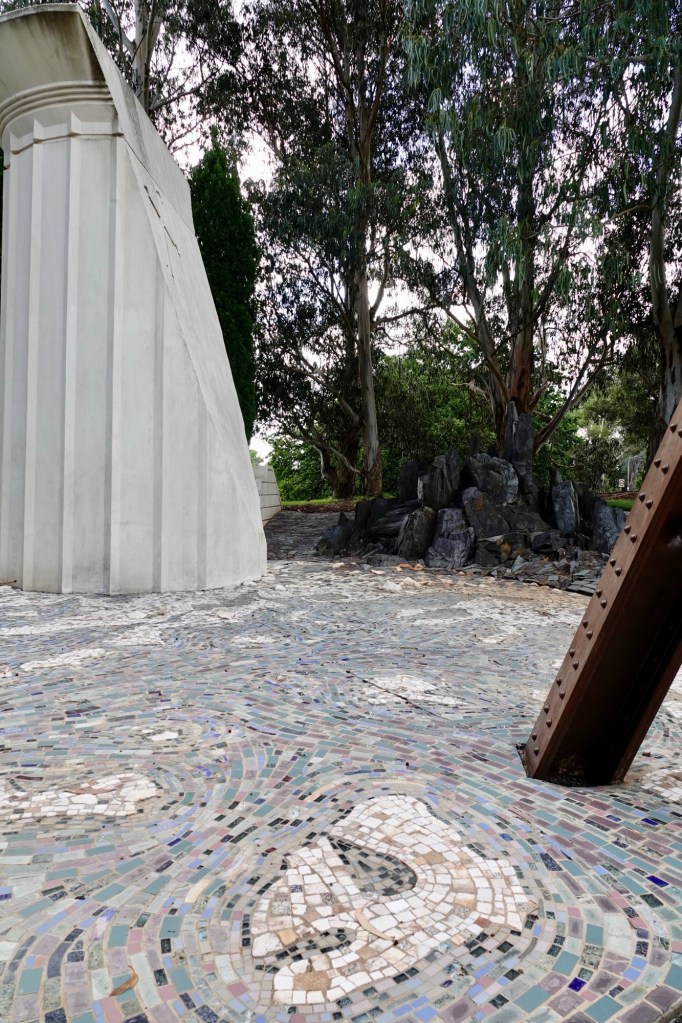
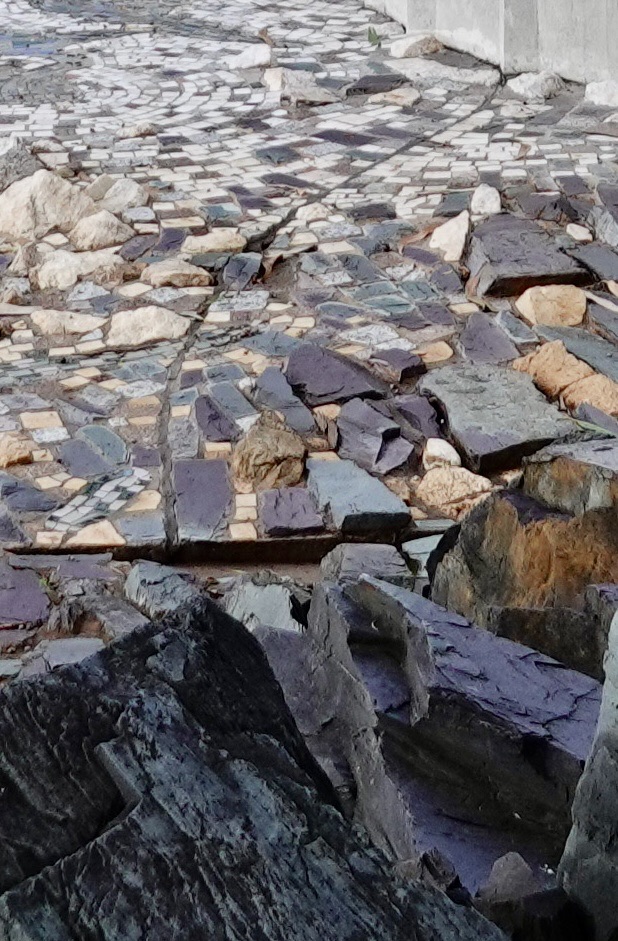
Dedicated in 1988, “The Australian-Hellenic Memorial depicts the harsh but beautiful landscape of Greece across which soldiers fought and died. It is a landscape that since the beginning has contrasted with man’s artefacts of civilization, cultivation, and war. Man has destroyed, and so has time, but the antiquities in this landscape symbolize man’s spirit as well as his struggles with nature and his own land. The most noble monument to man’s spirit is the Doric column. The most futile is the rusting shell-torn fragment of modern conflict. These pieces emerge from the ground, implying vast buried relics of both civilization and conflict. This ground is the most placid of places, an amphitheatre of seats where an audience contemplates this Greek tragedy. Like an ancient glade, the arc of seats resides in an olive grove, and the formal cypresses stand evidence of a sacred place. The column is oversized and cut by clear imagination, not the wear of time. The rocks, as sharp as flint, are also seen as mountains. The mosaic pavement represents the peninsula and archipelago of Greece, surrounded by the seas.” (Copied from the stone wall leading into the memorial)
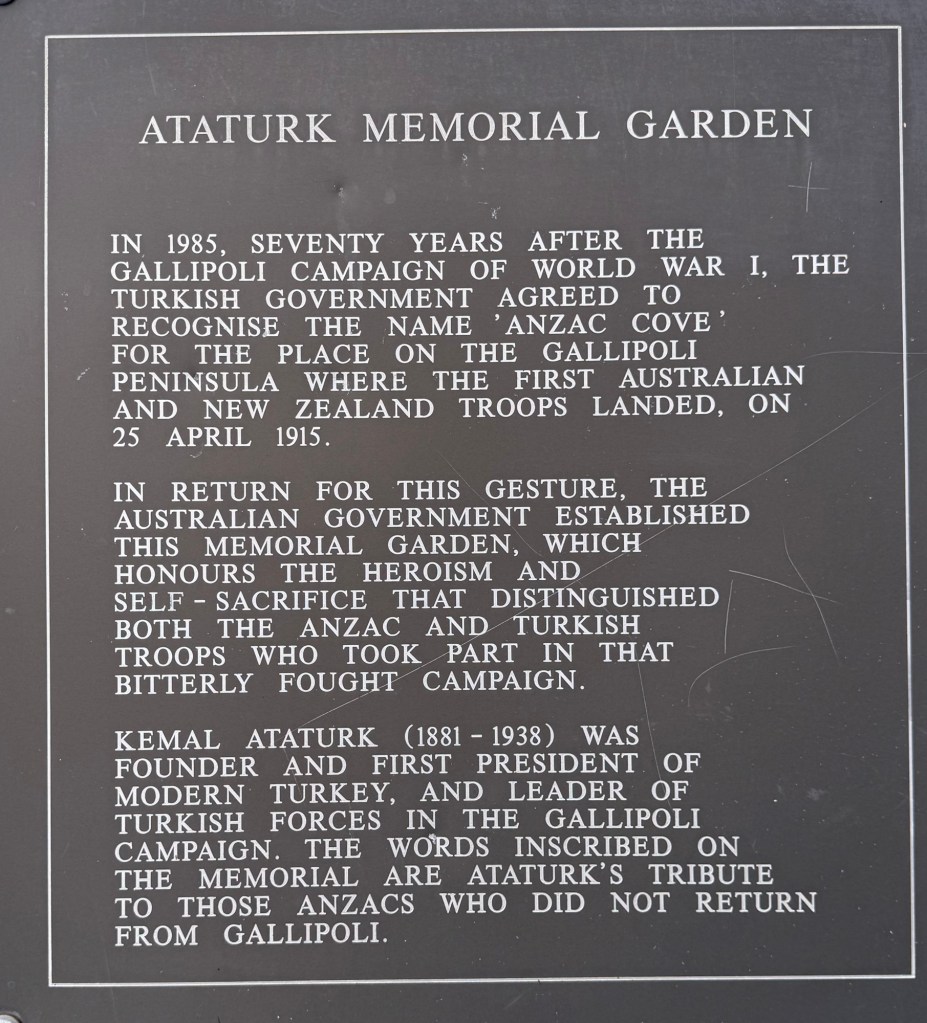
THE KEMAL ATATURK MEMORIAL
The last memorial on the Parade, opposite the Greek, is a Turkish memorial dedicated – surprisingly to us – to the Ataturk.
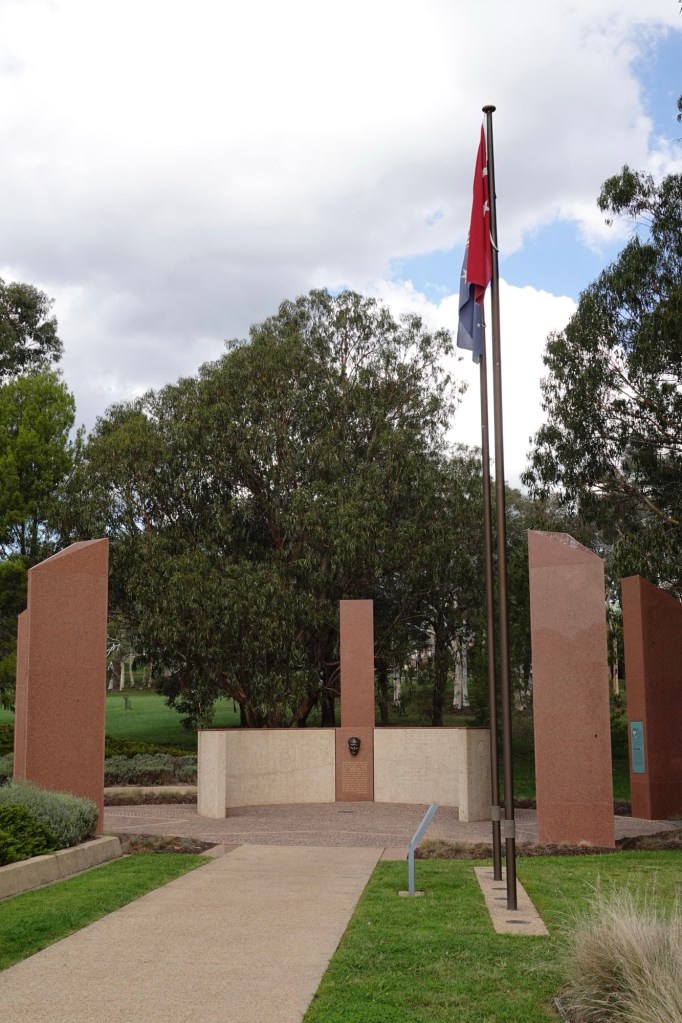
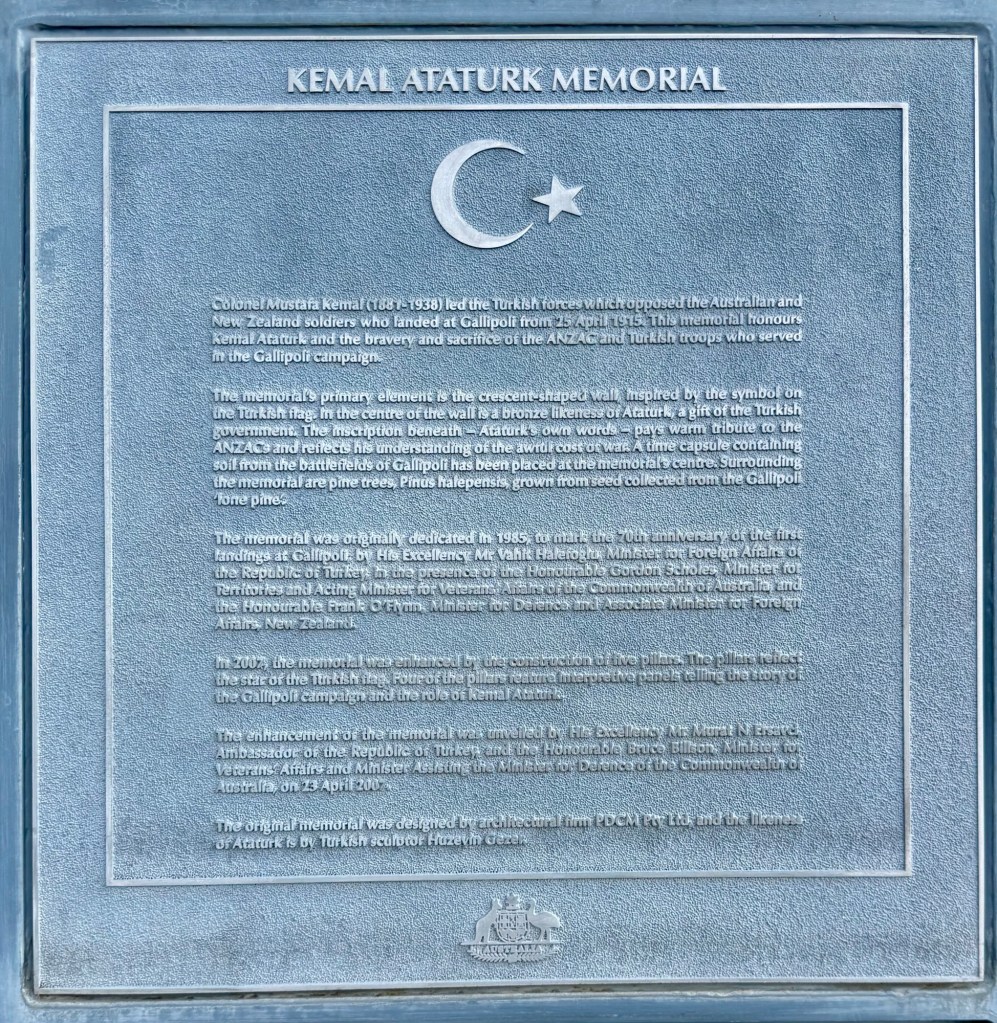
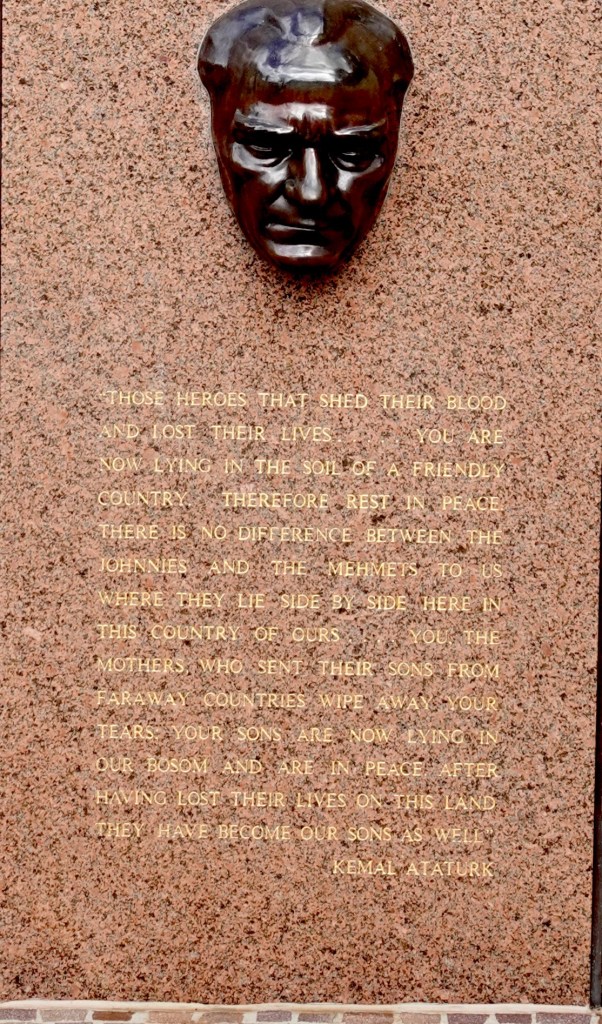
(From the sign above) “Colonel Mustafa Kemal led the Turkish forces who opposed the Australian and New Zealand soldiers who landed at Gallipoli from 25 April 1915. The memorial honours the Kemal Ataturk and the bravery and sacrifice of the ANZAC and Turkish troops who served in the Gallipoli campaign.”
Gallipoli, we know, was the site of a devastating battle. The 1915-1916 campaign resulted in over 500,000 total casualties (killed, wounded, or missing) – around 250,000 on each side. Among the dead were over 8,000 Australians, 2,700 New Zealanders, and between 66,000 and 86,000 Turks. In WWI bodies were not repatriated. Often they were not even identified.
It is the Ataturk’s own words that we have seen on many Gallipoli memorials, and again here.
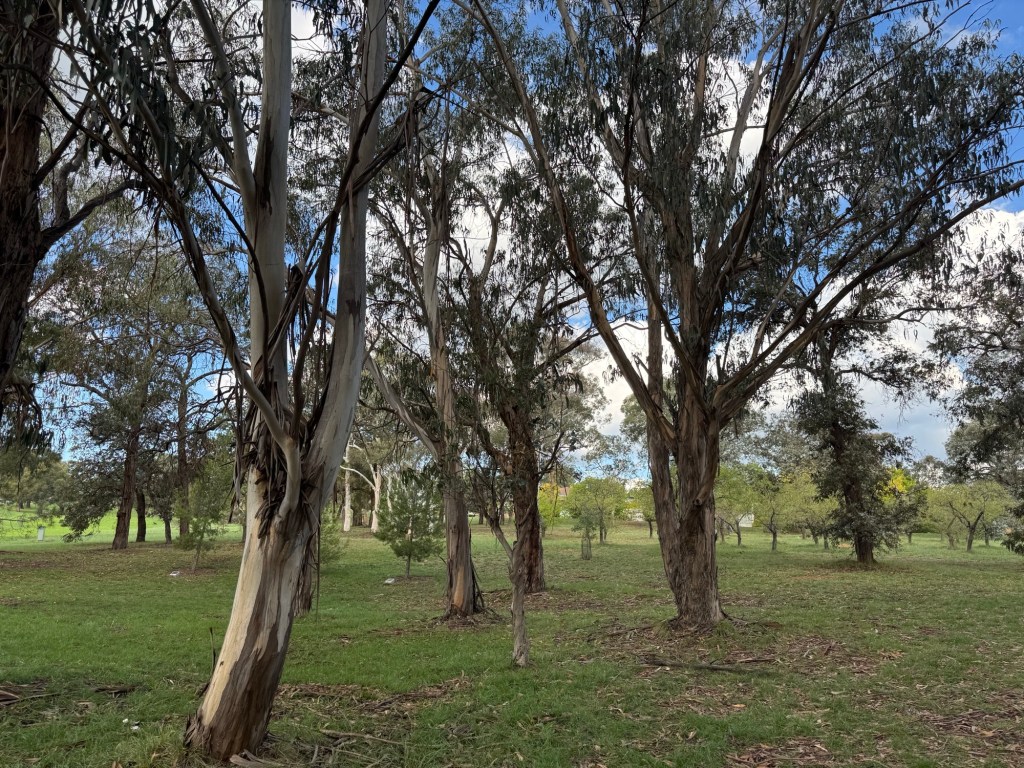
By the time we’d visited each memorial, we were hot, tired, and emotionally exhausted.
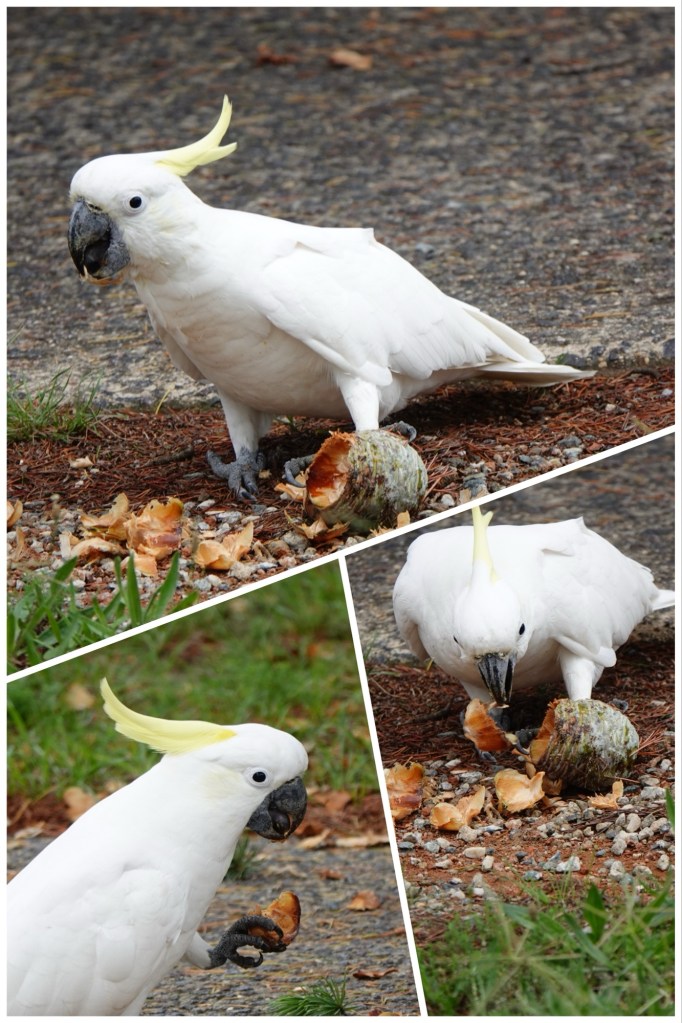
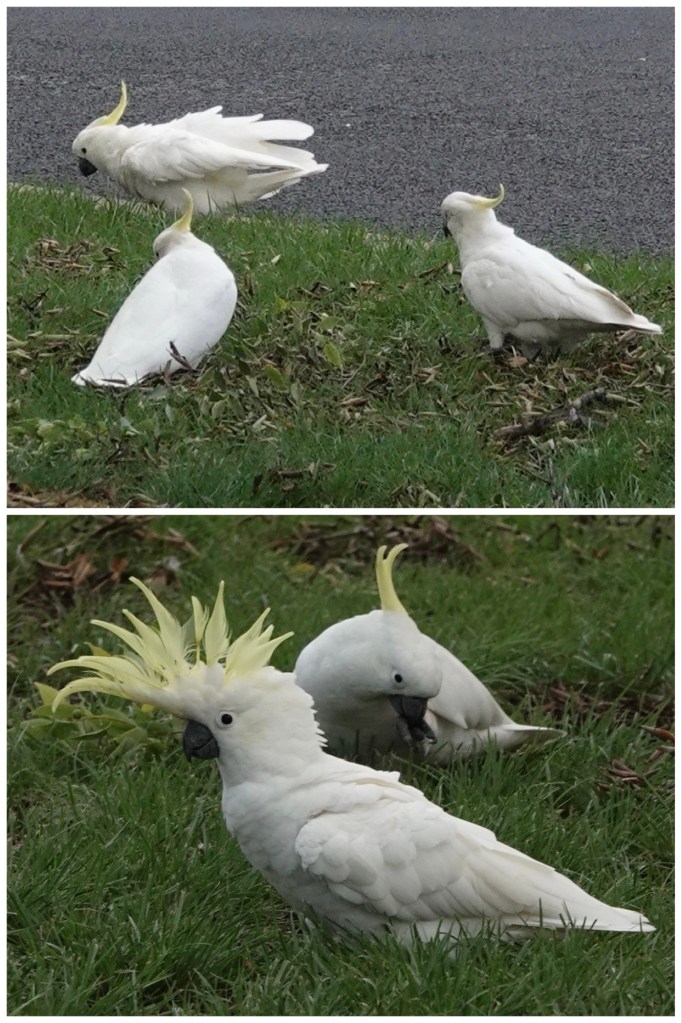
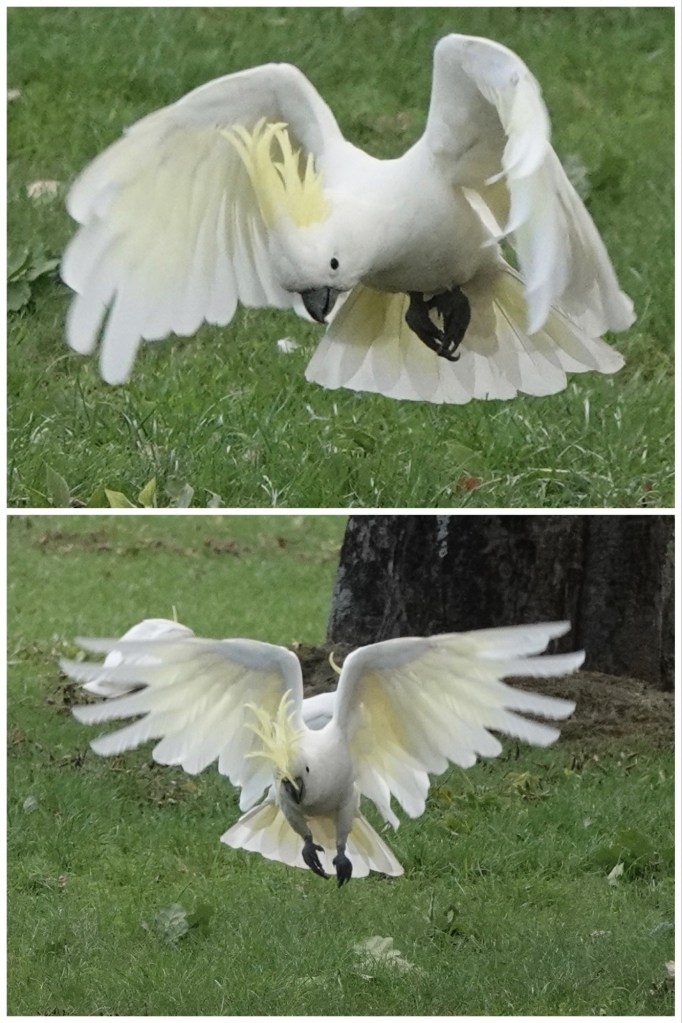
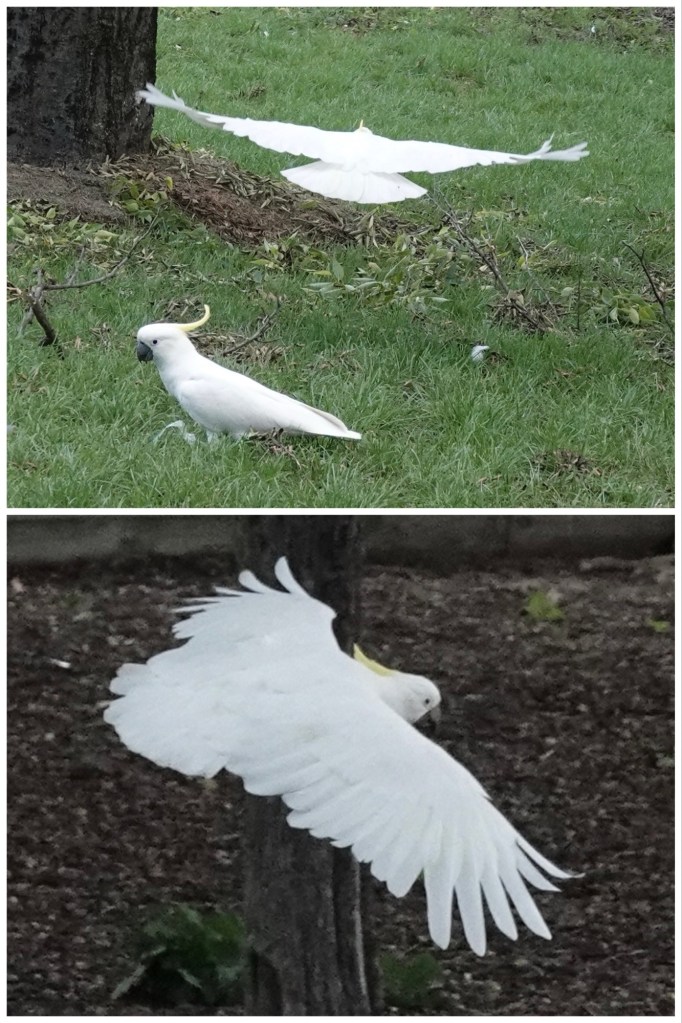
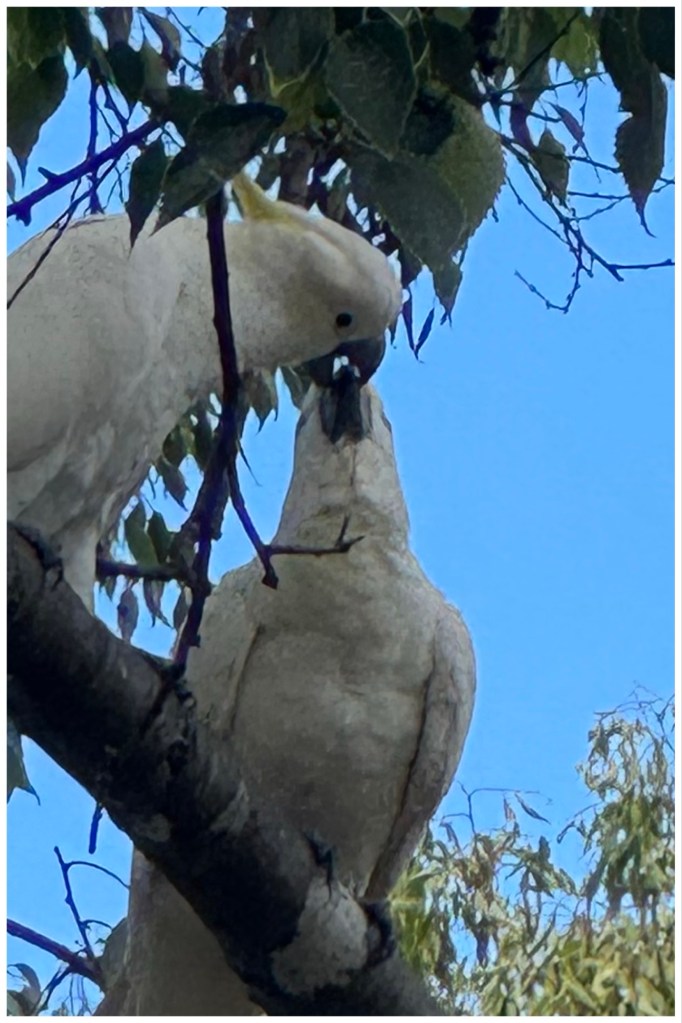
On our walk home, it occurred to me that Australia doesn’t have any white doves of peace among their native birds. They do, however, have plenty of white cockatoos of noise.
Tomorrow we head to Sydney for twelve nights, to complete our time in Australia.
 Rose and Ted’s Excellent Adventure
I have been following your travels for quite a while and always enjoy your commentary. This travel summary was particularly well written and informative.
Thanks,
David
LikeLiked by 1 person
Thanks for the kind words.
LikeLike