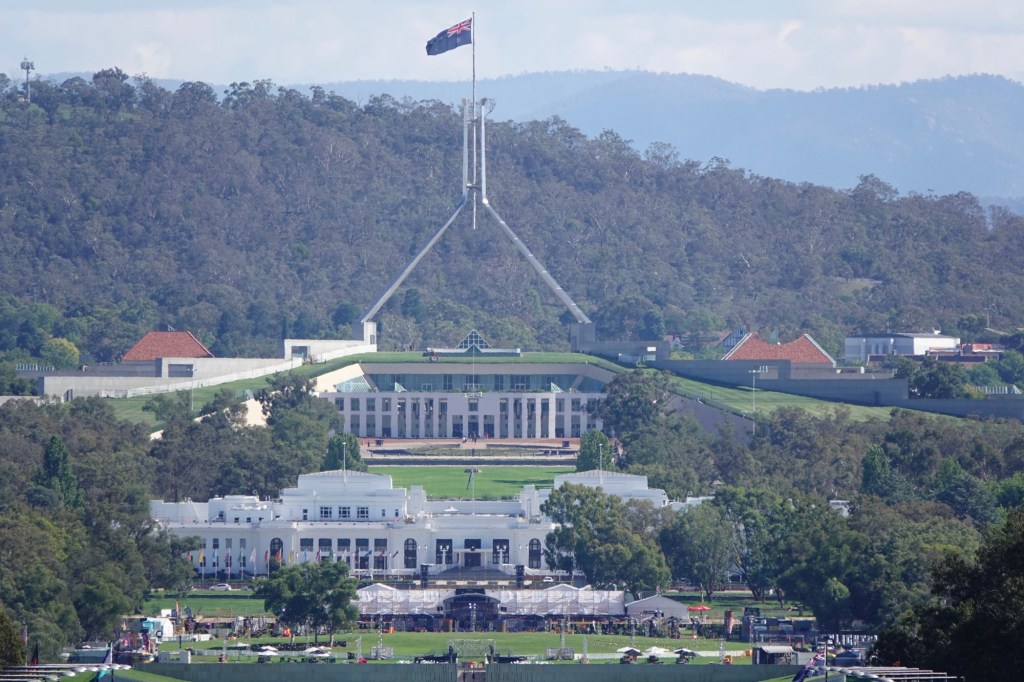
Australian Parliament House has daily guided tours – surprisingly, most of them for a fee.
We chose the $28AUD per person 45-minute “Best of Parliament House Tour”, described as : “Discover the must-see highlights within Parliament House from the towering flag mast to the Great Hall Tapestry, the architecture, art and craft, history and events, and some hidden surprises. These are the highlights and experiences our visitors tell us should not be missed on a visit to this iconic building.”
Our guide on the highlights tour today was David. While it was intended as an overview of the parliament, his passion for architecture and art came through.
The architecture of Australia’s National Parliament is much like the country itself: big, wide, and open. It is in stark contrast to the Victorian era parliament buildings in the various states. The ones we admired in Melbourne and Adelaide had very much an opulent old world feel; as lovely as they were, here in Canberra the Parliament feels bright, new, and full of promise.
Australia’s parliament met in a temporary building “Old Parliament House” for 61 years before outgrowing it.
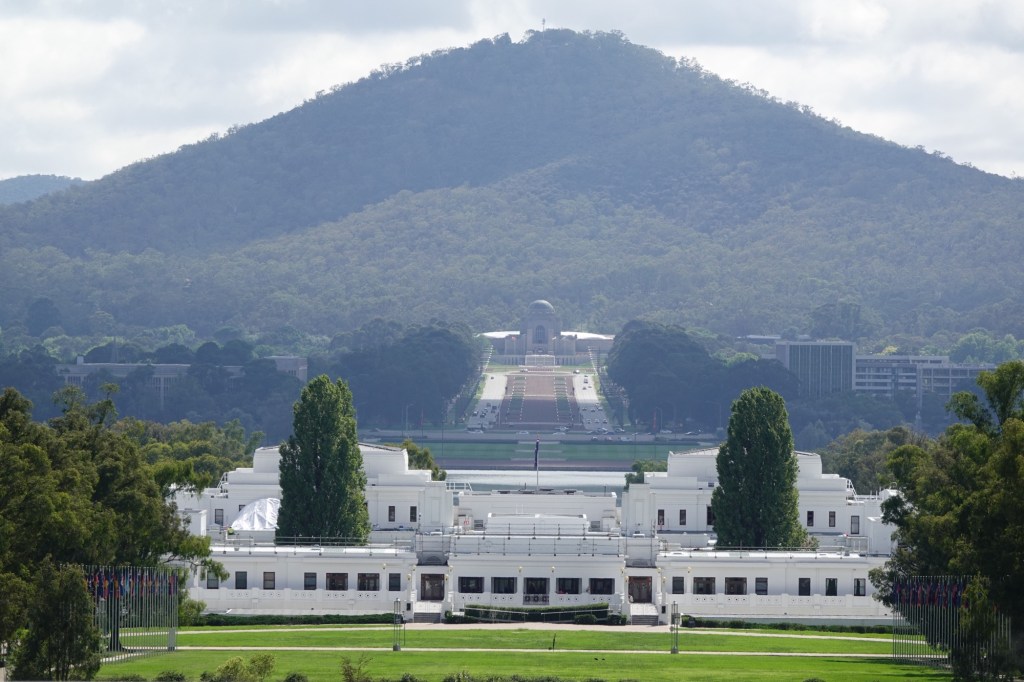
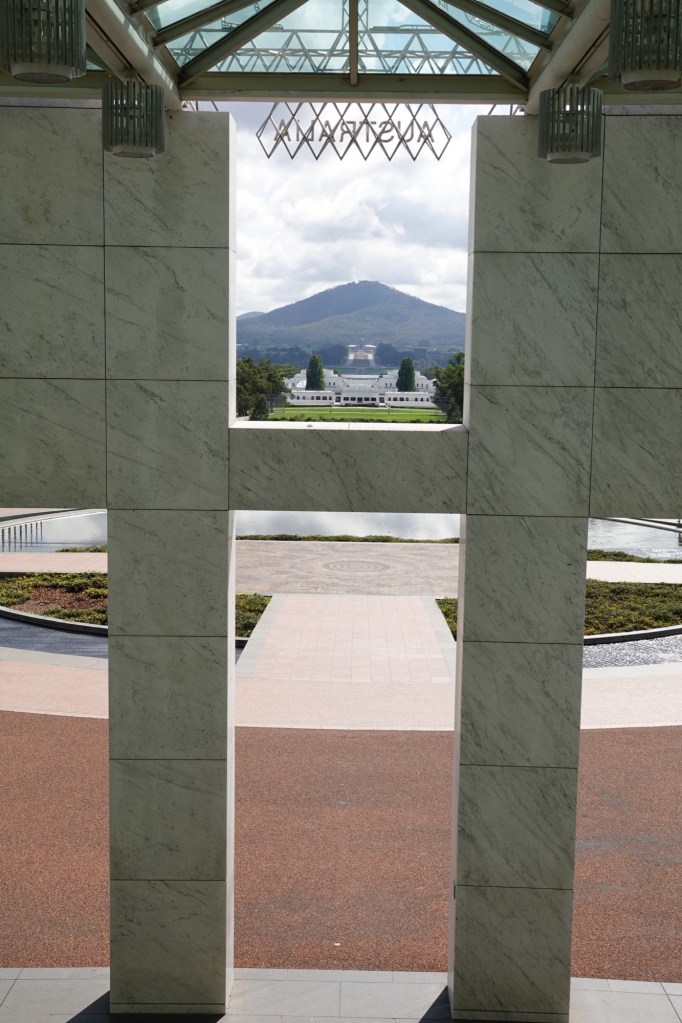
In 1978, the Australian government finally moved forward with a decision to build a new home for parliament.
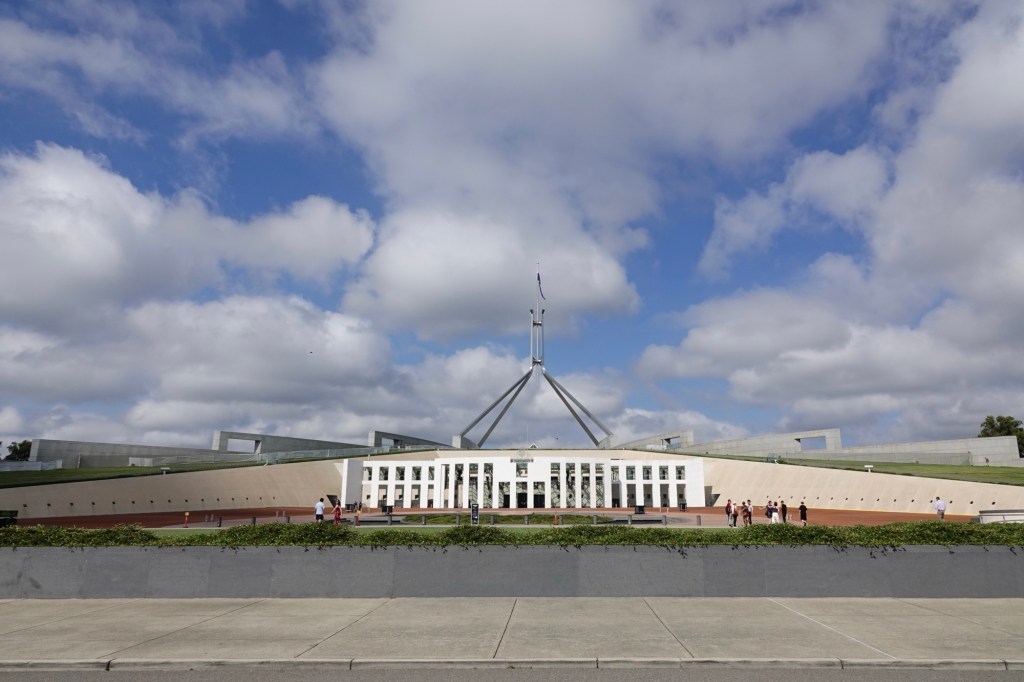
The open design competition received 329 entries from 29 countries , was narrowed down to 5, and ultimately the design of an Italian-born American, Romaldo “Aldo” Giurgola, was chosen. The winning design involved burying most of the building under Capital Hill, and capping the building with an enormous metal spire topped by an Australian flag the size of a double-decker bus.
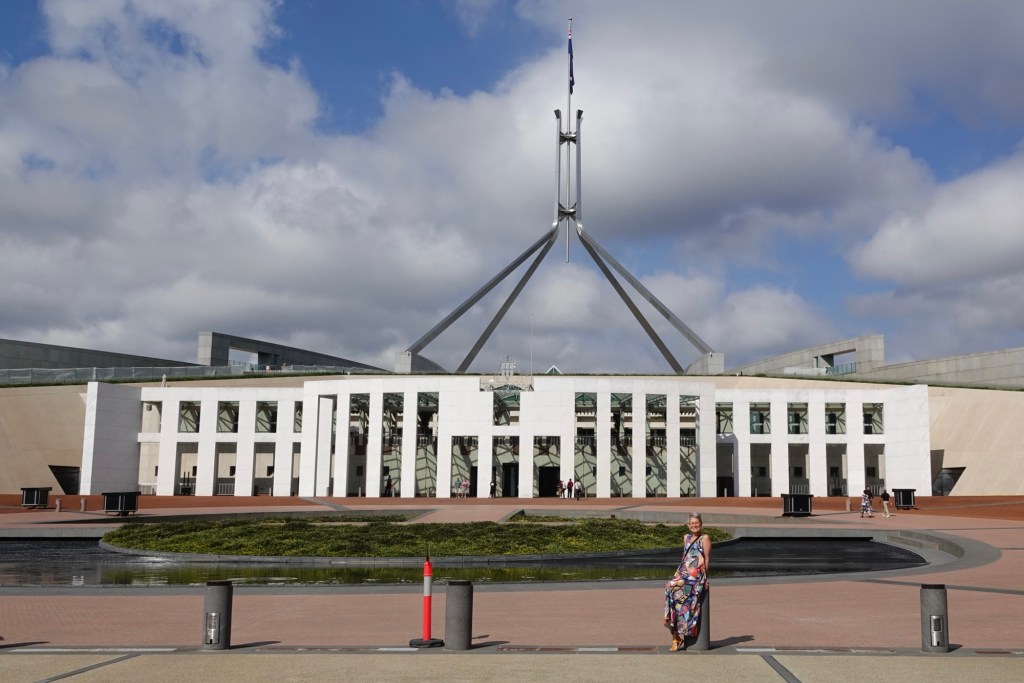
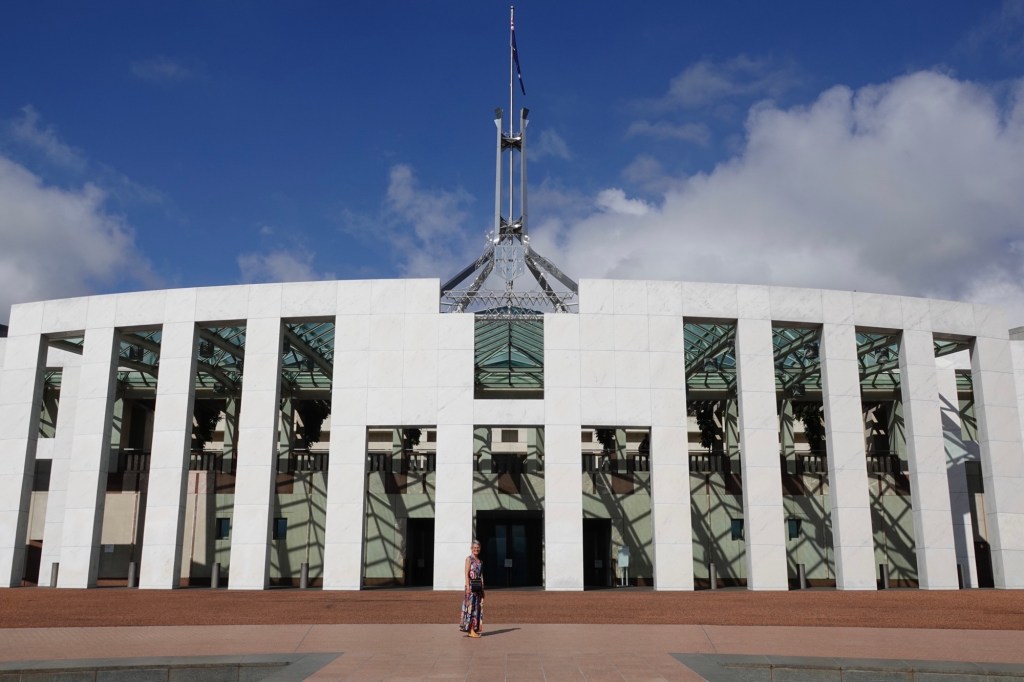
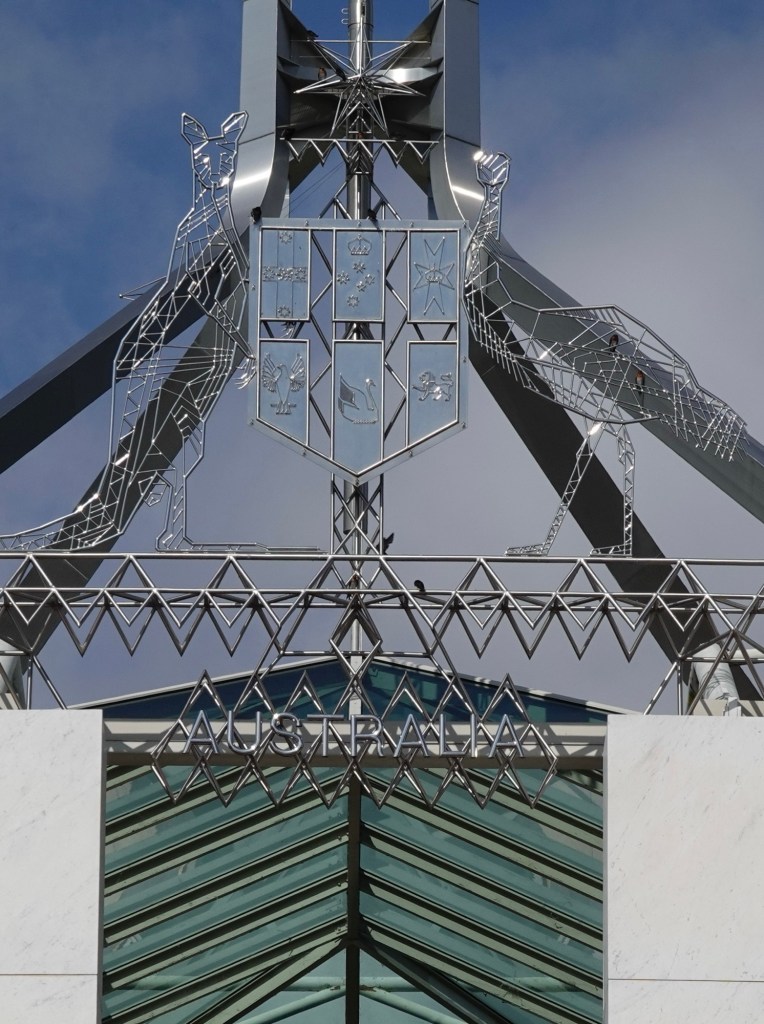
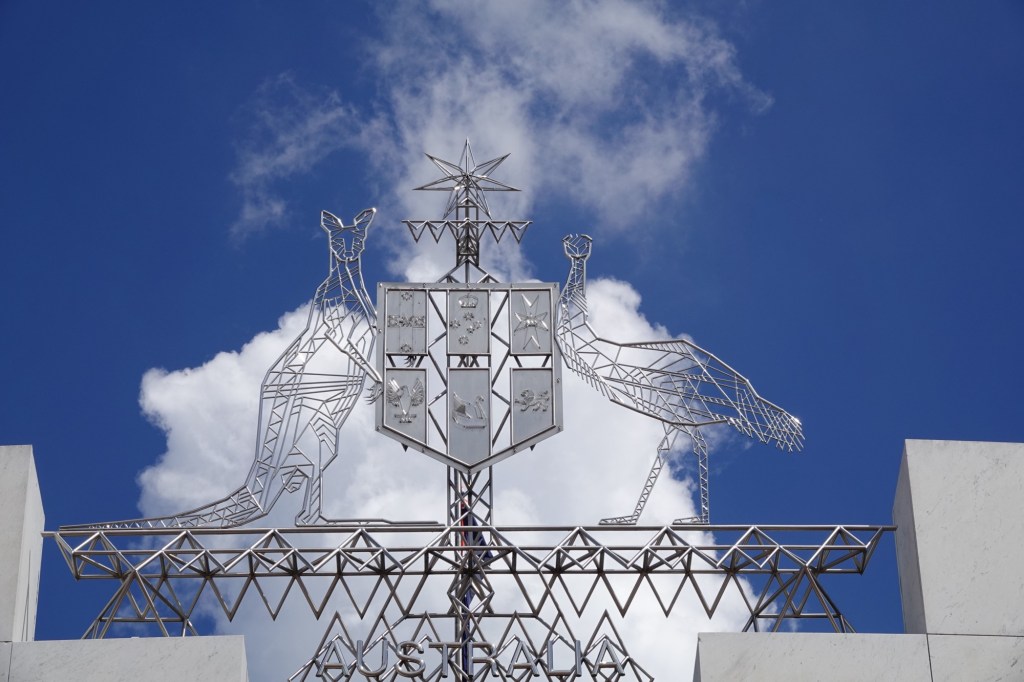
Gift of the Parliament and people of New South Wales to the Parliament of Australia, 1988
Since Australia had begun moving forward in their relationship with the country’s Aboriginal peoples by the 1980s, the building’s decor incorporates a number of Aboriginal elements.
One of those is the mosaic in the outdoor forecourt, made of 90,000 pieces of cut granite.
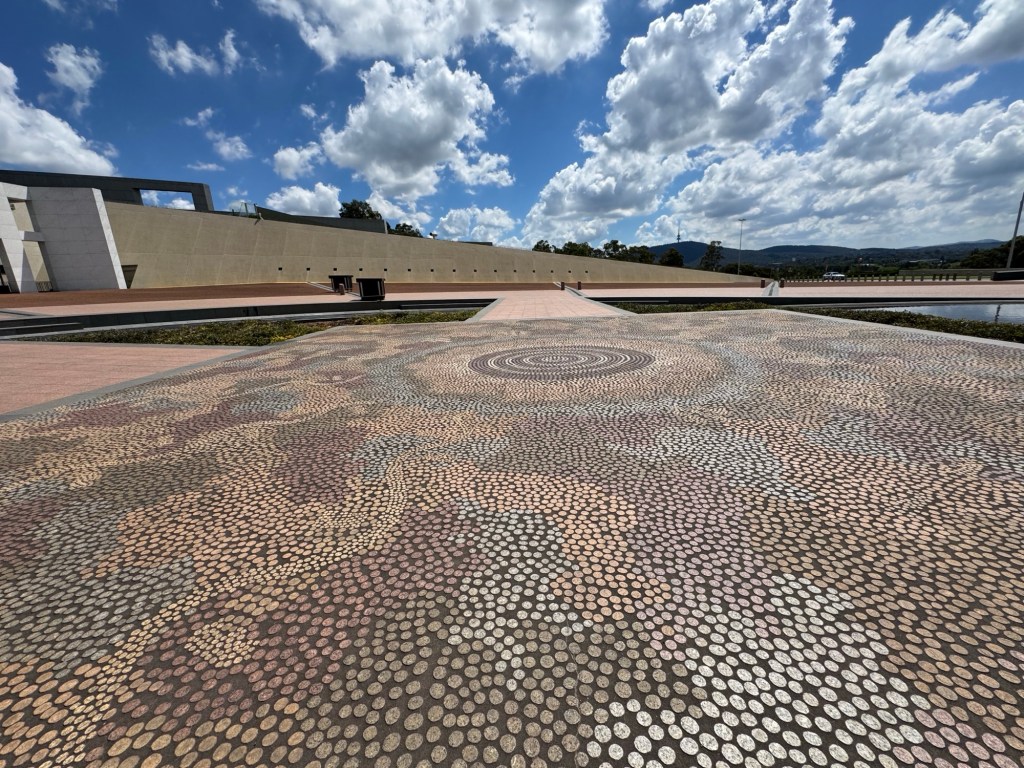
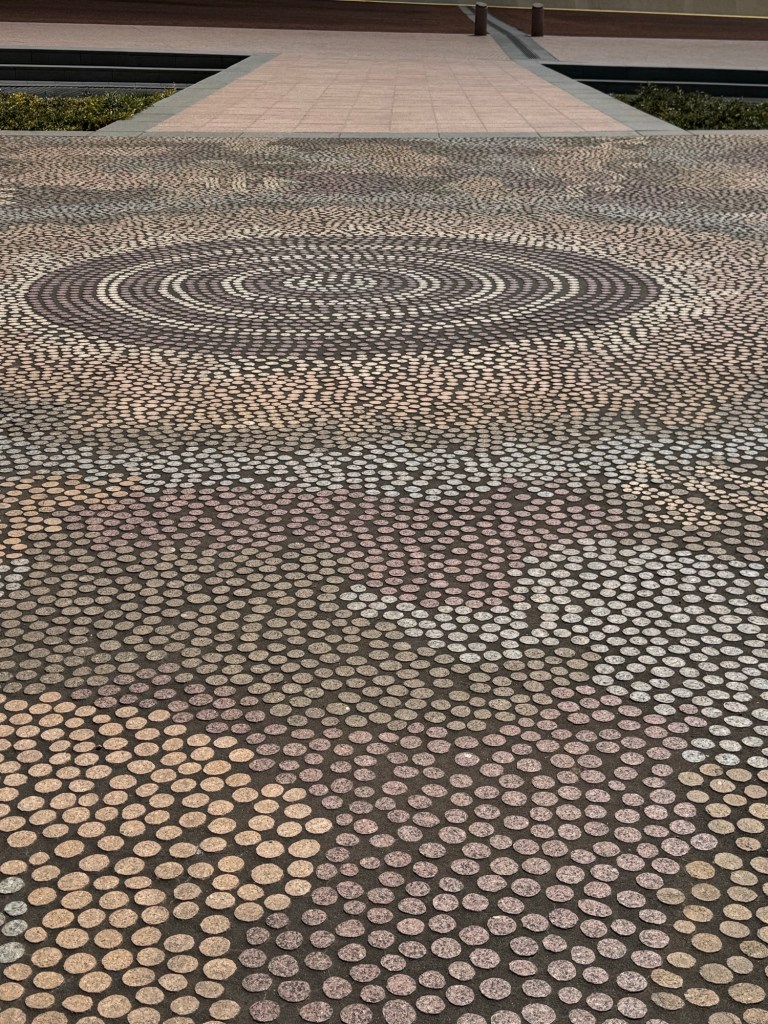
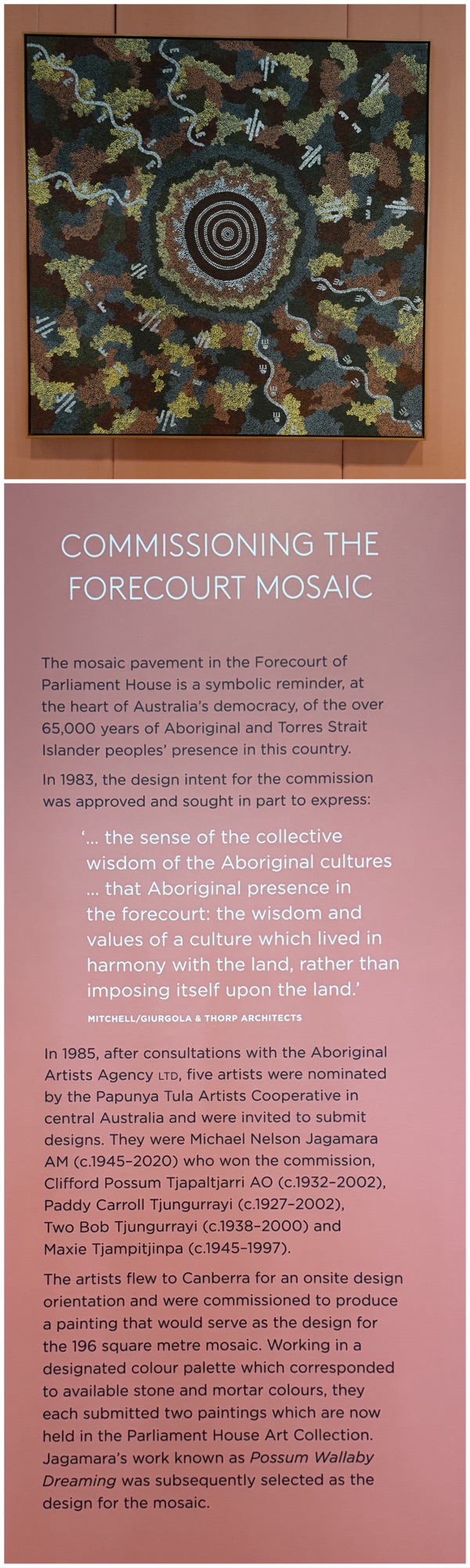
I wouldn’t have recognized the motif, but during our tour we were shown the painting by an Aboriginal artist on which it was based.
The design shows animal footprints moving toward a central watering hole/meeting place. The footprints are those of kangaroos and echidnas, the curved lines represent the dragging tail of goannas (monitor lizards). The “dot” painting is typical of Aboriginal sand art. Our guide told us that there is no “right side up” when hanging painted depictions, since they all start our flat on the ground.
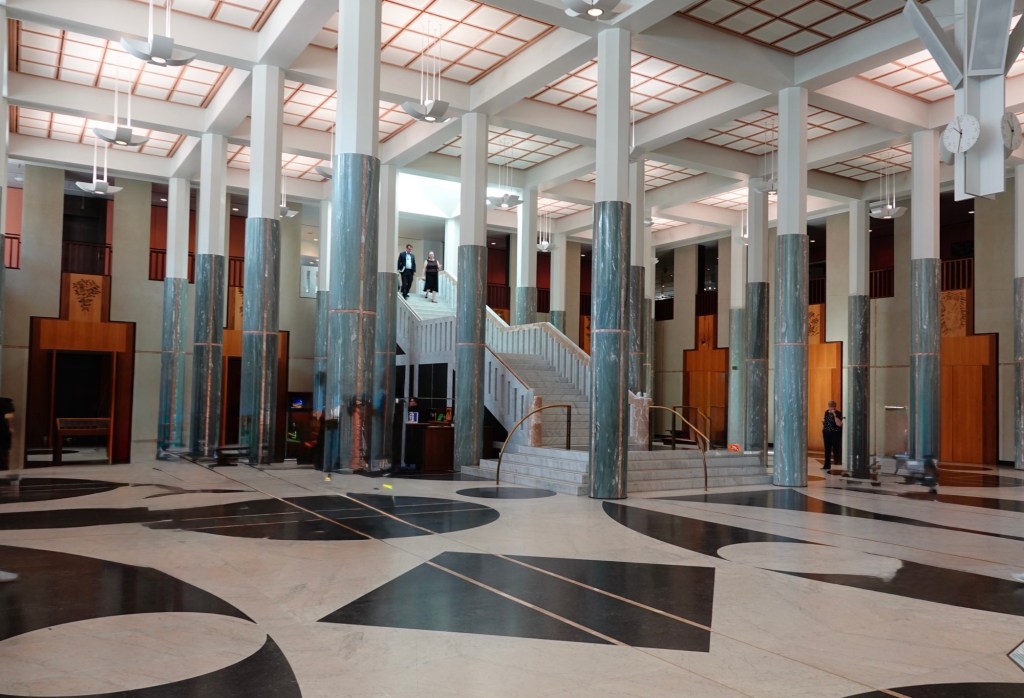
In the entry hall, with its sweeping marble staircases, the square shapes are meant to evoke square Roman pantheons, and the round to evoke Greek agorae – added to the stylized columns, everything is intended to recall the beginnings of democracy.
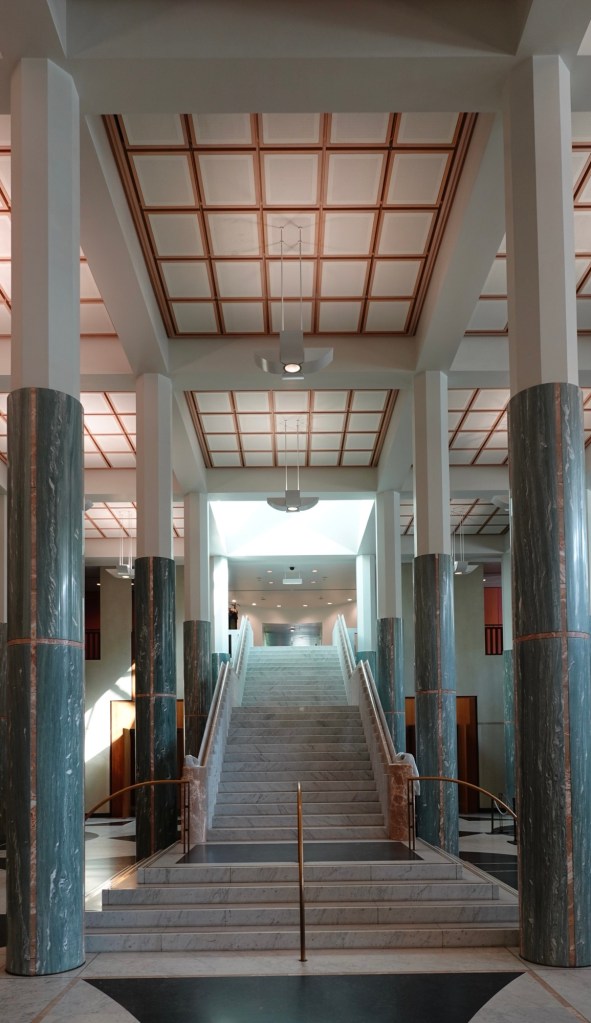
Some of the geometric elements that, without today’s guided tour, I would have assumed were Art Deco-inspired actually reflect classical Roman style: columns, clean lines, large open meeting spaces, and water features.
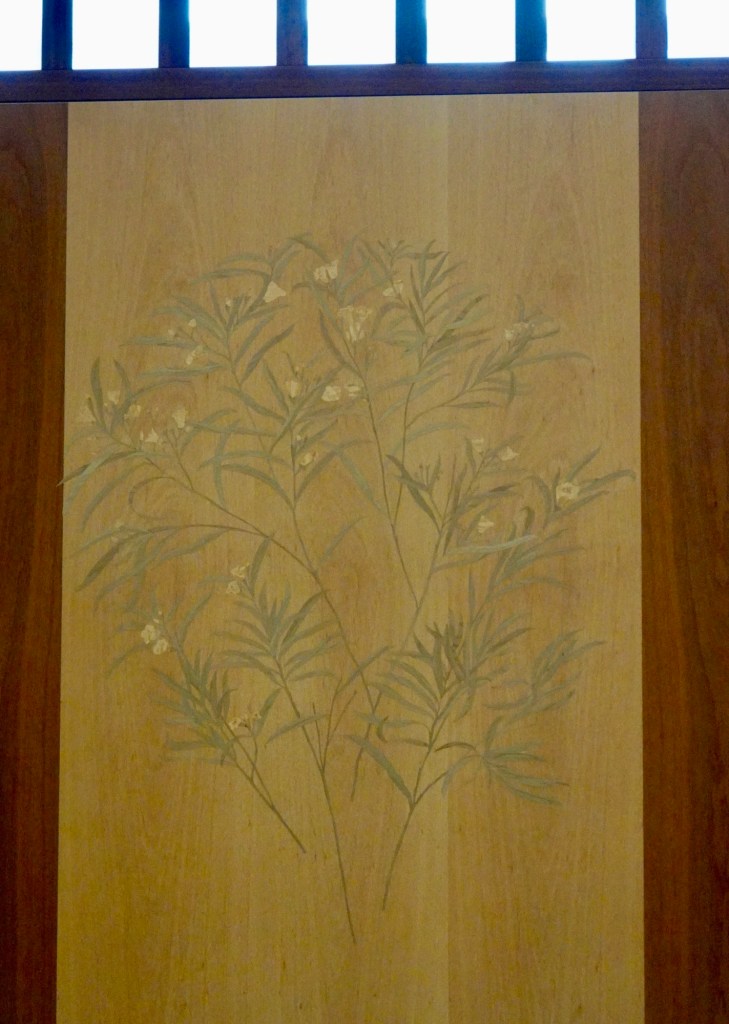
Around the entry are wood panels with native plants depicted in marquetry. Each of these was created from copper plates made from the original drawings of Joseph Banks, the botanist who travelled here with Captain Cook in the 1700s. The drawings, along with plant samples, were taken back to England and the plates “lost” for many years before eventually being made available to Australia.
If the entryway seems large, the building itself is huge – there are 4500 rooms in all.
We toured 3 main rooms, and several of the many halls containing public displays. The building belongs to the people and, with the exception of private work spaces, is very accessible (once you’ve gone through the security scan). People can even just come in for lunch in the courtyard café, or take the elevator to the grass rooftop to take panoramic photos.
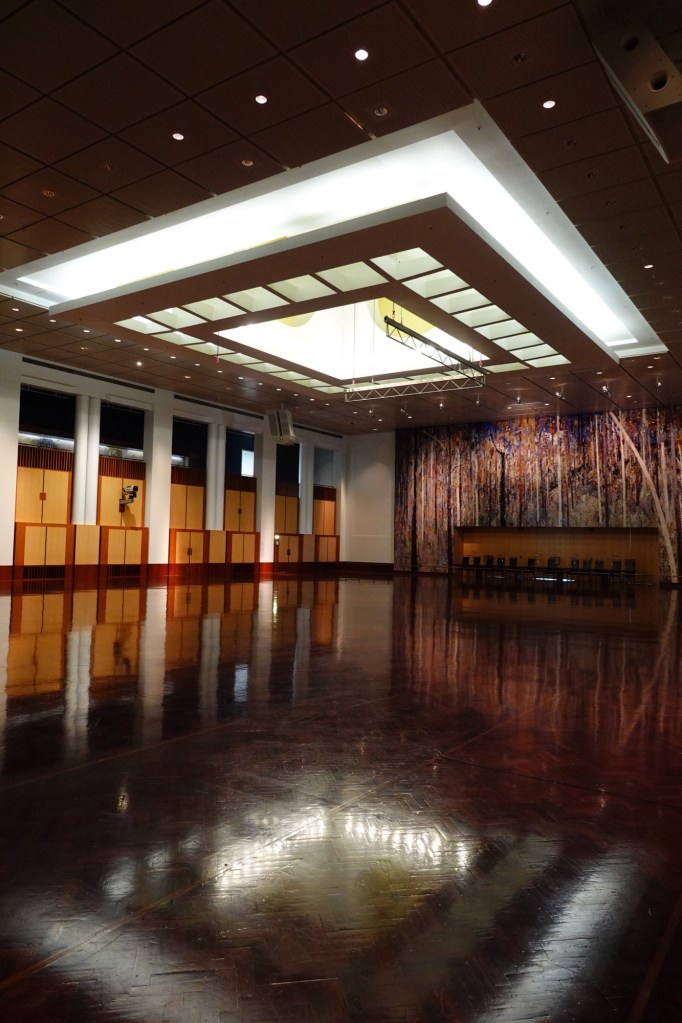
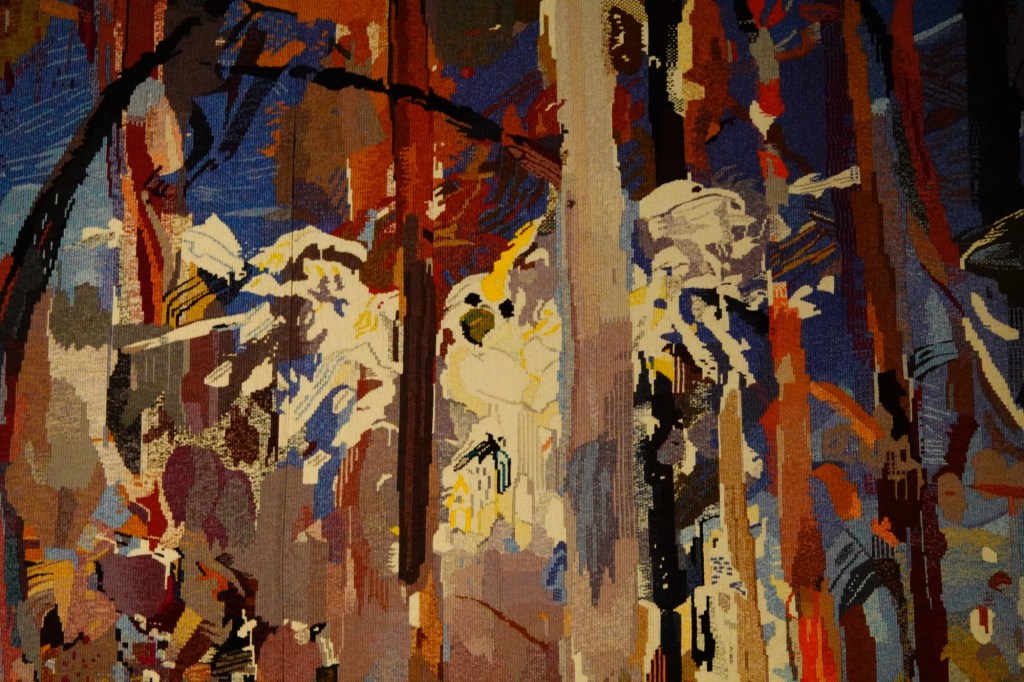
After an introduction that covered all the information I saved above, we were taken into the Great Hall – the “room of the land” – which is used for official receptions (formal seated dinners for 500, or stand-up cocktails for 1500). On the wall behind the head table is a 4 drop tapestry based on a painting by Arthur Boyd. The tapestry does not depict any people; it is intended to emphasize the importance of land and place.
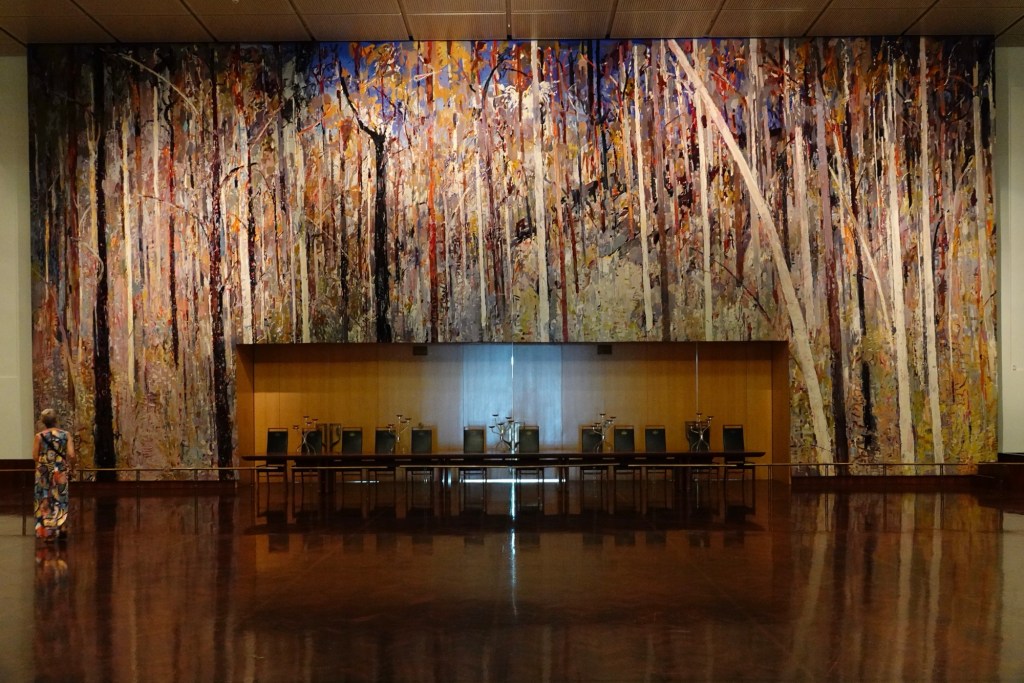
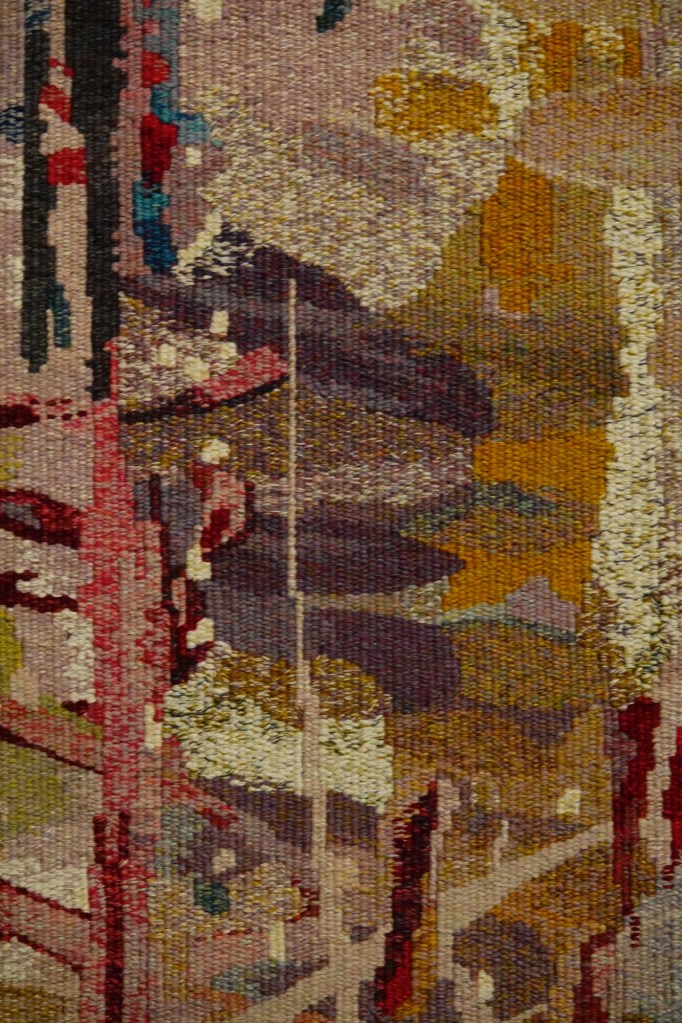
Our guide pointed out the cockatoo atop one of the eucalyptus trees. We wouldn’t have found it on our own.
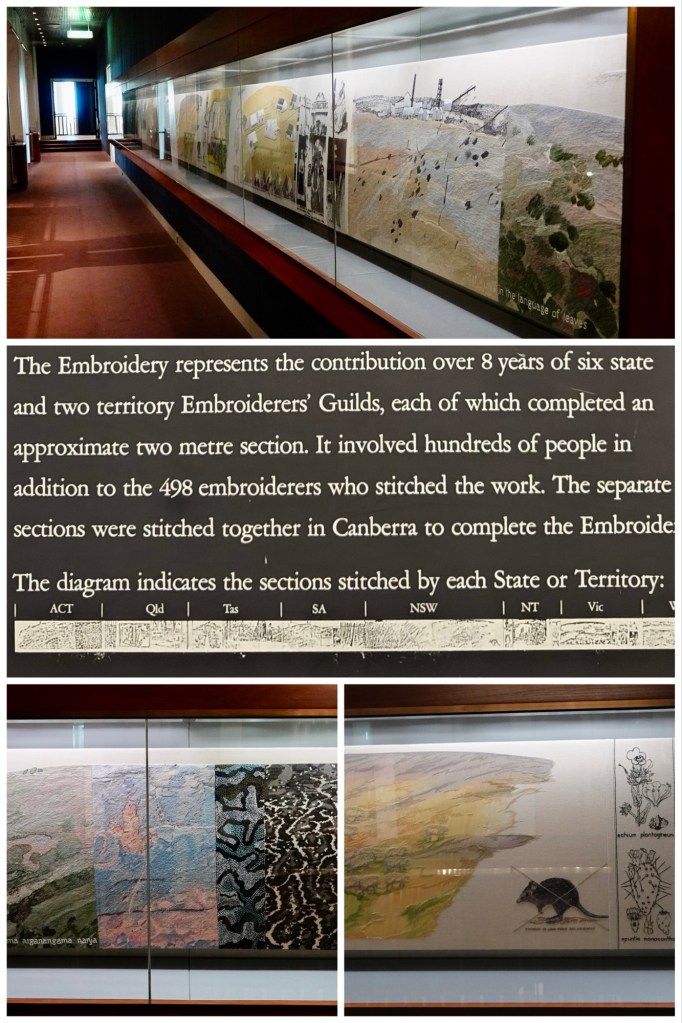
Alongside the great hall is a long embroidery telling the story of the changed landscape through colonization. It immediately reminded me of the Bayeux Tapestry as a record of events. After we got home, I looked for more information and found out that at 15 m long and 65 cm high it is only about 1/5 the length of the Bayeux Tapestry, despite bringing that more famous embroidery to mind.
From the Great Hall we walked to the House of Representatives. Australia uses the same name for this chamber as the USA, while Canada uses House of Commons like the UK. Nonetheless the colour conventions have remained: green for the lower house and red for the upper(senate), but in a distinctly Australian interpretation of the Westminster “royal red” and “commoners’ green”.
Here the greens are the minty shades of eucalypts, in a gradient from darkest in the carpet to palest in the galleries.
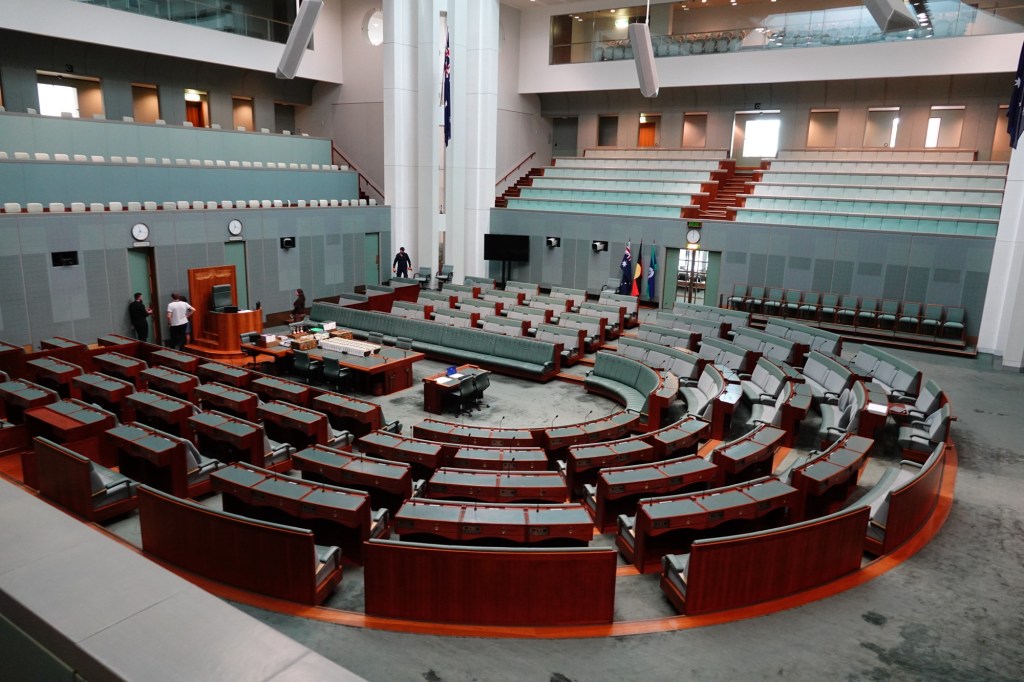
David explained that every one of Australia’s six states has the same number of senators (12) regardless of size/population, and the Northern Territories and Australian Capital Territory have 2 each, for a total of 76.
The House of Representatives has twice the number of representatives as the Senate does senators. Currently there are 150 Members, each representing one geographic area (constituency). Representatives are elected via a “preferential” ballot, whereas Senators are elected using a proportional system, with ballots that allow for “above the line” (party) or “below the line” (individual) preferences.
The voting age is currently 18. Since voting is compulsory (it has been since 1924) there is a huge education component and thus lots of school tours to parliament. There were at least four large groups with guides while we were there.
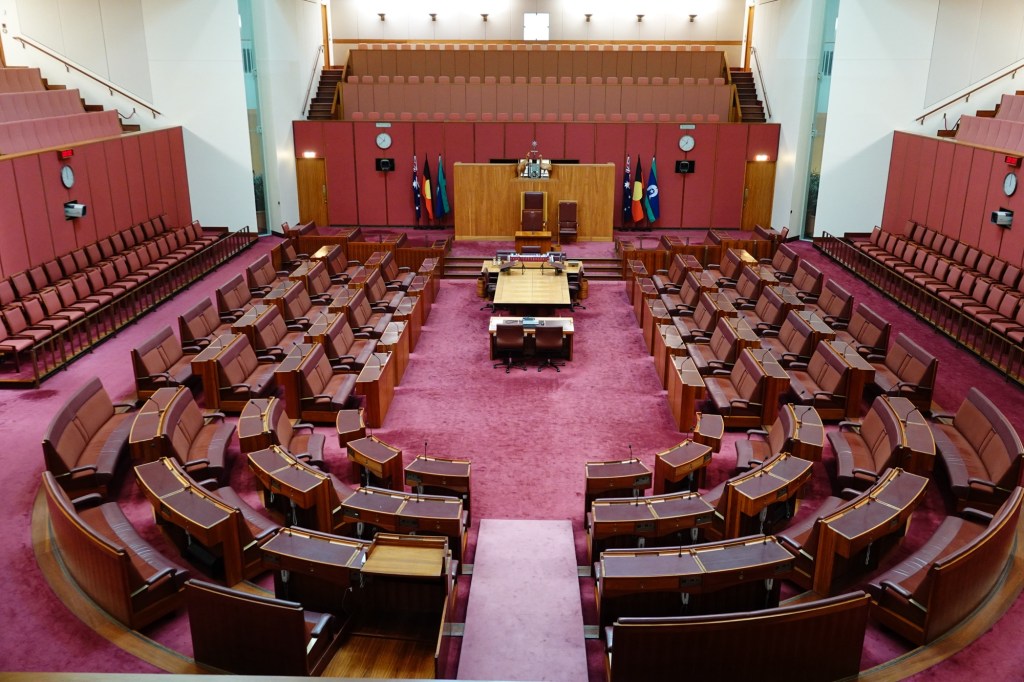
From the House of Representatives we walked the full 300 m length of the hallway to the Senate chamber directly opposite.
In the Senate, “royal red” has been replaced with the red of the Australian earth fading from deep red up to palest desert sand.
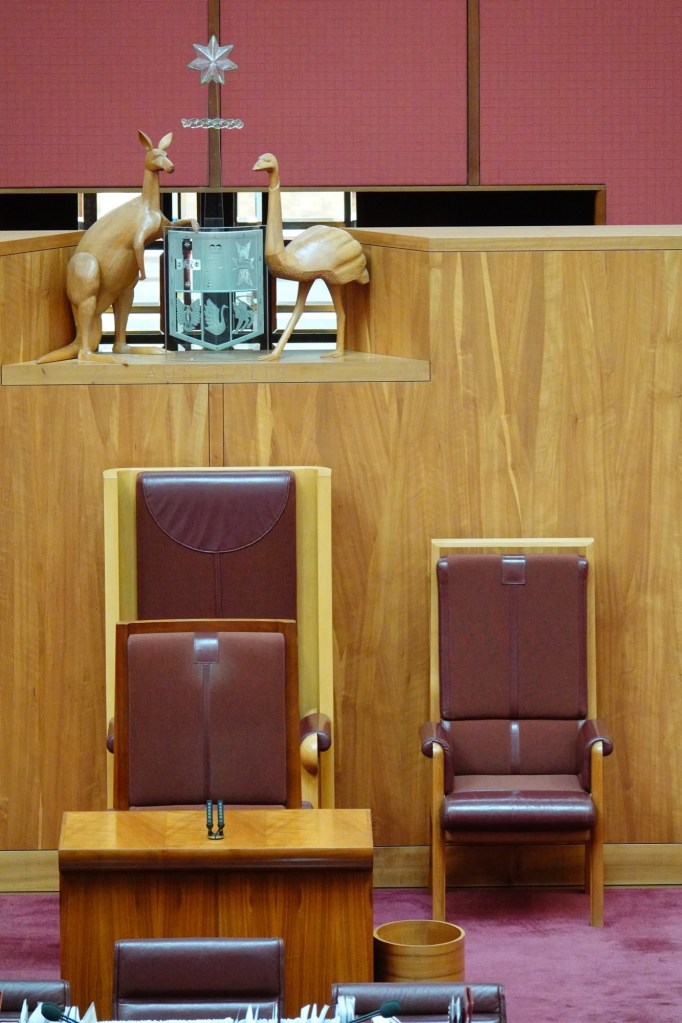
The Senate President’s chair was a gift of Canada, and is made from Canadian cherrywood. The yellow wood is Tasmanian.
Another Canadian gift was pointed out to us: the “budget tree”. In the courtyard outside the hallway between the two chambers is an October Glory maple tree. In Canada, beginning last year, October is budget month for the government. In Australia, it is April (which is autumn in the southern hemisphere). Our guide joked that the tree’s leaves turn a bright red, right about the same time the budget does. The Finance Minister gets his photo taken under that tree, with the budget portfolio under his arm… and then all the leaves drop.
That was the end of the formal tour, but – maybe because I’d asked about a couple of the portraits we passed and art was one of David’s passions, or maybe because he was just happy to be talking to Canadians in a week when our countries were reinforcing their friendship – David spent some extra time with Ted and me talking about some of the quirkier Prime Ministerial portraits.
Then we were on our own to look at a few of the highlights of the public collection.
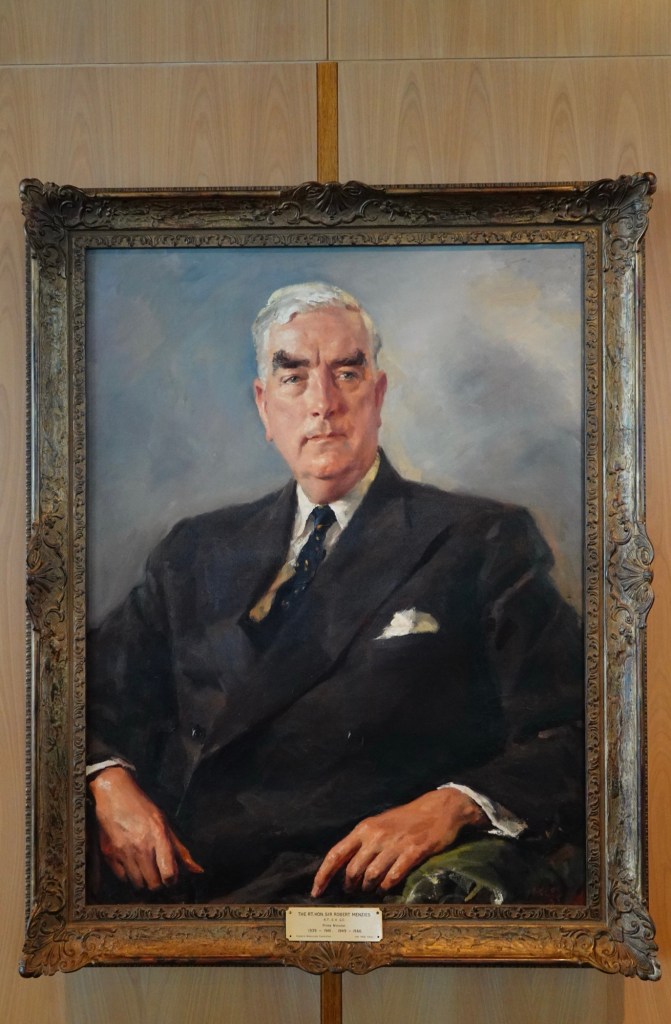
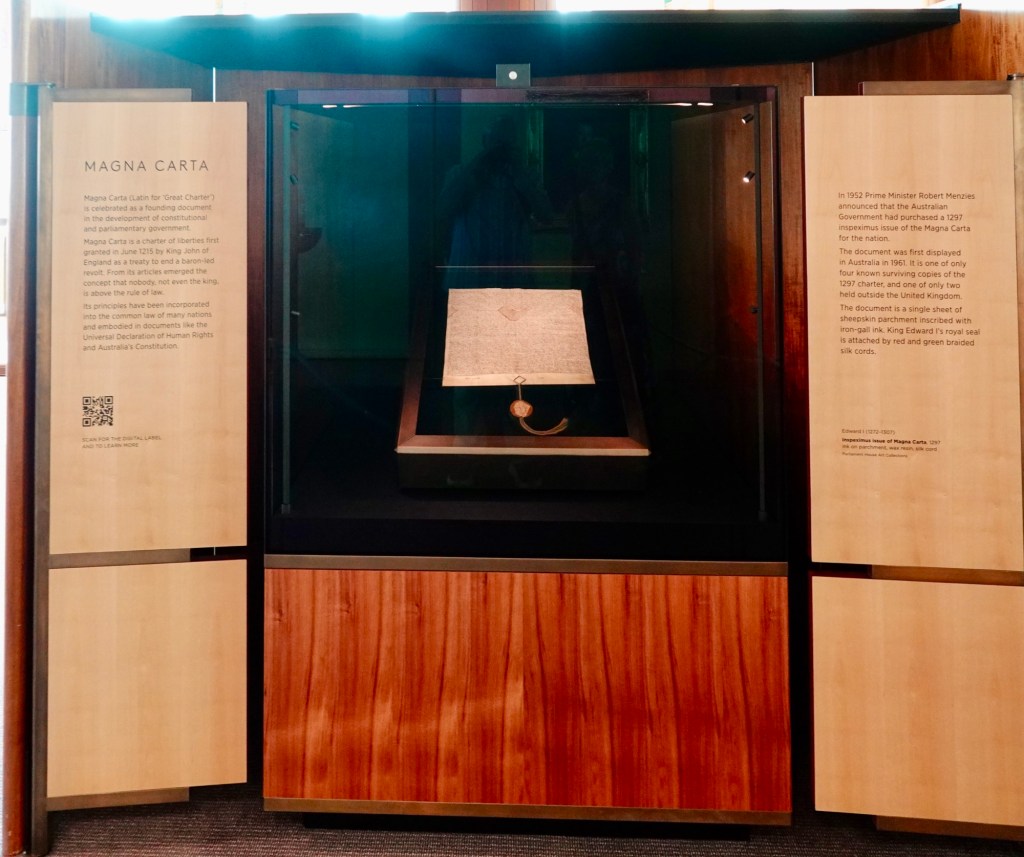
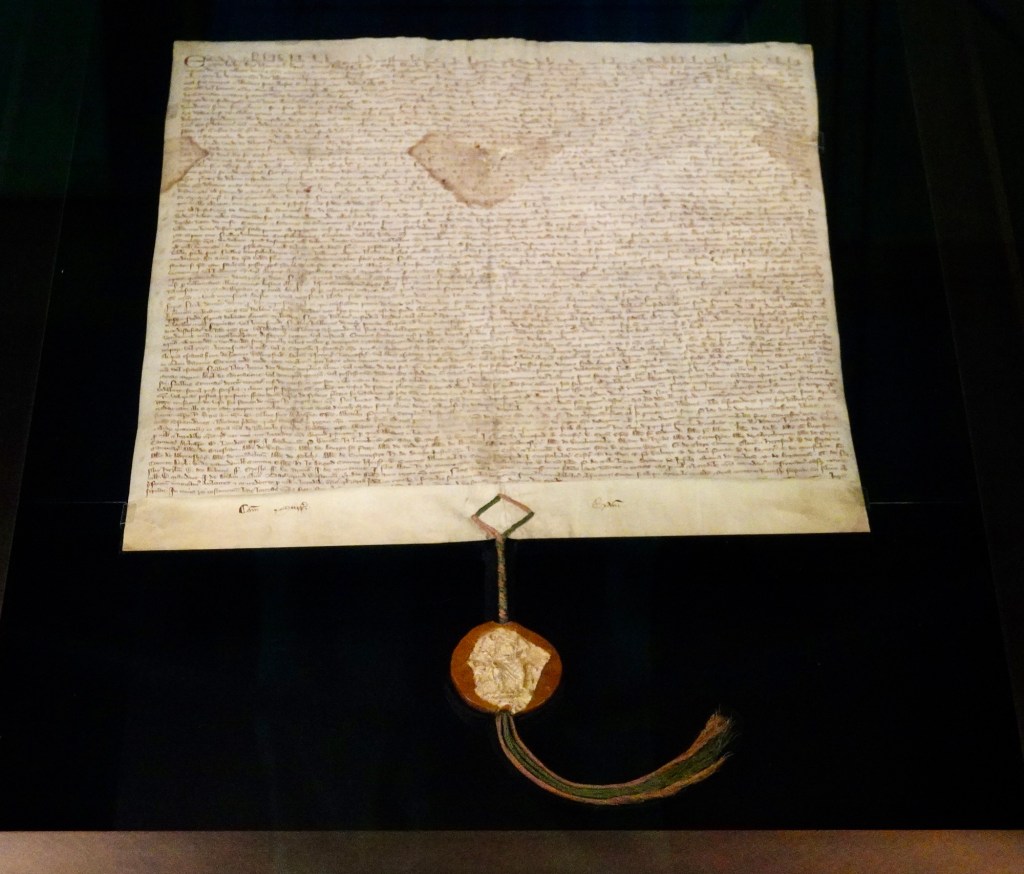
One of only 4 known surviving copies of the 1297 printing of the Magna Carta is on display in the upper hall, almost directly across from the portrait of Prime Minister Robert Menzies, who was responsible for obtaining it for Australia in 1952, using funds from the Prime Minister’s Department. Apparently he got a really good deal – and his portrait seems to be keeping a watchful eye on his investment.
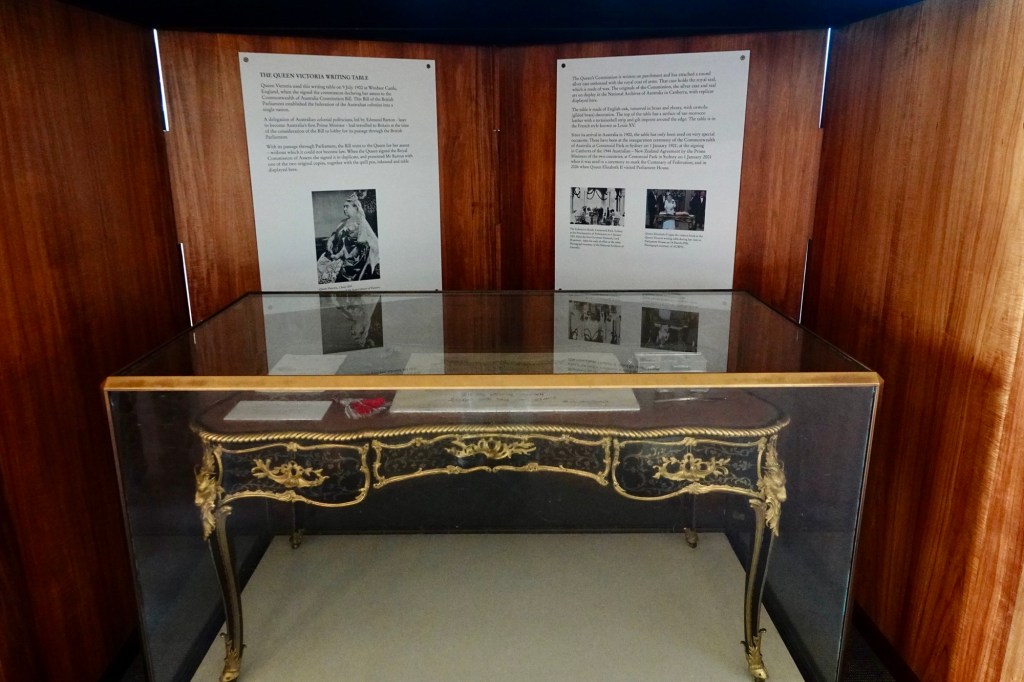
The table, quill, and inkstand that Queen Victoria sat at in Windsor Castle on July 9,1900 to sign the Commonwealth of Australia Constitution Act, which was subsequently gifted to Australia by Britain, is on display in a glass case.
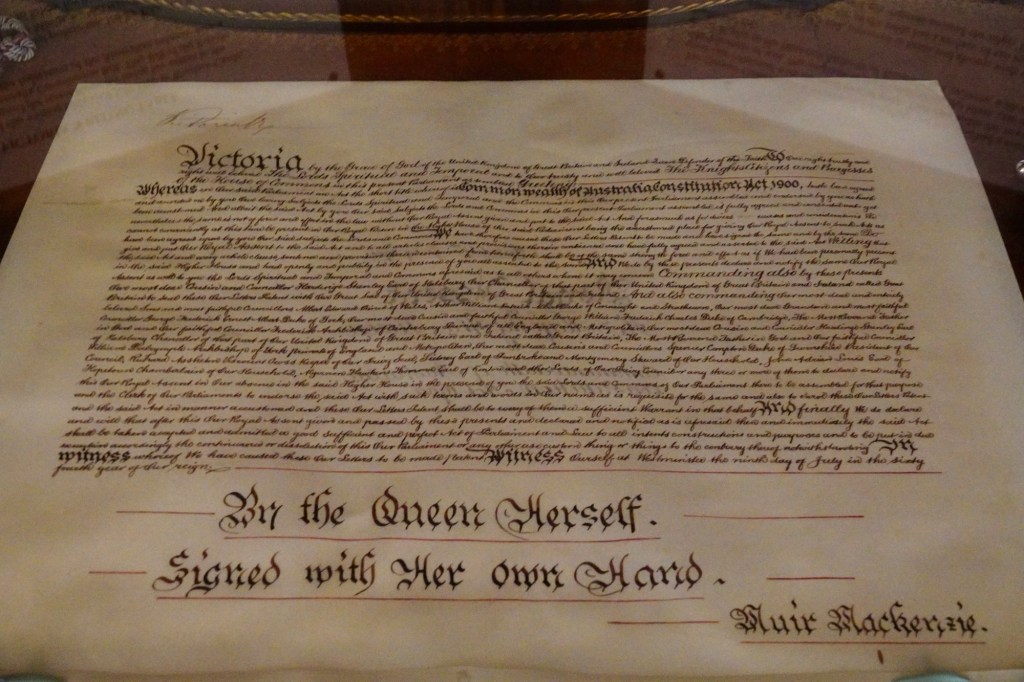
On the table is a meticulously reproduced facsimile of the document on vellum. The original is so precious it is kept under strict preservation conditions a stone’s throw away at the National Archives.
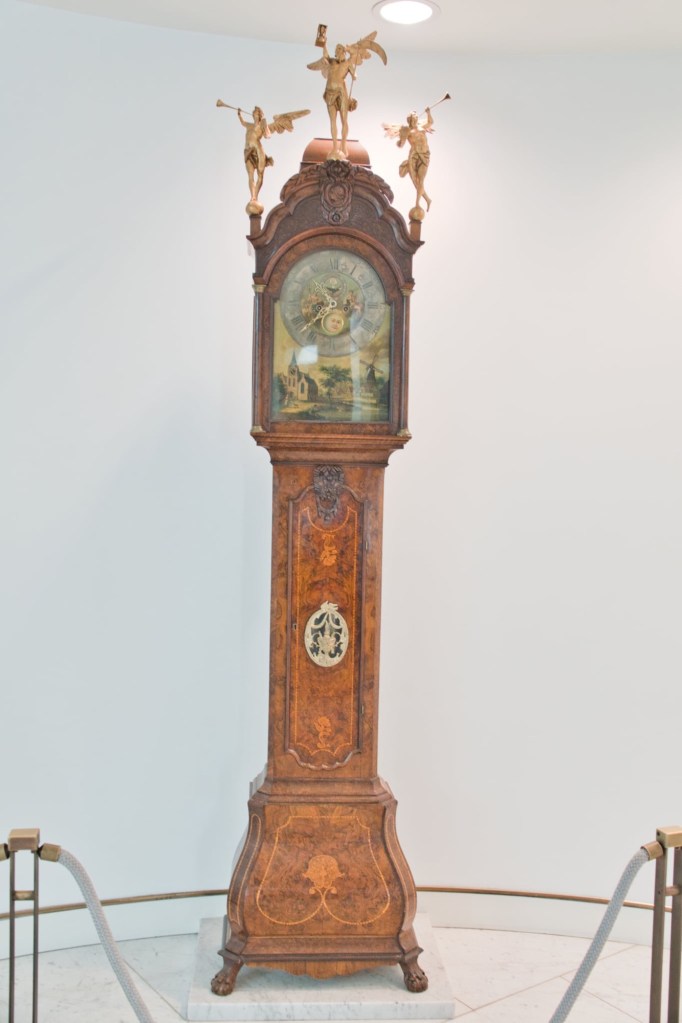
The gorgeous Dutch longcase clock in one of the hallways that dates to 1792 was a gift of the Government and People of the Netherlands.
That was just one special clock, but there are over 2700 “ordinary” clocks in Parliament House, fitted with two lights which call members of parliament to the chambers. One light flashes green for the House of Representatives and the other flashes red for the Senate. They let members of parliament know when a session of Parliament begins, a vote is to be held or if they are needed in the chamber for other business. When the lights are activated, the sound of a bell rings through loudspeakers in the building.
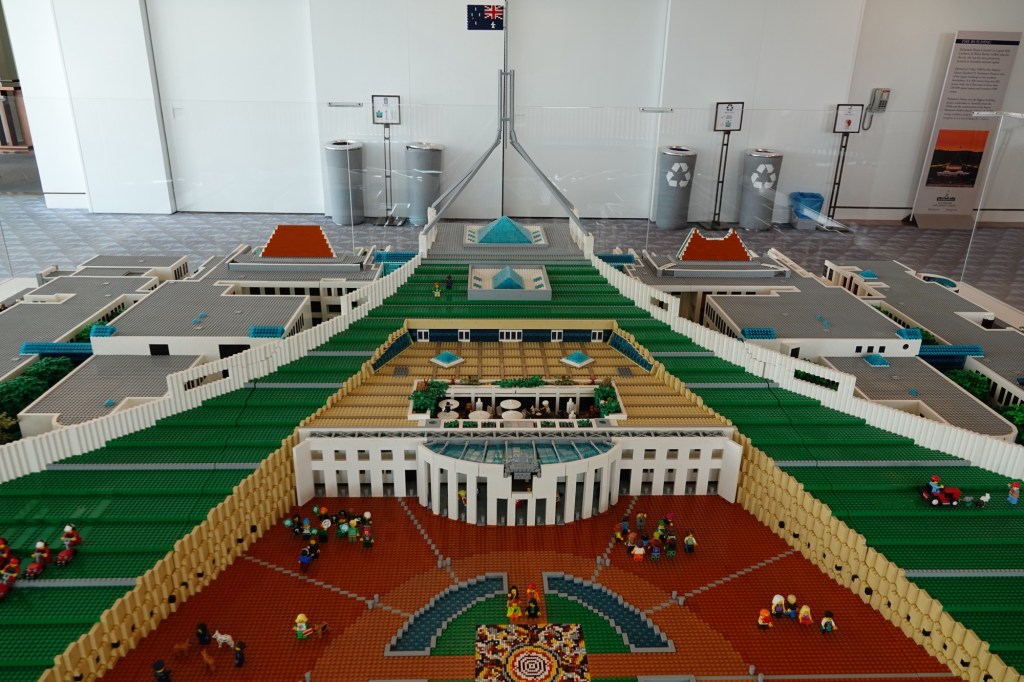
There’s even a Lego Parliament on display.
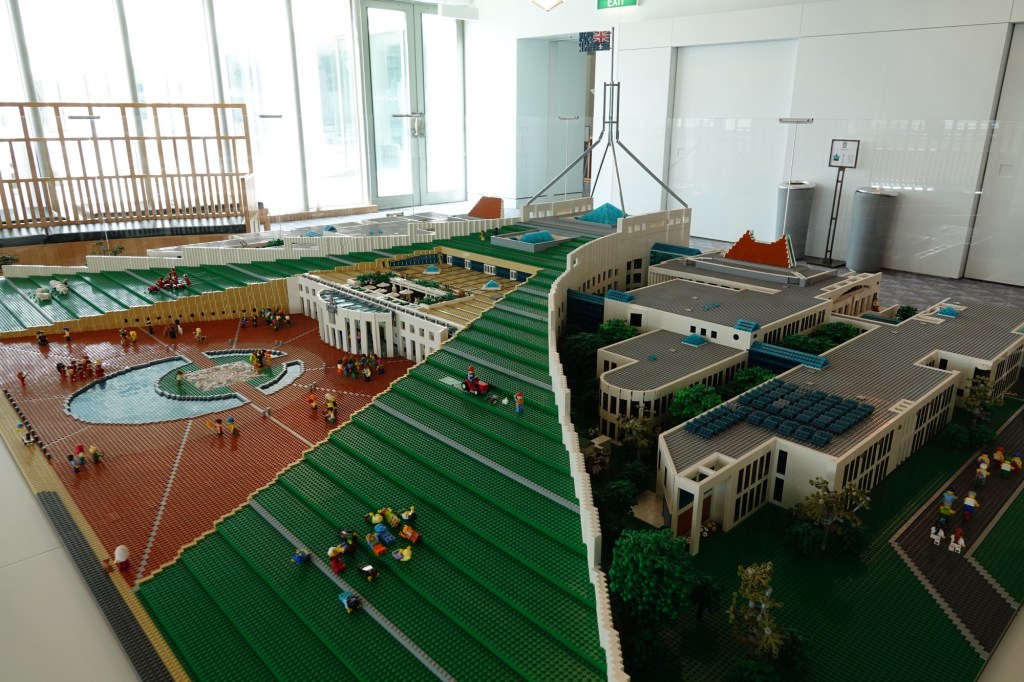
We took the elevator to the roof which, unsurprisingly since the building is literally built into Capital Hill, is covered in grass.
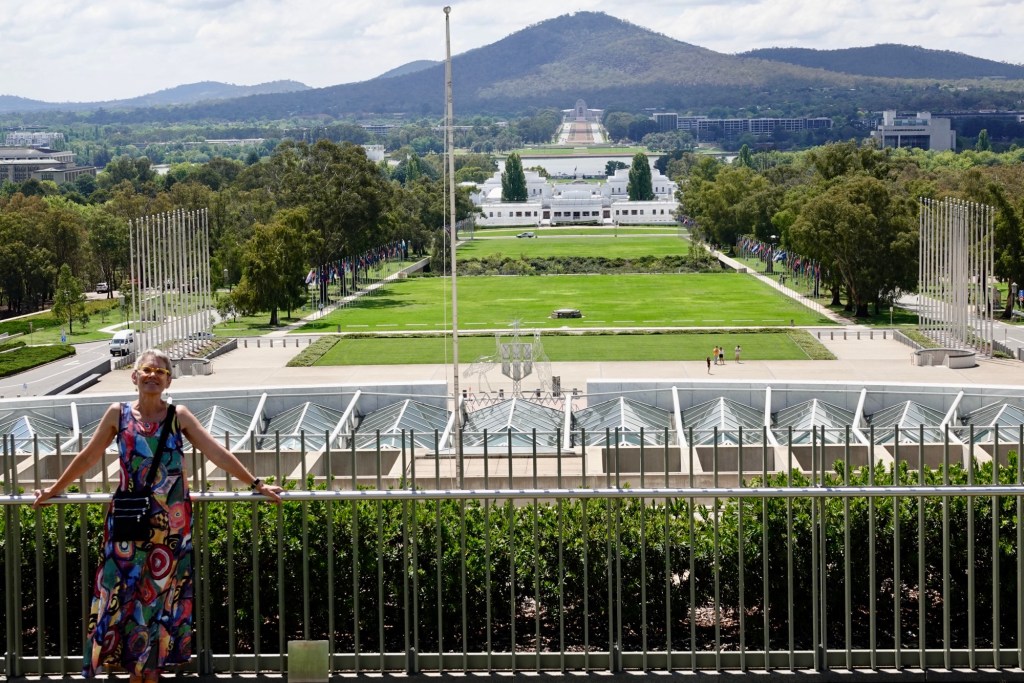
Being up with the flag was fun!
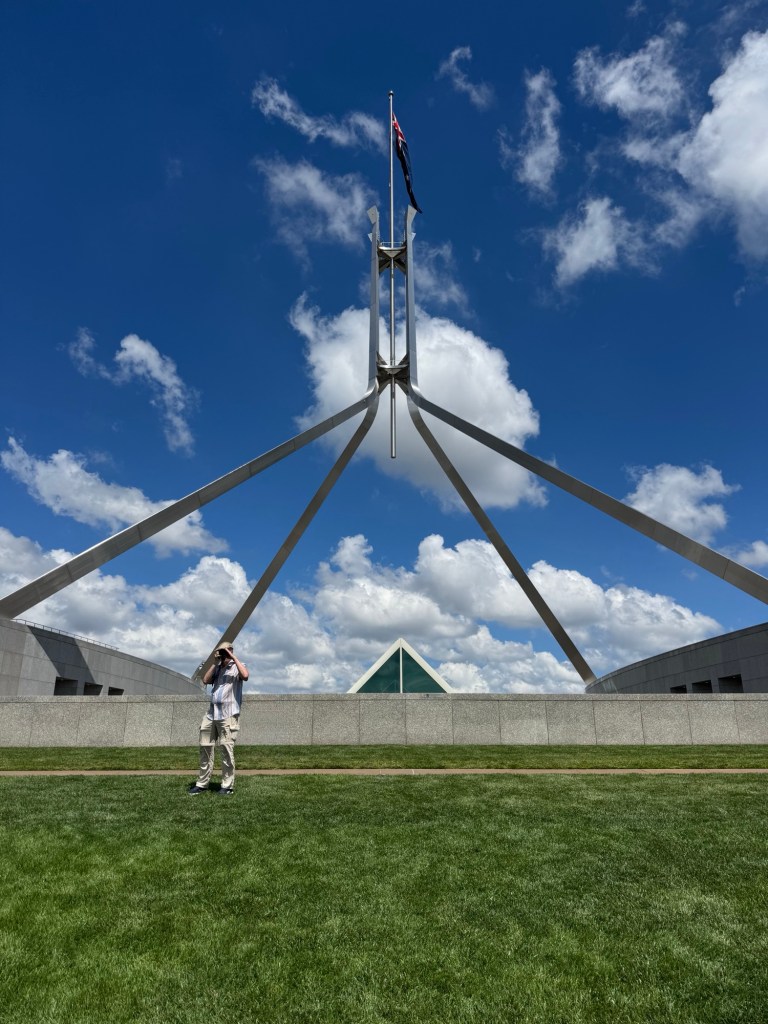
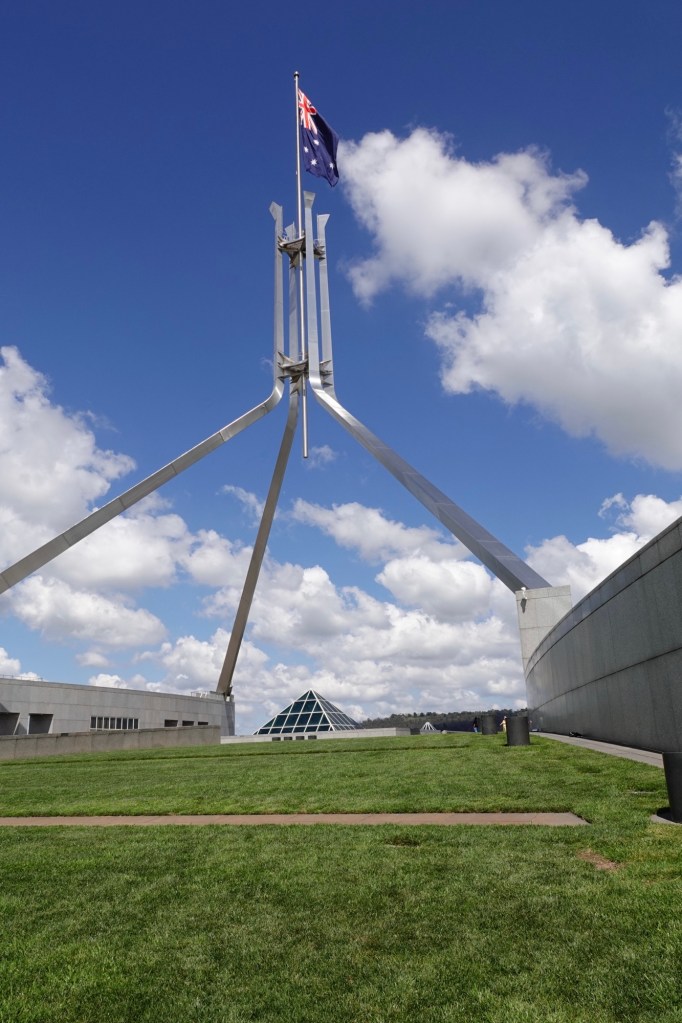
We now have a much better understanding of the similarities and differences between the parliamentary systems of Canada, Australia, and New Zealand, and we’ve enjoyed touring the buildings that house each of them.
Before we leave for Sydney, there’s one more long walk we’re planning to take.
 Rose and Ted’s Excellent Adventure
Again – many thanks for taking us along on your tours. Even if I ever get back to Australia, Canberra could not be high on my list with a friend in Melbourne, personal history in Sydney, a friend in Perth…
In the distance photo of that marvelous tapestry, it looked like you could blend right in. Great dress!
LikeLiked by 1 person
Just wanted to make a comment re voting age and it being compulsory here in Australia.
As soon as I turned 18, I registered to vote. When my nephew turned 18, I got the form for him, but he refused to sign it. He is now 35 and in that time, has never registered nor voted. I have no idea, if 18 year olds actually have to register or are they automatically enrolled these days in Australia…
LikeLike
Interesting. I don’t know the answer. Our guide seemed to indicate that it was somehow tied to birth and school records, although that could just mean registration forms being mailed out.
He mentioned that not voting meant a $20 fine – which he admitted was probably not much of a deterrent.
LikeLike
https://www.elections.act.gov.au/elections/education/fact-sheets/fact-sheet-compulsory-voting
LikeLike