Today was absolutely incredible.
The Australian War Memorial was created as the inspiration of Australian journalist and historian Charles Bean, who was embedded with the troops in WWI and realized that his country would need a place where it could remember and honour all those who fell on foreign soil and would never have graves in their home country.
Our Aussie friends Lee and Rosemary, both military veterans, in addition to opining that this is the world’s best war memorial, assured us that touring the highlights with a guide was the best way to really experience it.
To that end, we arrived at the War Memorial shortly after it opened at 10:00 and were impressed that there were already several school groups being led through various exhibits.
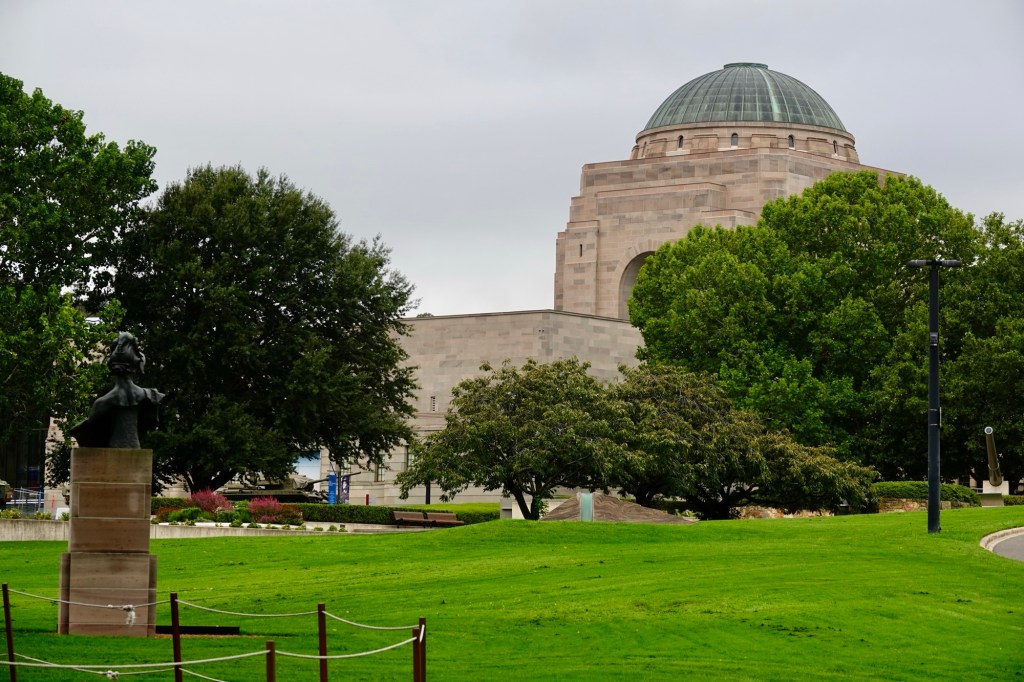
Lee and Rosemary were right: this is not the kind of place where just wandering aimlessly gives a full perspective, even with all of the plaques, posters, films, and touch screens. At any given time, more than 7,000 objects are on display from the Memorial’s collection – that’s far more than we could prioritize or absorb.
Our guide, Mark – a historian and author – was a wealth of historical knowledge, but more importantly had memorized and could share the personal stories of individual Australian service members. Those made our visit both poignant and relevant.
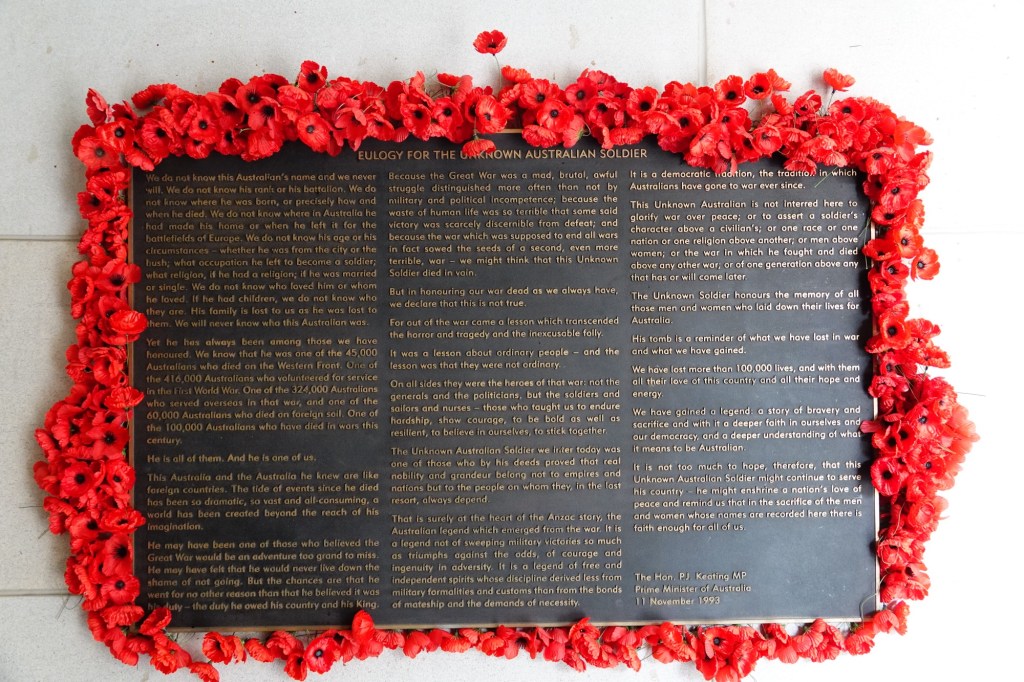
The figurative and literal heart of the memorial is the domed tomb of the unknown soldier, whose unidentified body was returned to be entombed here along with some Australian soil.
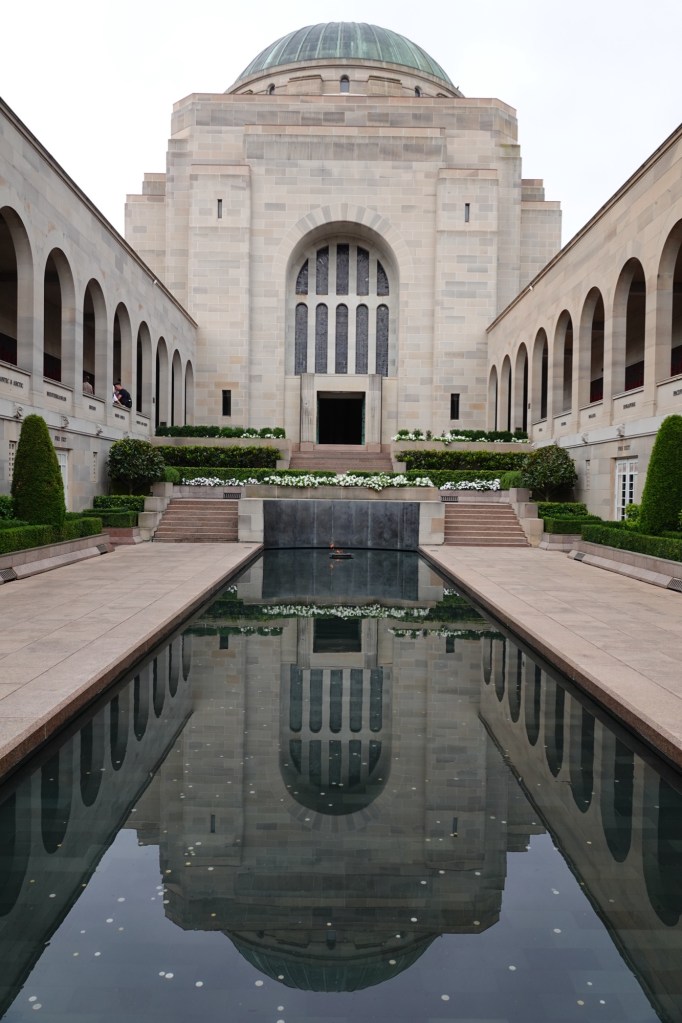
We began our tour outside that tomb at the eternal flame and reflecting pool.
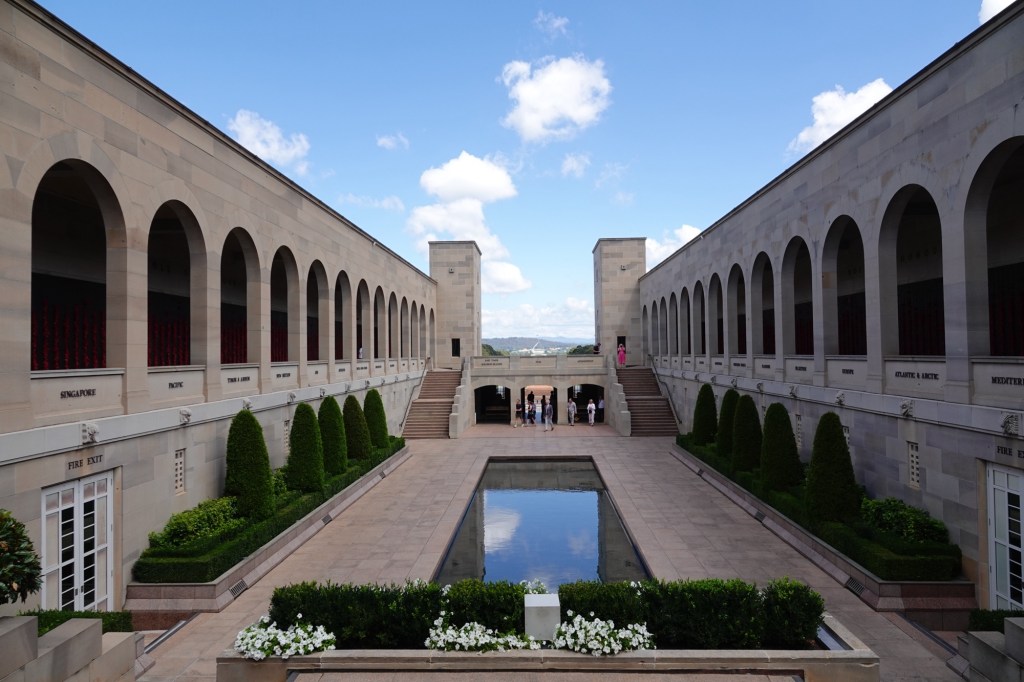
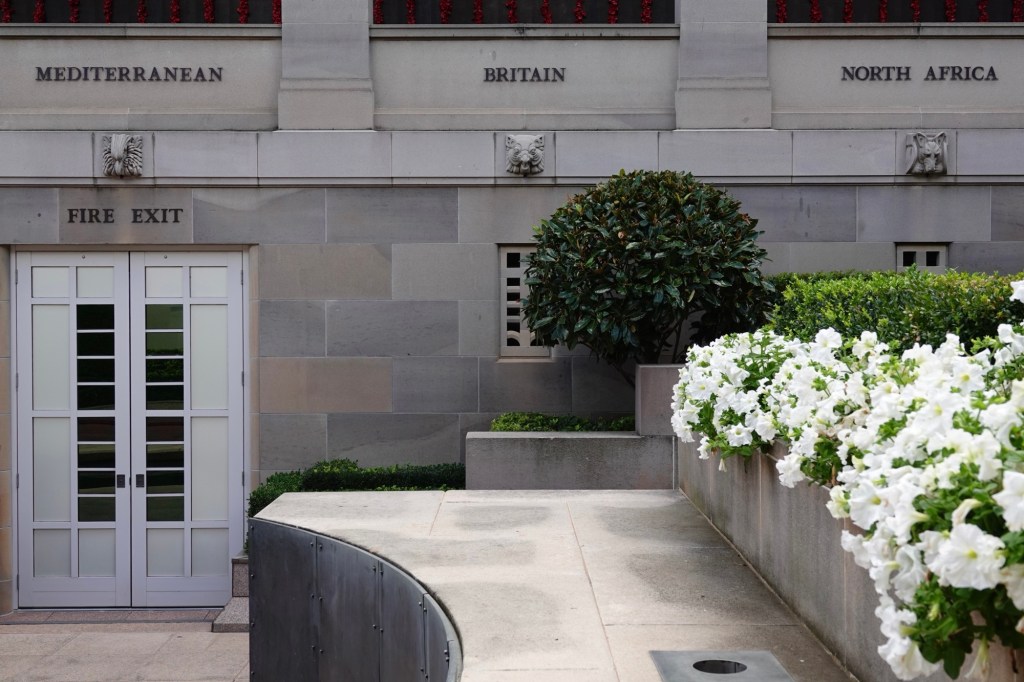
We learned that what looked like gargoyles overlooking the pool under the names of each of the war zones were not gargoyles at all. They are actually aboriginal-styled depictions of Australian animals.
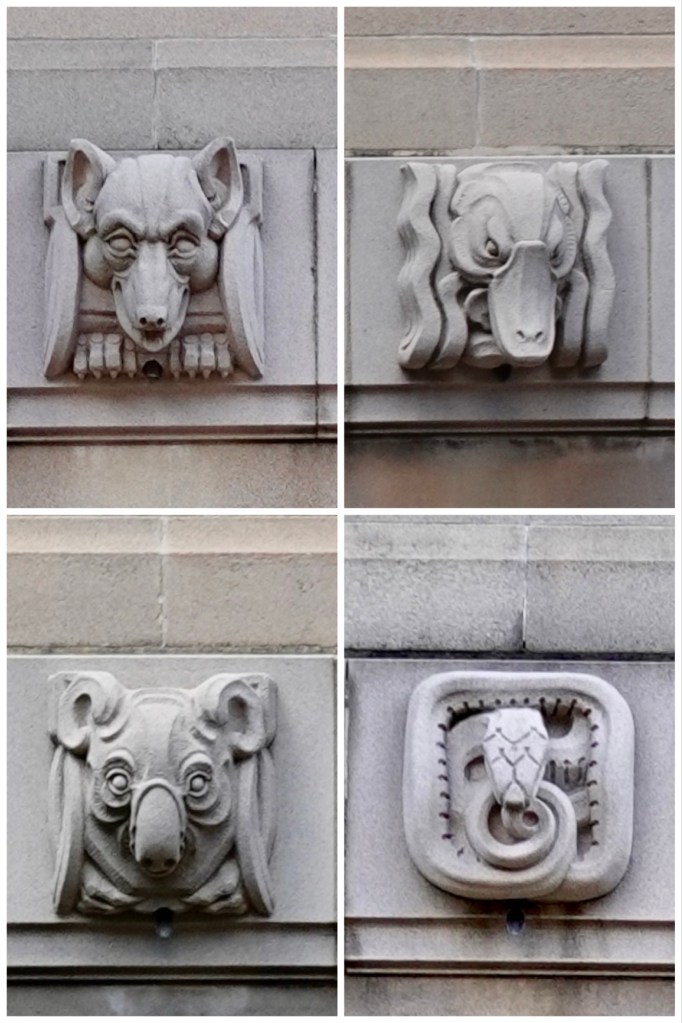
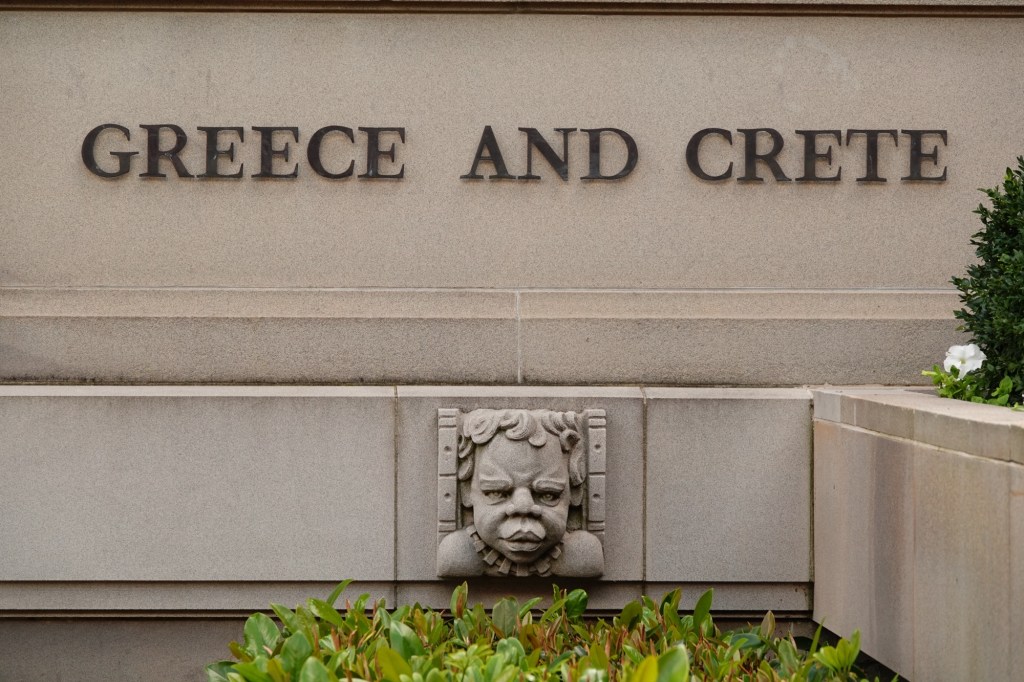
Only the two at the end were human Aboriginal faces.
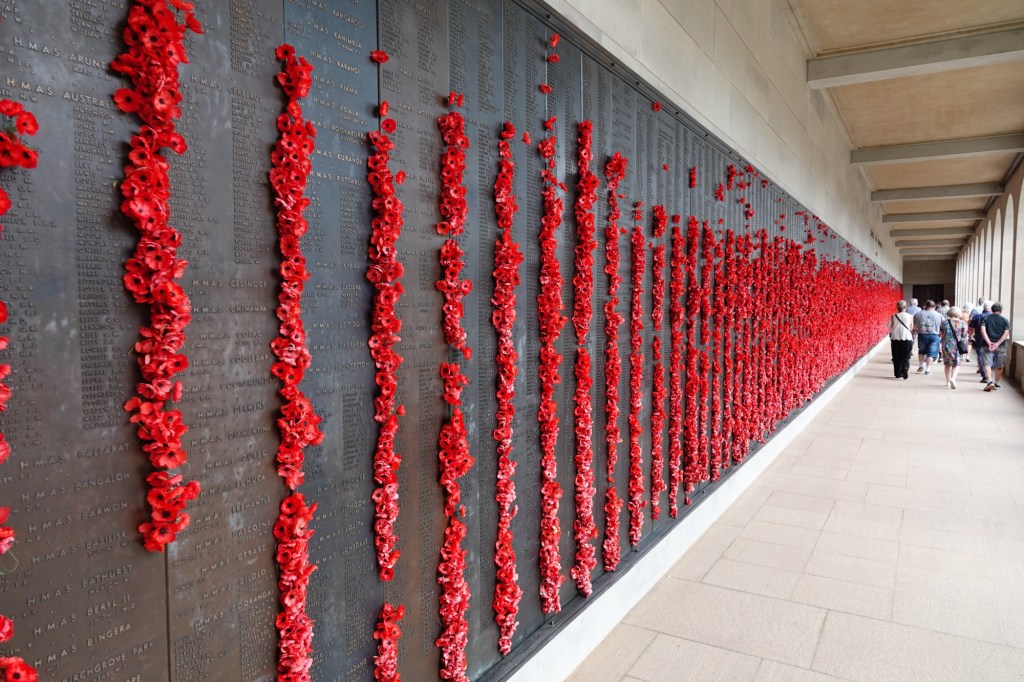
Surrounding the pool on a cloistered level are the memorial walls Rolls of Honour with the names, but not ranks, of those who gave their lives in all the arenas in which Australia’s forces fought. The names are arranged within their regiments or battalions.
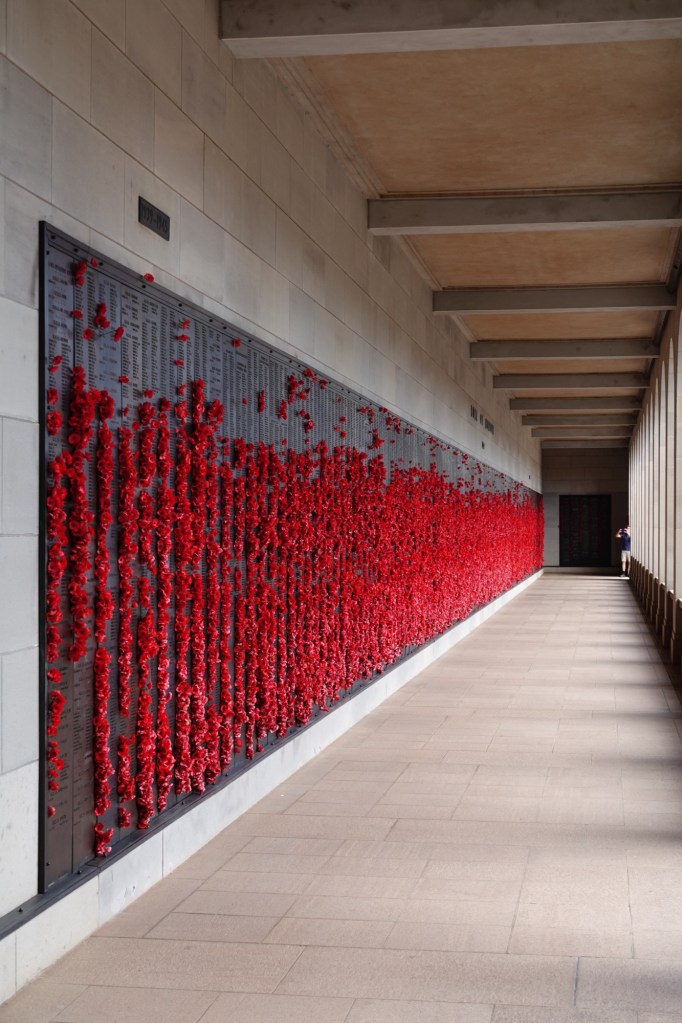
We began on the side dedicated to World War 1 and the wars prior to Australian federation, like the Boer War. This corridor lists around 63000 names, about 60,000 of which are related to WWI.
For perspective, Canada’s total casualties at the end of WWI stood at 67,000 killed and 173,000 wounded, at a time when our population in was about 8 million. Australia’s population at the same time was at just under 5 million.
Mark stopped at William Reginald “Bill” Rawlings, and told us his story. Bill Rawlings was one of the first aboriginal soldiers to win a Military Medal for Bravery. That was especially significant since Aboriginal Australians were not allowed to officially enlist until partway through WWI because they were not considered commonwealth citizens; even then only “half-caste” aboriginals were officially accepted . Those like Rawlings who served and died in the early years of the war may have pretended to be NZ Māori, who were citizens of the commonwealth in their own country.
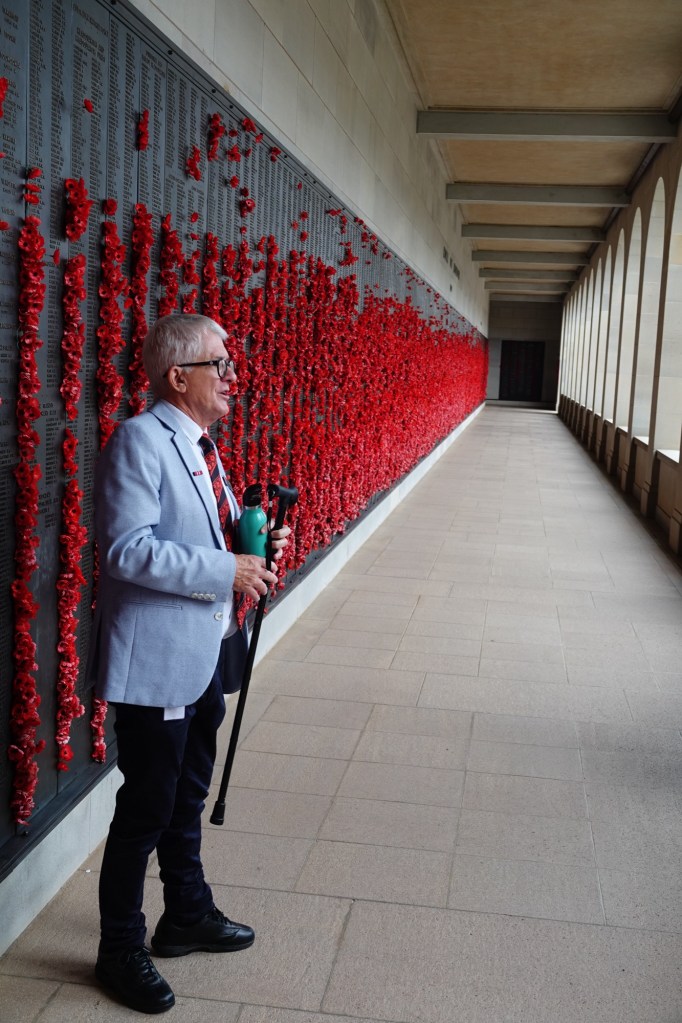
Further down the wall we stopped to hear the story of a Sydney soldier who enlisted as a quartermaster so that he wouldn’t have to kill anyone, but who himself was killed while working with his corps of stretcher bearers to retrieve the body of a fallen comrade. His own body was never recovered.
Between the two Honour Roll corridors we entered the Tomb of the Unknown Soldier, which is simultaneously somber and spectacularly beautiful.
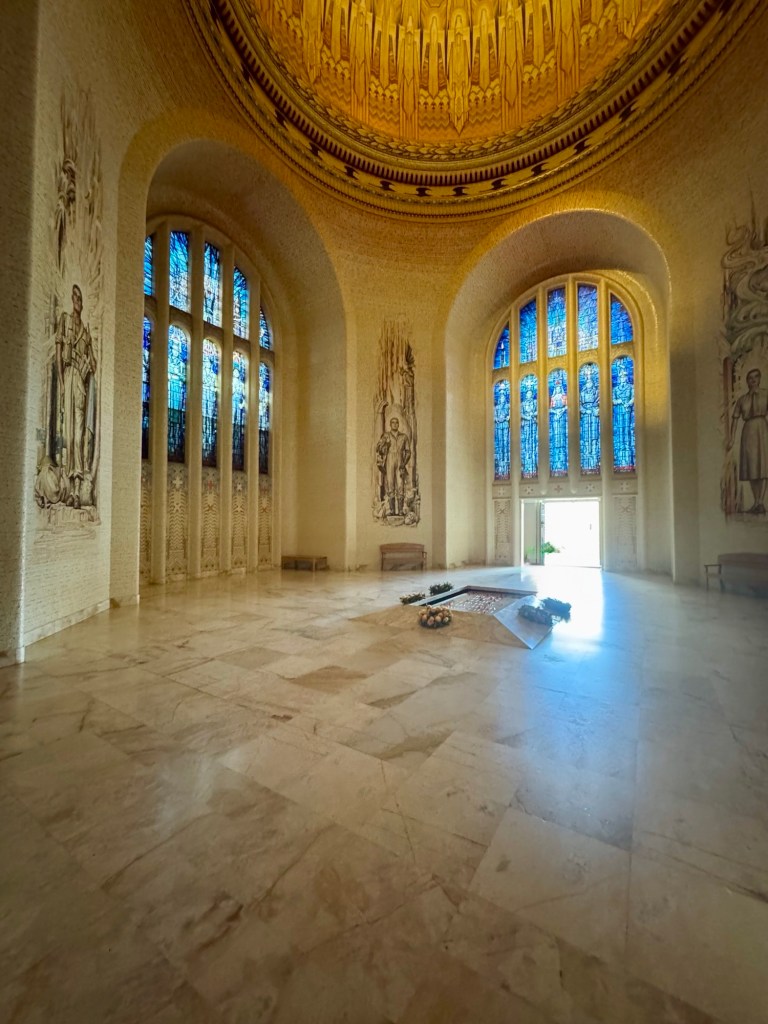
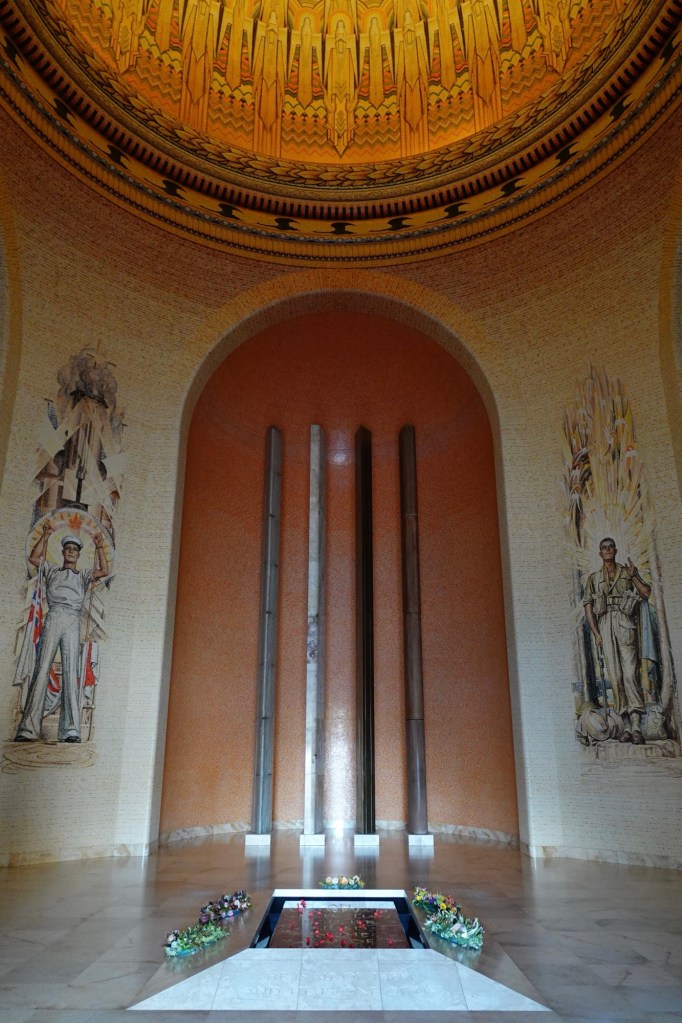
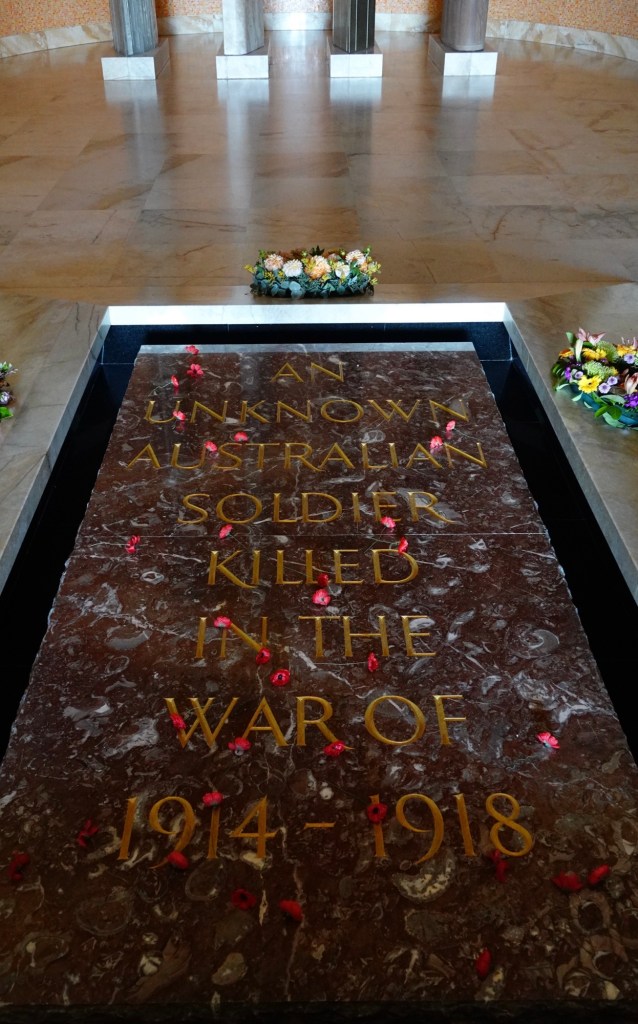
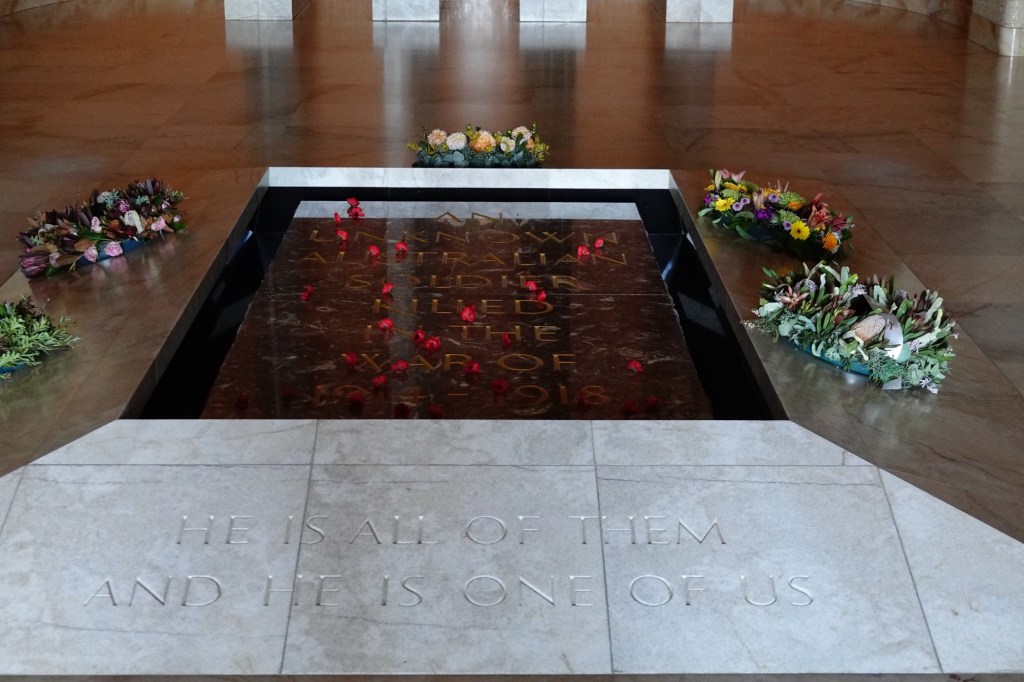
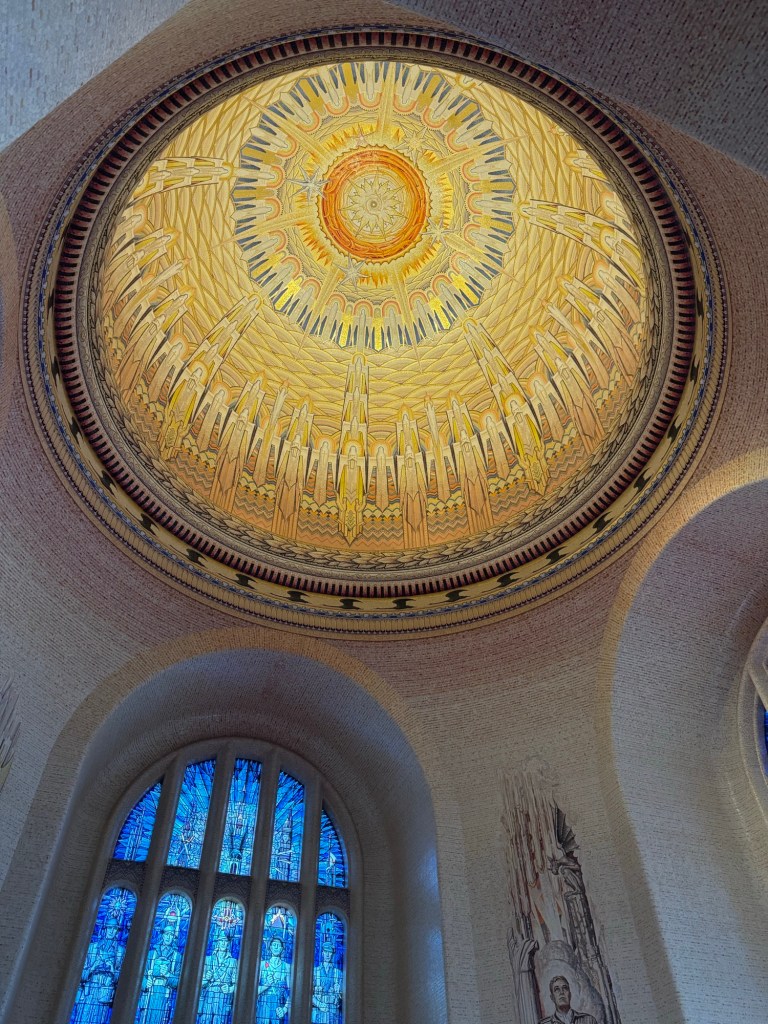
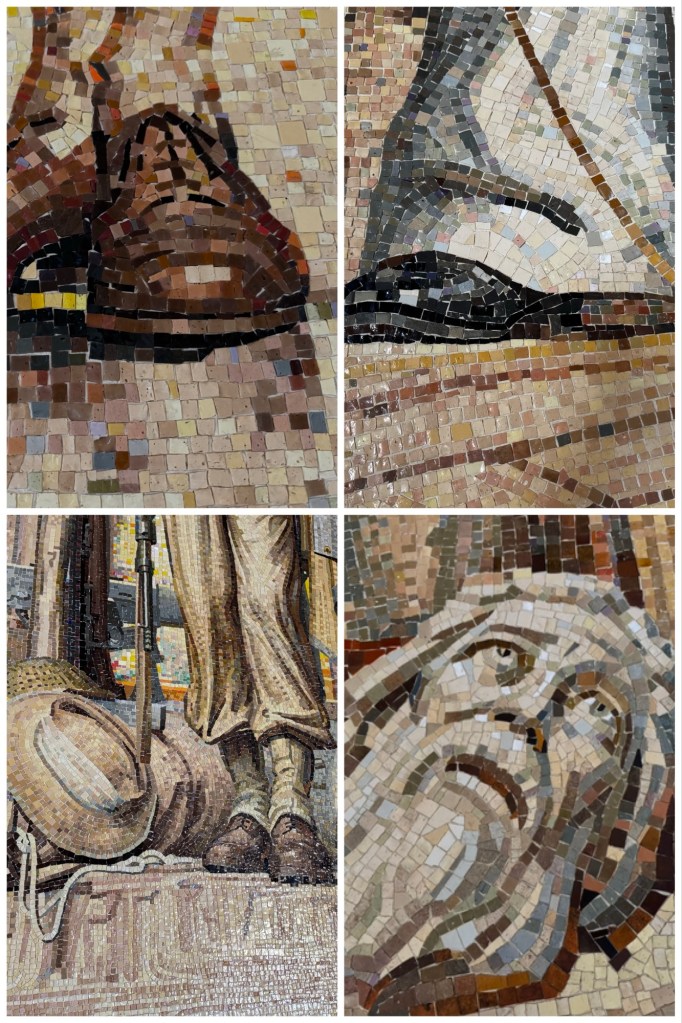
Inside the tomb 6 million mosaic tiles create the wall and ceiling decorations and murals.
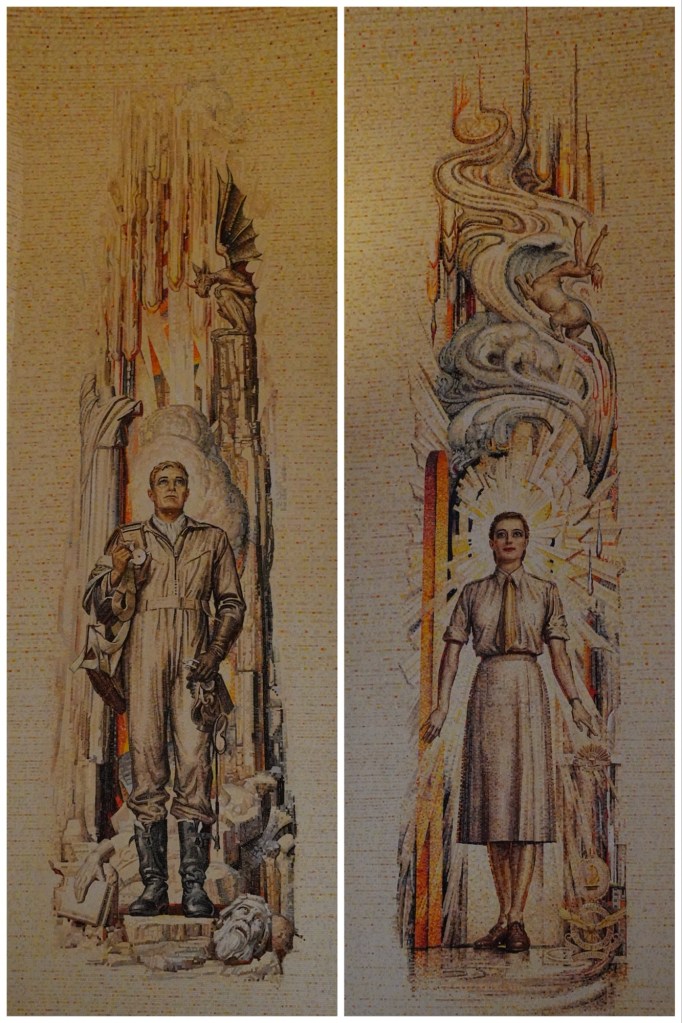
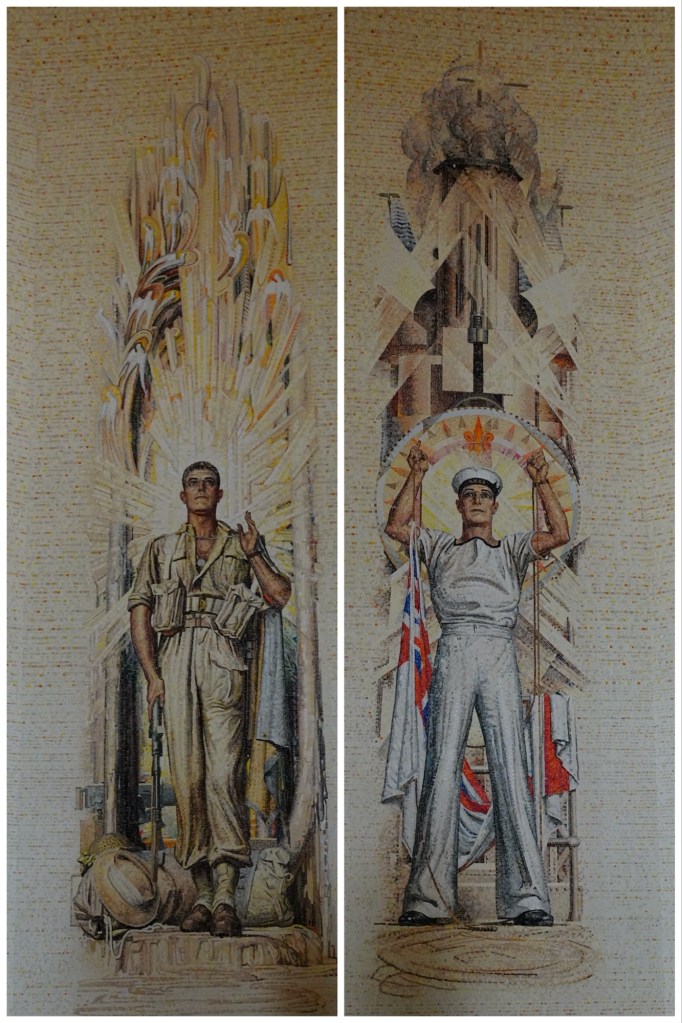
The details up close were wonderfully rendered.
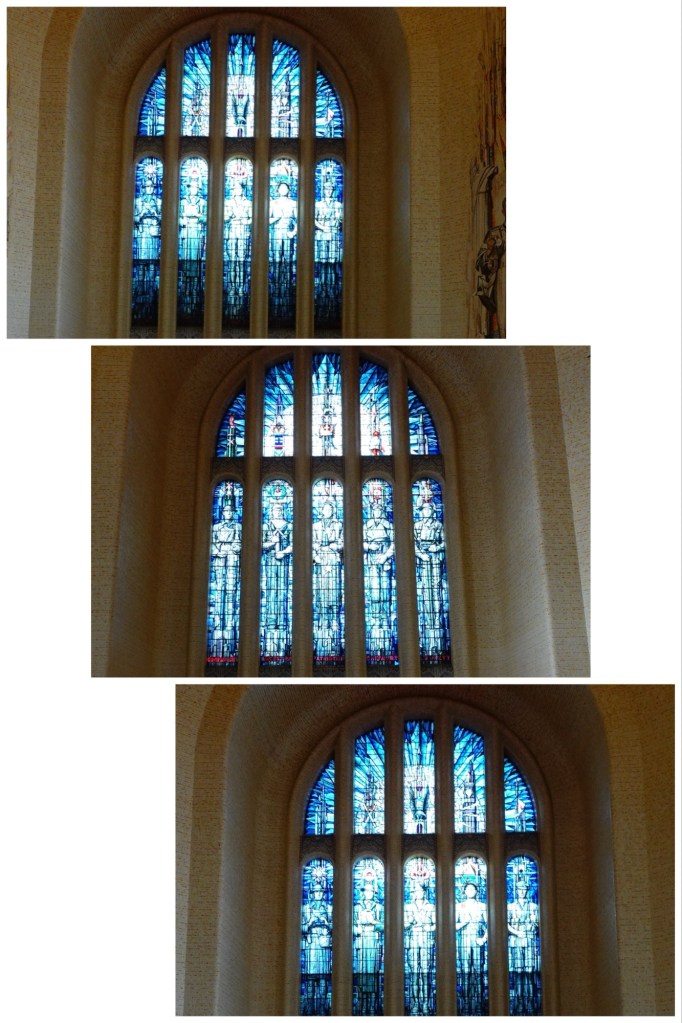
Three banks of 5 stained glass windows supplement the light that comes in from the tall entryway.
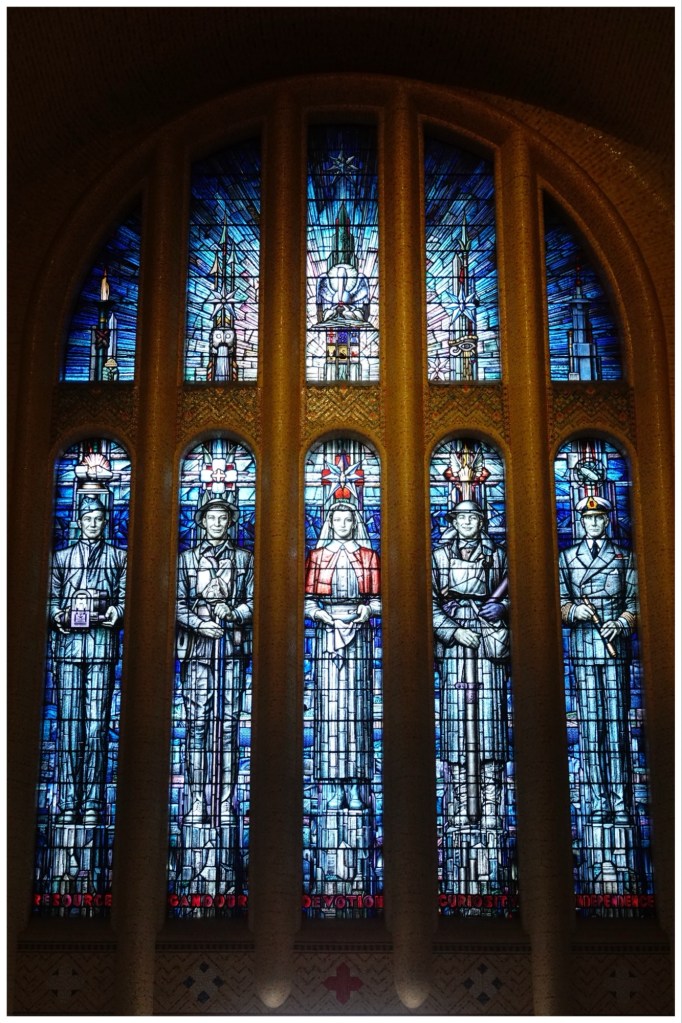
The words in red glass underneath each window panel represent the essential qualities of the Australian forces: coolness, control, audacity, courage, decision, resource, candour, devotion, curiosity, independence, patience, comradeship, ancestry, patriotism, chivalry, and loyalty.
After leaving the tomb we walked along the second Roll of Honour corridor where there are over 40000 more names from WWII through to Afghanistan.
Mark told us a bit of the story of the WWII Cruiser the HMAS Sydney II, lost off Fremantle after attack by the German ship HSK Kormoran. All 645 people aboard perished, as did the full crew of the German ship.
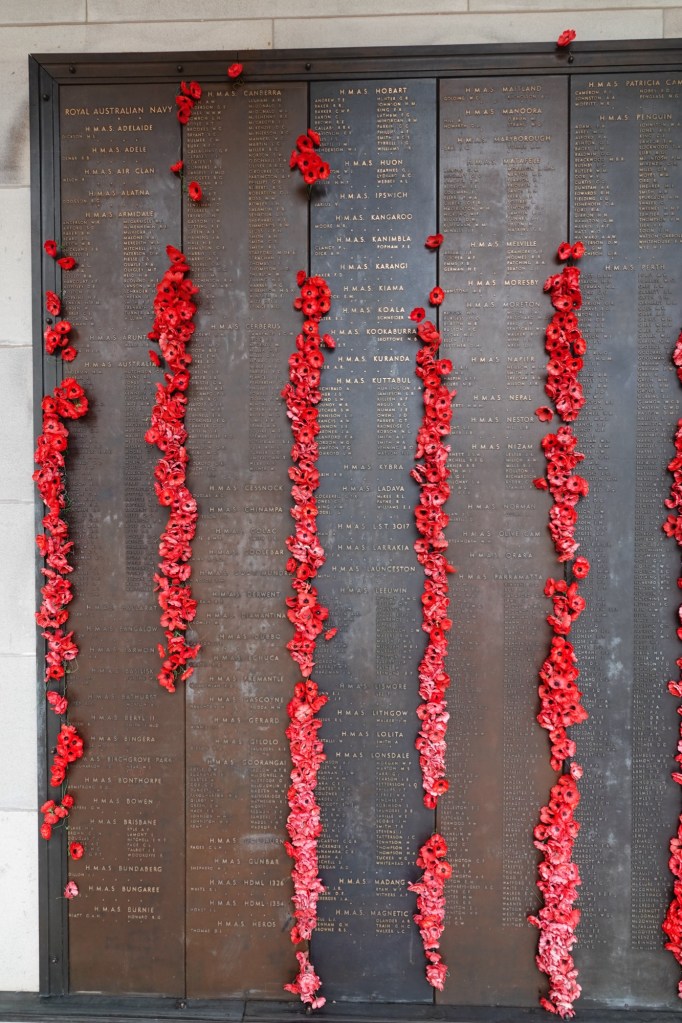
Mark also highlighted John Wheeler, ironically born on Anzac Day in 1948, who died on patrol in Vietnam in 1971.
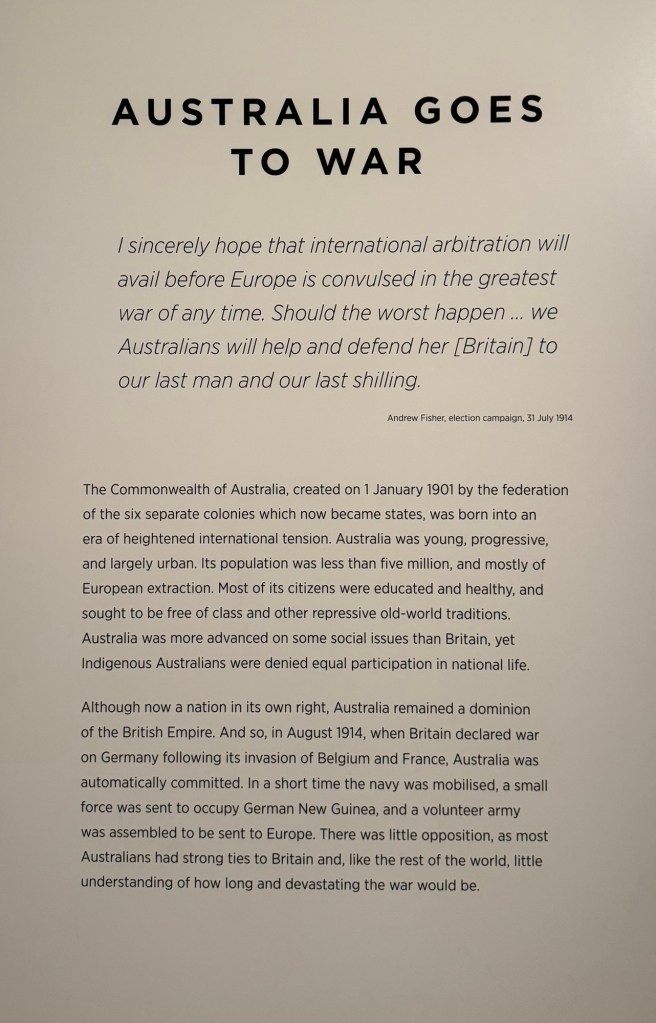
Then it was time to enter the WWI galleries. The displays in the galleries are grouped by year, and every display has touch screens for those who want more information about individual items.
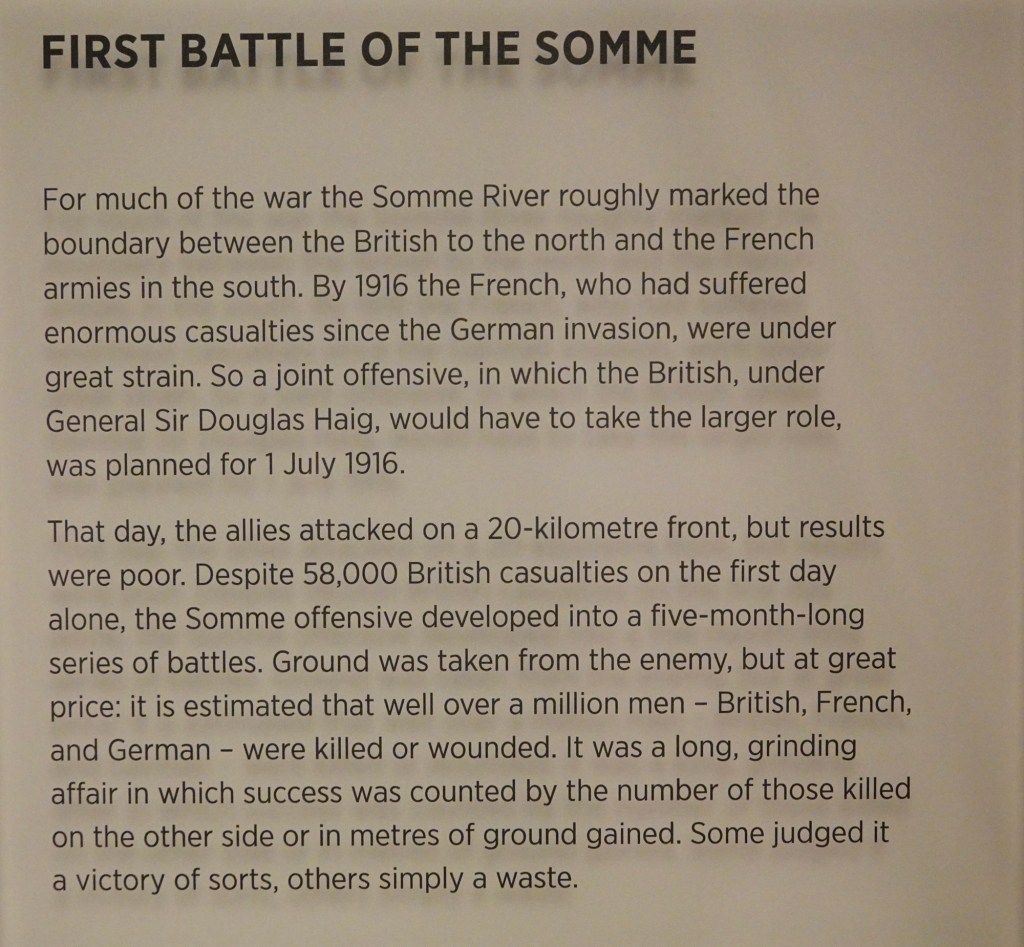
We stopped at the diorama of The Somme in Winter with its bleak depiction of soldiers in the mud and cold. Mark’s descriptions, including a graphic explanation of trench foot, brought it to life. Ted and I both thought back to visiting the trenches at Vimy Ridge (Episode 350)
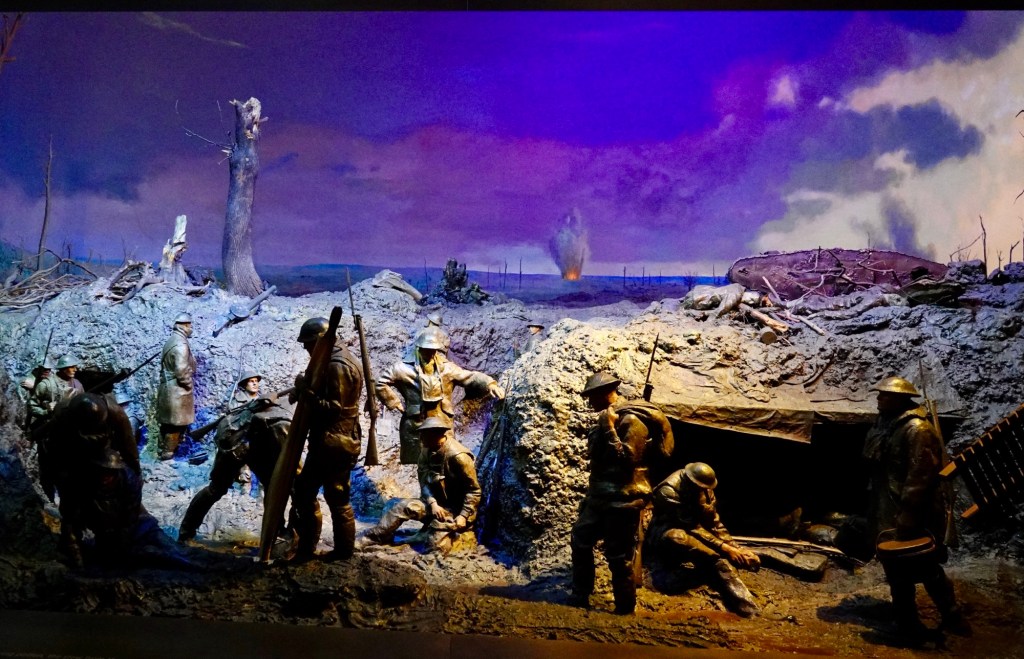
The incredible displays really emphasized what a waste of human life war is, and yet despite millions of lives lost, the refrain “never again”, repeated over and over, seems to mean nothing.
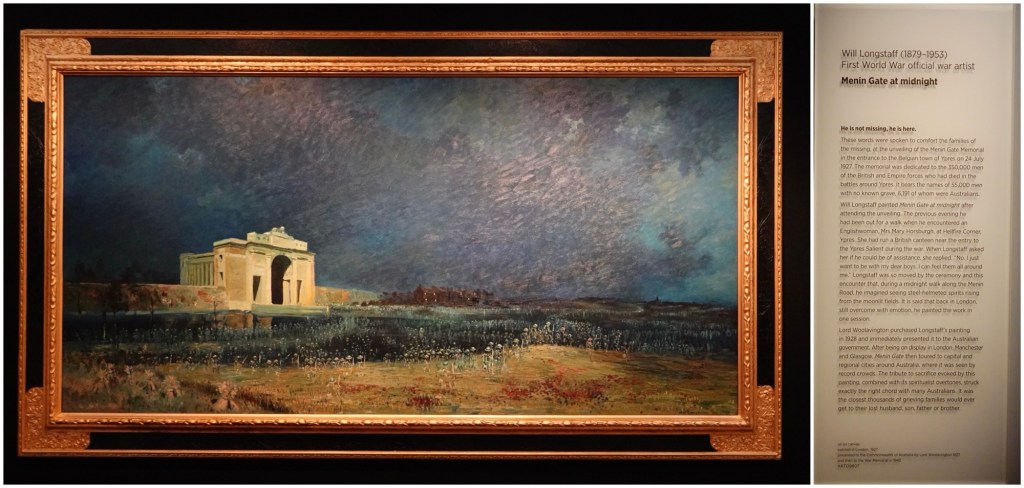
In addition to artefacts and dioramas, there were also paintings. The one titled Menin Gate at Midnight was particularly meaningful since it showed another memorial we’ve actually been to.
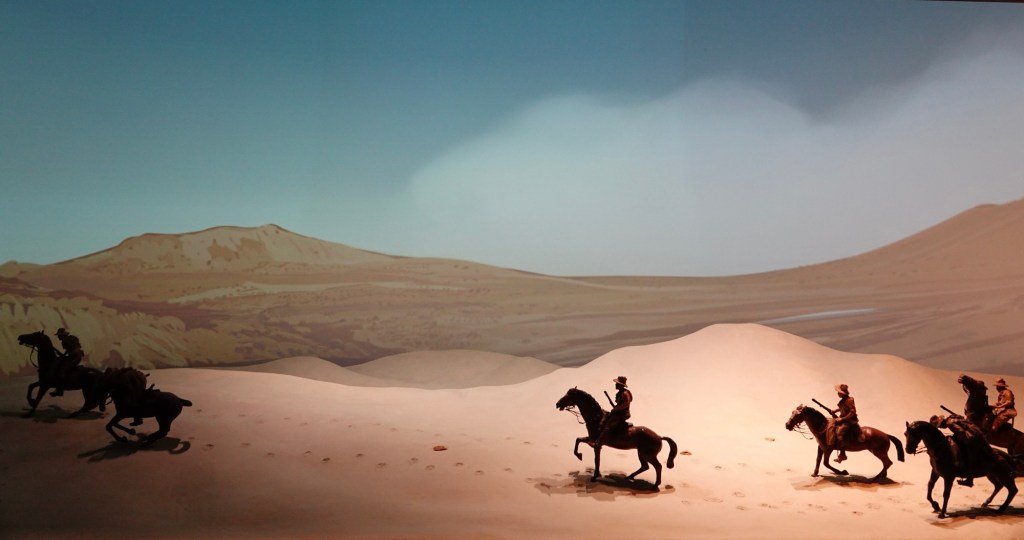
We learned that when Charles Bean envisioned creating this national war memorial, he was convinced that dioramas would be an important and effective way to share the stories of war. In our opinion, he was certainly right about that. Looking into scenes of battles complete with soldiers, bodies, armaments, and devastated landscapes is more than just a jumping off point for war stories. It creates a visceral reaction in anyone who sees them.
Both paintings and dioramas vividly demonstrated the differences between the Australians’ training grounds in the Egyptian desert, and conditions at the Western Front in Europe.
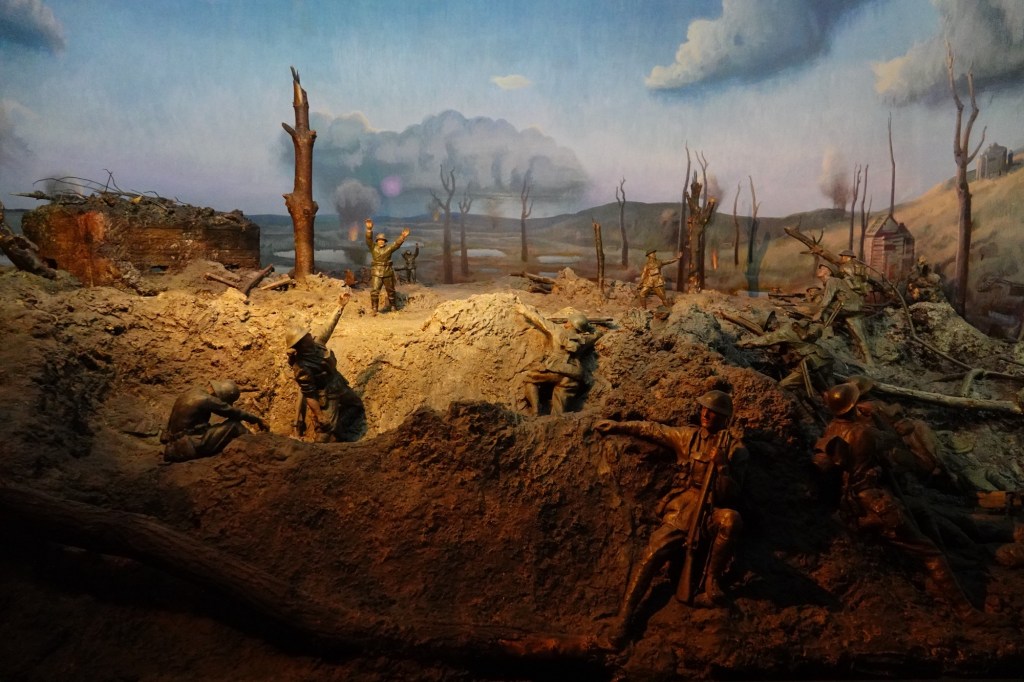
Australians (and Canadians) were in some of the most notable actions, including their final attempt to capture the village of Passchendale. All five Australian divisions, and the New Zealand Division, were there between September and November. The infantry, with artillery support, advanced in stages, often against stout defences that included strong concrete blockhouses. But in the end the rain turned the battlefield into a quagmire, and the offensive, which cost more than 500,000 casualties on both sides, including 38,000 Australians, collapsed in the bloodstained mud of the Belgian countryside.
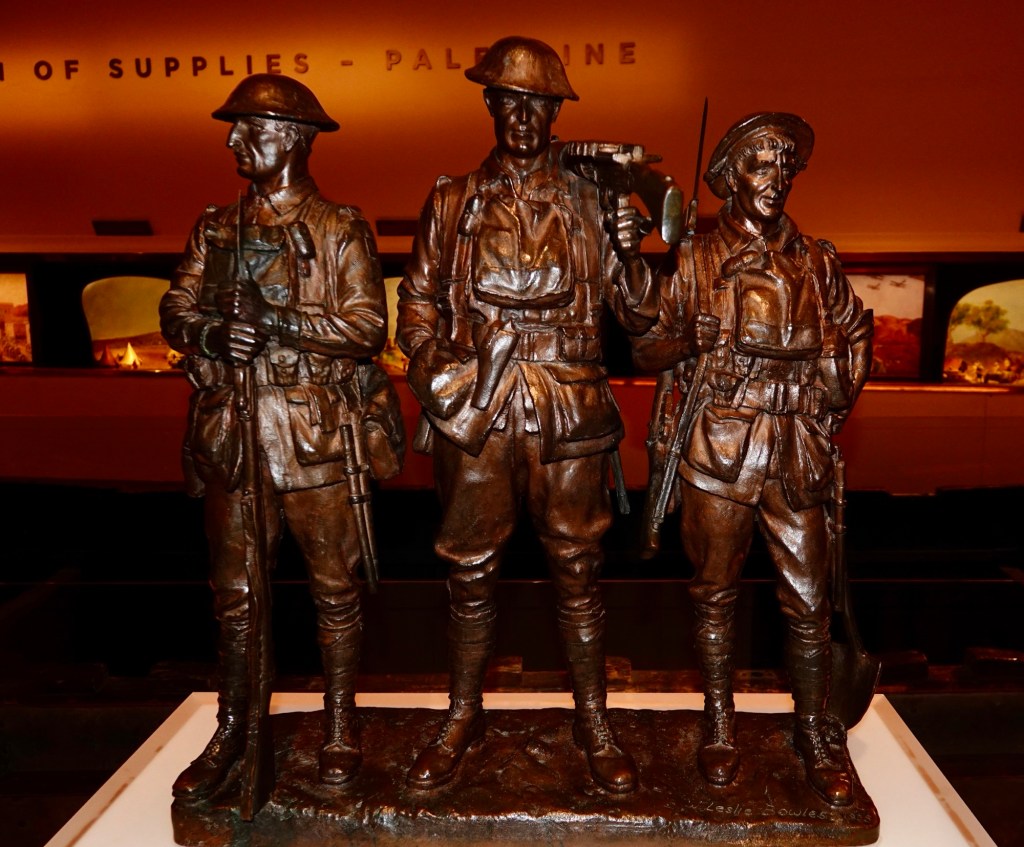
In the 1918 gallery Mark used a sculpture called Zero Hour, created from an actual photograph of a 3 man Lewis Gun team (a headmaster, a farmer, and a rabbiter) to tell us about the 29th battalion, Australia’s equivalent of the Band of Brothers.
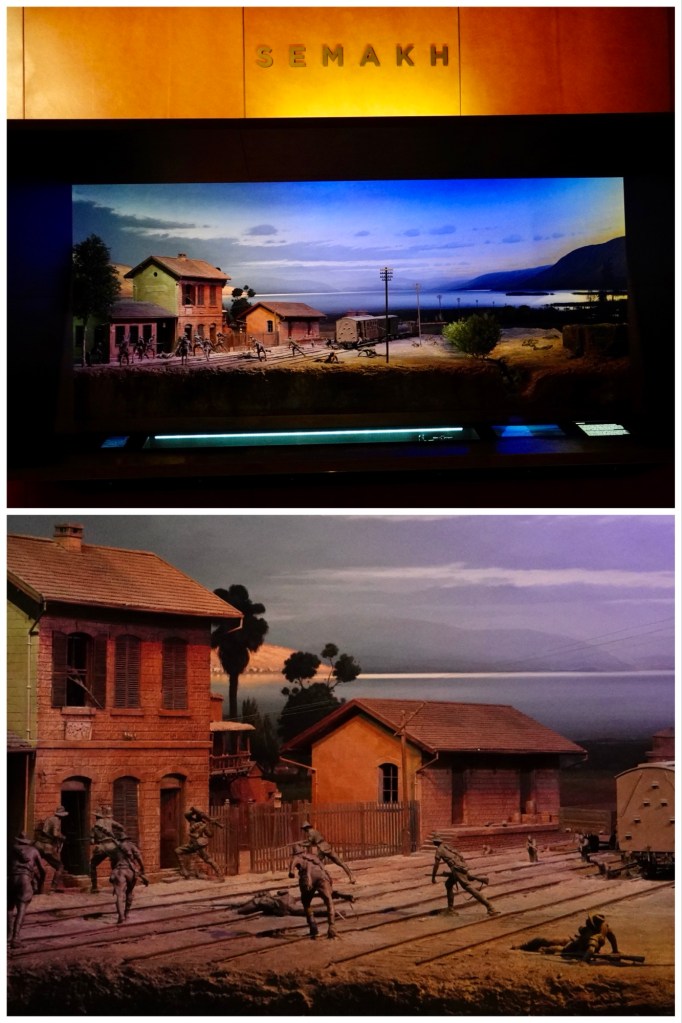
The diorama of the battle of Semakh showed the Australian 11th (mostly aboriginal and nicknamed the Black Watch) light horse regiment in action; effectively the last involvement of the Turkish in WWII.
The WWII galleries were also grouped by years.
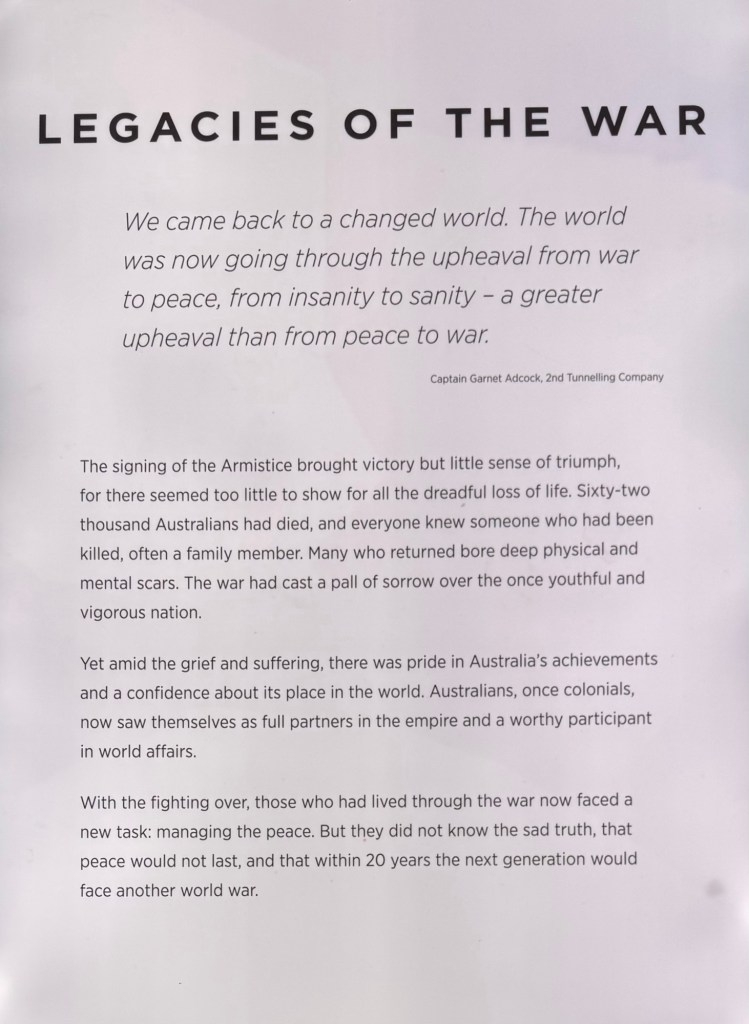
Walking from one war directly into another emphasized just how close in time the two world wars were, and how devastating both were.
The 1942 display detailing the bombing of Darwin by the Imperial Japanese, reinforced how fortunate we were in Canada never to have been bombed during the war. Our nearest danger was German submarines off the coast of Newfoundland. The first Australian flag ever to be fired upon by an enemy was in the gallery, but behind glass which prevented a good photo. It was originally flown above the Australian Northern Territory government house, and was rescued and subsequently flown in the national VE Day ceremonies.
The 1942 gallery also houses a Spitfire airplane.
In the 1943 gallery we stopped to hear the story of the hospital ship Centaur which was sunk by the Japanese.
A Holocaust area is included because many survivors settled in Australia, making their lives part of the Australian story.
In the 1944/45 galleries there is a German B1 flying bomb, and displays relating to the September 1945 Japanese surrender.
Our advertised 80 minute guided tour with Mark lasted over 100 minutes. We were very ready for a coffee and lunch break before continuing back into the memorial to explore in more depth on our own.
Outside Poppy’s café were a couple of statues that told incredibly touching stories.
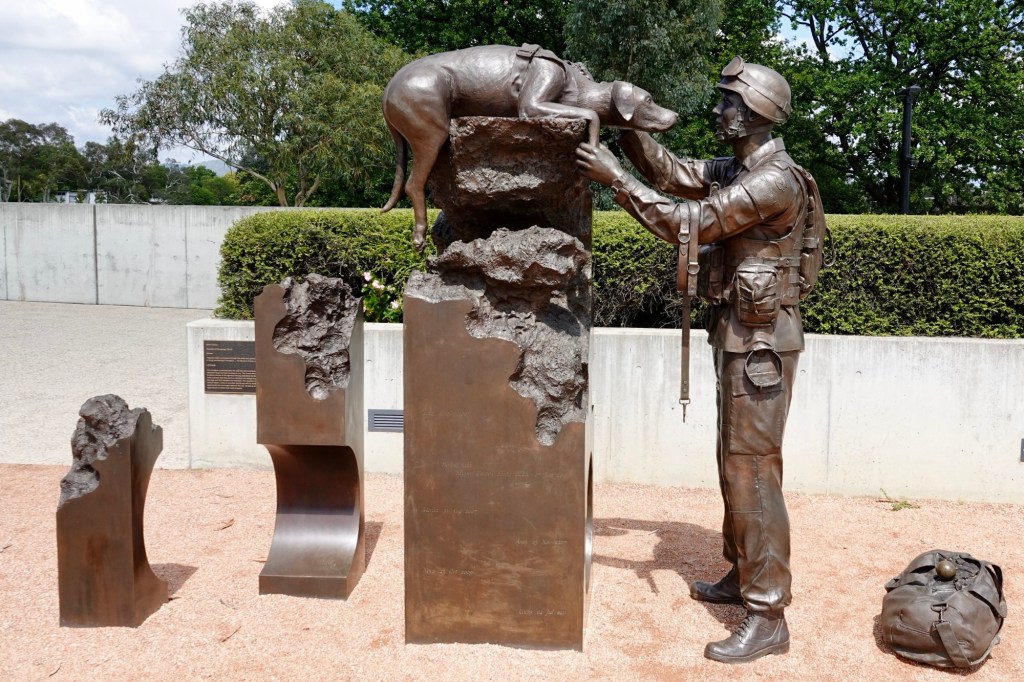
The EDD Ode
My eyes are your eyes to watch and protect yours.
My ears are your ears to detect evil minds in the dark.
My nose is your nose to scent the danger of your domain.
And so you may live, my life is also your life.
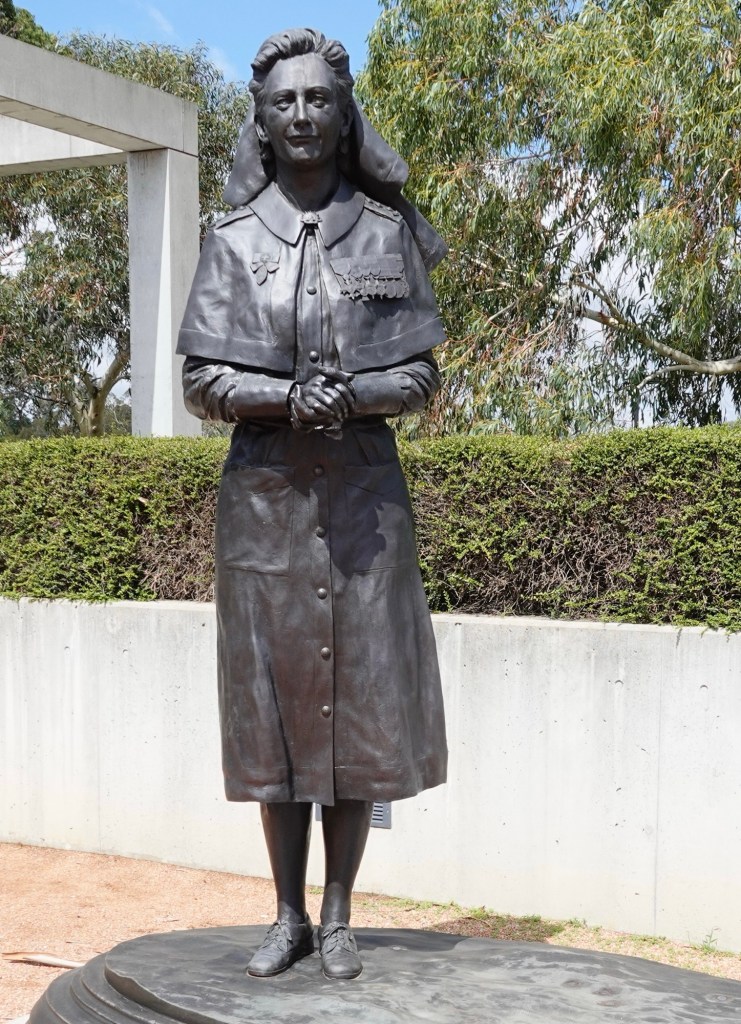
“Chin up, girls. I am proud of you, and I love you all.”
These were the final words of Matron Irene Drummond, spoken to 21 Australian Army nurses and a civilian woman as they were marched into the sea and massacred by Japanese machine-gun fire in the waters off Radji Beach, Dutch East Indies, on 16 February 1942.
One woman survived to reveal the details of the atrocity
– Lieutenant Golonel Vivian Bullwinkel AO MBE ARRED FNM FRONA (1915-2000).
Registered nurse and midwife Vivian Bullwinkel lived a life of service and devotion to her profession, to her country, and to humanity. Beyond the trauma of war, including the sinking of the SS Vyner Brooke and three and a half years as a prisoner of war, she became a distinguished leader and advocate for nurses and a formidable champion for justice and peace.
Vivian Bullwinkel lived in a way that meant her sisters would never be buried in the abhorrent darkness of war, but that their stories would continue to shine in the light of peace by which they lived
We had a couple of hours of exploration left.
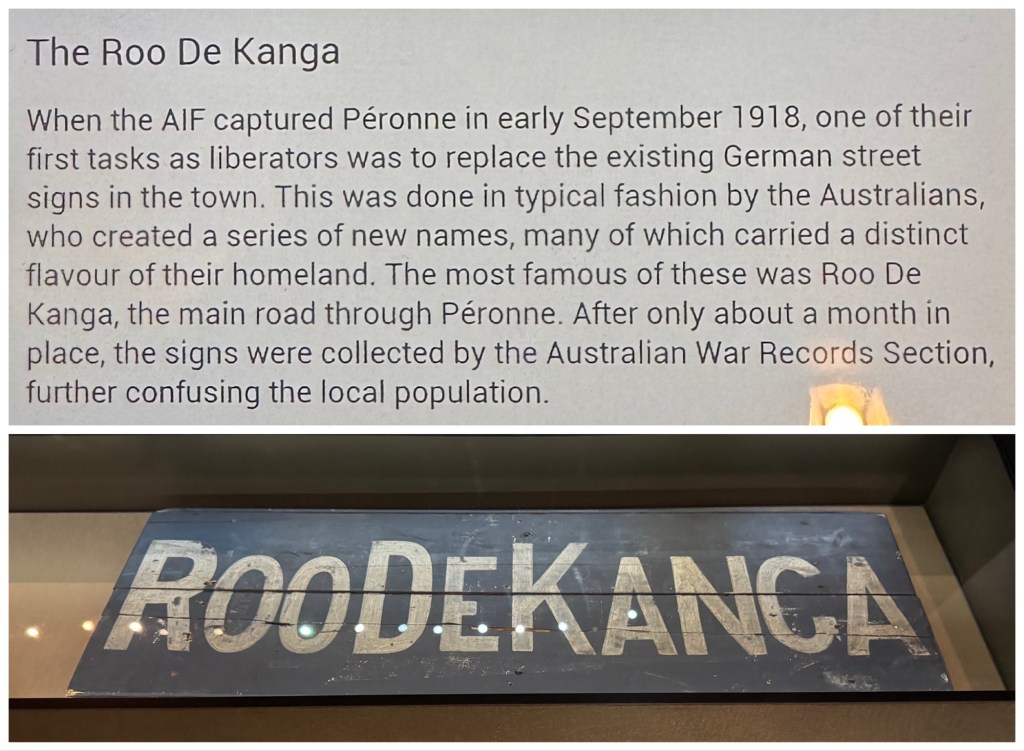
Occasionally mixed in with all the darkness there was a lighter note, like this street sign that demonstrated a sense of humour left intact despite horrific circumstances.
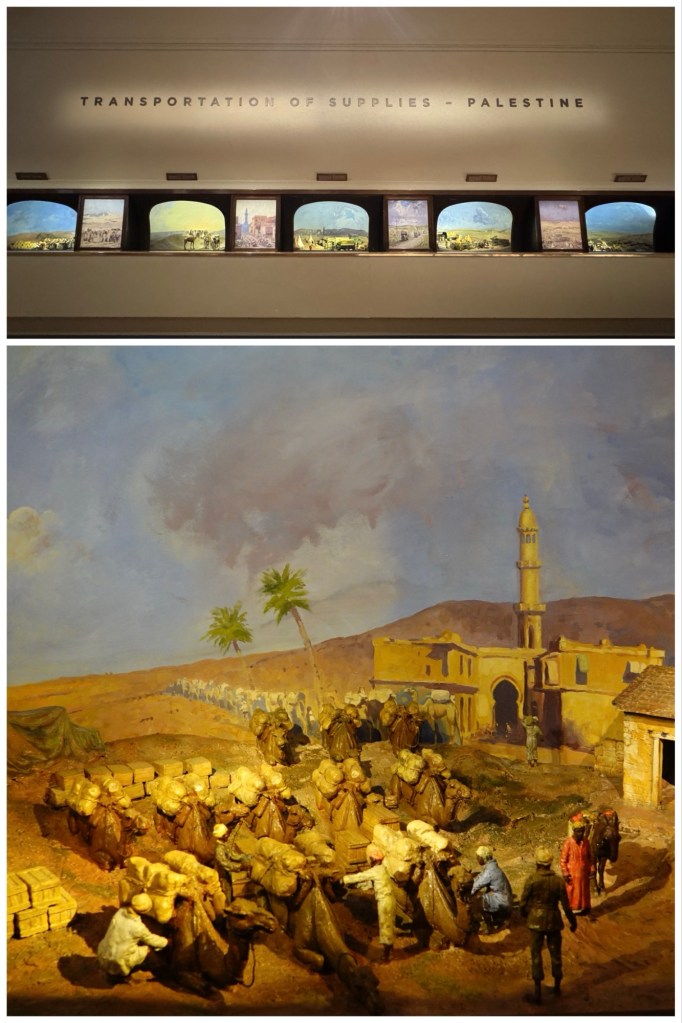
Most of the dioramas were quite huge, but the series of 9 under the heading Transportation of Supplies – Palestine, were each only about 1 cubic metre in size.
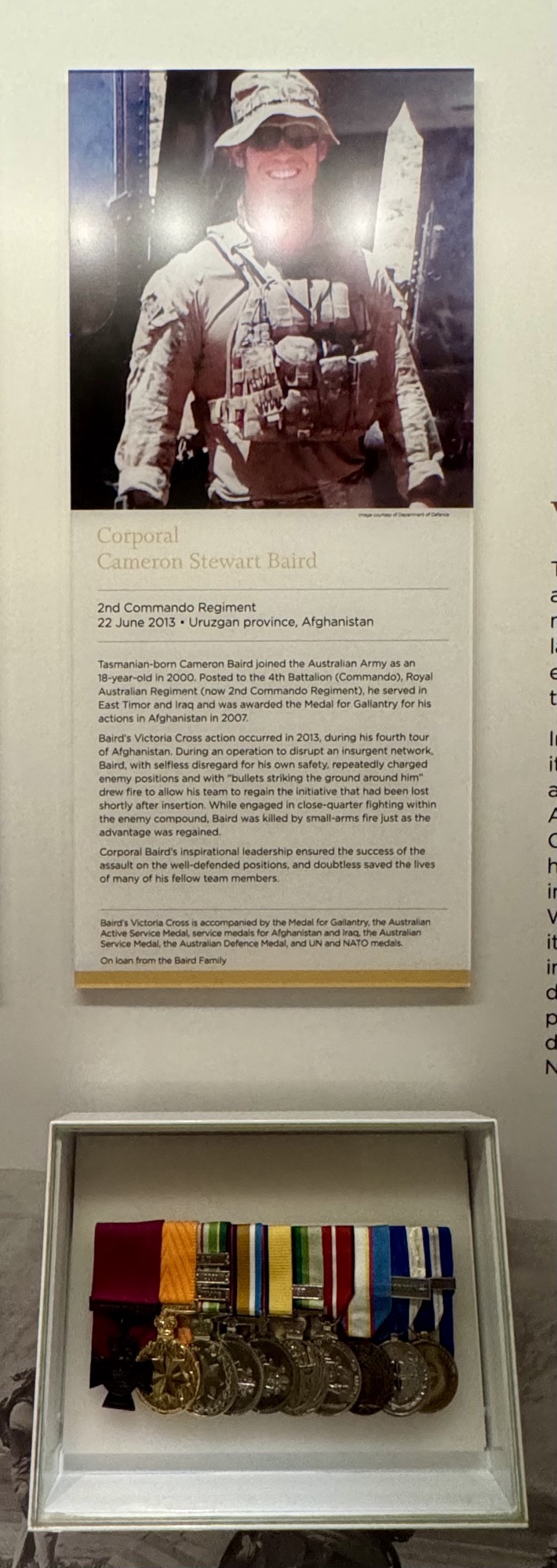
We’d bypassed the Hall of Valour on our tour. In it are the portraits and stories of every one of Australia’s Victoria Cross and George Cross honourees, from the Boer War through present day.
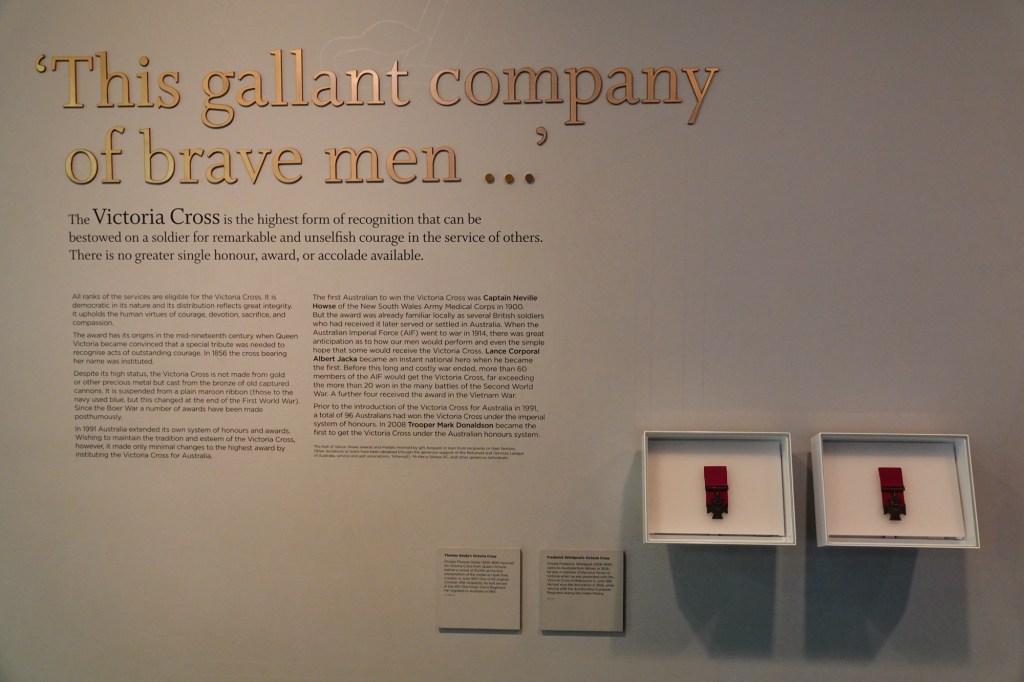
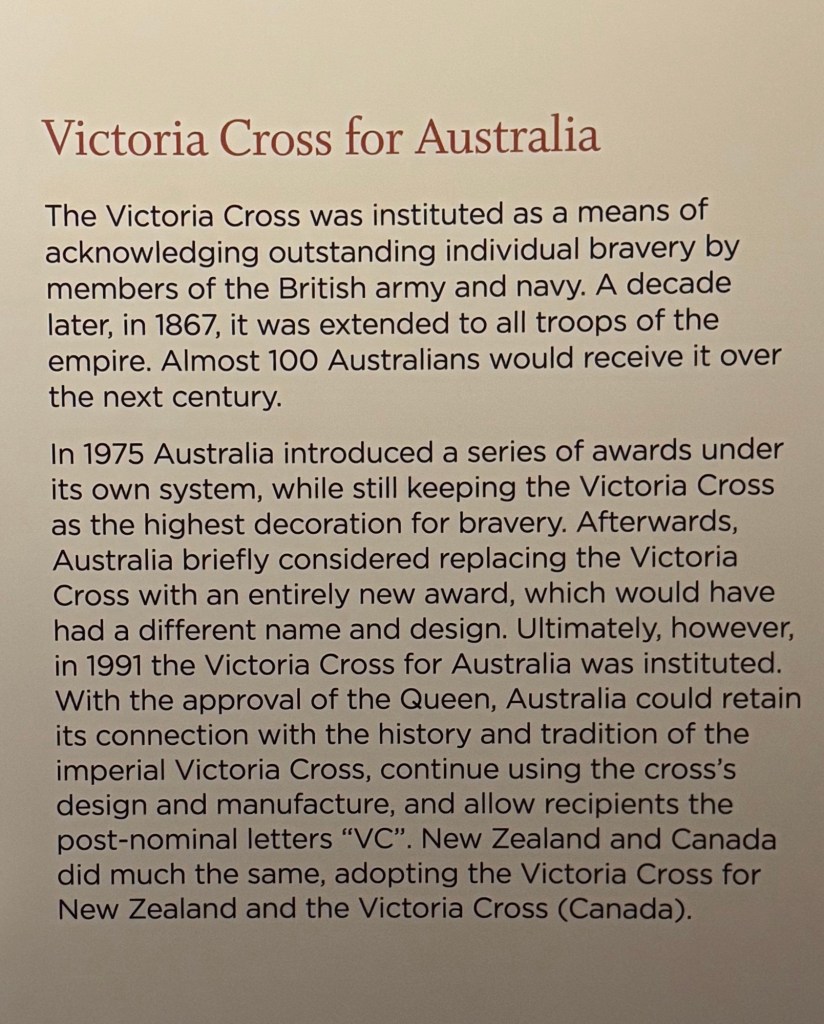
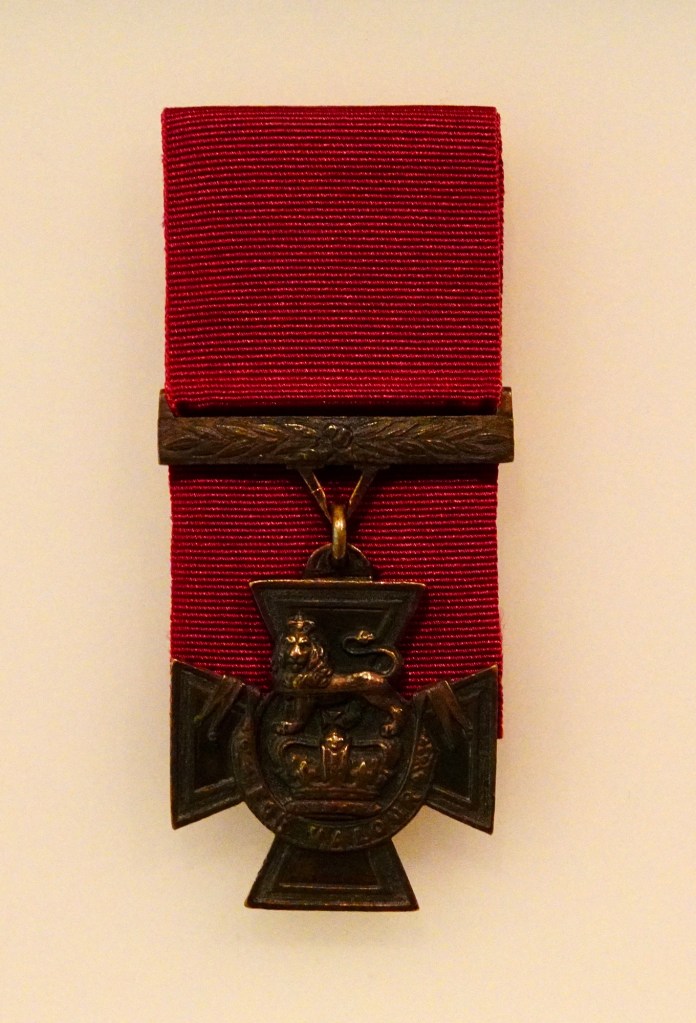
Each recipient was pictured above a short biography and, in most cases, with their medals. In some cases, medals were being restored, or had been retrieved by families to use in the upcoming ANZAC Day ceremonies April 25th.
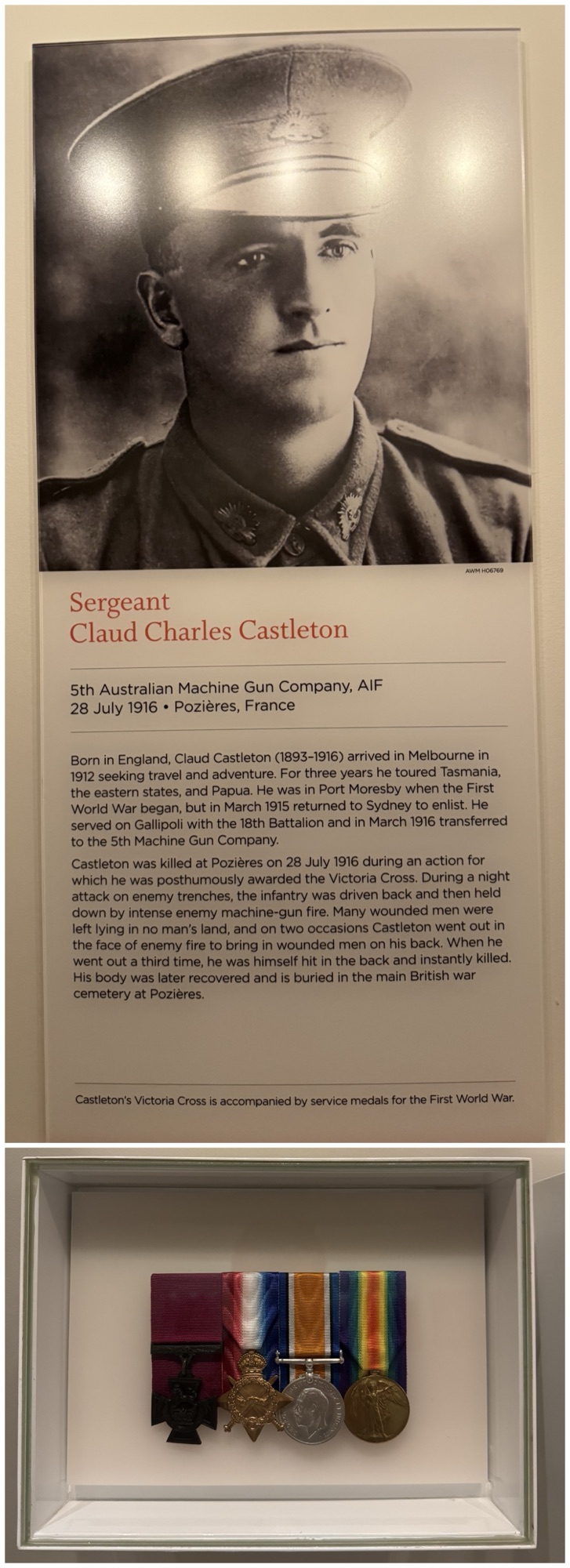
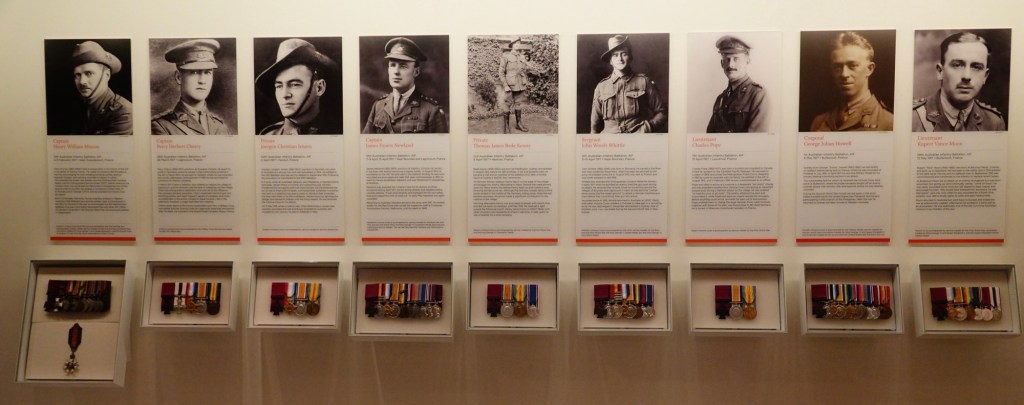
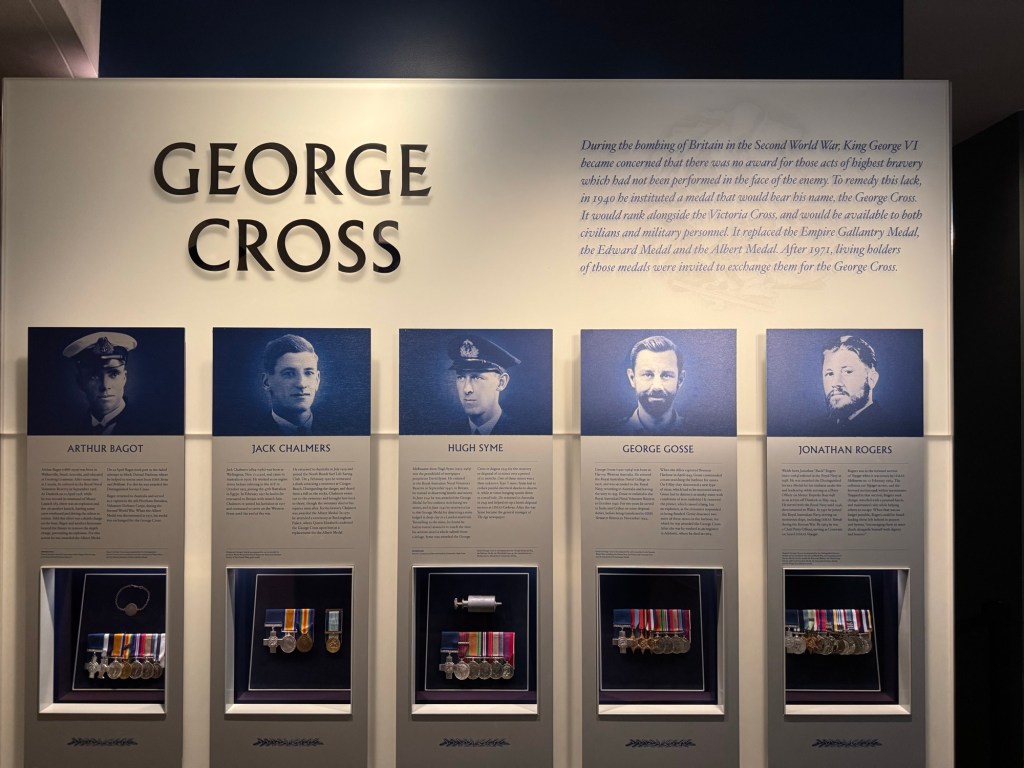
The most recent Victoria Cross for Australia was presented in 2013.
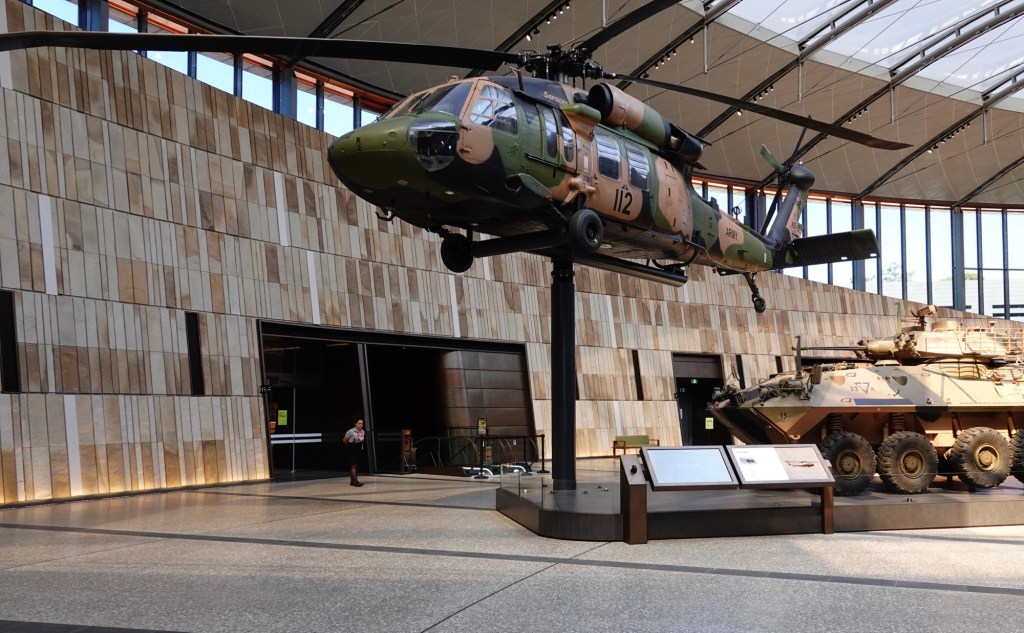
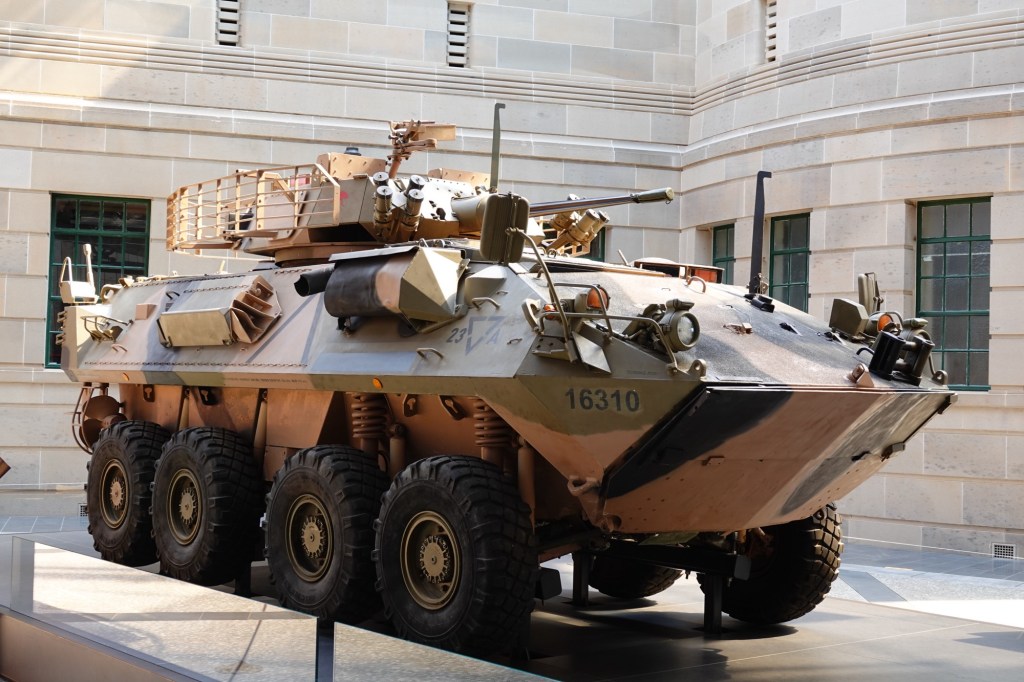
From there we went back downstairs to the ANZAC atrium, first for a cup of coffee before its café area closed at 3:00 (we just barely made it) and then to gawk at the machinery on display.
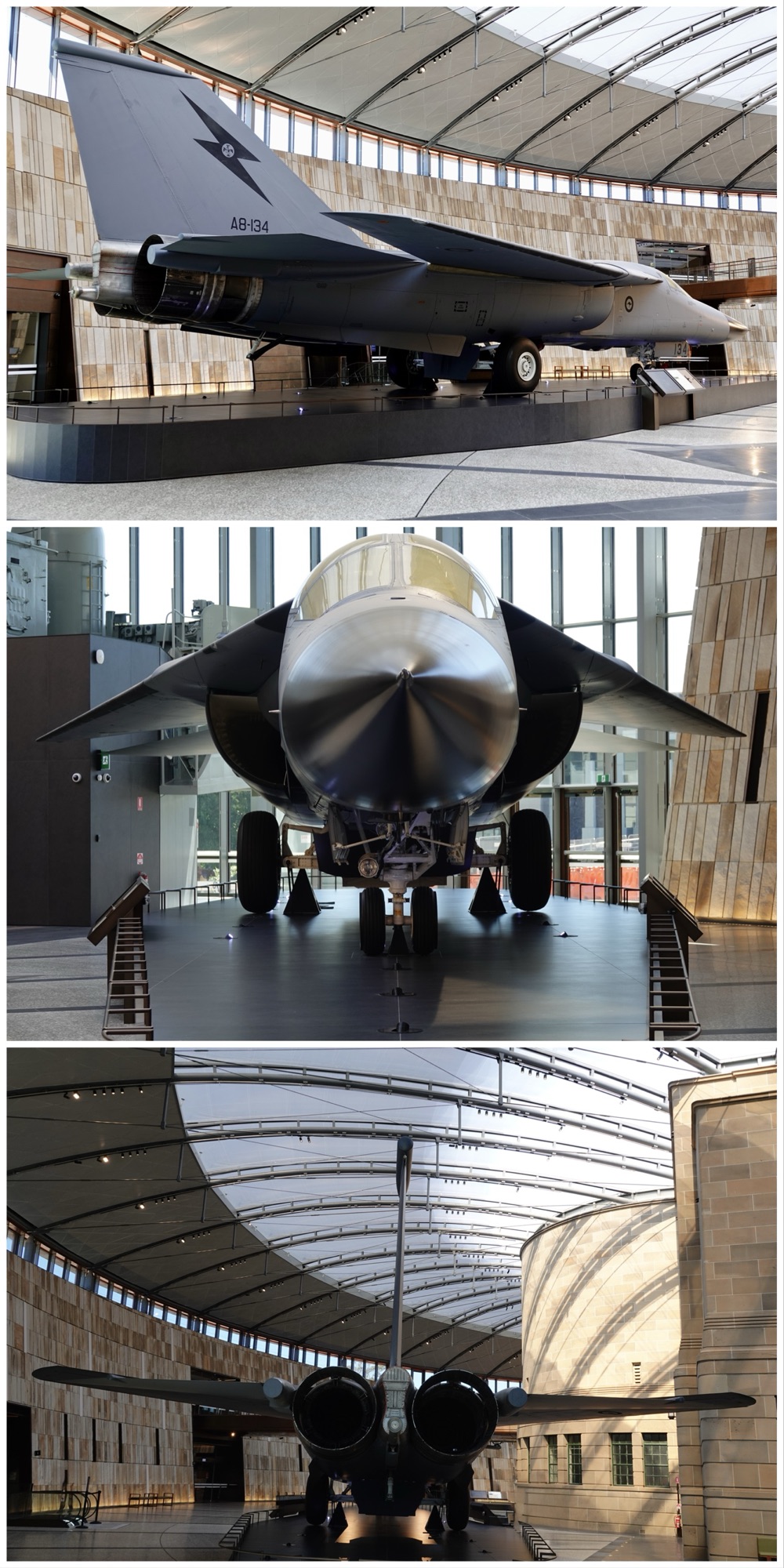
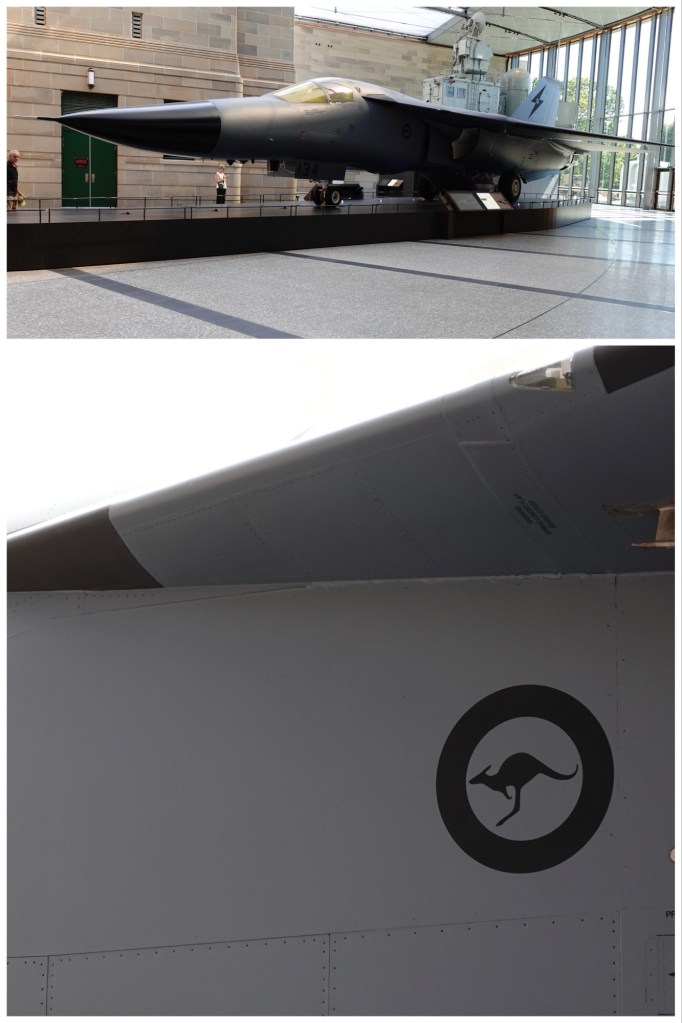
I hadn’t realized just how involved Australia had been in the Vietnam war until seeing the exhibits here at the war memorial. Australia got involved largely in support of the United States, which made me wonder looking back at exactly why Canada did not get involved. I was too young at the time of the war to be really interested, but now I’m going to have to find out more.
There were also exhibits about the Cold War and an entire area called “Critical Witness” about journalists who covered war stories.
Even more galleries are in progress, housing a Lancaster bomber, the Afghanistan memorial, and a gallery highlighting peacekeeping and modern conflicts which will represent Australia’s operational commitments after 1975. Completion is set for 2028.
We stayed for the Last Post ceremony which takes place at 4:30 p.m. every day. Each day it recognizes one specific fallen soldier. Today it was Private Clifford Stanley George Polkinghorne. There are more than 100,000 options, so no one is ever likely to be recognized twice.
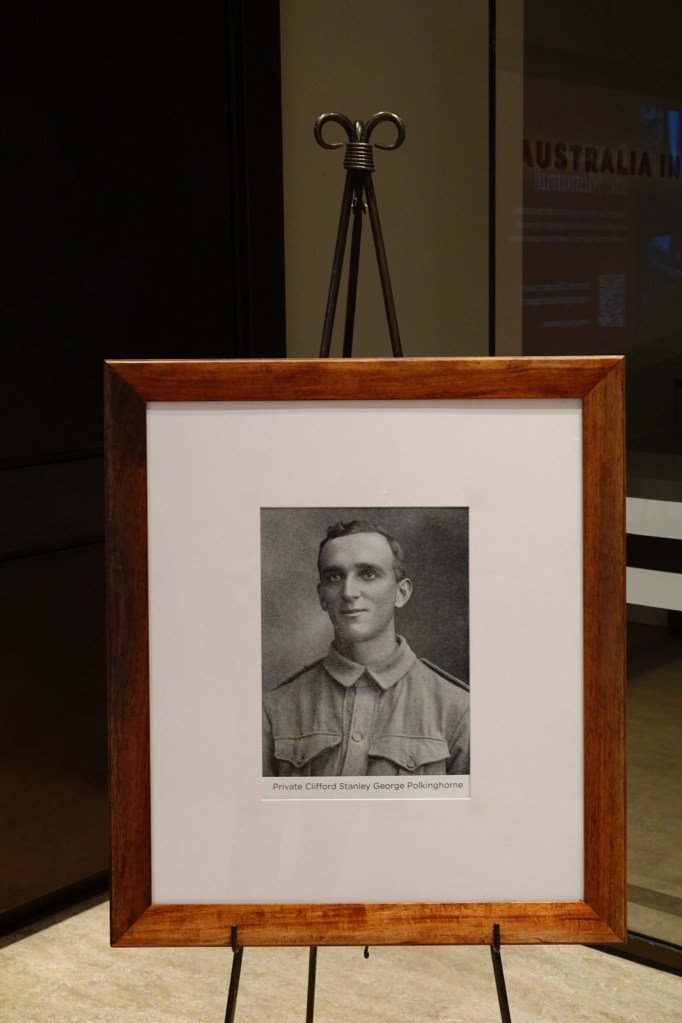
The Last Post ceremony is available to watch live as it happens, and is also posted and archived on YouTube each day. Today’s ceremony is linked below. Fast forward – it is 11 minutes into the video that the actual ceremony starts. Everything before that is just the eternal flame.
During the singing of the Australian National Anthem, Ted and I are visible standing on the balcony above the word “IRAQ”.
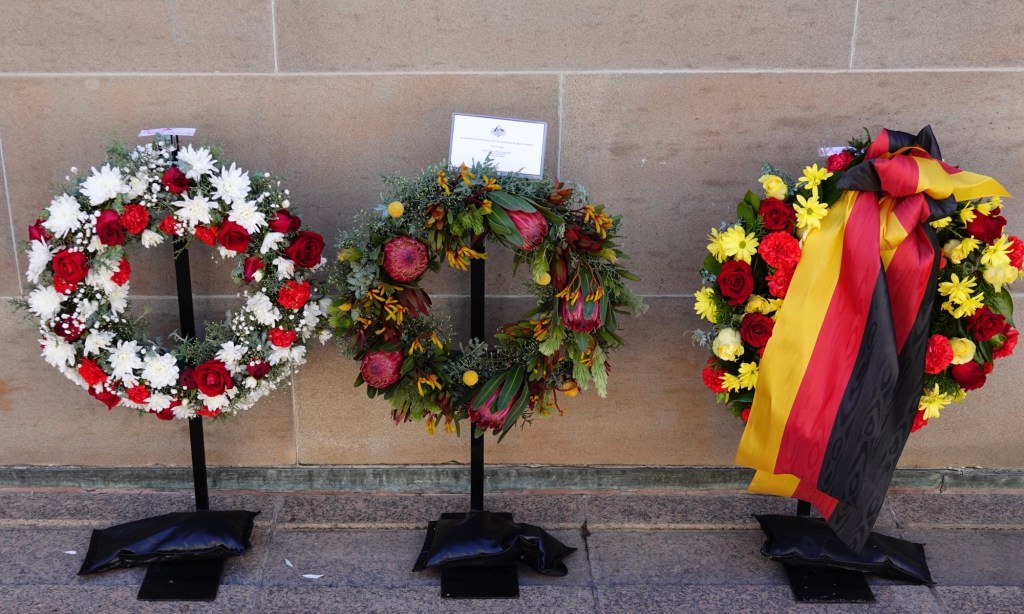
One of the wreaths being laid today was from Canada; another was from Germany.
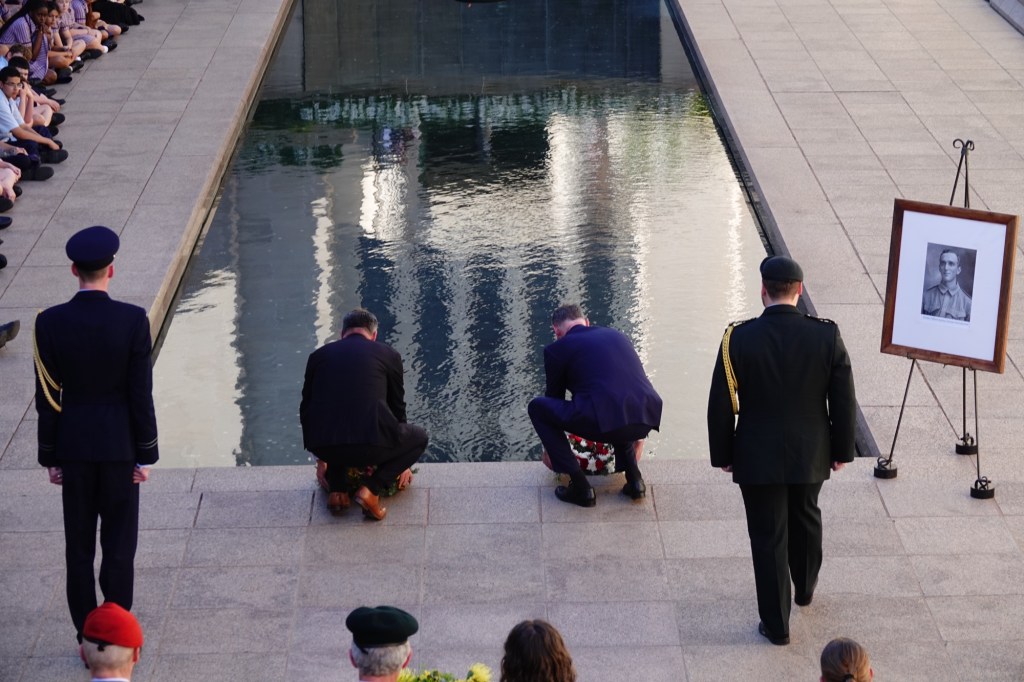
Since our Prime Minister Mark Carney is here right now with his delegation, it was our Minister of Defence, David McGuinty who laid Canada’s red and white wreath.
Afterwards, we got to talk to him and also meet Australia’s Deputy PM and Minister of Defence Richard Marles.
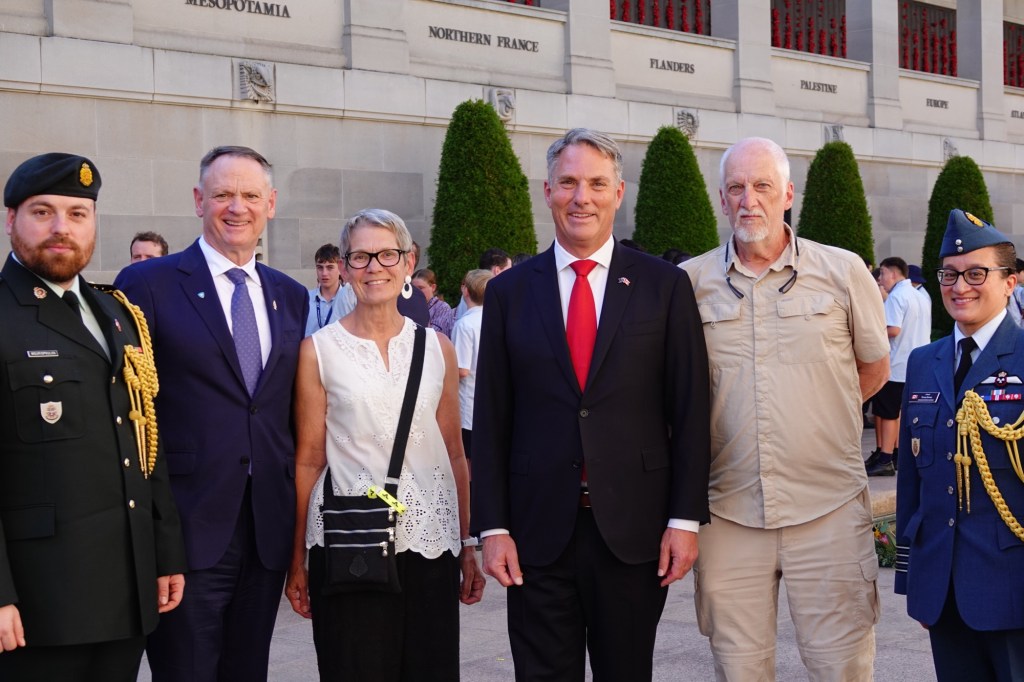
The two Canadian military members with us in the photo are Colonels from the army and air force who accompanied McGuinty.
We also really wanted to walk the Anzac Parade to see the memorials which line it, and explore the Memorial’s outdoor sculpture garden, but Ted’s feet said no. We do have two more days here, although tomorrow we’re touring Parliament.
 Rose and Ted’s Excellent Adventure
Remarkable. I’m sure your sons and grandsons will appreciate and learn from all this detail.
LikeLiked by 1 person