What fun to have the bookends of a reunion and new friends to bracket another busy day.
Ted and I met Barbara on our Eastern European Capitals cruise last fall, when I complimented her on her fabulous clothes. In ensuing conversations, we learned that Barbara lives in Melbourne; she was generous enough to offer to reconnect when our travels reached Melbourne.
Fortunately, her busy schedule allowed enough time for coffee with us this morning. She is a Historian by profession, so had lots of information to share about her city, but perhaps the most interesting thing she shared was something we’ve heard from everyone we’ve met here: they love living in Melbourne. Certainly our short time here has given us a very positive impression. It’s the kind of city we could see ourselves living in.
Today we took the tram to Flinders Station, from where we walked to one of the two locations of the Victoria National Gallery – the International building (the other is focussed on Australian art).
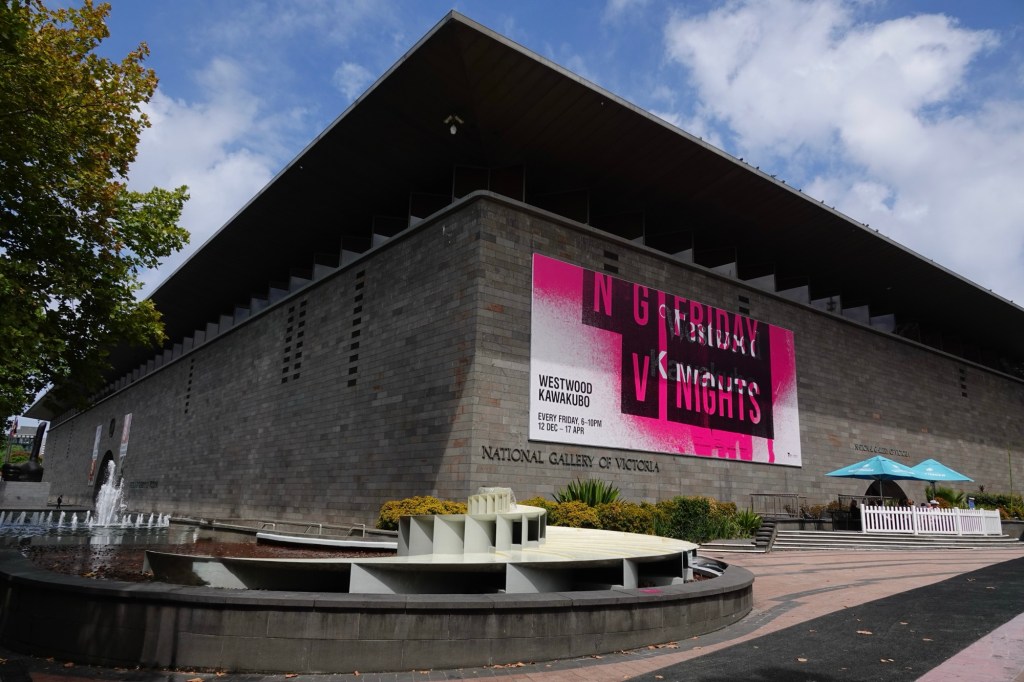
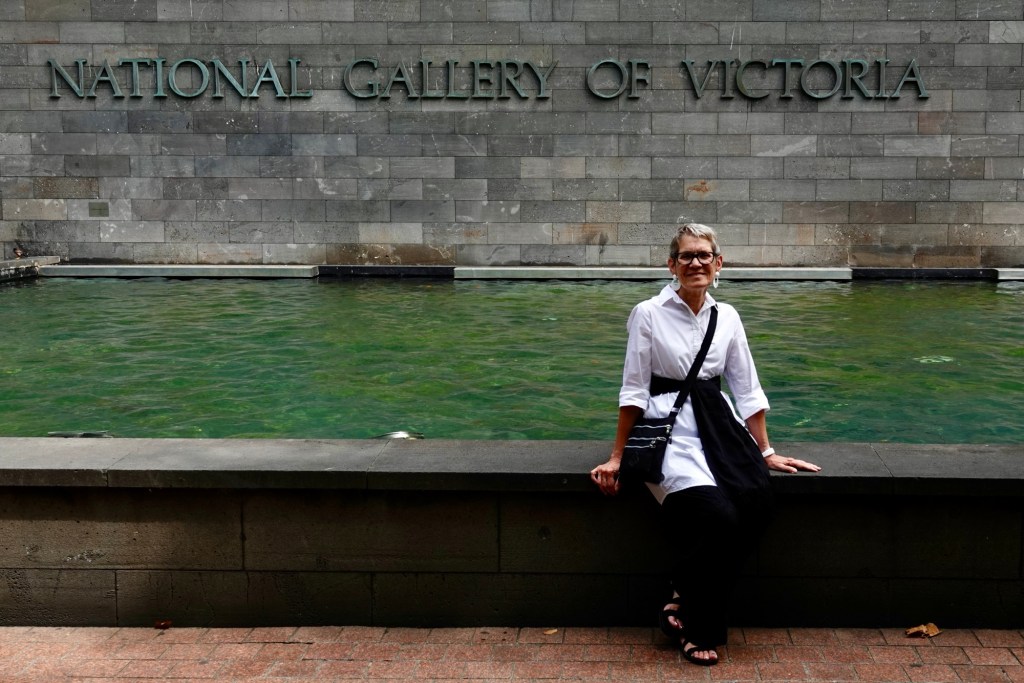
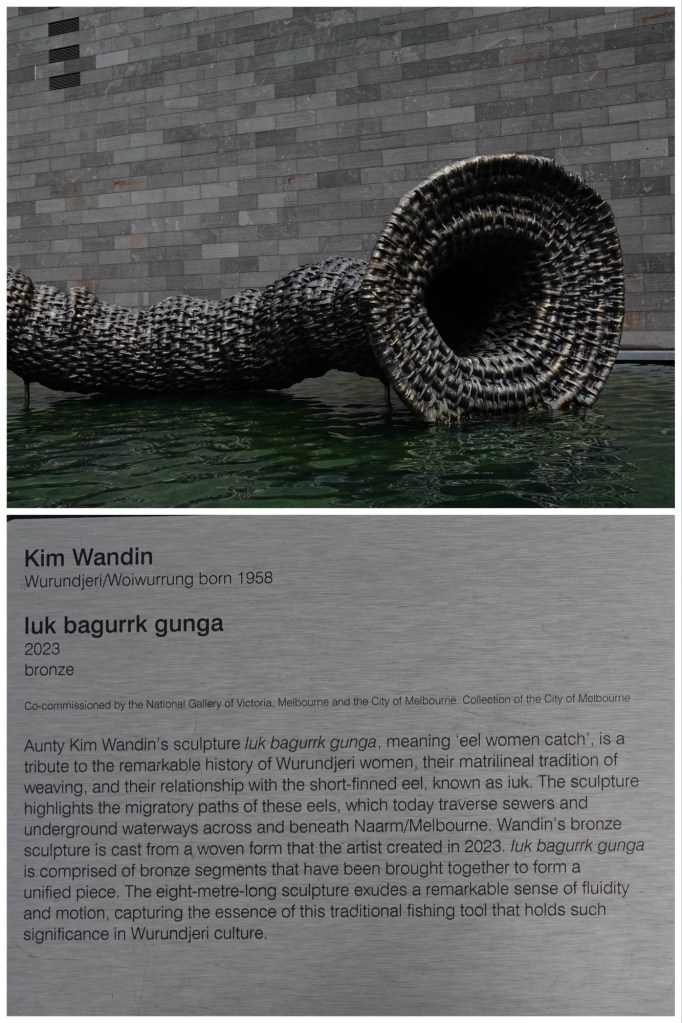
The art starts outside the gallery…
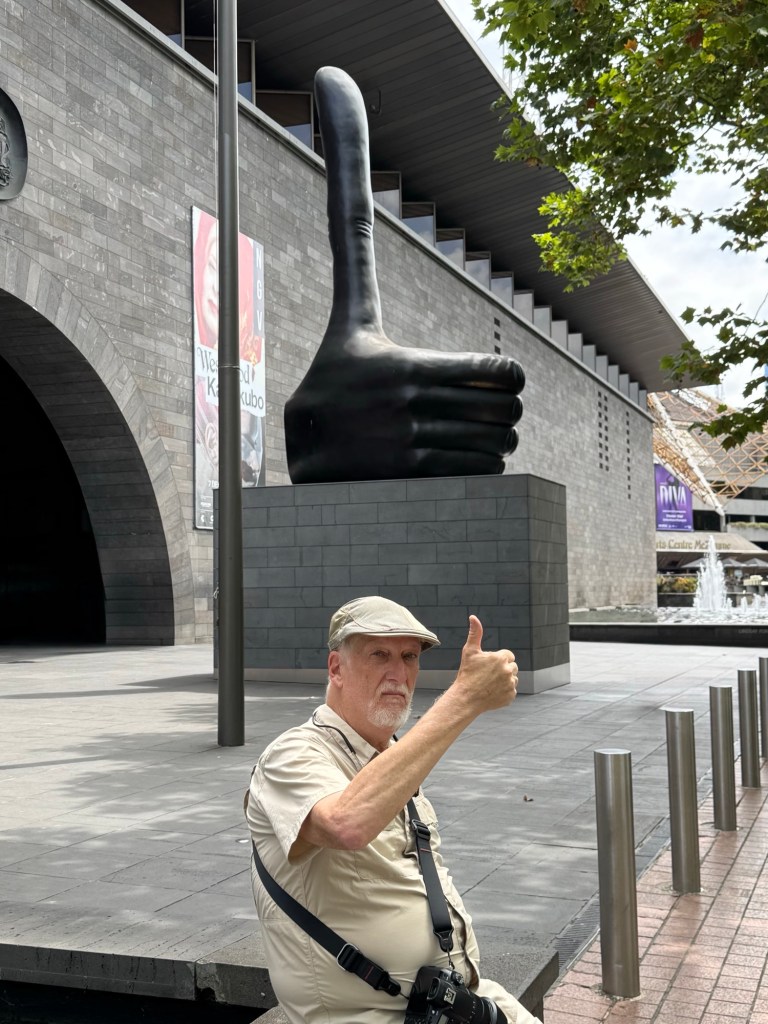
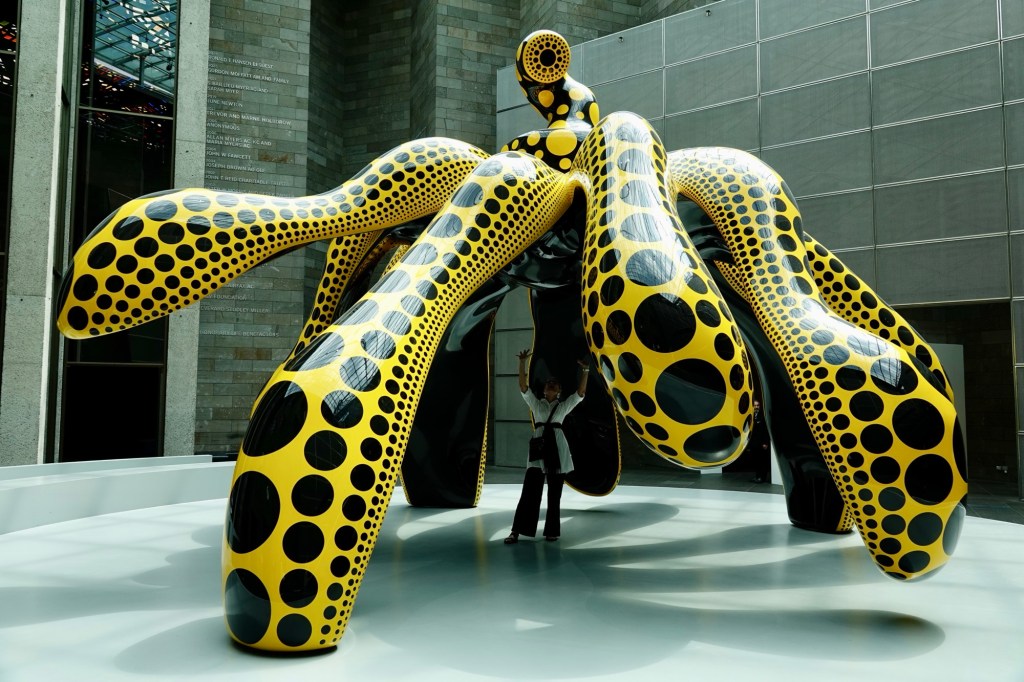
… and continues with a huge statement piece in the lobby.
Because we wanted to ensure that we were at the Victoria State Parliament building for their last tour of the day at 4:00 p.m., we had to limit our time in the gallery to just 90 minutes. The gallery deserves at least half a day – maybe more – so we needed to prioritize what to see.
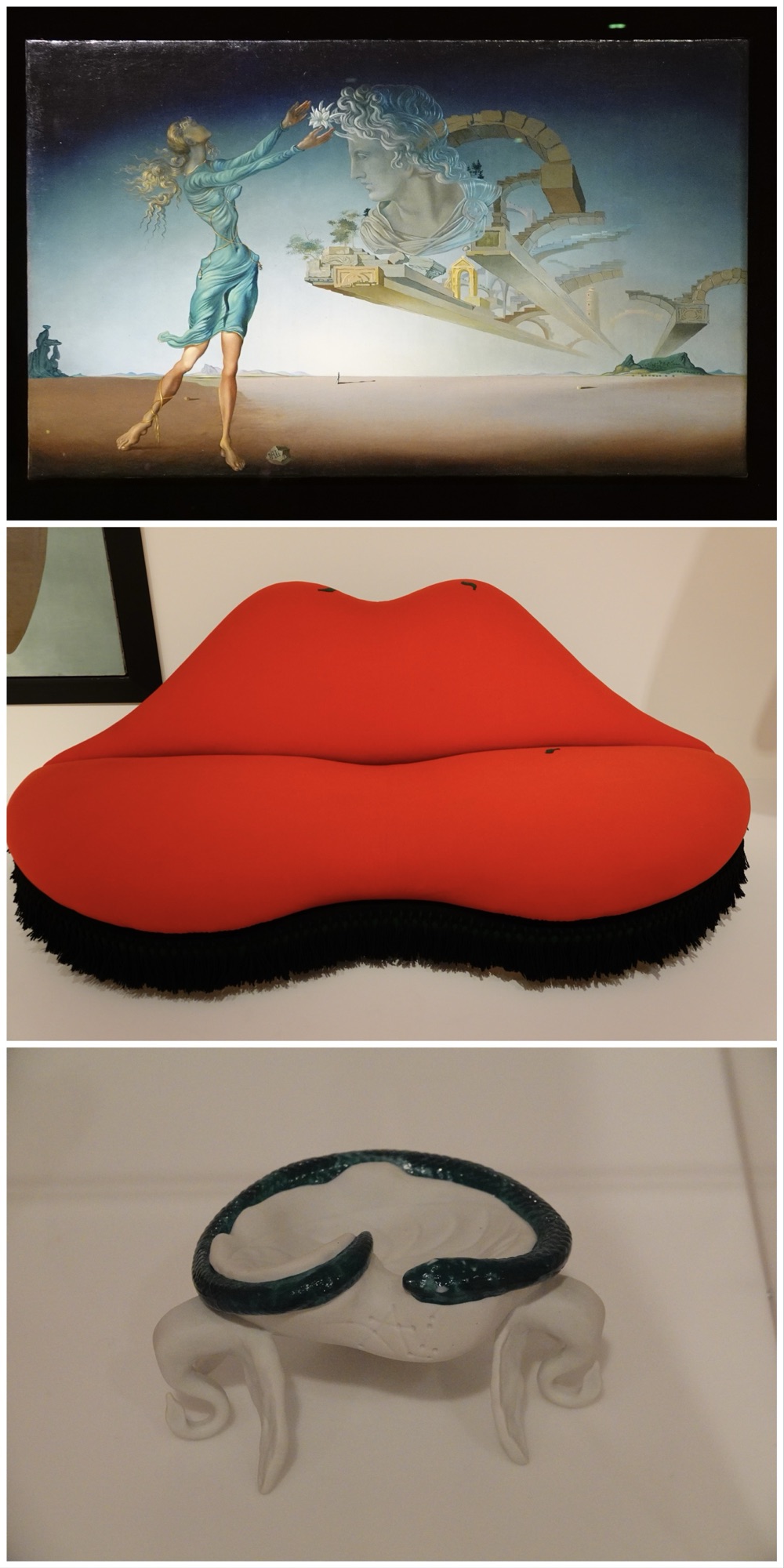
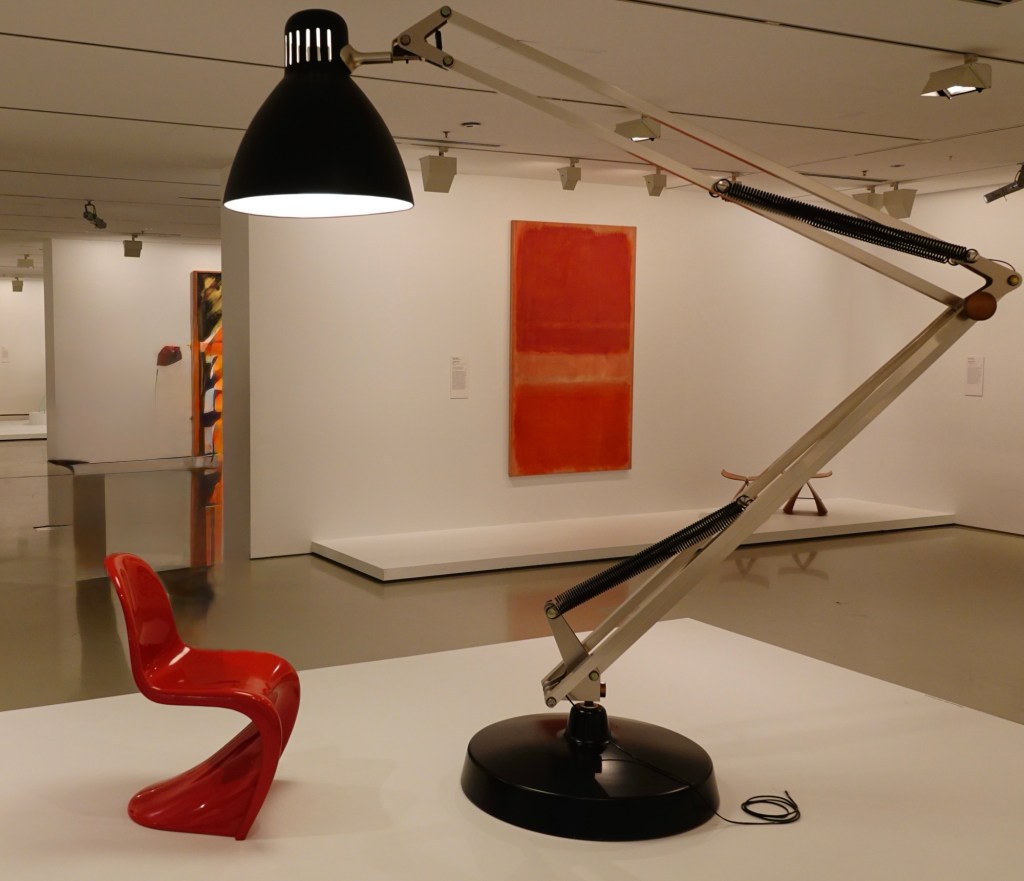
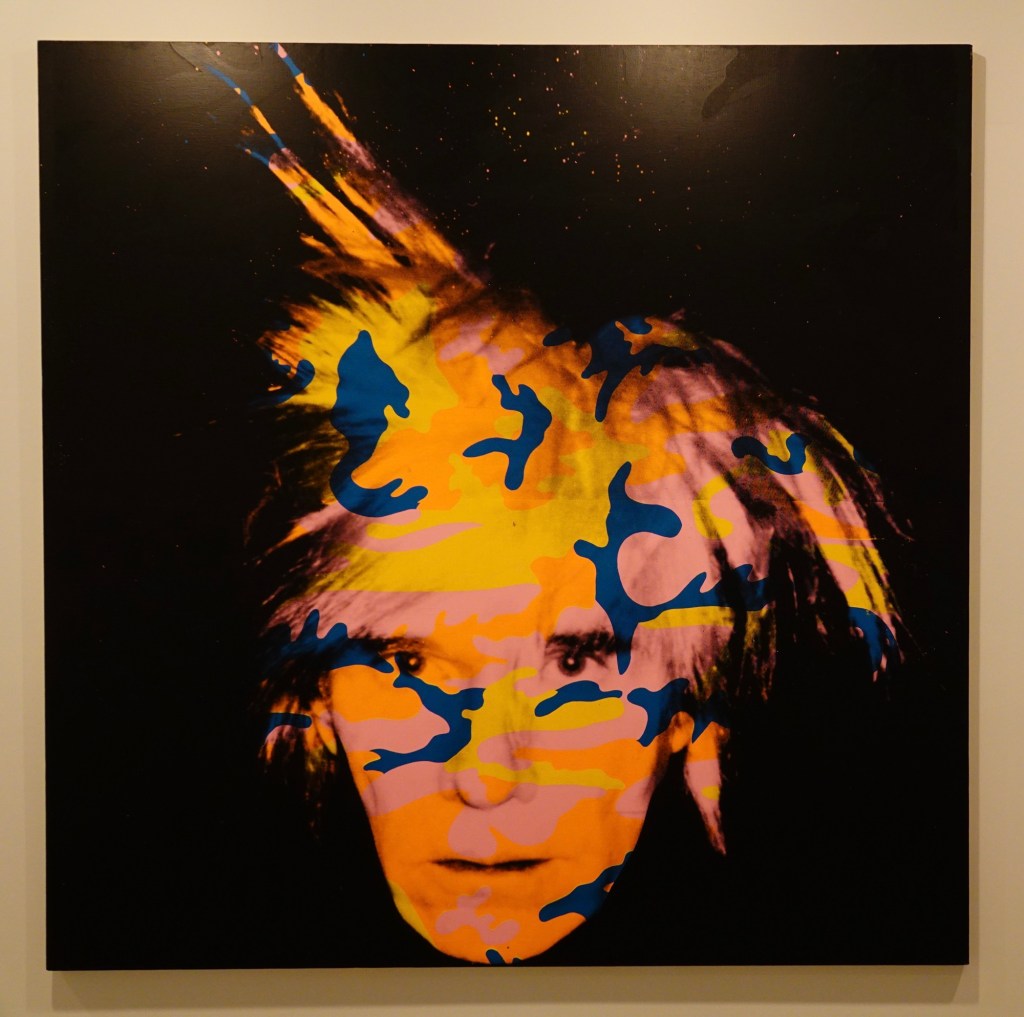
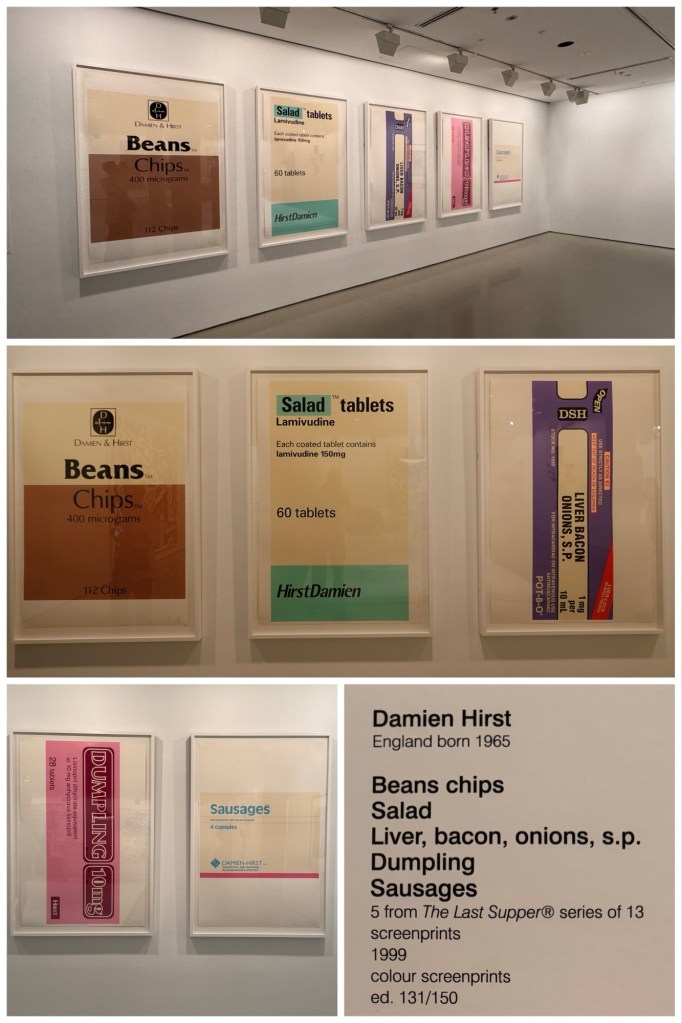
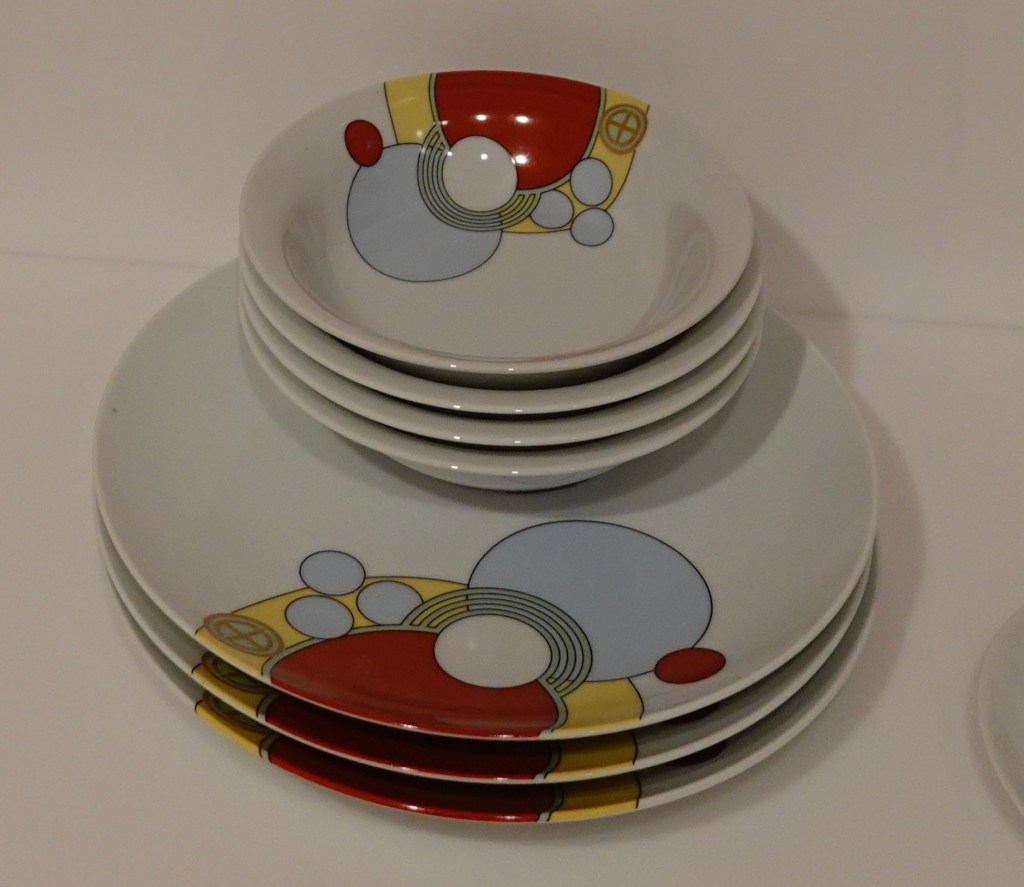
Ted let me choose (as he does) so I headed straight to the post-war Surrealists, 20th century modern furniture, and the Dior fashion exhibit.
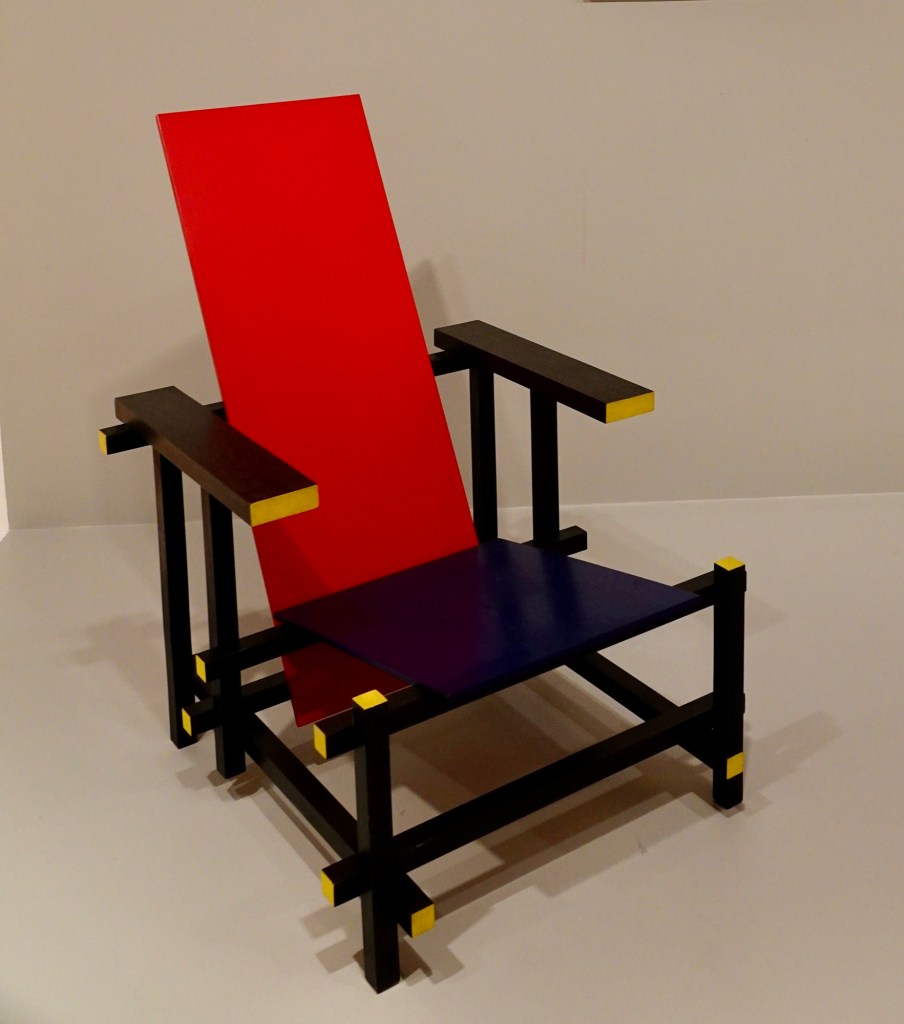
Netherlands made me think of Paul Mondrian’s geometric paintings.
The Dior exhibit highlighted styles designed by Christian Dor himself, but also those designed by Yves Saint Laurent and John Galliano when they worked for the House of Dior.
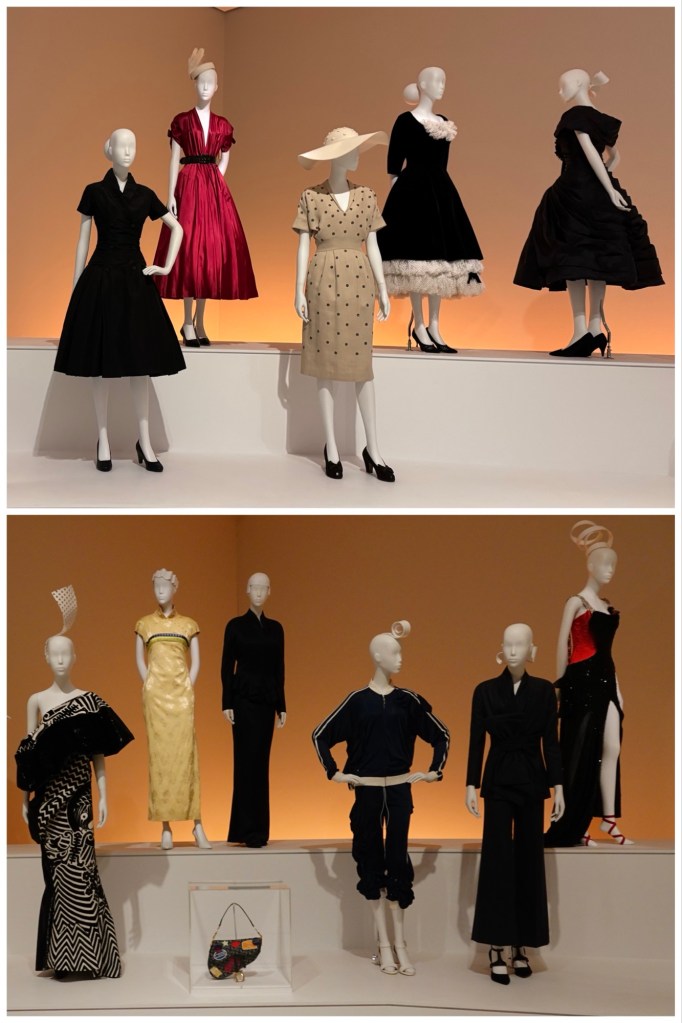
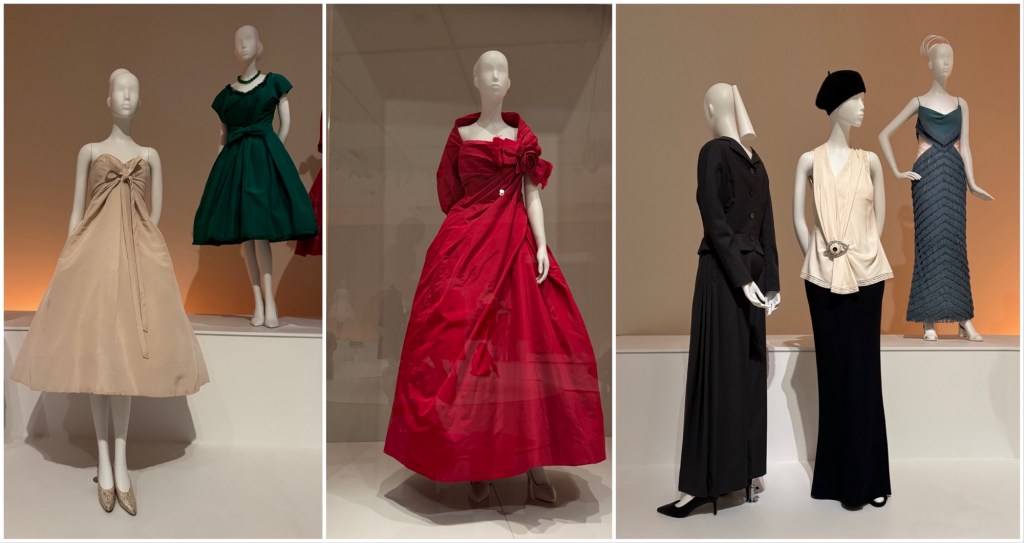
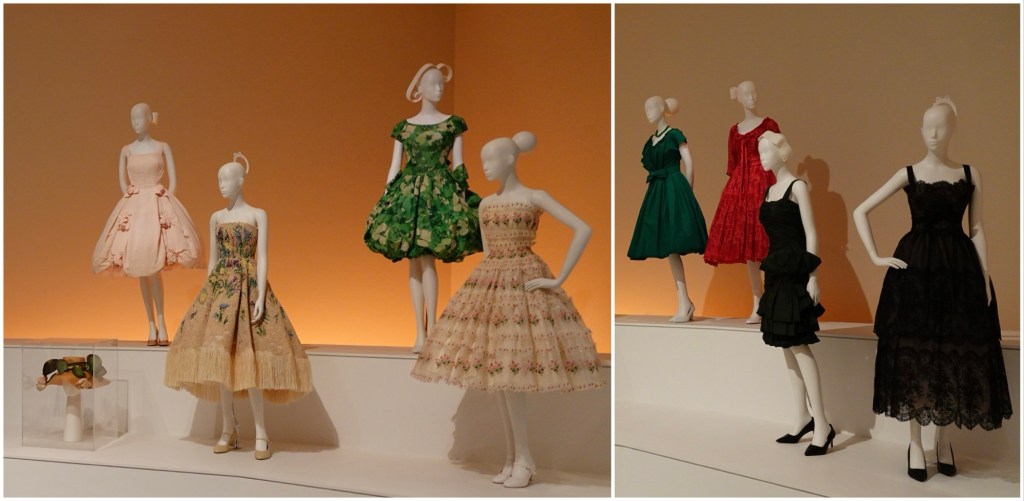
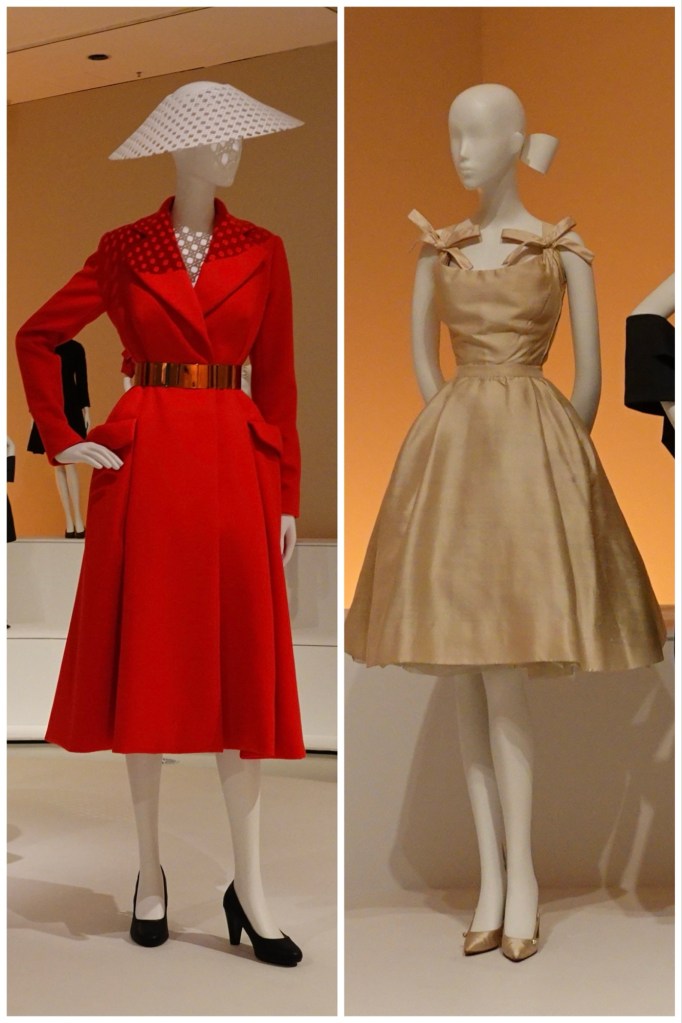
The NGV is currently highlighting its textile collections, so there were other designers integrated into exhibits of paintings and sculpture, as well as examples of period dress.
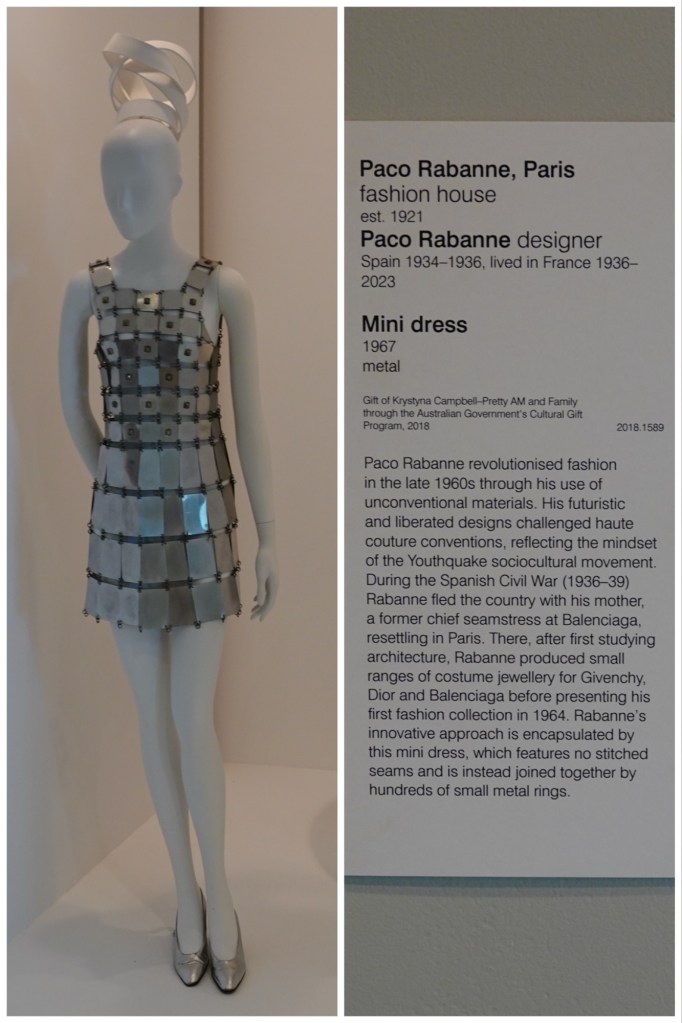
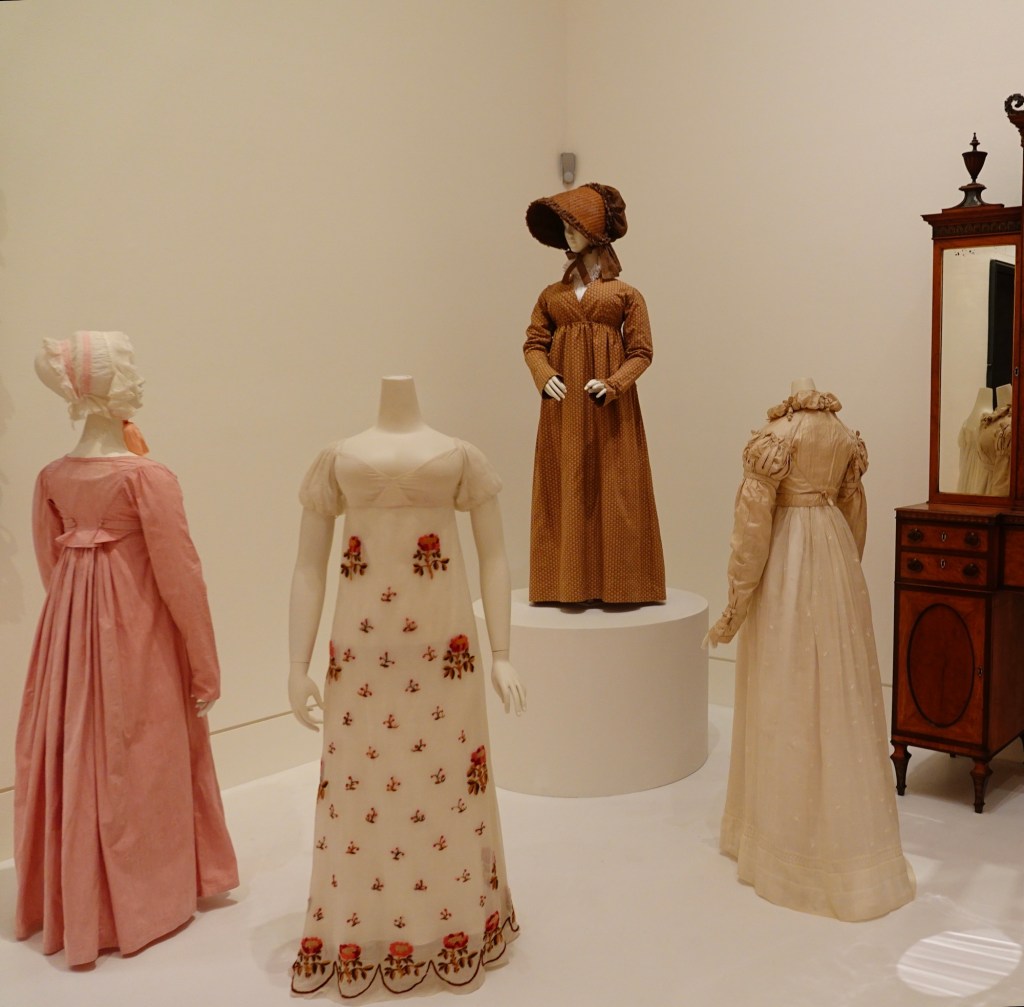
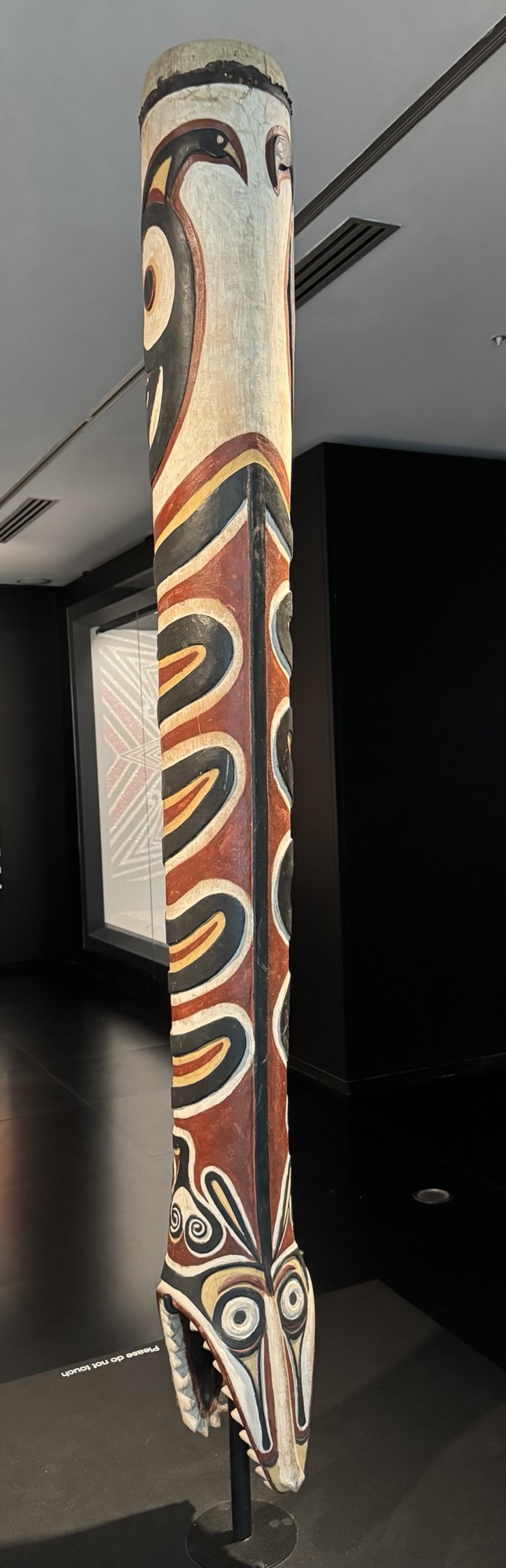
The gallery is, like everything here in Melbourne, really really big, so as we tried to find our way back to the lobby and exit, we passed a few other interesting items. Our route also let us see that there were more than a dozen huge galleries just waiting to be explored on a subsequent visit.
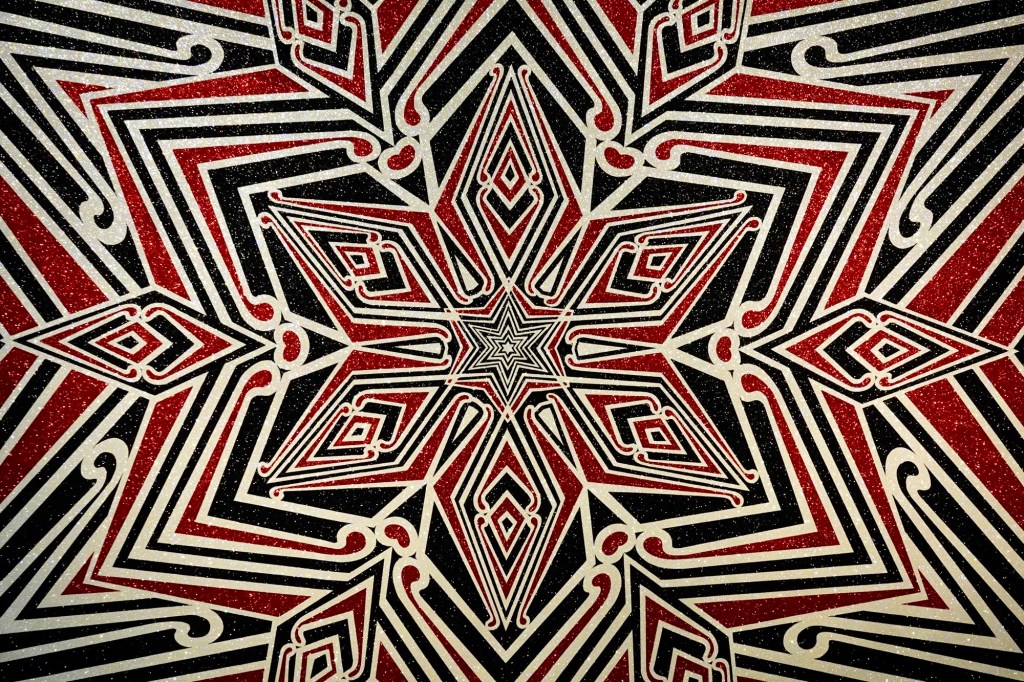
draws on the traditional Mãori Kowhaiwhai (pattern) the Puhoro, commonly used in thigh tattoos for men and women. The Puhoro depicts the wake of a waka (canoe) moving through the water as well as the wearer’s whakapapa (genealogy). Rendered in Paterson’s signature glitter – a reference to the artist’s childhood experiences of the glistening waters and sparkling black sand beaches of Tamaki Makarau’s west coast. A crucifixion rearticulates and extends Maori expression into the present.
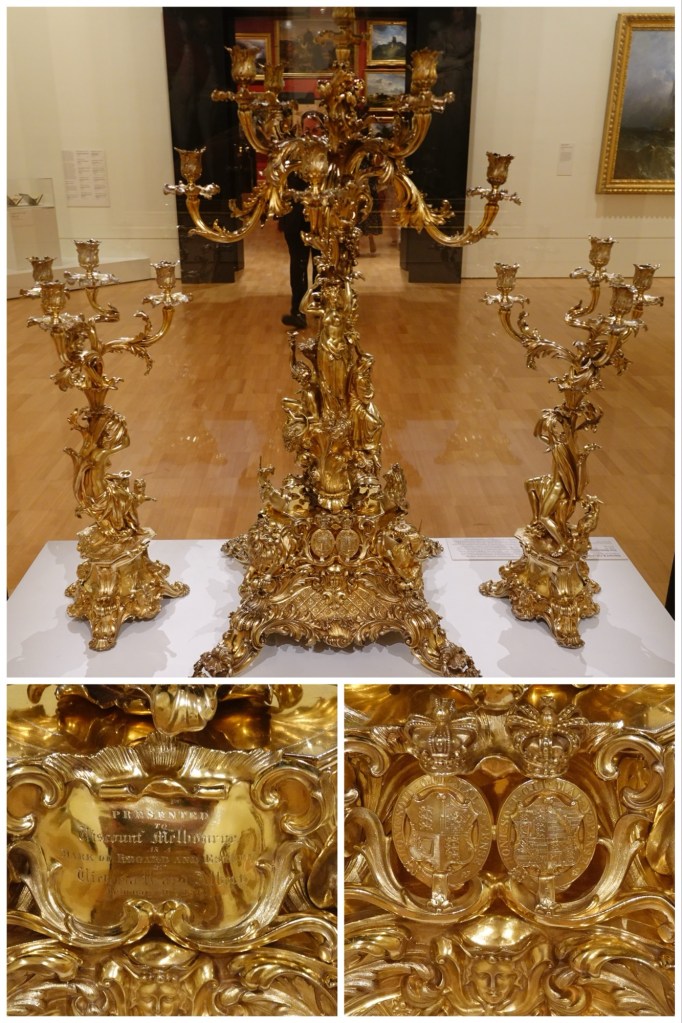
This monumental three-piece centrepiece was originally presented by Queen Victoria to Viscount Melbourne, Prime Minister of the United Kingdom of Great Britain and Ireland.Lord Melbourne, after whom the city of Melbourne is named, was a close confidant and companion to Queen Victoria prior to her marriage, and a significant influence on the early years of her reign. The engraved inscription reads: ‘Presented to Viscount Melbourne as a mark of regard and esteem by Victoria R. and Albert, February 10, 1840’, the date Victoria and Albert were married. In 1843 Queen Victoria appointed Garrard & Co. crown jeweller, a position the firm retained until 2007.
We needed to scurry a bit to ensure our parliament tour. Reservations are not accepted and tours are closed after 25 people line up, which they do 30-40 minutes ahead of the scheduled tour time.
Nonetheless, it doesn’t take Ted long to take photos as we walk, and there were lots of interesting things on the route. Barbara had given us some perspective over our morning coffee on why Melbourne has so many magnificent buildings: they were almost all built during the 1850s at the height of the gold rush, when money was no object. We saw proof of that firsthand a little later in the day.
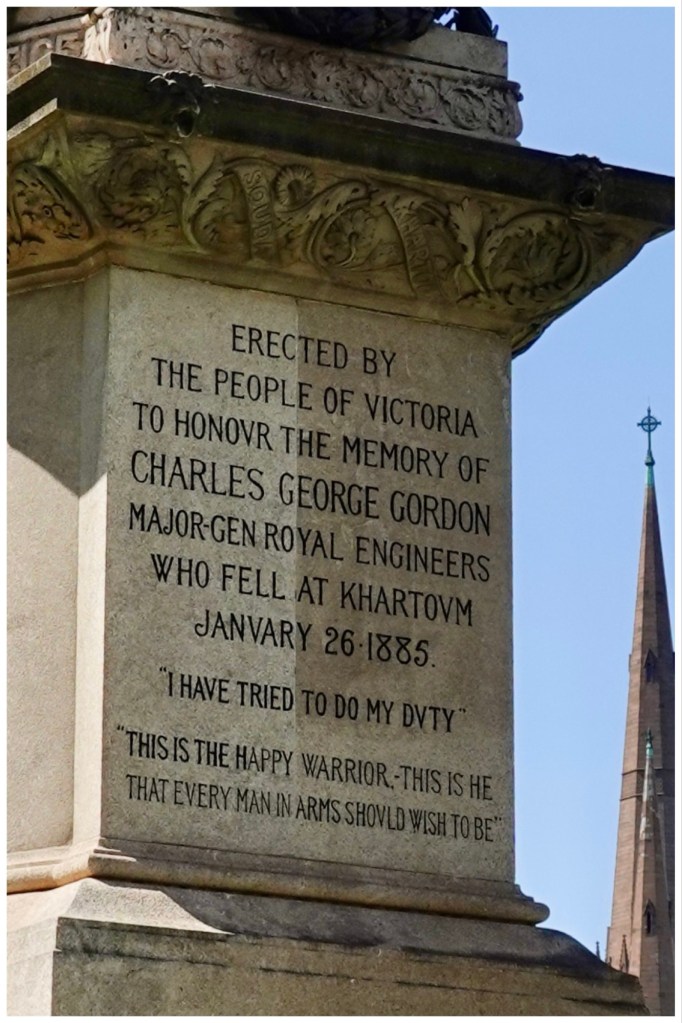
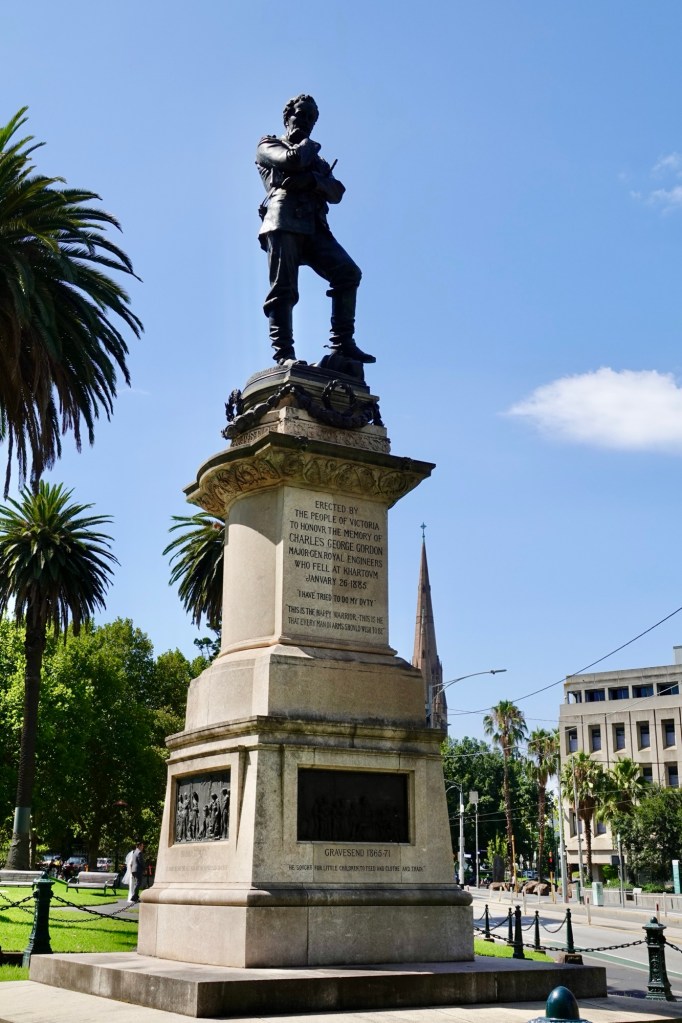
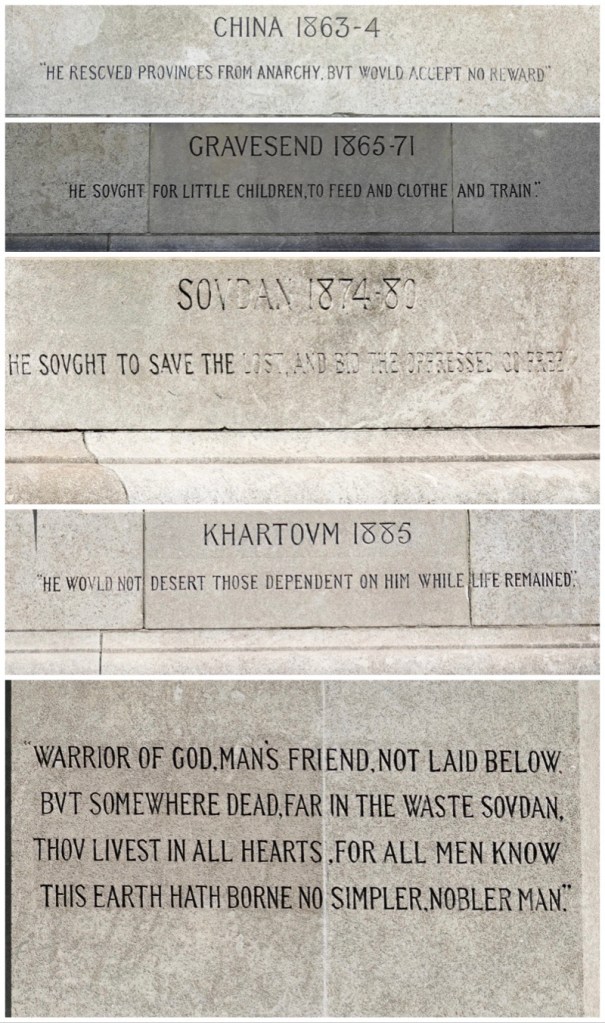
I don’t think we have ever seen a monument that expressed so much admiration for the person depicted as we saw on the one below. Each side of the plinth expressed admiration for wartime deeds in each of the arenas in which Major General Gordon fought.
We had to rush past the Old Treasury Building; there was no time to do the self-guided tour or explore the exhibits inside. Maybe we’ll return if the good weather holds through tomorrow.
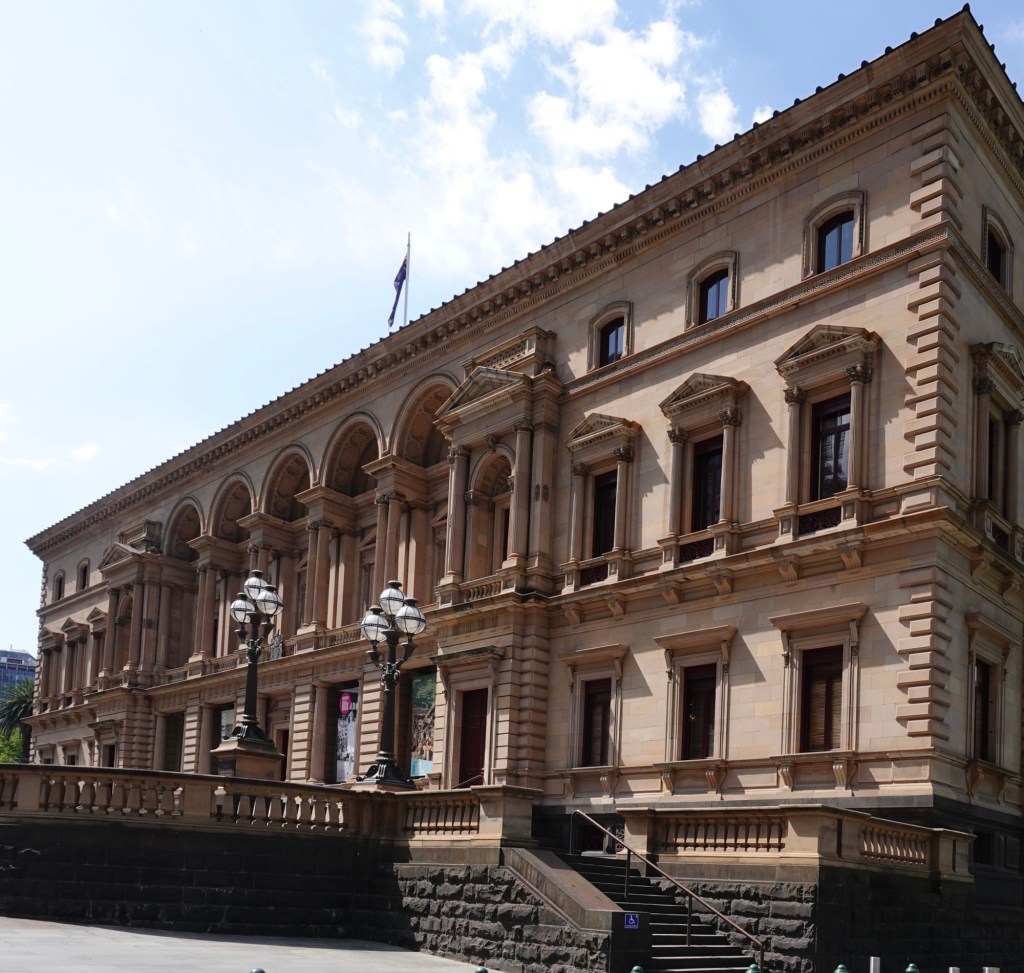
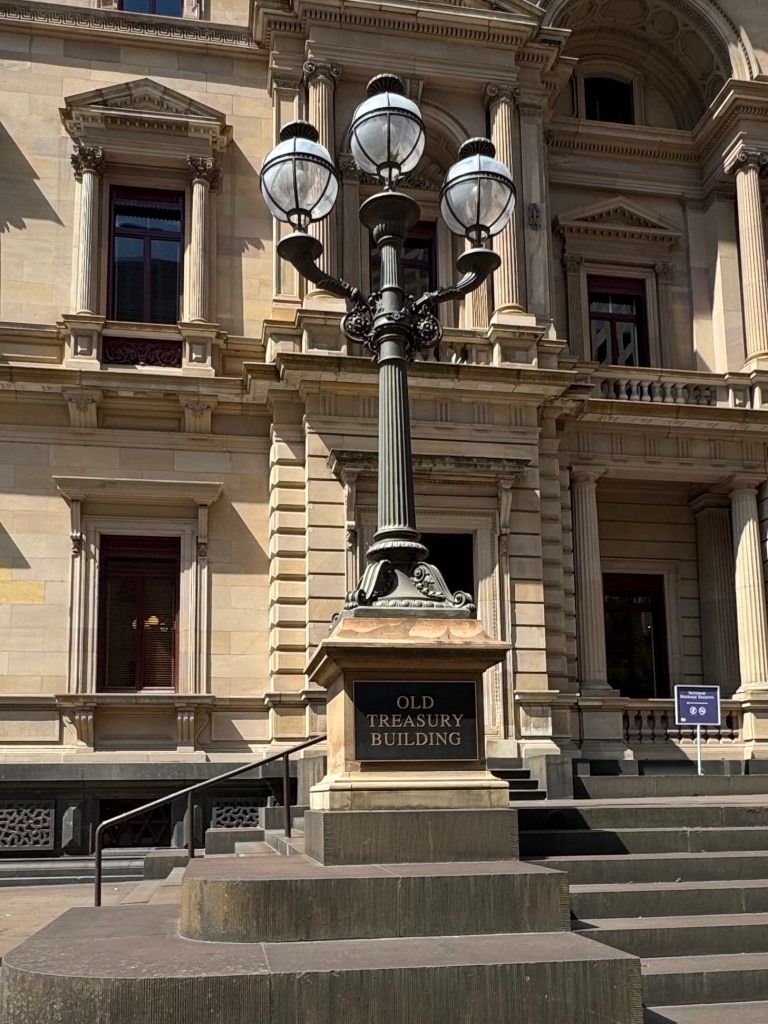
The Victoria Parliament Building (what in Canada we would call the Provincial Legislature, reserving “Parliament” for our national house) is right beside the Treasury. Because the staircase is directly on the street as opposed to separated by a swath of lawn, it seems even bigger than it is.
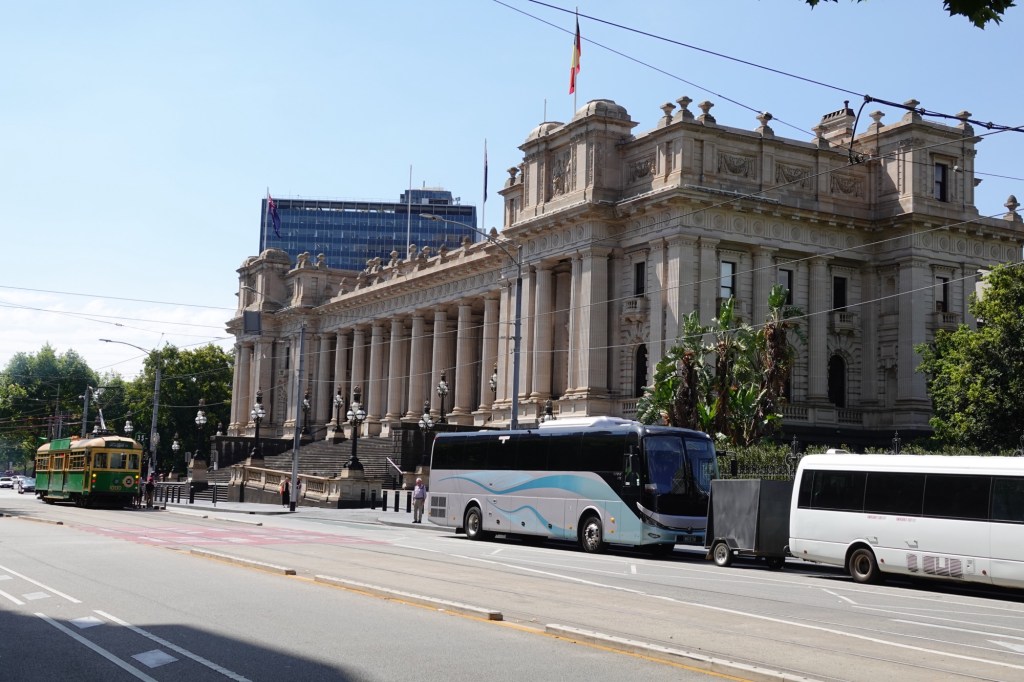
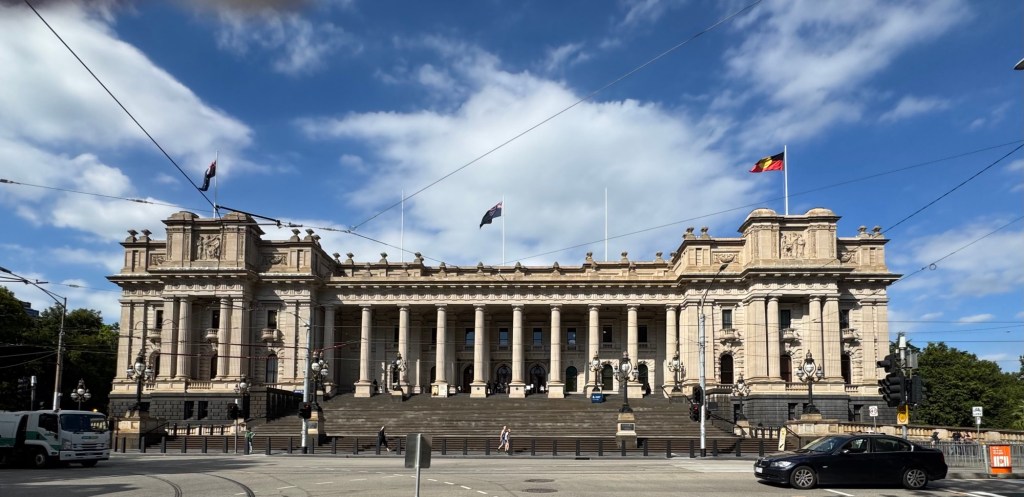
On reflection, we realized that it is actually not nearly as large as our British Columbia provincial legislature building. As designed by Samuel Merrett, it was 257 feet long, 90 feet wide and 59 feet high. By comparison, the facade of BC’s legislature is 152.4 metre (500 feet) long, and its completed dome soars 30.5m/100 feet. Had Victoria Australia’s planned central dome ever been completed, it would have been more than twice as tall.
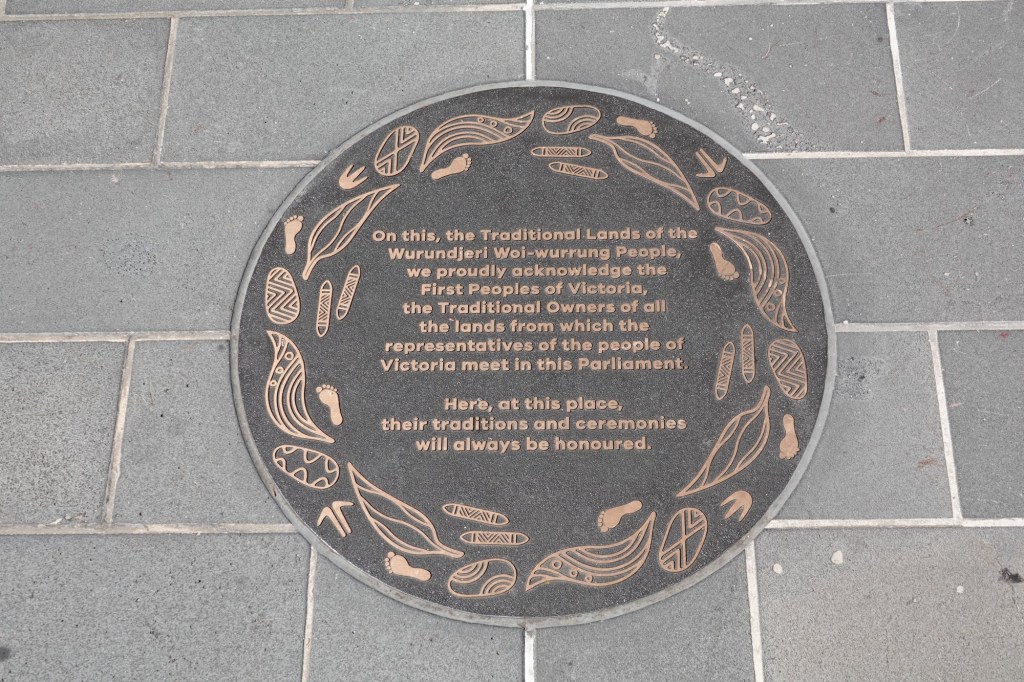
As we waited on the huge veranda, we admired the crowned lamp posts, ornate doors, and the land acknowledgement plaque.
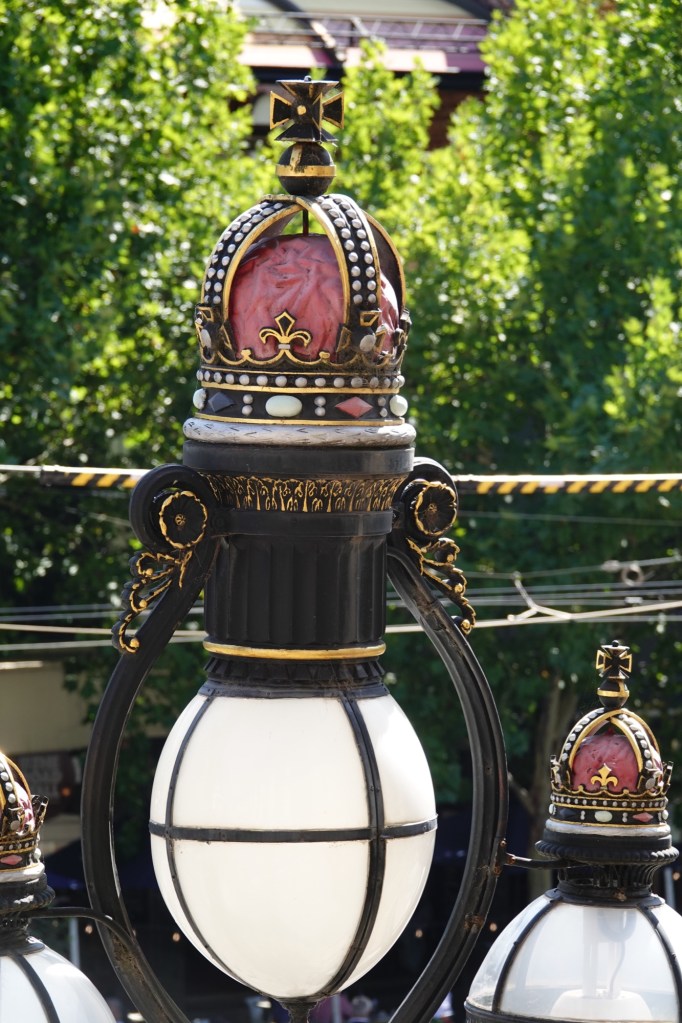
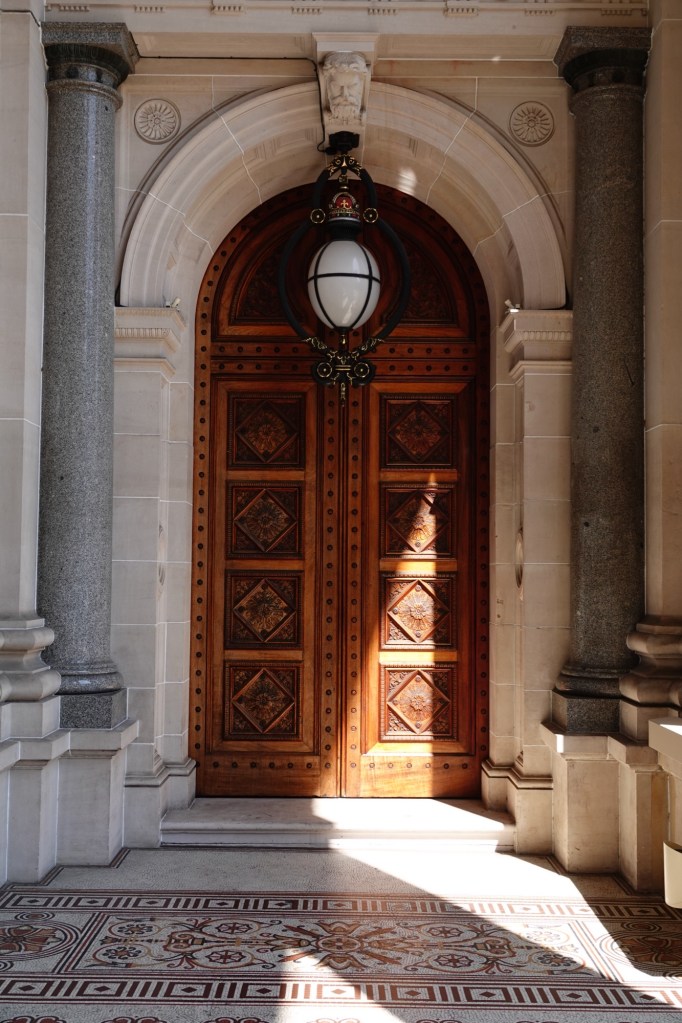
The State of Victoria split from New South Wales in 1851 just as gold was being discovered here. The combination of money, trade, and a quickly growing population allowed for numerous building projects. The hill site chosen for the parliament was the ancestral meeting place of the indigenous peoples who were here for 40,000 years before the British arrived and declared Australia as “terra nullius” (land belonging to no one).
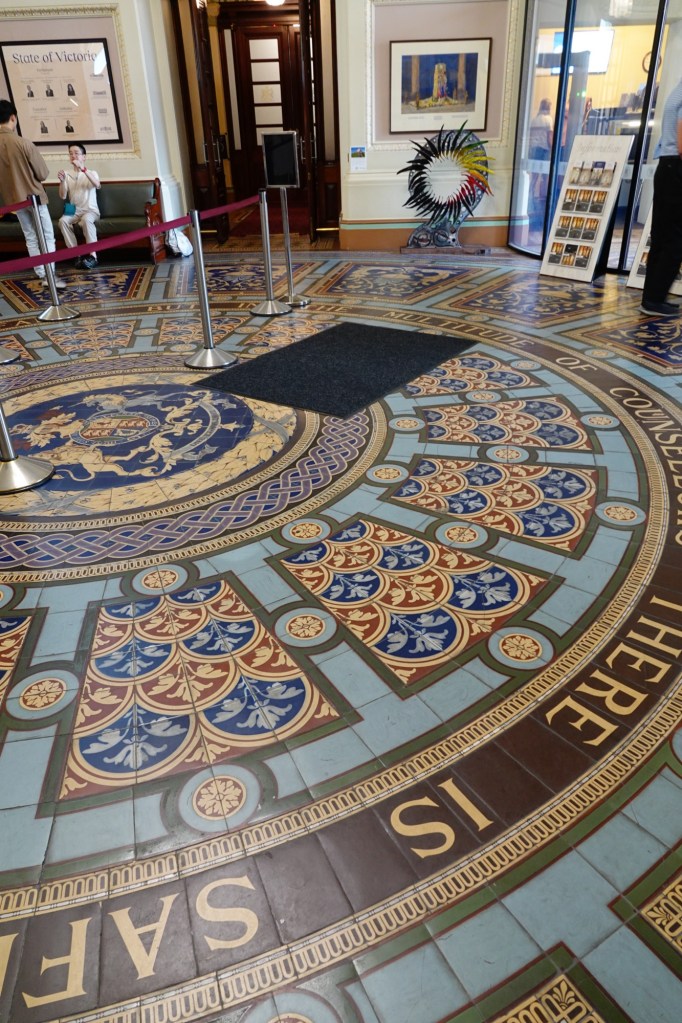
Once we’d gone through airport-style security and presented our photo identification, we gathered in the lobby on the Minton ceramic tile floor. The floor is made of encaustic tiles, a word meaning that the detailed patterns are produced by different colours of clay, not glaze. It is the largest surviving single-design encaustic floor in the world.
In the lobby is an indigenous memorial wreath, along with its story: “Every year since 2006 until 2019 before her passing in 19 September 2019, Aunty Dot Peters created a wreath made of gum leaves to commemorate, honour and remember the Aboriginal service men and women who served and continue to serve in The Australian Defence Force. Wayne McGinness, an Aboriginal and Torres Strait Islander man created this unique steel sculpture to honour Aunty Dot’s memory whilst respecting the original design of the Victorian Aboriginal Remembrance Committee logo, adding his own creativity to the design elements.This sculpture was a collaborative project with Aboriginal Victoria and Dreamtime Art – trusted advisors for Aboriginal and Torres Strait Islander Arts and Culture.”
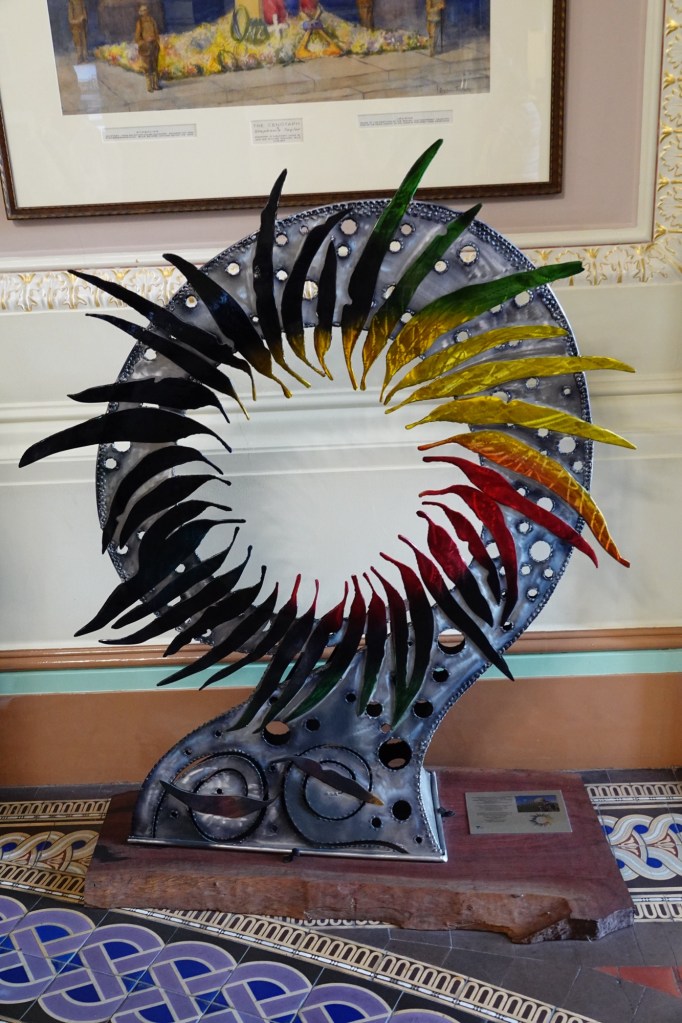
We were only allowed to tour three rooms, which was a bit of a disappointment compared to our tour of the New Zealand Parliament (or, for that matter, our own in Canada or even the German Reichstag).
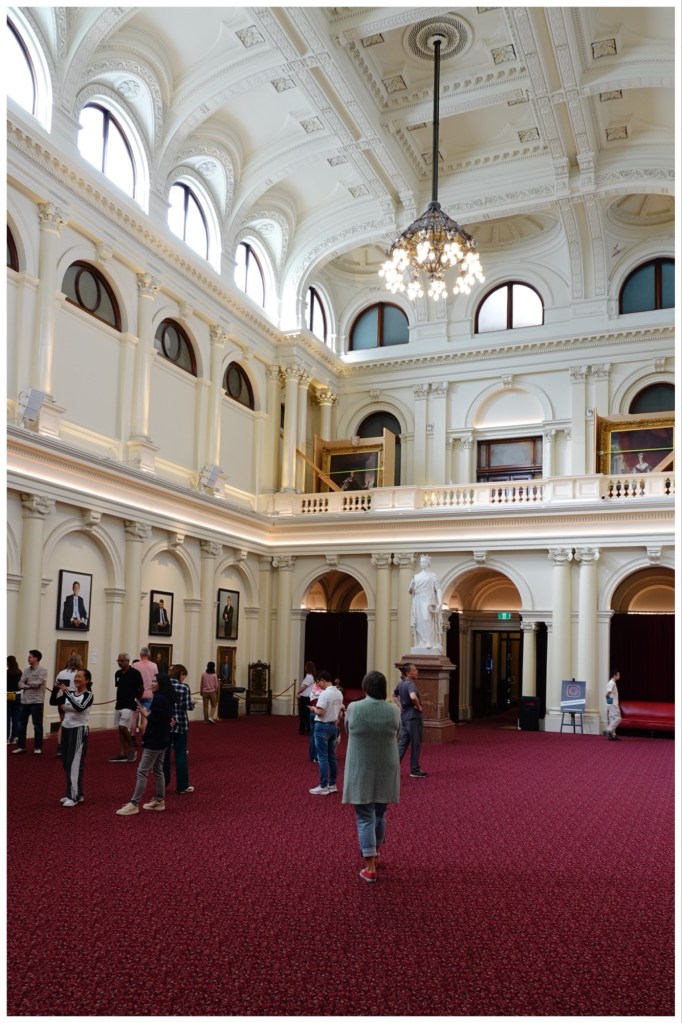
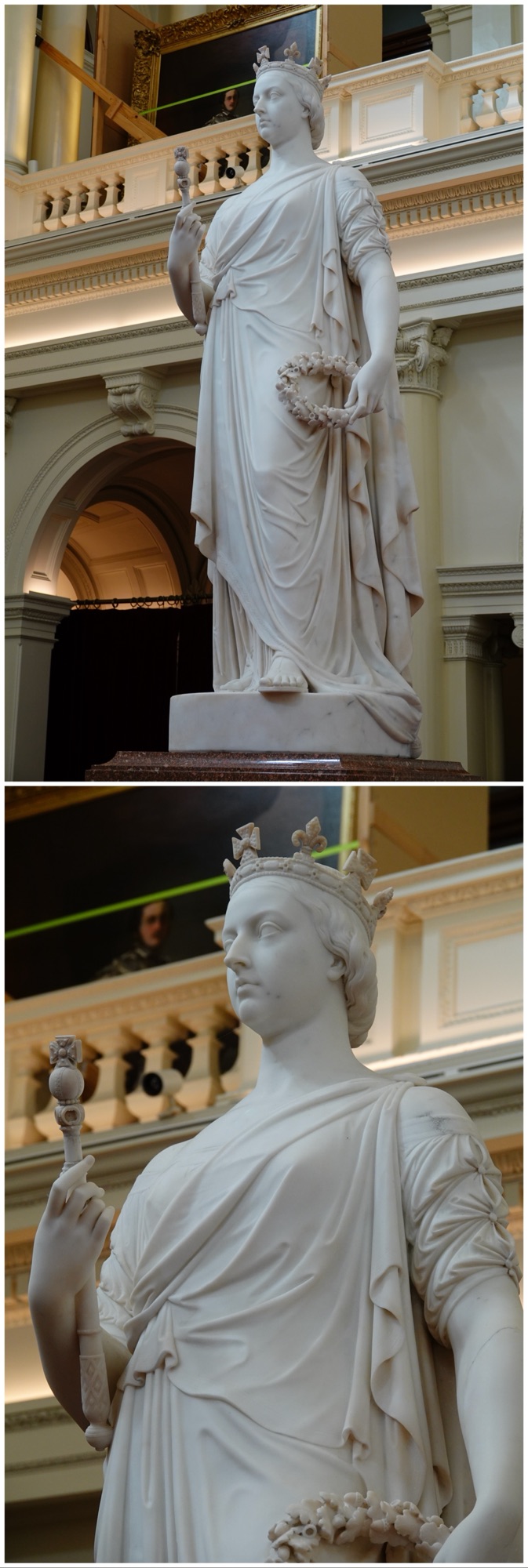
The first room we were introduced to was the “Queen’s Hall”, with its portraits of Premiers and statue of a young Queen Victoria.
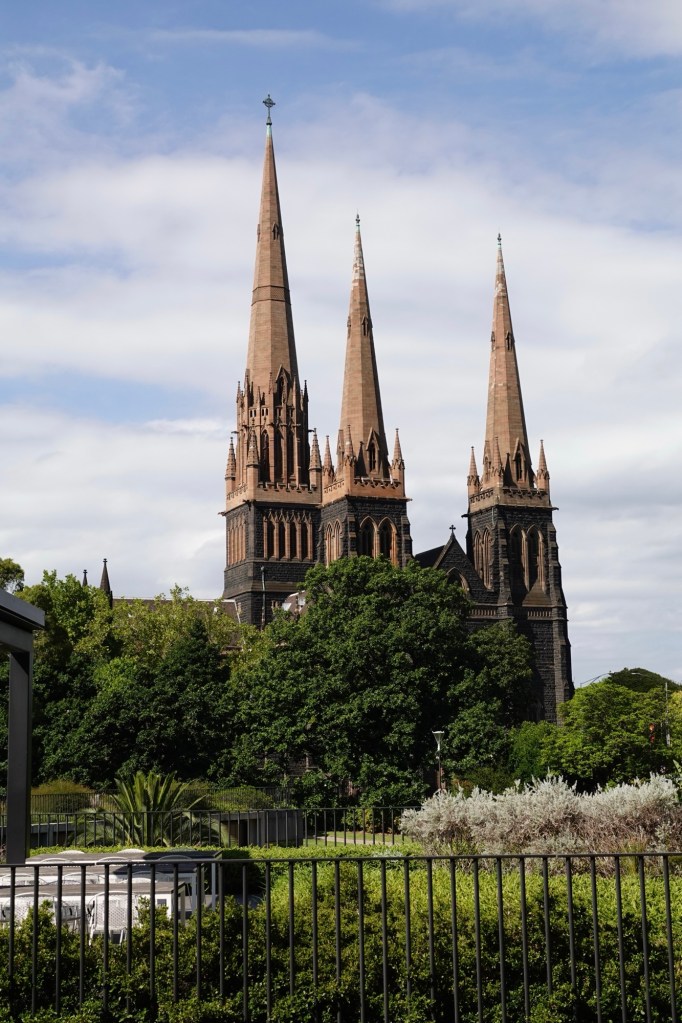
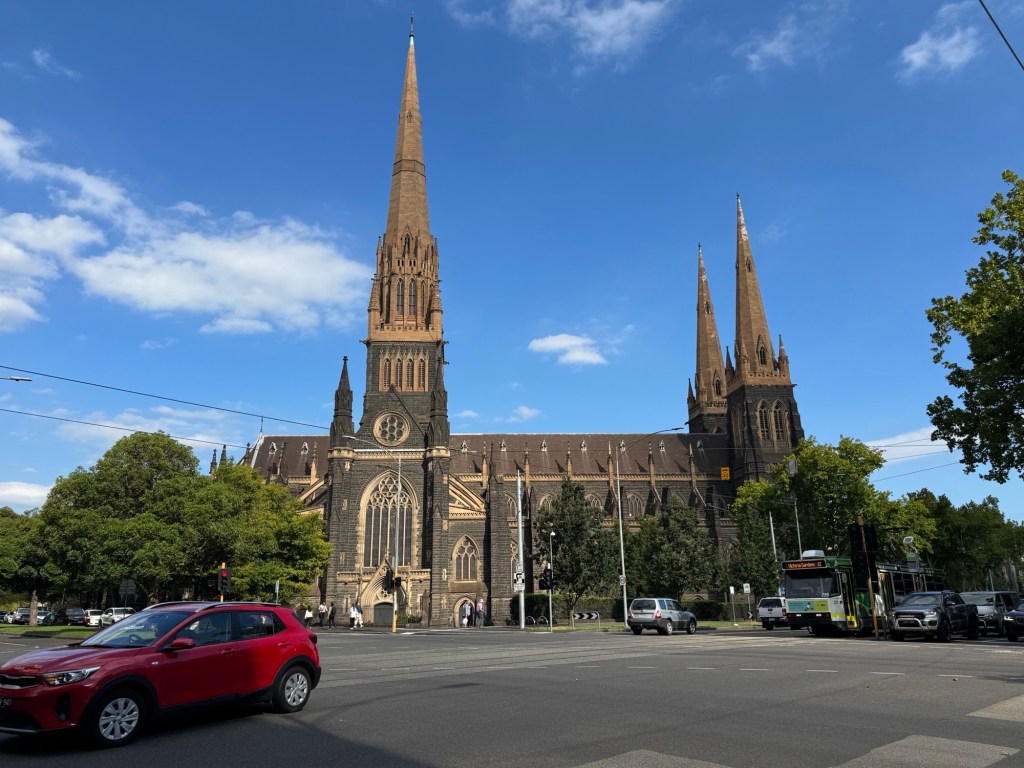
We stood on the rooftop balcony that was created in 2018 when a two storey addition of members’ offices was added. It gave us a lovely view of the spires of St. Patrick’s Cathedral. Victoria’s oldest Anglican church, a mosque, a German Lutheran church, and a synagogue are all in close proximity – not surprising in a city that boasts more than 75 nationalities and 110 languages!
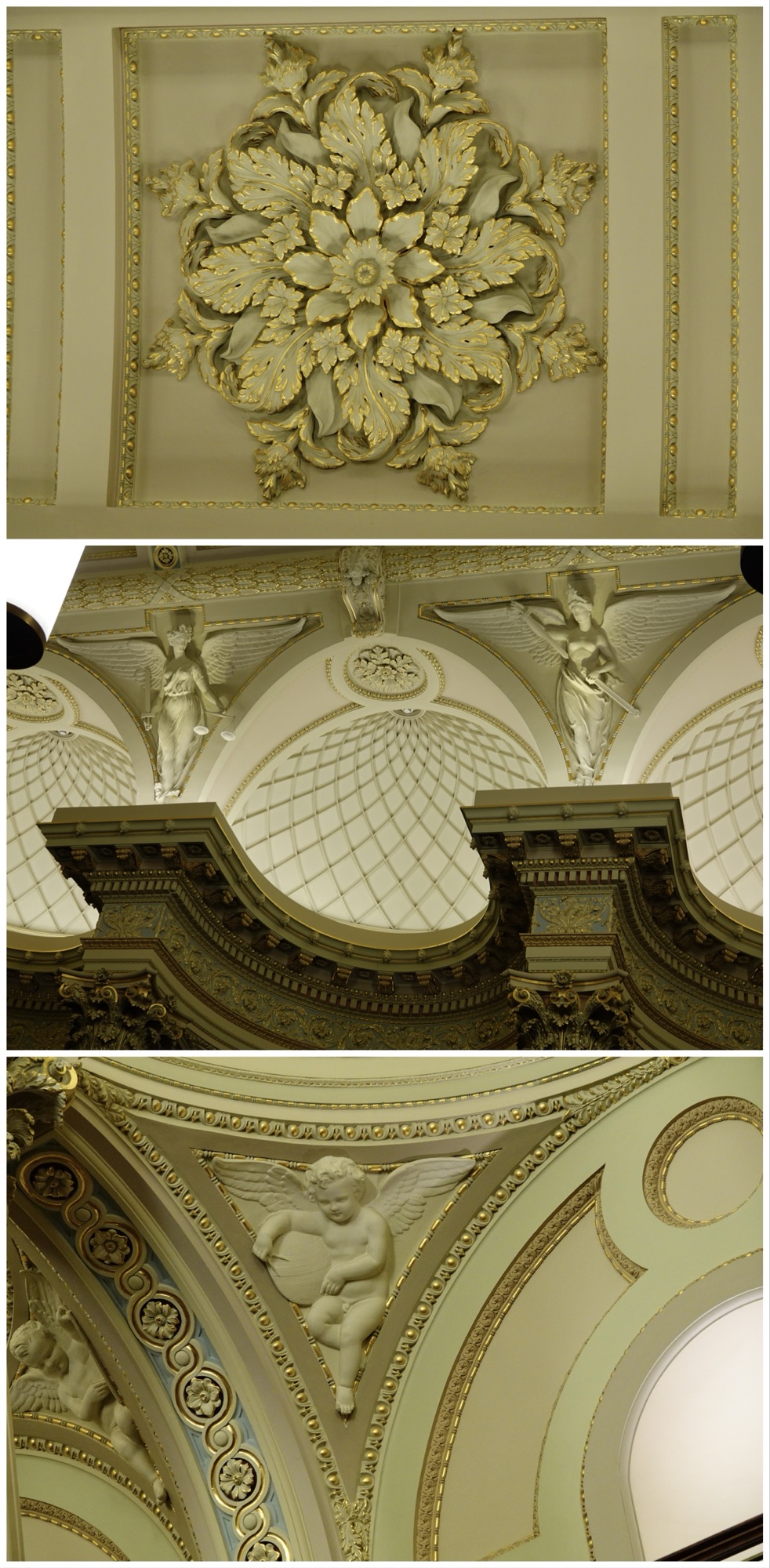
The second interior space we were allowed to tour was the Parliamentary Library. We’ve noticed over and over that libraries are often the loveliest rooms in any building. Of course, as book lovers we may be a wee bit biased.
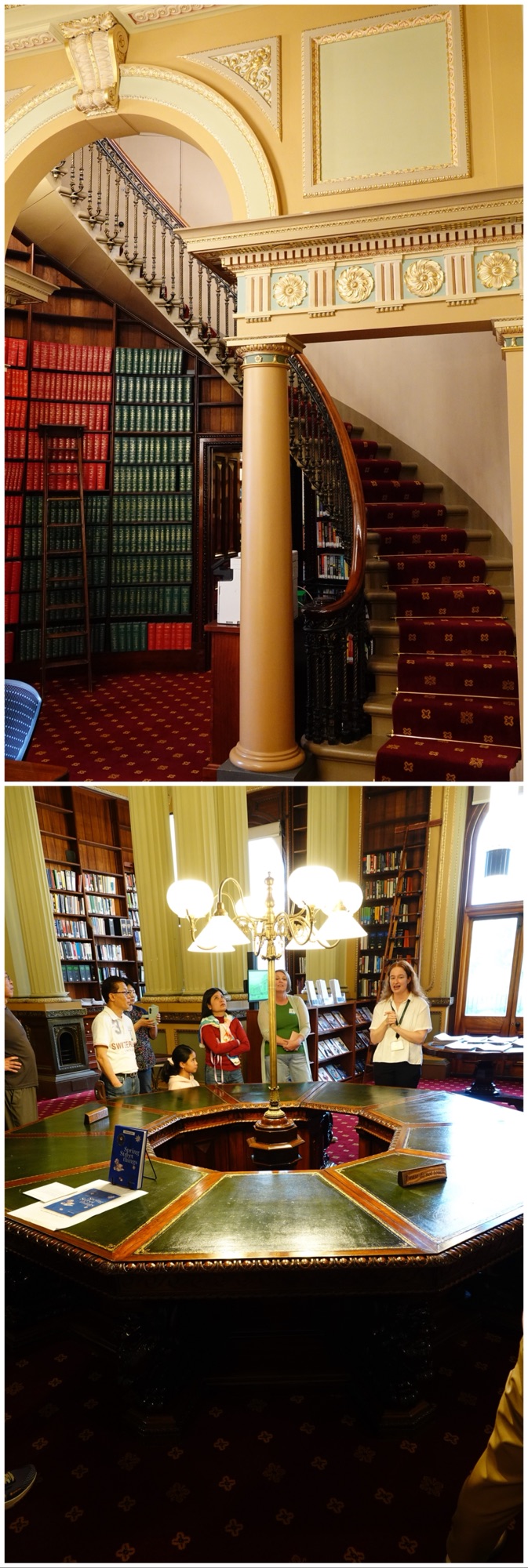
The library was built at the height of the gold rush, which partially explains its extravagant design, and completely explains the 23K gold leaf decorations. Our guide told us that at current values there is about $8 million Australian in gold in the building. She joked that maybe today there’d be better uses found for gold than gilding a building, and then – after checking the nationalities represented in our group – said “or maybe not”.
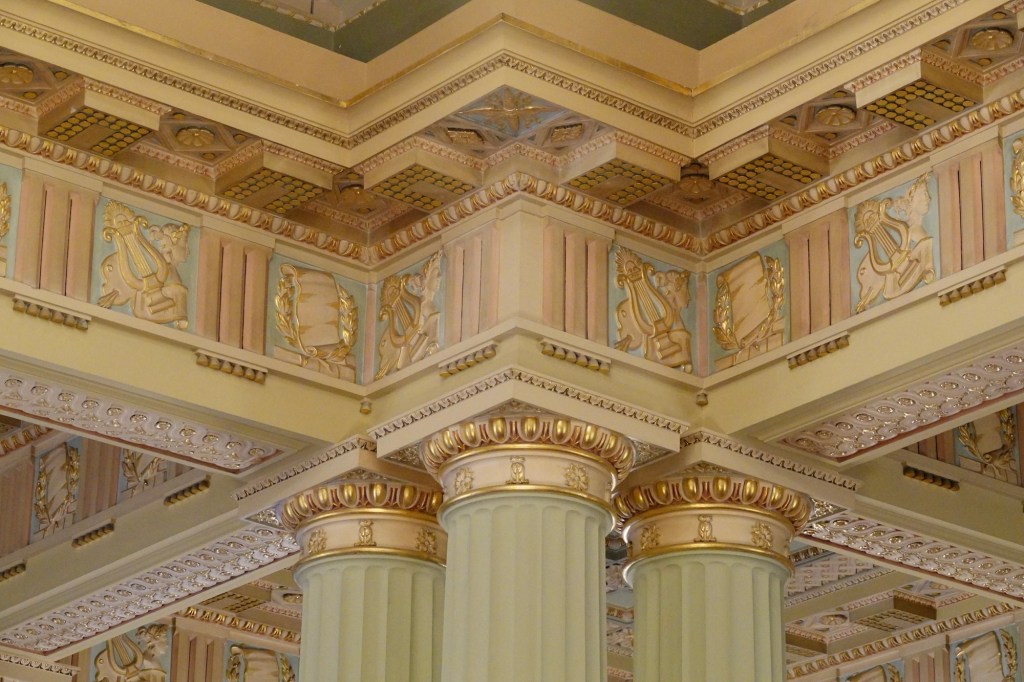
Above us (not sure how we ended up without a photo) was a chandelier composed of 2000 individual pieces of Belgian crystal. There were originally three of these in the building. Between 1901 and 1927, this building served as the meeting place of the newly created Parliament of Australia; for that period Melbourne was the temporary national capital. When the federal government moved to their new premises in Canberra, two of the three chandeliers “disappeared”, and didn’t reappear in the new Parliament Building. No one knows where they are.
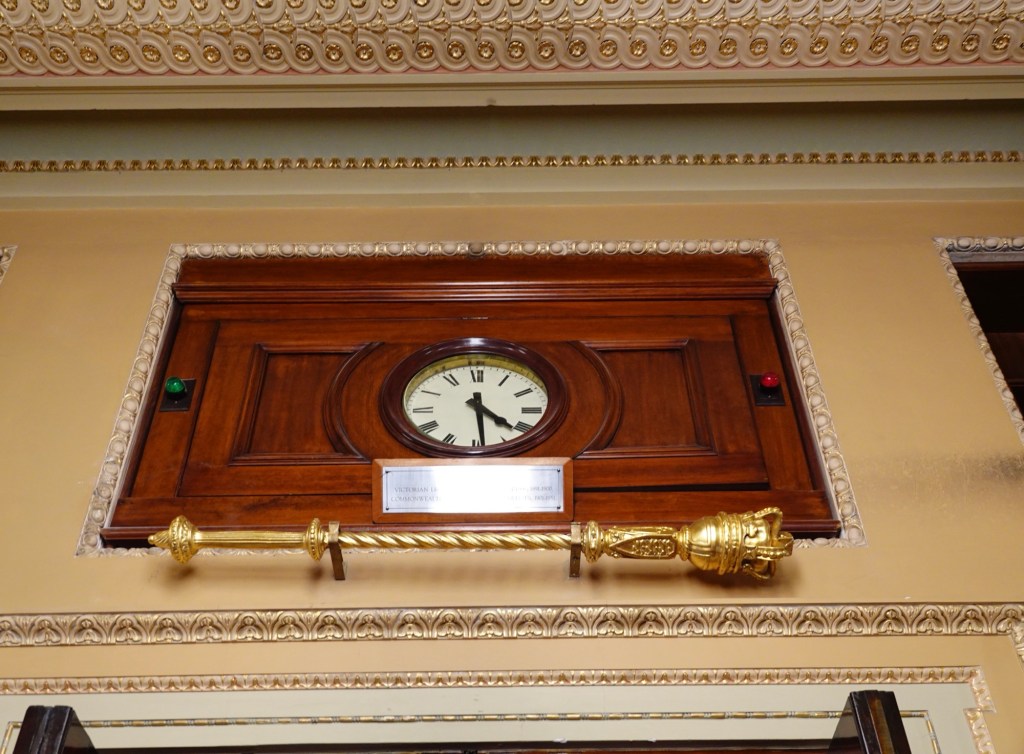
They were not the only thing taken from this building. Above the library door is the original wooden mace (painted gold) that was used from 1857 – 1866. It was replaced by a much more valuable (monetarily, not symbolically) solid silver mace that was stolen in 1890. There is still an active $50,000 reward available for anyone who recovers it.
Our final stop in the Parliament Building was the Upper House/legislative council. This is the “house of review”, where legislation proposed by the Lower House gets debated before being passed into law.
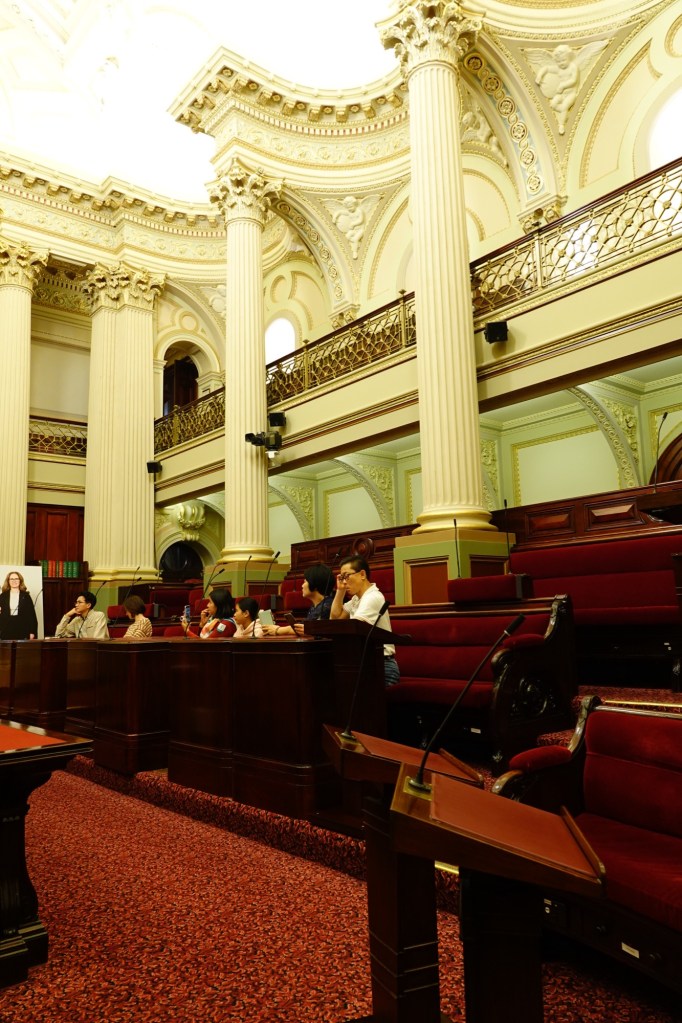
Unlike Canada’s Senate or Westminster’s House of Lords, which consist of appointed (or in the case of the latter, sometimes hereditary) members, Victoria’s 40 Upper House members are elected – five from each of 8 regions, based on proportional representation.
That means that while the Lower House (“the government”, elected using the first-past-the-post process as in Canada) most often only has the three strongest parties represented, in the Upper House (taken from the Parliamentary website) “Following the 2022 Victorian state election, the Legislative Council consists of 40 seats held by the Labor Party (Government), the Liberal/Nationals Coalition (Opposition), and a diverse crossbench. Parties represented include: Labor; Liberal; Nationals; Greens; Legalise Cannabis Victoria;Animal Justice Party; Libertarian Party; One Nation; and Shooters, Fishers and Farmers.
We were allowed to sit – but not touch the microphones – in the red velvet seats.
As in New Zealand, and in the UK, the red and green colours in the chambers signify crown and people. No monarch is allowed to step into the green “peoples” chamber. That protocol goes back to King Charles II in England, but that’s a whole other story.
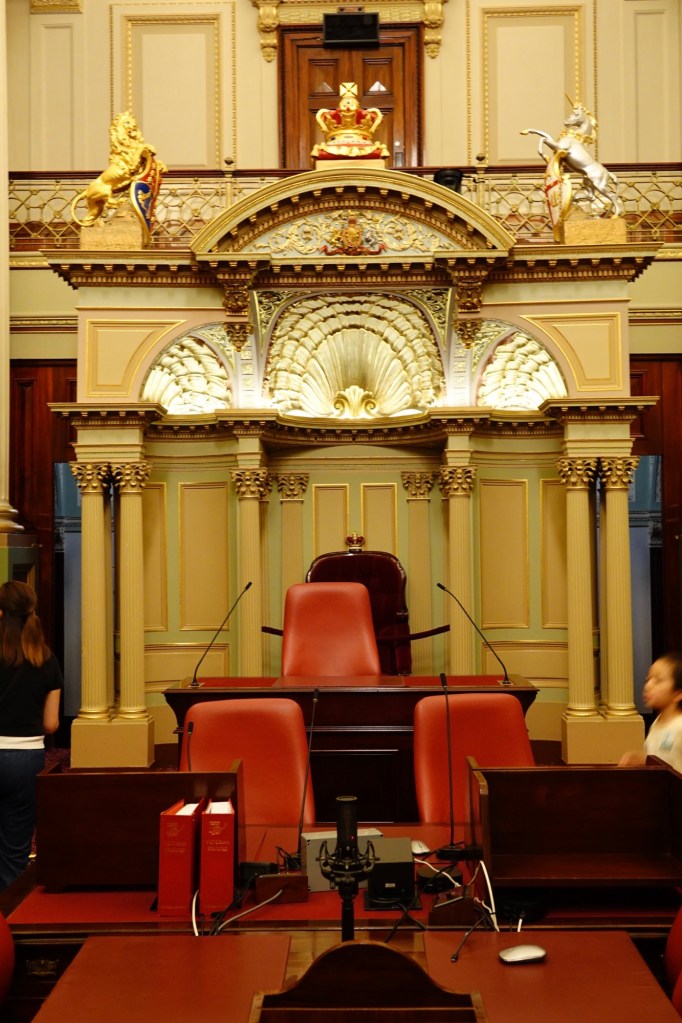
We were told that the Lower House is much more simply decorated, but – like royalty – we were not allowed to enter the green chamber.
That ended our 45 minute tour. It was perfect timing for us to walk to Melbourne’s Fitzroy neighbourhood for a dinner with fellow semi-nomads.
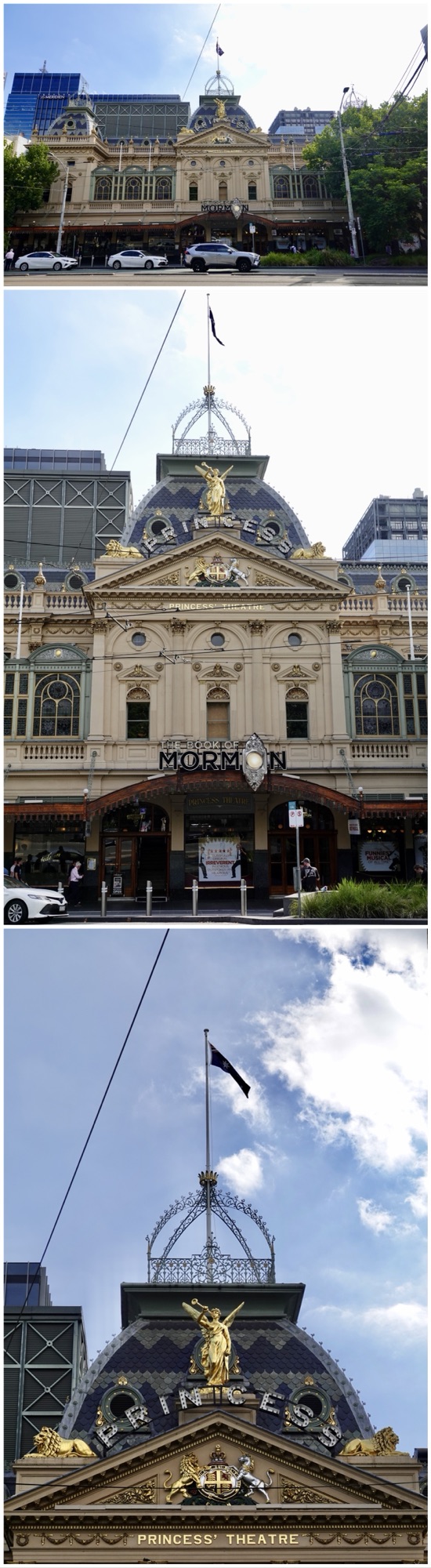
Of course, en route there were things to gawk at, like the Princess Theatre with its glittering silver crowns.
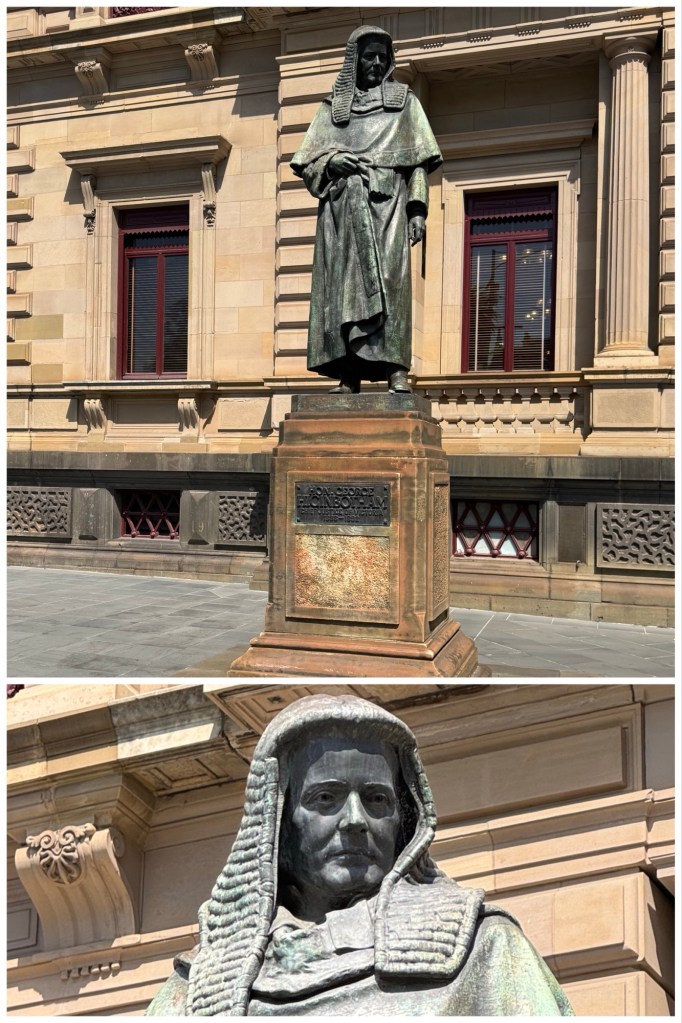
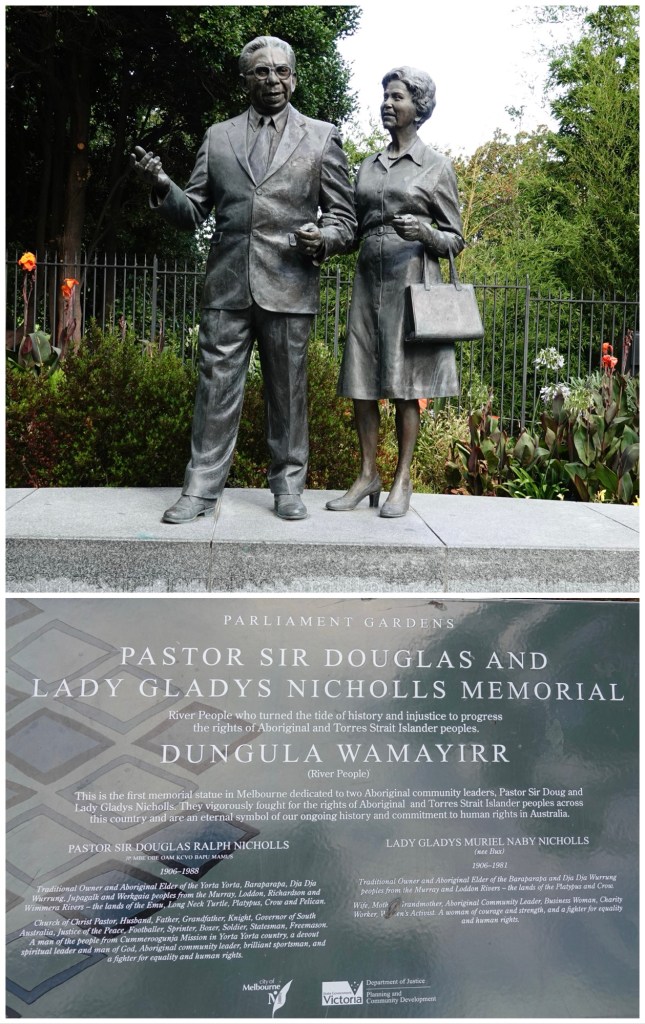
One of the reasons I’m a big fan of statues, especially those accompanied by explanatory plaques, is that they attract attention. Had we not noticed this statue, we would never have learned that this was the first memorial statue in Melbourne dedicated to two Aboriginal community leaders.
We also got a better view of St. Patrick’s Cathedral Basilica, built beginning in 1858 in the Gothic Revival style.
We continued on to our dinner destination: drinks and pizza with Bill and Meg Nyland, who I “know” through Bill’s blog How Bill Rolls. It’s been one of the big bonuses of our trip so far that we’ve had the flexibility to meet other world travellers. As Meg expressed, they’re easy meet-ups to have because we start from a common understanding of a lifestyle that embraces constant travel.
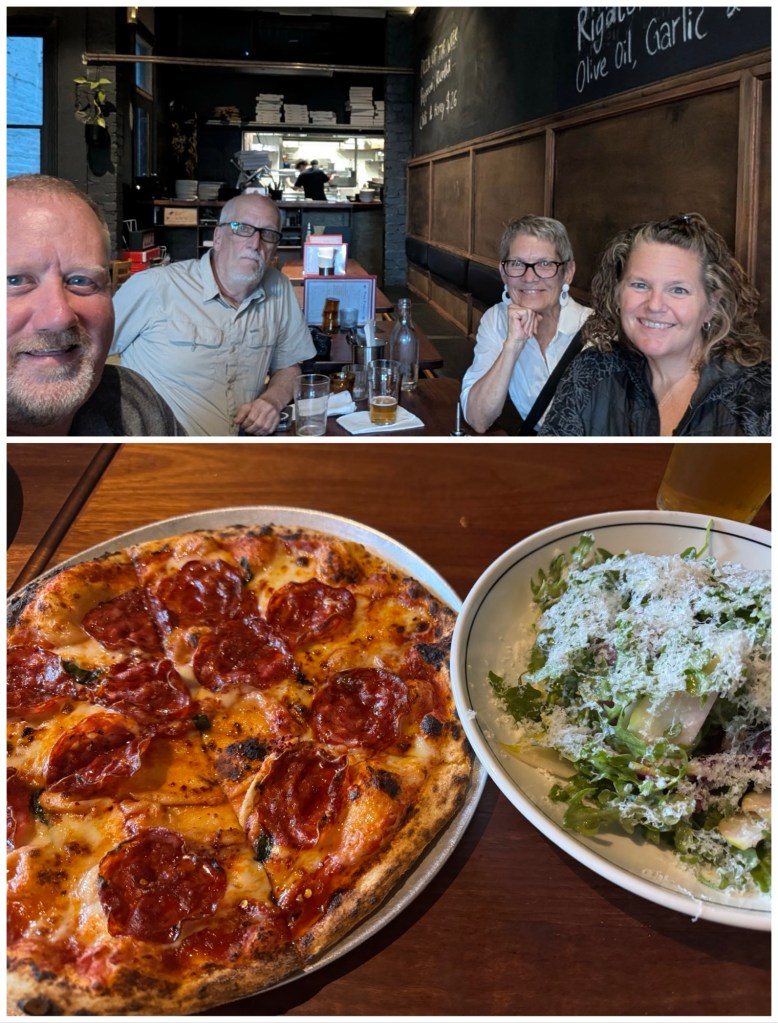
It looks like our itineraries may overlap again in Sydney, which would give us a chance to share impressions of Adelaide and hear about their experiences in Tasmania.
We have just one more day in Melbourne, but Ted and I are both pretty exhausted after four walking-intensive days. Further exploration of this wonderful city may have to be deferred to a future Australian adventure.
 Rose and Ted’s Excellent Adventure
I loved seeing the Dior exhibit through your eyes. You may be interested in someday visiting the Maryhill Museum of Art in Goldendale, Washington, to see Théâtre de la Mode, a collection of garments from post-World War II haute couture Paris designers displayed on one-third-life-size mannequins. I saw it when we were on a Columbia River cruise and was blown away. There is a long story behind how these French mannequins wound up in a small town in Washington state.
LikeLiked by 1 person
That sounds fascinating!
LikeLike
As always – jaw dropping! The joy of being nomads – you’re citizens of the world and can return to familiarity. Then back to discoveryAaaahhhh ! Wh
LikeLike