One of the biggest bonuses of travel is the opportunity to learn about other cultures through people’s personal stories and experiences.
A couple of days ago, at Hobbiton, we had one of those wonderful opportunities when Otiwa, our Māori guide, explained her facial tattoos.
Our sons both sport extensive tattoos, which – while the designs they chose have special significance to them – are not part of their cultural heritage.
For Māori, tattoos are not decoration;they are an integral part of their traditional culture, and have a “code” that can be read by anyone who knows the language of the ink.
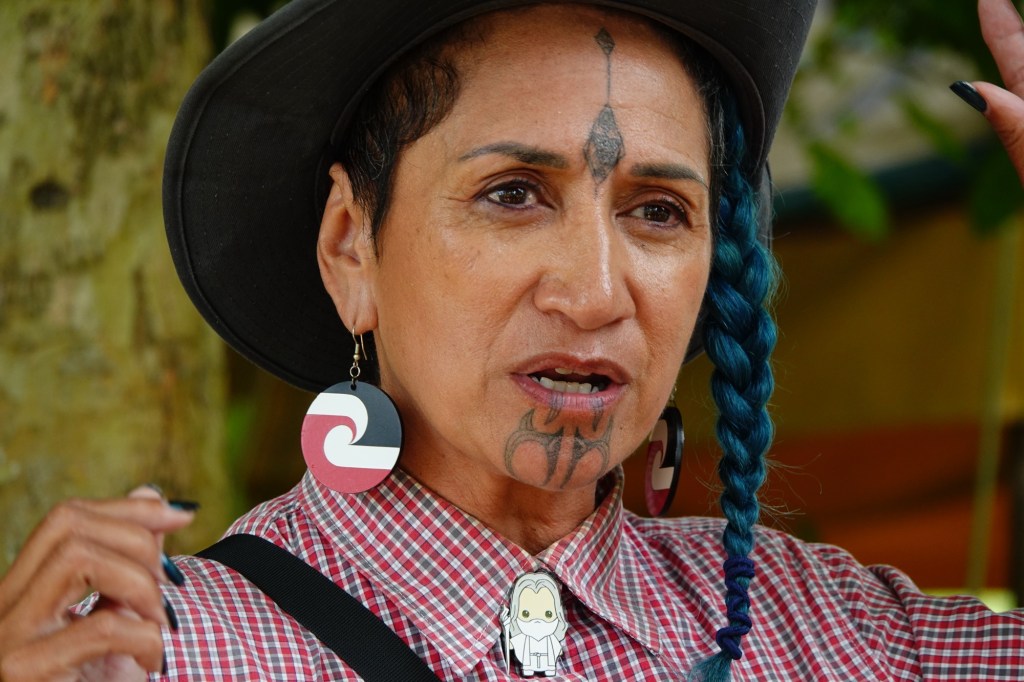
For Māori women who choose to have them, their facial tattoos are done concurrent with their first menses, usually between the ages of 13 and 16, at which time they are deemed to be able to contribute to the community. At one time that may have been associated with contributing children, but that is no longer the case.
The tattoo is done on the chin, because it is from the chin/jaw that wisdom is expressed. Otiwa also has her lips inked with arrows, indicating that the only words that are spoken should be uttered with kindness, compassion, and truth.
Her chin tattoos point upward, since she is the eldest daughter; her sisters’ chin tattoos point downward.
The ray/skate on her forehead was done when she reached menopause, the traditional time for a woman’s forehead to be inked. She quipped that it guarantees that older women don’t become “invisible”. The ray represents a guardian spirit, protection, and a deep connection to the ocean and ancestral wisdom.
Otiwa explained that she had intentionally chosen to have her tattoos done in the traditional way with knives and hammers, which is much more painful than modern needle tattooing. Historically, enduring the tattoo process demonstrated pain tolerance, which was considered a highly desirable trait. I can only imagine that for women it was, in some way, a preparation for childbirth – just as for men it was once a preparation for enduring battle.
We felt incredibly honoured that Otiwa chose to share this personal part of her heritage with us.
It was an affirmation of the value of travel.
 Rose and Ted’s Excellent Adventure