We booked two really interesting tours this week: one of New Zealand’s parliament buildings, and the other of the Supreme Court building.
Both are architecturally interesting, and both offer scheduled public tours.
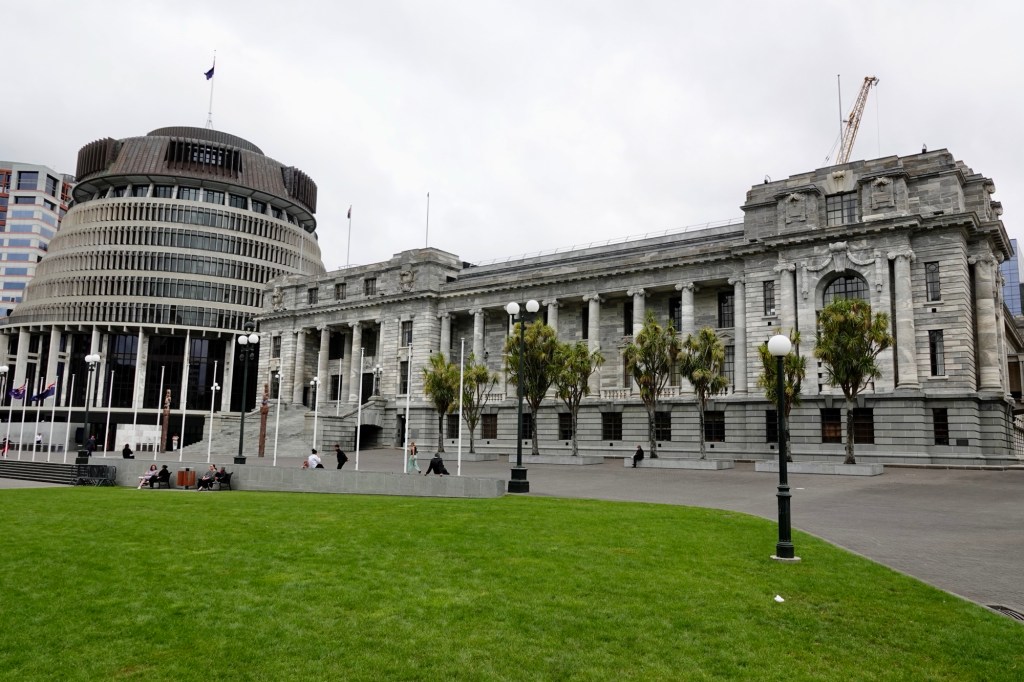
For today, it was the parliamentary precinct, where three unique buildings make up the “parliament”: the 20th century Executive Wing (The Beehive), the Edwardian Parliament House, and the Victorian Parliamentary Library.
There are multiple options for tours, if you book via the website early enough (Guided Tours), including tours focussed on the building’s art (one even given by the art curator), and a tour that looks at the role of women in New Zealand’s parliamentary history.
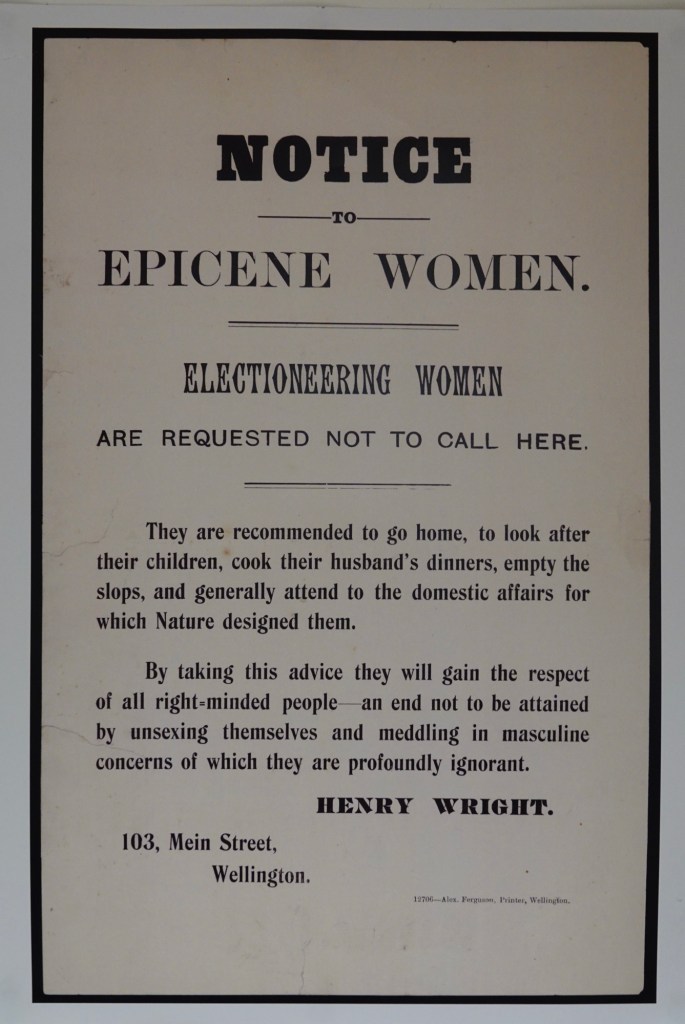
I hadn’t researched all the tour options before we arrived here, so we took the hour long Introduction to Parliament tour that runs daily.
As the website touted, it was a ngreat way to get a general introduction to New Zealand’s parliamentary processes, the architecture and history of the buildings, and how New Zealanders have their say in Parliament.
We began in the newest of the three buildings, “The Beehive”. Designed by a British architect from sketches he made in 1964, it was completed between 1969 and 1979. The 72m/236ft tall building has 12 floors above ground and 2 below, with the Prime Minister’s office on the 9th floor and the Cabinet Room on the 10th. There was very little of this building open to the public.
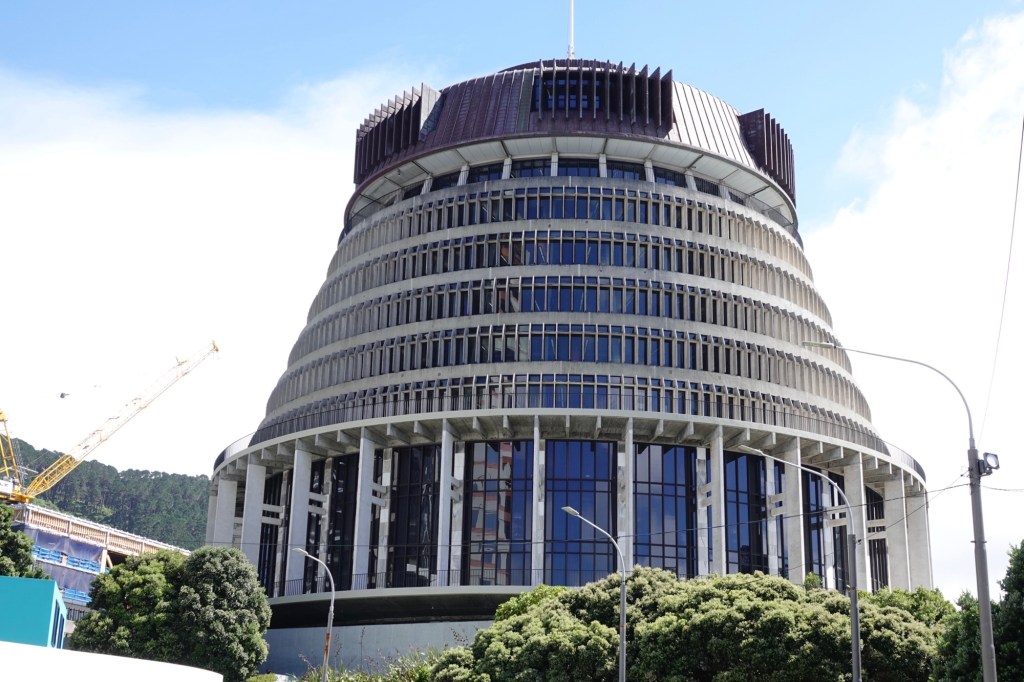
A significant refurbishment between 2006 and 2008 created the current bright and airy feel of the entrance hall. When the building first opened, its décor was very much 1970s brown, brown, and more brown. It now features macrocarpa wall panels and Takaka marble-clad walls.
Our first stop was in the Beehive theatrette – the press briefing room. Here the Prime Minister, flanked by the appropriate Cabinet Minister, makes announcements about new policies. This room was a familiar sight on NZ televisions during the pandemic. We learned that only the PM can use the podium on the left (the right when facing the gallery); opposition party leaders do not speak to the press corps here.
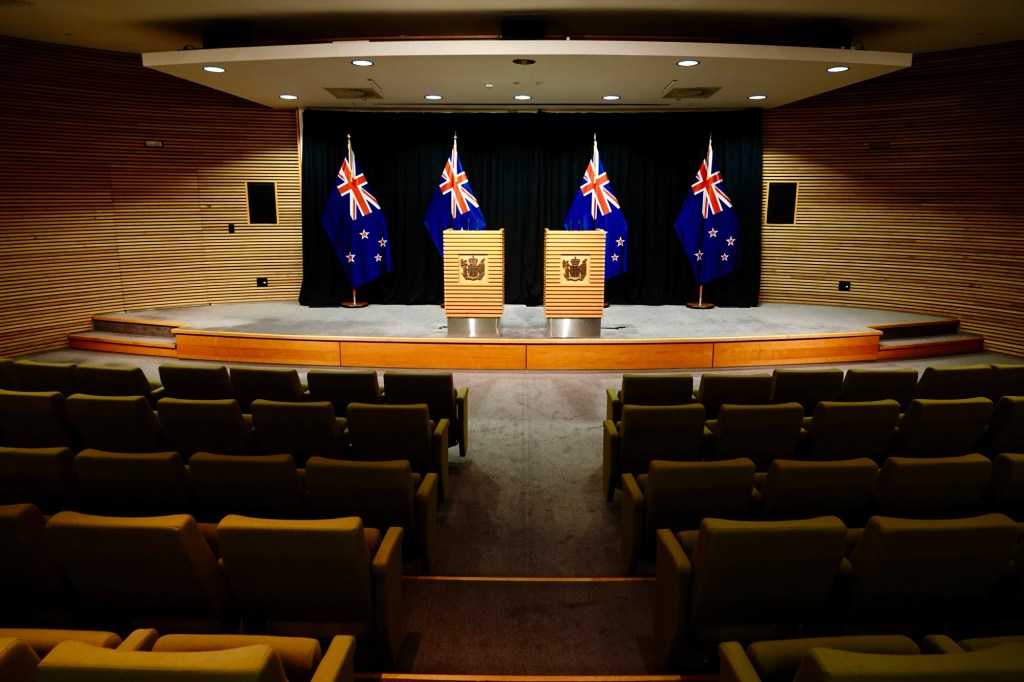
Our tour was done entirely without going outside, since the three buildings are connected, but at this point we moved into Parliament House.
In the black-and-white hall connecting The Beehive to Parliament House, the press can interact with MPs and Ministers on their way into parliament. There’s an alternate route to the Debating Chamber for MPs wanting to avoid the press too.
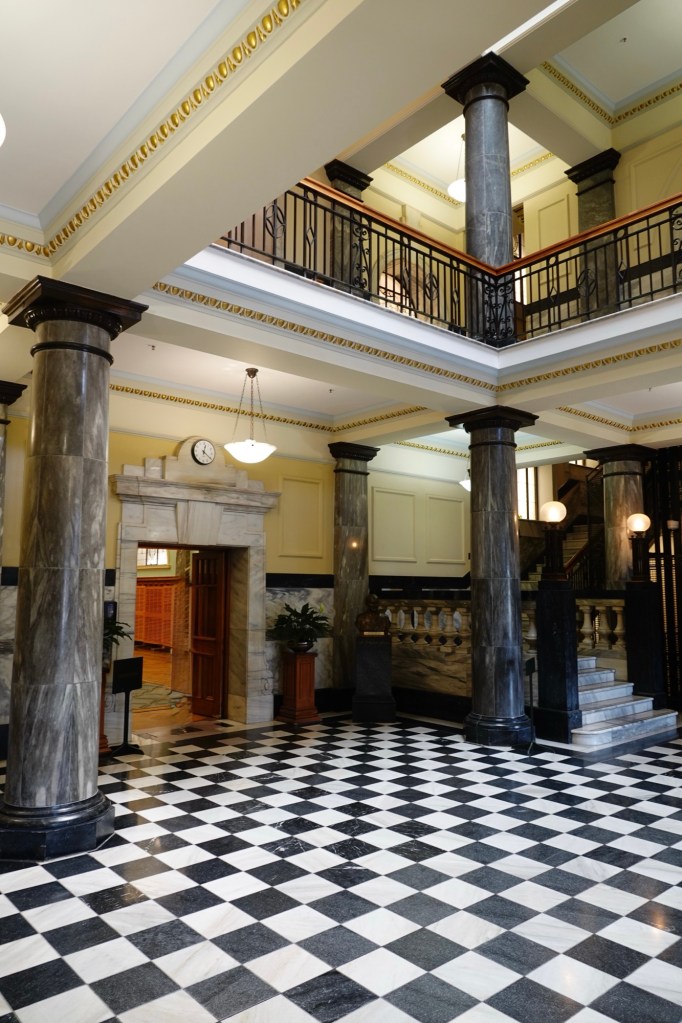
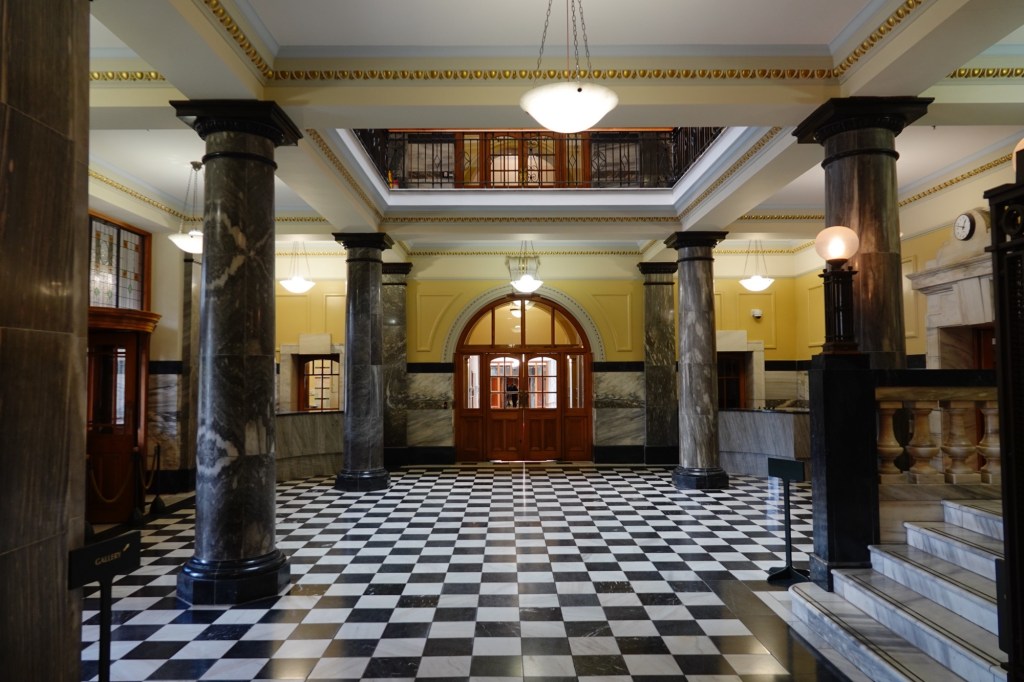
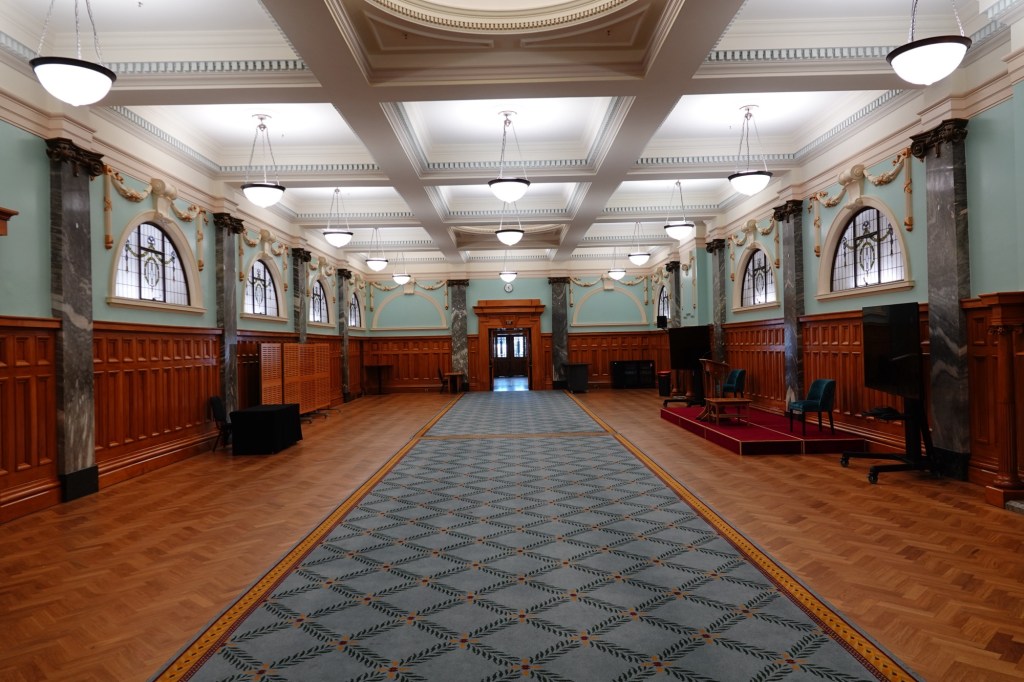
Off to the side of that hallway is the Grand Hall, originally the member’s lounge containing, among other things, billiards tables – because what better way for parliamentarians to relax? It no longer has those tables, but has recently become rentable as an event space.
Next was the Debating Chamber, the space that most people refer to simply as “Parliament”.
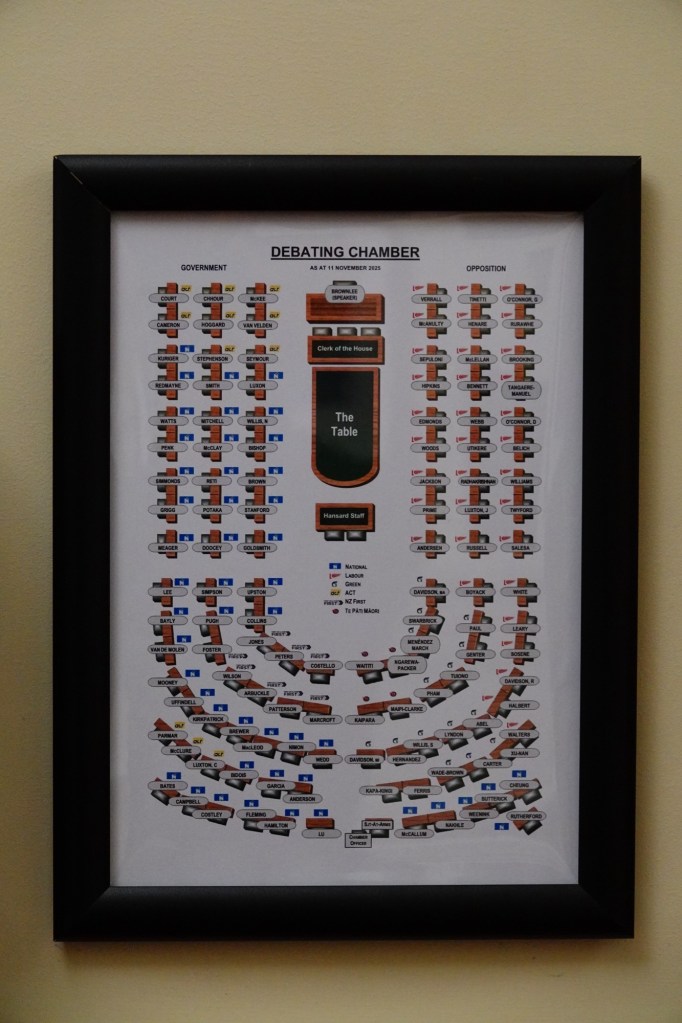
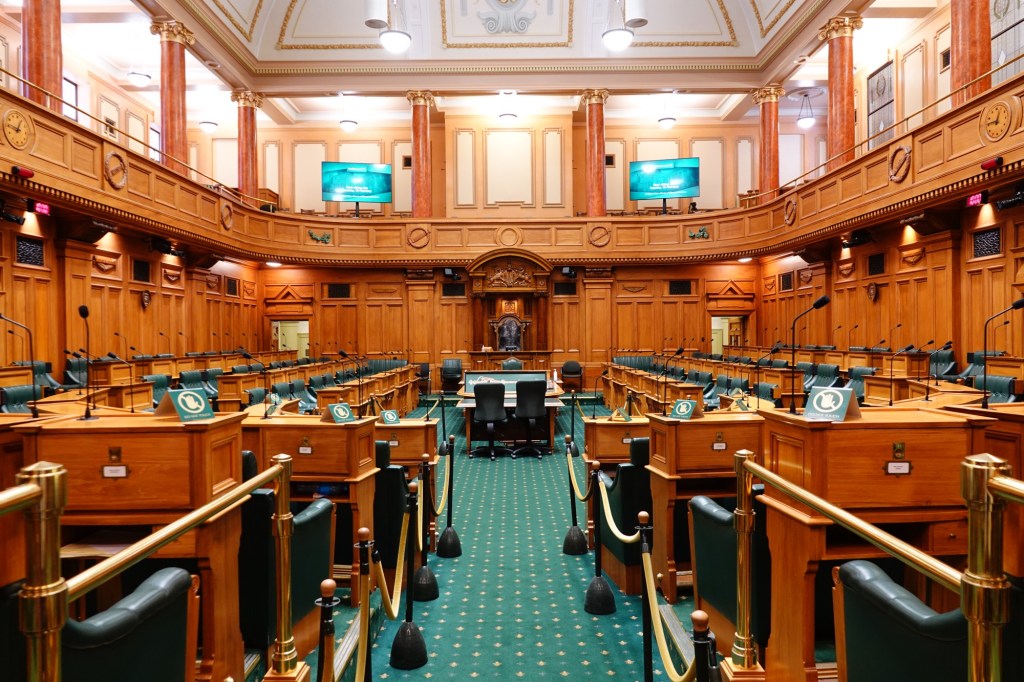
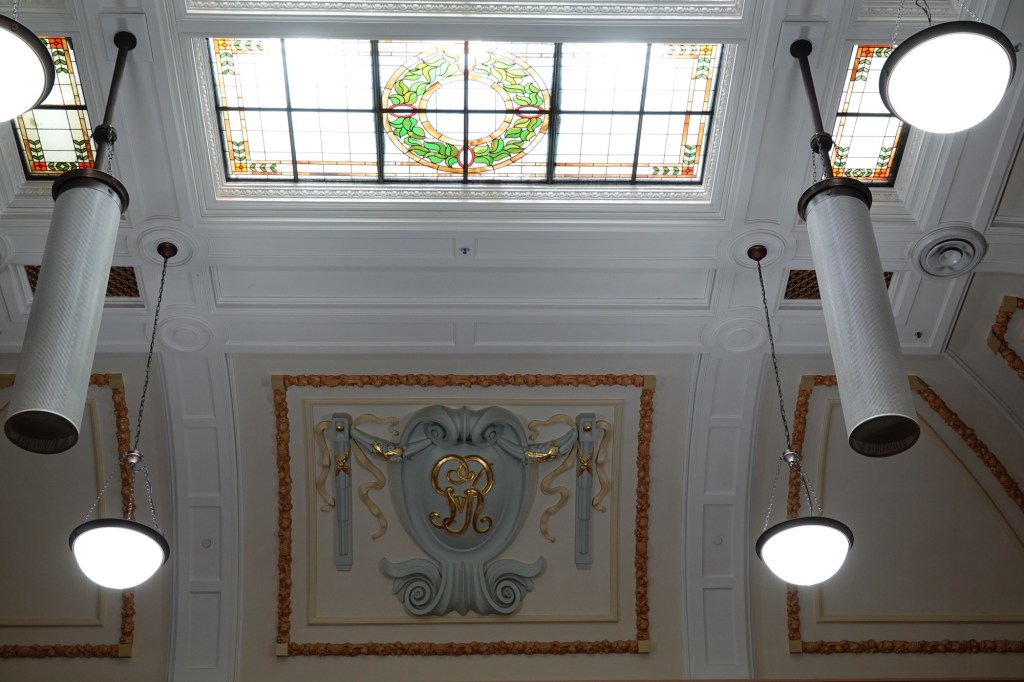
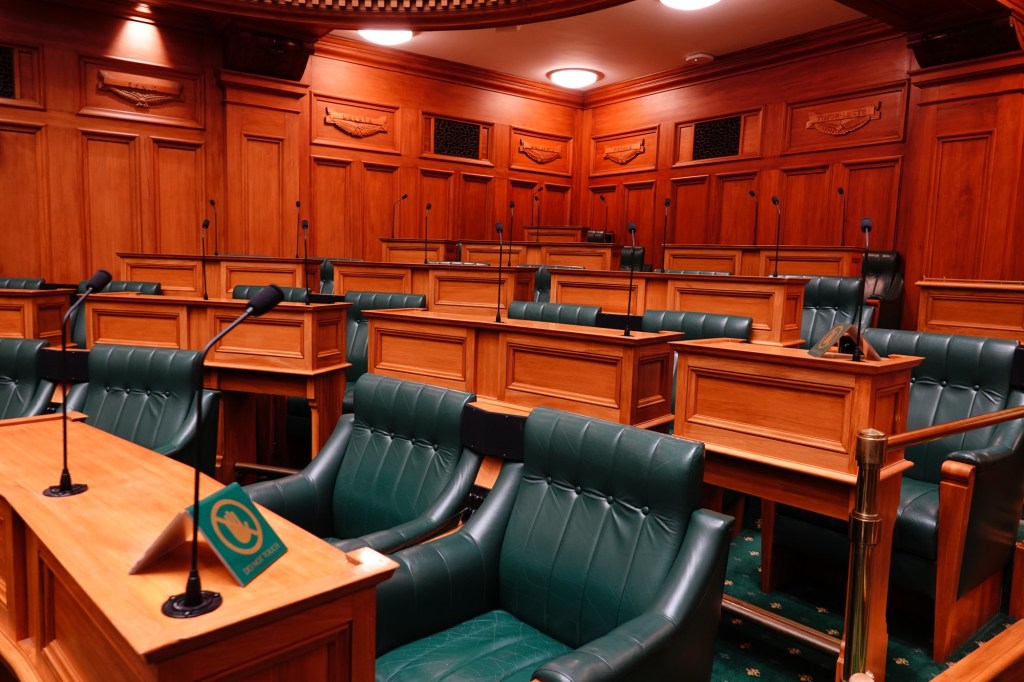
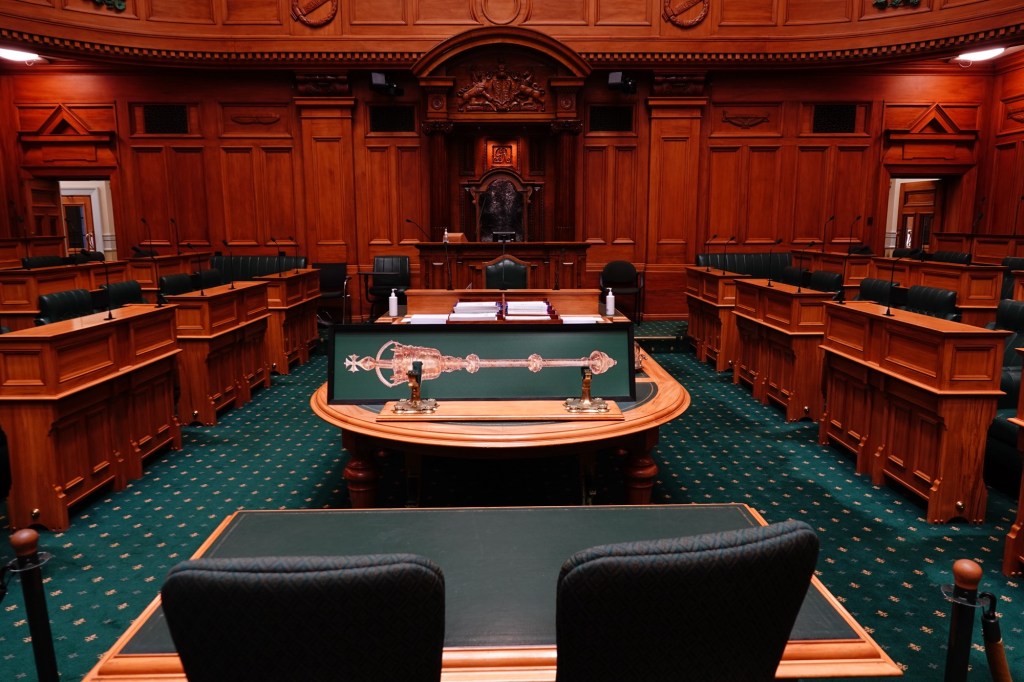
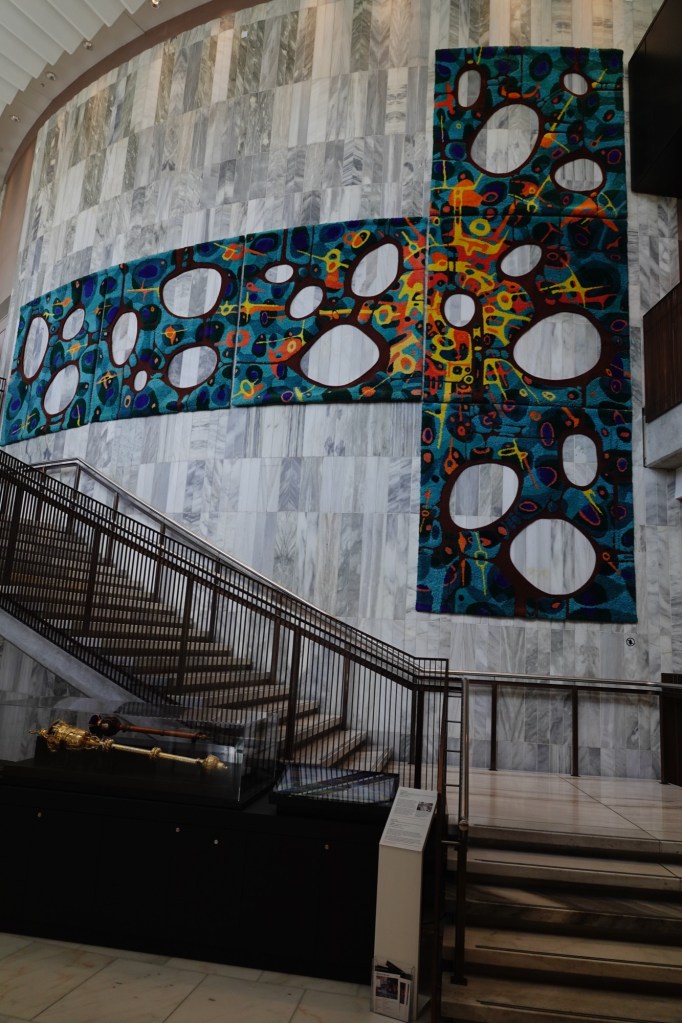
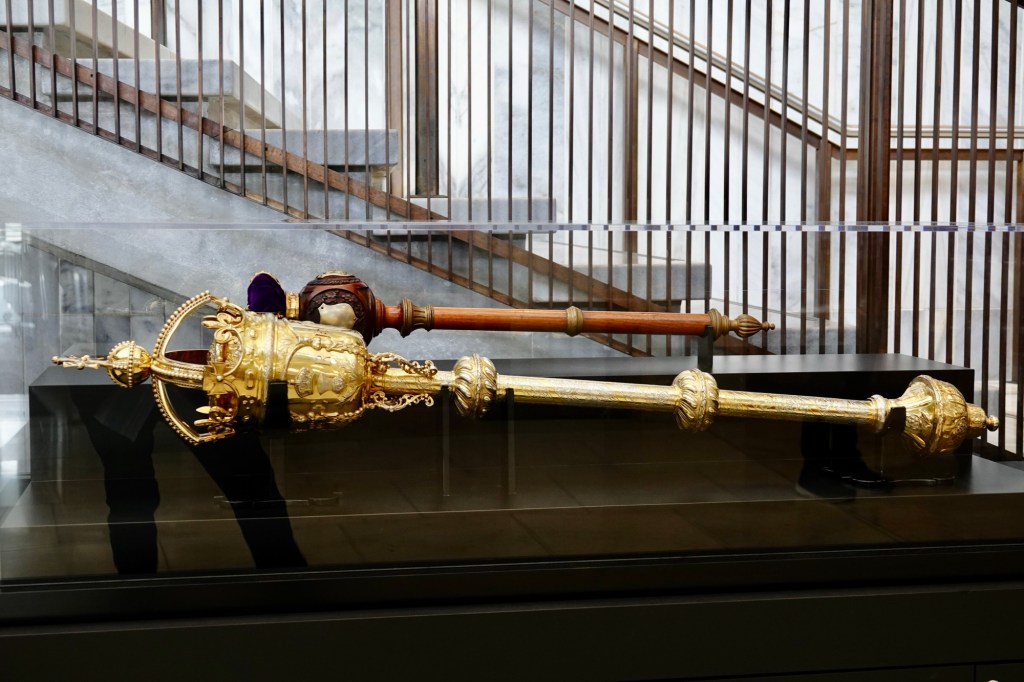
If parliament had been sitting, in the place where there was an image of the Speaker of the House’s mace there would have been the actual mace. Ted got a picture of it in its glass case in the foyer of The Beehive.
I was surprised to learn that New Zealand’s government is uni-cameral, the Legislative Council (the “upper house” equivalent to Canada’s Senate or the UK’s House of Lords) having been abolished in 1951. It is also the country’s only law-making entity, since New Zealand has no provincial/state governments.
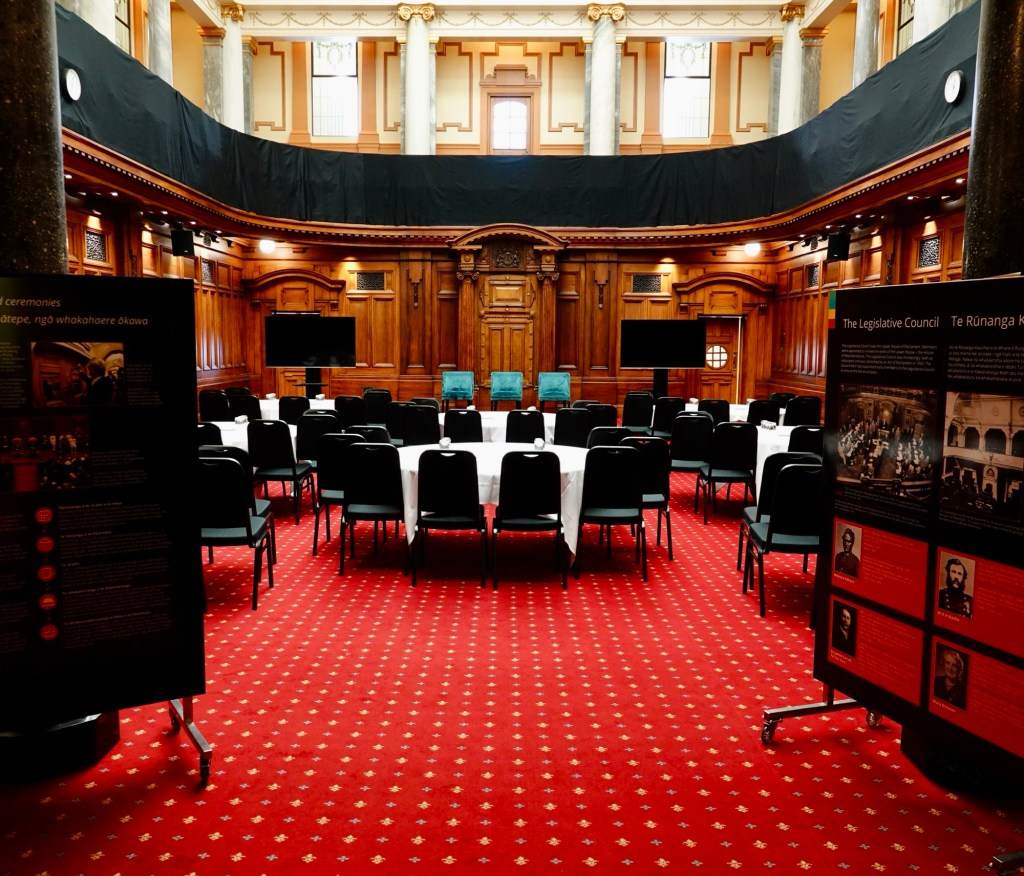
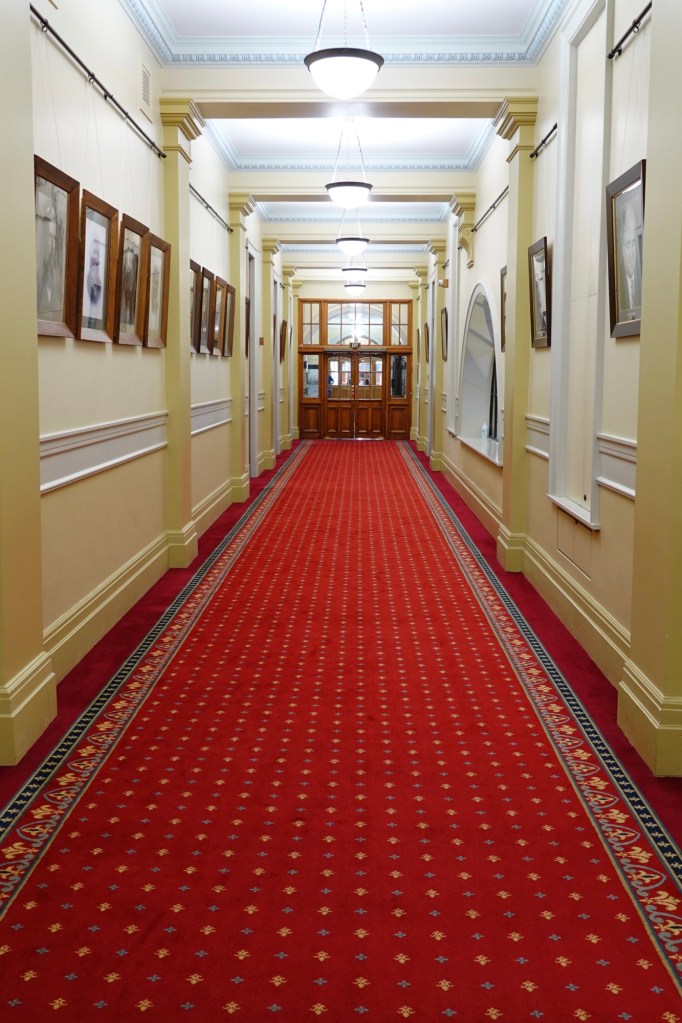
There was more red carpet in the portrait hall.
The country uses the Mixed Member Proportional voting system – just like Germany. Seats in Parliament are allocated based on the proportion of votes a political party gets. Of the 120 MPs, 72 are elected by winning an electorate (electoral district), and the remaining 48 are filled from party lists based on how many voted each political party received. That means that a party who got 10% of the vote, but did not have a candidate win a district, would get 4.8 seats in parliament. Those decimal points that don’t match actual bodies resulted in the current Parliament having 123 MPs instead of the usual 120. Under current rules, a party must get at least 5% of the party vote in order to seat an MP. In the current session, there are 6 parties represented in parliament; almost every government is a coalition as opposed to a simple majority.
To make this system work, every voter gets 2 votes: a “party vote” that impacts the proportion of seats each party gets, and an “electorate vote” to choose the MP for their district (using a first-past-the-post system,so the candidate with the most votes wins). Potentially, a voter could vote for a district representative from one party while allocating their party vote to the other party – although very few probably do.
Another interesting – and surprising – thing we learned was that New Zealand has no formal written Constitution! Instead there is a framework of statutes, treaties (most significantly the Treaty of Waitangi), conventions, and court decisions. The result is a flexible, easily updated system — but one that also gives significant power to Parliament.
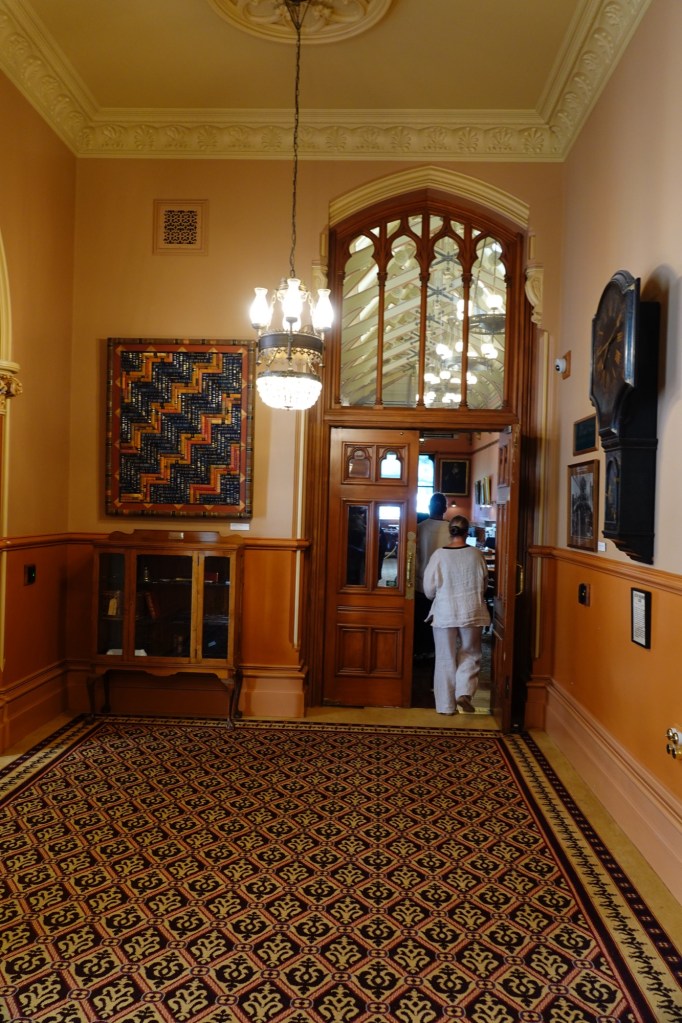
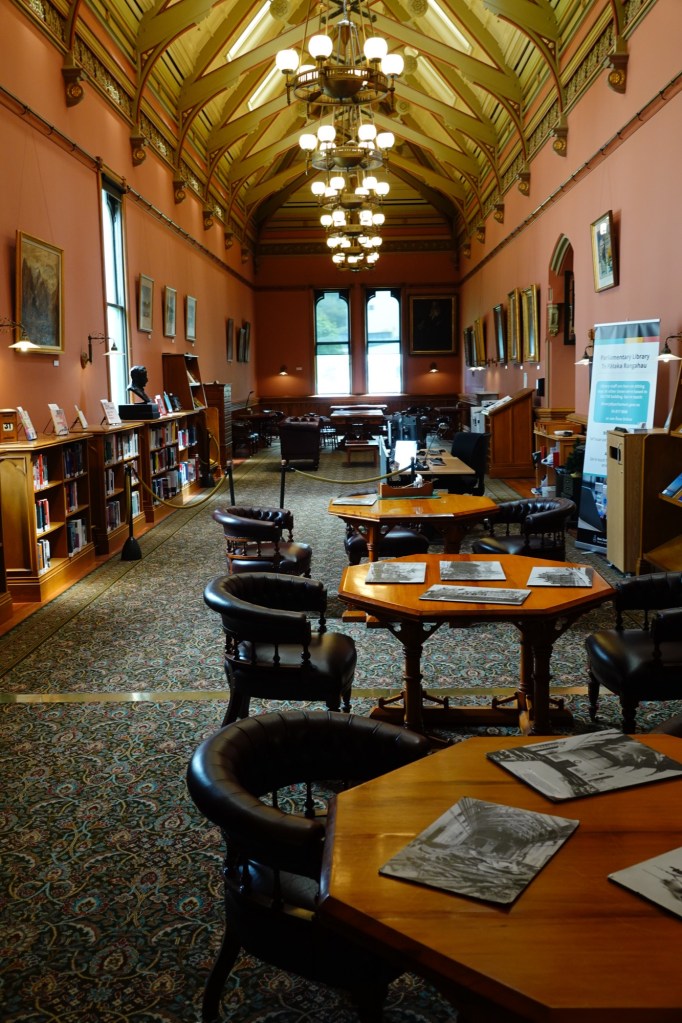
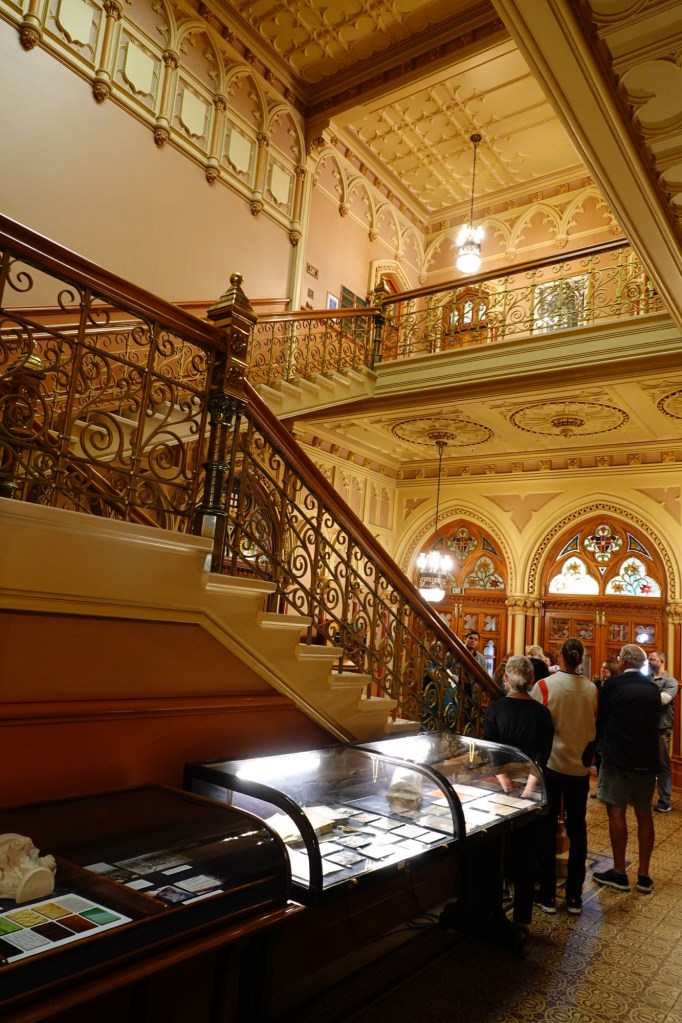
Then on to the Parliamentary Library, oldest of the three connected buildings.
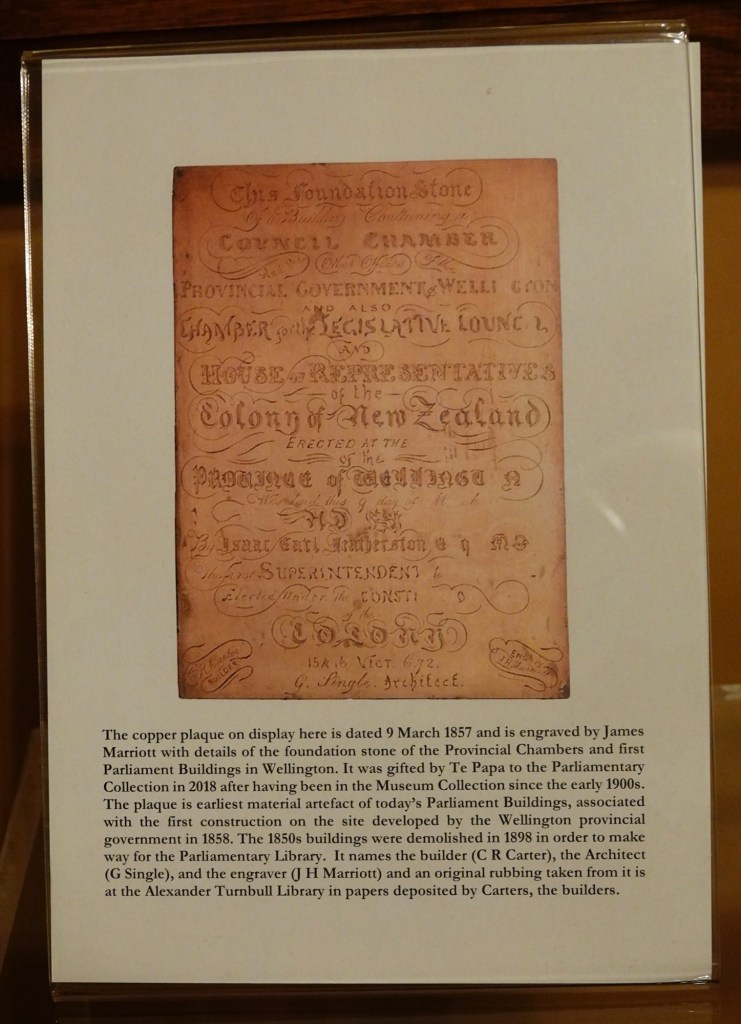
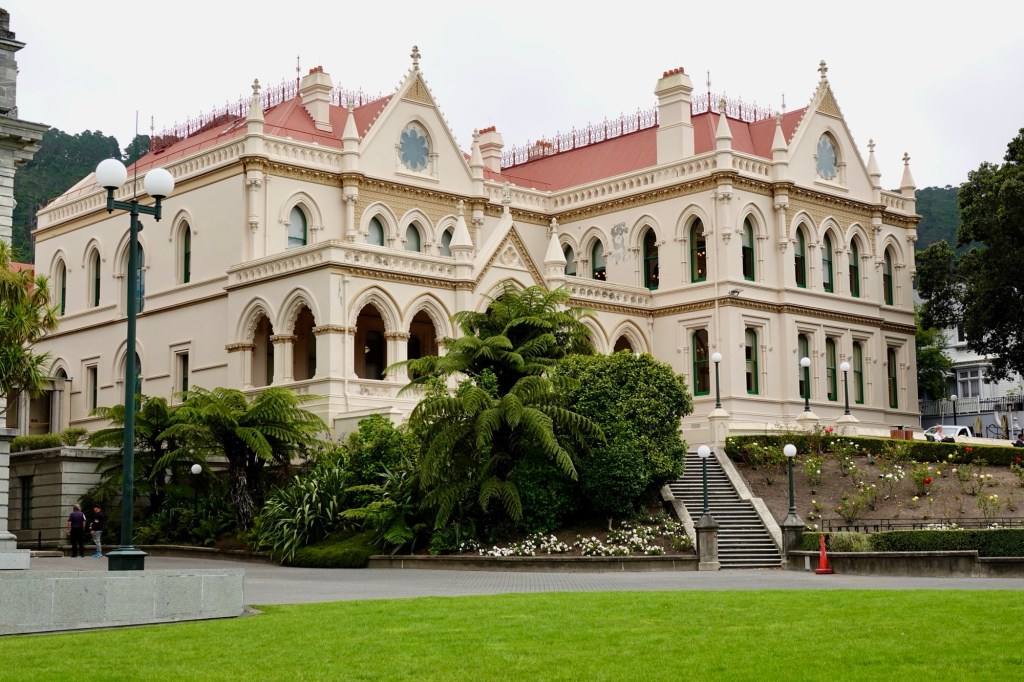
Again, although the buildings look separate from the outside – largely because they are so architecturally diverse – we transitioned via a connecting hallway.
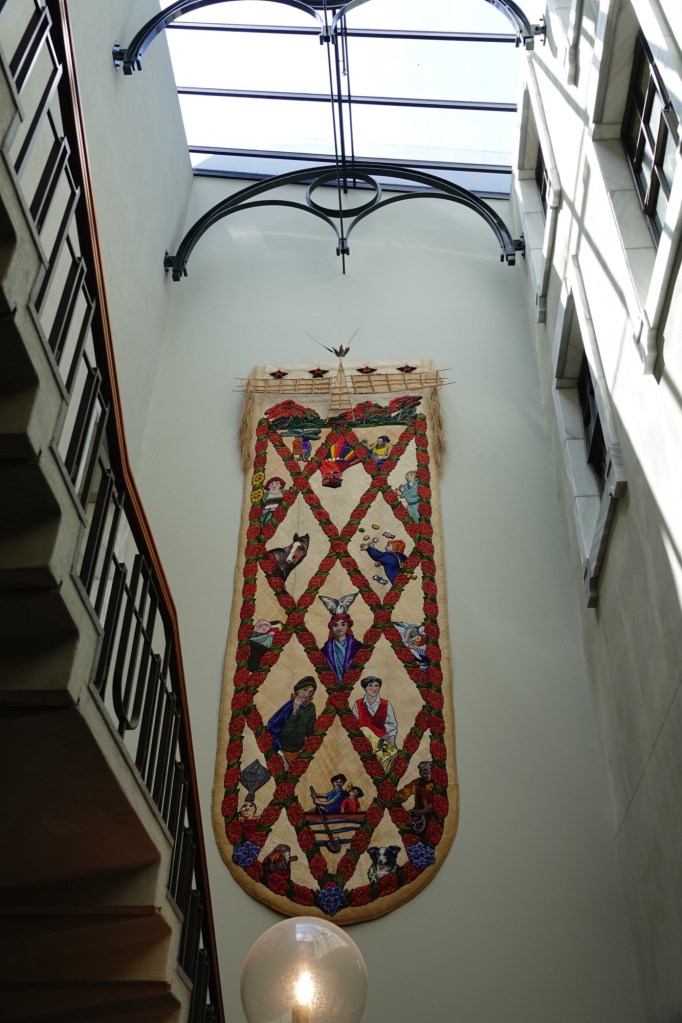
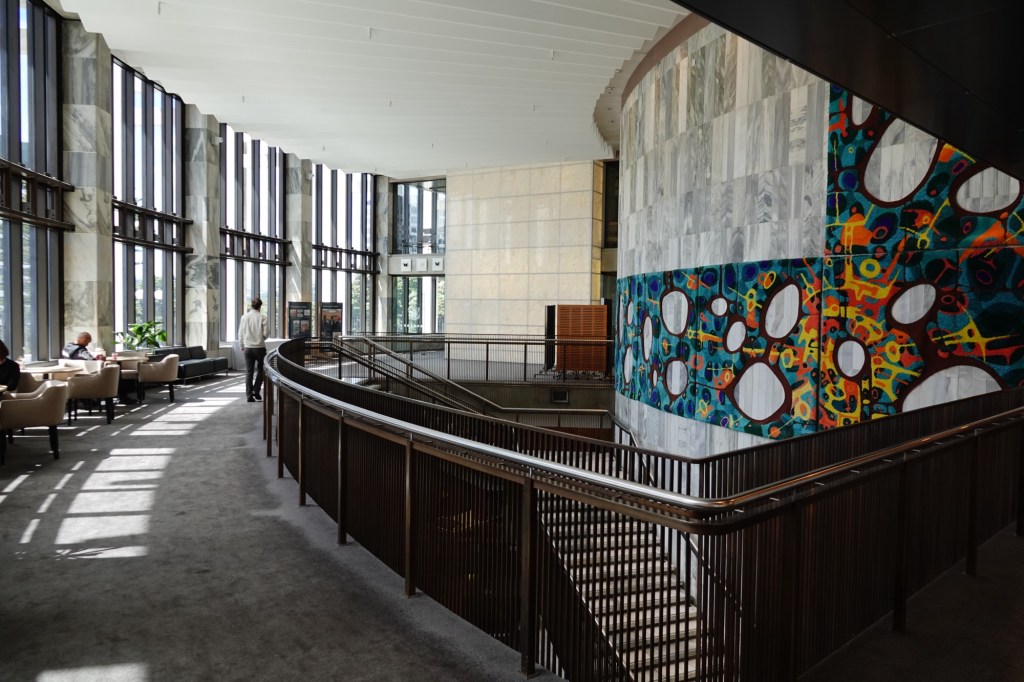
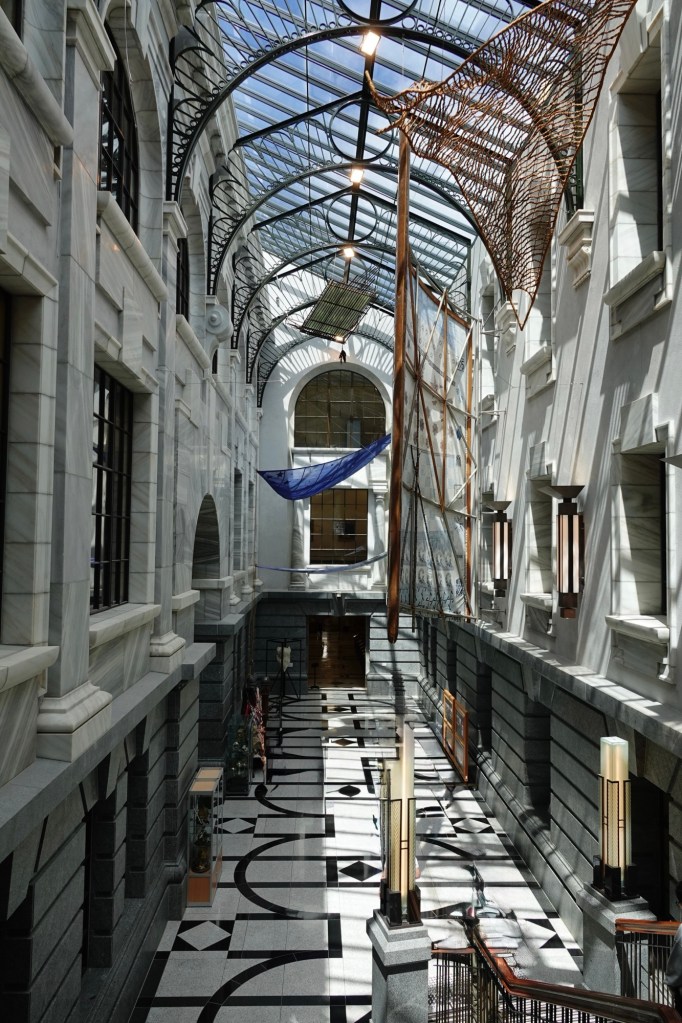
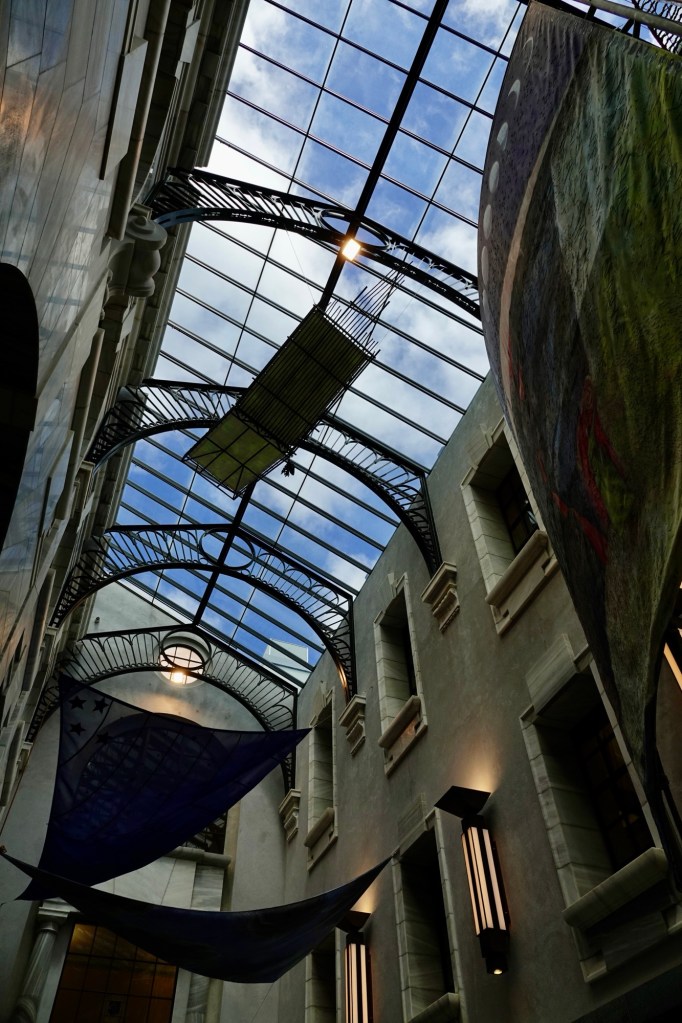
We transited back into Parliament House through the Galleria, created during the 1990s renovation. It’s hard to believe now that it was once an internal carpark!
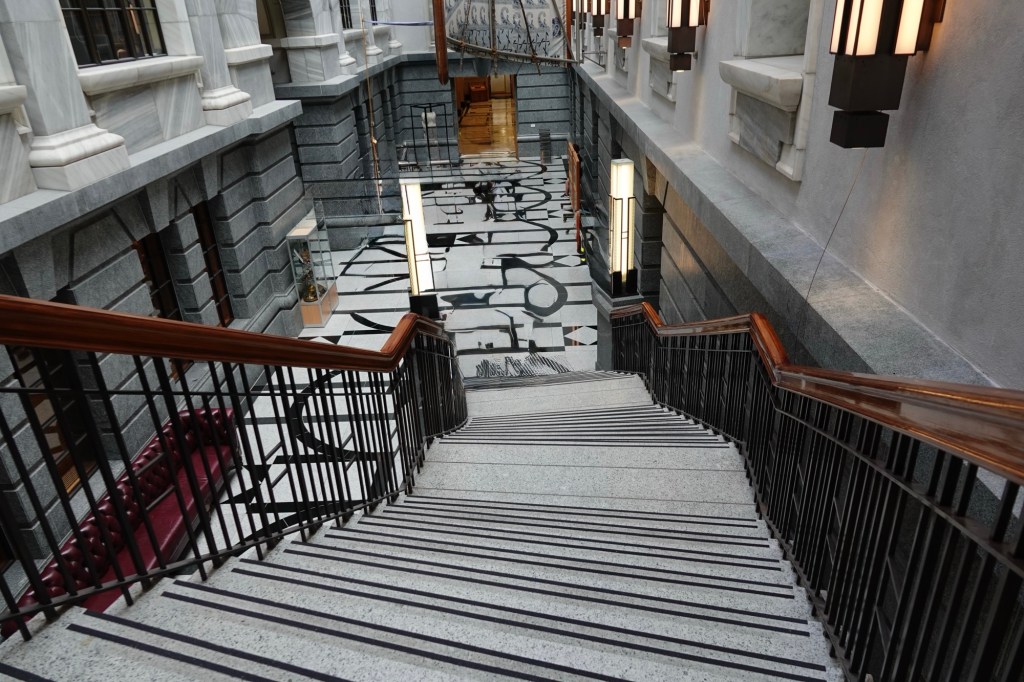
The main artwork here is called These are Matters of Pride, by Malcolm Harrison. The hanging panels represent the land, sea, and sky.
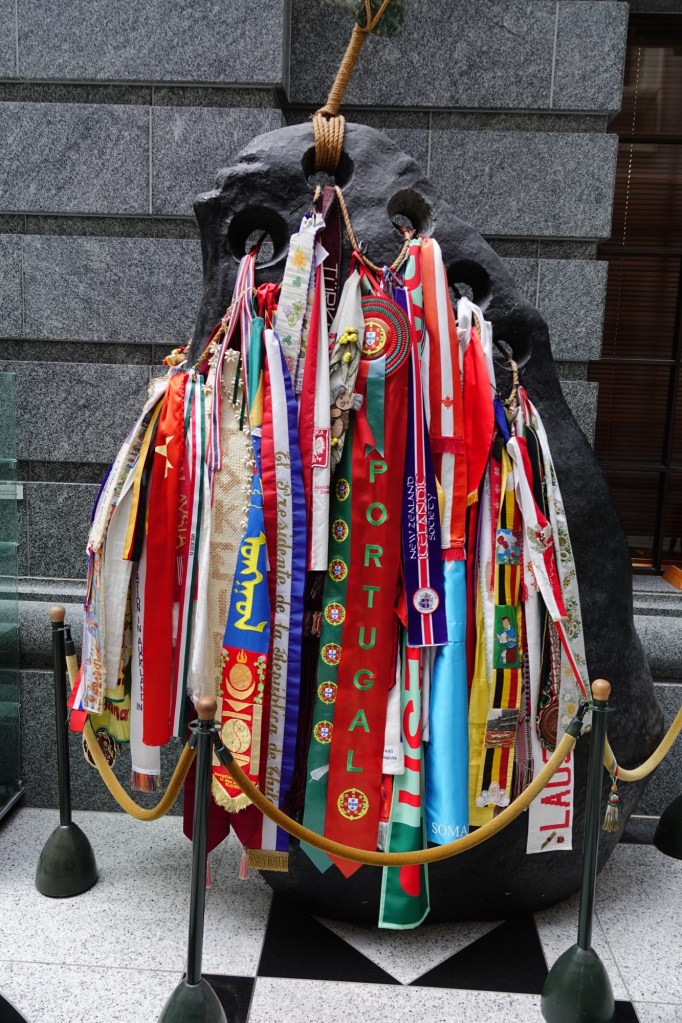
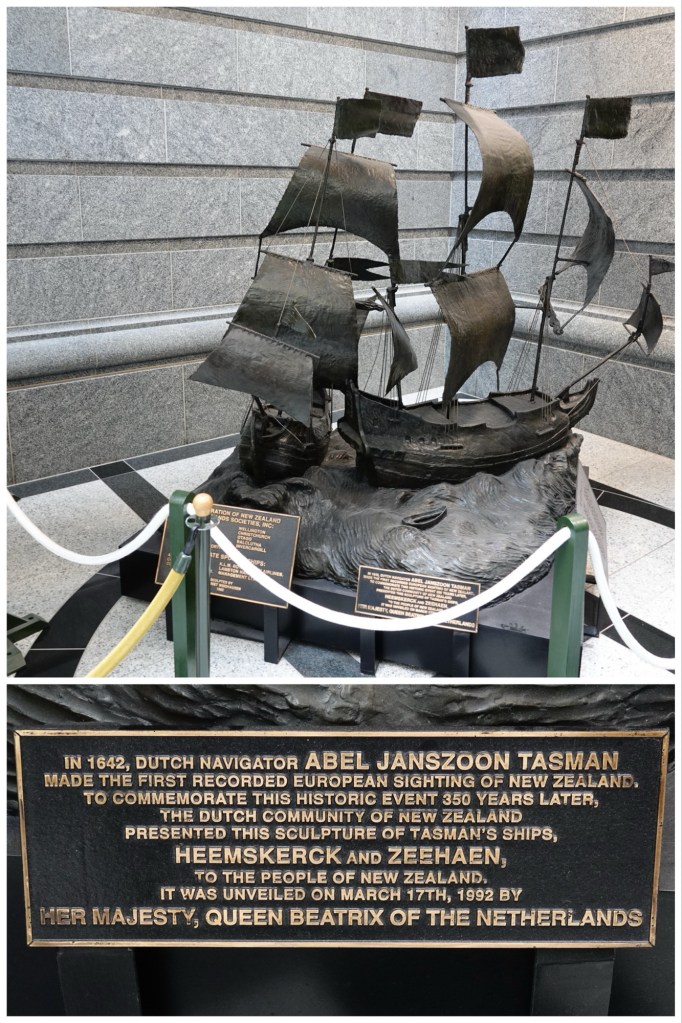
The ribbons on the waka anchor stone represent the many cultural groups that call New Zealand home. There’s a Canadian ribbon there too!
Given the anchor stone and the sails, I just assumed that the steel arches above us were the inverted ribs of a Māori waka (canoe).Our guide said she’d never had anyone suggest that before, and that they were simply a design chosen to make their function – as earthquake supports between the walls – decorative.
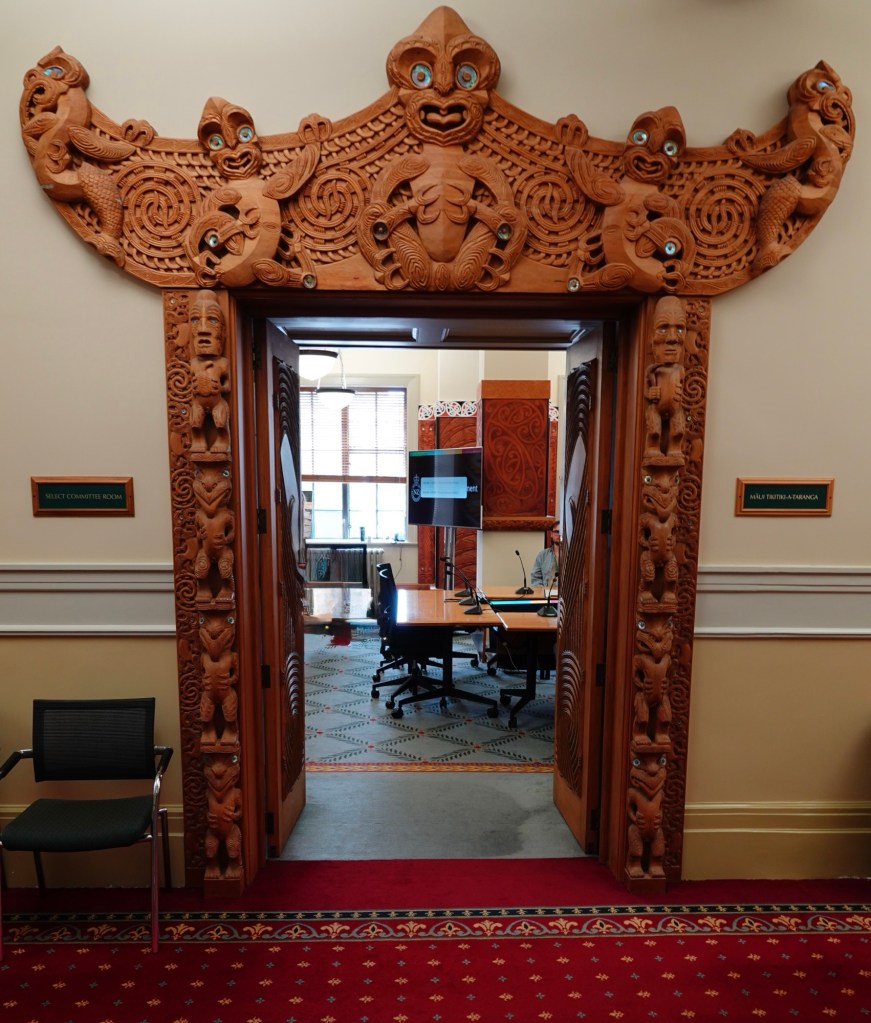
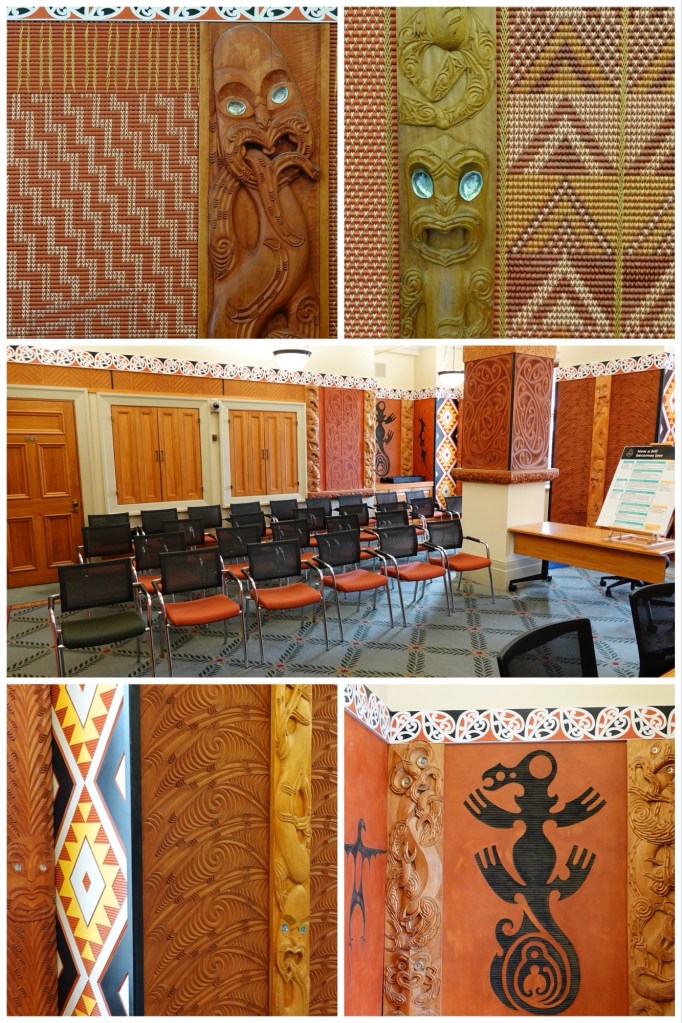
Once back in Parliament House, there was one more treat in store. Since parliament was not sitting in this lead-up week to Waitangi Day, we were able to visit one of the seven Select Committee Rooms. These rooms are used for the day-to-day work of small groups of MPs writing or refining legislation. We visited Māui-Tikitiki-a-Taranga, the Māori Affairs Select Committee Room, adorned with carvings and tukutuku (woven wall panels) that represent the four winds (iwi/tribes from across NZ) being bound together by kōwhaiwhai (painted rafter patterns).
As we were completing the tour, our guide commented that she’d noticed on the list that we were from British Columbia, and that they had done a private Māori-centric tour this morning for a BC provincial parliamentarian. We later found her name in the visitor’s book.

Elected in 2016, HLI HAYKWHL ẂII XSGAAK, Melanie Mark, was the first First Nations woman Member of the Legislative Assembly in British Columbia’s history, representing the riding of Vancouver-Mount Pleasant. She and her daughter, who is studying tourism with an Indigenous focus, made this a stop on their NZ itinerary just as we did.
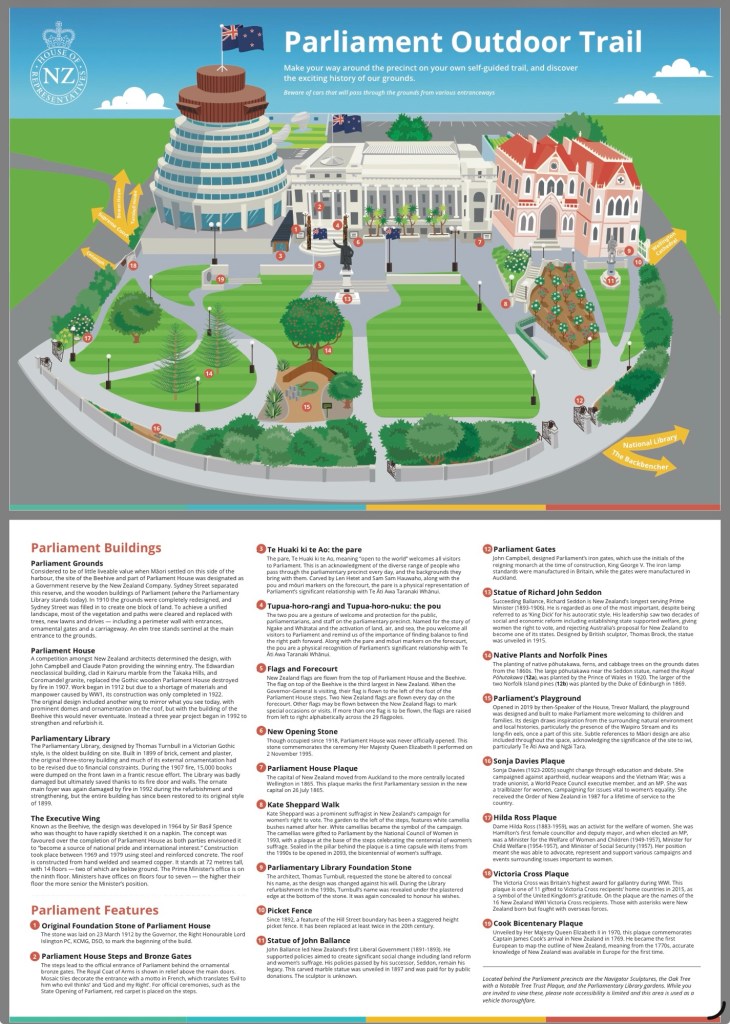
After the guided tour, we briefly walked the Parliamentary Outdoor Trail, using the self-guided map provided. We’d done this outdoor walk last January during our brief cruise stop in Wellington; there were no new photos today.
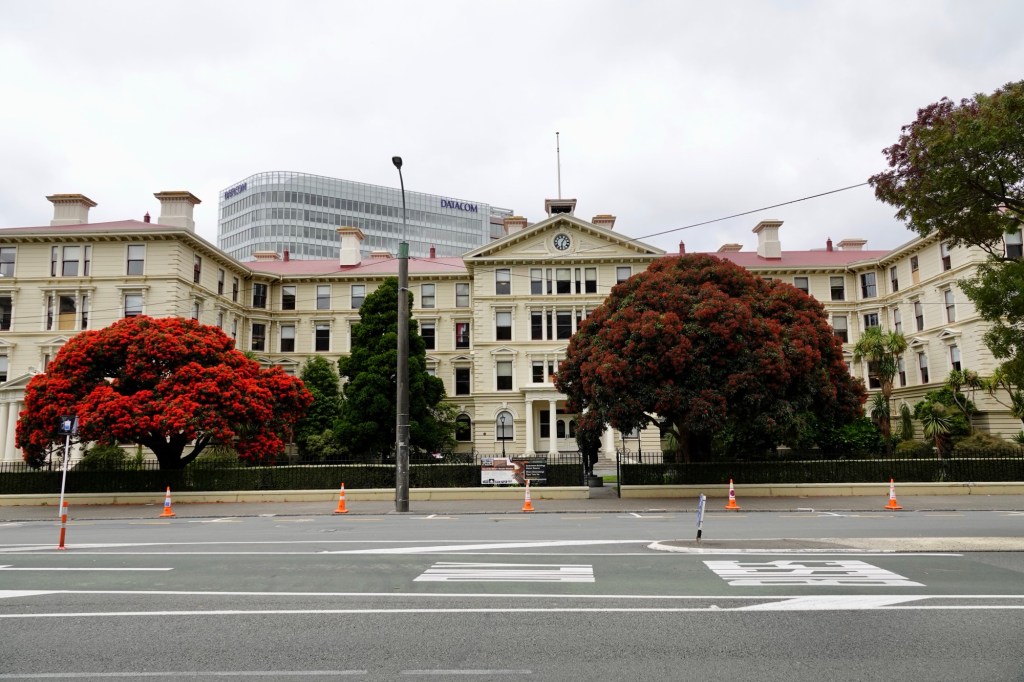
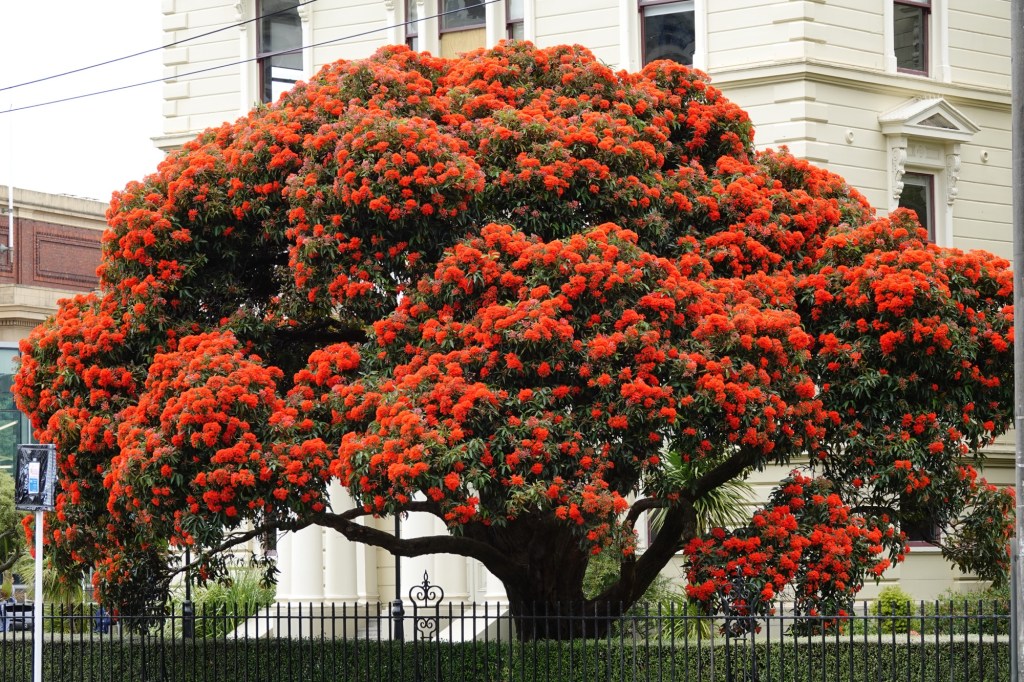
But, across the street in front of Wellington Town Hall Ted noticed a wonderful example of a tree he’s been wanting to photograph ever since we got to New Zealand.
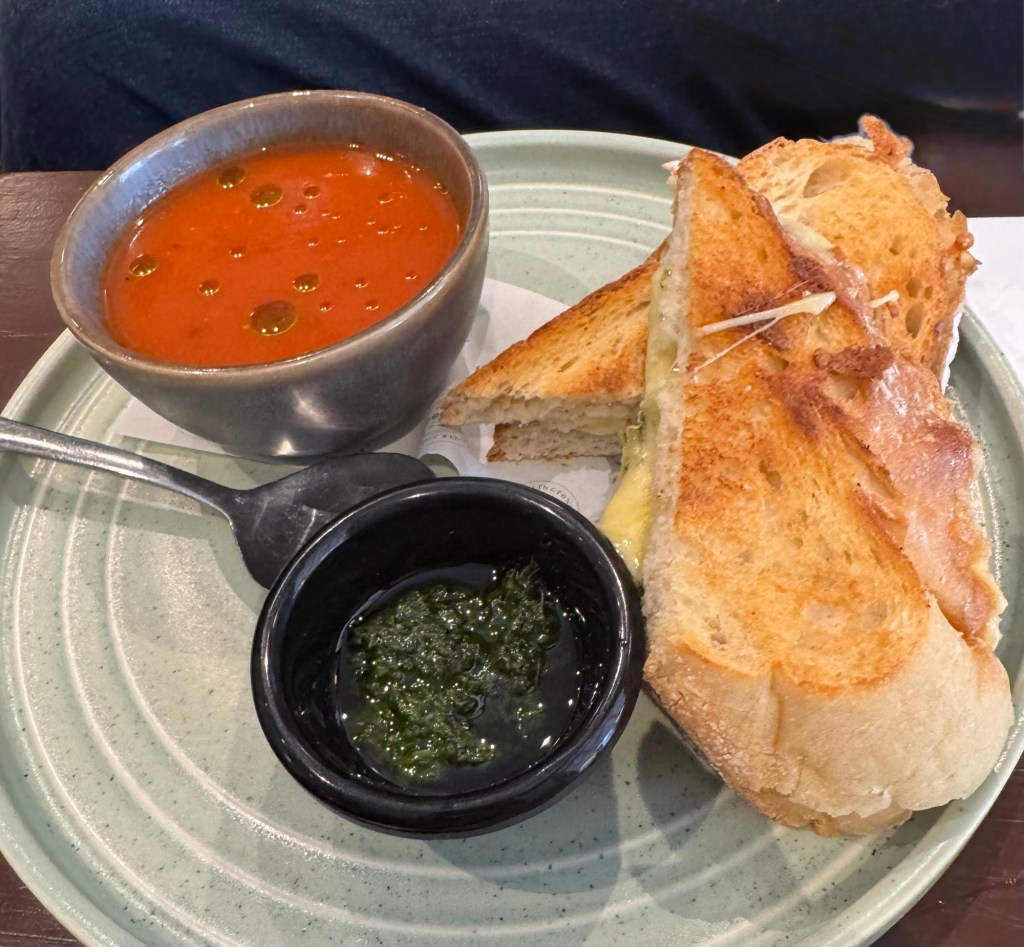
Tomorrow we tour the Supreme Court, so today’s lunch at The Old Bailey was, I suppose, a bit of foreshadowing.
 Rose and Ted’s Excellent Adventure