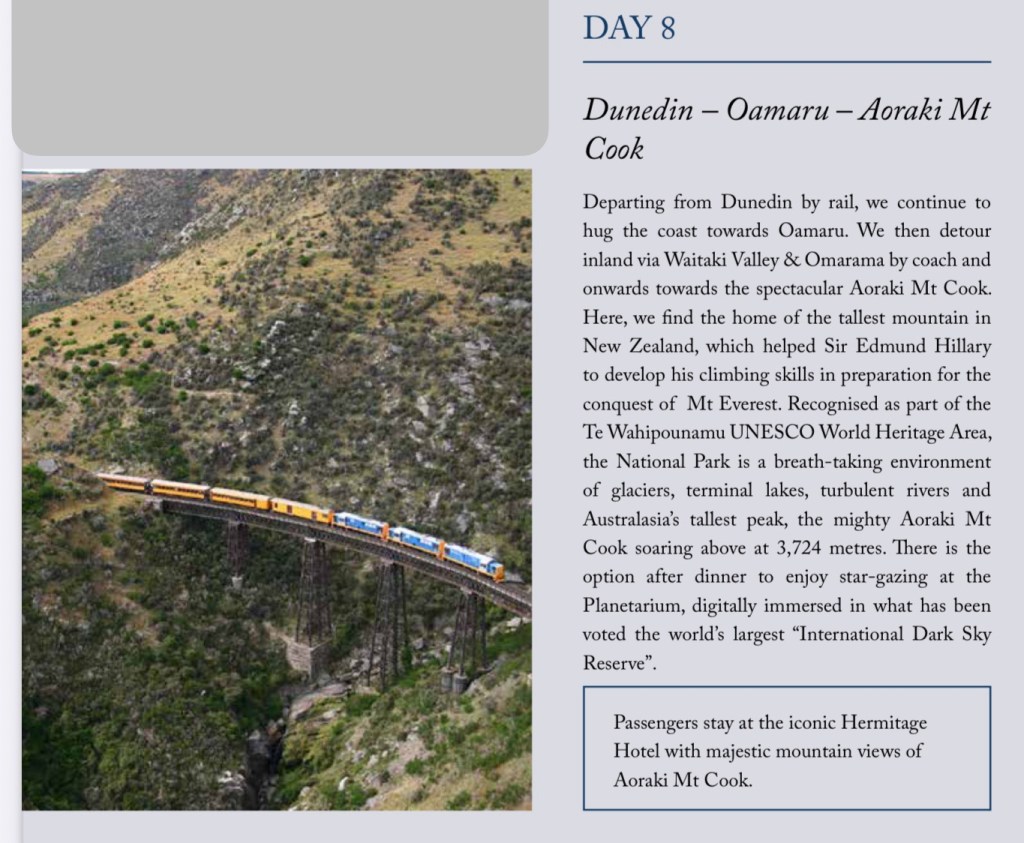
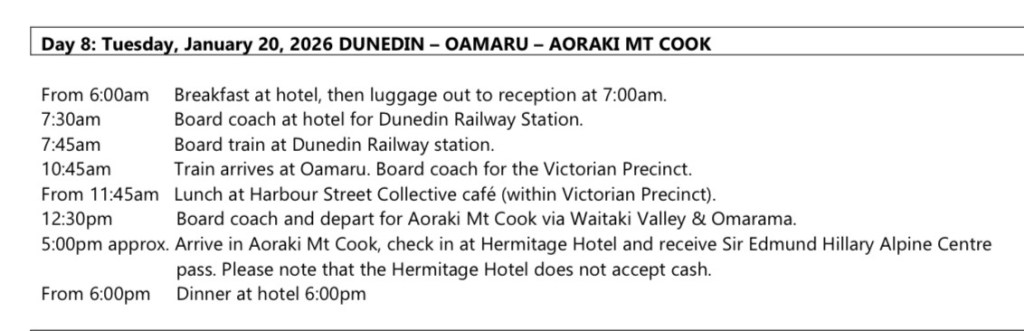
We’ve been waiting for another train day, but a week before our tour departure we got this notice:
“For operational reasons, on Day 8 you will now depart from Dunedin by luxury coach (instead of by rail), for the journey to Oamaru. The good news is that this creates an opportunity for us to visit the famed spherical boulders at Moeraki Beach on our way to Oamaru (made possible by coach), subject to tides. Then in Oamaru, we will enjoy lunch in the charming heritage precinct, after which we head inland via Waitaki Valley & Omarama and onwards towards the spectacular Aoraki Mount Cook.
We apologise for this mode of transport change on Day 8 and to recognise this inconvenience, we will be refunding every passenger NZD 200.”
No worries. We’re flexible.
As we left Dunedin this morning we learned that there is a new teaching hospital being built on the former site of the Cadbury Fry chocolate factory: 351 beds, 21 operating theatres, and 58 emergency room beds. Medical students from Otago University (established 1869) will train there. Otago is the oldest university in NZ and one of the top research universities in the world.
We drove today on State Highway 1 which is the main arterial road in New Zealand. It runs from Dunedin to Picton, where there’s a gap between the north and South Island that has to be traversed by ferry, and then restarts in Wellington to reach Auckland.
Someone thought they saw a pelican on Blueskin Bay, but Mike explained that “New Zealand does not have pelicans, just big fat ducks and big fat swans.”
As we drove through Karitane, we learned about the origins of the now defunct Karitane maternity hospitals and the Plunket Nurses who are credited with supporting and teaching new mothers about prenatal care, nutrition, and infant healthcare since the very early 1900s. Both Mike and Trevor were “Plunket babies” and still have their Plunket books tracking their growth as infants and young children. While the hospitals have closed, replaced by a preference for more modern facilities in the 1970s and 80s, Plunket Nurses still provide home care and maternal support.
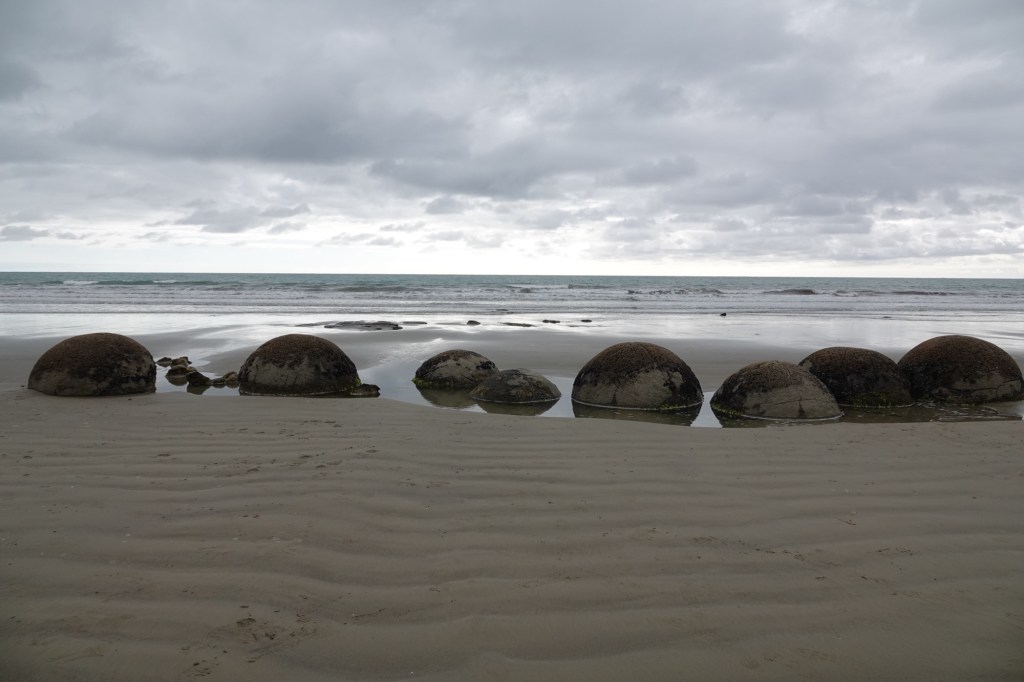
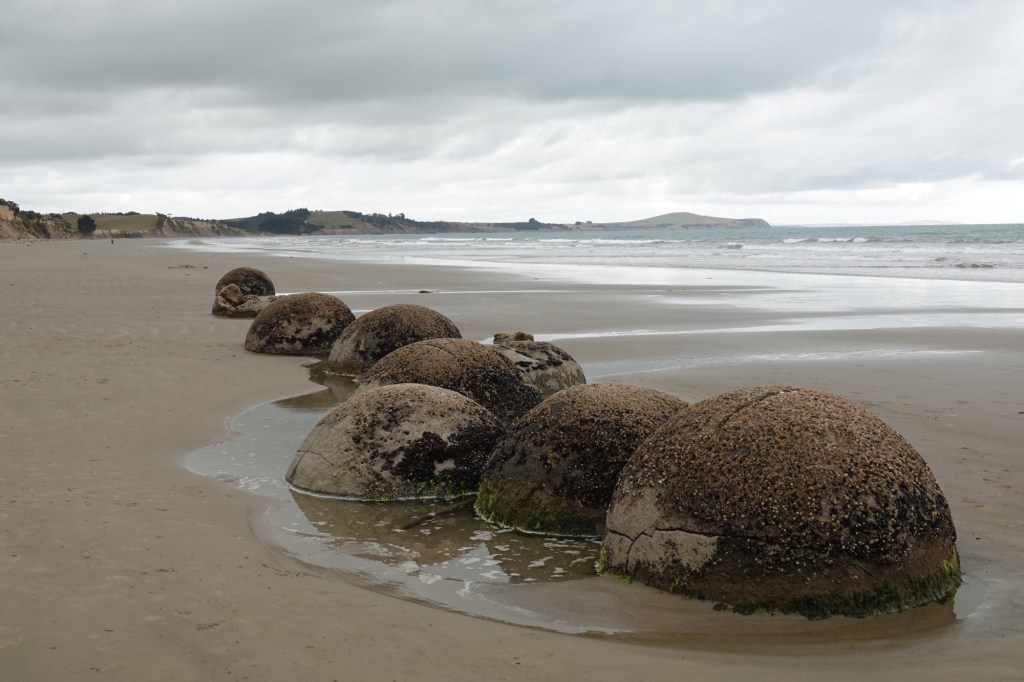
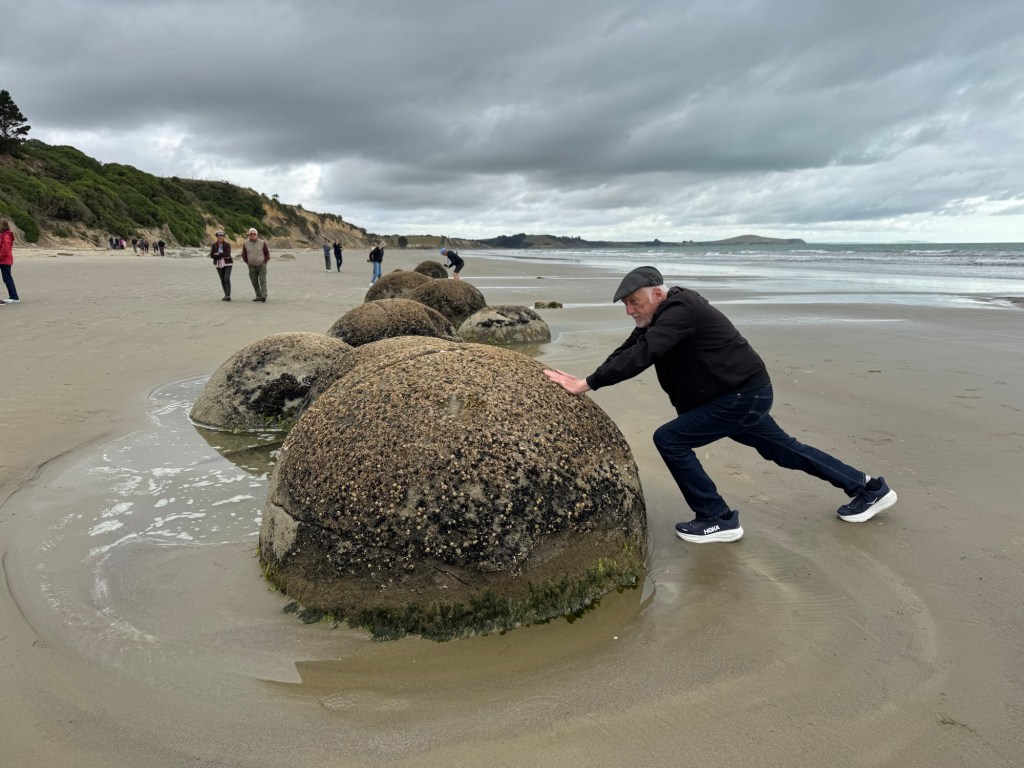
Our first en route stop was at Moeraki Beach, where the almost perfectly spherical boulders look as if they’ve been imported directly from outer space.
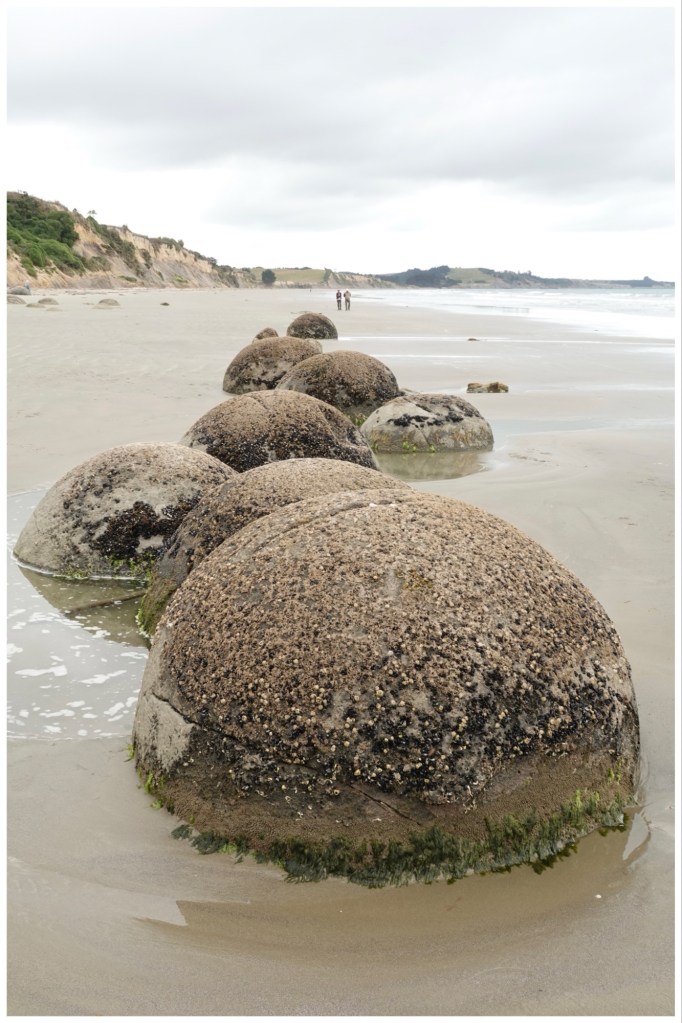
The scene just cried out for poses.
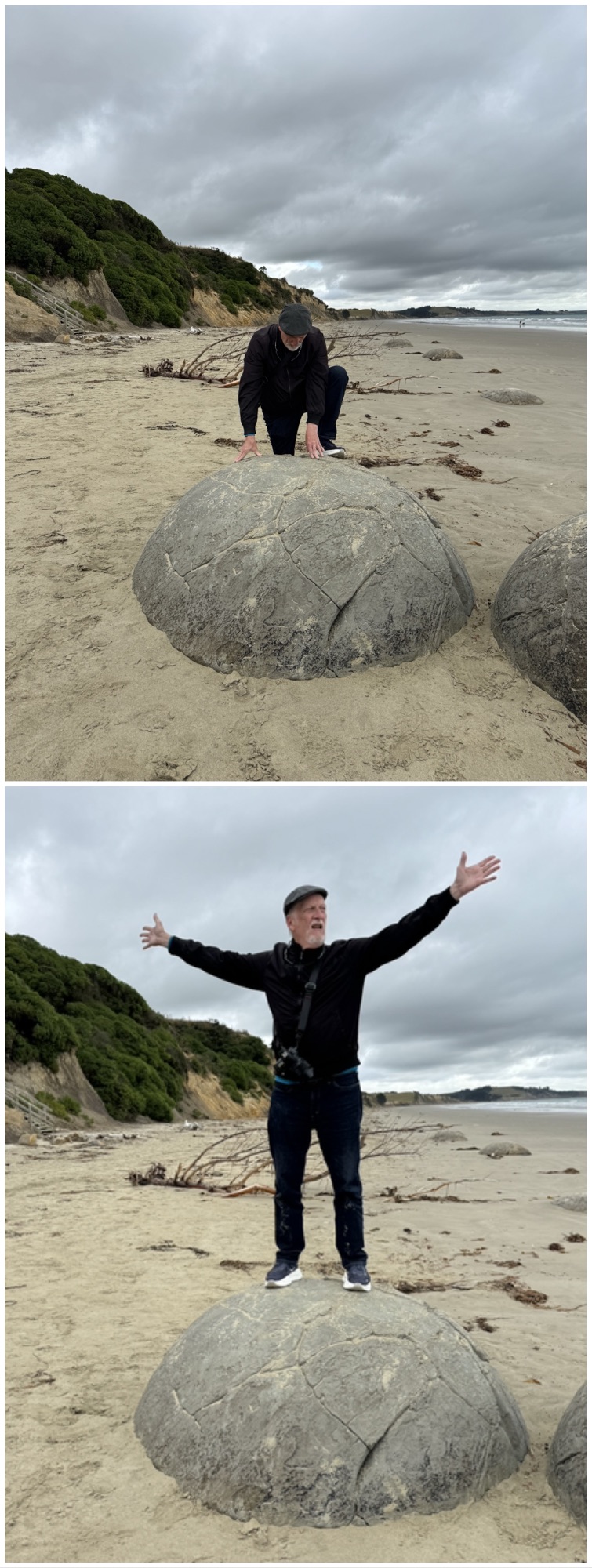
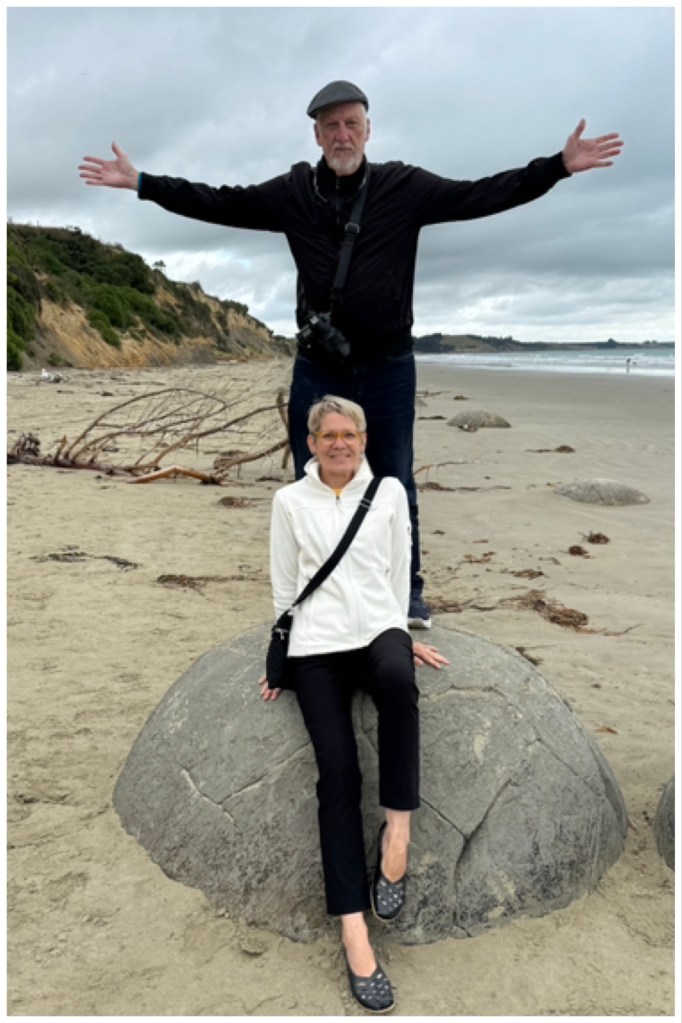
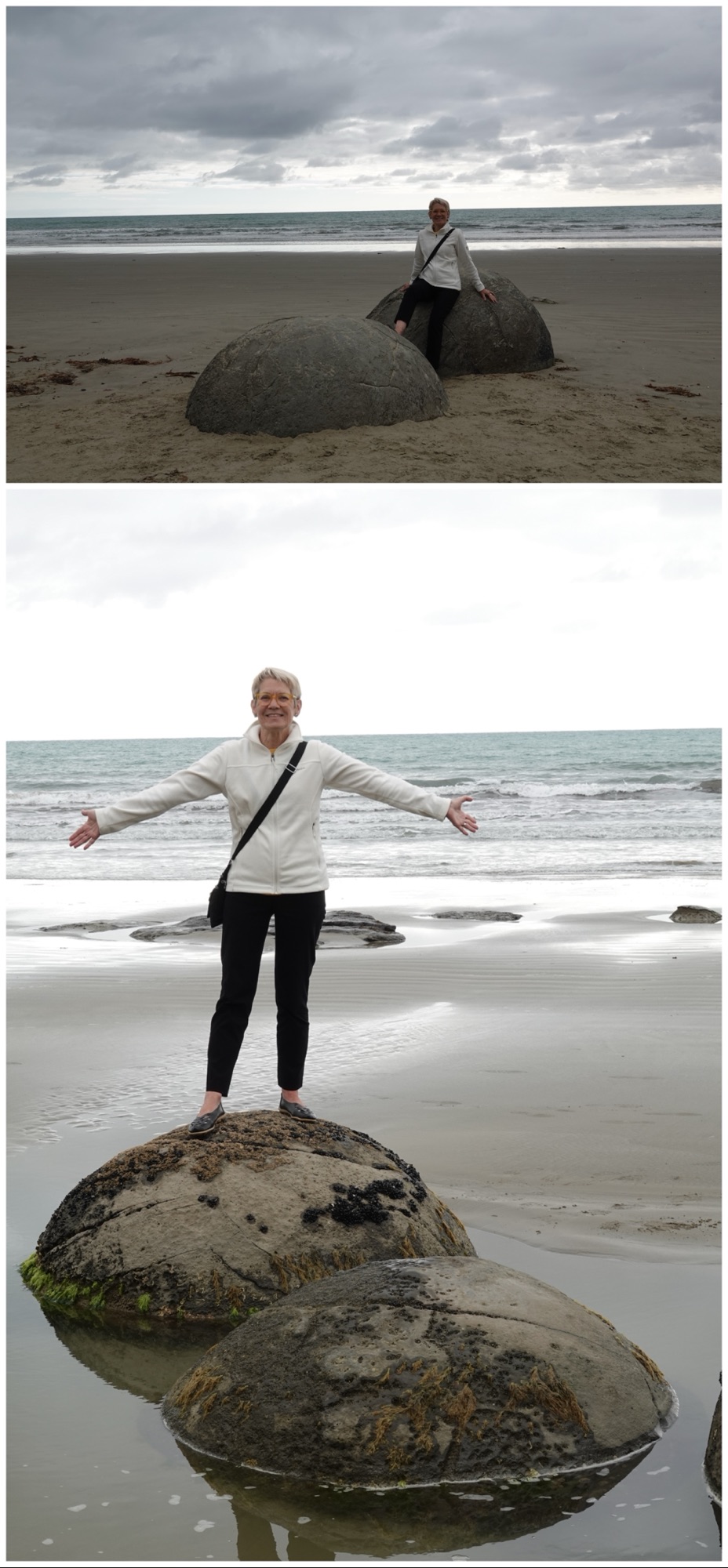
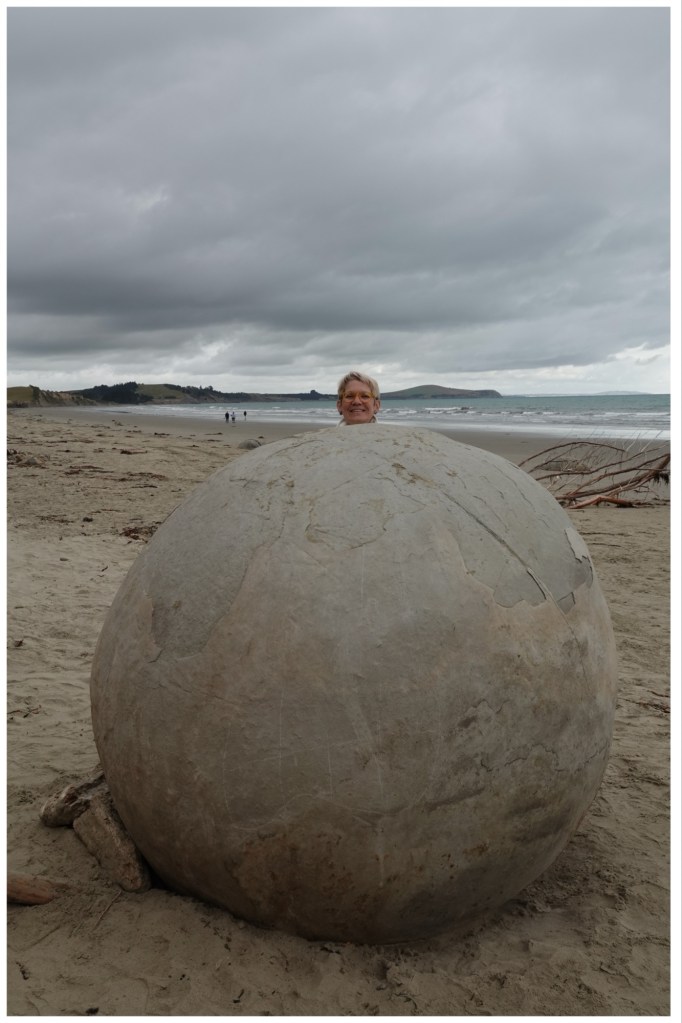
Even on tip-toe I could barely see over the largest boulder on the beach.
This broken boulder reminded us of a geode, except that there were no crystals inside.
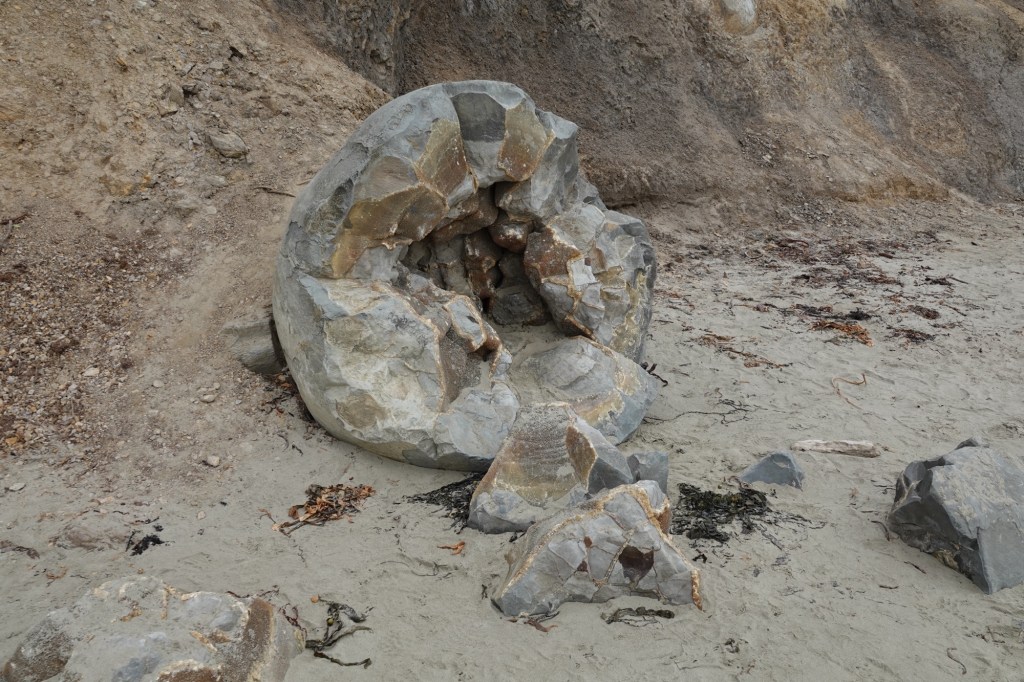
Māori legend says that the boulders are the relics of the baskets lost on the beach when one of the original waka (canoes) that brought the first Māori here from the Polynesian Islands capsized here. The large boulders on Te Kai Hinaki (Moeraki Beach) are the gourds and calabashes bound with flax which held water for the voyage, and the smallest rocks are the kumara, or sweet potato.
Or maybe Ted pushed them onto the shore…
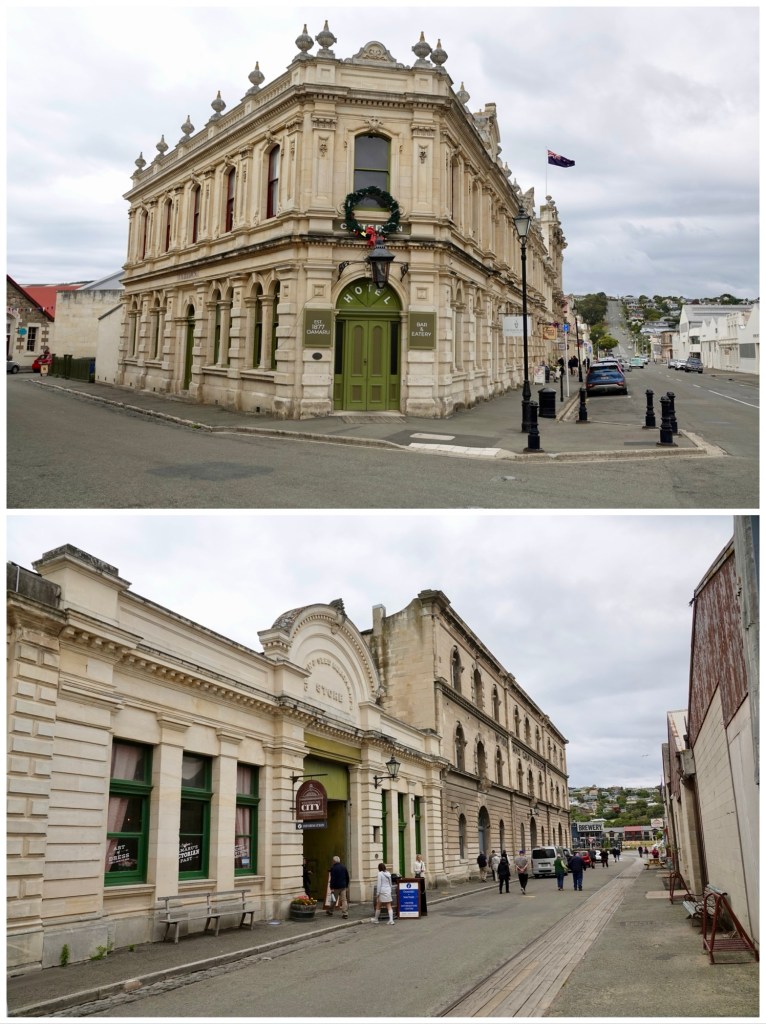
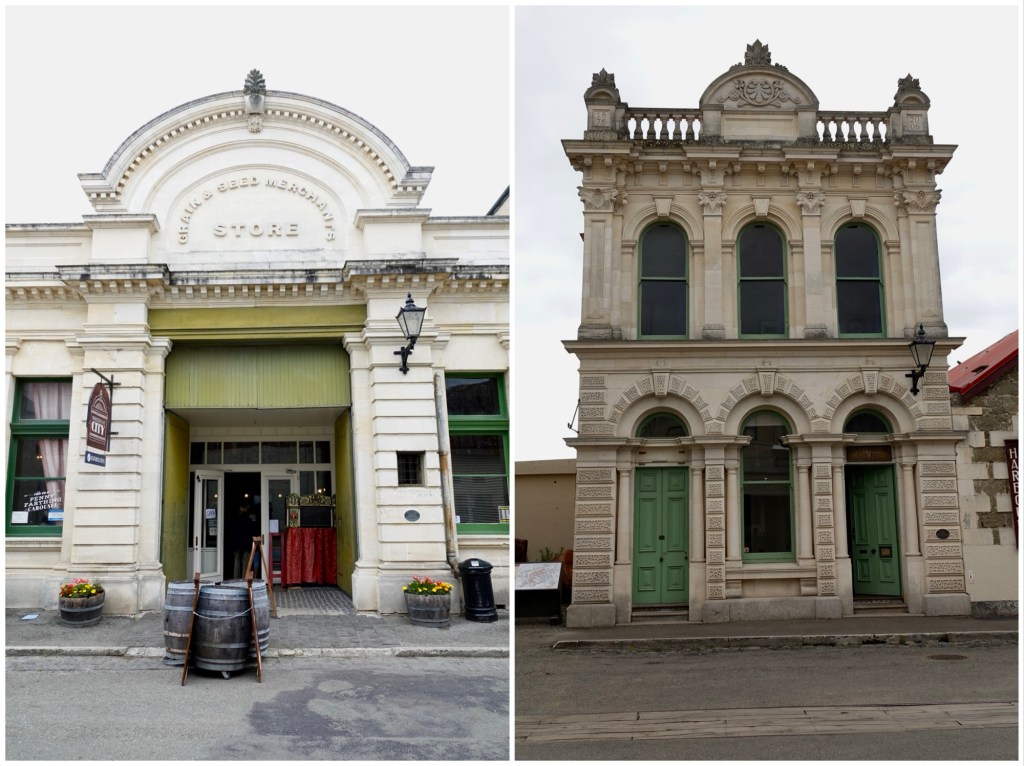
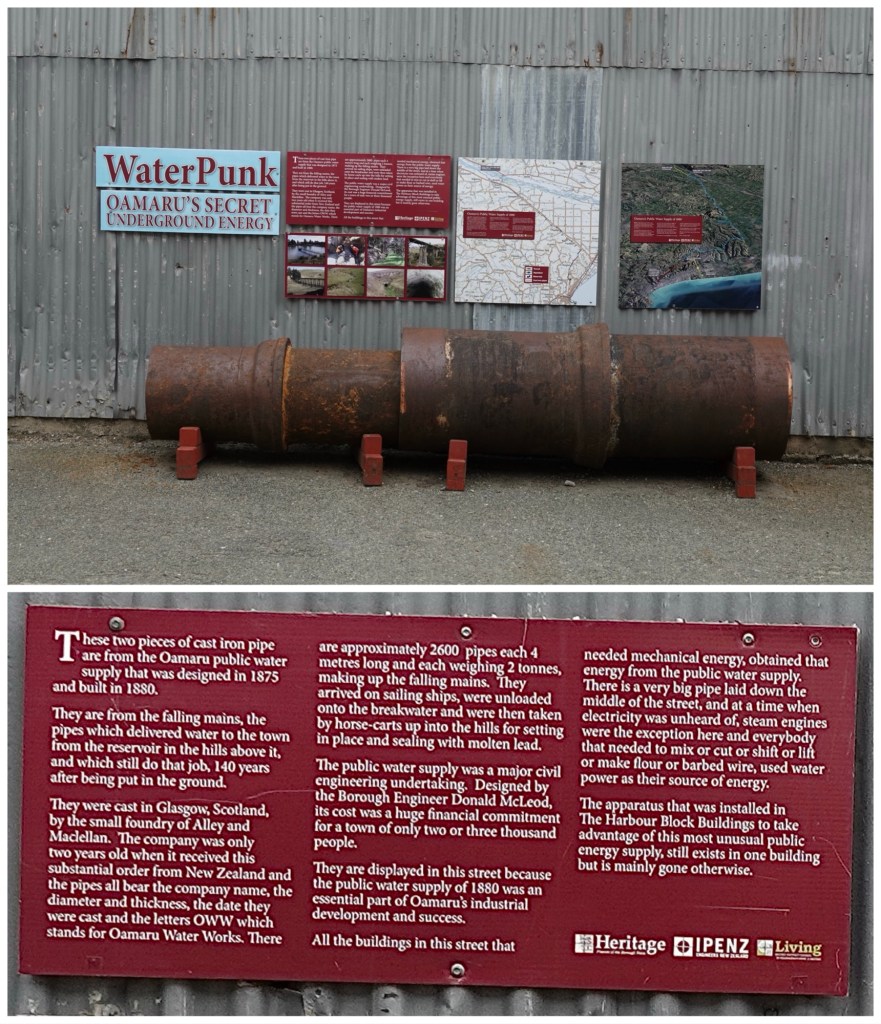
We stopped next in Oamaru, the fourth largest township in Otago. There are over 70 designated historic buildings here, mostly in the Victorian precinct.
The town has quite a distinctive style, with many interesting Oamaru sandstone buildings.
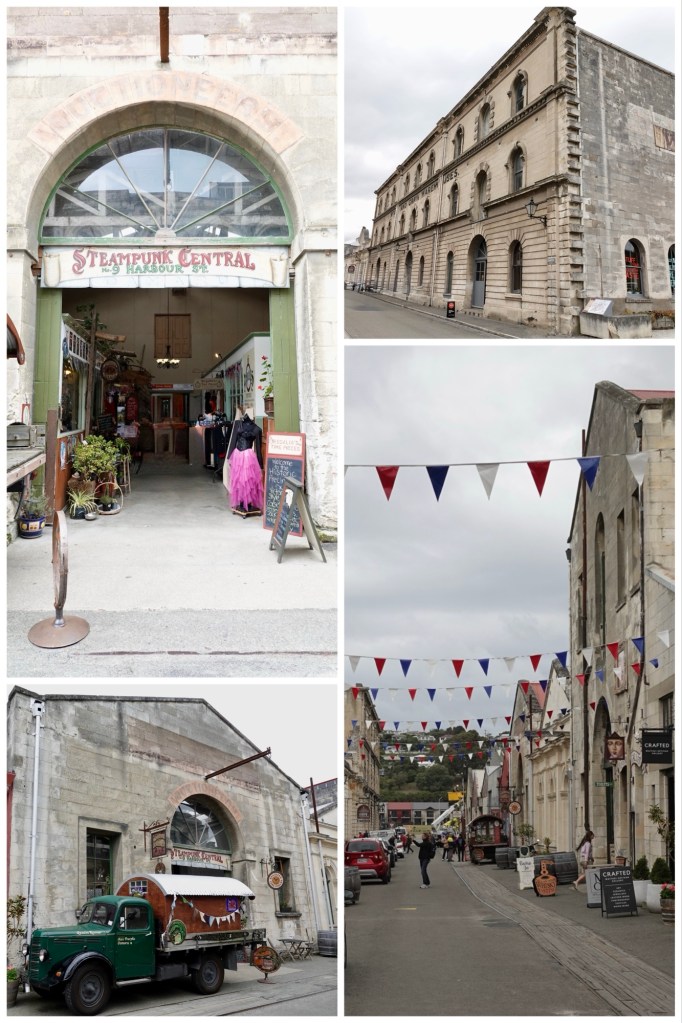
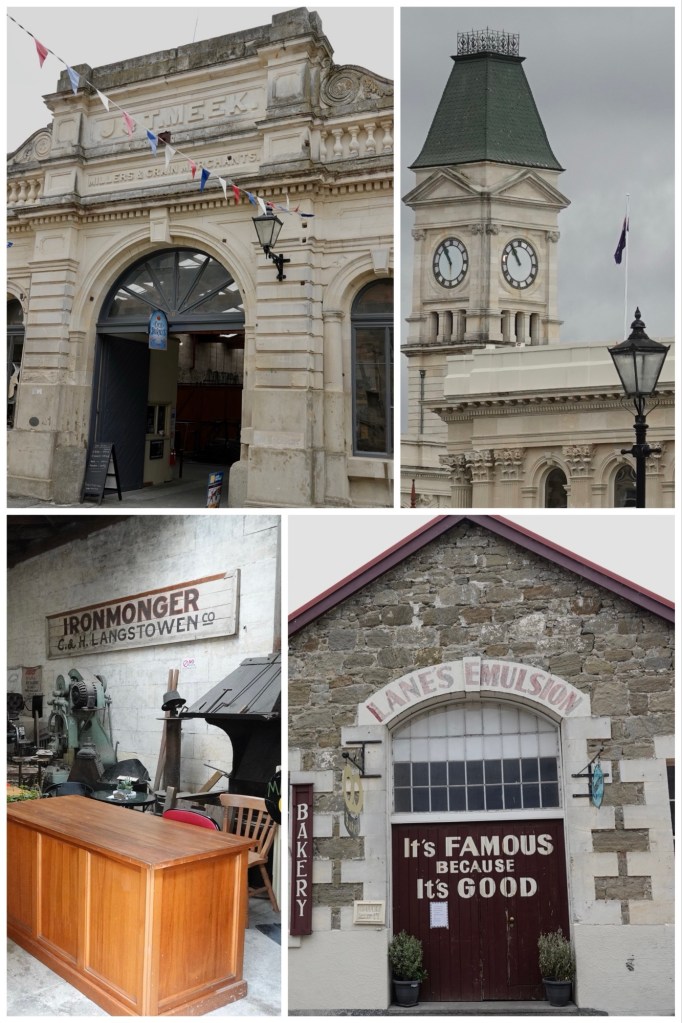
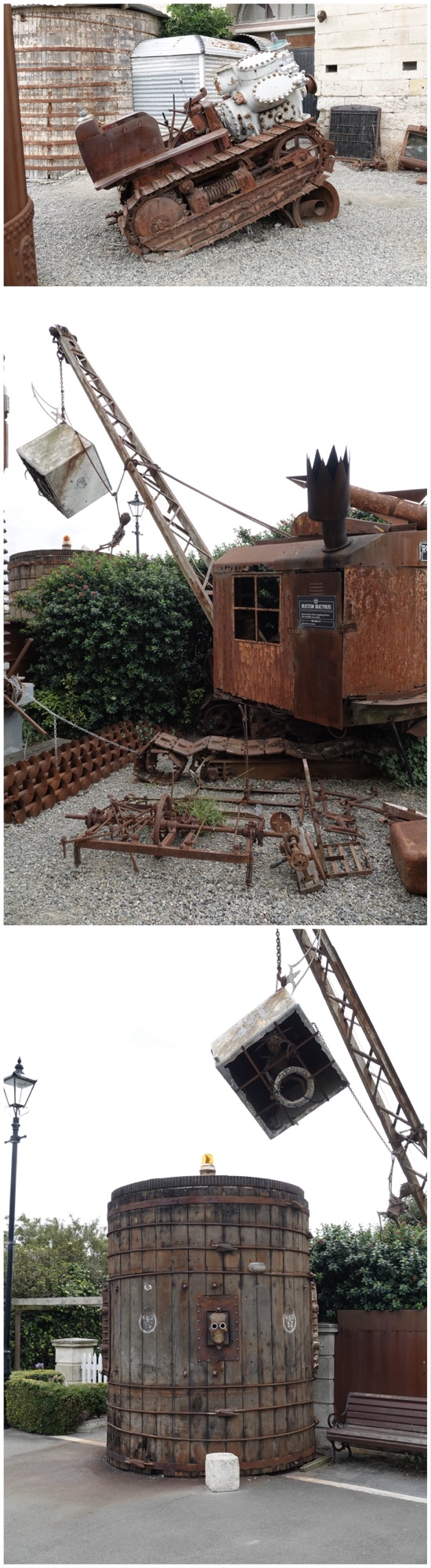
This is also the undisputed Steampunk capital of the world! We decided to pay the $15 each and tour the Steampunk Headquarters. What makes this so much fun is not just the crazy sculptures and “machines”, but the cheeky signs that go along with each of the displays.
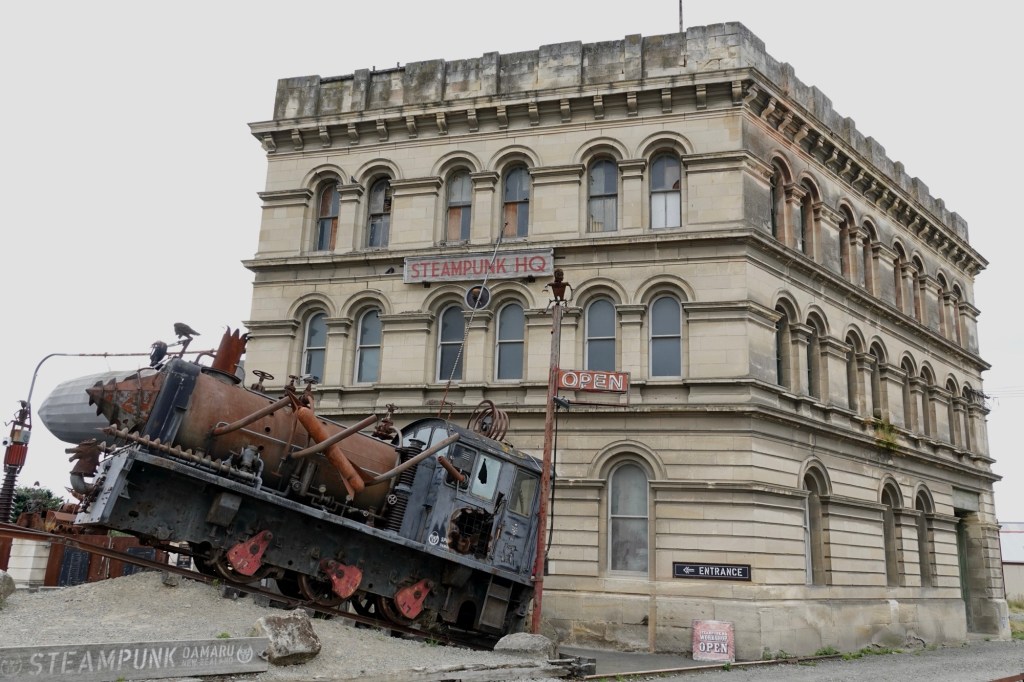
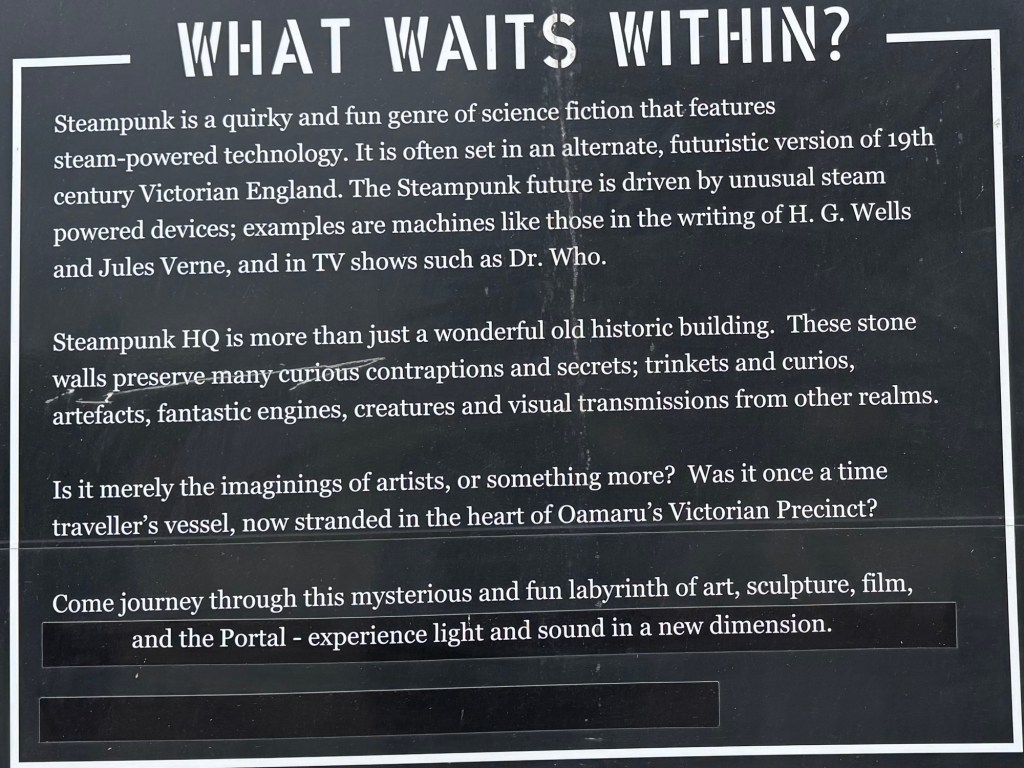
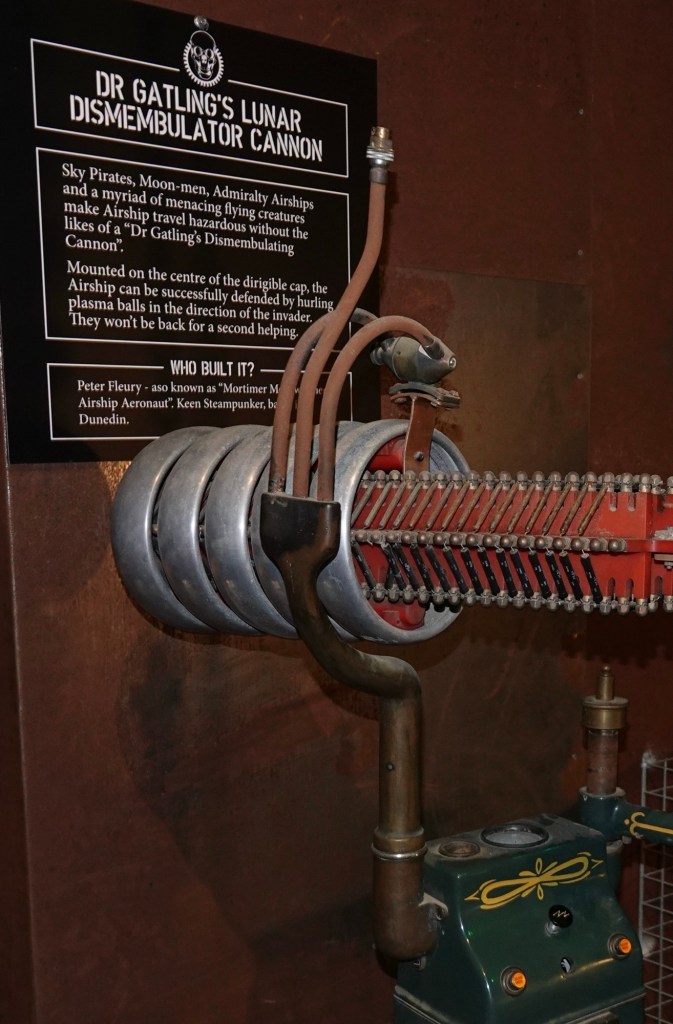
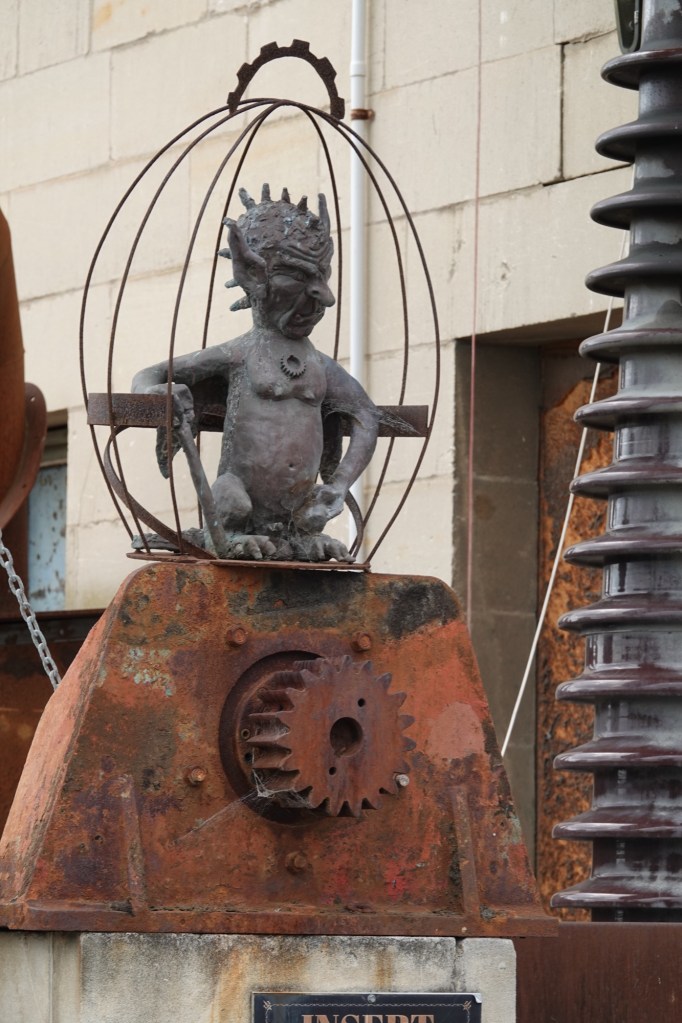
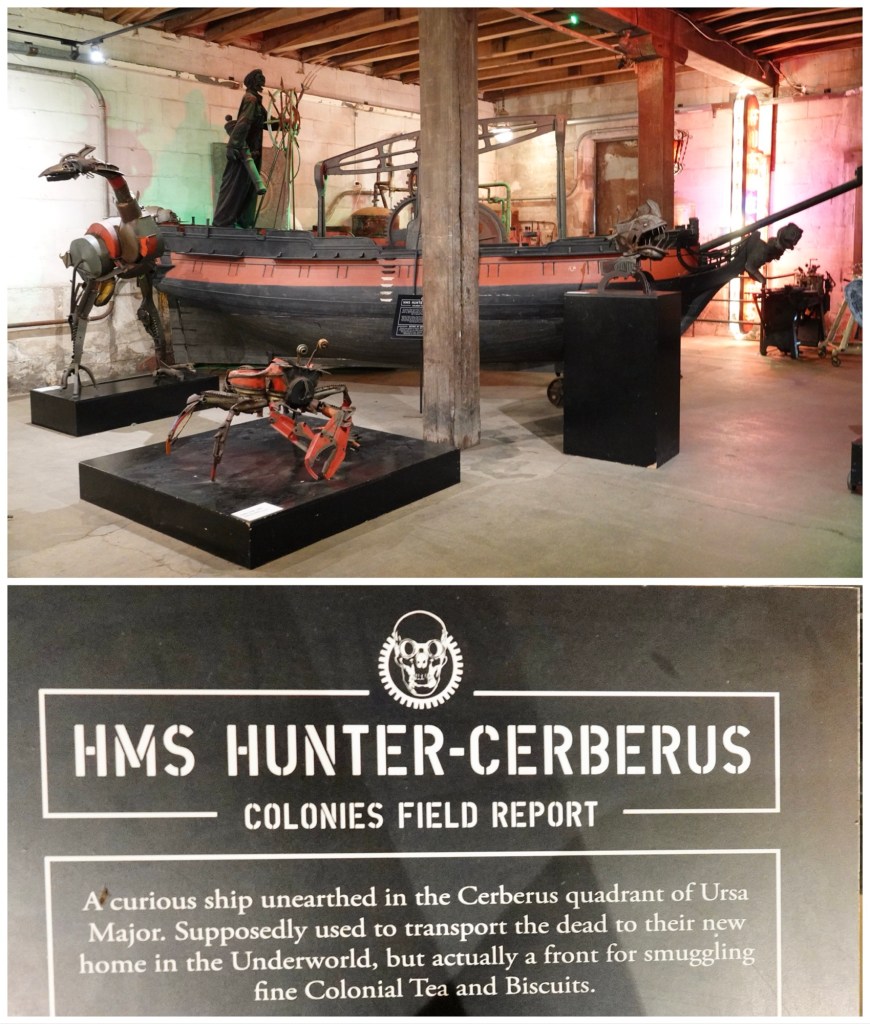
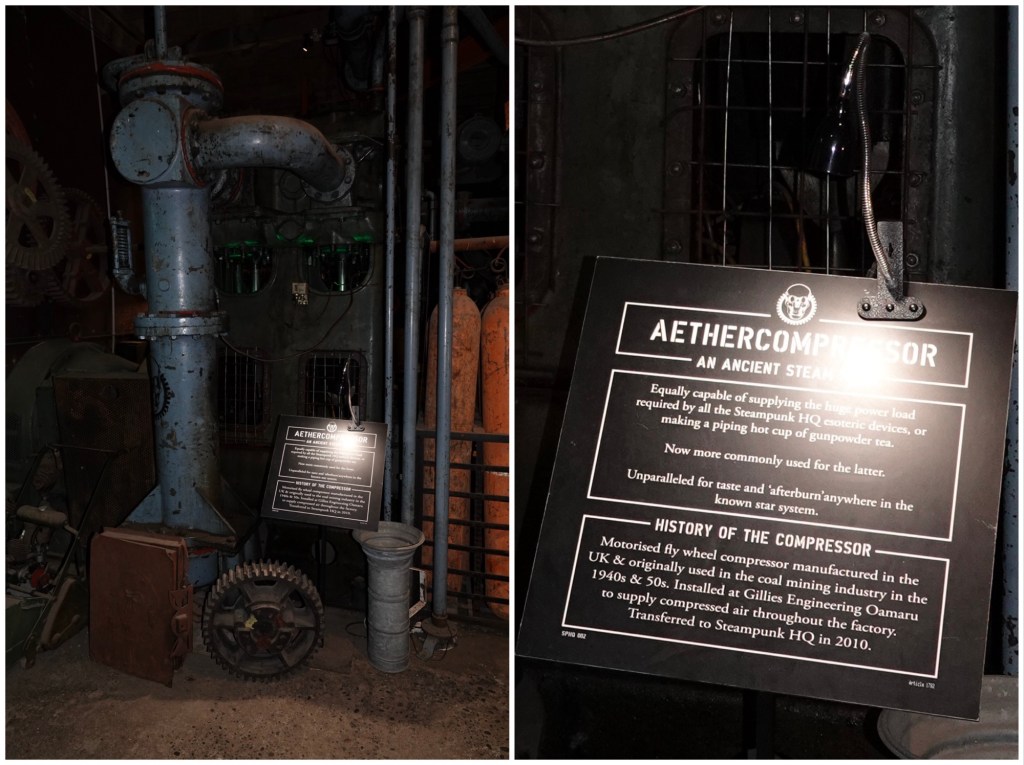
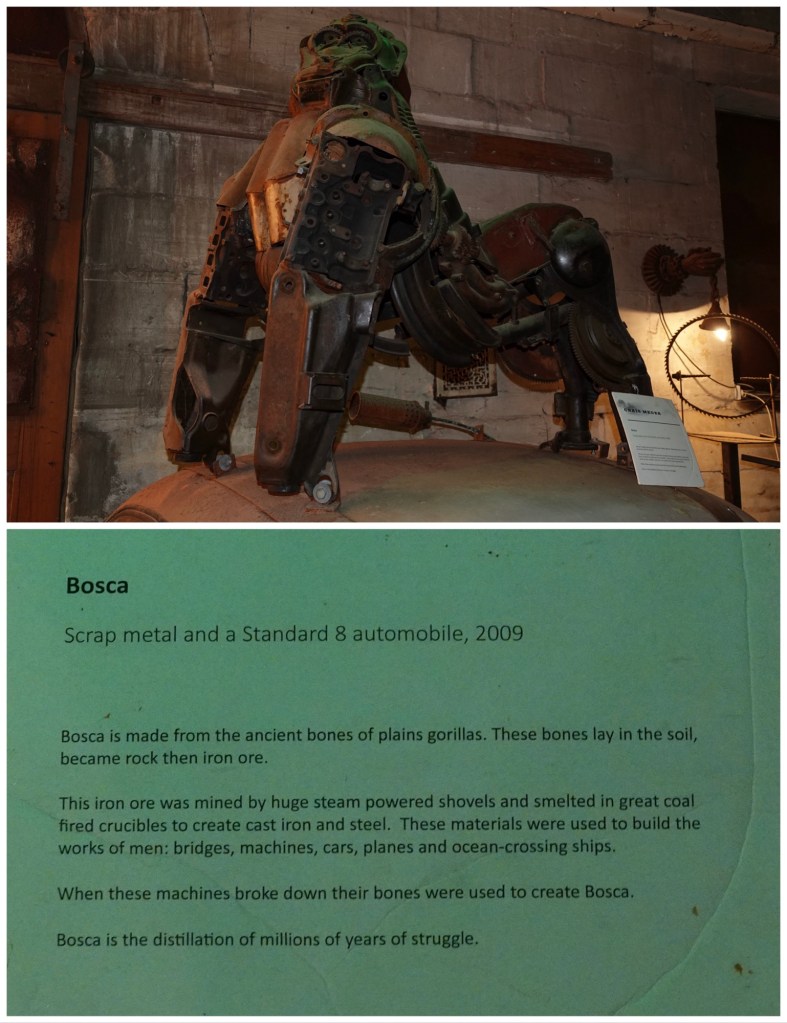
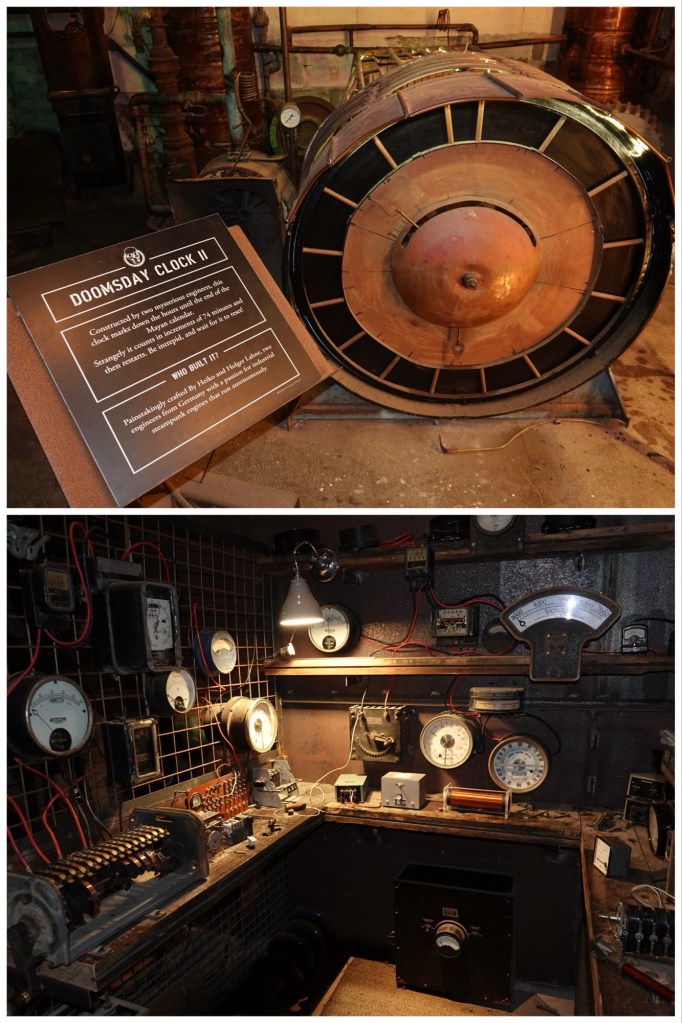
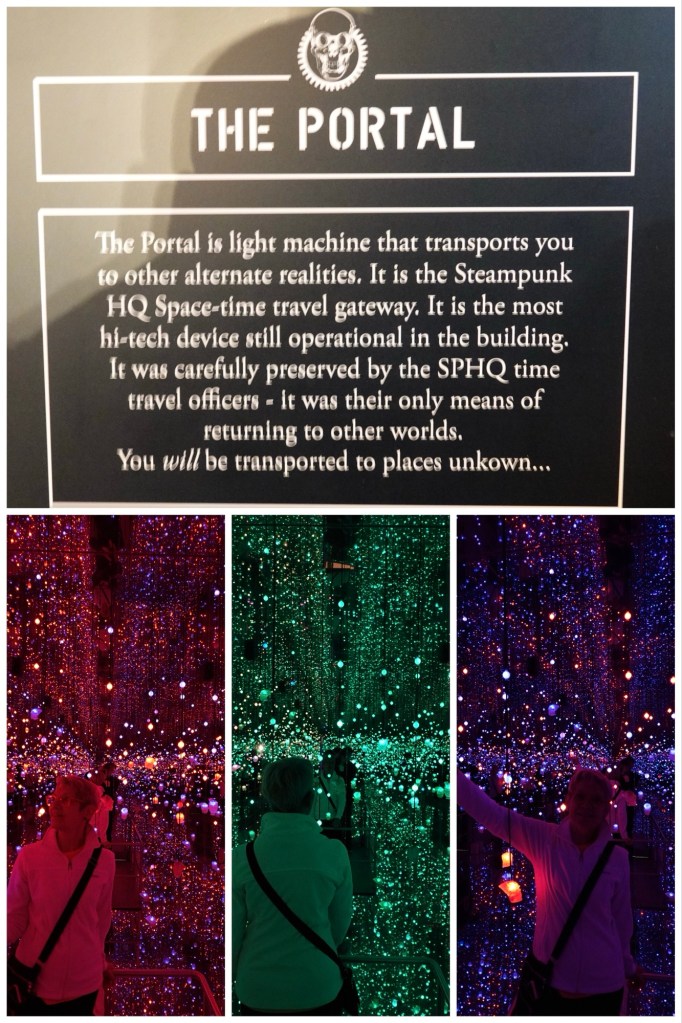
There was much much more, but the space inside Steampunk HQ was dark – as befits a steam-era workshop – which meant that many of our indoor photos were too dark to use.
There was lots more in the yard though, including my of the interactive outdoor displays…
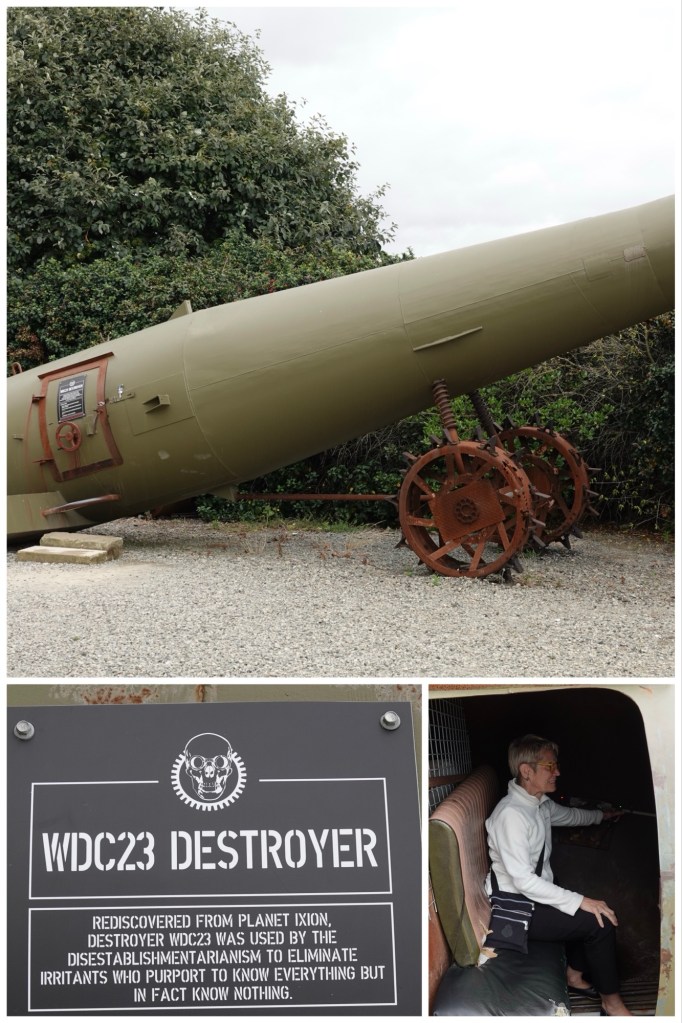
…because it did this:
And then there were fascinatingly-imagined modes of transportation, and construction equipment.
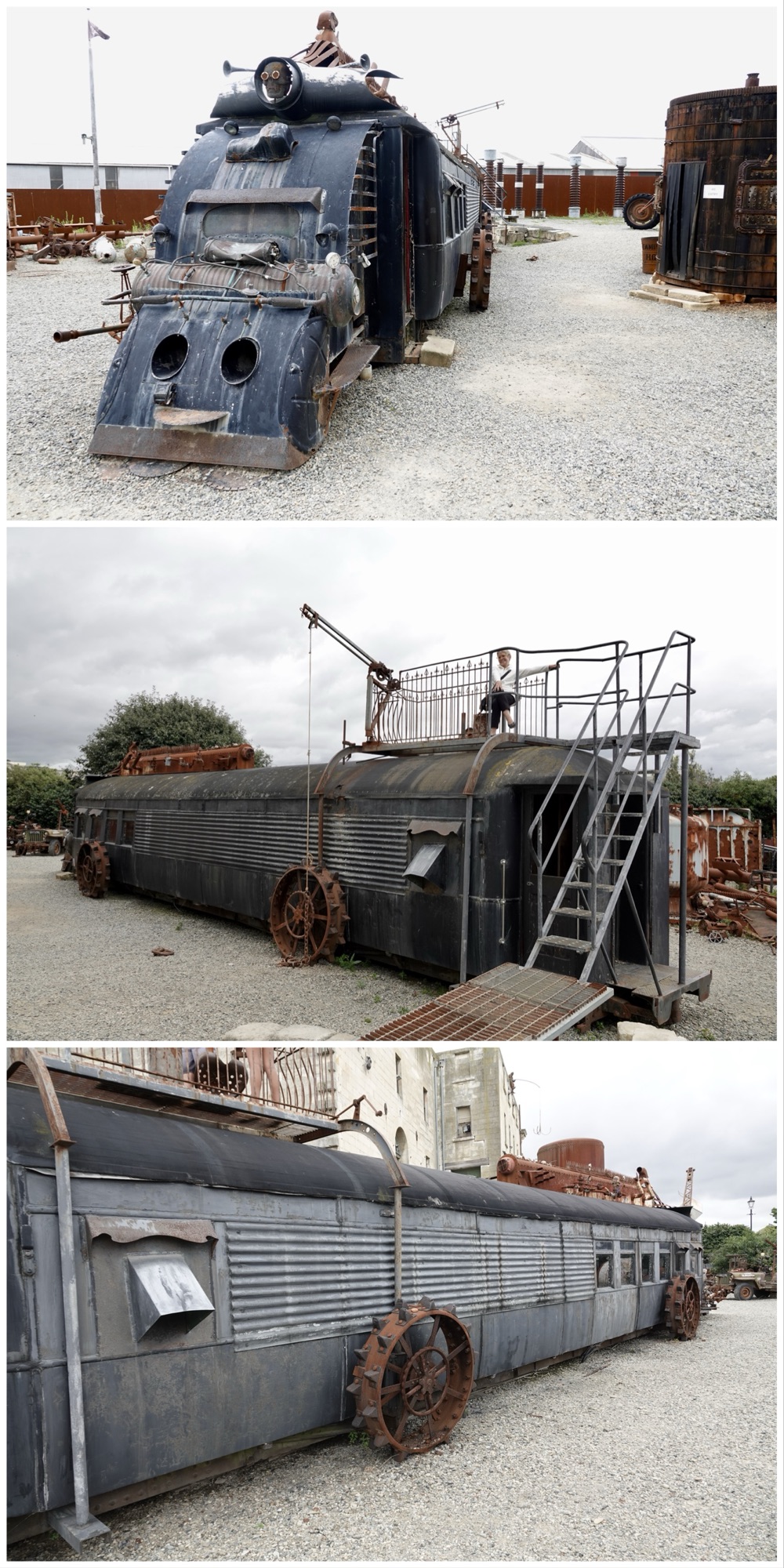
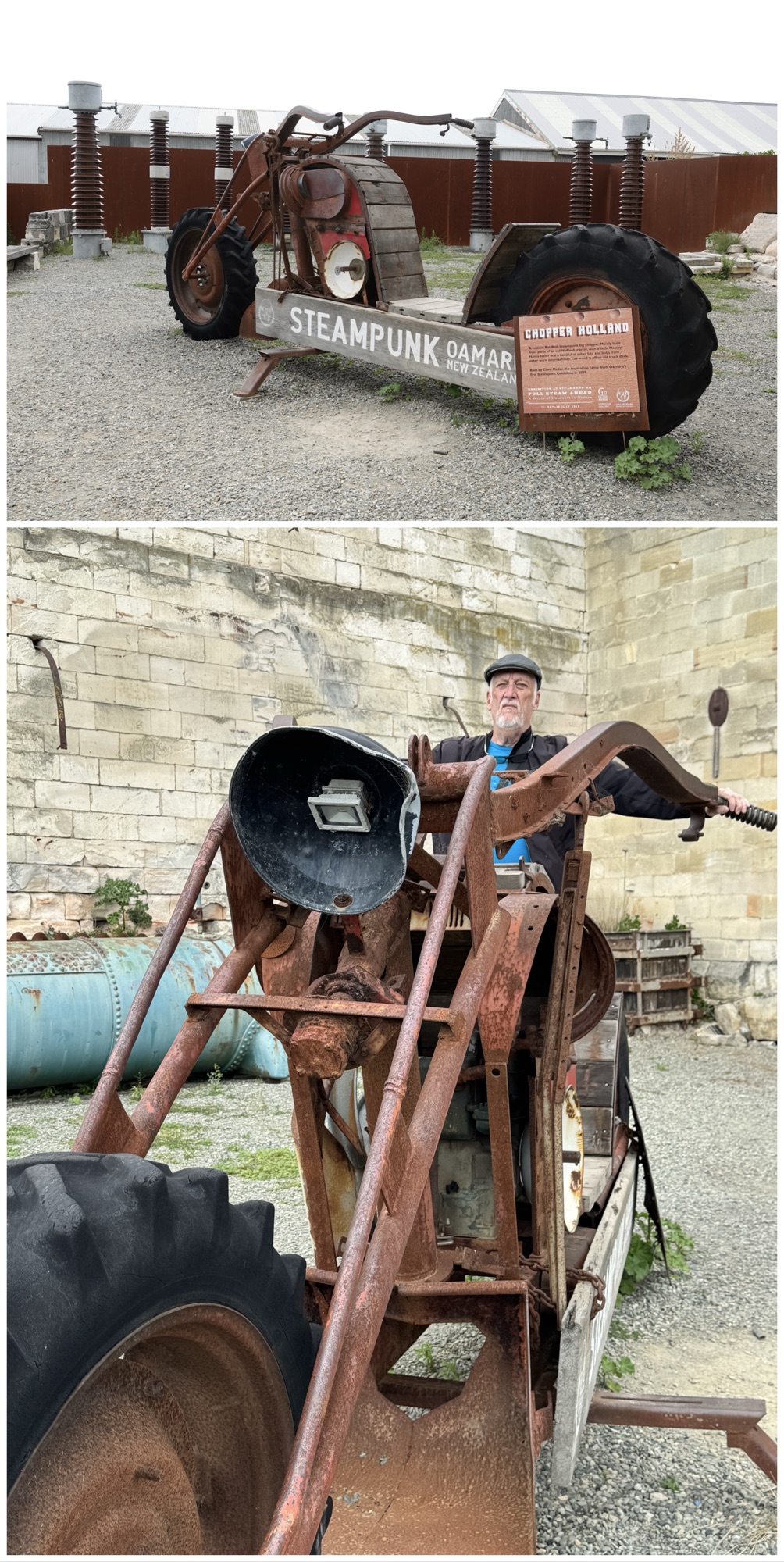
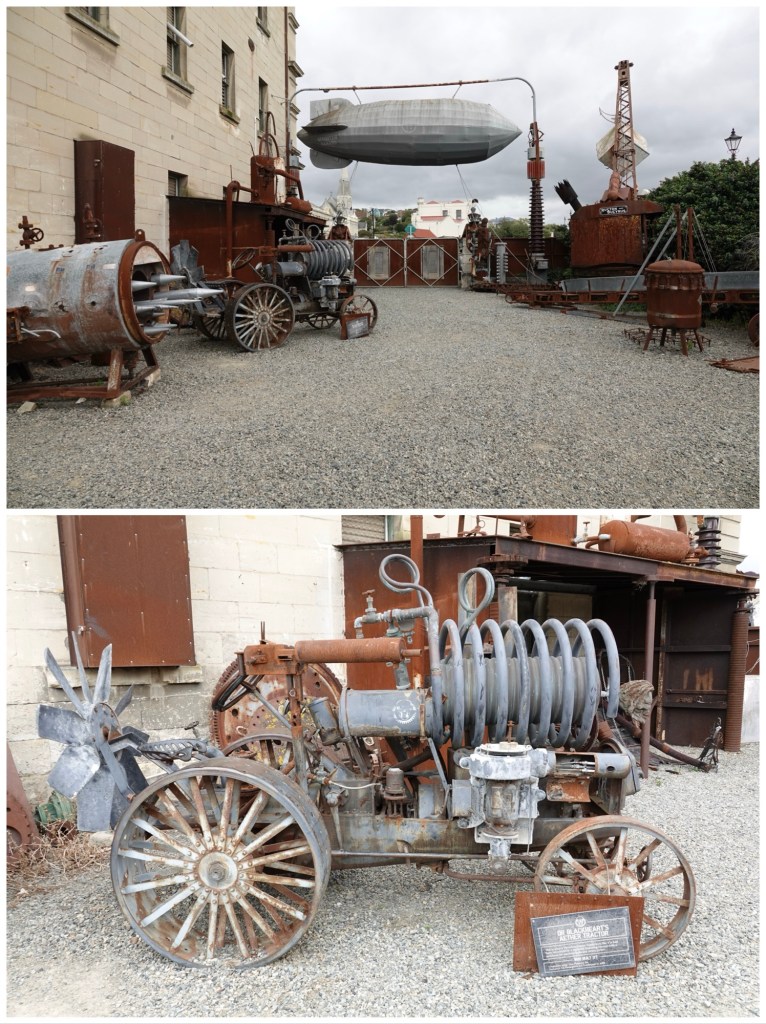
The shops along Harbour Street specialize in Victoriana, souvenirs, original and vintage artwork, and locally made merino knitwear.
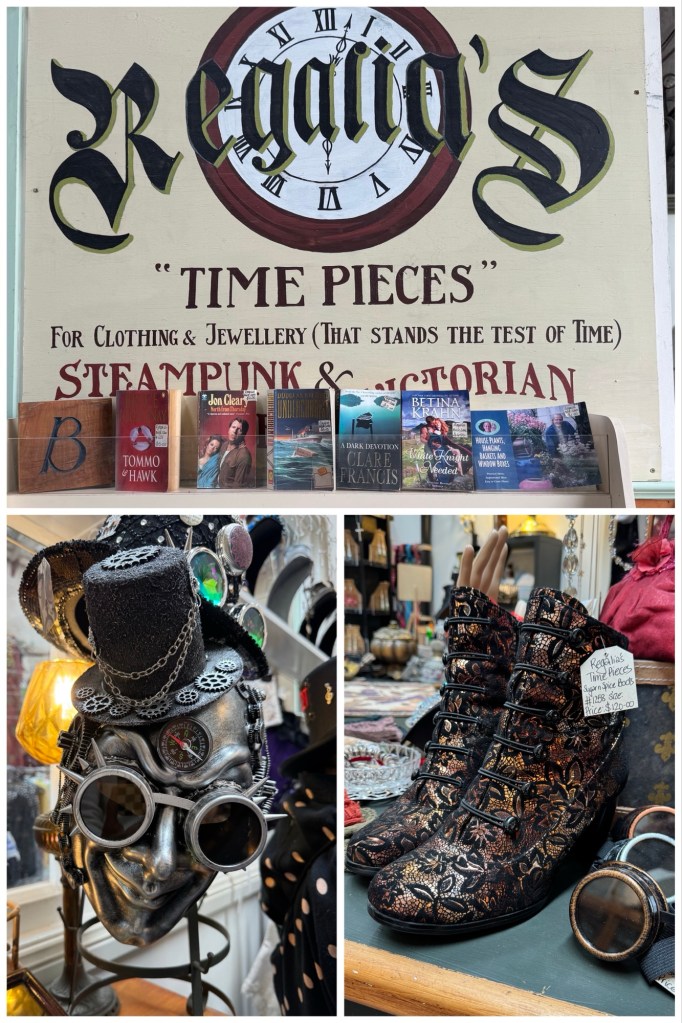
The town has, after what was apparently initial hesitation, fully embraced the “punk”.
Lunch was in Oamaru at the Harbour Street Collective, where absolutely scrummy sausage rolls were on offer!
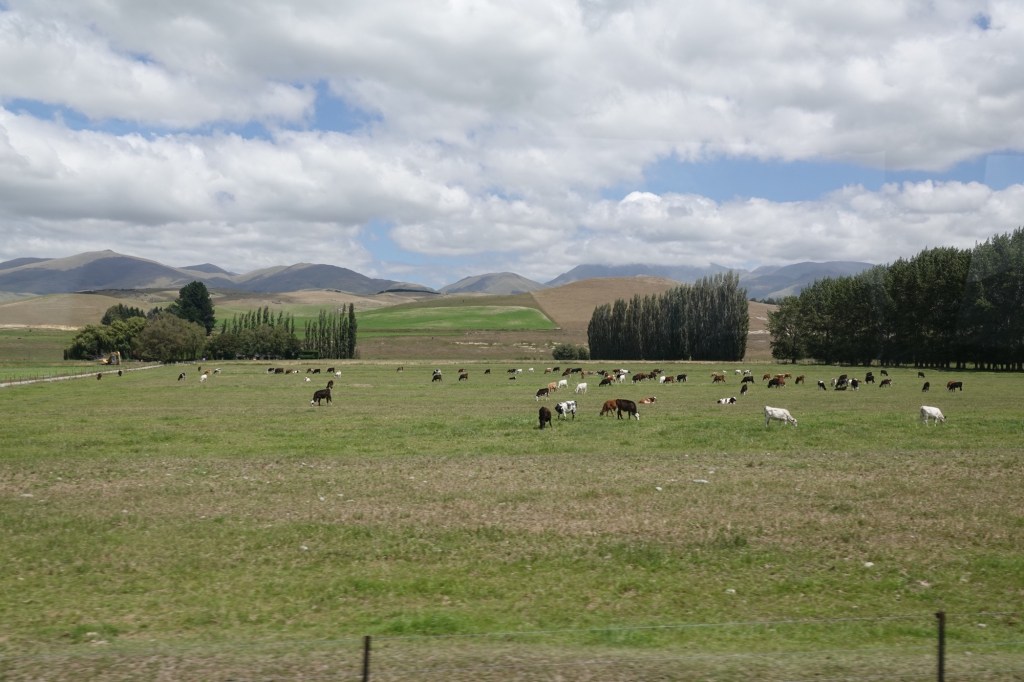
Shortly after lunch we crossed the 45° South latitude line, halfway between the equator and the South Pole. There was no marker – just wide open grazing plains.
Further along our route to Mount Cook we were lucky enough (luck for tourists not being luck for the economy in this case) to witness spillovers at 2 dams due to excess water (above lake capacity!) accumulated since September; an atmospheric river expected today is likely to dump yet more rain into the lakes.
The Waitaki hydroelectric scheme produces about 35% of New Zealand’s hydroelectric power.
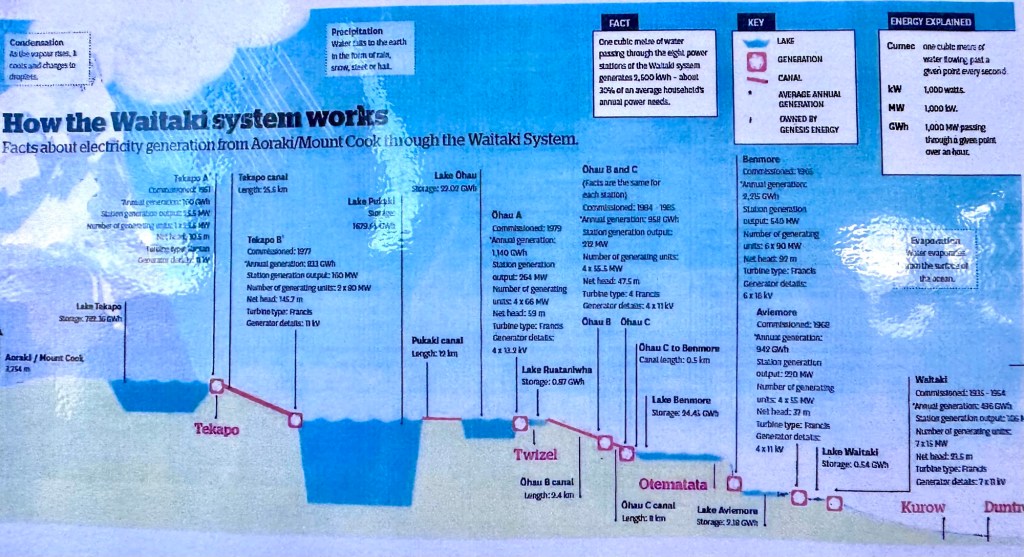
The Waitaki Dam is the last dam in the series of 7 on the Waitaki River, the southernmost of New Zealand’s great braided rivers. Today it was “spilling” around 250 cubic metres (250,000 litres) per second. There is no intentional spillway here, so excess water simply flows over the top of instead of through the dam. There are flow disrupters on the dam’s face.
Lake Aviemore dam, #6, was spilling almost 750 cu m per second (750,000 litres) via its spillway; this excess over what the dam can handle is, unfortunately, “wasted” energy.
Sadly, we didn’t stop for photos at either of those dams.
We did make a stop at the Benmore Dam, the largest dam in the Waitaki Power Scheme and the largest earth dam in New Zealand. The power station here generates 540 megawatts, with most of the electricity produced going to the much more populated north island. There were only two of the four spillways open, spilling 239,000 litres per second of excess water today, down from 750,000 litres per second a week ago. Our guides said they’d never seen it like this. Lake Benmore holds about 1.25-2 billion cubic metres of water. Multiply that by 1000 to get litres! That’s more than Wellington Harbour.
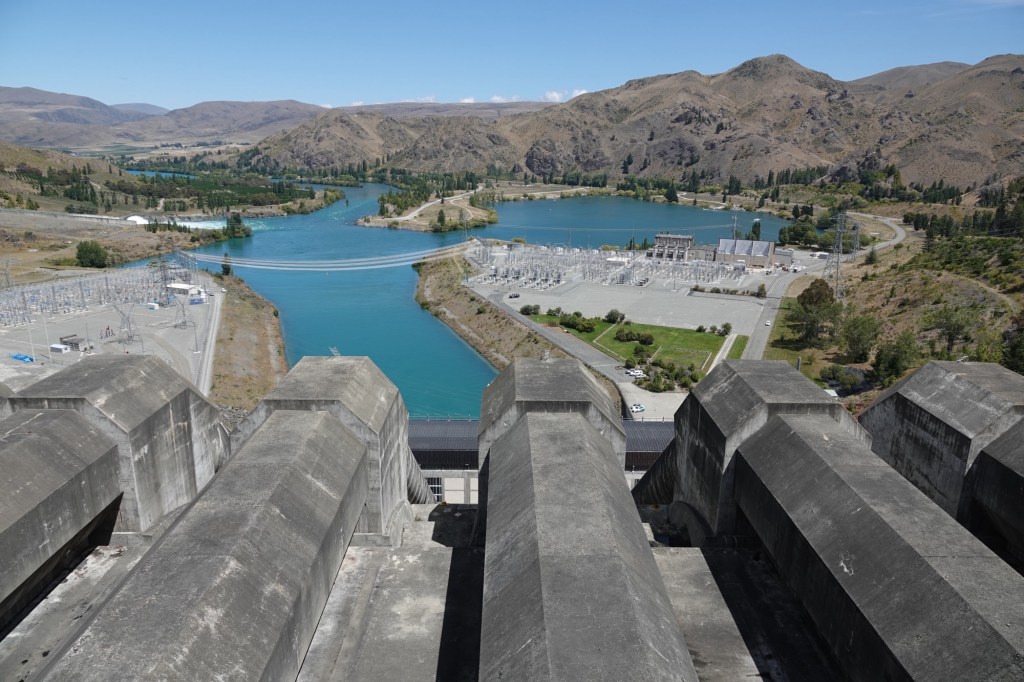
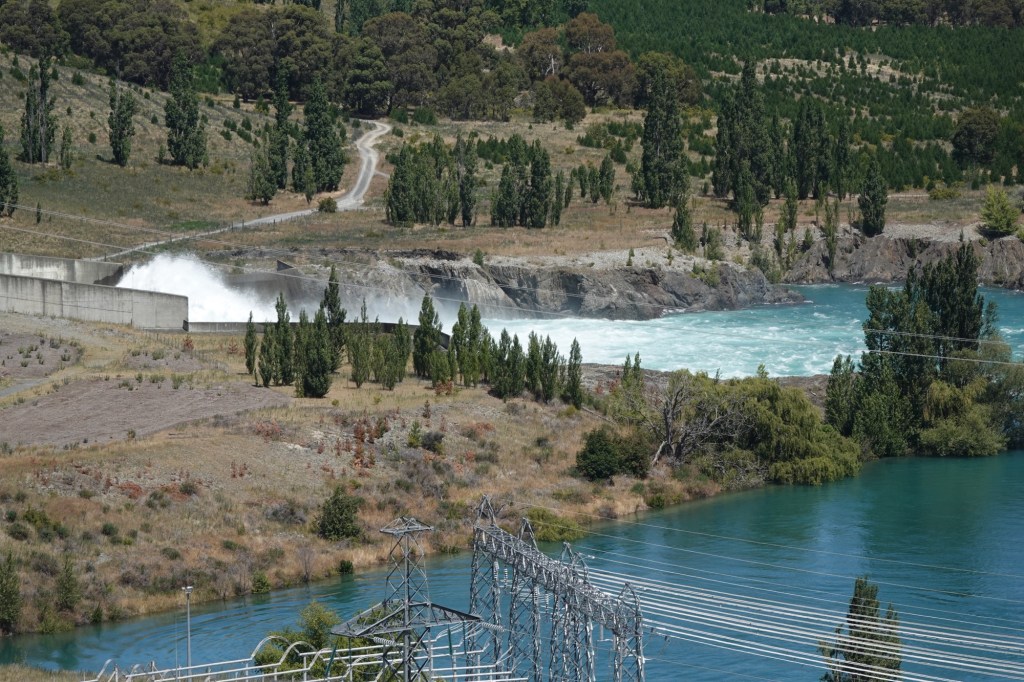
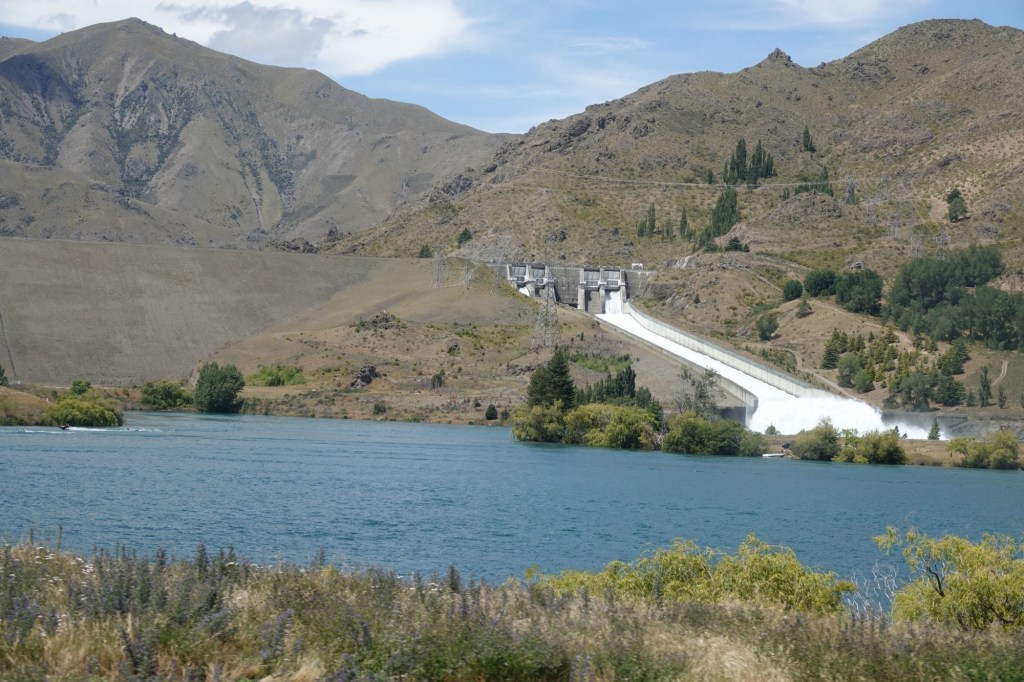
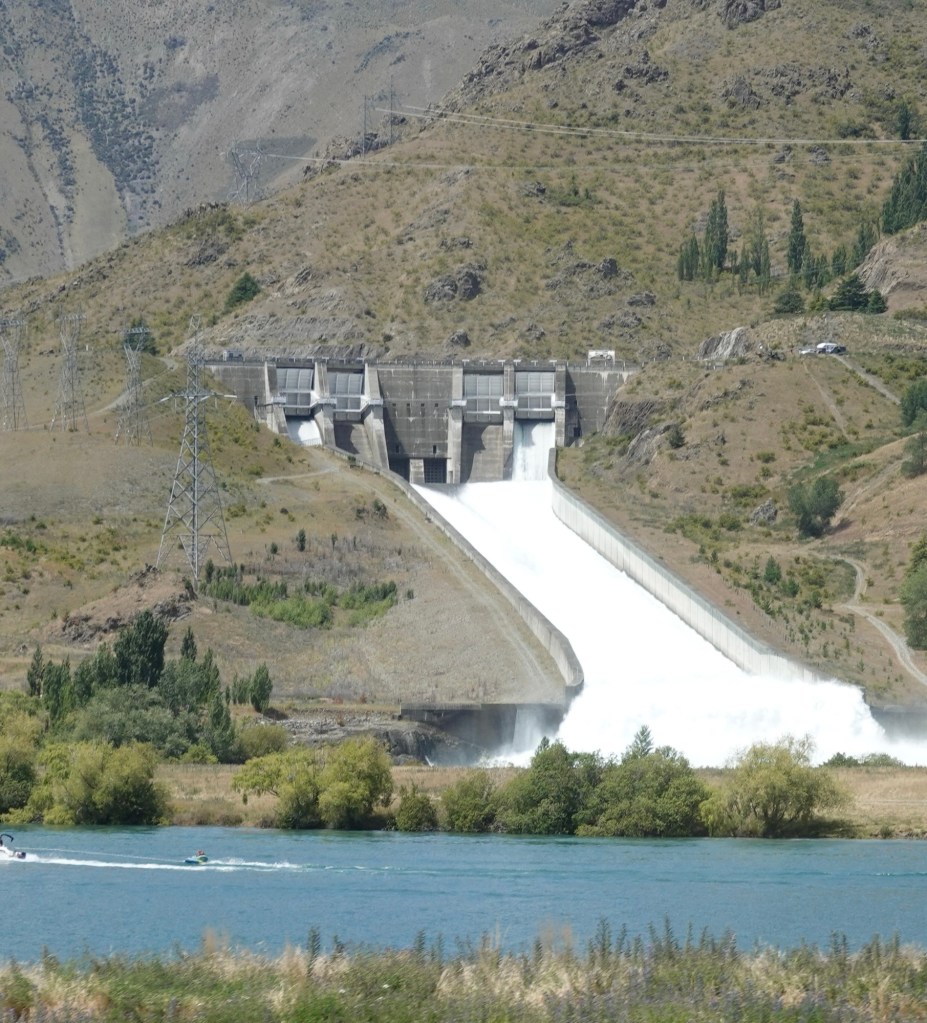
By comparison to these numbers, during peak daytime tourist hours, about 2800 m3 / 2.8 million litres per second thunder down the Horseshoe Falls in Niagara Falls.
One of the hydroelectric companies has trucks that are decorated with “When it rains it powers”. Clever.
Our afternoon tea break was at Omarama, a merino sheep station. The wool from here is all sold to Icebreaker, the company from which Ted’s merino clothes come.
Then it was back into the coach.
We are enjoyimg the pacing of this tour which allows for detours to take advantage of interesting views, like the dams.
Today we detoured along the canal (below) leading to the Ohau Power Station.
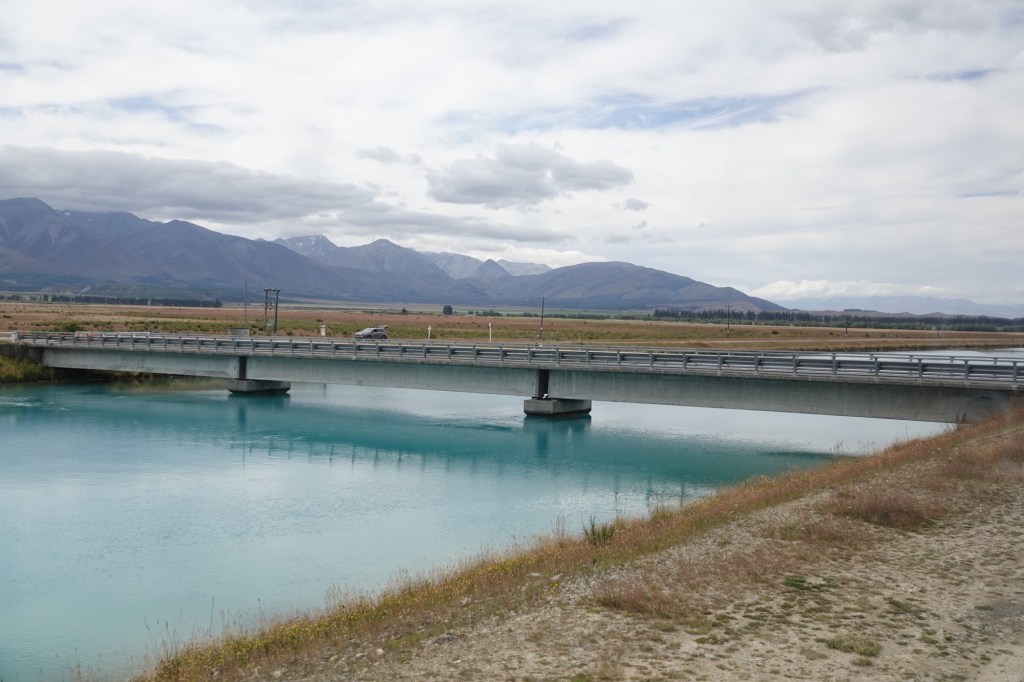
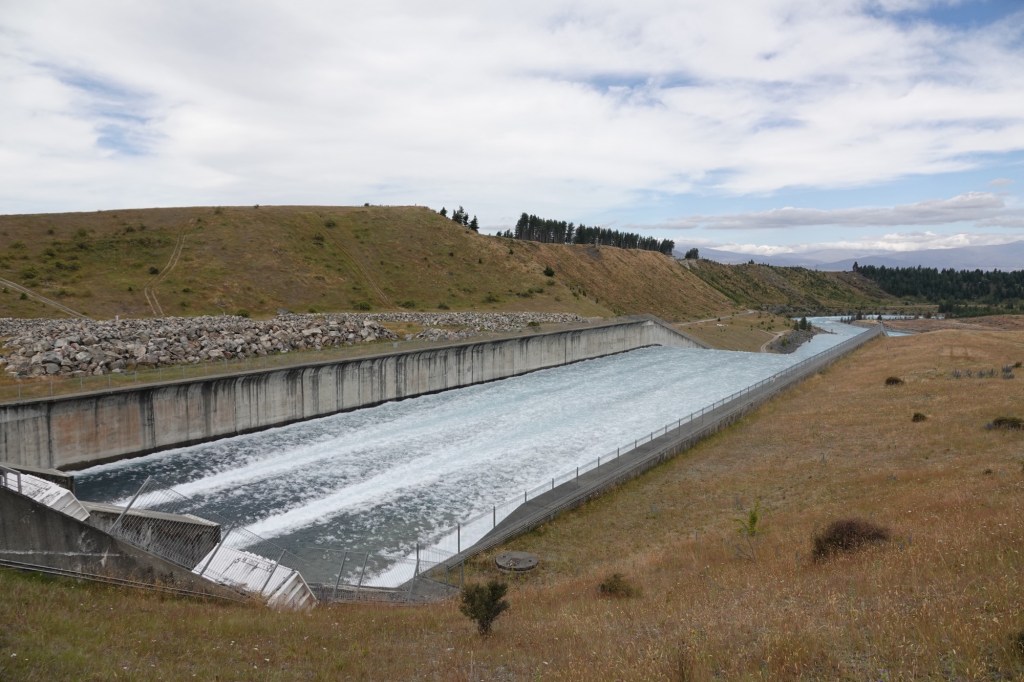
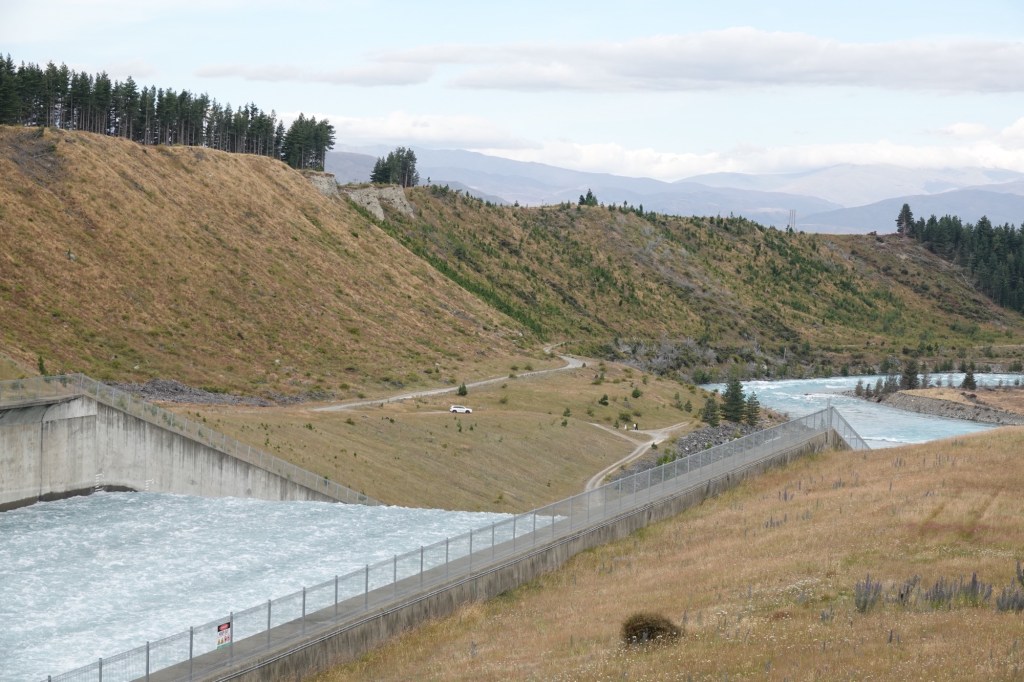
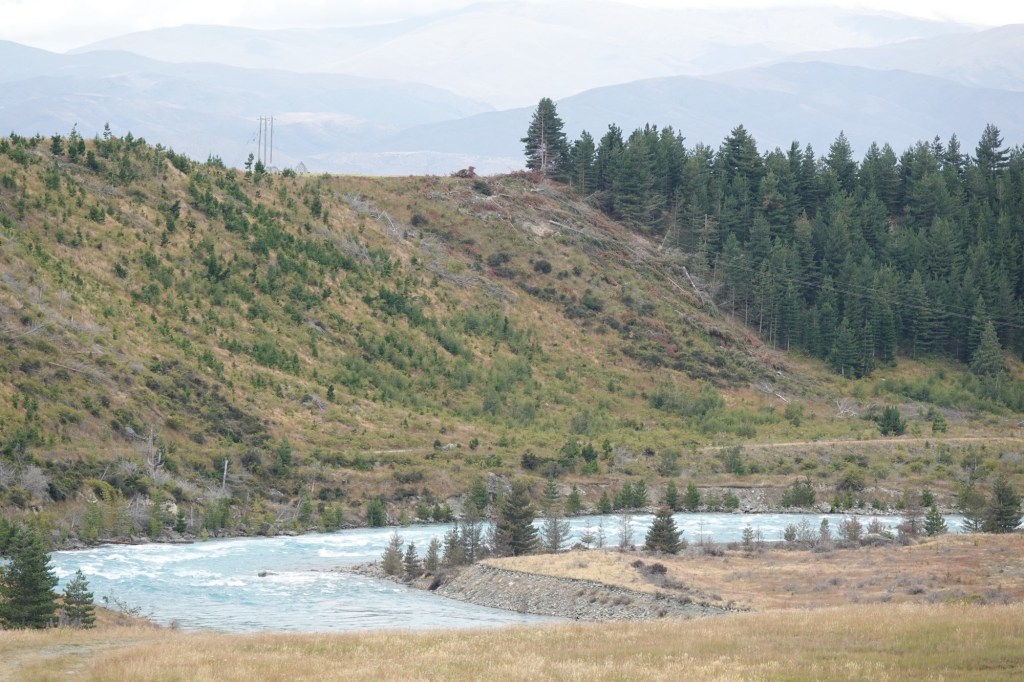
We made another stop at the Lake Pukaki Dam, spilling about 500,000 litres per second, and where we could get much closer than at Lake Benmore. The lake level over this huge lake surface can fluctuate by as much as 13m/42ft, and is currently at almost record high level. There is usually a rocky beach around the perimeter, and the rushing river we saw below the spillway normally doesn’t exist!
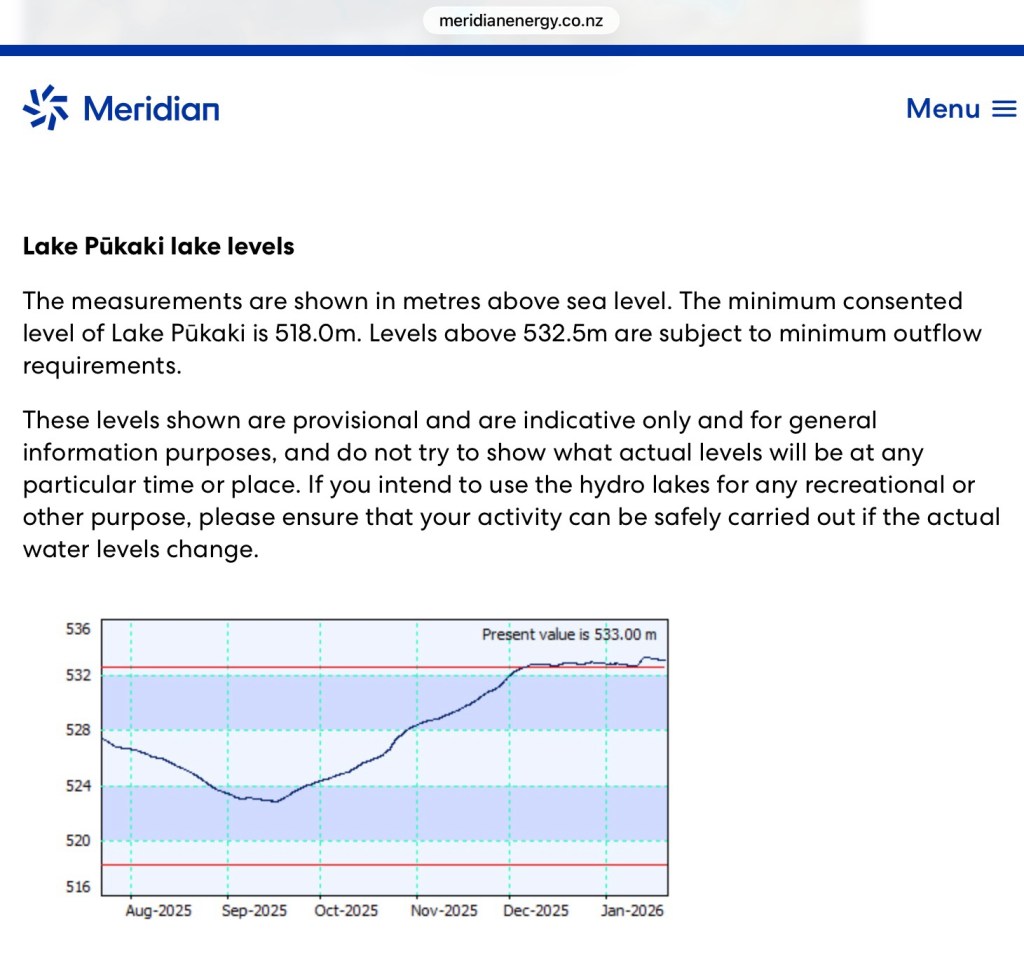
Wow.
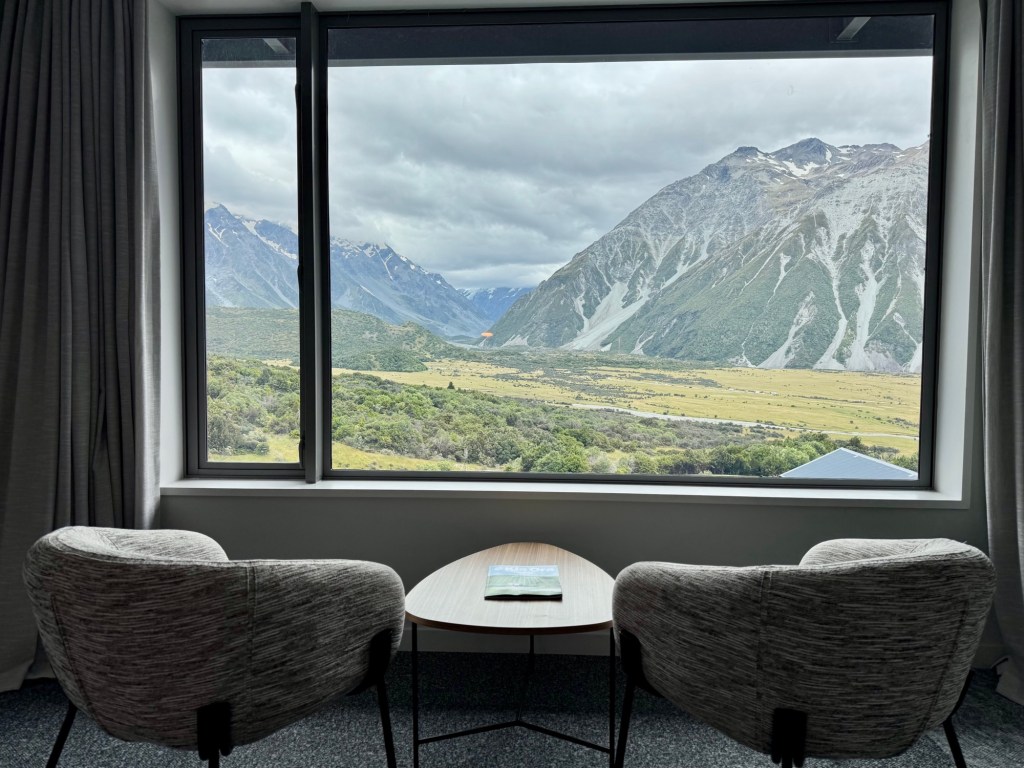
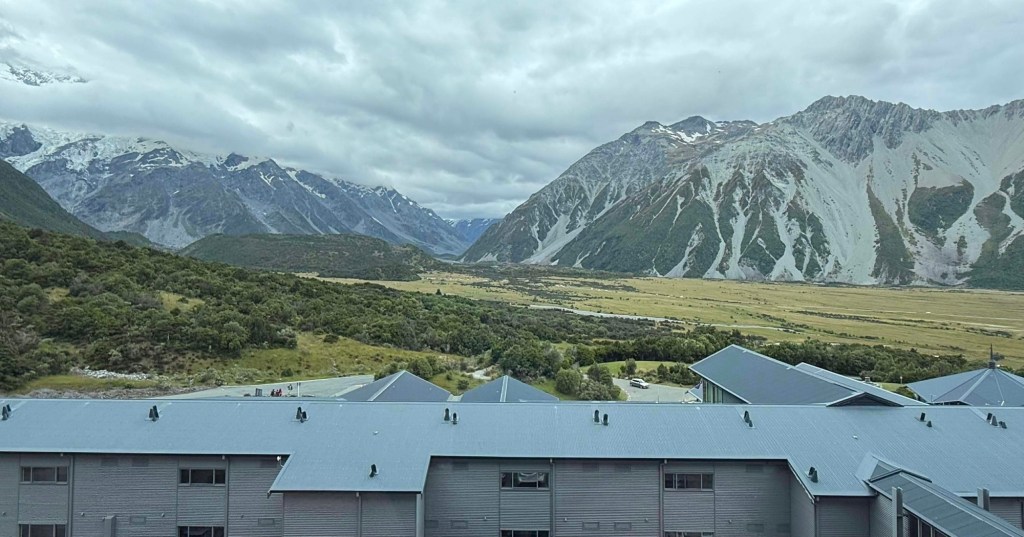
For the next two nights we’re at the Hermitage in Mount Cook Village within the Aoraki/Mount Cook National Park, where everything in our stunning 7th floor room – the bed, the chairs, the workstation – faces breathtaking mountain views.
Today’s new vocabulary:
- tane = Māori for “man”,
- kūmara = sweet potato,
- Jandals = kiwi slang for flipflops
Today’s takeaway: As we drove along vast expanses of green today, flanked by soaring mountains, glistening lakes, and rushing rivers, Ted mused, “The world sure is big”.
We are incredibly lucky to be able to explore so much of it. I have to think that if our entire world was just our own neighbourhood our lives would be much poorer for the lack of experiences and the missed stories and perspectives of other cultures.
 Rose and Ted’s Excellent Adventure
I’m really enjoying your posts, we were on the South Island in October and loved it! I am curious as to the brand/style of your shoes – they are really cute! Happy travels.
LikeLiked by 1 person
Thank you!
The shoes are a Chinese brand bought from Temu, and very flexible for walking.
LikeLiked by 1 person