The falcon-headed Egyptian god, Horus, has a complicated parentage. He was the son of Isis and her husband Osiris, but conceived through a magical act AFTER Osiris was murdered by his brother Set. Much of Horus’ life was spent in battle with his uncle (Set) to avenge Osiris’ death.

Horus’ eventual triumph is symbolic of a unified and stable Egypt, but the struggle cost Horus an eye, which was later restored by the god Thoth. The “Wedjat eye” became a symbol of protection, healing, and restoration in ancient Egypt.
In his incarnation as a falcon (as opposed to just a falcon-headed god), Horus’ wings were believed to span the sky, and his eyes to be the sun and moon.

Edfu is roughly equidistant between Luxor and Aswan. We were told that about 200,000 people live in this “village”.


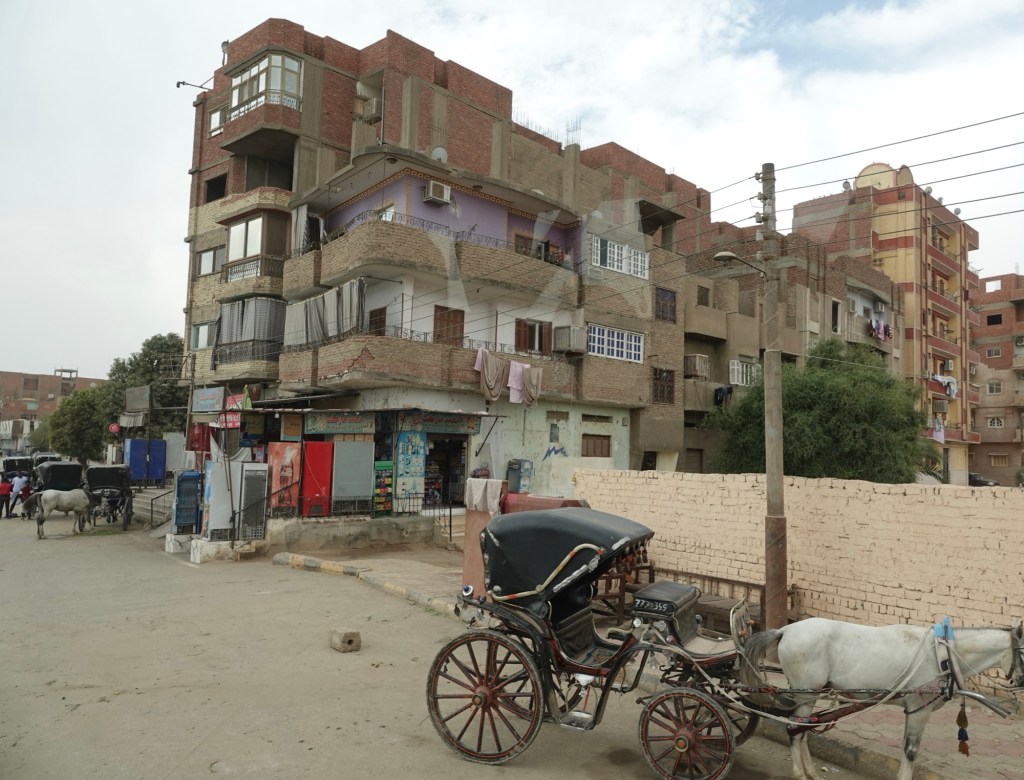
Edfu’s temple was designed and built in the second century BCE, at which time it would have been directly on the banks of the Nile. Today we took a shuttle a kilometre or more inland to visit it.
Despite being built in the early Roman era, Edfu qualifies as an ancient Egyptian temple because it is dedicated to an ancient Egyptian god, in this case Horus.
It is the best preserved temple in Egypt, having been entirely buried under sand. The temple of Kom Ombo was almost equally well preserved, but this temple is much much bigger.
(From Wikipedia:) Only the upper reaches of the temple pylons were visible by 1798, when the temple was identified by a French expedition. In 1860 Auguste Mariette, a French Egyptologist, began the work of freeing Edfu temple from the sands.
The entire temple was surrounded by mud brick walls, which we’ve learned was common for temples where “ordinary” people were kept out and only priests and pharaohs allowed in. Mud bricks in most places last for a couple of hundred years; here they have lasted for thousands.
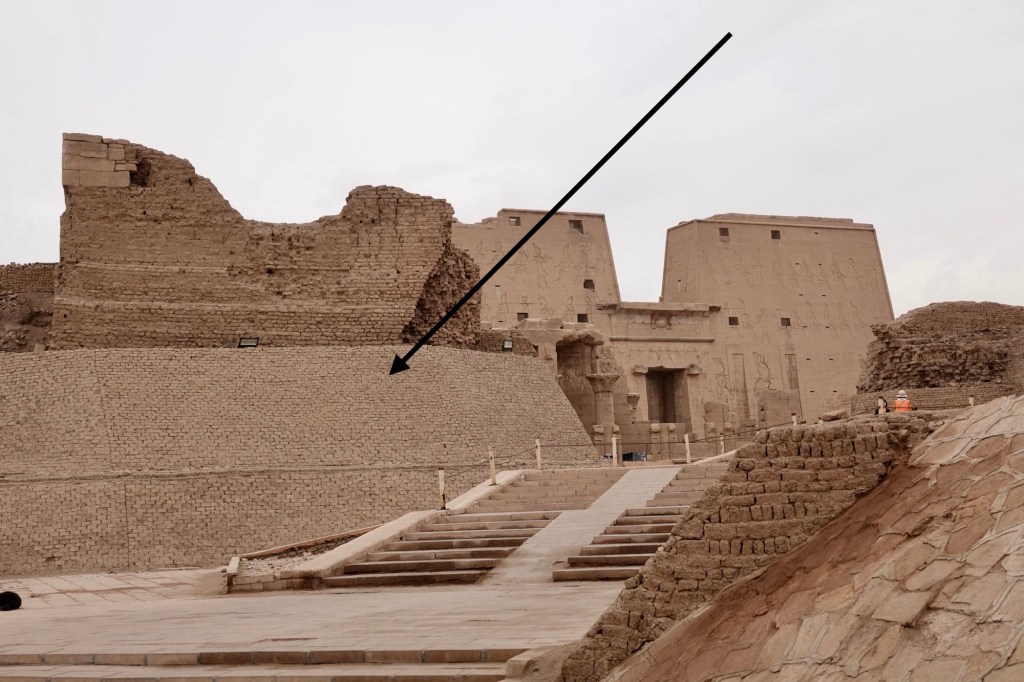
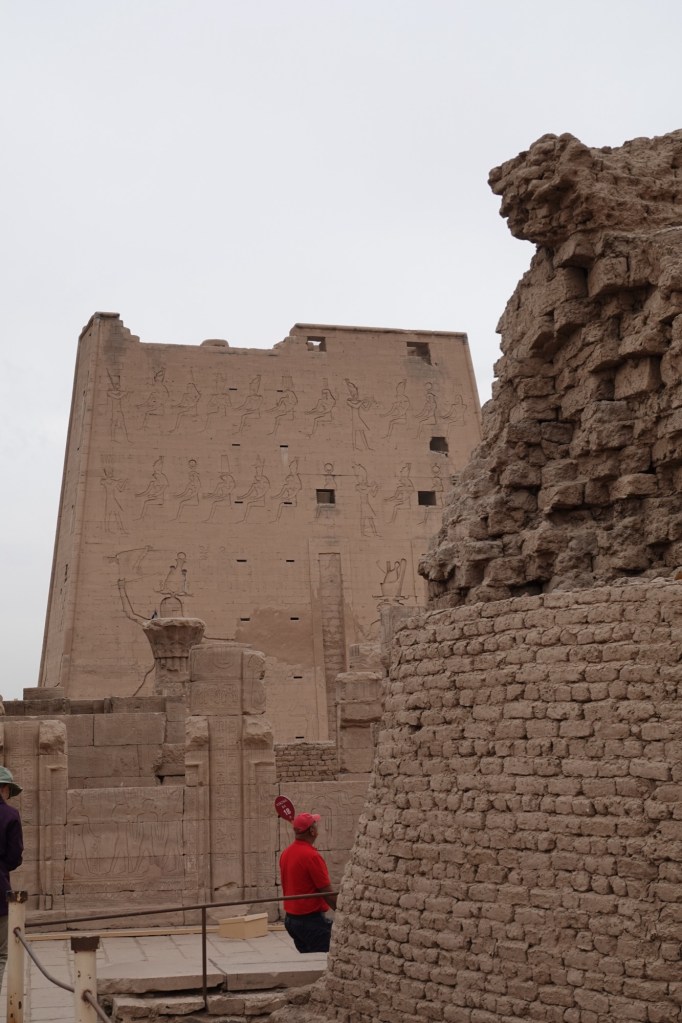

This temple, like most of the archeological finds in Egypt, was discovered in the 19th century.
The façade of the temple truly is magnificent, rising as it does almost straight up toward the sky.

The entry gate of a temple is called the “pylon ”. The top two rows of reliefs on either side of the gate show the pharaoh making offerings to a long line of Egyptian gods.
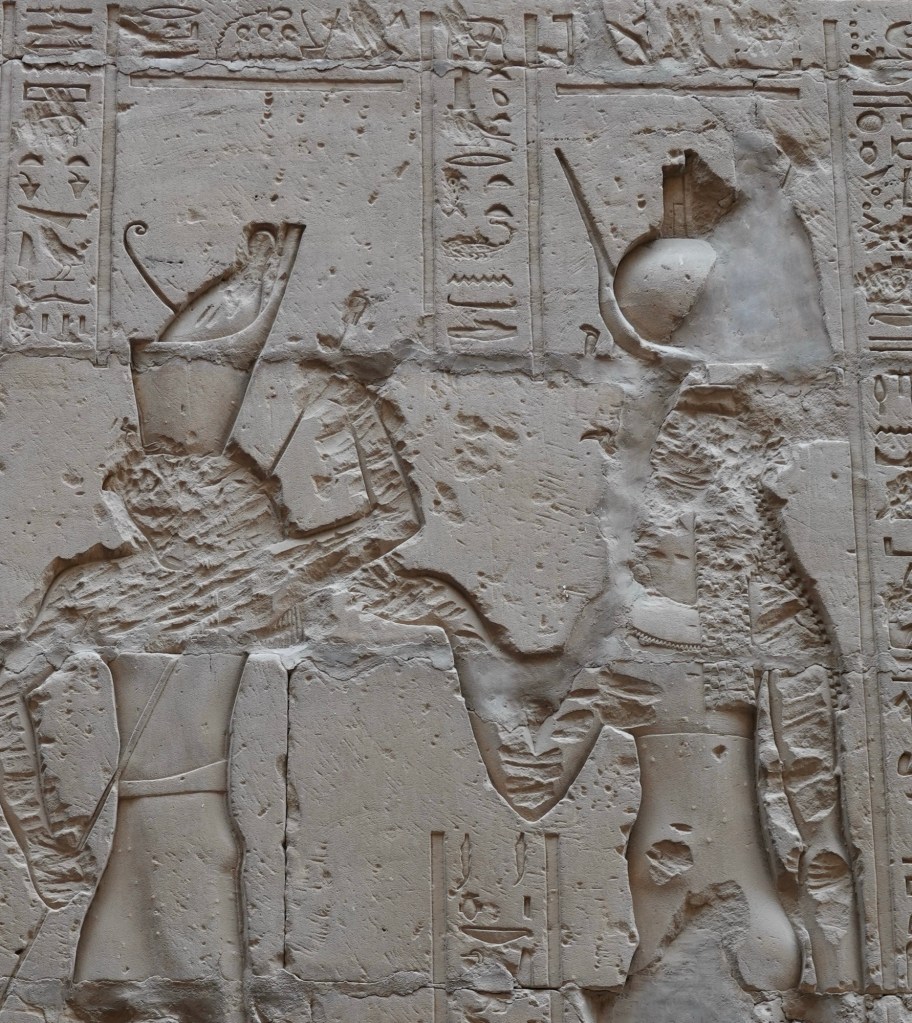
In the larger lower relief, the pharaoh – wearing a crown – is holding a stick and getting ready to smite his enemies, restrained by their hair held in his other hand. Watching the pharaoh smiting his enemies is the god Horus wearing Egypt’s double crown and Isis also wearing Egypt’s double crown. The picture is repeated in mirror image on the other side of the pylon.

Flanking the entrance are two statues of Horus, only one with its original crown intact. The falcon god looks rather stern, almost like the faces on cartoon Angry Birds. Walid promised that he would tell us why the God looked so unhappy later in the tour.


Between the legs of the statue on the left is a depiction of the pharaoh, under the god’s protection.

Inside the huge courtyard flanking the entrance to the temple are two more statues of the god Horus, again only one with its crown intact.

As is usual for temples of this era, the columns in the courtyard have capitals depicting lotus flowers, palm leaves, and papyrus. Open courtyards were designed to allow air circulation; air from the courtyard could blow into the sanctuary, keeping it from becoming stiflingly hot in the summer.

In ancient times there would have been a sand ramp shaped like a pyramid in the centre of the courtyard. A daily obligation of the priests was to bring the golden statue of the god from the sanctuary, place it on top of the pyramid, light incense, and perform rituals of worship in the open air under the light of the sun. Then the golden statue would then be returned to the sanctuary.
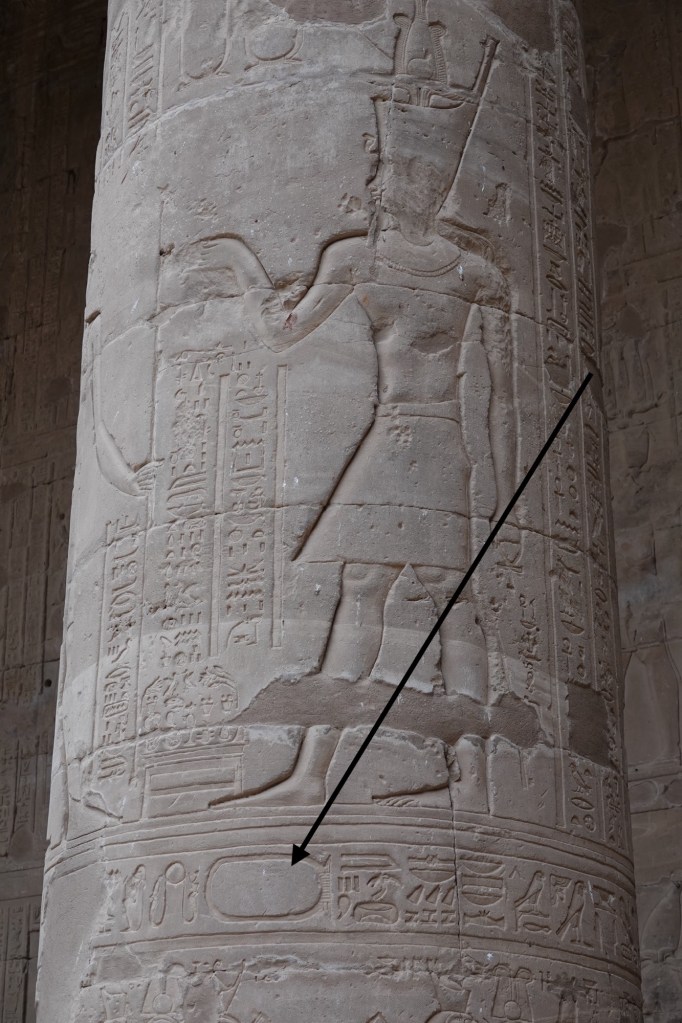
Some of the columns in the courtyard have blank cartouches on them. This is something we also saw at the temple in Dendera, which was built around the same time as this one in Edfu. We were reminded that the royal lineage at that time was being contested and, until a pharaoh was decided, there was no name to inscribe in the cartouche. Eventually, it seems the carvers simply gave up.
The next element of this (and every) ancient Egyptian temple is the hypostyle hall, the “hall of columns”.


With so many pictures covering every wall and column inside the temples, it is especially useful to be accompanied by an Egyptologist who can point out the most significant images and explain the writings.
We were told the story of the wedding of Horus to Hathor (the cow goddess who had been his wet nurse when his mother Isis grieved her dead husband so much that she lost weight and could not provide enough milk for her son).
The relief Walid pointed out showed the celebration of the anniversary of Horus and Hathor, which occurred annually at the time of the Nile’s flood.

The relief shows multiple priests by creating a 3D effect, reminiscent of the multi-legged speeding horses in the relief of Rameses II’s battle that we saw in one of the other temples. It is a feature we would certainly never have noticed on our own.

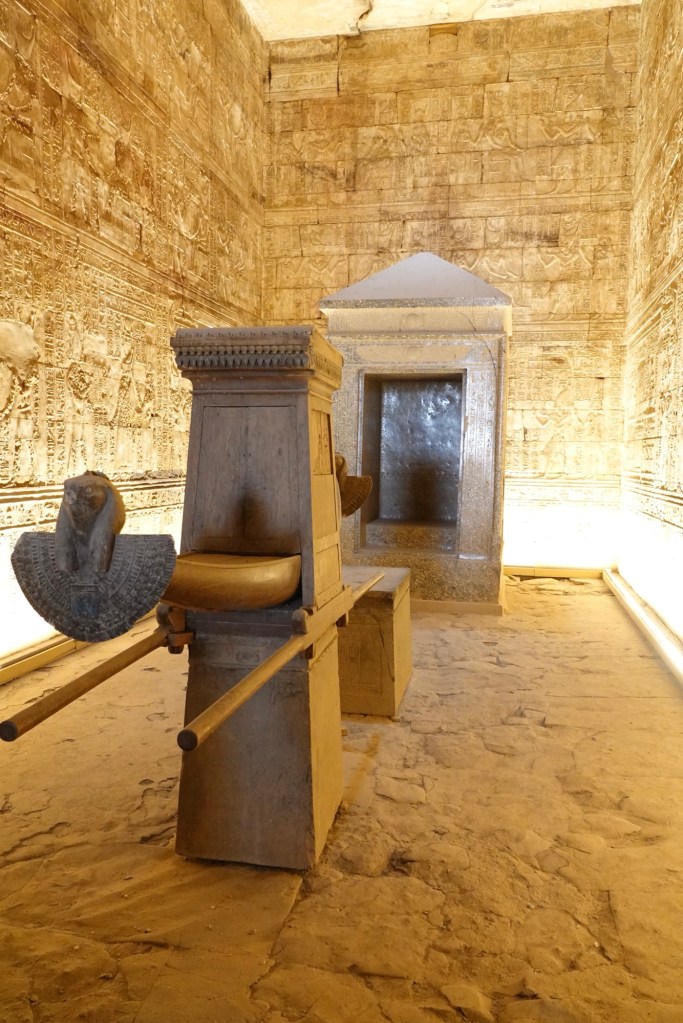
Finally, we reached the innermost area of the temple: the sanctuary.
In this sanctuary there is a granite shrine which would once have held the golden statue of Horus. Gold statues did not survive to the time of the modern day discovery of these places; it is very likely that after being stolen from temples and tombs many centuries ago, they were melted down for the value of the precious metal.

Also inside the shrine was a replica of the boat that would have been used to transport the god’s statue to the River Nile. This replica dates to the time of Auguste Mariette, the French Egyptologist who was in charge of the temple’s excavation.
The “master scene” on the exterior of the temple depicts the battle between an angry Horus (hence the “angry bird” face at the gates) and Set.
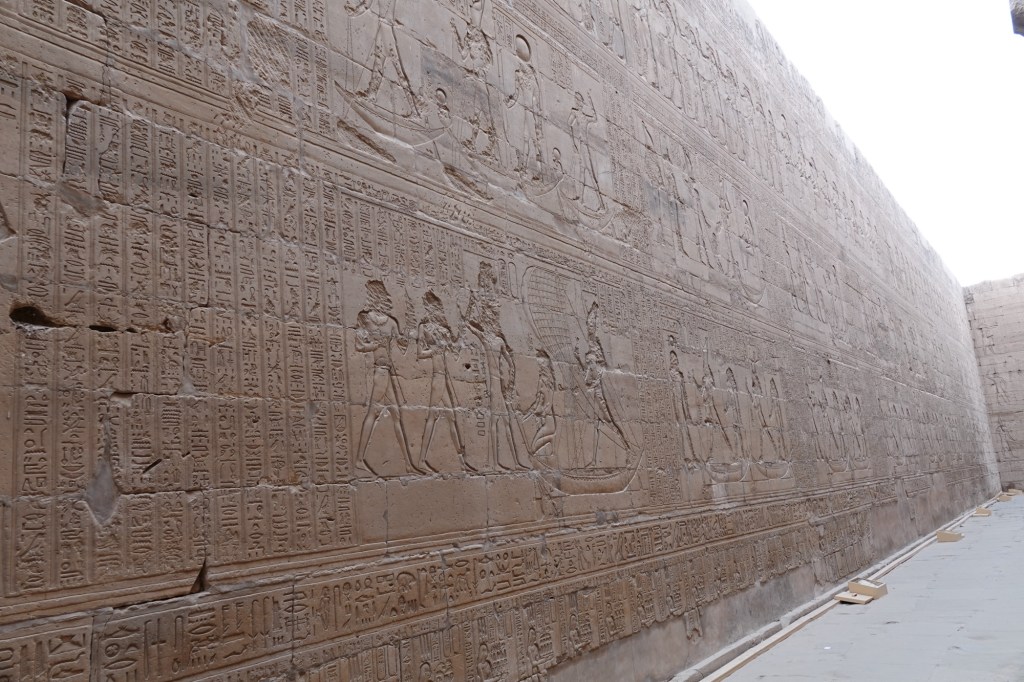
Legend has it that when Horus reached maturity, he wanted to take revenge on his uncle Set who was responsible for killing Horus’ father Osiris. Horus asked for and received permission from the supreme god Amun Ra to undertake this task.
Horus fought in the form of a falcon. Set took the form of a hippo.
Even though during their battle Set took out one of Horus’ eyes, it was Horus who was eventually victorious. The final relief shows Horus having captured Set. He did not kill him; killing a god just allows them to live again in another, and potentially more malevolent form.

Horus’ defeat of Set coincidentally pleased Amun Ra, against whom Set had been plotting, wanting to supplant Amun Ra as the supreme god. In gratitude for Set’s defeat, Amun Ra allowed Horus to adopt the symbol of the sun (Amun Ra’s circle symbol) with outstretched wings, which is the symbol of protection we have seen on so many temple and tomb ceilings.

The most amusing relief we have seen so far was also related to this fight. Walid explained that it depicts the annual celebration during which a priest slices a hippo-shaped cake and distributes pieces, commemorating Horus’ defeat of Set.
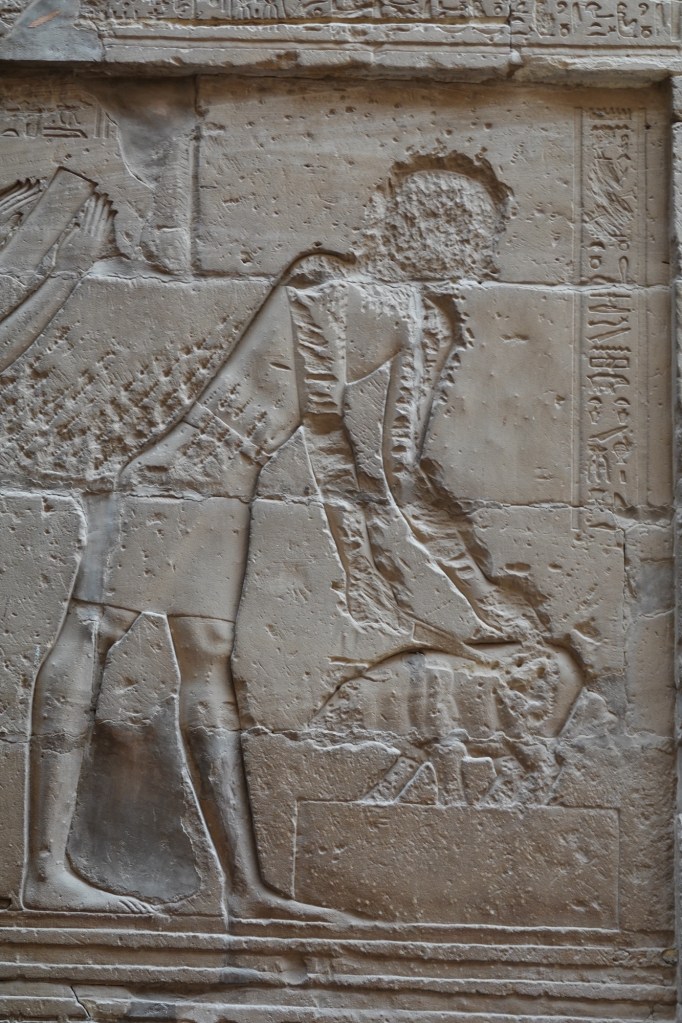
We were pretty sceptical about this story of an ancient cake, but Walid pointed out the hieroglyphic beside the relief that includes a hippo shape and a knife, separated by hieroglyphics that mean “sweet food”. It appears the ancient Egyptians had a droll sense of humour.

All the faces on these magnificent reliefs were defaced by the early Christians. I am constantly appalled by how people want to destroy what they don’t understand, or what they think threatens what they believe.
In order to return to Luxor for our flight to Cairo tomorrow, we have to go through the very busy lock at Esna. Hotel Manager Milena forewarned us that it is impossible to predict how long we’ll have to wait in the lock, but “we’ll definitely reach Luxor by the end of the day”.
By 10:30 a.m. we had set sail for Luxor, understanding that the lock process for transit is “first come, first served”. All day we witnessed Nile boats “racing” to the starting gate.
Occasionally children on the shore waved in farewell.

While ships anchored, waiting to go through the locks, that presented one last opportunity for Egypt’s entrepreneurial vendors to try to make one more sale. They row alongside, tether themselves to the boat, and throw items up (in plastic bags) and catch hoped-for payment thrown down via the same bags – to and from as high as 4 decks up, both with surprising accuracy. Practice clearly makes perfect. When they’ve enticed as many purchases as they think possible, they untie and row to another ship.

After we’d spent most of the afternoon just relaxing on the ship, and taking some time to pack for tomorrow’s early end-of-cruise departure, our second Egyptologist, Amin, gave a talk on “Women in Modern Egypt”.
It was a fascinating topic,and especially interesting for me to watch the reactions of fellow passengers perhaps less familiar with Muslim culture than those of us who live in very diverse areas.
Amin pointed out that in pharoahnic times, there was complete equality from a legal standpoint; it was a time of male and female gods and rulers. That continued into the time of the Crusades, when Egypt had at least one strong female leader.
For a Middle Eastern country, Egypt is seen as quite progressive. Amin shared lots of statistics related to the last 10 years.
- 2017 was “The Year of the Woman” in Egypt, when a formal plan for equality by 2030 was created, and the requirement of “equal pay for equal work” was legislated.
- In the current federal government, 24% of the Ministries are headed by women; congress is 27% female, which is above the international average.
- An impressive 62% of scientific researchers are female!
- As of this year there are 3900 female judges.
- The first female pilot in the Muslim world is here in Egypt.
- In post-graduate education, 60% of students are female.
- Egyptian women have competed and won Olympic events; the world champion in women’s squash is an Egyptian
In 2011, the extremist Muslim Brotherhood filled a power vacuum in Egypt and, in Amin’s words, pulled the country back into the Dark Ages. Amin opined that the thousands of brave and determined women who took to the streets to demonstrate were key to overturning that repressive regime, and that the country owes great thanks to their women.
The status of women in Egypt is defined three ways: by tradition, by religious beliefs, and by laws.
Of course, everyone wanted to talk about women’s garb. The idea of “covering” is a bit of an obsession with those of us who don’t.
Hair covering – and any other “dress code” – is not dictated by law. Egypt has separation of church and state. Women who wear the hijab and loose covering clothing believe it is part of the modesty required by the Quran, but Amin reminded us that Islam is not what you wear on the outside, but what you are inside.
So why do it? Wear it to fit into your community. Don’t wear it to perform jobs like airline crew or hotel staff. Wear it to avoid having to style your hair every day! Amin did acknowledge that there could be pressure from one’s husband or father – as can happen in any household of any religious beliefs. Anecdotally, he told us about his own mother, who wore “western” garb and mini-skirts well into her 40s, but then at 50 decided to cover her legs and hair. Amin’s father was not best pleased about that, but as Amin said , “it’s her decision”.
We were told that face coverings have nothing to do with actual Islam. It is completely “tradition” that developed largely within restrictive factions. We’ve seen a few covered women on our trip – Amin said those are likely tourists from more conservstive Middle Eastern countries.
How do Egyptians reconcile Islamic modesty with bellydancing? Dancing is a job like any other, and has its own dress code.
Both males and females are expected to live with their parents until married, which is legal at age 18. “Dating” is not an Egyptian concept. Instead connections are made through family or community introductions, and before a couple get engaged their families thoroughly vet the prospective partner. If all goes well, three rings are bought for the woman: the “rock”, the “lock” which has smaller diamonds, and a plain gold band, all worn on the right hand. Engagements typically last for a year. After marriage, which in Egypt is a consensual contract, the rings are transferred to the left hand.
Islam allows men to have up to four wives simultaneously only in Muslim countries. Apparently that original concept dated to the very early years of the religion, when religious wars decimated the male population and left widows destitute and young women unmarried. While it is allowed, the Quran also says that having only one wife is preferable.
Islam, unlike Coptic Christianity, allows divorce. The current divorce rate in Egypt is almost 33%, with most divorces occurring in the first two years of marriage and citing unpreparedness, finances, and family interference as the most common reasons. Mothers, and grandmothers, are given custody of any children, and keep the family home. Alimony and child support are decided by the courts.
Unfortunately, I lost my last 20 minutes worth of notes when our internet connection died and my notes wouldn’t save. Sigh.
Amin’s summary was that the status of women in Egypt was historically as equals to men, and that in modern day Egypt it is at least close.
The overall message that his talk conveyed to me was that the difference between (any) religion and its fundamentalist extremes tends to negatively impact women. It’s always about power (as it was under the one year rule of The Muslim Brotherhood) and not about piety.
We had one last dinner at the “Commonwealth Table” with the only other non-USA passengers on this cruise, two lovely couples from Australia.
And then it was back to our cabin to complete our packing.
We have one last day in Egypt tomorrow, the afternoon of which will be spent in Cairo.
 Rose and Ted’s Excellent Adventure