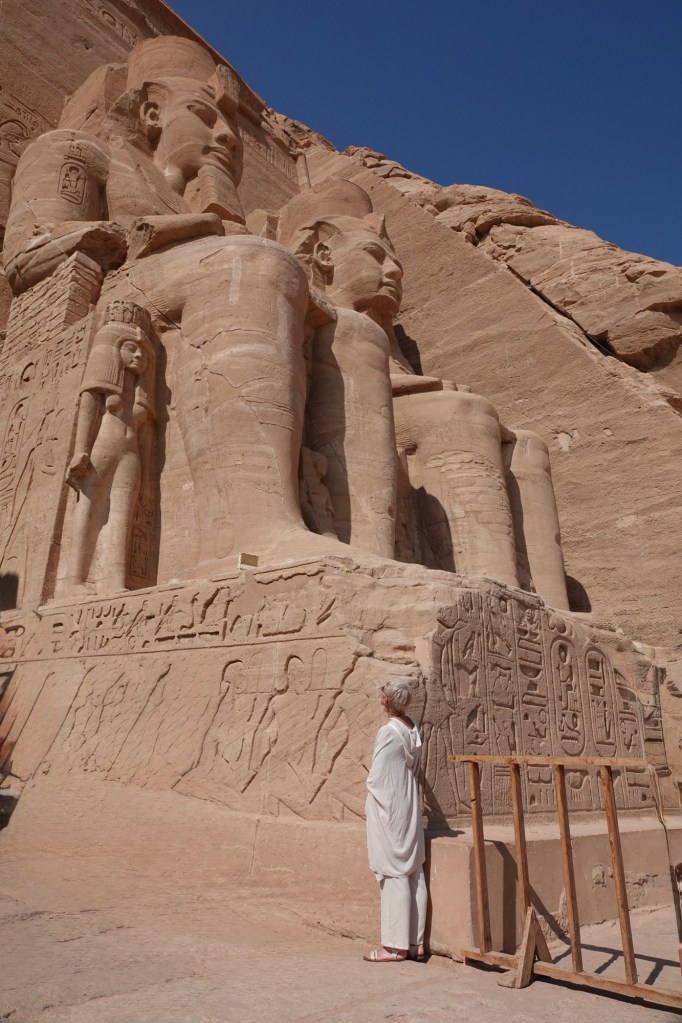
This photo is a teaser.
Bear with me as I go down a side path for a moment.
Construction of Canada’s St. Lawrence Seaway required the flooding of 20,000 acres along the Canadian shoreline between Iroquois and Cornwall. Some of these lands had been settled by loyalists as far back as the 1780s. Between 1955 and 1957, 6,500 residents were relocated, many of them to the new communities of Ingleside and Long Sault. Work crews moved buildings to new sites and re-routed highways and railway tracks. Iroquois and part of Morrisburg were rebuilt on higher ground.
On “Inundation Day,” July 1, 1958, the rising waters of Lake St. Lawrence slowly submerged the villages of Aultsville, Farran’s Point, Woodlands, Dickinson’s Landing, Wales, Moulinette, Mille Roches, and a farming community on Sheek’s Island. (Quoted from heritagetrust.on.ca). Scuba diving to view the villages is still a popular pastime.
I had the St. Lawrence River on my mind because a few years after those Canadian villages were flooded, Egypt was flooding Nubian villages for a similar reason: creating a lake.
The story of Abu Simbel is one of preserving ancient history during the 1960-1970 construction of the Aswan Dam. Unlike Canada’s 6500 displaced residents, the flooding of much of lower Nubia to create the Lake Nasser Reservoir required the resettlement of 100,000 to 120,000 people in Sudan and Egypt. The full story (accessible from the link to Wikipedia) is one not only of flood management, but of Cold War politics and Egypt calling the USA’s bluff, which ended in the USSR providing much of the project’s funding. It certainly reminded us of what we saw in Africa this year with China stepping in to fund projects either refused or abandoned by the US.
Twenty-two monuments and architectural complexes, including the 13th century BCE Abu Simbel temples, were moved to the western shores of the lake in order to preserve them. That project was named the UNESCO Nubia Campaign. The details of that incredible relocation project, which involved cutting and reassembling sandstone monuments weighing tens of thousands of pounds can be found here. The scope of the project is given perspective by knowing that the heads of the Pharoahs on the front of the Great Temple weighed more than 30 tons (60,000 pounds!) EACH.
Despite the fact that the temples of Abu Simbel are no longer in their original location as depicted in Agatha Christie’s Death on the Nile (written and set in 1937), today was nonetheless the day about which I was most excited.
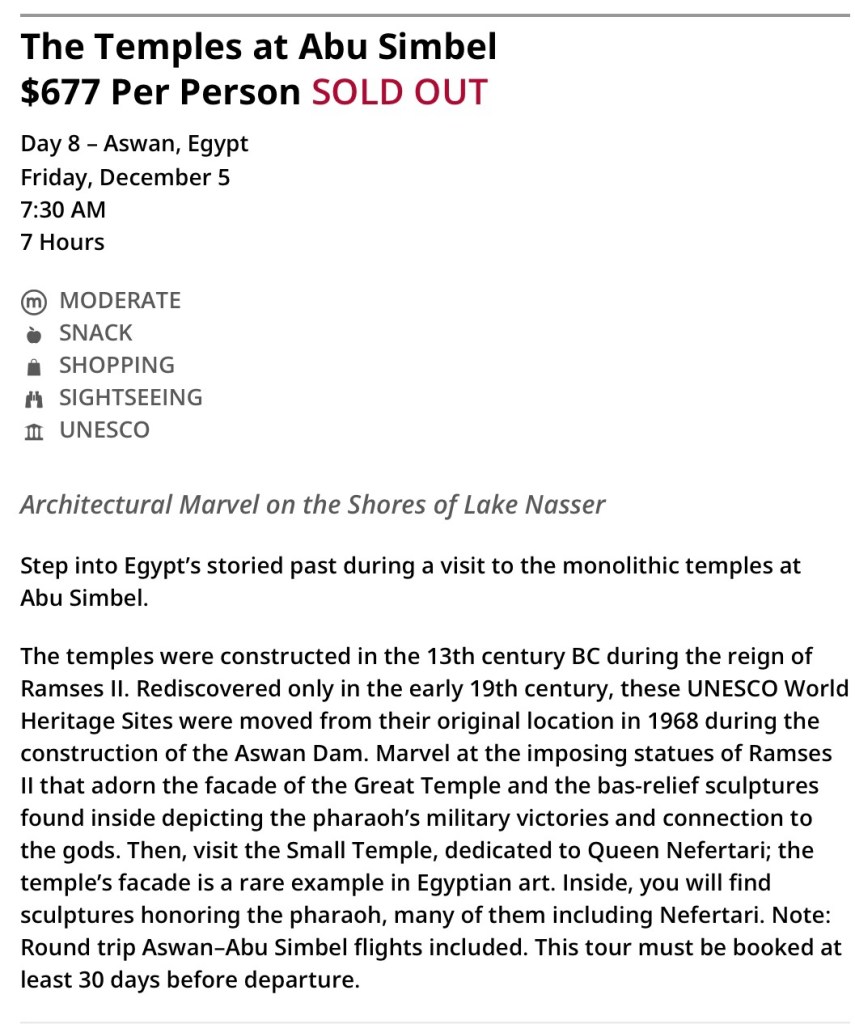
We were up at 05:30 and left our riverboat at 07:00, headed for Aswan International Airport.
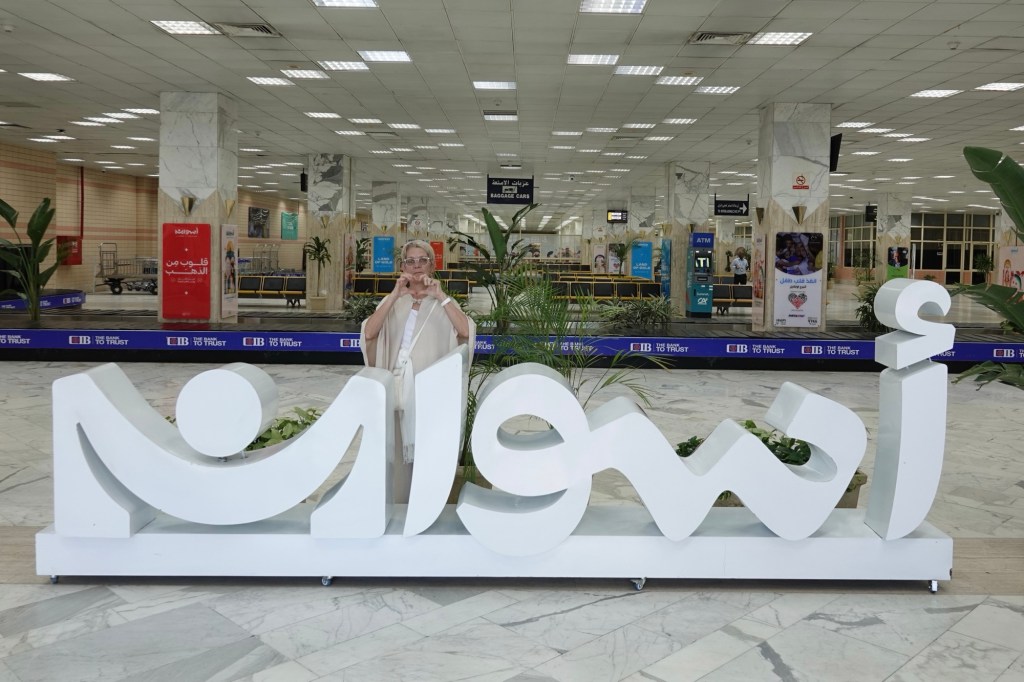
Our guide today was not Walid, but the Viking Ra’s other Egyptologist Asim. He filled our heads with a ton (but not 60 tons) of information en route. Here goes, interspersed with Ted’s photos:
Aswan is the southernmost city and province spanning from Sudan to Edfu. It is a resort area for Egyptians because in the winter when Cairo is a “freezing” 21°C/70°F, it is warm here. Today, December 5th, it was a balmy 29°C/84°F.
Aswan is the source of the granite used for many of the statues we have seen, and all of the magnificent obelisks. The floors, stairs, and portions of the walls at the airport were constructed of black, grey, and pink granite.
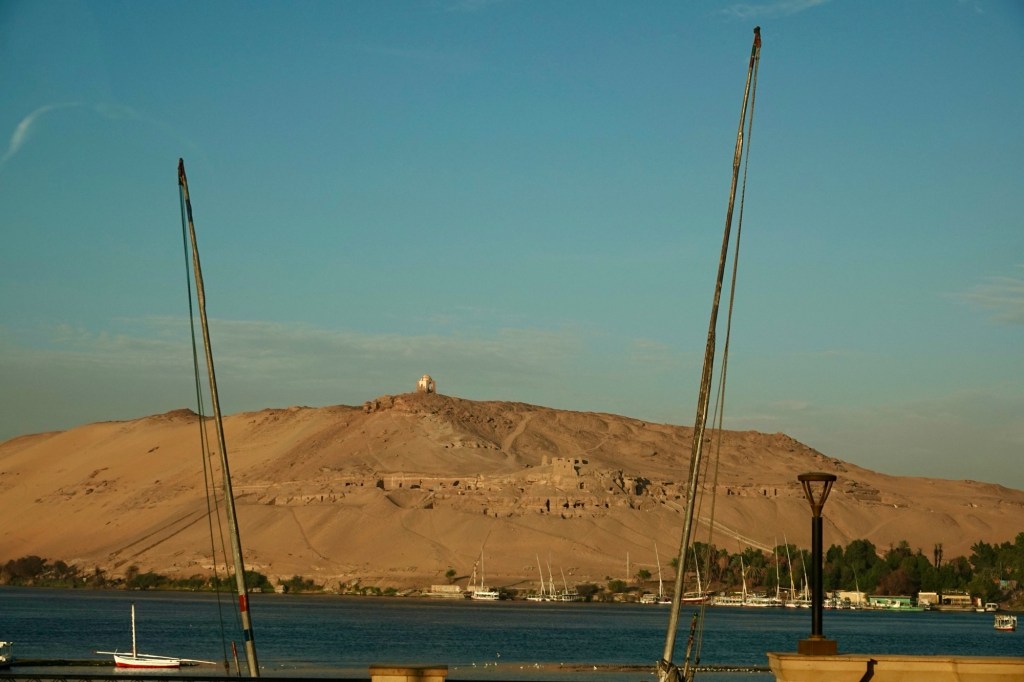
The tombs cut into the mountains, visible on our drive, date to the same period as those in Giza, about 2600BCE.
We began our day visiting the Aswan High Dam. The dam is a strategic military site since it controls all of the water supply for the country, and provides most of the country with hydroelectric power. As such, videography, binoculars, and high powered zoom cameras are not allowed. Of course, photography of military personnel is strictly prohibited.
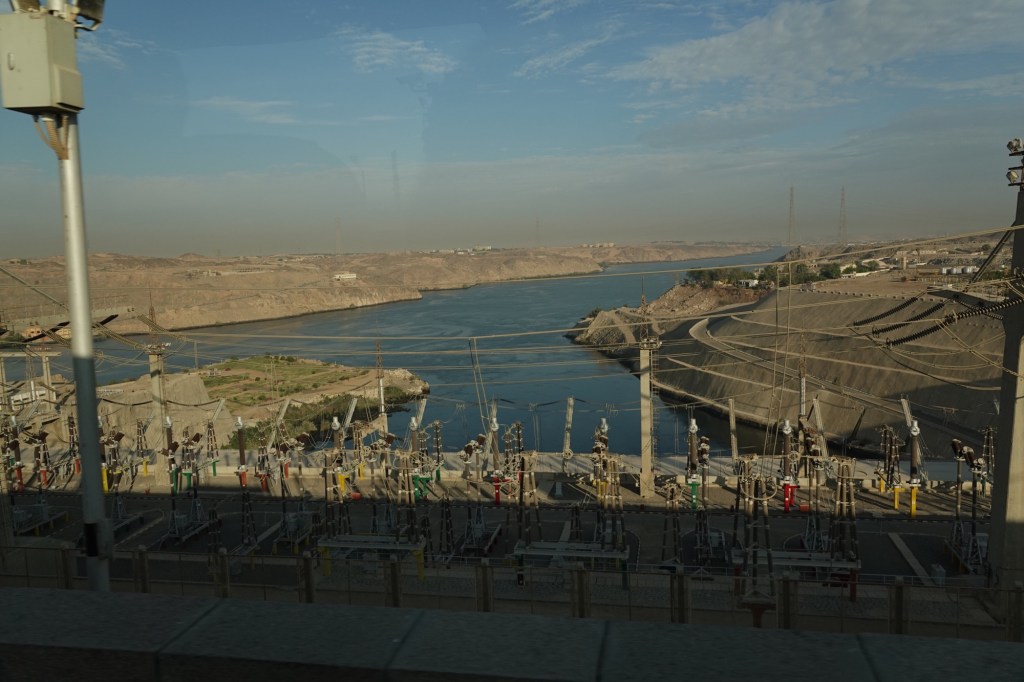
Dams were already used in Egypt all the way back to around 1500BCE under Tutmoses III . In subsequent years the Egyptians, Greeks, Romans, and British all built dams of various sizes and effectiveness.
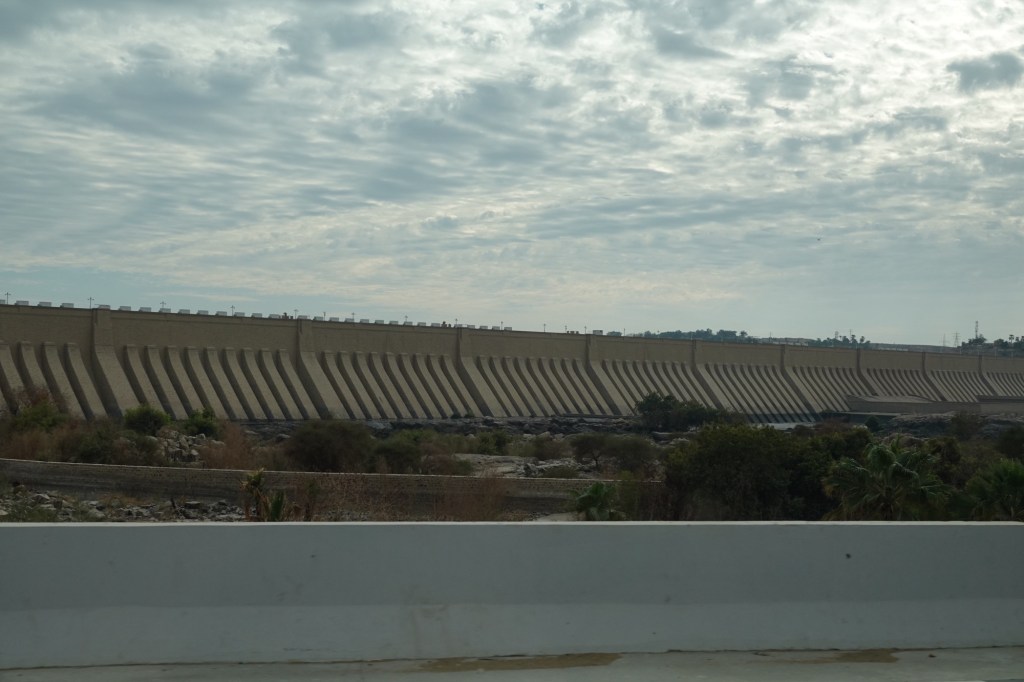
Egypt’s increasing population made the construction of a huge dam a necessity in order to supply water for irrigation and eliminate the devastating effects of cycles of flood and drought. Almost 1 million additional acres of arable land was created by the construction of the Aswan High Dam.
The story of funding the construction is a story of Western hubris and aggression, the Suez Crisis (known to Egyptians as the Triple Aggression) and Cold War machinations, ultimately resulting in the USSR providing money, technology, and a labour force to Egypt.
The high dam is 17 times as tall as the Great Pyramid of Giza, mostly of course under water, and earth-filled as opposed to concrete like the Hoover Dam.
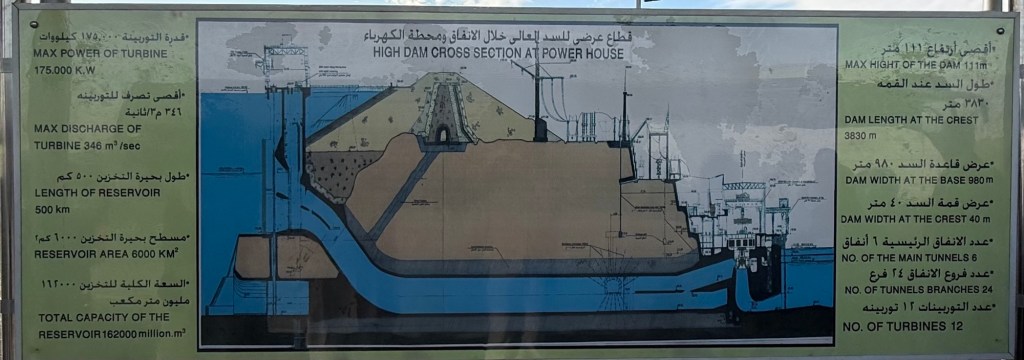
There are 6 tunnels each with 2 turbines which originally supplied almost 60% of Egypt’s clean power; now the percentage is much lower since there are lots of other clean power sources (solar and wind).
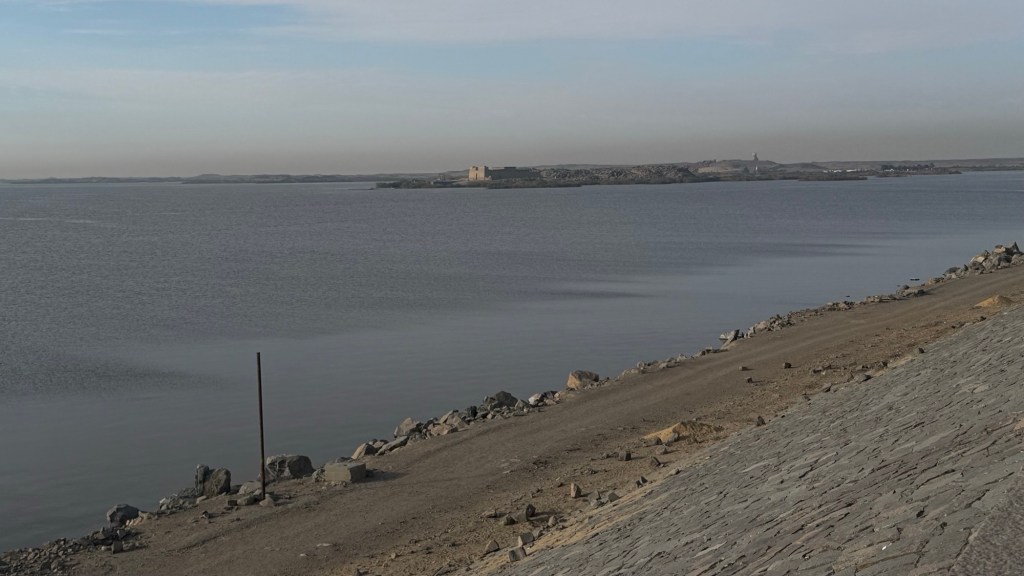
Lake Nasser (aka The Nubian Sea) represents 100% of the entire country’s water supply; 55 BILLION cubic metres of clean fresh water! It’s no wonder it is protected by the military.
The Russian loan ($150million 1960 USD, which would be $1.64 BILLION USD in 2025) has long been fully paid back, partially with premium Egyptian cotton.
Fun fact: Nubia’s name comes from the Egyptian word for gold; the lands flooded to create the lake and dam were the source of all of ancient Egypt’s gold.
Not so fun facts:
- the 100,000 Nubians relocated were moved out of their beautiful homes into condos, remunerated with only 50% of what they were promised, and their promise of return to their land delayed 60 years.
- The lack of silt moving down the river means artificial fertilizer now needs to be used, and there is no natural silt barrier preventing salt water from entering the river delta. That is exacerbated by the fact the river now flows more slowly than before, providing less resistance.
- Higher ground water saturation due to underground seepage from the lake, while a plus for farming, means that antiquities are now on unstable land.
- The very climate of Aswan has changed: evaporation from the lake forms clouds and creates both humidity and rain that were not previously known here.
- The sheer weight of the lake’s waters on the earth creates minor tremors.
Weighing the positives and negatives was and is complicated, but in the end Egypt decided that life giving water for the country’s people trumped all the other factors.
Our photo stop was at an area with the lake on one side and the narrowest part of the Nile (just 600m) on the other. It makes sense that the dam was constructed at the narrowest point.

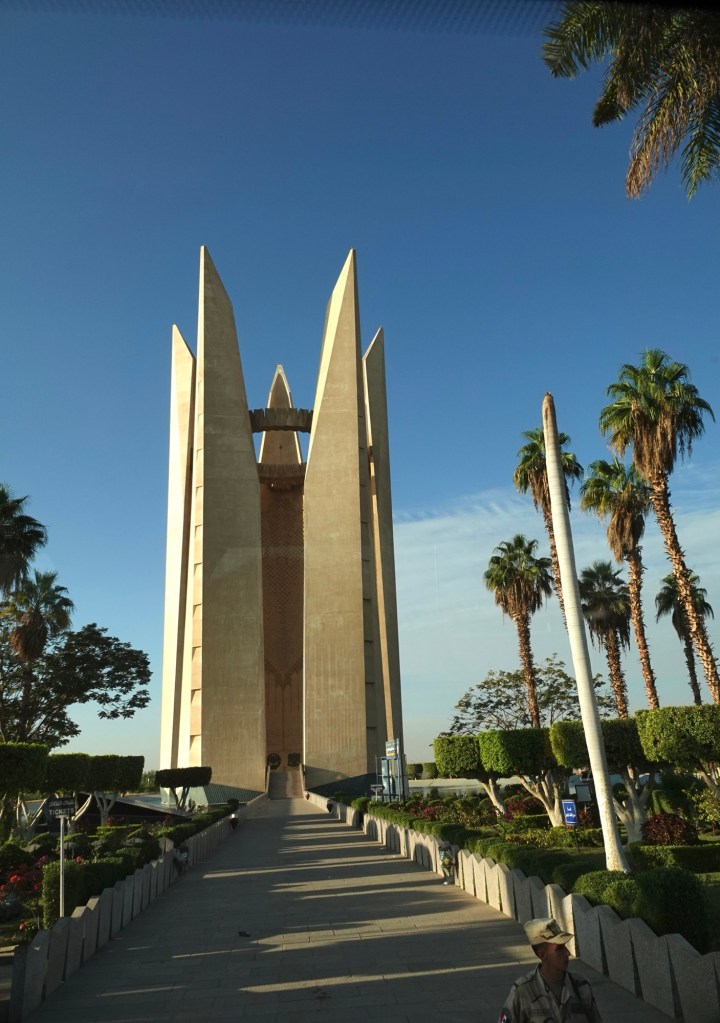
The lotus flower memorial, representing rebirth from the water, was unveiled in 1970 as part of the dam’s inauguration.

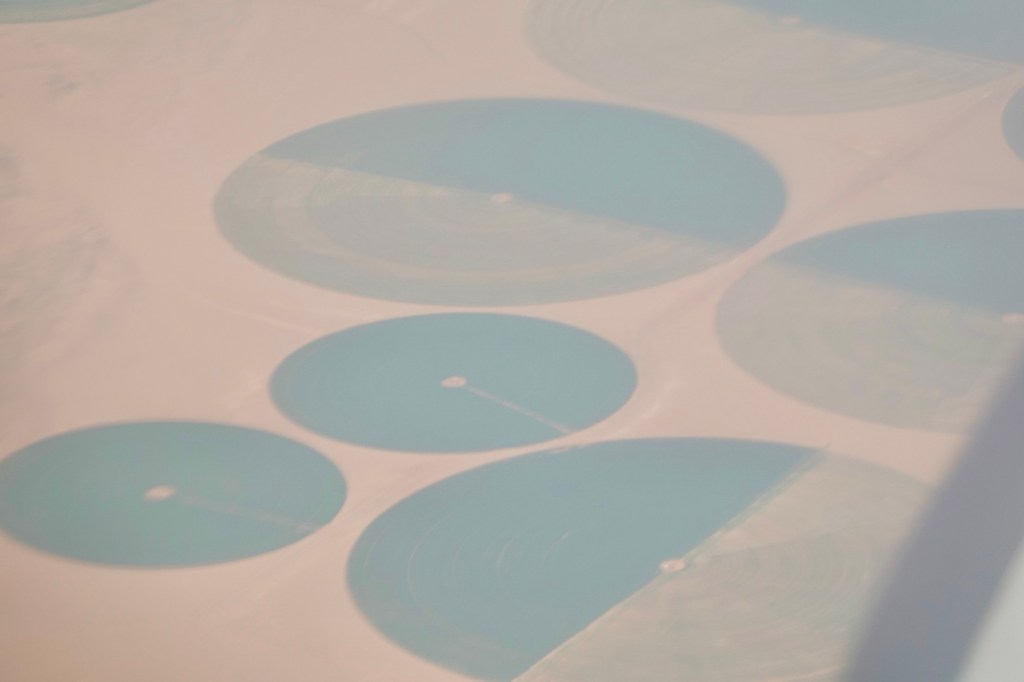
Our 35 minute flight to Abu Simbel was on Egypt Air, giving us a bird’s eye view of Lake Nasser, as well as a glimpse into the new fertile valley being created thanks to water availability. The green circles seen through our plane’s windows are in stark contrast to the arid sands of the Sahara. This is the Sharq El Owainat (East Oweinat) development of agricultural fields created using a modern farming method called center-pivot irrigation. They look like something from an Edward Burtynsky photo exhibition.
The Abu Simbel airport with its single gate features a beautiful frieze depicting Rameses II (centre) and his wife Nefertari (right)bringing offerings to the cow goddess Hathor. I was fascinated that Nefertari was wearing a crown that combined the headdresses of the gods Amun Ra and Hathor, since those crowns belong to those gods. Asim explained that since the pharoahs considered themselves equal to the gods, they didn’t hesitate in wearing their crowns. And from everything we know about him, Rameses II likely considered himself better than a god.

Before we actually visited the temples, Asim spent some time telling us about the potential options considered for preserving Abu Simbel. Some were quite amusing, like enclosing it in a glass dome and allowing it to be visited by submarine. The eventual plan implemented involved cutting the statues off their sandstone mountain face.
The two temples were sawed into over 1,000 blocks of up to 30 tons each, which were carefully labelled for reassembly 200m/656ft inland and 65m/215ft higher than its original location. An artificial mountain was built over a 60m dome in order to recreate the original aspect of the temples.
Moving the temple was its second miracle; the first was its creation around 1264BCE during the reign of Rameses II, the master of narcissism. In terms of pure statue height, Abu Simbel’s statues of Rameses II are taller than the heads of Mount Rushmore.
The first sighting of Abu Simbel’s statues is awe-inspiring in a similar way as getting the first glimpse of the library at Petra (Episode 240).

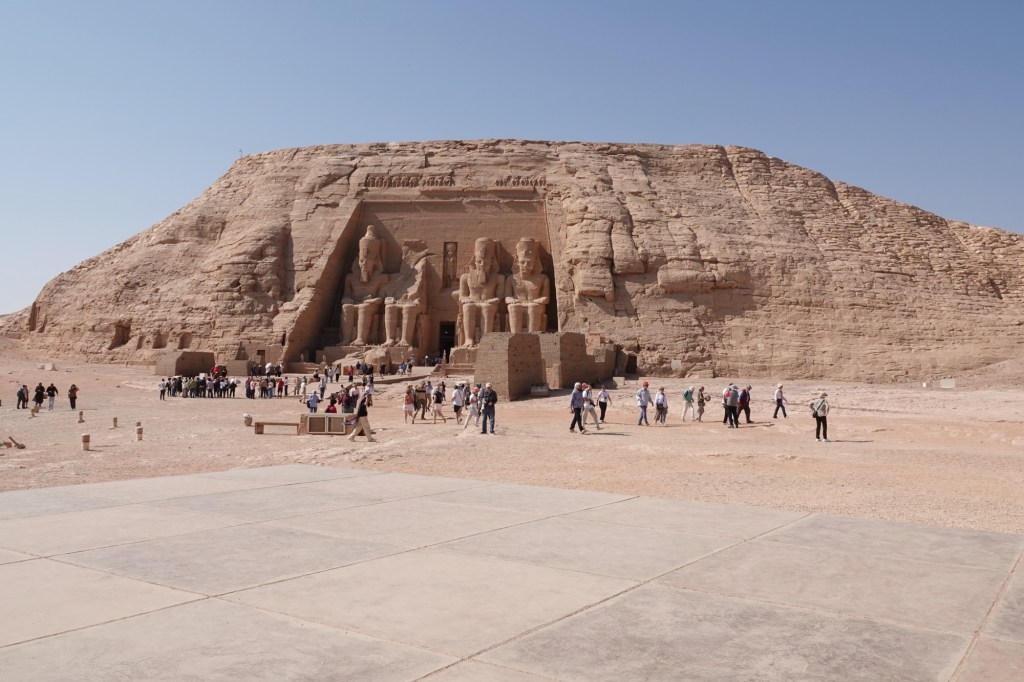
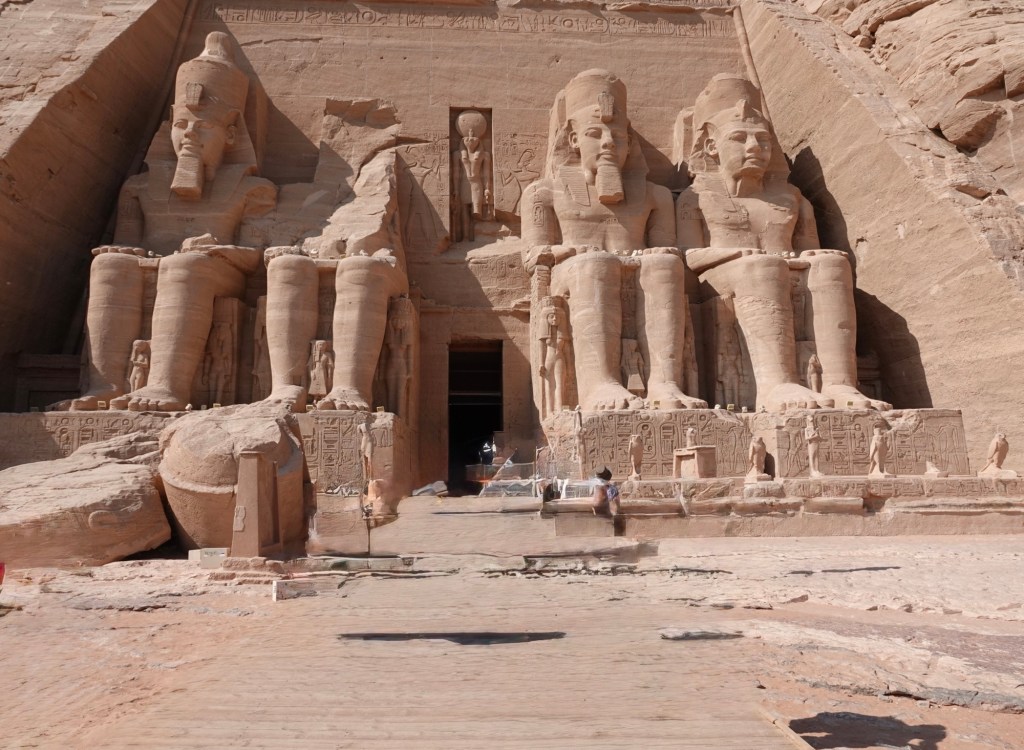

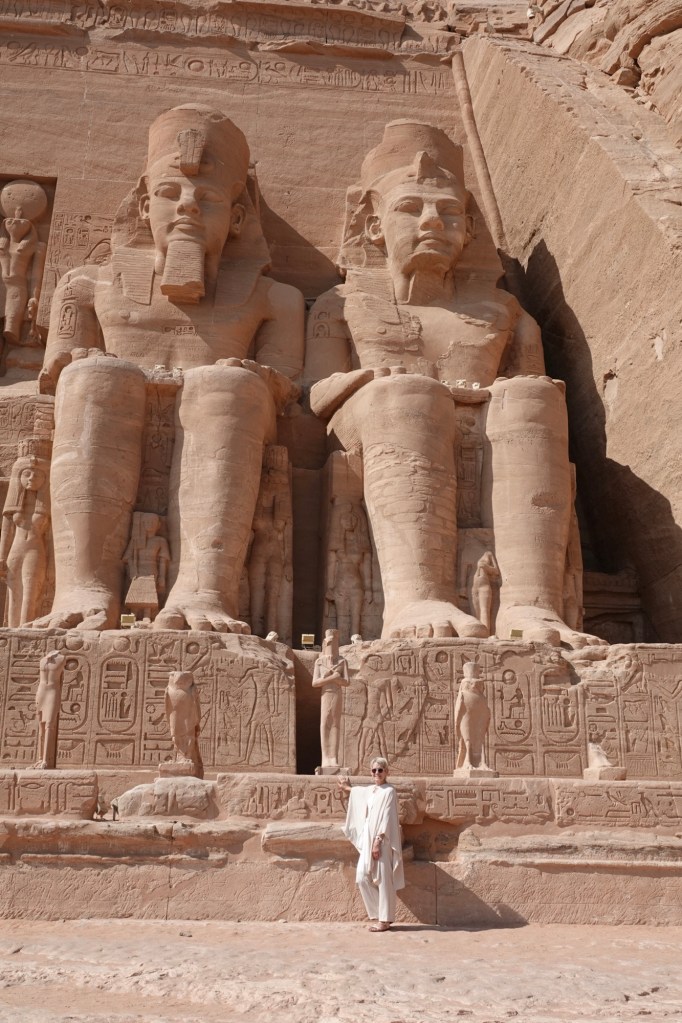
There are 22 baboons facing east with hands raised to welcome the sun.

At the heart of the facade is a statue combining Horus (the falcon headed god) and Ra (the sun god).

For all the complaining we do about modern teens tagging buildings, the graffiti on the statues here dates to early 19th century visitors to the site, including archeologists leaving their mark. And it’s not paint, but actually carved into the sandstone.

In the first room of the temple are 8 Rameses statues beneath a ceiling painted with images of the protective vulture goddess Nekhbet.
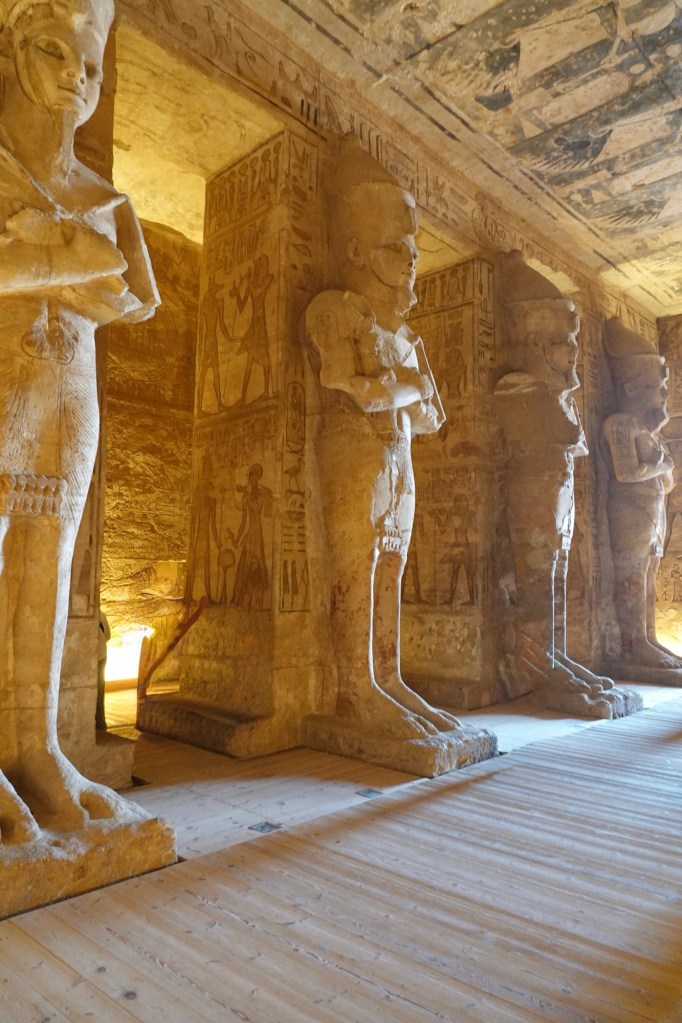

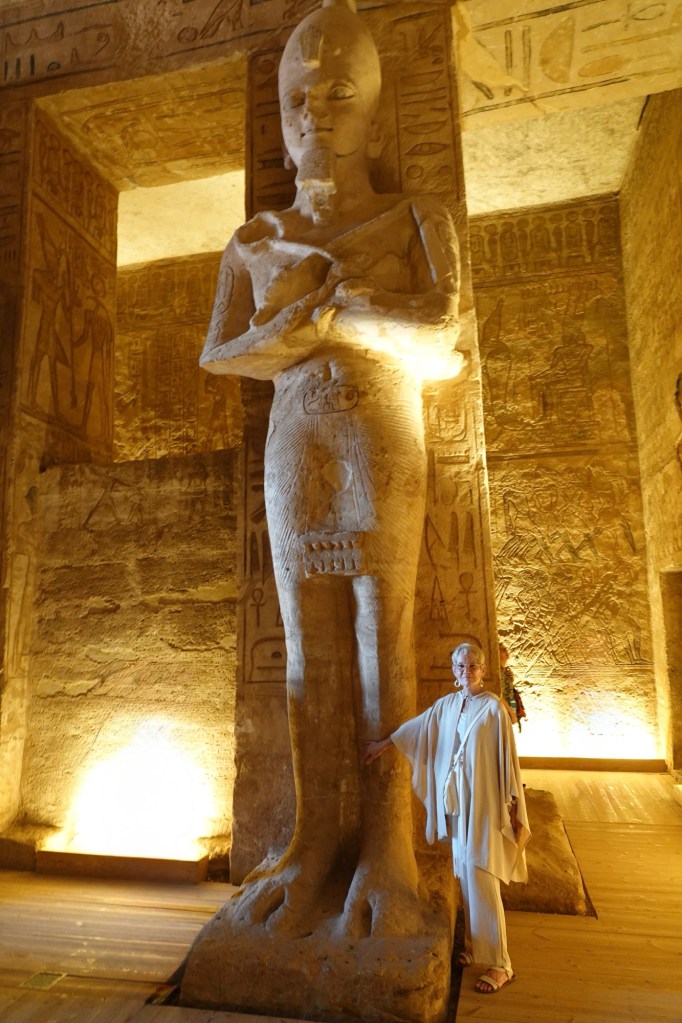
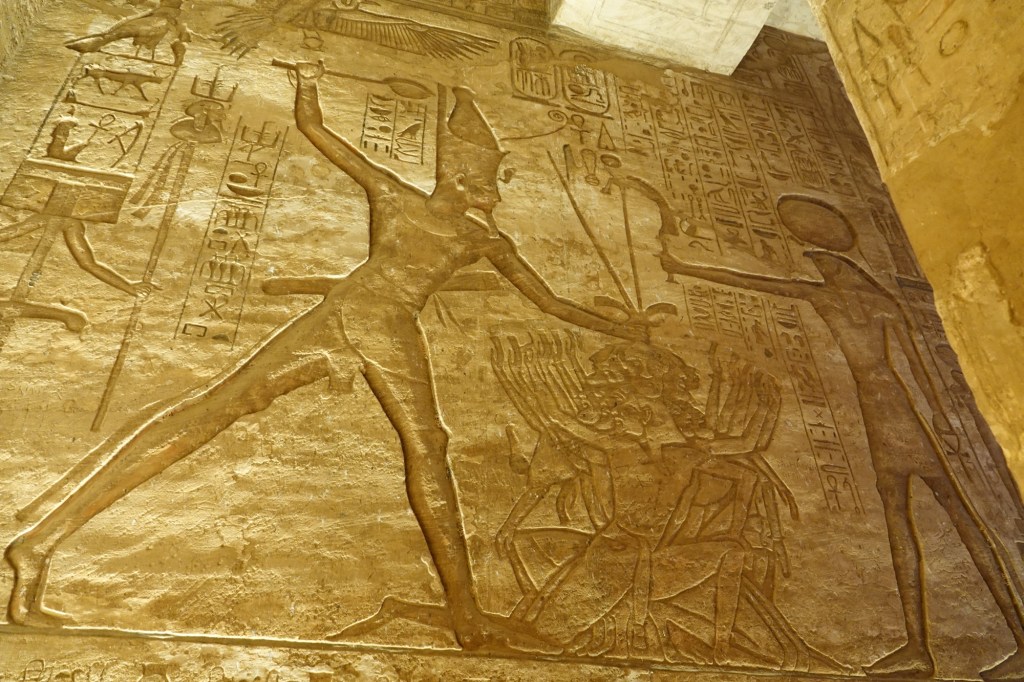
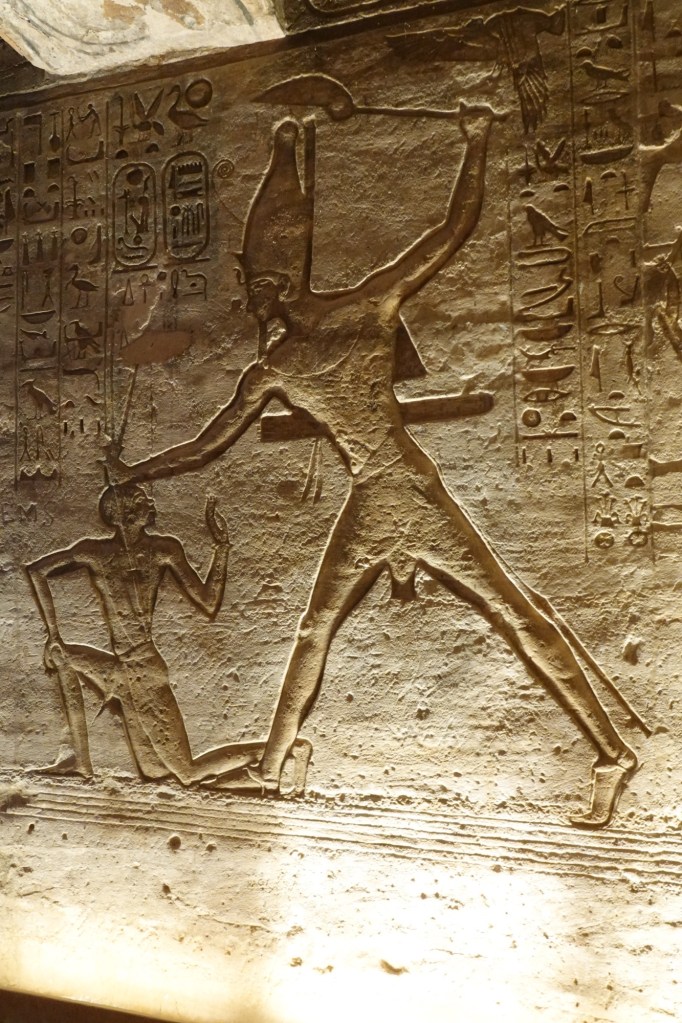
The carvings here depict the war between Egypt and the Hittites (modern day Syria), ending in the signing of the first ever recorded peace treaty, the text of which was found on one of the walls in the Karnak temple complex. Subsequent tiers of carvings depict war preparations, capture of spies, Rameses II both in his chariot and on his throne, the Hittite defeat, Rameses II killing the Hittite leader, and the pharoah attacking the Hittite fortress.

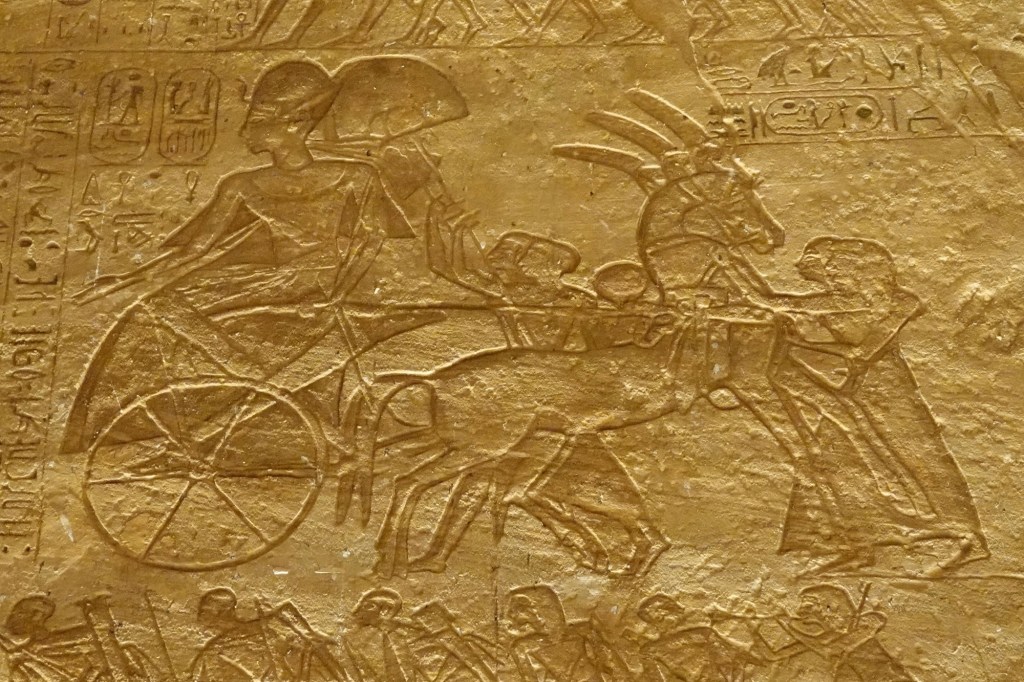
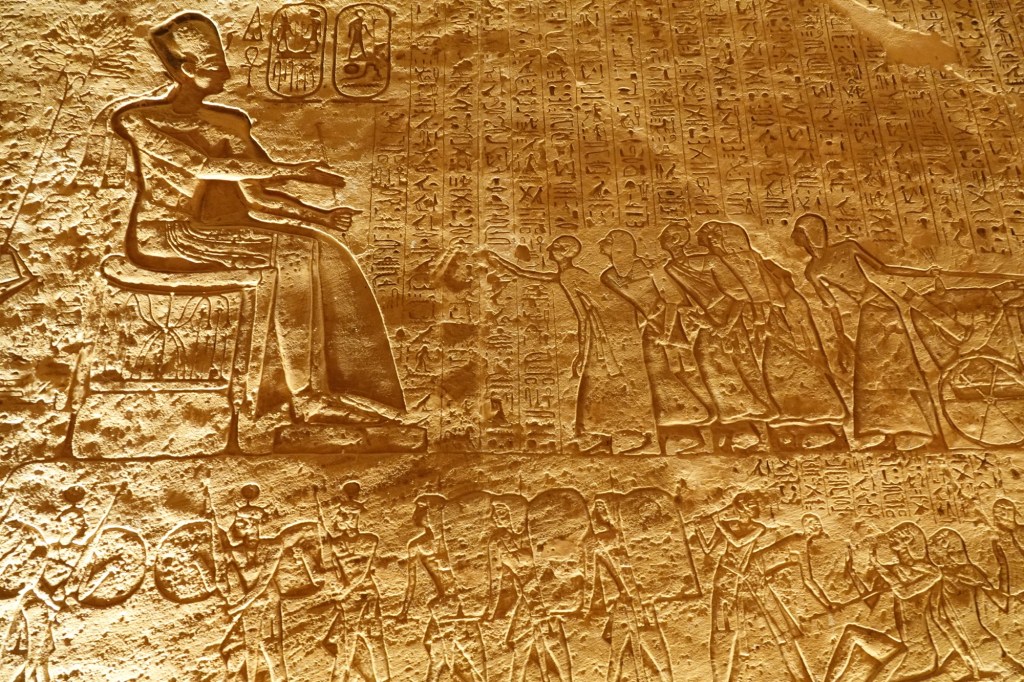
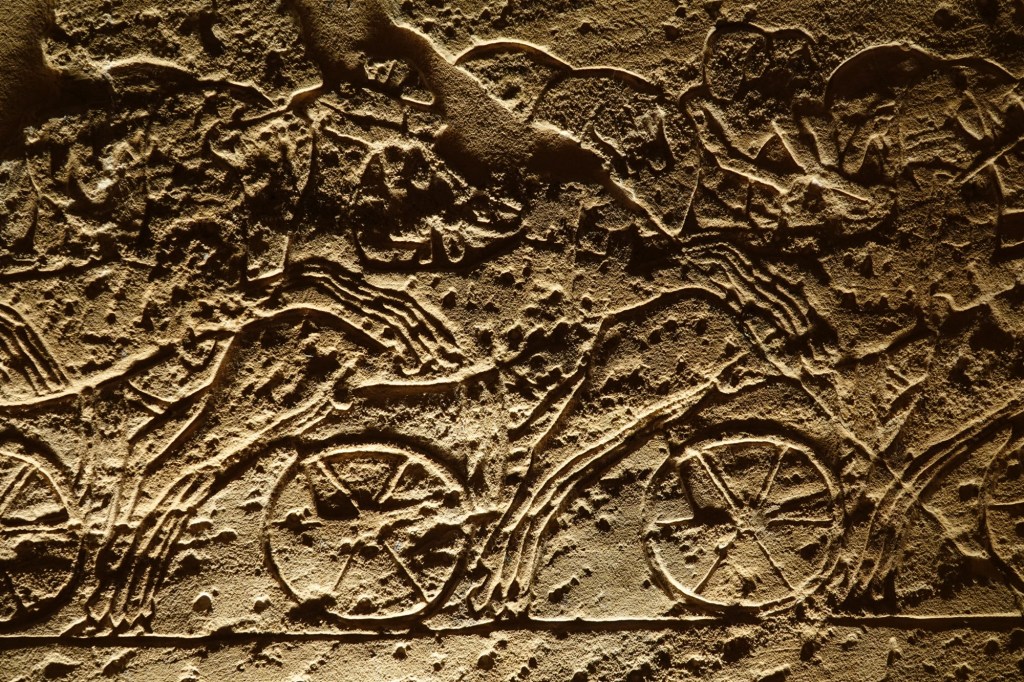
Great speed is represented in the final carving by doubling arms and legs on Rameses II and his horse. Look carefully at Ted’s photo below to see the effect the carvers created.
The last carving shows Rameses II delivering his captives to the god Amun Ra.
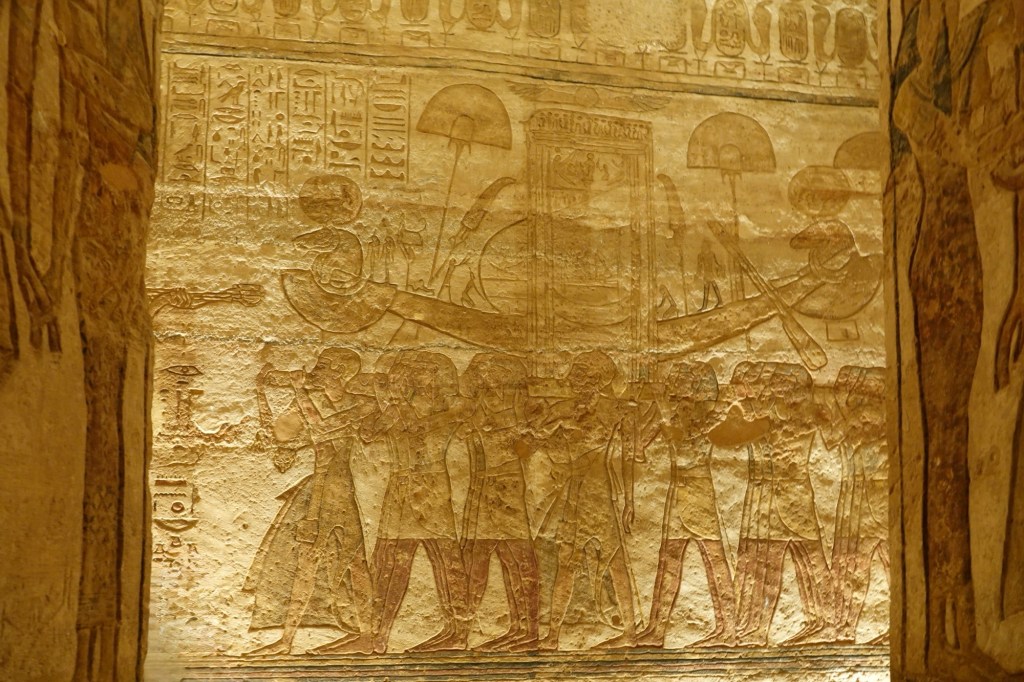
A side chapel features a series of reliefs showing priests bringing offerings to the gods. It is reminiscent of a cartoon strip!

The last carving was incomplete, with evidence of the black ink sketch ready for incising.


In the second room the carvings depict the priests delivering offerings to the gods, but now by boatloads!
In the innermost chapel are 4 statues carved into the rear wall: (left to right) Ptah the god of creation, Rameses II as a god, Amun Ra, and RaHorusAchti. The chapel was poorly lit, and we could not get close to the statues.

Moving the temple changed the dates on which the sun enters the temple and lands on Rameses face to October 22nd and February 22nd each year, just one day later than the original 21st of those months. That is the semi-annual phenomenon recreated in the GEM’s main gallery.
The second smaller temple at Abu Simbel is dedicated to the worship of Rameses II’s first and favourite wife Nefertari, conflated with Hathor – the goddess of love, beauty, music, dance, fertility, joy, and motherhood.

We noticed that, true to form for Rameses, while Nefertari’s temple was intended as a love song from the pharoah to his wife, 4 of the 6 large statues on its façade are of him, and only 2 of her.
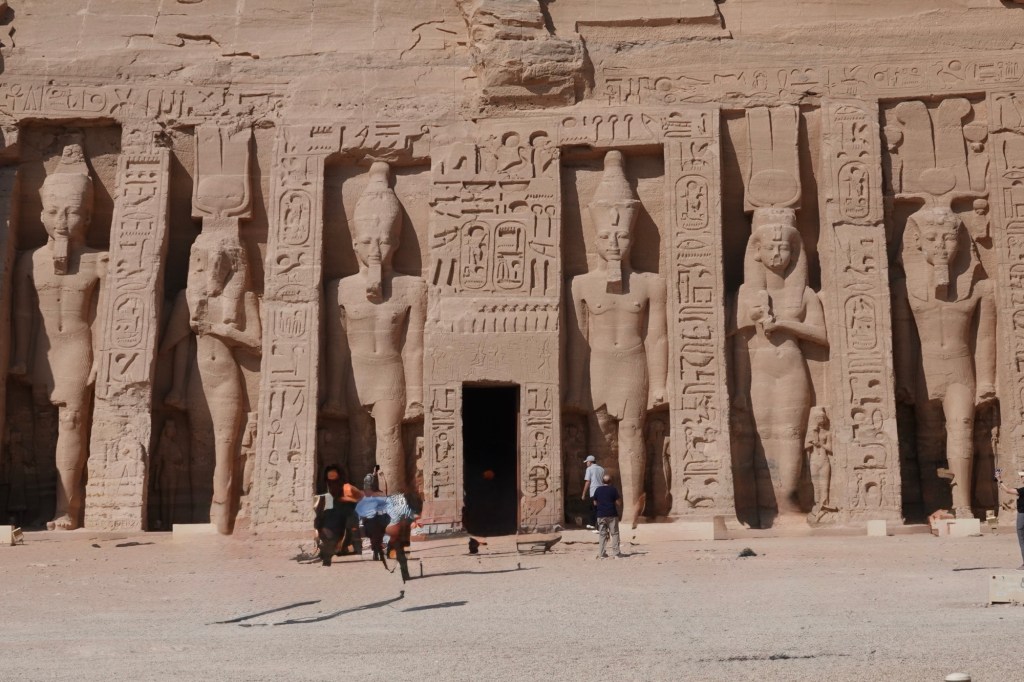

The pillars inside the temple depict Nefertari’s face, but there are no giant statues of her to mimic those of Rameses II in his temple…

… and the walls still depict mostly Rameses II’s deeds.
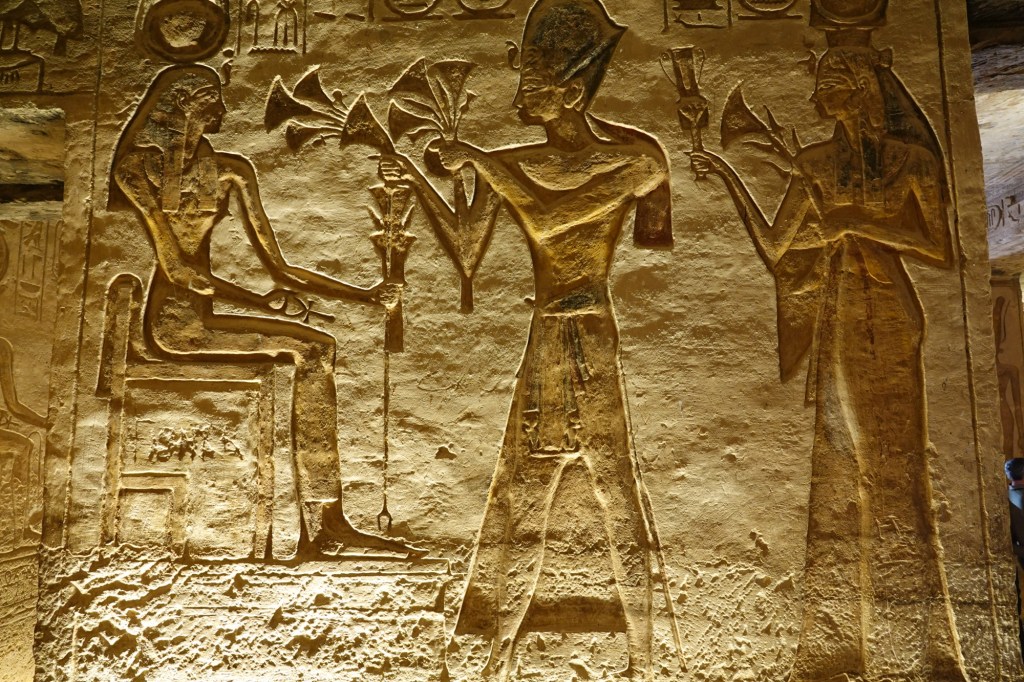
There are, however, lots of reliefs showing Nefertari either giving gifts to the gods, or receiving gifts.

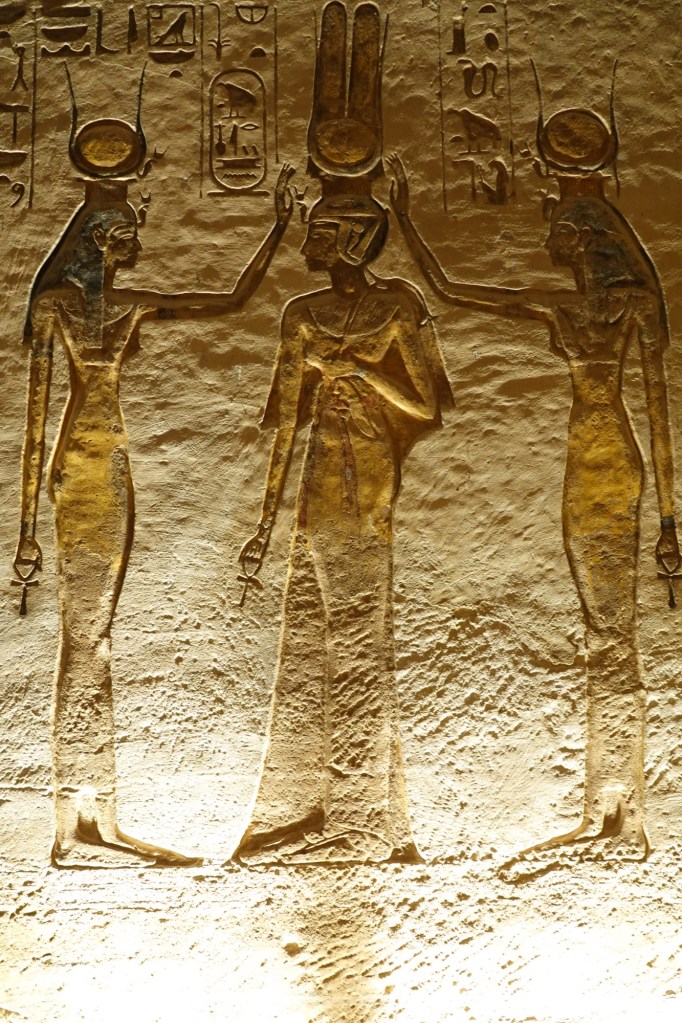
After touring the site, we asked why Rameses had chosen to build his magnificent temples here at Abu Simbel. The answer lay in making a political statement and a show of power to the bordering countries. Proximity to the gold mines of Nubia certainly didn’t hurt.

It was an absolutely amazing day. As we left the site, a bench beckoned. Clearly, I was perishing from the heat and in need of a fainting couch.
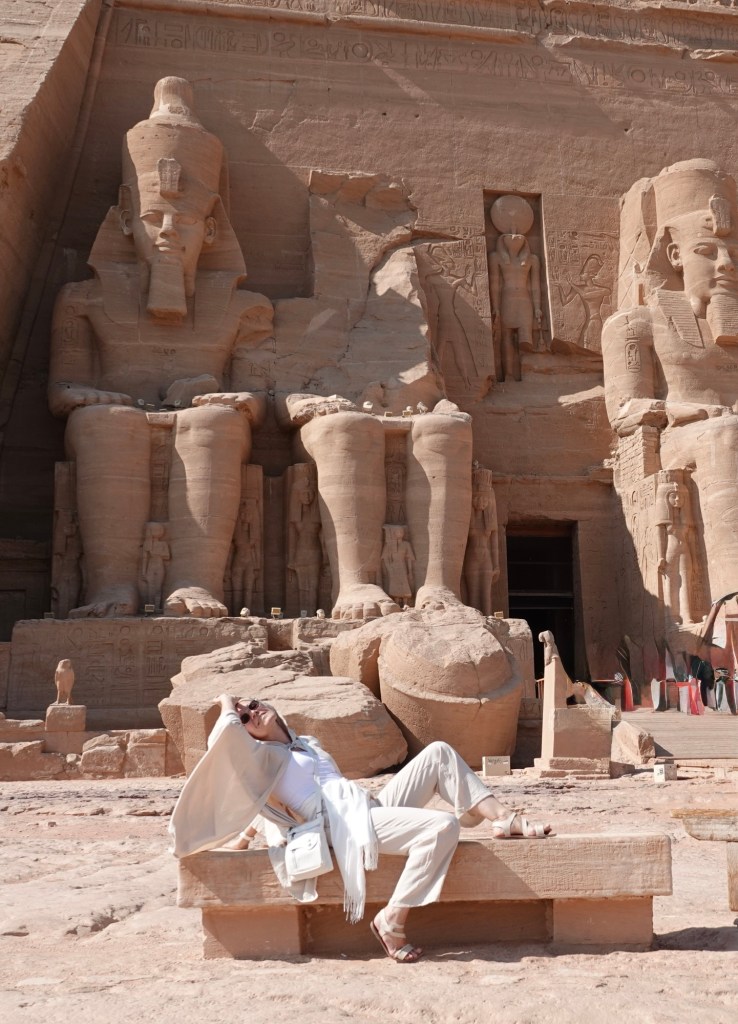
It wasn’t just me being silly. Ted was clearly half dead from the heat: arms crossed in death, but foot forward in life!

After dinner, we enjoyed a cultural performance of Nubian music and dance.

It was very much audience participation and SO much fun!
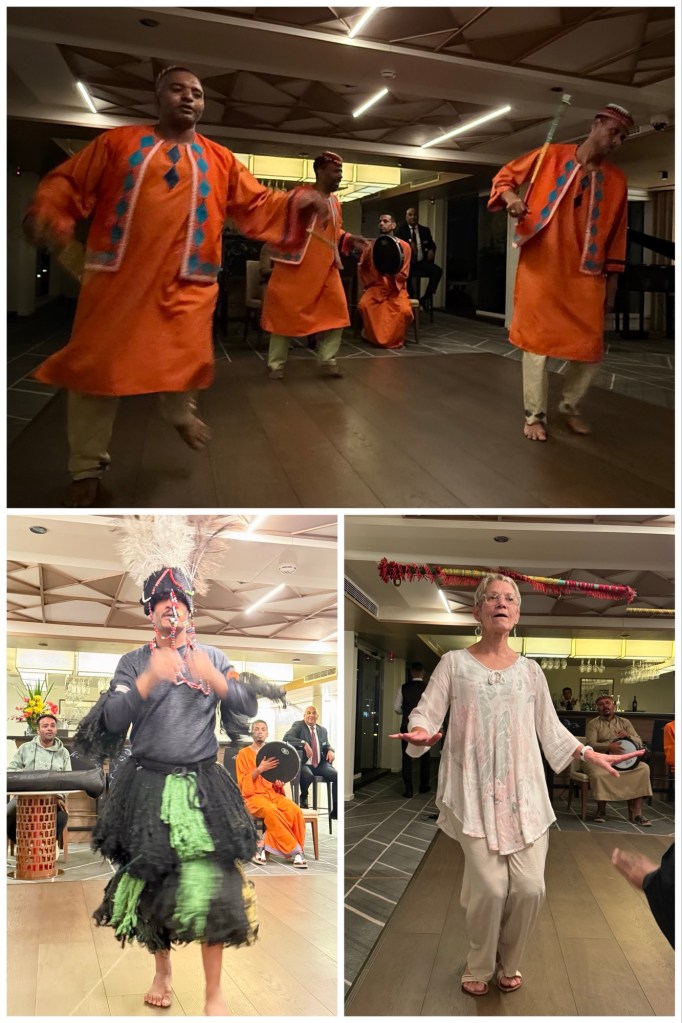
Ted video’d some of the fun:
Tomorrow we’ll take a small boat down the Nile to visit a Nubian village, a temple, and the Papyrus Institute. Egypt continues to have new things to reveal and share!
 Rose and Ted’s Excellent Adventure
Thank you and Ted so much for this blog. I had to cancel my trip to Egypt due to health reasons, but following along with you is almost better!Sent from my iPhone
LikeLiked by 1 person
Glad we could take you along with us!
LikeLike
Amazing! We won’t get to Abu Simbel on our trip in May. It was fascinating to learn how they moved the temples. What a project!
LikeLiked by 1 person
Truly one of the wonders of modern engineering!
LikeLike