Before our excursion today I looked back at our 2022 visit to Luxor (Episode 244 – Temples, Tombs, & Giants). That was a very full day, especially because we were travelling from Port Said – a 3-1/2 hour long bus ride.
It was wonderful to be back here docked just 15 minutes from the temple sites.
But first, we needed to get from Cairo to Luxor.
06:00 sharp – Everyone on the bus, luggage stowed, and headed to Cairo Airport for our one hour long charter flight to Luxor.
The PAS charter check-in was not quite ready for our group, but the nice thing about a charter flight is that they are not leaving without us. We were on board and wheels up by 08:10.

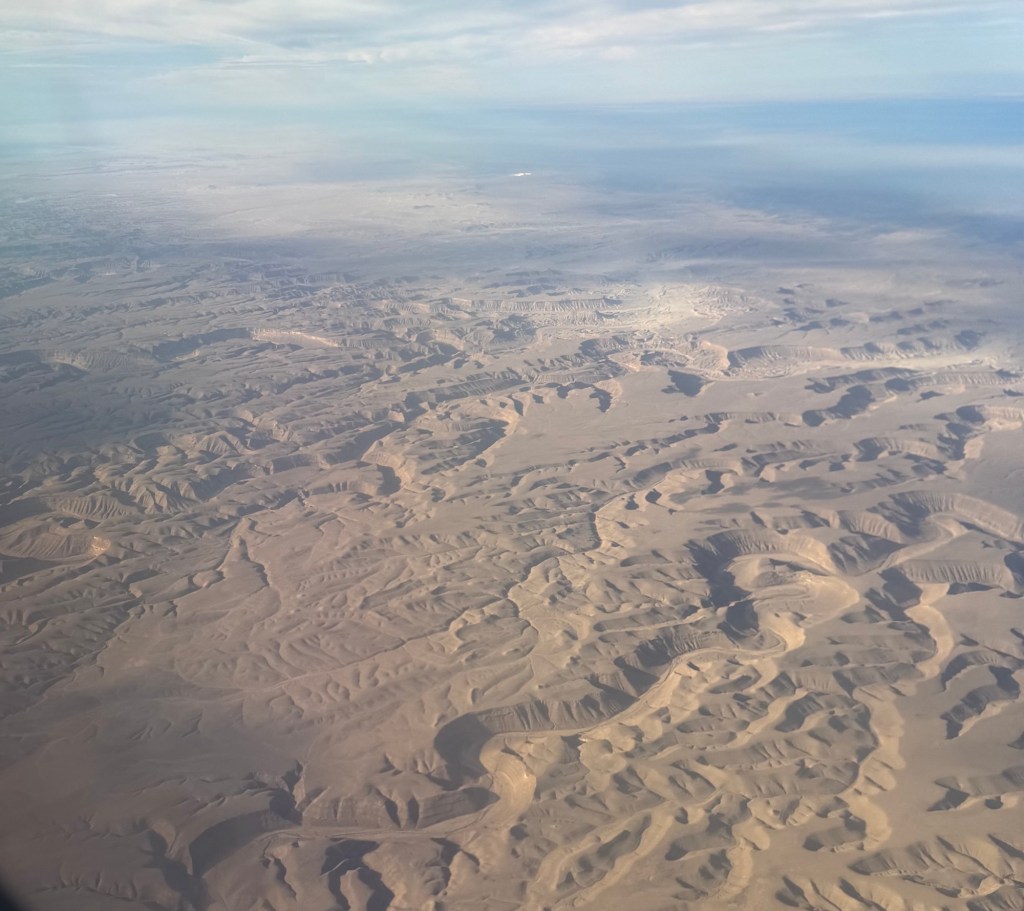
We flew over 500 kilometres of wind-sculpted sand. At times it looked as if the giant fingers of a child god had been drawn randomly through the softest imaginable beach sand; at other times the sand seemed to trace veins and capillaries across a living land.
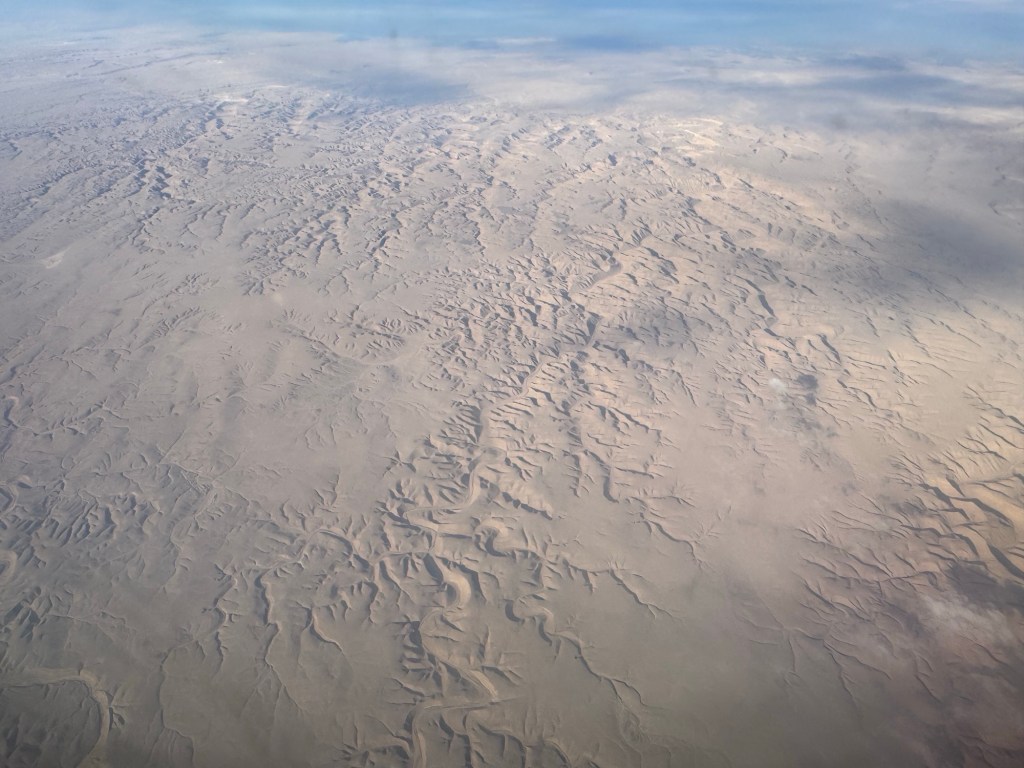
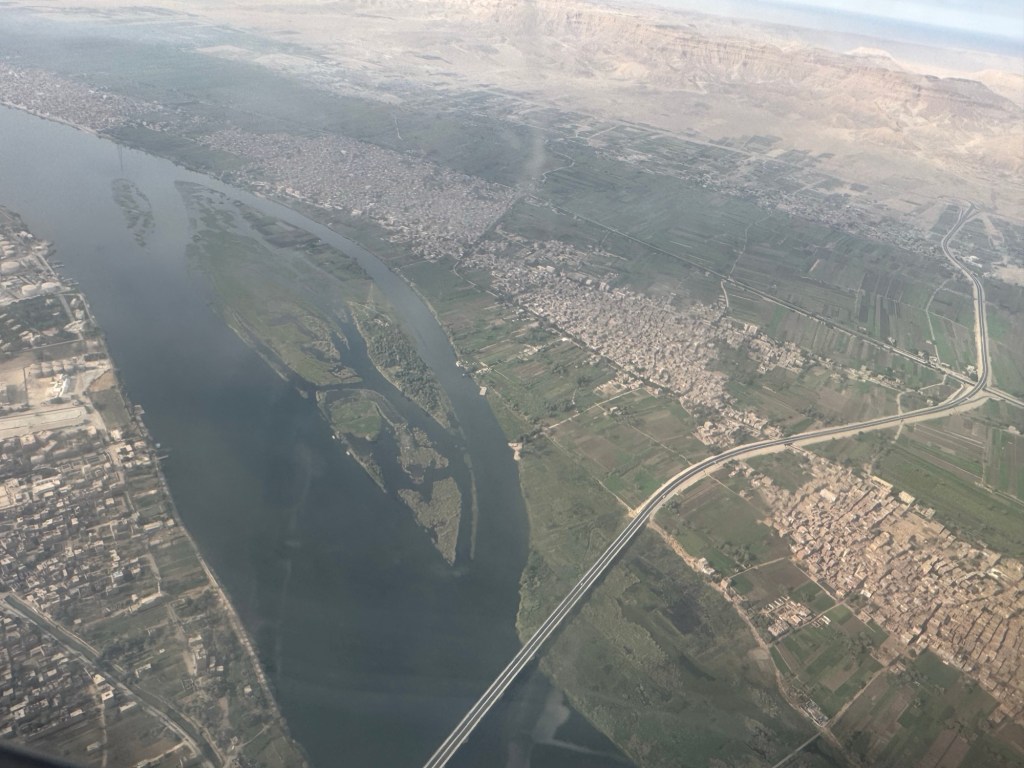
It was only when we reached the Nile again that we saw the green of farmers’ fields – but only as far as irrigation reaches.
We deplaned directly onto the coach that would take us on the very short drive to the site of the Karnak temples.
Note: we did not visit the exhibits of the Heritage Centre or the library, which were being painted.
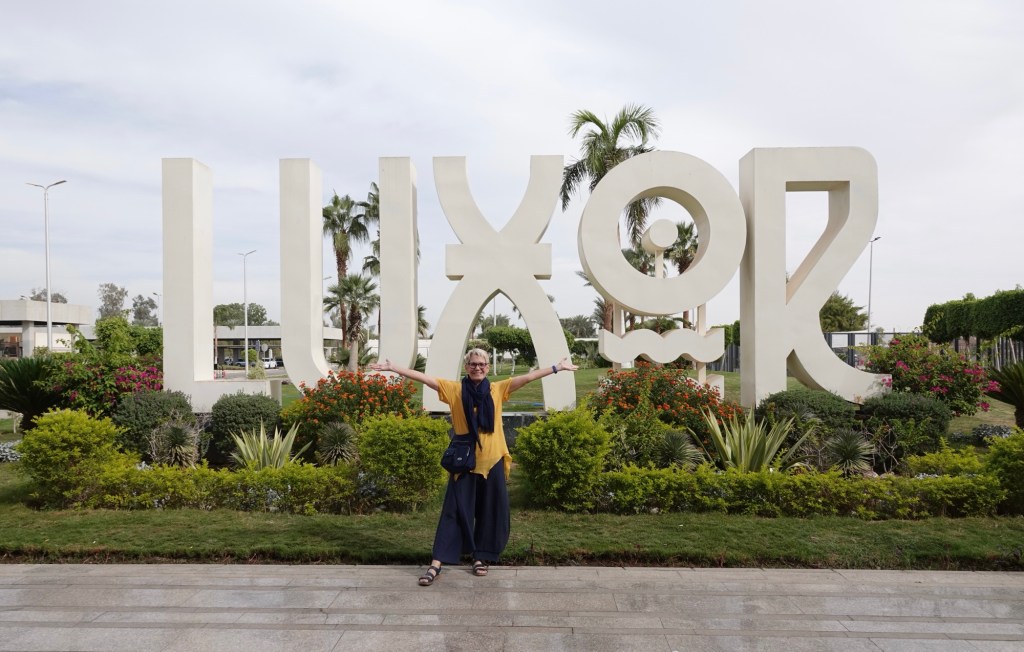
The original Egyptian name for this city was Waset. Later, the Greeks called it Thebes (not to be confused with Thebes in Greece). Luxor, which means “palaces”, has only been the name of this city since the Arabs arrived here around 639CE.
Luxor is located within the irrigation plane of the Nile, making it quite green for a desert city.

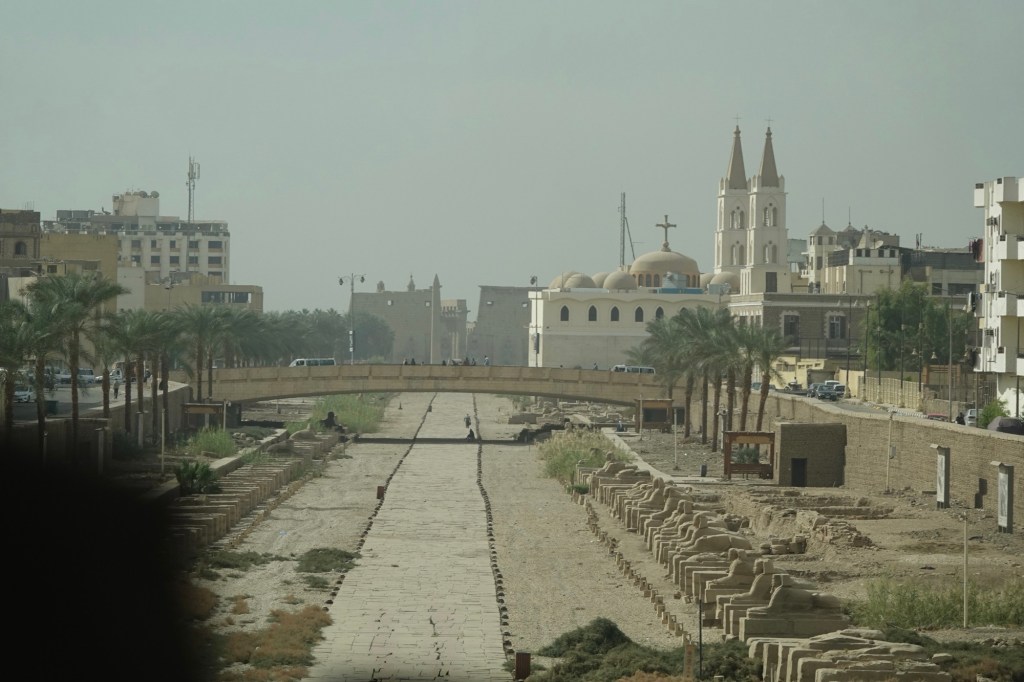
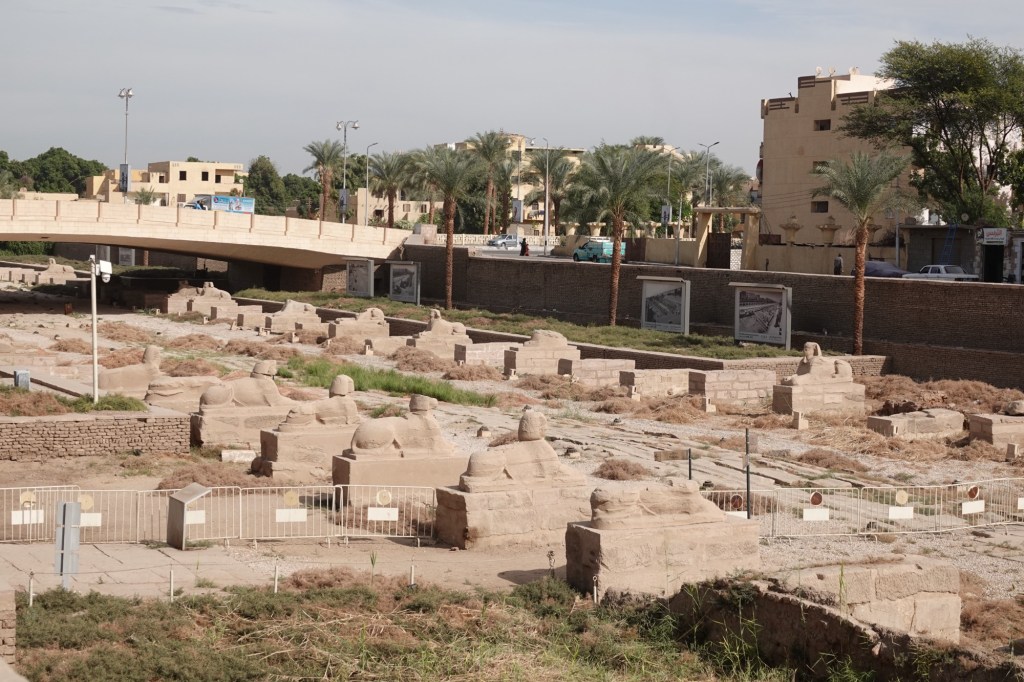
We got our first glimpse of the 3km/2mile long avenue of the sphinxes built by Rameses II . All 1042 sphinxes have the head of the pharaoh. Walid quipped that the pharaoh REALLY loved his own face! At one end of the avenue are the Karnak temples; at the other end is Luxor temple.

The temples at KARNAK were built over a period of almost 2000 years beginning around 2000BCE and not completed until 365BCE. All the temples within the complex were dedicated to the sun god Amun Ra, the king of the gods. We learned that Ra was always worshiped as a triad with his wife and son.
That millenia long construction timeline meant that many pharoahs each put their own stamp on the constructiom.
The main Temples to Ra are built along the east west axis, which is typical for Egyptian temples. Unusually for temple complexes, there is a second axis north-south.
The temples cover an area of 182 acres of land, making it the world’s largest temple complex.
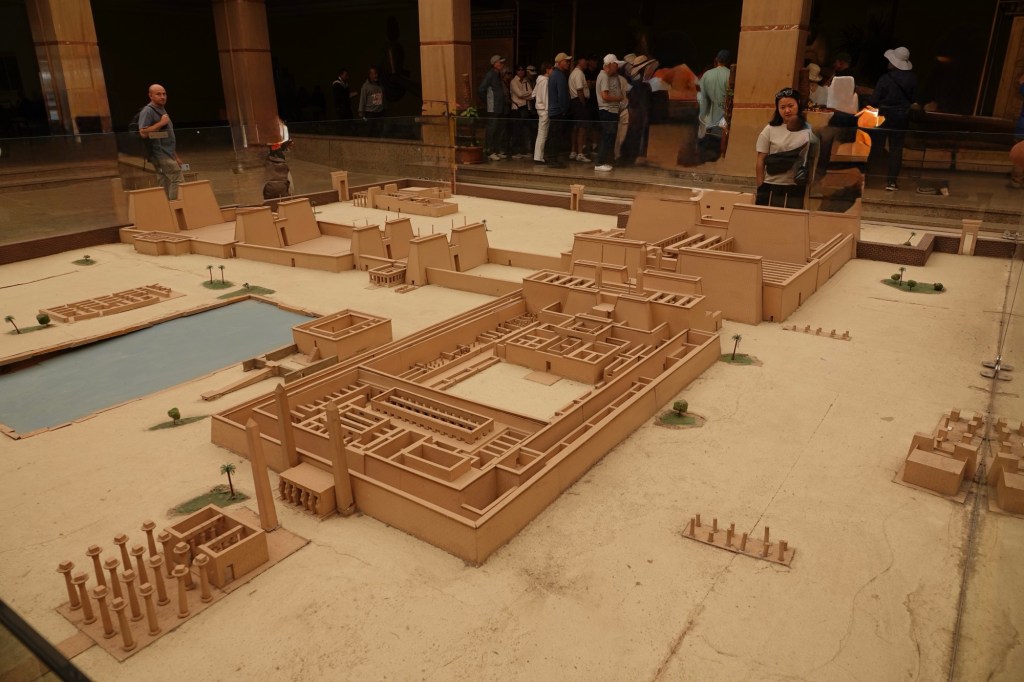
The entire complex was enclosed in a mud brick fence, which excluded everyone except priests and pharaohs from accessing the temples.
We entered the complex through the gate which is the newest part of the complex, built just before Alexander the Great conquered Egypt.
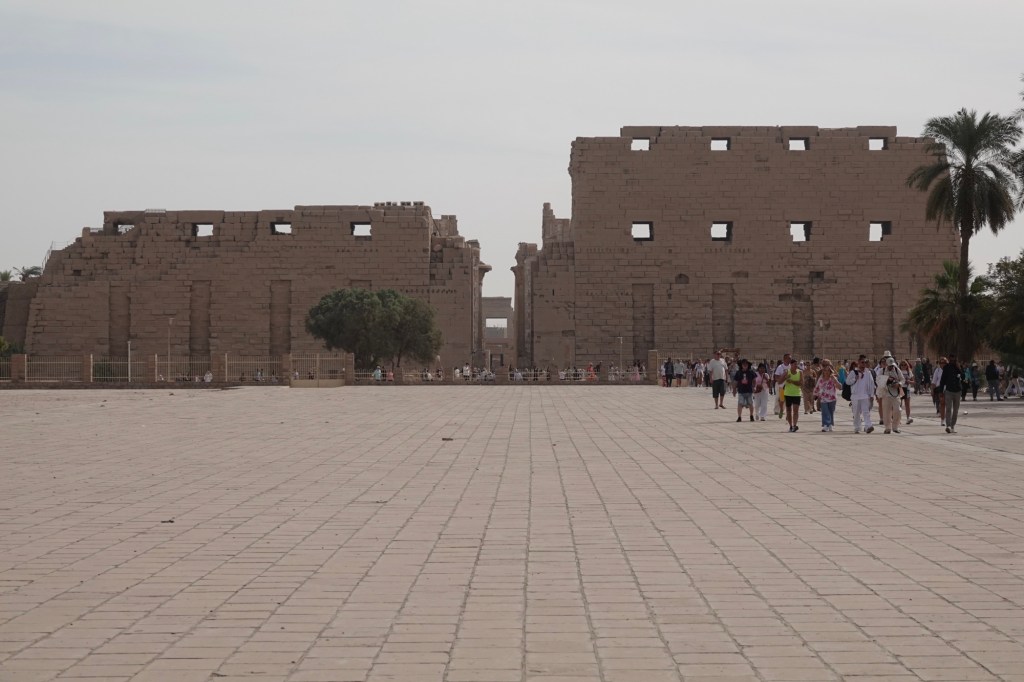
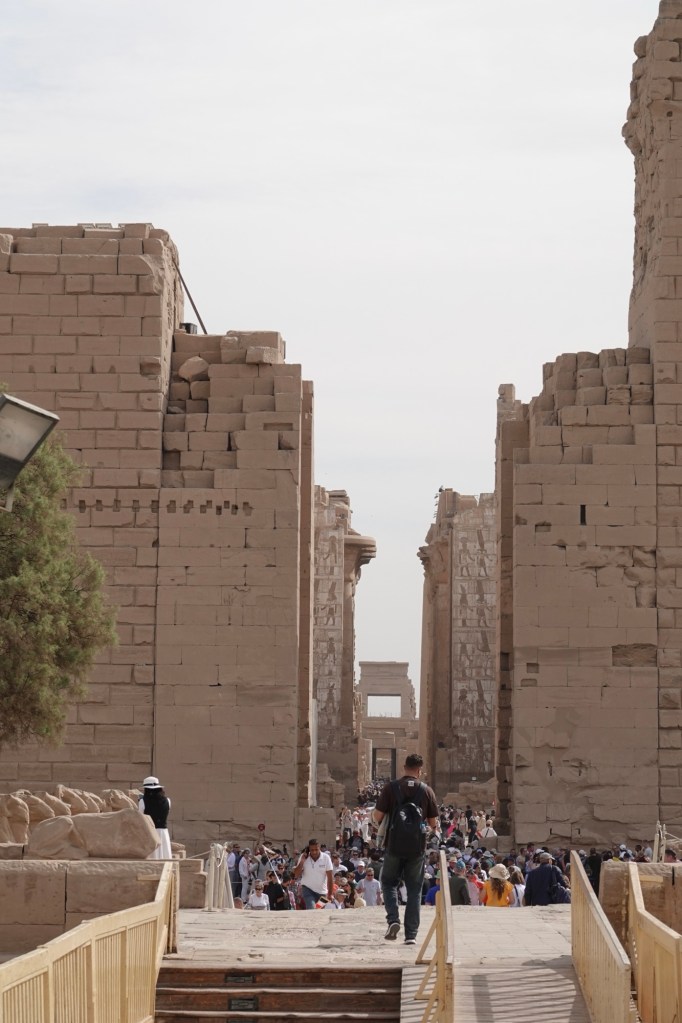
It’s amazing today to realize that the Karnak temple complex was designed to be directly on the bank of the Nile river. The Nile no longer floods and it’s difficult even to see it from the Karnak temples; it is currently approximately 1 mile from the outer wall of the complex.
Our guide, Walid, had some interesting ancient celebrations to tell us about. In ancient (pre Aswan Dam) times, when the Nile flooded annually, the priests would take a huge golden statue of the God Amun Ra, put it on a wooden boat, and sail it down the Nile from Karnak to Luxor. It was a great 21 day celebration for the population who normally would not be able to see the statue. During that time, the gold statue of Ra and the gold statue of his wife were placed in a temple together in a celebration of fertility: the Nile’s water arriving to begin a new season of growing.
The gold statue of Ra has never been found. It is assumed that if and when it was stolen, it was melted down.
One of the things that remains is the phalanx of sphinxes lining the avenue entering the gate to Karnak’s temples. These sphinxes that have rams’ heads on lion bodies, distinct from the 1042 sphinxes of the avenue connecting Karnak and Luxor temples, who all have the head of the pharaoh Rameses II. The ram heads are in honour of the ram headed god Khnum, who was another manifestation of the sun god Amun Ra.


Held between the lion paws of the ram headed sphinxes are statues of King Tut, indicating who erected the sphinxes. The pharoahs were all about memorializing themselves.


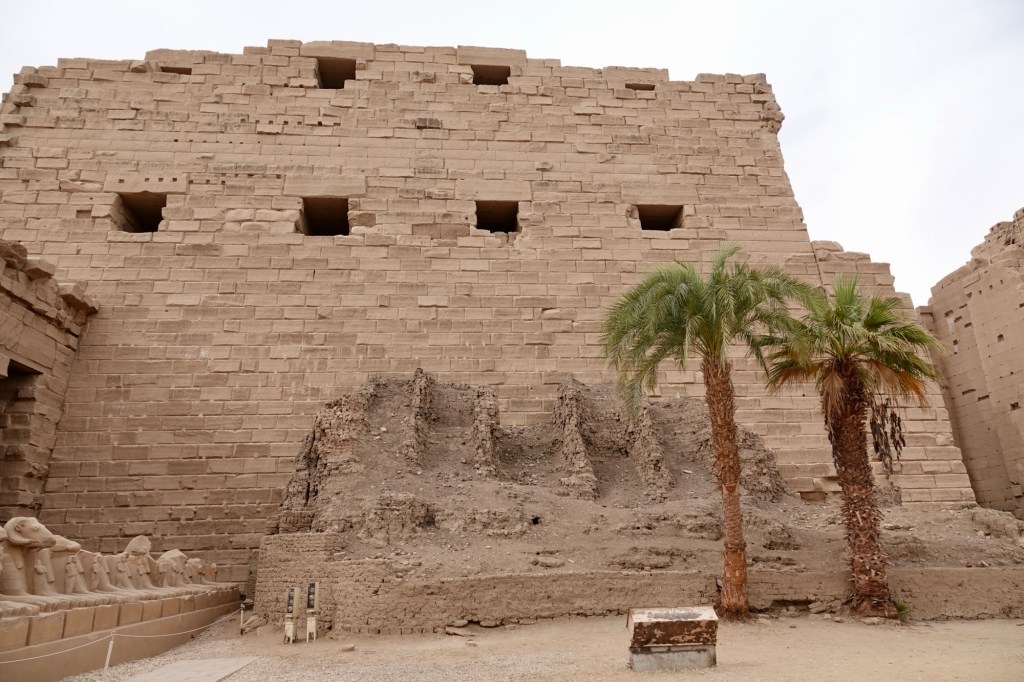
This entrance gate was left unfinished. It was the last portion of the complex built, and when Alexander the Great arrived in Egypt in 332 BCE, construction stopped.
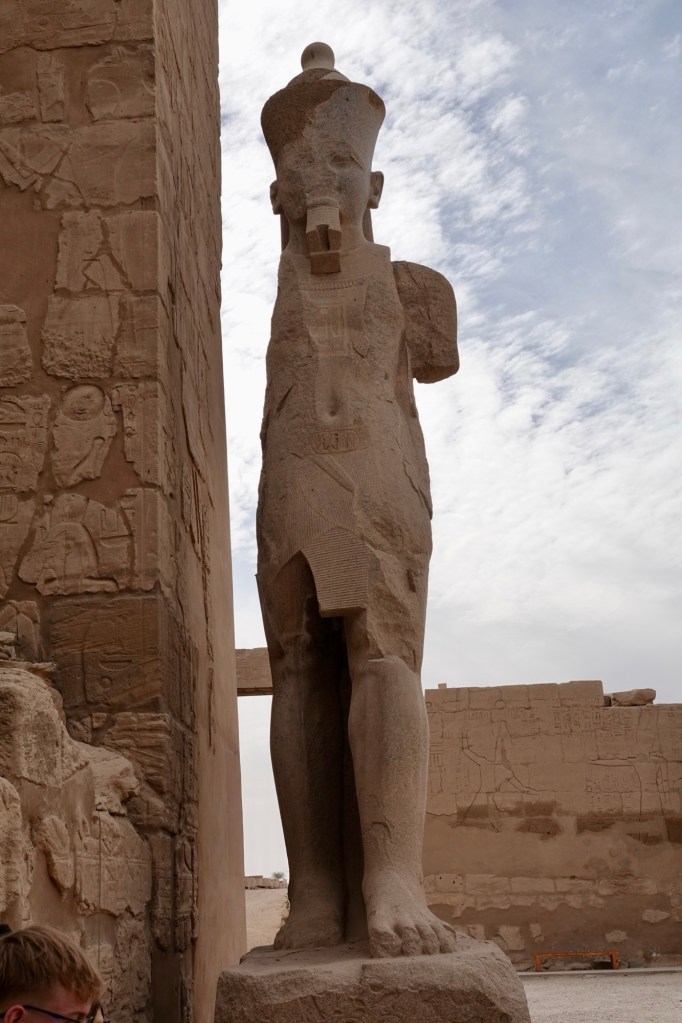
Here in the sunlit courtyard are two massive statue of Rameses II second.

One is a statue created after his death, as we know, from the fact that his arms are crossed, and his legs are together. At his feet is a statue of his beloved first wife Nefertari.

The other statue shows Rameses alive, as we can tell from his legs in motion. Both statues are made of granite from Aswan city.
The pile of mud bricks that remains against the back of the entrance gate was originally a ramp involved in allowing construction of the gate walls. The ramp would normally have bern removed in stages as the wall was clad with smooth limestone, but here that stage never happened, and when work stopped the ramp was simply abandoned.
On the other side of the gate is a three room shrine that was built by Pharaoh Seti I.

When he reigned, Rameses III built a double shrine, standing on the opposite side of the temple courtyard, outdoing Seti I. There’s a pattern of each subsequent pharoah trying to outdo their predecessor.
There were originally 10 lotus-topped columns in the first courtyard, of which only one is still complete. The tops of the others simply collapsed over the millenia.
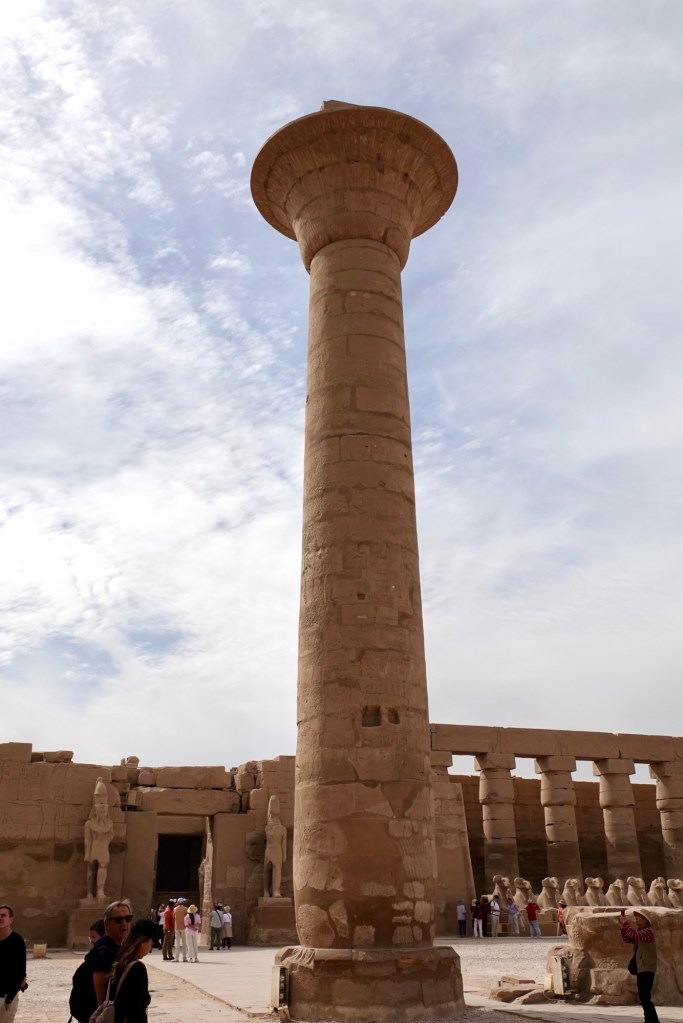
The massive size of the temple is quite humbling, in the same way that soaring cathedrals in Europe are intended to humble those who enter.
We walked among the colossal columns of the Hypostyle Hall, the “hall of columns” dating to around 1400BCE.


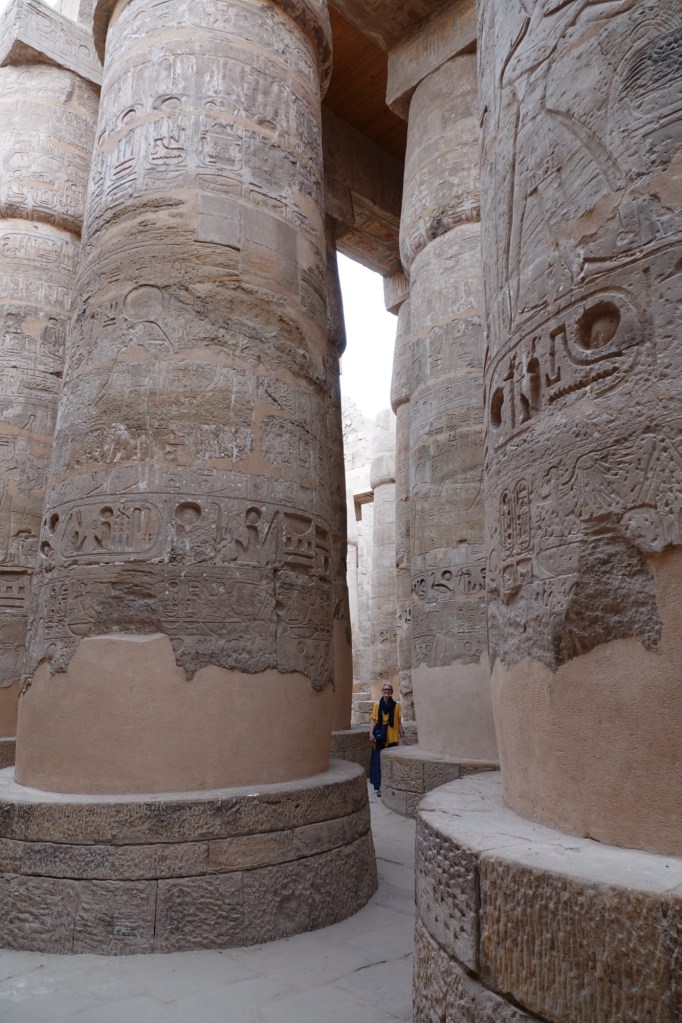
The construction of this area, which would originally have had a roof, features two columns on each side which are much taller than all of the others. That indicates that the ceiling was not originally flat. In the raised area created by the taller columns, window openings were added in order to allow better air circulation, and light to access to the hall. Light coming in from above to draw the eye upward is a design feature that lasted well into the neo-gothic period in Europe’s great churches.

Another interesting thing about these columns is that they would originally have been painted with bright colours. As we remembered seeing when we visited here in 2022, there is still evidence of the original colors, incredibly vibrant given the age and the exposure of these columns since their initial discovery (buried under sand) in the 17th and 18th centuries . The roof would originally have been colourfully painted as well.
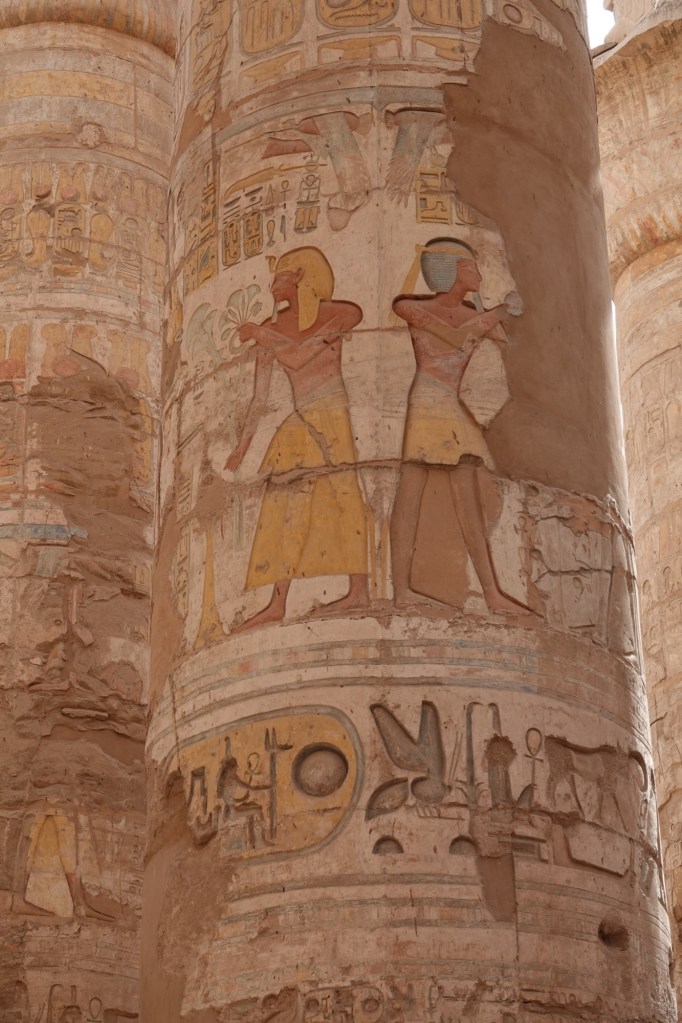


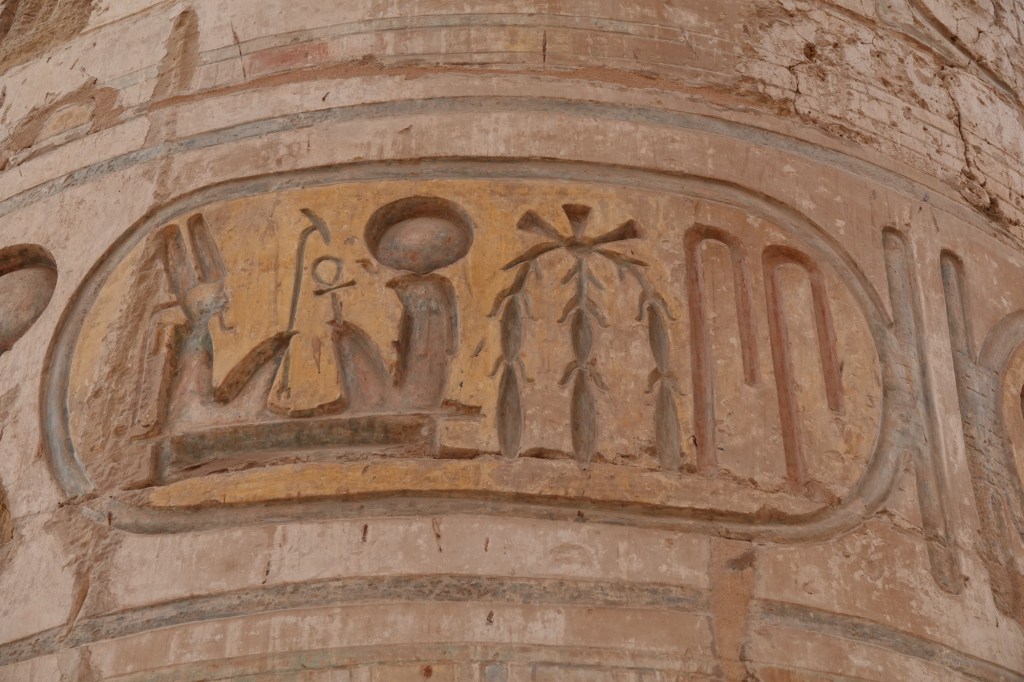
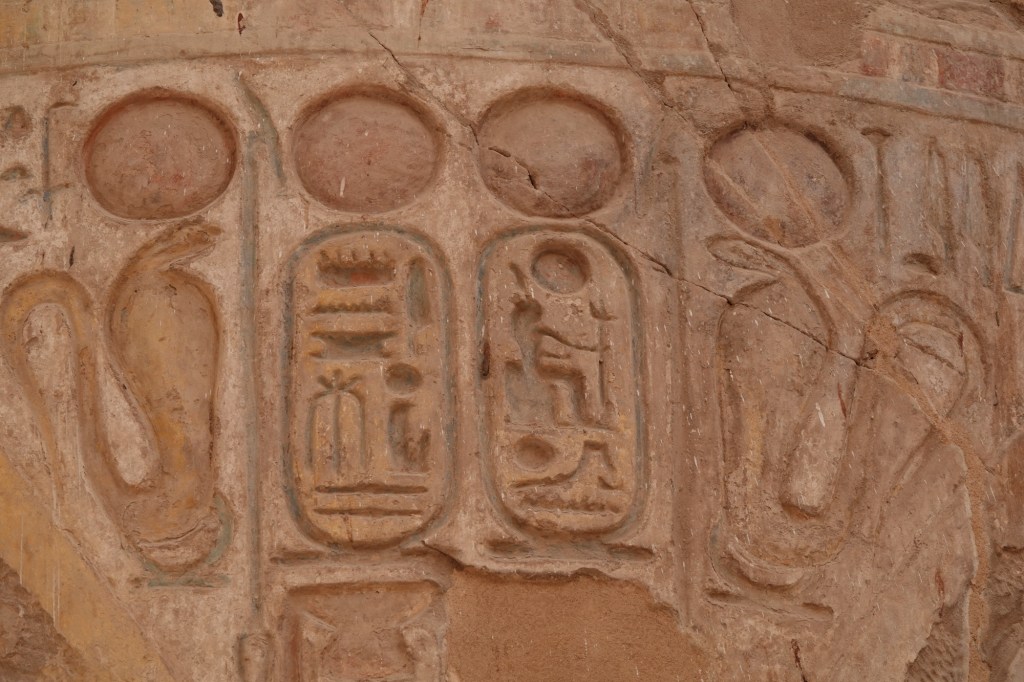
There are 134 columns in total, designed and built by only two pharaohs, Rameses I and Seti II. When Rameses II came to power, it was rumoured that he was very jealous of the fact that these beautiful columns had been erected by his father and grandfather, so in true Rameses II fashion, he had the cartouches with the names of previous pharaohs “erased” and his own name put into those cartouches. We know this because some of the cartouches near the tops of the columns were missed and still show the names of Rameses I and Seti II . The new cartouches are also much more deeply carved; perhaps he thought someone else would do exactly what he had done.

Fun fact: just “Rameses” in hieroglyphics is actually the three symbols Ra Me Su , “Son of Ra”. The modern spelling Rameses or Ramesses (like calling the pharoah Khufu “Cheops”) is thanks to the British.
There are two huge surviving obelisks in the temple complex. Each obelisk is made from one single block of granite, cut and carved in Aswan city, taken from the quarry to the riverbank on sand ramps, and then transported here along the Nile. We also now know how the massive obelisks were lifted into their final upright position. First the pediment was erected. Next, a thin limestone wall was built beside the pediment. The 87 ton obelisk was laid onto a sand ramp, ropes attached to holes in the wall, and send removed at the appropriate places in order to tip the oblique upright. Despite Walid’s explanation, I’m not sure I can picture it.
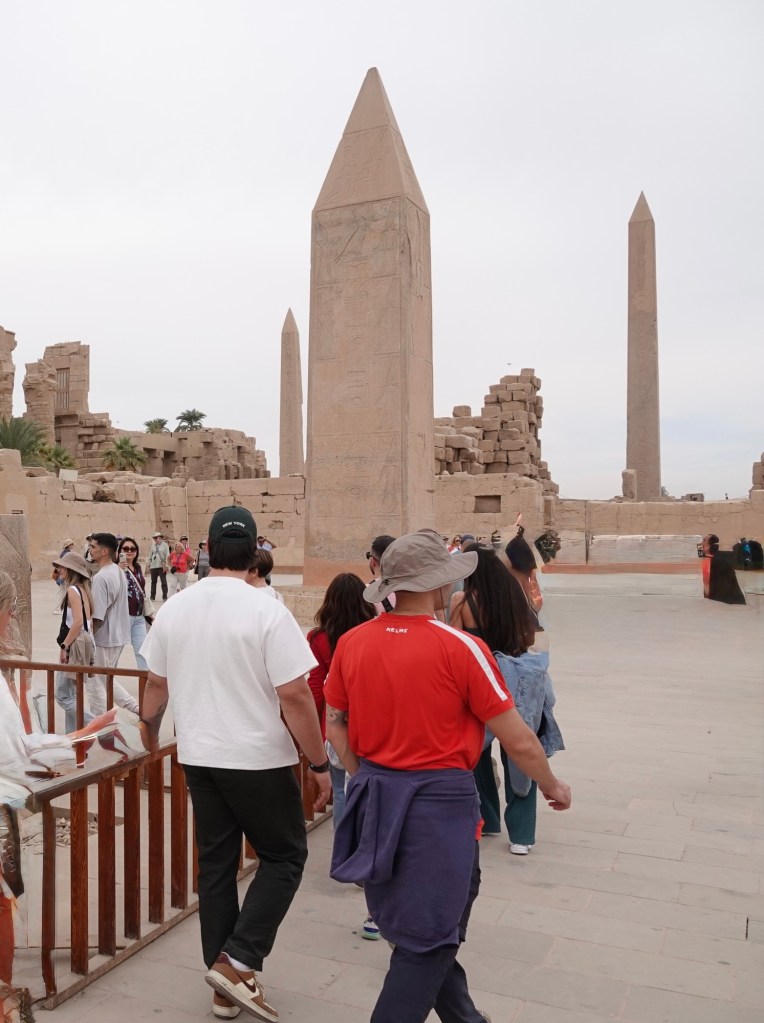


The largest obelisk perhaps ever erected in ancient Egypt (above) was erected by Queen Hatshepsut. There were originally two matching obelisks, but the queen’s stepson destroyed the second one out of hatred and revenge. He would have destroyed the second obelisk as well, but the granite was just too strong. Instead, he erected a mud brick wall around it to hide the sight of any carved cartouches that contained her name.
We stopped for a moment beside the only portion of the toppled obelisk. It allowed us to get a really close look at the carvings and pyramid tip of an ancient obelisk.

I’d never thought about it before because we think of obelisks as “obelisk shaped”, but the idea is that it is shaped like an index finger, representing the pharaoh pointing directly at the Sun God Amun Ra. The pyramid shaped tip would originally have been covered with gold leaf.
As we learned was the case for tomb decorations, the carved symbols on the obelisk were first drawn on the granite in black ink. Then a master craftsman would double check the work to ensure there were no mistakes before allowing actual carving and cutting to begin.
We walked alongside the huge pool that was dug to allow the priests to do their ritual ablutions.

Beside the pool was a short column with a carving of a scarab beetle on the top. While the scarab is generally considered to mean good luck, in ancient Egypt it was actually a symbol/harbinger of fertility. For females, walking around the column with the scarab counterclockwise three times is a wish for pregnancy, seven times is a wish for marriage. Go clockwise instead of counterclockwise, and you will stop having children, or get divorced. Walid laughed at the men who were walking around the column, because they clearly didn’t get the concept.

We then had 20 minutes of free time, really just enough time to get back to our coach on time and revisit a couple of places to get photos with fewer people in them.
At the new Luxor Heritage Centre we watched a 20 minute documentary about Luxor, before walking out to get another view down the Avenue of the Sphinxes. Before the statues were exposed, houses had been built over this area. Walid told us the story of one house with an exposed sphinx on its lower level that the family’s children used like a hobby horse!
Then it was time to board our ship for lunch shared with two lovely Australian coupled, and time to unpack and settle in a bit.


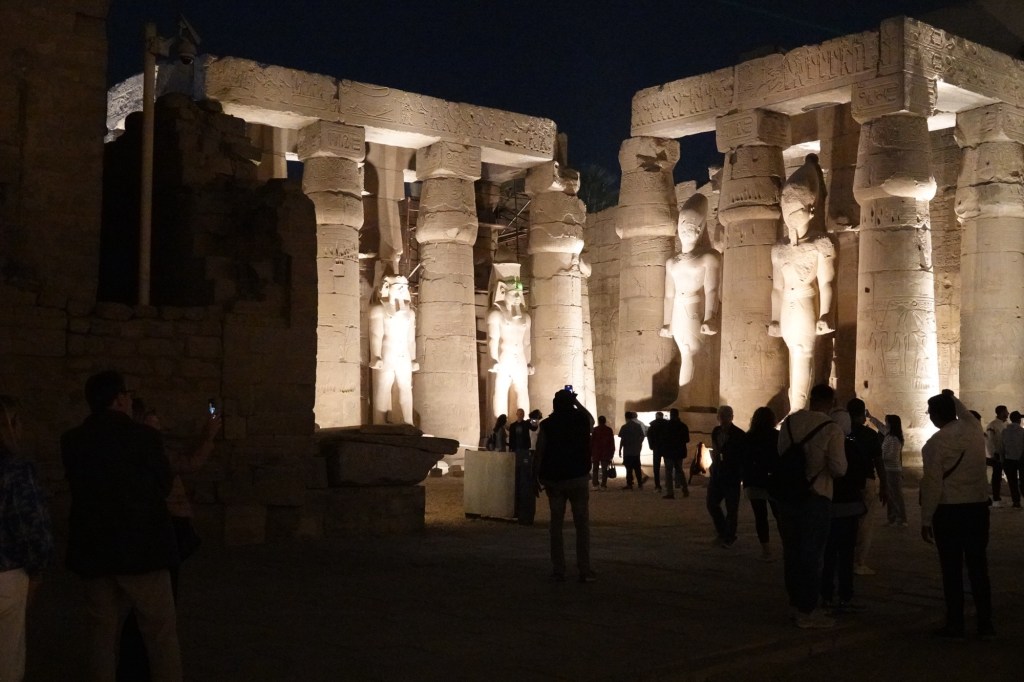
In the evening as the sun went down, we visited Amhotep III’s Temple of Luxor, illuminated. The temple was begun by Amhotep, but completed by Rameses II, whose statues adorn the temple entrance.
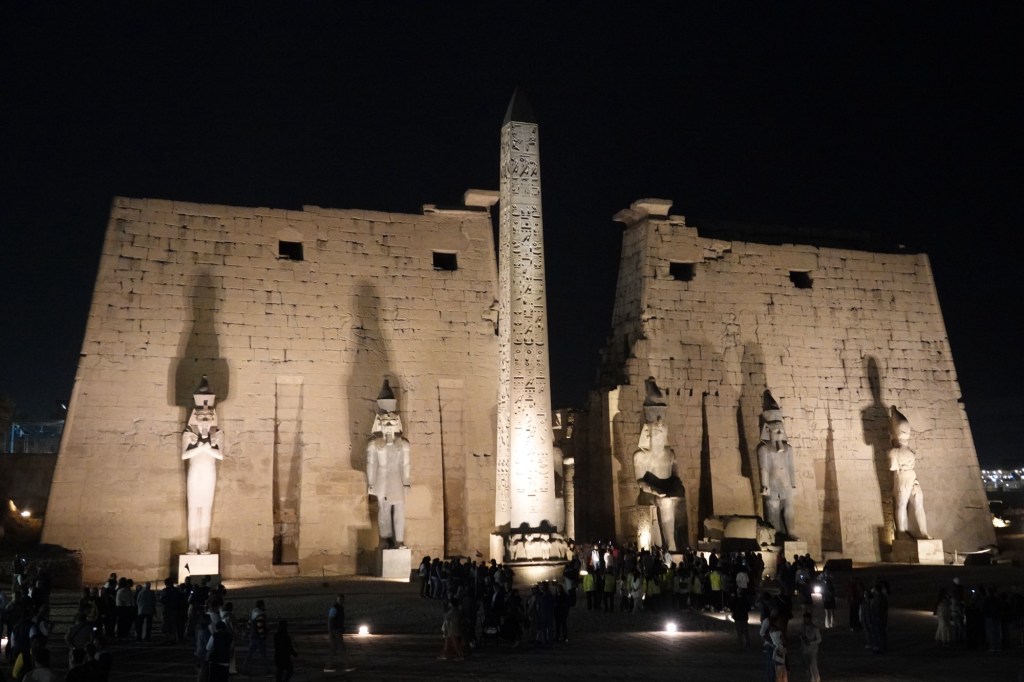
A fellow passenger (and another avid photographer) mentioned how effective some of these photos are when converted to black and white. I generally don’t manipulate Ted’s photos, but just this once…

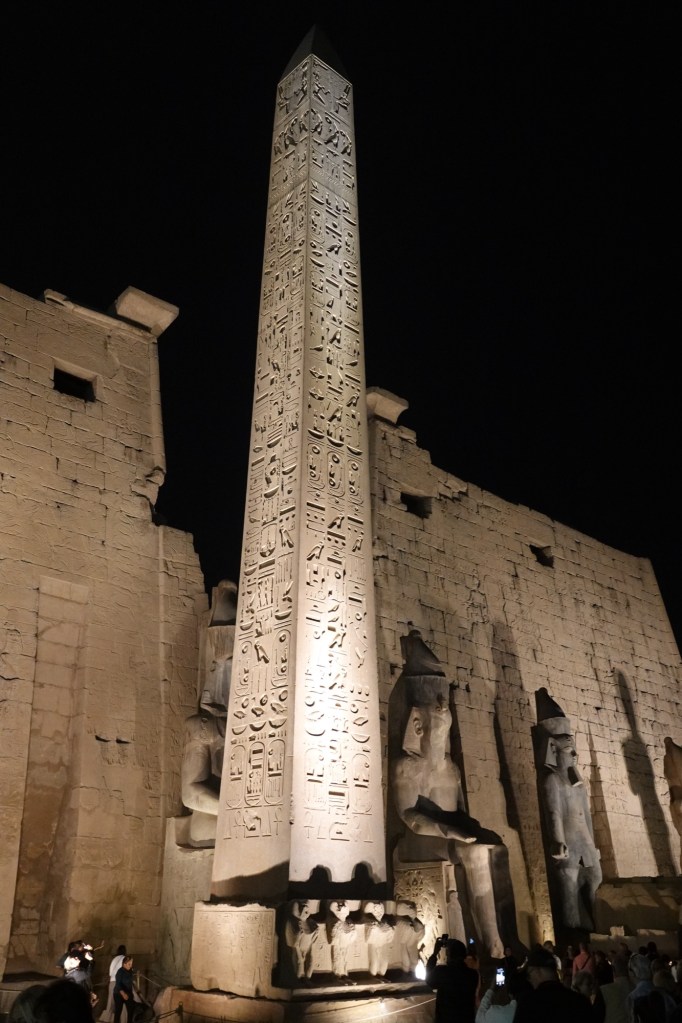
There were originally two identical obelisks, one on each side of the entrance to the temple. We saw only the base of the second obelisk which was gifted to France by Sultan Mohammed Ali.
At the beginning of the 18th century when this temple was found because of a sandstorm, more than 2/3 of it was still buried under sand. Only the heads of the colossal Rameses statues were visible, as seen in the poster made from an old photo.

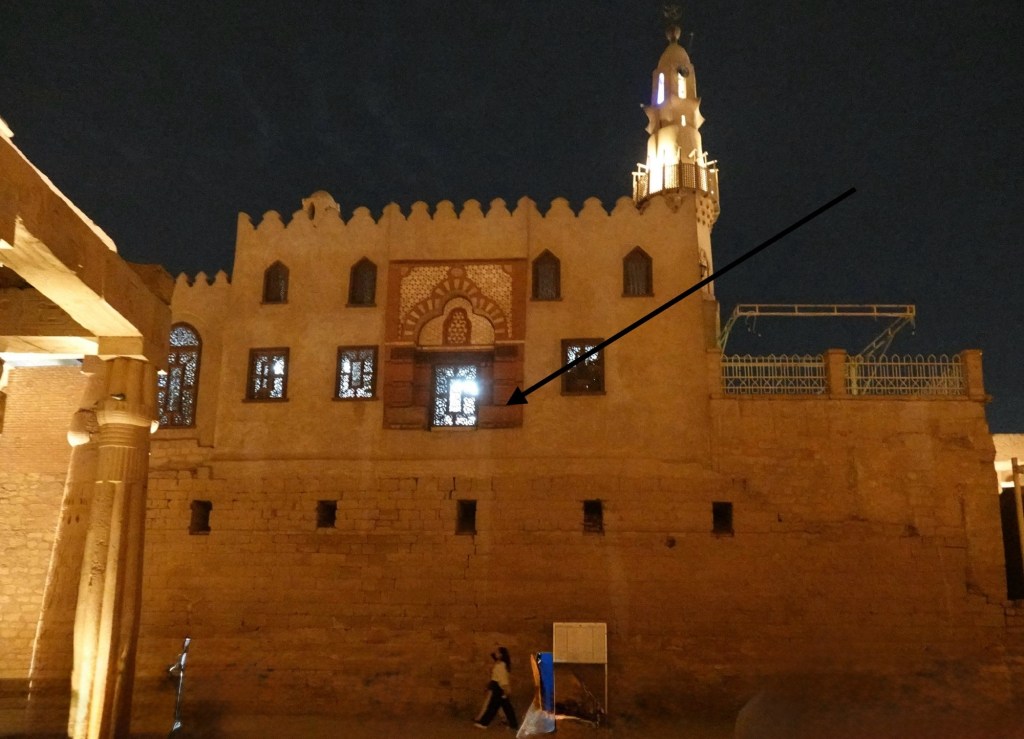
We were able to see where the Muslims who arrived here built a mosque in the 14th century CE. The base of the mosque is at the height that the sand was at that time. Now the base of the mosque is about three stories above the level of the sand on which we were standing.
In the first courtyard are 74 columns with tops that look like closed lotus flowers, interspersed with many many more statues of Rameses II.
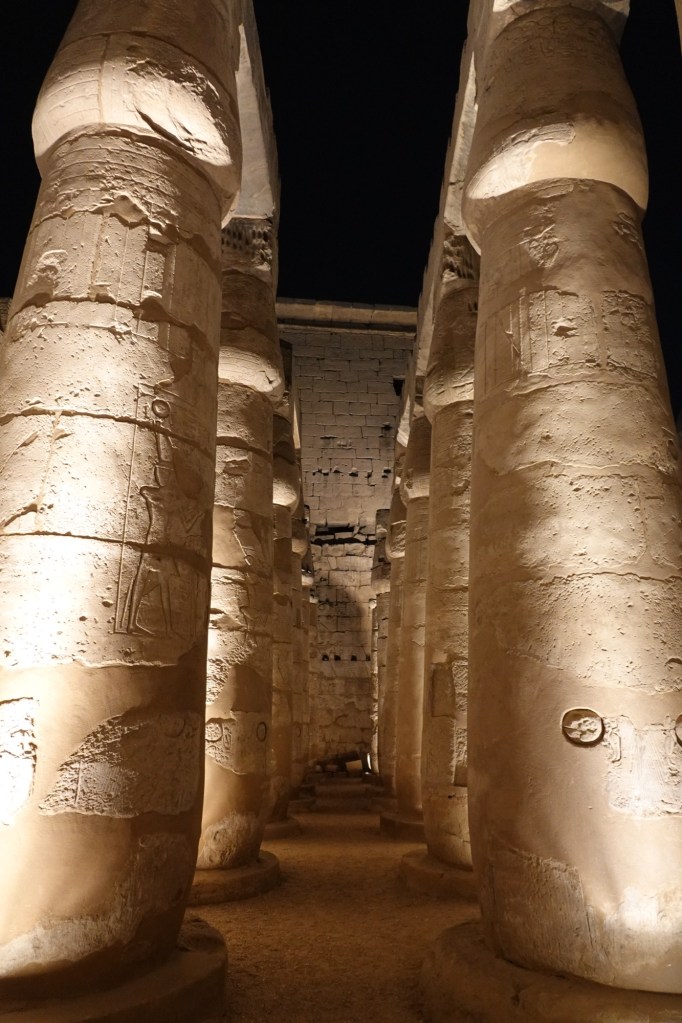

This is the only temple that has two courtyards, because it had two builders. Each pharaoh wanted to have his own stone on the temple. The second courtyard (but the older of the two) has columns shaped like bundles of papyrus plants wrapped near the top, and then topped with a closed lotus flower. Papyrus and lotus are symbolic of upper and lower Egypt, united as one.
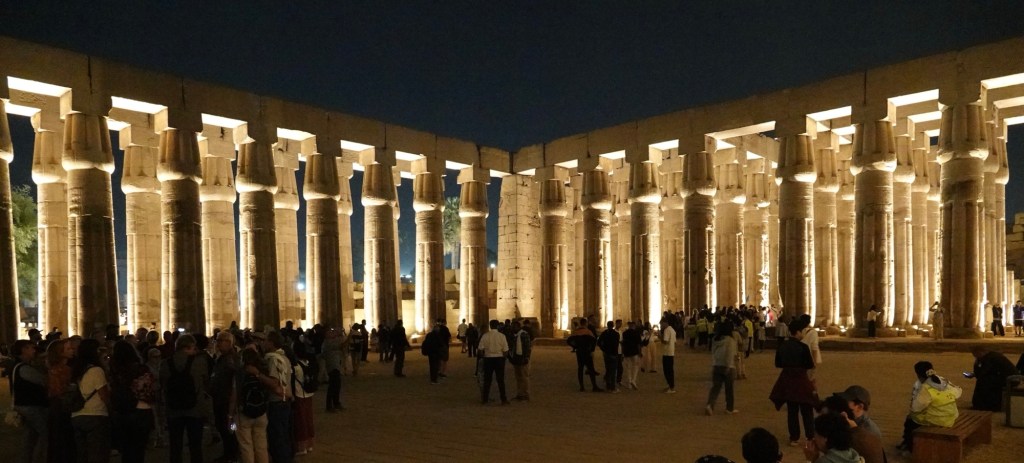
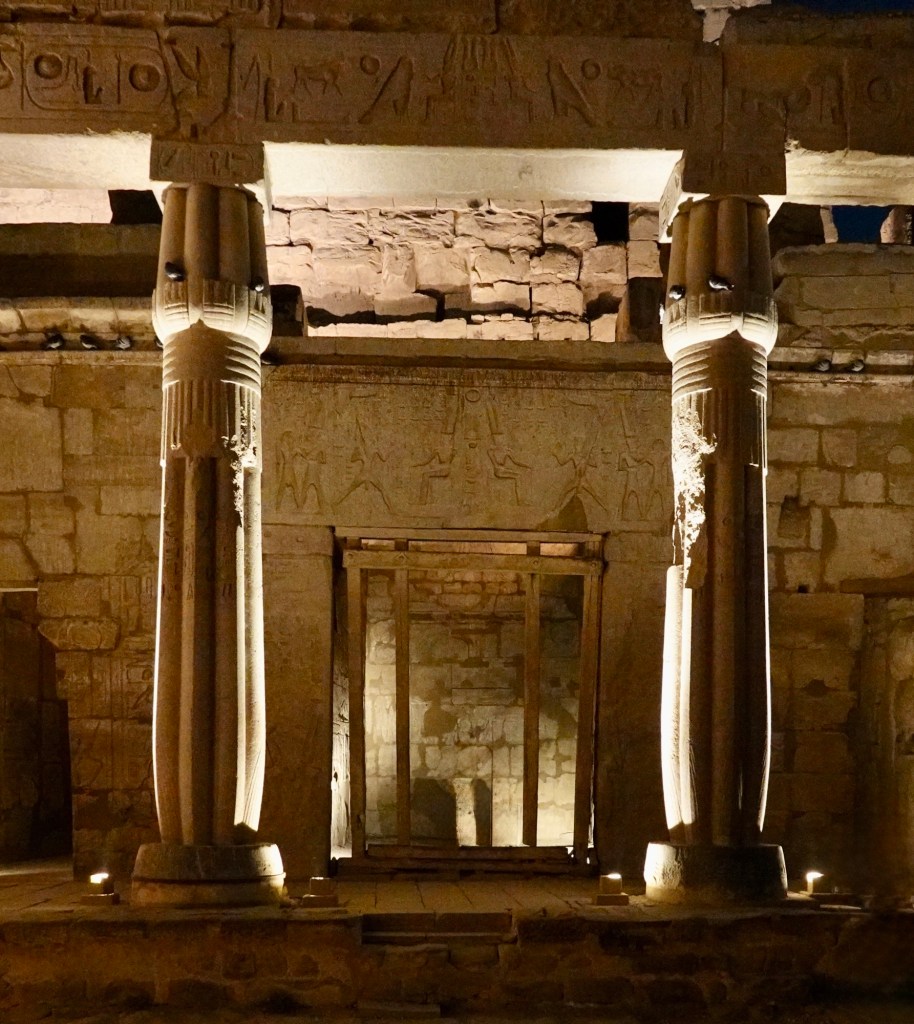
The temples original sanctuary designed by Amenhotep III was decorated in carved friezes. The sanctuary’s decoration was plastered over by the first Christians who arrived here around the first century CE to escape persecution. Amenhotep’s beautifully decorated ancient temple was converted into a Coptic church – the oldest in Egypt.
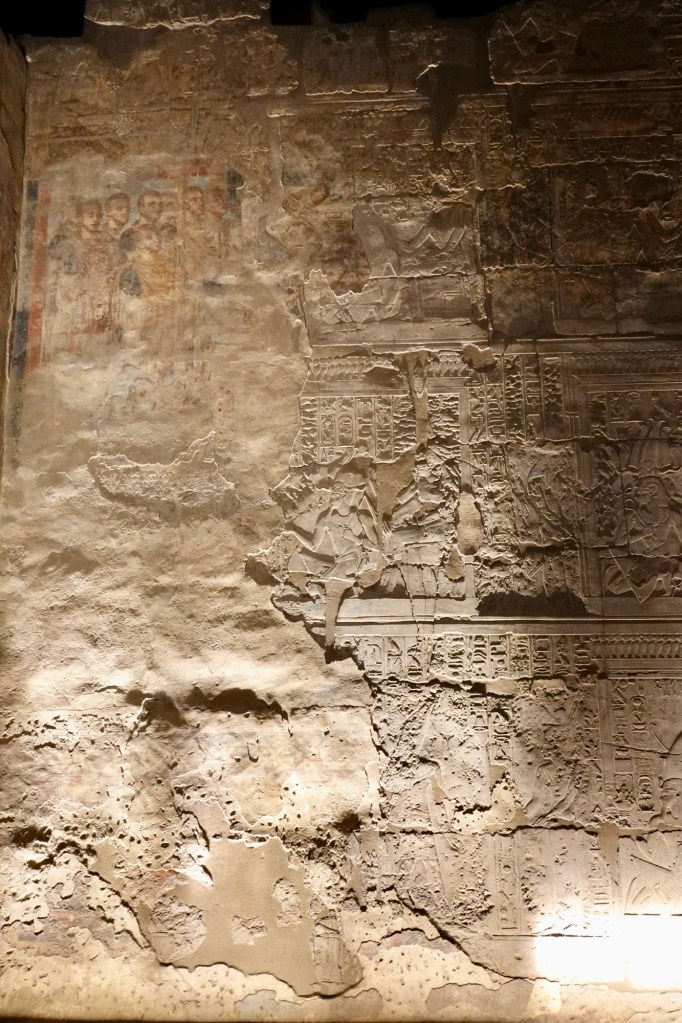
There is still evidence of paintings of Christian saints on remains of the plaster covering the reliefs.
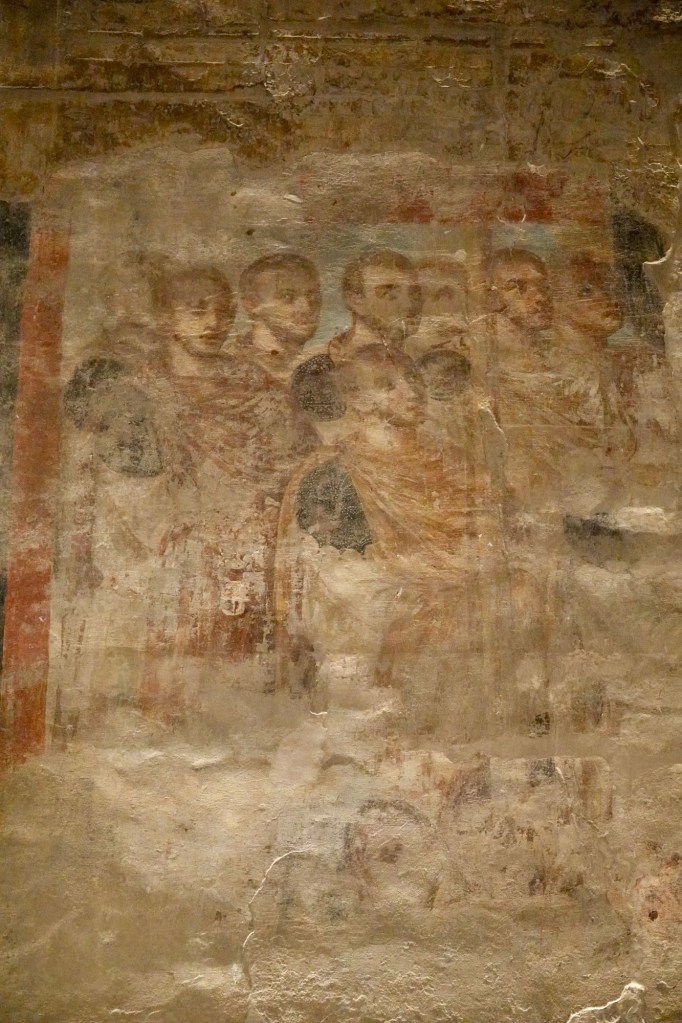

This is probably the only ancient temple in Egypt that has been home to the major religions of this country: the worship of Amun Ra and ancient Egypt’s 42 gods, Islam, and Christianity.
One of the walls shows Rameses II on his chariot, armed with a bow and arrow, in the act of defeating the Hitites.

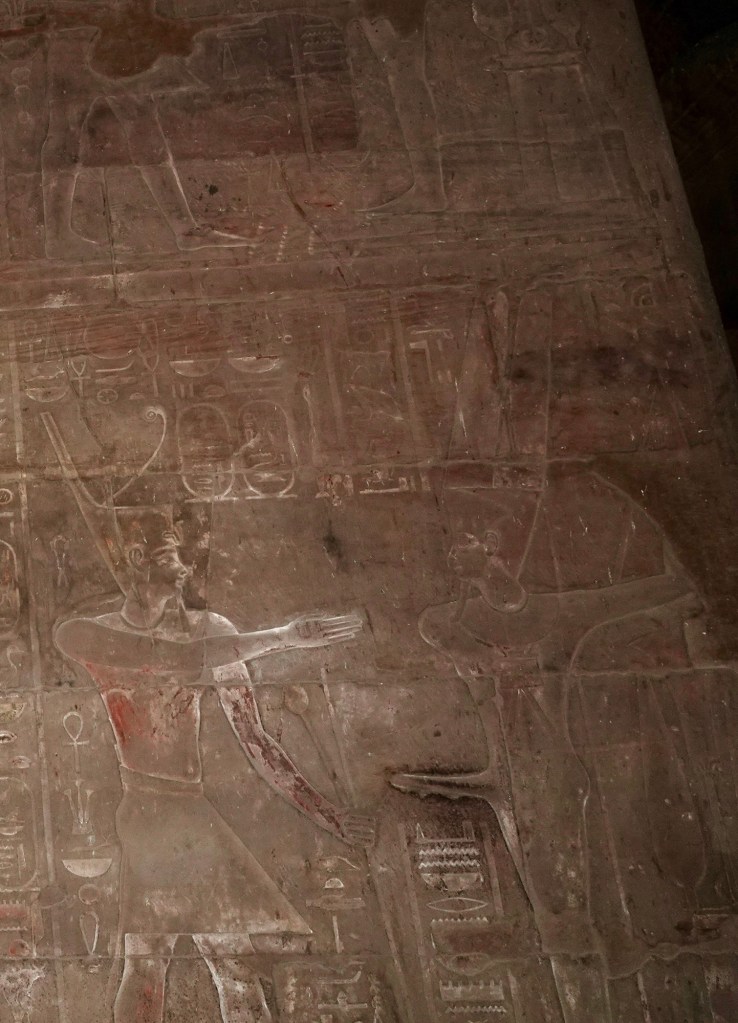
Inside the portion of the temple built by Amenhotep in 1400 BCE is a smaller sanctuary built around 300 BCE by Alexander the Great, who wanted to ingratiate himself to the Egyptian people and be accepted as their new pharaoh. A portion of the decoration on it depicts Alexander worshipping Amun Ra, who is always shown wearing a crown of two tall feathers.

The temple really was magnificent when illuminated at night, but also very crowded.
We returned to the ship for dinner, shared again with our new Australian friends.
We called it an early night. Tomorrow we need to be up by 03:45 for our hot air balloon ride!
 Rose and Ted’s Excellent Adventure