We’ve been in Šibenik before, when we toured the city’s old fortress on our 21/22 World Cruise with Viking (Episode 225). On that cruise, although our excursion brought us to Šibenik, we docked 66 km away in Zadar; that city’s waterfront is particularly lovely, with its unique “sea organ”.
Our sail-in this time was different, but also beautiful.

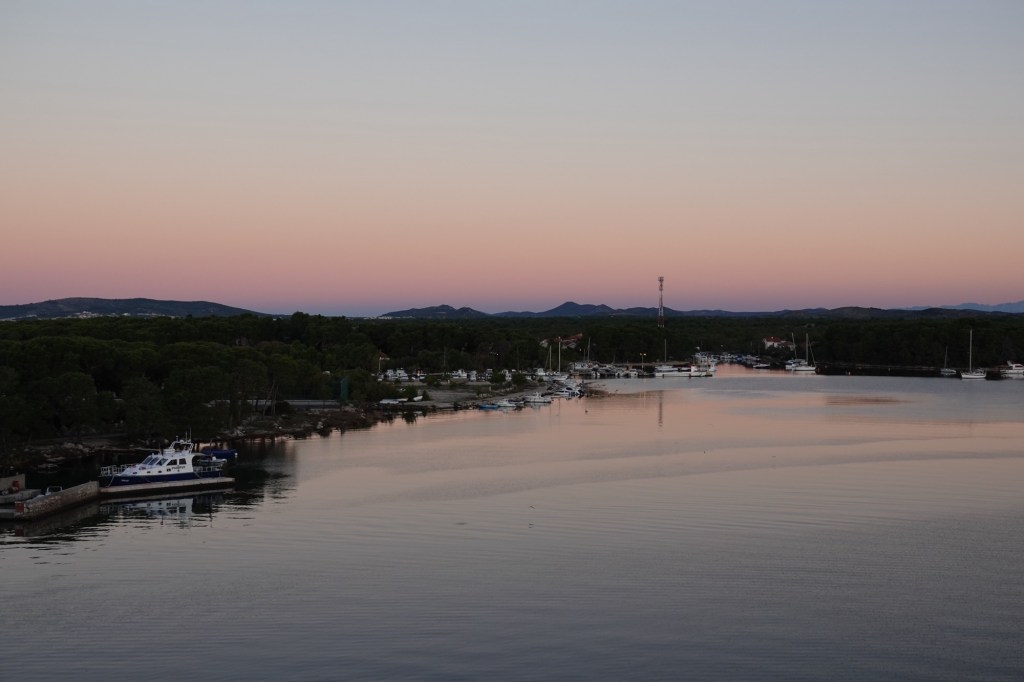
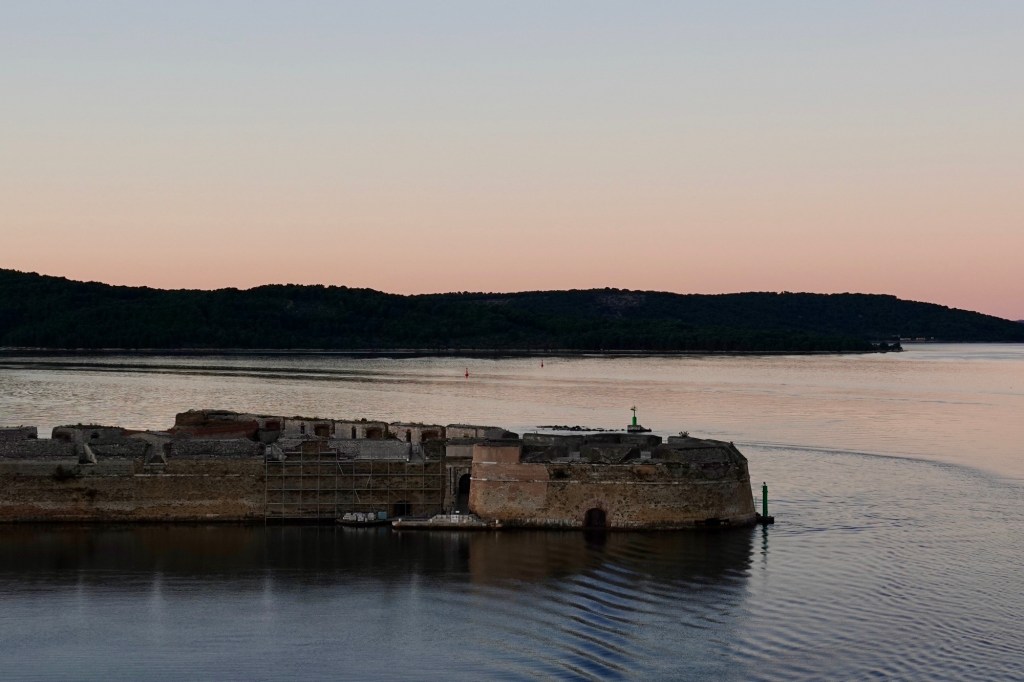
St. Nicholas Fortress, located at the entrance to St. Anthony’s Channel in Šibenik, Croatia.


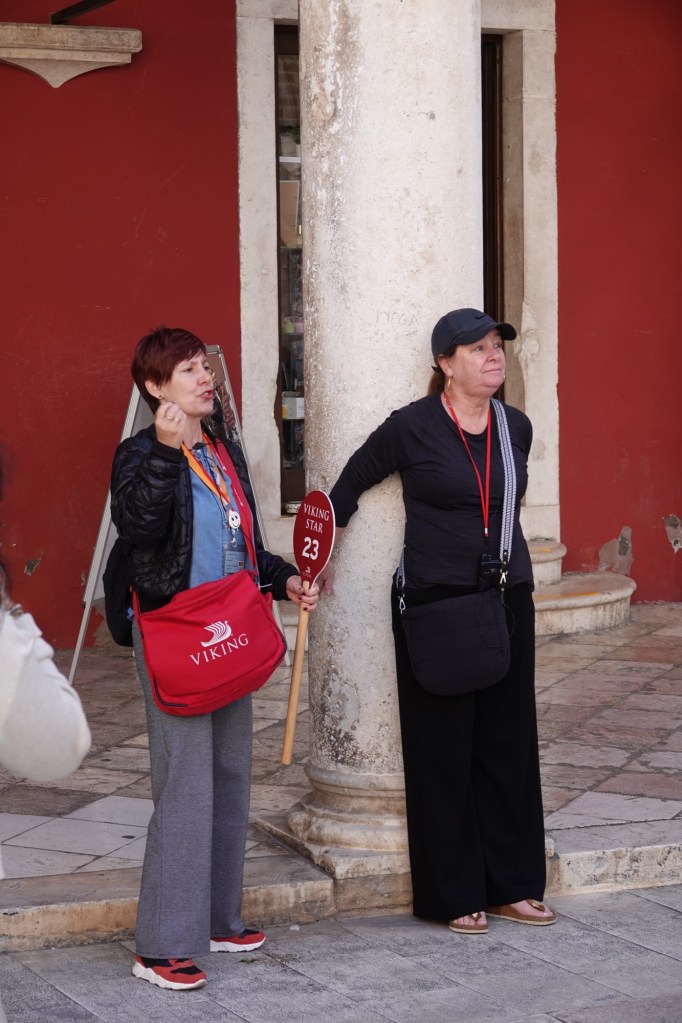
Much of our booked walking tour today was a repeat of what we did in 2022 (minus, sadly, the prosciutto tasting) but – as we’ve learned over many Viking excursions – every tour guide has a different perspective to share.

Šibenik is unique in that it is one of only five cities in the entire world that has two UNESCO World Heritage Sites: St. James Cathedral, and the Saint Nicholas Fort.
The original weather forecast for this part of Croatia was for a high of only 10°C, which would’ve been our first day of cooler autumn weather. However, when we docked, the sun was shining and the forecast had changed to become a high of 19°C. We have been incredibly lucky on this entire trip to not have been out in rain and to have had absolutely perfect walking weather.
We saw lots and lots of seagulls on the waterfront, which we wouldn’t have thought was unique, except that apparently (according to our guide) seagulls – and not Dalmatian dogs – are considered by many of the locals to be the official animal of Dalmatia.
I’d forgotten that Šibenik is the oldest Croatian city on the Dalmation coast. There was never a Greek or Roman city here! The first nomadic tribes here in Dalmatia were the Illyrians, but the founding of an actual “town” with walls and a fort dates to the 9th century CE by the Croats.
Unlike the nearby cities of Split and Zadar, Šibenik is built on a hill, and it is the best preserved renaissance old town in Croatia, largely due to the fact that almost all of the building was done in stone.
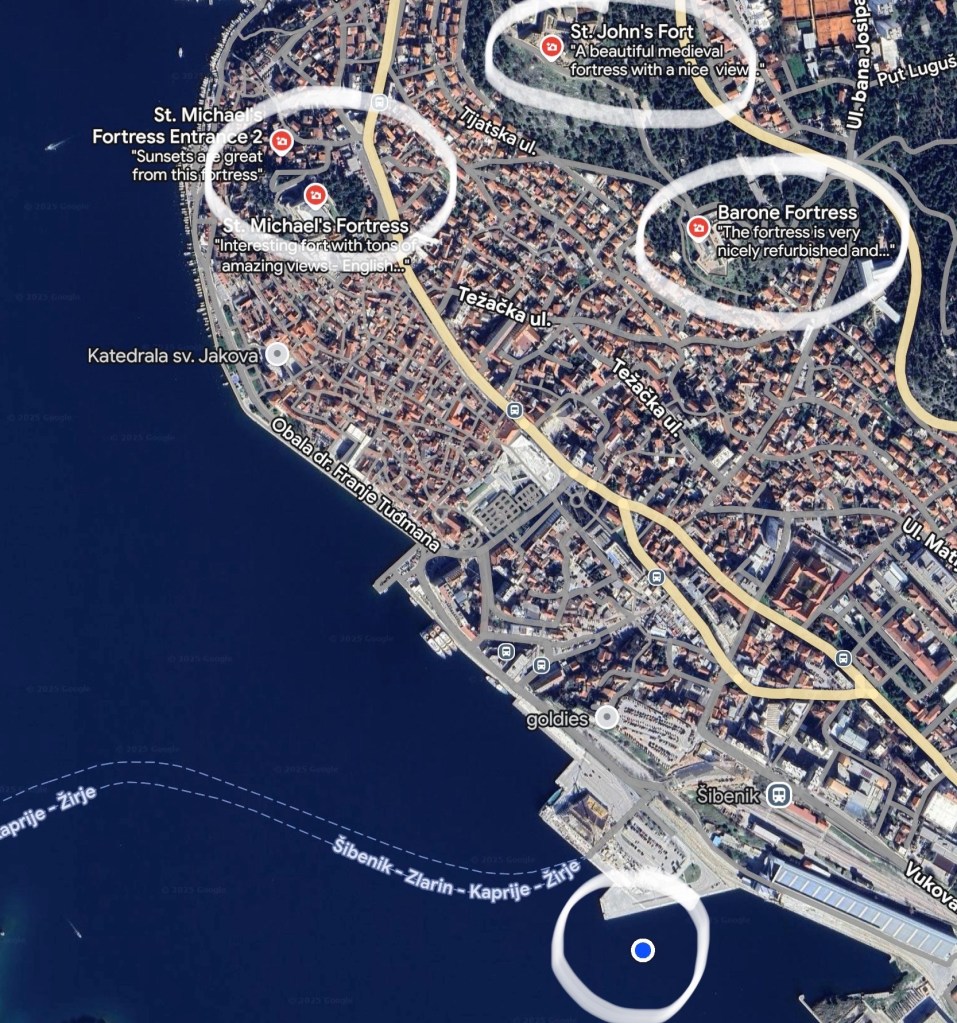
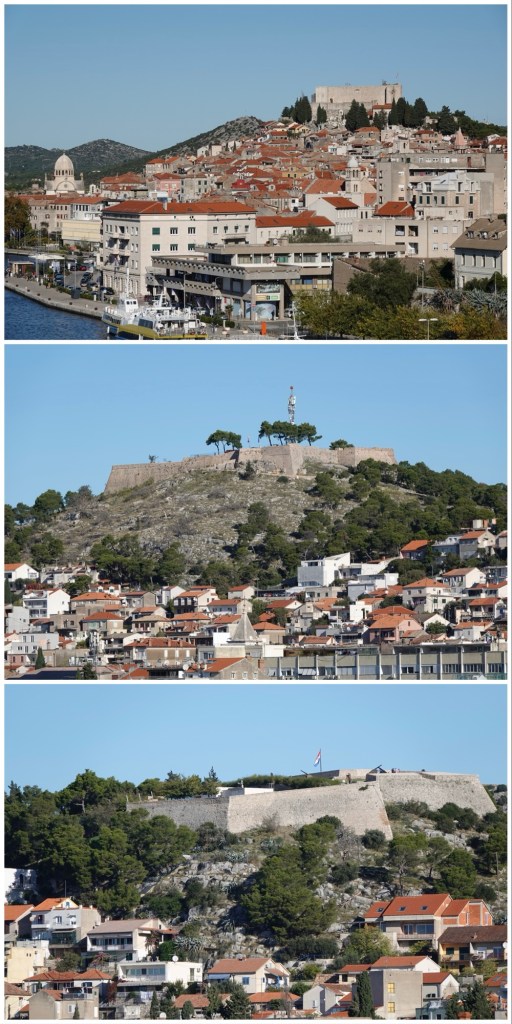
The city is protected by four forts. St. Nicholas Fort we passed on our sail-in, but the other three are in the old town.
The first stone building that we saw as we entered old town was the monastery of Saint Francis.

This modern Byzantine looking bronze statue is of the Croatian King Petar Kresimir IV, who ruled between 1058 and 1074 CE.
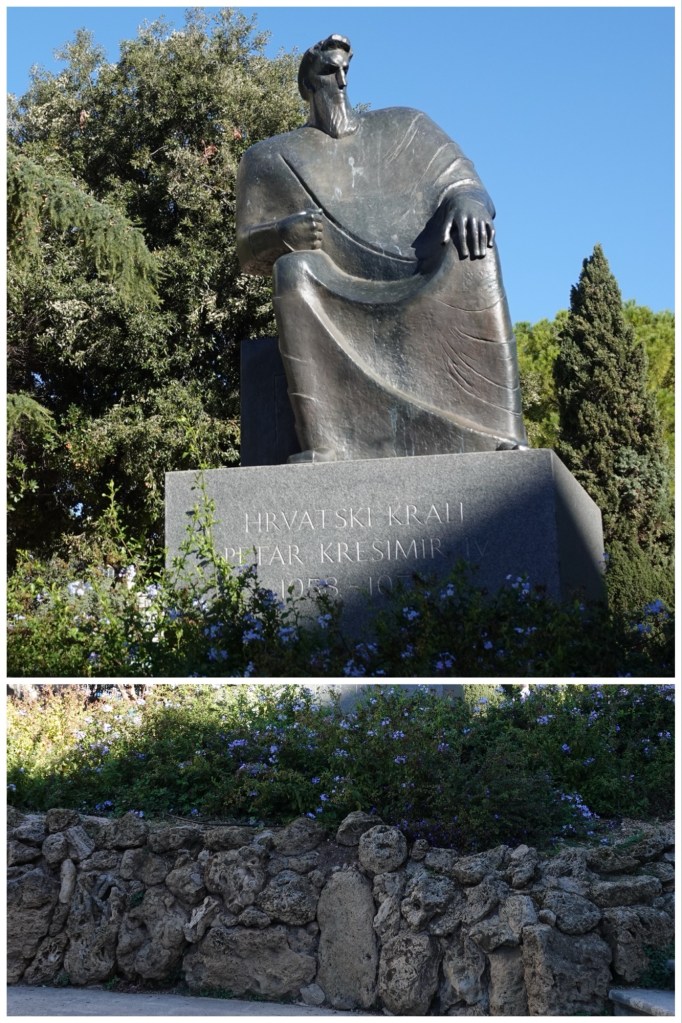
As we walked through the botanical garden with its herbs and occasional fruit trees, our guide, Sandra , reminded us that fruit brandies are very popular in Croatia. We remember tasting cherry, plum, and walnut brandies on our last visit here.
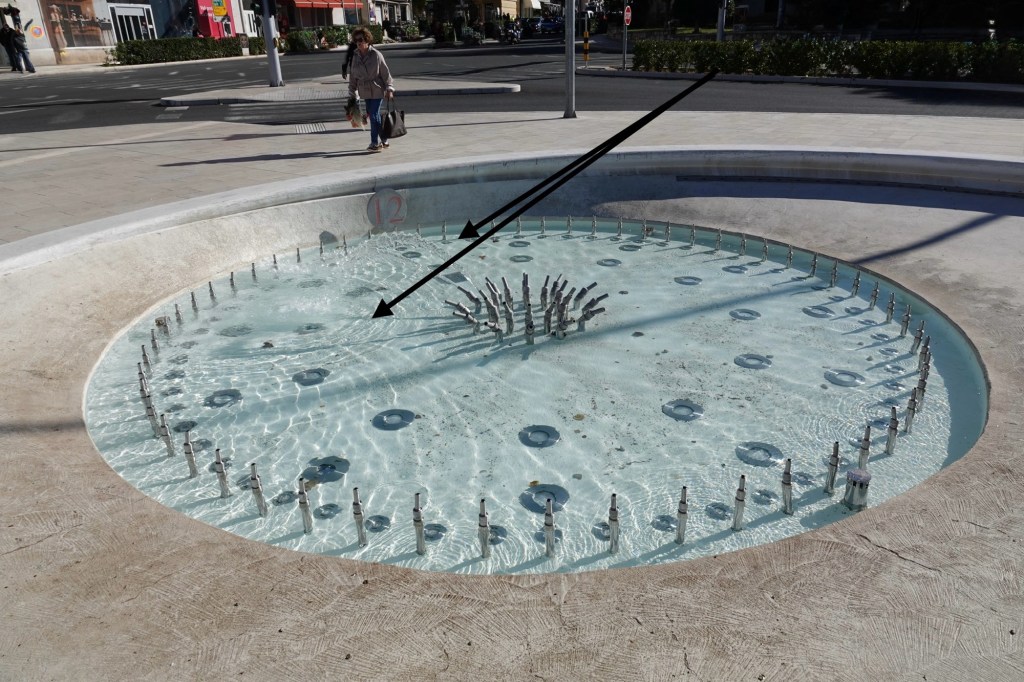
The first square we entered in the old town does have an official name, but Sandra told us that everyone who lives here simply calls it Polana, which translates to “field”, because that’s what was here before the square and fountain were erected. The dial shaped fountain in the park has a jet of water that is supposed to tell the time. It was quite accurately 10:50 when we saw it.
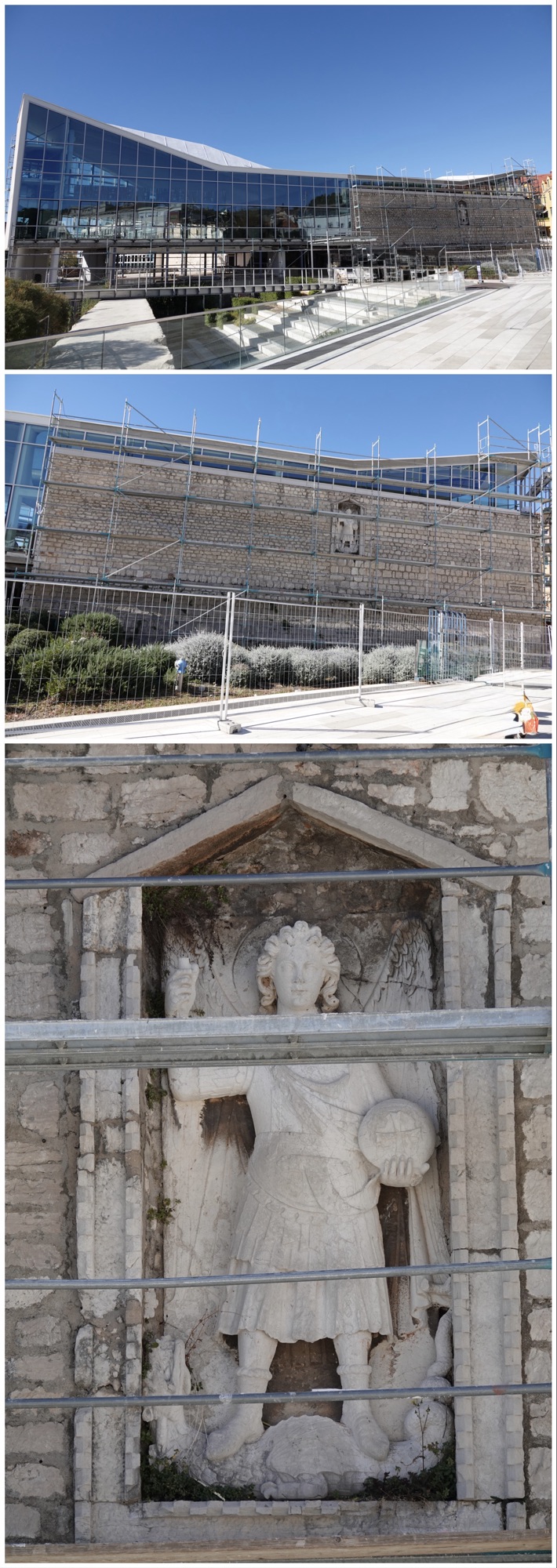
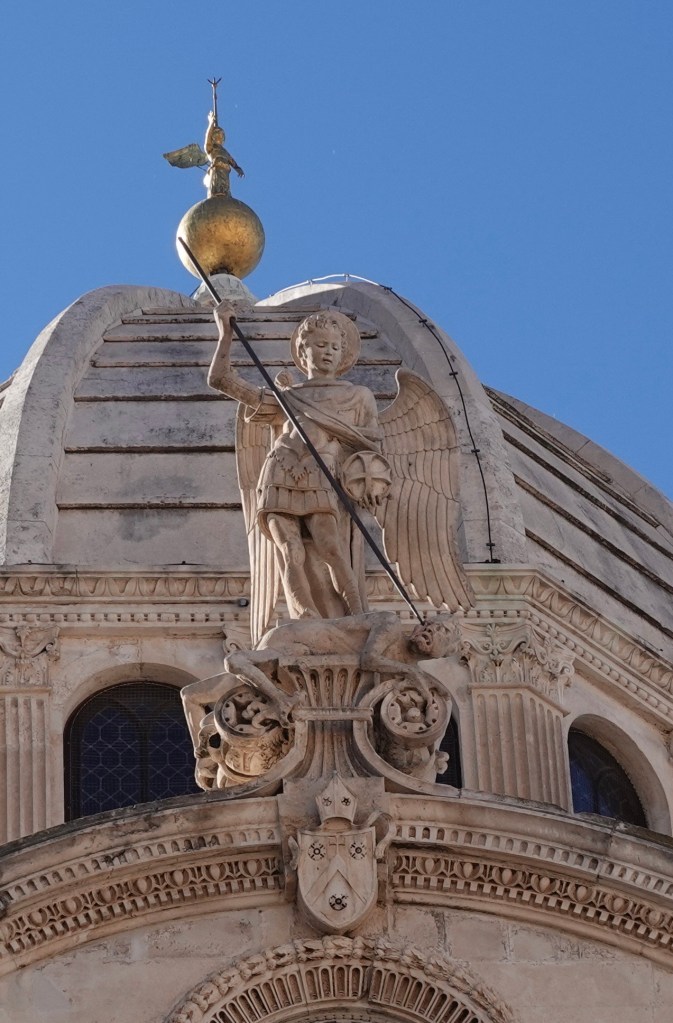
The modern glass and steel library incorporates one of the only two sections of 15th century town walls that still remains in Sibenik, which includes a statue of the archangel Saint Michael, who represents the eternal struggle between good and evil. He is stepping on a dragon.
Unfortunately, the early 19th century National Theatre, built entirely with the private funds of 23 wealthy families and then donated to the city, was completely wrapped for renovations.
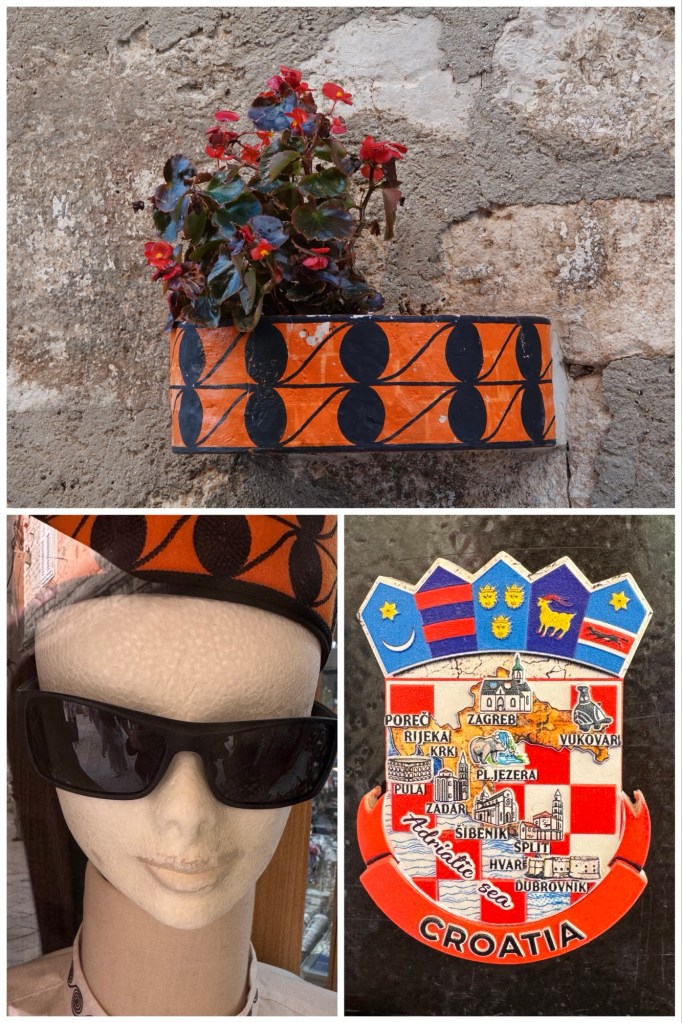
The official colour of Šibenik is orange, representing positivity.

The colour is represented in the hat of the area’s traditional costume (sunglasses optional).
In every Dalmatian town, no matter what the official name of the main street is, it is simply referred to as Calla Larga, coming from the Latin, and meaning simply Large (Main) Street.
We walked along Zagrebačka Ulica, which translates officially to “Zagreb Street”, but is colloquially called Greasy Street. It was originally a place that housed restaurants bars, butchers – all things food related. In centuries past, a great specialty here was spit-roasted lamb; restaurants would roast the lambs outdoors, and display the final product in front of their establishment so that people could compare the quality. The scent, and the greasy smoke, certainly contributed to the street being called Greasy Street.

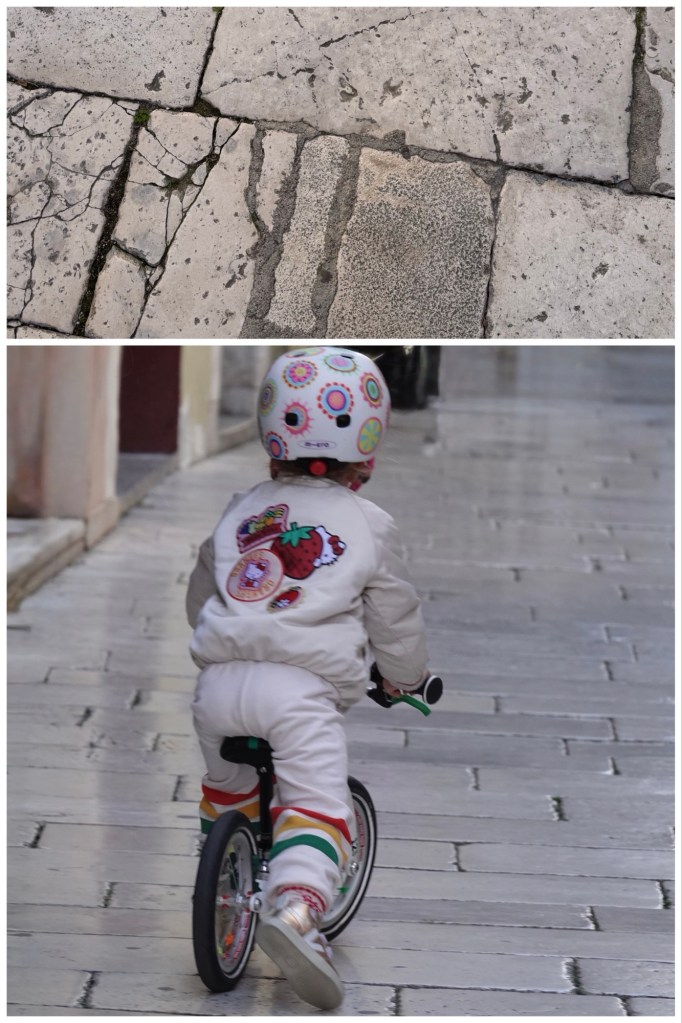
I was really impressed with the huge stone slabs used for all the roadways; they are so much more comfortable to walk on than cobblestone.
Šibenik is also the first place in the world where electricity was transmitted via wires, thanks to the innovations of Croatian native Nikola Tesla. The story of how Šibenik became the very first city illuminated using alternating current is fascinating, if little known. Nicola Tesla was involved (with Edison) in the creation of the first North American power plant at Niagara Falls, but also in creating the first European power plant here in Croatia. While the plant in Niagara Falls technically began producing electricity two days before the one here, it took a further period of months before electricity was actually transmitted from Niagara Falls to Buffalo. By contrast, when the plant power plant opened here in Croatia power was transmitted to Šibenik within two hours!! Our guide opined that Šibenik needs to do a better job of marketing in order to interest tourists in this amazing feat.
We learned about an interesting tradition of how wine was marketed in bars here. Hanging an olive branch in front of an establishment meant that the place served white wine, pine meant rosé wine, and juniper meant red wine.
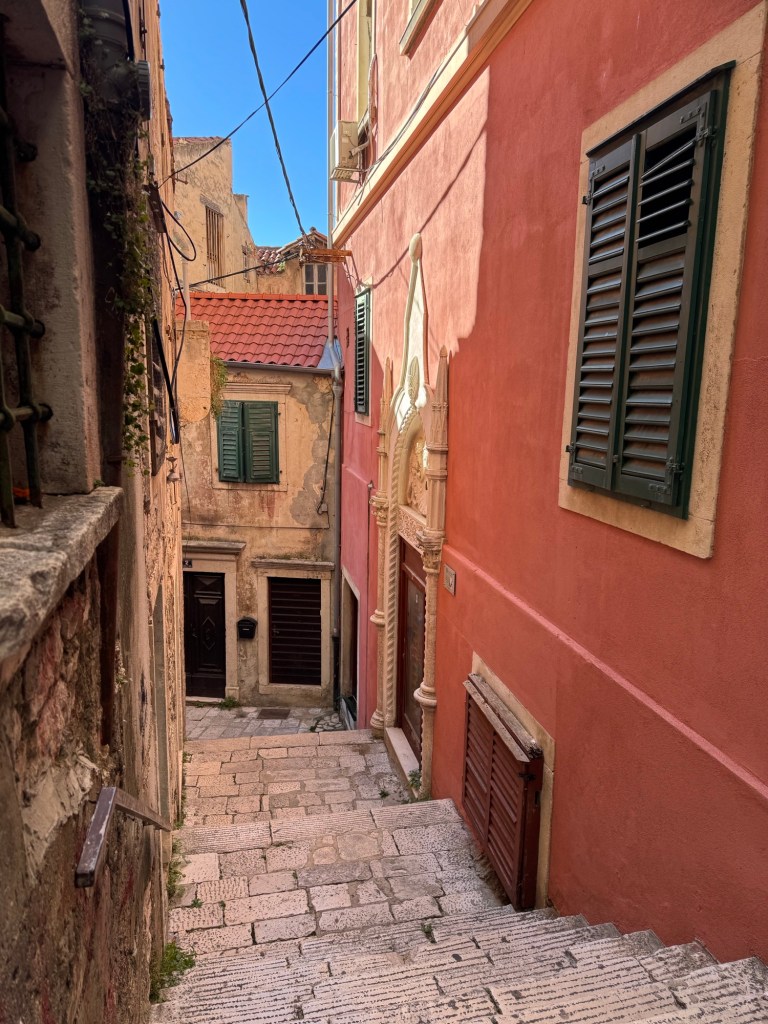
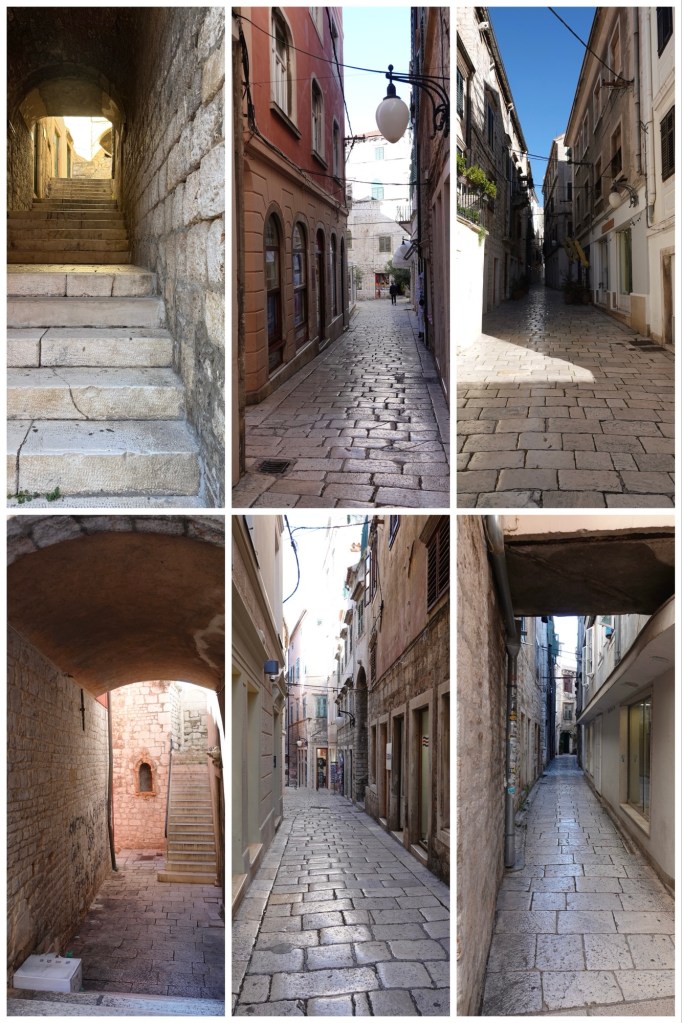
Like many old towns, what makes this one so charming is the narrow side alleys.
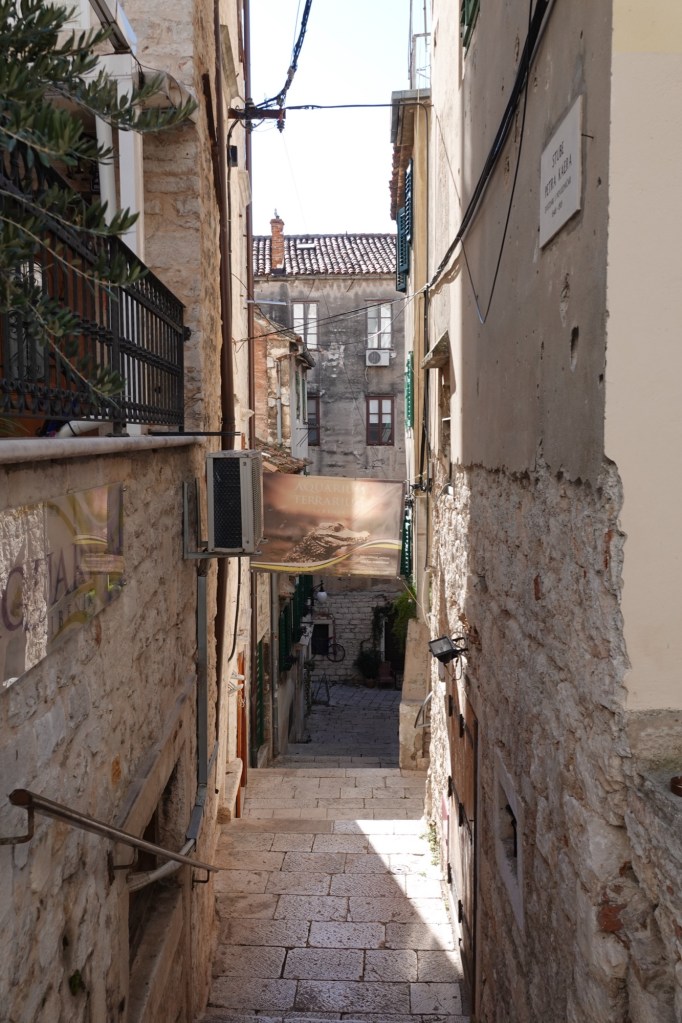
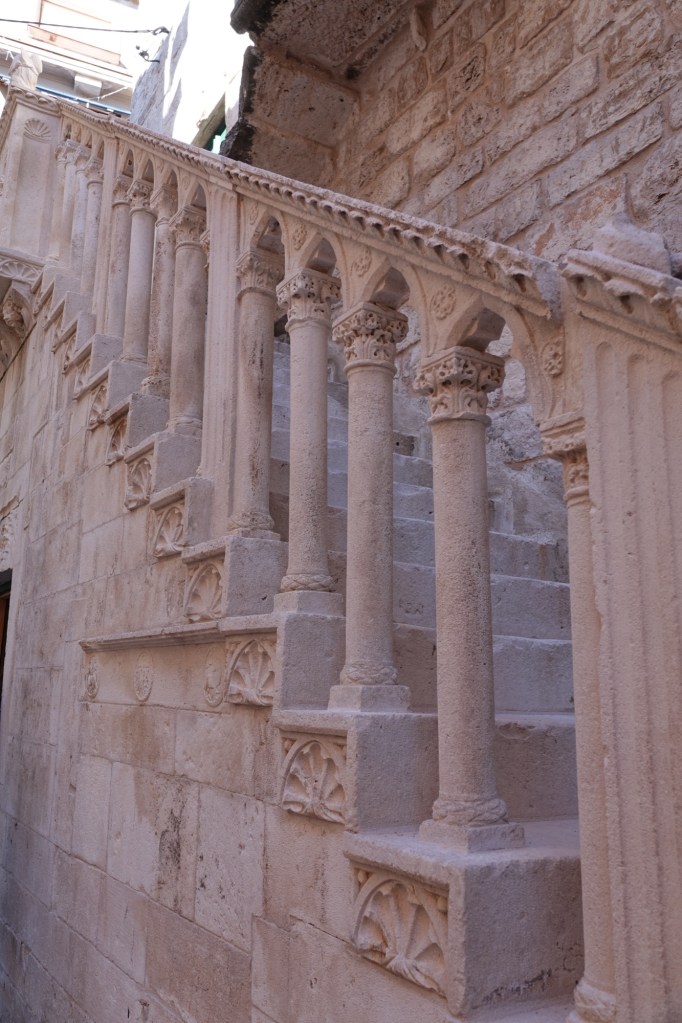
At the bottom of some of the buildings’ stone walls are inset bowls that are specifically intended for leaving water for local cats and dogs. To our guide’s knowledge, this is unique to the town of Sibenik (although Ted and I seem to remember seeing them in Dubrovnik, and even in Morocco).

Our first glimpse of Saint James Cathedral was down the narrow Calla Larga, where we glimpsed a portion of the dome and the beautiful statue of Sibenik’s patron saint, Michael, above the side entry.
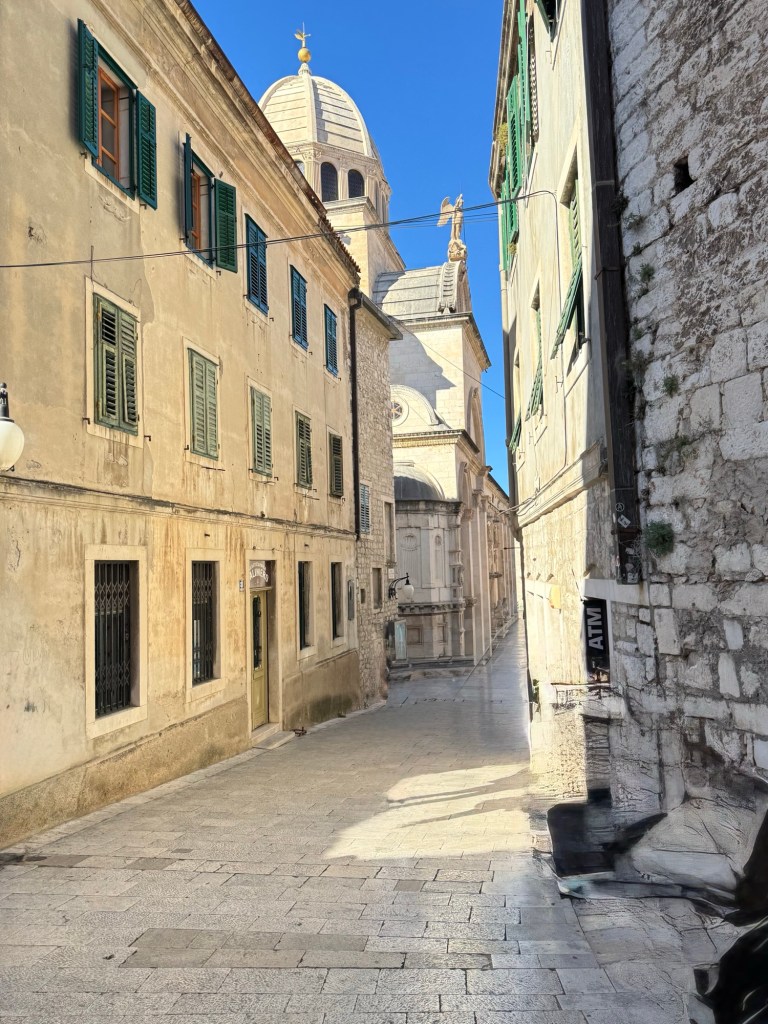

We walked into the Square of the Republic of Croatia; that official name is always supplanted simply by “Cathedral Square”.
On the four sides of the square are the Cathedral, the Bishop’s Palace, the City Hall, and the prison (with its pillar of disgrace).

The cathedral was intended to be the highlight of this walking tour, since it is a UNESCO world heritage site. The cathedral is dedicated to Saint James, and it is common for people from this town to make a pilgrimage to Santiago de Compostella in Spain, using the Camino Santiago to follow in the steps of Saint James (San Tiago, or San Diego, is Saint James).
The main entrance of the cathedral features the 12 apostles, withChrist at the top, and scenes from the New Testament.

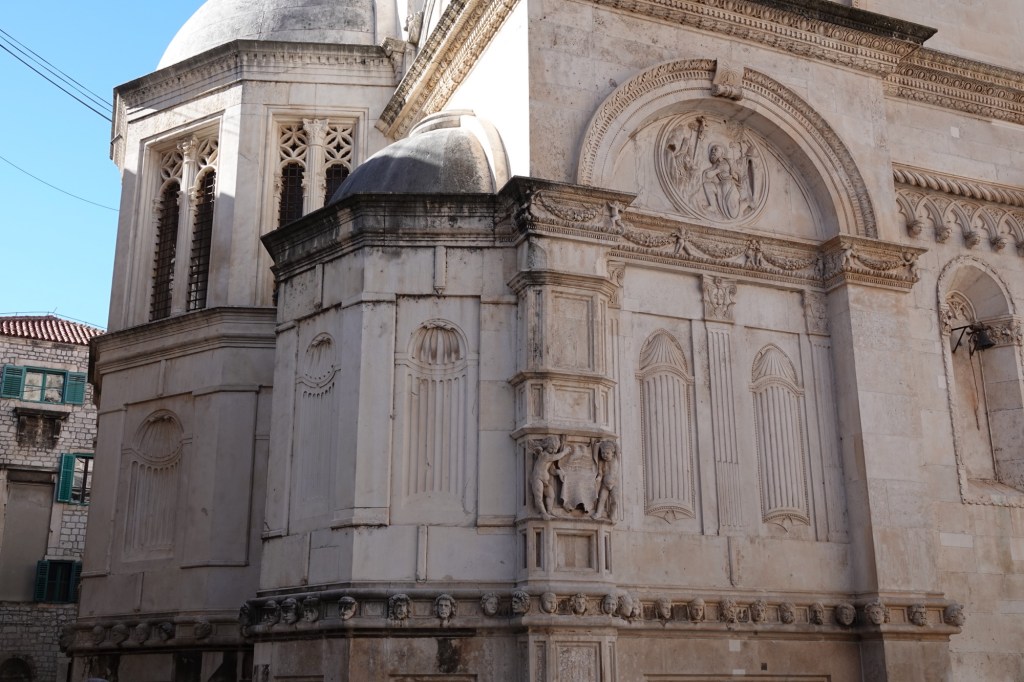
At the side entrance and around the side portal, are faces, putti, lions and statues of Adam and Eve. It is apparently quite unusual for the sides of cathedrals to be so heavily decorated.

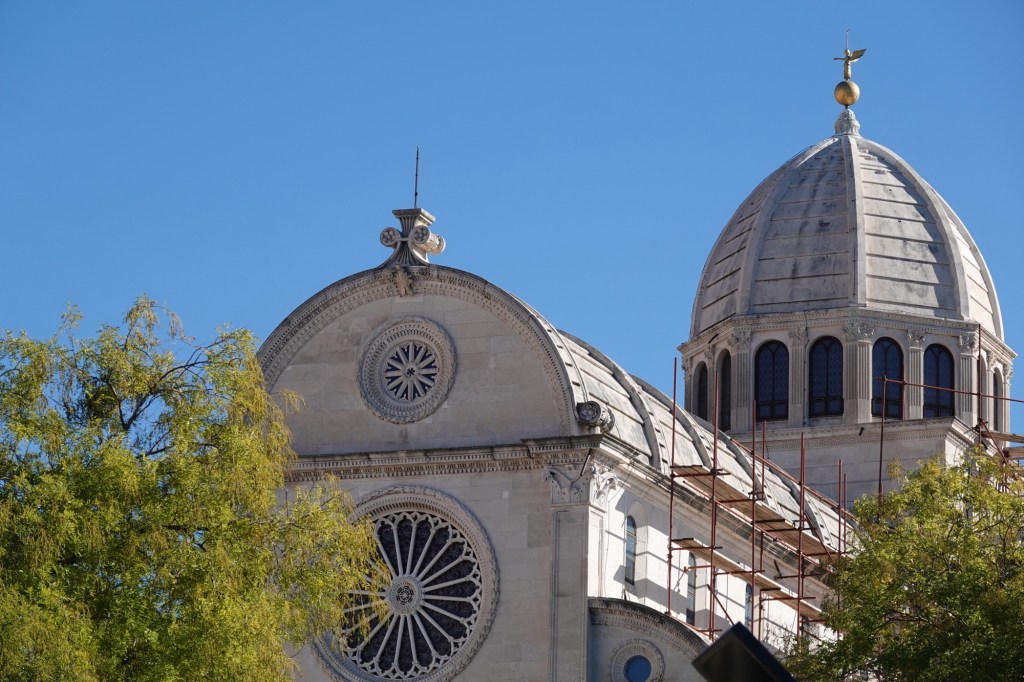
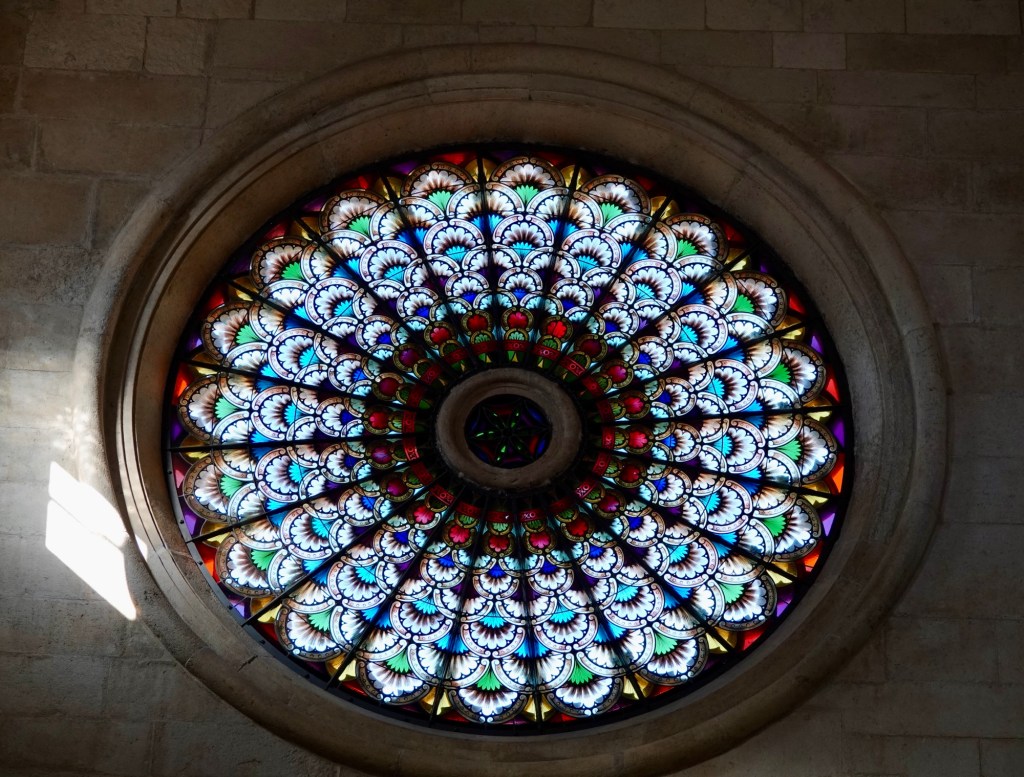
The famous rose window still contains its stained glass, which, when the sun shines through it creates a pattern on the floor of the cathedral, drawing everyone’s eye toward the altar.
As we arrived in the cathedral, the altar cloth was just being laid for noon mass. An interesting feature of this cathedral is that the shape of the interior 100% mimics the shape of the exterior, and the colour of the stone is consistent both inside and outside.
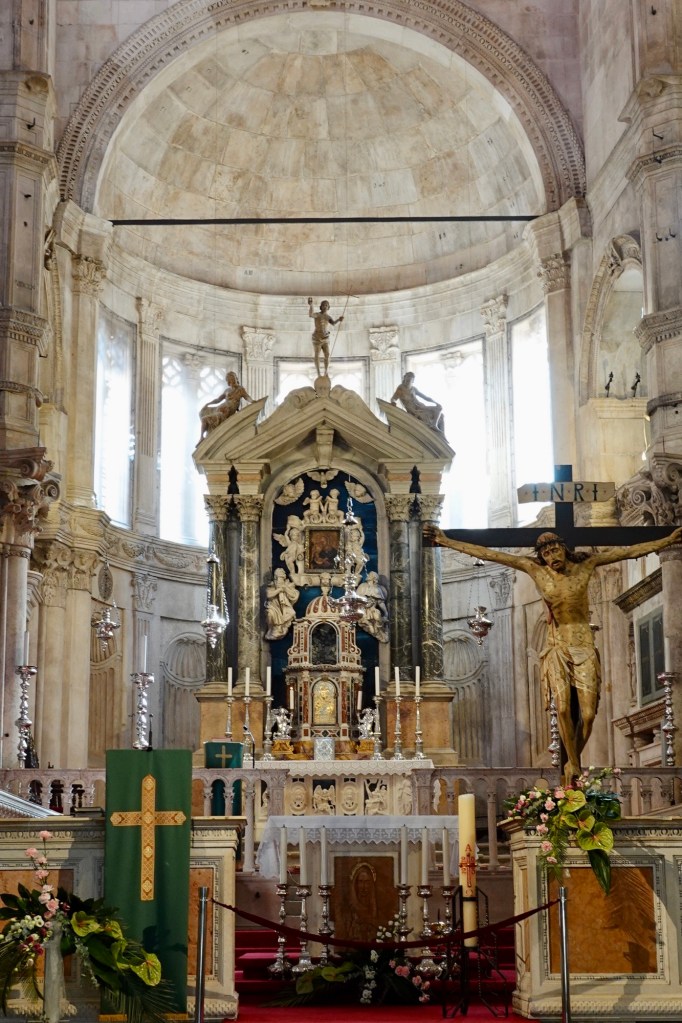
I didn’t keep lots of interior photos, because we already had so many in our previous visit’s post.
Sandra wanted us to imagine going back to the 15th century when the cathedral was built. Šibenik became an official town in the 13th century, but apparently no self-respecting town can call itself a real town if there is no cathedral. It took almost 2 centuries for Šibenik to attain that status. At that time, Croatia was part of the Venetian Republic, and one of the most capable and important masters from Venice was commissioned to build this cathedral. His initial six year commission turned into 36 years of work here and the cathedral was still not completed by the time he died. It eventually took almost another 105 years for the cathedral to be completed by other Venetian stonemasons and artisans.
Things that make this cathedral unique are (1) that it is built completely out of stone, (2) the method used to build it completely involved interlocking the stones, as if it were incredible limestone Lego, and (3) because of its very rich decoration, again all in stone. Paint is not used to create frescos or ceiling decoration; everything is carved or inlaid stone.
We were taken into the baptistry to get a closer look at the rich decoration. This was the first room that I really remembered our visit from 3 1/2 years ago.
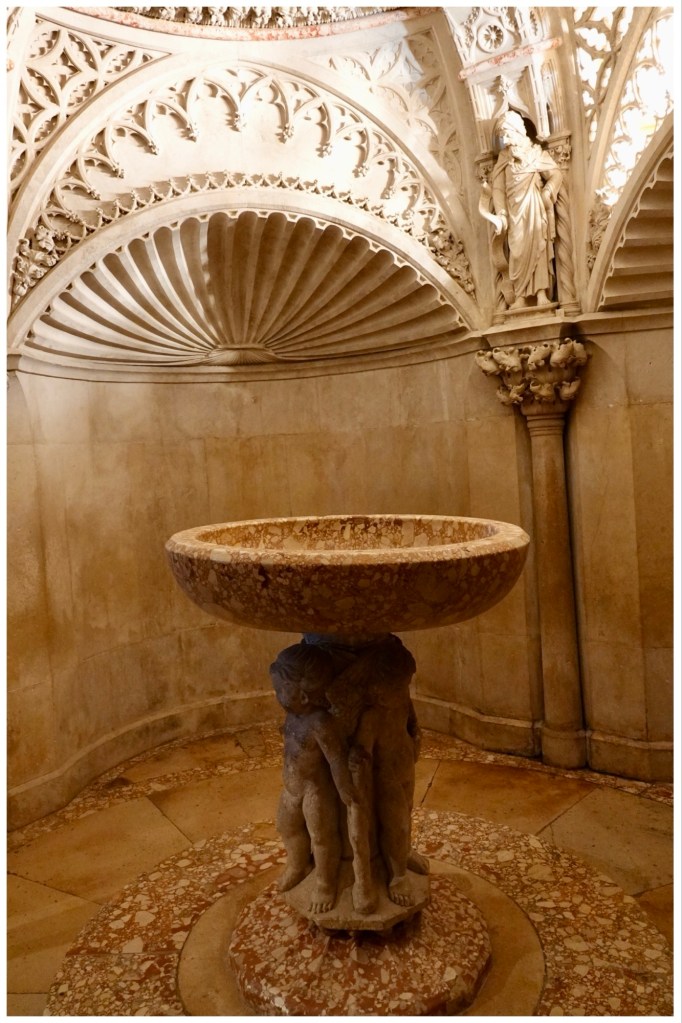
The openwork carving in the ceiling of the baptistry is stunning, as are the putti that hold up the baptismal font.

On the walls of the baptistry are shells, which have become symbols of St. James’ ministry. There are 4 statues (one atop each pillar), however only two of those remain after damage occuring during the many wars that have devastated this region. Only King David and Saint Simon remain.
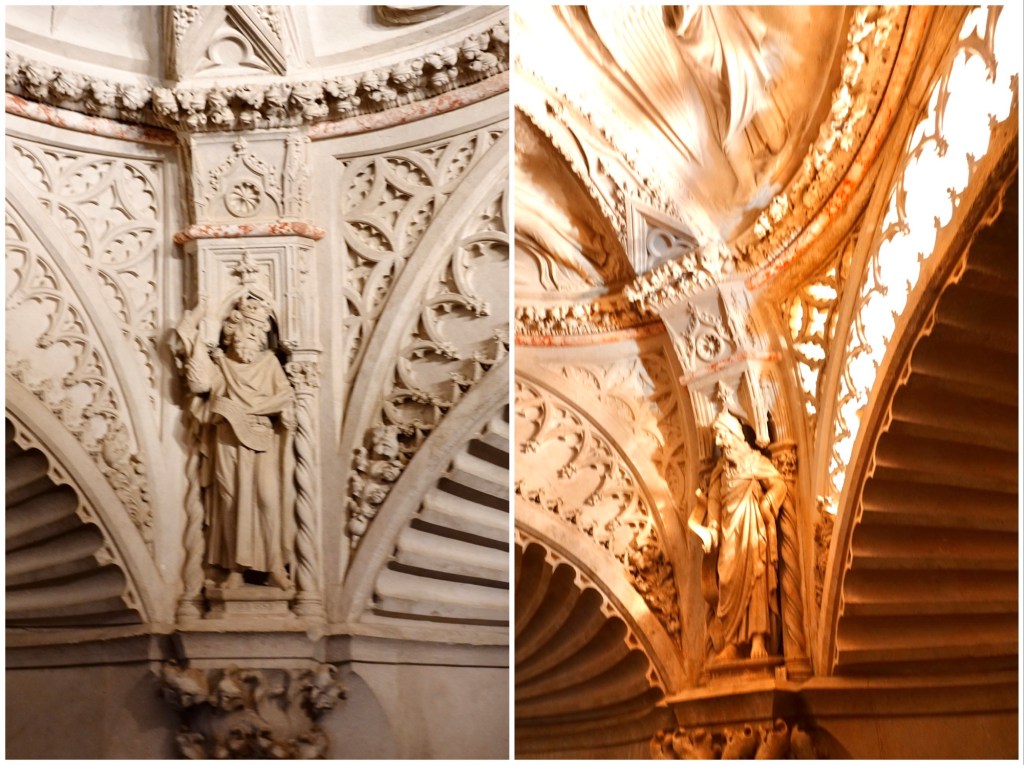
In sculpture, God is depicted as an old man with a beard, the Holy Spirit is depicted as a dove, and – in an element that was considered quite new and revolutionary for the time – Jesus is not represented at all. The child being baptized in the font is deemed to represent Christ. In that way, the holy Trinity is only present in the baptistry during a baptism.
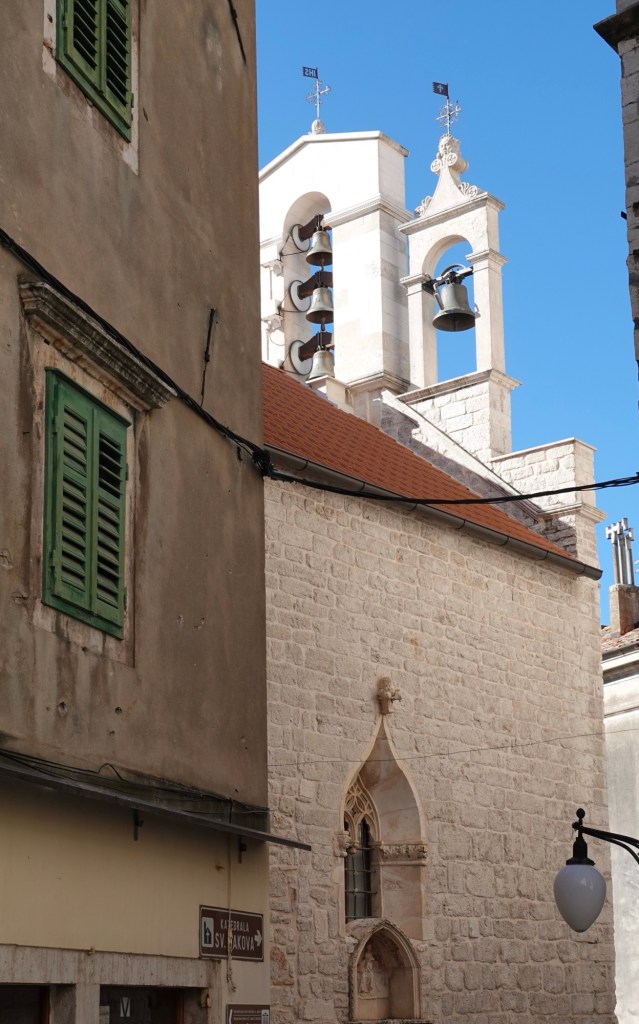
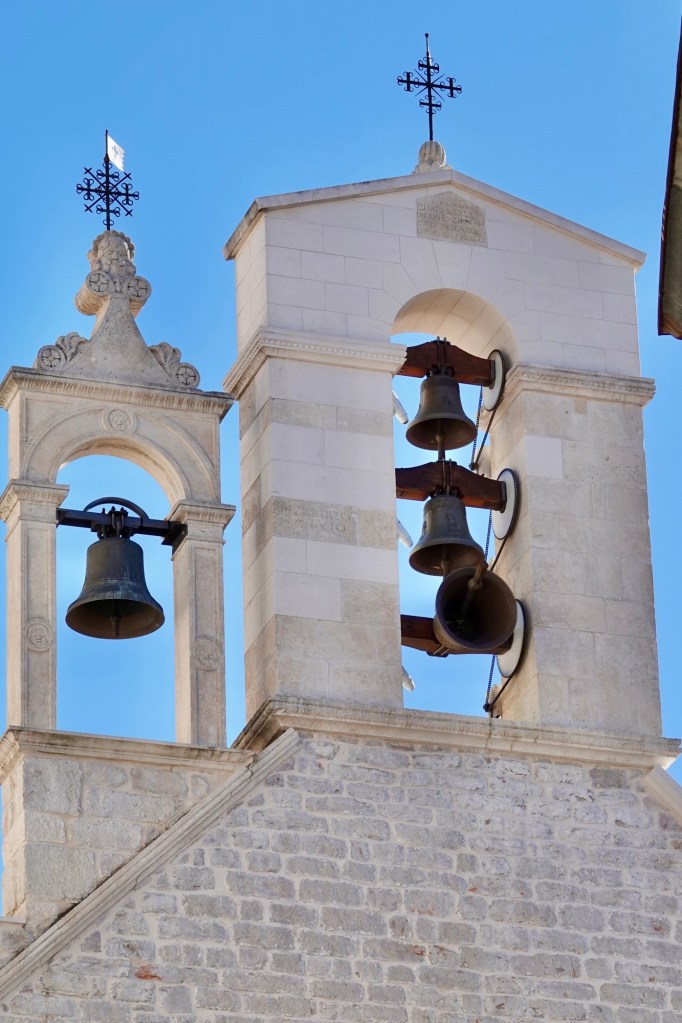
As our tour finished and we left St. James to head back into Cathedral Square, the nearby bell tower began chiming 12 noon. The arrangement of bells at the top looked like what we’re used to seeing on new world Missions. The lower bell that was chiming the hour was swinging almost wildly, and it tolled incredibly loudly.
The statue of a boy with an umbrella in an area adjacent to the cathedral represents the international children’s festival held here annually, the biggest festival in the city – even bigger than their Christmas Market!

The three fortresses within walking distance are all up on hills that we chose not to climb, despite having the entire afternoon available to explore on our own.
Instead … food. I was on the search for cheese birek, and we found some!

We spent the sunny afternoon in the sun-drenched Explorers’ Lounge, reading, writing, and enjoying a cool drink.

The sun sets by 5:00 p.m. at this time of year, and it’s pitch dark by 5:30; time to get ready for live music and dinner after another good day.
On board a Viking ship (even out on a windy deck so that Ted can experiment with camera settings) is definitely one of my happy places.

We had a lovely dinner in the main restaurant, made even more special by reconnecting with the wonderful Carlito, who was the Chef’s Table Maitre ‘d and wait staff team leader on our 24/25 world cruise, but is now back to his Head Waiter position in the main restaurant.

After 9 years with Viking, Carlito is prepping to go one a one year “vacation” in 2026. He told us that Viking is responsible for his ability to put his children through university, and save up enough money to eventually start up a small business in the Philippines. Long contracts that meant months of separation were hard on his family, although they supported him throughout. He shared that his adult children now understand and appreciate his decisions. His description of years of tearful farewells and joyous reunions was very emotional.
Carlito is one more example of how working for Viking changes people’s lives, and one more reminder of the sacrifices crew members make for their families.
We feel very privileged to have gotten to know so many crew members.
Sadly, a short cruise like this does not create many opportunities fir connection. Tomorrow is already our final day.
 Rose and Ted’s Excellent Adventure