(In Napoli where love is king
When boy meets girl here's what they say:)

When the moon hits your eye like a big pizza pie
That's amore
When the world seems to shine like you've had too much wine
That's amore
Bells will ring, ting-a-ling-a-ling, ting-a-ling-a-ling
And you'll sing "Vita bella"
Hearts will play tippy-tippy-tay, tippy-tippy-tay
Like a gay tarantella.

When the stars make you drool just like a pasta fazool
That's amore
When you dance down the street with a cloud at your feet
You're in love
When you walk in a dream but you know you're not dreaming
Signore
Scuzza me, but you see, back in old Napoli
That's amore.

THAT’S AMORE, written by Harry Warren & Jack Brooks
Pizza Napolitana. “Real” Neopolitan ice cream (spoiler: it’s not vanilla/chocolate/strawberry) . Flaky sfogliatella pastries. Limoncello.
THAT’S amore!
We love it when we’re docked close enough to walk into the city, because it means that if we’re up and about before our booked afternoon excursion (a 2-1/2 hour guided walk) we can simply wander around the city. Today, we’re docked at Pier 21, which is actually closer to a part of the city different from our afternoon tour.

But first, breakfast. I grabbed a barista-made cappuccino from the Explorers’ Lounge, and then met Ted in the World Café, where he enjoyed brioche French toast and I treated myself to smoked salmon (something I never do at home).

As the week progresses, I’ll definitely have a breakfast or two in Mamsen’s, where delicate Norwegian waffles, Norwegian breakfast pastries, and (my fave!) marinated herring are on offer daily.
There was a bit of rain in Naples overnight, making our sail-in a bit cloudy.

Naples may not be as busy as Rome’s port of Civitavecchia, which hosts over 1000 ships annually, but today alone there were 4 other cruise ships in port (including our sister ship the Viking Jupiter), and the huge ferries (Grimaldi Lines and the appropriately branded “Moby” that cross back and forth between Naples and the Amalfi and Sorrento Coasts, Ischia, Capri and Procida, the Aeolian Islands, the Pontine Islands, Sardinia, and Sicily).

We had been forewarned that Naples is much “grittier” than Rome or Florence, and certainly in the morning light the area visible from the port looked quite dingy.
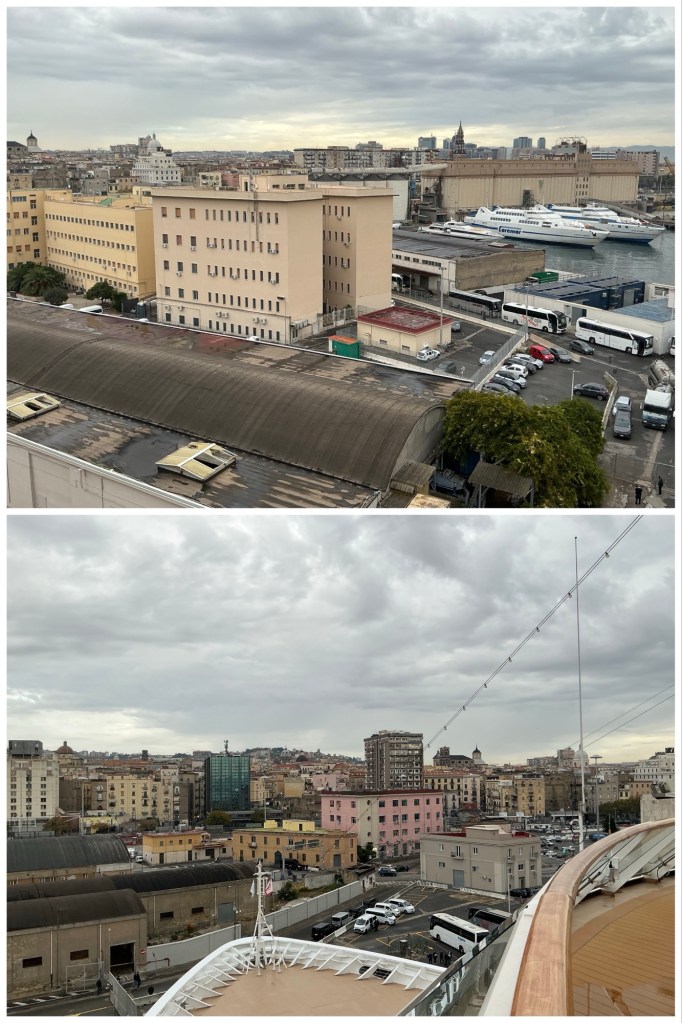
As the day progressed, the sun came out and the daytime temperatures reached 23°C/73°F, which translates in either system to “perfect”. All of a sudden the cityscape took on colour and charm.


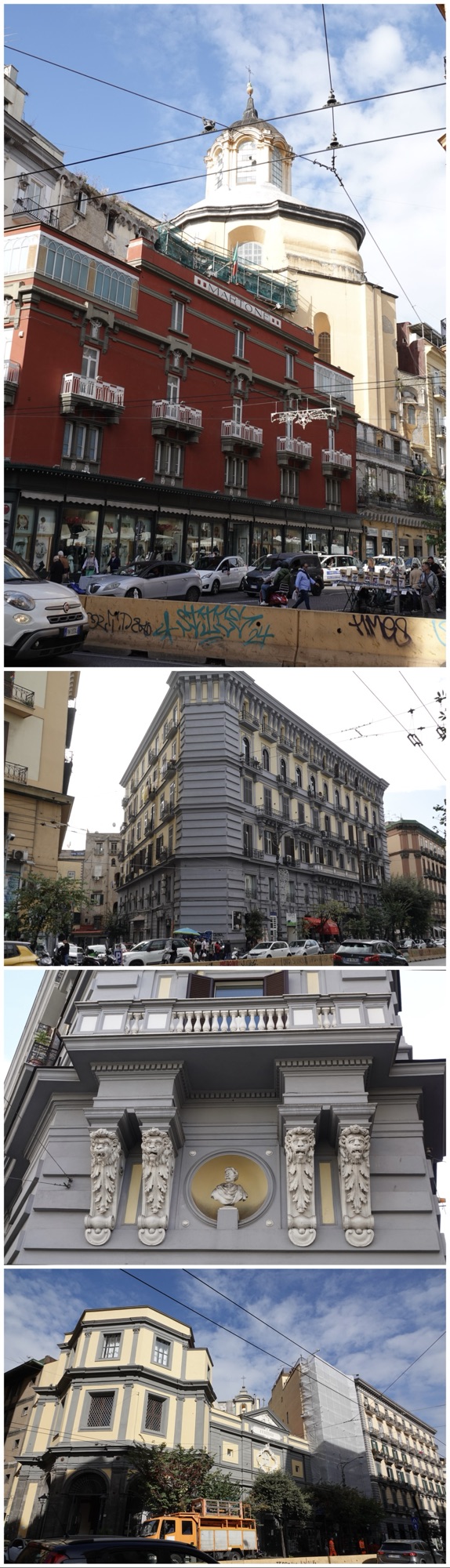
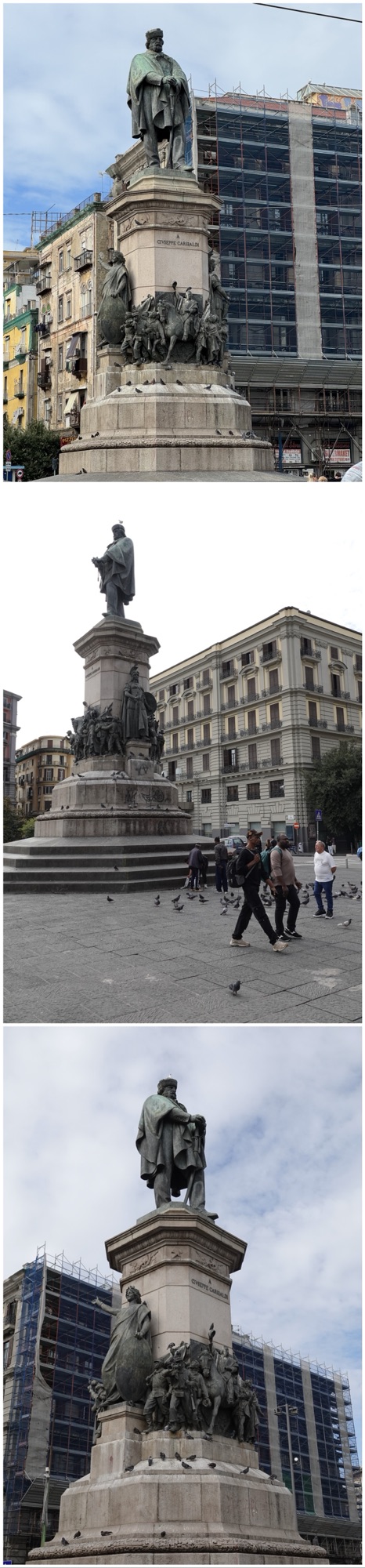
We headed out around 10:00 a.m. into what our afternoon guide, Mario, described as the “rough” part of town around the mercantile port where we are docked (the Jupiter was in berth in the cruise port 2 km north of us). However, despite the fact that the tourist downtown that we later toured has more notable landmarks, I didn’t really find it much more charming than the local port area, which was filled with local people eating, strolling, and shopping. The reputation that Naples is gritty is certainly, in my opinion, well deserved. Graffiti and homeless people were visible in both parts of the city through which we walked, and the state of sidewalk litter was unhelped by the large number of smokers in Naples who simply flick their butts.



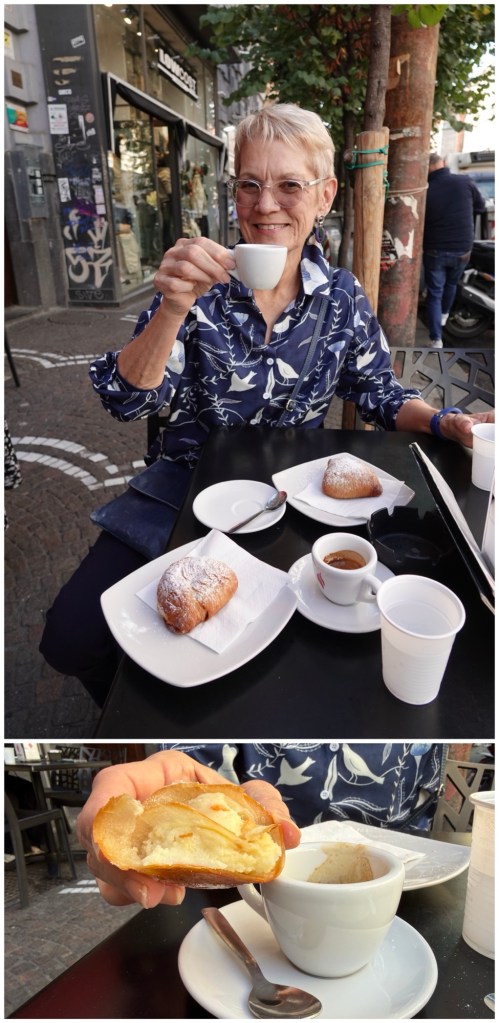
We stopped at one of the many small sidewalk cafés for espresso and pastry, both of which were delicious.
Because we can never pass by a church without going in, we popped into Saint Peter of Aram Basilica (where a monk reminded us to beware of pickpockets if we were going on the Metro), and the Santa Maria Monastery, which ministers to women in need.
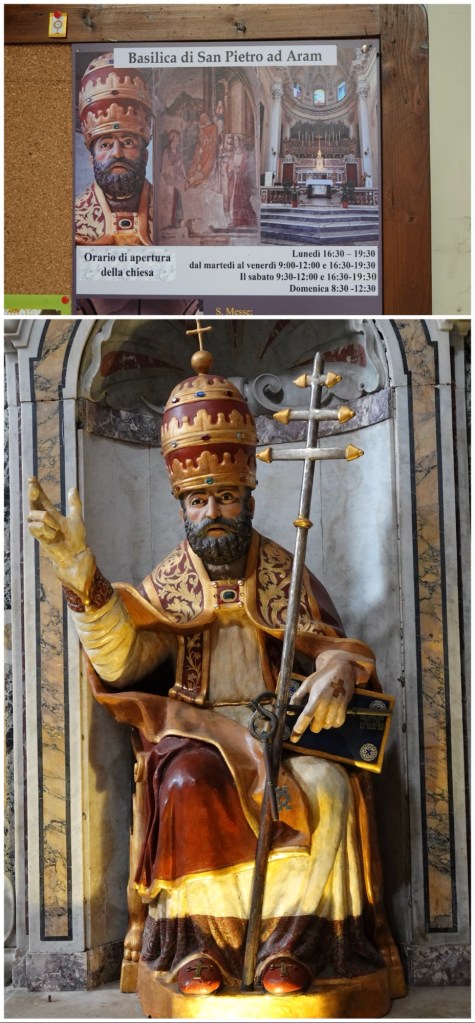
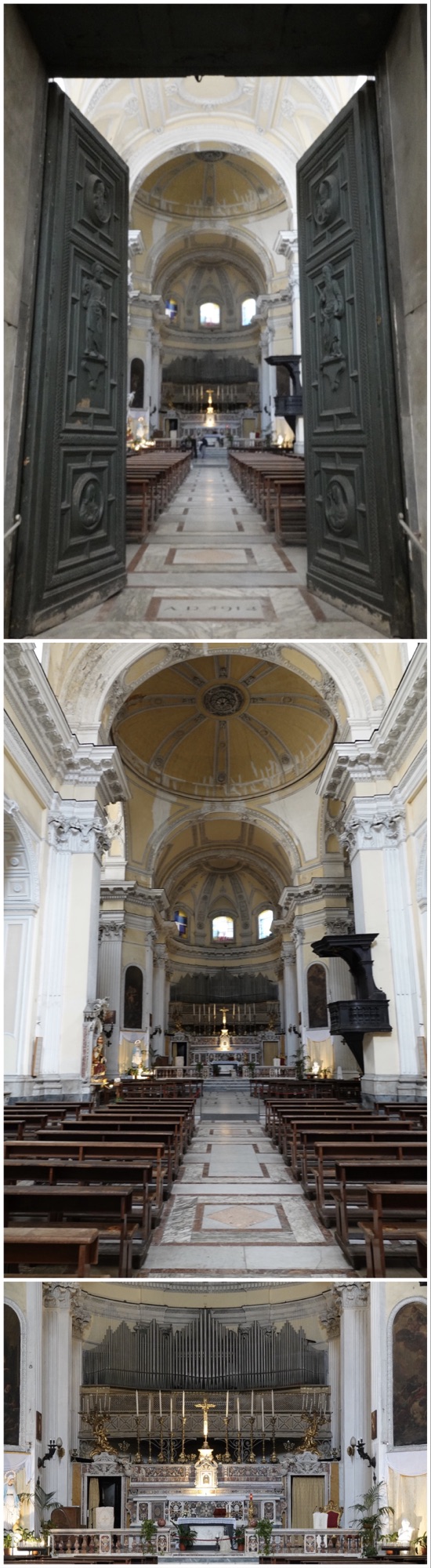

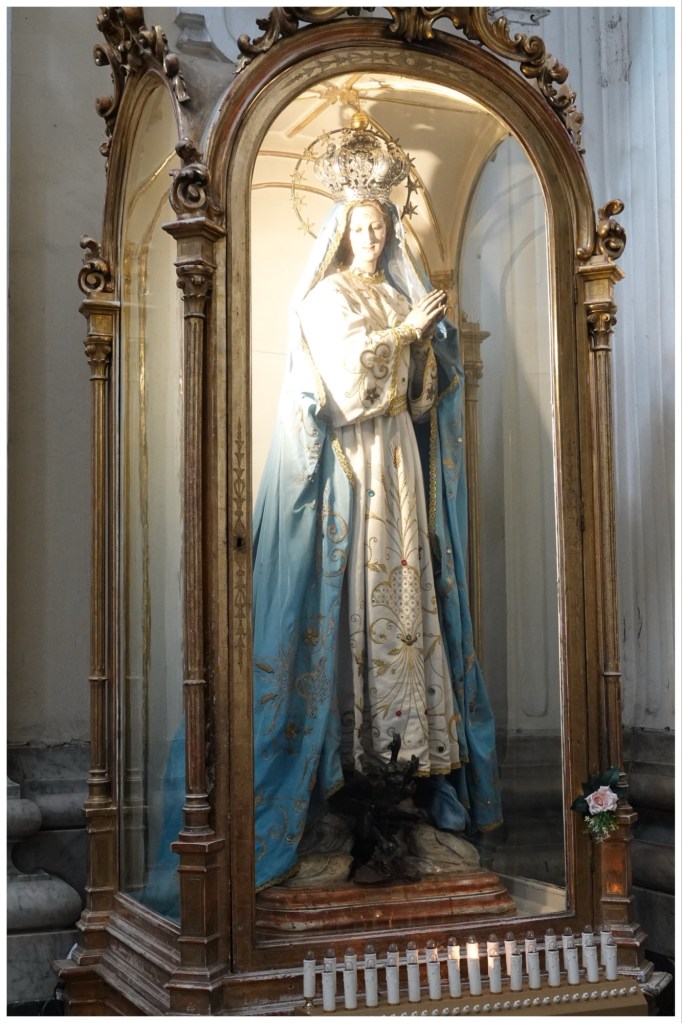
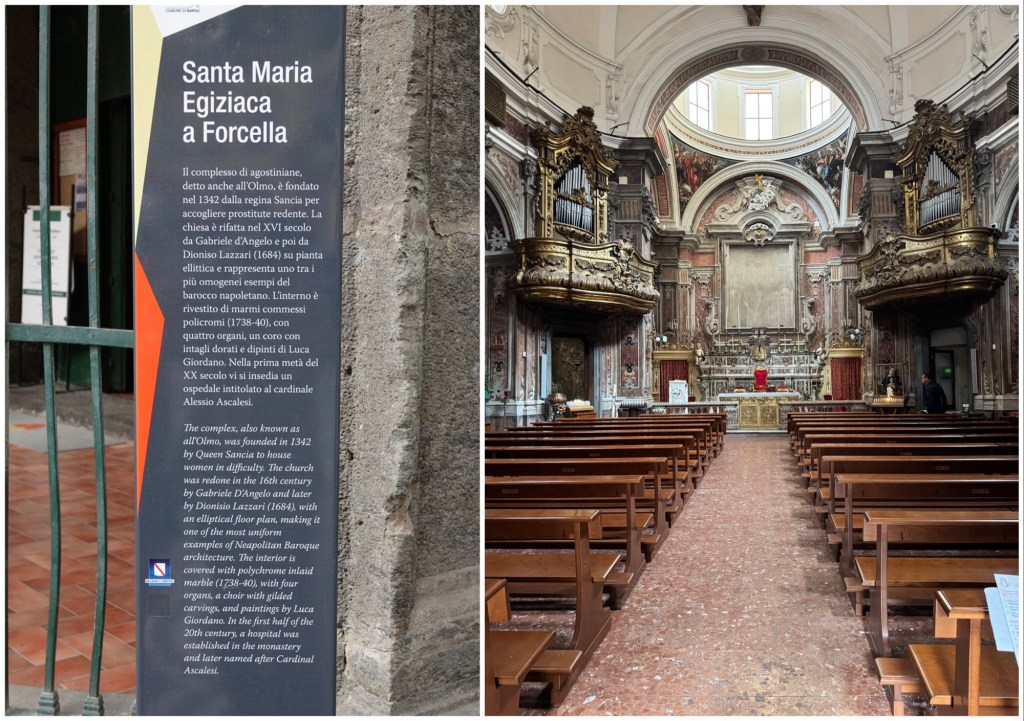
We made a quick stop at a pizza stand being frequented by lots of Neapolitans for a giant slice of margherita pizza. Ironically, although the last royal family of Naples was not particularly popular because they changed Naples from an independent state into part of a “country”with a new flag of red, white and green, the iconic Napolitan pizza is not only the colours of that flag but is named after King Umberto‘s wife Margaret.
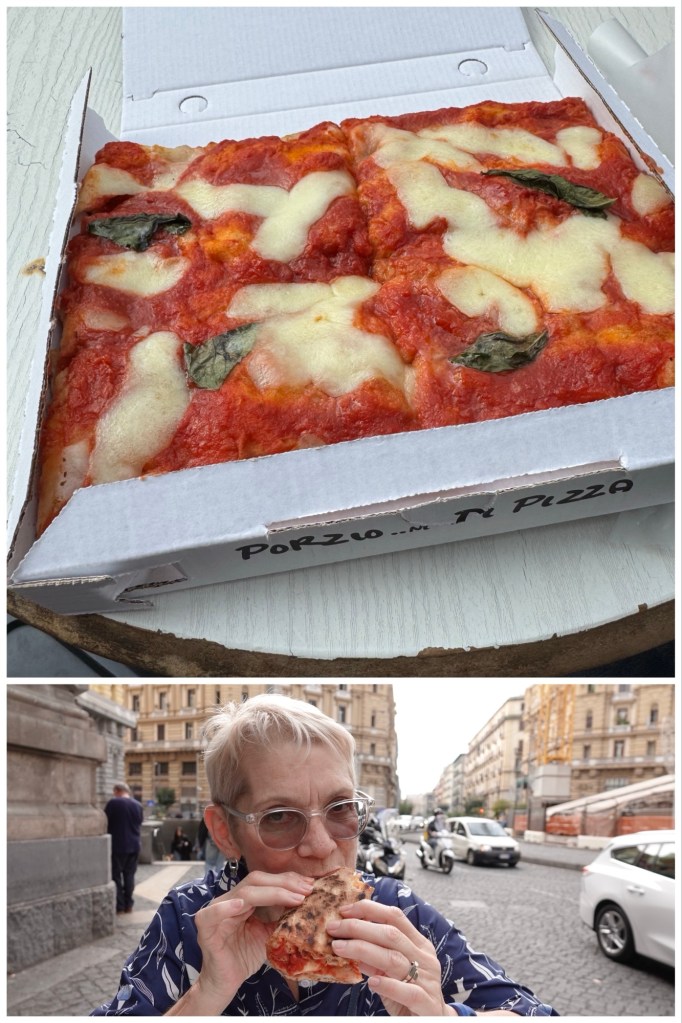
Then it was time to join our included excursion.
Our guide began our walking tour by describing Naples as a lasagna, layers upon layers of history, beginning with the Greek settlement of “neo polis” – the new city – and then layered with Roman, Christian, medieval, and baroque periods before modern times, reflecting Greek, Roman, French, Spanish, and eventually Neapolitan Italian occupations.
The Royal Palace dates to the late 1600s, but the original castle near the port dates to around 1100 CE and the French Anjou rulers. It has the kind of solid stone look with crenellated walls and towers that is typical of pictures of castles in children’s fairytales.

The three brick towers are made of local stone. The yellowy coloured bricks are a much softer kind of rock that is specifically suited to being resistant to the area’s very prevalent earthquakes. The gates in the centre with the bas relief on them are white marble and are the most recent portion of the structure, in Renaissance style, dated to the year 1432CE when the Spaniards, specifically from the kingdom of Aragon, arrived and conquered in this area.

Until 1860 the Bourbon dynasty ruled here. At that point, the Savoy King was part of uniting all of the various kingdoms into what we now know as the country of Italy.
The city is one of the oldest in Europe, having been founded by the Greeks in around 700 BCE, so the city is almost 3000 years old. It is also home to the oldest Christian churches in Europe.
We noticed both on our morning walk and in the afternoon with our guide that traffic in Naples is chaotic. There are many crosswalks, but it seems to be optional as to whether traffic stops or not. You take your chances based on how big the vehicle is I guess. It is important when crossing to look directly into the eyes of the driver to ascertain that they are going in fact to stop and stay stopped. Our guide told us that traffic lights in Naples are all simply suggestions.
One of the things that makes Naples unique is the presence of both Greek and Roman relics.
We walked by the Metro station closest to the port, where there is an active archeological dig we were told is going to be incorporated into what they are calling “the most beautiful Metro Station in Italy”. The site includes wooden ships and piers that date back to the first century CE. Like the wood in Venice, the lack of oxygen virtually petrified these structures, meaning that the artefacts are in excellent shape. We’d get to walk into the underground later.
The gates to the stables with bronze horses on either side date to the Spanish rule in Naples, and were then improved and increased in size by the Bourbon dynasty. The bronze horses were the personal gift of the Russian tsar to Ferdinand the Second, King of Naples. At that point Naples was one of the three major cultural cities of the world, along with Paris and London.

The building with gray arches and a white second story is the Teatro de San Carlo built in 1737, the first Opera House in all of Europe!

The opera house was established by King Charles I of the Bourbon dynasty. We heard that Naples in the 1500s had four music academies, and Mozart , among other composers, was hosted here by the British ambassador.

Interestingly, the first independent university (i.e. independent of the church) was also established here in Naples. Instruction at that university was at least partially given in German.
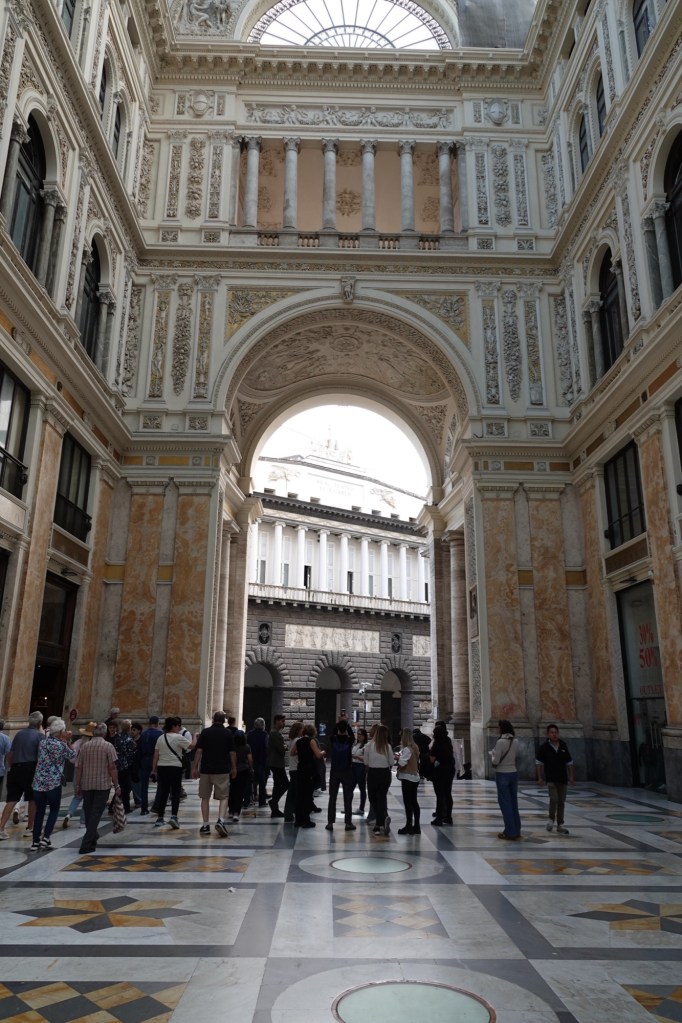
On the opposite side of the street, dating to 1890, is the gorgeous arcade, which was built as a huge shopping mall, the Galleria di Umberto Primo, named after Umberto the first Savoy king of the unified Italy. We had a chance to peek inside later.


The grey stone building with terra-cotta colored bricks and green balconies was originally part of the Royal Castle and now houses the national public library.

The most important square in Naples, historically speaking, is the Piazza del Plebiscito, with the huge pillared neoclassical church of Saint Francis as its main feature. The style of the church is reminiscent of the Greek Parthenon. When Napoleon conquered Naples, King Ferdinand fled to Sicily, which was not under Napoleonic control. During his exile, he promised God that if he was allowed eventually to return to a free Naples, he would build “a small church”. This massive church to Saint Francis fulfilled his promise to God in 1816 CE.
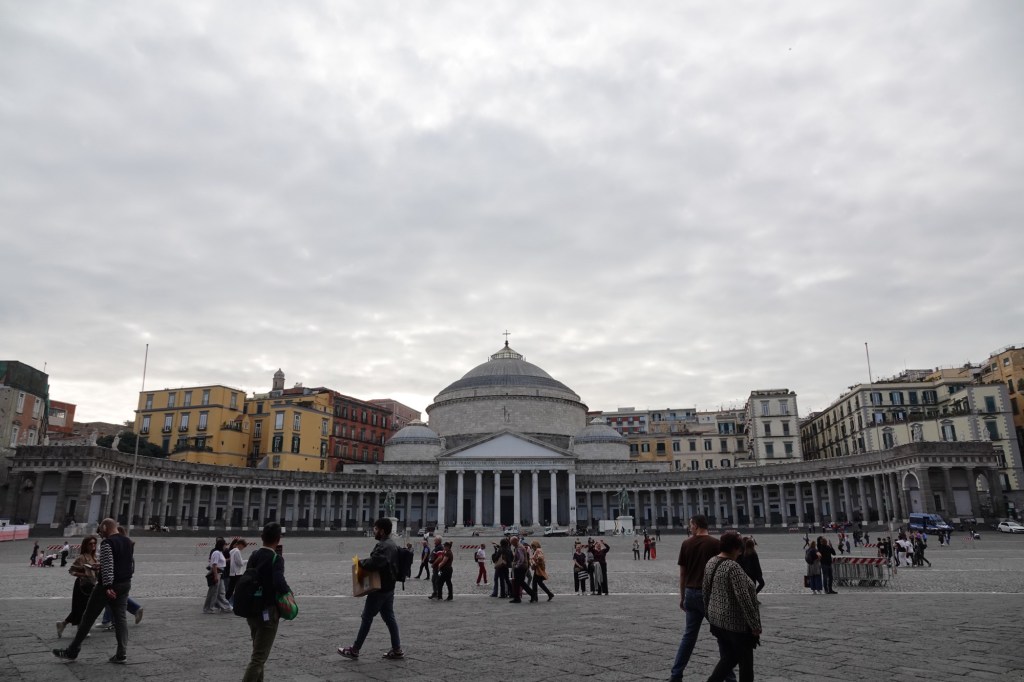
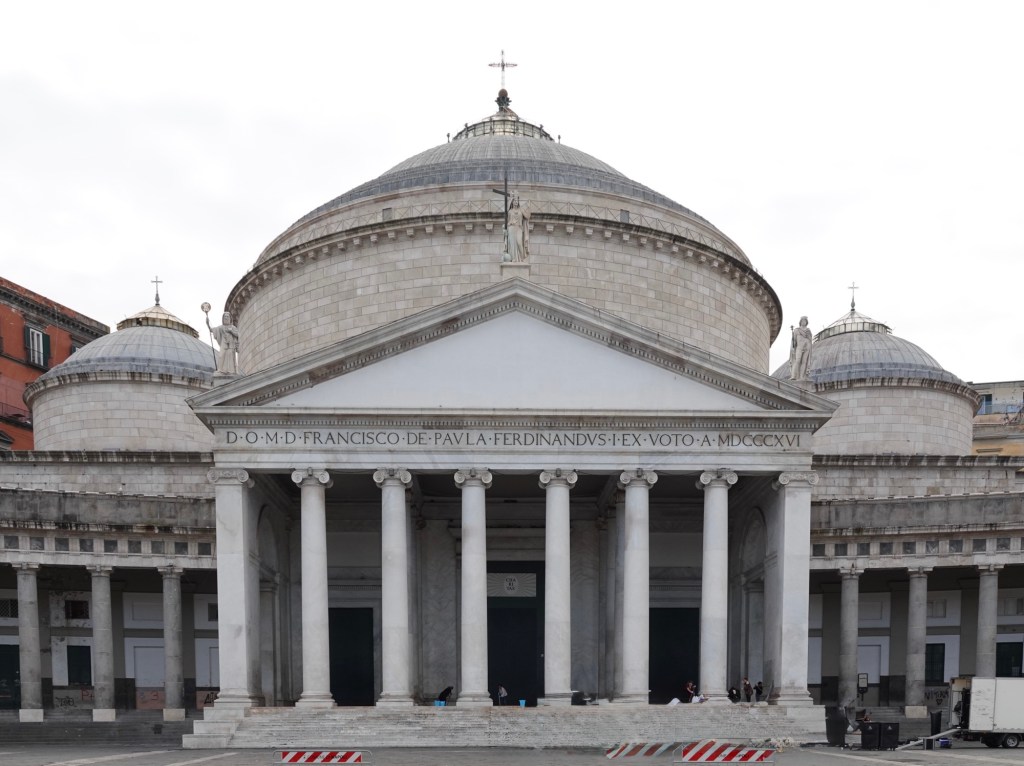
The statues in front of the church are the king of Naples, Ferdinand, and his father King Charles of Bourbon. Each one has in their hand a scroll representing the constitution given to the people; the constitution was never given to the people, but the statues were created this way “just in case”.

Opposite the church is the portion of the royal castle with alcoves containing statues of the Neapolitan rulers beginning with Roger, who came from the Scandinavia (Ted said that name made him think of “Mike, from Canmore” of The Royal Canadian Air Farce) and following through the emperors and kings from the mediaeval times until the last king prior to unification. The statues were put into the alcoves after Italian unification; prior to that the walls were beginning to crumble, and the alcoves were empty. In that Royal Castle, the coat of arms of Naples is over the main entrance, and the balcony was used not only by kings but for speeches by generals after the second world war ended.


We were able to take a short walk in the courtyard of the Royal Palace. This was the “courtyard of honour”, where the king would have welcomed royal visitors from other principalities. There would have been royal guards on all sides during those ceremonies.
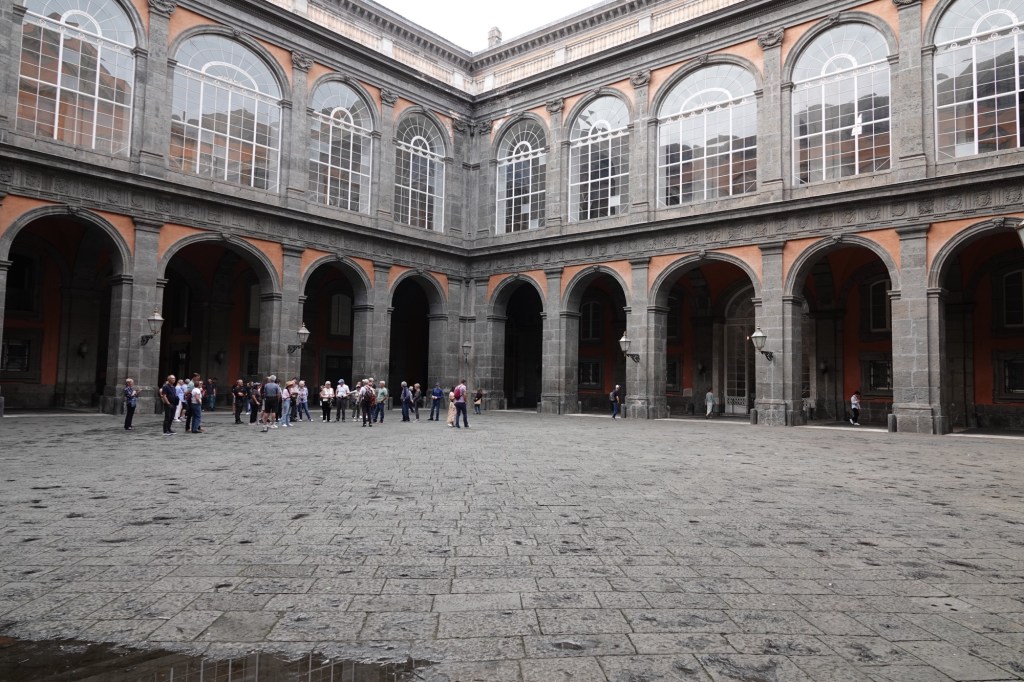
The windows visible around the courtyard were the hallways to the Royal apartments and Royal chapel.
Much of this palace was destroyed by the fire bombs of the American forces during World War II, but it has been reconstructed. Prior to that reconstruction, the castle was used as a bar for American soldiers, who used the Royal throne as a toilet during drunken revelries. War is destructive, but war also involves lots of disrespectful behavior.
We walked into the atrium that leads to the Royal apartments. The white marble, decorated in neoclassical style, all came from areas immediately around the city of Naples.
In the hallway leading to the Royal apartments is a magnificent staircase. Legend has it that this is the staircase on which Cinderella lost her glass slipper. Our guide told us that the story of Cinderella was originally a Neapolitan fairytale.

About an hour outside of Naples is the newer Royal Palace, which is the Italian equivalent of Versailles, with multicoloured marble and ornate decoration, but I think the white on white here is elegant and particularly effective.
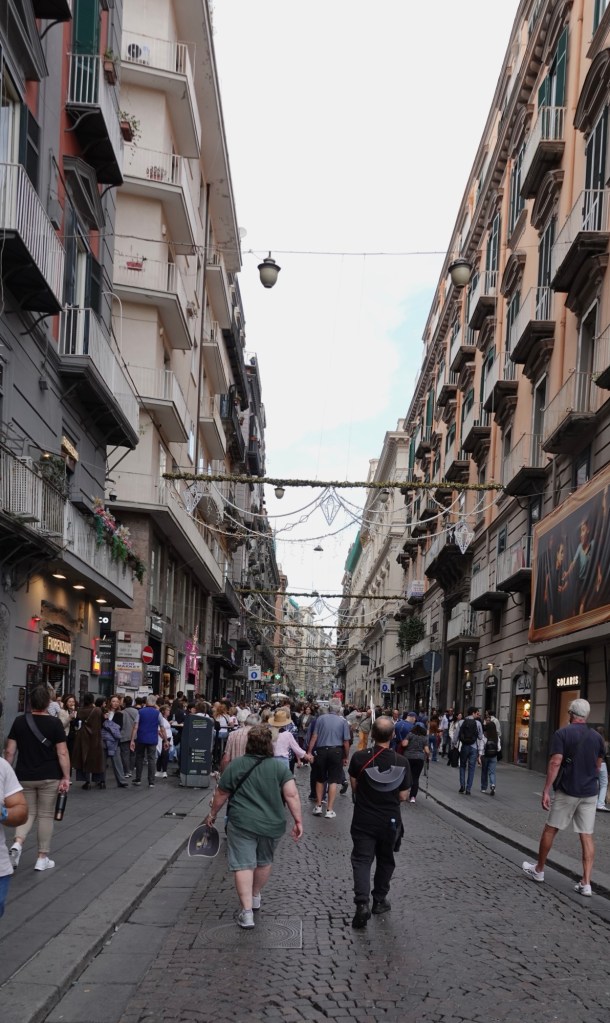
From the Square, we walked into the pedestrian only zone. The street itself, despite being lined with buildings that lead directly to the Royal Palace, was not all that impressive, but the alleyway leading into the Galleria Umberto was spectacular.
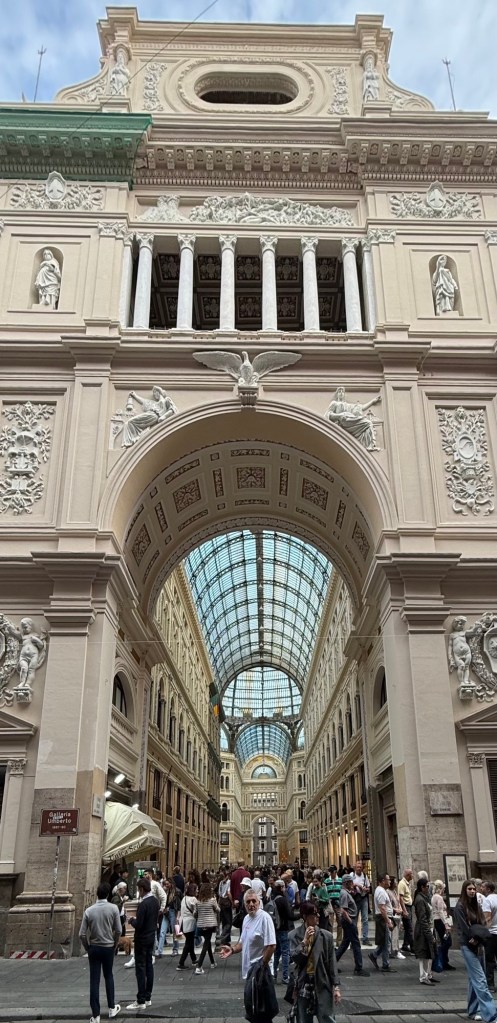
The beautiful iron framed roofline is reminiscent of Victorian era greenhouses, or the work of Gustav Eiffel.

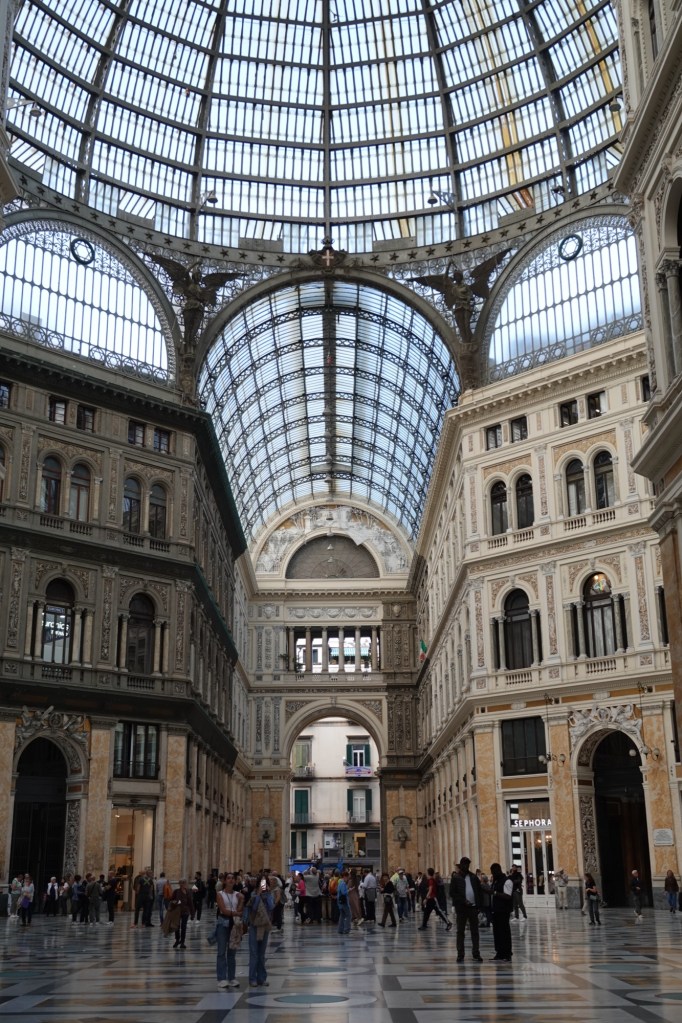
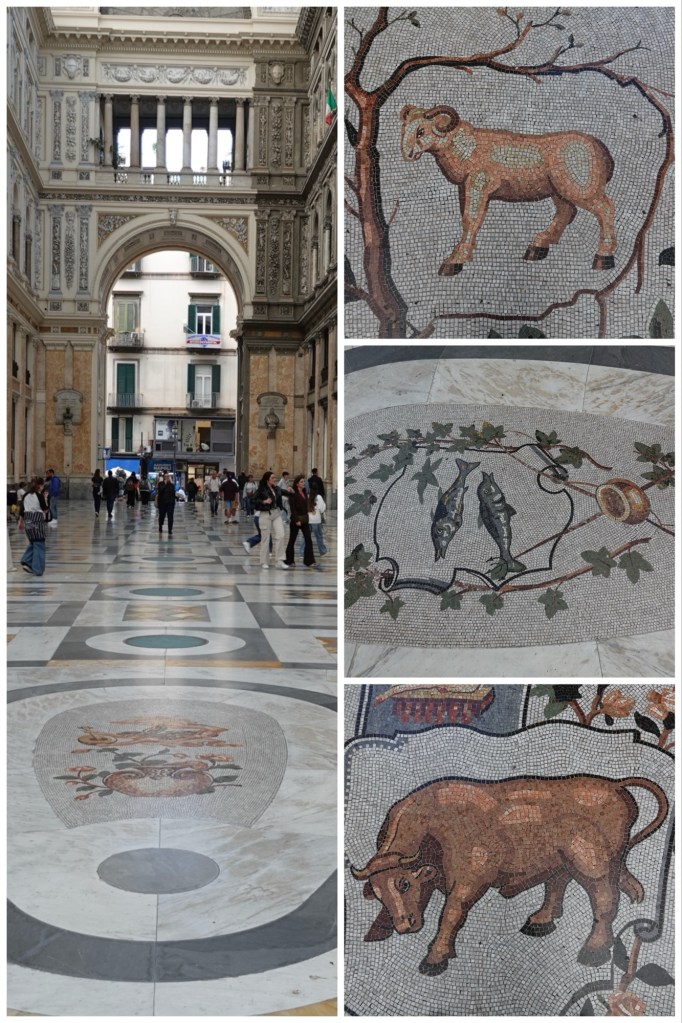
The arcade was by far the most beautiful building we saw in Naples, even considering the fact that it now hosts multinational chain stores, souvenir shops, and even the ubiquitous McDonald’s. Whether we looked up at the ironwork and carved marble, or down at the marble mosaic floors depicting the astrological signs, it truly was a spectacular place.
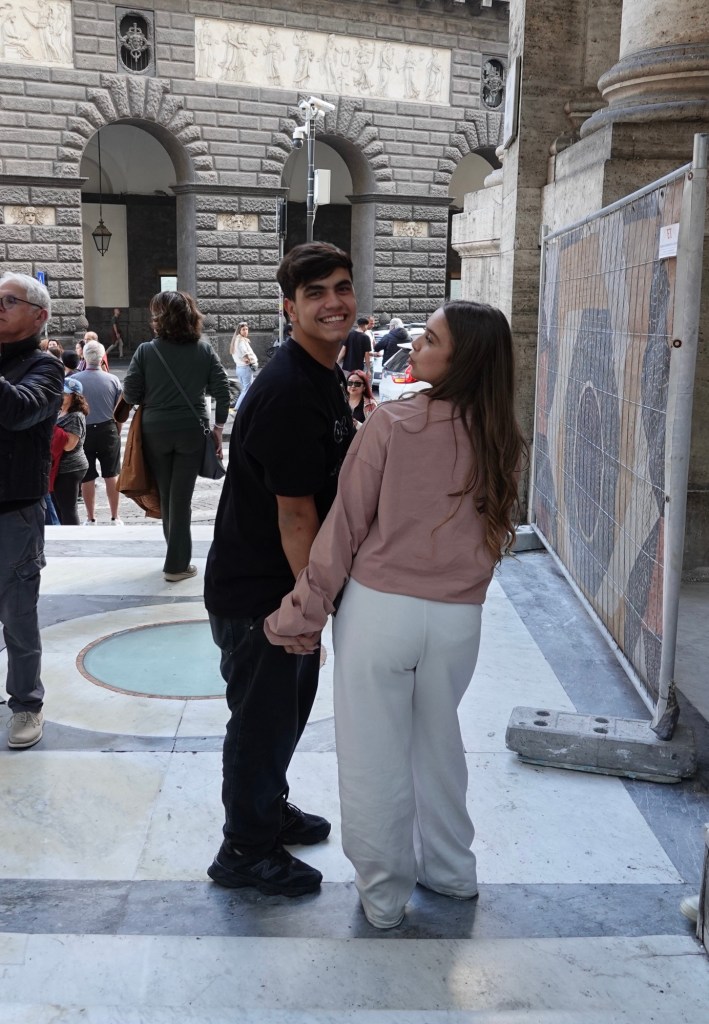
Ted’s camera sometimes attracts attention. This young couple insisted that he take their picture, and then wanted to see what it looked like on his camera’s screen. As a result, we have a picture of two random Napolitanos!
En route back to the ship, and after a brief stop for espressi and another sfogliatella each, we walked down into the metro station where some of the archeological relics of the Castel Nuovo walls are exposed and we could see exactly how far down the base of the old fort/castle was located below ground. At one point it would have been in water, having basically a moat created by the Mediterranean. It makes for a pretty impressive metro station.

We also got a look, albeit through a screened area and not really photographable, of the Greek relics that were discovered underground here. They will eventually be visible behind glass walls to people using this metro station.
It was an interesting quick glimpse into the city’s history, although it didn’t really inspire me to return to Naples.
Dinner tonight was in Manfredi’s, Viking’s Italian specialty restaurant.

After dinner we took in the Duets show by the Viking vocalists, followed by James on guitar and the band’s first rock ‘n’ roll set in Torshavn before calling it a day at 11:00 p.m.
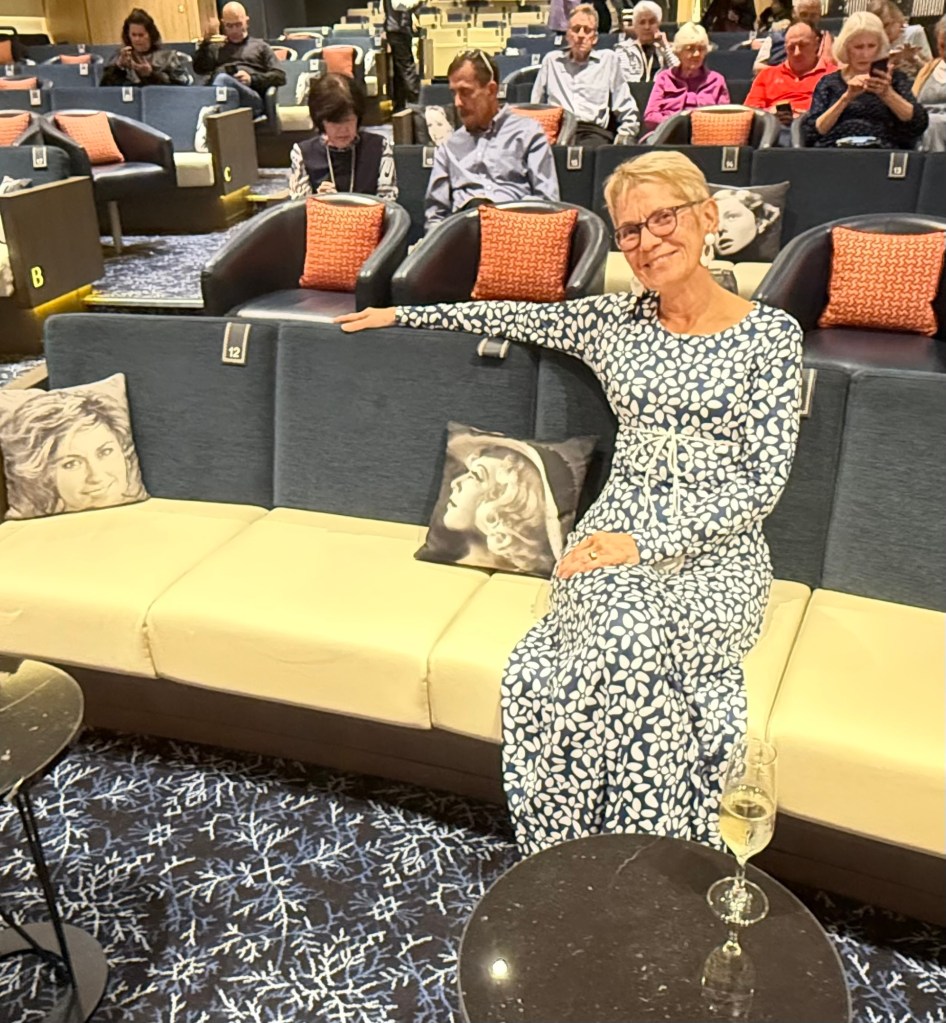
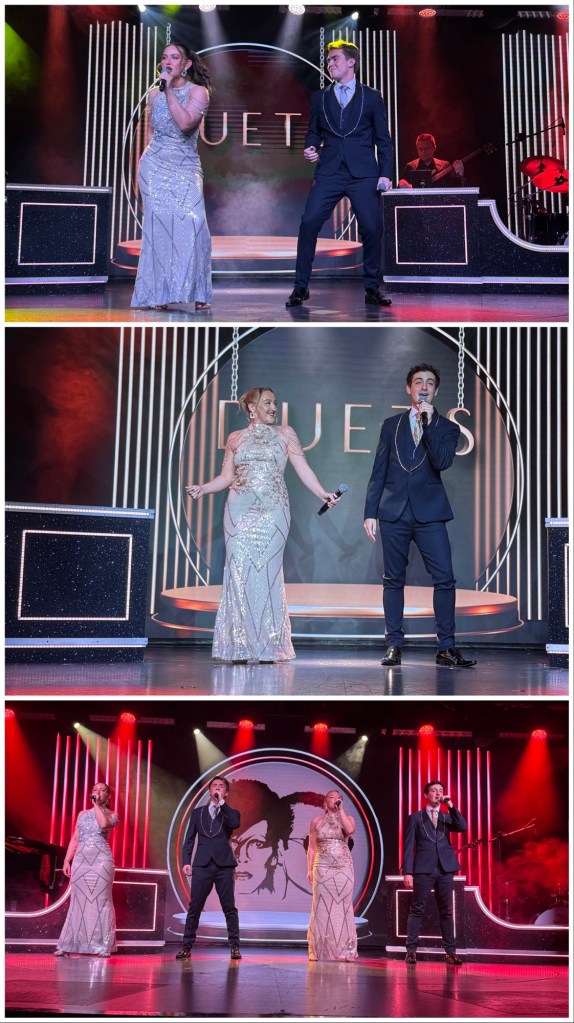
Tomorrow we have a morning excursion in Messina.
 Rose and Ted’s Excellent Adventure
It’s hard to believe the tour didn’t include the National Arcfhaeologial Museum, one of the most important in the world. This is where the items recovered from Pompeii and Herculaneum are stored.
LikeLike
We’ve visited Pompeii before. There was an optional there today too from Messina.
LikeLike
We’ve also visited Pompeii and Herculaneum, twice, BUT unless you go to the National Archaeological Museum you’ve missed what both those places were all about because this is where all the artifacts, statuary, mosaics — in other words, all the items that made those sites what they were — are stored.
LikeLiked by 1 person
We have been to Naples a few times but this brought back a lot of memories. There are a lot of places we haven’t been to that you added to our next visit. You might want to edit the line: “At that point …… was one of the three major cultural cities of the world, included with Paris and London.” Isn’t speech-to-text wonderful, but occasionally you get a laugh!
LikeLike
Oh dear…. I thought I had caught every time that happened!!!
LikeLike
Naples sounds interesting. I like gritty.
I had smoked salmon for breakfast many mornings on the Sky. It’s interesting that they’re serving it with hard-cooked eggs and cream cheese(?) on the Star. I wonder if the Sky will do the same. I try to avoid the waffles in Mamsen’s, or I would have them every morning.
How are the vocalists compared to the two groups we saw on the Sky for the world cruise?
LikeLiked by 1 person
The vocalists were not as good as “ours”, and interestingly the guys are the stronger voices in this quartet.
LikeLike
hi Rose,
We started skipping the vocalist shows, when they repeated on the Sky, ( Claire didn’t go much to start with) but the shows might be different by ‘28.
I picked up that you are caffeine tolerant. Not so, for me after breakfast, and Claire not at all. We were regulars at the smoked salmon, and yes, the Mamsen’s waffle is the only waffle, no doubt. We recently bought some of the Brunost cheese locally. Ted’s photos are delightful.
Paul
LikeLiked by 1 person
So… had to mention that with the new Asian station, this morning I had dim sum style dumplings and a “Chinese croissant” for breakfast (layers and layered of thinly sliced pork wrapped in an egg roll wrapper and the wrapped again inna crispy fried egg! Yummy!
LikeLike
…and Ted says thanks!
LikeLike