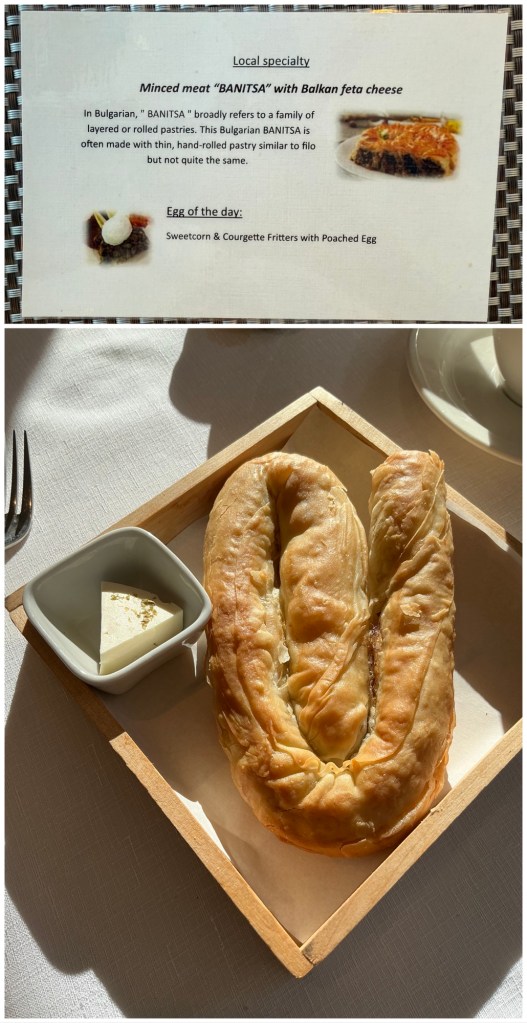
On this voyage, Viking is presenting a daily “pie” at breakfast, each one representative of the country in which we’re docked.
Today’s breakfast pie was banitsa, and Ted and I – who each finished an entire one – agreed that it was delicious!
Left to our own devices in the morning, we walked into Nikopol. I’d love to say it was a beautiful port town, but in fact it had a permeating air of despair emanating from the crumbling brick and plaster, broken fences, and missing windowpanes.
It seemed that the older folks, those born during the soviet era, were only just learning to look up and smile. To be fair, looking up could be treacherous given the state of the narrow and broken stone sidewalks and the unpaved roads.


There were several monuments along the streets.

EVLOGIZ ANGELOV,
BORIS
STEFANOV 1944

In every case, the monuments were in better condition than the buildings housing homes and businesses.

They also make rakia (the equivalent of Polish palinka or slivovitz), the very strong grape or fruit brandy with a MINIMUM 40% alcohol content.
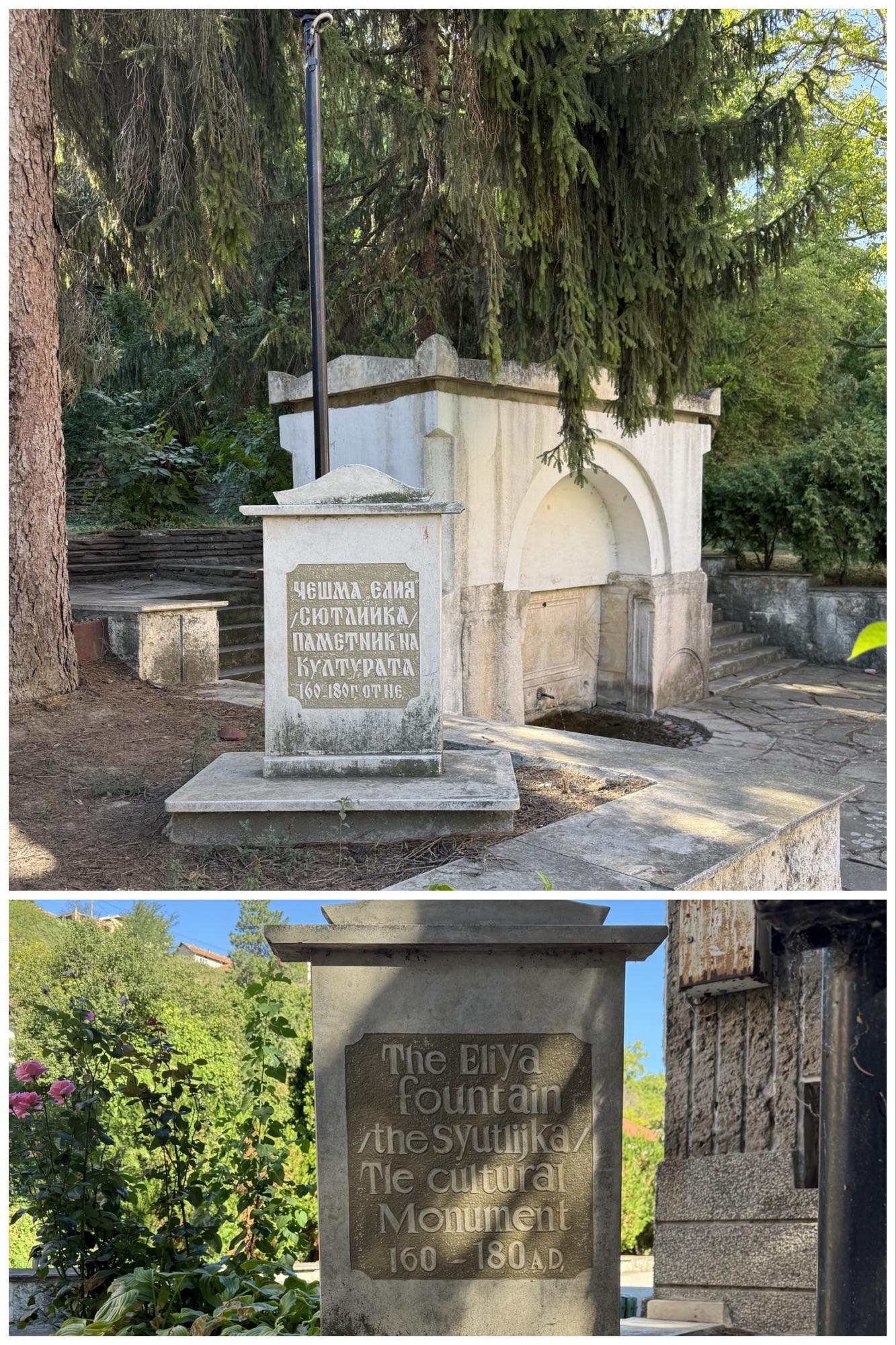
It’s quite possible that the best preserved construction in the town dates to Roman times: the Eliya fountain, dating to 160-180 CE. It’s not surprising that this is here, since Nikopol was an important Roman fortress and one of the earliest on the Danube.
Spring water still trickles from the faucet in the centre.
Every town, no matter how small, has a church. Bulgarians, like Romanians, are quite religiously observant. Here the stone wall outside the 1840 Church of the Assumption was plastered with death notices, a practice common in much of Europe (and in the Italian barbershop window of our hometown of Milton, Ontario right up until we moved in 2010.)

In contrast to the Audis, Porsches, and Reneaults we saw in Bucharest, in this small town there was a preponderance of rusty small cars, corroded buses, and Telstar mopeds. We even saw a LADA. Bulgaria and Romania both joined the EU in 2007, but neither has yet met the economic criteria required to adopt the Euro as their currency. Bulgaria is scheduled to do that in January 2026.

The stream running through town was dry, and in the 30°C/86°F heat smelled of the garbage thrown into it, despite the debris being mostly hidden by the vegetation that has taken over. We’ve noticed in our travels that, in general, the amount of litter on the streets is in direct proportion to the level of economic distress, reflected also in lack of public services.


Despite the crumbling housing, one thing we did NOT see were bullet holes. Our afternoon guide explained that the Bulgarian political philosophy was “always stick with Germany because they’re the strongest, but never cross Russia” . Apparently that explains Bulgaria “changing sides” mid WWII and not getting bombed by either the Axis or the Allies.
There was an overnight excursion inland to Sofia offered here in Bulgaria. I waffled quite a bit, especially since it cost $517CAD per person, and in the end chose to simply explore the two smaller cities in which we’d be docked: Pleven today, and Vidin tomorrow.
So, our activity today was the included 4-1/2 hour “Panoramic Pleven”, described as: Explore the City’s History and Landmarks.
A 45 minute drive from where we docked, Pleven is considered one of the most beautiful cities in Bulgaria. It is certainly a far cry from Nikopol!


As usual, the ride provided time for our guide to give us some relevant history and information. Today’s guide was very knowledgeable, as we’ve come to expect, but also very opinionated- and not at all shy about sharing his opinions, whether about politics or religion.
We learned that Pleven is the country’s 7th largest city, at around 90,000 inhabitants. There are only 6.5 million people in the entire country, about 1.3 million of whom live in the capital of Sofia. During the Soviet era rural families were (not voluntarily) moved into newly industrial zones outside the big cities to work in factories, leaving many uninhabited homes in small towns. Their lands were also taken, and converted into huge “cooperatives”. After 1989, lands were returned to their prior owners, but most people had lost the farming skills needed to utilize them, so ended up leasing them back to corporate agriculture conglomerates. That left the rural homes still empty, and a negative birth rate in the past 3 decades has exacerbated this problem.
Economic emigration has been yet another factor. Beyond the 6.5 million Bulgarians here, 3.5 million Bulgarians live in other countries; the 2 largest expat communities are in Chicago and Toronto!
Our guide told us that wages in Bulgaria are the lowest in Europe, despite the country ending the Soviet era with no international debt and significant gold reserves.
He also talked about bit about Bulgaria’s Soviet era dictatorship, describing the 30 year leadership of Todor Zhivkov as mostly benevolent. His actual words were “he wasn’t a macho strongman like Tito, or a megalomaniac like Ceauşescu”. The results for the country of their democratic elections have been mixed, with our guide describing post-Soviet Bulgaria as “the most corrupt country in Europe”, with nepotism rampant. Bulgaria is preparing for another election this October, despite being on a 5 year cycle and just having had one in 2024. The results of that election showed that no party attained a majority in the National Assembly, and no workable coalition has proved possible. Turnout was only 34.4 percent, the lowest since the end of communist rule in 1989, which I guess says something about how Bulgarians are feeling about their voices mattering.
The highlight of our tour was the Pleven Panorama.
I can’t summarize it any better than the three paragraphs included in our Viking Daily today:
—-Created by 13 Russian and Bulgarian artists and completed in just 11 months, the panorama was built in 1977 on the 100th anniversary of Pleven’s liberation from Ottoman rule. The structure of the monument itself is quite unique: the building is shaped like a truncated cone with horizontal rings encircling it. Three of the rings symbolize the three battles of Pleven, while the lowermost ring, etched with stylized bayonets, symbolizes the siege of Pleven itself. Inside, this incredible panoramic composition comprises four halls with vast and intricate artwork depicting the stories of the battles. Three of the halls— the panorama hall, diorama hall and conclusion, or final, hall— will transport the visitor to the battlefield and share the story of the war. The fourth hall, a permanent exhibition in the panorama’s rotunda, presents the highlights of Bulgaria’s liberation and the struggles to achieve it.—-

—-Due to its one-of-a-kind nature, awe-inspiring size and historical significance, the Pleven Panorama is a must-see monument on a visit to Bulgaria. This remarkable tribute was built almost 50 years ago in Pleven in order to recognize and remember a major battle fought here during the Russo-Turkish War of 1877-1878. During this battle (known as the Siege of Pleven) Russian Tsar Alexander II seized Pleven by cutting off the Turkish supply routes as part of an attempt to liberate Bulgaria. The victory came at a high cost: the Russian and Romanian forces suffered approximately 38,000 casualties and it took five grueling months to take the city after four assaults. Still, the Siege of Pleven paved the way for the defeat of the Ottoman Empire, as well as Romania’s independence and Bulgaria’s liberation.—-
—-Today, the Pleven Panorama is considered one of the most significant historic landmarks in Bulgaria. Also known as the Pleven Epopee 1877, the panorama is dedicated to the Siege of Pleven and the thousands of soldiers who lost their lives in battle. The only monument of its kind on the Balkan Peninsula, the panorama is a massive work of art located within the Skobelev Park museum on the site of the actual battlefield. The works of art contained within it depict the events of the Russo-Turkish War and describe the five-month Siege. —- (There is a similar Panorama at the Gettysburg battlefield in the USA)
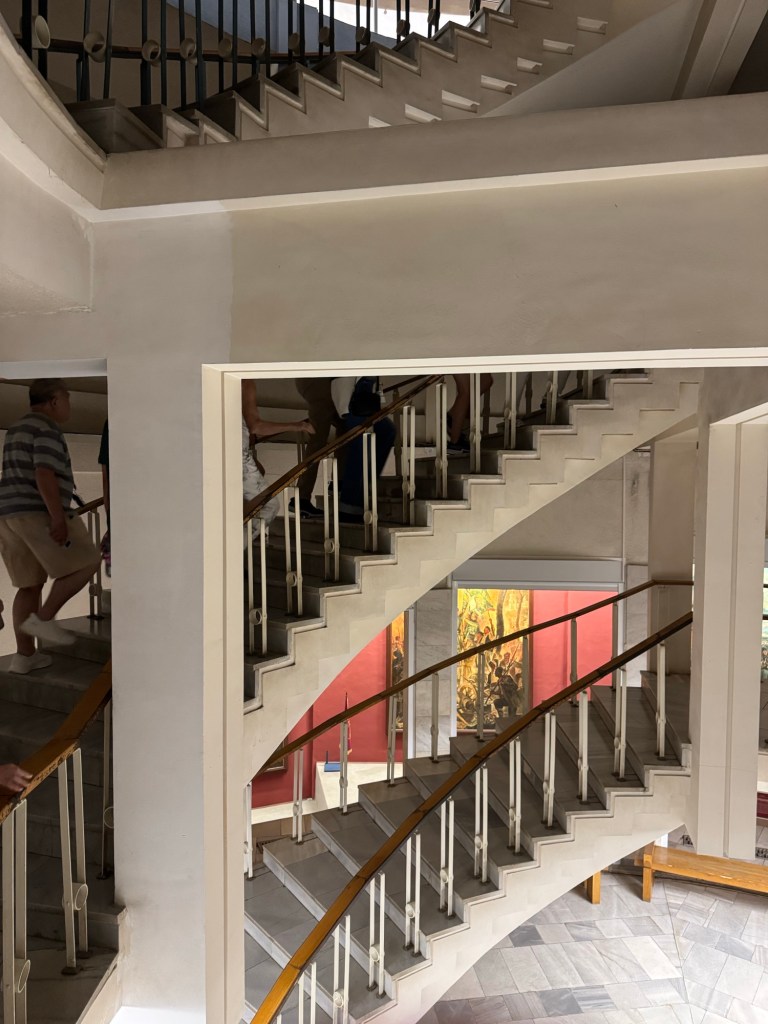
On the first 2 levels, as we climbed spiral marble staircases, were statues and huge paintings depicting various important events leading up to and during the Russo-Turkish War.

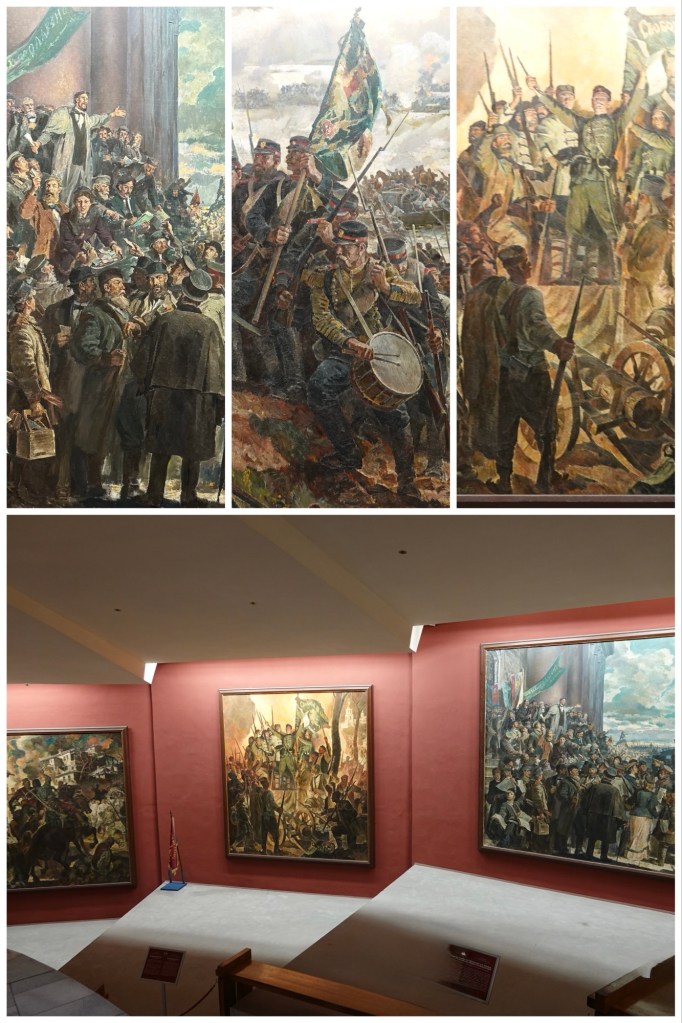
On the third level is the 360° panorama of the battle, incorporating a wraparound mural and a recreated battlefield. Photographs really don’t do it justice.

Ted’s panoramic video below is much better.
After leaving the Panorama, we ventured into the city centre, walking past a memorial to Bulgaria’s military hero, WWI general Vasov from the Balkan battlefront. Vasov’s trench warfare strategies and plentiful store of ammunitions allowed a single battalion to both prevail and survive gas attacks by wearing masks and using fires to evaporate the heavy chlorine and mustard gas. The battle became known as the “Bulgarian Military Miracle”.

We strolled the pedestrian promenade lined with shops, restaurants, and a few Habsburg-era buildings,
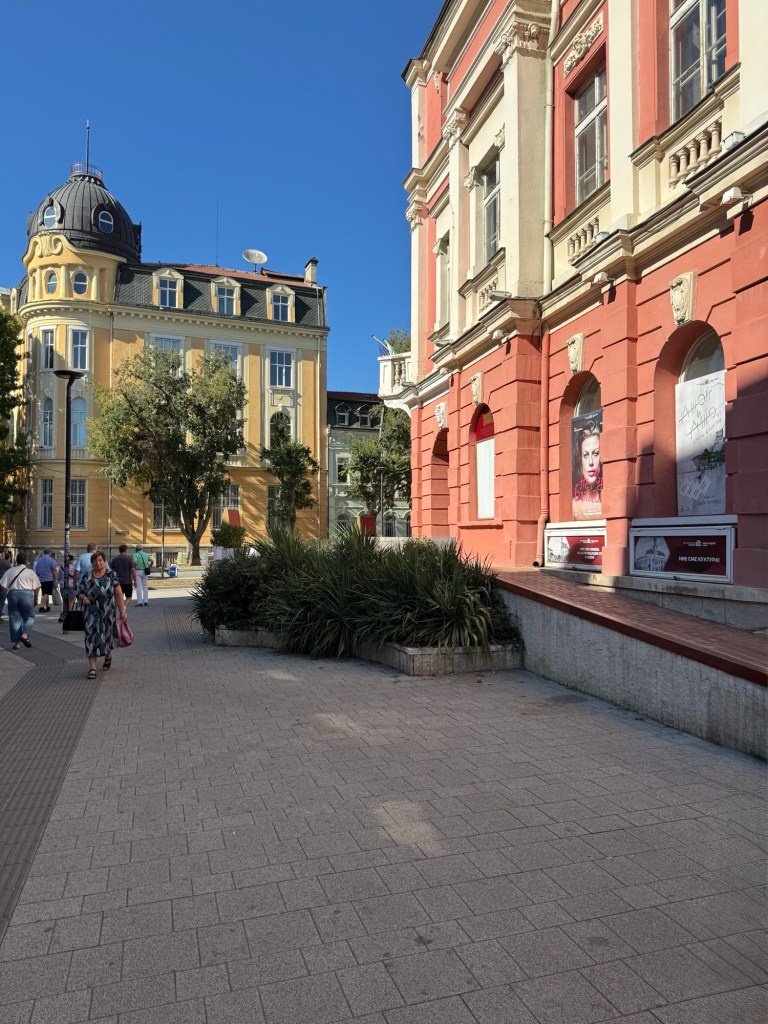
through the gate commemorating a Bulgarian war hero,
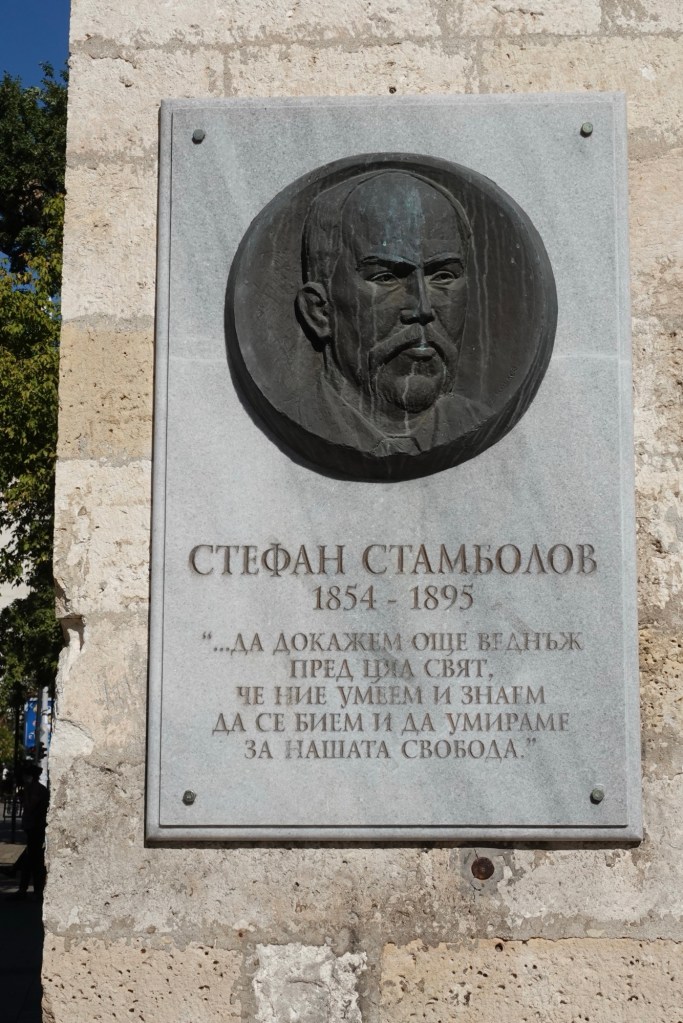
1854 – 1895
“LET US PROVE EVEN MORE TO THE WORLD THAT WE CAN AND KNOW HOW TO FIGHT AND DIE FOR OUR FREEDOM.”

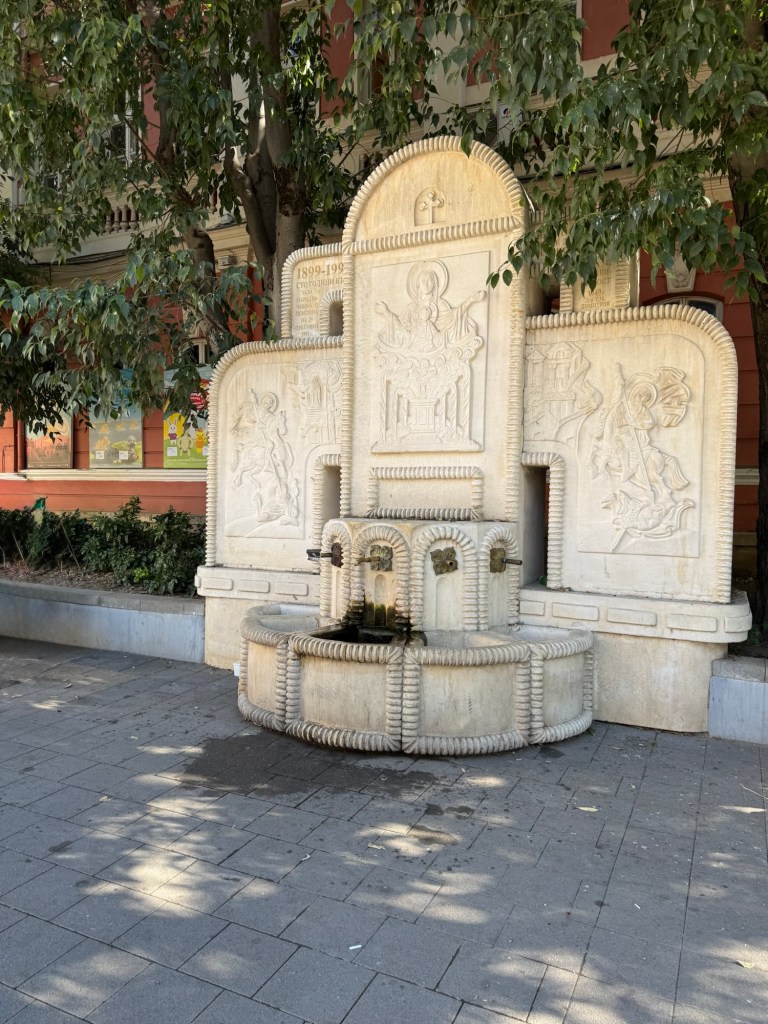
past one of the city’s many fountains dispensing drinkable spring water,
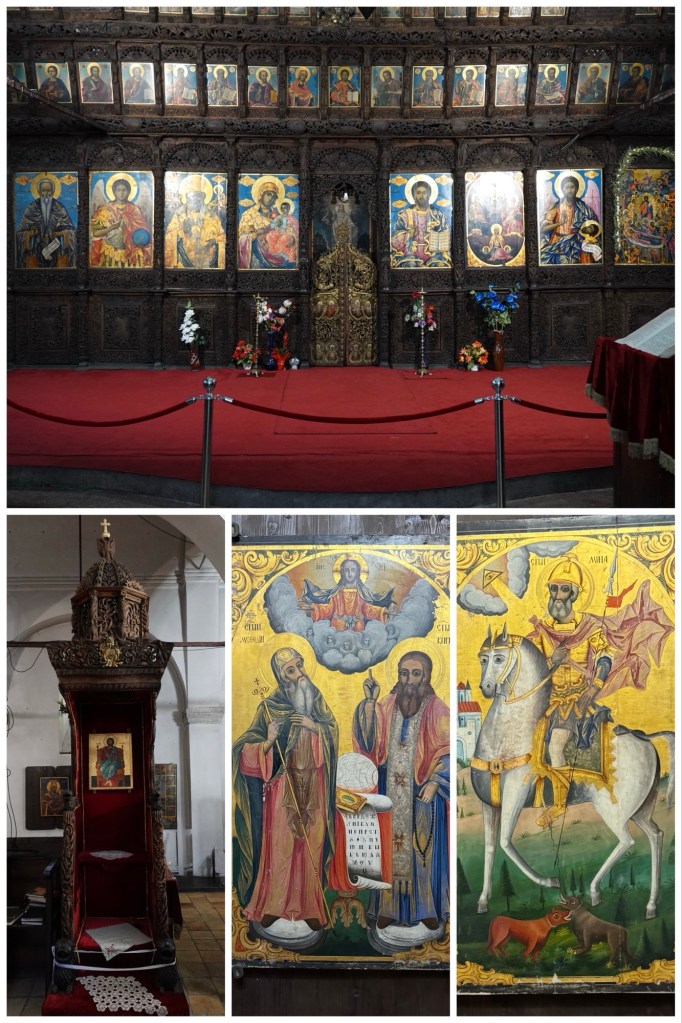
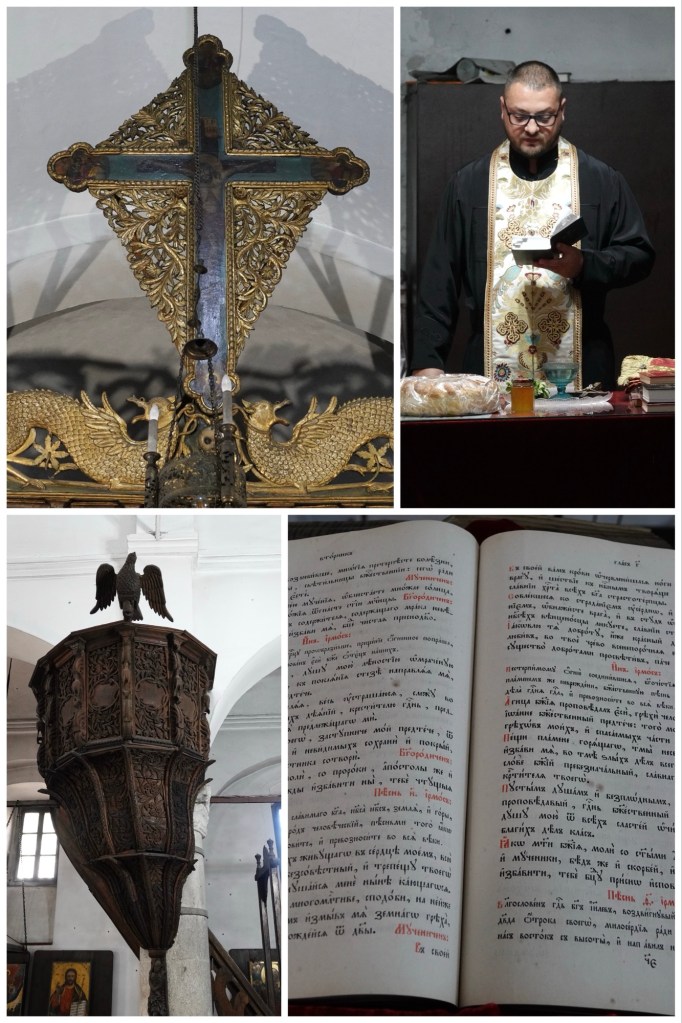
to St. Nicholas Eastern Orthodox Church, built in 1834. While we were inside, our guide explained the many differences between Eastern Orthodox and Roman Catholicism. I don’t think I knew that Roman Emperor Constantine had established his capital in Istanbul specifically to be nearer Jerusalem after converting the Roman Empire to Catholicism, or that it was his cardinals who objected and established a separate Roman Catholic version of Christianity in Rome.
At least, that’s how our guide explained it. He also opined that if Constantine’s version of catholicism had prevailed, the brutality of the Crusades would never have happened. Interesting to think about.

Then off to the other side of the pedestrian district, where we were given a guided tour of St. George Chapel Mausoleum, built in 1907 in dedication to St. George, the patron saint of soldiers. The landmark honors the Russian and Romanian soldiers who fought in the 1877 Siege of Pleven during the Russo-Turkish War.

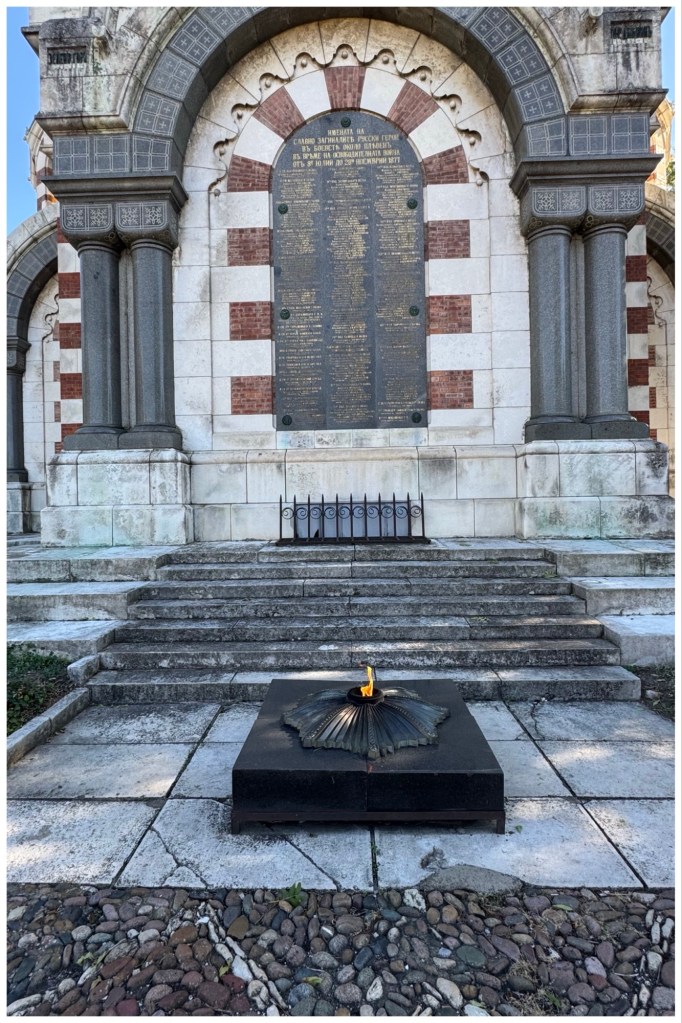
We were reminded that St George slaying the dragon is a metaphor for Christianity conquering Islam.

Photos were not allowed inside. We also descended into the basement of the church to visit the graves of members of the 5 liberation forces from the war of independence from the Ottomans: the Ukrainians, Romanians, Moldovans, Russians, and Finns who fought together to liberate Bulgaria.
We got back to the ship just in time for dinner. Ted and I both chose wild mushroom soup with mushroom cream, braised lamb shoulder roast, and Tilvenik (Bulgaria pumpkin “pie”, really more like a flaky strudel).

It was an enriching, educational day.
Tomorrow we’ll be in Vidin, our second Bulgarian stop.
 Rose and Ted’s Excellent Adventure
Good move
LikeLiked by 1 person