On Granville Street just below 65th Avenue in South Vancouver there’s a big 2-level Safeway grocery store (the store is above its own covered parking lot) with a row of windows at street level.
While most store windows are filled with items for sale, this one is filled with art.
Indigenous art.
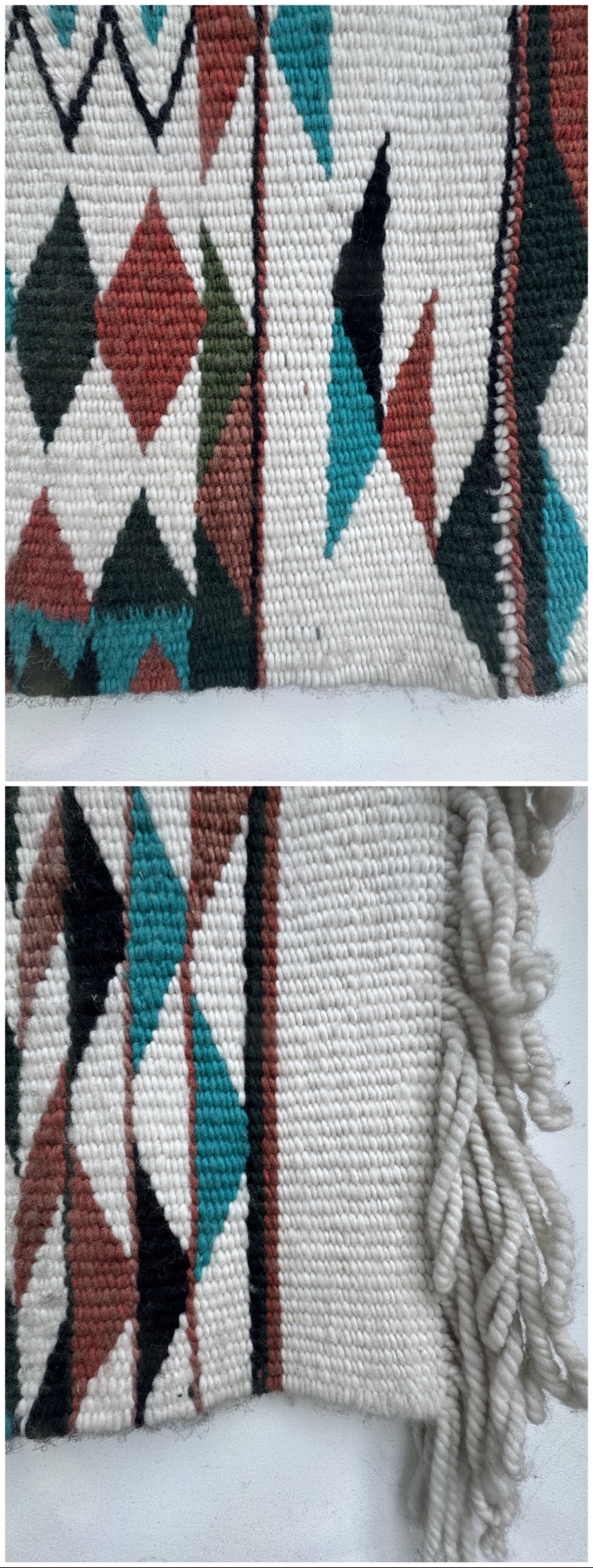
Beautiful woven pieces.
Living in Canada, and in British Columbia in particular, we’re used to hearing thanks expressed to our indigenous peoples for allowing events to take place on unceded territory. It happens before both professional and amateur sports competitions in our stadiums, before performances in theatres and concert halls, at the beginning of school assemblies, and before civic meetings.
I spent a bit of time looking up exactly why we’ve noticed this more in B.C. than we did when we lived in Ontario. What I found out was that while in many – perhaps most – parts of Canada, First Nations signed treaties (contracts with the government) that gave new settlers rights to the land, very few treaties were signed in B.C. In fact, 95% of B.C. is on First Nations land that never had a treaty agreement. That’s why today, in recognition of this issue, events in B.C. are often opened with a statement like, “We would like to acknowledge the territory of the Coast Salish people.” This recognizes that First Nations people did not give up their land or legally sign it away to Britain or Canada.
Through those land acknowledgments, we’re becoming familiar with at least some of the names of the First Nations people who have lived in our particular area of BC (the Lower Mainland) since well before Europeans arrived and colonized it in the mid-18th century: the Kwikwetlem, the Musqueam, the Qayqayt, the Semiahmoo, the Squamish, the Tsawwassen, and the Tsleil-Waututh.
That said, in our day-to-day we rarely come in touch with indigenous art, unless we’re at the airport (where totems and artwork is everywhere) or go specifically looking for it.
Today was an exception. Today it was simply “there”: five pieces of recent Musqueam weaving.


The signs accompanying and explaining the works were written by staff of the UBC Museum of Anthropology.
“Salish weaving is an ancient art form, dating back at least 4500 years. Woven blankets, made from the wool of mountain goats and dog hair, were often worn as garments and used in ceremonies, but also made for use in the home.
By the early 20th century, Coast Salish Culture had been profoundly affected by European influence, and the art of Salish weaving was almost lost. It was not until the 1960s that Salish blanket weaving began its revival. The people responsible taught it to themselves by studying examples of old weavings and questioning elders to learn whatever they remembered of the art.”
Today, very near our neighbourhood, at the mouth of the Fraser River, Coast Salish blanket weaving continues in the community of Musqueam, where respected and accomplished weavers continue to develop the art form.

The weavings above and below, by Robyn Sparrow, were created “to honour [our] ancestors and show respect to the Marpole Midden”.

The colours of the pieces reminded me of the gorgeous Cowichan sweaters we saw years ago when visiting Vancouver Island, although I remember those designs as featuring more recognizable animal shapes. They’re both completely different from the curvy totems featured on poles and in paintings and jewellery. I’m realizing that B.C. may be the perfect place to learn more about indigenous art and symbolism, if we just keep our eyes open.
To that point, after picking up what we needed at Safeway, we turned left to walk home and I realized that we’d blithely walked across the “lightning” crosswalk several times in the past weeks without really thinking about what it represented. No more of that!

 Rose and Ted’s Excellent Adventure
How could anyone miss th
LikeLike
Lovely weavings!
I’d love to read more about any indigenous art and symbols you see, on your meanderings around Vancouver.
LikeLike