Today’s was a full-day (9 hour) tour, leaving at 7:30 a.m. and returning shortly before our early evening sail-away.
Our destination was Bogor Botanical Gardens, followed by a tea plantation.
Our guide this morning said that if you come to a place without a horrendous traffic jam, it’s definitely not Jakarta! Bogor, in West Java, is just 60 km south of Jakarta, but the trip can easily take over 2 hours during morning traffic. With the police escort that Viking arranged for us we were there in just over an hour.
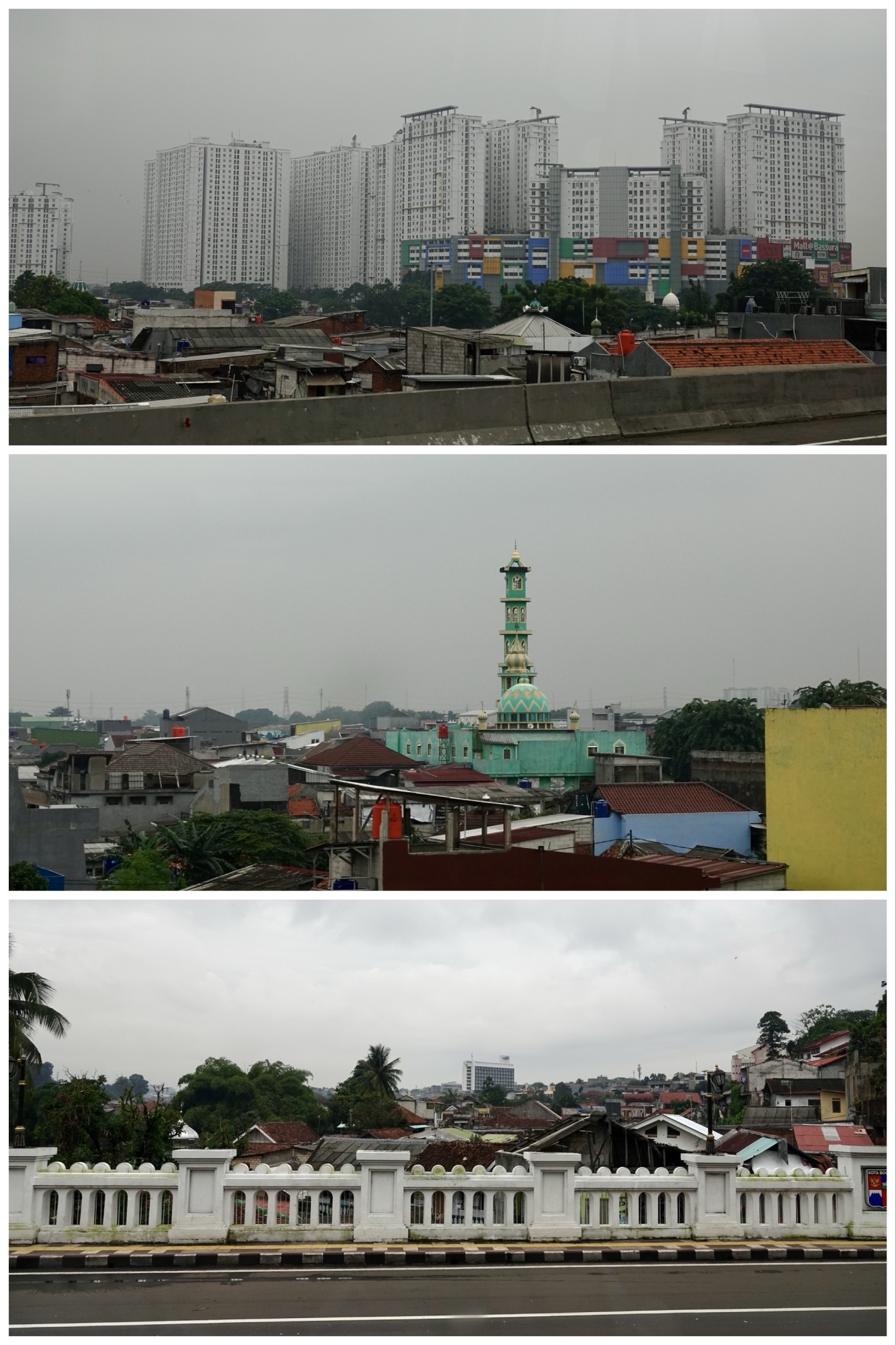
That police escort was not for security, but to get us through traffic congestion around Jakarta, and again in Bogor with its many traditional markets along the main roads, and school children walking along the sides of the roads too.

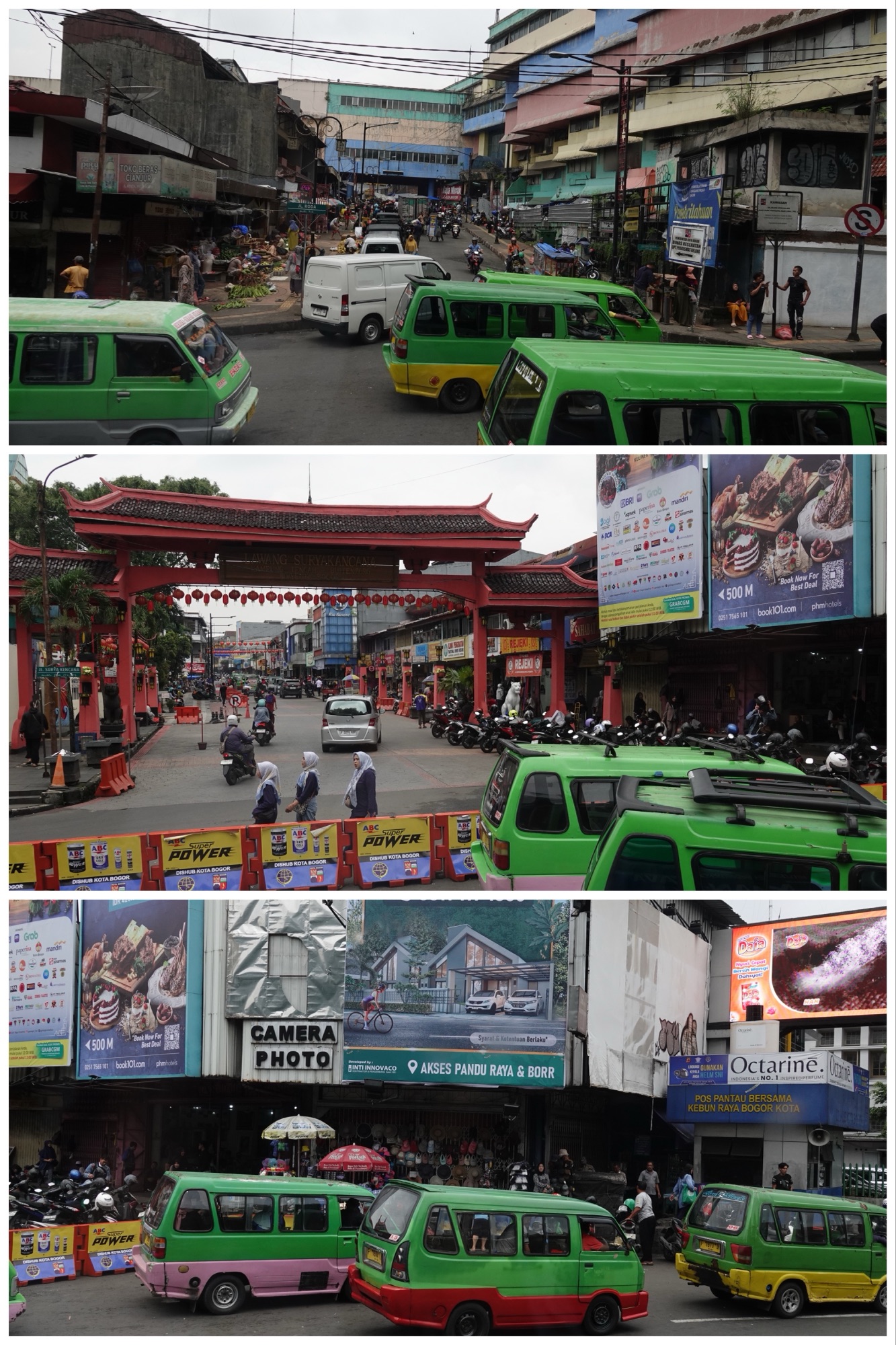


Once again, our drive was an opportunity to learn about Java from a knowledgeable local guide. He covered a variety of topics, and answered questions.
Today we learned that every Indonesian president since independence – until the latest one – has been from the island of Java. That’s likely because more than 50% of the entire population of Indonesia lives in Java. All the other islands together only account for about 45% of Indonesia’s population. Nonetheless, the current president is from Borneo, which is also where Indonesia’s capital will be relocated to in the next 5 to 10 years. That move is intended to mitigate Java’s overcrowding, and also acknowledges that Java is “sinking” in a way that Borneo is not.
Our guide, himself ethnically Sundanese as opposed to Javanese, explained that the city to which we were travelling, Bogor, is in Java’s Sundanese region. Sundanese Javans tend to have larger families, because children are seen as a blessing. President Suharto, during his highly divisive tenure as the country’s second president from 1968 to 1998, brought in a program of family planning initiatives encouraging Indonesian families to have only two children; that was successful in most urban areas but not in rural ones where it was harder for doctors to disseminate information about contraception. Our guide was one of nine children, although he only has four himself.
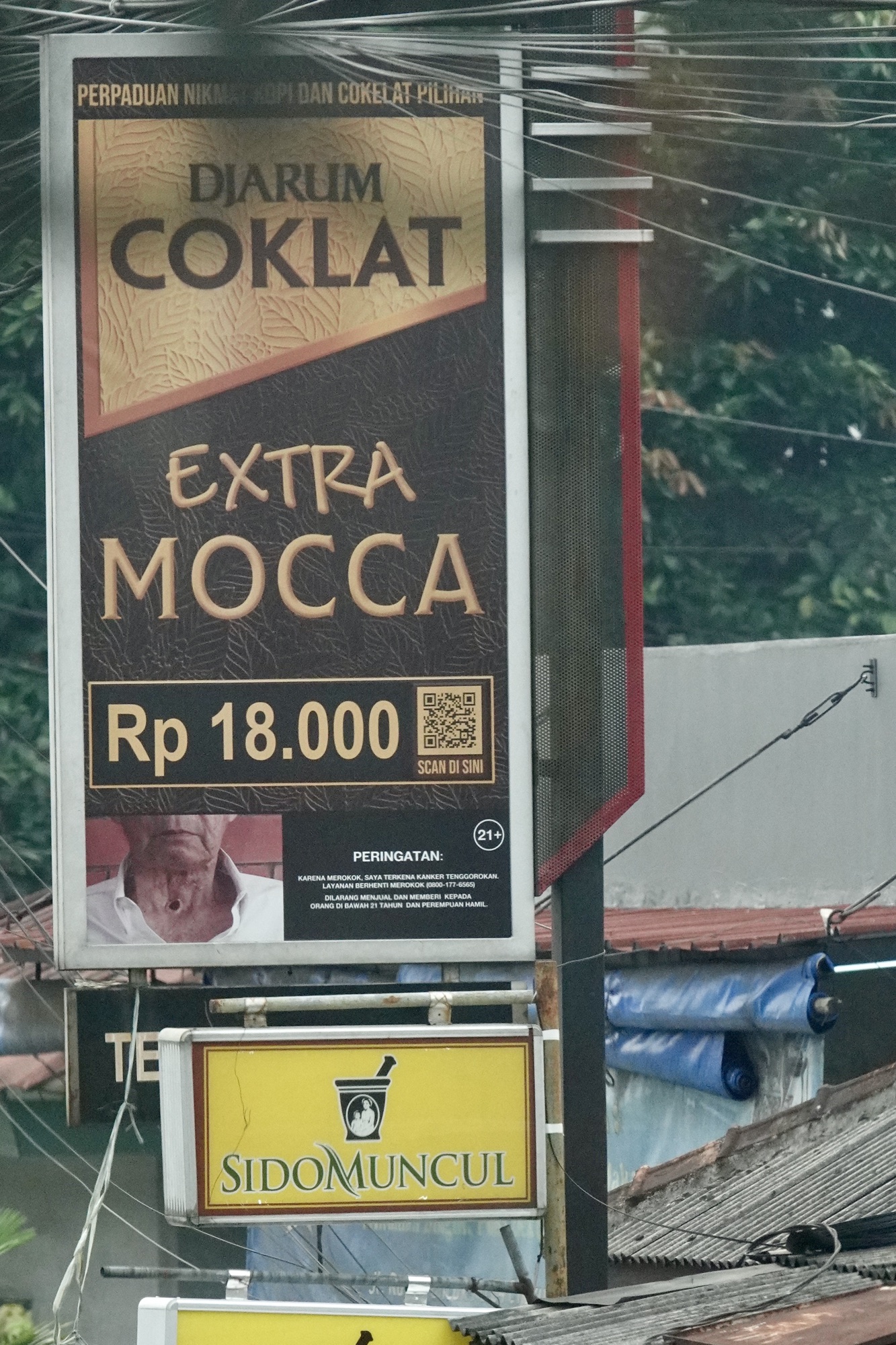
After a fellow passenger commented on how ubiquitous smoking seemed to be, and how that seemed out of sync with low incomes, our guide explained that cigarettes made from local tobacco are actually cheaper than food. We passed many, many billboards advertising cigarettes, and noticed that every single one included a picture of a man with a tracheotomy hole. So far, it wasn’t obvious that that campaign was discouraging smokers. Interestingly, we didn’t see a single female smoking.
Jakarta underwent a massive tree planting initiative to help clean its extremely polluted air. One of the fast-growing trees they planted were bintaro (sea mango) trees with beautiful white flowers and very poisonous fruit. They line long stretches of the toll road between Jakarta and Bogor.

Bogor is known as the rainy city because at its altitude it rains every day of the year, but is also as the place without worries. It is considered a “small” city of “only” 1.5 million people, although its metropolitan area holds four times that number.
When we reached the botanical garden, a local guide took over. That’s much the same protocol as what we experienced at Mexican ruins.

This garden was begun in 1811 and officially established by the Dutch on May 18, 1817, under the guidance of Prussian-born Dutch botanist Caspar Georg Carl Reinwardt. It is both the oldest and largest botanical garden in SE Asia, larger even than Singapore’s, at 500 acres (2 square km) compared to Singapore’s 202 acres. It has a huge arboretum portion containing trees up to 200 years old.
We started our visit in the orchid house, where the temperature is held at a constant 33°C and humidity at 60-70%, whereas outside in Bogor the humidity was at almost 90%!!!

The Bogor gardens boast over 12000 plants, including 500 species of orchids. The orchid house was built in 2002, sponsored by Indonesia’s first female president, Megawati Sukarnoputri. With all those orchid species, we were expecting a profusion of flowers, but the first room of the orchid house was mostly greenery without blooms since the plants are not “forced” and so do not bloom simultaneously. In fact, orchids like the famous tiger orchid bloom only once every three years (not this year!).
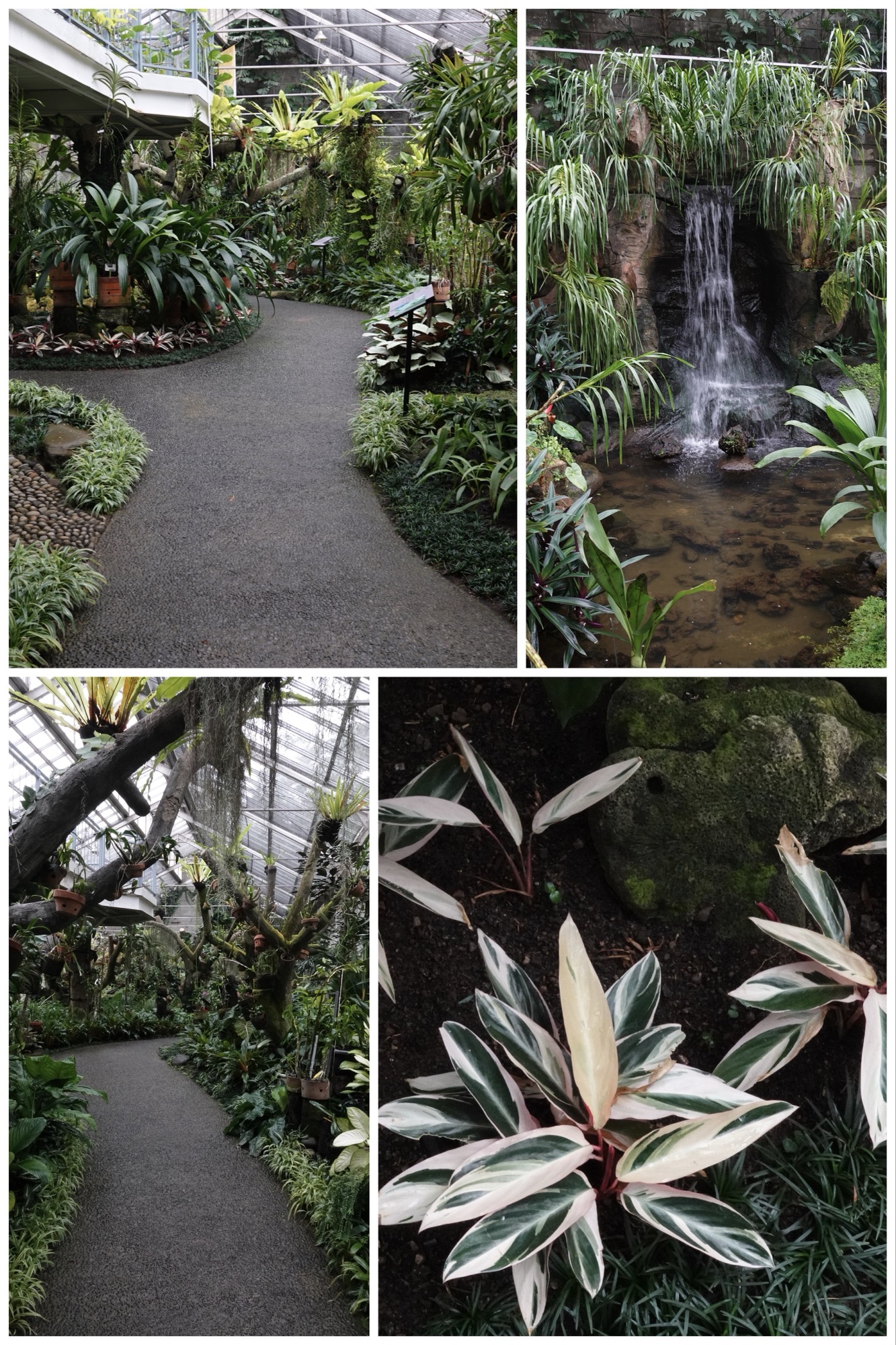
The second orchid hall contained hybrids, with a few in bloom. We learned that the gardens also have an orchid tissue culture lab.

We saw lots of cats. Stray cats are spayed as a municipal initiative when they are found hanging around the gardens. The cat we saw with 5 frolicking kittens (4 grey and one ginger)was apparently a new resident and had been “missed”.

We marvelled at the bright red flowers of the Flame of Papua tree, whose branches are often encouraged to grow across frameworks over streets and patios.

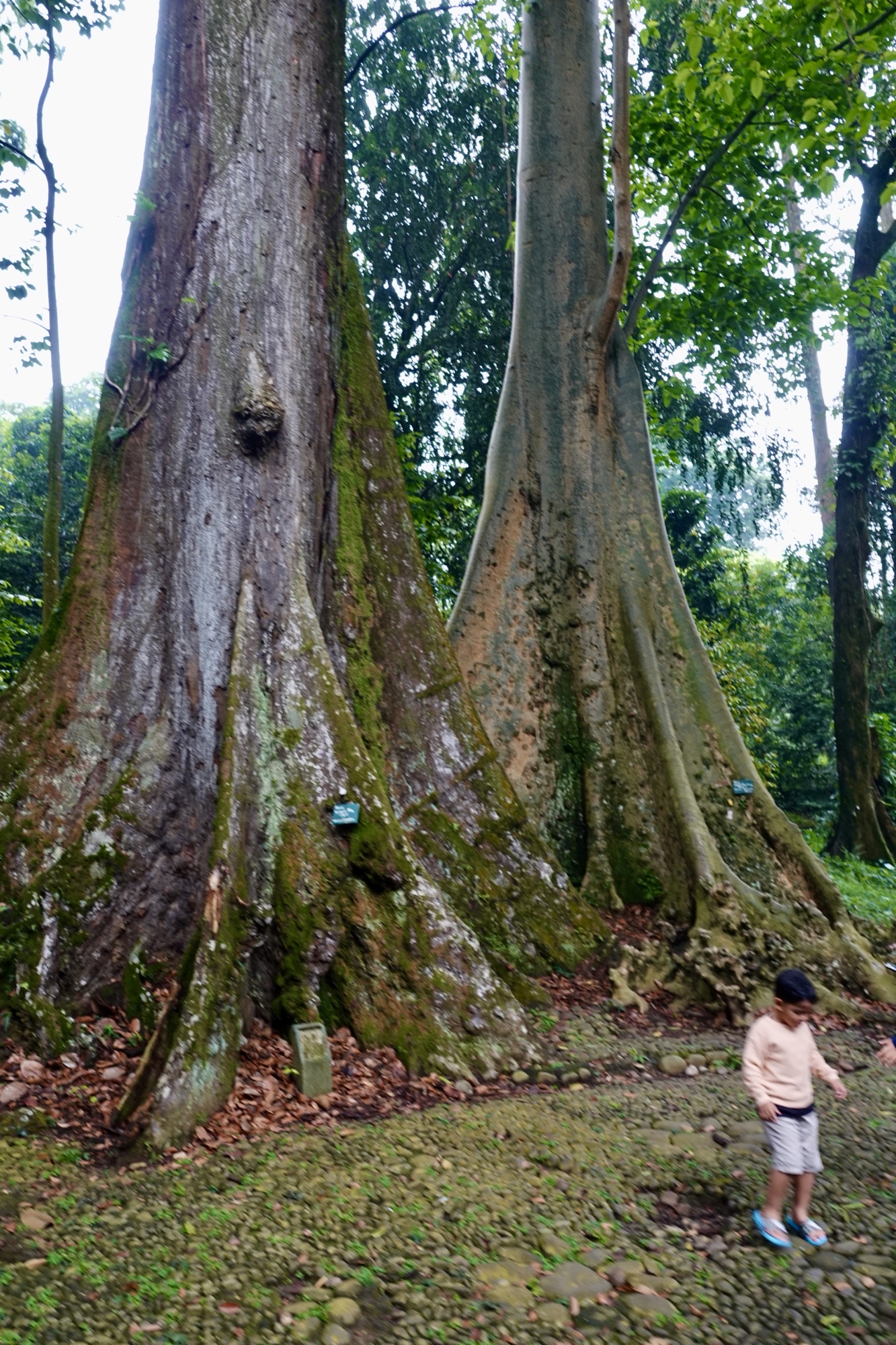
Our guide pointed out huge red and white ficus trees planted in 1866.
We stopped at the bamboo garden, where there are giant bamboo native to Burma that can reach 30m (almost 100 ft) in height. Our guide said that the bamboo grows so fast here that the size used in Java for supports in building houses is only 5 years old.

Yellow bamboo (below) is the kind we eat the young shoots of, and is used locally in herbal medicine where it is believed to fight hepatitis.

The park’s palm avenue is called “mini Beverly Hills Boulevard” by the youngsters here.

The park contains an old Dutch cemetery with 42 graves; most of those buried here died of malaria, which no longer exists in Java. The oldest grave dates to 1784, while the most recent burial, with a monument using the Dutch flag colours, was in 1994: Cornelius Portman, an important botanist in these gardens.

The Indonesian Presidential palace backs onto the gardens. It is here that the leaders of foreign countries are received, not in Jakarta. Ted’s photo is of the back of the building by the lotus pond nicknamed the “scissor “ pond for its shape.

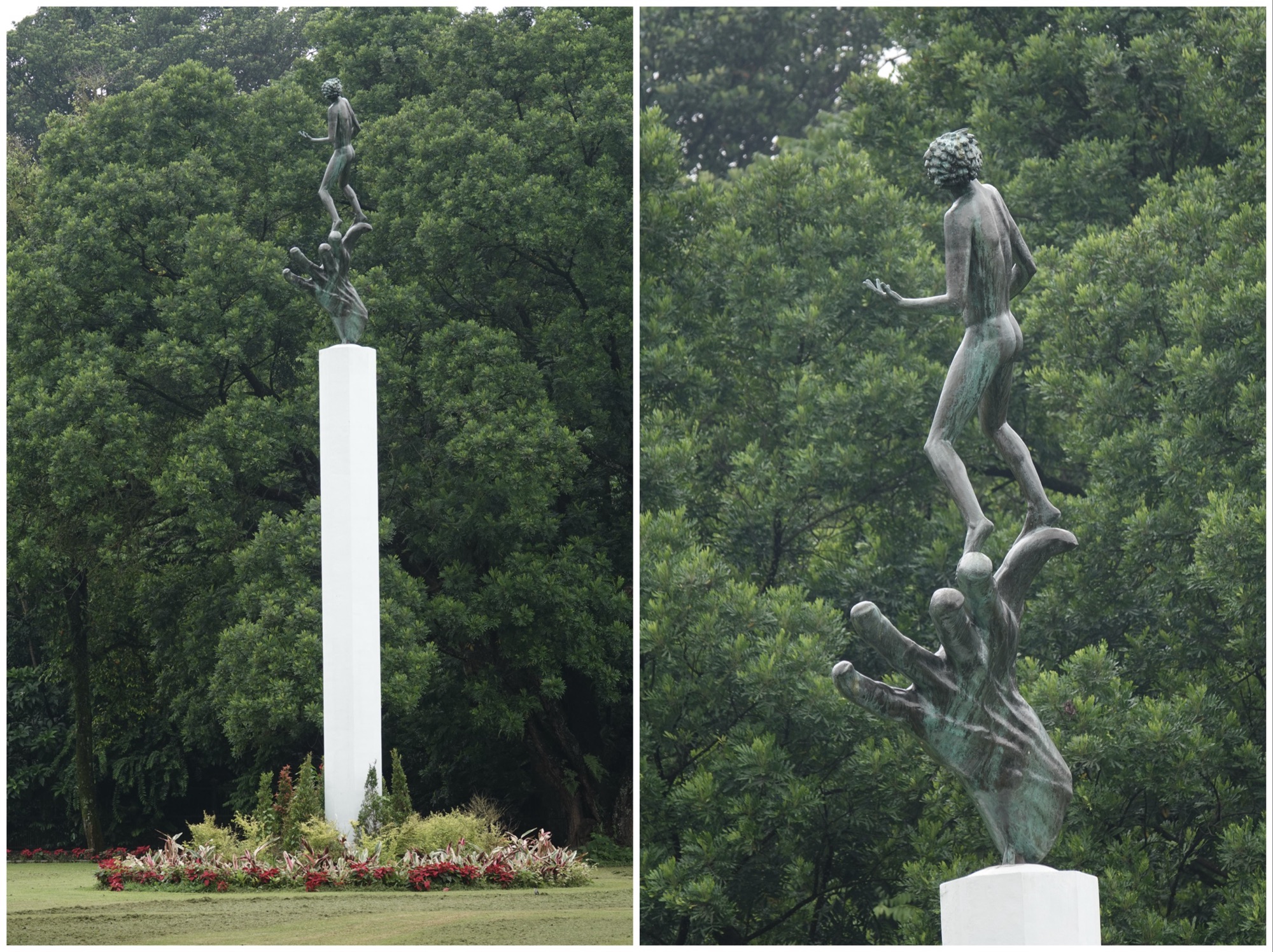
The statue “Hand of God” on the palace lawn was a gift from Sweden.
The palace grounds are full of deer, which we only saw from inside the bus on the wrong side, so there are no deer photos.
There were neither blossoms nor fruit on the fruit trees, because local fruits like mangosteen, rambutan, and durian all ripen during the rainy season, but despite a lack of flowers the gardens were a lovely place to explore and simply breathe in air that was so much cleaner than in the crowded city.
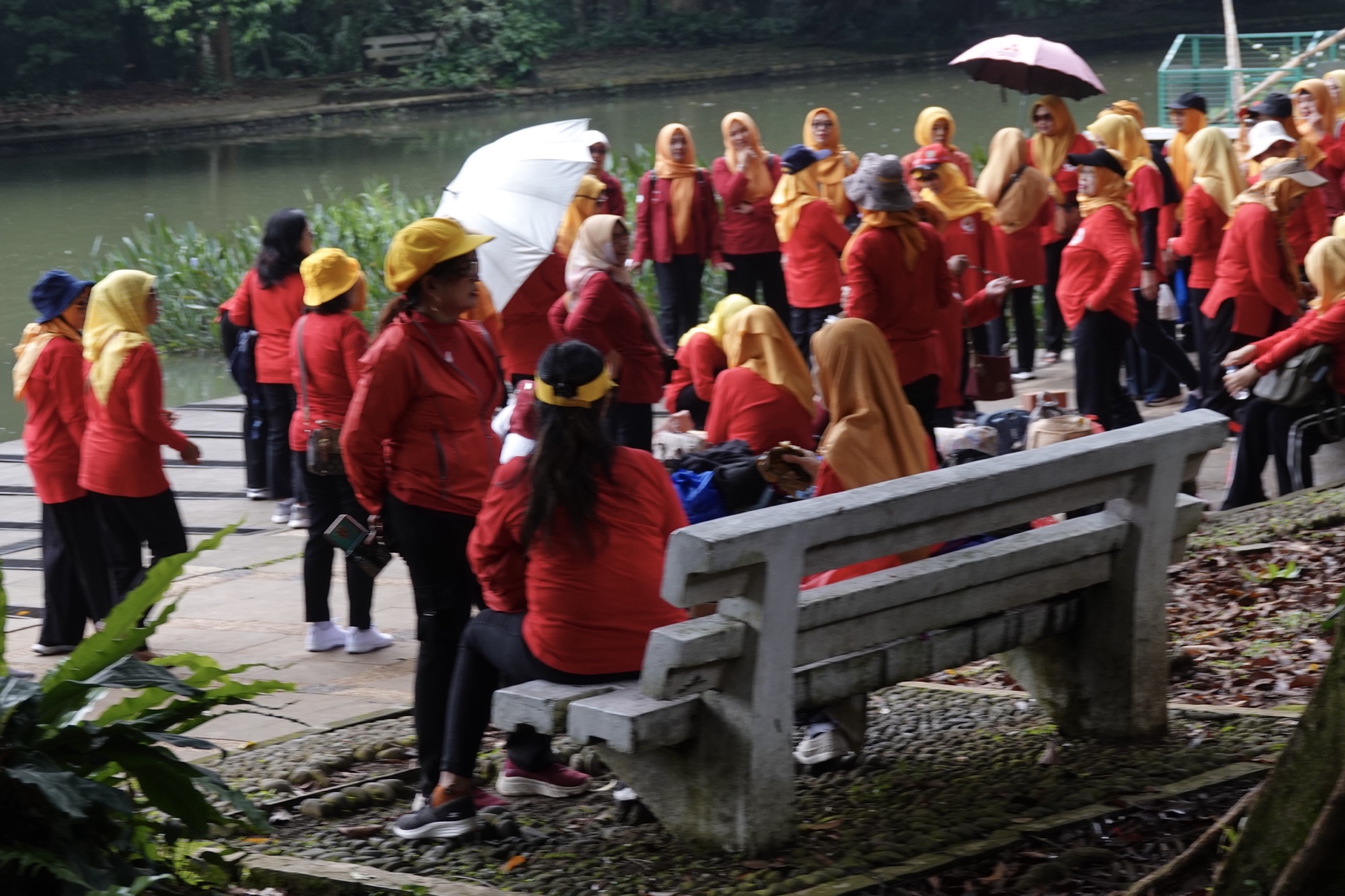
Outside the orchid house, we’d seen a yoga class being held. We were told that there are many women’s associations in Java, to both socialize and exercise. Java is mostly Islamic, so men and women do not socialize in mixed groups without their spouses. Since Ramadan is in a couple of days, many of the groups were also gathering for celebratory al fresco meals before their period of fasting. We observed several in the park.
We had a short break at the garden’s café for tea and the ubiquitous pisang goreng (fried and battered banana). The word “goreng” simply means fried, so the famous Indonesian nasi goreng is just “fried rice”.
Unbelievably, after a pretty filling snack, our next stop was lunch – at a restaurant about an hour from the garden, and at almost the highest elevation in the area, in a place called Puncak (“poon- chak”) Pass, which translates as Peak Pass. The area is renowned for luxury family holiday resorts and once upon a time for tea plantations, although most of those have been replanted with timber or turned into theme parks to supplement the resort experiences. We got an idea of the landscape before and after as we drove by through a low cloud that dimmed all the vibrant colours.


En route we continued to have our police escort clearing a priority path for us as we drove up winding roads and through blind turns (honking, of course) to the top of the Puncak Pass area at 1500 m/4920ft/0.932miles above sea level and into low cloud cover. It was incredibly green in every direction.
We were greeted with an elegant and exotic welcome dance, a portion of which Ted videoed.

Lunch was a delicious buffet plus the Javanese coffee that we’re really enjoying.
Then it was off to Gunung Mas (“gold mountain”) tea plantation – in the drizzling rain. Once again, Viking’s tour operator had us covered with rain ponchos for everyone, which we were fortunately able to remove part way through our visit, eliminating the “Smurf effect”.

Our driver navigated the twisting road to the plantation in total cloud/fog as our 3 buses followed the police car in convoy. Once again I was thrilled not to be driving.

All tea comes from only one plant called Camellia sinensis. However, based on the type of tea leaves picked and the level of oxidation or processing, tea is classified into five main types: Black, Green, Oolong, White, and Pu-erh. White is made from unopened tea leaves and is considered the best; most of that gets exported.
Leaves for commercial tea are handpicked (only the top 3 leaves on each sprig) and then sorted, dried in the “withering machine” (dessicator) to lose 42% of their moisture, then rolled, crushed, and fermented. That tea ends up in tea bags.

The darkest green leaves are used by the local Javanese, simply sun-dried and then steeped, and enjoyed that way without any further processing.
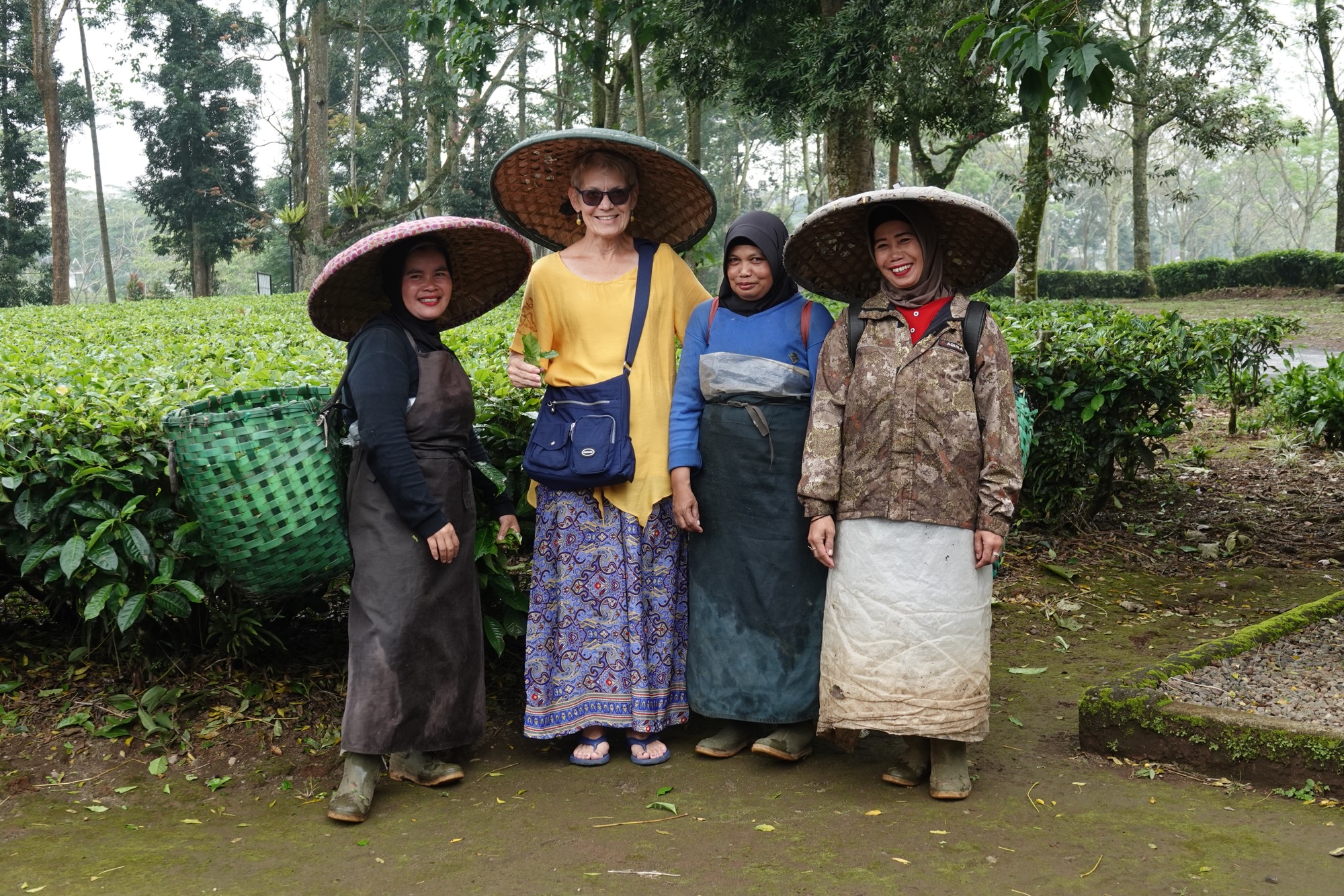
Pickers get paid according to the weight of leaves that they pick. An experienced picker can pick 30 kg in a day, for a payday of 100,000 to 150,000 rupiah. It is not considered a job in itself, but a supplement to the family income, where the father often works in the tea processing facility. That probably explains the big smiles and giggles elicited by the 100,000 rupiah (less than $9 CAD) I gave the ladies to share for allowing me to take a photo with them, in which one of them insisted that I wear their hat. I was determined to leave all my rupiah in Indonesia.

Newly planted tea bushes are kept separate for one year before being moved into a plantation. No leaves get picked during the first 3 years, and at 5 years the trees are pruned back in a process similar to creating bonsai.
We learned that tea grows best between 500 and 1500 metres above sea level, and that’s this particular part of Java is too wet for cacao or coffee.
We were shown cinnamon trees on the property. Their bark smells delicious, if much less pungent than once it has been dried and grated, although the tree itself doesn’t look very appetizing.

Even with our police escort, who wasn’t much use on single lane roads, we were unable to do better than 3 hours to travel back to our ship. En route we had a hilarious slow motion “race” with the other two tour buses as we jockeyed for position on crazily crowded roads. Any space left between our buses was immediately filled by several motorcycles, some of them carrying families of four!

By the time we reached the toll road we were actually in front of our police escort and had to pull over to wait for him, which meant that when he arrived both he and the other two buses overtook us. Then it really turned into a race as our driver was determined to regain first place. That man earned every bit of his 100,000 rupiah tip!
It was another jam-packed day, which will leave us with fond memories of our time in Jakarta.
The ship left port very soon after our group, the last to return, arrived back on board. It reminded us again of why we take Viking’s excursions: they won’t leave without us, whereas folks on a private excursion caught in traffic could find themselves making their own way to our next port of call.
It was a wonderful, if bittersweet, performance in the theatre, as we prepared to say goodbye to Cruise Director Matt Morgan and Assistant CD Tara Lucas, both of who leave us in Singapore on March 1st. Their final vocal show was a knockout.

Since Singapore is the end of another leg of this World Cruise, it will also mean saying goodbye to our most amazing pianist Enrico, our Hotel Purser (and ever-cheerful fellow Canadian) Adrian, “my” wonderful Simran in restaurant reservations, Hotel General Manager Ronald, and our wonderful Captain Marcus, among many, many others leaving us at this next port.
Today, as I get caught up, is a welcome sea day as we prepare for two days in Singapore, and our hard-working crew members who are going home spend an emotional day getting ready for family reunions.
The adventure continues.
 Rose and Ted’s Excellent Adventure
Beautiful flowers! I’m learning so much from your posts.
Barbara
>
LikeLike
As I am from yours!
LikeLike