https://improvesailing.com/destinations/is-the-tasman-sea-rough
The Tasman Sea was still relatively smooth today, although I could definitely feel the rocking motion, especially when sitting in the theatre at the ship’s bow.
The morning lecture on “G’day, Australia!” was given by Nitza Lowenstein, a 48-year Australian resident, who moved there from South Africa. She is a retired journalist and radio host, and (not yet retired) wedding officiant.
Nitza told us that Australia is a country of immigrants, of diversity, and a place where everyone gets a “fair go, mate”, which contrasted pretty starkly with our Māori guide in Wellington who described Aussies as “racist”. Perhaps that is because it was only in 1992 that a court case overturned the colonial concept of “terra nihilus” (empty/unoccupied land) that allowed Europeans to simply claim ownership of the entire continent, as compared to New Zealand’s 1840 Treaty of Waitangi. Even more-so, though, he might have been referring to Australia’s long-standing “white” immigration policy. Even during the time of highest immigration after WWII, when population growth was desperately needed in order to grow the country’s economy, it was only white Europeans who were accepted. It took until the late 1970s before immigration from Asian countries opened.
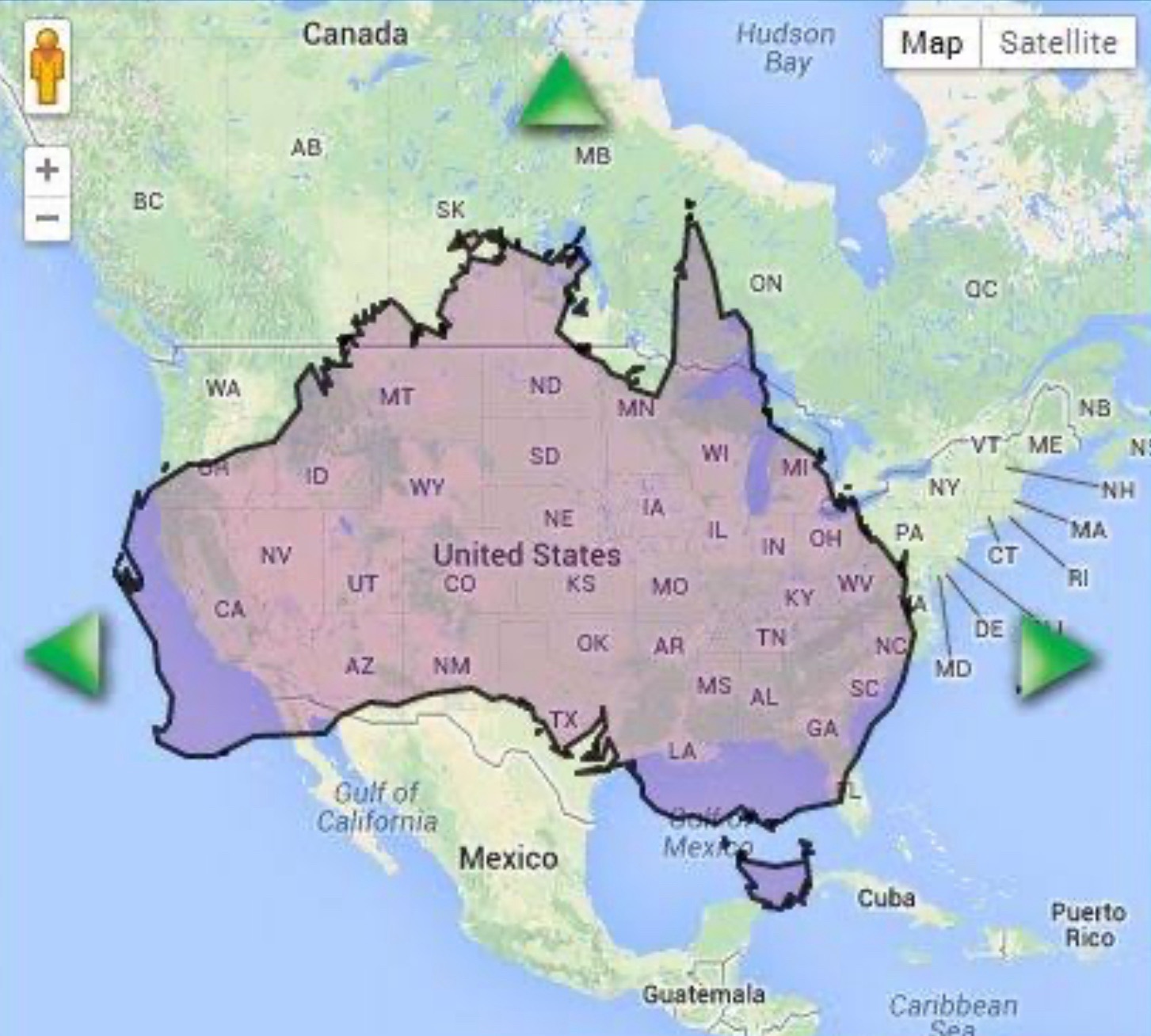
We were reminded that looking at a globe to judge the physical size of places is deceiving. Australia is as large as all of the United States, and three times larger than Greenland, and is a continent, not an island, even though it is surrounded by water. By definition, an island is a landmass surrounded by water, while a continent is a large landmass that’s part of a tectonic plate.
Fossils testify to how very different the animals that developed here were from anywhere else in our world. Many of the indigenous animals and plants are seen nowhere else.
Unlike New Zealand’s native people, who arrived there via water from Polynesia only about 700-800 years ago, the aboriginals of Australia have been there for 45,000 to 50,000 years, having crossed from East Asia via land bridge. They lived on the continent concurrent with giant wombats, massive lizards (think the Komodo dragon), and huge flightless birds – but no dinosaurs.
However, since it was seen by the Europeans as “terra nihilus”, it was “fair game” to use the country as a penal colony. Then there was gold found in 1851, which attracted miners. The resulting flood of settlers nearly wiped out the aboriginal population. As we learned from George Sranko in his lecture yesterday, Australia is the driest country in the world, so simply “moving inland” into an inhospitable desert was not a viable option for the indigenous peoples.
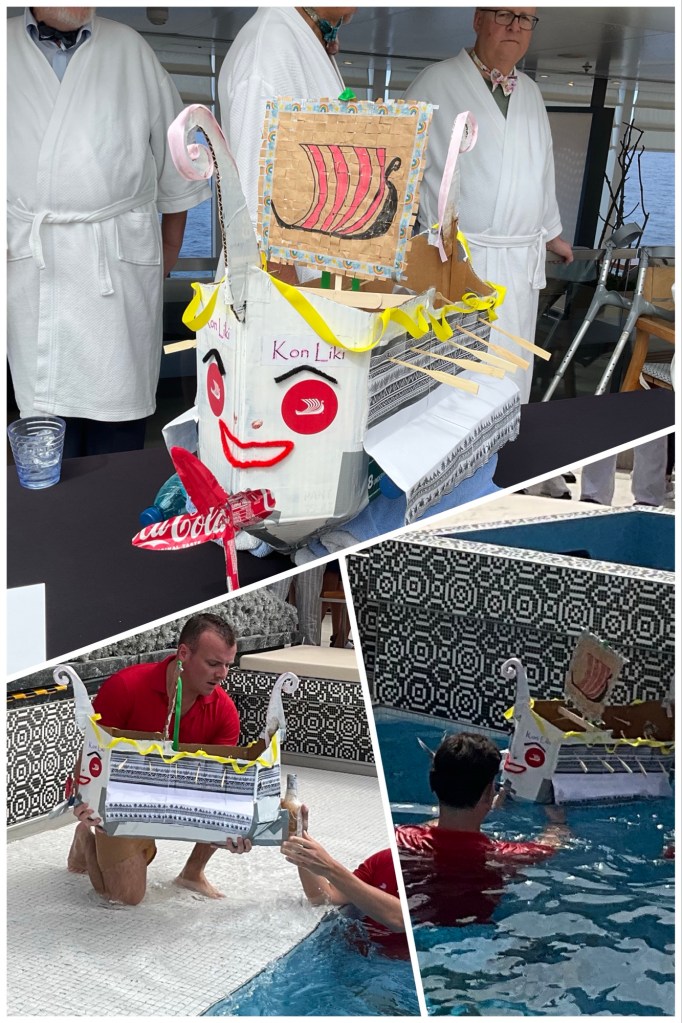
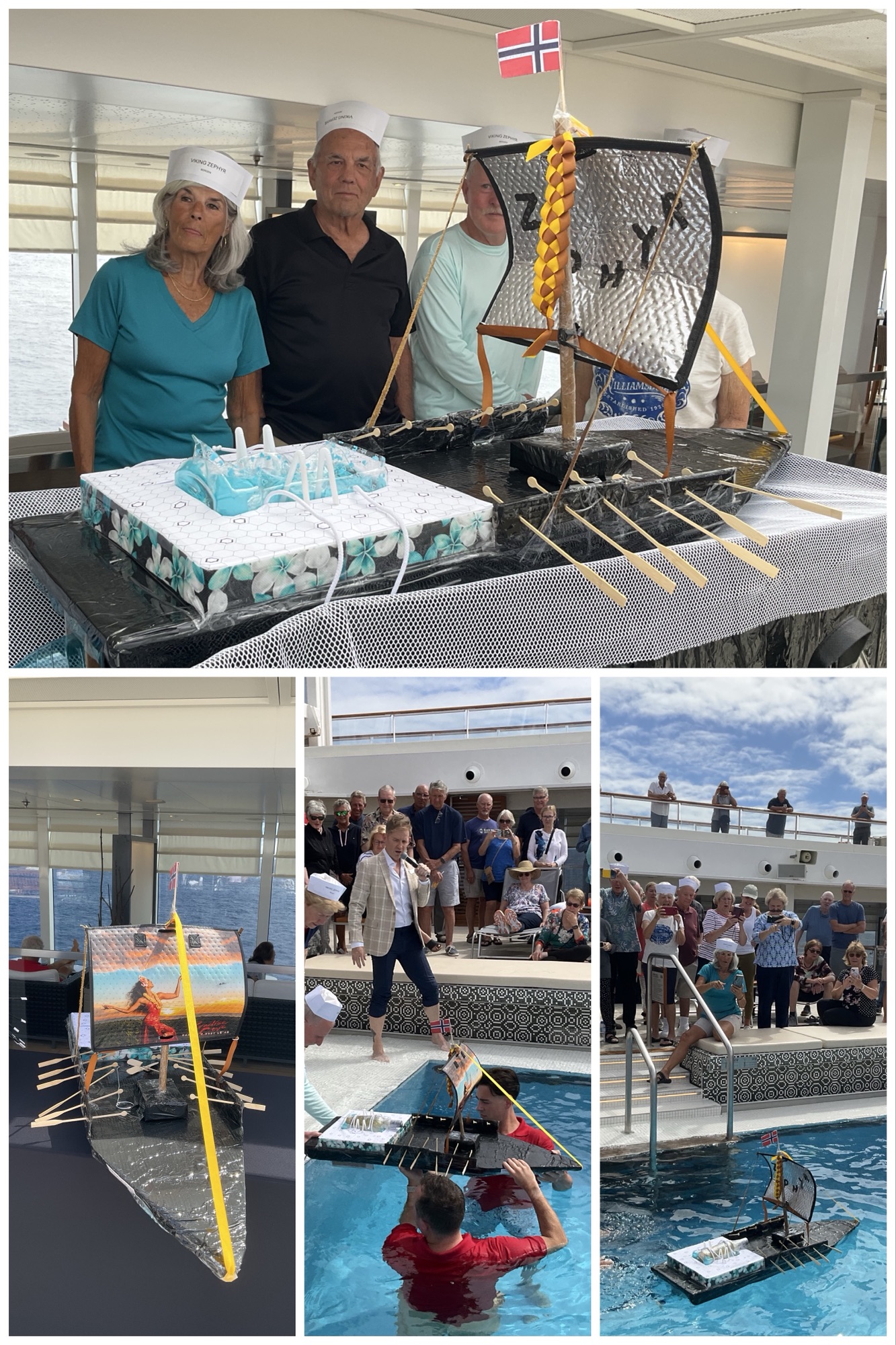
After the lecture, I hurried upstairs to take pictures of the Viking Boat Building finals. Seven teams, and one solo builder, created boats out of everyday items to enter into this cruise’s contest. Each boat was judged on appearance and “engineering”, but the most important thing of all was that it had to be capable of safely transporting a full bottle of Aquavit across the main pool. Only one boat failed in that endeavour.
Ted and I have never joined a team to build a boat, but I always enjoy watching the final competition. It reminds me of the high school robotics team with which I worked – lots of ingenuity demonstrated!




All that watching and cheering teams on left everyone hungry. Well, , maybe not, given the amount of wonderful food we ingest , but Chef Alastair had a New Zealand lamb station set up on the Aquavit terrace, with lamb curry, lamb roulade stuffed with apricot and pistachio, and grilled-to-order lamb chops – with all the trimmings of course. The delicious scent of grilling lamb beckoned…

I topped off my delicious lamb lunch with a scoop of red wine gelato. that may sound weird, but it was absolutely wonderful – like having frozen Lambrusco!
Rather than just go into a food coma and go to sleep, I found a chaise beside the pool in which to collage photos, write, and read. Ted used the time much more industriously, power walking 12 laps (3 miles/4.8 km) on deck two, followed by time in the spa and another 4 km on the exercise bike. I had a quick catnap.
There was a second lecture this afternoon that interested me, at least in part because it was delivered by a Cambridge professor, and I really enjoy his posh accent. It makes me feel as if I’m in a BBC miniseries.

Australia may be known by jewelry collectors for its gold and opals, but its minerals used in manufacturing and technology are actually a much more valuable global resource: lithium, iron, and coal, plus a wealth of natural gas. Australia is the world’s largest producer of iron ore, the largest producer by weight of lithium, the second largest producer of gold, and the world’s biggest exporter of coal. The talk was heavily focussed on geography and geology, but interesting.
It seems unbelievable – or maybe ridiculous – that we still had room to indulge in the Chef’s Table’s Taste of Britain tasting menu.
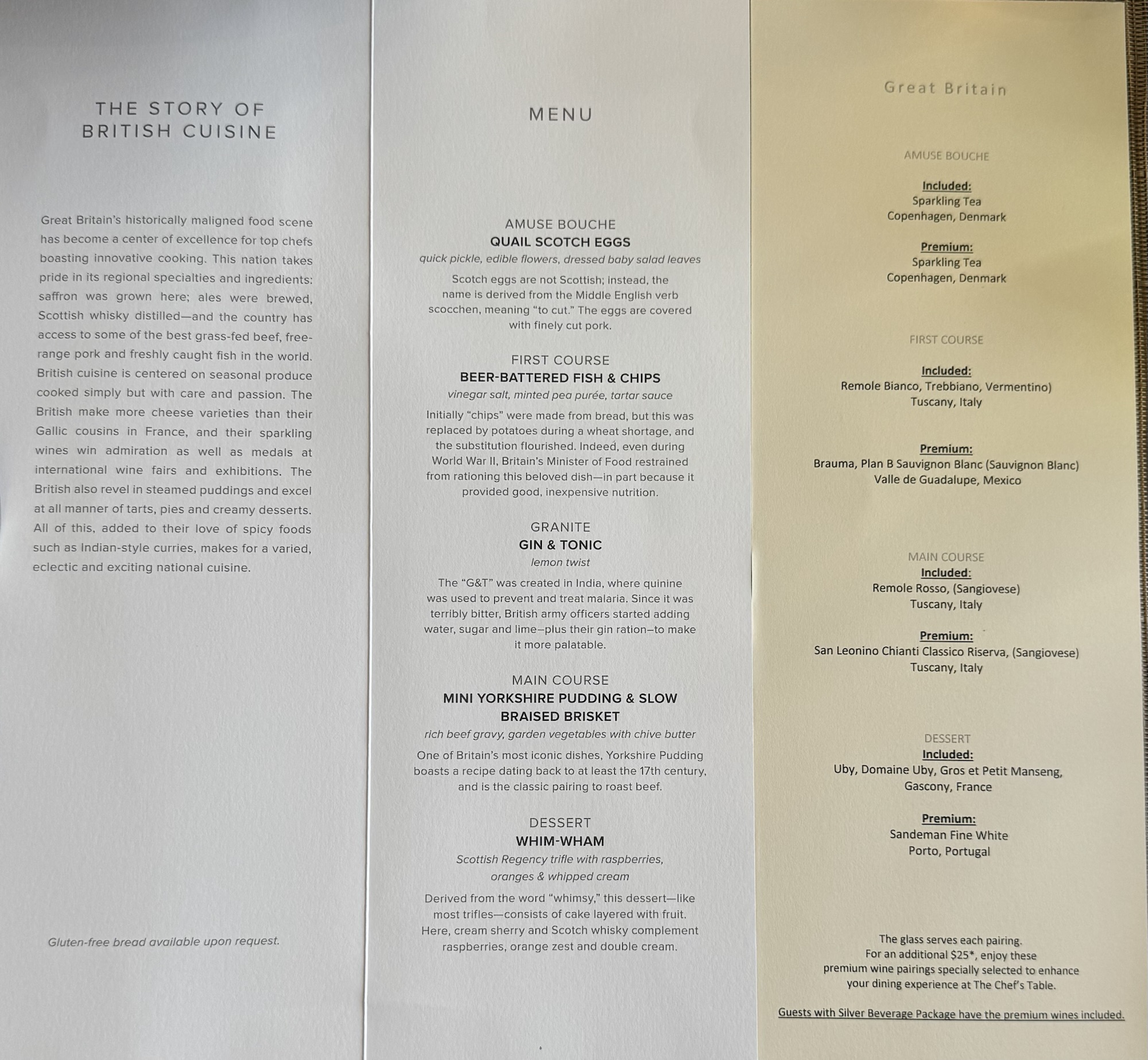
Ted and I agreed that we’d have liked to see some Indian influences, and a really great elevated haggis dish like the ones we enjoyed in Scotland.

Our evening was filled with great musical entertainment. First we enjoyed Aussie “piano man” John Milligan, who wowed us with his renditions of songs by Queen, Elton John, Carol King and more. Plus, he had 3 wardrobe changes as he removed successive sparkly jackets. We thoroughly enjoyed him!

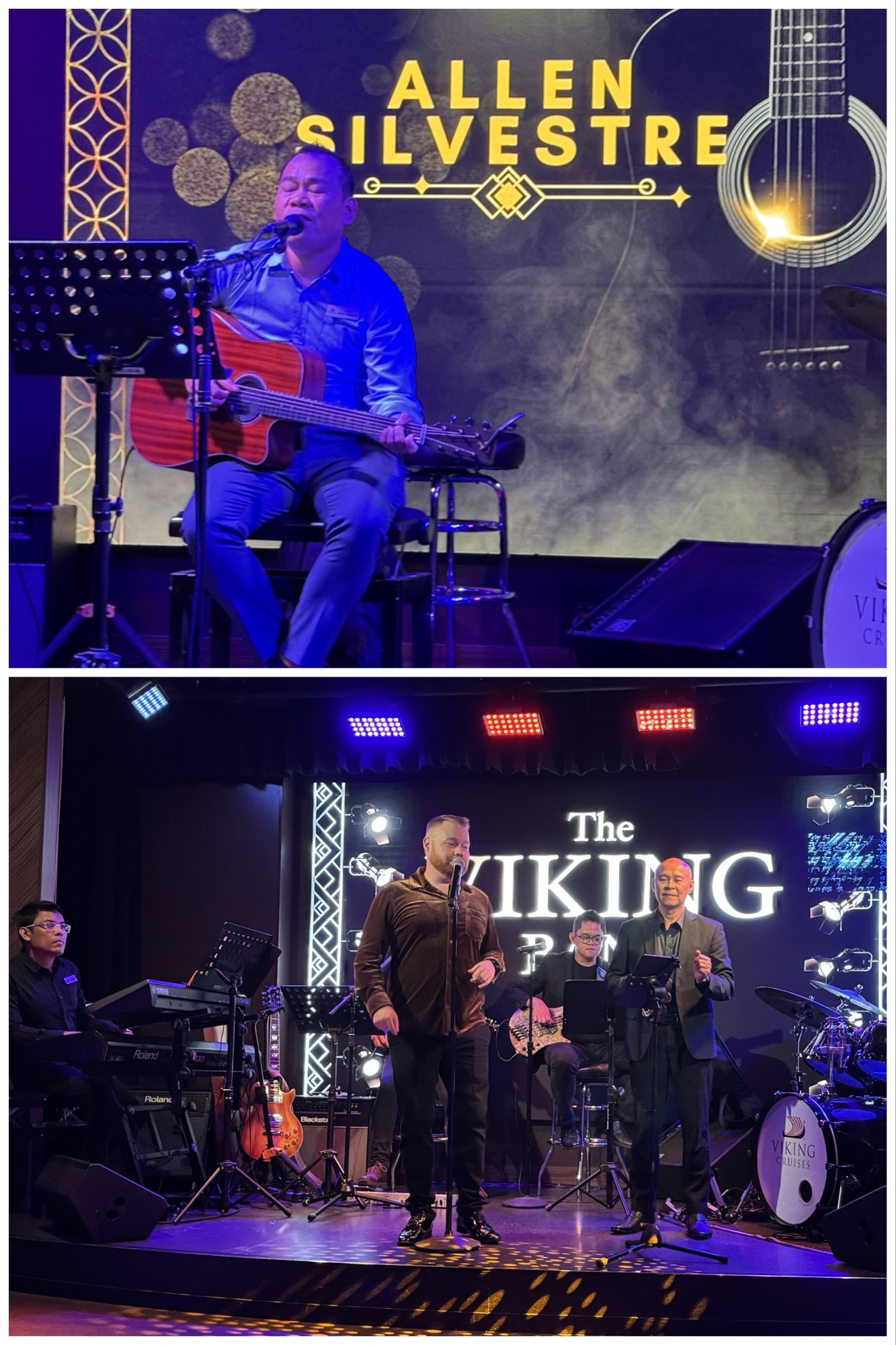
To top off an already great evening, we ended ours in Torshavn, where resident guitarist Allen kept the mood mellow, the Viking Band performed two exceptional sets, and John Milligan did a cameo.
The band has had to reconfigure temporarily to allow for 2 band members leaving to deal with a family emergency. Watching these ultimate professionals fill in for each other, which in some cases means doing double duty on board, is amazing. Hearing them simply “jam” is a joy. (And who knew that lead guitarist Hentje could sing like that?!)
It was a later than usual night for us, but the clocks go back an hour tonight to move us to Sydney time, so we gain an extra hour of sleep.
One more sea day tomorrow.
 Rose and Ted’s Excellent Adventure