We sailed into the Bay of Plenty today, and we had plenty to do and to be grateful for – especially the opportunities this cruise is giving us to broaden our horizons.
Like most New Zealand ports, Tauranga is a working cargo wharf, and its appearance reflects that. There is no “cruise terminal” vibe here, except for the warm smiles and welcome of the New Zealand security staff.
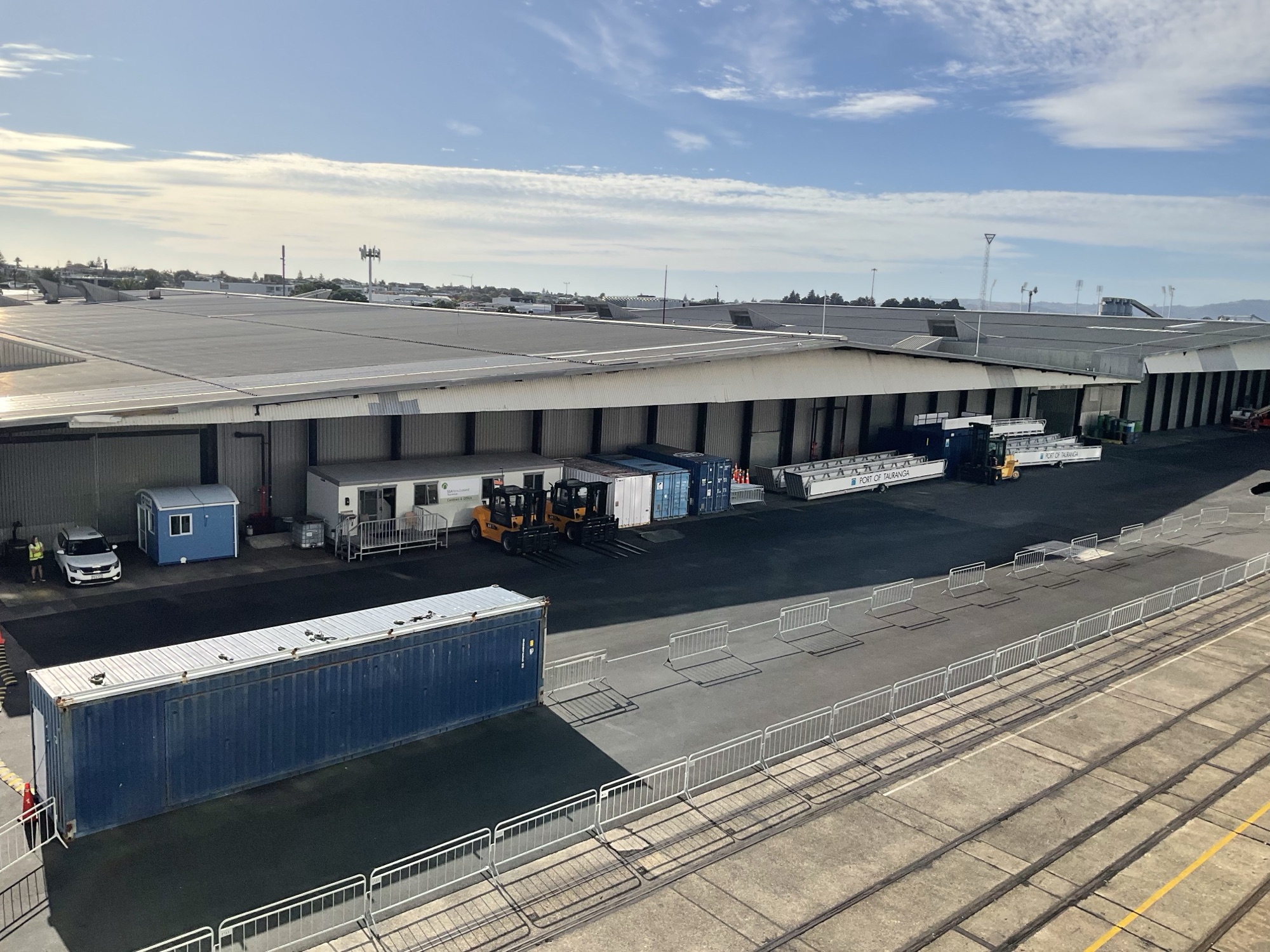
Of course, from the other side of the ship the view was much different!
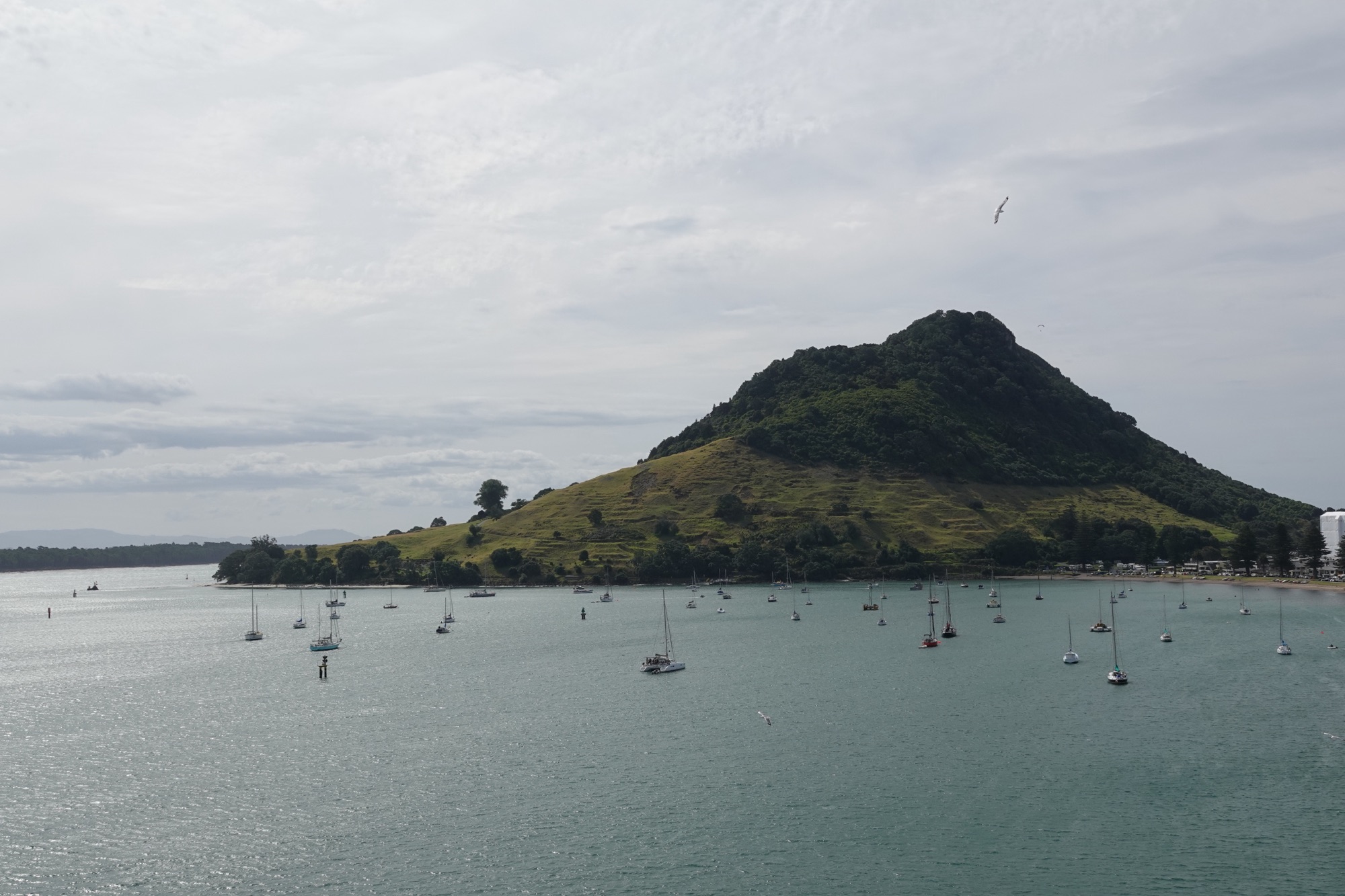
Our full day tour today (6.5 hours) was called Geothermal Rotorua, and described as “Natural Phenomena and Māori Heritage: Experience a landscape of bubbling hot springs, mudpools and geysers, and immerse yourself in Māori culture.”
We began with a drive through the scenic countryside toward Rotorua.
John, today’s coach driver and guide, had lots to tell us about where we were today.
We knew that we’d just come from New Zealand’s largest import port, Auckland, but found out that Tauranga is New Zealand’s largest export port, largely due to kiwi fruit and lumber.
Tauranga, which at 180,000 inhabitants is the country’s 5th largest city (behind Auckland, Wellington, Christchurch, and Hamilton) is the country’s fastest growing, expected to reach 250,000 by 2030. That growth is spurred by the exodus from Auckland of manufacturing companies, and a slightly milder climate. Maybe folks are also attracted by the idea of “tauranga”, which is a Māori word for safe harbour or resting place.
As we sped along the Coast Highway, where the speed limit for cars is 110 kph (90 kph for heavy vehicles), and across a “flyover” (what we’d call an overpass in Canada), John explained the three regions through which we’d be passing en route to Rotorua: kiwi orchards, forests, and the lake region.
Te Puke is the kiwi fruit capital of the world, but this is not where kiwi fruit originated. The seeds were brought from China in 1904 (called “Chinese gooseberries”) and flourished in New Zealand’s volcanic soil. The vines set up their own deep root system and do not need to be watered! Three kinds grow here: Hayward (the familiar fuzzy-skinned green ones), golden (with smooth skins and 3X as much vitamin C as an orange), and red (recently developed mostly for Asian markets).
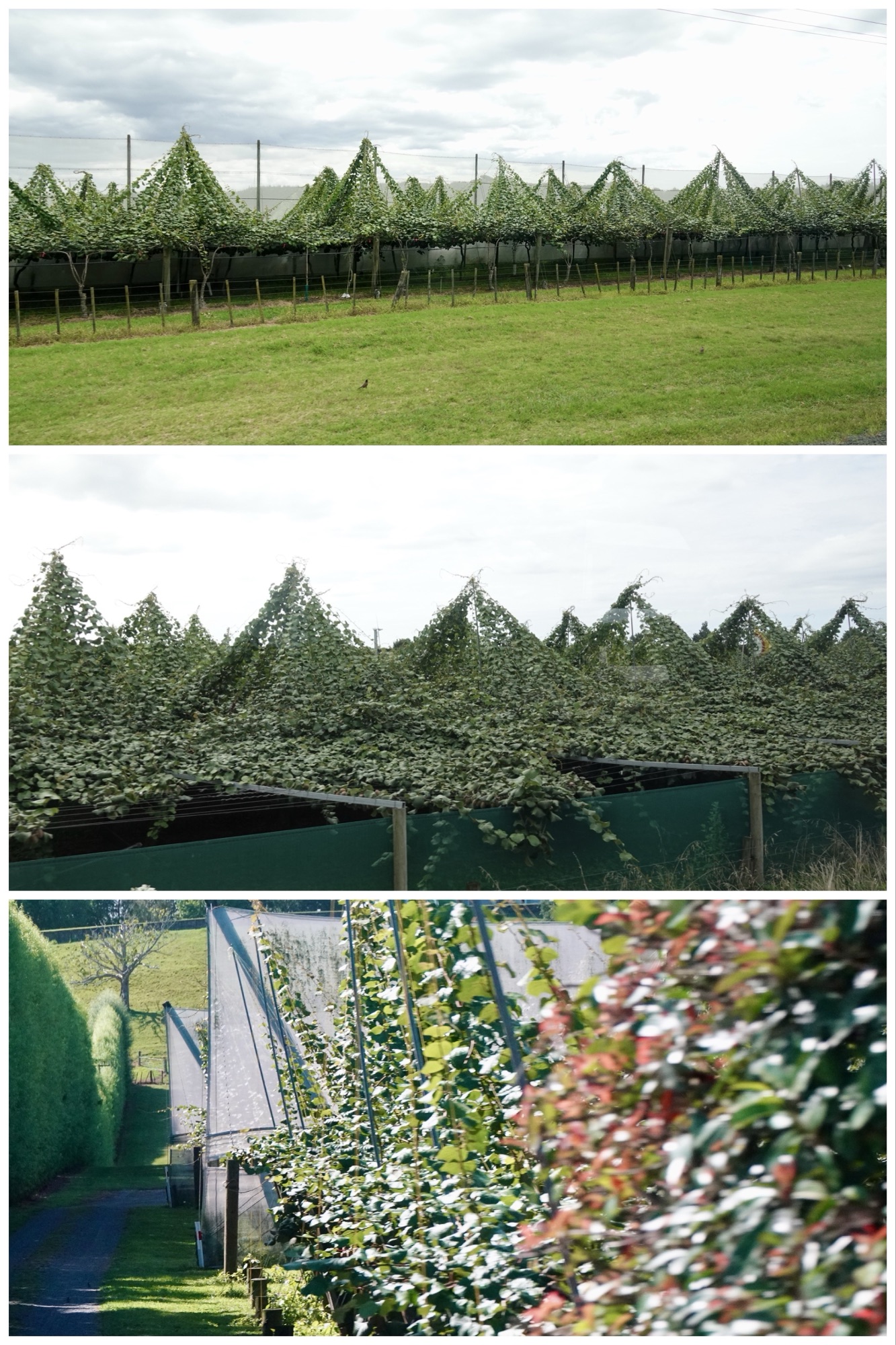
The picking season is from mid March through May, when there can be up to 1000 fruits per vine, and as many as 40,000 seasonal workers from Fiji, Samoa, Malaysia, and Singapore supplement New Zealand pickers. Once picked, the fruit does not have to be shipped right away; it can “sleep” for months at 1°C (33°F) in cold storage until being shipped around the world.
As we passed by the orchards (even though they grow on vines, they are not called “vineyards”) we noticed tall hedges – these are called “shelter belts” and protect the vines against strong westerly winds that come in from the Tasman Sea.
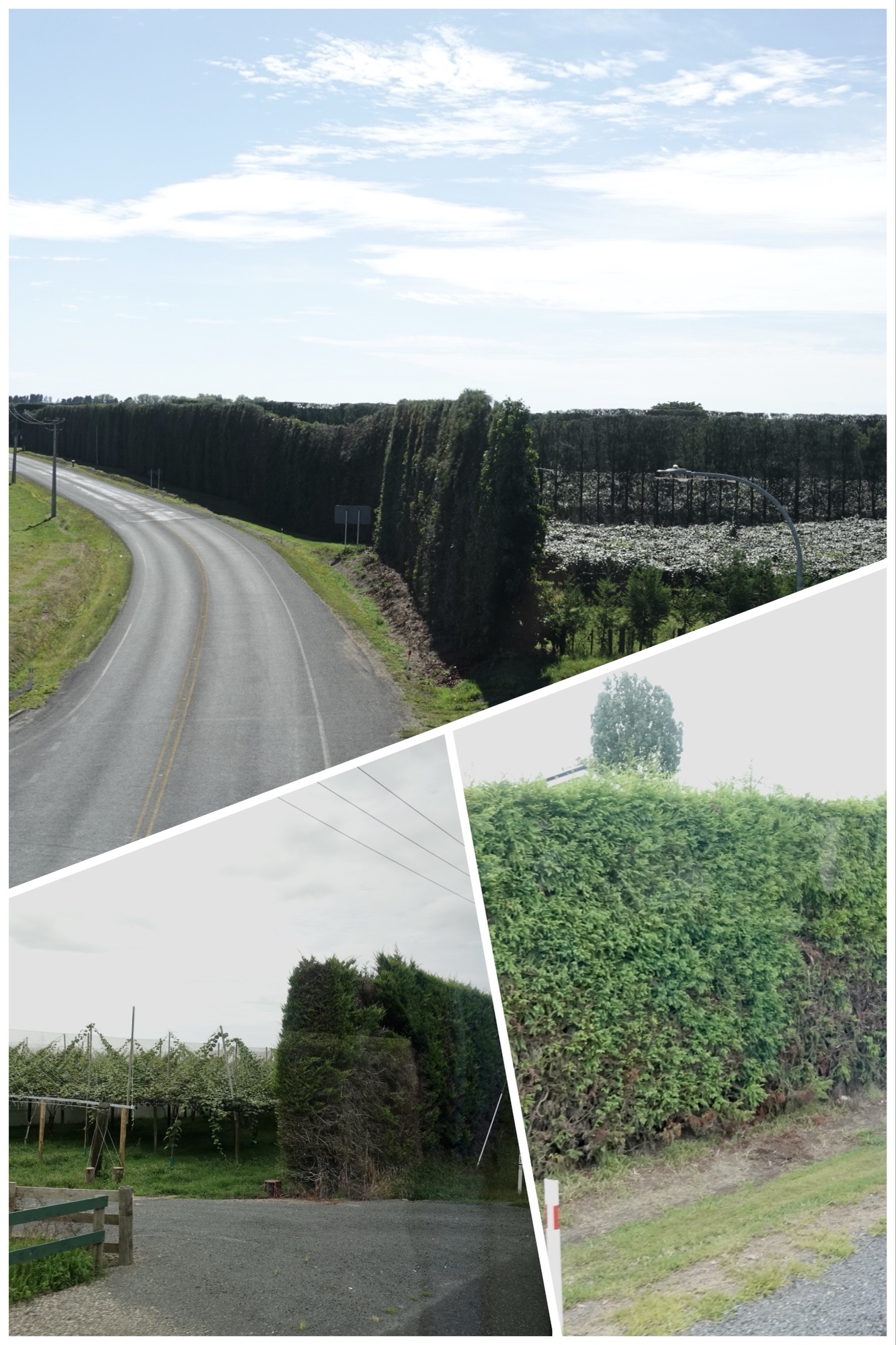
New Zealand utilizes all kinds of natural elements as “boundaries”, whether volcanic rock as curb-stones, native trees as fences, or flax plants grown as sound barriers along roadsides.
Once through the orchard region, the highway ran through dense forests full of Pinus Radiata, originally imported from Monterrey California. This pine genus now forms the country’s third largest export; it is ideally suited to volcanic soil, and matures in just 18 years, making it a quickly renewable lumber resource.
New Zealand has lots of native timbers, but they are no longer being felled. There is currently a big push for replanting those native trees on farmland that has proved less suitable for agriculture.
As we entered the lake region, John explained a couple of the Māora names. ”Roto” means lake. “Iti” means small. “Rua” means number two, or second. So Lake Rotoiti is “small lake”, named when seen from the hilltop by the Māori, when it looked deceptively small, and Rotorua is the second lake they saw when settling this area. Both lakes feed the Kaituna River (kai=food, tuna= fish).
Rotorua with its famous geysers is the heart of north island tourism, and also the heart of Māori settlement; its population of 90,000 is fully 50% Māori.
Our destination was Te Puia Thermal Reserve, home to the renowned spouting Pōhutu geyser and a wonderland of silica terraces, pools of boiling mud, and dramatic steam vents. We saw similar but much smaller vents in Furnas in the Açores last year (Episode 513).
We were warned before reaching the Te Puia (“our heritage”) that since Rotorua has sulfur deposits all around it also has the characteristic rotten egg smell, especially on overcast days. Luckily we had a clear and sunny day, and the smell was not at all oppressive.
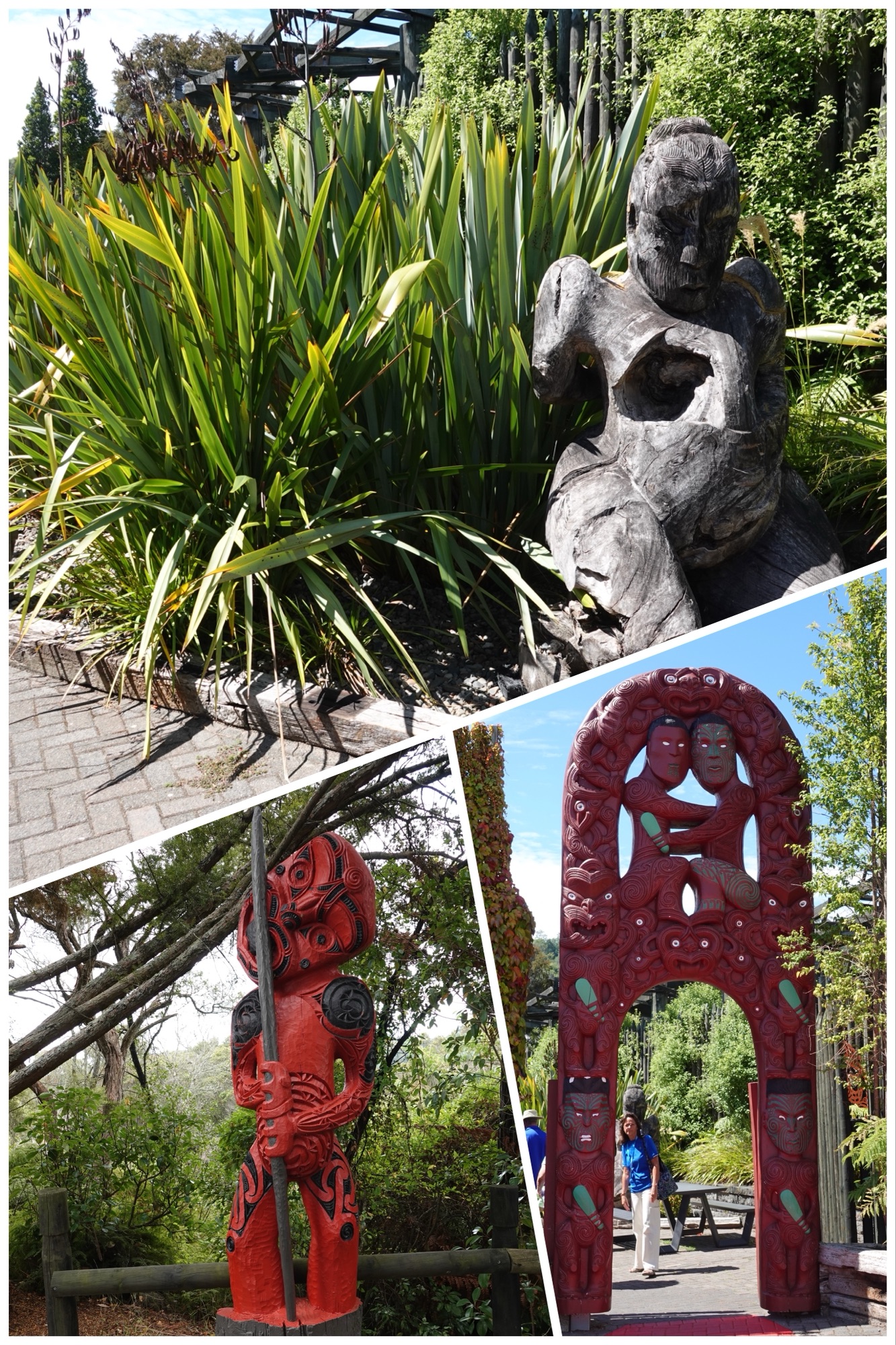
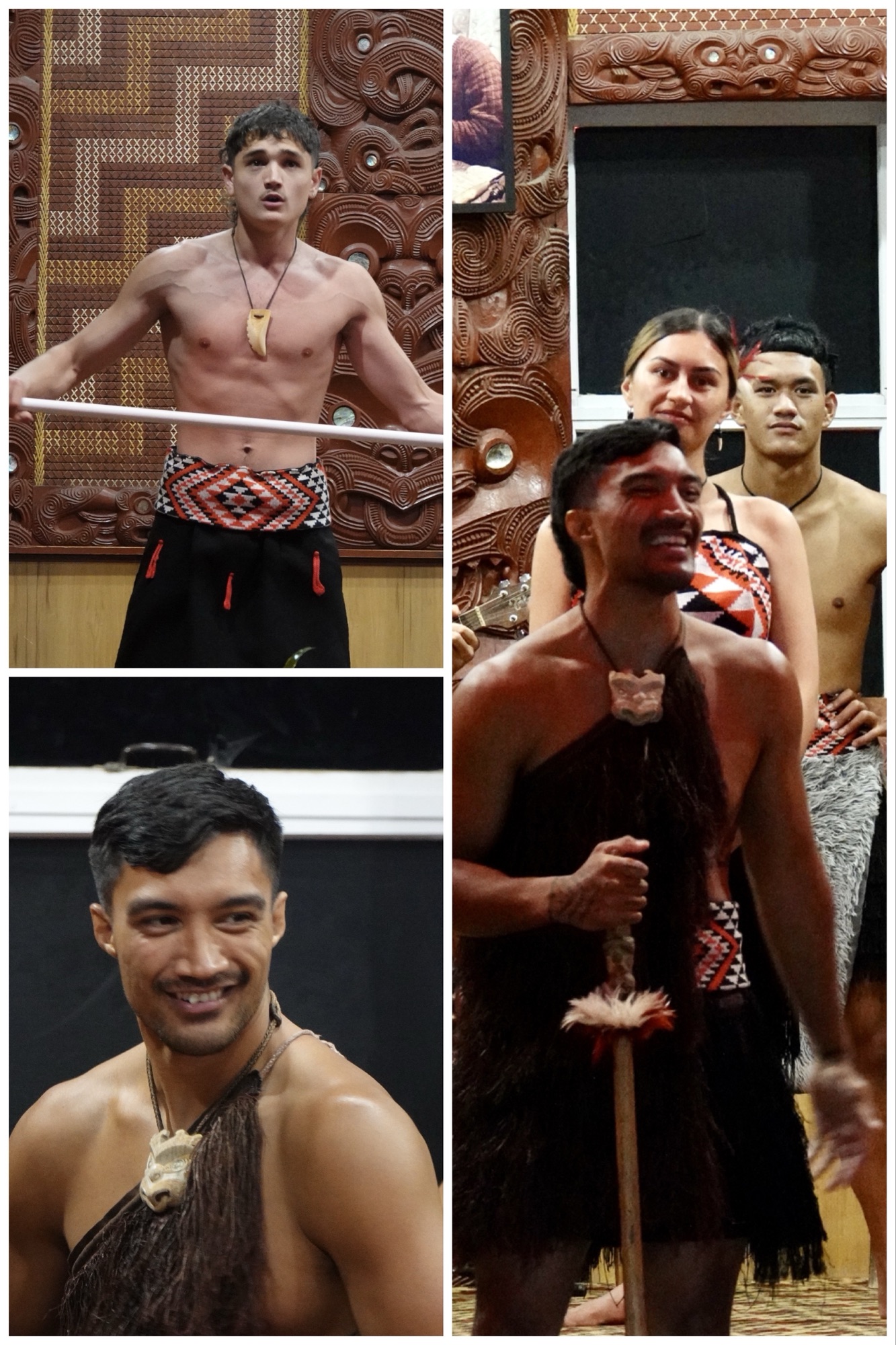
We began our visit to Te Puia with a traditional Māori wero (welcome), for which our friend Don was designated group chief. The young Māori man who represented their chief did not look nearly as fierce as pictures we’ve seen from other ceremonies, but nonetheless performed his welcome challenge with great sincerity. I was reminded of Ted’s big brother, Norm, one of whose favourite travel memories was being invited to take part in a wero; Norm and his wife Anne’s stories and photos were big inspirations for our travels.



“If we defeat you, you will taste good!”
Once cleared to enter the village, we were invited into the marae’s wharenui (meeting house) for a cultural demonstration that included a pōwhiri, or sacred welcome ritual, plus dance, song, and a haka (warrior chant/challenge). While the decoration in this wharenui was nowhere near as ornate as in the hotunui displayed in the Auckland Museum, it was still very beautiful.
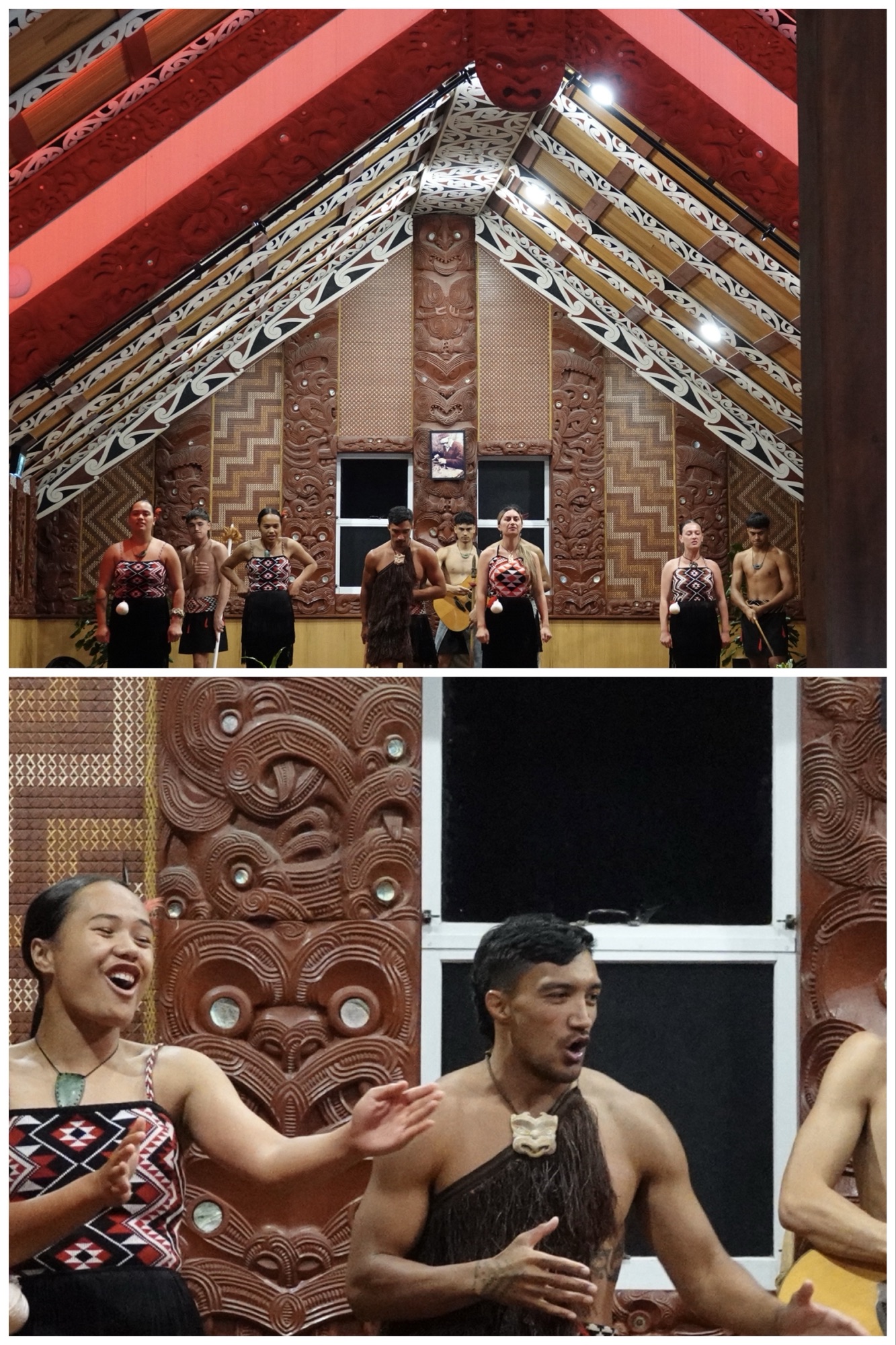

After the cultural demonstration we had a really good hot and cold buffet lunch featuring glazed ham, lamb, chicken, seafood, salads, kiwi juice, wonderful desserts, and ice cream, before waddling down the hill to the mud baths and geysers.
And … just wow! It was so much more spectacular than I’d expected. Pōhutu Geyser is the largest geyser in the southern hemisphere, and 4th largest in world (the top 3 are all in Yellowstone National Park in Wyoming). The geyser erupts up to twenty times per day at heights of up to 30 m (98 ft).


The stream below the geysers is cold, only 3-5°C (37-41°F), and provides fresh potable water to the Māori who live above the geysers. For a time in the 1990’s a sawmill located here released toxins into the earth that leached into the water, but that has been cleaned up and the water returned to drinking quality. Unlike in Furnas, in the Açores, there are no carbonated spring water taps here.
The water from the geyser reaches the boiling point, but the adjacent blue-green lake stays between 35-40°C (95-104°F), or about the temperature of a hot tub; it is used by the Māori for bathing.
Oh, there were also hot bubbling mud pools, but given that they were adjacent to a spectacular show of erupting water and steam, they weren’t a big photo draw.

We had an unexpected treat at Te Puia: kiwi birds! There is a breeding program here, with a viewing area that incorporates a reversed day/night lighting schedule to allow people to see these normally nocturnal birds during “our” daytime. Naturally, photography is not allowed inside the enclosure, but I can confirm that I saw Kete, the 5 year old male, and both of us saw the 11 week old male chick, who already weighs 600 grams. At full maturity – around 5 years old – a male kiwi will weigh around 2 kilograms, and a female slightly more. It was interesting to hear that it can also “rain” and change seasons (temperature) in the enclosure.

We learned that there are 5 species of kiwi bird, with the north island brown being the most endangered. Hearing the statistics made us realize that they are all endangered: their numbers have decreased from a high of 2 million to just 60,000, mostly due to predation. Since New Zealand naturally has no snakes and very few rodents, many of the bird species here have become flightless. There was no need to fly away to escape predators, and food sources could be found on the ground in the form of plentiful woodlice, millipedes, centipedes, slugs, snails, spiders, insects, seeds, berries and plant material. Being flightless, they also make their nests at ground level.
So… predators. Opossums, imported from (where else?) Australia attack flightless birds AND eat their eggs. They also love to climb hydro poles and chew power lines. They’re such an invasive pest, and reproduce so prolifically, that they are now being actively hunted, and a burgeoning industry is arising out of using their fur – combined with merino wool – to create extremely soft and durable garments. Our guide kiddingly referred to them as “road kill clothes”.
Then, we visited the Māori Arts & Crafts Institute for an introduction to skills such as carving, weaving and the creation of flax skirts and patterned bodices. The institute is celebrating 60 years of operation, funded partially by entrance fees to the geyser.


Watching young Māori men carving wood, bone, and stone – using modern tools to replicate ancient designs – was fascinating.

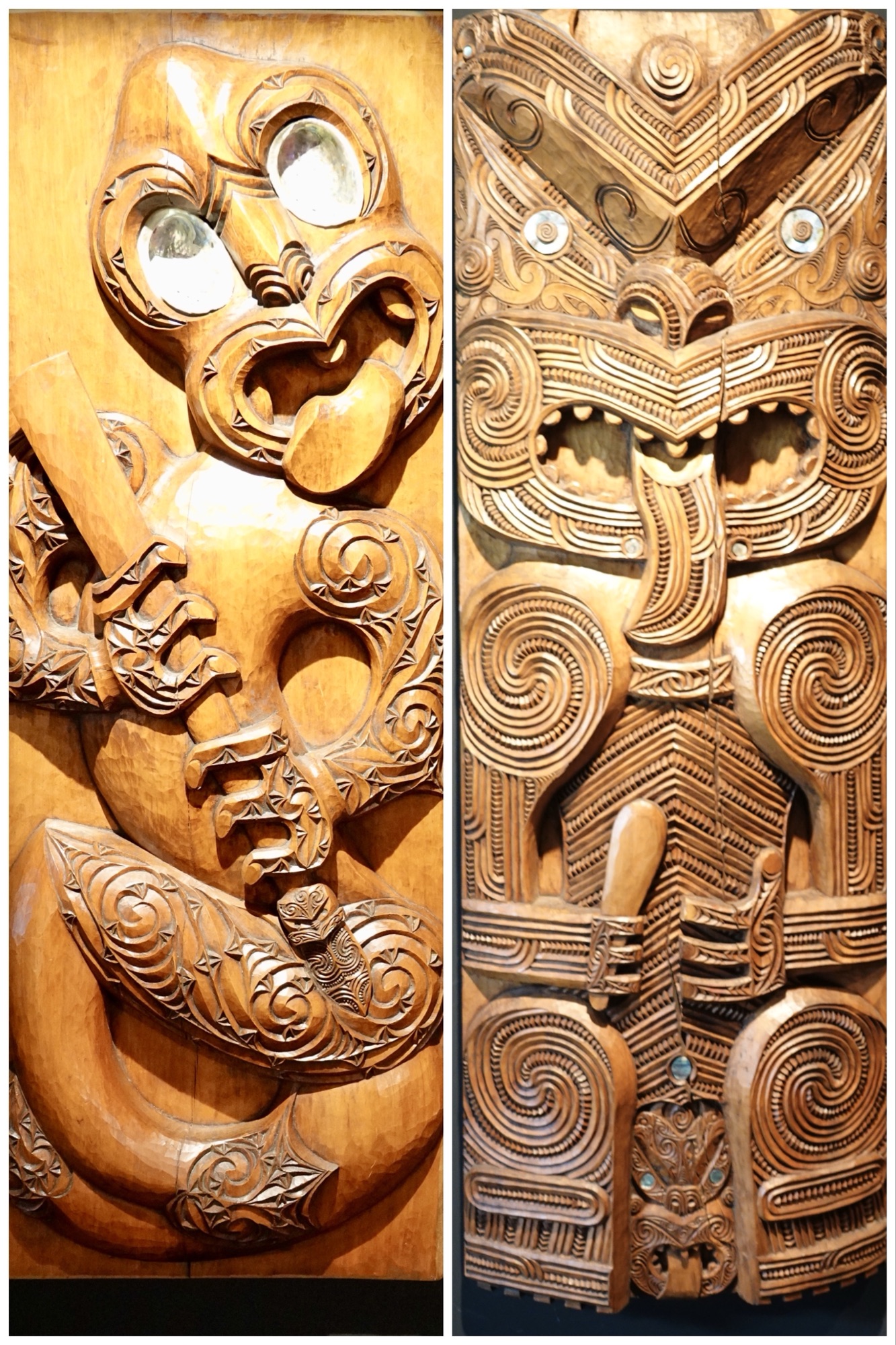

Watching Māori women weaving flax clothing, baskets, and wall panels was equally mesmerizing.


On our travels we have often remarked on European artisans and their apprentices keeping alive the skills needed to maintain and repair centuries-old artwork and buildings. Today’s visit to the Institute pointed out how important it is not just to repair and maintain, but to carry on traditional arts.

Our drive home took the same route as our morning drive, so there wasn’t a lot of narration. The quiet, plus lunch, plus sunlight and the even motion of the bus, put me to sleep.
When we got back to the ship, and had changed, we relaxed for a bit before checking out tonight’s New Zealand-themed event in the World Café. In addition to a HUGE lamb roast, there was a station featuring New Zealand green lipped mussels, and lots of desserts specific to New Zealand and Australia.

That was it for us tonight. There was so much to chronicle, and so many photos to go,through, that instead of going to the theatre I just found a quiet spot to drink sambuca-laced coffee and write.
Tomorrow we have a half-day stop in Napier.
 Rose and Ted’s Excellent Adventure
Such interesting detail — thanks for devoting your evening to sharing it.
LikeLiked by 1 person