This is our cruise’s only tender port, and the last tender back to the ship is at 3:00 p.m., so we didn’t have a ton of time and needed to prioritize what we wanted to see.

The Santa Barbara Mission is a famous tourist destination, but having toured several missions in San Diego (Episode 491 – On A Mission: San Diego de Alcalá) San Antonio (Episode-62-missions-accomplished/) and the Tucson area of Arizona (Episode 57 – On a mission in Arizona), we decided not to do the hour walk to the mission. Instead, thanks to a recommendation from one of our blog followers (thank you, Kathleen!) we headed for the city’s architectural gem, the Santa Barbara County Courthouse.
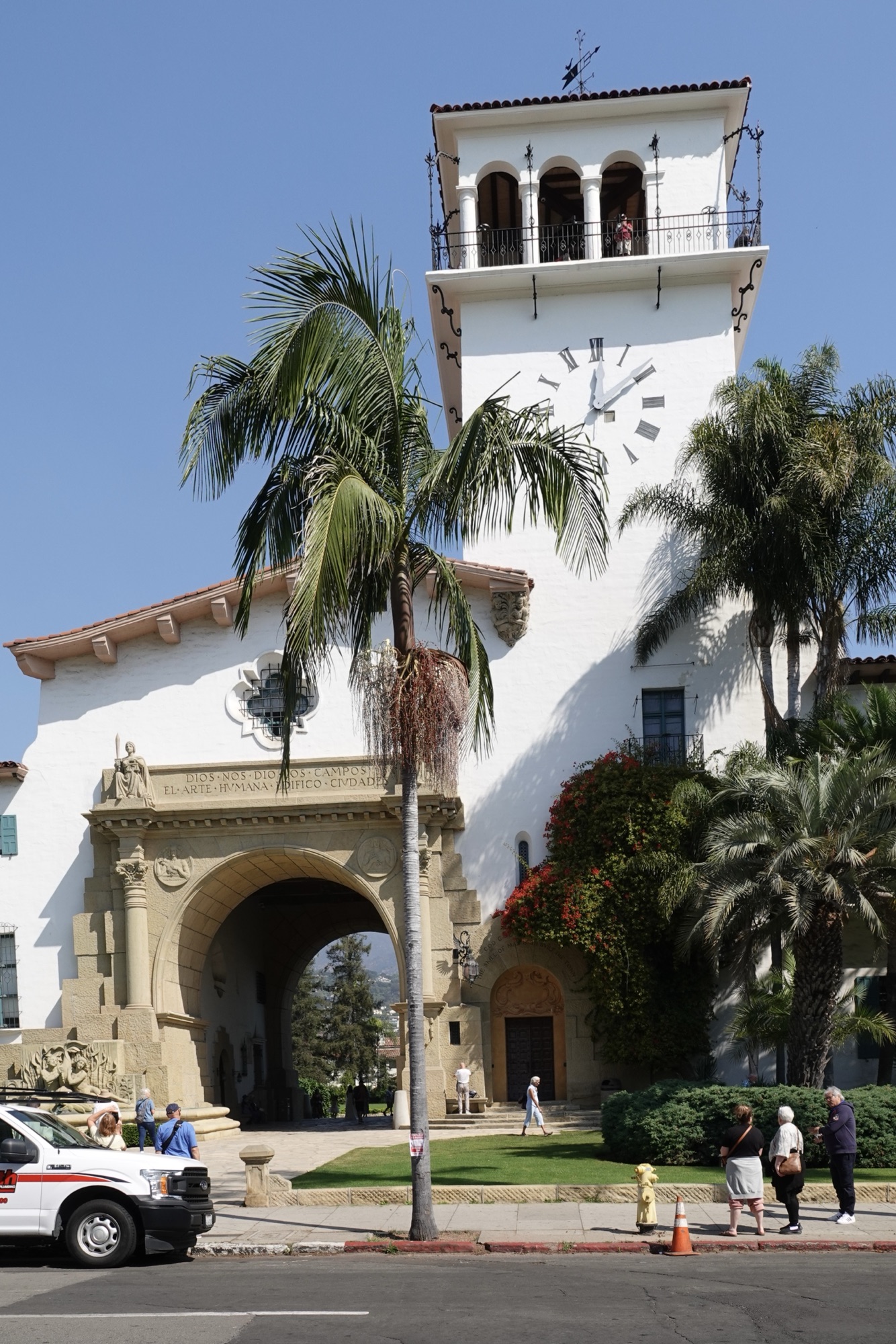
Free one-hour tours are offered Monday through Friday at 10:30 a.m. and 2 p.m. – with our tender schedule, we needed to be there for the morning tour, which meant setting an alarm and grabbing an early breakfast in order to get a 9:00 to 9:30 a.m. tender.
Despite some slight delays with the tendering process (HAL continues to be the worst organized cruise line we’ve experienced when it comes to their excursion organization), once on land we walked at a brisk pace and were able to join the 10:30 a.m. tour. Ted and I always like guided tours with well informed docents because we can learn so much more than just using a self guided headset or reading signs. In this case, our very enthusiastic docent was retiree Steven Chavin. The tour started out with about 15 people, but folks drifted off when they got tired of hearing about Santa Barbara’s history and so for the last half of the tour there were just six of us, which was perfect.
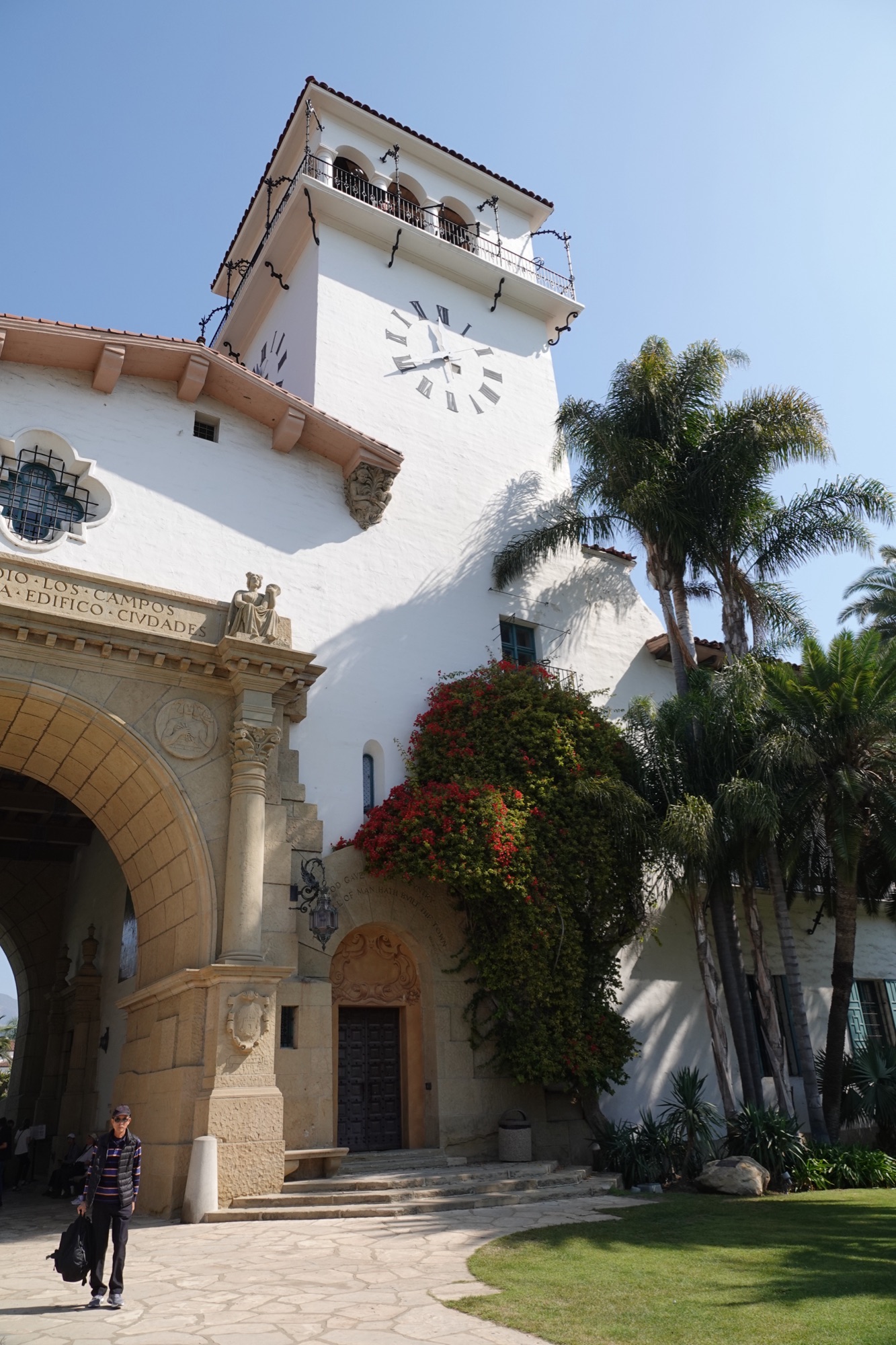
The courthouse was built to look like an Andalusian castle, with its mural room set up like a throne room. This is the only courthouse in the US that doesn’t look like an imposing courthouse, and that’s largely because of the wealthy Santa Barbarans. A few of them had built Andalusian “farmhouses” (aka mansions), and the style became the sine plus ultra of high class in the city. Unfortunately, a farmhouse was not deemed appropriate for a courthouse, but a castle was perfect! Our docent described the building’s design as “just fun”.
Anecdotally, Steven shared that the mural room is where vice president Kamala Harris got married. Out in the courthouse gardens is where Courtney Kardashian got married. He joked that it’s really important to pick the right place.

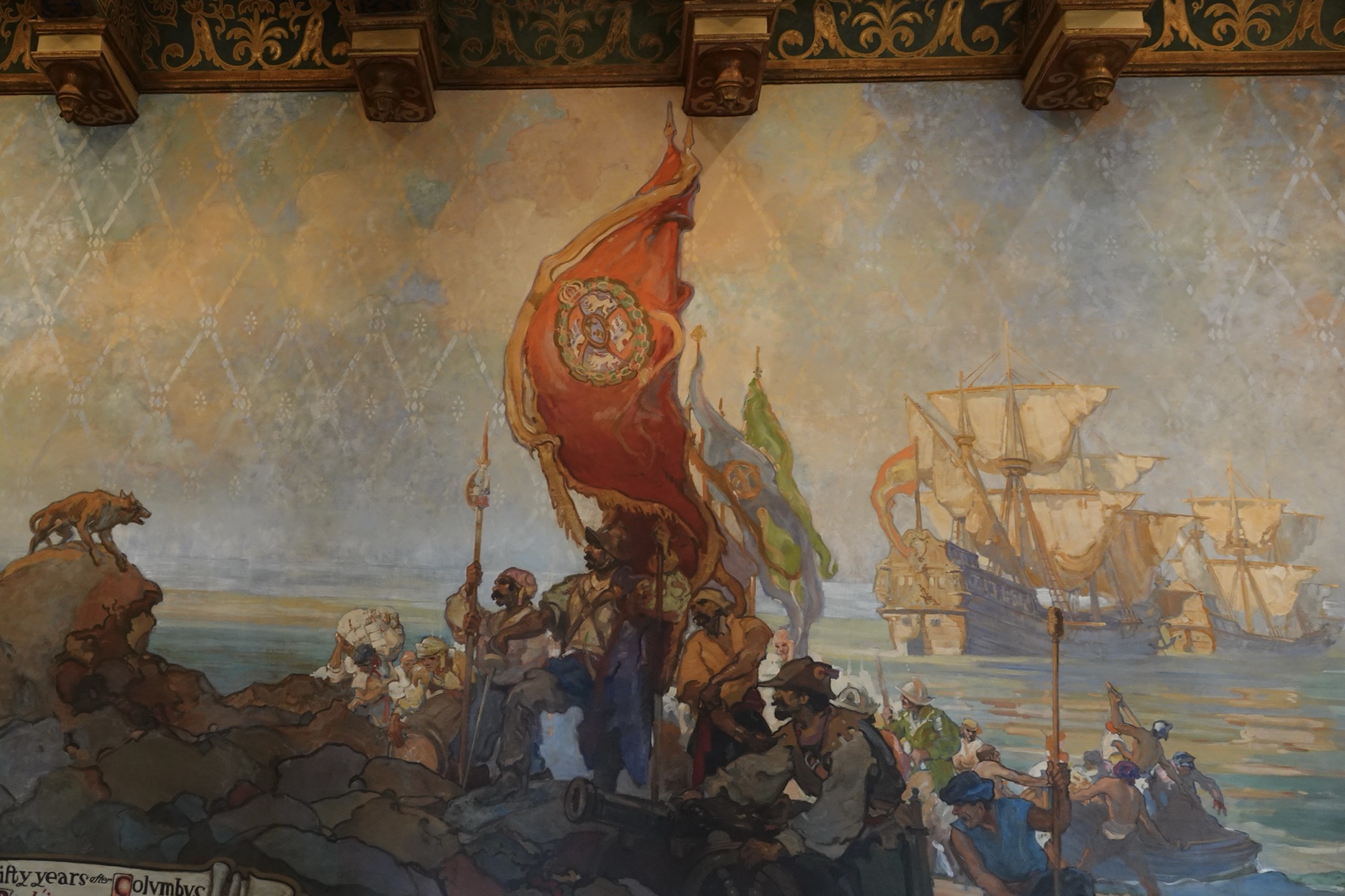
The murals in the courthouse represent Santa Barbara’s history from Canaliño tribal times through Cabrillo arriving in CE1542, 50 years after Columbus and all the way up to 1846 when Fremont descended the San Marco Pass during the Mexican American war. He brought the American flag, which supplanted the Mexican flag that had been flying since California became a Mexican territory in 1822.
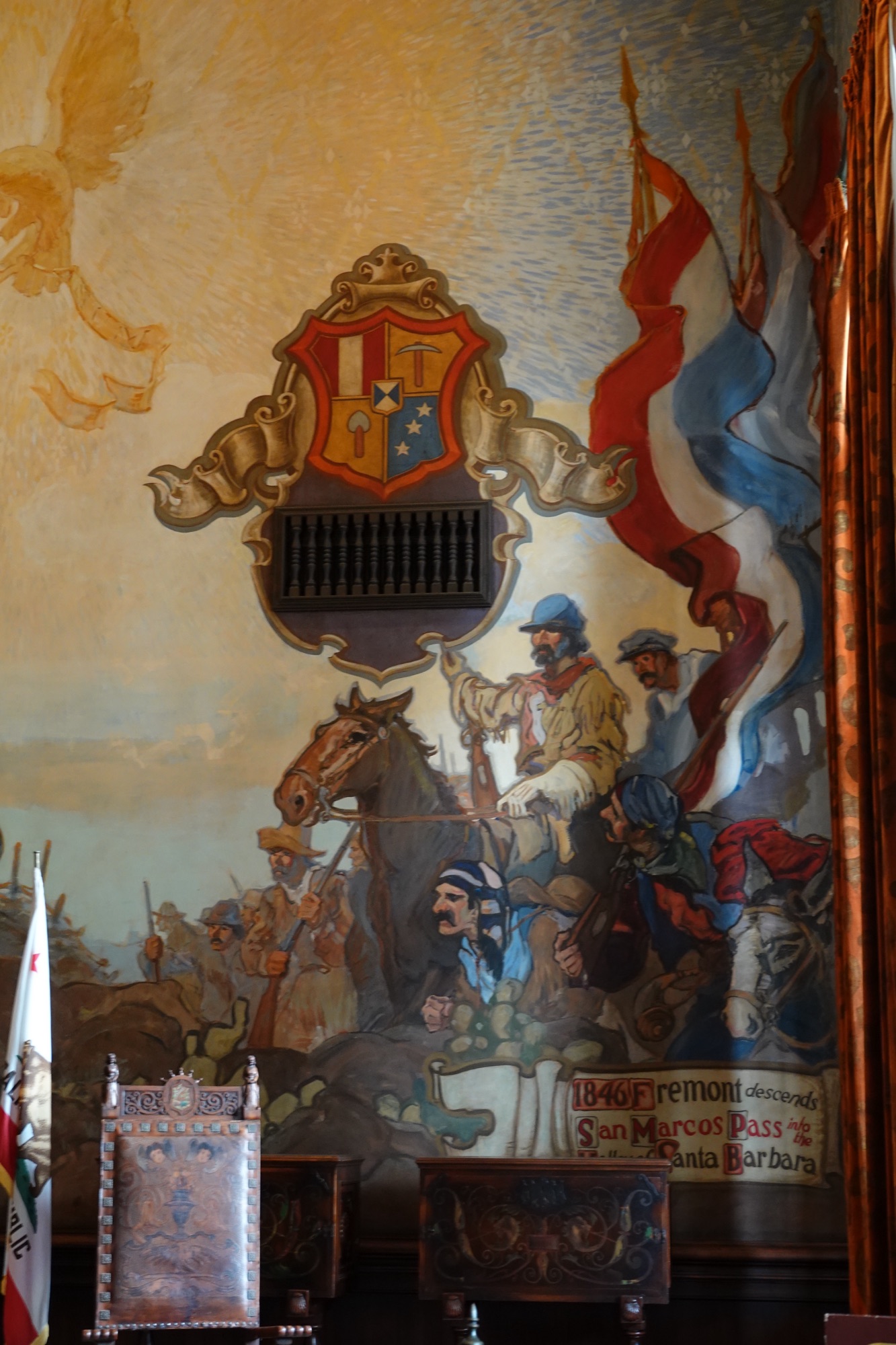
As he told us about what the murals were meant to depict, he described them as pretty much Hollywood fantasy. He asked us to look around and notice that in the origin mural the Chumash peoples look like Iroquois, and all the Spanish look like pirates. In a strange way, it makes sense since the muralist, Dan Sayre Groesbeck, was a famous designer of “visualization sketches” in the pre-cinematic era.
One of the fun things pointed out to us was that the Spanish ships supposedly at anchor all have their sails unfurled looking as if they are sailing away and abandoning the group planting the flag. That’s really just because a painting of a ship with sails furled is not as pretty.
On the wall showing 1786 and the mission being built, the man sitting on the rock has the face and figure of actor Douglas Fairbanks, and the priest and his helper pointing at the mission are Robin Hood and Friar Tuck. It’s really quite hilarious once you know the secrets in the mural.

Santa Barbara in 1849, at the time of the California gold rush, and into the 1850s was a place with cowboys and huge ranches, but most of the cowboys were Mexican. Suddenly an influx of almost 300,000 people, looking for gold, brought crime, gun battles, and rough justice with public hangings in the downtown. The courthouse building was a busy place.
The fourth mural wall highlights the biggest elements in Santa Barbara’s economy: minerals (like gold), stock (as in cattle), and agriculture, most especially wineries and more recently cannabis.

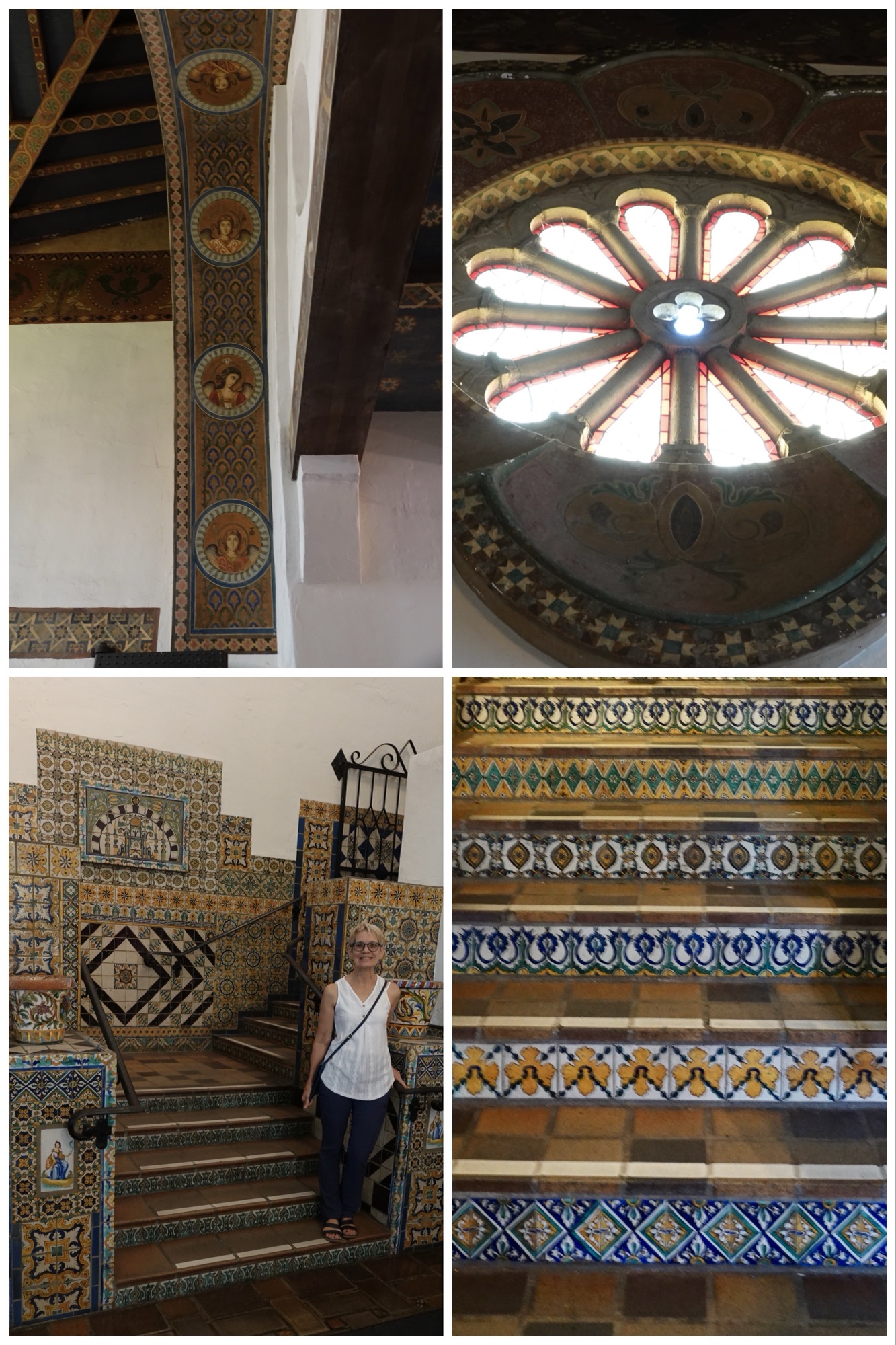
The interior of the courthouse is replete with gorgeous tile work.
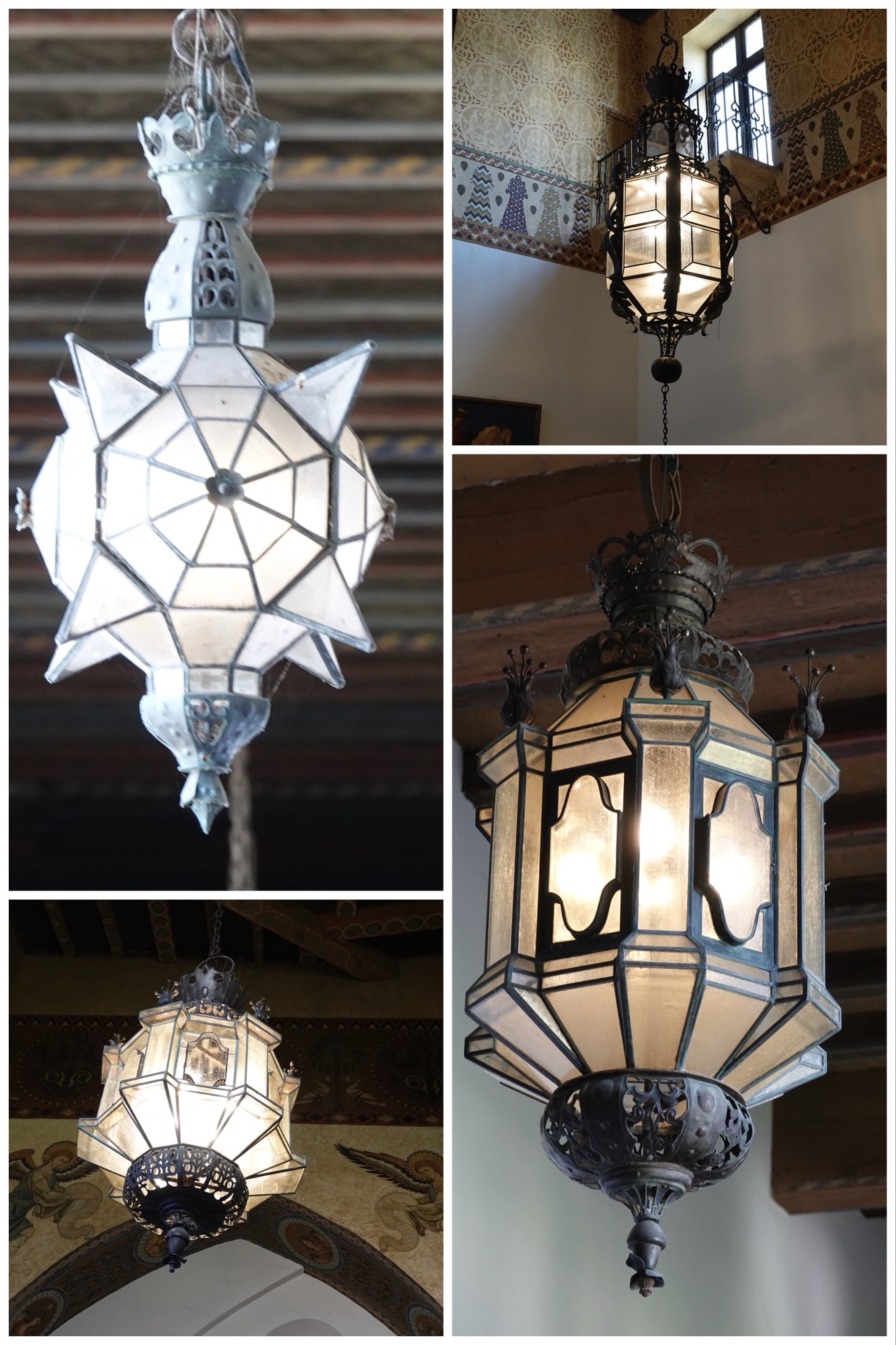
All the lanterns in the courthouse are replicas of lanterns from Spanish sailing ships.
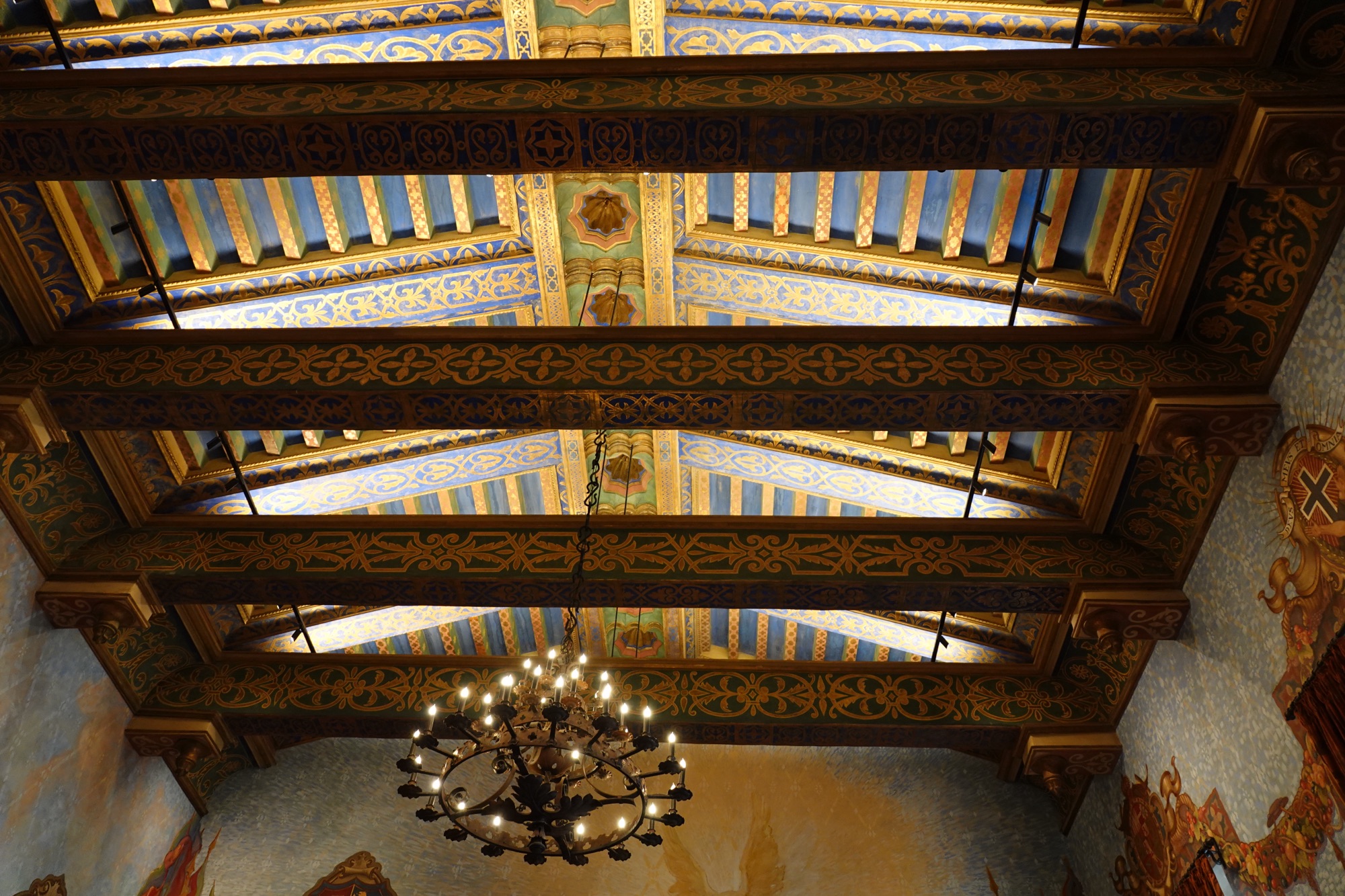
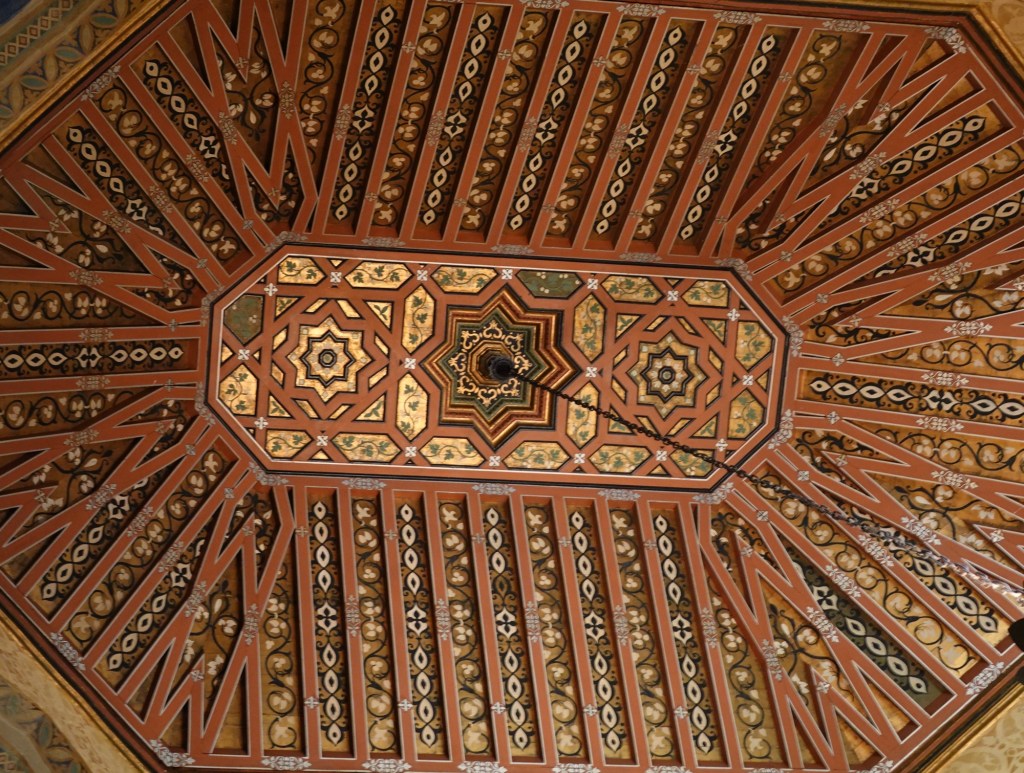
The ceiling above the main stairway is a replica of a 13th century Jewish synagogue ceiling. As is the case in Andalusia, Spain, where Islam, Christianity and Judaism all have a long history, this courthouse also has representations of all three religions.
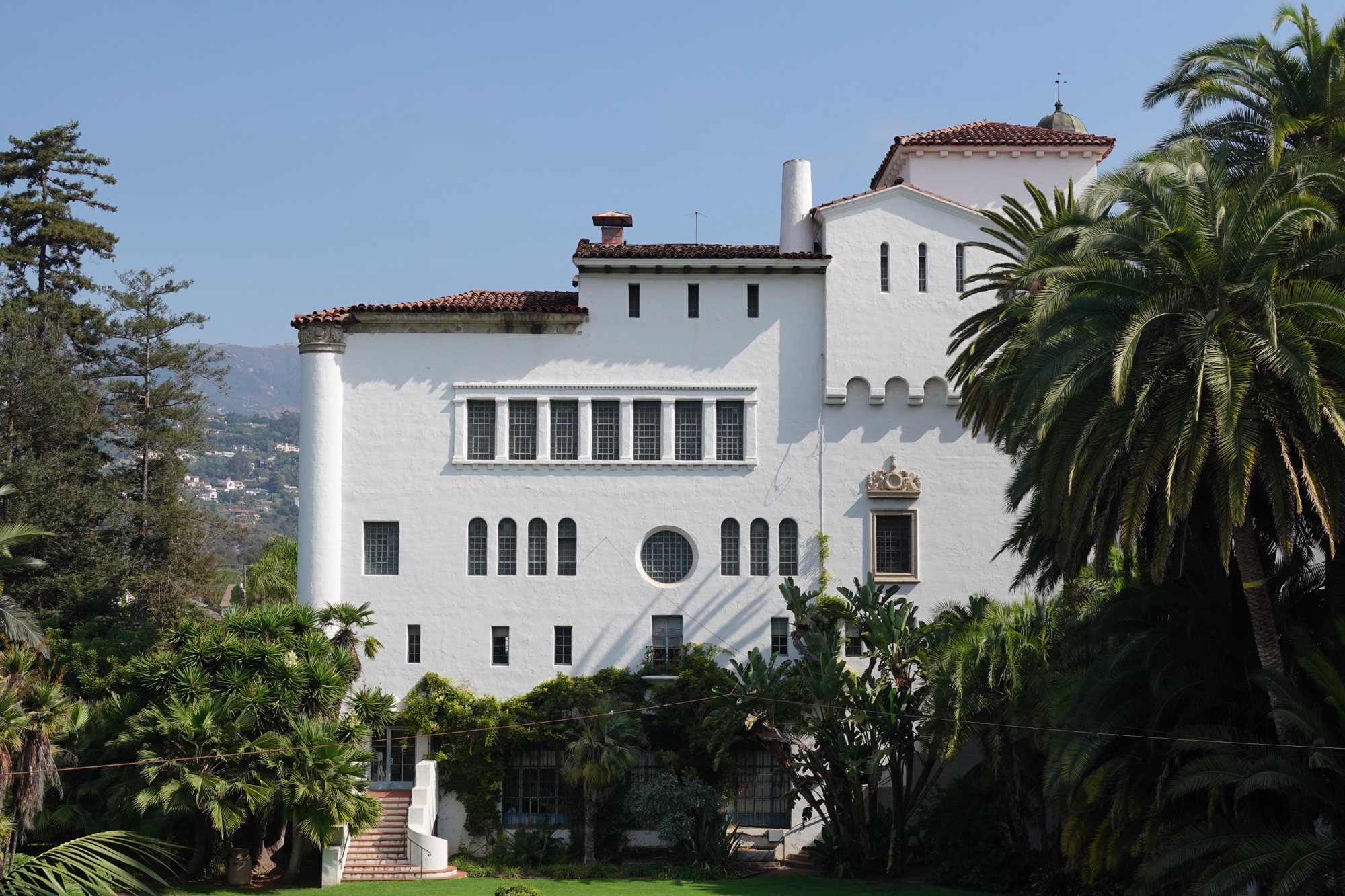
Across the beautiful courtyard is the jail, which is no longer used, but is a beautiful building externally. Again, it looks exactly like buildings in Andalusia with the Islamic style symmetrical windows, the white stucco exterior, and embellishment along the edge of the roof line.
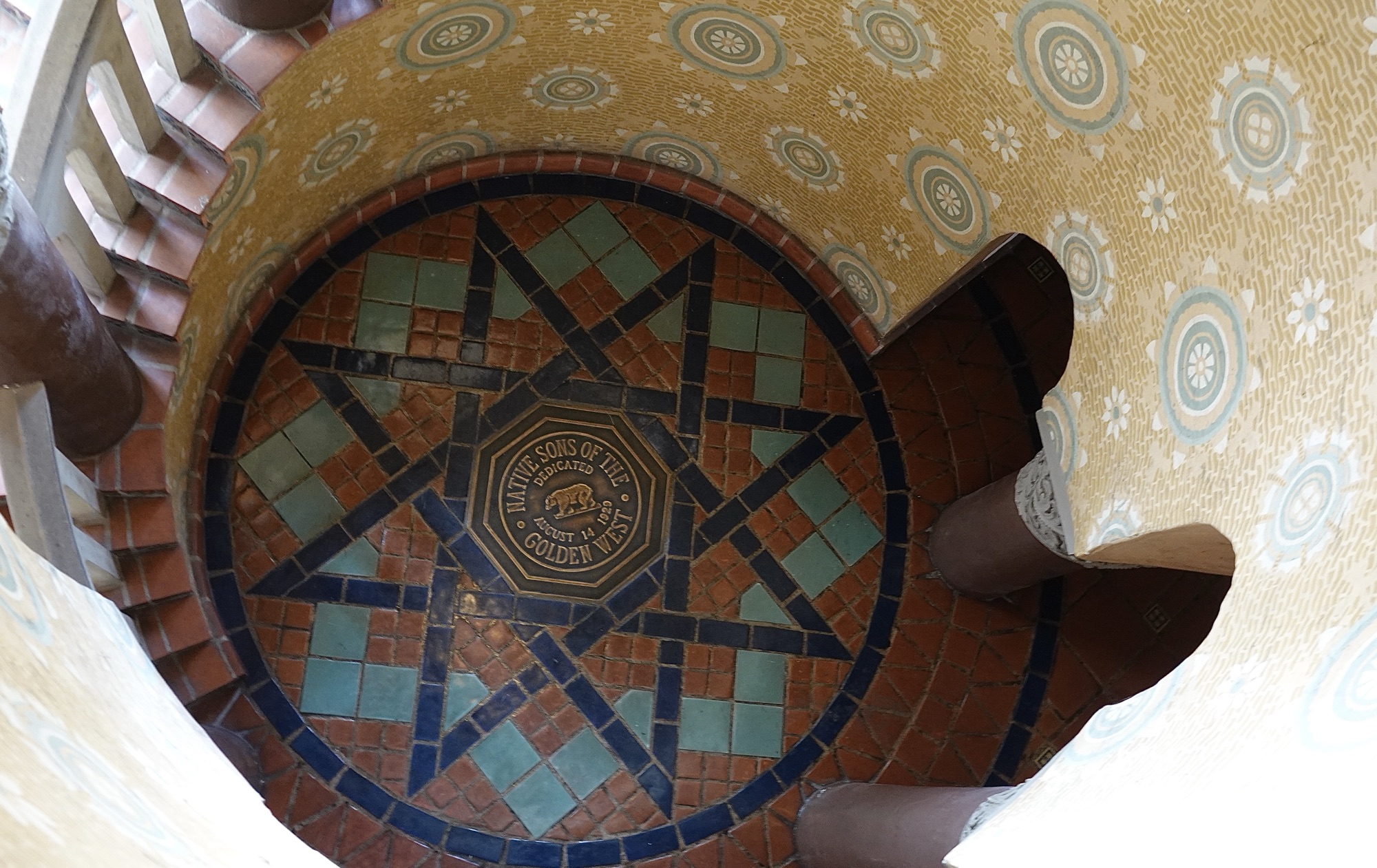
There’s a gorgeous mosaic tiled spiral staircase that leads to the castle keep. The only thing that is not typical is that the stairs themselves are evenly spaced. In an actual castle, they would all be different heights because the keep is for defence and defenders would know the pattern of the stairs, but attackers would not. Looking down the spiral, we could see the tiled floor design dedicated to the Native Sons of the Golden West.
The large murals along the hallways, depicting the history of Santa Barbara, combined with the Spanish revival architecture, reminded me of the Yucatan State Palace in Merida Mexico (Episode 388). The Santa Barbara County Courthouse is, however, much larger.

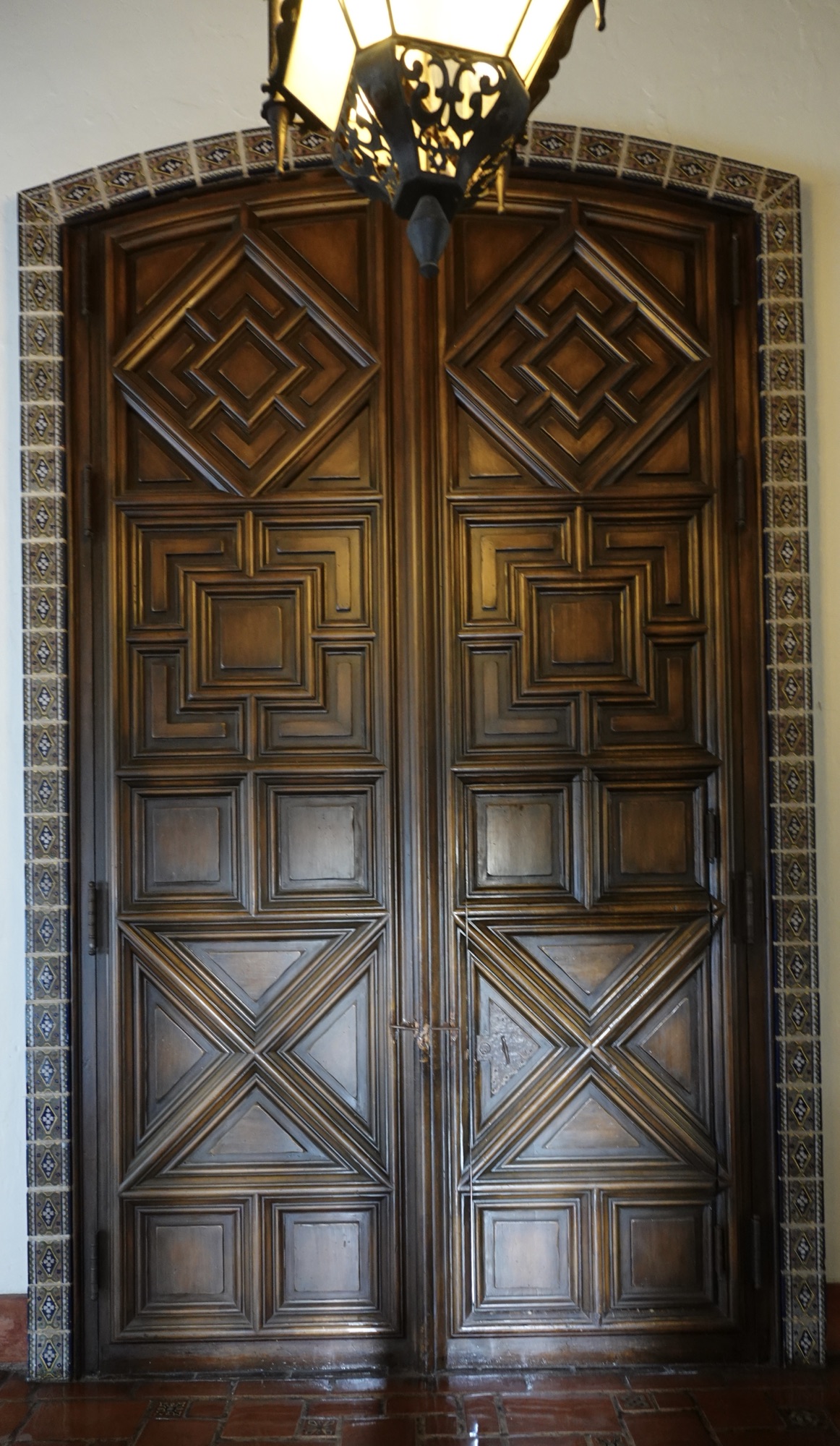
The castle also features a great door, large enough to bring riders through on horseback, with an inset smaller door called a wicket for every day use.In the Santa Barbara courthouse the great door is on the second floor, so it’s obviously just decorative since horses don’t fly.
We had a moment to go into the McMahon Law Library with its beautiful entrance and gorgeous carved bookshelves. The ceiling in the library is not Spanish revival style, but English, since the courthouse used the English system of law. Many of the books here luckily survived the earthquake.

There is a monument in the courthouse hallway to the Grand Master of the California Masons which is interesting for the date on it; it uses the Masonic calendar, which believes that the earth was created in the equivalent of 4001 BC, so the 5872 date translates to CE1871.

We had the opportunity to walk into the courtyard gardens, a popular spot for weddings, and around a bit of the building’s exterior before being left to our own devices.

There are 45 different species of palm trees in Santa Barbara, each one having a dedicated corner park. The two giant sequoias that used to be in the courthouse courtyard died only a couple of years ago.
Queen Elizabeth visited this courthouse and stood on the stairs in this very garden in which we stood. The queen was presented with two gifts: a plaque with 25 California animals on it, and a second plaque with 25 native plants depicted.
The walls of the sunken garden (below) are actually the stones from the original stone jailhouse that was destroyed during the earthquake prior to construction of the current courthouse.

On the courthouse turret is a soldier laughing at us, probably thinking that it’s impossible to breach the castle walls.
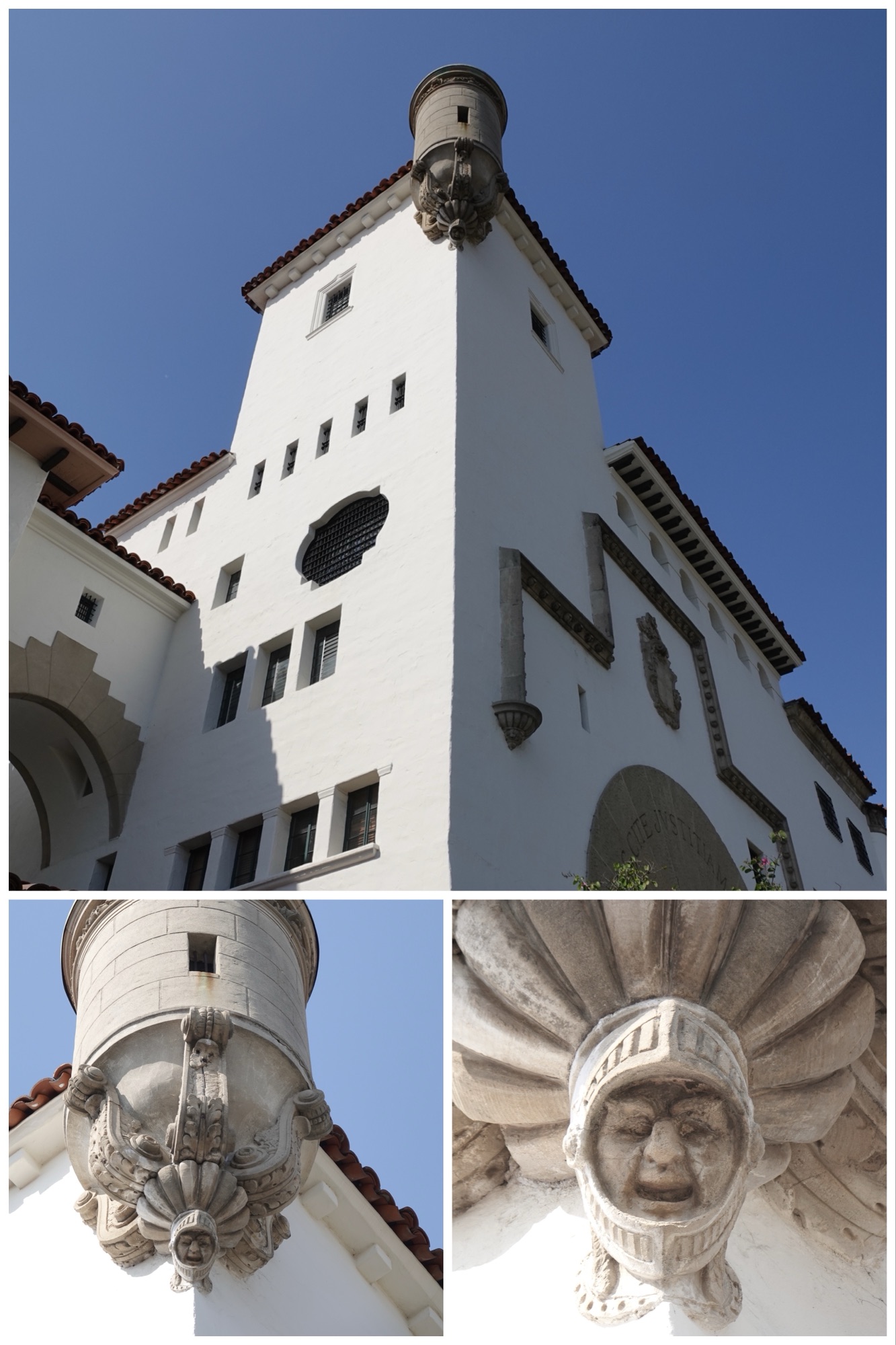
The fountain at the courthouse entrance is called “the spirit of the ocean”, but it is not the original since the limestone had become too weathered. Almost three quarters of a million dollars was spent constructing an exact replica.

After the tour we re-entered the courthouse, going through a second full security screening, in order to climb up the interior staircases and reach the clockworks just as the clock struck noon! The Santa Barbara clock tower is one of nearly 3000 prominent American buildings that feature a Seth Thomas clock.

We continued to climb to the top of the courthouse tower for a panoramic view of Santa Barbara, as well as a glimpse of our ship looking a bit like a pirate vessel lurking in the mist.
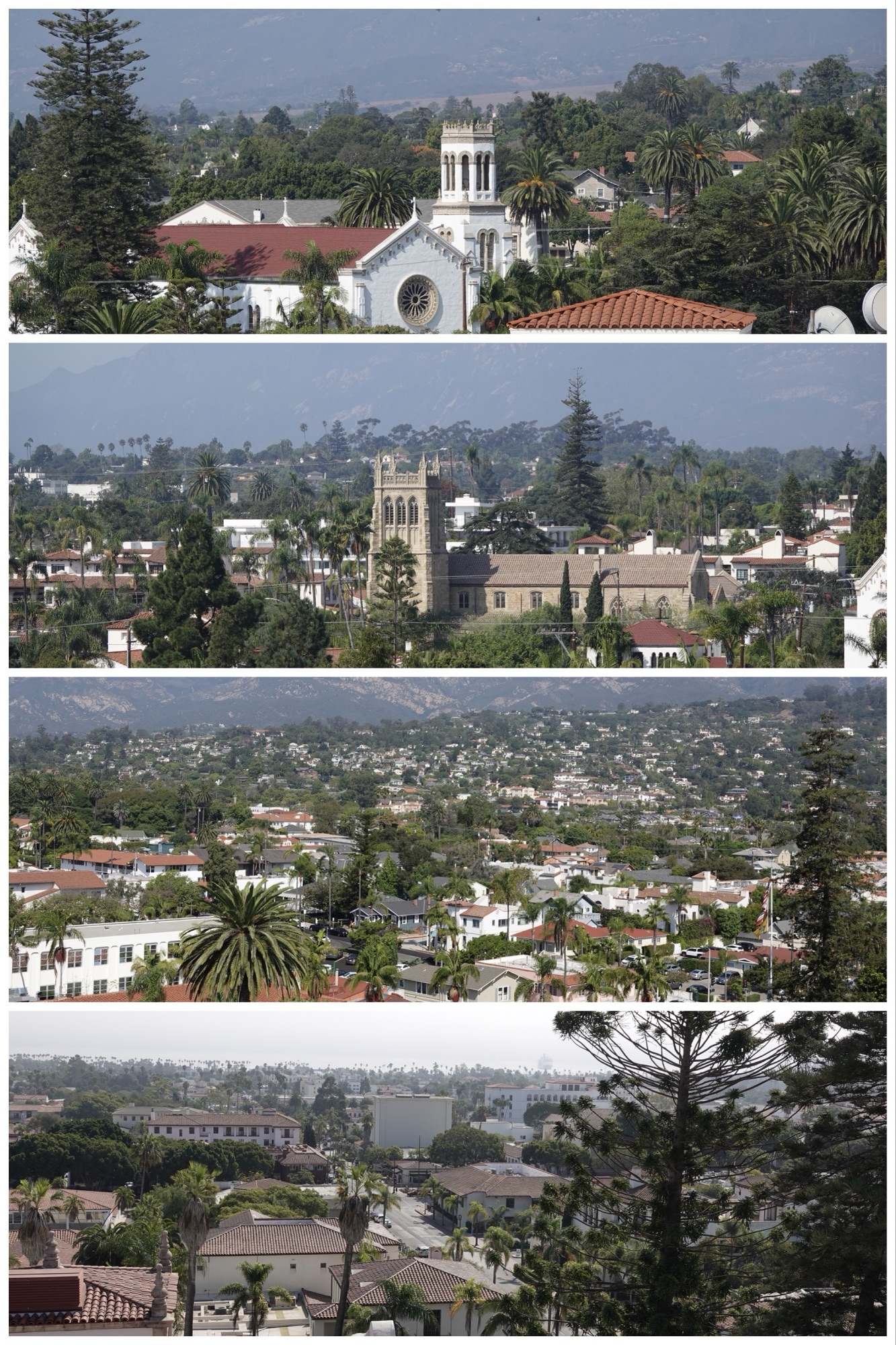

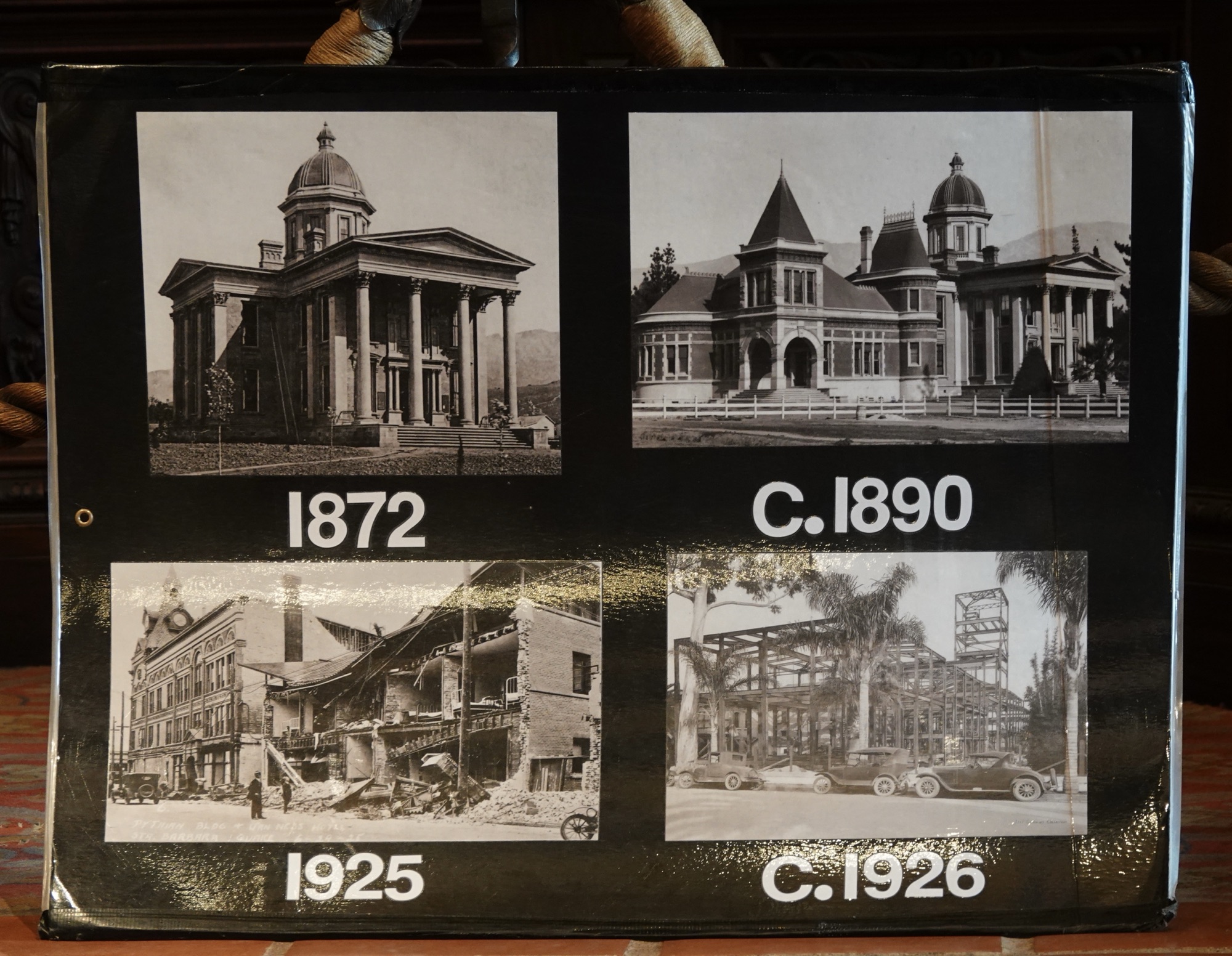
Since 1925’s earthquake, all construction in Santa Barbara’s downtown must conform to the Spanish revival style. The choice of this very Mexican looking construction from the early 20th century is thanks to the cross-cultural influence of the building of the Panama Canal. The Spanish colonial revival style is is also what gives the gorgeous look to the buildings in San Diego’s Balboa Park (Episode 483 – Balboa Park)
Since over 600 buildings were completely destroyed by the June 1925 earthquake; everything that replaced those buildings conforms to this style. The old town area with its pedestrian streets lined with trees, shops, and restaurants, is particularly picturesque.

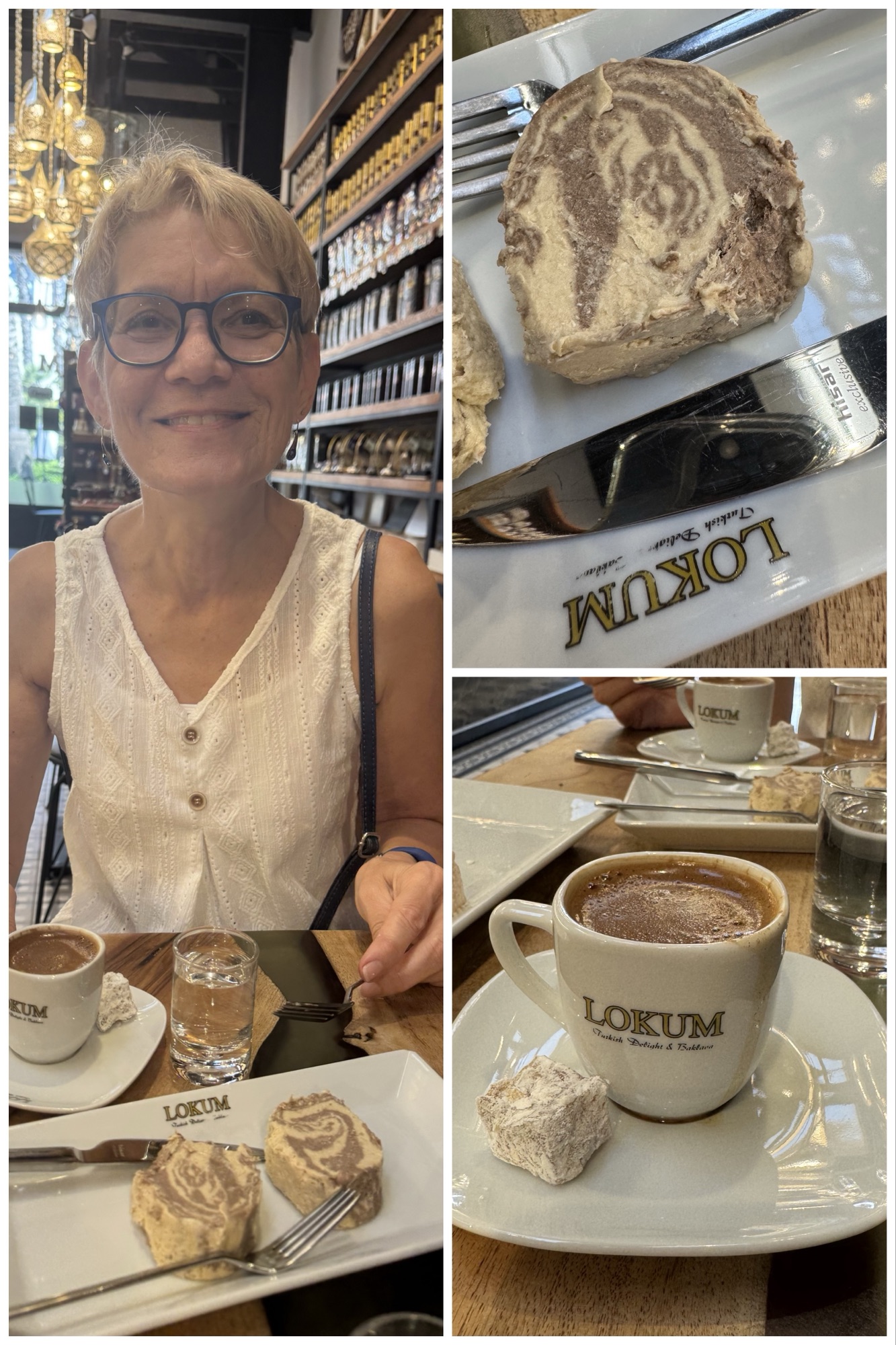
After leaving the courthouse and all that Andalusian, southern Spanish flavour, we stopped for a quick rest and a bite to eat at Lokum Turkish Café, drinking thick Turkish coffee and eating rosewater,lemon, honey and pistachio Turkish delight and marbled chocolate halva. Halva was a special treat throughout my childhood, so it always makes me smile.

En route back to the ship we made a very brief stop at the Old Spanish Days carriage museum. It’s a small free museum, but on this Wednesday there was no one in sight, not even a docent. We did a very quick walk-through while Ted got a couple of pictures of fancy saddles, carriages, and western wear, and then return to the ship.

The set up of the museum, with its recreation of a western town, reminded me of the dude ranch where we stayed in Tombstone Arizona in 2020 (Episode 55)

The entire experience made for a lovely day on shore, with the added benefits of sunshine and 27°C/80° F weather and 10,000 steps accomplished!
As we sat in the Crows Nest, me blogging and Ted reading the news, several pods of dolphins gave us a send-off from Santa Barbara, swimming alongside the ship. About an hour out, several whales spouted not far off our port side. I thought they were orcas, which have come as south as San Diego this year, but a fellow passenger was convinced they were much larger humpbacks. Either way… very neat to see.
As usual, we headed for the main dining room for dinner. It’s not that we don’t like the food in the buffet, but eating in the dining room forces us to “pace” our meal, and the open shared seating gives us a chance to meet other passengers with whom we might otherwise never interact.
We had another fun table, with folks from Washington state, San Diego, Langley BC, and New Westminster. As always, we got more travel inspiration – and hopefully gave some in return.

Hyperion Knight played piano in the main theatre again tonight. What I’ve enjoyed most about his performances is the way he explains the musical themes, but tonight what I REALLY enjoyed was his Rachmaninoff Piano Concert # 2.
Tomorrow we’re in beautiful San Diego.
 Rose and Ted’s Excellent Adventure