When we’re not actively travelling, and I have nothing new to blog about, I read voraciously.
It’s not a retirement hobby. It’s been my go-to amusement since I was about 10 years old in grade 5 reading A Tree Grows In Brooklyn, 12 and devouring To Kill A Mockingbird and Mark Twain’s classics, 13 and fascinated by Tolkein’s ring trilogy, 14 and exposed to the wonders of Thomas Costain and Irving Stone in our high school library, while in English classes it was Shakespeare that I preferred over Canadiana. After meeting Ted, I was pulled into science fiction: Isaac Asimov, Ray Bradbury, Philip K Dick, and Robert Heinlein. It’s almost sad to say that I read much less weighty or prescient tomes now.
Nonetheless, I do still read … a lot! I read 21 books in May and June: 19 that I thoroughly enjoyed, and 2 that I read just because I felt that I should (the Wilkie Collins duo). All were fiction; just two based loosely on historical events. That’s unusual for me in the past couple of years, when I’ve been somewhat obsessed with fiction-enhanced biographies and novels set in the two World Wars.
So, here we go. The late spring’s 21, in the order that I read them (Libby saves the thumbnails in the reverse order of their sign-out date, not necessarily in the order in which I read them)

1 Hang the Moon, by Jeannette Walls (author of the terrific The Glass Castle) is set in prohibition-era Virginia and creates a very realistic aristocracy of rum-runners, the “king” of whose daughter wants to inherit a crown normally reserved only for male heirs.
2 The Postscript Murders, by Elly Griffiths is the second in her mystery series featuring Detective Sergeant Harbinder Kaur. While not nearly as good as her Ruth Galloway series (one of my top 5 mystery series ever!), it’s still really good, and Griffiths certainly knows how to create relatable realistic female characters.
3 The Measure, by Nikki Erlick is a fascinating novel based on the premise that on one day everyone in the world simultaneously receives a box in which the exact date of their death is contained. What people do with those boxes (to open or not to open?), and what governments do when they can access those dates, is fascinating and a little scary.
4,5 The Moonstone, and The Woman in White, both by British Author Wilkie Collins, written in the 1860s. I chose these specifically because they’d been referenced in another mystery book I was reading. Collins is credited as being the originator of the detective/police procedural novel and the “sensation” genre in which the reader is drawn into solving the mystery. Both books were interesting, although the Victorian-era prose at times was tough slogging. I’m not sorry I persevered though!
6 The Personal Librarian, by Marie Benedict and Victoria Christopher Murray is the story of JP Morgan’s personal librarian, Belle da Costa Greene, the Black American woman who was for ed to pass as white in order to leave the lasting legacy that became the JP Morgan Library. It was a truly wonderful read that brought history to life, as all of Marie Benedict’s historical fiction does.
7 The House of Eve, by Sadeqa Johnson was a truly heartbreaking read (spoiler alert: happy ending). Earlier this year I read Looking for Jane, by Heather Marshall, set in Toronto during the years just prior to abortion being legalized in Canada. The House of Eve is set in Philadelphia and Washington DC in the 1950’s and follows the story of 2 young black women with difficult decisions to make.
8 Sheltering Rain, by Jojo Moyes is a wonderfully realistic story about 3 generations of Irish women coming to terms with their relationship. Why is it, in books as in real life, that it’s so much easier to talk to one’s grandmother than one’s mother?
9 I loved Sheltering Rain so much that I had to find out if Jojo Moyes could live up to her writing in anotherbook. Someone Else’s Shoes is the story of two women connected by a mix-up involving their shoes. It is very funny, but also really insightful. It left me thinking about women’s connection with their clothes, and how much the way we look affects the way we feel, the way we act, and the way others treat us.
10, 11 By Alexander McCall Smith (whose Mma Precious Ramotswe Ladies’ No. 1 Detective Agency books are so charming), the first 2 books in yet another new series featuring a hands-on matchmaking service called The Perfect Passion Company. Cook For Me, and A Labourer in the Vineyard of Love left me wanting more of the interesting characters and quirky situations. In an age of swiping left, the idea that two young people end up, through “fortunate” circumstance, running this agency is a delightful premise. Each match they make leaves the reader happier than when the story began. Just when I thought I might be tired of Smith – that he was becoming too formulaic – he has pulled me back in.
12 Inspired by those books, my next read was yet another McCall Smith, with a very different theme. The Private Life of Spies and the Exquisite Art of Getting Even is especially fun reading because each of the wryly funny short stories is based on an actual news story from the heyday of the war and cold war eras.
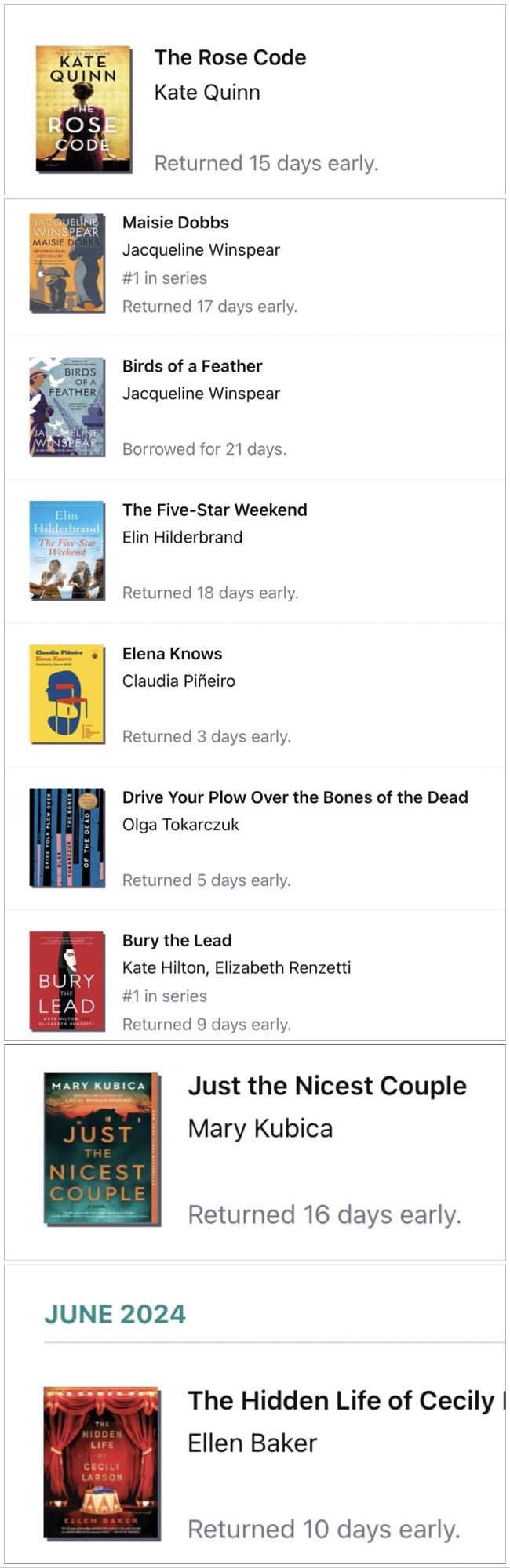
13 The Rose Code, by Kate Quinn, is a tale of 3 women working at Bletchley Park where the Enigma codes were broken in WWII. There’s a wonderful sub-plot involving one of them and Prince Philip and the period before 1947’s royal wedding. A suspenseful story pf love, patriotism, and government secrets.
14 Bury the Lead, by Kate Hilton, is a “cozy mystery” involving a theatre company in a Canadian resort town that could easily be Niagara-on-the-Lake or Drayton. It’s full pf quirky characters and plot twists and is a really fun read.
15 I was intrigued by the title of Drive Your Plow Over the Bones of the Dead, by Olga Tokarczuk. The author is a Polish winner of the Nobel Prize in Literature, so she means business. The story, translated from the original Polish, may or may not be a murder mystery, or a psychological thriller. It centres around characters in a bleak Polish village not far from the (presumed idyllic) Czech border. The main character, a fiercely independent “woman of a certain age” was just odd enough to keep me turning pages despite the somewhat depressing overall tone of the book. If you love the cynical mood of dark Scandinavian mysteries, this novel will appeal to you.
16 Elena Knows, by Argentinian author Claudia Piñiero, was another booked translated into English, this time from its original Spanish. After a young woman is found dead in a church, an apparent suicide, her mother is the only one not convinced. In the search for answers, lots is revealed about the fraught nature of mother-daughter relationships and the expectations that society puts on us.

17 The Five-Star Weekend, by Elin Hildebrand, isn’t the kind of book I usually read, being a bit like the book version of a rom-com/sisterhood movie, but I actually loved it. Theresa five women who come together to rekindle (or forge) friendships are all interestingly portrayed, and the plot twist is well done.
18, 19 Maisie Dobbs, and Birds of a Feather, by Jacqueline Winspear are the first 2 instalments in my latest mystery/detective series. In this case, the protagonist is a young woman who graduates from housemaid to WWI field nurse to private investigator, mentored by an aristocratic Lady and her detective friend. I love the period setting, and watching the character grow. Unfortunately, my local library os missing books 3 & 4, so when I return to this series in July ai’ll be jumping right into Book 5, An Incomplete Revenge.
20 Just the Nicest Couple, by Marylou Kubica, is a thriller with lots of twists. I found myself suspecting just about everyone once it became clear the main suspect wasn’t as guilty as she seemed – at least, not of murder.
21 The Hidden Life of Cecile Larson, by Ellen Baker was surprising and quite wonderful – maybe my favourite book out of this entire list. In a world where we’re all blithely sending our DNA off to find out about our ancestry, this novel is especially relevant. What happens to the identity we’ve worked so hard to create for ourselves when “science” suddenly throws a spanner into the works?
That’s it for May and June. In July, we’re back to travelling, so it’ll be a slow reading month, but I have a bunch queued up and ready to go!
 Rose and Ted’s Excellent Adventure
I’ve fallen way behind in reading your blog, and just now catching up. I’m adding a couple of these to my reading list. I also read The Rose Code in July and enjoyed it, too. I love Marie Benedict’s books, but haven’t read The Personal Librarian yet.
P.S. we enjoyed our visit to Collingwood, but my blog updates for that trip have been delayed by hurricane recovery and other priorities. I hope to get it done this weekend before we leave on our next trip! LOL.
-Nancy
LikeLiked by 1 person
Hurricane recovery?!?! Hope everything is okay, and will look forward to your impressions of butter tarts!
LikeLike